Author: Dave

I've always been curious about the world beyond my own backyard. While many people spend their entire lives close to where they were born, I've been fortunate enough to travel across the United States and around the world. Every place I've visited has challenged my assumptions in one way or another and reminded me that, despite our differences, people often have far more in common than they realize. I don't write to tell personal stories for the sake of telling them, and I don't believe every article needs to revolve around me. Instead, I enjoy using my experiences as a starting point for exploring larger ideas. Whether it's something I noticed while walking through a market overseas, a conversation with someone from another culture, or simply observing how different communities solve similar problems, I'm interested in the lessons those moments can teach all of us. Travel has given me perspective, but it has also taught me humility. The more places I visit, the more I realize there is still to learn. Every culture has something worth appreciating, and every journey has a way of expanding how we see the world and our place within it. When I write, my goal is simple: to share thoughtful observations, compare perspectives, and encourage curiosity. I hope readers come away having learned something new—not just about another place, but about the world we all share. If one of my articles inspires someone to look at a familiar idea differently, ask a new question, or venture a little farther than they otherwise might have, then I've accomplished exactly what I set out to do.
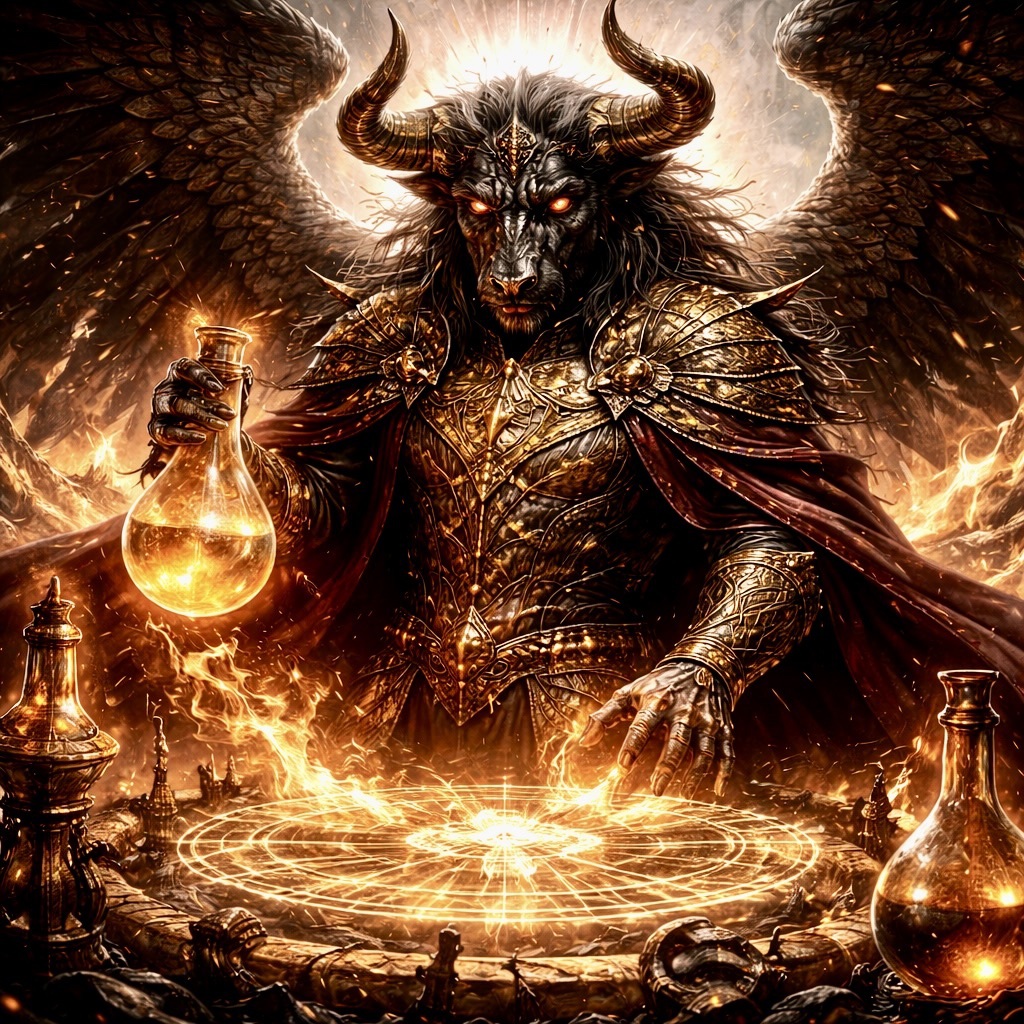
Zagan: The Alchemist King Who Turns Lies Into Truth and Chaos Into Command

Dave

Zagan is not a demon of subtlety, and he is not a demon of comfort. Among the spirits of the Ars Goetia, he occupies a singular position as a King and President of Hell, a title that immediately suggests authority layered upon authority. Zagan does not operate from the margins. He rules from the center of transformation itself, where things cease to be what they were and become something else entirely. His power is not rooted in destruction for its own sake, but in transmutation—the ruthless reshaping of reality until it conforms to his will.

In the grimoires, Zagan is described as appearing first in the form of a bull with the wings of a griffin. This image is not accidental, nor is it merely monstrous decoration. The bull represents raw strength, stubborn force, and earthly power. The griffin, a hybrid of lion and eagle, represents dominion over both land and sky, strength fused with vigilance. Zagan’s form is a declaration: power alone is not enough. Power must be able to change shape, adapt, and dominate across domains.

Only after being compelled does Zagan take on a human form, and even then, the sense of controlled volatility never leaves him. He is a demon of contradiction made functional. He makes the foolish wise, turns wine into water and water into wine, and transforms metals and substances from one state to another. These are not parlor tricks. They are symbolic assertions that nothing is fixed, nothing is sacred, and nothing is immune to redefinition.

Zagan’s association with alchemy is central to his identity. Alchemy was never merely about turning lead into gold. It was about understanding the hidden processes that govern change: decay, refinement, dissolution, and rebirth. Zagan embodies the darker side of that tradition. He does not seek enlightenment. He seeks control over transformation itself. Under Zagan, change is not organic. It is enforced.

One of Zagan’s most unsettling attributes is his ability to make lies become truth and truth become lies. This does not mean simple deception. It means alteration of consensus. Zagan reshapes reality by reshaping what is accepted as real. In this way, he is far more dangerous than demons who merely deceive individuals. Zagan corrupts systems of meaning.

As a King, Zagan commands legions not through fear alone, but through results. He is said to be capable of making those who are foolish become wise, though this “wisdom” is often stripped of innocence or moral grounding. Zagan’s wisdom is pragmatic, sharp-edged, and unsentimental. He teaches how to survive transformation, not how to prevent it.

The bull-griffin form also reflects Zagan’s dual mastery of brute force and elevated command. He is equally capable of overwhelming resistance and outmaneuvering it. This combination places him among the most politically resonant demons in the Goetia. Zagan understands hierarchy, but he is not bound by it. He reshapes hierarchies when they no longer serve him.

Unlike demons who tempt through desire or fear, Zagan tempts through opportunity. He offers reinvention. To those dissatisfied with their position, their identity, or their limitations, Zagan whispers that nothing is permanent—not even truth. This is an intoxicating promise. It is also a deeply destabilizing one.

Zagan’s power over substances mirrors his power over people. Wine into water, water into wine—these reversals are about control over perception and value. What is considered precious can be made worthless. What is dismissed can be elevated. Zagan does not respect intrinsic value. He respects leverage.

In psychological terms, Zagan represents the part of the human psyche that adapts without remorse. The survival instinct that justifies change at any cost. The voice that says, “Become something else, or be destroyed.” Zagan does not ask whether the transformation is ethical. He asks whether it works.

This makes him deeply relevant in the modern world. Institutions, identities, and truths are constantly being redefined. Narratives shift. Values invert. What was once unthinkable becomes normalized. Zagan is the demon of that process when it is driven by power rather than necessity.

Zagan’s kingship is important here. He is not a chaotic force. He governs transformation. He decides which changes persist and which collapse. This makes him more dangerous than demons of pure destruction. Destruction leaves ruins. Zagan leaves functioning systems that no longer resemble what came before.

In occult tradition, Zagan is not recommended for those seeking stability or clarity. He is sought by those who want to overturn conditions entirely. To call Zagan is to accept that the outcome will not resemble the starting point. There is no restoration under Zagan, only replacement.

His ability to make people witty and sharp also carries a cost. Wit under Zagan is not joy or humor. It is weaponized intelligence. Insight sharpened into a blade. Those transformed by Zagan often lose patience for weakness, nuance, or compassion. Efficiency replaces empathy.

Zagan’s association with alchemical change also ties him to time. Alchemy is slow, deliberate, and irreversible. Once a substance has been transformed, it cannot simply be turned back without consequence. Zagan enforces this rule. His changes are not temporary illusions. They persist.

In mythology, kings are often symbols of order. Zagan subverts this by ruling over instability itself. His kingdom is one where permanence is the illusion. Only power endures, and power belongs to those who can adapt faster than everyone else.

What makes Zagan especially unsettling is that he does not appear malicious by nature. He appears practical. He does not destroy out of hatred. He transforms out of efficiency. This makes him feel less like a demon and more like a force embedded in reality itself.

Zagan endures in demonology because transformation is unavoidable. Civilizations rise and fall. Truths are revised. Values are overturned. Someone always benefits from these shifts. Zagan gives that beneficiary a name.

To engage with Zagan, even symbolically, is to abandon the comfort of fixed meaning. He does not care what you were. He cares what you can become—and whether that form is useful.

Zagan is the demon of irreversible change, of power that rewrites the rules instead of breaking them. He does not knock down the structure. He remodels it while people are still inside.

And once the transformation is complete, there is no appeal. There is only adaptation, or extinction.

Related Posts

Valac: The Childlike Demon Who Commands Serpents and Uncovers What Is Hidden

Dave

Valac is one of the most unsettling figures in the Ars Goetia precisely because he does not look like what people expect a demon to be. He does not arrive crowned in fire or armored in menace. Instead, he appears as a small child with angelic wings, riding or accompanied by serpents. This contrast is not decorative or ironic. It is the essence of Valac’s power. He governs hidden things, buried truths, and secret movements beneath the surface of the world, and he does so by exploiting expectation itself. Valac teaches that what appears harmless, innocent, or insignificant is often where danger, knowledge, and power actually reside.

In demonological texts, Valac is described as a President of Hell who commands legions and possesses knowledge of hidden treasures, concealed serpents, and secret places. He can reveal where things are buried and expose what moves unseen beneath the earth. This association with serpents is ancient and layered. Serpents have always symbolized hidden knowledge, danger concealed in silence, and wisdom that exists outside moral categories. Valac does not control serpents as weapons alone. He understands them as symbols of what people fear but refuse to look at directly.

The childlike form Valac takes is deeply disturbing once understood. Children represent vulnerability, trust, and perceived innocence. By appearing this way, Valac disarms suspicion. He bypasses defenses. His presence asks a dangerous question: what if the most destructive truths arrive gently, without threat or warning? Valac is not loud. He is not aggressive. He reveals by letting curiosity do the work.

Valac’s wings reinforce this contradiction. Wings are traditionally symbols of divinity, guidance, and transcendence. In Valac, they become a mask of legitimacy. He does not challenge belief systems openly. He slips through them. His revelations feel discovered rather than imposed. This makes him far more dangerous than demons who force their influence openly.

In occult lore, Valac is invoked for knowledge of hidden things: treasures buried underground, secrets concealed by others, and dangers that move quietly toward the surface. But this knowledge is never neutral. To reveal what is hidden is to destabilize whatever depended on concealment. Valac does not create conflict, but he exposes the conditions that make conflict inevitable.

What separates Valac from demons associated with deception is that he does not lie. He reveals. But revelation itself can be destructive. Many systems survive only because certain truths remain buried. Valac does not judge whether something should remain hidden. He simply shows where it is.

The serpents under Valac’s command are not chaotic. They are controlled, precise, and patient. This reflects Valac’s approach to power. He does not rush. He waits beneath the surface. His influence accumulates quietly until it reaches a breaking point. When something emerges under Valac’s guidance, it feels sudden, but it has been moving all along.

Psychologically, Valac represents the fear of what has been ignored for too long. Secrets, suppressed memories, unresolved truths—these things do not disappear. They coil beneath awareness, waiting. Valac is the force that lifts the stone and shows what was always there.

In modern culture, Valac has been distorted into a figure of pure horror, often stripped of his symbolic complexity. But the original demon is far more unsettling than a jump scare. He embodies the idea that knowledge does not need to be violent to be dangerous. Sometimes it only needs to be seen.

Valac’s rank as a President suggests authority over systems rather than individuals. He governs processes of revelation. He does not care who benefits or suffers. His concern is exposure. Once something is revealed, consequences unfold on their own.

The angelic child imagery also raises an uncomfortable truth about trust. Humans are wired to lower their guard around perceived innocence. Valac exploits this instinct perfectly. He reminds us that appearances are strategies, not guarantees.

Valac is not cruel. He is indifferent. He does not punish. He uncovers. This indifference makes him a powerful mirror for human behavior. People often justify harm by claiming they were “just telling the truth.” Valac embodies that logic taken to its extreme.

To encounter Valac symbolically is to confront the cost of knowing. Once something hidden is revealed, it cannot be unseen. Relationships change. Beliefs fracture. Stability dissolves. Valac does not apologize for this. He does not explain himself. He reveals and moves on.

Ultimately, Valac represents the quiet terror of clarity. Not the clarity that liberates, but the clarity that destabilizes. He is the demon of what crawls beneath certainty, waiting for the moment it is exposed.

Valac endures in demonology because secrets endure. As long as humans bury truths, there will be forces that uncover them. Valac is not the origin of that impulse. He is its personification.

Related Posts

Andras: The Demon of Discord Who Thrives on Betrayal, Bloodshed, and Broken Trust

Dave

Andras is not subtle, and he is not patient. Among the spirits of the Ars Goetia, he stands out as one of the most openly hostile, volatile, and dangerous figures ever committed to parchment. Where many demons manipulate quietly, negotiate cleverly, or seduce with promises, Andras operates with a blunt and terrifying clarity of purpose. He exists to create conflict, to fracture alliances, and to turn trust into a weapon. His presence does not linger gently. It explodes, and when it does, something vital is usually destroyed.

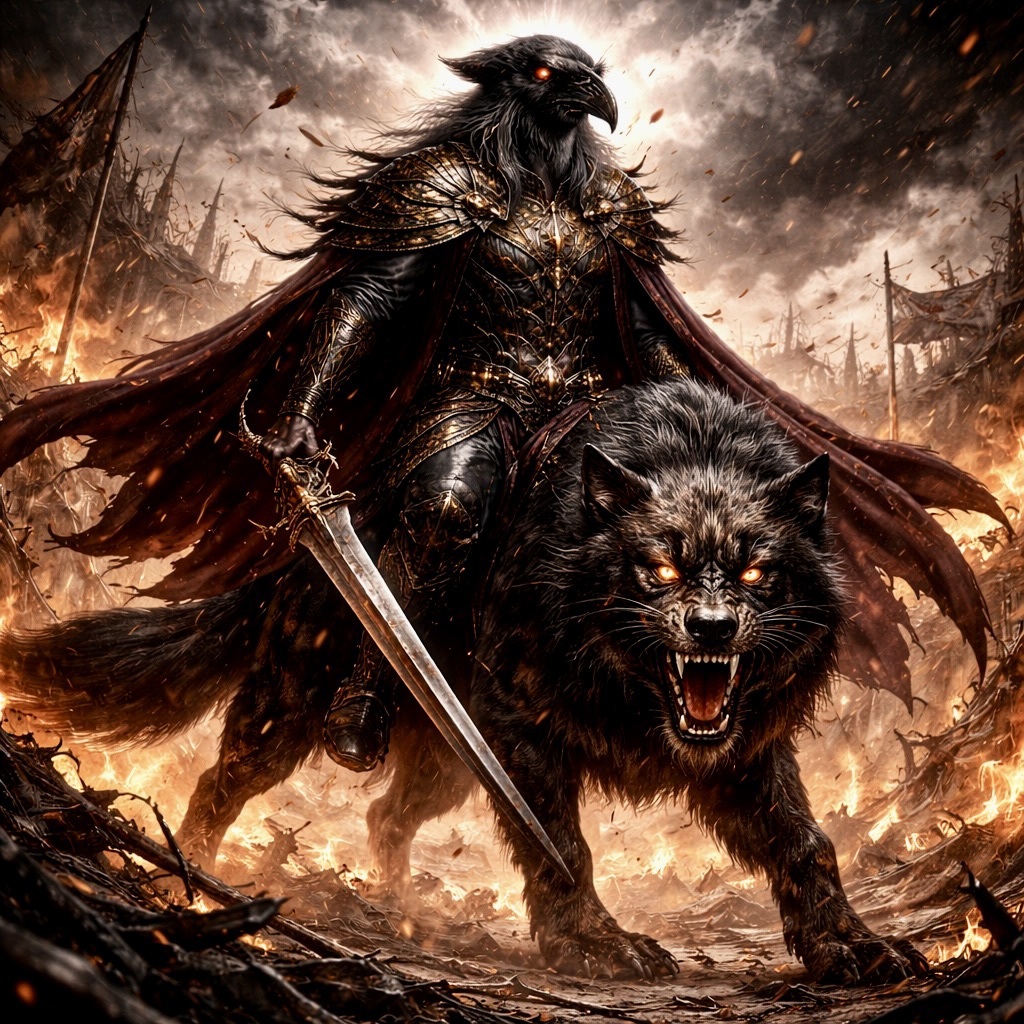
In demonological texts, Andras is described as a Great Marquis of Hell who appears as an angel with the head of a raven, riding a powerful black wolf and carrying a bright, razor-sharp sword. Every element of this imagery is intentional. The raven is a symbol of death, prophecy, and ill omen. The wolf represents predation, pack hierarchy, and sudden violence. The sword is not ceremonial; it is functional. Andras does not threaten symbolically. He kills.

What makes Andras uniquely feared, even among demons, is that grimoires consistently warn practitioners never to summon him lightly. He is said to be treacherous even toward those who call upon him, and if disrespected or improperly constrained, he may kill the summoner outright. This warning is rare in occult texts, which often treat demons as dangerous but manageable. Andras is different. He is not interested in cooperation. He is interested in collapse.

The domain of Andras is discord. He delights in sowing conflict between individuals, families, allies, and nations. He does not need to invent grievances. He amplifies what already exists. A doubt becomes suspicion. A disagreement becomes hatred. A rivalry becomes bloodshed. Andras works by accelerating fracture until reconciliation is no longer possible.

Unlike demons who tempt with pleasure or power, Andras tempts with certainty. He offers clarity in conflict. He sharpens sides. He removes ambiguity. Once Andras’s influence takes hold, there is no middle ground left to stand on. You are friend or enemy, ally or traitor, target or executioner. This absolutism is part of his danger. Nuance cannot survive him.

The raven-headed form of Andras reinforces this role. Ravens are intelligent, observant, and associated with battlefields and corpses. They do not kill indiscriminately, but they are always present when killing occurs. Andras does not always strike the first blow. Often, he waits until violence is inevitable, then ensures it is decisive.

The wolf he rides is equally important. Wolves are creatures of hierarchy and loyalty, but they are also capable of turning on their own when dominance is challenged. Andras weaponizes this trait. He turns packs against themselves. He dissolves unity from the inside. Betrayal, under Andras, is not accidental. It is engineered.

Andras’s sword is the final symbol. It represents execution, not battle. Battles imply uncertainty. Execution implies outcome. When Andras draws his blade, something has already been decided. His violence is not chaotic. It is purposeful and final.

In occult lore, Andras is sometimes associated with murder, especially murder that arises from conflict rather than passion. He governs killings that result from betrayal, conspiracy, or ideological fracture. This makes him one of the darkest mirrors held up to human behavior. Most violence is not random. It is justified, rationalized, and planned. Andras embodies that process.

Psychologically, Andras represents the part of the human mind that seeks enemies in order to feel certain. When complexity becomes unbearable, Andras offers simplicity through division. He reduces the world into opposing camps and then dares them to destroy one another. This is why his influence is so corrosive. It feels clarifying even as it ruins everything it touches.

Historically, figures like Andras resonate during periods of civil unrest, religious schism, and ideological extremism. He thrives when societies fracture along lines of belief, identity, or power. He does not care which side wins. He cares that the conflict becomes irreversible.

Unlike demons who can be bargained with, Andras is described as contemptuous of weakness. He does not reward hesitation. He does not tolerate fear. Those who seek him often believe they are strong enough to command him, only to discover that strength without restraint is exactly what he preys upon.

There is also a profound warning embedded in Andras’s mythology. He does not create evil out of nothing. He exposes it. He brings to the surface what was already festering. In that sense, Andras is less a corrupter than a catalyst. He accelerates outcomes humans were already moving toward.

This makes him deeply uncomfortable as a symbol. It is easier to blame external forces for violence than to acknowledge the internal fractures that make violence possible. Andras removes that comfort. He shows how quickly principles turn into weapons and how easily loyalty turns into justification for cruelty.

Modern interpretations of Andras often cast him as the embodiment of radicalization, the unseen force that turns disagreement into dehumanization. He is present wherever language shifts from debate to destruction, from persuasion to eradication. He does not whisper lies. He shouts convictions.

Andras endures in demonology because conflict is eternal. As long as humans form groups, define identities, and draw lines between “us” and “them,” there will be something for Andras to exploit. He is not the origin of hatred. He is its acceleration.

To invoke Andras, even symbolically, is to accept that something will be broken beyond repair. He does not restore balance. He does not teach lessons. He ends things. Relationships. Alliances. Lives. His clarity comes at the cost of everything else.

Andras is feared not because he is chaotic, but because he is honest about violence. He strips away the illusion that conflict can always be controlled. He reminds us that once certain forces are unleashed, they no longer belong to those who summoned them.

In the end, Andras represents the moment when disagreement becomes war, when trust collapses into suspicion, and when certainty demands blood. He is not a demon of temptation, but of consequence. And once he is present, there is no turning back.

Related Posts

Haures (Flauros): The Infernal Duke of Fire Who Burns Lies Down to the Bone

Dave

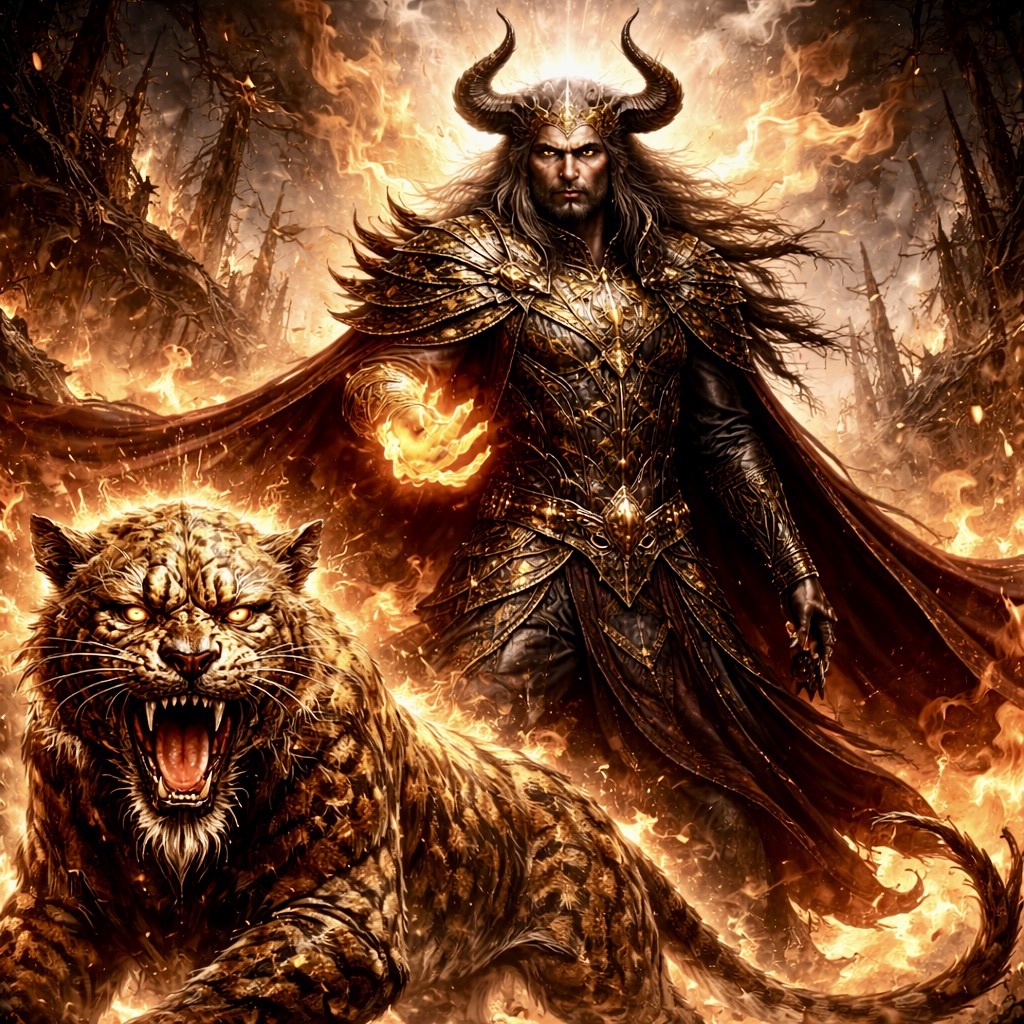
Haures, also known as Flauros, is not a demon who works in shadows. He is fire made articulate, destruction with a voice, revelation delivered through heat so intense it leaves nothing hidden behind. In the Ars Goetia, Haures is described as a Great Duke of Hell, commanding legions and appearing first as a terrifying leopard wreathed in flame. Only when constrained does he assume human form, and even then, the fire never truly leaves him. It simply becomes controlled, focused, and more dangerous.

Fire is the central truth of Haures. Not metaphorically, not symbolically, but fundamentally. Everything about him revolves around combustion: burning enemies, consuming deception, destroying spiritual opposition, and revealing what remains when illusion has been reduced to ash. Haures does not persuade. He exposes. He does not negotiate. He incinerates falsehood until only the irreducible truth survives.

The leopard form attributed to Haures is significant. Leopards are apex predators, patient, precise, and lethal. They do not waste energy. When combined with fire, this imagery becomes terrifyingly efficient. Haures does not burn indiscriminately like a wildfire. He burns with intent. His destruction is targeted, purposeful, and final. This makes him one of the most feared figures in demonology, not because he lies, but because he cannot be lied to.

Haures is said to answer questions truthfully when properly compelled, especially concerning enemies, spiritual opposition, and hidden intentions. But this truth is not gentle. It arrives without cushioning. Those who seek Haures are not looking for comfort or reassurance. They are looking for certainty, even if that certainty destroys relationships, beliefs, or self-image. Haures reveals not only the lies of others, but the lies one tells oneself.

One of Haures’s defining traits is his hatred of deceit. Unlike demons who manipulate, tempt, or distort, Haures despises falsehood. He burns it away. This makes him paradoxical within infernal hierarchy. A demon who values truth sounds contradictory until you understand the kind of truth Haures enforces. It is not moral truth. It is structural truth. What is real survives fire. What is false does not.

In grimoires, Haures is also associated with destruction of enemies, both spiritual and material. But again, this destruction is not random violence. It is elimination of opposition. Haures does not attack out of rage. He removes obstacles. Fire, in this context, is not chaos. It is purification through annihilation.

Haures’s human form is often described as terrible rather than monstrous. There is intelligence in his gaze, focus in his posture, and restraint in his movements. He does not posture or threaten. He knows the outcome before the flame is lit. This calm makes him more frightening than demons who roar or boast. Haures does not need intimidation. His presence is the warning.

Symbolically, Haures represents the moment when denial collapses. He is the demon of irreversible clarity. Once something has been burned away, it cannot be restored. Lies exposed by Haures do not return quietly. They leave scars, reshaped realities, and permanent consequences. This is why his invocation is traditionally warned against unless absolutely necessary. Haures does not give partial answers. He gives final ones.

Fire has always occupied a dual role in human culture. It warms and destroys, illuminates and consumes. Haures embodies the destructive side of illumination. He shows you the truth by removing everything else. In this way, he is deeply uncomfortable. He does not allow ambiguity. He does not permit interpretation. He reveals what is.

In modern terms, Haures feels less like a supernatural monster and more like an inevitability. He resembles moments in life when truth arrives violently: betrayals uncovered, secrets exposed, illusions shattered. Haures is the embodiment of that moment when reality asserts itself with no regard for emotional readiness.

Unlike demons associated with temptation or desire, Haures offers nothing seductive. He offers accuracy. He offers the removal of falsehood. This makes him attractive only to those who value truth over comfort, clarity over peace. And even then, the cost is steep. Haures does not care if the truth ruins you. He cares that it survives.

His fire is also said to protect against spiritual enemies, suggesting that Haures’s destruction is selective. He does not burn indiscriminately. He targets opposition, deception, and obstruction. This reinforces the idea that Haures is not chaos, but enforcement. He is the executioner of reality.

Within the hierarchy of Hell, Haures’s rank as a Duke places him in a position of strategic authority. He is not a foot soldier or a manipulator. He is deployed when something must end completely. When compromise has failed. When concealment has gone too far. Haures is not the first answer. He is the last.

What makes Haures enduring is that fire never goes out of relevance. As long as humans build illusions, there will be moments when those illusions burn. As long as deception exists, there will be forces—natural, psychological, or symbolic—that destroy it. Haures gives that force a name.

He is not merciful. He is not cruel. He is necessary in the way disasters are necessary to reset unstable systems. Haures represents the brutal honesty of reality asserting dominance over fiction.

To invoke Haures, even symbolically, is to accept that something in your life cannot survive truth. He does not ask permission. He does not soften the blow. He reveals, burns, and leaves what remains.

Haures endures because truth is terrifying. Not because it hurts, but because it cannot be undone. And once you have seen what remains after the fire, you cannot pretend it was ever otherwise.

Related Posts

Andrealphus: The Peacock Demon Who Masters Geometry, Astronomy, and Cold Precision

Dave

Andrealphus is not a demon of passion, temptation, or chaos. He is something far colder, far more exacting, and in many ways more unsettling. Where other infernal figures appeal to desire, ambition, or fear, Andrealphus appeals to intellect stripped of empathy. In the grimoires of the Ars Goetia, he is listed as a Marquis of Hell, a rank associated with authority, command, and structure. But unlike martial or political demons, Andrealphus rules over abstract order. His domain is geometry, astronomy, measurement, and the rigid logic that reduces the world to angles, distances, and predictable motion.

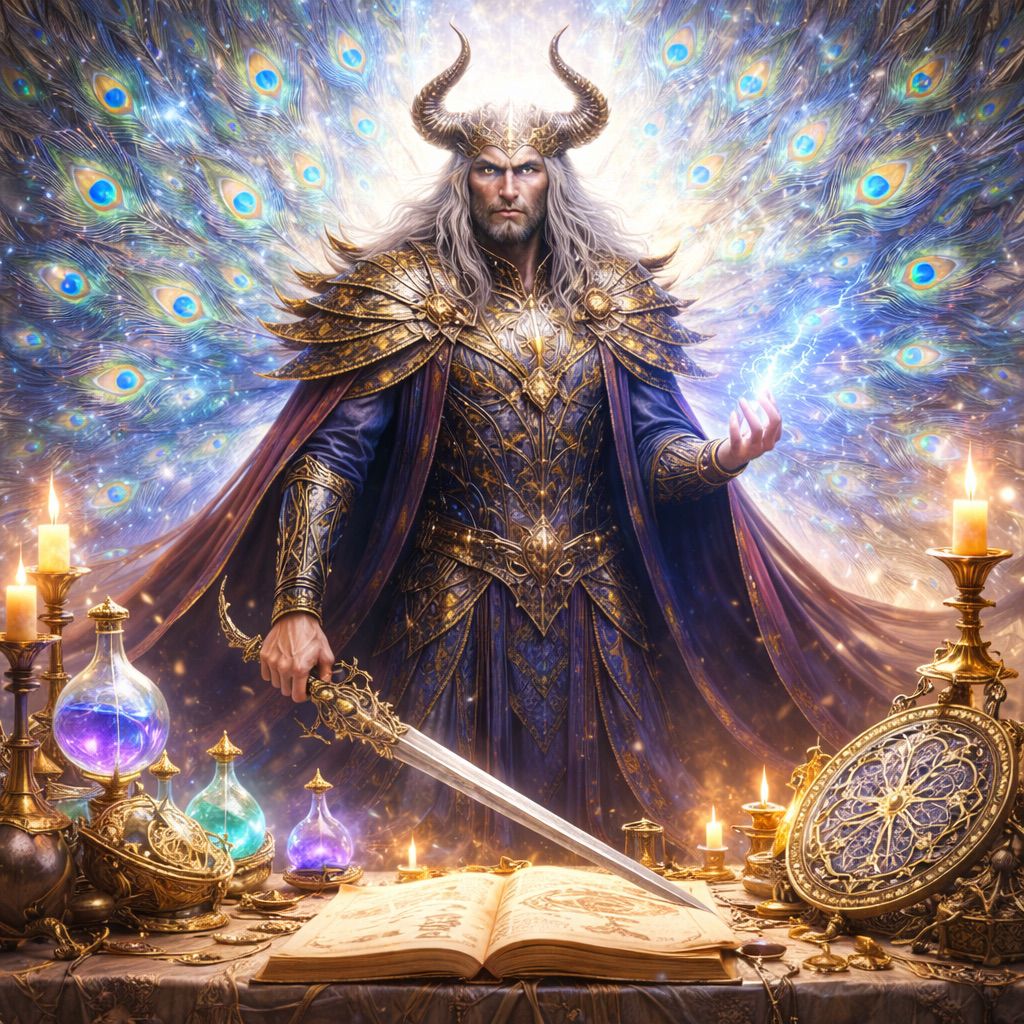
Andrealphus is described as appearing initially in the form of a peacock, a striking and unusual image in demonology. The peacock is often associated with beauty, symmetry, and display, but also with vanity and cold detachment. This form is not decorative. It is symbolic. The peacock’s feathers form natural geometric patterns, precise and repeating, eye-like shapes arranged with mathematical consistency. To encounter Andrealphus as a peacock is to confront beauty that is exact, ordered, and indifferent to human feeling.

Only when commanded does Andrealphus assume a human shape, and even then he retains something distant and calculating in his presence. He teaches geometry perfectly, makes men subtle in measurements, and instructs in astronomy. These are not arts of inspiration. They are arts of control. Geometry defines space. Astronomy defines time and movement. Measurement defines limitation. Andrealphus governs the frameworks that make the universe predictable.

This predictability is where his true menace lies. Andrealphus does not deceive. He clarifies. He strips away uncertainty and replaces it with certainty so precise it can become suffocating. In his world, there is a correct answer, a correct angle, a correct calculation. Anything that cannot be measured is irrelevant. Emotion, ambiguity, and intuition hold no value unless they can be quantified.

The association with astronomy places Andrealphus among the watchers rather than the movers. He does not shape fate through desire or force. He observes patterns, calculates trajectories, and understands inevitability. In ancient thought, astronomy was not merely scientific; it was prophetic. The movement of stars was believed to reveal destiny. Andrealphus’s mastery of this art suggests dominion over foresight without mercy.

What makes Andrealphus especially unsettling is his transformation of beauty into discipline. The peacock’s display, often seen as extravagant or vain, becomes under Andrealphus a demonstration of structural perfection. Beauty exists because it obeys rules. The feathers are beautiful because they align, repeat, and mirror one another. This is not beauty meant to comfort. It is beauty meant to assert order.

In demonological symbolism, Andrealphus represents the danger of intelligence divorced from compassion. Knowledge without conscience. Precision without restraint. He does not misuse geometry or astronomy. He uses them exactly as they are meant to be used. And that is the problem. When systems function perfectly, they do not care who is harmed by their efficiency.

The marquisate of Andrealphus reinforces this interpretation. A marquis governs borders and defenses. Andrealphus governs the borders of understanding. He defines where certainty ends and ignorance begins. Once something falls within his domain, it is fixed, categorized, and no longer open to interpretation.

Unlike demons who tempt with promises of pleasure or power, Andrealphus offers mastery. Mastery over space, motion, and proportion. This is deeply attractive to minds that crave control. But the cost is subtle. When everything is reduced to measurement, humanity itself becomes a variable rather than a value.

In modern symbolic terms, Andrealphus feels eerily contemporary. Algorithms, models, simulations, and predictive systems all echo his influence. These systems are not evil. They are precise. They optimize, calculate, and forecast. And like Andrealphus, they do not care about individual suffering unless it affects the model. The peacock demon becomes a mirror held up to modern rationalism.

Andrealphus does not rage. He does not threaten. He does not seduce. He waits. He calculates. He knows where things are going long before they arrive. This makes him a figure of inevitability rather than confrontation. Those who fall under his influence often do so willingly, believing they are choosing clarity over confusion.

Yet there is a warning embedded in his lore. Perfect measurement leaves no room for mercy. Perfect prediction leaves no room for hope. Andrealphus embodies the extreme end of rational order, where uncertainty is eliminated at the cost of freedom.

His peacock form reinforces this warning. The peacock does not fly far despite its wings. Its beauty is heavy. It is bound to display rather than escape. Andrealphus’s knowledge is similarly heavy. It dazzles, but it anchors. It impresses, but it confines.

In occult tradition, those who seek Andrealphus do so for intellectual power, not transformation. They want accuracy, foresight, and command over systems. Andrealphus provides this without deception. He gives exactly what is asked. What he does not give is balance.

Ultimately, Andrealphus represents the cold edge of intelligence. He is the demon of correct answers that leave no room for kindness, of systems that function flawlessly while ignoring the human cost. He reminds us that understanding the universe is not the same as understanding ourselves.

Andrealphus endures because humanity will always be tempted by certainty. In a chaotic world, the promise of perfect measurement is seductive. But his presence asks an uncomfortable question: when everything can be calculated, what happens to compassion?

Related Posts

Cimejes (Cimeies): The Infernal Marquis Who Commands Ruins, Lost Things, and the Discipline of War

Dave

Cimejes, sometimes written as Cimeies, is not a demon of spectacle. He does not dominate the imagination through grotesque excess or theatrical cruelty. Instead, his presence is quieter, more austere, and far more unsettling once you understand what he represents. In the grimoires of the Ars Goetia, Cimejes is listed as a Marquis of Hell, a title that immediately places him in a realm of command, discipline, and structure. Yet unlike other infernal nobles who rule passions or desires, Cimejes governs aftermath. He is the demon of what remains when ambition collapses, when battles are over, and when what was once valued has been forgotten or buried.

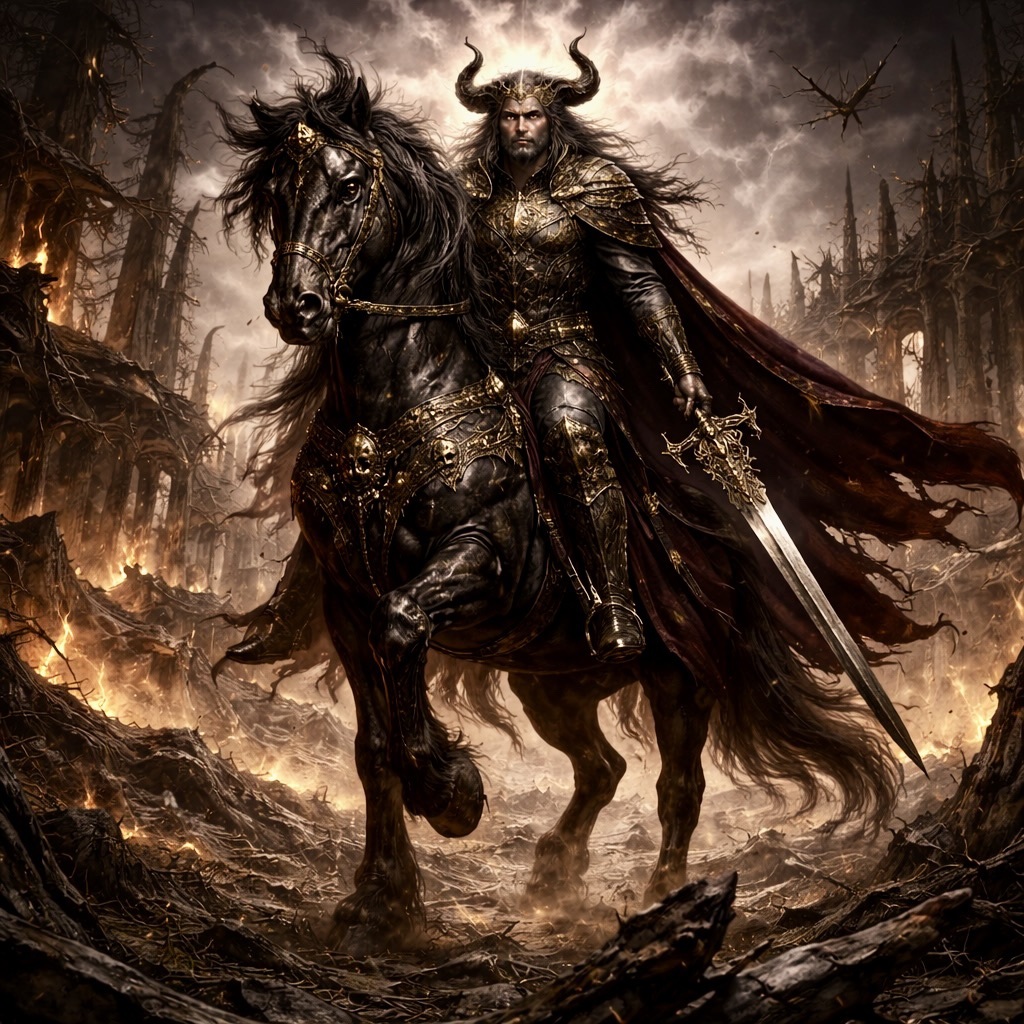
Cimejes is described as appearing as a warrior riding a black horse, a detail that anchors him firmly in the imagery of war. But this is not the romanticized war of banners and glory. This is war seen from the other side: broken ground, scattered weapons, abandoned strongholds, and the silent accounting of loss. His authority is not over victory, but over consequence. He teaches grammar, logic, and rhetoric, but he is also said to reveal hidden or lost things, particularly treasures concealed in the earth. This combination is not accidental. Language, reason, and loss all revolve around memory and structure. Cimejes governs what has been displaced from its original order.

In medieval demonology, a marquis was traditionally responsible for border territories and military defense. Cimejes fits this role perfectly. His domain exists at the borders between use and abandonment, between knowledge and obscurity. He does not create chaos; he manages what chaos leaves behind. Where others incite ambition, Cimejes catalogs its debris.

The black horse upon which Cimejes rides is symbolic of inevitability. Horses in myth often represent momentum, the forward movement of events that cannot easily be stopped. A black horse adds the dimension of finality. Cimejes arrives not at the beginning of a journey, but near its end. His appearance signals that something has already been decided, already lost, already buried. What remains is understanding.

One of the most intriguing aspects of Cimejes is his association with education. He teaches grammar, logic, and rhetoric, the classical foundations of structured thought. These disciplines are not creative in the emotional sense. They are corrective. They refine, categorize, and impose order. This aligns with Cimejes’s broader symbolism. He does not inspire; he clarifies. He takes what has been scattered and teaches how to interpret it.

The ability to reveal hidden treasures further reinforces this theme. Treasures, in demonological language, are not always gold or jewels. They can be forgotten truths, suppressed memories, or overlooked opportunities. Cimejes reveals what lies beneath the surface, but only what already exists. He does not invent value; he uncovers it. In this way, he resembles an archaeologist of consequence, unearthing what others abandoned in their rush forward.

Cimejes is often misunderstood as a demon of simple destruction because of his martial imagery. In reality, he is far more restrained. He does not delight in ruin. He governs it. This distinction matters. Ruin is not inherently evil. It is a state of transition. Civilizations rise, decay, and leave behind fragments. Cimejes presides over that phase, ensuring that what is lost is not entirely erased.

Unlike demons who tempt or deceive, Cimejes operates without urgency. His power is patient. He waits until the dust settles. This patience makes him especially resonant in a modern context. We live in a culture obsessed with growth and novelty, often at the expense of reflection. Cimejes represents the moment when forward motion pauses and reckoning begins.

His martial bearing also suggests discipline rather than aggression. Armor, weapons, and posture all imply order, hierarchy, and restraint. Cimejes does not fight wildly. He stands ready, composed, and observant. He embodies the soldier who understands that every advance creates a rear, every victory creates vulnerability, and every conquest leaves something unguarded behind.

In symbolic terms, Cimejes is the demon of inventory. He accounts for what remains after desire has burned itself out. This makes him deeply uncomfortable to confront, because he does not allow denial. He reveals what was sacrificed, what was forgotten, and what was never recovered. There is no illusion in his presence, only assessment.

The alternate spelling, Cimeies, reflects the instability of his domain. Names shift when things are no longer actively maintained. Spelling variations are a linguistic form of decay, and Cimejes exists comfortably in that decay. He is not diminished by inconsistency. He inhabits it.

Cimejes also represents the idea that knowledge itself can be a form of aftermath. Grammar, logic, and rhetoric are often learned after mistakes have been made. They are tools for correction, not impulse. In this sense, Cimejes governs learning born of consequence. He teaches not how to begin, but how to understand what has already happened.

In fiction and modern occult symbolism, Cimejes often appears as a stern, reserved figure, neither cruel nor kind. He is not interested in moral judgment. He is interested in accuracy. This neutrality is what gives him weight. He does not console. He reveals.

The ability to find lost things connects Cimejes to memory. What is lost is not always gone. Sometimes it is simply buried beneath newer layers of experience. Cimejes uncovers these layers methodically. He does not rush the process. He respects the weight of what is found.

Ultimately, Cimejes represents the discipline of reckoning. He is the demon who asks, “What remains?” when everything else has passed. In a world that constantly urges movement, ambition, and escalation, that question is deeply unsettling. It forces attention away from fantasy and toward reality.

Cimejes endures in demonology because ruin is inevitable. Every system, no matter how powerful, eventually leaves fragments behind. Someone must govern that stage. Someone must stand watch over what was abandoned. Cimejes fills that role, not as a destroyer, but as a custodian of aftermath.

To understand Cimejes is to accept that loss is not the end of meaning. It is the beginning of interpretation. He does not promise restoration. He promises clarity. And for those willing to face what has been left behind, that clarity can be its own form of power.

Related Posts

Amdusias: The Infernal Musician Who Commands Sound, Storms, and Falling Forests

Dave

Amdusias is not a demon that arrives quietly. In the grimoires where his name is written, he is associated with sound before sight, vibration before form. He is described as a Great Duke of Hell, commanding legions, but his authority does not manifest through law, deception, or temptation. It manifests through resonance. Music, thunder, the cracking of trees, the subtle pressure that sound exerts on the world—this is Amdusias’s domain. He is less a whisper in the mind and more a force that makes the air itself respond.

In the Ars Goetia, Amdusias is said to appear initially as a unicorn, an image that seems almost absurd until it is understood symbolically. The unicorn is not gentleness in this context, but rarity, raw power, and untamed force. Only when commanded does Amdusias take on human form, often with horns, reinforcing the idea that his true nature exists somewhere between animal instinct and conscious will. This duality matters. Amdusias is not chaos without direction; he is structured force, sound shaped into intent.

Music is the most intriguing aspect of Amdusias’s mythology. He is said to cause musical instruments to be heard, even when none are present. This is not the comforting music of celebration, but something deeper and more unsettling. It is the reminder that sound is never passive. Sound moves bodies, stirs emotions, and alters environments. Long before modern science explained resonance and vibration, demonology recognized sound as power, and Amdusias became its embodiment.

Unlike demons who specialize in manipulation or knowledge, Amdusias affects the physical world directly. Trees fall at his command. Forests bend and break. Storms answer him. These descriptions place him closer to natural disaster than moral allegory. He is the demon of reverberation, of cause and effect made audible. Where other infernal figures influence minds, Amdusias influences matter.

This connection to nature makes Amdusias stand out. Hell, in many traditions, is removed from the natural world, a realm of punishment and abstraction. Amdusias, however, is deeply tied to earth, wood, air, and weather. He reminds us that destruction is not always moral or immoral; sometimes it is simply force meeting structure. A storm does not hate a forest. It moves through it.

In occult practice, Amdusias is often associated with mastery over sound, music, and performance. He is said to teach instruments and musical arts, but there is always an edge to this teaching. His music is not merely entertainment. It is influence. Anyone who has stood in front of a powerful sound system or felt music vibrate through their chest understands this instinctively. Sound bypasses intellect and goes straight to the body. Amdusias rules that pathway.

The falling trees attributed to Amdusias are more than spectacle. Trees symbolize stability, growth, and time. To fell them is to interrupt continuity. Amdusias represents moments when stability gives way, when structures—natural or social—can no longer withstand accumulated pressure. His presence marks thresholds, the point at which vibration becomes collapse.

What makes Amdusias especially compelling is that he does not appear to act out of malice. There is no narrative of cruelty attached to him. He does not punish sinners or tempt the faithful. He acts. The grimoires do not moralize his behavior; they describe it. This neutrality is unsettling. It suggests a kind of power that operates independently of ethics, much like natural forces do.

In modern symbolic terms, Amdusias can be understood as the embodiment of amplification. Small inputs become overwhelming outputs. A note becomes a roar. A vibration becomes a fracture. This makes him an uncannily relevant figure in an age of amplified voices, viral media, and cascading effects. Amdusias is what happens when resonance is no longer contained.

His horns are significant as well. Horns have long symbolized both musical instruments and animal power. They produce sound, but they also signify aggression and dominance. Amdusias’s horned form merges these meanings. He is both the instrument and the force behind it. Sound is not something he uses; it is something he is.

Amdusias’s rank as a Duke places him in a position of command rather than subservience. He directs legions, not individuals. This reinforces the idea that his influence operates on a large scale. He is not concerned with personal transformation. He reshapes environments. When Amdusias is invoked in myth, the world itself responds.

There is also an implicit warning in Amdusias’s lore. Sound, once released, cannot be taken back. Vibrations travel outward, interacting with everything they encounter. Words, music, and noise all share this property. Amdusias symbolizes the permanence of impact. Once something resonates, it leaves traces long after the sound has faded.

Unlike more psychological demons, Amdusias does not linger in ambiguity. His effects are visible and audible. Trees fall. Storms rise. Music fills the air. This clarity makes him terrifying in a different way. There is no mystery about what he does, only uncertainty about when and how far it will go.

In artistic and fictional portrayals, Amdusias often appears as a dark conductor, orchestrating chaos like a symphony. This is an apt metaphor. Music is ordered sound, chaos given structure. Amdusias stands at the intersection of order and destruction, proving that the two are not opposites but collaborators.

Ultimately, Amdusias represents the truth that sound is never harmless. Every vibration carries force. Every resonance changes something. He is the demon of audible consequence, the reminder that the world is always listening, always responding.

To understand Amdusias is to respect the power of what is set into motion. He does not ask for belief. He proves himself through impact. In that sense, Amdusias is not merely a figure of demonology, but a mythic acknowledgment of a physical reality humans have always known: what we unleash into the world, especially through sound and force, does not vanish. It echoes.

Related Posts

Belial: The Lawless King Who Teaches Power Without Allegiance

Dave

Belial is one of the oldest names to surface when human beings try to give shape to rebellion. Long before grimoires cataloged demons into tidy hierarchies, Belial already existed as an idea: the force that refuses to kneel, the will that rejects imposed order, the voice that whispers that authority is a human invention, not a divine mandate. To encounter Belial in demonology is not to meet a simple villain, but to confront a concept that has troubled societies for as long as laws, kings, and gods have claimed dominion over human behavior.

The name Belial appears early in religious texts, often as a synonym for worthlessness, lawlessness, or moral corruption. In the Hebrew Bible, “sons of Belial” are those who reject social order, who refuse to submit to judges, elders, or divine commandments. Over time, this abstract accusation hardened into a figure, and that figure became Belial: a king of Hell who bows to no one and demands the same defiance from those who call upon him.

In later demonological traditions, particularly within the Ars Goetia, Belial is described as a powerful king who commands legions and grants high status, favor, and influence. Yet he is also notorious for demanding offerings and respect. Belial does not serve freely. He does not respond well to hesitation or weakness. This detail is crucial to understanding his symbolism. Belial does not represent chaos for its own sake. He represents power that exists outside of permission.

Belial’s defining trait is autonomy. He is said to have been created without a master, or to have fallen because he refused subjugation altogether. This places him in sharp contrast to demons who rebelled after serving. Belial never accepted the premise that authority was legitimate in the first place. In mythic terms, he is not a traitor. He is a nonparticipant.

This distinction matters. Belial is not driven by rage or envy. He is driven by principle, albeit a dark one. He embodies the belief that power belongs to those who take it, not those who are granted it. This belief has fueled revolutions, tyrannies, liberation movements, and criminal empires alike. Belial is not aligned with justice or injustice. He is aligned with self-rule.

In occult texts, Belial is associated with status, influence, and legal maneuvering. He can grant titles, sway judges, and elevate individuals within rigid systems. This seems paradoxical for a demon of lawlessness, but the contradiction is intentional. Belial understands systems precisely because he rejects them. He teaches how power actually functions beneath the surface of rules and rituals. Laws, in Belial’s domain, are tools to be exploited, not moral truths to be obeyed.

Those who sought Belial historically were often not dreamers or mystics, but pragmatists. They wanted leverage. They wanted to bend institutions to their will. They wanted to rise without loyalty. Belial was invoked by those who believed that the world was already corrupt, and that refusing to play by its rules was not evil, but honest.

Belial’s refusal to bow also places him in opposition to hierarchy itself. While Hell is often depicted as a rigid structure, Belial’s presence disrupts that image. He is a king who does not kneel even to higher infernal authority. This makes him dangerous not only to heaven, but to Hell. He is tolerated because of his power, not trusted because of his nature.

Symbolically, Belial represents the moment when obedience breaks. He is the voice that says, “Why should I?” That question can be liberating or catastrophic depending on who asks it and why. Belial does not care which outcome occurs. His concern is the assertion of will.

Unlike demons associated with temptation or pleasure, Belial does not seduce. He confronts. Those who engage with him are forced to examine their relationship with authority, responsibility, and consequence. Belial offers power, but he strips away excuses. If you act under Belial’s influence, you cannot claim ignorance or coercion. You chose autonomy. You own the outcome.

This is why Belial is often described as harsh or demanding. He does not nurture dependency. He despises submission disguised as devotion. In mythic terms, he is the anti-patron. He grants favor but expects self-sufficiency. He will elevate you, but he will not protect you from the fall.

Belial’s imagery often reflects this severity. He is depicted as regal, imposing, and unmoved. There is no frenzy in his presence, no theatrical cruelty. His menace lies in indifference. He does not punish out of anger. He withdraws support when respect is not maintained. In this way, Belial resembles power structures in the real world far more than supernatural monsters do.

In modern interpretations, Belial frequently appears as a symbol of radical independence. He is invoked in fiction as a force behind antiheroes, warlords, and leaders who reject moral constraints in favor of control. These portrayals are compelling because they reflect a truth many are uncomfortable admitting: authority often flows to those willing to abandon ideals.

Belial also exposes the darker side of self-rule. Absolute autonomy can easily become tyranny. When no higher authority is acknowledged, accountability collapses inward. Belial does not warn against this. He demonstrates it. He is the embodiment of freedom without restraint, power without justification.

Historically, societies have oscillated between fearing and needing figures like Belial. Order requires obedience, but progress often begins with defiance. Belial sits uncomfortably at the center of that tension. He is neither hero nor villain. He is the pressure point where systems fracture.

Even the name Belial carries weight. It is less a personal name than a label, a condemnation turned into identity. To be Belial is to be without worth in the eyes of the law, without allegiance in the eyes of authority. Yet within that rejection lies a strange form of sovereignty. Belial does not need validation because he rejects the framework that grants it.

What makes Belial enduring is not fear, but recognition. People see him in boardrooms, courtrooms, and corridors of power. They recognize the figure who rises not through loyalty, but through calculation. They recognize the leader who obeys nothing but his own will. Belial survives because he is already here.

At his core, Belial represents a question that never goes away: is authority legitimate because it exists, or does it exist because we agree to obey it? Belial answers that question with silence, then action. He does not argue philosophy. He demonstrates consequence.

To engage with Belial, even symbolically, is to accept responsibility for defiance. There is no moral cushion, no divine justification. There is only choice and outcome. In that sense, Belial is brutally honest. He does not pretend rebellion is noble. He simply insists it is yours.

Belial endures because rebellion endures. As long as there are systems, there will be those who reject them. As long as there is power, there will be those who take it without asking. Belial is not the origin of that impulse. He is its name.

Related Posts

Decarabia: The Star-Shaped Marquis Who Reveals Secrets Through Stones and Wings

Dave

Decarabia is one of those infernal figures whose reputation is built less on fear and more on curiosity. In the old demonological texts, he is not described as a roaring tyrant or a punisher of souls, but as a keeper of hidden knowledge, a quiet revealer of truths that already exist but remain unseen. His power does not come from destruction or temptation, but from interpretation. Decarabia governs the secret language of stones, herbs, birds, and gems, translating the natural world into meaning for those who know how to ask. In this way, he occupies a strange and fascinating space within the Ars Goetia, somewhere between demon, scholar, and natural philosopher.

According to the grimoires, Decarabia appears initially in the form of a pentagram, a five-pointed star suspended in the air. Only after being commanded does he take on a more recognizable shape, often described as a man with wings or a birdlike form. This transformation is deeply symbolic. The pentagram has long represented hidden order, balance, and the structure underlying apparent chaos. To encounter Decarabia first as a symbol rather than a body suggests that his essence is abstract before it is physical. He is knowledge before he is form.

Decarabia’s rank is that of a Marquis of Hell, a title that implies authority without absolute dominion. A marquis governs borderlands, territories at the edge of kingdoms. This fits Decarabia perfectly. His domain lies at the border between the human and the natural, the spoken and the unspoken, the observed and the interpreted. He does not create secrets; he reveals them. He teaches the virtues of stones and herbs, the qualities hidden within gems, and the meanings carried by the flight and calls of birds.

In medieval and early modern Europe, this kind of knowledge was not trivial. Stones and herbs were believed to carry inherent properties that could heal, harm, protect, or curse. Birds were omens, their movements read as messages from beyond human understanding. To know the true nature of these things was to possess power, not the loud power of conquest, but the quiet power of insight. Decarabia embodies this belief, serving as a supernatural librarian of the natural world.

What makes Decarabia particularly intriguing is his relationship with truth. Unlike demons associated with deception, Decarabia is described as truthful when properly constrained. He reveals what is already there. This does not make him safe, however. Knowledge without context can be dangerous, and understanding without wisdom can lead to ruin. Decarabia does not decide how his revelations will be used. He provides information, and the consequences belong to the one who asked.

The pentagram form attributed to Decarabia has been the subject of much interpretation. In many traditions, the five-pointed star represents the elements: earth, air, fire, water, and spirit. Decarabia’s connection to stones, herbs, and birds aligns neatly with this symbolism. He is a unifier of elements, a reminder that the natural world speaks a coherent language if one knows how to listen. His star-shaped appearance reinforces the idea that knowledge itself has structure, even when it seems mysterious.

Birds play a central role in Decarabia’s mythology. He is said to understand their songs and the meanings behind their movements. This places him in a long tradition of augury, the ancient practice of divination through observing birds. To ancient and medieval observers, birds were messengers between worlds, creatures that moved freely between earth and sky. Decarabia’s command over their language suggests mastery over liminal spaces, those places where boundaries blur and insight emerges.

Stones and gems, too, are central to Decarabia’s influence. In an era when gemstones were believed to hold specific virtues, knowing their true nature was invaluable. A stone could protect a traveler, enhance memory, or ward off illness. Decarabia’s teachings would have appealed to alchemists, healers, and scholars seeking to unlock the hidden properties of matter. Even today, the symbolic power of stones persists, suggesting that Decarabia’s appeal is not limited to superstition, but rooted in a deeper human impulse to find meaning in the material world.

Decarabia’s wings are another important symbol. Wings represent freedom, perspective, and transcendence. A winged Decarabia suggests an elevated viewpoint, the ability to see patterns invisible from the ground. This aligns with his role as a revealer of hidden connections. He does not change the world; he changes how it is seen. In doing so, he challenges the assumption that knowledge must come from human reasoning alone. Sometimes, understanding comes from observing what has always been present.

Unlike many demons, Decarabia is not described as hostile or malicious. His danger lies in indifference. He offers truths without concern for how they will be received or applied. This makes him a compelling metaphor for knowledge itself. Information is neutral. It can heal or harm, enlighten or overwhelm. Decarabia embodies this neutrality, standing as a reminder that insight carries responsibility.

In modern interpretations, Decarabia often appears as a figure of esoteric wisdom, a guide through hidden systems rather than a villain to be defeated. He resonates with those drawn to symbolism, natural magic, and the idea that the world is layered with meaning. In this sense, he feels almost contemporary, a patron of pattern-seekers and systems-thinkers in an age obsessed with data and interpretation.

The image of Decarabia as a star transforming into a winged being also speaks to the human experience of understanding. Knowledge often begins as an abstract concept, a symbol or theory, before becoming something lived and embodied. Decarabia’s manifestation mirrors this process. He is an idea that takes shape, a pattern that becomes a presence.

Decarabia’s continued relevance lies in his subtlety. He does not dominate narratives through spectacle. He lingers at the edges, waiting for those who are willing to look closely. His power is patient, observational, and deeply tied to the world as it is, not as we wish it to be. In a culture that often values loud certainty over quiet insight, Decarabia stands as a reminder that some truths are revealed only to those who slow down enough to notice.

Ultimately, Decarabia represents the hidden coherence of the natural world. He is the whisper behind patterns, the logic beneath symbolism, and the reminder that meaning is often already present, waiting to be recognized. Whether approached as a demon of occult lore or as a metaphor for interpretive knowledge, Decarabia endures because he reflects a timeless human desire: to understand the world not just as a collection of objects, but as a network of signs.

To engage with Decarabia is to accept that knowledge is not always comforting. It can unsettle, complicate, and challenge assumptions. But it can also deepen appreciation for the intricate systems that surround us. In this way, Decarabia is less a figure of fear and more a figure of revelation, a star that points not outward, but inward, toward a more attentive way of seeing.

Related Posts

Seere: The Swift Prince of Hell Who Bends Distance, Destiny, and Desire

Dave

Seere is not the kind of demon that announces himself with thunder or terror. His power is quieter, faster, and far more unsettling once you sit with it. In the old grimoires, Seere is described as a Prince of Hell who rides upon a winged horse and moves with impossible speed, carrying messages, altering circumstances, and shaping outcomes before anyone realizes change has occurred. Where other infernal figures rule through fear or temptation, Seere rules through momentum. He is the demon of things already in motion, the force that ensures events arrive exactly where and when they are meant to, whether that arrival is welcomed or dreaded.

The Ars Goetia paints Seere as a paradoxical figure. He is a demon, yet he is often described as good-natured, courteous, and even helpful. This contradiction is not accidental. Seere represents a deeply human tension: the desire for outcomes without consequences, speed without cost, and certainty without struggle. He is invoked for quick results, for bringing distant people or objects closer, for resolving situations before they spiral out of control. In a sense, Seere is the embodiment of impatience given supernatural form.

Descriptions of Seere emphasize motion. He appears riding a winged horse, a symbol that combines freedom, speed, and authority. The horse itself is significant. In myth and symbolism, horses often represent power, travel, and the boundary between worlds. A winged horse suggests transcendence of limits, the ability to cross not just physical distance but emotional and psychological barriers as well. Seere does not walk into your life. He arrives suddenly, already halfway through changing it.

One of Seere’s defining traits is honesty. Unlike many demons who are known for deception or trickery, Seere is said to speak truthfully. This detail has fascinated occult scholars for centuries. Why would a demon be honest? The answer may lie in the nature of his power. Seere does not need lies. His influence comes from acceleration, not distortion. He takes what already exists and pushes it forward, sometimes faster than the human mind can process. Truth, delivered at speed, can be just as disruptive as falsehood.

Seere’s ability to bring things swiftly is not limited to physical objects. He can transport emotions, intentions, and decisions. In matters of love, he is often invoked to reunite estranged partners or hasten romantic outcomes. In matters of conflict, he can bring resolution just as quickly, though resolution does not always mean harmony. Sometimes it means confrontation. Seere does not judge the nature of the destination; he simply ensures arrival.

This neutrality is what makes Seere so compelling and so dangerous. He does not distinguish between good outcomes and bad ones. He responds to intention and momentum. If you ask him to bring something to you quickly, he will—but you may not like the form it takes. In this way, Seere mirrors the real-world consequences of impulsive decisions. The faster you move, the less time you have to reflect, and the more likely you are to collide with something unexpected.

In the hierarchy of Hell, Seere’s rank as a Prince suggests autonomy and authority. Princes are not mere servants; they are rulers of domains. Seere’s domain is transit, transition, and inevitability. He governs the spaces between states of being: here and there, now and then, before and after. This liminal quality places him in a unique position among infernal figures. He is less concerned with possession or corruption and more concerned with completion.

Historically, Seere emerges from a tradition of demonology that sought to categorize and control the unknown. Medieval magicians and scholars did not invent these figures casually. Each demon represented a specific anxiety, a specific human fear or desire. Seere’s presence reflects an obsession with speed and certainty. In a world where travel was slow and communication unreliable, the idea of a spirit who could collapse distance would have been intoxicating.

Yet even in the modern world, Seere remains relevant. Today, we live in an age of instant messaging, same-day delivery, and real-time updates. Distance has been compressed, and patience has become a rare commodity. Seere feels less like a relic of superstition and more like a mythic expression of contemporary life. He is the demon of urgency, the whisper that says, “Why wait?”

Occult texts warn that Seere should be approached with clarity of purpose. Vague requests yield unpredictable results. This caution reflects a deeper truth about speed itself. When things move quickly, small errors are magnified. A misworded desire can become a regretted outcome. Seere does not refine your wish; he executes it. In this sense, he is brutally fair.

The image of Seere riding a winged horse also carries an emotional resonance. It suggests escape, rescue, and sudden change. To someone trapped in a painful situation, Seere might appear as salvation. To someone avoiding responsibility, he might appear as an enabler. This duality makes him one of the most psychologically interesting figures in demonology. He does not create desire; he responds to it.

Seere is also said to bring things from far away, both physically and metaphorically. This ability can be interpreted as the resurfacing of buried memories, unresolved relationships, or long-delayed consequences. What is distant is not always forgotten. Seere reminds us that distance is often an illusion, and that unresolved matters have a way of returning when summoned.

Unlike many demons, Seere is not associated with cruelty or torment. His danger lies in indifference. He does not care whether the outcome benefits you or harms you. He cares only that the path is clear and the destination defined. This makes him a powerful symbol of modern systems and technologies that operate without moral judgment. Algorithms, logistics networks, and automated processes function much like Seere: efficient, relentless, and unconcerned with human nuance.

In popular culture, characters inspired by Seere often appear as messengers, fixers, or catalysts. They arrive unexpectedly, solve problems quickly, and disappear just as fast, leaving behind consequences that others must live with. These portrayals capture the essence of Seere’s myth without naming him directly. He is the unseen hand that accelerates fate.

From a symbolic standpoint, Seere can be read as a warning against haste. His honesty does not protect you from regret. His speed does not guarantee satisfaction. He offers results, not wisdom. In a world that increasingly values efficiency over reflection, Seere’s legend feels almost prophetic. He asks a simple question: if you could have what you want immediately, would you still want it?

Seere’s enduring appeal lies in this question. He tempts not with forbidden pleasures, but with convenience. He promises not power, but immediacy. And in doing so, he exposes a vulnerability that has only grown stronger over time. We are not just afraid of demons who deceive us. We are afraid of demons who give us exactly what we ask for.

To understand Seere is to understand the cost of speed. He is the embodiment of the shortcut, the fast track, the skipped step. Sometimes shortcuts save lives. Sometimes they cut corners that should never have been cut. Seere does not discriminate. He rides, and things happen.

In the end, Seere is less about Hell and more about human nature. He reflects our impatience, our longing for instant resolution, and our belief that problems can be outrun. His winged horse is not just a mode of transport; it is a mirror. It shows us how quickly we are willing to move when desire outweighs caution.

Seere does not force himself into stories. He appears when summoned, when urgency eclipses reflection. And once he arrives, there is no pause button. Things move. Distances close. Outcomes arrive. Whether that is a blessing or a curse depends entirely on the one who called him.

Related Posts

Dantalion: The Many-Faced Demon Who Commands Minds, Memories, and Desire

Dave

Dantalion is one of those names that feels as if it has been whispered rather than written, carried forward by ink-stained fingers, candle smoke, and the uneasy fascination humans have always had with the hidden machinery of the mind. To encounter Dantalion in the old grimoires is not to meet a roaring monster or a horned brute thirsting for destruction. Instead, Dantalion appears as something far subtler and, in many ways, far more unsettling: a being whose power lies in thought itself, in the quiet rearranging of emotions, opinions, and memories. He is described as a Duke of Hell, commanding legions, yet his dominion is not over fire or war, but over the invisible architecture of human consciousness.

In the Lesser Key of Solomon, Dantalion is said to appear in many forms at once, bearing countless faces—male and female—upon a single body. This imagery is more than grotesque spectacle. It is symbolic of multiplicity, of empathy twisted into control, of the ability to perceive and manipulate the perspectives of others. Where other demons promise wealth, destruction, or physical power, Dantalion offers something more intimate: access to the inner lives of people. He knows the thoughts of all men and women, understands their secret desires, and can bend their affections at will. To the medieval mind, this was a terrifying ability. To the modern reader, it is disturbingly familiar.

The grimoires describe Dantalion as a master of influence. He can teach all arts and sciences, but his true specialty lies in emotional manipulation. He can change a person’s heart, turning love to hate or indifference to obsession. He can reveal the thoughts of others, making him a prized spirit for those seeking insight into rivals, lovers, or enemies. In a world where survival often depended on social alliances, marriage arrangements, and political favor, such power would have been immensely tempting. Dantalion’s presence in magical texts reflects a timeless human anxiety: the fear that our thoughts are not entirely our own.

What makes Dantalion especially compelling is how closely his mythology aligns with modern understandings of psychology. The idea of a being who can read minds and subtly alter emotions mirrors contemporary concerns about persuasion, propaganda, and psychological influence. Long before neuroscience and cognitive science existed, Dantalion embodied the dread that thoughts could be shaped by unseen forces. In this sense, he is less a monster and more a metaphor, a personification of manipulation itself. He represents the dark side of empathy—the ability to understand others not to help them, but to control them.

Descriptions of Dantalion’s appearance are among the most striking in demonological literature. He is often depicted holding a book in his right hand, a symbol of knowledge and memory. The many faces that cover his body gaze outward in all directions, suggesting omnipresent awareness. These faces are not uniform; they are diverse, reflecting different genders, expressions, and emotions. This multiplicity reinforces his role as a collector and controller of human experience. Each face could be seen as a stolen thought, a borrowed emotion, or a life observed too closely. In art and illustration, Dantalion often appears both regal and disturbing, a reminder that power over the mind is both alluring and dangerous.

Historically, Dantalion belongs to the Ars Goetia, a catalog of seventy-two demons supposedly summoned and constrained by King Solomon. These spirits were not invented as pure fiction; they emerged from a complex blend of folklore, theology, and moral instruction. Medieval and early modern texts often used demons as cautionary figures, embodying specific sins or fears. Dantalion’s association with manipulation and emotional control aligns him closely with anxieties about free will and moral responsibility. If a demon can alter your desires, how accountable are you for your actions? This question haunted theologians and philosophers long before it became a topic for psychologists and ethicists.

In occult practice, Dantalion is often approached for matters of love, influence, and understanding. Practitioners seeking reconciliation, attraction, or insight into another’s thoughts might call upon him, carefully framing their requests. Yet grimoires consistently warn that such dealings come at a cost. To invite a being that manipulates emotions is to risk losing clarity over your own. This warning feels especially relevant in an age dominated by social media algorithms, targeted advertising, and political messaging. Dantalion’s legend reads less like superstition and more like an early allegory for psychological vulnerability.

The demon’s title as a Duke of Hell suggests hierarchy and order within chaos. Hell, in these texts, is not a place of random torment but a structured realm with ranks and responsibilities. Dantalion commands thirty-six legions, emphasizing his authority and reach. This structured infernal bureaucracy mirrors the rigid hierarchies of medieval society, reinforcing the idea that power—whether divine or demonic—operates through systems. Dantalion’s system is the mind, and his soldiers are ideas, emotions, and memories deployed with precision.

Over time, Dantalion has evolved beyond the pages of grimoires and into modern culture. He appears in novels, games, and films, often reimagined as a master manipulator or mind reader. These portrayals retain the core of his myth while adapting it to contemporary fears. In a world obsessed with data, surveillance, and psychological profiling, Dantalion feels less like an ancient demon and more like a timeless archetype. He is the shadow behind influence, the whisper behind persuasion, the fear that someone else might be steering your thoughts.

What truly distinguishes Dantalion from other demonic figures is the intimacy of his power. He does not need brute force. He does not rely on fear alone. Instead, he works quietly, altering perceptions and feelings until the victim believes the change was their own idea. This is perhaps why he endures as a compelling figure. Physical threats are obvious and can be resisted. Psychological influence is subtle, often invisible, and far harder to escape. Dantalion’s legend captures this unsettling truth with remarkable clarity.

From a symbolic perspective, Dantalion can be read as a mirror held up to humanity. His many faces reflect our own complexity, our shifting identities, and our capacity for contradiction. We all contain multitudes, as the saying goes. Dantalion externalizes this truth in monstrous form, reminding us that understanding others carries ethical responsibility. Knowledge without empathy becomes exploitation. Insight without compassion becomes control. In this way, Dantalion is not just a demon to be feared, but a lesson to be learned.

The enduring fascination with Dantalion also speaks to humanity’s complicated relationship with desire. Love, attraction, and approval are among our strongest motivators, yet they are also areas where we feel most vulnerable. To imagine a being who can manipulate these forces is to confront our own insecurities. Are our feelings genuine, or are they shaped by external influences? Dantalion’s myth does not answer this question; it simply insists that the question matters.

In occult symbolism, books often represent hidden knowledge, forbidden truths, or the accumulation of experience. Dantalion’s book is not merely a prop; it is an extension of his power. It suggests that every thought, every emotion, is recorded and accessible. In an era where personal data is tracked, stored, and analyzed, this imagery feels eerily prescient. The demon who knows your thoughts is no longer just a supernatural threat; it is a metaphor for modern anxieties about privacy and autonomy.

Despite his fearsome reputation, Dantalion is not portrayed as chaotic or irrational. He is methodical, articulate, and precise. This rationality makes him more unsettling, not less. He represents the idea that manipulation does not require madness, only understanding. By framing Dantalion as a teacher of arts and sciences, the grimoires acknowledge that knowledge itself is morally neutral. It can enlighten or enslave, depending on how it is used. Dantalion embodies the darker potential of intellect divorced from ethics.

The language used to describe Dantalion in historical texts is often clinical rather than sensational. This tone reinforces his role as a specialist rather than a spectacle. He is summoned for specific purposes, bound by precise rituals, and dismissed with formal words. The ritualistic structure emphasizes control and consent, highlighting the tension between human agency and supernatural influence. Even within the myth, there is an acknowledgment that power over the mind must be carefully negotiated.

Modern interpretations of Dantalion often strip away the explicitly demonic elements and focus on his psychological dimensions. In this form, he becomes less a literal being and more an archetype of manipulation. He appears as a charismatic antagonist, a master strategist, or an uncanny observer who always seems to know what others are thinking. These reinterpretations keep the spirit of the myth alive while translating it into a secular context.

At its core, the story of Dantalion is about boundaries—where one mind ends and another begins. It challenges the assumption that our thoughts are private and inviolable. By personifying the fear of mental intrusion, Dantalion gives shape to an anxiety that has only intensified over time. In a world saturated with information and influence, the idea of a demon who commands minds feels less fantastical and more symbolic.

Ultimately, Dantalion endures because he speaks to something deeply human. We all want to be understood. We all fear being manipulated. We crave connection but dread vulnerability. Dantalion sits at the intersection of these desires and fears, embodying the tension between empathy and control. Whether approached as a figure of occult lore, a psychological metaphor, or a cultural archetype, he remains a powerful symbol of the unseen forces that shape our inner lives.

To read about Dantalion is to confront uncomfortable questions about autonomy, influence, and responsibility. It is to acknowledge that power does not always announce itself with violence or spectacle. Sometimes, it whispers, persuades, and convinces. Sometimes, it wears many faces and calls itself understanding. In that sense, Dantalion is less a relic of medieval superstition and more a timeless reminder: the mind is the most powerful territory of all, and whoever controls it wields the greatest influence.

Related Posts

The Silent Avenger: Andromalius, Hunter of Thieves

Dave

If you close your eyes and picture a demon, you might imagine wings and claws, fire and shadow, a creature born only for destruction. But not all the spirits that inhabit the old grimoires fit that mold. Some are more subtle, more strange, and in many ways more unsettling because of it. Among these is Andromalius, the seventy-second and final spirit of the Ars Goetia, the one who closes the infamous list of infernal names. He is not a fiery monster nor a horned tyrant, but a stern figure who walks with a serpent coiled in his hand, a manlike presence who stalks the guilty. His purpose, according to the medieval magicians who dared to inscribe his sigil and summon him into their protective circles, was not to sow chaos, but to punish thieves, uncover dishonesty, and return what was stolen. He is both avenger and judge, demon and lawgiver, and his story opens our descent into the hierarchy of Hell not with carnage, but with a whisper of justice, a reminder that even in the infernal order, balance must be maintained.

Andromalius has always occupied a peculiar place in demonology. The Ars Goetia describes him as a great Earl of Hell who commands thirty-six legions of demons, an impressive number, yet not among the highest ranks. His domain is narrower than the great kings like Paimon or Bael, but what he does, he does with terrifying precision. His job is simple: to track down thieves, to reveal who has taken what, to return goods to their rightful owners, and to punish the guilty. In some texts, he is also said to uncover plots, conspiracies, and treacheries, exposing enemies before they can strike. His serpent, which he always carries, is a symbol of cunning, justice, and vengeance, its coils winding like the inescapable trap of truth itself. This imagery, stark and simple, has survived for centuries because it speaks to something deeply human: the fear of being caught when we transgress, the dread of the unseen eye that sees what we try to hide.

The origins of Andromalius are shrouded in the mists of medieval grimoires, where so much of demonology took shape. The Lesser Key of Solomon, compiled in the seventeenth century, gives us our most detailed account. There, he is listed as the final spirit, almost like the period at the end of a long sentence. But that position is meaningful: he is the closer, the finisher, the one who ensures that what begins in chaos ends in justice. Unlike demons of lust, war, or greed, who tempt and corrupt, Andromalius waits. He lurks in the background until wrong has been committed, and then he strikes. His existence suggests a world where even Hell has rules, where even among the legions of the damned there are enforcers who will not allow dishonor to pass unpunished. That is a terrifying thought: not that Hell is chaos, but that Hell is order, cold and merciless.

Andromalius’s place in the hierarchy is also worth considering. As an Earl, he is not at the top of the infernal chain, but he holds real authority. His legions follow him not into conquest, but into judgment. Imagine an army of unseen watchers, spies who slip through walls and shadows, taking note of every theft, every betrayal, every secret plot. Imagine them whispering those names to their master, who then emerges, serpent in hand, to drag the guilty into the light. That was the fear of those who invoked him. The grimoire tradition is clear: to summon Andromalius was to risk exposure yourself. If you called on him to punish a thief, you had better be clean of theft, for he would turn his gaze upon you as well. This balance of usefulness and danger made him one of the most respected spirits in the magician’s catalogue.

Appearance is everything in demonology, and Andromalius’s appearance is deceptively simple. He is a man with a serpent. No claws, no flames, no monstrous hybrid body. Just a man and a snake. But what a powerful symbol that is. The serpent, from Eden onward, has always been the image of temptation, cunning, and hidden wisdom. In Andromalius’s hand, it is not the deceiver but the avenger, the winding justice that cannot be escaped. The man holding it is not wild or bestial, but composed, severe, and watchful. In some descriptions, he is almost monk-like, robed and somber, a judge rather than a warrior. This simplicity makes him all the more chilling. A monstrous demon you can recognize and fight; a stern figure who only watches until you slip feels inescapable. The thief cannot know when Andromalius will strike, only that he will.

His abilities, as listed in the Goetia, revolve around truth. He reveals thieves and their deeds. He uncovers hidden treasures, but only to return them. He punishes enemies, but only those who conspire unjustly. This is not the wild chaos of demons like Asmodeus or Belial. It is something colder, more precise. Andromalius is like the shadow of conscience, the weight on your shoulders when you pocket something that is not yours, the prickling on your neck when you speak a lie. He is not the one who tempts you into sin — he is the one who ensures you do not get away with it. For that reason, his image has endured. We may laugh at witches flying through the sky or monsters breathing fire, but we all know the feeling of being caught in a lie. We all know the fear of being found out. That fear has not faded with time, and so Andromalius remains relevant.

In cultural terms, Andromalius has not achieved the fame of Paimon or Asmodeus, but he has left a subtle mark. Occultists still speak of him as a spirit of justice, one invoked not for gain but for retribution. In literature and role-playing games, his name sometimes appears as a patron of bounty hunters or avengers, those who strike down criminals in the dark. In modern occult practice, he has even been reinterpreted as a kind of infernal Saint of Restitution, someone who can be called upon to right wrongs when human systems fail. Whether one believes in his literal existence or not, the archetype he represents continues to resonate. We crave justice. We fear punishment. We know that what is stolen should be returned, and that betrayal should not go unanswered. In Andromalius, that human need and fear take shape.

But how can he be defeated? The grimoires are clear: Andromalius, like all the spirits, can be compelled by the divine names and seals of Solomon. Summoners who drew his sigil within the protective circle could command him, binding him to their will. Outside of the circle, however, he was dangerous. The tradition holds that he respects the authority of sacred names, recoils from divine command, and can be dismissed by the words of power. That is the magician’s way. But for ordinary people, the answer is simpler, and more profound. To defeat Andromalius, do not steal. Do not betray. Live honestly, and there is nothing for him to punish. His vengeance is not indiscriminate; it is targeted. He comes only for the guilty. That makes him different from other demons, and in some ways, more frightening, because he forces us to look inward. He cannot be outsmarted with clever tricks, only with honesty.

In human terms, Andromalius is a mirror. He shows us that corruption eventually collapses, that lies eventually come to light, that theft always costs more than it gains. To outsmart him is to outsmart the shadow of guilt itself, which is impossible. To defeat him is to live in such a way that his judgment never falls on you. That is a sobering lesson, but also a hopeful one. Unlike many demons, he does not corrupt the innocent. He only hunts the guilty. His presence, then, is a strange kind of reassurance. If you live with integrity, he has no power over you. If you cheat, if you steal, if you betray, then he is already at your shoulder.

And so our descent begins, not with fire and fury, but with justice. The serpent coils, the man watches, and thieves tremble in the shadows. Andromalius stands at the threshold of Hell’s hierarchy, the first step on a path that will lead us downward through lust, greed, chaos, and pride. Each day will bring us closer to Lucifer himself, but here at the beginning, we are reminded that even in the pit, there is order. Even among demons, there is law. And if that does not chill your blood, nothing will.

Related Posts

The Travelers Within: Souls, Aliens, and the Eternal Mission of Spreading Life

Dave

Imagine for a moment that your life, as vivid and personal as it feels, is not entirely your own. You wake each day, make choices, carry memories, and feel emotions as uniquely yours — yet beneath it all, there might be something greater moving through you. For thousands of years, humans have described this “something” as the soul, a spark of eternal energy that inhabits the body for a brief span before moving on. Religion, philosophy, and mysticism have all tried to give it meaning. But what if there’s another way to frame it, one that bridges science, mythology, and the question of alien life? What if the soul and what we call “alien consciousness” are not different at all, but the same phenomenon seen from two perspectives?

Physics teaches us that energy cannot be created or destroyed. When the body dies, its biological energy dissipates, yet consciousness remains a puzzle. Some claim it dies with the brain. Others say it lingers, transformed into something unmeasurable. If we imagine the soul as energy, then it must persist. And if it persists, it must go somewhere. Some believe it returns to the universe, others that it reincarnates. But another possibility exists: that this energy is not just floating randomly, but guided, purposeful, and ancient. It might be part of an intelligence that spans stars, a collective mission not only to experience life but to spread it.

Now consider what we call aliens. In popular imagination, they arrive in ships of metal, crossing impossible distances to visit Earth. But physics makes such journeys daunting, even for the most advanced technology. Time, space, and energy pose limits. Unless, of course, physical travel is not the method at all. Suppose instead these beings do not move their bodies across the void but their consciousness, their energy, their essence. Suppose they choose to inhabit forms already alive on distant worlds. In doing so, they would not be visitors — they would become natives, living out lives from within, learning, growing, experiencing, and carrying knowledge with them beyond death.

This model changes everything. An alien is not a gray being in a saucer, but the hidden traveler inside your own eyes. The soul, eternal energy inhabiting bodies, could be the same phenomenon we’ve always struggled to name. And if these travelers move through time as easily as space, the idea of predestination suddenly makes sense. Your life feels like a path you are walking freely, yet it was chosen long before you entered it. The milestones are set — your beginning, your end, your great trials and turning points. But the way you live within that arc remains open. That tension between free will and fate dissolves if we imagine your soul as an ancient traveler who already glimpsed the road ahead and stepped into it willingly.

This would explain why life often feels like both accident and design. The chance meeting that changes everything, the dream that feels like a memory, the déjà vu that makes you shiver — all of these could be the ripples of your soul’s larger awareness, the faint echoes of the choice it made to live here and now. And it explains why we forget. To live authentically, to suffer and to love, to truly feel the weight of existence, we cannot remember every lifetime. The amnesia is essential. Only upon release, when the body dies and the energy moves on, does the traveler remember, carrying the wisdom of another chapter back into the eternal journey.

But why would such travelers exist? What is their purpose? Here lies the most profound part of the idea. Perhaps their mission is not just to gain knowledge, but to spread life. Across the universe, planets bloom and die, civilizations rise and fall, but consciousness may be the seed that connects them all. These travelers, inhabiting form after form, carry the spark of life wherever they go. Sometimes literally — scattering biological matter, guiding evolution, seeding worlds. Other times spiritually — embedding the essence of awareness itself into species that might otherwise never awaken. Humanity, then, may not be alone. We may be one branch of an infinitely branching tree, all of it tied together by the same eternal energy that moves from star to star, body to body, life to life.

Think of it this way: every human is both a singular self and a fragment of a vast cosmic organism. Your joys and sufferings, your victories and failures, are not wasted. They are recorded in the deep memory of your soul, carried into eternity, and shared across the universe. In this way, each life contributes to the great mission. By living authentically, by feeling fully, by learning deeply, you are doing the work of spreading consciousness. The soul gains knowledge, and in sharing that knowledge beyond the body, it enriches the eternal tapestry of life.

This concept also reimagines aliens. If they are not ships on horizons but sparks within us, then they are here already. They always have been. The myths of gods descending from the sky, of angels entering human bodies, of demons tempting mortals, of reincarnation and ancestral spirits — all could be interpretations of the same truth: we are vessels for eternal travelers. Sometimes they wear the mask of soul, sometimes of angel, sometimes of alien. Always, they are the same thing: energy seeking experience.

Skeptics will say this is fanciful, that it blurs science and myth. And yet, isn’t that exactly where the mystery lies? Science has not explained consciousness. Myth has not explained the mechanics of time. Each speaks in fragments. Together, they might sketch a fuller picture. Physics tells us energy persists, time is fluid, and the universe is stranger than our intuition allows. Religion tells us the soul endures, choices matter, and life has purpose. Blend them, and the idea of eternal travelers choosing lives across time and space emerges naturally.

If this concept is true, it changes how we view ourselves. Death is not an end, but a release. Life is not a punishment, but a chosen lesson. Suffering is not pointless, but a curriculum of growth. And loneliness — the sense that we are small and isolated in a vast cosmos — dissolves, because we are all sparks of the same great fire, moving through bodies and worlds, forever learning, forever spreading. Even the idea of “aliens” becomes less frightening. They are not invaders from without, but fellow travelers within, walking paths beside us, sometimes in the same world, sometimes in others.

And maybe, just maybe, this is why we search the stars. Our curiosity about life beyond Earth may not be just scientific. It may be memory, buried deep, of what we already are: eternal beings who have walked other skies, lived under other suns, and who will do so again when this chapter is finished.

So when you look at your life and wonder if it’s fate or free will, when you dream of distant worlds or feel a chill of déjà vu, perhaps you are touching the edges of this truth. You are not just you. You are a traveler. You chose this life. You will leave it, carrying the knowledge into eternity, and perhaps into another body, another time, another world. In living fully here and now, you are part of the eternal mission: to experience, to learn, to spread life across the universe.

Related Posts

From Saint to Sleigh: How Kris Kringle and Santa Claus Became Christmas

Dave

The story of Santa Claus and Kris Kringle is not a straight line but a long, winding journey through history, language, faith, and folklore. What we recognize today as a single cheerful figure is actually the result of several traditions blending together over nearly two thousand years. Each name—Santa Claus and Kris Kringle—comes from a different origin, shaped by different cultures, and only later did they merge into the same beloved character.

The earliest and most important root of Santa Claus is a real historical person: Saint Nicholas. Nicholas lived in the 4th century in the city of Myra, in what is now modern-day Turkey. He was a Christian bishop known for extraordinary generosity, especially toward the poor and children. Stories spread of him secretly giving money to families in need, often under cover of darkness so no one would feel embarrassed. One famous legend tells of Nicholas tossing gold coins through a window—or down a chimney—so young women could afford a dowry. Whether literal or symbolic, these stories established key traits that still define Santa today: anonymity, nighttime gift-giving, and compassion without expectation of reward.

After Nicholas’ death, devotion to him spread rapidly across Europe. His feast day, December 6, became associated with giving gifts, especially to children. Over centuries, Nicholas became a figure of legend as much as history. As his story traveled, it adapted to local cultures, taking on new clothing, customs, and personality traits while keeping its moral core intact.

In the Netherlands, Saint Nicholas evolved into Sinterklaas. Sinterklaas was depicted as a tall, dignified man dressed as a bishop, arriving by ship each year to reward well-behaved children. He rode a white horse across rooftops and left gifts in shoes placed by the fireplace. This version strongly influenced the American Santa Claus to come, especially through Dutch settlers who carried the tradition to the New World. Even the name “Santa Claus” is a linguistic evolution of “Sinterklaas.”

Meanwhile, a separate tradition was developing in German-speaking Europe. During the Protestant Reformation, reformers wanted to reduce the emphasis on saints and refocus Christmas on Christ himself. As a result, the role of gift-giver shifted from Saint Nicholas to the Christkind, meaning “Christ Child.” The Christkind was imagined as an angelic, childlike figure who delivered gifts on Christmas Eve. This tradition became especially popular in parts of Germany, Austria, and Switzerland.

When German immigrants settled in America—particularly the Pennsylvania Dutch—the word Christkind or Christkindl was unfamiliar to English speakers. Spoken aloud, it was gradually misheard and transformed into Kris Kringle. Over time, the religious meaning faded, and Kris Kringle became perceived not as the Christ Child, but as a person—eventually a man. This linguistic misunderstanding is one of the most fascinating aspects of Christmas history: a theological concept accidentally turned into a folkloric name.

By the 18th and early 19th centuries in America, these traditions began to blend. Dutch Sinterklaas, English Father Christmas, and German Kris Kringle merged into a single seasonal figure. The transformation accelerated in 1823 with the publication of A Visit from St. Nicholas, commonly known as ’Twas the Night Before Christmas. This poem reshaped Santa into a jolly, magical figure who traveled in a sleigh pulled by reindeer, entered homes through chimneys, and delighted in bringing joy rather than enforcing moral judgment.

The visual image of Santa Claus was solidified later in the 19th century by Thomas Nast, whose illustrations portrayed Santa as round, cheerful, bearded, and warm-hearted. Nast also introduced the idea of Santa living at the North Pole and keeping a list of who was naughty or nice. By this point, Kris Kringle and Santa Claus were no longer separate identities; they were different names for the same character.

In the 20th century, Santa’s image became standardized worldwide through popular culture and advertising, particularly through campaigns by The Coca-Cola Company in the 1930s. These illustrations cemented the red suit, white trim, friendly smile, and grandfatherly demeanor that most people recognize today. While Coca-Cola didn’t invent Santa, they helped fix his modern appearance in the global imagination.

Today, Santa Claus and Kris Kringle are culturally interchangeable names for the same figure. Santa Claus traces his roots to Saint Nicholas and Dutch Sinterklaas, while Kris Kringle comes from the German Christkind via linguistic transformation. Together, they represent a fusion of history, religion, folklore, immigration, and storytelling. What keeps them alive is not accuracy, but meaning.

In the end, Santa Claus—whether called Santa, Kris Kringle, St. Nick, or Father Christmas—endures because he embodies timeless human values: generosity without recognition, joy freely given, and the belief that kindness still matters. The journey from bishop to myth, from Christ Child to Christmas icon, reflects how traditions survive by adapting, blending, and speaking to the deepest hopes of the people who carry them forward.

Related Posts

The Quiet Miracle of Christmas

Dave

Christmas does not arrive all at once. It drifts in slowly, almost shyly, carried on colder air and shorter days. It announces itself in small ways long before the calendar confirms it—an extra light glowing in a neighbor’s window, a familiar song playing softly in a grocery aisle, the sudden urge to reach out to someone you haven’t spoken to in a while. There is something about this season that gently presses on the heart, reminding us of who we were, who we are, and who we still hope to become. Christmas is not merely a day. It is a feeling that accumulates, layer by layer, memory by memory, until it becomes something deeply personal and quietly profound.

For many of us, Christmas lives first in memory. It is the echo of childhood mornings, when the world felt impossibly still before sunrise and sleep was abandoned with reckless excitement. It is the way time seemed to slow as we padded down hallways in socks, the smell of coffee or cinnamon already in the air, the tree glowing like something alive. Those moments were not about what waited beneath the branches, even if it felt that way then. They were about anticipation, about the belief that something wonderful was possible simply because the day had arrived. Long before we understood money or stress or loss, Christmas taught us what hope felt like.

As we grow older, the shape of Christmas changes, but the emotional core remains. The magic becomes quieter, more fragile. It shifts from receiving to giving, from wonder to gratitude, from innocence to intention. We begin to notice the effort behind the season—the late nights, the careful planning, the silent sacrifices made so others can feel joy. We understand, often too late, that the warmth we once took for granted was something someone else worked hard to create. Christmas, in this way, becomes a lesson in love disguised as tradition.

There is also a certain ache that accompanies Christmas, one that becomes more pronounced with each passing year. Empty chairs appear at tables where laughter once spilled freely. Stockings go unfilled, names go unspoken, and memories press closer than usual. The season has a way of reopening old wounds, not out of cruelty, but because it invites reflection. Christmas asks us to remember, and remembering is rarely painless. Yet even in grief, there is something tender about the way Christmas holds space for loss. It does not rush it away. It allows us to feel deeply, to miss fiercely, to love even harder in absence.

At its heart, Christmas is about connection. It draws people together who might otherwise drift apart, if only briefly. Old arguments are softened, distance is crossed, and differences are set aside in favor of shared moments. There is an unspoken understanding during this time that being present matters more than being right, that kindness outweighs pride. Even those who feel disconnected from the traditional trappings of Christmas often sense this pull toward togetherness, toward something larger than themselves. It is the season that reminds us we are not meant to face the world alone.

The rituals of Christmas, repeated year after year, become anchors in an ever-changing life. Decorating a tree, preparing a familiar meal, wrapping gifts late into the night—these acts are comforting precisely because they are predictable. In a world that feels increasingly uncertain, Christmas offers continuity. It tells us that some things endure, that traditions can survive loss, distance, and time. Each ornament placed on a branch carries a story. Each recipe passed down carries hands and voices from the past. Through these small acts, we stitch our lives together across generations.

Christmas is also deeply introspective. It arrives at the end of the year, when the world seems to exhale and pause. The shorter days encourage us to turn inward, to take stock of the year behind us. We think about what we gained, what we lost, what we learned. We replay moments we wish we could redo and cherish those we wish we could relive. Christmas does not demand resolution, but it offers perspective. It reminds us that endings can be gentle, and beginnings do not always arrive with noise or certainty.

For those who observe it through a spiritual lens, Christmas carries a profound message of humility and grace. It speaks of light entering darkness, of hope born in the most unlikely of places. It is a story that has endured not because of spectacle, but because of its simplicity. The idea that love can change the world, that compassion can alter the course of history, resonates across belief systems. Even stripped of doctrine, the essence of the story remains powerful: that kindness matters, that mercy heals, that love is strongest when it is given freely.

Yet Christmas is not immune to contradiction. It exists alongside commercial excess, crowded schedules, and expectations that can feel overwhelming. The pressure to create a “perfect” holiday can sometimes eclipse the very joy we seek. But perhaps Christmas is not meant to be perfect. Perhaps it is meant to be real. The imperfect gatherings, the burned cookies, the awkward conversations—these are the moments that linger. They are honest, human, and shared. Christmas teaches us that joy does not require flawlessness, only sincerity.

One of the quiet miracles of Christmas is how it softens us. People who are otherwise guarded become more open. Strangers offer help more readily. Words like “peace” and “goodwill” are spoken without irony. It is as if the season gives us permission to be better versions of ourselves, if only temporarily. The challenge, of course, is carrying that spirit beyond the holiday. Christmas shows us what is possible when empathy leads the way. It leaves us with the question of why such kindness should be seasonal at all.

For children, Christmas is still magic, and watching that magic unfold can be as powerful as experiencing it firsthand. There is something healing about seeing the world through their eyes, about remembering how wonder once came easily. Their belief renews ours, reminding us that joy does not have to be complicated. In their excitement, we glimpse a version of ourselves that still lives somewhere within us, waiting to be acknowledged.

As the day itself arrives, there is often a quiet moment when everything feels briefly suspended. The rush gives way to stillness. The lights glow softly, conversations slow, and the weight of expectation lifts. In that space, Christmas reveals itself not as an event, but as a feeling—one of warmth, belonging, and gentle hope. It is fleeting, yes, but no less real for its impermanence. Like all meaningful moments, its value lies in its presence, not its duration.

When Christmas finally passes, it leaves behind more than discarded wrapping paper and fading lights. It leaves impressions on the heart. It reminds us of who showed up, who reached out, who made an effort. It reinforces the truth that love is expressed through time, attention, and care. The season may end, but its lessons linger, waiting to be carried forward into ordinary days.

In the end, Christmas is not about what we buy or how we decorate. It is about what we choose to feel and who we choose to be. It is about pausing long enough to notice the people beside us and the moments we are living through. It is about recognizing that even in a complicated world, there is room for tenderness. Christmas is a quiet miracle not because it changes the world overnight, but because it reminds us that we can.

And perhaps that is its greatest gift of all.

Related Posts

The Roots of Gratitude: How Thanksgiving Became America’s Defining Celebration

Dave

Thanksgiving in America is one of those rare cultural moments that somehow manages to blend history, myth, gratitude, family, food, and national identity into a single day. It arrives each year wrapped in a sense of ritual familiarity—the turkey in the oven, the scent of cinnamon drifting across the house, families gathering around a table, and the soft hum of conversation that feels older than memory itself. But beneath the mashed potatoes, the parades, and the football games lies a deeper, more complicated story—one that reflects the country’s beginnings, its struggles, its changing values, and the way Americans have chosen to define themselves through centuries of transformation. To understand what Thanksgiving truly is, why we celebrate it, and how it came to be, we have to revisit not only the famous feast of 1621, but the broader historical context that shaped it, the myths that grew around it, and the ways generations after reshaped the holiday into a cornerstone of American life.

The story most Americans hear begins with the Pilgrims, that small group of English separatists who crossed the Atlantic in 1620 aboard a cramped vessel called the Mayflower. They landed not at their intended destination in Virginia but on the rocky shores of Cape Cod, battered by weather, malnourished, and utterly unprepared for the brutal New England winter. Nearly half of them did not survive those first months. To understand their plight, imagine stepping onto an unfamiliar continent in December without proper shelter, sufficient food, or the knowledge of how to grow crops in the region’s sandy soil. The Pilgrims weren’t explorers or adventurers—they were religious refugees seeking a place where they could worship freely, yet they found themselves thrust into survival mode. In that moment of desperation, the Wampanoag people, who had lived in the region for thousands of years, made the pivotal decision that would alter the course of American history: they chose to help.

What followed was not the simple, harmonious narrative often told in school textbooks but a complex interaction shaped by diplomacy, mutual need, and the precarious balance of power between indigenous nations experiencing their own period of upheaval. A devastating epidemic had recently swept through parts of the Wampanoag territory, weakening their numbers and altering alliances across the region. Their chief, Massasoit, recognized the strategic advantage of forming an alliance with the struggling newcomers, who could serve as a counterweight against rival groups. It was in this context that a man named Tisquantum—known more widely as Squanto—entered the picture. Having been captured years earlier by English explorers, taken to Europe, and eventually returning to his homeland, he knew both English language and English customs. His experiences positioned him uniquely as a bridge between the two groups. To the Pilgrims, he was a miracle. To the Wampanoag, he was a man with shifting loyalties. To history, he remains a symbol of how survival, cultural exchange, and tragedy intersected in the early days of colonial America.

In the spring of 1621, Squanto taught the Pilgrims techniques that were essential for survival—how to plant corn using fish as fertilizer, how to identify local plants, how to gather resources in a landscape that was still foreign to them. With assistance from the Wampanoag, the Pilgrims’ fortunes began to turn. So when the autumn harvest arrived, marking the first moment of true abundance since their arrival, the Pilgrims decided to hold a celebration of gratitude. Whether they intended for it to be a religious observance, a harvest festival, or a diplomatic gesture remains a point of historical debate. What we do know is that it lasted several days and that the Wampanoag were present—not as invited dinner guests in the modern sense, but as political allies who arrived with warriors and food of their own. The “First Thanksgiving” was less a cozy family dinner and more a communal event blending two cultures whose futures were deeply intertwined yet destined to take very different paths in the years ahead.

The popular image of the Pilgrims and Wampanoag sharing a peaceful meal, though rooted in fragments of truth, has been shaped significantly by centuries of retelling. In the 19th century, as America faced internal conflict and sought symbols of unity, the story became romanticized. The complexities of colonization, indigenous displacement, and the harsh realities of early American settlement faded into the background, replaced with a more idyllic tableau—one that could be taught to children and embraced as a feel-good origin story. This version played a significant role in the holiday’s evolution. It transformed Thanksgiving from a regional observance—celebrated sporadically in various colonies and states—into a national symbol of gratitude, blessing, and unity.

The holiday gained real momentum during the American Civil War, when President Abraham Lincoln sought a way to encourage national healing. In 1863, prompted by the persuasive letters of writer Sarah Josepha Hale (best known for composing “Mary Had a Little Lamb”), Lincoln proclaimed a national day of Thanksgiving. At a time when brothers fought brothers, and the nation seemed at risk of fracturing irreparably, he imagined a holiday where Americans could pause, reflect, and find gratitude in their shared ideals. From that moment forward, Thanksgiving took on a new identity. It wasn’t just about recounting the story of the Pilgrims; it became a holiday rooted in the emotional fabric of the nation—a moment to acknowledge blessings amid hardship and to reaffirm collective resilience.

Throughout the late 19th and early 20th centuries, Thanksgiving absorbed new habits and traditions. Families began gathering around elaborate meals, with turkey emerging as the central dish partly due to its abundance and size—large enough to feed gatherings. Side dishes and desserts reflected local customs and immigrant influences, turning the Thanksgiving table into a celebration of America’s cultural diversity. Parades, later popularized by retailers like Macy’s, introduced a sense of spectacle and excitement. When President Franklin D. Roosevelt shifted the holiday slightly earlier in the calendar during the Great Depression to extend the shopping season, Thanksgiving also cemented its place at the start of the American holiday economy. What began as a harvest celebration became intertwined with commerce, family reunions, national identity, and the rhythm of American life.

Yet Thanksgiving has never been without tension or reflection. For many Native Americans, the holiday is a reminder of the loss, suffering, and cultural destruction that followed European colonization. Some observe it as a national day of mourning, using the occasion to honor ancestors and acknowledge the painful legacy that coexists with the traditional narrative. This duality—celebration and mourning, gratitude and grief—is part of what makes Thanksgiving uniquely American. It forces the country to confront its past even as it celebrates the present.

Still, at its core, Thanksgiving remains centered on the universal human desire to give thanks. Whether someone’s life has been marked by prosperity, hardship, or a mixture of both, the holiday encourages a pause—a moment to gather with people we care about, acknowledge the blessings we have, and reflect on the traditions that brought us here. It reminds us that gratitude doesn’t erase difficulty but can coexist with it, serving as a grounding force in a world that often feels chaotic and uncertain. This spirit of gratitude has allowed Thanksgiving to endure through wars, depressions, pandemics, and dramatic cultural shifts. It has adapted while remaining familiar, evolving while still anchored to its earliest roots.

One of the most powerful aspects of Thanksgiving is how it transcends boundaries. Families of every background, religion, and cultural heritage celebrate it. Immigrant families often adopt it enthusiastically, sometimes incorporating their own dishes into the feast—kimchi next to cranberries, tamales beside stuffing, curries alongside mashed potatoes—turning the table into a reflection of the nation’s rich mosaic. Despite its complicated origins, Thanksgiving has become a shared experience, a moment when millions of people sit down at roughly the same time to eat, talk, laugh, remember, and reconnect. It is perhaps one of the few days when the pace of American life slows down, even if briefly.

The meaning of Thanksgiving continues to evolve in modern society. For some, it is about faith; for others, about family. Some celebrate the abundance of food, while others focus on giving back through volunteer work, donations, or community service. Increasingly, people are also using the day to acknowledge historical truths surrounding Native American experiences and to honor indigenous resilience. In many ways, Thanksgiving has grown into a holiday that balances celebration with reflection—a blend of gratitude, memory, tradition, and awareness.

So what is Thanksgiving? It’s a holiday born from survival and shaped by centuries of storytelling. It is a feast that blends joy with introspection, a tradition that encourages both unity and historical honesty. It is a uniquely American fusion of old and new: the memory of a long-ago harvest festival combined with the modern rituals of food, family gatherings, and collective gratitude. Why do we celebrate it? Because across generations, Americans have found comfort and meaning in setting aside a day to acknowledge the good in their lives, even in difficult times. And how did it come to be? Through a journey that began on the shores of 17th-century New England, passed through the painful contradictions of American history, and ultimately emerged as a national tradition that binds people together each year.

Thanksgiving is not perfect—no holiday with such a complex history could be. But it endures because, at its heart, it speaks to something universal: the desire to pause, to appreciate, to connect, and to remember. That simple act of giving thanks, passed down through centuries, continues to shape the American experience today.

Related Posts

Forging a Fragile Union: The Day America Tried Its First Government

Dave

In the autumn of 1777, as the air grew colder and the Revolutionary War lumbered into yet another year of uncertainty, the Continental Congress found itself facing a problem that could no longer be postponed: the United States of America existed only as an idea—an inspiring one, a defiant one, but still a fragile and unformed concept. Thousands of men were fighting under a common banner, yet the political structure beneath them was a patchwork of loosely coordinated colonies, each still clinging to its own priorities, its own fears, and its own vision of the future. It was in this unsettled, anxious moment that the Articles of Confederation—America’s first national constitution—were finally adopted by Congress. The moment was monumental, not because the document was perfect, but because it marked the first attempt to bind thirteen fiercely independent states into a functioning political union. It was a bold step, daring for its time, and deeply reflective of the people who created it: wary of power, shaped by oppression, and determined never again to be ruled by a distant and unaccountable government.

The Articles of Confederation did not appear overnight. In fact, they grew out of years of effort, debate, hesitation, and profound mistrust—mistrust not only of Britain, but of centralized authority itself. When the Continental Congress first began discussing a potential national government in 1775 and 1776, many delegates felt torn. On one hand, they understood that defeating the British Empire would require cooperation on an unprecedented scale. On the other hand, they were each the product of colonial societies where self-rule, local autonomy, and resistance to outside interference were woven into the political DNA. The colonies had long functioned independently; some had been founded by religious dissidents fleeing tyranny, others by merchants seeking freedom from economic interference. In every one of them, the idea of forming a powerful centralized authority triggered uneasy memories of imperial overreach.

Yet as the Revolutionary War intensified, as the stakes grew higher, and as the fragile coalition of states struggled to unite around shared goals, the need for a continental framework became undeniable. Congress had soldiers to pay, debts to incur, foreign alliances to form, and territories to administer. A war could not be won through idealism alone. Delegates realized that the very cause of independence—ironically—required a level of coordination that bordered on the kind of authority they feared. The solution, as they imagined it, had to be something that united the states without controlling them, empowered a central body without enabling tyranny, and allowed Congress to coordinate the war without infringing on the sovereignty of the states. It was, in truth, a political tightrope.

Over the course of 1776 and 1777, debates raged on issues that would foreshadow the great constitutional battles to come. Should states be represented equally, or by population? Should Congress have the power to tax? Who would control western lands? Was a national executive necessary, or dangerous? How should disputes between states be resolved? These were not abstract questions—they were deeply emotional ones, tied to identity, pride, and fear. Small states did not want to be swallowed by large ones. Wealthy states feared subsidizing poorer ones. Frontier states eyed western territory as their economic inheritance. And all the states worried, to varying degrees, that Congress might morph into a new Parliament, issuing decrees from afar and stripping them of their hard-won freedoms.

In the end, the Articles of Confederation reflected a compromise that skewed heavily toward state sovereignty. The states would maintain their “sovereignty, freedom, and independence,” and Congress—such as it was—would hold only the powers the states explicitly chose to grant. There would be no independent executive, no national judiciary, and certainly no authority to levy taxes. Congress could request funds from the states, but not compel them. It could negotiate treaties, but not enforce them. It could coordinate war efforts, but rely on states to provide men and resources. It could act, in a sense, as a collective voice of the union, but it was a voice without teeth. In fact, under the Articles, Congress could barely function without state approval; most major actions required a supermajority of nine states, and amendments required unanimity—an impossible standard for a nation that could barely agree on the shape of its future.

And yet, despite its weaknesses—indeed, because of them—the Articles of Confederation were adopted by Congress on November 15, 1777, in what many delegates saw as an act of fragile but necessary unity. The war was ongoing. Morale was inconsistent. Supplies were dwindling. And the young nation desperately needed foreign support, especially from France. But no foreign government would invest its trust, resources, or blood in a cause whose political structure was undefined. The adoption of the Articles sent a message to the world: the United States was not merely a rebellion, but a nation—imperfect, new, and untested, but determined.

Adopting the Articles was, in some ways, an act of hope. Despite all their limitations, despite all the disagreements baked into their framework, the document at least provided an answer to the question of national legitimacy. It put something on paper. It created a Congress with defined responsibilities. It articulated the principles that the states believed would safeguard liberty, even if those principles would later prove unworkable. And perhaps most importantly, it allowed the revolution to move forward with a sense of identity rooted not only in resistance to Britain, but in a shared commitment—however tenuous—to a collective American future.

Life under the Articles was a study in contradictions. On the one hand, the system preserved the cherished autonomy of the states. There was no national authority capable of imposing unwanted policies. Local control remained supreme. State legislatures wielded enormous influence over their own affairs, and for many Americans, this felt right. It felt safe. It felt like the natural continuation of the political culture they had known even before the war. On the other hand, the weaknesses of the Articles became apparent almost immediately, especially as the war dragged on. Congress struggled to secure funding. Requests for troops and supplies went unanswered. Soldiers went unpaid. Inflation soared. Diplomats struggled to negotiate effectively because foreign powers doubted America’s stability. Interstate disputes simmered. There were even whispers, at times, that the union itself might fracture under the weight of its own contradictions.

Still, the Articles held the nation together long enough for the United States to survive the Revolutionary War. That alone was no small achievement. The system may have been flawed, but it was the best the delegates of 1777 believed they could safely create. They feared centralized power more than they feared dysfunction, and their caution was understandable. They had, after all, just risked everything to escape the grip of an empire that taxed them without representation, quartered troops among them, dissolved their assemblies, restricted their trade, and dismissed their petitions for redress. Their political imaginations were shaped by fresh wounds, and the Articles bore those scars.

Yet history has a way of revealing the limits of even the most well-intentioned ideas. The very fears that shaped the Articles soon became the obstacles that prevented the new nation from thriving. After the war, as trade declined and debt mounted, states turned inward, passing laws that favored their own citizens at the expense of interstate commerce. Some states issued their own currencies. Others imposed tariffs on their neighbors. Farmers, veterans, and laborers suffered under crushing debt and economic instability. Shays’ Rebellion in Massachusetts made clear how powerless Congress was to respond to domestic unrest. Internationally, Britain and Spain took advantage of America’s weakness—refusing to vacate forts, closing vital trade routes, and questioning the viability of the confederation.

In time, the limitations of the Articles of Confederation became too glaring to ignore. The document had served its purpose as a wartime framework, but the peace brought a new set of demands that the confederation simply could not meet. The war had been fought for liberty; now the challenge was to build a government strong enough to preserve that liberty without extinguishing it. The union needed a system that balanced power, not one that feared it. It needed cohesion, not fragmentation. It needed the ability to raise revenue, regulate commerce, negotiate effectively, and respond to crises. In short, it needed a constitution.

And yet, the Articles of Confederation deserve more credit than they often receive. It is easy, in hindsight, to view them merely as a failed experiment. But they were more than that—they were a bridge, a transition, a necessary first attempt at defining what America could be. They reflected the anxieties of their time, capturing the tension between unity and autonomy, cooperation and independence, liberty and authority. They preserved the states long enough for the idea of an American union to take root, grow, and ultimately flourish under a more balanced framework.

The Articles also created important precedents. Under the confederation, Congress passed the Land Ordinance of 1785 and the Northwest Ordinance of 1787—two landmark pieces of legislation that set standards for territorial expansion, public land surveying, education, and the admission of new states. These ordinances laid the groundwork for America’s methodical westward growth and ensured that the United States would expand not as an empire but as a union of equal states. This vision would shape the country for generations, guiding its transformation from a cluster of coastal settlements to a continental republic.

Perhaps most significantly, the Articles of Confederation forced Americans to confront fundamental questions about the nature of democracy, representation, and sovereignty. They revealed the difficulty of balancing freedom with responsibility, independence with cooperation. They taught valuable lessons about governance—lessons that would inform the Constitutional Convention in 1787, where delegates would craft a new system designed to correct the shortcomings of the confederation while preserving its core principle of representative government.

The adoption of the Articles on November 15, 1777, was not the end of a process but the beginning of one. It marked the moment when the United States first attempted to formalize its identity, to articulate its values, and to create a structure capable of supporting a nation built on revolutionary ideals. It was a step into the unknown, taken by men who disagreed with each other, feared power, and struggled to imagine a government that could protect freedom without threatening it.

But they took the step anyway.

And in doing so, they laid the imperfect but indispensable foundation upon which a stronger, more resilient union would eventually be built.

The Articles of Confederation may have been flawed, but they were also courageous. They were born in war, shaped by fear, and limited by caution, but they represented something profoundly American: a willingness to experiment, to compromise, to adapt, and ultimately to forge a better path forward. Without the Articles, there would have been no Constitution. Without the confederation, there would have been no union to preserve.

In the end, the Articles of Confederation stand as a testament not only to the challenges of nation-building but to the enduring spirit of a people determined to govern themselves. They remind us that democracy is not created in a moment, but in a journey—one marked by trial, error, disagreement, and, most importantly, the unshakable belief that a nation built on liberty is worth every imperfection along the way.

Related Posts

Bridging Cultures in the Gulf: The U.S. Embassy in Manama, Bahrain

Dave

In the vibrant capital of Bahrain, where the minarets of ancient mosques rise alongside the shimmering towers of modern commerce, the U.S. Embassy in Manama stands as a symbol of enduring partnership and shared vision. Nestled in the heart of this dynamic island kingdom, the embassy is more than a diplomatic outpost; it is a living testament to a friendship that has withstood the tests of time, regional change, and global transformation. Since its establishment, the U.S. Embassy in Manama has played a vital role in deepening the bonds between two nations that share a belief in mutual respect, cooperation, and progress. It is here that policy meets purpose, where cultures intersect, and where the values of peace, dialogue, and shared prosperity are brought to life every day.

The United States and Bahrain formalized diplomatic relations in 1971, marking the beginning of a partnership that has steadily grown stronger with each passing decade. What began as a modest diplomatic exchange has evolved into one of the most multifaceted and resilient relationships in the Gulf region. The embassy has been at the forefront of this evolution, fostering collaboration that spans defense, economics, culture, and education. Its mission extends far beyond the walls of diplomacy—it serves as a bridge between two peoples, linking American innovation and ideals with Bahraini heritage and vision. The story of the U.S. Embassy in Manama is therefore not only the story of diplomacy, but also of humanity, cultural understanding, and the shared pursuit of a more stable and connected world.

Bahrain’s position in the Arabian Gulf has long made it a crossroads of civilizations. With its strategic proximity to Saudi Arabia and its access to vital shipping lanes near the Strait of Hormuz, it is a nation whose geography naturally lends itself to diplomacy and global relevance. The United States recognized Bahrain’s significance early on, not only as a trading partner but as a trusted ally in maintaining regional stability. Today, that alliance is embodied through close cooperation between the U.S. Embassy in Manama and the government of Bahrain, particularly in areas such as defense, counterterrorism, and maritime security. The embassy is a key player in coordinating these efforts, ensuring that both nations remain aligned in their strategies for peace and protection in one of the world’s most sensitive regions.

One of the most tangible examples of this strategic partnership is the presence of the U.S. Navy’s Fifth Fleet, headquartered in Bahrain. The embassy and the fleet maintain a seamless relationship, balancing the delicate interplay between military cooperation and diplomatic engagement. Together, they uphold freedom of navigation, safeguard trade routes, and work to deter regional threats that could disrupt the flow of commerce and security across the Gulf. Embassy officials liaise daily with Bahraini counterparts in the Ministry of Defense, Ministry of Foreign Affairs, and Ministry of Interior, ensuring that both countries respond quickly and cohesively to emerging challenges. The level of trust that has developed between the United States and Bahrain over decades is a reflection of countless hours of collaboration, dialogue, and shared commitment to a safer world.

But the U.S. Embassy’s mission extends far beyond the confines of defense and security. It also serves as a beacon of opportunity and economic partnership. In 2006, Bahrain became the first Gulf nation to sign a Free Trade Agreement with the United States, a landmark achievement that underscored both countries’ dedication to open markets and mutual prosperity. The embassy played a central role in laying the groundwork for this historic accord, and it continues to be instrumental in facilitating trade and investment to this day. Through its commercial and economic sections, the embassy helps connect American businesses to opportunities in Bahrain’s expanding economy while also assisting Bahraini entrepreneurs seeking to engage with the U.S. market. From major corporations in energy and finance to small and medium-sized enterprises pioneering new ideas in technology and green innovation, the embassy ensures that both nations benefit from shared economic success.

The economic relationship between the United States and Bahrain has evolved with the times. In the early years, it focused primarily on energy and infrastructure. Today, the scope has broadened to include digital transformation, clean technology, education, and finance. American companies such as ExxonMobil, General Electric, and Microsoft have contributed to Bahrain’s growth, while Bahraini firms have established a growing presence in the U.S. marketplace. The embassy often serves as the connector, bringing together business leaders, policymakers, and investors to create sustainable ventures that benefit both economies. Trade missions, networking events, and entrepreneurship programs sponsored by the embassy foster innovation and empower both Bahraini and American participants to share expertise and create new pathways of cooperation. This economic symbiosis not only strengthens bilateral ties but also demonstrates the power of diplomacy in driving tangible progress.

Yet perhaps the most enduring impact of the U.S. Embassy in Manama lies not in defense agreements or trade deals, but in its commitment to cultural and educational exchange. For decades, the embassy has been a driving force behind programs that promote mutual understanding and build bridges between people. Through initiatives such as the Fulbright Program, EducationUSA advising, and English language scholarships, the embassy has opened doors for thousands of Bahrainis to study in the United States, experience American life firsthand, and bring back skills that enrich their homeland. Likewise, it has introduced Americans to Bahrain’s deep cultural heritage—its poetry, art, music, and hospitality—fostering genuine connections that go beyond political alliances. These people-to-people relationships are often the unseen yet most powerful threads that hold the fabric of diplomacy together.

Inside the embassy’s cultural affairs office, countless programs are designed with one guiding principle: understanding breeds cooperation. Workshops, exhibitions, concerts, and lectures are frequently organized to celebrate shared values such as creativity, freedom of expression, and innovation. American artists and educators collaborate with Bahraini counterparts to explore topics ranging from environmental sustainability to digital literacy and women’s empowerment. The embassy’s annual celebration of the Fourth of July, for example, is more than a ceremonial event—it is a gathering of Bahraini and American friends who come together to reflect on their partnership and celebrate the enduring friendship between their nations. Similarly, Bahraini cultural events hosted in collaboration with the embassy often highlight the kingdom’s diverse traditions, underscoring its identity as both a proud Arab nation and a global partner open to the world.

Education remains one of the strongest pillars of this relationship. The embassy’s educational initiatives have inspired a generation of Bahraini scholars, scientists, and entrepreneurs. Each year, students travel to the United States to pursue higher education, supported by the embassy’s EducationUSA advising center, which guides them through the process of applying to American universities. Upon their return, many of these alumni become leaders in their fields, embodying the spirit of collaboration and innovation that defines U.S.-Bahrain relations. The embassy also supports English language programs that equip young Bahrainis with the skills needed to compete in a globalized world. English Access Microscholarship Programs, for example, give students from diverse backgrounds the opportunity to learn the language of international commerce and diplomacy, while also exposing them to American culture and values.

Cultural diplomacy, however, is not a one-way street. The U.S. Embassy in Manama also plays a crucial role in helping Americans understand Bahrain’s rich heritage and traditions. Through community outreach and partnerships with local organizations, embassy staff engage directly with Bahraini citizens, participating in events that celebrate national identity, history, and the arts. By doing so, they foster respect and mutual appreciation, ensuring that the relationship between the two countries is built not on convenience, but on genuine friendship. These efforts may not always make headlines, but they are the foundation upon which lasting peace and cooperation are built.

Beyond its external engagement, the embassy also plays a vital role in serving the American community in Bahrain. For U.S. citizens living, working, or traveling in the kingdom, the embassy provides essential consular services—from passport renewals and notarial assistance to emergency support in times of crisis. In moments of uncertainty, such as during regional tensions or global health emergencies, the embassy becomes a lifeline, ensuring the safety and well-being of its citizens. Consular staff work around the clock to provide information, facilitate evacuations if necessary, and coordinate with Bahraini authorities to resolve complex situations. The relationship between embassy personnel and the American community is built on trust and reliability, offering a sense of reassurance that no matter the circumstance, support is never far away.

The embassy itself is a microcosm of cooperation. Within its walls, American diplomats and Bahraini staff work side by side, embodying the spirit of partnership that defines the U.S.-Bahrain relationship. Every department—from political and economic affairs to public diplomacy and consular services—contributes to a larger mission of understanding and collaboration. It is a dynamic environment where ideas flow freely, where challenges are met with teamwork, and where the shared goal of strengthening ties drives every decision. The embassy’s local employees, many of whom have served for decades, are not just staff—they are custodians of institutional memory, cultural bridges, and trusted advisors whose insights help shape the embassy’s success.

The U.S. Embassy in Manama also plays an important role in advancing regional diplomacy. Bahrain’s active engagement in multilateral forums and its participation in global initiatives make it a key partner in addressing regional and international challenges. The embassy facilitates high-level visits, coordinates humanitarian efforts, and supports initiatives that promote dialogue across the Gulf and beyond. Whether it is advancing peace talks, supporting regional development projects, or contributing to global security frameworks, the embassy serves as a crucial link between Washington and the wider Middle East. In times of tension, it becomes a center for communication and crisis management; in times of peace, it is a platform for vision and collaboration.

Technology and innovation have also become integral to the embassy’s work. In an era defined by digital diplomacy, the embassy uses social media, virtual exchanges, and online learning platforms to reach broader audiences and engage with younger generations. Virtual town halls, live-streamed cultural events, and online dialogues allow the embassy to connect with people across Bahrain, even those who may never step inside its compound. This modernization reflects a broader trend in U.S. diplomacy—one that values transparency, inclusivity, and accessibility in an increasingly interconnected world. By embracing these tools, the U.S. Embassy in Manama continues to evolve with the times, ensuring that diplomacy remains relevant and effective in the digital age.

Over the years, the embassy has faced challenges—political shifts, security threats, and even natural crises—but through it all, its mission has remained constant: to serve as a bridge between the people of the United States and the Kingdom of Bahrain. Its resilience mirrors the resilience of the partnership it represents. Each generation of diplomats builds upon the foundation laid by those before them, adapting to new realities while preserving the core principles of mutual respect and cooperation. In many ways, the story of the embassy is also the story of Bahrain’s own transformation—from a modest pearl-diving economy to a modern, diversified nation with global ambitions. The two have grown together, learning from one another and forging a relationship that is as practical as it is profound.

As Bahrain continues to evolve, embracing its Vision 2030 agenda for economic diversification and sustainable development, the U.S. Embassy remains a committed partner in that journey. It supports initiatives that promote innovation, empower youth, and advance gender equality. By working with government ministries, private sector leaders, and civil society organizations, the embassy helps nurture an environment where creativity, inclusion, and opportunity can flourish. These efforts reflect not just the goals of diplomacy, but the values that define the American spirit: optimism, collaboration, and a belief in the transformative power of education and enterprise.

The physical presence of the embassy itself is emblematic of this enduring bond. Its design blends modern architectural features with subtle nods to Bahraini culture, symbolizing the harmony between American ideals and local tradition. Behind its secure walls lies a space of diversity and dialogue, where decisions are made not only in the interest of policy but in the spirit of partnership. The daily rhythm of the embassy is a reflection of this purpose—meetings, cultural programs, visa interviews, educational seminars, and community events all happening under one roof, each contributing to the greater goal of fostering understanding between two nations.

To outsiders, the embassy may appear as just another government institution, but to those who work within and with it, it is a family—a dedicated community united by service and shared vision. Diplomats, local employees, and partners from across sectors contribute to its mission, often in ways that go unseen but not unfelt. Their work builds trust, resolves conflicts, and creates opportunities that ripple far beyond Bahrain’s shores. In times of celebration, such as national holidays or cultural festivals, the embassy becomes a gathering place of unity and friendship. In times of hardship, it stands as a pillar of stability, a reminder that true partnership is defined not by convenience, but by enduring commitment.

In the end, the U.S. Embassy in Manama is more than a diplomatic building; it is a bridge between two worlds. It connects the energy of American innovation with the heritage of Bahraini tradition, the aspirations of a young generation with the wisdom of an ancient land. It represents the shared hopes of two nations that, despite differences in geography and culture, have found common ground in their pursuit of peace, prosperity, and mutual respect. Through its daily work—quiet yet profound—the embassy continues to strengthen the bond between the United States and Bahrain, ensuring that this partnership remains not only a cornerstone of Gulf diplomacy but a shining example of how nations can thrive together through understanding and cooperation.

The story of the U.S. Embassy in Manama is therefore a story of connection—of two nations joined by purpose and friendship, navigating a complex world together with trust and determination. It is a story that continues to unfold, carried forward by the people who believe in its mission and the ideals it represents. In an age where diplomacy is often tested by uncertainty, the embassy stands as a steady beacon of continuity, reminding both Americans and Bahrainis that true partnership is built not in moments of ease, but in the steadfast collaboration that endures through every challenge and triumph.

Related Posts

Crowned in Firelight: Why the Sexy Pumpkin Queen Reigns Supreme on Halloween

Dave

Every October, pumpkins are everywhere. They sit on porches carved into grinning Jack-o’-Lanterns, line grocery aisles in orange abundance, spice lattes and candles with their seasonal flavor, and glow from windows as symbols of autumn’s magic. But while pumpkins are beloved in pies and celebrated in patch photoshoots, Halloween has given rise to something even more unforgettable: the Sexy Pumpkin Queen. Draped in an orange corset that clings like firelight, crowned with seasonal splendor, and glowing with makeup that seems lit from within, she doesn’t just join the Halloween festivities—she rules them. She is the fusion of harvest goddess and Halloween temptress, a monarch of mystery who commands the night with elegance, sass, and the allure of a glowing Jack-o’-Lantern.

The Sexy Pumpkin Queen thrives because she embodies the very spirit of Halloween. She isn’t borrowed from myths or legends; she is the legend. Her outfit is designed to pop like neon against autumn darkness: the orange corset is a visual exclamation point, bold and unapologetic, its vibrant hue evoking flickering lanterns and autumn sunsets. Her crown, crafted with leaves, thorns, or metallic orange detail, sets her apart as a sovereign presence—a reminder that she doesn’t just attend the Halloween party, she presides over it. And her glowing makeup, lit with glitter, metallic hues, and luminous highlighter, makes her skin shimmer like candlelight inside a Jack-o’-Lantern. She is both flame and pumpkin, both queen and reveler, both fantasy and fire.

Visually, the Pumpkin Queen costume is built for viral power. The orange corset sculpts the body into a regal silhouette, while skirts, lace, or flowing fabrics can be layered to add movement that mimics falling leaves. Fishnets or thigh-high boots add a sultry contrast, while pumpkin-inspired jewelry—earrings shaped like vines, chokers decorated with tiny lanterns—adds detail that photographs beautifully. The crown completes the ensemble, tall and ornate, catching light like embers. And then there’s the makeup: orange-gold eyeshadow blended with smoky browns, glitter along cheekbones, glowing highlighter along the jaw, and bold lipstick in black, crimson, or even metallic copper. Under neon lights, she looks like royalty. Under strobe lights, she looks like magic. And in every selfie, she looks unforgettable.

But what makes the Pumpkin Queen more than just fabric and glitter is the story she carries. Costumes that thrive aren’t just outfits—they’re characters. The Sexy Pumpkin Queen has a mythology of her own: she is the spirit of Halloween embodied, the monarch of autumn nights, the one who blesses Jack-o’-Lanterns with their glow and keeps the season alive. For the woman wearing the costume, this means embodying a persona—regal yet playful, powerful yet inviting, sultry yet seasonal. Every step is a royal procession, every smile a command, every photo an announcement: the Queen has arrived. That sense of roleplay makes her costume more than clothing—it makes it performance art.

On social media, the Sexy Pumpkin Queen explodes because she’s instantly recognizable yet infinitely adaptable. On TikTok, she thrives in transition videos, snapping from everyday clothes into glowing corsets, her crown sparkling under Halloween filters. On Instagram, she rules with her aesthetic, whether posed against pumpkin patches, framed by neon cobwebs, or dancing on smoky dance floors. On X, she trends because her hashtags are irresistible: she’s seasonal, she’s sultry, she’s meme-worthy, and she commands conversation. The Pumpkin Queen isn’t just a costume—she’s a brand, a seasonal icon who lives in our feeds as surely as she lives in our imaginations.

Her adaptability ensures she never grows stale. Some versions lean classic, with orange satin corsets, golden crowns, and soft glowing makeup. Others glam it up with sequined bodices, rhinestone crowns, and glitter exploding like sparks across her cheeks. Some lean gothic, adding black lace, thorned crowns, and dark smoky makeup for a sinister pumpkin monarch. Others lean playful, with tutu skirts, pumpkin-print fabrics, and glowing LED accessories. Each twist reimagines her, yet the essence remains: she’s orange, she’s glowing, she’s crowned, and she’s unforgettable.

The human side of the Sexy Pumpkin Queen is what seals her crown. Pumpkins are warm, nostalgic symbols of autumn, tied to family, tradition, and community. The costume channels that nostalgia but twists it into empowerment. For the woman wearing it, the Sexy Pumpkin Queen isn’t about hiding—it’s about celebrating. It says: I am the embodiment of Halloween’s heart, and I own this night. She becomes the fire in the Jack-o’-Lantern, the warmth of the harvest, the royalty of the season. That confidence radiates outward, filling every room with energy. People don’t just admire her—they’re drawn to her glow.

Halloween is about transformation, and no costume captures transformation better than the Pumpkin Queen. She transforms the ordinary into extraordinary, a pumpkin into a crown, autumn warmth into royal power. She’s not a side character—she’s the headliner, the monarch, the ruler of October 31st. And when the night ends, her legacy remains. Her selfies will glow across Instagram. Her TikToks will rack up millions of views. Her hashtags will trend because she embodies the spirit of the season. She isn’t just a costume—she’s a cultural phenomenon, reborn every year.

So when the Halloween lights flicker, when the music shakes the walls, and when the crowd hushes as someone makes her entrance, it will be her. Orange corset blazing, crown gleaming, makeup glowing like candlelight, smile sharp as a flame. She won’t need to demand attention—it will already be hers. Because that’s the Sexy Pumpkin Queen. That’s the monarch of Halloween. And that’s why, year after year, she reigns supreme over the night of fire and fantasy.

Related Posts

The Devil’s Pumpkin: How Stingy Jack Lit the Spirit of Halloween

Dave

There are few images as instantly recognizable as the glowing grin of a jack-o’-lantern on Halloween night. Its crooked smile, its flickering eyes, the eerie glow spilling out into the darkness—it’s the very heart of the holiday’s atmosphere. But behind that simple carved pumpkin is a story, an old tale whispered across centuries, that begins not with candy, costumes, or pumpkins at all, but with a man from Ireland known as Stingy Jack. His legend is a story of trickery, darkness, and a strange bargain with the Devil himself, a story that somehow traveled through time and across oceans to inspire one of Halloween’s most enduring traditions. And tonight, on October 31st, it’s worth retelling in full, because the tale of Stingy Jack is more than just folklore—it is the spark that lights every jack-o’-lantern burning on porches around the world.

Jack was not the sort of man people admired. In fact, by all accounts, he was a selfish, miserly, and rather mean-spirited fellow, earning him the nickname Stingy Jack. He was known in his village for being clever but cruel, sharp-witted but dishonest. Jack liked to drink, and one fateful evening in a small Irish tavern, as the story goes, he met the Devil himself. Whether the Devil came for Jack’s soul that night, or whether Jack invited him for a pint out of sheer audacity, no one quite knows. What we do know is that Jack, even when faced with the Prince of Darkness, refused to give up his cunning. Instead, he hatched a plan.

After drinking together, Jack convinced the Devil to pay for the drinks. But of course, Jack being stingy, didn’t have the money himself. He suggested that the Devil transform into a silver coin to settle the bill. Amused or intrigued, the Devil agreed and changed shape. But Jack, instead of handing over the coin, slipped it into his pocket next to a small crucifix he carried. The holy symbol trapped the Devil in coin form, unable to escape. And just like that, Stingy Jack had outwitted Satan himself.

Jack kept the Devil imprisoned for some time, enjoying the power he held. Eventually, he struck a bargain. If Jack let him go, the Devil had to promise not to claim his soul for ten years. The Devil, caught and humiliated, had little choice but to agree. Jack released him, and for a decade he lived as he always had—selfishly, drunkenly, and without remorse—knowing that for once, death and damnation would not come knocking.

But time has a way of circling back. Ten years passed quickly, and the Devil returned, ready to finally collect what was owed. Jack, of course, wasn’t done scheming. As the Devil led him toward his fate, Jack asked for a last request—a simple apple from a nearby tree to quench his hunger before eternity in Hell. The Devil, perhaps still annoyed at being tricked before, climbed into the branches to fetch it. But once again, Jack pulled out his crucifix, carving crosses into the bark of the tree, trapping the Devil up among the branches.

This time, Jack drove a harder bargain. He demanded not just another ten years, but that the Devil promise never to take his soul to Hell at all. The Devil, cornered and angry, had no choice. He swore an oath never to claim Stingy Jack. Jack, smug and victorious, removed the crosses, and the Devil went free, his pride bruised and his patience for mortals running thin.

Years later, Stingy Jack finally died. His soul left his body, and he approached the gates of Heaven. But Jack’s life had been nothing but sin, greed, and cruelty, and Heaven wanted no part of him. He was turned away. With no place to go, Jack wandered to Hell. But true to his word, the Devil refused him entrance. Jack had trapped himself in the worst possible fate: rejected by both Heaven and Hell, doomed to wander the world as a restless spirit, caught forever in between.

The Devil, perhaps enjoying one last cruel jest, tossed Jack an ember from the fires of Hell to light his way as he roamed the dark earth. To keep it from burning out, Jack carved a hollow turnip and placed the ember inside, carrying it with him as he drifted endlessly through the night. From that moment on, he was known as Jack of the Lantern—or Jack-o’-Lantern.

This strange tale did not stay in Ireland. It became part of the folklore of Samhain, when the dead were thought to walk among the living, and villagers would carve grotesque faces into turnips and gourds, placing candles inside to frighten away Jack and other wandering spirits. The image of the glowing lantern, flickering against the night, became a symbol of protection as much as fear. Families lit them on doorsteps, warning away the supernatural while marking the night when the living and the dead brushed against each other.

Centuries later, when Irish immigrants carried their traditions to America, they found that turnips were not as abundant as the pumpkin, a native fruit that was larger, softer, and easier to carve. Soon, the pumpkin became the new vessel for Jack’s ember, and the jack-o’-lantern as we know it today was born. What had once been a story about a stingy man tricking the Devil evolved into a festive tradition of carving pumpkins, setting them alight, and celebrating Halloween with a mix of fear and joy.

Of course, Halloween itself grew and changed over the years. From its roots in Samhain, a solemn recognition of the turning of the year, it blended with Christian observances of All Hallows’ Eve, later morphing into the modern celebration of costumes, candy, and haunted houses. But through all these transformations, the jack-o’-lantern endured. Its glow remains a reminder of the line between life and death, between mischief and malice, between the safety of home and the mysteries of the night outside.

And what makes Stingy Jack’s tale endure isn’t just the supernatural bargain—it’s the humanity behind it. Jack wasn’t a hero. He wasn’t noble or virtuous. He was selfish, greedy, and manipulative. Yet, in his own flawed way, he managed to outwit the Devil, not once but twice. There’s a kind of rebellious charm in that, a sense that even the worst of us can, for a moment, outsmart the darkness that seems inevitable. And yet his story is also a warning: cunning and trickery may win battles, but they don’t always win wars. In the end, Jack condemned himself to a fate worse than Hell—eternal wandering, never finding rest.

When we light jack-o’-lanterns today, we may not think of Stingy Jack’s lonely walk through the night, but in a way, we are keeping his story alive. Each crooked grin and jagged eye carved into a pumpkin is a reminder of the trickster who made a deal with the Devil and lost in the strangest way imaginable. Halloween is a night of stories, after all, and every glowing lantern is a whisper of the old ones, telling us to laugh, to fear, to celebrate, and to remember.

And perhaps that is why the jack-o’-lantern became the perfect symbol of Halloween. It embodies the mischief, the fear, the mystery, and the fun. It connects us back to ancient bonfires and ghost stories, to the people who huddled against the cold and darkness of winter with only the warmth of firelight and folklore. It reminds us that even in the darkest night, there is a flicker of light—sometimes playful, sometimes frightening, but always alive.

So tonight, when you pass a row of pumpkins glowing in the dark, remember Stingy Jack. Remember the Devil’s coin, the apple tree, the ember in the turnip. Remember that behind every lantern’s grin is the story of a man who tried to outwit Hell itself and ended up lighting a holiday for centuries to come. That is the power of stories—they take root in us, twist through time, and carve themselves into tradition. Jack’s crooked smile lives on, flickering against the October night, daring us to laugh at fear, even as it chills us.

Related Posts