Author: Elias Rowen

I enjoy writing about events that happened on specific days of the year. There’s something fascinating to me about the idea that every date carries its own story—moments when history quietly turned a corner or suddenly exploded into something unforgettable. I don’t focus on famous people as much as I focus on the moments themselves. I like digging into what was happening on that particular day, what led up to it, and what followed after. When I write, I try to bring readers into the moment, to capture what it might have felt like as events were unfolding in real time, before anyone knew how things would turn out. For me, history isn’t just a list of dates and facts. It’s a collection of lived moments that still ripple into the present. My goal is to turn calendar dates into stories that feel real, relatable, and worth remembering.

The Day Iraq Invaded Kuwait and the Gulf Caught Fire

Elias Rowen

August 2, 1990, began like many blistering summer days in the Middle East—dry, cloudless, and heavy with heat. But by the time the sun set over the Arabian Peninsula, the world had changed. In the dark early hours of that day, Iraqi tanks rolled across the Kuwaiti border in a swift and brutal invasion ordered by President Saddam Hussein. The move stunned the international community and shook global geopolitics to its core. In less than 48 hours, Kuwait—a sovereign oil-rich nation nestled between Iraq and Saudi Arabia—was under Iraqi control. What followed would spiral into one of the most consequential conflicts of the late 20th century: the Gulf War.

To understand the invasion, we must first understand the simmering tensions that preceded it. Iraq had just emerged from an eight-year war with Iran, one of the bloodiest conflicts since World War II, leaving its economy shattered and deeply indebted. During the Iran-Iraq War, Iraq had borrowed billions from Gulf nations, particularly Saudi Arabia and Kuwait. Saddam Hussein, a brutal authoritarian whose rule was characterized by fear and propaganda, believed Iraq had fought on behalf of the Arab world and expected generous post-war forgiveness. Instead, Kuwait continued to demand repayment, refused to forgive Iraq’s debt, and, in Saddam’s view, actively undermined Iraq’s economy.

Iraq’s grievances extended beyond debt. Saddam accused Kuwait of overproducing oil in violation of OPEC quotas, thus driving down prices and further damaging Iraq’s already flailing economy. Worse yet, he accused Kuwait of slant drilling into Iraqi oil fields near the border—effectively stealing Iraq’s oil. These claims were widely disputed, but in Saddam’s eyes, Kuwait was a wealthy and arrogant neighbor profiting at Iraq’s expense during a moment of vulnerability. Coupled with Iraq’s territorial claim that Kuwait had historically been part of its land, the stage was set for a storm.

On the night of August 1, 1990, while diplomats scrambled for solutions and the U.S. State Department urged restraint, Saddam Hussein made his move. Iraqi forces launched a full-scale invasion at around 2 a.m. on August 2. Airborne units secured key infrastructure while armored divisions blitzed through desert roads toward Kuwait City. The resistance was minimal. Despite being a well-financed state, Kuwait’s military was small and underprepared. By dawn, Iraqi soldiers had occupied the capital, seized government buildings, and declared a “liberation” of Kuwait. But this was not liberation—it was conquest. Members of the Kuwaiti royal family fled, and ordinary citizens awoke to find their nation under foreign control.

The world reacted with swift condemnation. Images of Iraqi soldiers looting homes, torching oil wells, and detaining civilians spread quickly. The U.N. Security Council denounced the invasion and demanded immediate withdrawal. The U.S., under President George H. W. Bush, called the act “naked aggression.” Yet Saddam was unfazed. He miscalculated, believing the international community would issue only rhetorical disapproval—much like after his invasion of Iran a decade earlier. But he had misjudged both the stakes and the resolve of the global powers.

Kuwait held immense strategic and economic significance. With nearly 10% of the world’s proven oil reserves, its fall into Iraqi hands threatened not just regional stability but global energy markets. Saddam now controlled a fifth of the world’s oil supply and stood poised to move south into Saudi Arabia, further tightening his grip. The West, particularly the United States and its allies, saw this as an intolerable threat. Beyond the economics, the invasion posed a direct challenge to the post-World War II international order. Allowing one nation to annex another without consequence would undermine decades of diplomatic norms and institutions.

By August 7, the U.S. began deploying troops to Saudi Arabia in a defensive operation known as Desert Shield. Over the coming months, a broad coalition would form, including European, Middle Eastern, and Asian nations. It was one of the largest military coalitions in history, eventually comprising 35 countries. For the first time since Vietnam, the United States was preparing for a major ground war—but this time with overwhelming global support.

As the months dragged on, the occupation of Kuwait became increasingly brutal. Iraqi forces looted priceless national treasures, set up oppressive checkpoints, and executed suspected resistance fighters. Reports of mass detentions, torture, and even rape circulated among fleeing refugees and Kuwaiti exiles. Environmental devastation loomed, as Saddam threatened to set oil fields ablaze if attacked. The world watched in horror, but also in anticipation—knowing that a storm was building.

Back in Baghdad, Saddam tried to manipulate global sentiment. He framed the invasion as a challenge to Western imperialism and portrayed himself as a champion of the Arab cause. He attempted to rally pan-Arab nationalism, even invoking the plight of Palestinians to gain regional sympathy. But the tide was not in his favor. Most Arab governments, wary of Saddam’s ambitions, quietly or openly supported the coalition. Egypt, Syria, and even the Soviet Union, Iraq’s longtime ally, joined efforts to compel withdrawal. Saddam had overplayed his hand.

On January 17, 1991, after months of failed negotiations and countless U.N. resolutions, the coalition launched Operation Desert Storm—a devastating air campaign aimed at crippling Iraq’s military infrastructure. For over a month, precision-guided bombs rained down on Iraqi command centers, airfields, and supply lines. The media broadcast dramatic night-vision footage of green-hued missiles striking targets with eerie precision. The campaign was one of the most technologically advanced in history, showcasing America’s post-Cold War military dominance.

The ground assault began on February 24, and within 100 hours, Iraqi forces were overwhelmed. Coalition troops liberated Kuwait on February 27. In retreat, Saddam ordered his soldiers to set more than 600 Kuwaiti oil wells on fire, creating a nightmarish landscape of blackened skies and burning fields. The environmental toll was catastrophic. Smoke plumes choked the atmosphere for months, oil spilled into the Persian Gulf, and marine life suffered immense damage. It was ecological terrorism—a final, vengeful act that left scars far beyond the battlefield.

Though the Gulf War was hailed as a military success, the political aftermath was far more complex. Saddam remained in power, having crushed internal rebellions by Shiites and Kurds after the war with brutal force—while the U.S. and coalition stood by. Sanctions were imposed on Iraq, devastating its civilian population and entrenching authoritarian rule. The decision not to remove Saddam in 1991 would cast a long shadow, contributing to the rationale for the Iraq War in 2003.

For Kuwait, the war was a trauma etched into national memory. It rebuilt quickly, thanks to its oil wealth and international support, but the scars—physical, emotional, and cultural—remained. Monuments to the invasion and liberation stand across the country. Veterans and civilians recall the fear, uncertainty, and resistance during the occupation. The event galvanized a new sense of Kuwaiti identity—fiercely independent, wary of neighbors, and deeply tied to the global order that came to its defense.

The Gulf War also marked a turning point in modern warfare and media. It was the first conflict to be broadcast live around the world, with CNN becoming a household name. Real-time coverage brought the war into living rooms and redefined public perception of military conflict. It was also one of the first wars fought with GPS-guided munitions and satellite surveillance, ushering in a new era of high-tech warfare. But for all its precision, war remained brutal and chaotic on the ground. The human cost—over 25,000 Iraqi soldiers killed, thousands of civilians dead, and widespread suffering—was immense.

Looking back, August 2, 1990, wasn’t just the start of a regional conflict—it was the ignition point for a series of global aftershocks that would ripple for decades. It reshaped the Middle East, hardened the U.S. military presence in the region, and laid the groundwork for future conflicts. It also triggered debates about sovereignty, intervention, and the true costs of war—debates that remain unresolved to this day.

And yet, like many historical moments, the invasion of Kuwait is both a cautionary tale and a mirror. It reveals the consequences of unchecked ambition, the fragility of international norms, and the perils of apathy in the face of aggression. It also shows the power of international unity, the importance of swift response, and the resilience of a people determined to reclaim their homeland.

Thirty-five years later, the images still haunt: oil-soaked seabirds along the coast, a mother clutching her child at a border checkpoint, a soldier weeping beside a fallen comrade. These are not just remnants of a war long past. They are reminders that history is not a static record—it is a living legacy. And August 2 is a day that forever altered the course of nations.

Related Posts

Empires in Turmoil, Chains Broken: The Twin Shockwaves of August 1

Elias Rowen

History doesn’t always announce itself with a thunderclap, but August 1, 1834, and August 1, 1914, were days when the world felt two very different yet equally monumental shifts. One marked the end of institutionalized slavery in much of the British Empire, a culmination of moral reckoning and decades of fierce activism. The other marked the beginning of a mechanized nightmare that would consume an entire generation in blood and steel: Germany’s declaration of war on Russia at the dawn of the First World War. On this single date, eighty years apart, the world experienced both a profound human liberation and the ignition of one of its darkest military catastrophes. To understand August 1 is to recognize the simultaneous potential for human progress and destruction—etched forever into the annals of global memory.

When the sun rose over the British Empire on August 1, 1834, it marked the first day in centuries that slavery was no longer legal in the vast majority of its colonies. The Slavery Abolition Act, passed a year earlier in 1833, officially took effect. For many, particularly in the Caribbean, this date symbolized long-awaited justice, hope, and a new beginning. Yet, the story is not one of immediate freedom or fairness. While the law officially abolished slavery in much of the British Empire—including the West Indies, Canada, and parts of Africa—it did so with constraints that reflect the deep economic and racial biases still embedded in the empire’s institutions. Nearly 800,000 enslaved Africans were “freed,” but many were forced into a system called “apprenticeship,” which effectively prolonged their servitude under a different label.

Still, even with its limitations, the act was revolutionary. It was the result of decades of unrelenting pressure from abolitionists like William Wilberforce, Olaudah Equiano, Thomas Clarkson, and countless others—many of them formerly enslaved or black British citizens who risked their lives and reputations to speak truth to power. The movement had faced fierce opposition from powerful plantation owners and politicians with vested interests in the massive economic engine fueled by slavery. But a combination of moral pressure, public awareness campaigns, and the raw courage of people fighting for their dignity finally won out. The British Parliament, in a moment of moral clarity, enacted the legislation that would ultimately cost the government £20 million—an enormous sum at the time—to compensate slaveowners, not the formerly enslaved, for their “loss of property.”

Across the Caribbean, bells rang, and celebrations erupted at midnight on July 31. On islands like Barbados and Jamaica, formerly enslaved people dressed in white to signify purity and rebirth. Some gathered for religious services that carried into the dawn. But this hope was complicated by the reality that freedom did not equate to equality. Land was scarce, education limited, and racism institutionalized. Still, the symbolic and real power of the law could not be denied. In countless ways, August 1 became not just Emancipation Day, but a rebuke to centuries of cruelty, a crack in the edifice of empire that would continue to crumble over the next century.

Fast forward to August 1, 1914, and the mood in Europe was the opposite of celebratory. The early 20th century had been a time of frenzied nationalism, militarism, and entangled alliances that turned regional tensions into global crises. After the assassination of Archduke Franz Ferdinand in Sarajevo on June 28, 1914, Europe stood on a knife’s edge. A tangle of treaties meant that what should have remained a localized conflict quickly spiraled into something catastrophic.

Germany, aligned with Austria-Hungary, saw Russia’s mobilization in defense of Serbia as a threat that could not be ignored. By August 1, after failed diplomatic maneuvers and ultimatums, Kaiser Wilhelm II signed the order for German mobilization and declared war on Russia. The once-confident empires of Europe were tumbling into a vortex of trench warfare, poison gas, and mass death from which none would emerge unscathed.

The decision was both calculated and terrifying. Germany, sandwiched between France and Russia, had long feared a two-front war. Its leaders believed that by acting quickly—using the Schlieffen Plan—they could defeat France rapidly before Russia could fully mobilize. But war is rarely so neatly executed. Within days, Germany would invade neutral Belgium, prompting Britain to declare war. What was once a Balkan affair became a global inferno. On August 1, as men donned uniforms and families waved their sons off to war, few could imagine the magnitude of the destruction that lay ahead. This wasn’t to be another quick, chivalrous war like those of the 19th century. It would be a mechanized slaughter.

For Germany, August 1 was both a declaration and a death knell. The country’s military machine was unmatched in discipline and organization, but it underestimated the resilience of its enemies and the horrors of trench warfare. The Western Front, stretching from the North Sea to Switzerland, would become a symbol of futility and bloodshed. Millions died in muddy fields over inches of territory. Machine guns, barbed wire, and artillery tore human bodies apart with ruthless efficiency. Entire towns in Belgium and France were flattened. Chemical weapons blinded and suffocated. The war wasn’t just fought on the battlefield—it consumed economies, rewrote borders, and reshaped ideologies.

And while white Europeans clashed in the heart of the continent, they pulled the rest of the world into their war. Colonial troops from India, Africa, the Caribbean, and elsewhere were conscripted or volunteered to fight in a war not of their own making. These soldiers were often treated as second-class—even as they shed blood on foreign soil for imperial masters who denied them basic rights back home. Their participation in WWI is frequently overlooked, but it sowed the seeds for later decolonization movements. Men who had fought and died for Europe returned to their homelands with new ideas about nationalism, freedom, and justice. August 1, 1914, may have sparked war, but it also ignited movements for liberation that would roar louder in the decades that followed.

It’s a strange symmetry that on this same date in different centuries, humanity simultaneously demonstrated its capacity for moral advancement and catastrophic regression. On one hand, the end of slavery in the British Empire was an unprecedented acknowledgment of human rights—imperfect and flawed, yes, but still an irreversible step forward. On the other, the beginning of WWI was a chilling reminder of how quickly diplomacy, decency, and logic can be discarded in the face of pride, nationalism, and fear.

What ties both events together is the human cost and the legacy they left behind. The Slavery Abolition Act didn’t end exploitation. Former slaves faced systemic racism, poverty, and segregation. But it gave future generations a legal foundation upon which to build. Civil rights movements, post-colonial struggles, and modern anti-racist campaigns all trace part of their lineage to that historic law. Similarly, the horrors of WWI paved the way for international cooperation and institutions aimed at preventing such conflicts in the future. The League of Nations may have failed, but it was the precursor to the United Nations. Geneva Conventions were updated. Global diplomacy evolved. The trauma of the war was so profound that many societies reimagined what peace, justice, and cooperation should look like.

These events are also connected by the role of ordinary people. Slavery didn’t end just because politicians woke up with a conscience. It ended because of relentless activism, slave revolts, pamphlets, boycotts, and public pressure. The war, too, wasn’t won solely in war rooms and strategy maps—it was endured by millions of soldiers, nurses, laborers, and citizens who sacrificed more than they could afford. The truest lessons from August 1 come not from kings or kaisers, but from the nameless individuals who fought for something better or bore the burden of decisions made far above their heads.

In some ways, August 1 stands as a reminder of duality: the capability of societies to both uplift and destroy, to grant freedom and to deny it elsewhere, to learn from the past and yet repeat its darkest mistakes. History doesn’t often offer clean narratives. It gives us messiness, contradiction, and complexity. But that’s where its value lies. We study August 1 not to glorify or condemn outright, but to recognize how the forces of change—whether they be abolitionist courage or militaristic aggression—shape the world we inherit.

So when we mark this date, it’s worth pausing to reflect not just on the events themselves but on what they demand of us now. Are we honoring the legacy of those who fought to abolish slavery by confronting modern exploitation? Are we remembering the devastation of war by fostering diplomacy, empathy, and global cooperation? Are we acknowledging that human progress doesn’t follow a straight line, but requires constant vigilance?

The legacies of August 1—freedom from chains, and the descent into war—both echo loudly today. And while we cannot change the past, we can shape the future it leads us toward.

Related Posts

The Day the World Got Its Voice

Elias Rowen

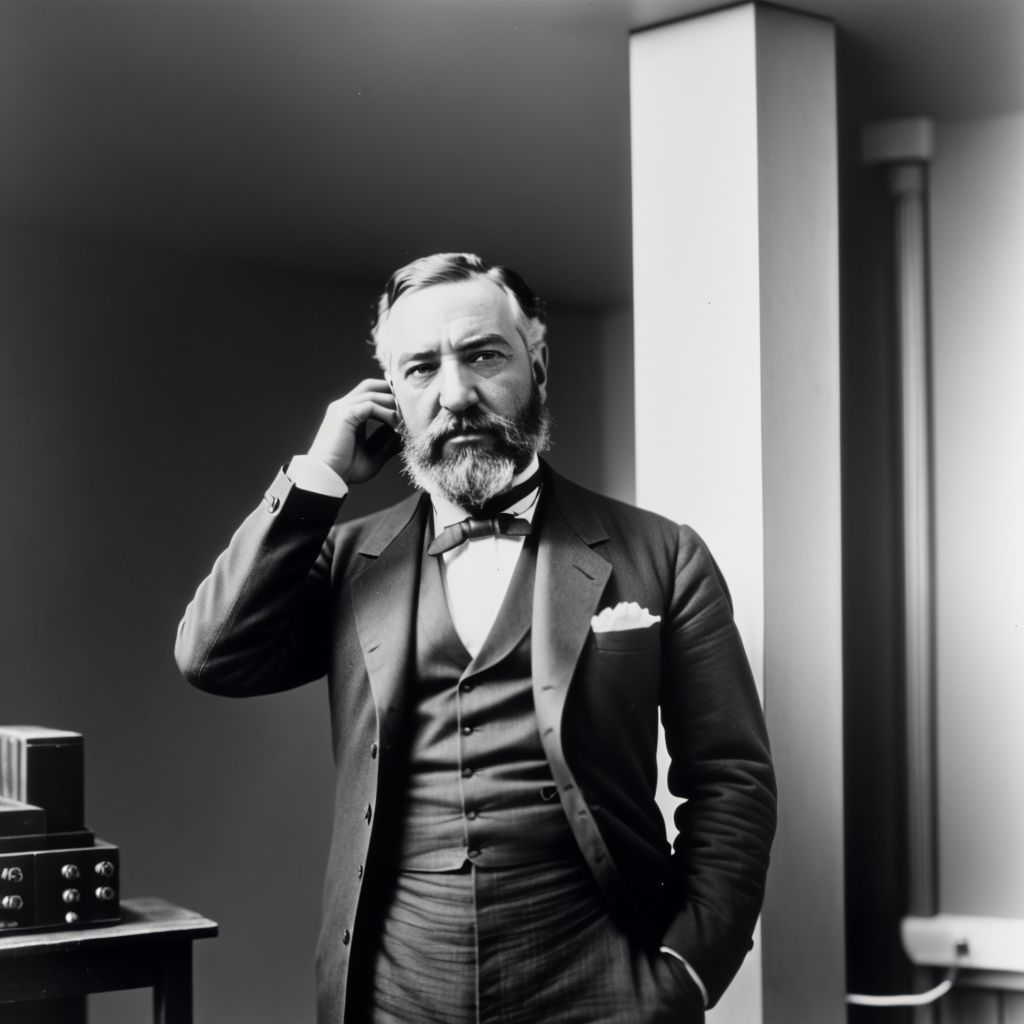
When Alexander Graham Bell received U.S. Patent No. 174,465 on July 31, 1876, he couldn’t have fully anticipated the extent to which his invention would change the world. What began as a rudimentary device capable of transmitting the human voice over a wire would evolve into one of the most transformative technologies in human history. That single patent didn’t just recognize a device; it codified the dawn of a new era in communication, one that would shrink distances, collapse time zones, redefine how humans interacted, and eventually embed itself into the fabric of daily life so thoroughly that it would become nearly invisible. But Bell’s story—and that of the telephone—was far from a straight line. It was filled with serendipity, rivalry, innovation, and above all, a profound belief in the human voice’s power to bridge space.

Alexander Graham Bell was born into a family already immersed in the study of sound. His father, Alexander Melville Bell, developed a system called “Visible Speech,” which was designed to help the deaf communicate through written symbols that represented vocal sounds. His mother, though hard of hearing, encouraged his pursuits in acoustics. And Bell, inheriting both curiosity and purpose, committed his life to the intersection of communication and science. It’s important to note that Bell’s interest in the telephone was not born from an obsession with gadgets or profit—it stemmed from his passion for helping the hearing impaired and connecting people through voice.

The story of the telephone is often narrated with Bell as the sole hero, but history is never so simple. In the 1870s, inventors around the world were racing to solve the problem of transmitting voice electronically. Elisha Gray, an American electrical engineer, submitted a caveat—a sort of placeholder for a patent—for a similar voice-transmitting device on the same day as Bell filed his patent application. This set the stage for one of the most heated patent battles in history. Though Bell was ultimately awarded the patent and recognized as the telephone’s inventor, controversy would swirl around the legitimacy of that victory for decades.

But it was Bell’s design that proved both novel and practical. It worked. The prototype used a diaphragm, a magnet, and a coil of wire to convert sound waves into electrical signals and then back into sound. Bell demonstrated his invention to the world at the 1876 Centennial Exposition in Philadelphia, famously calling to his assistant, “Mr. Watson, come here, I want to see you.” Those words, carried across a wire, electrified the minds of onlookers. For the first time in human history, a person could speak in one place and be heard clearly in another. It was not magic. It was science, and it was astonishing.

Bell was just 29 years old when the patent was granted. At that time, he had little money and no real infrastructure to commercialize his invention. But he quickly recognized its potential. Partnering with investors like Gardiner Greene Hubbard (who would later become his father-in-law) and Thomas Sanders, Bell helped form the Bell Telephone Company. The initial vision was modest—connect offices, government buildings, and perhaps some wealthy homes. What followed was an explosion in demand. Business owners understood immediately how revolutionary the device could be. Instead of sending a messenger across town, they could simply speak a sentence and be heard instantly. Efficiency skyrocketed.

Yet, acceptance wasn’t immediate across the board. Many skeptics dismissed the telephone as a toy or a novelty. The telegraph was still king, and it had the advantage of being well-established and understood. Western Union, the dominant player in the telegraph industry, even refused to buy Bell’s patents for what now seems a comically small amount of money. But the telephone had something that the telegraph didn’t—emotion. Human voice carried tone, urgency, warmth, and nuance in a way Morse code never could. Bell had unlocked a door to something profoundly human.

As the infrastructure for telephony expanded, so too did the technology. Switchboards were developed, allowing operators to manually connect calls. Then came the creation of telephone exchanges, rotary dialing, touch-tone phones, and eventually the transition from analog to digital systems. Each step along the way built on Bell’s original idea, refining it, expanding its reach, and making it ever more indispensable.

The cultural shift the telephone introduced was just as significant as the technological one. The notion that people could maintain relationships over distance—hear the voice of a loved one hundreds of miles away—altered family dynamics and business operations alike. Politicians could coordinate strategies faster, journalists could chase leads in real-time, and ordinary citizens could connect in ways never before imagined. It democratized information and emotion alike. And as the 20th century progressed, the telephone would become both a status symbol and a necessity. It found its way into nearly every household, reshaping architecture, etiquette, and even language itself.

And yet, Alexander Graham Bell never considered himself just an inventor of machines. Throughout his life, he continued to work with the deaf and champion causes related to education, aviation, and sound transmission. He founded Science magazine, worked on early aeronautics, and remained an intellectual force long after his telephone patent changed the world. In many ways, he saw the telephone not as an endpoint, but as a beginning—a foundation on which future generations would build new ways to connect.

Fast forward to the present, and the echoes of Bell’s first call can still be felt in every pocket and purse. The smartphone, packed with far more computing power than the Apollo missions, is a direct descendant of Bell’s 1876 prototype. Apps like FaceTime, Zoom, and WhatsApp are all modern manifestations of that original dream: connecting voices across space. The conversations we now have with AI voice assistants, the calls we make from the farthest corners of the Earth—all of them trace their roots back to that simple yet profound act of filing a patent and speaking across a wire.

But it’s not just the physical evolution of the telephone that’s worth reflecting on. It’s the human one. Bell’s invention didn’t merely change how we talked; it reshaped how we felt. It brought comfort during times of crisis, laughter in moments of joy, and urgency in emergencies. It provided a lifeline during world wars, a connection point in long-distance relationships, and a way for families separated by migration, war, or work to remain whole in spirit. That emotional bandwidth—the invisible thread connecting voices—is perhaps the most revolutionary aspect of all.

And like all powerful technologies, the telephone has also mirrored the times. During the civil rights movement, activists used telephones to organize. During the Cold War, hotline phones were established between world leaders to avert disaster. During the COVID-19 pandemic, voice and video calls replaced face-to-face interactions for months on end, reminding us that connection—while physical—is often sustained emotionally through voice.

The story of July 31, 1876, then, is more than a historical footnote. It’s the ignition point of a communications revolution that still reverberates. It’s a reminder that innovation often begins not with a profit motive, but with a human need—a desire to connect, to understand, to bridge distance with empathy. It’s a story of ambition, rivalry, triumph, and transformation. And it’s still unfolding.

As we stand today, surrounded by smart devices, satellites, fiber-optic cables, and wireless towers, it’s easy to overlook the fact that all this began with a young inventor’s deep desire to make voice travel. Bell may not have imagined the exact shape the future would take, but he knew it would speak—and that someone, somewhere, would be listening.

Related Posts

The Day America Promised to Care for Its Own

Elias Rowen

It was a sweltering July afternoon in Independence, Missouri, when a president stood shoulder to shoulder with a man who once held his job, both of them representing two very different chapters of American history. The year was 1965, and the moment was far more than ceremonial—it was a reckoning. On July 30th, President Lyndon B. Johnson, wielding a pen and a determined spirit, signed into law two of the most transformative pieces of social legislation in American history: Medicare and Medicaid. That day, the arc of the nation bent not only toward justice but also toward compassion, responsibility, and hope for its most vulnerable.

In attendance that day was former President Harry S. Truman, seated beside his wife, Bess. Johnson handed Truman the very first Medicare card, declaring him “the real daddy of Medicare.” It was a symbolic gesture that acknowledged the roots of the idea, one long planted during Truman’s presidency but left to wither under political resistance. Johnson’s decision to hold the signing ceremony in Truman’s hometown was not accidental—it was deeply intentional, a tribute to unfinished work now brought to fruition.

To understand how monumental this moment was, one must first look at the America that preceded it. For decades, older adults and low-income families languished in the shadows of the American healthcare system. Medical care, increasingly sophisticated and expensive in the 20th century, had become a luxury. For the elderly, the problem was particularly acute. More than half of Americans over the age of 65 lacked any form of health insurance in 1965, and many were bankrupted by illness. Without Medicare, their twilight years were often spent not in dignity but in destitution. Meanwhile, poor families—especially in southern states and minority communities—faced even grimmer prospects, denied both access and agency in their medical choices.

The road to this breakthrough was anything but smooth. Johnson’s “Great Society” vision was bold and sweeping, echoing FDR’s New Deal but stretching further into the soul of the nation. It promised civil rights, educational equality, environmental stewardship, and the alleviation of poverty. But it was the commitment to healthcare for the aged and the impoverished that would come to symbolize the moral clarity of this legislative push. The battle in Congress was fierce, lined with Republican opposition and even hesitation from moderate Democrats. Powerful lobbying forces, including the American Medical Association, feared what they saw as government overreach and socialized medicine.

Yet Johnson was a man who understood power and persuasion. He used every ounce of political capital, drawing from his time as Senate Majority Leader. He didn’t ask for consensus—he engineered it. By reframing the conversation not as a radical shift but as a moral imperative, Johnson brought skeptical lawmakers into the fold. He wrapped the issue in the American ethos of decency and duty, compelling Congress to act. When the final bills—Title XVIII and Title XIX of the Social Security Act—emerged from committee, they represented a delicate compromise but also a landmark departure from the past.

Title XVIII, better known as Medicare, created a health insurance program for Americans 65 and older, funded by payroll taxes and general revenues. It was structured in parts: Part A covered hospital insurance, while Part B addressed outpatient care. Title XIX, Medicaid, was more complex, targeting low-income Americans across all age groups. Unlike Medicare, it was jointly funded by states and the federal government, allowing some flexibility but also spawning decades of variation in access and quality across state lines.

The implementation was swift. Within the first year, over 19 million Americans enrolled in Medicare. Hospitals that had previously segregated or turned away elderly and poor patients began a process of desegregation and modernization, catalyzed by the financial incentives tied to compliance. The impact was immediate and profound. Senior citizens who had once feared becoming burdens could now afford to see a doctor, undergo surgery, and access medications. Poor families could bring their children to clinics without the cloud of bankruptcy.

But this was not just about medical bills—it was about dignity. It was about a mother no longer choosing between food and her child’s antibiotics, a grandfather seeing a specialist before it was too late, or a diabetic receiving insulin without pawning household possessions. It was about acknowledging that in the richest country on Earth, letting someone die for lack of money was not just inefficient—it was immoral.

In the decades that followed, Medicare and Medicaid became cornerstones of American public health. They grew in scope and complexity, adapting to the country’s evolving demographics and needs. Medicare expanded to include younger people with disabilities and those with end-stage renal disease. Medicaid became the backbone of long-term care, especially for elderly nursing home residents and disabled individuals. Together, the programs served over 100 million Americans by the early 21st century.

Yet, for all their achievements, the programs also became lightning rods in the nation’s endless healthcare debate. Critics raised concerns about costs, fraud, and inefficiency. Political battles flared over expansion, especially during the Obama administration’s Affordable Care Act rollout, which used Medicaid as its central expansion vehicle. In some states, ideological resistance led to millions being left without coverage, despite federal subsidies. Meanwhile, debates over privatization, “Medicare Advantage” plans, and state waivers for Medicaid reflected deeper philosophical disagreements about the role of government in health.

Still, amid the noise, the core truth remained unchanged: these programs saved lives. They kept hospitals open in rural America. They ensured care for premature infants and the terminally ill. They supported people through childbirth and hospice. They formed a safety net that, while imperfect, was better than the abyss.

The human stories behind these statistics are what give them soul. There’s the Alabama farmer who had never seen a doctor in his adult life until Medicaid made it possible. The Brooklyn grandmother who lived to hold her great-grandchild because Medicare covered her triple bypass surgery. The mentally disabled teen in Ohio who could finally attend a specialized school thanks to Medicaid-supported services. These are not anecdotes—they are testimonies to a society that, on that July day in 1965, chose compassion over complacency.

Johnson understood this well. In his speech at the signing, he said, “No longer will older Americans be denied the healing miracle of modern medicine. No longer will illness crush and destroy the savings that they have so carefully put away over a lifetime.” He didn’t use lofty economic metrics or wonky health statistics. He used the language of empathy, framing health care as a right, not a privilege.

And yet, the work remains unfinished. Today’s debates about healthcare access—whether around single-payer proposals, public options, or Medicaid work requirements—are echoes of the same philosophical battle waged in the 1960s. The questions remain: Who deserves care? Who pays for it? And what does it mean to live in a society that values health as a shared good?

As we reflect on that summer day in Independence, we are reminded that policy is not just paperwork—it’s a promise. Medicare and Medicaid were born not of perfection, but of political will and human need. They were declarations that no American should face death or suffering simply because they were poor or old. That spirit—that commitment to shared humanity—is the legacy of July 30, 1965.

Today, when politicians spar over healthcare budgets and citizens line up for prescription drugs they can’t afford, we do well to remember that change is possible. That, once upon a time, in the heartland of America, two presidents sat side by side and dared to believe that government could be a force for good.

In the story of American healthcare, July 30th is not a footnote—it is a chapter title. And in the hearts of those who have felt its impact, it’s a date carved into the soul.

Related Posts

The Man Who Forged the Fasces: The Rise, Rule, and Ruin of Benito Mussolini

Elias Rowen

On July 29, 1883, in a humble home in the small town of Predappio in northern Italy, a child was born who would go on to change the course of European history. That child, Benito Amilcare Andrea Mussolini, would become the founding father of Fascism, a political ideology that promised national strength and unity but delivered violence, oppression, and devastation. The world remembers Mussolini as the iron-jawed dictator who paraded in military garb, spouted firebrand speeches from Roman balconies, and forged a dangerous alliance with Adolf Hitler. But before he became “Il Duce”—The Leader—he was a schoolteacher’s son with revolutionary dreams, torn between socialism and nationalism, driven by ego, vision, and a lust for power.

To understand Mussolini is to understand the turbulent Italy into which he was born. In 1883, Italy was a young nation, barely unified and riddled with economic disparity. The industrial north thrived while the rural south remained impoverished. Political corruption was rampant. The dream of a united Italy had not yet matured into a functioning reality. For many Italians, life was a struggle, and politics offered no clear salvation. This fertile ground of discontent was where Mussolini’s identity would take root.

His father, Alessandro Mussolini, was a blacksmith and a passionate socialist. His mother, Rosa, was a devout Catholic schoolteacher. The contradictions in his household—radical politics on one side, strict discipline and faith on the other—created a young man of contrasts. Benito was intelligent, headstrong, and often in trouble. He was expelled from multiple schools for bad behavior, yet he was a voracious reader. Karl Marx, Friedrich Nietzsche, Georges Sorel, and Machiavelli filled his mind with revolutionary fervor, nihilism, and ideas about power, struggle, and destiny.

By the time he entered adulthood, Mussolini was a committed socialist and editor of a left-wing newspaper. He railed against capitalism, the church, and monarchy, championing workers’ rights and anti-militarism. He was even jailed for inciting strikes. Yet, when World War I erupted in 1914, Mussolini shocked his comrades by breaking with the Socialist Party to support Italian intervention. He believed that the war would forge a new national consciousness and provide the opportunity for Italy to claim its place among the great powers. This marked his ideological pivot—from revolutionary socialist to fervent nationalist—a transformation that would redefine not only his life, but the life of an entire nation.

Italy emerged from the war victorious but broken. The country’s economy was in shambles, its people demoralized, and its political system in disarray. Veterans returned to a land that felt indifferent to their sacrifices. The promise of territorial gains from the Treaty of Versailles had fallen short. In this chaos, Mussolini founded the Fasci di Combattimento in 1919—an amalgam of disgruntled soldiers, nationalists, and anti-communists. From this movement, the ideology of fascism was born.

Fascism was deliberately vague, adaptable to the political winds. It glorified the state, celebrated violence as a political tool, and demanded loyalty to a single leader. It was anti-communist, anti-democratic, anti-liberal. It promised order through strength and tradition. Mussolini used it as a vehicle for personal power. His “Blackshirts,” paramilitary thugs dressed in dark uniforms, terrorized opponents, broke strikes, and created chaos in the streets—all with the goal of making him appear as the only one who could restore peace.

In 1922, Mussolini staged his grand theatrical debut: the March on Rome. It was less a military conquest than a show of force, but it worked. King Victor Emmanuel III, fearful of civil war, invited Mussolini to form a government. At the age of 39, Mussolini became Italy’s youngest prime minister. He did not seize power in a bloody coup. He was handed it, legally, within the framework of a parliamentary monarchy.

What followed was a systematic dismantling of democracy. Press freedoms were curtailed, opposition parties outlawed, and political dissent silenced. By 1925, Mussolini had declared himself dictator. “Everything within the state, nothing outside the state, nothing against the state,” he declared. The fascist regime was built around the cult of personality. Mussolini’s image was everywhere—on billboards, in classrooms, in churches. He posed as the embodiment of Roman virtue: strong, stoic, decisive. He cultivated an aura of invincibility, though behind the façade was a man plagued by insecurity and obsessed with control.

Under Mussolini, Italy saw some modernization: public works projects, electrification, and the draining of marshlands. The trains, famously, did start running on time. But these achievements came at a terrible cost. The regime crushed unions, outlawed strikes, and imposed censorship. Dissenters were imprisoned, tortured, or exiled. Italy became a surveillance state, where informants and secret police eroded trust between neighbors.

Perhaps the most tragic consequence of Mussolini’s rule was his colonial ambition. Fascist ideology was deeply racist and imperialist. Mussolini envisioned a rebirth of the Roman Empire, and to achieve this, he turned his attention to Africa. In 1935, he ordered the brutal invasion of Ethiopia. Italian forces used chemical weapons and committed atrocities against civilians. The war was condemned internationally, but the League of Nations proved impotent. Mussolini took this as a green light and began to dream even bigger.

The same year, he began drawing closer to Adolf Hitler. Initially wary of the Austrian-born Nazi, Mussolini came to admire Hitler’s ruthlessness and ability to command loyalty. The two leaders, both steeped in fascist ideology, forged the Rome-Berlin Axis in 1936. Mussolini’s regime adopted increasingly racist policies, culminating in anti-Semitic laws that mirrored Nazi Germany’s Nuremberg Laws. Italian Jews, many of whom had supported Mussolini in his early years, found themselves stripped of rights and dignity.

When World War II broke out in 1939, Mussolini hesitated. Italy was not ready for war, economically or militarily. But as Hitler’s forces swept across Europe in 1940, Mussolini made the fateful decision to join the conflict on the Axis side. He believed the war would be over quickly and wanted a seat at the victory table. It was a catastrophic miscalculation. Italian forces were ill-prepared, poorly equipped, and led by a regime intoxicated with its own propaganda. Campaigns in Greece, North Africa, and the Soviet Union ended in humiliating defeat.

By 1943, Italy was in chaos. Allied forces landed in Sicily, and Mussolini’s support collapsed. The Grand Council of Fascism turned against him. He was arrested on the orders of the king—the same monarch who had once handed him power. But the story didn’t end there. Hitler sent commandos to rescue Mussolini in a daring mountaintop operation. The Nazi regime installed him as a puppet leader in northern Italy, heading the so-called Italian Social Republic. It was a grim epilogue: a broken man ruling a broken state, propped up by foreign tanks and dwindling loyalty.

In April 1945, as Allied forces closed in, Mussolini attempted to flee to Switzerland with his mistress, Clara Petacci. They were captured by Italian partisans near Lake Como. On April 28, he was executed by firing squad. His body was taken to Milan, where it was hung upside down in a public square, spat on and desecrated by the people he had once ruled. It was a gruesome end, devoid of the glory he had promised his followers.

Today, Mussolini’s legacy is still contested in Italy. Some remember him as a tyrant, others as a misunderstood patriot. His tomb in Predappio remains a pilgrimage site for far-right extremists. But history, when told in full, leaves little doubt. Mussolini was not a misunderstood leader. He was a dictator who promised unity but sowed division, who preached greatness but delivered ruin. He dragged his country into a world war, aligned with the most monstrous regime in human history, and left behind a trail of blood and rubble.

Yet, understanding Mussolini is essential—not to glorify him, but to recognize the signs of authoritarianism. He did not seize power in a vacuum. He exploited fear, economic insecurity, and nationalist sentiment. He used modern media to craft a myth of infallibility. He offered simple answers to complex problems and silenced those who questioned him. These tactics are not relics of the past. They resurface, time and again, wherever democracy grows fragile.

The story of Mussolini reminds us that democracy is not self-sustaining. It must be protected by informed citizens, independent institutions, and a culture that values truth over spectacle. Mussolini once said, “It is better to live one day as a lion than a hundred years as a sheep.” But his lion’s roar was built on lies, and in the end, it led only to disgrace.

On July 29 each year, we would do well to remember what was born that day in 1883—not just a man, but a warning. A cautionary tale about charisma without conscience, ambition without accountability, and nationalism unbound. The life and legacy of Benito Mussolini are reminders that freedom, once lost, is not easily regained—and that history, if ignored, is always waiting to repeat itself.

Related Posts

A Language for Peace: The Dawn of the Esperanto Movement

Elias Rowen

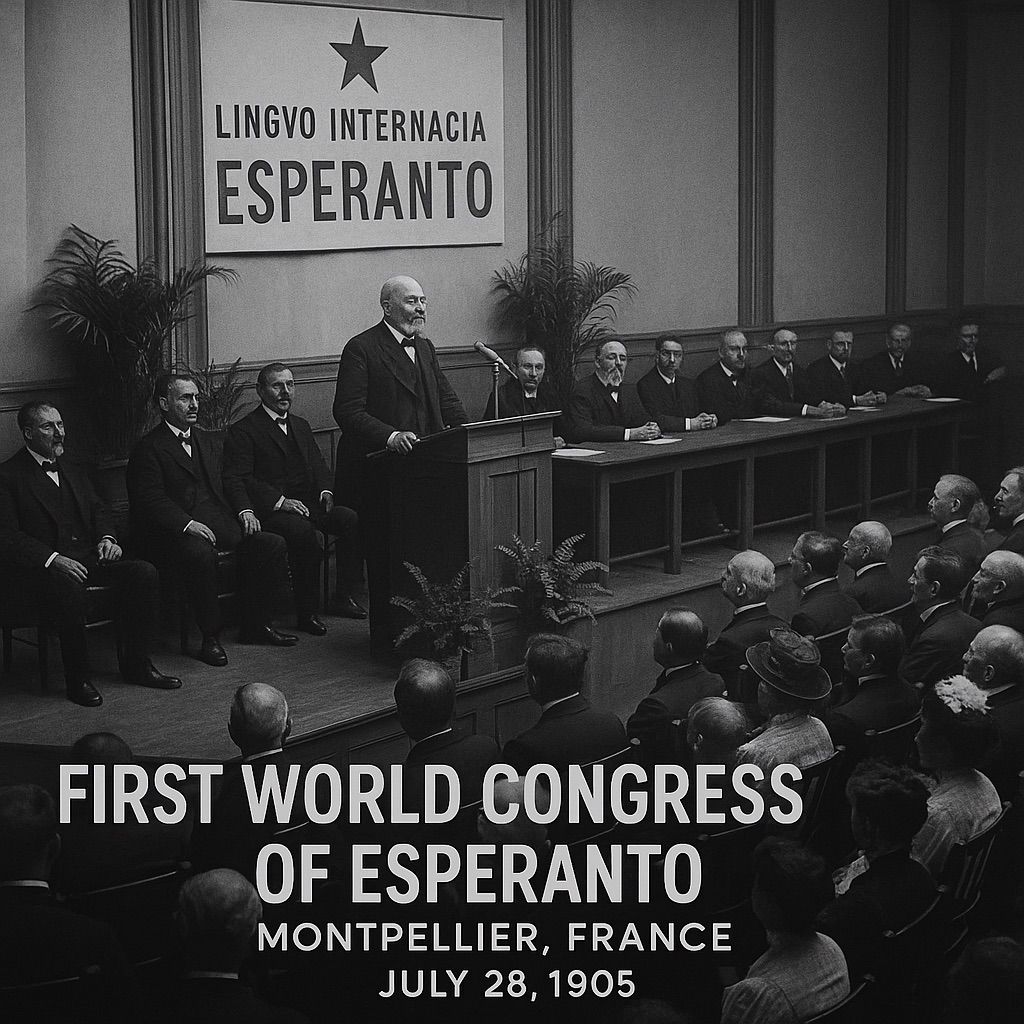
On July 28, 1905, the sleepy French seaside town of Boulogne-sur-Mer played host to an unprecedented event that would quietly echo across cultures and borders for more than a century—the First World Congress of Esperanto. Unlike political summits or royal affairs that often dominated the headlines, this was a gathering of idealists, linguists, teachers, and dreamers who came together for a radical reason: to build a better world through a common, neutral language. In a world already simmering with nationalism, colonialism, and rising tensions that would eventually explode into global war, the Esperanto Congress was a peaceful rebellion against division. It wasn’t just a linguistic experiment; it was a vision for global understanding.

The idea behind Esperanto was born decades earlier in the mind of Ludwik Lejzer Zamenhof, a Jewish ophthalmologist from Białystok—then part of the Russian Empire, now in modern-day Poland. Zamenhof grew up in a culturally fragmented city, where Poles, Russians, Germans, and Jews lived uneasily side by side, often separated not just by faith or politics but by language itself. As a child, he was disturbed by the misunderstandings, insults, and fights that arose simply because people couldn’t understand each other. It wasn’t just frustrating—it was heartbreaking. To young Ludwik, language seemed like both a wall and a weapon. And so, rather than simply accepting the world as it was, he began crafting a new way to communicate.

By 1887, Zamenhof had published Unua Libro (“First Book”) under the pseudonym “Doktoro Esperanto,” meaning “Doctor One Who Hopes.” In it, he presented the structure and vocabulary of an entirely new language—designed to be easy to learn, politically neutral, and globally accessible. With regular grammar, phonetic spelling, and a vocabulary largely drawn from European tongues, Esperanto was created with the learner in mind. The name he used, “Esperanto,” soon became the name of the language itself. Zamenhof never sought to replace national languages, but to provide a shared second language for international dialogue—a linguistic bridge for the human family.

The language slowly began to spread, first through Europe and then more broadly. It was shared in magazines, letters, and language clubs. People began writing poems, articles, and even novels in Esperanto. But it wasn’t until 1905, nearly two decades after its initial publication, that the movement took a historic leap forward with the First World Esperanto Congress.

The congress, known as the Unua Kongreso, brought together 688 delegates from 20 different countries. They arrived in Boulogne-sur-Mer by rail and by sea, from as far away as Japan and the United States, and from every corner of Europe. They had never met in person before, but they could speak fluently with one another in Esperanto. That shared language immediately erased the sense of strangeness that might have existed between such diverse individuals. There were no interpreters, no hierarchies of language prestige. For the first time, participants from different cultures could meet as equals—not in theory, but in practice.

The congress lasted several days, and the excitement was palpable. The attendees didn’t just discuss language or grammar. They organized lectures, recitals, and public events. They established cultural societies and exchanged publications. Zamenhof himself delivered a speech that remains iconic, not just in the history of Esperanto but in the broader story of global humanism. He spoke with modesty and warmth, warning against turning Esperanto into a religion or political doctrine. “The inner idea of Esperanto,” he said, “is the dream of universal human brotherhood.” The congress culminated with the ratification of the Fundamento de Esperanto, the official cornerstone document for the language’s grammar and usage, ensuring stability as the language continued to grow.

What made the 1905 congress so historic wasn’t just its size or novelty—it was its profound spirit. In a time when the world was still carved up by empires, and where prejudice was often codified in law, here was a gathering that defied it all through conversation, curiosity, and mutual respect. The congress demonstrated that a shared, intentionally neutral language could break down barriers that diplomacy and politics often couldn’t.

The human stories from that congress are especially striking. Consider the Japanese delegate who read his original poetry in Esperanto and was met with thunderous applause from his French and Russian peers. Or the group of children from Germany and the Netherlands who played games in Esperanto in the garden of the congress venue, laughing without needing translation. For many attendees, this was not just an intellectual meeting—it was a deeply emotional experience. They had found a kind of linguistic family, a new cultural home that transcended geography.

As Esperanto’s first truly international event, the 1905 congress also set a precedent for the movement’s democratic and inclusive values. Unlike elite academic conferences, the congress welcomed people from all walks of life: schoolteachers, postal workers, librarians, students, and scholars. No one was “foreign.” Everyone was an “Esperantist.” And this identity was chosen, not inherited or assigned. That spirit remains one of the defining qualities of the Esperanto community even today.

Of course, the story of Esperanto and the legacy of the 1905 congress cannot be separated from the broader currents of 20th-century history. The years that followed would challenge the dream Zamenhof so passionately believed in. World War I broke out just nine years after that hopeful gathering in Boulogne-sur-Mer. Then came fascism, Stalinism, and a second world war. Esperanto, seen by totalitarian regimes as a threat to nationalism, was brutally suppressed in several countries. The Nazis considered it subversive, partly due to Zamenhof’s Jewish heritage and the language’s association with internationalism. Stalin’s secret police arrested and executed many Esperantists during the purges, viewing them as suspected spies or enemies of the state.

And yet, despite persecution, Esperanto endured. Its speakers continued to correspond, publish, and organize. The World Esperanto Congress became an annual tradition, with interruptions only during global conflicts. Each time it resumed, it rekindled the same spirit that had defined the 1905 meeting. Over time, the congress grew even more diverse. Delegates began coming from Africa, Latin America, Oceania. The age range expanded. Esperanto music, theater, and literature flourished. Zamenhof’s dream did not fade; it adapted.

What makes the 1905 congress particularly moving, especially in hindsight, is how deeply it speaks to timeless human aspirations. It wasn’t a utopian delusion but a genuine effort to meet each other on common ground. Today, in an era of instant translation apps and AI-powered communication, the idea of a constructed global language might seem quaint. But Esperanto was never just about words—it was about intent. To learn Esperanto was to commit to the idea that people from vastly different backgrounds could engage with one another as equals. That vision remains as relevant as ever in our increasingly fragmented digital world.

The humanization of language—this was Esperanto’s great promise. And that was precisely what was celebrated in Boulogne-sur-Mer in 1905. The congress offered a rare glimpse of what the world could look like if we chose connection over conquest, mutual understanding over mistrust. It offered hope at a time when hope was in short supply. And perhaps most remarkably, it did so not through power or wealth, but through grammar, goodwill, and shared dreams.

There’s something poetic about the location, too. Boulogne-sur-Mer, perched on the English Channel, has always been a place of arrivals and departures—a liminal space where land meets sea, and where people pause on their way elsewhere. That it became the site of the first Esperanto Congress is fitting: a borderland city playing host to a language designed to erase borders.

L. L. Zamenhof died in 1917, having lived long enough to witness the beginnings of war but not the full scale of devastation to come. He didn’t see the Holocaust that claimed the lives of many members of his family. Nor did he see the rise of the United Nations or the long Cold War that would shape the second half of the century. But the seed he planted in 1905 continues to grow, nurtured by idealists who, like him, believe that language can heal, rather than divide.

Esperanto today remains a living language. It is spoken, written, sung, and studied by people around the world. There are Esperanto courses on Duolingo, conferences held in dozens of countries, and even families who raise their children as native Esperanto speakers alongside their local tongues. The ideals of equality, neutrality, and accessibility endure. And every year, Esperantists still gather for a World Congress, tracing their lineage back to that seminal meeting in France. The faces change, the technologies evolve, but the spirit is unmistakably the same.

The First World Congress of Esperanto wasn’t just a meeting—it was a declaration. A quiet revolution that chose verbs over violence, conversation over conquest. It reminds us that there is profound power in listening, in learning each other’s words, and in crafting new ones together. In an age of noise, the message from 1905 still whispers clearly: another world is possible—if we can find a common language.

Related Posts

Ceasefire at Panmunjom: The Day the Guns Fell Silent in Korea

Elias Rowen

It was a stifling summer morning in the demilitarized village of Panmunjom on July 27, 1953. After more than three years of grueling warfare, countless negotiations, and immeasurable loss, the guns finally fell silent on the Korean Peninsula. What unfolded that day was not a declaration of victory or a celebration of triumph, but a fragile agreement to stop the bloodshed—a ceasefire that marked the end of combat in the Korean War. The armistice was a moment of bittersweet significance, simultaneously a relief and a reminder that the conflict was unresolved. As the ink dried on the truce documents, the Korean War came to a halt, not with parades or banners, but with the quiet sigh of exhausted soldiers and broken families who had waited too long for a semblance of peace.

The Korean War has often been dubbed “The Forgotten War,” sandwiched between the global catastrophe of World War II and the controversial quagmire of Vietnam. Yet, for the millions affected, there was nothing forgettable about it. The war began in June 1950, when North Korean forces, backed by Soviet and Chinese support, launched a surprise invasion into South Korea. The peninsula, already fractured along ideological lines following Japan’s defeat in World War II, quickly became the stage for the first significant armed conflict of the Cold War. Within days, the fighting escalated into a multinational effort. Under the banner of the United Nations, led primarily by the United States, allied forces surged to support the beleaguered South Koreans. In response, waves of Chinese soldiers poured over the Yalu River to aid the North, plunging the region into a bloody stalemate.

By the time the armistice talks began in 1951, the conflict had become a grinding war of attrition. Trenches crisscrossed the Korean Peninsula like open wounds, eerily reminiscent of World War I. The front line stabilized near the 38th parallel, the same division that had marked the ideological rift since 1945. What ensued was not just a military confrontation, but a political deadlock, as both sides haggled over the minutiae of peace: the location of borders, the status of prisoners of war, and even the shape of the negotiating table. The latter became emblematic of how symbolism often trumped pragmatism in Cold War diplomacy. Progress was painfully slow, and soldiers continued to die even as their leaders sat in air-conditioned tents debating semantics.

The human toll was staggering. Estimates suggest that nearly five million people died during the Korean War, over half of them civilians. Cities like Seoul changed hands multiple times, each time leaving behind rubble, ruins, and the scars of war. Families were ripped apart, some never to reunite. For soldiers, the experience was harrowing. Bitter winters, mountainous terrain, and relentless artillery fire turned Korea into a hellish battlefield. The terrain was so rugged and the fighting so fierce that American veterans often referred to Korea as “no-man’s-land,” a place where the enemy could be invisible but always deadly. Meanwhile, for Korean civilians caught in the crossfire, the war brought untold suffering—villages razed, homes burned, and generations traumatized.

So, by the time that morning at Panmunjom arrived, hope had become a rare commodity. The armistice, signed at 10 a.m., was not a peace treaty. It did not resolve the ideological chasm between North and South Korea. Instead, it created the Korean Demilitarized Zone (DMZ), a 160-mile-long and 2.5-mile-wide buffer that remains one of the most fortified borders in the world. The agreement also included provisions for the repatriation of prisoners of war, a point of intense contention during negotiations. Operation Big Switch and Operation Little Switch followed the signing, facilitating the exchange of thousands of captured soldiers, many of whom had endured brutal conditions in POW camps.

What is most remarkable about the Korean Armistice is not just that it ended active combat but that it set a precedent for frozen conflict—one where peace is maintained not through resolution but through deterrence. To this day, no official peace treaty has been signed, and technically, North and South Korea remain at war. The armistice was a pause button on a conflict that has never been fully stopped. It marked the beginning of a tense status quo, punctuated by provocations, threats, and uneasy diplomacy.

Yet, despite its limitations, the armistice remains one of the most significant moments in Cold War history. It showed that even in the darkest hours of ideological confrontation, dialogue was possible. It reflected the exhaustion of superpowers wary of another global conflagration. The Soviet Union and the United States, while not direct adversaries on the battlefield, were keenly aware of the risks of escalation. In many ways, Korea became a testing ground for Cold War diplomacy—a proving point that mutual destruction could be avoided, if only barely.

The signing ceremony itself was somber and subdued. On the North Korean side, General Nam Il signed the document, while the United Nations Command was represented by U.S. Army Lieutenant General William Harrison Jr. There were no handshakes, no expressions of goodwill. Instead, the signatures were exchanged like tokens in a high-stakes chess game. The ink might have sealed the agreement, but it was the unspoken understanding—the weariness of endless war—that truly cemented the moment.

For veterans of the Korean War, the armistice brought a complex mixture of emotions. Relief was coupled with frustration. Many American soldiers returned home to muted receptions, their service overshadowed by the grand narratives of World War II. South Korean soldiers and civilians, while grateful for the cessation of hostilities, remained under the constant shadow of the North. In North Korea, the regime used the outcome to solidify its grip on power, portraying the armistice as a victory against imperialist forces.

In the decades since, the DMZ has become more than just a border—it is a symbol of division, resilience, and unresolved tension. Wildlife has flourished in the zone, ironically benefitting from the absence of human intrusion. Occasionally, diplomatic overtures have brought moments of optimism. The 2000 and 2018 summits between North and South Korean leaders at Panmunjom offered glimpses of potential reconciliation. But the armistice itself remains in place, a reminder that peace is often more elusive than war.

Generations born after 1953 have grown up in a Korea that knows neither complete peace nor active war. In South Korea, economic prosperity and democratic progress stand in stark contrast to the isolation and authoritarianism of the North. The armistice has allowed for survival and growth, but not healing. Families divided by the war still await reunification. Elders on both sides hold onto fading photographs and memories of loved ones who disappeared into the fog of conflict. The psychological scars remain, passed down like heirlooms to new generations.

The world today continues to feel the reverberations of that day in Panmunjom. North Korea’s nuclear ambitions, its missile tests, and the international response all occur against the backdrop of an unfinished war. The armistice is not just a historical footnote; it is a living document, its relevance undiminished by time. As long as the DMZ exists, so too does the question: when will the war truly end?

Perhaps the most profound legacy of the Korean Armistice is the lesson that conflict, even when paused, continues to shape societies. The ceasefire brought silence to the battlefield, but not to the discourse surrounding it. Veterans’ groups, historians, and peace activists continue to call for a permanent peace treaty. Efforts like those by the Korean War Veterans Memorial in Washington, D.C., and similar monuments around the world strive to preserve the memory of those who served and sacrificed.

On anniversaries of the armistice, aging veterans gather in solemn ceremonies. They lay wreaths, share stories, and remember those who never returned. Their memories are bridges between past and present, between sacrifice and legacy. For them, the armistice is more than a date—it is a pivotal chapter in their lives, etched into the fabric of who they are.

As we look back at July 27, 1953, it is important not to romanticize the armistice, but to recognize it for what it was: a necessary and hard-fought pause in a brutal conflict. It is a date that should compel reflection, not just on war, but on the value of peace, the cost of ideology, and the human spirit’s capacity to endure. It teaches us that sometimes the most powerful victories are not declared with trumpets or fanfare but whispered in the quiet moments when the guns fall silent and the healing begins.

Related Posts

The Spark That Lit a Revolution: Cuba’s 26th of July Movement and the Road to Revolution

Elias Rowen

On the morning of July 26, 1953, a group of young revolutionaries led by a little-known lawyer named Fidel Castro launched an attack on the Moncada Barracks in Santiago de Cuba. It was a desperate gamble, an audacious assault against the heart of Fulgencio Batista’s military regime. Most of the attackers were either killed or captured. In the immediate aftermath, it looked like an embarrassing failure. But that attack would go on to ignite the most transformative revolution in Latin American history—the Cuban Revolution—and give birth to a movement that still echoes through time: the 26th of July Movement. This essay traces the origins, evolution, and legacy of that bold uprising and the grassroots movement it inspired, exploring how one failed assault gave way to one of the most enduring socialist revolutions of the 20th century.

To understand the significance of July 26, we must go back to the political and social landscape of Cuba in the early 1950s. At that time, Cuba was mired in corruption, inequality, and repression under the authoritarian rule of Fulgencio Batista. Batista had come to power in a military coup in 1952, canceling democratic elections and imposing a dictatorship backed by the military and increasingly supported by foreign business interests—particularly from the United States. For much of the Cuban population, especially the rural poor and urban working class, life was marked by economic hardship, political disenfranchisement, and lack of access to education and healthcare. The veneer of modernization in Havana masked deep social divides across the island.

Among the voices of dissent rising from this climate of injustice was a young Fidel Castro. A well-educated lawyer from a middle-class background, Castro had grown disillusioned with the corruption of Batista’s regime and the impotence of traditional opposition politics. Alongside his brother Raúl Castro and other passionate idealists, Fidel began organizing a group of like-minded individuals—many of them students, workers, and disaffected soldiers—who believed that direct action was the only way to bring change to Cuba. This group would later coalesce into what became known as the Movimiento 26 de Julio, or the 26th of July Movement, named after the date of their first major action.

The plan was daring but flawed: storm the Moncada Barracks in Santiago de Cuba, the second-largest military garrison in the country. The objective was to seize weapons, inspire a mass uprising, and spark a revolution that would overthrow Batista’s dictatorship. Early on the morning of July 26, 1953, about 135 revolutionaries launched the attack. The operation was plagued by poor coordination, lack of communication, and overwhelming military opposition. The assault quickly fell apart. Dozens of rebels were killed in the fighting or executed shortly thereafter. Fidel and Raúl Castro were captured, and many others were tortured or disappeared.

Yet what followed turned failure into myth. Fidel Castro’s trial became a platform for revolution. Though technically a defendant, Castro used his time in court to deliver a fiery speech that would go down in history: “History will absolve me.” In that speech, he outlined the injustices of Batista’s regime, the corruption of Cuban society, and the hopes of the revolution. He articulated the goals that would later define the Cuban Revolution: land reform, education, healthcare, and an end to U.S. exploitation. Castro’s words were smuggled out of prison and widely circulated, turning public opinion and sowing the seeds of resistance.

Castro and his comrades were eventually sentenced to long prison terms, but due to mounting public pressure and a political amnesty campaign, they were released in 1955—less than two years after the attack. Upon release, Fidel went into exile in Mexico, where he met a young Argentine doctor with a fierce intellect and revolutionary passion: Ernesto “Che” Guevara. Together, along with Raúl and other exiled revolutionaries, they began to reorganize the 26th of July Movement with a new strategy: guerrilla warfare.

In December 1956, Castro and 81 other rebels set sail from Mexico aboard a cramped yacht named Granma. Their goal was to land in eastern Cuba and begin a guerrilla war in the Sierra Maestra mountains. Once again, disaster nearly struck. Their landing went awry, most of the group was killed or captured, and only a dozen or so survived. But those survivors, including Fidel, Raúl, and Che, managed to regroup in the mountains and build a small but determined insurgency. They relied heavily on support from rural peasants, whom they helped educate, treat medically, and organize politically. The guerrilla campaign began to gain momentum.

Over the next two years, the 26th of July Movement evolved from a ragtag band of rebels into a nationwide revolutionary force. Through a combination of tactical guerrilla warfare, propaganda, and popular support, they eroded the legitimacy and power of Batista’s government. Urban resistance, student protests, labor strikes, and international condemnation of Batista’s human rights abuses all contributed to the regime’s unraveling. As the movement grew, so did the myth of the revolutionaries: romanticized as underdog freedom fighters, their images and messages spread through the underground press and sympathetic media abroad.

By late 1958, Batista’s grip on power was faltering. Rebel forces, now numbering in the thousands, launched coordinated offensives across the island. On January 1, 1959, Fulgencio Batista fled Cuba, and Fidel Castro’s forces triumphantly entered Havana days later. The revolution had succeeded. What had begun as a failed assault on a military base on July 26, 1953, had culminated in a complete transformation of the Cuban political landscape.

But the triumph of the revolution was just the beginning of a far more complex journey. The 26th of July Movement, once a clandestine group of insurgents, now had to govern. Under Fidel Castro’s leadership, Cuba underwent sweeping changes. The new government nationalized industry and agrarian land, redistributed wealth, launched literacy and health campaigns, and aligned increasingly with the Soviet Union as tensions with the United States escalated. What began as a nationalist revolution quickly evolved into a socialist state.

The legacy of the 26th of July Movement is multifaceted. For many, it represents a courageous fight against dictatorship, imperialism, and inequality. It inspired revolutionary movements across Latin America, Africa, and Asia. It elevated figures like Che Guevara to global icons of rebellion. And it served as a real-world example of successful armed revolution against a militarized regime.

Yet for others, the movement’s legacy is more controversial. The Cuban government, under the revolutionary leadership, also imposed censorship, imprisoned dissidents, and curtailed freedoms in the name of the revolution. Critics argue that the ideals of July 26 were betrayed by the authoritarianism that followed. The island became a focal point of Cold War tensions, particularly during the Cuban Missile Crisis in 1962. Economic hardship, political repression, and mass emigration—particularly to the United States—shaped the lives of generations of Cubans.

Despite these tensions, the significance of July 26 remains deeply woven into the fabric of Cuban identity. It is a national holiday, celebrated with parades, speeches, and revolutionary imagery. Across Cuba, towns, streets, and institutions bear the name “26 de Julio.” The date is more than just an anniversary; it is a symbol of resistance, perseverance, and transformation. Whether one sees it as the start of liberation or the beginning of authoritarianism, it is impossible to ignore the impact of that fateful day in 1953.

On a human level, the 26th of July Movement tells the story of ordinary people who chose to risk everything in the face of injustice. The young men and women who joined the cause were driven not by personal gain but by a vision of a more just society. They endured torture, exile, and death. Some became legends; others were forgotten. But all were part of a movement that reshaped not only Cuba but also the political consciousness of the world.

Today, Cuba continues to grapple with the legacy of the revolution. Economic reforms, shifts in U.S.-Cuba relations, the death of Fidel Castro in 2016, and ongoing debates about political freedom and socialism ensure that the story of the 26th of July Movement is far from over. As younger generations of Cubans confront new challenges, they do so with the shadow—and the inspiration—of the revolution behind them.

The story of July 26 is ultimately a human story—of idealism and sacrifice, of triumph and tragedy, of what happens when people dare to believe that the world can be changed through action. The rebels who marched on Moncada may have failed that morning, but in doing so, they sparked a fire that would burn through history. And in the echoes of that fire, we find a mirror to the eternal human struggle for justice, dignity, and freedom.

Related Posts

When America Came to Puerto Rico: The 1898 Invasion That Changed an Island Forever

Elias Rowen

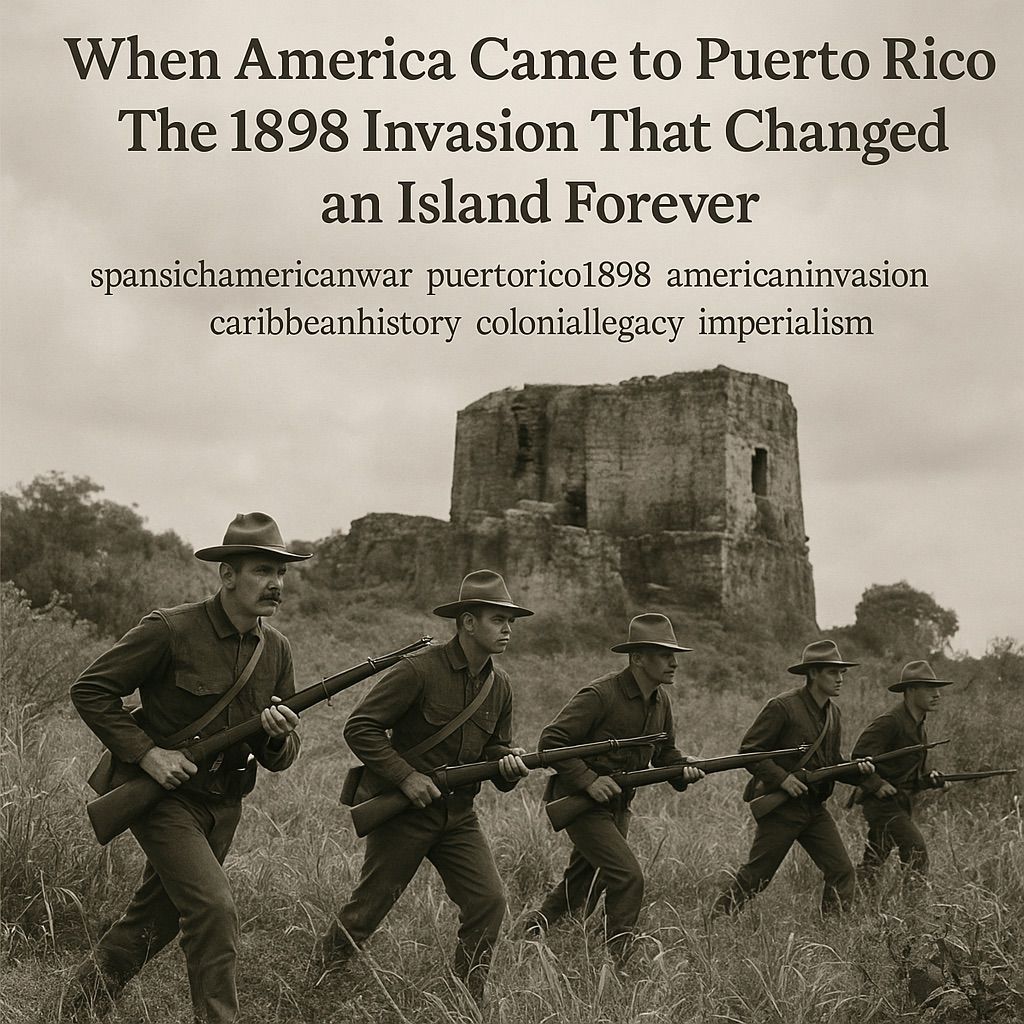
The summer of 1898 was a time of fierce battles, rapid political shifts, and the assertion of American power beyond its mainland borders. On July 25, 1898, the United States launched a decisive invasion of Puerto Rico, a pivotal moment within the larger context of the Spanish–American War that would redefine the destiny of the Caribbean island and signal America’s emerging role as a global imperial power. This essay explores the complex causes, dramatic events, and long-lasting consequences of that invasion, bringing to life the voices of the soldiers, the islanders, and the politicians whose lives intertwined during this transformative chapter in history.

In the late 19th century, Puerto Rico was a Spanish colony caught in the turbulence of empire and revolution. Spain, once a dominant global force, had been steadily losing its grip on its American territories throughout the 1800s. The Cuban War of Independence, which began in 1895, ignited fervent anti-colonial sentiment throughout the Caribbean and intensified tensions between Spain and the United States. The U.S., motivated by a combination of strategic interests, economic ambitions, and a growing sense of Manifest Destiny, had been watching these events closely. The sinking of the USS Maine in Havana Harbor on February 15, 1898, acted as the immediate catalyst, sparking outrage and calls for war against Spain in the U.S. Congress.

The Spanish–American War officially began in April 1898, initially focusing on Cuba, but swiftly expanding its theater of operations to include other Spanish possessions such as Puerto Rico and the Philippines. Puerto Rico was viewed by American strategists as a key military and economic prize—a gateway to the Caribbean and a foothold for further expansion. The island’s location made it a strategic hub for controlling vital shipping lanes and asserting influence over the region. Despite the war’s relatively short duration, lasting only a few months, the invasion of Puerto Rico was a critical and dramatic episode that captured international attention.

The invasion force that arrived on Puerto Rican shores on July 25 was led by General Nelson A. Miles, a veteran soldier with a storied military career. His troops landed near the town of Guánica on the southwestern coast of the island. The American military objective was clear: to quickly secure the island, minimize resistance, and establish U.S. control. What awaited them, however, was a complex landscape of local loyalties, resistance fighters, and a population caught between two empires.

The Puerto Rican defenders, primarily composed of local Spanish troops and militia, were vastly outnumbered and outgunned. The Spanish military presence on the island was relatively small and ill-prepared to withstand a large-scale invasion. Nevertheless, the Puerto Rican population was deeply affected by the conflict, with many caught in the crossfire or forced to choose allegiances in a war not of their own making. Some Puerto Ricans hoped for liberation from Spanish rule and saw the Americans as potential liberators, while others viewed the U.S. forces with suspicion and fear of another colonial master.

The landing at Guánica was swift and met with little immediate resistance. American forces quickly advanced inland, securing key towns such as Ponce and Arecibo within days. The battles that followed were generally brief but sometimes intense, marked by skirmishes and the difficult terrain of Puerto Rico’s mountainous interior. The American military utilized its superior numbers and firepower to outmaneuver Spanish forces, who conducted a series of defensive retreats.

One of the most notable engagements during the invasion was the Battle of Asomante, where American troops encountered determined resistance amid the rugged hills near Ponce. Despite the challenges posed by geography and climate, the U.S. soldiers persevered, gradually consolidating their control over the island. The campaign was marked not only by military action but also by logistical challenges such as supply lines, tropical diseases, and the difficulties of maintaining morale in an unfamiliar environment.

While the military campaign unfolded, the political landscape was rapidly evolving. The Treaty of Paris, signed on December 10, 1898, formally ended the Spanish–American War. Under its terms, Spain ceded Puerto Rico, Guam, and the Philippines to the United States and relinquished its claim to Cuba, which became an independent republic under American influence. For Puerto Rico, the treaty marked a profound turning point—from centuries of Spanish colonial rule to becoming a territory of the United States.

The transition was far from smooth. Puerto Ricans now faced a new colonial reality under American administration. The U.S. established a military government that later gave way to civil rule, but political and cultural tensions remained high. Many Puerto Ricans sought greater self-governance, while American officials imposed policies aimed at assimilating the island into the broader U.S. system. Language, education, and economic reforms became battlegrounds for identity and autonomy. The Foraker Act of 1900, which created a civilian government, stopped short of granting full citizenship or voting rights, sowing seeds of frustration and resistance.

Economically, the American takeover brought both opportunity and disruption. The U.S. invested in Puerto Rico’s infrastructure, expanding roads, ports, and agriculture focused on cash crops like sugar. However, the island’s economy became increasingly dependent on American capital and markets, deepening inequalities and marginalizing local farmers. The island’s social fabric changed as new political parties emerged, voicing a range of views from independence to statehood.

The legacy of the 1898 invasion still resonates in Puerto Rico today. It marked the beginning of a complicated and ongoing relationship between the island and the United States—a relationship characterized by debates over identity, political status, and rights. Puerto Rico remains a U.S. territory, with its residents holding American citizenship but lacking full representation in Congress or the right to vote in presidential elections. The questions raised by the invasion—about sovereignty, colonialism, and self-determination—continue to fuel political discourse.

From a broader perspective, the invasion of Puerto Rico symbolized the United States’ arrival on the world stage as an imperial power. It was part of a wave of territorial acquisitions that extended American influence into Asia and the Caribbean, reshaping global geopolitics. The war itself, often overshadowed by later conflicts, was a significant moment of American expansionism and a harbinger of the 20th century’s global dynamics.

The human stories behind the military maneuvers reveal the complexity of war and empire. Puerto Rican civilians lived through fear, uncertainty, and the upheaval of their daily lives. Some welcomed the Americans as a promise of change, others mourned the loss of Spanish heritage and feared the erosion of their culture. Soldiers on both sides faced the harsh realities of combat in an alien land, bound by duty yet caught in a larger historical tide.

In examining the 1898 invasion of Puerto Rico, we gain insight not only into a military campaign but into the broader themes of power, identity, and colonialism. The event is a reminder that history is not just about dates and battles but about people’s lives shaped by forces beyond their control. It invites reflection on how past actions continue to influence present realities and future possibilities.

Today, Puerto Rico’s rich cultural heritage, vibrant communities, and resilient spirit stand as a testament to its history—marked by conquest but also by resistance and renewal. The island’s journey from Spanish colony to American territory is a story of transformation and enduring complexity, one that continues to inspire and challenge all who seek to understand the tangled legacy of empire and freedom.

July 25, 1898, remains a date etched in the collective memory of Puerto Rico and the United States alike—a day when the tides of history brought new rulers and new challenges, forever altering the course of an island and its people.

Related Posts

The Rediscovery of Machu Picchu and the Journey That Changed History

Elias Rowen

On July 24, 1911, amidst the dense jungles and perilous slopes of the Peruvian Andes, an American academic named Hiram Bingham stumbled upon something that would astonish the world. Hidden under centuries of moss, fog, and vines stood an ancient city in the clouds—majestic, ghostly, untouched. Machu Picchu, once a whisper in Quechua legends and little more than a mystery in the Western imagination, emerged into the global spotlight. Its terraces climbed the mountain like a green staircase to the heavens. Its stone temples, astronomically aligned, whispered stories of an empire long gone. In that moment, the modern world was reintroduced to the genius of the Inca civilization, and Hiram Bingham became its unlikely herald. Yet, as with all great discoveries, the story is layered—with ambition, awe, appropriation, and a search not just for ruins, but for meaning. This is the human story of that rediscovery, and the ripples it cast through history, science, and cultural identity.

Before we go back to that fateful day in 1911, we must first understand what Machu Picchu was, and what it meant to the people who built it. Constructed in the mid-15th century under the reign of the Inca emperor Pachacuti, Machu Picchu was not a mere settlement. It was a citadel, a ceremonial hub, perhaps even a royal estate. Suspended between the peaks of Huayna Picchu and Machu Picchu mountains, the site is strategically positioned both for defense and for spiritual significance. The Incas, master stone masons and astronomers, aligned their structures with solstices and constellations. Their walls fit so precisely that not even a blade of grass can slide between the stones. This was not random architecture; it was sacred geometry, a fusion of earth and cosmos.

Despite its grandeur, Machu Picchu was never found—or at least not understood—by the Spanish conquistadors. When Francisco Pizarro and his men decimated the Inca Empire in the 16th century, they never laid eyes on the sanctuary above the clouds. Perhaps that was Machu Picchu’s salvation. As cities like Cusco and Lima fell under colonial rule, Machu Picchu quietly receded into obscurity, swallowed by the forest, remembered only in whispers by local Quechua communities who revered it as part of their sacred geography. By the late 19th and early 20th century, it was all but forgotten in Western maps, a legend waiting to be reborn.

Enter Hiram Bingham, a Yale professor with a background in history and a penchant for adventure. He was not an archaeologist by training—his specialty was Latin American history—but his heart burned with a romantic vision of uncovering lost civilizations. Inspired by tales of El Dorado and the last Inca stronghold of Vilcabamba, Bingham set out in 1911 on a Yale-sponsored expedition to search the jungles of Peru. With him were local guides, a military escort, and an ambition that outpaced the limits of cartography. His journey was arduous—mud-slicked trails, stifling humidity, venomous insects—but Bingham pressed on, fueled by fragments of lore and the adrenaline of the unknown.

On the morning of July 24, Bingham was led by a local farmer named Melchor Arteaga along a narrow trail winding up the ridge. The path was steep and treacherous, clinging to cliffs like a thread on a tapestry. When they reached the top, a young boy from the local area guided him through the dense foliage. What lay beyond the veil of vines took Bingham’s breath away. Stone terraces cascaded down the mountainside. Temple walls, though moss-covered, stood firm against centuries of time. Towers and dwellings rose like ghosts from the forest. Bingham had found something extraordinary.

Initially, he believed he had discovered Vilcabamba—the last refuge of the Incas during the Spanish conquest. But in time, it became clear that Machu Picchu was something else entirely. Unlike Vilcabamba, which had been an active resistance center, Machu Picchu bore no signs of siege or destruction. It was serene, abandoned, pristine. Its location, so remote and inaccessible, had likely spared it from the ravages of war and conquest. Bingham, awestruck and overwhelmed, called it “the finest example of Inca civilization” and began documenting, excavating, and publicizing the site with fervor.

The story of Machu Picchu’s “discovery” spread like wildfire through international media. Newspapers hailed Bingham as a modern-day Indiana Jones. National Geographic dedicated its entire April 1913 issue to Machu Picchu, igniting a global fascination with Incan culture and Andean history. Soon, academics, tourists, and adventurers turned their attention to Peru, retracing Bingham’s path in search of mystery and meaning.

But the discovery was not without controversy. Bingham, backed by Yale and supported by the Peruvian government at the time, removed thousands of artifacts—ceramics, tools, human remains—for study in the United States. For decades, these items remained in Yale’s possession, leading to a long-standing dispute between Peru and the university. Only in recent years have many of these artifacts been returned, part of a broader reckoning with the colonial legacy of Western archaeology.

Beyond the politics, the rediscovery of Machu Picchu reshaped how the world saw the Inca civilization. For centuries, the prevailing narrative had painted the Incas as technologically inferior, their achievements overshadowed by their sudden fall to Spanish steel and disease. Machu Picchu challenged that view. It revealed a society capable of extraordinary architectural sophistication, deep astronomical knowledge, and harmonious integration with their environment. The site stood as a silent rebuke to the notion that only European or classical civilizations could produce wonders.

Machu Picchu also sparked a cultural revival within Peru. Indigenous communities, long marginalized, began to reclaim pride in their heritage. The Quechua language saw a resurgence. Folklore and traditions gained new visibility. The site became not just a tourist destination, but a symbol of national identity—proof that Peru’s roots were deeper and more glorious than colonial history had acknowledged.

For Hiram Bingham, the discovery became the defining moment of his life. He went on to serve as a U.S. Senator, wrote books detailing his expedition, and basked in the fame of his find. Yet, he remained haunted by Machu Picchu, always yearning to understand its secrets. Despite decades of study, the purpose of the city remains a puzzle. Was it a royal retreat? A spiritual sanctuary? An agricultural laboratory? Or all of these? Every carved stone seems to hint at something more, some cosmic riddle woven into the architecture.

Standing at Machu Picchu today, one can’t help but feel the weight of both time and silence. The mountains loom like guardians. Clouds drift over stone temples with the grace of old spirits. Llamas graze where once nobles walked. The sun, when it pierces the mist, strikes the Intihuatana stone—the “hitching post of the sun”—in precise alignment with ancient solstices. It is a place of serenity, yes, but also of questions. Why was it abandoned? Why was it never finished? And what does it mean that it was forgotten for so long?

Perhaps that is Machu Picchu’s ultimate lesson—that even the greatest human achievements can be swallowed by time, and only rediscovered when the world is ready to listen again. Its survival was accidental, its rediscovery a mix of luck, ambition, and courage. But its meaning continues to evolve, as each generation projects its own dreams onto the stones. For scientists, it’s a marvel of engineering. For Peruvians, it’s a source of pride. For travelers, it’s a bucket-list destination. And for the world, it’s a reminder that the past still holds mysteries capable of humbling the present.

More than a hundred years after Bingham climbed that mountain, Machu Picchu still speaks. Not in words, but in silence, in symmetry, in stone. Its terraces are poems carved into earth. Its temples are prayers frozen in architecture. Its rediscovery in 1911 was not just the unveiling of a forgotten city, but the beginning of a global reckoning with the complexity and brilliance of the Inca world.

The journey of Hiram Bingham—from professor to explorer, from historian to legend—was never just about finding a lost city. It was about touching the past, listening to its heartbeat, and letting it change the rhythm of the present. And on July 24, 1911, the clouds parted just enough for the world to remember what it had nearly forgotten.

Related Posts

The Egyptian Revolution of 1952

Elias Rowen

July 23, 1952, was not just the dawn of a new day in Cairo—it was the awakening of a nation long stifled under monarchy, colonialism, and corruption. As a revolution surged through the heart of Egypt, it did not erupt with wild chaos, but with strategic precision. Tanks rolled silently through Cairo’s arteries, the radio stations crackled to life with revolutionary declarations, and whispers of the Free Officers movement filled homes with a new kind of electricity. That day marked the start of a revolution that would overthrow King Farouk, end British dominance, and birth a republic out of the ashes of an exhausted kingdom. But it was more than a political shake-up. It was the genesis of modern Arab nationalism, a cultural and ideological shift that would ripple across the Middle East and into the fabric of the 20th century.

To understand the Egyptian Revolution, you must first understand the Egypt that birthed it. The Egypt of the 1940s and early 1950s was a land of contradictions. On one hand, it was rich in culture, pride, and ancient legacy. On the other, it was shackled by a monarchy widely seen as decadent and detached from its people, and by the lingering influence of British colonialism. Though Egypt had technically achieved independence in 1922, British troops remained entrenched, especially in the Suez Canal Zone, guarding British interests under the guise of cooperation. The ruling elite lived in a world far removed from the streets of Cairo and Alexandria, sipping imported liquor behind palace walls while the majority of Egyptians struggled in poverty.

King Farouk, the last reigning monarch of the Muhammad Ali Dynasty, had inherited a throne weighed down with resentment. His image—once hopeful—deteriorated rapidly in the public eye. Known for his excessive spending, obsession with European luxury, and womanizing, Farouk came to symbolize everything that was wrong with the status quo. More damning was his government’s corruption and inability to respond to the dire needs of its people. When British forces were attacked by Egyptian nationalists and responded with brutal crackdowns, Farouk’s failure to act decisively made him appear both complicit and cowardly.

The final nail in the coffin of his reign was the 1948 Arab-Israeli War. Egypt’s embarrassing defeat left deep scars, not only in military terms but in national pride. The people began to see their army, long revered, as humiliated and poorly led. Behind closed doors, many young military officers seethed. Among them was a man named Gamal Abdel Nasser—a charismatic thinker, quietly gathering like-minded officers who would form the backbone of the revolution.

These men, later known as the Free Officers, came from humble backgrounds. They were not aristocrats or foreign-educated elites; they were the sons of workers, clerks, and farmers. Their leader, Nasser, had grown up in Alexandria and witnessed firsthand the deep divides of Egyptian society. He and his comrades—including future president Anwar Sadat—believed in pan-Arab unity, independence from foreign domination, and a society based on merit rather than class. They were young, idealistic, and increasingly convinced that the only way to break Egypt’s chains was through direct action.

What made the Egyptian Revolution unique was its almost surgical execution. Unlike other revolutions steeped in bloodshed and prolonged war, this one unfolded in less than 24 hours. On the night of July 22, 1952, while Cairo slept, the Free Officers quietly began their plan. By dawn on July 23, military units had taken control of key installations—radio stations, government buildings, the police. At 7:30 a.m., an announcement came over the radio: General Muhammad Naguib, the nominal figurehead of the movement, declared the end of the monarchy. The revolutionaries promised to clean up corruption, restore dignity to the army, and protect the sovereignty of Egypt.

What followed was astonishing. The people of Egypt, tired of false promises and royal indifference, embraced the change with open arms. There were no mass arrests of civilians, no chaotic clashes in the streets. The military acted swiftly, but with restraint. When King Farouk was forced to abdicate and sail into exile aboard the royal yacht Mahroussa, the revolution had already won the public’s heart. Nasser insisted that Farouk be spared—a move that earned the revolution additional credibility at home and abroad.

But the revolution’s true challenge began after the throne was empty. Power struggles emerged among the officers. General Naguib, respected and elder, was the face of the revolution but not its soul. That role belonged to Nasser. As months turned into years, Nasser gradually sidelined Naguib and consolidated power, ultimately becoming president in 1956. Under his leadership, Egypt transformed. He nationalized the Suez Canal, implemented sweeping land reforms, and began to craft a vision of Arab socialism that inspired leaders across the Middle East and North Africa.

Nasser was not without flaws. His rule became increasingly authoritarian. Political opposition, including communists and the Muslim Brotherhood, was crushed. The media was tightly controlled. Prisons filled with dissidents. Yet, for millions of Egyptians, Nasser was a hero—the man who stood up to colonial powers, who gave voice to the voiceless, who dreamed of a unified Arab world.

One of the defining moments of his leadership came in 1956 during the Suez Crisis. After Egypt nationalized the Suez Canal, Britain, France, and Israel launched a military intervention. It was a humiliating episode for the Western powers—not because of their military might, which was formidable, but because of the backlash. The United States and the Soviet Union—strange bedfellows in this scenario—forced the invaders to withdraw. Nasser emerged as a symbol of anti-imperialist defiance. His speech to a roaring crowd, defiant and proud, became a cornerstone of Arab nationalism.

Domestically, the post-revolution period was a mixed bag. Land reform aimed to break the stranglehold of feudal landlords and redistribute land to peasants, but implementation was slow and uneven. Education expanded, and industrialization became a cornerstone of national policy. Yet, economic difficulties and bureaucratic mismanagement persisted. Egypt modernized, but at a cost. A one-party system replaced the old monarchy, and while the trappings of democracy existed, real opposition was not tolerated.

Still, the symbolism of the revolution was too powerful to ignore. For the first time in centuries, Egypt was ruled by Egyptians for Egyptians. It was no longer a pawn in the hands of empires. The ripple effect of July 23 was immense. Across the Arab world, from Syria to Algeria, revolutionaries saw in Nasser a model for their own struggles. He was not just a politician; he was a movement. Arab nationalism—once a vague cultural idea—now had a face, a voice, and a flag.

Yet, as with many revolutions, the fervor of 1952 could not sustain itself indefinitely. By the late 1960s, cracks began to show. Egypt’s disastrous defeat in the 1967 Six-Day War against Israel dealt a crushing blow to Nasser’s prestige. His dream of Arab unity was left in tatters. Though he remained in power, the weight of failure began to age him rapidly. When he died suddenly of a heart attack in 1970, millions poured into the streets to mourn—not just the man, but the dream he embodied.

The legacy of the 1952 revolution remains contested. For some, it was the beginning of Egypt’s modern identity—a necessary break from colonialism and monarchy. For others, it marked the start of authoritarianism under the guise of populism. But perhaps both can be true. Revolutions are rarely clean. They are born of hope, but often bear the scars of compromise. Egypt in the decades since has continued to grapple with its revolutionary DNA—sometimes embracing it, sometimes rejecting it.

In the uprisings of the Arab Spring in 2011, when millions once again flooded Tahrir Square demanding freedom, echoes of 1952 rang in the air. The faces were younger, the demands more nuanced, but the soul of rebellion was unmistakable. They too sought dignity, justice, and a voice. They too faced the challenge of building a future from the wreckage of the past.

What began on July 23, 1952, was more than just a coup. It was a statement. It said that Egypt would no longer be dictated to by kings or colonizers. It said that ordinary men, when united by conviction and vision, could shake the foundations of history. The tanks that rolled silently through Cairo that morning didn’t just change the regime—they changed the story Egypt would tell itself for generations to come.

Today, the legacy of the revolution lives in monuments, in speeches, in textbooks, but also in the questions that Egyptians still ask: What does true independence look like? Can freedom and stability coexist? And how do you honor a revolution without repeating its mistakes?

These are the questions that continue to haunt and inspire a nation forever changed by that fateful morning in July. For in the heart of every Egyptian beats the rhythm of that revolution—not just in the memory of what was, but in the enduring hope of what still could be.

Related Posts

The Day Gandhi Was Taken from the World

Elias Rowen

There are some days when the world seems to pause. Not for joy, not for celebration, but because the air has been pulled out of history. January 30, 1948, was such a day. On that day, India—the heart of a newborn nation—felt the thunderous silence of grief, and the world lost not just a man, but a moral compass. Mohandas Karamchand Gandhi, known to millions as Mahatma—“Great Soul”—was gunned down in the gardens of Birla House in Delhi. His assassination shook a nation that was just beginning to heal from the wounds of Partition and called into question the very nature of nonviolence in a world increasingly consumed by political rage. Though the bullets that killed him were fired by an assassin’s hand, they were forged in the fires of hatred, division, and radicalism. Yet Gandhi’s story does not end in that tragic moment; it lives on, not in statues or currency notes alone, but in the conscience of humanity.

Born in 1869 in Porbandar, Gujarat, Gandhi’s journey began far from the epicenter of revolutionary politics. He was a shy child, devout and disciplined, and by no means destined for the towering role he would play on the world stage. He studied law in London, a foreign world where he trained his mind and soul as rigorously as he trained in jurisprudence. But it was in South Africa, not India, where Gandhi began to sharpen the tools of passive resistance. It was there, in response to racial discrimination, that he crafted the philosophy of satyagraha—truth-force—which would eventually become his answer to tyranny and injustice. When he returned to India in 1915, the nation was a colony straining under British rule. What followed over the next three decades was a struggle unlike any the world had seen—a revolution powered not by rifles or bombs, but by hunger strikes, salt marches, and an unshakeable belief in human dignity.

Gandhi’s India was no utopia. It was a country fractured by caste, religion, and colonial manipulation. And yet, Gandhi dared to dream of unity. He fasted to erase the lines drawn by caste, embraced untouchables whom society discarded, and reached out across religious divides even as tensions boiled. His relationship with Indian Muslims was complex and layered, but always built on the foundation of shared humanity. He was no stranger to controversy; many Hindus thought he favored Muslims too much, especially during Partition when he demanded that India pay Pakistan the money it was owed. He was threatened, reviled, and even ostracized by segments of the very community he loved so deeply.

When independence finally came in August 1947, it was bittersweet. India was free, yes, but it was also torn in two. Pakistan had been carved out as a separate homeland for Muslims, and the resulting mass migrations became some of the most horrific in modern history. Hindus, Sikhs, and Muslims slaughtered each other in the streets. Millions were displaced. Gandhi, rather than join in the political fanfare, walked barefoot into the ashes of communal violence. In Calcutta, he fasted until Hindus and Muslims agreed to lay down their weapons. He had no government post, no security detail, no political power—and yet he held the nation in his palm.

But peace was a fragile dream. And Gandhi was not universally loved. Among his harshest critics were Hindu nationalists who believed he had capitulated to Muslim interests. They viewed Partition as a betrayal and Gandhi as a traitor. One of them, Nathuram Godse, would ultimately decide that Gandhi’s dream of harmony was an obstacle to a Hindu nationalist vision of India. Godse saw Gandhi’s nonviolence not as moral strength, but as political weakness. He believed Gandhi had emasculated the Hindu spirit and weakened India’s resolve. And so, he plotted his murder with cold precision.

The final hours of Gandhi’s life were marked, as always, by quiet humility. He was staying at Birla House in New Delhi, a place he had made into a spiritual refuge. Every evening, he led prayer meetings in the garden. On January 30th, at 5:17 p.m., he walked out to greet a gathering of followers. Frail from fasting, he leaned on two grandnieces for support. Nathuram Godse emerged from the crowd, pushed through the people surrounding Gandhi, and fired three bullets from a Beretta pistol into his chest at point-blank range. Gandhi’s final words, as witnesses recall, were “Hey Ram”—a cry to God that echoed through the garden like a hymn of resignation. He fell instantly, draped in white, his blood soaking the earth beneath him.

The scene was one of disbelief. In the moments after the shots rang out, silence fell—not just over the garden, but across the conscience of a country. People didn’t just mourn Gandhi’s death; they mourned what it signified. The man who had taught them to fight without hatred, to resist without harming, had been felled by an ideology that knew no such restraint. India wept. Jawaharlal Nehru, the first Prime Minister of independent India and one of Gandhi’s closest confidants, announced the death to a stunned nation with trembling lips: “The light has gone out of our lives, and there is darkness everywhere.”

Godse was captured immediately and later tried and executed. During his trial, he offered a chilling rationale for his act—claiming that Gandhi’s politics were suicidal for Hindus and that his refusal to resist Islamic aggression would doom the nation. What made the assassination even more tragic was that Gandhi had predicted it. He knew he was hated. He had survived previous attempts on his life. But he refused protection, insisting that he would not live in fear. “If I am to die by the bullet of a madman, I must do so smiling,” he had once said. And that, heartbreakingly, is exactly how he died.

In the days that followed, riots were quelled not by force, but by Gandhi’s legacy. His death brought a stunned hush to communal tensions. In many ways, his martyrdom sealed his place in history not just as a leader, but as a saint. The world responded with an outpouring of grief. In America, President Truman expressed sorrow. In the UK, Winston Churchill—Gandhi’s former nemesis—offered uncharacteristically kind words. Albert Einstein said, “Generations to come will scarce believe that such a one as this ever in flesh and blood walked upon this earth.”

But Gandhi was not a god. He was flawed, and he knew it. He battled personal demons, wrestled with doubts, and frequently admitted his own inconsistencies. He was a man who experimented with truth in every sense of the word—from his diet to his celibacy to his political ideals. What made him powerful wasn’t his perfection, but his transparency. He led by example, not decree. He challenged colonialism with a spinning wheel. He fought bigotry with prayer. He faced death with serenity. He was, at his core, a man who believed in the goodness of people—even when they failed him.

The legacy of Gandhi’s assassination goes beyond the tragedy of a life lost. It asks enduring questions: Can nonviolence survive in a violent world? Can tolerance defeat extremism? Can spiritual strength stand against political might? Gandhi believed the answer to all these was yes. And though the world has often failed to live up to his ideals, the echo of his life still lingers in every peaceful protest, in every hunger strike for justice, in every act of civil disobedience against tyranny.

His death marked the end of an era, but also the beginning of a new chapter in global consciousness. Martin Luther King Jr. would later walk in Gandhi’s footsteps during the Civil Rights Movement. Nelson Mandela found courage in Gandhi’s philosophy during his long imprisonment. Across continents, Gandhi’s legacy became the blueprint for moral resistance. The bullet that killed him could never kill his idea.

India today is a far more complex and conflicted place than the one Gandhi left behind. It’s an economic powerhouse, a nuclear state, and a chaotic democracy pulsing with energy and contradiction. Yet, amidst all its change, the memory of Gandhi persists—not just in the institutions named after him, but in the quiet decisions people make each day to choose peace over violence, tolerance over bigotry, love over hate.

On every anniversary of his death, the nation observes Martyrs’ Day. At Raj Ghat, the site of his cremation, leaders gather to lay wreaths and offer prayers. But the real tribute to Gandhi lies not in ceremonies but in action. In refusing to hate, in choosing dialogue over bullets, in believing that the arc of the moral universe, as Dr. King said, bends toward justice.

January 30 was the day Gandhi died. But it is also the day that Gandhi became eternal. And every time the world turns toward hatred, every time oppression rears its head, we remember a frail old man in homespun cloth, walking unarmed into the heart of conflict, armed only with faith and truth.

Related Posts

Conquering the Giant: The First Ascent of the Matterhorn

Elias Rowen

In the heart of the Alps, where the horizon is pierced by jagged peaks and the sky seems to touch the earth, stands the mighty Matterhorn—majestic, mysterious, and once considered unclimbable. It is a mountain of legend, its near-perfect pyramid shape a natural monument etched into the imagination of climbers and travelers alike. On July 21, 1865, the Matterhorn’s summit was finally reached, marking not only a pinnacle in mountaineering history but also a moment of human triumph and tragedy. That day, an ambitious team led by the young and determined Edward Whymper achieved what many deemed impossible, forever altering the landscape of Alpine exploration.

To understand the significance of that fateful ascent, we must first appreciate what the Matterhorn represented in the mid-19th century. Towering at 4,478 meters (14,692 feet), it dominates the skyline of the Swiss-Italian border and had repelled all attempts at conquest. Its steep faces and sharp ridges were seen as too treacherous, even as neighboring peaks like Mont Blanc had already yielded to human perseverance. The Matterhorn remained a symbol of defiance, an unyielding titan that scoffed at the ambitions of mere mortals. To scale it was to challenge not only nature but one’s own limits.

By the 1860s, mountaineering was blossoming into a Victorian-era passion, particularly among the British upper class. What had once been considered dangerous and irrational was becoming a noble pursuit of science, physical endurance, and personal glory. These gentlemen climbers, dressed in tweeds and wielding rudimentary equipment, embraced the Alps as their playground. Chief among them was Edward Whymper, a 25-year-old English illustrator whose obsession with the Matterhorn would lead to both fame and infamy.

Whymper was not a nobleman but had been commissioned to sketch Alpine scenery for a London publisher. His artistic assignment soon evolved into a passion for climbing, and he became known for his tenacity and fearlessness. By 1861, he had made several attempts on the Matterhorn, approaching it from both the Swiss and Italian sides. Each time, the mountain denied him. But the repeated failures only stoked his resolve. Whymper wasn’t just after a summit; he was chasing immortality, eager to etch his name in the annals of mountaineering forever.

The year 1865 brought a flurry of activity to the base of the Matterhorn. Rumors swirled that Italian guides were preparing an ascent from the southern side, hoping to beat Whymper to the summit. Spurred by this competition, Whymper swiftly organized his own team. His party included experienced mountain guide Michel Croz of Chamonix, Reverend Charles Hudson, Lord Francis Douglas, Douglas Robert Hadow—a young, inexperienced climber—and two Zermatt-based guides, Peter Taugwalder and his son. It was a hastily assembled group, united by ambition rather than cohesion, but Whymper was undeterred.

On July 13, 1865, the team set out from Zermatt, opting for the Hörnli Ridge—an approach few had considered viable. The following day, they established a bivouac at around 3,400 meters, sleeping under the stars with the icy breath of the mountain wrapping around them. On the morning of July 14, they began their final push. The climb was arduous, but the ridge provided an unexpectedly manageable path. Step by step, they carved a route into the unknown, chipping footholds into the ice, relying on their alpenstocks, ropes, and raw grit.

At precisely 1:40 p.m., the summit was theirs. Whymper and Croz were the first to reach the top, followed by Hudson, Hadow, and the others. For a moment, there was elation—an almost sacred stillness. From the summit, the view stretched for miles, a panorama of peaks, valleys, and glory. Whymper would later describe it as standing “on a throne of rock, with the kingdoms of the world spread out beneath.”

But the euphoria was short-lived. What began as a story of triumph would quickly descend into tragedy. During the descent, disaster struck. As they carefully retraced their steps down the Hörnli Ridge, the unthinkable happened. Hadow, unsteady and inexperienced, lost his footing and fell against Croz, knocking him off balance. The two plunged down the north face, dragging Hudson and Douglas with them. The rope connecting the doomed climbers to the rest of the team snapped—mercifully, or cruelly—and Whymper and the Taugwalders watched helplessly as their companions disappeared into the abyss.

The survivors descended in stunned silence. News of the disaster reached Zermatt the following day, and the Alpine world was rocked. The first ascent of the Matterhorn had ended not in pure celebration but in mourning. Four men had perished, their bodies—save for Lord Douglas—eventually recovered days later. The broken rope was scrutinized, sparking debates and accusations. Some speculated it had been deliberately weakened; others blamed Whymper for assembling an ill-matched team. Whymper defended himself in public and in print, but the shadow of the tragedy would follow him all his life.

Despite the sorrow, the ascent of the Matterhorn marked a turning point. It was the symbolic end of the “Golden Age of Alpinism,” a decade during which nearly all the major Alpine peaks had been climbed. The Matterhorn, once the last great prize, had finally fallen. But its conquest came at a price that forever altered the perception of mountaineering. No longer was it seen merely as a gentleman’s pursuit or an eccentric hobby. The dangers were real, and the mountains, majestic as they were, could be merciless.

Whymper, shaken but undeterred, continued to climb. He later explored the Andes and wrote extensively about his adventures. His book, Scrambles Amongst the Alps, remains a classic of mountain literature—a blend of adventure, reflection, and sorrow. In it, he famously wrote: “Climb if you will, but remember that courage and strength are naught without prudence, and that a momentary negligence may destroy the happiness of a lifetime.” Those words, born from the Matterhorn’s brutal lesson, have echoed through generations of climbers.

Today, thousands ascend the Matterhorn each year, guided by fixed ropes and modern equipment. But the mountain has not lost its danger or its allure. Its sheer faces and knife-edged ridges continue to challenge even seasoned mountaineers. At its base, memorials stand to those who have fallen—reminders that while technology has improved, the risks remain very real.

What makes the story of July 21, 1865, so compelling is not just the daring feat or the tragic loss—it’s the deeply human tale beneath it all. It is a story of ambition, rivalry, courage, and the thin line between victory and disaster. Whymper and his team were not gods, but men, full of hope and fallibility. Their ascent of the Matterhorn wasn’t just a physical conquest; it was a metaphor for the Victorian spirit of exploration, for the eternal human drive to reach beyond the possible.

There’s something timeless in that pursuit. Even today, when Everest has become a bucket-list destination and gear is made of ultralight composites, the soul of climbing remains rooted in moments like Whymper’s. The mountain humbles and exalts in equal measure. To stand on a summit is to momentarily hold dominion over the world, but to reach it requires humility, respect, and a deep understanding of our fragile place in nature.

The first ascent of the Matterhorn continues to inspire not because it ended perfectly, but because it didn’t. It reminds us that greatness is often born in moments of peril, and that some of the most enduring legacies are forged in both triumph and loss. Whymper and his team, in chasing the summit, became symbols not only of bravery but of the high cost of ambition. And the Matterhorn, in turn, remains what it always was—a magnificent sentinel watching over the Alps, challenging each generation to answer its silent, daunting call.

Related Posts

How the Apollo 11 Moon Landing Changed Humanity Forever

Elias Rowen

The world held its breath on July 20, 1969. In living rooms across the globe, people huddled around black-and-white television sets, tuning in to a moment that would transcend borders, ideologies, and languages. The grainy images beamed from the Sea of Tranquility on the Moon were not just scientific or technological milestones—they were deeply human. When Neil Armstrong took that first step and spoke the immortal words, “That’s one small step for man, one giant leap for mankind,” it felt like all of humanity had taken that step with him. The Apollo 11 moon landing wasn’t just an American triumph—it was a planetary awakening, the climax of centuries of curiosity, ambition, and imagination.

At the height of the Cold War, space exploration had become a symbolic battlefield. The Soviet Union had stunned the world in 1957 by launching Sputnik, the first artificial satellite, and again in 1961 with Yuri Gagarin’s orbital flight. The United States, determined to catch up and surpass, galvanized its resources in response. In 1961, President John F. Kennedy boldly challenged America to land a man on the Moon and return him safely to Earth before the end of the decade. At the time, it seemed almost impossible. The U.S. had just begun launching astronauts into space, and the Moon was a quarter of a million miles away. Yet, within eight short years, an incredible collaboration of scientists, engineers, and astronauts achieved exactly that.

Apollo 11 was the culmination of Project Apollo, NASA’s ambitious lunar program. The spacecraft consisted of three modules: the Command Module Columbia, where astronauts Neil Armstrong, Edwin “Buzz” Aldrin, and Michael Collins would spend most of their journey; the Service Module, which housed propulsion and life-support systems; and the Lunar Module Eagle, which would carry two of the men to the Moon’s surface. On July 16, 1969, Apollo 11 lifted off from Kennedy Space Center atop the Saturn V rocket, the most powerful machine ever built at the time. As the rocket roared skyward, it carried with it not just three men, but the hopes and dreams of generations.

Four days later, after navigating the cold void of space, Armstrong and Aldrin boarded Eagle and began their descent to the Moon. Collins remained in orbit aboard Columbia, performing critical systems checks and preparing for their return. The descent was anything but smooth. Alarms blared inside the Lunar Module—computer errors due to data overload. Armstrong, calm and composed, took manual control to steer Eagle away from a boulder-strewn area, touching down with only seconds of fuel remaining. “Houston, Tranquility Base here. The Eagle has landed,” Armstrong radioed. Applause erupted at Mission Control in Houston. On Earth, it was as though time had stopped.

Nearly seven hours later, Armstrong emerged from the Lunar Module, descending the ladder in deliberate steps. As he stepped onto the surface, his boot pressed into the fine lunar dust, leaving an imprint that would last millennia. “That’s one small step for man, one giant leap for mankind,” he declared—a phrase etched forever into the collective memory of humanity. Aldrin followed soon after, describing the view as “magnificent desolation.” Together, they planted the American flag, deployed scientific instruments, and collected lunar samples, all while moving with the awkward grace of low gravity.

For 21 hours and 36 minutes, Armstrong and Aldrin explored the Moon, while Collins circled above in solitary silence, the loneliest man in the universe. Though unseen, his role was crucial—he ensured that Columbia was ready to bring them all home. On July 21, Eagle lifted off from the lunar surface, docked with Columbia, and the crew began their journey back to Earth. On July 24, 1969, they splashed down in the Pacific Ocean, greeted by recovery teams and a jubilant world.

But what did it all mean? In the immediate aftermath, the Apollo 11 mission was hailed as a triumph of American ingenuity and perseverance. Yet its impact went far beyond national pride or geopolitical victory. It sparked a philosophical and existential shift. Seeing Earth from the Moon as a fragile blue marble floating in the vastness of space prompted a new awareness of our planet’s fragility and unity. Environmentalism gained momentum. So did the recognition that despite our differences, we are one species, sharing a single home.

The Apollo 11 mission also ushered in a new era of science and technology. The innovations developed for space travel trickled down into everyday life—advancements in computing, telecommunications, materials science, and medical technology. The integrated circuit, for instance, was propelled forward by the demands of the space race and laid the groundwork for modern computers. The mission became a catalyst for STEM education, inspiring countless young people to pursue careers in science and engineering.

Yet, as with all great achievements, Apollo 11 also carried contradictions and critiques. Some questioned the staggering costs—over $25 billion in 1960s dollars—arguing that the money could have been better spent on poverty, education, or civil rights. Others lamented the rapid decline in public interest that followed. After the initial flurry of moon landings, enthusiasm waned. By 1972, the Apollo program was shut down. No human has walked on the Moon since.

Still, the legacy endures. Armstrong, Aldrin, and Collins became global icons, though each bore the weight of fame differently. Armstrong, famously private, shied away from the limelight. Aldrin struggled with depression and alcoholism but later became a vocal advocate for Mars exploration. Collins, the quiet pilot who never set foot on the Moon, wrote eloquently about the loneliness and majesty of space. They were not superheroes, but ordinary men doing extraordinary things, which made their feat all the more inspiring.

In the decades since Apollo 11, our understanding of space has continued to grow. Robotic missions have explored distant planets, telescopes have peered into the origins of the universe, and the International Space Station has become a model of global cooperation. Yet the Moon remains the most tangible symbol of humanity’s reach beyond Earth. In recent years, there has been renewed interest in returning. NASA’s Artemis program aims to land the first woman and next man on the Moon. Private companies like SpaceX are developing technologies to make space travel more accessible. The dream of Mars looms on the horizon.

But perhaps the most enduring impact of Apollo 11 is emotional and symbolic. It represents what we can achieve when we dream big, when we invest in knowledge, when we work together toward a common goal. It reminds us that exploration is a fundamental part of who we are. Long before rockets, humans looked up at the Moon with wonder. Poets wrote about it, sailors navigated by it, lovers gazed at it. On July 20, 1969, we didn’t just look—we went. And in doing so, we redefined what was possible.

The moment Armstrong stepped onto the Moon, it became not just a celestial body, but a place where humans had stood, worked, and returned. It became part of our story, our mythos. That dusty footprint said: we are capable of greatness. In an age marked by division and uncertainty, the Apollo 11 mission remains a beacon. It shows that even when challenges seem insurmountable, even when odds are long, we can still reach for the stars—and sometimes, we get there.

That July night in 1969, as the world watched in awe, there was a rare sense of unity. Strangers on the street smiled at one another. Children imagined themselves as astronauts. Scientists cried. Political leaders paused. It was one of those moments when history doesn’t just unfold—it soars. And though decades have passed, the echoes of that leap still resonate. They remind us not only of where we’ve been, but of how far we still might go.

As we look toward future missions—back to the Moon, on to Mars, and perhaps beyond—it is worth remembering that Apollo 11 wasn’t just about conquering space. It was about discovering ourselves. It was about proving that with courage, vision, and persistence, we can transcend limitations. The Moon landing wasn’t the end of the journey—it was the beginning of a new chapter in the human story. And what a magnificent chapter it was.

Related Posts

Britannic, the Titanic’s Sister and the Tragedy That History Overlooked

Elias Rowen

In the shadow of Titanic’s infamy lies another story—quieter, less told, but equally powerful. The Britannic, launched on July 19, 1914, was the third and final ship in the White Star Line’s Olympic-class trio, a vessel intended to be the pinnacle of maritime advancement. While her sister Titanic met a tragic end on her maiden voyage in 1912, and the Olympic served with distinction before being retired, the Britannic’s fate remains one of the great untold stories of 20th-century maritime history. Born into the same ambition that crafted Titanic, Britannic was not just another ship. She was a promise—of redemption, of safety, of lessons learned. Yet history had other plans. Transformed from a luxurious ocean liner into a wartime hospital ship, Britannic would never carry a single paying passenger. Her brief life ended violently in the Aegean Sea, a casualty of a war that spared no soul, no matter how grand. Her story is one of hope, transformation, and quiet heroism, overshadowed by a sister’s fame but rich in its own right.

To understand Britannic’s significance, one must begin with her bloodline. The White Star Line had struck gold with its Olympic-class ships—Olympic, Titanic, and the planned Gigantic, which was later renamed Britannic after Titanic’s sinking. These ships were conceived during the Edwardian era, when transatlantic travel had become both a booming business and a matter of national prestige. Luxury was the watchword. White Star Line was determined to outdo the competition not in speed, like the Cunard Line’s Lusitania and Mauretania, but in sheer opulence. The Olympic-class ships were to be floating palaces, symbols of industrial might and elegance.

Britannic was to be the crown jewel of this strategy. At 882 feet long and over 48,000 tons, she was to be the largest and safest ship afloat. But before she could be completed, Titanic’s horrific end changed everything. The world was stunned in April 1912 when the “unsinkable” ship went down in the North Atlantic, taking over 1,500 lives with her. In the aftermath, the very idea of luxury at sea was questioned. Safety had become paramount, and Britannic’s design was overhauled. Her hull was strengthened, her watertight compartments extended higher, and she was equipped with more lifeboats—enough for all aboard. It was a painful lesson learned too late for Titanic, but it would make Britannic the safest of the three sisters.

Her launch on July 19, 1914, was a quiet affair compared to the fanfare that greeted Titanic. There were no grand speeches or lavish celebrations. The world was already shifting, and clouds of war loomed on the horizon. Less than two weeks later, the first shots of World War I would be fired, and Britannic’s future as a luxury liner would vanish. She was completed during wartime and requisitioned by the British government before she ever entered civilian service. Renamed HMHS Britannic (His Majesty’s Hospital Ship), she was painted white with a green stripe and red crosses, signaling her new purpose—to heal instead of to host.

Britannic’s wartime role was both noble and tragic. Fitted with operating rooms, wards, and medical equipment, she became a floating hospital. Her mission: to carry the wounded from the front lines in the Dardanelles Campaign back to safety. She completed five successful voyages, ferrying thousands of injured soldiers and medical staff. The work was grueling and often dangerous. Wartime seas were unpredictable, and the lines between combatant and non-combatant were often blurred. For those aboard Britannic, the threat of mines and submarines was ever-present, even with the red crosses that were supposed to guarantee safe passage.

On November 21, 1916, Britannic met her fate. While sailing through the Kea Channel near the Greek island of Kea, she struck a mine—planted by a German U-boat—at around 8:12 a.m. The explosion rocked the ship and tore a gaping hole in her starboard bow. Despite the damage, the improvements made after Titanic’s sinking held—for a time. But as water rushed in and bulkheads began to give, it became clear that Britannic would not survive. Captain Charles Bartlett attempted to beach the ship on the nearby island, but the flooding was too rapid. She sank in just 55 minutes—faster than Titanic.

Unlike Titanic, Britannic’s death toll was lower. Of the 1,066 people aboard, 30 lost their lives—most tragically, not from the explosion itself but from lifeboats being sucked into the ship’s still-turning propellers. The very mechanisms designed to keep her moving hastened the deaths of those trying to escape. It was a horrific irony, one that would haunt survivors for years. Yet in the chaos, acts of bravery emerged. Nurses and crew helped evacuate the wounded, and many risked their lives to save others. One survivor, Violet Jessop, had also survived Titanic’s sinking and was aboard Olympic during a collision with HMS Hawke. Her story, almost unbelievable in its improbability, personified the strange fate that followed these ships.

In the aftermath, Britannic faded into obscurity. She was overshadowed by Titanic’s legend and the ongoing horror of the war. There were no sweeping memorials or epic tales of hubris and heartbreak. Her wreck rested quietly beneath the Aegean Sea, largely undisturbed, until Jacques Cousteau located her in 1975. Divers and historians have since explored the site, uncovering details that fill in the blanks of her story. Yet still, Britannic remains the lesser-known sister—a footnote in Titanic documentaries, a curiosity for maritime enthusiasts.

But perhaps that is what makes her story so compelling. Britannic represents the quiet heroism of those who serve without seeking glory. She was built for luxury but died in service. Her transformation from ocean liner to hospital ship mirrors the transformation of an entire era—from innocence to experience, from gilded excess to grim necessity. Her story is one of adaptation, of sacrifice, and of the quiet, relentless march of history.

There’s something profoundly human in the idea of a ship that never fulfilled her intended destiny, yet still found purpose. Like many during World War I, Britannic was reshaped by circumstances beyond her control. She carried not dancers and debutantes but the wounded and weary. Her salons were not places of champagne toasts but recovery and pain. In that way, her legacy is arguably more noble than that of her more famous sister. She saved lives rather than hosted extravagance. And for that, she deserves more than a passing mention in the annals of maritime history.

The men and women who served aboard her—the nurses who tended to broken soldiers, the engineers who kept the engines humming, the sailors who stood watch in hostile waters—deserve to be remembered. Their courage, professionalism, and compassion represent the best of what humanity has to offer. They were ordinary people in extraordinary times, navigating not just seas but moral choices, danger, and trauma.

Today, Britannic lies on her side beneath the Aegean, a ghostly monument to a world at war. Her hull is largely intact, her features still recognizable. Explorers describe her as peaceful, majestic even, in her watery grave. She has been claimed not by headlines, but by the quiet reverence of the sea. In many ways, she is more intact in death than Titanic, both physically and symbolically. She holds together because her purpose was one of healing. Perhaps that’s why her story, though less sensational, continues to touch those who learn it.

The story of Britannic is not just about a ship. It is about human resilience. It’s about learning from tragedy, about trying to do better the next time, even if fate has other plans. It’s about the lives aboard her—some lost, many saved—and the dignity with which she served in her brief existence. The world may have forgotten her for a time, but the sea remembers. And so should we.

Related Posts

How the Seneca Falls Convention Sparked a Revolution for Women’s Rights

Elias Rowen

On July 18, 1848, something remarkable began in a sleepy town in upstate New York. It wasn’t the booming echo of cannons or the blaring fanfare of politics that marked this moment, but rather the steady murmur of conversation turning into conviction. Inside the Wesleyan Chapel in Seneca Falls, a modest group of people—mostly women, a few brave men—gathered to question the foundations of an entire society. They had no illusions that their meeting would instantly change the world, but what they did know, perhaps more deeply than they dared say aloud, was that they were planting a seed. And as history would prove, that seed would take root, grow, and transform the landscape of human rights.

To appreciate the significance of the Seneca Falls Convention, it’s essential to understand the conditions leading up to it. In the mid-19th century, women in the United States had few legal rights. They couldn’t vote, they couldn’t own property if they were married, and their earnings—if they worked—legally belonged to their husbands. They were denied access to higher education and the professions. Even within reform movements like abolitionism, women often found themselves relegated to the sidelines. Yet it was precisely within that same abolitionist movement that many of the Seneca Falls organizers, including Elizabeth Cady Stanton and Lucretia Mott, found their political voices.

Elizabeth Cady Stanton was a force of nature—sharp, charismatic, and unyielding in her belief that women deserved equality in every sense. She met Lucretia Mott, a Quaker minister and experienced orator, at the 1840 World Anti-Slavery Convention in London. There, they were both refused participation because they were women. The sting of that experience lingered. They vowed to organize something of their own, something that would not just include women but place them at the center. Eight years later, that vow materialized into the Seneca Falls Convention.

The announcement was modest: a brief notice in the local newspaper, The Seneca County Courier, inviting “a Convention to discuss the social, civil, and religious condition and rights of woman.” The call may have seemed unassuming, but its implications were seismic. Over two hundred people attended the two-day event, which opened on July 19, but it was July 18—the day before the official start—when the organizers convened to shape what would become the soul of the movement: the Declaration of Sentiments.

Modeled on the Declaration of Independence, the Declaration of Sentiments boldly asserted that “all men and women are created equal.” Those seven words were not just a rhetorical flourish; they were a direct challenge to centuries of doctrine, both religious and secular. The document listed eighteen grievances, echoing the grievances the Founding Fathers had leveled against King George III. Only this time, the tyrant was not a distant monarch but an entrenched system of patriarchal oppression.

The grievances ranged from denial of the right to vote, to the lack of property rights, to restrictions on educational and professional opportunities. The most controversial demand—women’s suffrage—was hotly debated even among attendees. Elizabeth Cady Stanton insisted it remain, while others, including Lucretia Mott, feared it might be too radical and jeopardize the credibility of the entire movement. It was Frederick Douglass, the great abolitionist and former slave, who rose in defense of Stanton’s position. His speech, passionate and unflinching, helped tip the balance. In the end, the suffrage clause was included and passed, though not without hesitation.

The significance of Douglass’s support cannot be overstated. His presence at the convention was more than symbolic; it represented the intersectionality of struggles for justice. He understood that the fight for freedom was indivisible—that one group’s liberation could not come at the expense of another’s. This principle would echo through subsequent decades of civil rights activism, although not always without tension or contradiction.

Though the Seneca Falls Convention did not immediately spark legislative change, its impact was deep and enduring. The Declaration of Sentiments circulated widely. The very act of putting pen to paper, of stating clearly and unequivocally that women were entitled to equality, had a galvanizing effect. More conventions followed—Rochester in 1848, Worcester in 1850—spreading the message and building momentum. Women like Susan B. Anthony, who didn’t attend Seneca Falls but would later become a close ally of Stanton, entered the movement and brought with them new energy and organization.

In many ways, the Convention served as the launching pad for what became known as the first wave of feminism. It provided a blueprint not only for advocacy but for the framing of grievances and the articulation of rights. While the suffrage movement would stretch on for decades—culminating in the 19th Amendment in 1920—the foundation had been laid in that little chapel in Seneca Falls. The courage it took to make such radical claims in 1848 cannot be overstated. These were women who risked social ostracism, ridicule, and even danger to stand up for their beliefs.

And yet, they were also women of their time, not without limitations. The early women’s rights movement struggled with issues of race and class. While some leaders like Stanton and Anthony were fierce advocates for universal suffrage, they also occasionally made strategic compromises that marginalized Black voices. The movement’s early exclusivity would be a stain that future generations would work to address and repair. Still, none of that erases the importance of what began at Seneca Falls. Rather, it deepens our understanding of its complexity.

Human stories from the convention bring it all into sharper relief. Consider Charlotte Woodward, a 19-year-old glove maker who was the only signer of the Declaration of Sentiments to live long enough to see women gain the right to vote in 1920. Her story is both triumphant and bittersweet. Though she lived to see the 19th Amendment ratified, she was too frail to cast a vote herself. But what mattered was that the vision she dared to believe in as a teenager had finally materialized.

Then there’s the story of Thomas M’Clintock and his wife Mary Ann, Quakers who opened their home for the drafting of the Declaration. Their home, now preserved as a historical site, witnessed the birth of ideas that would one day reshape American democracy. It’s easy to romanticize such moments, but they were not gilded or grand. They were real—messy, impassioned, imperfect. And that’s what makes them so powerful.

Seneca Falls was not just a point on the map. It became a symbol—a rallying cry, a historical hinge. Movements need origin stories, and though the struggle for women’s rights did not begin or end there, the convention provided a sense of identity and purpose. It became something that women and men alike could look back on for inspiration and forward from for direction.

The resonance of that moment continues to this day. When modern activists march for gender equality, reproductive rights, or pay equity, they walk in the footsteps of those who gathered in that dusty New York chapel. The issues have evolved, the context has changed, but the underlying principle remains unchanged: the fight for full and equal rights for all genders is not over, and history demands we remember where that organized fight began.

We live in a world transformed by the courage of those who dared to declare their grievances in 1848. From boardrooms to voting booths, from classrooms to courtrooms, the ripple effect of that declaration continues to influence every space where gender justice is contested. What was once radical is now foundational, and what is foundational must be vigilantly protected and advanced.

The story of Seneca Falls reminds us that change begins not with consensus, but with conviction. It starts when someone stands up—or gathers others to sit down and write. It requires imagination, audacity, and relentless hope. Elizabeth Cady Stanton could not see the world we live in today, but she envisioned a better one. And that vision, shared aloud on July 18, 1848, is still echoing.

Related Posts

Giants Among Us: The Day Mankind Took Aim at the Moon

Elias Rowen

It was the summer of 1969. America was still reeling from the social tremors of the civil rights movement, the Vietnam War was raging across headlines and hearts, and Woodstock hadn’t yet welcomed its muddy masses. But on one blistering morning in Florida, something incredible happened—something that paused the noise of the world and replaced it with awe. On July 17, 1969, at precisely 9:32 a.m. Eastern Daylight Time, the roar of 7.5 million pounds of thrust lifted three men toward the heavens. The launch of Apollo 11’s Saturn V rocket from Kennedy Space Center wasn’t just a marvel of engineering. It was a thunderous symbol of humanity’s unshakable resolve to go beyond its known boundaries—to put boots on the Moon and claim a dream that had lived in hearts for centuries.

The Saturn V rocket was an astonishing spectacle. Towering over 363 feet tall—taller than the Statue of Liberty—it wasn’t just the largest rocket ever built; it was a declaration of purpose. Built by NASA under the guidance of Wernher von Braun and his team at Marshall Space Flight Center, it was the product of a nation’s willpower and genius. Every bolt, wire, and fuel tank was designed with one goal in mind: to send humans to the Moon and bring them back safely. Weighing over 6.5 million pounds when fully fueled, the Saturn V was essentially a skyscraper filled with controlled explosions. But on that day, it was poetry in motion.

The crowd that gathered on the Florida coast to witness the launch numbered in the hundreds of thousands. Families, scientists, news crews, and curious onlookers stood shoulder-to-shoulder in the sweltering heat, gazing upward. Many had traveled across the country to witness history, setting up folding chairs and telescopes days in advance. Their chatter turned to silence as the final countdown began. There was a collective inhale as the final seconds ticked away. Then—ignition. The Earth trembled. The sound was deafening. It was a deep, rolling thunder that you didn’t just hear—you felt it reverberating through your chest, your bones, your soul. The rocket, slow at first, pushed skyward, flames unfurling from its base, until it was just a shining needle piercing the blue.

Onboard were three men: Neil Armstrong, Buzz Aldrin, and Michael Collins. Each brought their own quiet heroism. Armstrong, a soft-spoken pilot from Ohio, would go on to become the first human to set foot on the Moon. Aldrin, a mechanical-minded astronaut with the heart of a philosopher, would follow close behind. Collins, often the unsung hero of Apollo 11, would remain alone in lunar orbit aboard the command module, holding vigil while his crewmates walked on alien soil. They were men with families, with fears, with dreams—and yet they strapped themselves atop a controlled inferno and aimed for the stars.

But the journey didn’t begin on July 17. It began years earlier, when President John F. Kennedy stood before Congress in 1961 and boldly declared that America would send a man to the Moon before the decade was out. It sounded impossible then. The United States had barely made it into orbit. But the Space Race with the Soviet Union was about more than Cold War posturing—it became a matter of national pride, of global leadership, of human ambition. NASA accelerated its efforts. Mercury. Gemini. Test after test, failure after failure, each one a hard-earned lesson that brought us closer to the Moon.

Apollo 11 was the culmination of thousands of engineers, scientists, and technicians working tirelessly behind the scenes. At its peak, the Apollo program employed over 400,000 people. From mathematicians like Katherine Johnson calculating trajectories by hand, to welders working on fuel tanks in dusty hangars, the Moon landing wasn’t achieved by astronauts alone—it was a monumental act of collaboration. These men and women weren’t just building rockets. They were laying stepping stones to the stars.

The Saturn V had three stages. The first, powered by five massive F-1 engines, lifted the rocket through the lower atmosphere. As it fell away, the second stage took over, continuing the climb. Finally, the third stage placed the spacecraft into Earth orbit, and later, after the “Trans-Lunar Injection” burn, sent Apollo 11 hurtling toward the Moon. By the time the third stage separated, the astronauts were alone in the vast silence of space—traveling 240,000 miles to a place no human had ever stood.

What followed in the days ahead—the lunar landing on July 20, Armstrong’s historic words, the triumphant return—are carved forever in our collective memory. But it all began on that fiery morning of July 17. That was the day the countdown reached zero. That was the day Earth let go.

Looking back, it’s easy to focus on the majesty and the triumph. But what makes the Apollo 11 launch so deeply human is everything that could have gone wrong—and didn’t. The risks were staggering. They had practiced every contingency, but there was no guarantee of success. The astronauts wrote letters to their families before launch, just in case. President Nixon had even prepared a speech titled “In Event of Moon Disaster,” which he hoped he’d never have to read. That launch was a gamble. A beautiful, daring, impossibly complex gamble—and the world held its breath.

And yet, Apollo 11 succeeded. It succeeded because humans believed they could achieve the unthinkable. Because science triumphed over fear. Because in a world full of division and conflict, for a few shining moments, we all looked in the same direction. We all looked up.

There was something else, too—something poetic about the name “Enterprise” from the previous shuttle era or “Columbia” for Apollo 11’s command module. These weren’t just machines. They were vessels of hope. They carried not only astronauts but our yearning for discovery. When Saturn V rose from Pad 39A, it carried a message: that no frontier is beyond our reach, no dream too distant. It reminded us of our place in the cosmos, yes—but also of our power to reach beyond it.

In the decades since, the world has changed. The Cold War ended. New nations have entered the space race. We’ve sent rovers to Mars, telescopes to the edge of the observable universe, and space stations circling Earth like silent sentinels. But Apollo 11 remains our greatest leap—not because it was the farthest we’ve gone, but because it was the first time we proved we could go.

Today, the Saturn V rocket stands silent in museums, a monument to an age of analog dreams and boundless optimism. Tourists walk past it, staring up in awe. Kids press their faces against glass cases holding moon rocks. Veterans remember where they were when they watched the launch, the landing, the return. And the rest of us, born long after, still feel something stir inside when we see that grainy footage of the rocket lifting off into the blinding light of history.

July 17, 1969, was a turning point—not just in space travel, but in the human story. It reminded us what we can achieve when we aim high and work together. It gave us heroes. It gave us Moon dust. And maybe most importantly, it gave us perspective. From the Moon, Earth is just a fragile blue marble—borderless, breathtaking, and infinitely precious.

In a time when we face new global challenges, from climate change to geopolitical tensions, the memory of Apollo 11 and its mighty Saturn V reminds us that we are capable of more than we know. That even our loftiest goals can become footprints on the Moon. That sometimes, the biggest transformations begin with the simple act of liftoff.

So when you see a photo of that launch—white rocket against a sapphire sky, flames curling beneath it—remember this: it wasn’t just about getting to the Moon. It was about proving we could. It was about showing the universe that we were ready to take our place among the stars.

Related Posts

Enterprise Rising: The First Flight That Launched a Spacefaring Dream

Elias Rowen

On July 16, 1973, something extraordinary stirred above the desert of Edwards Air Force Base in California. It wasn’t a rocket piercing the sky, but rather a gleaming white vehicle cradled atop a modified Boeing 747. The aircraft, burdened but stable, took to the air as thousands watched, breath held in quiet awe. What they witnessed was not just a test flight—it was the dawn of a new era in human exploration. The Space Shuttle Enterprise, though never destined for orbit, had taken flight for the first time. This was more than a technological experiment. It was the first flutter of wings for NASA’s dream of reusable spaceflight.

The year 1973 was a strange time in the arc of American space history. Just four years earlier, Neil Armstrong had stepped onto the lunar surface. But after the Apollo triumphs, public interest and political appetite for costly missions waned. NASA was facing budget cuts, uncertain direction, and skepticism from those who questioned why, in a world full of problems, humanity should invest in space. And yet, even amid these uncertainties, engineers, astronauts, and visionaries at NASA were hard at work on something bold—a spaceplane, a spacecraft that could be launched like a rocket and landed like a plane. The Space Shuttle program was born of that ambition, and the prototype to test it all was named Enterprise.

Interestingly, Enterprise almost had a different name. NASA originally planned to christen the shuttle Constitution, fitting for its first-of-its-kind design. But fans of the television show Star Trek mounted a passionate letter-writing campaign, and their voices reached the halls of power. President Gerald Ford, responding to the wave of fan enthusiasm, agreed to rename the vehicle Enterprise—a nod to the fictional starship that had inspired a generation to look to the stars. On September 17, 1976, the shuttle was unveiled with Star Trek’s original cast in attendance. It was a rare moment where science fiction and real-life science shook hands.

Though it would never fly in space, the Enterprise was central to NASA’s future plans. Built without engines or a functioning heat shield, it was never intended to reach orbit. Instead, it was designed to validate the aerodynamic performance and handling of the shuttle design—especially during landing. In many ways, it was a test pilot’s dream and a nightmare rolled into one: a full-scale prototype that needed to fly free and land safely without power, relying entirely on aerodynamics and precision.

That brings us to July 16, 1973—the first time Enterprise took to the skies, albeit still attached to its Boeing 747 carrier aircraft, the Shuttle Carrier Aircraft (SCA). This “captive-carry” test wasn’t flashy, but it was crucial. Engineers needed to know how the shuttle would behave while riding piggyback, how the combined aircraft would respond to turbulence, drag, and stress. And perhaps most importantly, the data gathered would inform future free-flight glides, where Enterprise would detach and glide down on its own.

As the SCA taxied down the runway with Enterprise atop it, the visual alone was enough to leave spectators slack-jawed. Here was a spacecraft, something imagined for space, now cruising above the California desert. Inside the cockpit, test pilots Gordon Fullerton and Fred Haise—both veterans of Apollo-era training—monitored the shuttle’s systems. Every vibration, every subtle sway, was recorded and analyzed. This was aviation choreography at its most intricate. The shuttle had to ride cleanly, with no dangerous buffeting or instability.

That first flight lasted a little under an hour. It may seem mundane by today’s standards, but in 1973, this was audacious. The idea that spacecraft could be reused, that launches could someday become routine—this was science fiction made real. And the data confirmed what engineers hoped: the shuttle configuration was airworthy. This cleared the path for the Approach and Landing Tests (ALT) that would follow in 1977, where Enterprise would be released midair and glide down to the runway on its own.

There was something poetic about it all. The shuttle didn’t roar into space that day. There was no trail of fire, no countdown heard around the world. But in the quiet desert sky, something shifted. This test symbolized a future in which space travel would be less rare, less dangerous, more accessible. It wasn’t about one mission—it was about a new kind of mission model. Enterprise represented vision, one not shackled to immediate results but aimed at changing the very foundation of how we reach the stars.

From a human perspective, the story of Enterprise is just as moving. Engineers and scientists who worked on the shuttle program speak of it with a reverence usually reserved for fine art. The craft’s curves, its tiles, its integration of aeronautics and astronautics—they were achievements born of relentless effort and precise collaboration. Many of the young engineers on the project had grown up watching Mercury and Gemini launches on black-and-white televisions. Now, they were sculpting the next chapter in spaceflight.

And for the test pilots, Enterprise demanded everything. It was not like flying a commercial jet or even a military fighter. The shuttle glided with the grace of a brick—it had no engines to recover if something went wrong. Once released, it had one chance to land. Every approach was a commitment, every flare and touchdown a balance between calculation and instinct. The trust between the pilots and the engineers had to be absolute.

Beyond the technical, Enterprise also captured the public’s imagination in subtle ways. Children began drawing the shuttle in crayon. Model kits were built and proudly displayed on bookshelves. And inside NASA’s offices, hope started to return. Yes, Apollo was gone. But the shuttle, this strange winged spacecraft, could be the bridge to something greater.

It took years before that promise came fully to fruition. Columbia, the first shuttle to fly into space, wouldn’t launch until 1981. But without Enterprise, Columbia would never have existed. Every rivet, every design tweak, every adjustment to the thermal tiles—those were lessons first learned by watching Enterprise in flight.

In many ways, Enterprise’s legacy is bigger than even its successors’. It never flew to space, never deployed satellites or visited the International Space Station. But it was the mother of them all. It proved what was possible. It gave engineers and planners the confidence to invest in the future of reusable spacecraft. And it told a public, weary from war and scandal in the early ’70s, that America’s dreams were still alive above the atmosphere.

Today, you can visit the Enterprise at the Intrepid Sea, Air & Space Museum in New York City. It sits quietly, its wings no longer stretched to the sky, but its presence still resonates. Visitors walk beneath it and gasp at its scale, its elegance. They take photos, they whisper, they remember. For those who lived through that era, Enterprise was a symbol that not all dreams fade. For those too young to remember, it’s a monument to daring when the future felt uncertain.

When we talk about the history of human spaceflight, it’s easy to jump to big moments: the Moon landing, the Challenger tragedy, the Mars rovers. But nestled between those flashpoints is a quieter revolution—one built not on spectacle, but on test data and belief. Enterprise’s first flight on July 16, 1973, didn’t make the front page of every newspaper, but it made history.

In an era of reusable rockets and private space companies, it’s worth remembering the roots. Enterprise was the prototype not just of a shuttle, but of an idea—that we could build spacecraft that return, that space could be a destination not once, but repeatedly. That we could bring back our explorers and send them again.

And like the fictional starship for which it was named, the real Enterprise pointed us toward a future of exploration and discovery. Its first flight didn’t breach the atmosphere, but it lifted our aspirations off the ground.

Related Posts

The Turning Tide: Courage, Sacrifice, and the Second Battle of the Marne

Elias Rowen

The sky over France in mid-July 1918 was heavy not just with summer heat but with the weight of years of brutal, grinding war. The First World War—once hailed by some as “the war to end all wars”—had ravaged Europe since 1914, transforming the verdant countryside into a muddy graveyard of youth and hope. Across trenches that spanned from the North Sea to the Swiss frontier, soldiers had endured years of bloodletting, poison gas, and despair. But on July 15, 1918, a different kind of moment began to unfold—a moment that would shift the balance of the war and ultimately set the stage for peace. The Second Battle of the Marne was more than just another engagement; it was the last great German offensive on the Western Front, and the first clear sign that the tide was turning in favor of the Allies.

Germany’s strategy in 1918 had been built on urgency. The Russian Revolution in 1917 had allowed Germany to transfer over 50 divisions from the Eastern Front to the West, a temporary advantage that they hoped to leverage before American forces could fully deploy in Europe. The German Spring Offensives of that year—starting with Operation Michael in March—had nearly broken the Allied lines. Paris came under threat. Allied morale teetered on collapse. But each offensive was met with staunch resistance, and German casualties mounted alarmingly. As the summer arrived, General Erich Ludendorff, the chief architect of Germany’s military operations, launched what he believed would be the decisive blow: a massive pincer attack on the Marne River aimed at drawing in and destroying Allied reserves. It was an ambitious gambit, timed precisely for July 15.

At first glance, the German plan was brilliant. Ludendorff hoped to strike the French Fourth Army east of Reims and simultaneously drive into the French Sixth Army to the west. The goal was not just to conquer ground but to entrap and annihilate. But this time, the French and their allies were ready. Allied Supreme Commander Ferdinand Foch had suspected Ludendorff’s intentions and allowed just enough space to bait the German assault. Meanwhile, the French had adopted a more flexible, defense-in-depth strategy—allowing Germans to penetrate lightly held front lines only to be met with devastating artillery fire and counterattacks in depth.

As German troops surged forward in the early morning hours of July 15, the French unleashed a punishing barrage of artillery fire. The air filled with thunder. Machine guns rattled from hidden positions. Gas shells seeped across no-man’s land. By noon, it was clear that the attack to the east had stalled almost entirely. On the western front of the offensive, progress was minimal. The Germans were encountering fierce resistance not just from the French but from British, Italian, and fresh American troops, who had by now begun arriving in strength.

The presence of the Americans was a crucial turning point. Though initially inexperienced, their sheer numbers and enthusiasm injected much-needed energy into the Allied cause. Among the most notable contributions was the heroic defense at Château-Thierry by the American 3rd Division, earning them the nickname “Rock of the Marne.” These young soldiers—many of them barely out of high school—held their ground against veteran German shock troops, proving that the United States was no longer a passive participant in the war.

On July 18, only three days after the German offensive began, the Allies counterattacked. The counteroffensive, led by General Charles Mangin and supported heavily by American forces under General John J. Pershing, was swift and brutal. Hundreds of Allied tanks—many for the first time being used en masse and effectively—rolled forward through the fog. French and American infantry followed, cutting through exhausted German ranks. The element of surprise was complete. Within days, the Germans were in retreat.

As the German lines buckled, it became clear that the myth of German invincibility had been shattered. For years, German morale had been sustained by victories on the Eastern Front and a belief in eventual triumph. Now, those hopes dimmed. The Allies had not only stopped a massive German assault—they had taken the initiative. The Second Battle of the Marne marked the beginning of what would become known as the Hundred Days Offensive, a relentless series of attacks that would continue until the armistice in November.

But none of this came without a cost. The battle claimed over 270,000 casualties—dead, wounded, and missing—on both sides. The French countryside, already battered by years of trench warfare, was left in ruins once again. Small villages disappeared from maps. Fields turned to cratered wastelands. Families were left grieving for sons who had only just arrived or who had never returned. The price of this turning point was staggering, but it was paid in full by those who believed the end was in sight.

There is something deeply human about the Second Battle of the Marne. It is a story of desperation and strategy, but also of resilience and renewal. On both sides, young men stared into the abyss, some for the final time, others to emerge forever changed. It is easy to become lost in the figures and tactics—the divisions moved, the kilometers gained or lost—but behind every trench was a human being longing for home. Letters from this period capture the contrast: soldiers wrote about fear and longing, about the scent of lavender wafting above the gunpowder, about the odd moments of silence between shellfire, and about the quiet dream of peacetime.

What makes the battle especially poignant is that it represented both an end and a beginning. For Germany, it was the end of ambition—a final roll of the dice that fell short. For the Allies, it was the first true moment of unity and forward momentum. For the world, it was a reminder that even the most grinding conflict could be turned, not by a single blow, but by collective courage and coordination. The Second Battle of the Marne did not end World War I, but it broke its inertia. It signaled that the path to peace, though bloodied, was finally open.

In the aftermath, as the guns fell silent and the bodies were buried, the world began to reckon with what it had become. The fields of the Marne would never be the same, but neither would the minds of those who had fought there. Nations would rise and fall, empires would collapse, and borders would be redrawn—but the memory of that July battle remained. It remained not because of the grandeur of strategy, but because of the endurance of spirit.

Each July 15, as we look back on that pivotal day, we honor not just the military outcome, but the human will that drove it. We remember the men in mud-soaked uniforms, the medics tending to the wounded under fire, the horses and tanks that charged through smoke, and the children who grew up in the shadow of that war. We remember the Americans who crossed the ocean not knowing what awaited them, and the French villagers who returned to rebuild homes brick by brick.

The Second Battle of the Marne is more than a chapter in a history book—it is a testament to what can happen when unity overcomes despair. It reminds us that wars are fought not in abstract, but in trenches, in hearts, and in hopes. The turning tide of July 1918 didn’t just wash away the illusions of German victory—it carried forward the belief that justice and peace were worth fighting for.

Related Posts

Rising Dawn: The Heartbeat of Revolution at the Bastille

Elias Rowen

On a sweltering summer morning in Paris on July 14, 1789, the city stirred with restless energy. King Louis XVI’s monarchy was teetering on the brink of collapse. Bread had become unaffordable, debt hemmed in every household, and whispers of change threaded through the cafés and marketplaces. Yet no one could have predicted the seismic spark that would echo across centuries—the storming of the Bastille.

The Bastille—an imposing fortress with thick walls, narrow towers, and a dark reputation—loomed over Paris. It was a royal symbol of absolutist imprisonment, where torture and arbitrary detention thrived outside any legal framework. Though only seven prisoners remained in its gloomy cells that morning, the Bastille’s true power lay in what it represented: the crumbling authority of a monarchy that had failed to protect its people.

As tensions reached a fever pitch, Parisians banded together—commoners, tradesmen, artisans, women, and even a few soldiers sympathetic to their plight. They were armed not just with muskets and farming tools but with desperation, solidarity, and hope. The absence of trust in the royal troops, coupled with deepening fear, transformed ordinary Parisians into insurgents.

By mid‑morning, the crowd reached the fortress gates. A tense standoff ensued. Negotiations faltered. Rumors swirled of reinforcements being dispatched from the court to suppress the rebellion. Fear gave way to action. Shots rang out. The drawbridge rose. A firefight erupted. Townsfolk, with fierce determination, scaled the walls, toppled the drawbridge, and seized control of the armory and bastion.

Inside, the remaining guards surrendered their artillery. The seven prisoners—three forgers, two mentally ill individuals, and a forger’s wife—were freed. Their liberation was symbolic, but their tear­stained joy gave voice to all who suffered under tyranny. As the gates of the Bastille fell, so too did the invisible chains shackling the conscience of a nation awakening.

Word spread like wildfire across France. Parisians lit bonfires, imploring their neighbors to raise the tricolor flag. Nobles and clergy, shaken by the force of the uprising, rushed to join the National Guard. The Estates-General convened in earnest, recognizing the people’s call. By the end of July, the feudal system was dismantled, and the Declaration of the Rights of Man and of the Citizen was drafted in August.

In hushed kitchens and bustling streets alike, people spoke of one message: sovereignty no longer belonged to divine right or royal decree—it belonged to the people. Every shopkeeper, every seamstress, every laborer felt it: the power of an idea that whispered, “You matter.”

This moment of revolution was imperfect. Waves of violence followed, including the reign of terror. Yet the storming of the Bastille had ignited something more enduring than fear: it ignited belief in self-determination and public voice. Monuments were built; July 14 became Bastille Day—a national holiday, a carnival of liberty.

Today, on Bastille Day, fireworks burst over the Champ de Mars in Paris. Soldiers stand shoulder to shoulder. Crowds chant in celebration, united across generations. They don’t merely commemorate the storming of a fortress—they celebrate the ideals of revolutionary humanity: liberty, equality, fraternity.

At its heart, the storming of the Bastille is not just a tale of a building overtaken—it’s the story of a people who said, “Enough.” It’s the story of ordinary citizens who reclaimed dignity. It’s the story of how hope can topple walls and how unity can reshape history.

And so, as the sun sets on July 14 each year, Parisians and people far beyond its borders light candles, lift glasses, and remind themselves that freedom is not given—it’s claimed. They remind us that when voices unite, no fortress—literal or metaphorical—can withstand the tide.

Related Posts