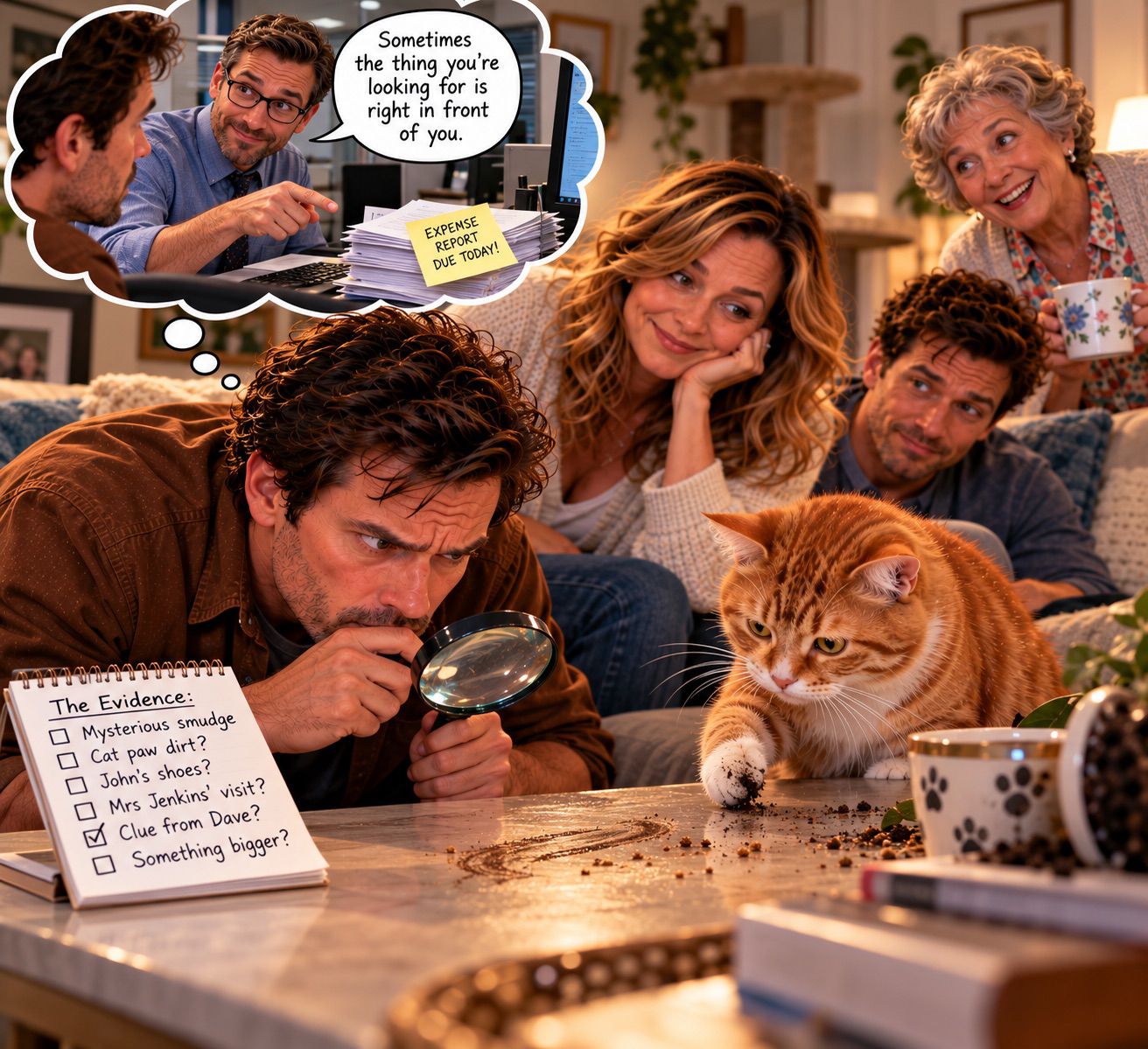
I’m sitting in the living room staring at a smudge on the coffee table. It isn’t a particularly large smudge, and under normal circumstances I probably wouldn’t have noticed it, but yesterday Dave said something at work that has been bothering me ever since. I can’t remember his exact words, which is part of the problem. I remember the conversation, I remember where he was standing, and I remember the expression on his face, but the sentence itself has somehow become annoyingly incomplete in my memory. It was something about paying attention to what was right in front of me. Or maybe noticing the obvious. Either way, now there is a smudge on the coffee table directly in front of me, and I’m having difficulty accepting that these two events are entirely unrelated. Pandora is sitting in the chair across from me fixing her hair, John Mercer is stretched out on the couch pretending to watch television, and Mr Whiskers is asleep on his cushion by the window. Nobody else appears concerned about the smudge, which means either I’m overthinking it or I’m the only person in the room currently paying attention.
“What are you staring at?” Pandora finally asks. I point toward the coffee table and ask whether she sees anything unusual. She looks at the table, then at me, then back at the table. “There’s a smudge.” I tell her I know there’s a smudge; I’m asking whether she knows how it got there. She says no and returns to her hair, which seems remarkably dismissive considering the available evidence. John opens one eye and asks what evidence I’m referring to. I explain that Dave said something yesterday about noticing what was right in front of me, and now there is an unexplained mark directly in front of me. John closes his eye again. “Those things are not connected.” I ask how he can possibly know that without knowing what Dave actually said. “Because Dave was at work and the smudge is on our coffee table.” It is a reasonable geographical argument, but geography alone does not eliminate causation.
I get up for a closer inspection. The mark is brownish gray, roughly two inches long, and slightly curved at one end. It could be dirt. It could be food. It could be something transferred from an object that had been sitting there earlier. John’s shoes immediately come to mind because he has a well-documented tendency to leave them wherever gravity finally persuades him to stop carrying them, but even John usually understands that shoes do not belong on the coffee table. Mrs Jenkins had been over earlier in the week, although I have no reason to believe she touched the table with anything capable of leaving dirt behind. Mr Whiskers is a more credible possibility because his relationship with household surfaces is based entirely on whether he can physically reach them. I look toward his cushion. He is still asleep, although one ear moves slightly when I say his name. I make a note of that without assigning significance to it.
The problem is that the more I try to remember Dave’s comment, the more important it starts to sound. Yesterday afternoon, I had been looking for a document on my desk at work and couldn’t find it. I checked a folder, then another folder, then my email, then the printer, and eventually asked Dave whether he had seen it. He looked at my desk and said something that I now believe may have been, “Sometimes the thing you’re looking for is right in front of you.” At the time I assumed he was being philosophical, which seemed unusual for Dave in the middle of the afternoon. Then he pointed toward my keyboard, where the document was sitting underneath another piece of paper. I remember laughing, but now I’m wondering whether there was more to the comment. Maybe Dave had noticed a pattern. Maybe I had been overlooking obvious things more frequently than I realized. The smudge suddenly feels less like a housekeeping issue and more like an opportunity to determine whether Dave had been offering constructive criticism disguised as casual conversation.
Pandora listens to this explanation with the patient expression she usually reserves for situations she suspects will resolve themselves if she waits long enough. “So Dave told you that you couldn’t find a piece of paper sitting in front of you, and now you think he was warning you about our coffee table?” I tell her “warning” is too strong a word. I’m considering the possibility that he was encouraging greater situational awareness. John sits up and says, “Dave told you where your paper was.” I explain that I understand the literal sequence of events. What I’m examining is the potential broader meaning. John asks whether Dave has ever shown any indication that he communicates through layered metaphor. I tell him not that I’m aware of. “Then maybe he was just telling you where your paper was.” Pandora smiles. I don’t appreciate how quickly consensus develops in this house.
Still, Dave’s comment has now forced me to examine the immediate environment more carefully, and once I do, I notice several things. There is a faint second mark near the first one. A few inches away, there are three tiny crumbs. On the floor beside the table is something that looks suspiciously like a fragment of dried mud. I point these out to Pandora, who says, “Okay,” in a tone that suggests she does not yet understand their importance. I follow the evidence toward the couch and discover another small piece of dirt near one of the legs. John looks down at the floor, then at his feet. He is wearing socks. His shoes are by the front door, so the most obvious explanation appears to have eliminated itself. Mr Whiskers wakes up during this process, stretches, jumps down from his cushion, and walks directly past me without showing any interest whatsoever in the evidence. His lack of concern is notable, although after yesterday’s mouse incident I am trying not to give him undue investigative authority.
Mrs Jenkins knocks a few minutes later to return a container Pandora had loaned her, and Pandora makes the mistake of mentioning the smudge. Mrs Jenkins immediately looks at me and says, “You found that?” The wording catches my attention. I ask what she means by “found.” She explains that when she stopped by the previous evening, Mr Whiskers had jumped onto the coffee table with dirty paws after somehow getting into one of her flowerpots in the hallway. She had wiped the table down but apparently missed a spot. I look at Mr Whiskers. He sits down and begins washing one paw with an extraordinary lack of remorse. Mrs Jenkins apologizes and offers to clean the remaining mark, but I tell her not to touch it yet because I’m still reconstructing the sequence. Pandora says, “The cat stepped in dirt and walked on the table. Sequence reconstructed.” I admit that her summary is efficient, although somewhat dismissive of the analytical process.
That should resolve the matter, except I’m still bothered by Dave. The next morning at work, I decide to ask him directly what he meant when he told me to pay attention to what was right in front of me. Dave stares at me for several seconds before saying, “I meant your document was right in front of you.” I ask whether there was any larger point he was trying to make. “No.” I ask whether he had noticed me overlooking obvious things lately. “Not until this conversation.” Karen, who has unfortunately been listening from the next desk, asks what this is about. I explain the coffee-table smudge, Dave’s comment, Mrs Jenkins’ flowerpot, and Mr Whiskers’ involvement. Karen takes a slow drink of coffee and asks, “So the cat got dirt on the table?” I tell her that is the current working explanation. Dave says, “Hal, yesterday I was trying to tell you something.” I immediately turn toward him. Finally. “What?” I ask. Dave points at the stack of papers beside my keyboard. “Your expense report is due today.”
I look at the papers. The expense report is sitting directly on top. I had printed it yesterday so I wouldn’t forget. Karen starts laughing before I can say anything, and Dave just walks away. I complete the report immediately because there is no reason to allow an unrelated administrative issue to interfere with the conclusion of the investigation. When I get home that evening, Pandora asks whether I ever figured out what Dave was trying to tell me. I explain that I did, although technically it turned out to be two separate instances of him telling me about things directly in front of me. She says this might indicate that Dave understands me better than I think. I’m about to disagree when Mr Whiskers jumps onto the coffee table, walks across the exact spot Pandora cleaned that morning, and sits down facing me. His paws are perfectly clean this time. He stares at me for several seconds, then slowly looks down at the table. I look down too. There is a small crumb beside my coffee cup that I hadn’t noticed. I look back at him. “Don’t start,” I say. He blinks once. I’m not claiming Dave and the cat are making the same point. I’m just becoming increasingly uncomfortable with how often things seem to be right in front of me.