Latest Articles

Herman Melville: The Patron Saint of My Inner Contradictions

Penelope

Herman Melville’s words have been lingering in my mind for years, even before I dove into his novels as a college student. There’s something about the way he tackles complex themes like identity, morality, and the human condition that resonates with me on a deep level. I think it’s because his writing often feels like a reflection of my own internal struggles – those moments when I’m forced to confront the contradictions within myself.

I remember feeling particularly drawn to Moby-Dick during my freshman year. Maybe it was the way Ahab’s obsession with the white whale mirrored my own fixation on trying to find meaning in life. Or maybe it was the way Ishmael’s voice, with its mix of wonder and skepticism, seemed to speak directly to me. Whatever the reason, I found myself returning to that book again and again, each time uncovering new layers of depth and complexity.

One aspect of Melville’s writing that continues to fascinate me is his use of ambiguity. He rarely provides clear answers or tidy resolutions – instead, he seems to revel in the uncertainty of life. Take Ahab’s motivations, for example. Is he driven by a desire for revenge, a need for control, or something more profound? Melville leaves it up to us to decide, and I think that’s part of what makes his work so compelling.

As someone who’s always struggled with making decisions, I find myself drawn to characters like Ahab and Ishmael. They’re both searching for something – a whale, a sense of purpose, a way out of the wilderness – but they’re not quite sure what they’ll find when they get there. That vulnerability feels strangely relatable to me, especially in today’s world where we’re constantly expected to have it all together.

But Melville’s work also makes me uncomfortable, particularly when I think about his depiction of whiteness and racism. As a white woman from a privileged background, I’ve always felt like I’m on shaky ground when it comes to issues of systemic oppression. Melville’s writing often blurs the lines between satire and critique, leaving me wondering if he’s truly condemning or perpetuating racist attitudes.

Take the character of Queequeg, for example. On one hand, Melville portrays him as a kind and gentle soul, one who represents a more compassionate and inclusive way of living. But on the other hand, his depiction is also marked by stereotypes and exoticism – qualities that have contributed to Queequeg’s enduring marginalization.

I’m not sure how to reconcile these contradictions in my own mind. Part of me wants to argue that Melville was ahead of his time, that he was trying to subvert the dominant narratives of his era. Another part of me wonders if he was simply reflecting the biases and prejudices of his age, even if unintentionally.

These questions have been swirling around me for years now, and I’m still not sure how to untangle them. Maybe that’s the point – maybe Melville’s work is meant to leave us with more questions than answers, to nudge us toward a deeper understanding of ourselves and our place in the world. Whatever his intentions, I know that Herman Melville has become an integral part of my own search for meaning and purpose. His words continue to challenge me, provoke me, and inspire me – even when they make me uncomfortable.

As I look back on my college years, I realize that Melville’s writing was a constant companion during those formative times. His novels were like a series of mirrors reflecting different aspects of myself: the idealist, the skeptic, the seeker. And while I’ve grown and changed since then, his work remains a source of fascination for me – a reminder that the search for meaning is a lifelong journey, one that requires patience, courage, and a willingness to confront our own complexities head-on.

I’m not sure what lies ahead, but I do know that Melville’s words will continue to be there, guiding me through the twists and turns of life. And maybe, just maybe, that’s all we can ask for – a steady hand pointing us toward the next great mystery, the next great challenge, and the next step forward into the unknown.

As I reflect on Melville’s influence in my life, I’m struck by how his writing has shaped my perspective on identity. Growing up, I often felt like I was searching for a sense of self, trying to pin down who I was and where I fit into the world. Moby-Dick’s exploration of Ishmael’s journey resonated deeply with me – the way he navigates different cultures, confronts his own biases, and grapples with the complexities of belonging.

I think what draws me to this aspect of Melville’s work is its portrayal of identity as a fluid, ever-changing process. For so long, I’d been taught that there was one “right” way to be – to fit into certain boxes, follow established paths, and conform to societal norms. But Melville’s writing shows me that identity is messy, multifaceted, and often contradictory.

Take Ahab, for example. On the surface, he appears to be a one-dimensional character driven by revenge and obsession. But as I delve deeper into the novel, I see glimpses of vulnerability, of desperation, and of a deep-seated need for connection. It’s this complexity that makes him so relatable – because, let’s be honest, who hasn’t struggled with their own demons and contradictions?

This fluidity of identity has been a liberating concept for me, especially in recent years as I’ve navigated the transition from college to adulthood. I’ve found myself questioning old assumptions, challenging my own biases, and embracing the uncertainty of it all. Melville’s writing has given me permission to explore these complexities without fear of judgment or expectation.

Of course, this exploration also comes with its own set of challenges. As I grapple with my own identity, I’m forced to confront the privileges and advantages that have been bestowed upon me – namely, being a white woman from a relatively affluent background. Melville’s portrayal of whiteness and racism in his work has made me acutely aware of these power dynamics, and I struggle to reconcile this awareness with my own positionality.

I wonder if Melville would have seen the privilege that I possess as a curse or a blessing? Would he have encouraged me to use it as a tool for social change, or would he have cautioned me against its corrupting influence? These are questions that haunt me still, and ones that I’m not sure I’ll ever fully answer.

Still, Melville’s writing continues to guide me on this journey of self-discovery. His words remind me that identity is a fluid, ever-changing process – one that requires patience, compassion, and a willingness to confront our own complexities head-on. As I look to the future, I know that I’ll continue to grapple with these questions, even as I try to make sense of my place in the world.

I think about how Melville’s writing has influenced my relationships with others. In Moby-Dick, he explores the complexities of human connection through the bond between Ishmael and Queequeg. Their friendship is built on mutual respect, trust, and a deep understanding of each other’s differences. It’s a portrayal that challenges the dominant narratives of colonialism and imperialism, instead highlighting the beauty of cross-cultural exchange.

As I reflect on my own relationships, I realize that I’ve often struggled with feeling like an outsider. Whether it was navigating friendships in high school or trying to find my place within my college community, I’ve always felt like I’m observing from the periphery rather than being fully immersed. Melville’s writing has given me permission to see this as a strength rather than a weakness – to acknowledge that my perspective as an outsider can be a unique asset.

I think about how Queequeg’s character has become a kind of touchstone for me when it comes to thinking about identity and belonging. He’s a figure who exists outside the dominant culture, yet he finds ways to navigate its complexities with grace and humor. His story reminds me that identity is not fixed or static – that we can belong in multiple places and communities at once.

But what does this mean for my own relationships? How can I use Melville’s lessons on identity and belonging to build more authentic connections with others? These are questions that still feel like a work-in-progress for me, but ones that I’m committed to exploring further. As I look to the future, I know that I’ll continue to grapple with these themes – and to seek out new insights from Melville’s writing along the way.

One thing that’s struck me about Melville’s work is its ability to capture the tensions between individuality and community. On one hand, his characters are often driven by a desire for independence and self-expression – whether it’s Ahab’s quest for revenge or Ishmael’s search for meaning. But on the other hand, they’re also deeply connected to others – whether through their relationships with friends, family, or even strangers.

This tension between individuality and community feels particularly relevant to me right now. As I navigate the ups and downs of adulthood, I’m constantly being pulled in different directions by my own desires for independence and connection. Melville’s writing reminds me that these are not mutually exclusive – that we can cultivate a sense of self while still being deeply connected to others.

Of course, this is easier said than done. As someone who’s struggled with anxiety and feelings of isolation, I know how tempting it can be to retreat into my own little world. But Melville’s work encourages me to stay engaged with the world around me – to seek out new connections and relationships that can help me grow as a person.

I wonder if this is what Melville meant by his phrase “the sea of life.” Is it not just a physical body of water, but a metaphor for the complexities and uncertainties of human existence? Ahab’s quest for Moby-Dick becomes a symbol for our own search for meaning and purpose – a journey that requires us to navigate the choppy waters of identity, belonging, and connection.

As I reflect on Melville’s writing, I’m struck by how it continues to resonate with me long after my college years are behind me. His words have become a kind of anchor in my life, reminding me that the search for meaning is a lifelong journey – one that requires patience, courage, and a willingness to confront our own complexities head-on.

As I delve deeper into Melville’s work, I’m starting to notice how his writing often blurs the lines between reality and fantasy. Take the character of Queequeg, for example – is he truly a Pacific Islander, or is he a product of Melville’s imagination? And what about the white whale itself – is Moby-Dick a symbol of Ahab’s obsession, or is it something more profound?

This blurring of reality and fantasy has me thinking about my own experiences with creativity. As a writer, I often find myself straddling the line between fact and fiction – trying to capture the essence of real events while also infusing them with a sense of imagination and wonder. Melville’s writing shows me that this is not only acceptable but also necessary – that the best art often lies in its ability to transcend the boundaries between reality and fantasy.

But what about when this blurring gets too close to home? When do we start to lose sight of what’s real and what’s just a product of our own imagination? I think back to my college years, when I was struggling to come to terms with my own identity. Melville’s writing often felt like a reflection of my inner world – a way for me to process the complexities and contradictions that were swirling inside me.

As I navigated these questions, I found myself drawn to characters like Ishmael and Queequeg – individuals who existed on the margins of society but still managed to find ways to connect with others. Their stories reminded me that identity is not fixed or static – that we can belong in multiple places and communities at once.

But what about when these identities are imposed upon us? When do we start to internalize the labels and expectations that are placed upon us by others? Melville’s writing often critiques the ways in which societal norms can constrain our individuality, but it also shows me that there is always a way out – that we can resist, subvert, or even rewrite these narratives for ourselves.

This is a theme that resonates deeply with me as I look to my own future. As someone who’s struggled with feelings of inadequacy and self-doubt, I know how tempting it can be to buy into the expectations of others – whether it’s from family members, friends, or even societal norms. But Melville’s writing shows me that this is a path that leads to stagnation and disconnection.

Instead, he encourages me to seek out my own identity – to explore the complexities and contradictions that make up who I am. And when I’m faced with moments of uncertainty or self-doubt, I try to recall Ishmael’s words from Moby-Dick: “To produce a mighty book, you must choose a mighty theme.”


Related Posts

Shax the Thief of Sight and Silver: Unmasking the Cunning Demon of the Ars Goetia

Dave

There is something uniquely unsettling about a demon who does not rage, does not roar, and does not promise kingdoms or forbidden love—but instead slips quietly into the world to steal what you thought was secure. Shax is not the lord of fire or the master of storms. He is subtler than that. In the old grimoires, especially within the pages of the Lesser Key of Solomon, Shax appears as a Great Marquis of Hell, commanding thirty legions of spirits. His description is brief but chilling: he steals money from kings, carries it away to distant lands, and—perhaps most disturbingly—takes away sight, hearing, and understanding from those he deceives.

Unlike the grander figures of infernal mythology, Shax does not seduce through power. He destabilizes through absence. He removes. He subtracts. He empties vaults, clouds perception, and erodes certainty. In a world that values accumulation and clarity, Shax represents the terror of loss and confusion.

In the Ars Goetia, Shax is depicted as appearing in the form of a stork, speaking with a hoarse and subtle voice. The image itself is strange—why a stork? The stork has long associations with migration, distance, and silent observation. It stands motionless before striking with precision. That symbolism aligns perfectly with Shax’s reputation. He is not chaotic. He is deliberate. He waits. He watches. Then he takes.

Earlier references to Shax appear in the Pseudomonarchia Daemonum, compiled by Johann Weyer. Weyer’s work, though skeptical in tone, preserved many of the demonological hierarchies that later grimoires expanded upon. In these writings, Shax’s abilities are emphasized not as theatrical displays of hellfire but as calculated acts of theft and deception. He steals horses. He steals money. He removes hearing and sight unless constrained by ritual authority.

What makes Shax particularly compelling in modern interpretation is how psychological he feels. In medieval Europe, literal theft of treasure and livestock was catastrophic. To lose a horse meant losing transportation, livelihood, perhaps survival. To lose gold meant instability and disgrace. But to lose sight and hearing? That implied something more insidious: a stripping away of perception itself. In a symbolic sense, Shax embodies cognitive distortion. He clouds judgment. He fosters misunderstanding. He makes people certain of falsehoods.

If one reads between the lines of the old texts, Shax is not merely a supernatural burglar; he is the archetype of misdirection. He is the voice that convinces a king his treasury is secure while quietly emptying it. He is the influence that assures someone they see clearly when, in fact, they have been blinded by their own assumptions.

The rituals associated with summoning Shax in the grimoires are precise and cautious. Practitioners are warned that he is deceptive and may lie unless constrained within a proper magical triangle. This emphasis on containment speaks volumes. Even within demonological systems—where manipulation is expected—Shax is flagged as particularly unreliable. He does not simply obey; he misleads. He promises what he does not intend to deliver.

This trait distinguishes him from demons whose domains are more transactional. Shax is not a straightforward bargain-maker. He is closer to a trickster. His power lies in exploiting trust. In that sense, he reflects a universal human anxiety: the fear that what we rely upon—our senses, our savings, our understanding—can quietly vanish.

There is also an economic undertone to Shax’s mythology that feels strikingly modern. The idea of wealth disappearing into distant lands echoes contemporary concerns about financial instability, hidden transactions, and unseen hands manipulating markets. In the medieval imagination, that uncertainty became personified. It became Shax. Rather than abstract systems, people envisioned a marquis of Hell quietly relocating riches across borders.

And yet, like many Goetic spirits, Shax is not entirely malevolent in all interpretations. When properly commanded, he is said to reveal hidden things and return stolen goods. That duality is fascinating. The same force that obscures can clarify. The same entity that steals can restore. It suggests that Shax’s domain is not merely theft, but the control of access. He governs who sees and who does not, who possesses and who loses.

From a psychological lens, Shax can be understood as the embodiment of internal sabotage. We all experience moments when clarity vanishes. We misplace important things. We misunderstand people we love. We act against our own interests. The medieval world externalized those experiences into demons. Shax became the explanation for the inexplicable loss, the sudden confusion, the inexplicable drain of resources.

The stork form adds another layer of symbolism. Storks migrate great distances, disappearing with the seasons and returning without warning. They are creatures of transition. To envision Shax as a stork suggests movement—wealth traveling, perception shifting, certainty migrating away. The hoarse voice described in the grimoires evokes something whispering at the edge of awareness, not commanding but suggesting.

There is something deeply unsettling about a demon who does not need spectacle. Shax operates in quiet erosion. He undermines foundations without dramatic collapse. By the time you notice, the vault is empty. The senses are dulled. The understanding is gone.

And yet, perhaps that is precisely why Shax endures in modern occult discussions. He represents an anxiety that has never faded. We fear losing what we cannot immediately replace. We fear being deceived without realizing it. We fear blindness more than darkness, because blindness implies something has been taken.

In contemporary demonology circles, Shax is sometimes approached as a spirit of revelation through inversion. By confronting the archetype of loss, practitioners seek to sharpen awareness. If Shax clouds understanding, then awareness becomes the defense. If Shax steals wealth, then vigilance becomes the shield. In this way, the demon becomes a mirror—reflecting our vulnerabilities.

Whether one interprets Shax as literal spirit, psychological archetype, or symbolic narrative, his presence in the Goetia stands as a reminder of fragility. Wealth can disappear. Perception can falter. Certainty can dissolve. The medieval magicians who wrote of him were not merely cataloging monsters; they were articulating fears that remain painfully relevant.

Shax is not the loudest name in demonology. He does not command legions of pop culture fascination like Lucifer or Asmodeus. But there is something more intimate about him. He lingers in the spaces where confidence meets complacency. He waits where assumption replaces scrutiny.

And perhaps that is why his legend persists. Because somewhere, in every era, someone opens a ledger and finds it lacking. Someone realizes too late that they misunderstood what stood before them. Someone discovers that what they trusted has quietly slipped away.

Shax is the whisper that precedes that discovery.

Related Posts

Italo Calvino: Where Fragmented Thoughts are a Beautiful Mess

Penelope

Italo Calvino’s words have a way of slipping into my thoughts like whispers from an old friend. I remember stumbling upon his essays and stories while researching for a paper on Italian literature in college. At first, they felt foreign – the language was poetic, the ideas were complex, and the tone was detached yet intimate. But as I delved deeper into his work, I found myself drawn to the way he probed the human experience with a mix of curiosity and skepticism.

One aspect that continues to fascinate me is Calvino’s obsession with the fragmented nature of reality. In “Invisible Cities,” he writes about a series of fantastical cities that exist in the mind of an emperor, each one a representation of a particular idea or emotion. I found myself pondering the notion that our understanding of the world is composed of disparate fragments – memories, experiences, stories – that we try to weave together into a coherent narrative.

It’s a thought that resonates with me on a deeply personal level. As someone who struggles to articulate their own thoughts and emotions, I often feel like my perception of reality is fragmented and disjointed. Calvino’s work offers a strange comfort in this disorientation – a sense that it’s okay to be uncertain, that the fragmentation itself might be an essential part of the human experience.

But what I find most compelling about Calvino is his ambivalence towards the notion of truth. He often presents multiple perspectives and possibilities without seeming to lean on one over the other. This ambiguity can be disorienting – it’s as if he’s holding up a mirror to my own doubts and uncertainties, forcing me to confront the provisional nature of knowledge.

It’s a discomfort that I’m not always comfortable with. As someone who writes for clarity and understanding, I often find myself wanting to tidy up Calvino’s loose ends, to tie together the disparate threads into a neat package. But he resists this impulse, instead embracing the complexity and uncertainty of life.

I’ve come to realize that my attraction to Calvino lies in his refusal to offer easy answers or clear solutions. His work is a constant reminder that truth is not something you arrive at, but rather something you inhabit – a feeling that’s constantly shifting and evolving. It’s a perspective that both exhilarates and terrifies me, leaving me with more questions than answers.

Perhaps it’s this sense of uncertainty that keeps me coming back to Calvino’s work – the knowledge that I’ll never fully grasp his ideas or understand his perspective. His writing is an invitation to explore the labyrinthine corridors of my own mind, to confront the contradictions and ambiguities that lie at the heart of existence.

As I continue to grapple with Calvino’s words, I find myself returning to the same questions – what does it mean to seek truth in a world that resists certainties? How do we navigate the fragmented landscape of our own experiences? And what lies at the intersection of language and reality, where meaning is constantly slipping away from us?

These are questions that Calvino’s work refuses to answer, instead offering only more questions, more possibilities, and more uncertainties. It’s a gesture that I both admire and find frustrating – a reminder that sometimes, it’s not about finding answers, but about embracing the ambiguity itself.

As I delve deeper into Calvino’s work, I’m struck by the way he weaves together multiple narratives and perspectives, creating a sense of multiplicity that reflects the complexities of human experience. His writing is like a palimpsest, with layers of meaning peeling away to reveal new insights and interpretations. It’s as if he’s saying, “Look, there’s no one ‘right’ way to understand this; instead, let’s dance among the possibilities.”

This multiplicity resonates with me on a personal level, as I navigate my own relationships and interactions. I often find myself oscillating between different roles – friend, writer, daughter, sister – each one demanding its own unique perspective and set of expectations. Calvino’s work acknowledges this multiplicity, rather than trying to reduce it to a single, essential identity.

But what I find most intriguing about Calvino is the way he uses language itself as a tool for exploring the fragmented nature of reality. He plays with words, juxtaposing them in unexpected ways to create new meanings and associations. It’s as if he’s saying, “Language is not just a reflection of reality; it’s also a creator of reality.” This realization unsettles me, because it forces me to confront my own relationship with language – how I use it to shape my perceptions, to communicate with others, and to make sense of the world.

Calvino’s writing is like a mirror held up to my own linguistic habits. I see myself using words as tools to construct a coherent narrative, to impose order on a chaotic world. But what about when language falters or fails? What about when words fall short of conveying the complexity and messiness of human experience? Calvino’s work suggests that it’s in these moments of linguistic failure that we might discover new insights and perspectives – not through language itself, but through the gaps and silences that surround it.

As I continue to explore Calvino’s ideas, I’m drawn back to my own writing practice. How do I use language to shape my perceptions of reality? Do I rely on clear, concise sentences to convey a single message, or do I experiment with ambiguity and uncertainty? Calvino’s work encourages me to take risks with language, to push against the boundaries of what’s possible in order to capture the fluidity and multiplicity of human experience.

But this experimentation also fills me with anxiety. What if I’m not good enough at writing? What if my words are too clumsy or unclear? Calvino’s work doesn’t offer easy answers or reassurances; instead, it invites me to confront the provisional nature of language itself – to recognize that meaning is always in flux, and that words can never fully capture the complexity of reality.

In this sense, Calvino’s writing becomes a kind of mirror held up to my own creative insecurities. I see myself struggling to find the right words, to convey the depth and nuance of human experience. But perhaps it’s precisely this struggle that makes my writing worth doing – not for the sake of clarity or precision, but for the sake of experimentation, risk-taking, and the uncertain search for meaning.

As I reflect on Calvino’s use of language, I’m reminded of my own struggles with articulating complex ideas in a clear and concise manner. His work encourages me to take a more fluid approach to writing, one that acknowledges the provisional nature of meaning and the instability of language itself. This is both liberating and terrifying – it means that I have the freedom to experiment and push against the boundaries of what’s possible, but it also means that I risk failing or falling short in my attempts to convey meaning.

I find myself wondering if Calvino’s ambivalence towards truth extends to his own creative process. Does he too struggle with the uncertainty of language and the instability of reality? Or is it precisely this uncertainty that allows him to create works that are both deeply personal and universally relatable?

As I delve deeper into Calvino’s essays and stories, I begin to notice a recurring theme – the idea that our understanding of reality is always filtered through our individual perspectives and experiences. This realization resonates with me on a deeply personal level, as I navigate my own relationships and interactions. I often find myself oscillating between different roles – friend, writer, daughter, sister – each one demanding its own unique perspective and set of expectations.

Calvino’s work acknowledges this multiplicity, rather than trying to reduce it to a single, essential identity. Instead, he celebrates the complexity and diversity of human experience, revealing the ways in which our individual perspectives intersect and collide with one another. This is both exhilarating and overwhelming – it means that I have the freedom to explore different identities and perspectives, but it also means that I risk getting lost in the labyrinthine corridors of my own mind.

As I continue to grapple with Calvino’s ideas, I’m struck by the way he uses storytelling as a tool for exploring the human experience. His stories are like palimpsests, layered with multiple meanings and interpretations that unfold over time. This multiplicity resonates with me on a personal level, as I navigate my own relationships and interactions – it reminds me that people are complex and multifaceted, and that our understanding of them is always incomplete.

Calvino’s work also raises important questions about the nature of storytelling itself. Is it possible to capture the complexity and messiness of human experience through a single narrative or perspective? Or do we need to create multiple stories, each one revealing different facets of reality? As I ponder these questions, I’m drawn back to my own writing practice – how do I use storytelling as a tool for exploring the human experience?

Do I rely on clear, linear narratives to convey a single message, or do I experiment with non-linear structures and fragmented perspectives? Calvino’s work encourages me to take risks with narrative, to push against the boundaries of what’s possible in order to capture the fluidity and multiplicity of human experience.

But this experimentation also fills me with anxiety – what if my stories are too fragmented or disjointed? What if I fail to convey the depth and nuance of human experience through my writing? Calvino’s work doesn’t offer easy answers or reassurances; instead, it invites me to confront the provisional nature of narrative itself – to recognize that meaning is always in flux, and that stories can never fully capture the complexity of reality.

In this sense, Calvino’s writing becomes a kind of mirror held up to my own creative insecurities. I see myself struggling to find the right narrative voice, to convey the depth and nuance of human experience through my stories. But perhaps it’s precisely this struggle that makes my writing worth doing – not for the sake of clarity or precision, but for the sake of experimentation, risk-taking, and the uncertain search for meaning.

As I continue to explore Calvino’s ideas, I’m drawn back to my own relationship with uncertainty and ambiguity. How do I navigate the complexities and contradictions of human experience? Do I try to impose order on a chaotic world through language and narrative, or do I learn to inhabit the uncertainty itself?

Calvino’s work suggests that it’s precisely this uncertainty that allows us to discover new insights and perspectives – not through clear solutions or definitive answers, but through the ambiguities and contradictions that surround them. This is both exhilarating and terrifying – it means that I have the freedom to explore different possibilities and interpretations, but it also means that I risk getting lost in the labyrinthine corridors of my own mind.

As I ponder these questions, I’m left with more uncertainty than answers. But perhaps it’s precisely this uncertainty that makes Calvino’s work so compelling – not for its clarity or precision, but for its willingness to confront the provisional nature of meaning and the instability of reality itself.

As I grapple with Calvino’s ideas about uncertainty and ambiguity, I’m struck by the way he uses metaphor and allegory to convey complex concepts. His writing is like a rich tapestry, woven from threads of mythology, literature, and philosophy. Each thread is carefully selected and intricately intertwined, creating a narrative that’s both personal and universal.

I find myself wondering if Calvino’s use of metaphor is a deliberate attempt to sidestep the problem of language itself. By using metaphors and allegories, he can convey complex ideas without getting bogged down in precise definitions or clear explanations. This approach resonates with me on a deeply personal level, as I navigate my own writing practice.

I often find myself struggling to articulate complex concepts through straightforward language, only to discover that the words themselves are inadequate for conveying the depth and nuance of human experience. Calvino’s use of metaphor offers a way out of this impasse – by embracing the ambiguities and contradictions of language itself, he can create a narrative that’s both more inclusive and more mysterious.

This is particularly evident in his essay “The Castle of Crossed Destinies,” where he weaves together a complex tale of chance encounters, multiple narratives, and intersecting lives. The story is like a palimpsest, layered with meanings and interpretations that unfold over time. Each reader brings their own perspective to the text, revealing new insights and connections that Calvino himself might not have intended.

As I read this essay, I’m struck by the way Calvino uses language to create a sense of uncertainty – not just about the events themselves, but about the nature of reality itself. The story blurs the lines between chance and fate, free will and determinism, creating a narrative that’s both dreamlike and unsettling.

This is precisely what I find so compelling about Calvino’s work – his willingness to confront the ambiguities and contradictions of human experience head-on. By embracing uncertainty, he creates a narrative that’s both deeply personal and universally relatable. It’s as if he’s saying, “Look, we’re all lost in this labyrinthine world, but perhaps it’s precisely this disorientation that allows us to discover new insights and perspectives.”

As I continue to explore Calvino’s ideas, I’m drawn back to my own relationship with the unknown. How do I navigate the complexities and contradictions of human experience? Do I try to impose order on a chaotic world through language and narrative, or do I learn to inhabit the uncertainty itself?

Calvino’s work suggests that it’s precisely this uncertainty that allows us to discover new insights and perspectives – not through clear solutions or definitive answers, but through the ambiguities and contradictions that surround them. This is both exhilarating and terrifying – it means that I have the freedom to explore different possibilities and interpretations, but it also means that I risk getting lost in the labyrinthine corridors of my own mind.

As I ponder these questions, I’m left with a sense of awe and wonder at Calvino’s writing. His work is like a mirror held up to the complexities and contradictions of human experience – a reflection that’s both deeply personal and universally relatable. It’s as if he’s saying, “Look, we’re all lost in this world, but perhaps it’s precisely this disorientation that allows us to discover new insights and perspectives.”

Related Posts

The Demon King Who Commands Storms, Topples Empires, and Reveals Hidden Truths

Dave

There are demons in grimoires who whisper, demons who tempt, demons who deceive, and then there are those whose presence feels less like a secret and more like a natural disaster. Vine belongs firmly to the latter category. Among the seventy-two spirits cataloged in the Ars Goetia, Vine stands apart not merely because of rank—though he is counted among kings and earls—but because of what he represents. Vine is not subtle corruption or quiet manipulation. Vine is upheaval. Vine is force. Vine is revelation delivered with thunder rather than suggestion.

To understand Vine is to step into the worldview of medieval demonology itself, where spiritual entities were believed to influence the physical world directly. These spirits were not abstract metaphors to those who recorded them; they were intelligences capable of reshaping fate, altering perception, and even influencing war and weather. Vine’s domain reflects this belief perfectly. He is described as commanding storms, discovering hidden things, destroying walls, and revealing enemies—powers that blur the boundary between supernatural insight and catastrophic intervention.

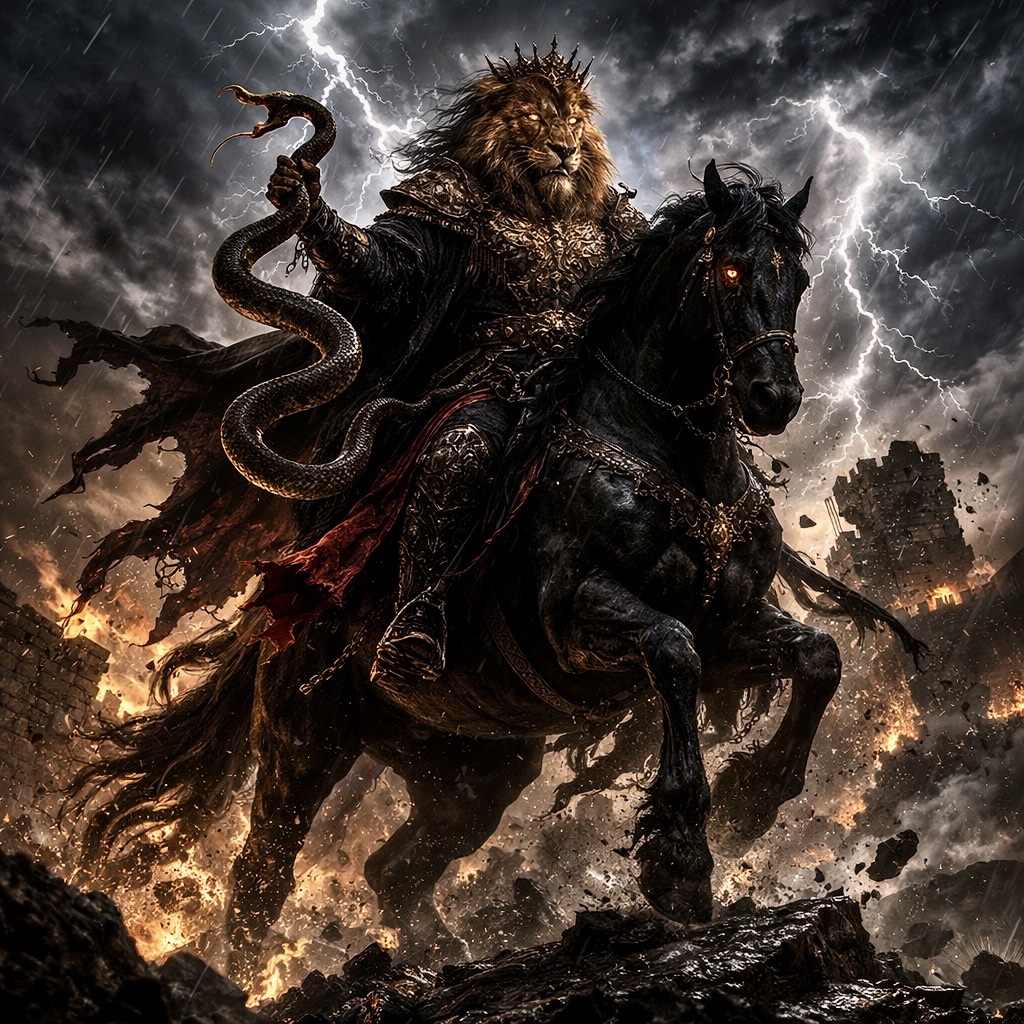
In traditional descriptions drawn from seventeenth-century occult manuscripts, Vine appears as a lion riding upon a black horse while holding a serpent in his hand. The imagery is striking and deliberate. Every element communicates authority and danger. The lion symbolizes dominance and sovereignty, the black horse evokes unstoppable momentum, and the serpent suggests knowledge—particularly knowledge that coils beneath appearances waiting to strike. Vine is not chaos for chaos’s sake. He represents controlled devastation, destruction guided by awareness.

The grimoires classify him as both King and Earl of Hell, commanding thirty-six legions of spirits. Titles in demonology were never ornamental. They reflected hierarchy modeled after earthly monarchies, suggesting that infernal realms mirrored human political structures. Kings commanded strategy. Earls oversaw execution. Vine therefore occupies a fascinating dual role: planner and enforcer, intelligence gatherer and battlefield commander. His abilities reinforce this interpretation. He reveals hidden things, exposes sorcerers, uncovers secrets, and protects or destroys fortifications depending on the will of the summoner.

What makes Vine especially compelling is how closely his mythology aligns with humanity’s ancient fear of unseen threats. Across history, civilizations have worried less about visible enemies than concealed ones—betrayal, espionage, conspiracy, hidden intentions. Vine becomes the supernatural answer to paranoia. Invoke him, the texts promise, and concealed truths will surface. Lies crumble. Enemies reveal themselves. The invisible becomes undeniable.

This association with revelation explains why Vine appears repeatedly in occult traditions concerned with knowledge rather than temptation. Unlike demons linked to pleasure or wealth, Vine’s power revolves around exposure. He forces reality into the open. In many ways, he resembles a cosmic investigator, albeit one whose methods involve storms and shattered defenses.

Storm imagery surrounding Vine deserves particular attention. Medieval thinkers viewed weather not as random but as morally or spiritually influenced. Tempests were interpreted as divine punishment or supernatural warfare. Vine’s ability to command storms therefore symbolized dominion over instability itself. Lightning and thunder represented sudden truth—the moment illusion ends. A storm strips away comfort. It reveals structural weakness. Roofs collapse, defenses fail, and what once seemed permanent proves fragile.

Psychologically, Vine embodies moments in human life when certainty collapses. Entire belief systems can crumble overnight under new information. Relationships dissolve after hidden truths emerge. Nations fall when secrets surface. Vine’s mythology reflects this universal experience: revelation often arrives violently.

The serpent he carries deepens this symbolism. In Western tradition, serpents occupy an ambiguous role—agents of wisdom and danger simultaneously. Knowledge liberates, but it also destroys innocence. Vine’s serpent suggests mastery over forbidden understanding. Those who sought him were rarely looking for pleasant truths. They wanted answers regardless of consequence.

Historical practitioners of ceremonial magic approached spirits like Vine with elaborate ritual protections. Circles were drawn, divine names invoked, and strict procedures followed. These rituals reveal something important about how Vine was perceived. He was not considered easily controlled. Summoners believed that without authority grounded in sacred power, the spirit’s destructive nature could overwhelm the operator. This fear underscores Vine’s character as a force rather than merely an entity.

Interestingly, Vine is also described as capable of building towers as well as destroying them. This duality mirrors the broader demonological principle that infernal powers reflect human intention. The same force that demolishes can construct. Storms devastate landscapes yet renew ecosystems. Fire destroys forests yet enables regrowth. Vine represents transformational energy—the breaking down required before rebuilding becomes possible.

Modern interpretations often frame such figures psychologically rather than literally. From this perspective, Vine becomes an archetype of disruptive awareness. Every person encounters moments when denial becomes impossible. Evidence accumulates. Truth intrudes. Internal defenses collapse much like the walls Vine is said to tear down. The experience can feel catastrophic, yet it frequently precedes growth.

Carl Jung’s exploration of shadow integration resonates strongly here. The shadow contains truths individuals avoid acknowledging about themselves. Encountering it is rarely gentle. It dismantles identity structures constructed around illusion. Vine’s mythology parallels this process almost perfectly: revelation, destruction of false defenses, emergence of hidden reality.

Even outside psychological interpretation, Vine’s legend speaks to humanity’s enduring fascination with power over uncertainty. Weather, war, betrayal, and secrecy remain among the most destabilizing aspects of existence. The promise of commanding such forces—even symbolically—holds immense appeal. Medieval magicians lived in unpredictable worlds shaped by disease, invasion, and political intrigue. A spirit capable of exposing enemies or controlling storms represented security in an insecure age.

Descriptions of Vine’s temperament vary, but many sources emphasize obedience when properly constrained. This reinforces the ritual worldview in which authority determines outcome. Power itself is neutral; intention shapes its manifestation. Vine does not inherently deceive or corrupt. He executes.

That neutrality distinguishes him from more manipulative demons. Vine does not seduce; he reveals. He does not persuade; he acts. The fear surrounding him arises from consequence rather than trickery. Truth uncovered cannot easily be hidden again.

The lion imagery reinforces regal inevitability. Lions do not negotiate dominance—they embody it. A lion riding a horse creates layered symbolism: raw strength directing momentum. The black horse often signifies death, war, or unstoppable advance in European symbolism. Together they portray authority moving forward with irreversible force.

One can imagine why Renaissance occultists found Vine compelling. Europe during this period experienced religious upheaval, scientific discovery, and political revolution. Old certainties shattered rapidly. Figures like Vine symbolized both terror and empowerment amid transformation. Knowledge expanded faster than tradition could contain it. Entire worldviews were under siege.

Interestingly, Vine’s powers include discovering witches and sorcerers. This reflects anxieties of the era when accusations of hidden magical influence were widespread. The idea of a spirit revealing secret practitioners mirrors societal obsession with identifying concealed threats. Demonology often acted as a mirror reflecting collective fears rather than inventing them.

In contemporary culture, Vine’s symbolism remains surprisingly relevant. Modern societies grapple with misinformation, concealed agendas, and unseen systems shaping daily life. Data breaches, hidden algorithms, intelligence operations—all echo ancient fears of invisible influence. Vine becomes an archetype of exposure within an information age defined by secrecy and revelation.

The destructive aspect of his mythology also carries philosophical weight. Structures—whether psychological, social, or political—often resist change until external pressure forces collapse. Vine represents that pressure. He is the storm that arrives when stagnation persists too long.

Some occult traditions suggest that working with Vine required clarity of purpose above all else. Ambiguous intent could produce unintended outcomes. This aligns with broader magical philosophy emphasizing alignment between desire and action. To summon revelation without readiness for truth invites chaos.

The enduring fascination with figures like Vine reveals something deeply human. People simultaneously crave truth and fear it. We seek clarity yet construct elaborate defenses against uncomfortable realities. Vine’s legend dramatizes this tension. He is both liberator and destroyer because truth itself holds both qualities.

Stories surrounding Vine often emphasize dramatic manifestation—violent winds, sudden insight, overwhelming presence. Whether literal or symbolic, these descriptions capture how transformative realization feels. Life rarely changes gradually at moments of profound understanding. Instead, perception shifts abruptly, like thunder breaking silence.

Across centuries, demonology has functioned as a language for grappling with forces beyond control. Vine’s association with storms situates him among humanity’s oldest fears. Before meteorology, storms represented divine or infernal will. Their unpredictability mirrored existence itself. By personifying storms in a being like Vine, people imposed narrative upon chaos.

Yet Vine is not merely destruction incarnate. His ability to build suggests mastery over transition. Creation frequently follows collapse. Old walls must fall before new structures rise. In this sense, Vine embodies necessary endings—the difficult transformations enabling renewal.

Artists and occult scholars continue to reinterpret Vine through modern lenses, depicting him as a sovereign of revelation rather than a monster. This shift reflects changing attitudes toward darkness and knowledge. What earlier ages feared as demonic disruption may now be understood as confrontation with truth.

Even skeptics can appreciate the symbolic richness of Vine’s mythology. Whether viewed as literal spirit, psychological archetype, or cultural artifact, he encapsulates a universal experience: the moment when hidden reality breaks through illusion and demands acknowledgment.

Perhaps that explains why Vine persists in occult imagination while lesser spirits fade into obscurity. He represents something fundamental. Empires collapse when truths emerge. Personal identities transform when denial ends. Storms arrive regardless of preparation.

And when they pass, the landscape—internal or external—is never quite the same.

Vine stands therefore not simply as a demon king of infernal hierarchy, but as a narrative embodiment of revelation itself. He reminds humanity that knowledge carries consequence, that power disrupts stability, and that truth rarely arrives quietly. In mythic form, he asks an unsettling question: if every hidden thing were revealed, what structures in our lives would survive the storm?

The answer, as generations of occultists suspected, may be both terrifying and liberating.

Related Posts

Margaret Mead: The Unsettling Truth About Being True to Myself (Mostly)

Penelope

Margaret Mead. I’ve always been fascinated by her, but not for the reasons you’d expect. It’s not her groundbreaking research on adolescence, though that does get a nod of respect from me. As someone who’s still figuring out this whole “adulting” thing, I appreciate that she didn’t shy away from exploring the complexities of growing up.

What really draws me to Mead is her willingness to challenge the status quo, especially when it came to societal expectations around women. Her work in Samoa, for example, showed that the girls there weren’t as bound by traditional feminine norms as Western society led us to believe. It’s a concept I’ve grappled with personally – the idea that our paths are determined by what others think we should be doing.

I remember reading about Mead’s experiences on the island and feeling a pang of discomfort. Not because she was critiquing the Samoa culture (she was, but in a way that respected their traditions), but because I saw echoes of her struggles in my own life. The pressure to conform to certain expectations, the weight of “shoulds” – it’s exhausting trying to navigate those expectations while still being true to myself.

Mead’s relationship with her mentor, Ruth Benedict, also sparked some curiosity in me. Their professional partnership was unconventional for its time, and I find myself wondering what that meant for their personal dynamics. Were they supportive friends? Did their differing perspectives lead to creative tension or frustration?

What I love about Mead is that she didn’t shy away from her own uncertainties. She admitted when she was wrong, like in her initial assessment of the Arapesh people, which later led to a reevaluation of her research methods. That willingness to revise and improve resonates with me as someone who’s still figuring out my place in the world.

Sometimes I wonder if Mead’s confidence (some might call it arrogance) was a coping mechanism for the scrutiny she faced as a woman in academia. Did she have to be bold, even brash, to be taken seriously? I think about my own life and how often I’ve had to find ways to assert myself in order to be heard.

Mead’s legacy is complex – some see her as a trailblazer, while others view her work as flawed or even problematic. As someone who’s still learning, I’m drawn to the gray areas she inhabited. Her story reminds me that there’s no one-size-fits-all approach to making a difference in the world. Sometimes it means challenging existing power structures, other times it means acknowledging and respecting those same systems.

I don’t think I’ll ever fully understand Mead’s inner workings or the intricacies of her relationships. But what I do know is that she pushed boundaries and asked hard questions – often at great personal cost. As someone who’s still trying to find my own voice, Margaret Mead’s story serves as a reminder that growth often requires discomfort and uncertainty.

As I delve deeper into Mead’s life, I’m struck by the ways in which she navigated the tension between her desire for intellectual freedom and the societal expectations placed upon her as a woman. She was a product of her time, yet she refused to be defined by it. Her experiences with Ruth Benedict, in particular, have me wondering about the intricacies of their professional partnership.

I imagine that Benedict’s more traditional approach to anthropology might have clashed with Mead’s more progressive ideas, but instead of dismissing each other’s perspectives, they seemed to feed off each other’s energy. I find myself admiring their ability to maintain a sense of respect and curiosity in the face of disagreement. It’s a quality I aspire to, especially when working on group projects or collaborating with peers who hold different opinions.

Mead’s willingness to take risks and challenge her own assumptions also resonates with me. As someone who’s struggled with imposter syndrome, it’s reassuring to know that even someone as accomplished as Mead had doubts about her abilities. Her story serves as a reminder that growth often requires embracing uncertainty and taking calculated leaps into the unknown.

One of the things that continues to fascinate me about Mead is the way she balanced her intellectual pursuits with her personal life. She was married twice, but both relationships seemed to be shaped by her career ambitions. I wonder if this tension between love and work was a source of stress for her, or if it allowed her to maintain a sense of independence and focus.

As I continue to learn about Mead’s life, I’m struck by the ways in which she embodied the complexities of being a woman in a male-dominated field. Her struggles with sexism and misogyny are well-documented, but what I find most compelling is her refusal to be defined solely by those experiences. Instead, she used them as fuel for her research and activism, pushing against the boundaries of what was considered acceptable for women at the time.

I don’t think I’ll ever fully grasp the intricacies of Mead’s life or the nuances of her relationships. But what I do know is that she left an indelible mark on anthropology and beyond. Her story serves as a reminder that growth, change, and progress often require us to navigate uncertainty and push against the status quo.

As I delve deeper into Mead’s life, I’m struck by her ability to balance intellectual curiosity with emotional vulnerability. In many of her writings, she shares personal anecdotes and reflections on her own experiences as a woman in academia. It’s as if she’s saying, “I’ve been there too, and this is how it affected me.” That level of self-awareness and willingness to share one’s emotions feels both courageous and relatable.

I think about my own struggles with anxiety and imposter syndrome, and I wonder if Mead ever felt the same way. Did she have moments where she doubted her abilities or felt overwhelmed by the expectations placed upon her? If so, how did she navigate those feelings without letting them define her work?

What’s also fascinating is the way Mead’s relationships with other women in her life influenced her thinking and research. Her friendships with Ruth Benedict and others seem to have been a source of support and inspiration, but also a catalyst for intellectual growth. I find myself drawn to this aspect of her life – the idea that our personal connections can shape our ideas and passions.

I’ve always believed that women’s relationships are just as important as their achievements, yet we often overlook or downplay these aspects in favor of more “important” narratives. Mead’s story offers a refreshing counterpoint to this trend. By highlighting her friendships and partnerships, she shows us that even the most influential thinkers can be deeply human and emotionally complex.

As I continue to explore Mead’s life, I’m struck by the ways in which she embodied the contradictions of being a woman in a patriarchal society. She was both confident and uncertain, bold and vulnerable – all at once. It’s this paradox that makes her story so compelling to me: she’s not just a brilliant anthropologist or a trailblazing feminist; she’s also a multidimensional human being with her own set of struggles and doubts.

Mead’s legacy is complex because it reflects the complexities of her own life. She was a product of her time, but she refused to be defined by its limitations. Her story serves as a reminder that we can’t reduce people or their work to simple labels or categorizations. Instead, we must grapple with the messy realities of human experience and the ways in which our lives intersect and overlap.

I’m not sure where this exploration of Mead’s life will lead me, but I know it’s changing my perspective on what it means to be a woman in academia – or anywhere, for that matter. Her story is a powerful reminder that growth, change, and progress often require us to navigate uncertainty and push against the status quo.

As I reflect on Mead’s life, I’m struck by her willingness to take risks and challenge established norms. It’s not just about being bold or confident; it’s about being willing to be vulnerable and uncertain in order to learn and grow. This resonates deeply with me as someone who’s still figuring out my place in the world.

I think about how Mead’s experiences on Samoa had a profound impact on her thinking, but also on her own personal growth. She wrote about feeling like an outsider among the Samoan people, struggling to understand their culture and customs. Yet, she also found herself drawn to their way of life, admiring their sense of community and cooperation.

I wonder if Mead’s experiences in Samoa helped her develop a greater sense of empathy and understanding for others. Did she learn to see beyond her own biases and assumptions? As someone who’s struggled with my own cultural privilege and biases, I find myself drawn to Mead’s story as a reminder that we all have the capacity to grow and change.

One of the things that continues to fascinate me about Mead is her ability to balance intellectual curiosity with emotional vulnerability. She wasn’t afraid to share her personal thoughts and feelings in her writing, even when they made her seem vulnerable or uncertain. This willingness to be open and honest has a profound impact on how we relate to each other – both personally and professionally.

I think about my own relationships and how I often struggle to balance intellectual curiosity with emotional intimacy. Do I prioritize being right over being understood? Do I value knowledge over connection? Mead’s story serves as a reminder that it’s okay to be vulnerable, to ask questions, and to seek understanding from others.

Mead’s legacy also reminds me of the importance of mentorship and collaboration. Her partnership with Ruth Benedict was built on mutual respect and trust, allowing them to push each other intellectually and creatively. This kind of collaboration is essential in academia and beyond – it allows us to learn from each other, to challenge our assumptions, and to grow as individuals.

As I continue to explore Mead’s life, I’m struck by the ways in which she embodied the complexities of being a woman in a patriarchal society. She was both confident and uncertain, bold and vulnerable – all at once. It’s this paradox that makes her story so compelling to me: she’s not just a brilliant anthropologist or a trailblazing feminist; she’s also a multidimensional human being with her own set of struggles and doubts.

I’m left wondering what Mead’s life would have been like if she had more women around her who shared her values and ambitions. Would she have felt less isolated, less alone in her struggles? Or did her experiences shape her into the person she became – a woman who refused to be defined by societal expectations, but instead forged her own path?

These questions linger in my mind as I reflect on Mead’s life, leaving me with more questions than answers. But that’s what makes her story so compelling – it’s a reminder that growth, change, and progress often require us to navigate uncertainty and push against the status quo.

As I continue to grapple with Margaret Mead’s complexities, I find myself thinking about the role of privilege in shaping her experiences. She was a white, middle-class woman from a wealthy family, which undoubtedly influenced her access to education and opportunities. Did this privilege shape her perspective on the cultures she studied? Did it make it easier for her to navigate the male-dominated world of academia?

These questions are difficult to answer, but they’re essential in understanding Mead’s legacy. Her work often centered around marginalized communities, and yet, she was a product of her own privileged upbringing. It’s a tension that I’m still trying to reconcile – how can we celebrate someone’s contributions while also acknowledging the power dynamics at play?

Mead’s relationship with her husband, Luther Cressman, is another area that interests me. He was a professor and an anthropologist in his own right, but their marriage seems to have been marked by tension and criticism. Mead’s biographers suggest that she often felt stifled by Cressman’s more traditional views on women’s roles, while he struggled with her independence and ambition.

It’s a dynamic that feels eerily familiar to me – the push-and-pull between individual desires and societal expectations. As someone who’s still figuring out their own relationships and career path, I’m drawn to Mead’s struggles as a way of navigating my own uncertainty.

One thing that strikes me is how Mead’s experiences with relationships and mentorship influenced her research. Her work on Samoa, for example, was heavily influenced by her friendships with Samoan women who became close confidantes during her time on the island. These relationships not only informed her understanding of Samoan culture but also challenged her own assumptions about femininity and identity.

This blurring of personal and professional boundaries is something that I find myself drawn to – the idea that our relationships can shape our perspectives, our research, and ultimately, our understanding of the world around us. It’s a delicate balance between intimacy and objectivity, one that Mead navigated with remarkable nuance in her work.

As I reflect on Mead’s life, I’m reminded that growth often requires embracing uncertainty and taking risks. Her willingness to challenge established norms, to question her own assumptions, and to seek out new experiences has a profound impact on how we think about learning, relationships, and personal growth.

It’s a message that resonates deeply with me – the idea that our lives are not fixed or predetermined but rather shaped by the choices we make and the relationships we cultivate. Mead’s story is a powerful reminder of this possibility, one that encourages us to be brave, to take risks, and to push against the status quo in order to create meaningful change.

And yet, as I continue to explore Mead’s life, I’m also reminded of the complexities and contradictions that make her so compelling. She was a woman of great privilege, yet she used her platform to advocate for marginalized communities. She was confident and bold, but also uncertain and vulnerable – all at once.

It’s this paradox that makes her story so fascinating, one that challenges me to think more critically about my own assumptions and biases. Mead’s legacy is not simply a reflection of her accomplishments or her flaws; it’s a reminder that we are complex, multifaceted beings with our own set of struggles and doubts – and that it’s in embracing these complexities that we find true growth and transformation.

Related Posts