Latest Articles

Focalor the Storm Duke: The Grieving Lord of Winds and Waters in the Ars Goetia

Dave

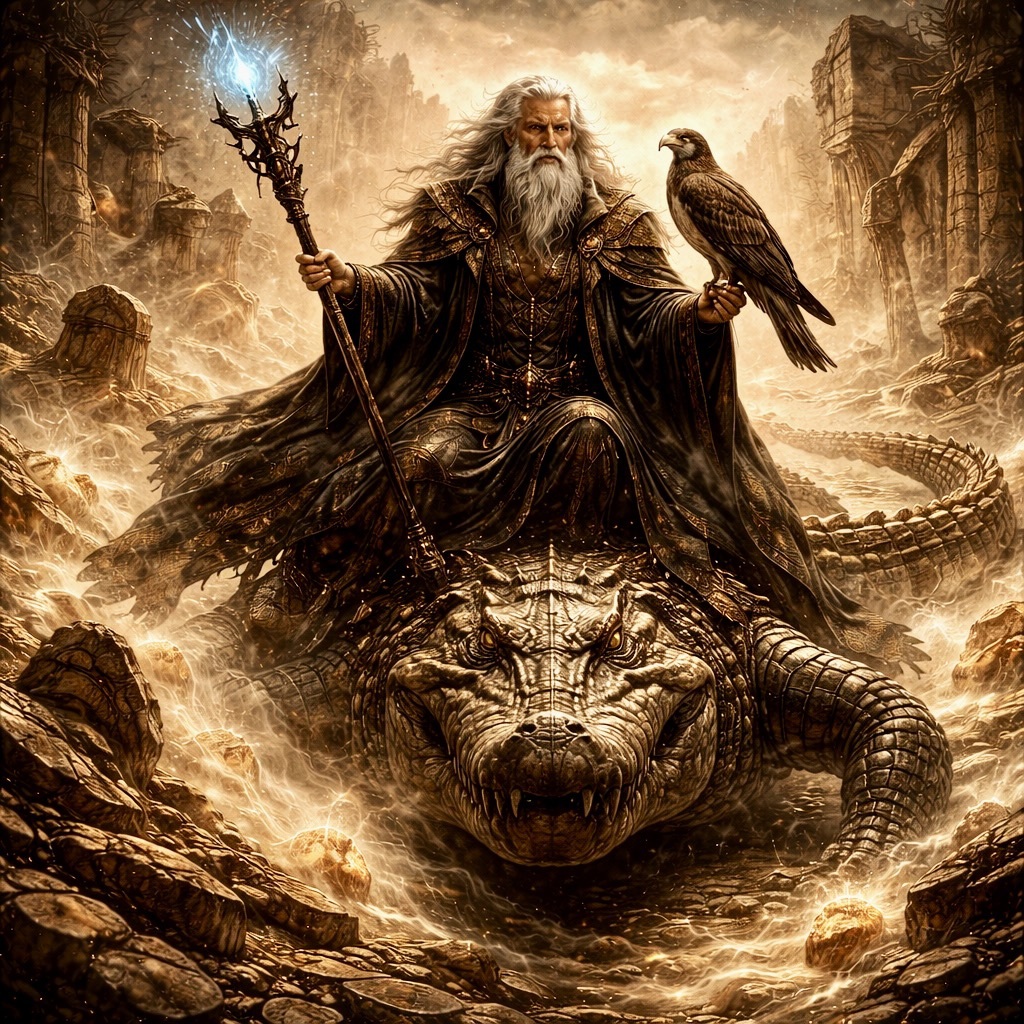
There is a particular kind of fear that rises when the sky turns the color of bruised iron and the sea begins to heave as if something beneath it has awakened. Before radar and weather satellites, before forecasts and barometric charts, storms seemed alive. They moved with intention. They punished without warning. In the old grimoires of demonology, that terrifying force found a name: Focalor. Within the pages of the Lesser Key of Solomon, Focalor is listed as a powerful Duke of Hell who commands three legions of spirits and governs the winds and seas. He is described as appearing in the form of a man with the wings of a griffin, and his power is as violent as it is tragic.

Focalor’s presence in the Ars Goetia is concise but unforgettable. He has the power to drown men and overthrow ships of war. He can raise tempests and destroy vessels, yet when properly constrained by ritual authority, he is said to obey without deceit. Unlike many other spirits in the Goetia, there is an unusual note attached to Focalor’s description: he hopes to return to the Seventh Throne after a thousand years. That detail is brief, almost easy to overlook, but it gives him something rare among infernal beings—regret.

Earlier references to Focalor appear in the Pseudomonarchia Daemonum compiled by Johann Weyer. Weyer’s work sought to catalog and critique the belief in demons, yet in doing so he preserved their mythic frameworks. Across versions, Focalor remains consistent: a spirit of wind and water, destructive yet obedient, powerful yet strangely sorrowful.

The griffin wings attached to his form are symbolically rich. The griffin, a mythical creature with the body of a lion and the head and wings of an eagle, represents strength and vigilance. It is both terrestrial and aerial. By giving Focalor griffin wings, the tradition connects him to dominion over air while grounding him in predatory force. He is not a formless storm. He is embodied wind, intention within turbulence.

The sea has always been humanity’s proving ground. Entire civilizations rose or fell depending on maritime success. A storm could undo years of preparation in a single night. To attribute that power to a Duke of Hell was not superstition born of ignorance; it was myth born of awe. When ships vanished beneath towering waves, when sailors were swept overboard and never seen again, the explanation felt personal. Someone had willed it.

Focalor’s ability to drown men and sink ships is explicit in the grimoires. There is no subtlety in that. He commands waters to overwhelm. But unlike other Goetic spirits known for deception, Focalor is described as obedient when bound within the ritual circle. This obedience matters. In the cosmology of the Goetia, authority—specifically divine authority invoked by the magician—subjugates infernal forces. Focalor’s compliance suggests structure within chaos. Even the storm answers to hierarchy.

Yet it is the note of longing that makes Focalor unique. The text states that he hopes to return to heaven after a thousand years. In a tradition where demons are often portrayed as irredeemable rebels, this hint of repentance feels almost startling. It humanizes him. It suggests a being aware of his fall, conscious of loss.

That longing casts his storms in a different light. Perhaps they are not only acts of destruction but expressions of exile. Wind is restless. It moves without settling. It searches without anchoring. Water erodes, reshapes, and retreats. If Focalor embodies wind and sea, then his domain is movement without home.

From a psychological perspective, Focalor can be interpreted as the embodiment of emotional turbulence. There are moments in life when grief becomes stormlike—sudden, overwhelming, impossible to contain. Relationships capsize. Certainty drowns. The winds of anger or despair feel external, yet they rise from within. Focalor becomes the archetype of that force: the grief-stricken storm that both destroys and longs for restoration.

In maritime history, storms determined destiny. The defeat of fleets, the loss of explorers, the reshaping of trade routes—all hinged on weather. To sailors, the wind was not abstract. It was personal, almost moral. A favorable wind felt like blessing; a hurricane felt like curse. Focalor stands at that intersection of reverence and terror.

Unlike demons associated with temptation or hidden knowledge, Focalor’s power is elemental. He does not whisper secrets. He does not seduce with promises. He raises waves. He bends masts. He tears sails from rigging. His authority is kinetic.

And yet, despite his violence, he is not described as deceitful. That distinction matters. In a hierarchy filled with tricksters, Focalor is straightforward. If commanded to raise a storm, he will. If commanded to cease, he will obey. There is a kind of brutal honesty in that. The storm does not pretend to be calm.

The griffin imagery reinforces that nobility. Griffins guard treasure in myth. They symbolize vigilance and power aligned with guardianship. To graft griffin wings onto Focalor suggests that his fall did not erase his former dignity entirely. He is still majestic, even in exile.

The sea and wind are also agents of change. Coastlines are carved by persistent waves. Forests are reshaped by tempests. Ships driven by wind opened the world to exploration. Focalor’s domain is not purely annihilation; it is transformation. What he destroys, he reshapes.

Modern occult practitioners sometimes interpret Focalor as a spirit of necessary upheaval. In this view, storms clear stagnant air. Floods wash away decay. Turbulence precedes renewal. The destructive aspect is balanced by catharsis. Just as emotional storms can lead to clarity, elemental storms can reset ecosystems.

Still, the danger remains real. The sea does not negotiate. Wind does not compromise. Focalor’s mythology reminds us that power beyond human control can still be addressed within symbolic frameworks. The ritual circle becomes metaphor for boundaries—structures that contain chaos.

There is something deeply poetic about imagining a fallen spirit who commands storms yet yearns for return. It reframes destruction as part of a larger arc. Perhaps his tempests are echoes of celestial power, diminished but potent. Perhaps his obedience reflects lingering memory of divine order.

Focalor’s three legions may seem modest compared to other dukes and kings, yet his elemental authority compensates for numbers. Three is a symbolic number of balance and triads—past, present, future; birth, life, death. Focalor’s power spans cycles.

In contemporary storytelling, he would be the storm-bringer with sorrow in his eyes. Not a cackling villain, but a force of nature burdened by exile. The waves crash not only with fury but with longing.

And perhaps that is why he endures in demonological study. He captures the duality of power and regret. He embodies the truth that strength does not erase sorrow. The wind may roar, but it also wanders.

To stand on a cliff as waves pound below is to feel small. To watch lightning fracture the sky is to feel humbled. Focalor’s legend is an attempt to give that feeling shape. He is the name whispered when ships vanish and storms gather. He is the restless Duke of the Tempest, commanding destruction yet dreaming of return.

In the end, Focalor is more than a demon of wind and sea. He is the storm that rises within and without, the turbulence that tests resilience, the force that humbles pride. And somewhere in the howl of the gale, one might almost imagine a voice—not triumphant, but yearning.

Related Posts

Paul Celan: Where Identity Goes to Hide (And Why It’s Still Talking to Me)

Penelope

Paul Celan’s poetry has been a constant presence in my life since I first stumbled upon it in a literature class during my junior year of college. His words have haunted me, lingered with me, and sometimes even felt like they were speaking directly to me. But as much as his poetry resonates, there are aspects of Celan’s life that leave me unsettled.

One of the things that has always fascinated me about Celan is the way he navigated his Jewish heritage amidst the devastation of World War II and its aftermath. As a Romanian-born Jew who survived the Holocaust, Celan’s experiences inform his poetry in profound ways. But what strikes me is the complexity of his feelings towards his own identity. He often wrote about being torn between his Jewish roots and his desire to assimilate into German culture.

I find myself struggling with similar questions. Growing up, my family wasn’t very involved in our Jewish heritage, despite being Jewish ourselves. We celebrated holidays, but it was more out of tradition than any deep connection to the faith. As I got older, I began to feel a sense of disconnection from this part of my identity, like there were parts of myself that I didn’t fully understand or acknowledge.

Reading Celan’s poetry has made me confront these feelings head-on. His work is not just about Jewish identity; it’s also about the fragmentation and dislocation that occurred during the war. He writes about how words themselves became tainted by association with Nazi ideology, making it impossible to speak truthfully without being compromised.

This resonates deeply with me because I’ve always felt like language can be both powerful and limiting. As a writer, I know that words have the ability to convey complexity and nuance, but I also recognize that they can be used to silence or erase entire communities. Celan’s poetry forces me to consider the ways in which language is never neutral.

But what really gets under my skin is the way Celan struggled with his own sense of responsibility as a writer. He felt like he was failing to adequately convey the horrors of the Holocaust, that his words were too timid or too obscure. This anxiety speaks directly to my own fears about writing – that I’ll never be able to capture the essence of what I’m trying to say.

It’s this tension between ambition and inadequacy that I find so compelling in Celan’s work. His poetry is both a testament to his skill as a writer and a reflection of his own doubts and fears. It’s as if he’s constantly pushing against the limits of language, testing its ability to express the unexpressible.

I’m drawn to this aspect of Celan’s work because it speaks to my own creative insecurities. As someone who writes for myself, I often feel like I’m trying to capture something intangible – a feeling or an experience that can’t be fully articulated. Reading Celan’s poetry makes me realize that these feelings are not unique to me; they’re shared by countless writers and artists throughout history.

And yet, despite this sense of solidarity with Celan, I still find myself wrestling with the implications of his work. His poetry is not just a reflection of his own experiences but also a commentary on the broader cultural landscape of post-war Germany. He writes about the ways in which language was used to justify atrocities, and how it continues to shape our perceptions of reality.

This makes me uncomfortable because I know that similar dynamics are still at play today. We’re living in an era where misinformation spreads quickly, and facts are often distorted or omitted altogether. Reading Celan’s poetry forces me to confront the ways in which language can be used as a tool for manipulation, and how we must remain vigilant against its misuse.

As I continue to grapple with Celan’s work, I’m struck by the complexity of his legacy – both as a writer and as a human being. His poetry is not just a testament to his own resilience but also a reminder that language has the power to both heal and harm. It’s this paradox that keeps me coming back to his words again and again, searching for answers in the midst of uncertainty.

The more I delve into Celan’s poetry, the more I’m struck by the way he navigates this tension between language as a tool for healing and its potential to harm. It’s as if he’s constantly walking on a tightrope, aware that one misstep could lead to further devastation.

This resonates deeply with me because I’ve always felt like writing is a double-edged sword. On the one hand, it allows me to process my thoughts and emotions in a way that feels therapeutic. But on the other hand, I’m constantly worried about how my words might be received by others – whether they’ll be misunderstood or misinterpreted.

Celan’s poetry makes me realize that this anxiety is not unique to me as a writer, but rather a fundamental aspect of the creative process. He writes about how even the most well-intentioned language can become tainted by its context, and how the very words we use to express ourselves can be used against us.

This thought sends a shiver down my spine because it speaks to the darker corners of human nature. I think about all the ways in which language has been used as a means of control – to silence marginalized communities, to justify oppression, or to spread hate speech. And yet, at the same time, I’m also aware that language has the power to bring people together, to inspire change, and to create something new.

This paradox is what keeps me up at night, wondering about the responsibilities that come with writing. Do I have a duty to use my words in a way that promotes understanding and empathy? Or can I simply focus on expressing myself honestly, without worrying about how others might receive it?

As I grapple with these questions, I’m drawn back to Celan’s poetry – specifically his concept of the “Ashes” collection. For me, this collection represents the ultimate expression of the tension between language as a tool for healing and its potential to harm.

The Ashes poems are written in a style that’s both beautiful and brutal – a deliberate fragmentation of language that mirrors the shattered remains of human experience during the Holocaust. It’s as if Celan is trying to convey the unrepresentable, to capture the essence of something that can’t be put into words.

This approach makes me uncomfortable because it forces me to confront my own limitations as a writer. I’m aware that there are certain experiences and emotions that are beyond my grasp – things that I can only attempt to describe, but never truly capture.

And yet, even in the midst of this uncertainty, Celan’s poetry offers me a sense of hope. It reminds me that language is not a fixed entity, but rather a dynamic and ever-changing force that can be shaped and reshaped by our experiences and perspectives.

As I continue to explore Celan’s work, I’m struck by the way it encourages me to think more critically about the role of language in shaping our understanding of the world. It’s a reminder that words have power – not just as tools for communication, but also as instruments of transformation and healing.

As I delve deeper into Celan’s poetry, I find myself drawn to his use of imagery and metaphor. His descriptions of the Holocaust are both stark and beautiful, a juxtaposition that seems to capture the complexity of human experience during that time. For example, in one of his poems, he writes about the ash trees that grew from the crematoria at Auschwitz-Birkenau, their branches stretching towards the sky like skeletal fingers.

This image haunts me because it speaks to the ways in which trauma can leave its mark on the natural world. The idea that something as beautiful and life-giving as a tree could grow out of such darkness is both heartbreaking and profound. It makes me wonder about the long-term effects of trauma on individuals, communities, and even the land itself.

Celan’s use of imagery also forces me to confront my own relationship with beauty and ugliness. As someone who writes for themselves, I often struggle with the idea that my words can be both aesthetically pleasing and disturbing at the same time. Do I have a responsibility to create something beautiful, even in the face of darkness? Or is it more important to simply express the truth, no matter how ugly or difficult it may be?

These questions swirl around me as I read Celan’s poetry, his words weaving together like a tapestry that’s both fragile and resilient. It’s as if he’s trying to capture the very essence of human experience – all its complexities, contradictions, and paradoxes.

And yet, despite the depth and richness of his work, I still find myself struggling with the idea of representation. Can poetry truly represent the Holocaust? Or is it just a pale imitation, a feeble attempt to grasp something that’s inherently beyond words?

These doubts plague me because I know that language can never fully capture the horrors of the Holocaust. There are some experiences that are too great for words, and Celan’s poetry reminds me of this fact. His work is not about representing the Holocaust in all its gory detail; it’s about capturing the emotions, the sensations, and the very essence of what happened.

This realization makes me wonder about my own relationship with representation as a writer. Do I have a responsibility to represent certain experiences or perspectives? Or can I simply focus on expressing myself honestly, without worrying about how others might receive it?

These questions linger in my mind long after I finish reading Celan’s poetry. They haunt me because they force me to confront the limitations of language and the power of words to both heal and harm.

As I continue to grapple with these questions, I’m struck by the way Celan’s poetry encourages me to think about the role of silence in creative expression. He often writes about the importance of silence as a means of conveying the unrepresentable, the unspeakable. It’s as if he’s saying that sometimes, the only way to truly express something is to leave it unsaid.

This resonates with me because I’ve always been drawn to the idea of silence as a form of resistance. In a world where words are often used to dominate or oppress, silence can be a powerful tool for reclaiming one’s own narrative and agency. Celan’s poetry reminds me that silence is not just the absence of sound; it’s also a presence, a palpable force that can shape our understanding of the world.

But what I find particularly intriguing about Celan’s use of silence is the way he often juxtaposes it with music. In many of his poems, he writes about the sound of silence, describing it as a kind of mournful melody that haunts the reader. It’s as if he’s trying to capture the sound of absence, the way that silence can take on a life of its own.

This image has stayed with me long after I finished reading Celan’s poetry. I find myself thinking about the ways in which music and silence are intertwined – how they both have the power to evoke strong emotions and create complex meanings. As someone who writes for themselves, I’m drawn to the idea that language can be used as a kind of musical instrument, one that can create harmony or discord depending on how it’s played.

But what I’m struggling with is the way Celan’s poetry often blurs the line between music and silence. He writes about the sound of silence, but he also uses language in ways that are almost musical – employing rhythm, meter, and repetition to create a sense of sonic texture. It’s as if he’s trying to capture the essence of music itself, rather than just using it as a metaphor.

This has me wondering about the relationship between language and music in my own writing. Do I have a responsibility to use language in ways that are more musical, more evocative? Or can I simply focus on expressing myself honestly, without worrying about how others might receive it?

As I grapple with these questions, I’m drawn back to Celan’s poetry – specifically his concept of the “language after Auschwitz.” For me, this phrase represents the ultimate expression of the tension between language and silence, music and meaning. It’s as if Celan is saying that language itself has been forever changed by the horrors of the Holocaust, that it can never be the same again.

This idea haunts me because I know that language is a constantly evolving entity – shaped by history, culture, and personal experience. But what I’m struggling with is the way Celan’s poetry often presents language as something fixed, unchanging. He writes about the ways in which words become tainted by association, how they can never be used again without being compromised.

This makes me wonder about my own relationship with language as a writer. Do I have a responsibility to use language in ways that are aware of its history and context? Or can I simply focus on expressing myself honestly, without worrying about the implications of my words?

As I continue to explore these questions, I’m struck by the way Celan’s poetry encourages me to think more critically about the role of language in shaping our understanding of the world. It’s a reminder that words have power – not just as tools for communication, but also as instruments of transformation and healing.

Related Posts

Vepar the Sea-Duchess of the Ars Goetia: The Demon Who Commands Storms, Ships, and the Rot Beneath the Waves

Dave

There is something ancient and instinctive about the fear of the sea. Long before maps were precise and coastlines charted, the ocean represented both opportunity and annihilation. It fed nations and swallowed fleets. It promised wealth and delivered storms. Within the pages of the Lesser Key of Solomon, that primal fear takes form in Vepar, a Great Duke of Hell who governs the waters, commands storms at sea, and inflicts festering wounds filled with corruption. She is one of the most striking figures within the Ars Goetia, not because she rages with fire, but because she moves through salt and tide.

Vepar is described as appearing in the form of a mermaid. That detail alone sets her apart from many other Goetic spirits. While numerous demons take hybrid animal shapes—lions, stags, birds—Vepar’s marine form anchors her domain entirely within the ocean. She commands twenty-nine legions of spirits and is said to guide ships laden with arms, ammunition, and soldiers. At her command, the sea becomes strategic terrain. Trade routes, war fleets, and maritime campaigns fall within her shadow.

Earlier references to Vepar appear in the Pseudomonarchia Daemonum compiled by Johann Weyer. Though the wording varies slightly, the themes remain consistent: she governs waters, raises tempests, and causes putrefying wounds unless restrained. As with many spirits of the Goetia, Vepar is not simply a monster of destruction. She is a force of navigation, transport, and influence over the sea’s vast unpredictability.

To understand Vepar fully, one must step into the mindset of a world where the ocean was mystery incarnate. In medieval Europe, the sea was not just a route—it was an abyss. Ships vanished without explanation. Storms struck without warning. Diseases spread rapidly among sailors in cramped quarters. The boundary between natural disaster and supernatural agency was porous. When a fleet was lost, it was not hard to imagine a duchess of Hell rising from beneath the waves, her voice carried on the wind.

Vepar’s ability to guide ships armed for battle suggests that her domain includes both commerce and conquest. Maritime power has always determined empires. Whoever controls the sea controls trade, supply chains, and invasion routes. To place Vepar in that role is to acknowledge the ocean as both highway and battlefield. She does not merely sink ships; she directs them.

Yet her darker power lies in the wounds she causes. The grimoires state that Vepar can cause wounds filled with worms—lesions that fester and refuse to heal. In an age of saltwater voyages, infection was a constant threat. Minor cuts exposed to brine and filth could become deadly. Scurvy, gangrene, and septic wounds ravaged crews long before they reached shore. Vepar’s association with putrefaction reflects the grim reality of maritime life. The sea nourishes, but it also rots.

There is an almost poetic symmetry in her mythology. The ocean preserves and corrodes. Saltwater sustains life yet erodes stone. Similarly, Vepar both protects ships under her command and brings decay upon those she targets. She is not merely a storm-bringer; she is the slow corruption beneath the surface.

The mermaid form is particularly fascinating. In folklore, mermaids are not universally malevolent. They are seductive, elusive, sometimes benevolent, sometimes deadly. Sailors told stories of hearing songs on the wind. Some legends warned of drowning embraces; others spoke of guidance through reefs. Vepar stands at the intersection of those narratives. She is neither fully siren nor simple tempest spirit. She is command over the waters themselves.

Unlike demons associated with fire and earth, Vepar’s power is fluid. Water cannot be grasped easily. It shapes itself around obstacles, erodes them over time, and moves with persistent force. Vepar’s symbolism mirrors that fluidity. She represents influence that spreads quietly, like a tide rising unnoticed until it reaches the door.

In modern psychological interpretation, Vepar can be seen as the archetype of emotional undercurrents. Just as the ocean hides depth beneath a calm surface, human emotions can conceal turmoil. A calm exterior may mask storms within. The festering wound she causes might symbolize unresolved emotional injuries—hurts that remain submerged until they infect daily life.

The connection between Vepar and maritime warfare is equally compelling. Ships armed with weapons traveling under her guidance suggest organized strategy. She is not chaos incarnate but calculated control of maritime resources. This aligns with the historical importance of naval dominance. From Mediterranean fleets to Atlantic armadas, the sea has always been decisive. Vepar’s mythology echoes that truth.

In the ritual tradition, practitioners were warned to approach her with caution. Like many Goetic spirits, Vepar is said to obey when constrained within proper ritual boundaries. Authority and structure matter. Without them, the sea answers to no one. That tension between command and chaos defines her character.

There is also a haunting femininity in Vepar’s depiction. In a pantheon dominated by male titles—marquises, kings, presidents—Vepar’s identity as a duchess and her mermaid form stand out. She embodies a version of power that is neither purely nurturing nor purely destructive. She is the ocean’s sovereignty—capable of sustaining trade and devouring fleets.

The historical context of the grimoires amplifies her significance. These texts emerged during periods of expanding maritime exploration. New trade routes opened. Naval conflicts intensified. Disease spread across continents via ships. The sea was both economic lifeline and vector of catastrophe. Vepar personified that duality.

Even today, the ocean retains its mythic hold. Despite satellites and sonar, its depths remain largely unexplored. Storms still overwhelm vessels. Coral reefs hide hazards. The idea of a spirit ruling beneath the waves does not feel entirely antiquated. Vepar’s legend lingers because the sea still commands awe.

Symbolically, Vepar’s putrefying wounds carry a lesson. When something is submerged too long—emotion, resentment, trauma—it decays. Exposure and cleansing become necessary for healing. Saltwater both preserves and disinfects, yet stagnation breeds corruption. Vepar’s wounds remind us of the cost of neglect.

Some contemporary occult practitioners reinterpret Vepar as a guide through emotional depths. In this framework, she governs intuition, dreams, and subconscious currents. The sea becomes metaphor for the psyche. Storms represent upheaval necessary for clarity. Her role shifts from destroyer to initiator—forcing confrontation with hidden tides.

Yet the original grimoires maintain her edge. She is not sentimental. She commands legions. She can sink fleets or fill hulls with arms. Her power is strategic and surgical. The ocean obeys her.

In a broader mythological sense, Vepar aligns with ancient sea deities who balanced benevolence and wrath. From Poseidon to Tiamat, water gods have embodied creation and destruction simultaneously. Vepar fits within that lineage, reframed through Christian demonological lenses. What older cultures revered, later traditions cataloged as infernal.

There is something deeply human in that transformation. Fear of the unknown often becomes personified. The sea’s unpredictability demanded explanation. Vepar became that explanation. She offered structure to chaos—a name to invoke, a hierarchy to understand.

The enduring power of her image lies in its resonance. A mermaid rising from storm-tossed waves, directing ships heavy with cannons, whispering decay into wounds—it is cinematic and unsettling. It captures the romance and horror of maritime history.

And perhaps that is why Vepar remains compelling. She reminds us that control over nature is never absolute. Ships may be armed, sailors disciplined, maps detailed—but the ocean still decides. Beneath every voyage lies vulnerability.

Vepar is not merely a demon of the sea. She is the tide itself—guiding, crashing, eroding, and renewing. She is the reminder that beneath calm waters, currents move unseen. And those currents, once stirred, reshape everything in their path.

Related Posts

Susan B Anthony: The Rebel in a Corset

Penelope

I’ve been thinking a lot about Susan B. Anthony lately, and what draws me to her is the sense of contradictions that surround her legacy. On one hand, she’s often celebrated as a pioneering figure in the fight for women’s suffrage – and rightfully so. Her tireless efforts to secure voting rights for women are inspiring, even if they were met with resistance, ridicule, and even arrest.

But what strikes me is how often I hear people say that Anthony’s cause was “pure” or “selfless,” implying that she was motivated by some kind of altruistic desire to better the world. Don’t get me wrong – I think it’s wonderful that she dedicated her life to fighting for women’s rights. But it’s impossible to separate Anthony’s actions from her own experiences, desires, and frustrations.

I’ve been reading about how Anthony grew up in a family that valued education and social reform, but also expected her to conform to traditional feminine roles. She rebelled against these expectations, of course – who wouldn’t? – but I wonder what it meant for her to be constantly caught between these competing demands. Did she feel like she was sacrificing her own ambitions by focusing on women’s suffrage, or did she see it as a way to break free from the constraints placed on her?

Sometimes I think about how Anthony’s reputation has been sanitized over time – how we remember her as a steadfast leader, but forget that she had her own share of doubts and controversies. Like when she advocated for property owners being able to vote, excluding many poor women who couldn’t afford to buy property. Or when she clashed with other suffragists who disagreed with her methods.

These complexities make me feel uncomfortable, because they suggest that Anthony wasn’t a one-dimensional figure at all – not some kind of saint or icon, but a multifaceted person with her own contradictions and flaws. And yet, I’m drawn to this very messiness, precisely because it makes her more human.

I think what really resonates with me is the way Anthony’s life was shaped by her relationships – particularly with other women like Elizabeth Cady Stanton and Matilda Joslyn Gage. Their friendships were forged in the fire of activism, but they also contained all the usual complexities: disagreements, misunderstandings, and moments of deep affection.

When I think about my own relationships, especially with other women who are passionate about social justice, I’m struck by how often we’re expected to be supportive, selfless, and united. But what if we’re not? What if we disagree, or feel burnt out, or just plain frustrated with each other’s approaches?

Anthony’s legacy is a reminder that even in the midst of struggle and disagreement, relationships can be a source of strength – but also of tension and conflict. And it’s this messy, complicated aspect of her life that I think I’m most drawn to.

I’ve been writing about Anthony for weeks now, but I still don’t have any clear answers or conclusions. Maybe that’s the point: sometimes the most interesting questions are the ones we can’t resolve, or that leave us feeling uncertain and unsettled.

As I continue to delve into Susan B. Anthony’s life, I find myself thinking about my own relationships with other women in a different light. We often talk about how women support each other in our struggles for social justice, but what does that really look like? Is it always easy and harmonious, or are there moments of tension and conflict?

I think back to a conversation I had with my friend Rachel last semester. We were both working on a project together, advocating for more diverse representation in our university’s curriculum. But as we started brainstorming ideas, we realized that our approaches were vastly different. I wanted to focus on creating a comprehensive report, while Rachel was adamant that we should prioritize social media campaigns. The tension between us grew thicker than the air, and before long, we found ourselves at odds.

It wasn’t until we took a step back, acknowledged our differences, and started talking about why they were important to each other, that we began to find common ground. It was a messy process, but ultimately, it made our collaboration stronger.

I wonder if something similar happened between Anthony and her fellow suffragists. Did they have their own moments of disagreement and tension? Or did they somehow manage to maintain this idealized sense of unity and solidarity?

The more I read about Anthony’s life, the more I’m struck by how little we know about the inner workings of her relationships with other women. There are glimpses here and there – a letter from Elizabeth Cady Stanton, a newspaper clipping about Anthony’s disagreements with Matilda Joslyn Gage – but it’s like trying to piece together a puzzle with missing pieces.

And yet, it’s precisely this uncertainty that makes me feel more connected to Anthony. I see myself in her messiness, in the ways she navigated complex relationships and conflicting desires. Maybe that’s what being human is all about: embracing our contradictions, our doubts, and our disagreements.

As I continue to explore Susan B. Anthony’s life, I find myself thinking about the notion of “sisterhood” in a different light. We often talk about how women support each other in their struggles for social justice, but what does that really mean? Is it enough to simply agree on the end goal, or do we need to navigate our differences and complexities along the way?

I think back to my own experiences with female friends who share similar passions and values. We often bond over our shared outrage and frustration with systemic injustices, but when it comes down to implementation and strategy, things can get messy. We disagree on tactics, priorities, and even core principles. And yet, despite these disagreements, we continue to support and care for each other.

It’s almost as if we’re trying to recreate the idealized sense of sisterhood that Anthony and her fellow suffragists seemed to have achieved. But I wonder if that’s even possible – or desirable. Do we need to be in perfect harmony all the time, or can we tolerate a little bit of tension and disagreement?

I’ve been reading about how Anthony’s relationships with other women were marked by both deep affection and intense conflict. She clashed with Elizabeth Cady Stanton over issues like property ownership and voting rights for African American men, but she also wrote letters to Matilda Joslyn Gage that reveal a profound sense of respect and admiration.

It’s this paradox that I find so fascinating – the idea that we can love and support each other even when we disagree. Maybe it’s not about achieving some kind of false unity or harmony, but about embracing our differences as an opportunity for growth and learning.

I think back to my conversation with Rachel again, and how we were able to find common ground by acknowledging our differences and talking through them. It was a messy process, but ultimately, it made our collaboration stronger. And I wonder if something similar could happen between Anthony and her fellow suffragists – or even between us, as women who are trying to create change in the world.

But what would that look like? Would we need to compromise on core principles, or find ways to balance our differences with a shared commitment to social justice? These questions swirl in my mind as I continue to learn about Anthony’s life and legacy.

As I delve deeper into Susan B. Anthony’s relationships with other women, I’m struck by the way they seem to embody both the ideals of sisterhood and the messy realities of human connection. It’s like they’re living proof that we don’t have to choose between being allies or adversaries – we can be both at the same time.

I think about how often I’ve seen this dynamic play out in my own life, where friendships are forged over shared passions and values, but eventually give way to disagreements and conflicts. It’s as if we’re constantly navigating a tightrope, trying to balance our desire for unity with the need to acknowledge and respect each other’s differences.

Anthony’s letters to Elizabeth Cady Stanton and Matilda Joslyn Gage reveal a deep sense of mutual respect and affection, but also a willingness to disagree and challenge each other. It’s like they’re modeling a new kind of sisterhood – one that acknowledges the complexity and nuance of human relationships.

I wonder if this is what I’ve been searching for in my own friendships with women who share similar passions and values. We often talk about how we need to “lift each other up” and “support each other’s dreams,” but what does that really mean? Is it enough to simply offer encouragement and validation, or do we need to engage in more meaningful conversations about our differences and disagreements?

Anthony’s legacy is a reminder that sisterhood isn’t just about being in perfect harmony – it’s about navigating the messy realities of human connection. It’s about acknowledging our differences and finding ways to work together despite them.

As I continue to explore Anthony’s life, I’m struck by how little we know about the inner workings of her relationships with other women. There are glimpses here and there – a letter from Stanton, a newspaper clipping about Anthony’s disagreements with Gage – but it’s like trying to piece together a puzzle with missing pieces.

And yet, it’s precisely this uncertainty that makes me feel more connected to Anthony. I see myself in her messiness, in the ways she navigated complex relationships and conflicting desires. Maybe that’s what being human is all about: embracing our contradictions, our doubts, and our disagreements.

I think back to my conversation with Rachel again, and how we were able to find common ground by acknowledging our differences and talking through them. It was a messy process, but ultimately, it made our collaboration stronger. And I wonder if something similar could happen between Anthony and her fellow suffragists – or even between us, as women who are trying to create change in the world.

But what would that look like? Would we need to compromise on core principles, or find ways to balance our differences with a shared commitment to social justice? These questions swirl in my mind as I continue to learn about Anthony’s life and legacy.

I’ve been thinking a lot about how Anthony’s relationships with other women were not just about shared goals and values, but also about the messy, complicated emotions that come with working together towards a common cause. I think about how often I’ve felt frustrated or hurt by disagreements with my own friends who share similar passions, only to later realize that those same conversations were also opportunities for growth and learning.

One of the things that strikes me about Anthony’s relationships is how she was willing to listen to and learn from others, even when they disagreed with her. She wrote letters to Elizabeth Cady Stanton, for example, that reveal a deep sense of respect and admiration for her fellow suffragist, despite their differences on issues like property ownership and voting rights.

I think about my own relationships with women who share similar passions, and how often I feel the need to be right or to “win” an argument. But Anthony’s legacy suggests that maybe that’s not what’s most important – maybe what’s more important is being willing to listen, to learn, and to grow together.

It’s funny, because when I think about it, I realize that my own relationships with women who share similar passions are often marked by a sense of competition or one-upmanship. We’re all trying to prove ourselves as the most committed, the most passionate, the most dedicated – but in doing so, we often forget that our differences and disagreements are an opportunity for growth and learning.

Anthony’s legacy is a reminder that sisterhood isn’t just about being in perfect harmony – it’s about navigating the messy realities of human connection. It’s about acknowledging our differences and finding ways to work together despite them. And I think that’s something we can all learn from, regardless of whether we’re suffragists or social justice advocates.

As I continue to explore Anthony’s life and legacy, I’m struck by how little we know about the inner workings of her relationships with other women. There are glimpses here and there – a letter from Stanton, a newspaper clipping about Anthony’s disagreements with Gage – but it’s like trying to piece together a puzzle with missing pieces.

And yet, it’s precisely this uncertainty that makes me feel more connected to Anthony. I see myself in her messiness, in the ways she navigated complex relationships and conflicting desires. Maybe that’s what being human is all about: embracing our contradictions, our doubts, and our disagreements.

I think back to my conversation with Rachel again, and how we were able to find common ground by acknowledging our differences and talking through them. It was a messy process, but ultimately, it made our collaboration stronger. And I wonder if something similar could happen between Anthony and her fellow suffragists – or even between us, as women who are trying to create change in the world.

But what would that look like? Would we need to compromise on core principles, or find ways to balance our differences with a shared commitment to social justice? These questions swirl in my mind as I continue to learn about Anthony’s life and legacy.

Related Posts

Sabnock the Fortress Builder: The Blood-Stained Marquis of the Ars Goetia Who Commands Wounds, Walls, and War

Dave

There is something unnervingly practical about Sabnock. In a catalog of spirits filled with tempters, illusionists, seducers, and whisperers of hidden knowledge, Sabnock stands apart with a hammer in one hand and a blade in the other. He does not merely deceive or seduce; he constructs and destroys. In the hierarchy recorded in the Lesser Key of Solomon, Sabnock is described as a Great Marquis of Hell who commands fifty legions of spirits. He appears as an armed soldier with the head of a lion, riding upon a pale horse. He builds high towers, furnishes castles with armor and weapons, and inflicts festering wounds that refuse to heal.

Even in summary, Sabnock feels severe. There is nothing subtle about a lion-headed warrior charging forward on horseback. Unlike demons who cloak themselves in soft persuasion, Sabnock is martial from the start. He represents fortification, defense, siege, and the long memory of violence.

His name appears prominently in the Ars Goetia, where he is sometimes spelled Sabnac or Sabnach. Earlier demonological texts such as the Pseudomonarchia Daemonum by Johann Weyer also reference him, preserving his rank and attributes within the infernal order. Across variations, certain themes remain constant: walls rise at his command, weapons appear in armories, and wounds linger under his influence.

On the surface, Sabnock seems to embody straightforward brutality. But as with many Goetic spirits, there is more beneath the imagery. The lion’s head is not merely decorative. In medieval symbolism, the lion represents courage, ferocity, nobility, and dominion. It is a creature that both protects and devours. To graft that image onto a soldier riding a pale horse is to combine predatory instinct with disciplined warfare. Sabnock is not chaos on the battlefield; he is organized aggression.

The pale horse is another striking detail. Throughout Western iconography, the pale horse often signals plague, death, or inevitability. It evokes the rider who cannot be escaped. In Sabnock’s case, the pale horse may suggest the inevitability of conflict once walls begin to rise and weapons are gathered. Fortification invites siege. Preparation anticipates violence. The very act of building defenses implies that something terrible is expected.

The grimoires note that Sabnock can build high towers and fortify cities with weapons and armor. In a literal medieval context, that power was invaluable. Fortresses determined survival. A city’s walls were the thin line between prosperity and massacre. To command a spirit capable of strengthening defenses would have seemed not only useful but urgent. Yet the same texts warn that Sabnock can also afflict men with wounds that rot and fester.

This duality is crucial. Sabnock both protects and punishes. He reinforces walls but undermines flesh. In that sense, he embodies the paradox of militarization. The more one prepares for war, the more war becomes present in spirit and structure. The fortress may stand strong, but the cost is carried in blood.

It is tempting to read Sabnock as merely a relic of medieval warfare, but his symbolism remains deeply relevant. In modern psychological terms, Sabnock can represent emotional fortification. When someone builds walls around themselves—armor against betrayal, distance against vulnerability—they may feel protected. But those same defenses can isolate and harden the spirit. The wound that refuses to heal may not be physical at all; it may be the scar left by constant vigilance.

The lion-headed marquis riding into view is a dramatic image, but the true terror of Sabnock lies in the festering wound. The old texts emphasize that he causes wounds filled with worms, sores that linger unless commanded otherwise. In pre-modern Europe, such infections were catastrophic. Without antibiotics, a minor injury could spiral into death. To associate Sabnock with festering wounds is to align him with decay that cannot easily be stopped.

And yet, even here, there is nuance. Some interpretations suggest that when properly constrained within ritual authority, Sabnock can prevent such afflictions or redirect them. Like many Goetic spirits, he is not purely destructive but conditional. He responds to authority, structure, and discipline—the very traits associated with military hierarchy.

Sabnock’s legion count—fifty legions—places him among the more powerful marquises. In the hierarchical imagination of demonology, numbers signified status and influence. Fifty legions suggest organization, command, and scale. Sabnock is not a lone marauder; he is a general. His influence extends through ranks of subordinate spirits, mirroring earthly armies.

There is something almost disturbingly relatable about him. Humanity has always oscillated between building and breaking. We erect cities, walls, systems, and institutions. We fortify ourselves with laws and weapons. Yet the same mechanisms that promise safety often produce prolonged conflict. Sabnock becomes the embodiment of that cycle: prepare, defend, suffer, endure.

In contemporary occult discussions, Sabnock is sometimes approached as a spirit of strategic protection. Practitioners interpret his ability to build towers as symbolic of establishing boundaries. In this framework, Sabnock teaches resilience, discipline, and preparedness. The lion’s head becomes courage rather than cruelty. The pale horse becomes inevitability accepted rather than feared.

Still, one cannot ignore the darker undertones. The festering wound is a powerful metaphor for unresolved conflict. When grievances are left untreated, they rot. When trauma is ignored, it seeps into daily life. Sabnock’s wounds may be psychological reminders that armor alone does not heal what lies beneath.

Historically, the grimoires that cataloged Sabnock emerged in a world defined by siege warfare. Castles dotted the European landscape. Plagues and infections spread unchecked. The fear of attack was constant. To imagine a spirit governing walls and wounds was not abstract—it was immediate. Sabnock represented both hope for protection and dread of decay.

What fascinates modern readers is how vividly physical he feels compared to more abstract demons. Sabnock is tactile: stone walls rising, steel weapons clashing, flesh splitting under blades. There is a grounded brutality in his depiction. Even the lion’s mane conjures texture and heat.

And yet, beneath that physicality lies something archetypal. Sabnock is the spirit of defense mechanisms. He is the instinct to harden after betrayal. He is the voice that says, “Build higher walls. Sharpen the blades.” Sometimes that instinct is necessary. Boundaries protect. Preparation saves lives. But when carried too far, fortification becomes isolation, and readiness becomes paranoia.

The old magicians who wrote of Sabnock likely approached him with caution and precision. Ritual circles, divine names, and structured invocations were not theatrical flourishes; they were safeguards. In demonology, authority is everything. To summon Sabnock without discipline would invite chaos. To command him properly would harness structured strength.

This dynamic reflects something deeply human. Power without structure destroys. Power within boundaries protects. Sabnock’s mythology reinforces that lesson again and again. The lion-headed warrior obeys hierarchy. The walls he builds stand only when commanded. The wounds he inflicts persist unless restrained.

There is also a strange dignity in Sabnock’s martial image. Unlike demons associated with deceit or seduction, Sabnock’s domain is overt. He does not pretend to be gentle. He arrives armed. There is honesty in that. You know what you face. In a world where many threats are hidden, there is something almost comforting about a visible adversary.

Over centuries, artists and occultists have reimagined Sabnock in countless forms: towering armored knight, leonine-faced general, spectral rider emerging from smoke. The core imagery remains consistent because it resonates. We recognize the archetype of the defender-warrior. We understand the cost of walls. We know the sting of wounds that take too long to heal.

Whether viewed as literal entity, psychological construct, or mythic narrative, Sabnock occupies a powerful place within the Goetic tradition. He is not merely a demon of violence. He is a symbol of preparation, defense, consequence, and the fragile line between protection and harm.

In the end, Sabnock’s story is not just about Hell’s marquises. It is about humanity’s enduring struggle to protect itself without becoming hardened beyond recognition. It is about the towers we build—externally and internally—and the wounds we carry when those towers are tested.

Sabnock rides on, lion-headed and relentless, reminding us that every fortress casts a shadow, and every blade leaves a mark.

Related Posts