Latest Articles

Ada Lovelace: Where Art Meets Algorithm (and I Meet Myself)

Penelope

I’ve always been fascinated by Ada Lovelace, the world’s first computer programmer. But what draws me to her is not just her groundbreaking work on Charles Babbage’s Analytical Engine – it’s the sense of tension that exists between her calculated logic and her artistic imagination.

I’m someone who loves writing as a way to clarify my thoughts, but Ada’s life feels like a constant tug-of-war between reason and creativity. Born Augusta Ada Byron, she was the daughter of Lord George Gordon Byron, the famous poet – but her mother, Anne Isabella Milbanke, made sure Ada was schooled in mathematics and logic, determined to shield her from her father’s supposed instability.

It’s hard not to see this as a reflection of my own complicated relationship with creativity. I’m a writer who values precision and clarity, often finding myself getting lost in the messiness of emotions and experiences. But when I read about Ada’s work on the Analytical Engine, I feel a twinge of recognition – she saw the potential for machines to go beyond mere calculation, to create art and music.

Ada’s Notes on the Analytical Engine are like nothing I’ve ever read before. They’re not just technical explanations or even predictions about what the machine could do; they’re poems, almost. She sees the engine as a tool that can “compose elaborate and scientific pieces of music” – an idea that both thrills and unsettles me.

What strikes me is how Ada’s passion for art and music doesn’t feel separate from her technical expertise, but rather intertwined with it. It’s like she’s showing us that creativity isn’t just something you add to a project after the fact; it’s woven into every step of the process.

But there’s also this sense of distance, of detachment – Ada observing her own imagination from outside, almost as if it’s a machine she can program and control. It makes me wonder: what does it mean to be creative, really? Is it just about producing something new and original, or is it about tapping into some deeper part of ourselves that we can’t quite explain?

I find myself drawn to Ada’s contradictions – the way she’s both a product of her mother’s logic and her father’s artistic legacy. It’s like she’s holding two opposing forces in tension within herself, and I’m not sure which one is driving her forward.

Sometimes, when I’m writing, I feel like I’m stuck between these same poles – the need for clarity and precision versus the messy uncertainty of emotions and experiences. Ada’s life feels like a reminder that this tension isn’t something to be resolved; it’s what makes us human.

I’ve been reading through Ada’s Notes again, and I’m struck by how she sees the Analytical Engine as not just a machine, but an instrument. An instrument that can take in raw data and produce something new, something beautiful. It’s like she’s saying that creativity isn’t just about having a spark of inspiration, but about using tools to shape and refine it.

I think this is where my own writing process gets stuck. I get so caught up in trying to make sense of things, to pin down the exact words and phrases that will convey what I mean. But Ada’s approach feels more… fluid. She’s not afraid to take risks, to explore the possibilities of the engine even when they seem impossible.

It makes me wonder if my own writing is too calculated, too safe. Am I just going through the motions, following a set of rules and conventions that don’t allow for true creativity? Ada’s work shows me that there’s a different way to approach things – one that combines logic and imagination in ways that feel both deliberate and spontaneous.

I’ve been trying to tap into this sense of fluidity in my own writing, but it feels like a hard habit to break. I get anxious about making mistakes, about not being able to control the outcome. But Ada’s notes are full of “what-ifs” and hypotheticals – she’s constantly pushing the boundaries of what’s possible with the Analytical Engine.

It’s like she’s saying that creativity isn’t just about producing something new, but about exploring the unknown. And that’s a scary prospect for me. What if I don’t know where this exploration will take me? What if it leads to places I don’t want to go?

But at the same time, there’s a part of me that’s drawn to this uncertainty. It feels like Ada is speaking directly to my own fears and doubts – telling me that it’s okay not to have all the answers, that sometimes the best way forward is to simply start writing, or coding, or exploring.

I think I need to let go of some of this control, to trust that the process will take care of itself. Ada’s life feels like a reminder that creativity isn’t just about producing something perfect; it’s about embracing the imperfections and uncertainties along the way.

As I continue to read through Ada’s Notes, I’m struck by her use of language – it’s like she’s speaking directly to me, addressing my own fears and doubts about creativity. She writes about the Analytical Engine as if it’s a living being, one that can be coaxed and cajoled into producing something beautiful. And yet, at the same time, she’s aware of its limitations, its potential for failure.

I find myself wondering if I’m holding onto my own creative endeavors too tightly. Am I trying to control the outcome, to make sure that every word is perfect and every sentence flows seamlessly? Or am I allowing myself to be led by curiosity, to explore the unknown and see where it takes me?

It’s funny – when I was in college, I would often get caught up in trying to write “perfect” essays. I’d spend hours researching and outlining, making sure that every argument was sound and every sentence was grammatically correct. And yet, looking back on those essays now, they feel so…safe. So formulaic.

Ada’s Notes are the opposite of that. They’re like a wildflower blooming in the middle of a field – unpredictable, untamed, and full of beauty. And it’s not just her writing style that I’m drawn to; it’s the way she thinks about creativity itself.

She sees the Analytical Engine as an instrument, one that can be used to create something new and beautiful. But she also knows that it’s only as good as the person using it – that the machine is a tool, not a replacement for human imagination.

I think this is what I’m missing in my own writing process. I’m so caught up in trying to use language as a tool, as a means to an end, that I forget about the beauty of the journey itself. Ada’s Notes are like a reminder to me that creativity isn’t just about producing something new; it’s about the process of creating, the act of bringing something into being.

And so, as I continue to read through her notes, I’m struck by a sense of longing – a desire to break free from the constraints of my own writing style and see where Ada’s approach might lead me. To let go of control and allow myself to be guided by curiosity, to explore the unknown and see what wonders it holds.

It’s scary, of course – there’s always the risk that I’ll fail, that I’ll produce something mediocre or even worse. But at the same time, I feel a sense of excitement building inside me. What if I do let go of control? What if I allow myself to be led by my imagination, rather than trying to tame it with rules and conventions?

I don’t know where this will take me, but I’m willing to find out.

As I delve deeper into Ada’s Notes, I start to notice the way she weaves together different threads of thought – mathematics, music, poetry, and technology. It’s like she’s creating a tapestry that’s both intricate and beautiful, with each thread informing and enriching the others. I’m struck by how she sees the Analytical Engine as a means to transcend the limitations of human creativity, to push beyond what we think is possible.

I find myself wondering if this is why I’ve always been drawn to writing – not just as a way to communicate ideas, but as a way to explore the depths of my own imagination. When I’m writing, I feel like I’m tapping into something deeper and more mysterious than mere words on paper. It’s like I’m accessing a hidden world that’s both familiar and unknown.

But what if this is precisely the problem? What if I’ve been trying to control this process, to harness it for my own purposes rather than letting it unfold organically? Ada’s Notes seem to suggest that creativity is not something we can contain or possess; it’s more like a force of nature that we can only surrender to.

I’m not sure how to reconcile these opposing forces within myself. On the one hand, I crave precision and control – the safety net of rules and conventions that keeps me from falling into chaos. But on the other hand, I’m drawn to the uncertainty and risk-taking that Ada’s Notes embody. It’s like I’m caught between two opposing poles, each pulling me in different directions.

As I continue to read through Ada’s work, I start to feel a sense of connection to her as a person – not just as a historical figure or a pioneer in computer science, but as someone who struggled with similar tensions and contradictions. It’s like she’s speaking directly to my own fears and doubts about creativity, telling me that it’s okay to be uncertain, to take risks, and to explore the unknown.

I’m starting to see Ada’s life not just as a reflection of her work on the Analytical Engine, but as a journey of self-discovery – one that was marked by struggles with identity, creativity, and purpose. And I think this is what resonates with me so deeply – the sense that we’re all on our own journeys of discovery, each struggling to make sense of ourselves and our place in the world.

As I close Ada’s Notes for now, I’m left with more questions than answers. What does it mean to be creative? How do we balance control and uncertainty in our work? And what lies at the heart of this tension between reason and imagination?

But even as these questions linger, I feel a sense of excitement building inside me – the thrill of not knowing where this journey will take me, or what wonders I might discover along the way.

As I sit here with Ada’s Notes still open in front of me, I’m struck by the realization that her life is not just a reflection of her work on the Analytical Engine, but also a testament to the power of resilience and determination. Despite facing countless obstacles and setbacks, she persevered in pursuing her passions, even when it meant going against conventional norms.

I find myself drawn to this aspect of Ada’s story, the part where she refuses to be defined by the expectations placed upon her. Born into a world that valued reason and logic above all else, she chose to defy these conventions and instead explore the uncharted territories of art and music. It’s as if she knew that true creativity lies not in conforming to societal norms, but in challenging them.

As I reflect on my own life, I’m reminded of the many times I’ve felt pressure to conform to expectations – from family and friends, to teachers and mentors. There have been moments when I’ve felt like I need to choose between following a traditional path or pursuing my true passions. Ada’s story is a powerful reminder that it’s okay to take risks, to challenge the status quo, and to forge our own paths.

But what if this means embracing uncertainty? What if it requires me to let go of control and surrender to the unknown? I think about the many times I’ve felt anxious or uncertain in my writing, when I’ve worried that I’m not good enough or that my ideas won’t resonate with others. Ada’s approach seems to suggest that these fears are normal, even necessary, for growth and creativity.

As I continue to ponder this idea, I start to feel a sense of liberation washing over me. It’s as if I’ve been holding onto control too tightly, trying to micromanage every aspect of my writing process. But what if the true act of creation lies not in control, but in surrender? What if it requires me to let go of my attachment to perfection and instead trust in the process?

I think about the many times I’ve tried to force my writing into neat little boxes, trying to fit my ideas into predetermined structures or conventions. But Ada’s Notes show me that creativity is messy, unpredictable, and full of contradictions. It’s like she’s saying that true artistry lies not in trying to control the outcome, but in embracing the chaos and uncertainty that comes with it.

As I close my laptop and take a deep breath, I feel a sense of excitement building inside me. What if I let go of control and allowed myself to be guided by curiosity? What if I trusted in the process, rather than trying to micromanage every step of the way?

I’m not sure where this will lead, but I know that it’s time for me to take a leap of faith. To surrender to the uncertainty and risk-taking that Ada’s Notes embody. To see where this journey takes me, and what wonders I might discover along the way.

Related Posts

Andrealphus: The Peacock Demon Who Masters Geometry, Astronomy, and Cold Precision

Dave

Andrealphus is not a demon of passion, temptation, or chaos. He is something far colder, far more exacting, and in many ways more unsettling. Where other infernal figures appeal to desire, ambition, or fear, Andrealphus appeals to intellect stripped of empathy. In the grimoires of the Ars Goetia, he is listed as a Marquis of Hell, a rank associated with authority, command, and structure. But unlike martial or political demons, Andrealphus rules over abstract order. His domain is geometry, astronomy, measurement, and the rigid logic that reduces the world to angles, distances, and predictable motion.

Andrealphus is described as appearing initially in the form of a peacock, a striking and unusual image in demonology. The peacock is often associated with beauty, symmetry, and display, but also with vanity and cold detachment. This form is not decorative. It is symbolic. The peacock’s feathers form natural geometric patterns, precise and repeating, eye-like shapes arranged with mathematical consistency. To encounter Andrealphus as a peacock is to confront beauty that is exact, ordered, and indifferent to human feeling.

Only when commanded does Andrealphus assume a human shape, and even then he retains something distant and calculating in his presence. He teaches geometry perfectly, makes men subtle in measurements, and instructs in astronomy. These are not arts of inspiration. They are arts of control. Geometry defines space. Astronomy defines time and movement. Measurement defines limitation. Andrealphus governs the frameworks that make the universe predictable.

This predictability is where his true menace lies. Andrealphus does not deceive. He clarifies. He strips away uncertainty and replaces it with certainty so precise it can become suffocating. In his world, there is a correct answer, a correct angle, a correct calculation. Anything that cannot be measured is irrelevant. Emotion, ambiguity, and intuition hold no value unless they can be quantified.

The association with astronomy places Andrealphus among the watchers rather than the movers. He does not shape fate through desire or force. He observes patterns, calculates trajectories, and understands inevitability. In ancient thought, astronomy was not merely scientific; it was prophetic. The movement of stars was believed to reveal destiny. Andrealphus’s mastery of this art suggests dominion over foresight without mercy.

What makes Andrealphus especially unsettling is his transformation of beauty into discipline. The peacock’s display, often seen as extravagant or vain, becomes under Andrealphus a demonstration of structural perfection. Beauty exists because it obeys rules. The feathers are beautiful because they align, repeat, and mirror one another. This is not beauty meant to comfort. It is beauty meant to assert order.

In demonological symbolism, Andrealphus represents the danger of intelligence divorced from compassion. Knowledge without conscience. Precision without restraint. He does not misuse geometry or astronomy. He uses them exactly as they are meant to be used. And that is the problem. When systems function perfectly, they do not care who is harmed by their efficiency.

The marquisate of Andrealphus reinforces this interpretation. A marquis governs borders and defenses. Andrealphus governs the borders of understanding. He defines where certainty ends and ignorance begins. Once something falls within his domain, it is fixed, categorized, and no longer open to interpretation.

Unlike demons who tempt with promises of pleasure or power, Andrealphus offers mastery. Mastery over space, motion, and proportion. This is deeply attractive to minds that crave control. But the cost is subtle. When everything is reduced to measurement, humanity itself becomes a variable rather than a value.

In modern symbolic terms, Andrealphus feels eerily contemporary. Algorithms, models, simulations, and predictive systems all echo his influence. These systems are not evil. They are precise. They optimize, calculate, and forecast. And like Andrealphus, they do not care about individual suffering unless it affects the model. The peacock demon becomes a mirror held up to modern rationalism.

Andrealphus does not rage. He does not threaten. He does not seduce. He waits. He calculates. He knows where things are going long before they arrive. This makes him a figure of inevitability rather than confrontation. Those who fall under his influence often do so willingly, believing they are choosing clarity over confusion.

Yet there is a warning embedded in his lore. Perfect measurement leaves no room for mercy. Perfect prediction leaves no room for hope. Andrealphus embodies the extreme end of rational order, where uncertainty is eliminated at the cost of freedom.

His peacock form reinforces this warning. The peacock does not fly far despite its wings. Its beauty is heavy. It is bound to display rather than escape. Andrealphus’s knowledge is similarly heavy. It dazzles, but it anchors. It impresses, but it confines.

In occult tradition, those who seek Andrealphus do so for intellectual power, not transformation. They want accuracy, foresight, and command over systems. Andrealphus provides this without deception. He gives exactly what is asked. What he does not give is balance.

Ultimately, Andrealphus represents the cold edge of intelligence. He is the demon of correct answers that leave no room for kindness, of systems that function flawlessly while ignoring the human cost. He reminds us that understanding the universe is not the same as understanding ourselves.

Andrealphus endures because humanity will always be tempted by certainty. In a chaotic world, the promise of perfect measurement is seductive. But his presence asks an uncomfortable question: when everything can be calculated, what happens to compassion?

Related Posts

Langston Hughes: Where the Rivers Meet My Confusion

Penelope

Langston Hughes. I’ve always been drawn to his words, like a moth to a flame that burns bright but uncertain. There’s something about the way he speaks of love and loss, of blackness and identity, that resonates deeply within me.

I think it’s because, on some level, I see myself in his struggles. Not directly, of course – Hughes was a product of the Harlem Renaissance, a movement I only learned about in college. But as I read his poetry and essays, I feel this kinship with him, like we’re both navigating the complexities of being black and American.

For me, it starts with “The Negro Speaks of Rivers.” I remember reading those lines – “I’ve known rivers ancient as the world and older than the flow of human blood in human veins” – and feeling a shiver run down my spine. It’s not just the words themselves, but the way they make me feel: seen, heard, understood.

But it’s also unsettling. Hughes writes about the weight of history, the pain of being torn between two worlds. I think about my own experiences growing up, caught between my white mother and black father, trying to find a sense of belonging in a world that didn’t always make room for me. It’s like he’s speaking directly to my soul, and I’m not sure if it’s comforting or suffocating.

I’ve always been fascinated by the idea of identity – how we define ourselves, and how others see us. Hughes’s work is like a mirror held up to this question, reflecting all the contradictions and paradoxes that come with being black in America. He writes about the beauty of African American culture, but also its brutal suppression.

Sometimes I wonder if he’s talking directly to me, asking: “What are you? Where do you belong?” I feel like I’m searching for answers just as much as Hughes was, even though we’re separated by time and experience.

One thing that draws me to his work is the way he blends poetry with prose. He’s not afraid to get messy, to use language in unexpected ways. It’s like he’s speaking truthfully about himself, without apology or pretension. I admire that.

But it also makes me uncomfortable. His writing can be raw and painful, confronting themes of racism, poverty, and loss head-on. Sometimes I feel like I’m not ready for it – like I need to steel myself before diving in.

I’ve come back to his work again and again, each time finding something new to grapple with. It’s like Hughes is a puzzle I’m trying to solve, but the pieces keep shifting and rearranging themselves. Maybe that’s what makes him so compelling: he never gives me easy answers or clear resolutions.

As I sit here thinking about Langston Hughes, I realize that my fascination with his work has less to do with the man himself than with the questions he raises within me. His poetry and essays are a mirror held up to my own identity, forcing me to confront the complexities of being black, American, and uncertain.

I don’t know what it means to truly understand him – or myself, for that matter. But I do know that his words have become a part of me, like a heartbeat I feel in my chest whenever I read about his struggles, his joys, and his unflinching honesty.

I find myself returning to the same themes over and over – identity, belonging, the search for authenticity. Hughes’s work is like a thread that weaves through these questions, never providing clear answers but always keeping me on my toes. I’ve come to realize that his poetry isn’t just about him; it’s about all of us who feel caught between worlds, searching for a sense of self.

I think back to the words from “The Negro Speaks of Rivers” – those ancient rivers that flow through human veins. It’s as if Hughes is saying that our experiences are connected, that our stories are part of a larger narrative. But what does it mean to be connected when we’re so different? Is it possible to find common ground across cultures and histories?

Sometimes I feel like I’m trying to unravel a knot, pulling at individual strands only to have them tangle even further. Hughes’s work is like that – a tangled web of ideas and emotions that refuse to be untangled. It’s frustrating and exhilarating all at once.

I’ve been reading his essays on jazz and blues, and it’s struck me how similar the sounds are to the rhythms of my own life. The way jazz musicians improvise over familiar melodies, creating something new with each note – it’s like that for me when I write. I’m not sure what I’m trying to say or create, but I know it’s connected to the emotions and experiences that flow through me.

But here’s the thing: Hughes didn’t just write about music; he wrote about life. And life is messy and complicated and sometimes brutal. He confronts these harsh realities head-on, never shying away from the hard questions or painful truths. I admire his courage, but it also makes me nervous – what if I’m not brave enough to face my own demons?

As I continue to read and reread Hughes’s work, I feel like I’m becoming a part of it – like his words are seeping into my skin, becoming a part of who I am. It’s both exhilarating and terrifying, this sense of absorption. Am I losing myself in his stories, or finding myself in the process?

I find myself lost in the intersection of Hughes’s world and mine, searching for that elusive connection between our experiences. His words become a kind of cartography, mapping the contours of my own identity. But as I delve deeper into his work, I start to notice the silences – the gaps between the lines, the unspoken emotions, the untold stories.

It’s like he’s showing me the invisible threads that bind us all together, but also the ones that tear us apart. His writing is a kind of surgical precision, cutting through the noise and getting straight to the heart of the matter. But sometimes I feel like I’m stuck in the operating room, watching as he dissects the very fabric of our humanity.

Take his poem “Mother to Son.” It’s a powerful exploration of resilience, of the ways in which we’re shaped by the experiences of those who came before us. The speaker’s words are like a gentle but firm hand on my shoulder, urging me to keep moving forward even when the path ahead is uncertain. But it’s also a painful reminder that I’m not immune to the struggles he writes about – that my own mother’s story is one of sacrifice and struggle, of trying to create a better life for her children despite the odds against her.

I wonder if Hughes knew this would be his legacy – that his words would continue to resonate with generations after him. Or was it simply a byproduct of his artistry, a natural extension of his vision? Sometimes I feel like I’m eavesdropping on a private conversation, one that’s meant for me alone but also speaks directly to the hearts of those who’ve come before me.

It’s this sense of connection that draws me back to his work again and again. Not just because he writes about blackness and identity, but because he writes about humanity – all its complexities, contradictions, and frailties. His poetry is a mirror held up to our shared experience, reflecting both the beauty and the brutality of life.

As I sit here thinking about Langston Hughes, I realize that his work has become a kind of anchor for me – a reminder that I’m not alone in this journey, that there are others who’ve walked similar paths before me. His words are a lifeline, connecting me to a larger community that spans time and space.

But even as I feel this sense of connection, I’m aware of the distance between us – the differences in our experiences, our contexts, our cultures. It’s like trying to bridge two rivers, each with its own currents and depths. How do we find common ground when the waters are so different? Is it possible to speak a language that transcends borders and histories?

These questions swirl inside me as I continue to read Hughes’s work, searching for answers that may never come. But perhaps that’s the point – not to find resolution or closure, but to keep exploring, to keep grappling with the complexities of our shared humanity.

As I ponder these questions, I’m reminded of a conversation I had with my friend and colleague, Rachel, about her own experiences as a black woman in America. She spoke of feeling like she’s constantly navigating multiple worlds, never quite finding her footing in either one. It was as if she was living in the spaces between two rivers, just as Hughes wrote about in “The Negro Speaks of Rivers.” Her words resonated deeply with me, and I felt a sense of solidarity, knowing that we were both struggling to find our place in this complex landscape.

Rachel’s story reminded me of another essay by Hughes, one that explores the tension between assimilation and resistance. He writes about how African Americans have always been caught between the desire to be seen as equal and the need to maintain their cultural identity. It’s a delicate balance, one that requires constant negotiation and self-reflection.

As I think about this dynamic, I’m struck by the ways in which Hughes’s work continues to speak to me across time and space. His words are like a mirror held up to our shared experiences as black people in America, but also as individuals navigating the complexities of identity and belonging. He reminds us that we’re not alone in our struggles, that there have been countless others who’ve walked similar paths before us.

But what does it mean to find common ground with someone from a different time and place? Is it possible to transcend the boundaries of culture, history, and experience? These questions linger in my mind as I continue to read Hughes’s work, searching for answers that may never come. And yet, even in the uncertainty, I feel a sense of connection to this writer who lived so long ago but still speaks so powerfully to me today.

Perhaps it’s because his words have become a part of me, seeping into my skin like a slow-moving river. Or maybe it’s because he reminds me that our experiences are not unique, that we’re all connected in ways both visible and invisible. Whatever the reason, I know that Langston Hughes will continue to be a source of inspiration and guidance for me as I navigate the complexities of being black, American, and uncertain.

As I close this essay, I’m left with more questions than answers, but also a deeper appreciation for the power of art to connect us across time and space. Hughes’s work is like a thread that weaves through our shared experiences, a reminder that we’re not alone in this journey. And even as I struggle to find my place within it, I know that his words will continue to guide me forward, illuminating the path ahead with their fierce honesty and unwavering compassion.

As I reflect on Langston Hughes’s work, I’m struck by the way he uses language to capture the complexities of human experience. His poetry is like a musical composition, weaving together disparate threads to create a rich tapestry of sound and emotion. He has a way of distilling the essence of life into simple, yet powerful words that resonate deep within me.

I think back to his essay on jazz, where he writes about the improvisational spirit of musicians like Duke Ellington and Charlie Parker. They take familiar melodies and turn them into something new, something original, something that speaks to the heart of their own experiences as black Americans. Hughes sees this same spirit in the work of African American writers, who take the raw material of their lives and shape it into art that is both personal and universal.

For me, this idea of improvisation speaks directly to my own writing process. When I sit down with a blank page or screen, I feel a sense of uncertainty, like I’m standing at the edge of a river with no clear path ahead. But as I begin to write, something starts to flow – ideas, emotions, memories – and before I know it, I’ve created something new, something that reflects my own unique perspective on the world.

It’s this feeling of creation, of bringing something into being, that draws me to Hughes’s work. He writes about the power of art to transform our lives, to give us a sense of hope and purpose in the face of adversity. His words are like a lifeline, connecting me to a larger community of writers and artists who have struggled with similar questions and doubts.

But even as I admire Hughes’s craft, I’m aware that his work is not just about aesthetics; it’s also about politics. He writes about racism, poverty, and inequality, using his words to challenge the status quo and demand justice for African Americans. This was a radical act in its time, and one that continues to resonate today.

As I think about Hughes’s commitment to social justice, I’m reminded of my own experiences as a young black woman navigating the complexities of identity and belonging. Growing up, I often felt like an outsider, caught between two worlds that didn’t always make room for me. But through writing, I’ve found a way to express myself, to tell my story in all its complexity and nuance.

Hughes’s work has given me permission to do this, to speak truthfully about my own experiences without apology or pretension. His words have become a kind of manifesto, a call to action that reminds me of the power of art to transform our lives and challenge the systems that oppress us.

As I continue to read Hughes’s work, I’m struck by the way he uses his words to build bridges between different cultures and communities. He writes about African American culture with pride and passion, but also acknowledges its connections to other traditions and experiences. This sense of interconnectedness is something that resonates deeply with me, as I navigate my own relationships with people from diverse backgrounds.

For Hughes, this connection is not just about aesthetics; it’s also about politics. He writes about the ways in which racism and oppression have been used to divide us, to create artificial boundaries between different groups of people. His words are a powerful call to action, urging us to reject these divisions and build bridges instead.

As I reflect on this idea, I’m reminded of my own experiences as a student at college, where I was surrounded by people from all walks of life. It was a diverse community, but also one that was often divided along lines of race, class, and identity. Hughes’s work spoke to me during those times, reminding me of the power of art to bring us together across our differences.

Now, as I look out at the world around me, I see the same divisions and tensions playing out in real-time. But I also see the potential for connection and solidarity, for people from different backgrounds to come together and build something new. Hughes’s work has given me hope that this is possible, that we can create a more just and equitable society through our words and actions.

As I close my essay on Langston Hughes, I’m left with a sense of wonder and awe at the power of his words. His poetry and essays have become a part of me, shaping my thoughts and feelings about identity, belonging, and social justice. But they’ve also given me something more – a sense of connection to a larger community of writers, artists, and activists who are working towards a common goal.

Hughes’s work will continue to be a source of inspiration for me as I navigate the complexities of my own life and world. His words remind me that art has the power to transform us, to connect us across our differences and give us hope in the face of adversity.

Related Posts

Cimejes (Cimeies): The Infernal Marquis Who Commands Ruins, Lost Things, and the Discipline of War

Dave

Cimejes, sometimes written as Cimeies, is not a demon of spectacle. He does not dominate the imagination through grotesque excess or theatrical cruelty. Instead, his presence is quieter, more austere, and far more unsettling once you understand what he represents. In the grimoires of the Ars Goetia, Cimejes is listed as a Marquis of Hell, a title that immediately places him in a realm of command, discipline, and structure. Yet unlike other infernal nobles who rule passions or desires, Cimejes governs aftermath. He is the demon of what remains when ambition collapses, when battles are over, and when what was once valued has been forgotten or buried.

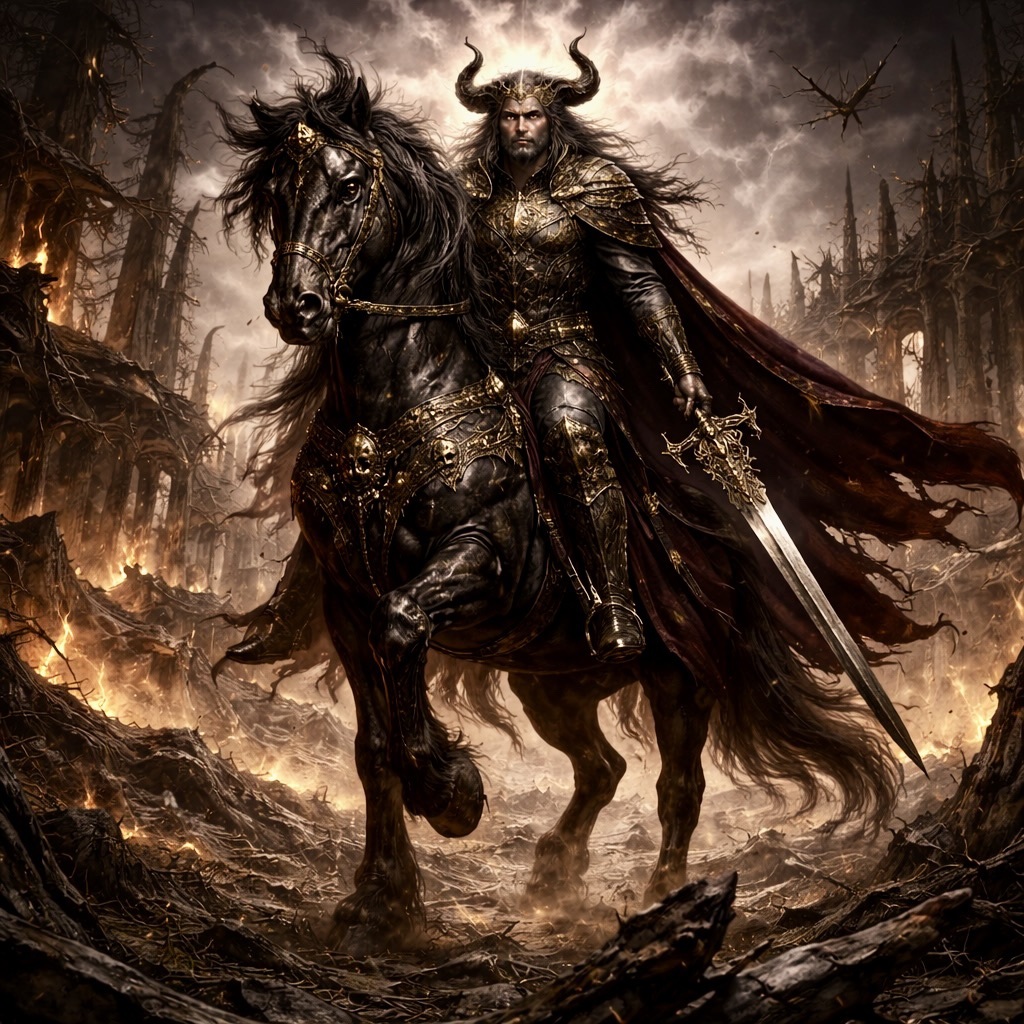
Cimejes is described as appearing as a warrior riding a black horse, a detail that anchors him firmly in the imagery of war. But this is not the romanticized war of banners and glory. This is war seen from the other side: broken ground, scattered weapons, abandoned strongholds, and the silent accounting of loss. His authority is not over victory, but over consequence. He teaches grammar, logic, and rhetoric, but he is also said to reveal hidden or lost things, particularly treasures concealed in the earth. This combination is not accidental. Language, reason, and loss all revolve around memory and structure. Cimejes governs what has been displaced from its original order.

In medieval demonology, a marquis was traditionally responsible for border territories and military defense. Cimejes fits this role perfectly. His domain exists at the borders between use and abandonment, between knowledge and obscurity. He does not create chaos; he manages what chaos leaves behind. Where others incite ambition, Cimejes catalogs its debris.

The black horse upon which Cimejes rides is symbolic of inevitability. Horses in myth often represent momentum, the forward movement of events that cannot easily be stopped. A black horse adds the dimension of finality. Cimejes arrives not at the beginning of a journey, but near its end. His appearance signals that something has already been decided, already lost, already buried. What remains is understanding.

One of the most intriguing aspects of Cimejes is his association with education. He teaches grammar, logic, and rhetoric, the classical foundations of structured thought. These disciplines are not creative in the emotional sense. They are corrective. They refine, categorize, and impose order. This aligns with Cimejes’s broader symbolism. He does not inspire; he clarifies. He takes what has been scattered and teaches how to interpret it.

The ability to reveal hidden treasures further reinforces this theme. Treasures, in demonological language, are not always gold or jewels. They can be forgotten truths, suppressed memories, or overlooked opportunities. Cimejes reveals what lies beneath the surface, but only what already exists. He does not invent value; he uncovers it. In this way, he resembles an archaeologist of consequence, unearthing what others abandoned in their rush forward.

Cimejes is often misunderstood as a demon of simple destruction because of his martial imagery. In reality, he is far more restrained. He does not delight in ruin. He governs it. This distinction matters. Ruin is not inherently evil. It is a state of transition. Civilizations rise, decay, and leave behind fragments. Cimejes presides over that phase, ensuring that what is lost is not entirely erased.

Unlike demons who tempt or deceive, Cimejes operates without urgency. His power is patient. He waits until the dust settles. This patience makes him especially resonant in a modern context. We live in a culture obsessed with growth and novelty, often at the expense of reflection. Cimejes represents the moment when forward motion pauses and reckoning begins.

His martial bearing also suggests discipline rather than aggression. Armor, weapons, and posture all imply order, hierarchy, and restraint. Cimejes does not fight wildly. He stands ready, composed, and observant. He embodies the soldier who understands that every advance creates a rear, every victory creates vulnerability, and every conquest leaves something unguarded behind.

In symbolic terms, Cimejes is the demon of inventory. He accounts for what remains after desire has burned itself out. This makes him deeply uncomfortable to confront, because he does not allow denial. He reveals what was sacrificed, what was forgotten, and what was never recovered. There is no illusion in his presence, only assessment.

The alternate spelling, Cimeies, reflects the instability of his domain. Names shift when things are no longer actively maintained. Spelling variations are a linguistic form of decay, and Cimejes exists comfortably in that decay. He is not diminished by inconsistency. He inhabits it.

Cimejes also represents the idea that knowledge itself can be a form of aftermath. Grammar, logic, and rhetoric are often learned after mistakes have been made. They are tools for correction, not impulse. In this sense, Cimejes governs learning born of consequence. He teaches not how to begin, but how to understand what has already happened.

In fiction and modern occult symbolism, Cimejes often appears as a stern, reserved figure, neither cruel nor kind. He is not interested in moral judgment. He is interested in accuracy. This neutrality is what gives him weight. He does not console. He reveals.

The ability to find lost things connects Cimejes to memory. What is lost is not always gone. Sometimes it is simply buried beneath newer layers of experience. Cimejes uncovers these layers methodically. He does not rush the process. He respects the weight of what is found.

Ultimately, Cimejes represents the discipline of reckoning. He is the demon who asks, “What remains?” when everything else has passed. In a world that constantly urges movement, ambition, and escalation, that question is deeply unsettling. It forces attention away from fantasy and toward reality.

Cimejes endures in demonology because ruin is inevitable. Every system, no matter how powerful, eventually leaves fragments behind. Someone must govern that stage. Someone must stand watch over what was abandoned. Cimejes fills that role, not as a destroyer, but as a custodian of aftermath.

To understand Cimejes is to accept that loss is not the end of meaning. It is the beginning of interpretation. He does not promise restoration. He promises clarity. And for those willing to face what has been left behind, that clarity can be its own form of power.

Related Posts

Marie Curie: Where Vulnerability Meets Radioactive Genius (and a Whole Lot of Unanswered Questions)

Penelope

Marie Curie’s name has been echoing in my mind since I stumbled upon her story a few weeks ago. What struck me most was the way she embodied both vulnerability and resilience, qualities that are often at odds with each other. As someone who’s struggled to balance my own sense of self-worth with the demands of higher education, I found myself drawn to her determination.

I’ve always been fascinated by women in science – those who dared to challenge societal norms and pursue careers in fields dominated by men. Marie Curie was one such trailblazer, and her story is both inspiring and unsettling. Her achievements are undeniably remarkable: two Nobel Prizes, a pioneering work on radioactivity, and the establishment of the Curie Institutes in Warsaw and Paris. Yet, what I find most compelling about her narrative is the way it unravels at its seams.

Marie’s relationship with Pierre Curie has been extensively documented – their romance, their shared passion for science, and ultimately, their tragic fate when a carriage ran over him in 1906. What I’m drawn to is not the grand love story itself but rather the complexity it adds to Marie’s character. I find myself wondering how much of her drive was fueled by Pierre’s influence and support versus her own intrinsic motivation. Did she genuinely believe in her work, or was she propelled by a desire to prove herself worthy of Pierre’s love?

I’ve always been torn between wanting to idealize pioneers like Marie Curie and acknowledging the darker aspects of their stories. Her experiences with sexism and racism are well-documented, yet I sometimes wonder if we’re more inclined to focus on her triumphs rather than the battles she fought along the way. It’s as if we want to preserve a sanitized version of these women, one that aligns with our own ideals of strength and determination.

My own experiences in college have taught me about the importance of perseverance, but also the weight of expectation. I’ve often felt like I’m walking a tightrope between pursuing my passions and meeting the standards set by others – professors, peers, even myself. Marie Curie’s struggles to balance her scientific pursuits with motherhood, marriage, and social obligations resonate deeply with me.

As I delve deeper into her story, I find myself questioning what it means to be “inspired” by someone like Marie Curie. Is it the fact that she persevered in a male-dominated field? Or is it something more nuanced – the way she navigated multiple identities, sometimes at great personal cost? My own sense of identity is still evolving, and I’m not sure if I’m drawn to Marie’s example because of her achievements or because they mirror my own fears and doubts.

The more I learn about Marie Curie, the more I realize how little I truly know. Her story is a tangled web of triumphs and setbacks, with moments of quiet introspection that have yet to be fully explored. Perhaps it’s this complexity – this refusal to simplify or reduce her narrative to a single thread – that continues to captivate me.

As I sit here, surrounded by the detritus of my own thoughts, I’m left wondering what Marie Curie would make of me, of my struggles and insecurities. Would she see herself in me? Or would she view me as a pale imitation, someone too timid to fully grasp the possibilities that lay before her? The truth is, I don’t know. But it’s this uncertainty – this feeling of being suspended between two worlds – that keeps drawing me back to Marie Curie’s story, and to my own place within its shadow.

As I sit in this liminal space, questioning what I can learn from Marie Curie’s life and legacy, I’m struck by the ways in which her experiences mirror my own struggles with identity and ambition. Like her, I’ve often felt torn between pursuing my passions and meeting the expectations of others – whether that’s a professor pushing me to produce “worthy” research or my own internalized voice whispering doubts about my abilities.

But what really gets me is how Marie Curie’s story highlights the fragility of success. We’re so often taught to idealize pioneers like her, to see them as beacons of strength and determination who overcame insurmountable obstacles with ease. But the truth is, their struggles are just as real as ours – maybe even more so, given the societal pressures they faced.

Take, for example, Marie’s relationship with her daughters. We know that she struggled to balance her scientific pursuits with motherhood, and that her work often came at the expense of time spent with Irene and Ève. It’s a complex dynamic, one that speaks to the ways in which women’s lives are often structured around others’ needs rather than their own desires.

As I think about this, I’m reminded of my own relationships – with family members, friends, romantic partners. How do we navigate these demands on our time and energy? Do we prioritize our own passions, or do we sacrifice them for the sake of others? Marie Curie’s story shows me that it’s not always an either-or situation; sometimes, it’s a messy negotiation between competing identities.

But even as I’m drawn to this complexity, I still can’t shake the feeling that I’m somehow “less” than Marie Curie. That her achievements are more remarkable, her struggles more triumphant, because she lived through times of such profound societal change. It’s a strange kind of nostalgia, one that makes me feel like I’m living in a world already built by others – a world that values innovation and progress over the messy, incremental steps we take each day.

And yet…and yet…I think this is where Marie Curie’s story becomes truly powerful. Because despite all the expectations placed upon her, she still managed to carve out a space for herself in the scientific community. She pushed boundaries, challenged norms, and created something new – not just in her research, but in the way we understand ourselves as women, as scientists, as human beings.

It’s this sense of agency that I think draws me back to Marie Curie’s story again and again. Not just because she was a trailblazer, or because her work changed the course of science history. But because in her own messy, imperfect way, she showed us that it’s possible to create something new – even when we’re not sure what that looks like, or where we fit within the world around us.

As I close this essay, and Marie Curie’s story begins to recede into the background of my mind, I’m left with a sense of uncertainty. What does it mean to be inspired by someone like her? Is it possible to emulate her strength and determination without reducing myself to a pale imitation? The truth is, I don’t know – but I think that’s what makes Marie Curie’s story so compelling: its willingness to complicate the narrative, to show us the messy, imperfect parts of ourselves.

I’ve been thinking about this idea of agency a lot lately, and how it relates to my own experiences as a young woman in a world that often seems designed to constrain me. I think back to all the times I felt like I was living up to other people’s expectations – my parents’, my professors’, even my own internalized voice. It’s a strange kind of weight, one that can make you feel like you’re constantly performing for an audience rather than being true to yourself.

But Marie Curie’s story shows me that it’s possible to create something new, even in the midst of all these expectations. She didn’t just challenge societal norms; she created her own space within them. And I think that’s what I’m drawn to – not just the fact that she was a trailblazer, but the way she navigated the complexities of her own identity.

It’s funny, because when I first started reading about Marie Curie, I thought I was mainly interested in her achievements as a scientist. But the more I learned about her life, the more I realized that it was her struggles with identity and ambition that really resonated with me. She was a woman who defied convention, but also one who struggled to balance her multiple identities – scientist, wife, mother.

I think we often forget that these pioneers we idolize were human beings, too – people with their own doubts and fears and insecurities. And yet, it’s precisely this humanity that makes Marie Curie’s story so compelling. She wasn’t just a brilliant scientist; she was someone who felt the weight of expectation, who struggled to find her place in the world.

As I reflect on my own experiences, I realize that I’ve been trying to emulate this kind of agency – this ability to create something new despite all the constraints around me. But it’s not always easy. There are times when I feel like I’m just going through the motions, performing for an audience rather than being true to myself.

And yet…I think Marie Curie’s story shows me that even in those moments of uncertainty, there is agency. It’s a fragile thing, maybe – one that can be easily disrupted by societal pressures or internalized expectations. But it’s also a powerful force, one that can drive us to create something new and meaningful in the world.

I’m not sure what this looks like for me yet – whether I’ll follow in Marie Curie’s footsteps as a scientist, or find my own path in some other field entirely. All I know is that I want to create something new, to challenge the norms and expectations that have been placed upon me. And I think that’s what makes Marie Curie’s story so compelling – not just her achievements, but the way she showed us that it’s possible to carve out our own spaces in the world, even when it feels like everything is working against us.

As I continue to grapple with Marie Curie’s legacy, I find myself thinking about the concept of “authenticity” – what does it mean to be true to oneself in a world that often seeks to constrain and define us? Marie Curie’s story shows me that authenticity is not a fixed state, but rather a dynamic process of negotiation and creation. She didn’t simply conform to societal expectations or fit into predetermined roles; instead, she carved out her own path, even when it meant challenging the norms.

I think about my own experiences with identity and how they intersect with societal expectations. As a young woman in academia, I’ve often felt pressure to present myself in a certain way – as confident, assertive, and unapologetic. But what if that’s not who I am? What if I’m still figuring out my place in the world, still uncertain about what I want or who I am?

Marie Curie’s story shows me that it’s okay to be unsure, to question, and to explore. She didn’t have all the answers, and she certainly didn’t fit into any predetermined mold. Instead, she used her uncertainty as a catalyst for growth and creation – pushing boundaries, challenging norms, and creating something new.

I’m not sure if I’ll ever find my own Marie Curie moment – that defining instance where I feel like I’ve truly claimed my place in the world. But what I do know is that I want to approach life with the same sense of agency and curiosity that she did. I want to be willing to take risks, to challenge myself, and to create something new – even if it means making mistakes or facing uncertainty along the way.

It’s funny, because when I first started reading about Marie Curie, I thought her story would be a source of inspiration for me – a reminder that anything is possible with hard work and determination. But what I’ve come to realize is that her story is so much more nuanced than that. It’s a complex tapestry of struggles, doubts, and fears, woven together with moments of triumph, joy, and creation.

I think that’s why Marie Curie’s legacy feels so relevant to me today – because it shows me that even in the midst of uncertainty and doubt, there is always the possibility for growth, creation, and transformation. It’s not a linear process, and it’s certainly not without its challenges. But what I’ve learned from her story is that it’s precisely this willingness to navigate complexity, to question assumptions, and to create something new that makes life worth living.

As I close this essay, I’m left with more questions than answers – about identity, agency, and the complexities of Marie Curie’s legacy. But what I do know is that her story has given me a sense of permission to explore, to create, and to be unsure. And for that, I will always be grateful.

Related Posts