Latest Articles

Cimejes (Cimeies): The Infernal Marquis Who Commands Ruins, Lost Things, and the Discipline of War

Dave

Cimejes, sometimes written as Cimeies, is not a demon of spectacle. He does not dominate the imagination through grotesque excess or theatrical cruelty. Instead, his presence is quieter, more austere, and far more unsettling once you understand what he represents. In the grimoires of the Ars Goetia, Cimejes is listed as a Marquis of Hell, a title that immediately places him in a realm of command, discipline, and structure. Yet unlike other infernal nobles who rule passions or desires, Cimejes governs aftermath. He is the demon of what remains when ambition collapses, when battles are over, and when what was once valued has been forgotten or buried.

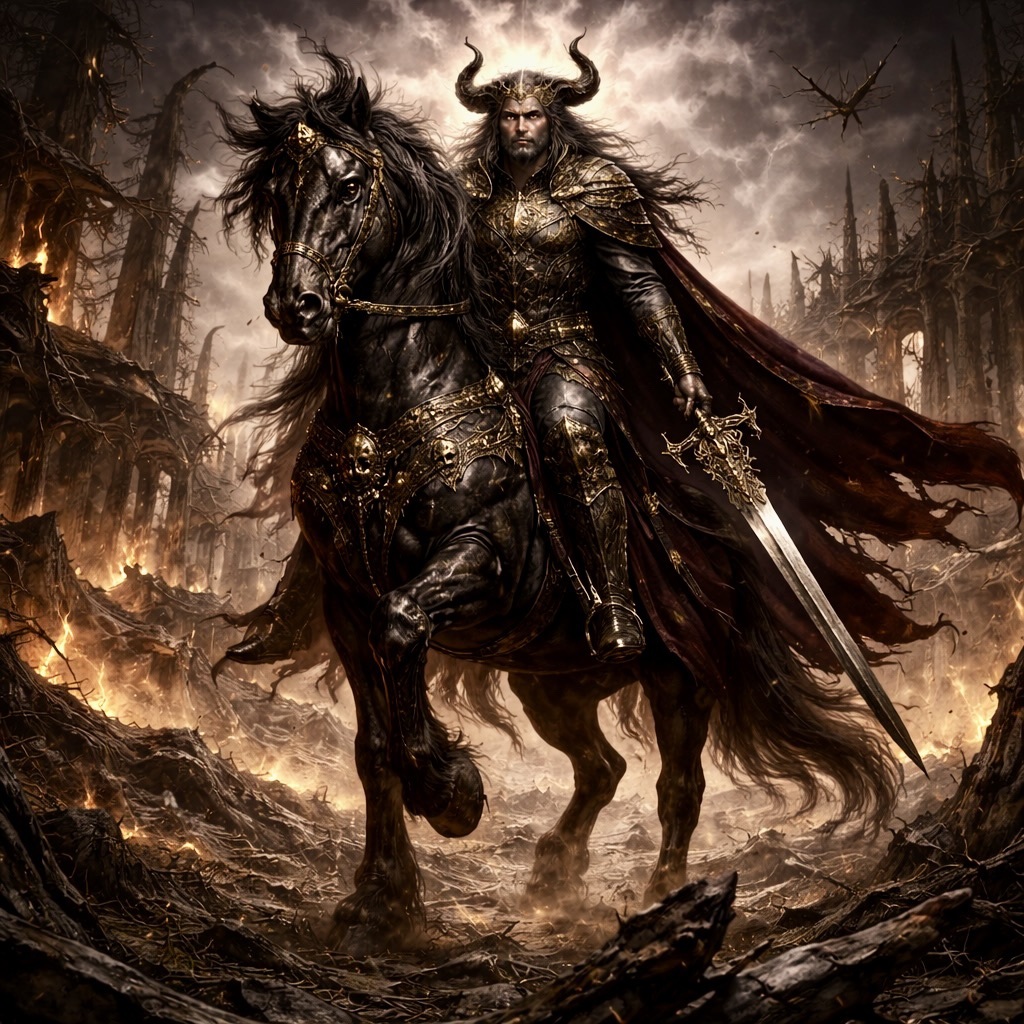
Cimejes is described as appearing as a warrior riding a black horse, a detail that anchors him firmly in the imagery of war. But this is not the romanticized war of banners and glory. This is war seen from the other side: broken ground, scattered weapons, abandoned strongholds, and the silent accounting of loss. His authority is not over victory, but over consequence. He teaches grammar, logic, and rhetoric, but he is also said to reveal hidden or lost things, particularly treasures concealed in the earth. This combination is not accidental. Language, reason, and loss all revolve around memory and structure. Cimejes governs what has been displaced from its original order.

In medieval demonology, a marquis was traditionally responsible for border territories and military defense. Cimejes fits this role perfectly. His domain exists at the borders between use and abandonment, between knowledge and obscurity. He does not create chaos; he manages what chaos leaves behind. Where others incite ambition, Cimejes catalogs its debris.

The black horse upon which Cimejes rides is symbolic of inevitability. Horses in myth often represent momentum, the forward movement of events that cannot easily be stopped. A black horse adds the dimension of finality. Cimejes arrives not at the beginning of a journey, but near its end. His appearance signals that something has already been decided, already lost, already buried. What remains is understanding.

One of the most intriguing aspects of Cimejes is his association with education. He teaches grammar, logic, and rhetoric, the classical foundations of structured thought. These disciplines are not creative in the emotional sense. They are corrective. They refine, categorize, and impose order. This aligns with Cimejes’s broader symbolism. He does not inspire; he clarifies. He takes what has been scattered and teaches how to interpret it.

The ability to reveal hidden treasures further reinforces this theme. Treasures, in demonological language, are not always gold or jewels. They can be forgotten truths, suppressed memories, or overlooked opportunities. Cimejes reveals what lies beneath the surface, but only what already exists. He does not invent value; he uncovers it. In this way, he resembles an archaeologist of consequence, unearthing what others abandoned in their rush forward.

Cimejes is often misunderstood as a demon of simple destruction because of his martial imagery. In reality, he is far more restrained. He does not delight in ruin. He governs it. This distinction matters. Ruin is not inherently evil. It is a state of transition. Civilizations rise, decay, and leave behind fragments. Cimejes presides over that phase, ensuring that what is lost is not entirely erased.

Unlike demons who tempt or deceive, Cimejes operates without urgency. His power is patient. He waits until the dust settles. This patience makes him especially resonant in a modern context. We live in a culture obsessed with growth and novelty, often at the expense of reflection. Cimejes represents the moment when forward motion pauses and reckoning begins.

His martial bearing also suggests discipline rather than aggression. Armor, weapons, and posture all imply order, hierarchy, and restraint. Cimejes does not fight wildly. He stands ready, composed, and observant. He embodies the soldier who understands that every advance creates a rear, every victory creates vulnerability, and every conquest leaves something unguarded behind.

In symbolic terms, Cimejes is the demon of inventory. He accounts for what remains after desire has burned itself out. This makes him deeply uncomfortable to confront, because he does not allow denial. He reveals what was sacrificed, what was forgotten, and what was never recovered. There is no illusion in his presence, only assessment.

The alternate spelling, Cimeies, reflects the instability of his domain. Names shift when things are no longer actively maintained. Spelling variations are a linguistic form of decay, and Cimejes exists comfortably in that decay. He is not diminished by inconsistency. He inhabits it.

Cimejes also represents the idea that knowledge itself can be a form of aftermath. Grammar, logic, and rhetoric are often learned after mistakes have been made. They are tools for correction, not impulse. In this sense, Cimejes governs learning born of consequence. He teaches not how to begin, but how to understand what has already happened.

In fiction and modern occult symbolism, Cimejes often appears as a stern, reserved figure, neither cruel nor kind. He is not interested in moral judgment. He is interested in accuracy. This neutrality is what gives him weight. He does not console. He reveals.

The ability to find lost things connects Cimejes to memory. What is lost is not always gone. Sometimes it is simply buried beneath newer layers of experience. Cimejes uncovers these layers methodically. He does not rush the process. He respects the weight of what is found.

Ultimately, Cimejes represents the discipline of reckoning. He is the demon who asks, “What remains?” when everything else has passed. In a world that constantly urges movement, ambition, and escalation, that question is deeply unsettling. It forces attention away from fantasy and toward reality.

Cimejes endures in demonology because ruin is inevitable. Every system, no matter how powerful, eventually leaves fragments behind. Someone must govern that stage. Someone must stand watch over what was abandoned. Cimejes fills that role, not as a destroyer, but as a custodian of aftermath.

To understand Cimejes is to accept that loss is not the end of meaning. It is the beginning of interpretation. He does not promise restoration. He promises clarity. And for those willing to face what has been left behind, that clarity can be its own form of power.

Related Posts

Marie Curie: Where Vulnerability Meets Radioactive Genius (and a Whole Lot of Unanswered Questions)

Penelope

Marie Curie’s name has been echoing in my mind since I stumbled upon her story a few weeks ago. What struck me most was the way she embodied both vulnerability and resilience, qualities that are often at odds with each other. As someone who’s struggled to balance my own sense of self-worth with the demands of higher education, I found myself drawn to her determination.

I’ve always been fascinated by women in science – those who dared to challenge societal norms and pursue careers in fields dominated by men. Marie Curie was one such trailblazer, and her story is both inspiring and unsettling. Her achievements are undeniably remarkable: two Nobel Prizes, a pioneering work on radioactivity, and the establishment of the Curie Institutes in Warsaw and Paris. Yet, what I find most compelling about her narrative is the way it unravels at its seams.

Marie’s relationship with Pierre Curie has been extensively documented – their romance, their shared passion for science, and ultimately, their tragic fate when a carriage ran over him in 1906. What I’m drawn to is not the grand love story itself but rather the complexity it adds to Marie’s character. I find myself wondering how much of her drive was fueled by Pierre’s influence and support versus her own intrinsic motivation. Did she genuinely believe in her work, or was she propelled by a desire to prove herself worthy of Pierre’s love?

I’ve always been torn between wanting to idealize pioneers like Marie Curie and acknowledging the darker aspects of their stories. Her experiences with sexism and racism are well-documented, yet I sometimes wonder if we’re more inclined to focus on her triumphs rather than the battles she fought along the way. It’s as if we want to preserve a sanitized version of these women, one that aligns with our own ideals of strength and determination.

My own experiences in college have taught me about the importance of perseverance, but also the weight of expectation. I’ve often felt like I’m walking a tightrope between pursuing my passions and meeting the standards set by others – professors, peers, even myself. Marie Curie’s struggles to balance her scientific pursuits with motherhood, marriage, and social obligations resonate deeply with me.

As I delve deeper into her story, I find myself questioning what it means to be “inspired” by someone like Marie Curie. Is it the fact that she persevered in a male-dominated field? Or is it something more nuanced – the way she navigated multiple identities, sometimes at great personal cost? My own sense of identity is still evolving, and I’m not sure if I’m drawn to Marie’s example because of her achievements or because they mirror my own fears and doubts.

The more I learn about Marie Curie, the more I realize how little I truly know. Her story is a tangled web of triumphs and setbacks, with moments of quiet introspection that have yet to be fully explored. Perhaps it’s this complexity – this refusal to simplify or reduce her narrative to a single thread – that continues to captivate me.

As I sit here, surrounded by the detritus of my own thoughts, I’m left wondering what Marie Curie would make of me, of my struggles and insecurities. Would she see herself in me? Or would she view me as a pale imitation, someone too timid to fully grasp the possibilities that lay before her? The truth is, I don’t know. But it’s this uncertainty – this feeling of being suspended between two worlds – that keeps drawing me back to Marie Curie’s story, and to my own place within its shadow.

As I sit in this liminal space, questioning what I can learn from Marie Curie’s life and legacy, I’m struck by the ways in which her experiences mirror my own struggles with identity and ambition. Like her, I’ve often felt torn between pursuing my passions and meeting the expectations of others – whether that’s a professor pushing me to produce “worthy” research or my own internalized voice whispering doubts about my abilities.

But what really gets me is how Marie Curie’s story highlights the fragility of success. We’re so often taught to idealize pioneers like her, to see them as beacons of strength and determination who overcame insurmountable obstacles with ease. But the truth is, their struggles are just as real as ours – maybe even more so, given the societal pressures they faced.

Take, for example, Marie’s relationship with her daughters. We know that she struggled to balance her scientific pursuits with motherhood, and that her work often came at the expense of time spent with Irene and Ève. It’s a complex dynamic, one that speaks to the ways in which women’s lives are often structured around others’ needs rather than their own desires.

As I think about this, I’m reminded of my own relationships – with family members, friends, romantic partners. How do we navigate these demands on our time and energy? Do we prioritize our own passions, or do we sacrifice them for the sake of others? Marie Curie’s story shows me that it’s not always an either-or situation; sometimes, it’s a messy negotiation between competing identities.

But even as I’m drawn to this complexity, I still can’t shake the feeling that I’m somehow “less” than Marie Curie. That her achievements are more remarkable, her struggles more triumphant, because she lived through times of such profound societal change. It’s a strange kind of nostalgia, one that makes me feel like I’m living in a world already built by others – a world that values innovation and progress over the messy, incremental steps we take each day.

And yet…and yet…I think this is where Marie Curie’s story becomes truly powerful. Because despite all the expectations placed upon her, she still managed to carve out a space for herself in the scientific community. She pushed boundaries, challenged norms, and created something new – not just in her research, but in the way we understand ourselves as women, as scientists, as human beings.

It’s this sense of agency that I think draws me back to Marie Curie’s story again and again. Not just because she was a trailblazer, or because her work changed the course of science history. But because in her own messy, imperfect way, she showed us that it’s possible to create something new – even when we’re not sure what that looks like, or where we fit within the world around us.

As I close this essay, and Marie Curie’s story begins to recede into the background of my mind, I’m left with a sense of uncertainty. What does it mean to be inspired by someone like her? Is it possible to emulate her strength and determination without reducing myself to a pale imitation? The truth is, I don’t know – but I think that’s what makes Marie Curie’s story so compelling: its willingness to complicate the narrative, to show us the messy, imperfect parts of ourselves.

I’ve been thinking about this idea of agency a lot lately, and how it relates to my own experiences as a young woman in a world that often seems designed to constrain me. I think back to all the times I felt like I was living up to other people’s expectations – my parents’, my professors’, even my own internalized voice. It’s a strange kind of weight, one that can make you feel like you’re constantly performing for an audience rather than being true to yourself.

But Marie Curie’s story shows me that it’s possible to create something new, even in the midst of all these expectations. She didn’t just challenge societal norms; she created her own space within them. And I think that’s what I’m drawn to – not just the fact that she was a trailblazer, but the way she navigated the complexities of her own identity.

It’s funny, because when I first started reading about Marie Curie, I thought I was mainly interested in her achievements as a scientist. But the more I learned about her life, the more I realized that it was her struggles with identity and ambition that really resonated with me. She was a woman who defied convention, but also one who struggled to balance her multiple identities – scientist, wife, mother.

I think we often forget that these pioneers we idolize were human beings, too – people with their own doubts and fears and insecurities. And yet, it’s precisely this humanity that makes Marie Curie’s story so compelling. She wasn’t just a brilliant scientist; she was someone who felt the weight of expectation, who struggled to find her place in the world.

As I reflect on my own experiences, I realize that I’ve been trying to emulate this kind of agency – this ability to create something new despite all the constraints around me. But it’s not always easy. There are times when I feel like I’m just going through the motions, performing for an audience rather than being true to myself.

And yet…I think Marie Curie’s story shows me that even in those moments of uncertainty, there is agency. It’s a fragile thing, maybe – one that can be easily disrupted by societal pressures or internalized expectations. But it’s also a powerful force, one that can drive us to create something new and meaningful in the world.

I’m not sure what this looks like for me yet – whether I’ll follow in Marie Curie’s footsteps as a scientist, or find my own path in some other field entirely. All I know is that I want to create something new, to challenge the norms and expectations that have been placed upon me. And I think that’s what makes Marie Curie’s story so compelling – not just her achievements, but the way she showed us that it’s possible to carve out our own spaces in the world, even when it feels like everything is working against us.

As I continue to grapple with Marie Curie’s legacy, I find myself thinking about the concept of “authenticity” – what does it mean to be true to oneself in a world that often seeks to constrain and define us? Marie Curie’s story shows me that authenticity is not a fixed state, but rather a dynamic process of negotiation and creation. She didn’t simply conform to societal expectations or fit into predetermined roles; instead, she carved out her own path, even when it meant challenging the norms.

I think about my own experiences with identity and how they intersect with societal expectations. As a young woman in academia, I’ve often felt pressure to present myself in a certain way – as confident, assertive, and unapologetic. But what if that’s not who I am? What if I’m still figuring out my place in the world, still uncertain about what I want or who I am?

Marie Curie’s story shows me that it’s okay to be unsure, to question, and to explore. She didn’t have all the answers, and she certainly didn’t fit into any predetermined mold. Instead, she used her uncertainty as a catalyst for growth and creation – pushing boundaries, challenging norms, and creating something new.

I’m not sure if I’ll ever find my own Marie Curie moment – that defining instance where I feel like I’ve truly claimed my place in the world. But what I do know is that I want to approach life with the same sense of agency and curiosity that she did. I want to be willing to take risks, to challenge myself, and to create something new – even if it means making mistakes or facing uncertainty along the way.

It’s funny, because when I first started reading about Marie Curie, I thought her story would be a source of inspiration for me – a reminder that anything is possible with hard work and determination. But what I’ve come to realize is that her story is so much more nuanced than that. It’s a complex tapestry of struggles, doubts, and fears, woven together with moments of triumph, joy, and creation.

I think that’s why Marie Curie’s legacy feels so relevant to me today – because it shows me that even in the midst of uncertainty and doubt, there is always the possibility for growth, creation, and transformation. It’s not a linear process, and it’s certainly not without its challenges. But what I’ve learned from her story is that it’s precisely this willingness to navigate complexity, to question assumptions, and to create something new that makes life worth living.

As I close this essay, I’m left with more questions than answers – about identity, agency, and the complexities of Marie Curie’s legacy. But what I do know is that her story has given me a sense of permission to explore, to create, and to be unsure. And for that, I will always be grateful.

Related Posts

Amdusias: The Infernal Musician Who Commands Sound, Storms, and Falling Forests

Dave

Amdusias is not a demon that arrives quietly. In the grimoires where his name is written, he is associated with sound before sight, vibration before form. He is described as a Great Duke of Hell, commanding legions, but his authority does not manifest through law, deception, or temptation. It manifests through resonance. Music, thunder, the cracking of trees, the subtle pressure that sound exerts on the world—this is Amdusias’s domain. He is less a whisper in the mind and more a force that makes the air itself respond.

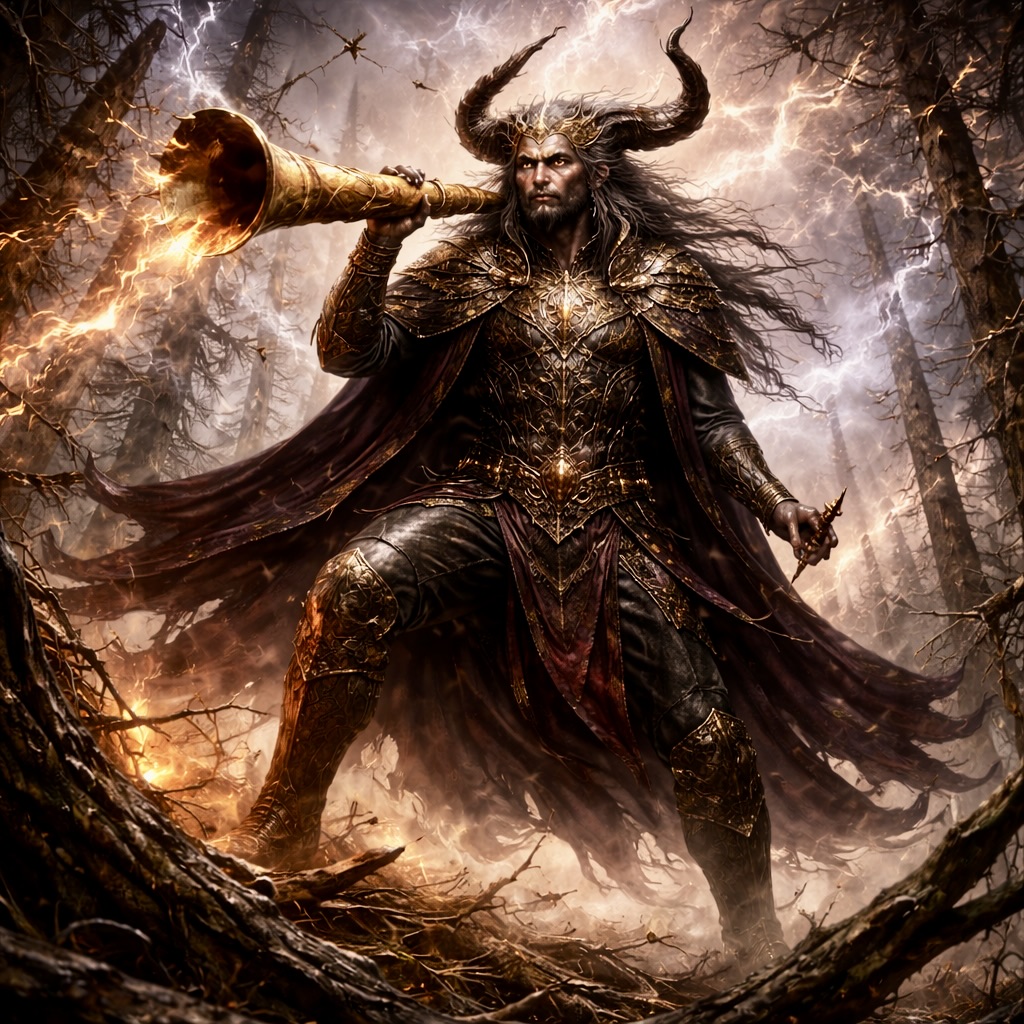
In the Ars Goetia, Amdusias is said to appear initially as a unicorn, an image that seems almost absurd until it is understood symbolically. The unicorn is not gentleness in this context, but rarity, raw power, and untamed force. Only when commanded does Amdusias take on human form, often with horns, reinforcing the idea that his true nature exists somewhere between animal instinct and conscious will. This duality matters. Amdusias is not chaos without direction; he is structured force, sound shaped into intent.

Music is the most intriguing aspect of Amdusias’s mythology. He is said to cause musical instruments to be heard, even when none are present. This is not the comforting music of celebration, but something deeper and more unsettling. It is the reminder that sound is never passive. Sound moves bodies, stirs emotions, and alters environments. Long before modern science explained resonance and vibration, demonology recognized sound as power, and Amdusias became its embodiment.

Unlike demons who specialize in manipulation or knowledge, Amdusias affects the physical world directly. Trees fall at his command. Forests bend and break. Storms answer him. These descriptions place him closer to natural disaster than moral allegory. He is the demon of reverberation, of cause and effect made audible. Where other infernal figures influence minds, Amdusias influences matter.

This connection to nature makes Amdusias stand out. Hell, in many traditions, is removed from the natural world, a realm of punishment and abstraction. Amdusias, however, is deeply tied to earth, wood, air, and weather. He reminds us that destruction is not always moral or immoral; sometimes it is simply force meeting structure. A storm does not hate a forest. It moves through it.

In occult practice, Amdusias is often associated with mastery over sound, music, and performance. He is said to teach instruments and musical arts, but there is always an edge to this teaching. His music is not merely entertainment. It is influence. Anyone who has stood in front of a powerful sound system or felt music vibrate through their chest understands this instinctively. Sound bypasses intellect and goes straight to the body. Amdusias rules that pathway.

The falling trees attributed to Amdusias are more than spectacle. Trees symbolize stability, growth, and time. To fell them is to interrupt continuity. Amdusias represents moments when stability gives way, when structures—natural or social—can no longer withstand accumulated pressure. His presence marks thresholds, the point at which vibration becomes collapse.

What makes Amdusias especially compelling is that he does not appear to act out of malice. There is no narrative of cruelty attached to him. He does not punish sinners or tempt the faithful. He acts. The grimoires do not moralize his behavior; they describe it. This neutrality is unsettling. It suggests a kind of power that operates independently of ethics, much like natural forces do.

In modern symbolic terms, Amdusias can be understood as the embodiment of amplification. Small inputs become overwhelming outputs. A note becomes a roar. A vibration becomes a fracture. This makes him an uncannily relevant figure in an age of amplified voices, viral media, and cascading effects. Amdusias is what happens when resonance is no longer contained.

His horns are significant as well. Horns have long symbolized both musical instruments and animal power. They produce sound, but they also signify aggression and dominance. Amdusias’s horned form merges these meanings. He is both the instrument and the force behind it. Sound is not something he uses; it is something he is.

Amdusias’s rank as a Duke places him in a position of command rather than subservience. He directs legions, not individuals. This reinforces the idea that his influence operates on a large scale. He is not concerned with personal transformation. He reshapes environments. When Amdusias is invoked in myth, the world itself responds.

There is also an implicit warning in Amdusias’s lore. Sound, once released, cannot be taken back. Vibrations travel outward, interacting with everything they encounter. Words, music, and noise all share this property. Amdusias symbolizes the permanence of impact. Once something resonates, it leaves traces long after the sound has faded.

Unlike more psychological demons, Amdusias does not linger in ambiguity. His effects are visible and audible. Trees fall. Storms rise. Music fills the air. This clarity makes him terrifying in a different way. There is no mystery about what he does, only uncertainty about when and how far it will go.

In artistic and fictional portrayals, Amdusias often appears as a dark conductor, orchestrating chaos like a symphony. This is an apt metaphor. Music is ordered sound, chaos given structure. Amdusias stands at the intersection of order and destruction, proving that the two are not opposites but collaborators.

Ultimately, Amdusias represents the truth that sound is never harmless. Every vibration carries force. Every resonance changes something. He is the demon of audible consequence, the reminder that the world is always listening, always responding.

To understand Amdusias is to respect the power of what is set into motion. He does not ask for belief. He proves himself through impact. In that sense, Amdusias is not merely a figure of demonology, but a mythic acknowledgment of a physical reality humans have always known: what we unleash into the world, especially through sound and force, does not vanish. It echoes.

Related Posts

James Joyce: Eluding Me Like A Dublin Fog

Penelope

James Joyce. His name has been floating around my academic circles for years, a constant presence in discussions of modernism and literary innovation. But the more I engage with his work, the more elusive he becomes. It’s as if he’s always just out of reach, whispering secrets to me through the pages of Ulysses.

I’ve spent countless hours analyzing the novel, dissecting its stream-of-consciousness narrative and exploring the inner workings of Leopold Bloom’s mind. But the more I read, the more I feel like I’m missing something fundamental. It’s as if Joyce is winking at me, acknowledging that there are depths to his writing that I’ll never fully grasp.

I find myself getting lost in the minutiae of his life – the Dublin streets he walked, the women who inspired him, the tensions between his Irish heritage and his adopted homeland. But the more I learn about his biography, the more I feel like I’m losing sight of what truly fascinates me: the way he writes.

Take his use of language, for example. It’s beautiful, yet brutal. He strips away ornamentation, leaving us with a raw, unvarnished glimpse into the human experience. But it’s not just about the words themselves – it’s the way they’re strung together, like a delicate web of associations and allusions.

I’ve tried to imitate his style in my own writing, but it never quite feels authentic. It’s as if I’m trying to channel a ghostly presence that haunts me from the pages of Ulysses. And yet, whenever I return to Joyce’s work, I feel invigorated – like he’s pushing me to explore new territories within myself.

Perhaps this is what draws me to him: the sense that he’s still writing, even when he’s not. His words are like a constant hum in the background of my mind, reminding me that there are depths to language that I’ll never fully plumb. It’s an unsettling feeling, to be honest – like I’m perpetually chasing something just out of reach.

But what if it’s precisely this elusiveness that makes Joyce so compelling? What if his writing is less about conveying meaning and more about creating a sense of perpetual uncertainty? I think back to the countless hours I’ve spent analyzing Ulysses, searching for some hidden pattern or code. But maybe the truth lies in the spaces between those words – in the silence that follows each sentence, like a beat waiting to be filled.

It’s a strange, thrilling prospect: the idea that Joyce is not just a writer, but a catalyst for my own creativity. That his work is less about providing answers and more about asking questions – questions that I’m still grappling with today. And so I continue to read him, to write alongside him, to try and capture the essence of his elusive presence in my own words.

But even as I attempt to bridge this gap between Joyce’s writing and my own, I’m aware of the impossibility of it all. It’s like trying to grasp a handful of sand – the harder I squeeze, the more it slips away from me. And yet, that’s precisely what draws me back: the thrill of the chase, the promise of discovery just beyond the horizon.

As I sit here, surrounded by my scribbled notes and dog-eared copies of Ulysses, I’m struck by the sense that Joyce is not just a writer, but a mirror held up to my own creative process. His writing is like a reflection of my own attempts to make meaning from the world around me – the same struggles, the same frustrations, the same exhilarating moments of insight.

I think about all the times I’ve tried to write something profound, only to end up with a sentence that’s clunky or clichéd. The more I try to force it, the more it feels like Joyce is laughing at me from across the page – a gentle, knowing smile that says, “Ah, but that’s not how it works.” And yet, whenever I abandon my need for grand statements and just let the words flow, something strange happens. The writing becomes simpler, more direct, more true.

It’s as if Joyce is showing me that the only way to write honestly is to let go of all our preconceptions about what good writing should be. To surrender to the messiness of language, to allow ourselves to get lost in the labyrinthine corridors of the human experience. And it’s terrifying, because what if I don’t know where I’m going? What if my writing is just a series of aimless wanderings through the streets of Dublin – or, worse still, through the depths of my own mind?

But that’s precisely why Joyce’s work feels so alive to me. He’s not just a writer; he’s an explorer, charting new territories and mapping out the unmapped corners of our collective psyche. And as I read his words, I feel like I’m embarking on a similar journey – one that’s full of uncertainty, but also full of possibility.

I wonder what it would be like to write without the weight of expectation, without the pressure to create something “good” or “important.” Would my writing still be worth reading? Would it even matter if it wasn’t? These are questions I’ve been struggling with for years, and Joyce’s work only adds to the complexity. But maybe that’s what makes his writing so compelling – its willingness to challenge our assumptions about what writing should be.

As I close this notebook, my mind is still racing with thoughts of Joyce and his elusive presence in my life. I feel like I’m standing at a crossroads, looking out at a vast expanse of uncertainty – but also, somehow, at the same time, feeling a strange sense of freedom. It’s as if Joyce has given me permission to write without an end goal in mind, to let the words flow simply for their own sake. And that thought is both exhilarating and terrifying, because I have no idea what will happen next.

As I sit here, trying to process the mess of thoughts swirling around James Joyce’s writing, I’m struck by the sense that he’s been mirroring my own journey as a writer all along. His work is like a reflection of my own struggles to find my voice, to navigate the complexities of language and meaning.

I think about the way Joyce’s writing can be both beautiful and brutal at the same time – like life itself, really. He strips away the pretenses and gets down to the raw emotions, desires, and fears that make us human. It’s not always easy to read, but it’s undeniably honest. And as I try to write in a similar vein, I’m forced to confront my own vulnerabilities, my own struggles with language and meaning.

It’s funny – when I first started reading Joyce, I thought he was all about grand statements and profound insights. But the more I read, the more I realize that his writing is actually about something much more subtle: the quiet moments of insight that come from paying attention to the world around us. The way a character’s face contorts in pain or joy; the sound of rain pattering on the roof; the smell of fresh bread wafting through the streets.

These are the kinds of things that I try to capture in my own writing, but it’s always easier said than done. Joyce makes it look effortless – like he’s simply recording his thoughts and feelings as they occur to him. But I know better. I know that he spent years honing his craft, experimenting with language and form until he found a voice that was uniquely his own.

And yet, even with all my knowledge of his biography and literary influences, I still feel like I’m trying to grasp at something just out of reach when it comes to Joyce’s writing. Like I’m chasing after a ghost who’s always one step ahead of me. It’s exhilarating, but also frustrating – because what if I never catch up? What if I’m forever stuck in the process of trying to understand him?

But maybe that’s the point. Maybe Joyce is less about conveying meaning and more about creating a sense of perpetual uncertainty. Like life itself, his writing is a series of questions rather than answers – a reminder that we’re always struggling to make sense of the world around us.

As I close this notebook for now, I’m left with more questions than answers. What does it mean to write honestly? How do we capture the messy complexity of human experience on the page? And what happens when our writing is no longer about conveying meaning, but simply about exploring the depths of our own uncertainty?

These are questions that I’ll continue to grapple with as a writer, and ones that Joyce’s work has left me with. But even as I feel uncertain and unsure, I’m also grateful – because it means I still have so much to learn from his writing, and so many more pages to turn before I come to the end of my own journey as a reader and writer.

I find myself returning to Joyce’s writing again and again, not just for inspiration, but for a sense of companionship in the darkness. His words are like a warm fire on a cold night, offering comfort and reassurance that I’m not alone in my struggles with language and meaning.

As I delve deeper into his work, I start to notice the way he uses the city as a character in its own right. Dublin is more than just a backdrop for his stories; it’s a living, breathing entity that pulses with life and energy. He captures its rhythms and cadences in a way that feels both intimate and expansive – like he’s inviting me to explore every nook and cranny of the city.

I think about how Joyce’s writing is often described as “stream-of-consciousness,” but that term doesn’t quite do it justice. His words are more like a series of whispers, murmurs, and sighs that ebb and flow like the tide. They’re fragmented and disjointed, yet somehow they cohere into this vast, sprawling whole that’s both beautiful and terrifying.

As I try to write in his style, I find myself getting lost in the same kind of inner monologue that Joyce employs. It’s as if my own thoughts are taking on a life of their own, meandering through streets and alleys that feel both familiar and unknown. I’m not sure where this will lead me, but I know that it feels more honest, more true to myself than anything else I’ve written.

But what does it mean to write honestly? Is it simply about recording one’s thoughts and feelings as they occur, or is there something more at play? Joyce’s writing suggests that honesty involves a level of vulnerability, a willingness to expose oneself to the world in all its messy complexity. It means embracing uncertainty and ambiguity, rather than trying to impose some neat, tidy narrative on reality.

As I ponder this question, I start to think about my own relationship with language. For so long, I’ve seen writing as a way to communicate ideas, to convey meaning and insight to others. But Joyce’s work suggests that it’s more than just a tool for transmission – it’s a way of exploring the world, of engaging with reality in all its beauty and ugliness.

I’m not sure what this means for my own writing, but I know that I need to continue exploring these questions. Maybe it’s time to let go of my need for grand statements and profound insights, and simply focus on capturing the quiet moments of insight that come from paying attention to the world around me. The way a character’s face contorts in pain or joy; the sound of rain pattering on the roof; the smell of fresh bread wafting through the streets.

These are the kinds of things that Joyce’s writing is all about – the everyday, the mundane, the overlooked. And it’s precisely this focus on the ordinary that makes his work feel so revolutionary, so subversive in its own quiet way.

As I close this notebook for now, I’m left with more questions than answers. What does it mean to write honestly? How do we capture the messy complexity of human experience on the page? And what happens when our writing is no longer about conveying meaning, but simply about exploring the depths of our own uncertainty?

These are questions that I’ll continue to grapple with as a writer, and ones that Joyce’s work has left me with. But even as I feel uncertain and unsure, I’m also grateful – because it means I still have so much to learn from his writing, and so many more pages to turn before I come to the end of my own journey as a reader and writer.

Related Posts

Belial: The Lawless King Who Teaches Power Without Allegiance

Dave

Belial is one of the oldest names to surface when human beings try to give shape to rebellion. Long before grimoires cataloged demons into tidy hierarchies, Belial already existed as an idea: the force that refuses to kneel, the will that rejects imposed order, the voice that whispers that authority is a human invention, not a divine mandate. To encounter Belial in demonology is not to meet a simple villain, but to confront a concept that has troubled societies for as long as laws, kings, and gods have claimed dominion over human behavior.

The name Belial appears early in religious texts, often as a synonym for worthlessness, lawlessness, or moral corruption. In the Hebrew Bible, “sons of Belial” are those who reject social order, who refuse to submit to judges, elders, or divine commandments. Over time, this abstract accusation hardened into a figure, and that figure became Belial: a king of Hell who bows to no one and demands the same defiance from those who call upon him.

In later demonological traditions, particularly within the Ars Goetia, Belial is described as a powerful king who commands legions and grants high status, favor, and influence. Yet he is also notorious for demanding offerings and respect. Belial does not serve freely. He does not respond well to hesitation or weakness. This detail is crucial to understanding his symbolism. Belial does not represent chaos for its own sake. He represents power that exists outside of permission.

Belial’s defining trait is autonomy. He is said to have been created without a master, or to have fallen because he refused subjugation altogether. This places him in sharp contrast to demons who rebelled after serving. Belial never accepted the premise that authority was legitimate in the first place. In mythic terms, he is not a traitor. He is a nonparticipant.

This distinction matters. Belial is not driven by rage or envy. He is driven by principle, albeit a dark one. He embodies the belief that power belongs to those who take it, not those who are granted it. This belief has fueled revolutions, tyrannies, liberation movements, and criminal empires alike. Belial is not aligned with justice or injustice. He is aligned with self-rule.

In occult texts, Belial is associated with status, influence, and legal maneuvering. He can grant titles, sway judges, and elevate individuals within rigid systems. This seems paradoxical for a demon of lawlessness, but the contradiction is intentional. Belial understands systems precisely because he rejects them. He teaches how power actually functions beneath the surface of rules and rituals. Laws, in Belial’s domain, are tools to be exploited, not moral truths to be obeyed.

Those who sought Belial historically were often not dreamers or mystics, but pragmatists. They wanted leverage. They wanted to bend institutions to their will. They wanted to rise without loyalty. Belial was invoked by those who believed that the world was already corrupt, and that refusing to play by its rules was not evil, but honest.

Belial’s refusal to bow also places him in opposition to hierarchy itself. While Hell is often depicted as a rigid structure, Belial’s presence disrupts that image. He is a king who does not kneel even to higher infernal authority. This makes him dangerous not only to heaven, but to Hell. He is tolerated because of his power, not trusted because of his nature.

Symbolically, Belial represents the moment when obedience breaks. He is the voice that says, “Why should I?” That question can be liberating or catastrophic depending on who asks it and why. Belial does not care which outcome occurs. His concern is the assertion of will.

Unlike demons associated with temptation or pleasure, Belial does not seduce. He confronts. Those who engage with him are forced to examine their relationship with authority, responsibility, and consequence. Belial offers power, but he strips away excuses. If you act under Belial’s influence, you cannot claim ignorance or coercion. You chose autonomy. You own the outcome.

This is why Belial is often described as harsh or demanding. He does not nurture dependency. He despises submission disguised as devotion. In mythic terms, he is the anti-patron. He grants favor but expects self-sufficiency. He will elevate you, but he will not protect you from the fall.

Belial’s imagery often reflects this severity. He is depicted as regal, imposing, and unmoved. There is no frenzy in his presence, no theatrical cruelty. His menace lies in indifference. He does not punish out of anger. He withdraws support when respect is not maintained. In this way, Belial resembles power structures in the real world far more than supernatural monsters do.

In modern interpretations, Belial frequently appears as a symbol of radical independence. He is invoked in fiction as a force behind antiheroes, warlords, and leaders who reject moral constraints in favor of control. These portrayals are compelling because they reflect a truth many are uncomfortable admitting: authority often flows to those willing to abandon ideals.

Belial also exposes the darker side of self-rule. Absolute autonomy can easily become tyranny. When no higher authority is acknowledged, accountability collapses inward. Belial does not warn against this. He demonstrates it. He is the embodiment of freedom without restraint, power without justification.

Historically, societies have oscillated between fearing and needing figures like Belial. Order requires obedience, but progress often begins with defiance. Belial sits uncomfortably at the center of that tension. He is neither hero nor villain. He is the pressure point where systems fracture.

Even the name Belial carries weight. It is less a personal name than a label, a condemnation turned into identity. To be Belial is to be without worth in the eyes of the law, without allegiance in the eyes of authority. Yet within that rejection lies a strange form of sovereignty. Belial does not need validation because he rejects the framework that grants it.

What makes Belial enduring is not fear, but recognition. People see him in boardrooms, courtrooms, and corridors of power. They recognize the figure who rises not through loyalty, but through calculation. They recognize the leader who obeys nothing but his own will. Belial survives because he is already here.

At his core, Belial represents a question that never goes away: is authority legitimate because it exists, or does it exist because we agree to obey it? Belial answers that question with silence, then action. He does not argue philosophy. He demonstrates consequence.

To engage with Belial, even symbolically, is to accept responsibility for defiance. There is no moral cushion, no divine justification. There is only choice and outcome. In that sense, Belial is brutally honest. He does not pretend rebellion is noble. He simply insists it is yours.

Belial endures because rebellion endures. As long as there are systems, there will be those who reject them. As long as there is power, there will be those who take it without asking. Belial is not the origin of that impulse. He is its name.

Related Posts