Latest Articles

Verdun: The 303-Day Slaughter That Redefined the Horror of Modern Warfare

Elias Rowen

The Battle of Verdun did not begin with a dramatic breakthrough or a swift advance. Instead, it unfolded slowly, deliberately, and mercilessly, grinding human lives into the soil of northeastern France over the course of 303 days. When it finally ended on December 18, 1916, Verdun had become more than a battlefield. It was a symbol of industrialized death, of endurance pushed beyond reason, and of a war that seemed determined to consume an entire generation.

Verdun was never intended to be just another offensive. For the German high command, it was meant to be something far more calculated and devastating. General Erich von Falkenhayn believed that France could be bled white by attacking a position the French could never afford to abandon. Verdun, with its historic fortresses and strategic importance, was the perfect target. Falkenhayn did not necessarily seek to capture the city outright. His aim was attrition—forcing France to pour men into the fight until its army collapsed under the weight of its own losses.

On February 21, 1916, the German assault began with one of the most intense artillery barrages the world had ever seen. Shells rained down relentlessly, tearing apart trenches, forests, and bodies alike. The earth itself seemed to scream under the violence. French soldiers, many of them stunned and buried alive, struggled to regroup as German infantry advanced through a shattered landscape.

Verdun’s defenses were formidable but incomplete. Years of complacency had left some forts under-garrisoned and inadequately supplied. Yet what the French lacked in preparation, they made up for in resolve. Reinforcements were rushed to the front along the “Sacred Way,” a single supply road kept open day and night under constant shellfire. Trucks moved in endless columns, carrying men toward the front and wounded away from it, creating a grim rhythm that would continue for months.

General Philippe Pétain emerged as the battle’s defining figure on the French side. Calm, methodical, and deeply aware of his soldiers’ limits, he reorganized defenses and emphasized artillery coordination. His famous declaration, “They shall not pass,” became both a rallying cry and a grim vow. Verdun would be held, no matter the cost.

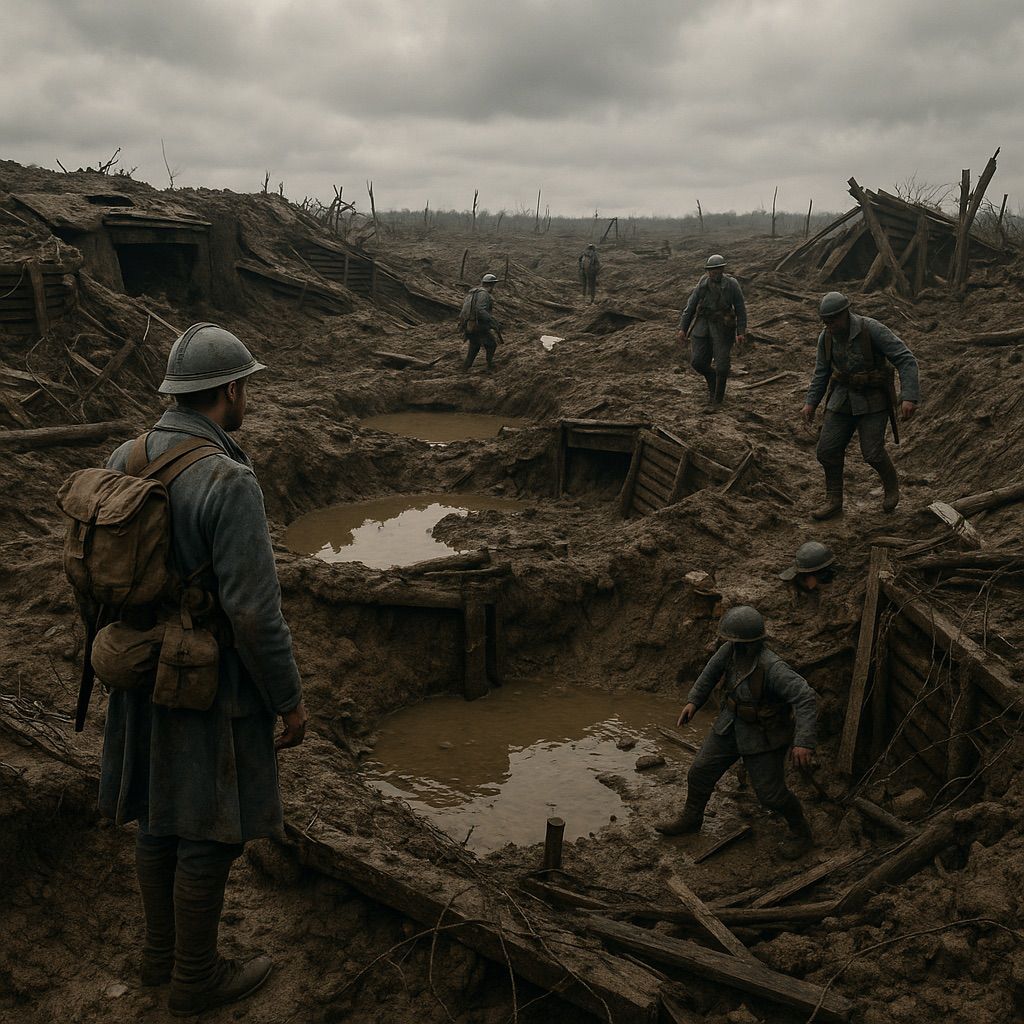
The cost was staggering. Attacks and counterattacks turned hills, forts, and villages into names etched in blood—Douaumont, Vaux, Fleury. Ground was gained and lost repeatedly, sometimes measured in meters at the price of thousands of lives. Trenches collapsed under shellfire, forcing soldiers to fight in open craters filled with mud, water, and decomposing bodies. The landscape became unrecognizable, transformed into a lunar wasteland scarred by millions of shell holes.

As spring turned into summer, Verdun became a war within the war. Both sides fed divisions into the furnace, rotating units to prevent complete collapse. Even so, psychological trauma spread rapidly. Soldiers spoke of “shell shock,” of men reduced to silence or hysteria by constant bombardment. Sleep became impossible. Survival felt arbitrary, dependent on chance rather than skill or bravery.

German frustration mounted as the battle dragged on without decisive results. Falkenhayn’s strategy succeeded only in destroying his own army alongside the French. By mid-1916, German resources were strained, and public confidence wavered. Falkenhayn was eventually replaced, but the damage had been done. Verdun had become a trap for both sides.

In the autumn, the French regained momentum. Improved artillery tactics and renewed offensives slowly pushed German forces back from key positions. Fort Douaumont, once a symbol of German success, was retaken. Fort Vaux, defended with almost mythic desperation earlier in the year, stood as a monument to endurance and suffering.

By December, exhaustion defined both armies. When fighting finally ceased on December 18, 1916, neither side could claim real victory. Verdun remained in French hands, but at an almost incomprehensible cost. Roughly 700,000 men had been killed, wounded, or gone missing. Entire regiments ceased to exist. Families across Europe would never recover from the loss.

The physical devastation was matched by moral shock. Verdun exposed the true nature of modern warfare—mechanized, impersonal, and ruthlessly efficient at killing. It shattered illusions of glory and honor, replacing them with images of mud, blood, and endless artillery fire. For France, Verdun became sacred ground, a symbol of national endurance. For Germany, it became a cautionary tale of strategic hubris.

The battle reshaped military thinking. It accelerated the search for alternatives to trench warfare, contributing to the development of tanks, improved artillery coordination, and new infantry tactics. Yet no innovation could erase Verdun’s legacy. It remained a warning etched into history, a reminder of what happens when strategy ignores humanity.

In the years that followed, Verdun became a place of remembrance. Memorials rose where soldiers once fell. Forests regrew over shattered ground, but beneath the soil lay unexploded shells and unmarked graves. Even today, the land bears scars that refuse to disappear.

Verdun endures not because it was decisive, but because it was relentless. It showed how modern war could devour nations without resolution, how victory itself could feel indistinguishable from defeat. It stands as one of the clearest lessons of World War I: that courage alone cannot redeem a war built on attrition and mass sacrifice.

The Battle of Verdun ended in December 1916, but its echoes continue to shape how we understand war, memory, and loss. It remains one of history’s most haunting reminders that survival, not triumph, is sometimes the only possible outcome.

Related Posts

The Simpsons Redefined Television and American Culture Forever

Elias Rowen

On the evening of December 17, 1989, millions of Americans settled into their living rooms expecting nothing more than another quiet Sunday night of television. Families flipped through channels, children sprawled across carpets, and parents half-watched the screen while thinking about the workweek ahead. Few could have imagined that what aired that night would not only change television forever, but become one of the most influential cultural creations of the modern era. When The Simpsons premiered on Fox, it did not arrive with thunder or spectacle. It arrived quietly, wrapped in yellow skin, crude animation, and a humor that felt oddly familiar and dangerously honest.

At its core, The Simpsons was never about outrageous jokes or shocking satire alone. It was about family, frustration, and the contradictions of modern life. Creator Matt Groening drew deeply from his own upbringing in Portland, Oregon, using personal experience as the emotional blueprint for Springfield’s most famous household. Homer, Marge, Bart, Lisa, and Maggie were exaggerated reflections of people Groening had known all his life, flawed but recognizable, absurd yet grounded in reality.

Groening had little interest in creating traditional cartoon heroes. Instead, he envisioned characters who failed often, contradicted themselves, and stumbled through life with imperfect intentions. Homer Simpson, lazy and impulsive yet strangely endearing, embodied the anxieties of the working-class American father. Marge represented emotional resilience and quiet strength. Bart was rebellion incarnate, Lisa the moral compass, and Maggie the silent witness to it all. Together, they mirrored the American family more truthfully than many live-action sitcoms ever dared.

The road to The Simpsons began humbly with animated shorts on The Tracey Ullman Show. These crude sketches introduced audiences to the Simpson family in brief segments, rough in design but sharp in tone. Viewers responded immediately. There was something refreshing about the show’s irreverence, its willingness to mock authority, consumerism, and even itself. Recognizing its potential, producers James L. Brooks and Sam Simon encouraged Groening to expand the idea into a full half-hour series.

The transition was not easy. Animation schedules were brutal, budgets tight, and early episodes plagued by production challenges. Yet these struggles shaped the show’s identity. The animation style, initially criticized as crude, became iconic. Its imperfections gave the show character, allowing the writing and performances to shine. The voice cast, including Dan Castellaneta, Julie Kavner, Nancy Cartwright, Yeardley Smith, and Hank Azaria, transformed flat drawings into living, breathing personalities.

When the first full episode, Simpsons Roasting on an Open Fire, aired, it set the emotional tone for the series. Rather than opening with cynicism, the episode focused on failure, empathy, and compassion. Homer’s attempt to provide a Christmas gift ends in disappointment, only to transform into something meaningful when Santa’s Little Helper joins the family. It was funny, yes, but also sincere. Viewers saw themselves in that struggle, and the connection was immediate.

Critics took notice. While some were initially skeptical of animated programming in prime time, many praised the show’s intelligence and heart. The Simpsons wasn’t just parodying America—it was holding up a mirror. It tackled issues like class inequality, corporate greed, environmental neglect, and political hypocrisy long before such themes became mainstream in entertainment. It trusted its audience to laugh and think at the same time.

As the first season unfolded, the show’s confidence grew. Storylines expanded beyond slapstick, allowing characters to evolve emotionally. Homer’s stupidity became a lens for exploring insecurity and longing. Lisa’s intelligence highlighted alienation and moral struggle. Springfield itself became a character, populated by exaggerated archetypes that reflected real societal roles: corrupt politicians, incompetent police, predatory businessmen, and apathetic media figures.

By the early 1990s, The Simpsons had become a phenomenon. Bart Simpson emerged as a cultural icon, plastered across lunchboxes, T-shirts, and billboards. Parents worried about his rebellious influence while children embraced his irreverence. The show found itself at the center of national debates about morality, parenting, and popular culture—ironically proving its relevance in the process.

Yet the show’s greatest strength lay in its writing. Episodes like Marge vs. the Monorail showcased how satire could be layered with music, character, and absurdity without losing coherence. The annual Treehouse of Horror episodes pushed creative boundaries, allowing writers to experiment with science fiction, horror, and parody in ways no other series attempted. These episodes demonstrated the show’s willingness to take risks and trust its audience.

Throughout the 1990s, The Simpsons consistently reinvented itself. It tackled racism, gender roles, labor exploitation, and environmentalism with humor sharp enough to cut but never alienate. Episodes like Stark Raving Dad and Lisa the Vegetarian showed the series’ ability to balance comedy with genuine emotional resonance. These were stories that stayed with viewers long after the jokes faded.

Behind the scenes, the writers’ room became legendary. Many writers would go on to shape American comedy for decades, bringing The Simpsons’ DNA into late-night television, film, and stand-up. The show’s influence spread quietly but profoundly, shaping the rhythm, tone, and expectations of modern comedy.

As the years passed, The Simpsons faced the inevitable challenge of longevity. Maintaining relevance across generations is no small task, yet the show adapted. It addressed the rise of the internet, celebrity culture, social media, climate change, and political polarization. Some episodes landed better than others, but the willingness to engage with the present remained constant.

Matt Groening’s influence expanded beyond Springfield. Futurama and Disenchantment carried his signature blend of absurdity and emotional intelligence into new worlds. Still, The Simpsons remained his defining achievement, not because of its length, but because of its cultural reach.

Today, The Simpsons stands as the longest-running primetime scripted series in television history. It has won dozens of awards, inspired countless creators, and permanently altered what animation can achieve. More importantly, it continues to reflect society back at itself—flaws, contradictions, and all.

What began as a simple cartoon has become a living chronicle of modern life. The Simpsons did not just entertain; it taught audiences that humor could be smart, that cartoons could matter, and that satire could be compassionate. Its legacy is not measured in episodes, but in influence.

More than three decades later, the Simpson family still sits on that couch, frozen in time yet forever relevant. And in that simple image lies the show’s greatest achievement: the ability to remain familiar while continually evolving, reminding us that laughter, when wielded honestly, can be one of the most powerful tools of storytelling ever created.

Related Posts

The Spark That Shook the Arab World: How Tunisia Ignited the Arab Spring

Elias Rowen

The year 2010 quietly closed one chapter of Middle Eastern history and violently opened another. What began as scattered frustrations over unemployment, corruption, and rising prices soon erupted into one of the most consequential political movements of the twenty-first century. The Arab Spring did not start in a palace or a parliament, nor was it engineered by foreign powers or elite political groups. It began with ordinary people who had reached a breaking point, and nowhere was that clearer than in Tunisia, where the first sparks of revolt ignited an uprising that would reshape an entire region.

For decades, Tunisia had been held up as a model of stability in North Africa. Tourists flocked to its beaches, foreign investors praised its predictability, and Western governments pointed to it as an example of controlled modernization. Beneath the surface, however, resentment simmered. Economic growth existed on paper, but for millions of Tunisians, daily life told a very different story. Jobs were scarce, wages stagnated, and opportunities were distributed not by merit but by proximity to power.

At the center of this imbalance stood President Zine El Abidine Ben Ali and his inner circle. Having seized power in a bloodless coup in 1987, Ben Ali promised reform, progress, and prosperity. In reality, his rule became increasingly authoritarian. Political opposition was crushed, journalists were silenced, and surveillance became a routine part of daily life. Fear replaced hope, and silence became a survival strategy.

Corruption was not a side effect of Ben Ali’s rule; it was its foundation. The president’s wife, Leila Trabelsi, and her extended family were notorious for their grip on Tunisia’s economy. Entire industries fell under their control, from banking and telecommunications to real estate and mining. State contracts flowed to favored insiders, while ordinary citizens watched opportunity slip further out of reach.

As the global financial crisis hit in 2008, Tunisia’s fragile social contract collapsed. Unemployment soared, particularly among young people who had done everything society asked of them. University degrees no longer guaranteed work. Graduates returned home to live with their parents, trapped between ambition and reality. Frustration turned into humiliation, and humiliation hardened into anger.

Rural Tunisia suffered just as deeply. Farmers faced falling prices for their crops while costs for fuel and supplies rose. Many were forced to sell their land or migrate in search of work. Entire communities felt abandoned, invisible to a government more concerned with protecting elite wealth than addressing public need.

The phosphate mining industry became a symbol of everything that was broken. Despite being one of Tunisia’s most valuable resources, profits rarely reached workers or local communities. Instead, wealth flowed upward, reinforcing the perception that the state existed to serve a narrow elite rather than the nation as a whole. Protests over jobs and wages in mining towns were frequent, but they were usually crushed quickly and quietly.

What made 2010 different was not the presence of discontent, but the sudden collapse of fear. On December 17, in the small town of Sidi Bouzid, a young street vendor named Mohamed Bouazizi was humiliated for the last time. Harassed by local officials and stripped of his livelihood, Bouazizi did something unthinkable. He set himself on fire in front of the governor’s office, a desperate act that transformed private suffering into public outrage.

Bouazizi’s self-immolation struck a nerve that years of repression had failed to sever. Images and stories spread rapidly through social media, satellite television, and word of mouth. Protests erupted almost immediately, first in Sidi Bouzid, then in neighboring towns, and soon across the entire country. What began as demands for jobs and dignity quickly evolved into calls for the end of Ben Ali’s rule.

The government responded with force. Police fired tear gas and live ammunition. Protesters were arrested, beaten, and in some cases killed. But repression no longer worked. Each act of violence fueled more anger, drawing larger crowds into the streets. Workers, students, lawyers, farmers, and civil servants stood shoulder to shoulder, united by a shared sense that the system had failed them.

Tunisia witnessed scenes that would have been unthinkable just weeks earlier. Mass demonstrations filled city centers. Chants of “Ben Ali must go” echoed through neighborhoods once silenced by fear. Flags waved not for a political party, but for dignity and accountability. The regime attempted concessions, promising reforms and blaming corruption on lower officials, but the public no longer believed words without action.

By January 2011, the situation had reached a tipping point. The army, sensing the inevitability of change, refused to fire on protesters. International allies began distancing themselves from Ben Ali. On January 14, after twenty-three years in power, the president fled Tunisia under cover of darkness, leaving behind a stunned nation and a political vacuum filled with uncertainty and hope.

Tunisia’s revolution sent shockwaves far beyond its borders. Across the Arab world, people saw what had seemed impossible: a dictator removed by mass popular protest. Demonstrations soon erupted in Egypt, Libya, Yemen, Bahrain, and Syria. The Arab Spring had begun, and Tunisia stood at its origin.

The aftermath of revolution was anything but simple. Tunisia faced economic instability, political fragmentation, and security threats. Extremist groups sought to exploit uncertainty, and old networks of power resisted reform. Yet unlike many of its neighbors, Tunisia managed to navigate its transition without descending into civil war.

A new constitution, adopted in 2013, enshrined democratic principles, human rights, and gender equality. Elections followed, producing coalition governments that reflected compromise rather than domination. Progress was uneven and often frustratingly slow, but it existed.

Tunisia’s experience revealed both the promise and the limits of popular uprisings. While dictatorship could be overthrown, building democracy required patience, institutions, and sustained civic engagement. Economic challenges persisted, and corruption did not vanish overnight. Still, Tunisia proved that change was possible without total collapse.

More than a decade later, the legacy of Tunisia’s revolution remains contested, debated, and unfinished. Yet its significance cannot be denied. It demonstrated the power of ordinary people to challenge entrenched authority and forced the world to reckon with voices long ignored.

The Arab Spring began not with ideology or violence, but with dignity. It began with a single act of protest that exposed the fragility of authoritarian rule. Tunisia’s story stands as both a warning and an inspiration—a reminder that stability without justice is temporary, and that when people lose fear, even the strongest regimes can fall.

Related Posts

The Wright Brothers Invented Powered Flight and Changed the World Forever

Elias Rowen

For thousands of years, humans looked to the sky with a mixture of wonder and envy. Birds soared effortlessly overhead while people remained bound to the ground, dreaming of flight but unable to escape gravity’s grip. Myths told stories of wings made from wax and feathers, of gods and heroes who could defy nature, yet reality always pulled dreamers back to earth. That reality finally changed in the early years of the twentieth century, not through magic or myth, but through patience, experimentation, and relentless determination. The dawn of powered flight arrived quietly on a cold December morning in 1903, carried aloft by two brothers from Dayton, Ohio, who refused to accept that human flight was impossible.

Orville and Wilbur Wright were not famous scientists, wealthy industrialists, or government-backed engineers. They were bicycle mechanics, self-taught thinkers who believed that careful observation and methodical testing could solve even the most complex problems. What set them apart from other would-be aviators was not raw genius alone, but their willingness to question assumptions, collect their own data, and learn from every failure. Their story is not one of sudden inspiration, but of years spent chasing answers through trial, error, and persistence.

By the late nineteenth century, the idea of human flight had shifted from fantasy into serious scientific inquiry. Engineers and inventors across Europe and America were experimenting with gliders, kites, and powered contraptions, all attempting to unlock the secrets of lift and control. One of the most influential figures of the era was Octave Chanute, whose book Progress in Flying Machines compiled decades of aeronautical experiments into a single volume. For the Wright brothers, this book was a revelation. It showed them that flight was not a foolish dream, but a technical challenge waiting to be solved.

Another key influence was Otto Lilienthal, a German engineer whose glider flights demonstrated that controlled, heavier-than-air flight was possible. Lilienthal’s work fascinated the Wright brothers, but his death in a gliding accident also served as a sobering reminder of how dangerous aviation could be. Rather than discouraging them, his death convinced Orville and Wilbur that careful control, not just lift, was the missing piece of the puzzle. They believed that mastering control would be the key to safe and sustained flight.

Their early experiments began modestly. In 1899, the brothers built small kite-like machines to test wing warping, a method of controlling an aircraft by twisting the wings. These tests revealed something revolutionary: control could be achieved not by brute force, but by subtle adjustments that worked with the air rather than against it. Encouraged by these results, they turned their attention to gliders capable of carrying a human pilot.

Finding the right testing ground was crucial. After extensive research, the Wright brothers chose Kitty Hawk, North Carolina, a remote coastal area known for steady winds, soft sand, and isolation from prying eyes. There, far from crowds and critics, they could test freely and fail safely. Beginning in 1900 and continuing through 1902, they made repeated trips to Kitty Hawk, hauling gliders, tools, and notebooks across rough terrain in pursuit of progress.

Those early glider experiments were anything but smooth. The brothers quickly realized that existing aerodynamic data was flawed. Lift calculations from respected scientists did not match real-world results. Instead of abandoning their efforts, Orville and Wilbur did something radical: they built their own wind tunnel back in Dayton. Using carefully crafted models, they gathered more accurate data than anyone before them. This quiet innovation laid the foundation for modern aerodynamics and gave the Wright brothers an enormous advantage over their competitors.

By 1902, their improved glider represented a major breakthrough. It incorporated effective wing warping and a movable rear rudder, allowing pilots to maintain balance and direction. For the first time, sustained controlled gliding was possible. The brothers knew they were close. All that remained was the most difficult challenge of all: powering the aircraft without making it too heavy to fly.

No existing engine met their needs, so they built one themselves. Working with their mechanic, Charlie Taylor, they designed a lightweight gasoline engine capable of delivering enough power without weighing the aircraft down. It wasn’t elegant, and it wasn’t particularly powerful by modern standards, but it was sufficient. Paired with custom-designed propellers—another area where the brothers’ calculations surpassed conventional wisdom—the engine transformed their glider into a true airplane.

By December 1903, everything was ready. The Wright Flyer, constructed from spruce wood and fabric, was assembled at Kill Devil Hills near Kitty Hawk. It was fragile, awkward, and unremarkable in appearance, yet it represented years of accumulated knowledge and perseverance. On December 14, Wilbur attempted the first powered flight, but the aircraft stalled and crashed shortly after takeoff. The damage was repaired, and the brothers prepared for one final attempt.

On the morning of December 17, 1903, the wind was strong but manageable. Orville took his place in the Flyer while Wilbur steadied the wing. At 10:35 a.m., the engine roared to life, and the aircraft began moving along its wooden rail. Then, almost imperceptibly, it lifted off the ground. For twelve seconds, Orville Wright flew. The aircraft covered 120 feet before settling back onto the sand, but history had been made.

Three more flights followed that day, each longer than the last. The final flight, piloted by Wilbur, lasted nearly a minute and traveled over 800 feet. It ended abruptly when a gust of wind overturned the aircraft, damaging it beyond immediate repair. Yet the damage didn’t matter. The goal had been achieved. Human beings had flown under their own power, with control, and returned safely to the ground.

At the time, few people noticed. The event was witnessed by only a handful of locals, and early newspaper reports were skeptical or dismissive. The Wright brothers themselves returned quietly to Dayton, focused not on fame, but on improvement. They understood that their invention was only the beginning. True success would require reliability, endurance, and practical applications.

Over the next several years, Orville and Wilbur refined their designs, developing aircraft that could fly longer distances, turn smoothly, and remain stable in changing conditions. One of their most important contributions was the three-axis control system, which allowed pilots to manage roll, pitch, and yaw independently. This innovation remains fundamental to aircraft design today.

As evidence of their success accumulated, skepticism faded. Public demonstrations in the United States and Europe silenced critics and established the Wright brothers as legitimate pioneers. Governments and militaries took notice. In 1908, the U.S. Army Signal Corps purchased a Wright aircraft, marking the birth of military aviation. Soon after, flying schools, air shows, and experimental aircraft began appearing around the world.

The brothers’ impact extended far beyond aviation. Their methods—testing assumptions, collecting data, and learning from failure—became models for modern engineering and scientific research. Their work accelerated advancements in transportation, communication, and global connectivity. Within a few decades, airplanes shrank the world, making international travel and commerce routine rather than extraordinary.

Tragically, Wilbur Wright died of typhoid fever in 1912 at the age of forty-five, before he could witness the full scope of their achievement. Orville lived on, watching aviation evolve from fragile biplanes to powerful aircraft capable of crossing oceans and continents. He remained humble, often emphasizing that flight was not the result of a single moment, but of years of careful effort.

Today, the Wright brothers are remembered not just as inventors, but as symbols of human potential. Their story reminds us that progress rarely comes from sudden brilliance alone. It comes from persistence, curiosity, and the courage to fail repeatedly in pursuit of something greater. The first powered flight was short and unremarkable by modern standards, yet it changed everything.

Every airplane that lifts off today carries a piece of that December morning at Kitty Hawk. Every jet crossing the sky traces its lineage back to two brothers who believed that controlled flight was possible and refused to give up until they proved it. Their legacy is written not only in history books, but across the skies themselves, wherever human beings continue to rise above the earth and push the boundaries of what is possible.

Related Posts

The Night Tea Sparked a Revolution: How the Boston Tea Party Changed America Forever

Elias Rowen

The Boston Tea Party stands as one of those rare moments in history when a single night of action rippled outward to change the fate of an entire nation. It wasn’t a battle, it wasn’t a declaration, and no blood was shed, yet its impact echoed louder than cannon fire. On a cold December night in 1773, ordinary colonists made an extraordinary decision: they would no longer quietly accept being ruled, taxed, and ignored by a distant government that saw them as little more than a source of revenue. What followed was not random vandalism or mob violence, but a carefully planned act of political defiance that would become a cornerstone of American identity.

To understand why the Boston Tea Party happened, it’s important to step back into the world of the American colonies in the mid-18th century. The colonists were, in many ways, loyal British subjects. They shared language, customs, legal traditions, and a sense of pride in being part of the British Empire. But loyalty had its limits, especially when decisions made thousands of miles away in London began to directly affect daily life in the colonies without any meaningful colonial input. That tension simmered for years before finally boiling over.

The first sparks appeared after Britain emerged victorious from the French and Indian War in 1763. The war had been costly, and Parliament faced staggering debts. British leaders reasoned that the colonies, which had benefited from British military protection, should help shoulder the financial burden. From the perspective of Parliament, this seemed logical. From the perspective of the colonists, it felt deeply unfair. They had no representatives in Parliament, yet they were being asked to pay taxes decided entirely without their consent.

The Sugar Act of 1764 marked one of the earliest signs of trouble. By taxing imported sugar, molasses, and other goods, the British government struck at the economic lifeblood of colonial trade. Merchants, sailors, and artisans felt the effects almost immediately. What angered colonists just as much as the tax itself was the aggressive enforcement that accompanied it. British customs officials were given expanded powers, and smugglers faced harsh penalties. The message was clear: London was tightening its grip.

Then came the Stamp Act of 1765, and with it, a wave of outrage that swept through the colonies. For the first time, a direct tax was imposed on everyday items like newspapers, legal documents, licenses, and even playing cards. This wasn’t a distant tax hidden in shipping fees or trade regulations; it was impossible to ignore. Colonists from all walks of life suddenly felt the weight of British authority pressing down on them.

Protests erupted almost immediately. Crowds gathered in the streets, effigies of British officials were burned, and tax collectors were harassed, threatened, and sometimes forced to resign. In Boston, resistance coalesced into a more organized form with the rise of the Sons of Liberty. This loosely connected group of merchants, craftsmen, and political agitators became the beating heart of colonial resistance. Figures like Samuel Adams emerged as powerful voices, arguing that liberty itself was at stake.

Although Parliament repealed the Stamp Act in 1766, it did so with a warning. The Declaratory Act asserted that Britain retained full authority over the colonies “in all cases whatsoever.” This wasn’t reconciliation; it was a reminder of who held the power. The tension never truly faded, and before long, new taxes arrived in the form of the Townshend Acts. Duties on imported goods such as glass, paint, paper, and tea reignited colonial anger. Boycotts followed, and once again, resistance spread.

Boston became the epicenter of unrest. British soldiers were stationed in the city to maintain order, but their presence only made things worse. The streets felt occupied, tempers ran high, and mistrust grew on both sides. This volatile atmosphere eventually led to the Boston Massacre in 1770, where British soldiers fired into a crowd, killing five colonists. Though the Townshend duties were largely repealed afterward, the tax on tea remained, serving as a symbol of Parliament’s authority and the unresolved conflict between ruler and ruled.

Tea might seem like a small thing, but in colonial America, it was anything but. Tea was a daily ritual, a symbol of refinement, and a staple in households across social classes. By keeping the tea tax in place, Parliament was sending a message: it still had the right to tax the colonies. Many colonists understood this clearly. Accepting taxed tea meant accepting Parliament’s authority, and that was something growing numbers of Americans were unwilling to do.

The situation escalated dramatically in 1773 with the Tea Act. Designed to rescue the struggling British East India Company, the act allowed the company to sell tea directly to the colonies at a lower price, undercutting colonial merchants and smugglers. On paper, it made tea cheaper. In reality, it was a political trap. The tax remained, and the monopoly threatened local businesses. Colonists saw it as a calculated attempt to force them into submission.

When ships carrying East India Company tea arrived in colonial ports, resistance flared. In New York and Philadelphia, ships were turned away. In Charleston, the tea was seized and stored. But in Boston, Governor Thomas Hutchinson refused to budge. He insisted the tea be unloaded and the tax paid. With the ships sitting in the harbor and tensions rising, Boston stood at a crossroads.

On the night of December 16, 1773, the decision was made. Thousands gathered at the Old South Meeting House, where heated debates filled the air. When it became clear that the governor would not compromise, a signal was given. As darkness fell, a group of men, many disguised as Mohawk Indians, moved quietly toward Griffin’s Wharf.

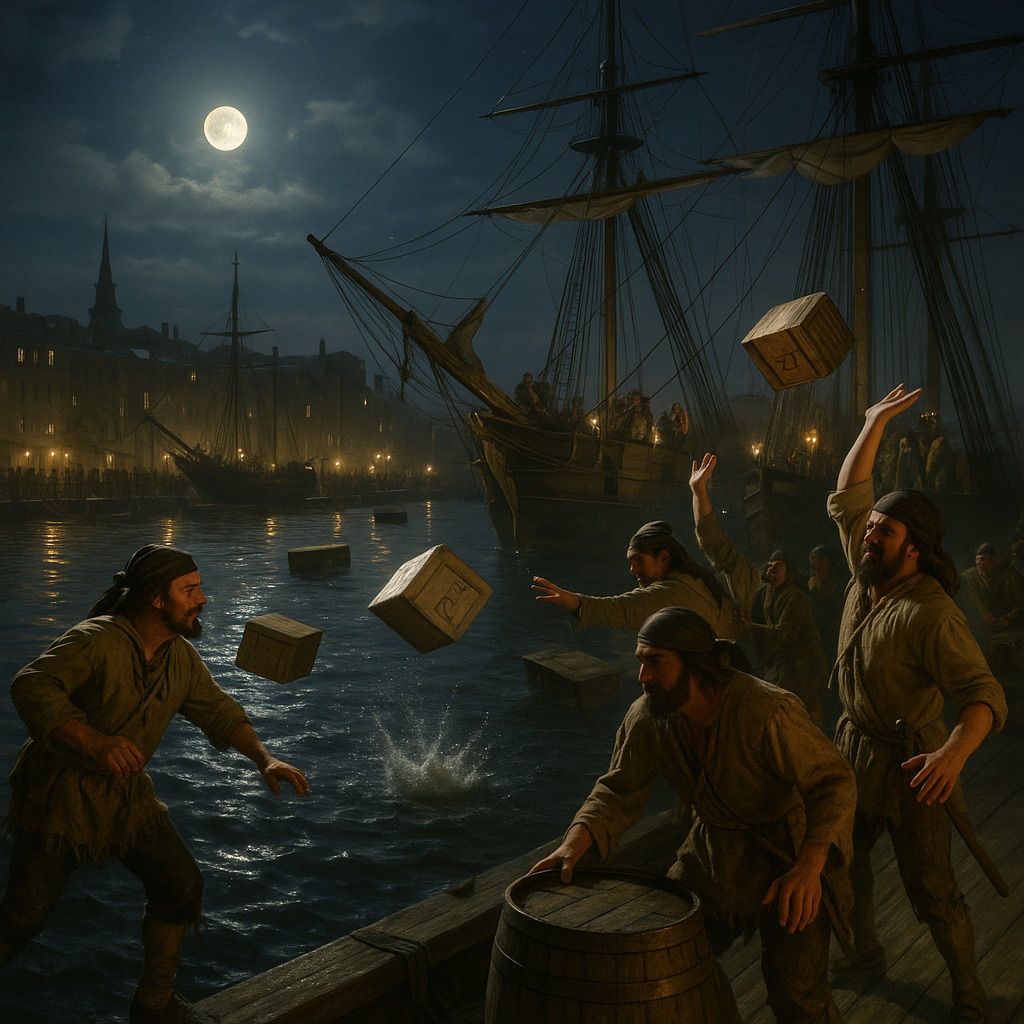
They boarded three ships—the Dartmouth, the Eleanor, and the Beaver—with remarkable discipline. This was not a drunken riot or chaotic outburst. The men worked methodically, breaking open 342 chests of tea and dumping them into Boston Harbor. They took care not to damage other cargo, and even replaced a broken padlock. By the end of the night, the harbor was thick with tea leaves, and a powerful statement had been made.

News of the Boston Tea Party spread quickly throughout the colonies and across the Atlantic. To many colonists, it was an act of courage and principle. To British officials, it was a shocking display of lawlessness and defiance. Parliament responded with fury, determined to make an example of Massachusetts. The result was the Coercive Acts, known to colonists as the Intolerable Acts.

Boston Harbor was closed until the tea was paid for. Massachusetts’ self-government was severely restricted. British officials accused of crimes were given protection from colonial courts. Soldiers were quartered in private homes. These measures were meant to isolate Boston and crush resistance, but they had the opposite effect. Instead of dividing the colonies, they united them.

Sympathy poured in from other colonies. Supplies were sent to Boston. Committees of correspondence strengthened communication and coordination. In 1774, colonial leaders gathered for the First Continental Congress, marking a new level of unity and resolve. The Boston Tea Party had transformed resistance into something far more powerful: a shared American cause.

Within two years, shots would be fired at Lexington and Concord. Within three, independence would be declared. The Boston Tea Party didn’t cause the American Revolution on its own, but it made compromise nearly impossible. It forced both sides to confront the reality that the relationship between Britain and the colonies was fundamentally broken.

Today, the Boston Tea Party is remembered not just as an act of protest, but as a defining moment in the story of democracy. It showed that ordinary people, when pushed too far, could organize, resist, and reshape their destiny. It wasn’t about tea. It was about dignity, representation, and the belief that government derives its power from the consent of the governed.

That belief continues to resonate centuries later. The image of chests splashing into dark harbor waters remains a symbol of resistance to unjust authority. It reminds us that history is often changed not by kings or parliaments, but by people who decide they have had enough and are willing to act.

Related Posts