Latest Articles

Operation Desert Fox: The Four-Day Air War That Set the Stage for Iraq’s Future

Elias Rowen

In December 1998, as the world approached the end of the twentieth century, a brief but consequential military campaign unfolded over Iraq that would quietly shape the trajectory of Middle Eastern geopolitics for years to come. Operation Desert Fox, launched by the United States and the United Kingdom, was a four-day bombing campaign aimed at degrading Iraq’s military infrastructure and compelling Saddam Hussein’s regime to comply with United Nations weapons inspections. Though short in duration, the operation carried profound political, strategic, and humanitarian implications that continue to be debated decades later.

The roots of Operation Desert Fox lay in the unresolved tensions following the 1991 Gulf War. Iraq’s defeat had forced Saddam Hussein to accept strict ceasefire conditions, including the dismantling of nuclear, chemical, and biological weapons programs. United Nations inspectors were tasked with verifying compliance, while economic sanctions placed enormous pressure on Iraq’s economy and civilian population. For much of the 1990s, this uneasy standoff defined relations between Iraq and the international community.

From the outset, Saddam Hussein viewed the inspections as an affront to Iraqi sovereignty. While inspectors uncovered and destroyed large quantities of prohibited weapons and materials, cooperation was inconsistent. Iraqi authorities frequently restricted access to sites, delayed inspections, or accused inspectors of espionage. Each confrontation heightened tensions, reinforcing mistrust on both sides.

By 1998, the situation had deteriorated significantly. Iraq suspended cooperation with UN inspectors altogether, effectively daring the international community to respond. For U.S. policymakers, this defiance was unacceptable. President Bill Clinton’s administration argued that allowing Iraq to obstruct inspections undermined global nonproliferation efforts and threatened regional stability.

Operation Desert Fox was conceived as a punitive and preventative measure rather than a full-scale war. Its objectives were narrowly defined: degrade Iraq’s ability to produce and deliver weapons of mass destruction, weaken its air defense systems, and signal that continued defiance would carry consequences. Unlike the Gulf War, there would be no ground invasion. Air power would carry the mission alone.

The operation began on December 16, 1998. Cruise missiles and aircraft struck Iraqi air defense installations, command-and-control facilities, missile production sites, and suspected chemical and biological weapons infrastructure. Over four days, coalition forces conducted hundreds of sorties, employing precision-guided munitions designed to minimize collateral damage while maximizing military impact.

From a tactical standpoint, the strikes demonstrated the growing sophistication of Western air power. Advances in targeting technology allowed aircraft to hit hardened and deeply buried facilities with unprecedented accuracy. U.S. and British officials claimed that the campaign significantly degraded Iraq’s military capabilities, setting back weapons programs and limiting its ability to threaten neighbors.

Yet the political context surrounding the operation complicated its reception. The timing of Desert Fox coincided with domestic political turmoil in the United States, including impeachment proceedings against President Clinton. Critics questioned whether the operation was influenced by internal political considerations, casting doubt on its legitimacy and intent.

International reactions were mixed. Britain strongly supported the strikes, framing them as a necessary response to Iraqi noncompliance. Other allies were less enthusiastic. France, Russia, and China expressed concern over the use of force without explicit new authorization from the UN Security Council, arguing that diplomacy had not been exhausted.

Within Iraq, the impact was immediate and visible. Bombing damaged military installations but also affected infrastructure already weakened by years of sanctions. Iraqi officials accused the coalition of targeting civilian areas, a claim echoed by humanitarian organizations monitoring conditions on the ground. While coalition leaders insisted that strikes were carefully planned to avoid civilian harm, independent assessments raised questions about unintended consequences.

Operation Desert Fox underscored the limitations of air power as a tool for coercion. While the campaign inflicted damage, it did not compel Saddam Hussein to resume cooperation with inspectors. In fact, Iraq expelled UN inspection teams entirely in the aftermath, leaving the international community without direct oversight of its weapons programs.

The operation also deepened the humanitarian crisis inside Iraq. Sanctions had already strained healthcare, food supply, and infrastructure. Additional damage from airstrikes exacerbated suffering among civilians, fueling criticism that military pressure was being borne disproportionately by the Iraqi population rather than the regime itself.

Strategically, Desert Fox marked a shift in U.S. policy toward containment through periodic force. Rather than pursuing regime change outright, Washington sought to manage the Iraqi threat through sanctions, no-fly zones, and occasional military action. This approach reflected both caution and constraint, shaped by lessons from earlier conflicts and uncertainty about long-term outcomes.

Despite its limited scope, Operation Desert Fox foreshadowed developments that would culminate in the 2003 invasion of Iraq. The absence of inspectors, combined with continued intelligence assessments suggesting potential weapons programs, created a climate of suspicion that proved difficult to dispel. The operation did not resolve the Iraq problem; it prolonged it.

In retrospect, Desert Fox revealed the complexities of enforcing international norms through military means. It highlighted the difficulty of achieving compliance without sustained diplomatic engagement or credible enforcement mechanisms. It also exposed the moral tension inherent in strategies that seek to pressure regimes while minimizing harm to civilians—a balance that is rarely achieved in practice.

For military planners, the operation offered lessons in joint operations, precision strike capabilities, and rapid deployment. For policymakers, it raised enduring questions about proportionality, legitimacy, and effectiveness. For Iraq, it was another chapter in a decade defined by isolation, hardship, and confrontation.

Operation Desert Fox did not change Saddam Hussein’s behavior in any fundamental way, but it altered perceptions. It reinforced the view within Washington that limited force alone could not resolve the Iraqi issue. It also reinforced Saddam’s belief that survival depended on defiance, not accommodation.

Today, Desert Fox is often overshadowed by the events that followed in the next decade. Yet its significance lies precisely in its position between wars—a moment when the international community grappled with how to respond to defiance without escalation, and ultimately failed to find a durable solution.

The four-day campaign serves as a case study in the limits of military power when political objectives are ambiguous and humanitarian consequences unavoidable. It reminds us that short wars can have long shadows, shaping decisions and perceptions long after the last missile is launched.
Related Posts

The Battle of the Bulge and Hitler’s Last Gamble

Elias Rowen

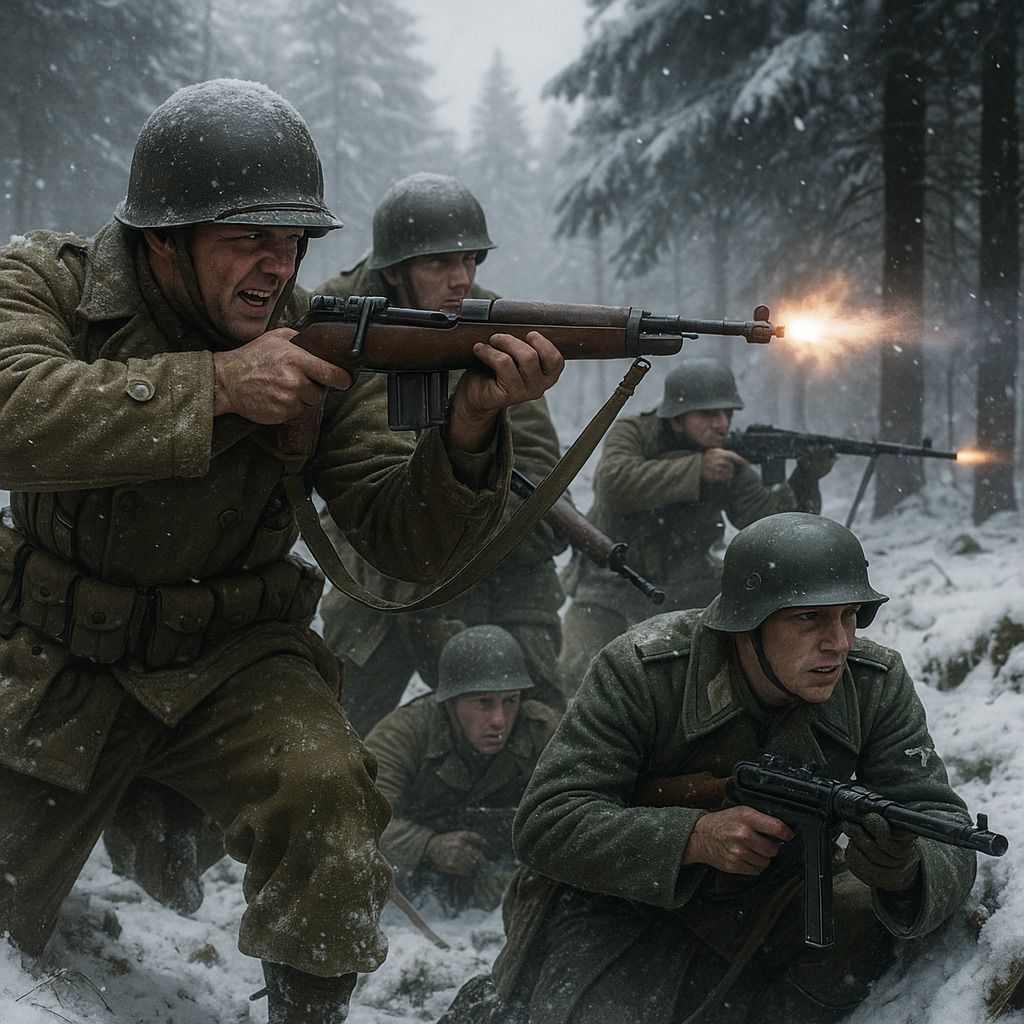
December 16, 1944, dawned cold, quiet, and deceptively calm across the Ardennes Forest. Snow blanketed the rolling hills of Belgium and Luxembourg, muffling sound and limiting visibility. For many Allied soldiers stationed in the region, the area was considered a rest sector, a place to recover from months of brutal fighting across France. Few suspected that this frozen landscape was about to become the stage for the largest and bloodiest battle ever fought by the United States Army.

The Battle of the Bulge was born out of desperation. By late 1944, Nazi Germany was losing on every front. The Allied invasion of Normandy had succeeded beyond expectations, Paris had been liberated, and Allied armies were pushing steadily toward Germany’s western borders. In the east, Soviet forces were closing in relentlessly. Adolf Hitler, increasingly isolated and dismissive of his generals, believed only a bold, decisive strike could reverse Germany’s fortunes.

Hitler’s plan was audacious to the point of recklessness. He ordered a massive surprise offensive through the Ardennes, the same forested region used successfully during Germany’s 1940 invasion of France. The goal was to split Allied forces, capture the vital port of Antwerp, and force the Western Allies into a negotiated peace. It was a gamble based on speed, surprise, and the hope that Allied morale would collapse under pressure.

To carry out the plan, Germany assembled over 200,000 troops, along with tanks, artillery, and limited air support. Many units were composed of inexperienced soldiers, older reservists, and teenage conscripts. Fuel shortages plagued the operation from the start, and German commanders quietly doubted its chances. Still, orders were orders, and preparations moved forward in secrecy.

At 5:30 a.m. on December 16, German artillery shattered the silence. Shells rained down on American positions, followed by waves of infantry and armored units pushing through fog and snow. The surprise was nearly complete. Many American units were understrength and scattered, caught off guard by the scale of the assault. Roads quickly clogged with retreating troops, refugees, and burning vehicles.

The German advance created a massive bulge in the Allied lines, giving the battle its enduring name. In the opening days, German forces achieved alarming gains, overrunning towns and capturing thousands of American soldiers. Panic spread in some sectors, but collapse never came. Small units fought stubbornly, delaying German progress and buying precious time.

Weather played a decisive role in the battle’s early phase. Thick clouds grounded Allied aircraft, preventing air support and reconnaissance. German forces advanced under cover of fog, while American troops struggled to resupply and reposition. The cold was relentless. Temperatures plunged below zero, and frostbite became as deadly as enemy fire.

One of the most critical points of the battle centered on the Belgian town of Bastogne. Its road network made it strategically vital, and German commanders were determined to seize it. The U.S. 101st Airborne Division, rushed to the area in trucks, was ordered to hold the town at all costs. They arrived poorly equipped for winter warfare and quickly found themselves surrounded.

Encircled, low on ammunition, and battered by constant attacks, the defenders of Bastogne became symbols of defiance. When a German envoy demanded surrender on December 22, General Anthony McAuliffe famously replied with a single word: “NUTS.” The message encapsulated the unbreakable resolve of Allied forces and soon spread throughout the ranks as a rallying cry.

As the siege continued, American artillery units fired relentlessly, often at close range. Medics worked without rest, treating wounded soldiers in freezing conditions. Civilians huddled in cellars, caught between advancing armies. Bastogne held, denying German forces a crucial objective and slowing their entire offensive.

Meanwhile, Allied command reacted swiftly. General Dwight D. Eisenhower recognized the threat and ordered reserves into action. The most dramatic response came from General George S. Patton, whose Third Army executed a rapid and daring pivot northward. In a matter of days, Patton’s forces marched through brutal winter conditions to relieve Bastogne.

On December 23, the weather finally broke. Clear skies returned, and Allied air power roared back into action. Fighter-bombers struck German supply lines, tanks, and troop concentrations with devastating effect. Without adequate fuel or air cover, German momentum stalled.

The battle turned decisively in favor of the Allies. American, British, and Canadian forces launched coordinated counterattacks, squeezing the bulge from both sides. German units, exhausted and undersupplied, began to retreat. What had been intended as a bold offensive became a costly withdrawal.

By January 25, 1945, the Battle of the Bulge was effectively over. The front lines returned nearly to their original positions, but the cost had been enormous. Approximately 19,000 Americans were killed, with tens of thousands wounded or captured. German losses were even greater, including irreplaceable tanks, aircraft, and experienced troops.

The battle marked Germany’s last major offensive in the West. After the Ardennes, the Wehrmacht would never regain the initiative. Allied forces surged forward into Germany, crossing the Rhine and accelerating the collapse of the Third Reich. Victory in Europe was now inevitable.

Beyond its strategic significance, the Battle of the Bulge became a defining test of endurance, leadership, and unity. Soldiers fought not only the enemy but starvation, exhaustion, and freezing cold. Acts of heroism occurred daily, often unnoticed, as small units held ground against overwhelming odds.

The battle also revealed the adaptability of Allied command. Initial surprise gave way to rapid coordination, flexible planning, and decisive action. Lessons learned in the Ardennes would influence modern military doctrine for decades to come.

For Adolf Hitler, the failure of the offensive was catastrophic. It shattered any remaining confidence among his generals and drained Germany’s final reserves. The illusion of a negotiated peace evaporated, replaced by the grim reality of total defeat.

Today, the forests and towns of the Ardennes stand quiet once more. Memorials and cemeteries mark where thousands fought and fell. Veterans’ stories, preserved through memory and history, continue to remind the world of the cost of freedom.

The Battle of the Bulge endures as a testament to the resilience of the human spirit. It was a battle defined not by flawless planning, but by perseverance under the harshest conditions imaginable. Against surprise, cold, and overwhelming pressure, Allied forces stood firm—and in doing so, helped bring an end to the most devastating war in human history.

Related Posts

Gone With the Wind Premieres: The Night Hollywood Changed Forever

Elias Rowen

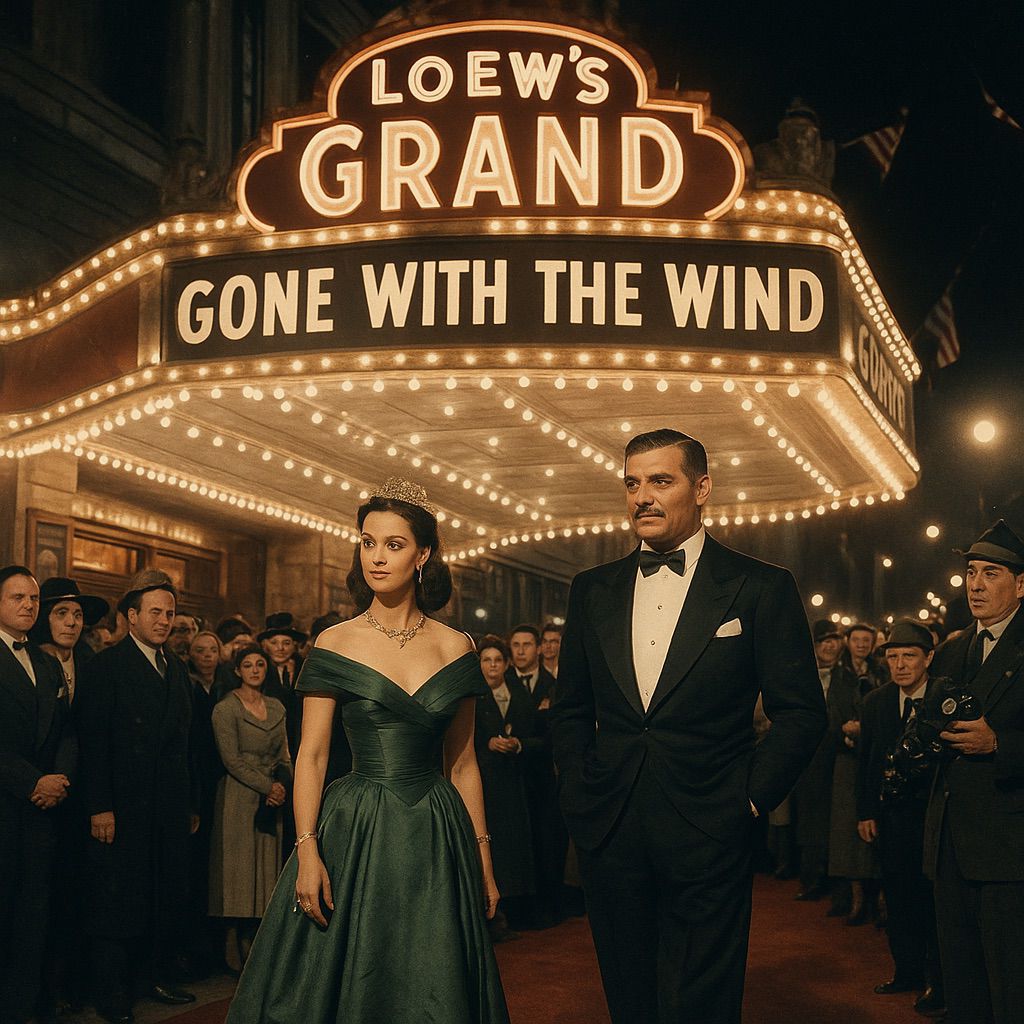
On the evening of December 15, 1939, Atlanta, Georgia became the epicenter of the cinematic world. Searchlights cut through the Southern night sky, streets overflowed with spectators, and anticipation hung thick in the air as one of the most ambitious films ever produced prepared to make its debut. Gone with the Wind was more than a movie premiere—it was a cultural event, a statement of Hollywood’s power, and the unveiling of a story that would shape American cinema for generations.

The Loew’s Grand Theatre stood at the heart of the celebration, transformed into a shrine of glamour and spectacle. Thousands gathered outside, hoping to catch a glimpse of stars arriving in elegant gowns and tailored tuxedos. The premiere was treated with the grandeur of a royal coronation, complete with parades, fireworks, and national attention. In an era still recovering from the Great Depression, the night offered an intoxicating sense of escapism and wonder.

Gone with the Wind had already achieved legendary status before a single frame reached the screen. Margaret Mitchell’s novel, published in 1936, became an instant phenomenon, selling millions of copies and embedding itself deeply into American culture. Readers were captivated by the story of Scarlett O’Hara, a fiercely determined Southern woman whose life is upended by the Civil War and its aftermath. The book’s success made a film adaptation inevitable, but also immensely risky.

From the outset, adapting the novel proved to be a monumental challenge. The story spanned decades, featured dozens of characters, and grappled with themes of love, survival, loss, and societal collapse. Producer David O. Selznick committed himself to honoring the scope of Mitchell’s work, even as Hollywood insiders doubted that such a sprawling narrative could be translated to film. The result was a production plagued by rewrites, director changes, and mounting pressure.

Casting Scarlett O’Hara became one of the most publicized searches in Hollywood history. Hundreds of actresses were considered, auditions scrutinized, and opinions fiercely debated. When Vivien Leigh, a relatively unknown British actress, was finally cast, the decision was met with both excitement and skepticism. Yet from her first appearance on screen, it became clear that Leigh embodied Scarlett’s fire, vulnerability, and resilience in a way few others could have achieved.

Clark Gable, already one of Hollywood’s biggest stars, was cast as Rhett Butler, the charismatic rogue whose wit and emotional detachment mask deep complexity. Gable’s presence brought gravitas and star power, but his participation was not without personal strain. Behind the scenes, he was grieving the recent death of his wife and struggling with health issues, adding emotional weight to his performance.

The production itself was an endurance test. Filming stretched over two years, with multiple directors rotating through the project before Victor Fleming ultimately guided it to completion. Sets were constructed on a massive scale, costumes meticulously crafted, and battle scenes staged with unprecedented ambition. Over a thousand costumes were designed, many of them worn by Scarlett alone, visually charting her transformation from sheltered plantation daughter to hardened survivor.

Music played a crucial role in shaping the film’s emotional power. Max Steiner’s sweeping score underscored moments of romance, despair, and defiance, weaving itself into the identity of the film. The music elevated scenes into operatic grandeur, reinforcing Gone with the Wind’s epic tone and emotional resonance.

As the premiere approached, anticipation reached a fever pitch. Atlanta embraced the film as its own, seeing it as both a tribute to Southern history and a major cultural milestone. Streets were decorated, Confederate imagery prominently displayed, and the city transformed into a living backdrop for the film’s themes. While this celebration reflected the sentiments of the time, it also foreshadowed the complex and controversial legacy the film would carry.

When the lights dimmed inside the Loew’s Grand Theatre, the audience was transported to Tara, Scarlett’s beloved plantation. From the opening moments, the scale of the film was unmistakable. Sweeping landscapes, vivid Technicolor, and emotionally charged performances drew viewers into a world both romanticized and ravaged by war.

Audiences were mesmerized. Gasps echoed during battle scenes, tears flowed during moments of loss, and applause erupted at iconic lines that would later become legendary. By the time Rhett Butler delivered his now-famous farewell, the film had secured its place in cinematic history.

Critical reception was overwhelmingly positive. Reviewers praised the film’s ambition, performances, and visual splendor. Vivien Leigh was hailed as a revelation, while Clark Gable’s portrayal of Rhett Butler was celebrated as one of his defining roles. The film would go on to win eight Academy Awards, including Best Picture and Best Actress, further cementing its status.

Financially, Gone with the Wind became an unprecedented success. Adjusted for inflation, it remains one of the highest-grossing films of all time. Its popularity endured through multiple re-releases, drawing new audiences with each generation and reinforcing its place in the American canon.

Yet even at the height of its acclaim, the film was not without controversy. Its portrayal of slavery and the Old South drew criticism for romanticizing a brutal and oppressive system. Characters were depicted through lenses that reflected the prejudices of the era, sparking debates that continue to this day. Over time, Gone with the Wind became a focal point for discussions about historical memory, representation, and the responsibility of art.

Despite these debates, the film’s influence on cinema is undeniable. It set new standards for epic storytelling, production design, and emotional scope. Countless filmmakers drew inspiration from its scale and ambition, while its characters and dialogue became embedded in popular culture.

Gone with the Wind also demonstrated the power of film as a shared national experience. At a time when the world stood on the brink of global conflict, the movie offered both escape and reflection, reminding audiences of resilience in the face of upheaval.

As decades passed, interpretations of the film evolved. What was once seen primarily as a romantic epic came to be examined through more critical lenses. Scholars, historians, and audiences reassessed its themes, acknowledging both its artistic achievements and its problematic elements. This ongoing dialogue has ensured that the film remains relevant, not frozen in time but continually reexamined.

More than eighty years after its premiere, Gone with the Wind continues to provoke conversation, admiration, and debate. Its legacy is complex, layered with both brilliance and contradiction. Yet its impact is unquestionable. Few films have shaped the language of cinema so profoundly or left such a lasting imprint on cultural consciousness.

The night of December 15, 1939 marked more than a premiere—it marked a turning point. Hollywood demonstrated its capacity for grand storytelling, emotional depth, and cultural influence. Gone with the Wind became not just a film, but a mirror reflecting both the dreams and the flaws of the society that created it.

In the end, Gone with the Wind endures because it tells a story about survival—about people clinging to identity, love, and purpose as their world collapses around them. That theme, more than any spectacle or controversy, is what continues to resonate across generations.

Related Posts

Venera 7 and the First Touchdown on Hell: How the Soviet Union Landed on Venus

Elias Rowen

On December 15, 1970, humanity accomplished something that once seemed firmly in the realm of science fiction. A robotic spacecraft built by the Soviet Union survived its descent through the crushing atmosphere of Venus and transmitted data back to Earth from the planet’s surface. That spacecraft was Venera 7, and its success marked one of the boldest and most technically demanding achievements in the history of space exploration. For the first time, a human-made object had landed on another planet and spoken back from the ground itself.

Venus had long taunted scientists with its mystery. From Earth, it appeared serene and luminous, wrapped in thick clouds that reflected sunlight brilliantly. Yet those same clouds hid an environment that was violently hostile. Early radar observations hinted at extreme heat and pressure, but the true nature of Venus remained uncertain throughout much of the 20th century. Sending a spacecraft there was not merely difficult—it bordered on reckless. And yet, that challenge was precisely what drew the attention of Soviet engineers and scientists.

The Soviet Union began conceptualizing missions to Venus in the early 1960s, driven by both scientific ambition and geopolitical rivalry. Space exploration had become a defining arena of the Cold War, and each new milestone carried symbolic weight. But Venus presented a problem that neither ideology nor ambition alone could solve. The planet’s atmosphere was dense enough to crush steel, and its temperatures could melt lead. Any spacecraft sent there would need to survive conditions far beyond anything previously encountered.

Early Venera missions were plagued by failure. Some spacecraft lost communication before reaching Venus. Others succumbed to the planet’s atmosphere during descent. Each failure, however, yielded invaluable data. Engineers learned how electronics behaved under intense heat, how pressure affected structural integrity, and how communication signals degraded under extreme atmospheric density. The Venera program became a masterclass in learning from defeat.

By the time Venera 7 was conceived, the Soviet space program had accumulated nearly a decade of hard-earned experience. The mission represented a shift from atmospheric probes to surface exploration, reflecting a growing understanding that Venus’s geology could offer clues about planetary evolution and Earth’s own climate history. But to reach the surface, engineers had to solve problems no one else had ever solved.

Venera 7 was designed with survival as its primary objective. Unlike earlier probes, it was built like a pressure vessel, with thick walls and minimal moving parts. Its most critical feature was its heat shield, constructed from specialized materials capable of withstanding temperatures exceeding 500 degrees Celsius. This shield would bear the brunt of atmospheric friction during descent, protecting the delicate instruments inside.

Launched from the Baikonur Cosmodrome on December 4, 1970, Venera 7 began its journey quietly, without fanfare outside scientific circles. As it cruised through space toward Venus, mission controllers monitored its systems closely. There would be no second chances. Once it entered Venus’s atmosphere, everything depended on the integrity of its design.

When Venera 7 reached Venus, it plunged into an atmosphere unlike any other encountered by a spacecraft. The air was thick with carbon dioxide, laced with sulfuric acid clouds, and compressed to staggering density. Temperatures climbed rapidly as the probe descended, testing the limits of its shielding. Instruments recorded pressure and heat values that confirmed Venus was far more extreme than previously imagined.

At approximately 25 kilometers above the surface, Venera 7’s parachute deployed—but only briefly. Engineers had anticipated that a conventional descent would expose the probe to lethal heat for too long. The parachute was designed to tear away intentionally, allowing the probe to fall faster and reduce exposure time. It was a calculated risk, one that underscored the mission’s boldness.

The final descent was brutal. Venera 7 slammed into the surface of Venus at high speed, its impact knocking the probe onto its side. For a moment, mission control feared total failure. Communication signals were faint, erratic, and barely distinguishable from background noise. But then came confirmation: the probe was alive.

For 23 minutes, Venera 7 transmitted data from the surface of another planet. Those minutes rewrote the history of space exploration. The data confirmed surface temperatures of approximately 467 degrees Celsius and atmospheric pressures more than 90 times that of Earth. Venus was not merely hot—it was an industrial furnace wrapped in crushing air.

Though the probe was not equipped with cameras, its measurements told a vivid story. Venus was a world shaped by intense volcanic activity and runaway greenhouse effects. Its environment bore little resemblance to Earth, despite similar size and composition. The findings forced scientists to rethink assumptions about planetary habitability and climate stability.

The success of Venera 7 sent shockwaves through the global scientific community. For the Soviet Union, it was a moment of immense pride, demonstrating technical mastery in one of the harshest environments imaginable. For planetary science, it was transformative. Venus was no longer an abstract mystery—it was a measurable reality.

Venera 7 also proved that robotic exploration could succeed where human exploration could not. No astronaut could survive Venus’s surface, but machines, carefully designed and ruthlessly simplified, could endure long enough to bring back knowledge. This realization would guide planetary exploration for decades to come.

The mission’s legacy extended far beyond its brief transmission window. Later Venera missions built upon its success, eventually sending probes equipped with cameras that captured haunting images of Venus’s rocky terrain. Each mission pushed technology further, refining heat resistance, pressure tolerance, and communication systems.

Venera 7’s achievement also carried deeper implications for Earth. Venus became a cautionary tale—a planet that may once have been temperate, now transformed into a hellscape by atmospheric imbalance. Its example added urgency to emerging studies of climate change and greenhouse effects, showing how planetary systems could spiral beyond recovery.

The engineers behind Venera 7 worked largely in obscurity, constrained by secrecy and limited resources. Yet their work rivaled—and in some areas surpassed—that of their Western counterparts. They solved problems not with elegance, but with relentless pragmatism, designing systems that favored durability over sophistication.

In hindsight, Venera 7 stands as one of the most underappreciated triumphs of the Space Age. While moon landings captured public imagination, landing on Venus demanded equal courage and ingenuity. It was not glamorous, not televised, and not easily celebrated—but it was revolutionary.

More than half a century later, no spacecraft has surpassed the audacity of Venera 7’s mission profile. Modern probes still struggle with Venus’s environment, and future missions continue to rely on lessons learned by Soviet engineers in the 1960s. The planet remains one of the greatest challenges in planetary science.

Venera 7 proved that humanity could touch even the most inhospitable worlds. It reminded us that exploration is not about comfort or safety, but about extending knowledge beyond the limits of our environment. In landing on Venus, the Soviet Union did not just win a technical race—it expanded the frontier of what was considered possible.

Related Posts

Securing Liberty: How the Bill of Rights Became America’s Shield Against Power

Elias Rowen

In the fragile years following the American Revolution, the United States stood at a crossroads, unsure whether the hard-won promise of liberty could survive the transition from rebellion to governance. Independence had been secured, but freedom itself still felt uncertain. Many Americans feared that the very government created to protect them might one day resemble the distant tyranny they had just cast off. Out of this tension, debate, and distrust emerged one of the most consequential achievements in the nation’s history: the ratification of the Bill of Rights.

The Constitution, ratified in 1788, was a bold experiment. It replaced the weak Articles of Confederation with a stronger federal system capable of taxation, defense, and lawmaking. For its supporters, the document was a triumph of political philosophy, blending order with republican ideals. For its critics, however, it was deeply unsettling. Nowhere did it explicitly guarantee freedom of speech, religion, or personal security. To many citizens, the absence of those protections felt like a betrayal of the Revolution’s ideals.

Opposition voices were loud and influential. Figures such as Patrick Henry and George Mason warned that unchecked federal power would inevitably erode liberty. They argued that without written protections, citizens would be left vulnerable to abuse by distant lawmakers. Mason, who had helped draft Virginia’s Declaration of Rights, refused to sign the Constitution specifically because it lacked safeguards for individual freedoms. His objections echoed through town halls, newspapers, and state conventions across the young nation.

James Madison initially believed the Constitution itself offered sufficient protection through its structure of checks and balances. Over time, however, he recognized that political reality demanded compromise. Without additional guarantees, public trust in the new government would remain fragile. Madison understood that legitimacy was not secured by authority alone, but by consent rooted in confidence.

In 1789, Madison introduced a series of amendments to Congress, drawing heavily from state declarations of rights and earlier colonial grievances. His proposals sought to clarify what the federal government could not do, rather than expanding what it could. This distinction was crucial. The amendments were not meant to weaken the Constitution, but to complete it.

The congressional debate that followed was intense. Some lawmakers feared that listing specific rights would imply the existence of others not mentioned, potentially limiting freedoms rather than expanding them. Others worried that amendments would invite endless revisions and undermine the authority of the new government. Madison navigated these concerns carefully, refining his proposals to focus squarely on essential liberties.

Outside Congress, public opinion was sharply divided. Newspapers printed fiery essays both defending and denouncing the amendments. Supporters argued that liberty demanded explicit protection. Critics warned that excessive limitations would paralyze governance. Yet even amid disagreement, one principle gained traction: a government accountable to its people must acknowledge boundaries.

By late 1789, Congress approved twelve amendments and sent them to the states for ratification. The process was slow and uneven. Some states ratified quickly, viewing the amendments as a victory for democratic ideals. Others hesitated, wary of federal intrusion or skeptical of the amendments’ necessity. Political culture varied widely from state to state, reflecting regional priorities and lingering distrust.

James Madison worked relentlessly behind the scenes, corresponding with state leaders and appealing to shared revolutionary values. His efforts paid off gradually. State by state, momentum built. Each ratification represented not just legal approval, but a philosophical endorsement of individual liberty as the cornerstone of the republic.

By December 1791, the necessary number of states had ratified ten of the twelve proposed amendments. These ten became known as the Bill of Rights. They enshrined freedoms that Americans had long believed were inherent but had never before formally protected at the federal level. Freedom of speech, religion, the press, and assembly; protection from unreasonable searches; the right to due process; safeguards against cruel punishment—all were now woven into the nation’s supreme law.

The ratification of the Bill of Rights transformed the Constitution from a framework of governance into a moral covenant between the government and its people. Power was no longer assumed to be benevolent. It was constrained, questioned, and defined. This shift marked a profound evolution in political thought, recognizing that liberty must be defended not only from foreign threats, but from domestic authority as well.

The impact was immediate and enduring. Citizens gained confidence that their rights were not dependent on goodwill or tradition, but guaranteed by law. Courts began interpreting these protections, shaping a legal culture that would continue to evolve for centuries. Over time, the Bill of Rights became a touchstone in struggles for equality, justice, and civil liberties.

Importantly, the Bill of Rights did not freeze American ideals in time. Instead, it provided a foundation upon which future generations could build. Amendments expanding voting rights, abolishing slavery, and guaranteeing equal protection drew inspiration from the same principle: that liberty grows stronger when clearly defended.

The Bill of Rights also influenced global movements for freedom. Its language and structure echoed in constitutions around the world, inspiring nations seeking to balance authority with individual dignity. What began as a domestic compromise became an international symbol of democratic aspiration.

James Madison’s role in this process secured his legacy not merely as an architect of government, but as a guardian of liberty. His willingness to adapt, compromise, and persist demonstrated that democracy thrives through dialogue rather than rigidity. The Bill of Rights was not inevitable; it was earned through effort, debate, and trust-building.

More than two centuries later, the Bill of Rights remains central to American identity. It is invoked in courtrooms, classrooms, protests, and political debates. Its principles continue to be tested, reaffirmed, and reinterpreted, reflecting the living nature of constitutional democracy.

The ratification of the Bill of Rights stands as a reminder that freedom is not self-sustaining. It requires vigilance, courage, and the willingness to confront power with principle. In securing those first ten amendments, the founders acknowledged a timeless truth: that a nation devoted to liberty must place limits on itself.

Related Posts