Latest Articles

When the Axis Turned on America: How Germany and Italy Pushed the World Into Total War

Elias Rowen

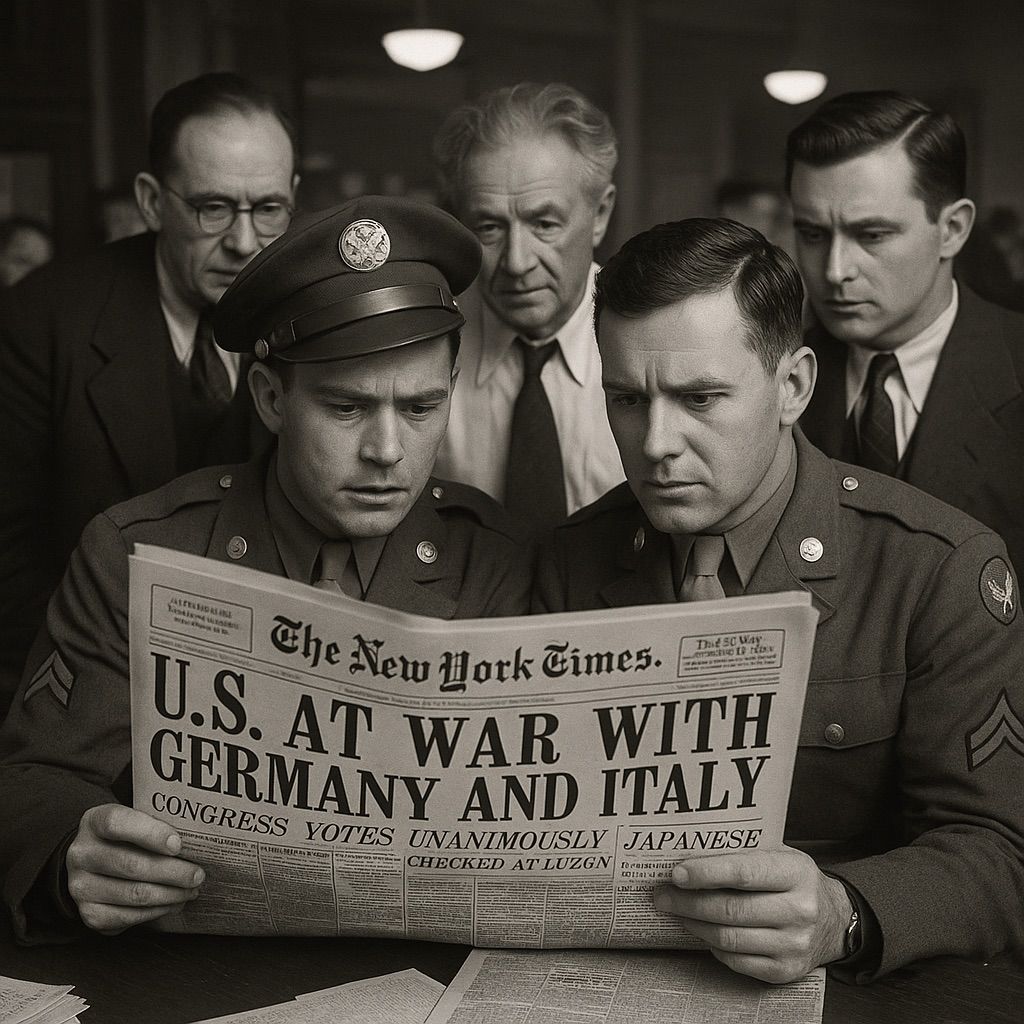
The winter of December 1941 settled heavily over Washington, London, Berlin, and Rome, but the cold did little to mute the shockwaves already rolling across the world. The United States had barely begun to process the devastation of Pearl Harbor—smoldering ships still leaked oil into Hawaiian waters, families were still being notified of loved ones lost, and the nation was only beginning to shift from the mindset of distant observer to active combatant—when yet another blow arrived. On December 11, 1941, Germany and Italy, under Adolf Hitler and Benito Mussolini, declared war on the United States, thrusting America formally into both the Atlantic and Pacific theaters of World War II. Their declarations expanded the conflict from a fractured, uneven international crisis into the fully global war it would become, forever redefining the twentieth century and reshaping the world’s political future.

To understand why Germany and Italy chose that moment to declare war on a country far more industrially powerful than themselves, one must trace the arc of the increasingly volatile atmosphere that had been building across the globe since the 1930s. Germany’s grievances after World War I were not merely emotional—they were strategic, economic, and purposeful. Hitler rose to power on promises to overturn the Treaty of Versailles, restore German pride, and rebuild the military machine that had been shattered in 1918. In a few short years, he dismantled democratic institutions, rebuilt the Luftwaffe, reintroduced conscription, and pushed the boundaries of diplomacy as far as Europe would allow. He annexed Austria, carved up Czechoslovakia, and molded the Nazi state into an engine designed for territorial expansion.

Italy, under Mussolini, shared similar ambitions but lacked the same military capacity. Mussolini dreamed of restoring the glories of ancient Rome, imagining a new Italian empire stretching across the Mediterranean and into Africa. His ventures into Ethiopia and Albania were attempts to stake Italy’s claim as a modern imperial power, even though Italian forces consistently lacked the skill, equipment, and organization of their German counterparts. But Mussolini’s ego demanded prestige, and aligning himself with Hitler offered the illusion of strength he could not produce on his own. Together, Germany and Italy formed a partnership that had as much to do with ideological alignment as it did with shared political fantasies of domination.

While war consumed Europe, the United States had watched from afar, hopeful that the Atlantic Ocean could remain a shield. Franklin D. Roosevelt understood that Germany’s aggression threatened global stability, but the American public—still scarred by the memory of World War I—wanted no part in another foreign war. Roosevelt walked a careful line, slowly edging the U.S. closer to the Allies, supplying Britain, supporting China, and quietly preparing for the possibility that neutrality would not last forever. The Lend-Lease Act was the clearest sign that the U.S. was no longer an impartial observer. American factories roared to life, producing tanks, aircraft, ammunition, and supplies for the nations resisting Hitler’s advance. The U.S. Navy found itself increasingly involved in escorting Allied convoys across the Atlantic, sometimes exchanging fire with German U-boats. Though America had not yet declared war, it was already drifting in that direction.

Yet despite Germany’s growing aggression, it was Japan’s decision to attack Pearl Harbor that finally forced America into the conflict. Japan had been expanding across East Asia for years, driven by militaristic ambitions and a desire to secure resources that its island nation could not produce. China suffered under Japanese occupation, and Southeast Asia braced for the same fate. When Japan swept into French Indochina, the U.S. responded with sanctions, including a crippling oil embargo. In Tokyo, Japan’s military government viewed the embargo as an existential threat. Without oil, their empire would collapse. A preemptive strike on the United States, they believed, would neutralize American influence long enough for Japan to seize the raw materials of Southeast Asia.

The attack on Pearl Harbor shocked the world. Americans who had once insisted on staying out of foreign wars now stood united in outrage. Roosevelt’s speech on December 8 declared the date as one that would live in infamy, and Congress swiftly approved a declaration of war against Japan. But for Hitler and Mussolini, seeing the U.S. locked into a Pacific war offered an enticing strategic illusion. They believed America would be too preoccupied fighting Japan to make meaningful contributions to the European theater. Moreover, Germany badly underestimated the industrial and military capacity of the United States. Hitler misread the moment entirely. He assumed that by declaring war on the U.S., he could draw Japan into a war against the Soviet Union, forming a united three-front assault that would break Stalin. That miscalculation would be one of the most significant turning points of the war.

Thus, Hitler and Mussolini formally declared war on the United States on December 11. Their speeches were full of bravado, ideological vitriol, and Nazi mythology about inevitable victory. They painted the United States as a decadent, capitalist nation incapable of sustaining a prolonged military campaign. They underestimated American resilience, industrial might, and the unity that Pearl Harbor had inspired. What they triggered instead was a mobilization unlike anything the world had ever seen. The U.S. economy—already humming from Lend-Lease production—shifted fully into wartime mode. Women entered factories, men lined up at recruiting offices, universities turned into research hubs, and automotive plants converted to produce aircraft and artillery.

Germany and Italy found themselves facing a nation that not only had massive human and industrial resources but also unparalleled logistical capability. The U.S. could build ships faster than Germany could sink them, could produce aircraft at quantities no Axis power could match, and could supply its allies with food, fuel, and weapons while simultaneously replenishing its own forces. The declarations of war that Hitler and Mussolini believed would divide the Allies instead unified them with unprecedented resolve.

As American involvement expanded, major turning points in the war began to shift momentum. In North Africa, U.S. and British forces pushed back the once-formidable Afrika Korps. In Italy, Allied troops fought up the peninsula, eventually toppling Mussolini’s regime. On the Eastern Front, the Red Army slowly reversed Germany’s advances, culminating in catastrophic losses for Hitler at Stalingrad and Kursk. And in the Pacific, the U.S. Navy, having turned the tide at Midway, began the long island-hopping campaign that would carry American forces ever closer to Japan.

By 1944, the full consequences of Hitler’s miscalculations were evident. American troops landed in Normandy, opening the long-awaited Western Front. The Allies closed in on Germany from both east and west, and Italy, having surrendered in 1943, became a battleground between German occupiers and Allied liberators. Hitler’s dream of a thousand-year Reich crumbled under the overwhelming weight of coordinated Allied offensives. Mussolini met a grim end at the hands of Italian partisans, and Germany surrendered in May 1945.

In the Pacific, the U.S. faced an enemy unwilling to surrender even in hopeless circumstances. Fierce battles on Iwo Jima and Okinawa revealed the staggering human cost of invading Japan itself. Truman’s decision to authorize the atomic bombings of Hiroshima and Nagasaki remains one of the most consequential and controversial decisions in world history. Japan surrendered shortly after the bombings, bringing World War II to its end.

The world that emerged from the ashes of the war bore little resemblance to the one that had existed in 1939. Germany was divided, Italy had abandoned fascism, the United States and the Soviet Union rose as superpowers, and the global order—politically, militarily, and ideologically—shifted dramatically. The United Nations was formed in the hope of preventing future conflicts, though the Cold War would soon cast a new shadow over international relations. For millions of families across continents, the war left scars that would never fully heal. And for historians and citizens alike, the conflict became a testament to the dangers of unchecked aggression, ideological extremism, and catastrophic miscalculation.

Looking back, the declarations of war by Germany and Italy seem almost surreal—acts of political arrogance and strategic blindness that sealed the Axis powers’ fate. They expected a fractured, reluctant America; instead they awakened a nation whose industrial strength and determination would help dismantle fascism and reshape the global balance of power. The world today still lives with the echoes of those December days when one nation recovering from the shock of Pearl Harbor suddenly found itself drawn fully into a war on two fronts, a war that would fundamentally rewrite the course of history.
Related Posts

El Mozote: The Massacre That Exposed a War Built on Silence

Elias Rowen

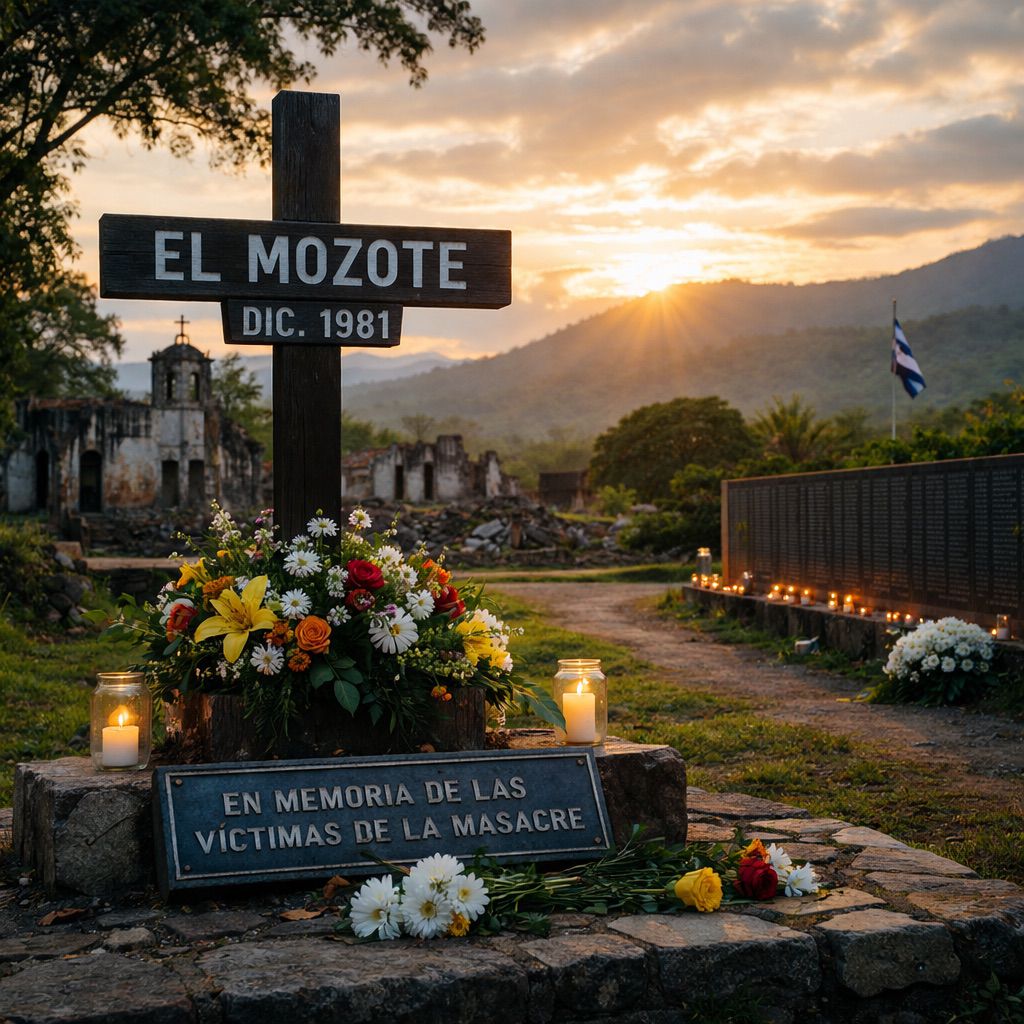
The morning sun that rose over the hills of Morazán in December of 1981 should have been no different than any other, casting its soft gold tones across the valleys and the quiet farming villages of northeastern El Salvador. But for the people of El Mozote, a small rural community whose lives revolved around cornfields, coffee plants, church gatherings, and the rhythms of family and work, the quiet beauty of those days would soon be overshadowed by one of the darkest events in Latin American history. The massacre that unfolded on December 11–12, 1981, would leave 863 people dead, entire families erased from existence, and the world forced to confront the brutal dimensions of a war that had long been painted in ideological simplicity.

El Salvador’s civil war, at least on the surface, seemed like a familiar Cold War script: leftist guerrillas of the Farabundo Martí National Liberation Front (FMLN) fighting against a government backed strongly by the United States. But beneath the geopolitical framing, the conflict was a cauldron of poverty, inequality, repression, and generations of rural neglect. The Salvadoran military, underpinned by U.S. training and funding, had adopted increasingly violent counterinsurgency tactics as the war intensified. Civilian populations in contested regions were no longer treated merely as unfortunate bystanders; they were redefined as potential collaborators, and therefore as legitimate targets.

The Atlacatl Battalion, an elite rapid-response unit created, trained, and heavily supported by U.S. advisers, would become infamous in the months and years that followed. Its members had been trained for efficiency, aggression, and counter-guerrilla strategy. What no amount of official training manuals admitted was that such training would also become the backbone for some of the worst atrocities of the war. What happened at El Mozote was not a spontaneous act of battlefield chaos; it was a methodical, organized mission whose objective was chillingly clear.

On December 10, 1981, the battalion encircled the village. Residents were frightened but still held onto a fragile belief that if they cooperated, no harm would come to them. The town’s reputation as a place sympathetic to guerrillas had long made it a target, but many residents had stayed precisely because they believed that declaring neutrality and avoiding armed involvement would protect them. They were tragically wrong.

The soldiers began by ordering everyone out of their homes. Men, women, children—entire families were gathered together in the village square. What followed was a deliberate pattern of separation: men forced into one location, women into another, children into the convent. The soldiers accused them of supporting the FMLN, of feeding guerrillas, of hiding weapons—accusations that, in the tense logic of counterinsurgency doctrine, required little to justify extreme measures.

The men were the first to be executed. Blindfolded, beaten, interrogated for information they did not have, many of them were shot in groups, their bodies left in open fields or buried hastily. Women were subjected to unspeakable violence before being killed. Children—some as young as infants—were gathered inside a church and murdered in ways so brutal that even decades later forensic experts struggled to process the evidence without emotional collapse.

The soldiers then burned the town. Homes, livestock, personal belongings, and even the bodies of victims were set ablaze in an attempt to erase any trace of what had occurred. El Mozote no longer resembled a community—it looked instead like a ghostly remnant of war, a place where silence lingered heavier than the smoke.

For a time, the Salvadoran military believed the operation had been a success. They denied everything. They accused survivors of lying. They told foreign journalists sympathetic to the villagers that their reporting was communist propaganda. The Reagan administration, eager to maintain military support for El Salvador’s government, quickly dismissed the first press stories about the massacre. Officials went so far as to imply that journalists had fabricated the event or had been manipulated by the FMLN.

But the truth—though temporarily buried—was not so easily silenced. In 1983, human rights investigators and journalists made their way to El Mozote again. This time they met survivors, remnants of buildings, and bones protruding from shallow graves. Forensic experts uncovered tiny skeletons, many belonging to children still wearing their shoes. There was no mistaking what had happened.

The massacre became emblematic not only because of its scale but because of the systemic impunity surrounding it. U.S. officials had denied it. The Salvadoran government had covered it up. And the military officers who planned and carried out the massacre were protected by an amnesty law passed in 1993, just days after the UN Truth Commission released its findings affirming the military’s responsibility.

Still, the dead did not disappear quietly. Families demanded truth. They demanded justice. They demanded dignity for those buried in unmarked graves.

As years passed, El Mozote became a symbol of memory and resistance. Survivors returned to rebuild what they could. Churches erected memorials. Activists organized pilgrimages and educational programs. International organizations provided forensic analysis, counseling, documentation support. In 2016, the Inter-American Court of Human Rights ruled that El Salvador had violated the rights of the victims by refusing to investigate and that the government must reopen the case. For the first time, high-ranking officers were ordered to face judicial proceedings.

Yet the path to accountability remains difficult. Many of those responsible lived long lives abroad or in military retirement. The same geopolitical forces that enabled the massacre continue to influence politics. And the scars left on survivors cannot be erased by tribunals alone.

The story of El Mozote is a story of a community destroyed not because of what people did, but because of who they were—poor, rural, and living in a zone of conflict where suspicions outweighed humanity. It is also a story of silence: the silence forced upon victims, the silence insisted upon by governments, the silence demanded by those who benefited from looking away.

But above all, it is a story of memory. Survivors have ensured that El Mozote is remembered not simply as a tragedy, but as a warning. A warning about the dangers of unchecked military power. A warning about what happens when ideological battles dehumanize entire communities. A warning about the ways great powers can enable atrocities even while speaking the language of freedom and democracy.

Standing in El Mozote today, one sees a town rebuilt—modest homes, gardens, a school, a church. But the ground beneath holds layers of history that refuse to be forgotten. Flowers and crosses mark places where bodies were found. The air carries the echoes of names once spoken in family gatherings, at church festivals, in childhood laughter.

The massacre remains a wound in El Salvador’s national memory, one still in the process of healing. Its lessons extend far beyond national borders. It shows that truth must be protected even when governments fear it. It shows that accountability matters not only for the past but for the future. And it shows that even in the wake of unimaginable violence, communities can rise—not to erase what happened, but to ensure it is never repeated.

Related Posts

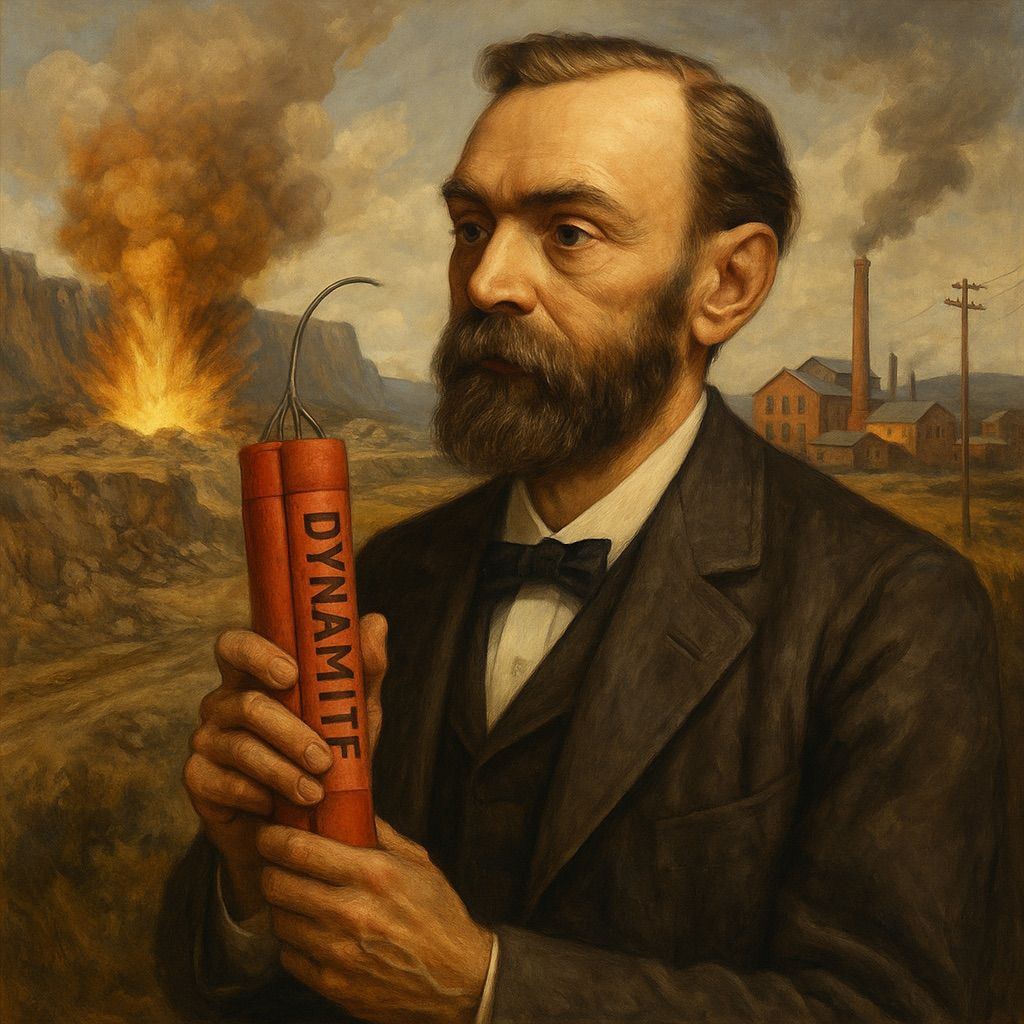
Alfred Nobel Turned a Legacy of Dynamite into a Legacy of Peace

Elias Rowen

Alfred Nobel’s life ended quietly on December 10, 1896, in the gentle warmth of the Italian Riviera, but the irony of his final years is that almost nothing about his legacy would remain quiet. His death at age sixty-three marked the beginning of one of the most profound transformations in modern intellectual and scientific history. The man whose name had long been associated with the raw power of explosives would, through one stunning and unexpected twist, become forever linked to the advancement of knowledge, human progress, and international peace. What began as a life centered around invention—particularly inventions that wielded fearsome power—ended as a legacy devoted entirely to rewarding humanity’s greatest achievements.

Alfred Nobel was born on October 21, 1833, in Stockholm, into a household that could best be described as intellectually restless. His father, Immanuel Nobel, was an engineer, an inventor, and something of a relentless dreamer whose fortunes rose and fell as fast as the markets he chased. When Alfred was still a child, Immanuel moved the family to St. Petersburg, Russia, where he secured work as an engineer for the Imperial Army. It was in Russia, surrounded by the machinery of war and industry, that Alfred’s natural abilities began to take shape. He developed a fascination with chemistry and engineering, two disciplines that would determine the arc of his life.

By the time he reached adulthood, Alfred Nobel was well on his way to becoming one of the most prolific inventors in Europe. He studied in Paris and worked in factories and laboratories across the continent. His sharp mind and unusual intuitive sense for the behavior of chemical compounds allowed him to see possibilities where others saw only risk. By 1863, he had developed a usable form of nitroglycerin—far more powerful than anything previously available for blasting rock or excavating tunnels. But nitroglycerin was dangerously unstable, often exploding unpredictably, killing workers and damaging equipment.

The turning point came in 1866, when Nobel discovered that combining nitroglycerin with silica and diatomaceous earth created a clay-like mixture that was both powerful and stable. He named it dynamite. With dynamite, construction firms could blast through mountains, carve railways through continents, and accelerate the industrial age into a new chapter. Nobel patented the invention, founded factories across the world, and rapidly became one of the wealthiest men of his generation.

But dynamite brought something else—controversy. Many saw it as a tool for progress, yet others saw it as an instrument of destruction. Nobel, who was intensely private and somewhat emotionally distant, carried these criticisms quietly, perhaps even painfully. In his personal life, he suffered profound loneliness and loss. His first and only love, the Austrian pacifist Bertha von Suttner, became a lifelong correspondent rather than a partner. His younger brother Ludvig died in 1888. And then came the incident that changed everything: a French newspaper mistakenly published Alfred Nobel’s obituary—believing that it was he, not his brother, who had died.

The headline read: “The merchant of death is dead.”
The article went further, condemning Nobel for becoming rich by inventing a substance that killed people more efficiently than ever before. Imagine the shock of reading your own legacy reduced to such brutal clarity. Nobel, deeply shaken, realized that this might truly be how history remembered him. And in that moment of painful introspection, a new idea began to take shape—one that would eventually redefine the meaning of his name.

By 1895, Nobel had quietly drafted a will that stunned even those closest to him. He left nearly all of his vast fortune—equivalent today to billions of dollars—to establish five annual prizes. These prizes would be awarded to those who had conferred “the greatest benefit to humankind” in physics, chemistry, medicine, literature, and peace. He did not consult his family. He did not request approval. He simply wrote the instructions, sealed the document, and ensured that his wealth would build a legacy far different from the one his inventions might have suggested.

When the will was read aloud in Stockholm in January 1897, Sweden erupted in debate. The will was legally unusual and politically delicate. Some argued that Nobel’s estate should rightfully go to his relatives. Others objected to the international nature of the prize committees. Even the Swedish King expressed disapproval. Yet Nobel’s wishes ultimately prevailed, as if the moral momentum behind his vision could not be denied.

On December 10, 1901—five years to the day after Nobel’s death—the first Nobel Prizes were awarded. The ceremony marked an extraordinary moment, not just for science and literature, but for a world beginning to recognize that human achievement extended far beyond national boundaries. Wilhelm Conrad Röntgen received the physics prize for discovering X-rays, a breakthrough that revolutionized medicine. Marie Curie, who had inspired Nobel’s admiration during his lifetime, received her first Nobel just two years later. The literature prize went to Sully Prudhomme, while the peace prize was awarded to Henry Dunant and Frédéric Passy, two pioneers of humanitarian thought.

The world immediately understood that something monumental had begun.

In the decades that followed, the Nobel Prizes became the global gold standard for intellectual accomplishment. Scientists whose work changed the course of history—Einstein, Bohr, Watson and Crick, Fleming—walked across the stage in Stockholm to receive an award made possible by the man who once feared being remembered only for creating explosives. Writers who reshaped the world’s imagination, leaders who fought oppression, doctors who cured diseases—all came to stand under the banner of Nobel’s vision.

The irony, of course, is profound. A man who built his fortune on controlled destruction ultimately engineered one of the most constructive philanthropic legacies ever conceived. Nobel never married, never had children, and lived much of his life in isolation. But he left behind an idea greater than any invention: the belief that humanity’s brightest minds should be honored and encouraged, that progress was something worth investing in, and that peace—fragile though it may be—deserved recognition equal to any scientific breakthrough.

Today, the Nobel Foundation’s endowment has grown to billions, allowing the prizes to continue indefinitely. More than 600 laureates have been honored, some of them twice. The awards have shaped careers, influenced political movements, and propelled scientific revolutions. They have sparked debate, controversy, admiration, and sometimes outrage—but always engagement. The world watches each year, waiting to see who has nudged humanity forward.

In a very real sense, Alfred Nobel succeeded in rewriting his own obituary. He ensured that he would be remembered not as the merchant of death, but as the architect of one of humanity’s greatest traditions—one that celebrates imagination, discovery, and the pursuit of peace. His life reminds us that redemption is possible, that legacy is malleable, and that a single moment of clarity can alter the destiny of millions.

When we speak his name today, we think not of dynamite but of brilliance. Not of destruction but of progress. Not of explosions but of enlightenment.

And perhaps that is exactly the future Alfred Nobel hoped to build—not only for himself but for the world.

Related Posts

Universal Declaration of Human Rights adopted

Elias Rowen

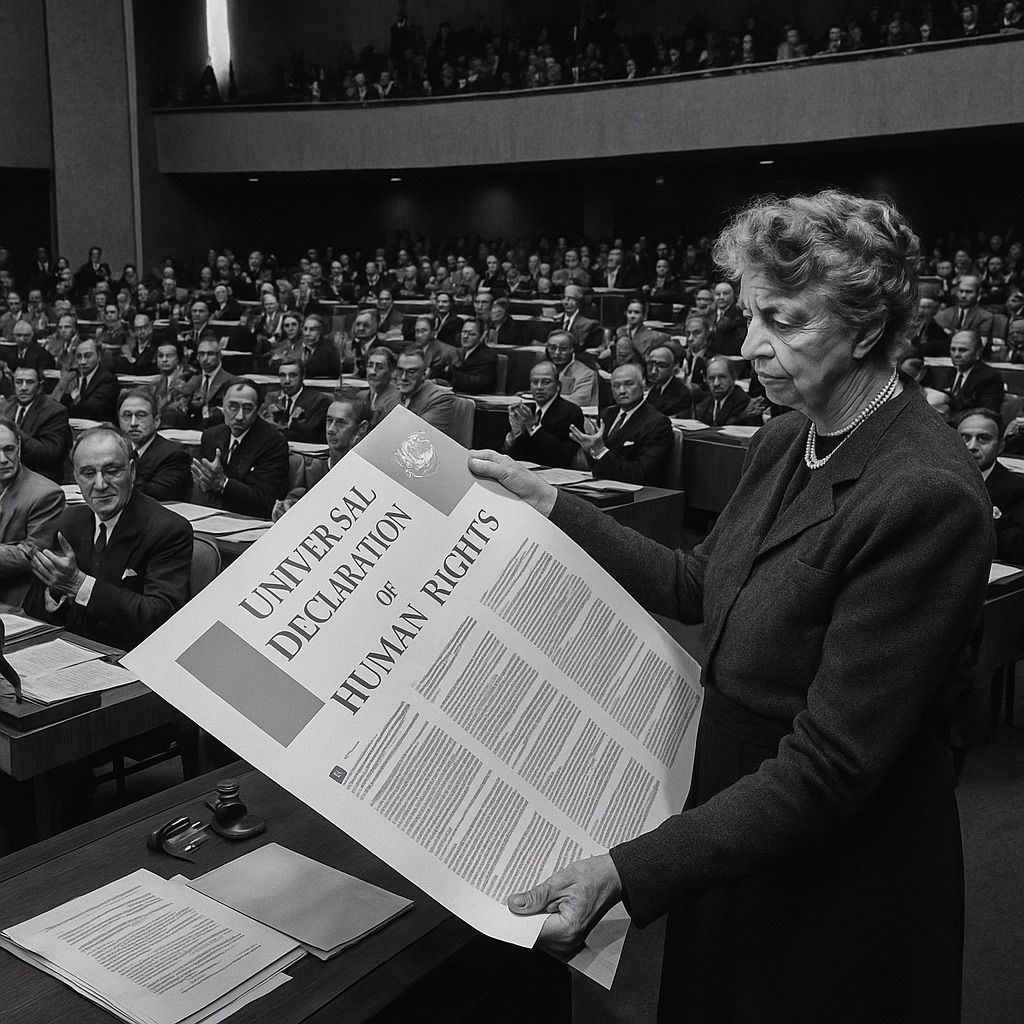
In the cold December air of 1948, as the world continued to patch its wounds from a war more devastating than anything humanity had ever endured, a different kind of battle was unfolding inside the United Nations General Assembly in Lake Success, New York. Delegates from dozens of nations, many still reeling from the trauma of occupation, genocide, and political collapse, gathered to discuss a document that dared to do something unprecedented: declare, openly and unflinchingly, that every human being on earth possessed inherent dignity and rights, regardless of nationality, religion, class, or ideology. In a century defined by unimaginable cruelty and division, the Universal Declaration of Human Rights emerged as a beacon of hope—a promise that humanity could rise above its darkest moments and attempt to define, at last, what it meant to treat all people with fairness and respect. This declaration, which years earlier had seemed almost impossible to imagine, was now on the verge of becoming reality, carried forward by leaders who refused to allow the atrocities of the past to become the blueprint for the future.

The momentum behind the declaration began long before delegates took their seats in 1948. In the immediate aftermath of World War II, the world’s horror at Nazi concentration camps, mass executions, forced labor systems, and the systematic dehumanization of entire populations forced global leaders into a stark confrontation with their own failures. Never before had the world seen such destruction inflicted with such calculated efficiency, and the question of how humanity could prevent such tragedies from recurring became a moral imperative. When representatives gathered in San Francisco in 1945 to establish the United Nations, they knew the organization had to stand for something greater than political alliances and peacekeeping mandates. Yet the resulting UN Charter was cautious, gesturing toward human rights without explicitly defining what those rights should be. This omission left many dissatisfied, especially activists and nations emerging from colonial rule who felt that without a clear, universal standard, the world risked repeating its most catastrophic mistakes.

Among the voices pushing the hardest for a global framework was Eleanor Roosevelt, who had stepped into the role of U.S. delegate to the new Commission on Human Rights not out of any formal diplomatic training but out of a deeply ingrained conviction that moral leadership was necessary for global stability. Eleanor carried with her the legacy of her late husband, Franklin D. Roosevelt, who had championed the “Four Freedoms”—freedom of speech, freedom of worship, freedom from want, and freedom from fear—as essential pillars of a peaceful world. But she also brought her own lived experience: the empathy she had cultivated while traveling through war-torn cities, refugee camps, mining towns, and segregated American communities. Her work on the Commission would require her to navigate a labyrinth of clashing ideologies, national interests, and cultural norms, yet her calm persistence would ultimately become one of the most defining forces behind the Universal Declaration.

The first draft of the document was prepared by John Humphrey, a Canadian lawyer whose encyclopedic knowledge of legal systems gave him the foundation to craft something truly global in scope. Humphrey approached his task like a historian, a lawyer, and an idealist all at once. On his desk sat an enormous collection of world constitutions, philosophical treatises, religious texts, and political charters. He drew inspiration from the American Bill of Rights, the French Declaration of the Rights of Man and of the Citizen, the writings of Confucius, the teachings of the Quran, and the democratic ideals of newly independent nations. His goal was not to impose one culture’s values upon another but to find the overlapping principles that all human societies, at their best, aspired to uphold. The result was a sweeping statement of rights spanning civil liberties, political freedoms, economic security, and social equality—all expressed in language that the average person could understand.

Yet drafting the document was only the beginning. The real struggle emerged during months of debate inside the Commission on Human Rights and later in the UN’s Third Committee, where delegates from vastly different systems of governance attempted to reconcile their conflicting views. The Soviet Union argued forcefully for economic and social equality, insisting that the right to food, work, and shelter was as essential as the right to vote or speak freely. Western democracies prioritized political freedoms and warned that states must not be given excessive power over the individual. Meanwhile, newly decolonizing nations pressed for recognition that human rights must apply not only within nations but also in the context of imperialism, where powerful countries continued to control the destinies of millions without representation or consent. These conversations grew heated, occasionally erupting into ideological clashes that reflected the early tension of the Cold War. But despite fierce disagreements, a shared acknowledgment persisted beneath the rhetoric: the world needed this document, and failure to adopt it would be a betrayal of the millions who had suffered through war, oppression, and genocide.

Eleanor Roosevelt became the crucial bridge between competing worldviews. She used personal charm where diplomacy stalled, moral clarity where politics muddied the waters, and unwavering conviction where others hesitated. Late into the night she studied revised drafts, scribbled notes in the margins, wrote letters to world leaders, and reassured smaller nations that their voices mattered. Her insistence that the declaration had to be accessible to the ordinary person—not just lawyers or politicians—reshaped the language into something almost poetic in its simplicity: “All human beings are born free and equal in dignity and rights.” That opening line, elegant and courageous, would become one of the most quoted sentences in the history of international law.

By December 1948, the debates had reached their final stage. Delegates gathered once again in the General Assembly, each carrying the weight of their nation’s hopes and anxieties. Some worried the declaration would be impossible to enforce; others feared it would interfere with domestic sovereignty. Yet, as speeches echoed through the chamber, a quiet sense of unity began to take hold. Representatives who had once clashed over ideology now found themselves acknowledging a shared truth—that humanity had reached a crossroads, and failing to act would leave the door open for future atrocities. As the final vote was cast, the room held its breath. Forty-eight nations voted in favor. Eight abstained. None voted against. The Universal Declaration of Human Rights had passed.

The moment was met with applause, relief, and an unmistakable sense that history had shifted. Though the declaration had no legal force, its moral authority was undeniable. Newspapers around the world hailed it as a triumph of the human spirit. In Paris, London, and New York, crowds gathered outside consulates and universities to discuss the newly adopted principles. Survivors of war wrote letters expressing hope that future generations might be spared the suffering they had endured. Civil rights activists in the United States, anti-colonial leaders in Africa and Asia, and reformers in Latin America all saw the declaration as validation for their struggles. At a time when humanity felt fragile and fractured, the UDHR offered something rare: a shared vision of dignity, equality, and justice that transcended borders and ideologies.

In the decades that followed, the declaration became the blueprint for a new generation of international treaties, including the International Covenant on Civil and Political Rights and the International Covenant on Economic, Social, and Cultural Rights. It influenced new constitutions in nations emerging from colonial rule. It inspired social movements, from the fight against apartheid in South Africa to campaigns for gender equality, children’s rights, LGBTQ+ rights, and protections for people with disabilities. Its principles appeared in classrooms, courtrooms, refugee camps, and grassroots campaigns around the world. Even authoritarian governments, when accused of violating human rights, found themselves forced to respond—not because the UDHR had legal teeth, but because it had become the moral compass against which nations were judged.

Yet the legacy of the UDHR is not one of unbroken progress. The world continues to struggle with human rights abuses, discrimination, and violence. Genocides have occurred long after the declaration’s adoption. Governments still silence dissent, restrict movement, and violate basic freedoms. Economic inequality persists, disproportionately affecting the most vulnerable. Cultural and political differences still challenge the dream of universal application. But the enduring power of the declaration lies not in the perfection of its implementation but in its ability to remind humanity of what is possible. It remains a guidepost—a vision of the world we continue striving to build, even when we fall short.

Today, as the Universal Declaration approaches its eighth decade, its words remain as urgent as ever. New technologies raise questions about privacy, surveillance, and digital rights. Migration crises challenge our understanding of borders and belonging. Climate change threatens the stability and well-being of millions, testing our commitment to Article 25’s promise of a standard of living adequate for health and well-being. But through all of these challenges, the declaration endures, offering a framework grounded in the simple but revolutionary idea that every person matters.

The story of the Universal Declaration of Human Rights is ultimately a story of hope. It is the story of how, in the wake of unimaginable devastation, the world chose not bitterness but aspiration—not vengeance but empathy. It is the story of people like Eleanor Roosevelt, John Humphrey, Charles Malik, René Cassin, and countless unnamed delegates who believed that dignity was not a luxury but a birthright. And it is the story of millions throughout the world who continue to raise their voices in defense of those rights, proving that the declaration was not merely adopted—it was embraced. As long as its principles live in the minds, hearts, and actions of people everywhere, the UDHR remains one of humanity’s greatest achievements: a collective promise to build a world in which every person can live freely, equally, and without fear.

Related Posts

Dr. Martin Luther King Jr. receives Nobel Peace Prize

Elias Rowen

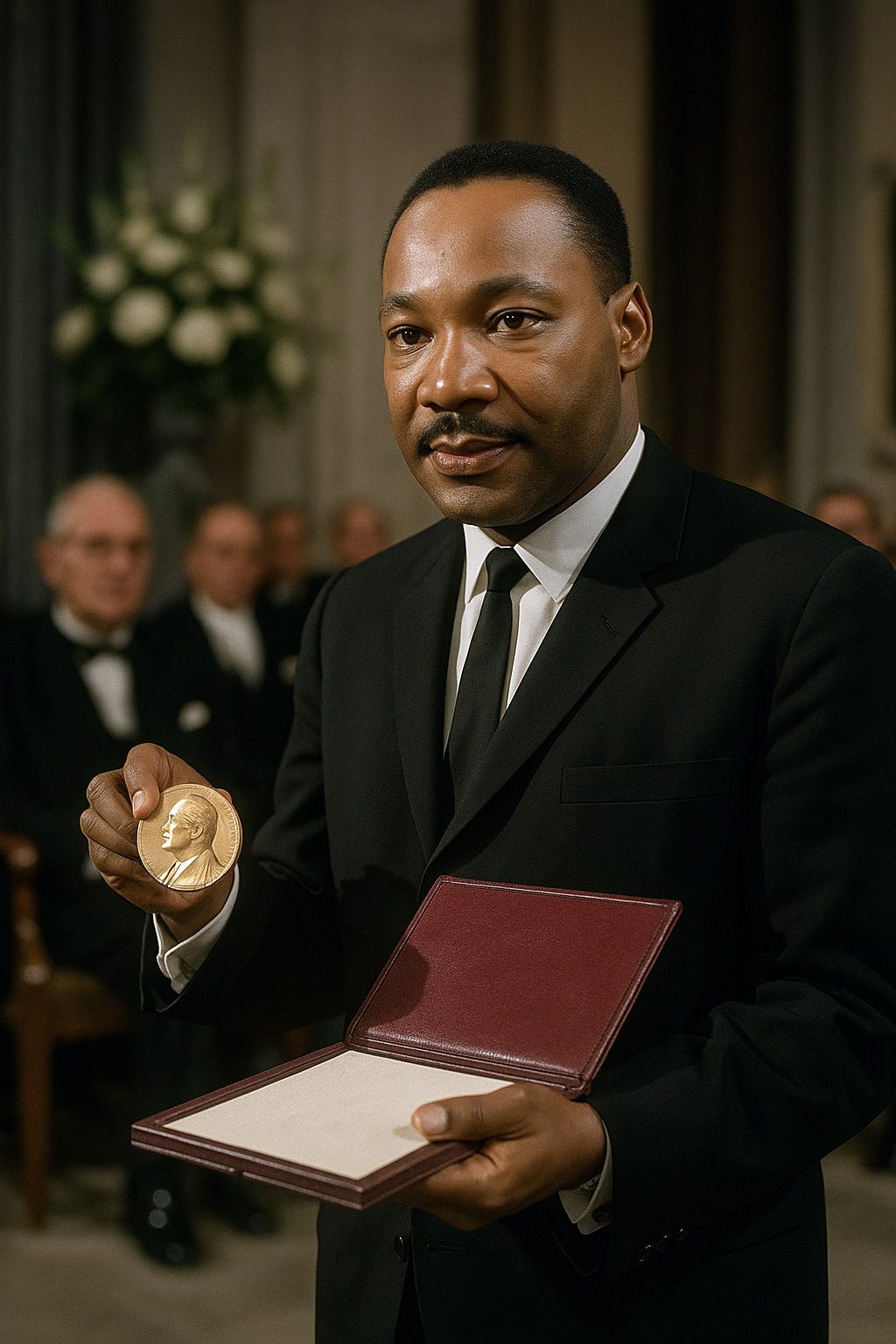
It was October 14, 1964, and the chill of an early Norwegian autumn swept gently across Oslo as dignitaries, journalists, and scholars gathered in growing anticipation. Inside the University Church of Norway, the energy felt almost electric—an unspoken awareness that history was taking shape within its walls. Dr. Martin Luther King Jr., the Baptist minister whose voice had become a moral compass for millions, had been awarded the Nobel Peace Prize. At just 35 years old, he became the youngest recipient in the prize’s history, a testament not only to his extraordinary leadership but to the unwavering force of a movement demanding dignity, justice, and equality.

For many watching from across the world, King’s arrival in Oslo represented more than a ceremonial accolade. It symbolized the global recognition of a struggle often met with violence, resistance, and profound sacrifice. The Civil Rights Movement had already faced countless trials—bombings, arrests, beatings, and assassinations—and yet King stood firm as the living embodiment of the philosophy he preached: nonviolent resistance rooted in deep, unshakable love for humanity. The Nobel Committee’s decision was not without controversy; critics argued that awarding a man at the center of so much domestic turmoil might embolden unrest. But to the millions who believed in his mission, the award validated what they already knew—that the pursuit of equal rights transcended borders, that the courage to challenge injustice was a universal calling, and that King’s leadership had become a beacon of moral truth.

Martin Luther King Jr.’s path to that moment began decades earlier in the deep-seated segregation of Atlanta, Georgia, where he grew up acutely aware of both the boundaries imposed by racism and the spiritual strength cultivated within his community. His father, Martin Luther King Sr., was a respected pastor who instilled in young Martin a profound belief in education, righteousness, and moral duty. The harsh realities of discrimination were unavoidable—schools divided by race, neighborhoods separated, opportunities withheld—but what shaped King most was the sense that resistance to injustice must be guided by conscience rather than hatred.

During his years at Morehouse College, King’s worldview began to take shape. Influenced by mentors like Benjamin Mays, he developed a belief in the transformative power of moral leadership. His academic gifts were clear, but it was his ability to articulate the pain and hopes of his people that distinguished him. After Morehouse, his studies at Crozer Theological Seminary and later Boston University exposed him to new philosophies, including the nonviolent teachings of Mahatma Gandhi, whose influence would become central to King’s approach in the coming years.

When Rosa Parks refused to surrender her seat in Montgomery in December 1955, King was thrust unexpectedly into the forefront of a burgeoning movement. At just 26 years old, he found himself leading a community that had reached its breaking point. The Montgomery Bus Boycott lasted 381 days and faced relentless intimidation, including King’s home being bombed while his wife Coretta and newborn daughter were inside. Yet King did not waver. When crowds gathered in anger, he called for peace. When fear spread, he called for resolve. His words—steady, thoughtful, and rooted in faith—gave strength to thousands who walked miles each day rather than submit to humiliation.

King’s rise to prominence was not without cost. The more visible he became, the more threats intensified. The FBI began monitoring him, politicians labeled him a danger to public order, and segregationists portrayed him as a radical agitator. But King saw the bigger picture—that the movement was not simply about bus seats, voting booths, or lunch counters. It was about the fundamental human right to exist freely without the weight of oppression.

By the early 1960s, the movement had expanded far beyond Montgomery. Sit-ins spread across the South, Freedom Riders challenged segregation laws, and thousands faced jail time for their participation. King was arrested repeatedly, most famously in Birmingham in 1963. From his jail cell, he wrote one of the most powerful defenses of civil disobedience ever composed: “Injustice anywhere is a threat to justice everywhere.” The world read his words, and the moral authority of nonviolent protest gained even deeper resonance.

The March on Washington in August 1963 further solidified King as the voice of a movement. Standing before more than 250,000 supporters, he delivered the “I Have a Dream” speech that would echo across generations. He spoke not only of the pain of discrimination but of the hope for unity—a nation where children would “not be judged by the color of their skin but by the content of their character.” It was one of the defining speeches in American history, a moment where King’s ability to meld moral clarity with poetic vision reached its zenith.

When King was named the Nobel Peace Prize laureate the following year, it was clear that his influence had transcended national boundaries. In Oslo, the committee described him as “the first person in the Western world to have shown us that a struggle can be waged without violence.” At a time when global tensions ran high—from the Cold War to decolonization—King’s philosophy of peaceful resistance struck a chord internationally.

King chose to donate the entire $54,500 prize to the Civil Rights Movement, a gesture that spoke volumes about his character. The cause always came before personal gain. In his acceptance speech on December 10, 1964, he acknowledged the giants on whose shoulders he stood: the activists who faced fire hoses, attack dogs, nightsticks, and bombs. He spoke of the unfulfilled hopes of millions and the struggle still ahead. “I accept this award in the spirit of a curator,” he said, “for peace and brotherhood.” His words reinforced that the Nobel Prize was not an endpoint but a charge to continue onward.

The ceremony was transformative in ways that extended beyond its immediate symbolism. International leaders began viewing the Civil Rights Movement not merely as an American issue but as a global human rights struggle. King’s visit sparked dialogue in countries grappling with their own racial, colonial, or class-based inequalities. His ability to express universal truths made him a unifying figure in a fragmented world.

But even as King was celebrated abroad, challenges at home intensified. His advocacy expanded to include issues like poverty, labor inequality, and opposition to the Vietnam War—stances that cost him political favor and increased surveillance by the FBI. Yet he believed deeply in speaking the truth, even when doing so risked alienating allies. His Poor People’s Campaign sought to unite Americans across racial and economic divides, a movement he never saw realized due to his assassination in 1968.

King’s death shook the world, leaving millions mourning the loss of a man who embodied hope itself. But the seeds he planted continued to grow. Civil rights legislation had already begun reshaping America, and new generations of activists—Black, white, Latino, Indigenous, Asian—took up the mantle of justice. King had not simply changed laws; he had changed consciousness.

The legacy of his Nobel Prize endures as a testament to the power of peaceful resistance and moral conviction. It reminds the world that movements are built not only on marches and speeches but on courage, compassion, and the unyielding belief that humanity is capable of profound transformation. Today, as nations confront systemic racism, political turmoil, and social divisions, King’s teachings remain a blueprint for progress.

His Nobel Prize was not the culmination of his life’s work, but a moment that crystallized the essence of his message: that equality is not a privilege but a right, that justice is non-negotiable, and that peace is not merely the absence of conflict but the presence of fairness.

Nearly 60 years later, King’s legacy continues to illuminate the path forward, urging us to imagine a world guided not by fear, but by love; not by violence, but by understanding; not by division, but by unity. His voice still echoes—steady, compassionate, unyielding—calling us toward the dream he never abandoned and urging us to continue the work he began.

Related Posts