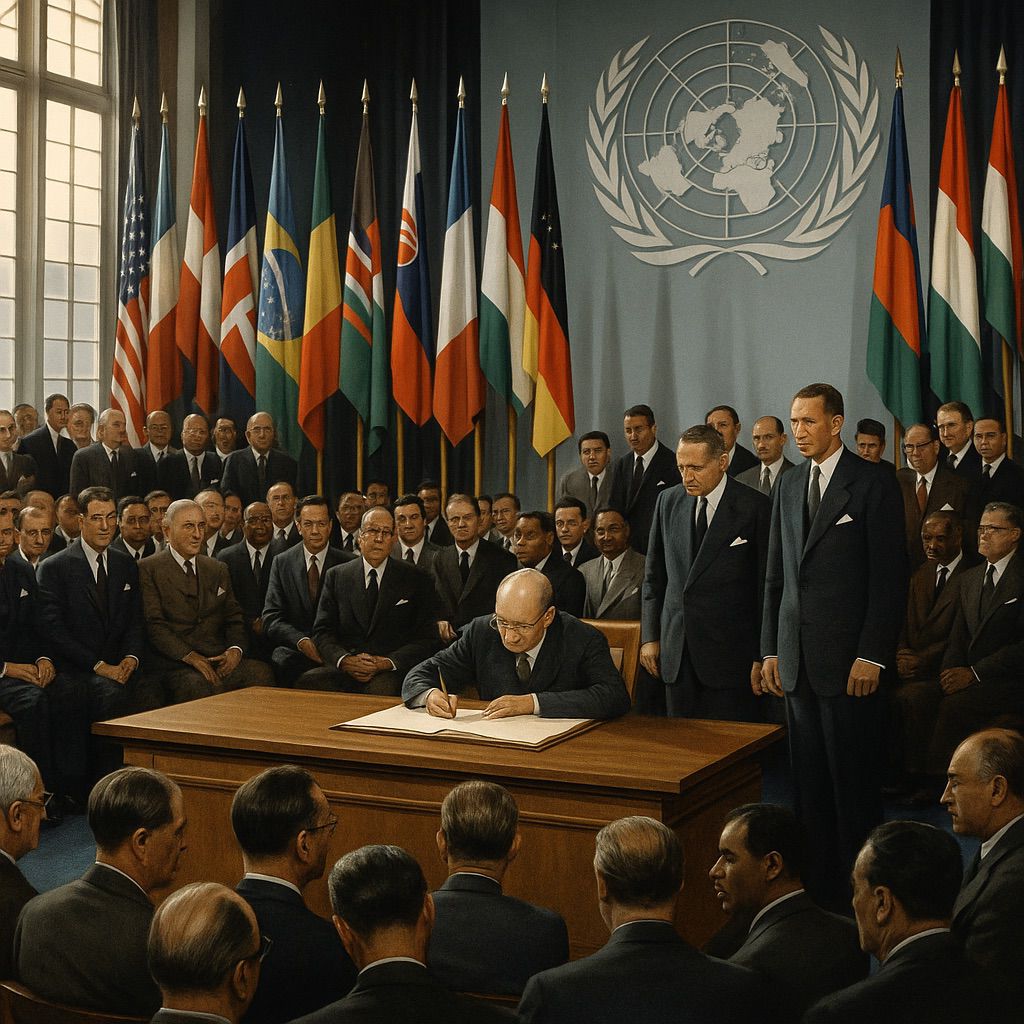
On October 24, 1945, in the aftermath of the deadliest war the world had ever endured, humanity dared to dream of peace. The United Nations was officially born, an organization built not on the illusions of perfection but on the desperate need to prevent the horrors of World War II from ever repeating. On that day, representatives of 51 nations signed a charter that spoke of human dignity, collective security, and the audacious belief that cooperation could succeed where isolation and rivalry had failed. It was a moment both fragile and monumental, a declaration that even amid ruins and grief, humanity could choose dialogue over destruction.
The world in 1945 was broken. Cities lay in rubble from Warsaw to Tokyo, millions were displaced, families shattered, economies ruined. The memory of Auschwitz, Hiroshima, and Stalingrad lingered like open wounds. Twice in a generation, global war had consumed humanity, and leaders recognized that if the cycle continued, civilization itself might not survive a third. Out of that devastation came an urgent call: never again. The United Nations emerged not as utopia, but as necessity.
The seeds were planted even before World War II ended. In 1941, Franklin D. Roosevelt and Winston Churchill drafted the Atlantic Charter, envisioning a world based on collective security, free trade, and disarmament. By 1944, at Dumbarton Oaks in Washington, diplomats hammered out the skeleton of an international organization. Finally, in June 1945, representatives from dozens of nations gathered in San Francisco to finalize the United Nations Charter. On October 24, after ratification by the major powers—China, France, the Soviet Union, the United Kingdom, and the United States—the United Nations officially came into being.
The Charter was more than paper. It was a promise. It spoke of saving succeeding generations from the scourge of war, reaffirming human rights, and promoting social progress. It created a General Assembly, where every nation would have a voice, and a Security Council, tasked with maintaining peace through collective action. It was ambitious, flawed, and unprecedented. For the first time in history, nations agreed to bind themselves to a global institution dedicated to peace.
But the story of the United Nations is not simply about diplomats in suits or resolutions on paper. It is about people. It is about the refugee in 1946 receiving food and shelter from UN relief programs. It is about the peacekeeper in a blue helmet standing between warring factions. It is about the child in a war-torn village who learns to read thanks to UNESCO programs, the mother whose baby receives vaccines from UNICEF, the family spared starvation by the World Food Programme. Behind acronyms and bureaucracy, the UN has always been, at its best, a human story.
Yet the organization was never free of contradictions. From the beginning, the Security Council reflected the harsh reality of power. The five permanent members, armed with vetoes, ensured that peace would often be hostage to politics. During the Cold War, the UN became an arena for superpower rivalry, where East and West clashed in debates as much as in proxy wars. Critics scoffed at its impotence, pointing to failures in Rwanda, Bosnia, and elsewhere. And yet, despite its flaws, the UN endured. Its blue flag became a symbol, its forums a place where even enemies could speak rather than shoot.
October 24, 1945, matters because it marked humanity’s willingness to try. In a world fractured by conflict, nations chose cooperation. They chose dialogue, however messy, over isolation. They chose hope, however fragile, over despair. For a planet scarred by two world wars, that was nothing short of revolutionary.
Think of the individuals who shaped that moment. Franklin Roosevelt, who dreamed of a global organization but died before seeing it realized. Eleanor Roosevelt, who later championed the Universal Declaration of Human Rights, giving flesh to the Charter’s lofty words. Diplomats from small nations, who insisted that the UN not become simply a playground for great powers. Soldiers, workers, teachers, and survivors across the globe, who looked to the UN not as perfection, but as possibility.
To humanize the UN’s founding is to remember the ordinary people whose lives were altered by its existence. The orphan in 1947 who received food rations marked with the UN emblem. The villager in the Congo who saw peacekeepers arrive in the 1960s. The doctor who vaccinated children in Asia under WHO’s guidance. The protester in South Africa, whose struggle against apartheid was bolstered by UN resolutions. The farmer in drought-stricken Africa, whose family survived because of UN aid. These were not abstract policies—they were lives.
Of course, the UN’s journey has been fraught with failures. It could not stop every war, prevent every atrocity, or live up to every promise. But it remains, for all its imperfections, the closest thing humanity has to a collective conscience. Its very existence is testimony to the fact that nations, despite rivalry and suspicion, can choose to talk, to negotiate, to compromise.
October 24 is now celebrated as United Nations Day, not because the UN is flawless, but because it is necessary. It is the imperfect table at which the world still gathers, where nations both powerful and powerless speak, where hope still flickers that humanity can cooperate to face shared challenges—whether war, climate change, pandemics, or poverty.
The founding of the United Nations in 1945 was not the end of conflict. It was not the dawning of perfect peace. But it was a beginning. It was humanity saying, after the most violent century in history, “We must do better.” It was an act of faith, not in governments, but in people—the belief that dialogue, however fraught, is better than silence, and cooperation, however flawed, is better than despair.
October 24, 1945, was the day humanity reached for unity, and though our grip is still uncertain, the attempt itself remains one of our greatest acts of courage.