Latest Articles

The Day Humanity Reached for Unity: Founding of the United Nations

Elias Rowen

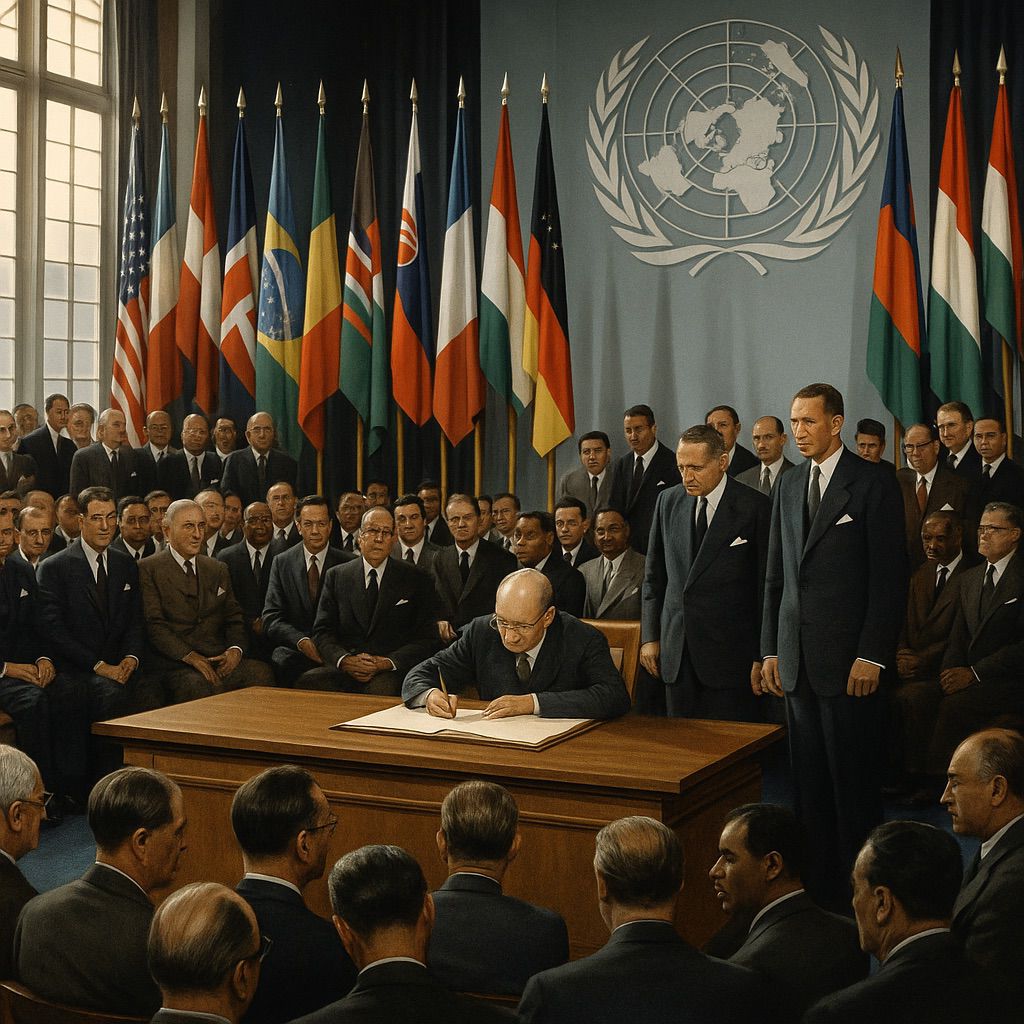
On October 24, 1945, in the aftermath of the deadliest war the world had ever endured, humanity dared to dream of peace. The United Nations was officially born, an organization built not on the illusions of perfection but on the desperate need to prevent the horrors of World War II from ever repeating. On that day, representatives of 51 nations signed a charter that spoke of human dignity, collective security, and the audacious belief that cooperation could succeed where isolation and rivalry had failed. It was a moment both fragile and monumental, a declaration that even amid ruins and grief, humanity could choose dialogue over destruction.

The world in 1945 was broken. Cities lay in rubble from Warsaw to Tokyo, millions were displaced, families shattered, economies ruined. The memory of Auschwitz, Hiroshima, and Stalingrad lingered like open wounds. Twice in a generation, global war had consumed humanity, and leaders recognized that if the cycle continued, civilization itself might not survive a third. Out of that devastation came an urgent call: never again. The United Nations emerged not as utopia, but as necessity.

The seeds were planted even before World War II ended. In 1941, Franklin D. Roosevelt and Winston Churchill drafted the Atlantic Charter, envisioning a world based on collective security, free trade, and disarmament. By 1944, at Dumbarton Oaks in Washington, diplomats hammered out the skeleton of an international organization. Finally, in June 1945, representatives from dozens of nations gathered in San Francisco to finalize the United Nations Charter. On October 24, after ratification by the major powers—China, France, the Soviet Union, the United Kingdom, and the United States—the United Nations officially came into being.

The Charter was more than paper. It was a promise. It spoke of saving succeeding generations from the scourge of war, reaffirming human rights, and promoting social progress. It created a General Assembly, where every nation would have a voice, and a Security Council, tasked with maintaining peace through collective action. It was ambitious, flawed, and unprecedented. For the first time in history, nations agreed to bind themselves to a global institution dedicated to peace.

But the story of the United Nations is not simply about diplomats in suits or resolutions on paper. It is about people. It is about the refugee in 1946 receiving food and shelter from UN relief programs. It is about the peacekeeper in a blue helmet standing between warring factions. It is about the child in a war-torn village who learns to read thanks to UNESCO programs, the mother whose baby receives vaccines from UNICEF, the family spared starvation by the World Food Programme. Behind acronyms and bureaucracy, the UN has always been, at its best, a human story.

Yet the organization was never free of contradictions. From the beginning, the Security Council reflected the harsh reality of power. The five permanent members, armed with vetoes, ensured that peace would often be hostage to politics. During the Cold War, the UN became an arena for superpower rivalry, where East and West clashed in debates as much as in proxy wars. Critics scoffed at its impotence, pointing to failures in Rwanda, Bosnia, and elsewhere. And yet, despite its flaws, the UN endured. Its blue flag became a symbol, its forums a place where even enemies could speak rather than shoot.

October 24, 1945, matters because it marked humanity’s willingness to try. In a world fractured by conflict, nations chose cooperation. They chose dialogue, however messy, over isolation. They chose hope, however fragile, over despair. For a planet scarred by two world wars, that was nothing short of revolutionary.

Think of the individuals who shaped that moment. Franklin Roosevelt, who dreamed of a global organization but died before seeing it realized. Eleanor Roosevelt, who later championed the Universal Declaration of Human Rights, giving flesh to the Charter’s lofty words. Diplomats from small nations, who insisted that the UN not become simply a playground for great powers. Soldiers, workers, teachers, and survivors across the globe, who looked to the UN not as perfection, but as possibility.

To humanize the UN’s founding is to remember the ordinary people whose lives were altered by its existence. The orphan in 1947 who received food rations marked with the UN emblem. The villager in the Congo who saw peacekeepers arrive in the 1960s. The doctor who vaccinated children in Asia under WHO’s guidance. The protester in South Africa, whose struggle against apartheid was bolstered by UN resolutions. The farmer in drought-stricken Africa, whose family survived because of UN aid. These were not abstract policies—they were lives.

Of course, the UN’s journey has been fraught with failures. It could not stop every war, prevent every atrocity, or live up to every promise. But it remains, for all its imperfections, the closest thing humanity has to a collective conscience. Its very existence is testimony to the fact that nations, despite rivalry and suspicion, can choose to talk, to negotiate, to compromise.

October 24 is now celebrated as United Nations Day, not because the UN is flawless, but because it is necessary. It is the imperfect table at which the world still gathers, where nations both powerful and powerless speak, where hope still flickers that humanity can cooperate to face shared challenges—whether war, climate change, pandemics, or poverty.

The founding of the United Nations in 1945 was not the end of conflict. It was not the dawning of perfect peace. But it was a beginning. It was humanity saying, after the most violent century in history, “We must do better.” It was an act of faith, not in governments, but in people—the belief that dialogue, however fraught, is better than silence, and cooperation, however flawed, is better than despair.

October 24, 1945, was the day humanity reached for unity, and though our grip is still uncertain, the attempt itself remains one of our greatest acts of courage.


Related Posts

Golden Legacy: Why the Cleopatra Queen Reigns Over Every Halloween

Dave

Every October, when costumes flood the streets, bars, and parties of the world, certain archetypes rise above the rest. Vampires stalk in velvet and fangs. Witches glide in black silk with broomsticks in hand. Devils sparkle in red sequins and horns. Yet among all the monsters, seductresses, and rebels of the night, there is one figure who doesn’t need claws, wings, or spells to command attention. She simply needs a golden dress, a snake armband coiled like power on her arm, and a headpiece that gleams like the desert sun. She is Cleopatra, Queen of the Nile—the woman who, more than two thousand years after her reign, still owns any room, any stage, any Halloween night she chooses to enter.

The Cleopatra Queen costume endures because it blends history with fantasy. Cleopatra herself was a figure of myth and reality, power and beauty, intellect and seduction. Historians remember her as one of the most cunning rulers of ancient Egypt, a woman fluent in politics, economics, and languages, who dared to challenge Rome’s supremacy. Pop culture, however, immortalized her as a seductress, a queen who ensnared Julius Caesar and Mark Antony with her allure. The truth lies somewhere in the middle—but that duality is exactly what makes her perfect for Halloween. She’s both real and legendary, both political and passionate, both goddess and human. Wearing Cleopatra isn’t just about looking glamorous—it’s about embodying a role that has commanded fascination for millennia.

Visually, the Cleopatra Queen costume is pure spectacle. The gold dress is the foundation, shimmering under any light like the sands of the Nile at sunset. Its fabric clings, flows, and dazzles, sculpting the body into a figure of undeniable regality. The snake armband is the perfect detail, a coil of power and symbolism—snakes represented royalty, divinity, and immortality in Egyptian culture. Worn on the upper arm, it signals authority, danger, and sensuality. And the headpiece? That’s her crown, her unmistakable signature. Whether a cobra diadem, a bejeweled circlet, or a golden band across the forehead, it frames her like a living goddess, marking her not just as beautiful, but as divine. No matter how crowded the room is, Cleopatra’s costume gleams like a beacon—every eye finds her, every camera captures her, every post featuring her goes viral.

But Cleopatra’s power isn’t just in the costume—it’s in the performance it inspires. Costumes that thrive on Halloween are the ones that allow for character, and Cleopatra is a role ready to be played. The tilt of her chin, the smolder of her eyes, the deliberate grace of her walk—all become tools of her seduction. She doesn’t need to shriek or scare. She doesn’t even need to speak. Her presence alone is enough to make people hush, to turn heads, to create an aura of awe. At parties, the Cleopatra Queen doesn’t fade into the crowd—she rules it, as if every dance floor is her throne room and every guest her subject. And online, her presence transforms into content that feels mythic: slow-motion spins of her golden gown, close-ups of eyeliner sharp enough to cut, captions declaring her “Queen of Halloween.”

Adaptability also explains why Cleopatra’s look has remained one of the most popular Halloween costumes for decades. Some lean into historical authenticity, with linen gowns, intricate beaded collars, and cobra headpieces straight out of ancient reliefs. Others glam her up with sequins, stilettos, and plunging necklines that modernize her allure. Some reinterpret her as dark and gothic, adding shadowy tones and venomous accents. Others reimagine her as futuristic, a Cleopatra reborn for a cyberpunk age, draped in metallics and LED jewels. No matter the spin, the core essence remains: Cleopatra is power, Cleopatra is beauty, Cleopatra is eternal. That flexibility ensures that she never feels stale—she always returns, always reinvents, always reigns.

The humanizing part of Cleopatra’s costume is what makes it more than just dress-up. Cleopatra, the historical figure, was complicated. She was brilliant and strategic, but also vulnerable. She lived in a world that constantly sought to diminish women, yet she carved out her legacy in stone. She’s remembered as both seductress and stateswoman, sinner and saint, goddess and mortal. That messy duality resonates with us today because we all know what it feels like to be underestimated, to be judged, to be told we’re too much of one thing and not enough of another. When someone wears Cleopatra, they’re not just wearing gold—they’re embodying that defiance. They’re saying: I contain multitudes, I can be soft and fierce, I can be beautiful and brilliant, and I will not apologize for any of it. That’s why the costume isn’t just glamorous—it’s empowering.

And on social media, Cleopatra is viral gold. Instagram feeds light up with golden shimmer when she appears, her eyeliner wings cutting sharper than any vampire fang, her poses regal enough to rival influencers and models. On TikTok, Cleopatra transitions thrive: one moment barefaced, the next moment crowned in gold, draped in sequins, staring down the camera like a goddess. On X, she trends because she isn’t just another character—she’s an icon, a cultural touchstone that everyone instantly recognizes. Cleopatra’s hashtag fills with queens of all shapes, shades, and sizes, each one taking her legacy and making it their own. And that universality, that ability to connect across generations and cultures, is what cements her as a viral staple.

Halloween is about transformation, and Cleopatra’s story is one of eternal transformation. She has been remembered, reimagined, and reborn countless times across history: in Shakespeare’s words, in Elizabeth Taylor’s eyes, in the costumes of women at Halloween parties around the globe. She proves that icons never die—they simply take new forms, shimmering in new fabrics, glowing under new lights. Every Cleopatra costume is part of that ongoing story, another chapter in the Queen’s endless reign.

So when the Halloween party reaches its peak, when the music pounds and the lights flash, watch who stands at the center. She’ll be the one in gold, snake coiled around her arm, headpiece gleaming as if it were forged by the gods themselves. She won’t need to fight for attention—it will already be hers. People will approach her, drawn like moths to flame, eager to bask in her glow. Phones will rise, flashes will pop, feeds will flood. And when the night ends and the costumes are packed away, her image will linger, her posts will spread, her reign will continue. Because Cleopatra is not just a queen of the Nile—she’s the queen of Halloween.

Related Posts

Howling Through the Bayou: The Endless Terror of the Rougarou

Dave

Louisiana is a land of shadows and whispers, where cypress trees twist above dark waters, where Spanish moss hangs like the hair of ghosts, and where the night carries voices older than memory. It is a place where myth and reality intermingle, where Catholic prayers brush against Creole superstition, and where every ripple in the swamp can feel like a story waiting to pounce. Among these stories, none is as feared or as beloved as the Rougarou — the Cajun werewolf. A creature of French folklore reshaped by the Louisiana bayou, the Rougarou stalks swamps and sugarcane fields, hunting not only for flesh but for souls, a living embodiment of curses, punishment, and primal fear. On October 23, when its legend is remembered, the bayou feels alive with its breath, and the moon itself seems complicit in the terror.

The Rougarou (sometimes spelled loup-garou from the French) is, at its core, a werewolf. But unlike the polished versions of werewolves we see in modern films, the Rougarou is deeply Cajun, its story infused with Catholic morality, swamp geography, and the rhythms of a culture born of both survival and faith. By day, the Rougarou may appear human, cursed to hide among neighbors. But by night, under the light of the moon, it transforms — tall, wolf-headed, with glowing red eyes and a hunger that nothing can satisfy. It stalks through cane fields, emerges from the swamp mist, and terrorizes those who cross it. Its howl cuts through the night like a warning, a sound that freezes blood and sends whole communities into prayer.

The legend was carried from France, where loup-garou tales spoke of werewolves cursed for breaking Lent or committing sins. In Louisiana, it mingled with Catholic teachings and local traditions, becoming a figure of fear but also of discipline. Parents warned children: behave, or the Rougarou will get you. Keep your Lenten fasts, or risk being cursed to wear its skin. It became not just a monster but a moral enforcer, a way to embed religious teachings into the cultural fabric. In this sense, the Rougarou was never just about the beast — it was about the community, about control, about keeping the Cajun people tied to faith and survival.

Descriptions of the Rougarou vary, which only adds to its menace. Some say it is a towering wolf-headed man with glowing eyes and claws like knives. Others say it is more wolf than man, running on all fours, its fur matted with swamp water, its growl echoing through cane fields. In some stories, it is not a transformation at all but a curse that passes from one person to another, like a dark inheritance. To be bitten by the Rougarou is not only to risk death but to risk becoming the very thing you fear. In this way, the Rougarou embodies the cyclical nature of sin: once infected, you too become the hunter, forced to carry the curse forward.

Its setting makes it uniquely terrifying. The bayou itself is a perfect backdrop for horror. The water is dark, the fog endless, the cries of unseen animals echoing through the night. Spanish moss drips from ancient oaks like spectral curtains. Crocodiles slip silently beneath the surface, their eyes glinting. To walk alone in the swamp at night is to feel constantly watched. In such a setting, the Rougarou feels inevitable, as though the land itself requires such a creature to exist. When the mist rolls in and the moon rises, it feels natural to believe something monstrous prowls just out of sight.

But the Rougarou is not only about fear — it is also about belonging. Cajun communities embraced the story as part of their cultural identity. It appears in festivals, in songs, in tales told around campfires. To speak of the Rougarou is to speak of Cajun history itself, of a people who blended French, African, Native American, and Creole traditions into something entirely unique. The Rougarou is a monster, yes, but it is their monster, woven into the DNA of Louisiana storytelling.

The Rougarou is also striking in how it blurs the line between punishment and tragedy. Some versions of the legend say that the Rougarou is a cursed soul, forced to wander as a beast for 101 days before the curse passes on. During that time, it cannot speak of its condition, and to reveal its curse is to transfer it to another. This detail makes the Rougarou less a predator and more a victim, trapped in a cycle of silence and suffering. It is not evil by choice but by compulsion, its howl less a threat than a cry of despair. This tragic element deepens the legend, making it more than a simple tale of monster and prey.

The endurance of the Rougarou shows the power of folklore to adapt and survive. Today, it appears not only in campfire stories but in popular culture: novels, TV shows, even local festivals where “Rougarou runs” keep the legend alive. Modern Cajun storytellers use the Rougarou both as a source of pride and as a way to connect to heritage. In an age where myths often fade, the Rougarou thrives because it is both universal and deeply local: the werewolf is a global symbol, but the Cajun Rougarou belongs uniquely to Louisiana.

What makes the Rougarou so compelling in the viral imagination is its blend of horror, mystery, and cultural resonance. It is a creature tied to morality, to landscape, to community. It is both terrifying and tragic, both enforcer and victim. It is a monster you can fear, but also one you can pity, because in some versions, the Rougarou is your neighbor, your friend, your relative, cursed into silence, howling in the swamp. That blend of horror and humanity makes it unforgettable.

So on October 23, when we tell the story of the Rougarou, we are telling more than just a werewolf tale. We are telling the story of the bayou itself — its fog, its faith, its fear. We are telling the story of Cajun culture, of French roots entwined with American soil, of the way monsters become markers of identity. And we are reminding ourselves that sometimes, the scariest monsters are not strangers at all. Sometimes, they are us.

And maybe, when the swamp fog curls low across the water, and the moon hangs heavy above the cypress trees, you’ll hear it — a distant howl, too deep to be a wolf, too human to be a beast. Maybe you’ll feel the Rougarou’s eyes on you, glowing through the mist, waiting for you to falter, to sin, to stray. And maybe you’ll realize the swamp never sleeps — and neither does the Rougarou.

Related Posts

Beirut, 1983: The Morning the World Shook

Elias Rowen

On October 23, 1983, at precisely 6:22 a.m., Beirut was shattered by the roar of an explosion so powerful it was felt miles away. A suicide bomber drove a truck packed with explosives into the U.S. Marine barracks near the Beirut International Airport, killing 241 American servicemen—most of them sleeping in their bunks. Just minutes later, another bomber struck the French barracks, killing 58 French paratroopers. It was the deadliest single-day loss for the U.S. Marine Corps since Iwo Jima in World War II. In an instant, a peacekeeping mission became a massacre, and the world was forced to confront the grim reality of a new age of warfare: terrorism without boundaries, suicide attacks as strategy, and violence that could obliterate lives in seconds.

The Marines in Beirut had not come as conquerors. They had been sent as part of a multinational peacekeeping force, tasked with stabilizing a nation torn apart by civil war. Lebanon in the early 1980s was a cauldron of sectarian conflict, foreign interventions, and proxy battles. Once called the “Paris of the Middle East,” Beirut had become a city scarred by snipers, rubble, and militia checkpoints. The U.S., France, Italy, and Britain sent troops to oversee a fragile ceasefire, believing their presence could calm the chaos. But peacekeepers soon found themselves in a war with no front lines, where every street corner, every alley, and every vehicle might conceal an enemy.

For the Marines, life in Beirut was tense but monotonous. They stood guard, patrolled, and tried to maintain a sense of normalcy in a city always on edge. Letters from home were read by flashlight, meals eaten in makeshift cafeterias, moments of camaraderie forged amid danger. Many were barely out of their teens, young men who had joined the service with dreams of duty, travel, or a steady future. They could not have imagined their mission would end in one of the worst acts of violence against Americans abroad.

The attack itself was devastating in its simplicity. The bomber, driving a yellow Mercedes truck loaded with the equivalent of six tons of TNT, barreled past guards and into the barracks. A guard managed to chamber a round, but by then it was too late. The truck detonated, obliterating the four-story building and reducing it to a heap of concrete, steel, and dust. The force was so great that it lifted the structure off its foundations, collapsing it like a house of cards. Within seconds, hundreds of lives were extinguished or buried in rubble. Survivors described a deafening roar, walls folding inward, fire and smoke filling the air, and comrades trapped in the wreckage crying out for help.

The French barracks, struck moments later, suffered the same fate. Another suicide bomber, another truck, another explosion. Fifty-eight soldiers gone in an instant. The precision and coordination of the attacks stunned military leaders. These were not random acts of violence—they were carefully planned strikes meant to send a message: foreign troops were not welcome, and peacekeeping was a target.

The aftermath was chaos and heartbreak. Rescue crews clawed through rubble with bare hands, searching desperately for survivors. Many Marines were crushed in their bunks, never given a chance to fight or flee. Medics worked frantically, their hands covered in blood and dust, as helicopters ferried the wounded to hospitals. Commanders walked among the ruins in disbelief, their men gone, their mission shattered. In Washington and Paris, news of the bombings sent shockwaves through governments and families alike. Mothers and fathers answered doors to find uniformed officers bearing the words every parent dreads: “We regret to inform you…”

The attack changed everything. It exposed the vulnerability of peacekeeping forces in hostile environments. It introduced the modern world to the weapon of suicide bombing as a tactic of war. It reshaped U.S. policy in the Middle East, leading to the eventual withdrawal of American and French forces from Lebanon. For many, it was a painful lesson in the limits of military power, the complexity of foreign interventions, and the deadly price of misjudging local dynamics.

But beyond geopolitics, the bombing was a human tragedy. Each of the 241 Americans killed had a story. They were sons, brothers, fathers, and friends. Some had joined the Marines to escape small-town obscurity, others out of family tradition, others simply seeking a path forward. Their lives ended not in combat but in sleep, their service cut short by an act of terror that cared nothing for dreams or futures.

For the survivors, the scars ran deep. Many carried physical wounds, broken bones, burns, and lifelong pain. Others bore invisible scars: survivor’s guilt, nightmares, the haunting memory of comrades they could not save. Families who lost loved ones gathered in grief, united by a bond of sorrow, their lives forever marked by a Sunday morning in Beirut.

The bombing also marked a turning point in how Americans understood the threats of the modern world. It foreshadowed decades of conflict to come: embassies bombed in Africa, the USS Cole attacked in Yemen, the towers falling on September 11. Beirut was a grim preview of the age of asymmetric warfare, where suicide bombers, not armies, could shake the world.

And yet, even in the rubble, there was courage. Marines risked their lives to pull comrades from debris, medics treated the wounded with steady hands, and survivors carried the memories of the fallen with honor. Out of tragedy came resilience, the determination that sacrifice would not be forgotten.

October 23, 1983, was the day Beirut broke hearts across oceans. It was the day the U.S. Marine Corps suffered its worst peacetime loss, the day peacekeeping revealed its dangers, the day terrorism declared itself on the global stage. But it was also the day ordinary young men became symbols of duty and sacrifice, the day their lives, though cut short, became part of a story far larger than themselves.

Related Posts

Commanding the Carnival: Why the Ringmaster Seductress Steals the Halloween Spotlight

Dave

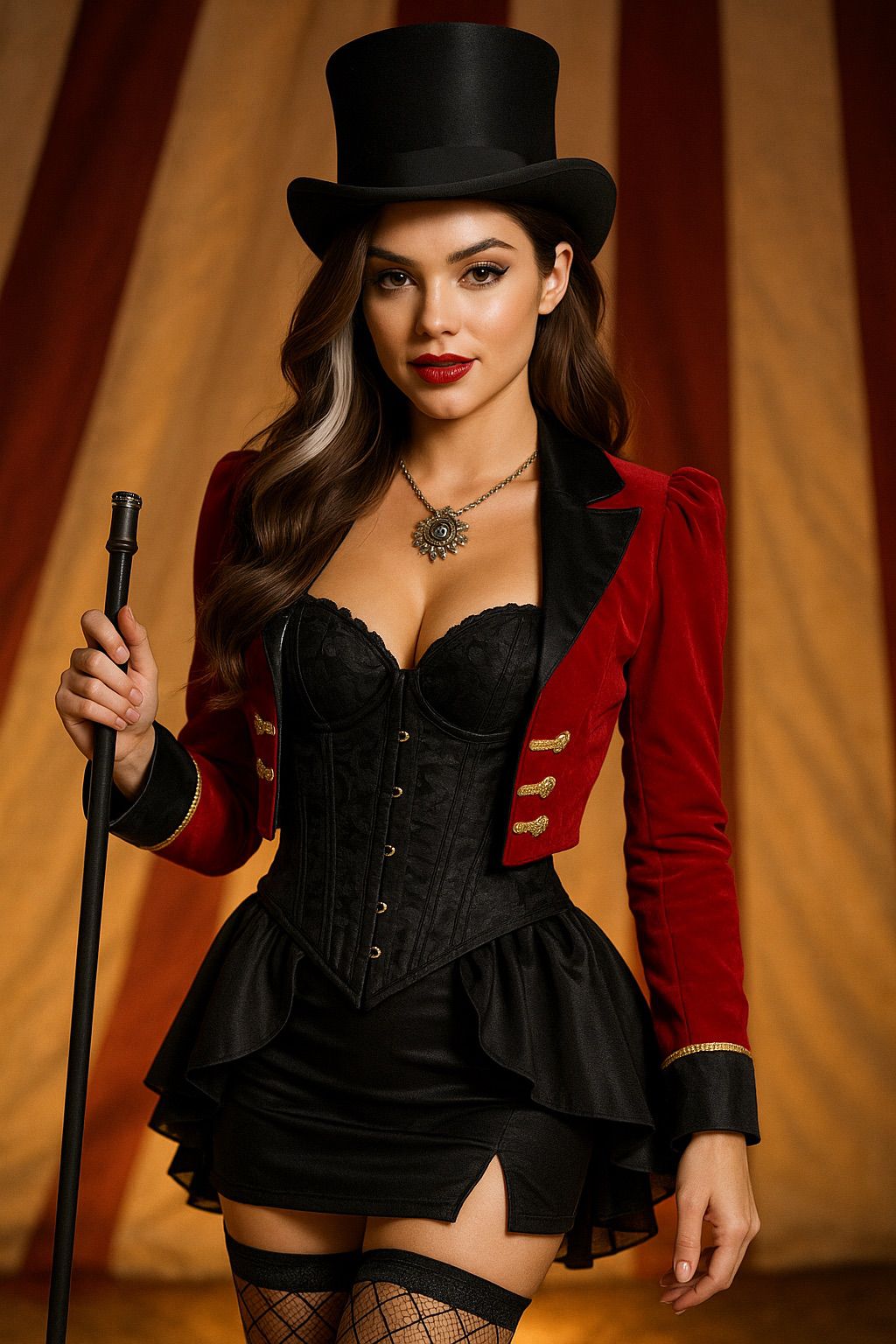
Halloween thrives on spectacle, and no costume delivers a spectacle quite like the Ringmaster Seductress. With her tailored mini jacket lined with gold trim, a corset that cinches like a promise of danger and delight, stockings that gleam in the glow of neon lights, and a top hat perched at a mischievous angle, she doesn’t just walk into a party—she commands it. She’s not just another guest in the crowd—she’s the one with the whip in hand, the spotlight at her back, and the confidence of someone who knows she’s running the entire show. The Ringmaster Seductress isn’t here to blend in; she’s here to captivate, to orchestrate, to dominate. And that’s why she’s one of the most viral, magnetic, and unforgettable Halloween costumes of all time.

The reason this look resonates so strongly is that it plays on power. Most Halloween costumes lean toward fantasy, fright, or flirtation—but the Ringmaster Seductress embodies authority. She isn’t pretending to be scary like a zombie or supernatural like a witch. Instead, she is rooted in a role we instantly recognize: the master of ceremonies, the leader of the circus, the one who controls the chaos. But when that role is reimagined with a seductive twist—mini jackets instead of full-length coats, corsets instead of waistcoats, stockings instead of trousers—it transforms into something irresistible. The result is a blend of dominance and allure that few costumes can match. People aren’t just looking at her—they’re responding to her command.

Visually, the Ringmaster Seductress thrives because she’s theatrical. The mini jacket, often red with gold detailing, pops instantly in photos. The corset, laced tightly, creates a silhouette that demands attention. The top hat, dramatic and tall, frames her like a crown, while thigh-high boots or stockings add just enough edge to balance the elegance. The whip or cane is the perfect prop, tying the whole aesthetic together as a symbol of both play and authority. Under the flashing lights of a party, the metallic trim on her outfit glitters, the corset gleams, and every movement feels choreographed—like she’s orchestrating the entire room. On Instagram, she dominates feeds because her costume looks like it belongs on a movie poster. On TikTok, transitions thrive on her performance potential—normal one second, whip-cracking goddess the next. And on X, she trends because she embodies the kind of energy people can’t resist talking about: commanding, sexy, unforgettable.

But the costume isn’t just about spectacle—it’s about roleplay. The woman who wears the Ringmaster Seductress costume isn’t just dressed up—she’s performing. Every gesture becomes part of the show. A smirk beneath the top hat? A cue for applause. A snap of the whip? A declaration of authority. A slow turn in her corset and stockings? A reminder that she’s not just running the circus—she is the circus. And that performance is what makes her magnetic. People can’t help but interact with her, can’t help but watch, can’t help but become part of the spectacle she’s orchestrating. She doesn’t just wear the costume—she embodies the persona, and that’s what sets her apart.

Part of her viral power also lies in adaptability. Some Ringmaster Seductresses lean traditional, sticking with the classic red-and-gold palette and whip accessory. Others glam it up, with sequins, rhinestones, and dramatic makeup that turns her into a carnival queen. Some lean gothic, turning the jacket black and trimming it with silver, pairing it with dark lipstick and smoky eyes. Others go playful, using candy-striped stockings, oversized props, or comedic timing to spin her into a parody. Each variation still reads as “ringmaster,” but each one feels fresh, unique, and personal. That adaptability ensures the costume never feels stale—it grows, evolves, and reinvents itself with every Halloween season.

The humanizing element here is essential. The Ringmaster Seductress costume is about more than just looking good—it’s about confidence. For the woman wearing it, it’s not just an outfit—it’s a declaration of presence. It says: I am here, I am bold, I am in charge, and you’re going to remember me. That kind of confidence is magnetic in any setting, but on Halloween, when people are searching for connection, laughter, and energy, it becomes unstoppable. The costume gives permission to step into a role of authority and charisma, to play a character that doesn’t just participate in the party, but directs it. That empowerment radiates, sparking admiration, conversation, and yes—virality.

Halloween is about transformation, and the Ringmaster Seductress is the purest embodiment of that idea. She takes the chaos of the night and organizes it into spectacle. She takes the flirtation of a costume and wraps it in authority. She takes the energy of the crowd and amplifies it until the room feels like a carnival. She doesn’t fade into the background—she is the background, the foreground, the center stage. She’s the one pulling the strings, cracking the whip, and keeping the spotlight where it belongs—on her.

And that’s why, year after year, the Ringmaster Seductress continues to dominate Halloween culture. Because she isn’t just sexy—she’s commanding. She isn’t just commanding—she’s theatrical. And she isn’t just theatrical—she’s unforgettable.

So when the Halloween lights glow and the music pounds, look for the woman in the red jacket, corset cinched, whip in hand, top hat tilted just so. Notice how the crowd gravitates toward her, how phones rise to capture her every pose, how laughter and applause follow wherever she walks. That’s the Ringmaster Seductress. That’s the carnival’s queen. And that’s why she doesn’t just attend Halloween—she runs it.

Related Posts