Latest Articles

The Day the Revolution Lost Its Face: The Execution of Che Guevara

Elias Rowen

On October 9, 1967, in a dusty Bolivian schoolhouse in the small village of La Higuera, a man who had become more myth than flesh was executed by a firing squad. His name was Ernesto “Che” Guevara—doctor, guerrilla fighter, revolutionary icon. He died not on a battlefield, surrounded by the thunder of armies, but in a cramped room, his hands bound, his body battered, his legend already outpacing the life he was about to lose. His final words, according to the soldier who pulled the trigger, were, “Shoot, coward. You are only going to kill a man.” With those words, Che crossed into immortality, his face destined to be stamped on T-shirts, murals, and banners across the globe. His execution ended a life of restless rebellion, but it also cemented him as one of the most enduring—and divisive—symbols of revolution in modern history.

Che Guevara’s journey to that Bolivian schoolhouse was anything but ordinary. Born in Rosario, Argentina, in 1928, Ernesto was not the archetypal warrior. He was a frail, asthmatic child, often confined to bed. Yet from an early age, he devoured books on philosophy, politics, and history, feeding a mind that saw injustice not as an abstract concept but as a tangible enemy. His famous motorcycle journey across Latin America in 1952 transformed him. Confronting the poverty, exploitation, and inequality that scarred the continent, Guevara shed the skin of a medical student and began to see himself as a soldier in a global struggle.

It was in Mexico in the mid-1950s that destiny introduced him to Fidel Castro. The two men, vastly different in temperament but united in vision, forged a bond that would alter the course of history. Together, they joined the ragtag group of revolutionaries who sailed aboard the Granma to Cuba in 1956. Most were killed or captured soon after landing, but Che survived, fighting alongside Castro in the Sierra Maestra mountains. His bravery, discipline, and ruthlessness elevated him to command. By 1959, Batista’s dictatorship had fallen, and Cuba stood reborn as the world’s first successful Marxist revolution in the Western Hemisphere.

In Havana, Guevara became more than a fighter; he became a face of revolution itself. He served as minister, diplomat, and theorist, giving speeches that blended idealism with fiery conviction. Yet Che was restless. Bureaucracy bored him, and he despised the trappings of power. He was not content to see socialism thrive in Cuba alone. He believed revolution had to be exported, spread like fire across the globe, liberating the oppressed from imperialism. To Che, the world was one battlefield, and he was its eternal soldier.

That restlessness led him first to the Congo in 1965, where he attempted to ignite revolution in the heart of Africa. It failed—riven by chaos, disunity, and logistical nightmares. Still, Guevara did not retreat into comfort or safety. Instead, he turned his eyes to South America once again, convinced that the Andes could become the continent’s Sierra Maestra. Bolivia, with its poverty, oppression, and proximity to other vulnerable states, became his chosen spark.

But Bolivia was no Cuba. The peasants did not rally to Che’s banner; they distrusted outsiders. The terrain was unforgiving, supplies scarce, and communication with Cuba unreliable. The CIA and Bolivian military, aided by U.S. advisors, tracked his every move. By October 1967, his small band of guerrillas was surrounded, exhausted, and decimated. On October 8, Che was captured after a firefight in the Yuro ravine, wounded and unable to continue. He was taken to La Higuera, a prisoner of men who understood they held a legend in their hands.

For 24 hours, the world’s most famous revolutionary sat in that schoolhouse, bound and awaiting his fate. Witnesses recalled him defiant, refusing to beg, refusing to crumble. When Bolivian officials, under pressure from the CIA, decided to execute him rather than risk a trial that might inflame global opinion, Che met his death as he had lived—unflinching. The bullets ended his life, but not his myth.

News of his death spread rapidly, but it only amplified his legend. Photographs of his lifeless body, eerily Christ-like in repose, circulated worldwide, fueling both mourning and inspiration. For revolutionaries, Che became martyr and model, a reminder that ideals outlive the men who carry them. For his enemies, he became a cautionary tale of reckless idealism, a man consumed by his own ideology. Love him or hate him, no one could ignore him.

Che Guevara’s execution remains one of the defining moments of the Cold War era. It symbolized the lengths to which the United States and its allies would go to contain communism. But it also symbolized the power of a single life to inspire beyond its death. His face, immortalized in Alberto Korda’s iconic photograph, became perhaps the most reproduced image of the 20th century—painted on walls in Nicaragua, waved on banners in Vietnam, worn on T-shirts in Paris, and invoked in hip-hop lyrics decades later.

And yet, the human Che was far more complex than the legend. He was a man who read poetry between battles, who treated wounded comrades with the care of a physician, who wrote love letters to his wife even while in hiding. But he was also a man capable of brutality, overseeing executions in revolutionary Cuba, insisting that the struggle required blood. His contradictions—romantic and ruthless, healer and executioner, dreamer and fighter—are what make him enduringly fascinating.

October 9, 1967, was the day Che Guevara’s body fell, but his spirit did not. He became less a man and more a symbol—of rebellion, of defiance, of the belief that individuals can challenge empires. His legacy is contested, celebrated by some, condemned by others, but never forgotten. Che’s life reminds us that revolutionaries do not die quietly. Their echoes travel through time, igniting debates, dreams, and rebellions long after the gunfire has ceased.

Related Posts

Plunder and Pleasure: Why the Pirate Siren Rules the Seven Seas of Halloween

Dave

Halloween is a night of transformation, a celebration of shedding the ordinary and stepping into the extraordinary, and among the countless costumes that surface every October, some shine brighter than others because they embody fantasy at its fullest. The Pirate Siren is one of those timeless, magnetic archetypes, an intoxicating mix of daring adventure and sultry seduction, the perfect balance of swashbuckler and temptress. With her corset top hugging curves like armor for allure, her ruffled skirt swishing with every bold step, and her thigh-high boots clicking like cannon fire on the dance floor, she is a vision of freedom, danger, and irresistible charm. She doesn’t just walk into a party—she storms it like a ship crashing into a harbor, demanding attention and stealing hearts with the same effortless ease she’d plunder treasure from a gilded chest.

The Pirate Siren taps into one of humanity’s oldest fantasies: the pirate life. Pirates represent rebellion, freedom from rules, and the thrill of danger. They are the outlaws of the sea, unbound by society’s expectations, living by their own codes. That foundation already makes the pirate archetype alluring, but add the siren twist and suddenly it’s not just about adventure—it’s about seduction. In mythology, sirens lured sailors to their doom with beauty and song, a dangerous blend of temptation and destruction. Combine that with the swagger of a pirate, and the result is the Pirate Siren, a character who embodies danger and desire, freedom and fire, fantasy and flesh.

What makes the costume viral is its sheer visual appeal. The corset top cinches the waist, lifting and shaping, transforming the torso into a bold declaration of confidence. The ruffled skirt adds playful movement, every step a tease, every twirl a performance. And the thigh-high boots? They are power incarnate, elongating the legs, adding dominance to every stance, commanding the floor as surely as any captain commands her ship. Together, the pieces create a look that is both sultry and commanding, a costume that doesn’t just beg for attention—it demands it.

Halloween thrives on fantasy, and the Pirate Siren offers a fantasy layered with stories. She isn’t just dressing up as a character—she is stepping into a world of high-seas adventure, where treasure maps and whispered legends swirl together with moonlit duels and secret kisses stolen on the deck. When someone wears the Pirate Siren costume, they don’t just look good—they tell a story without saying a word. The glint in her eye is mischief, the curl of her smile is danger, the sway of her skirt is seduction. Everyone who sees her knows, instinctively, that this is not someone to underestimate, but also not someone they can resist.

Part of the costume’s allure is its versatility. Some wear the Pirate Siren as pure elegance, with jewel-toned corsets, lace sleeves, and carefully detailed accessories—feathers in hats, polished sabers at the hip. Others go bold and edgy, with ripped ruffles, leather belts, and smudged eyeliner that looks like it was earned in a tavern brawl. Some lean into fantasy with mermaid-inspired siren details—scales in the makeup, seashell accents, oceanic jewelry—turning the costume into a hybrid of land and sea. And then there are those who strip it down to the essentials: corset, skirt, boots, a little sparkle, and a lot of attitude. No matter how it’s styled, the Pirate Siren costume works, because it’s built on archetypes that are powerful, primal, and universal.

What makes the Pirate Siren truly viral, though, is her presence. Some costumes are about the clothes; this one is about the attitude. To wear the Pirate Siren properly is to embody her spirit: to walk with swagger, to smirk like you know every secret in the room, to laugh loudly, flirt shamelessly, and maybe even brandish your prop sword in mock battle. She is not timid, she is not meek—she is the storm. And that energy translates perfectly into photos, videos, and social posts. On Instagram, TikTok, or X, the Pirate Siren becomes a character larger than life, the kind of costume that dominates feeds and lingers in memory. The lighting glints off the corset, the boots catch shadows, the ruffles create texture, and suddenly every shot looks like a poster for a blockbuster film that never was but should be.

There’s also something deeply humanizing about why the Pirate Siren works so well. She represents freedom—the kind of freedom we crave but don’t often get to live. Daily life is rules and schedules and responsibilities; the Pirate Siren laughs at all of that. She is chaos wrapped in lace, rebellion with a smirk. Wearing her costume is a chance to taste that freedom, to play at being someone who takes what she wants, who answers to no one, who lives for adventure and pleasure in equal measure. That fantasy resonates because it’s something everyone wishes for, if only for one night.

And that’s the magic of Halloween. It isn’t about pretending to be someone else—it’s about uncovering sides of ourselves that usually stay hidden. The Pirate Siren lets people step into a role that is powerful, seductive, and unapologetically free. For one night, she is untouchable, unforgettable, unstoppable. And that feeling isn’t just intoxicating for the person wearing the costume—it’s magnetic for everyone around them. That’s why the Pirate Siren costume doesn’t just work—it dominates.

So when the music is blaring, the lights are flashing, and the night is alive with mischief, watch who commands the room. Chances are, it’s the woman in the corset, skirt, and boots, the one with the sly grin and the confident stance, the one everyone wants to talk to, take photos with, dance beside, and remember. That’s the Pirate Siren. That’s the queen of the Halloween seas. And that is why, year after year, she continues to plunder hearts and go viral long after the last lantern flickers out.

Related Posts

When Death Rides: The Haunting Legend of Ireland’s Dullahan

Dave

There are stories that follow you home no matter how fast you run, legends that live not just in the land where they were born but in the very marrow of those who hear them. Among Ireland’s many ghosts, banshees, and fair folk, none chills the blood quite like the Dullahan: the headless horseman who carries his own skull, a harbinger of death galloping across the emerald hills. To glimpse him is to know that death is near, to hear his call is to feel your heart sink, and to speak of him is to brush against that thin veil between life and the inevitable shadow that comes for us all.

The Dullahan is not just a figure of fright; he is a reminder of mortality, of fate, and of the way human beings have always personified the inescapable truth of death. Ireland’s oral traditions have preserved him for centuries, whispered in the flicker of peat fires and retold in the misty lanes of rural towns. He is terrifying, yes, but he is also deeply human in the sense that he embodies what we fear most: the loss of control, the coming of an end we cannot escape, and the image of death itself riding toward us in the night.

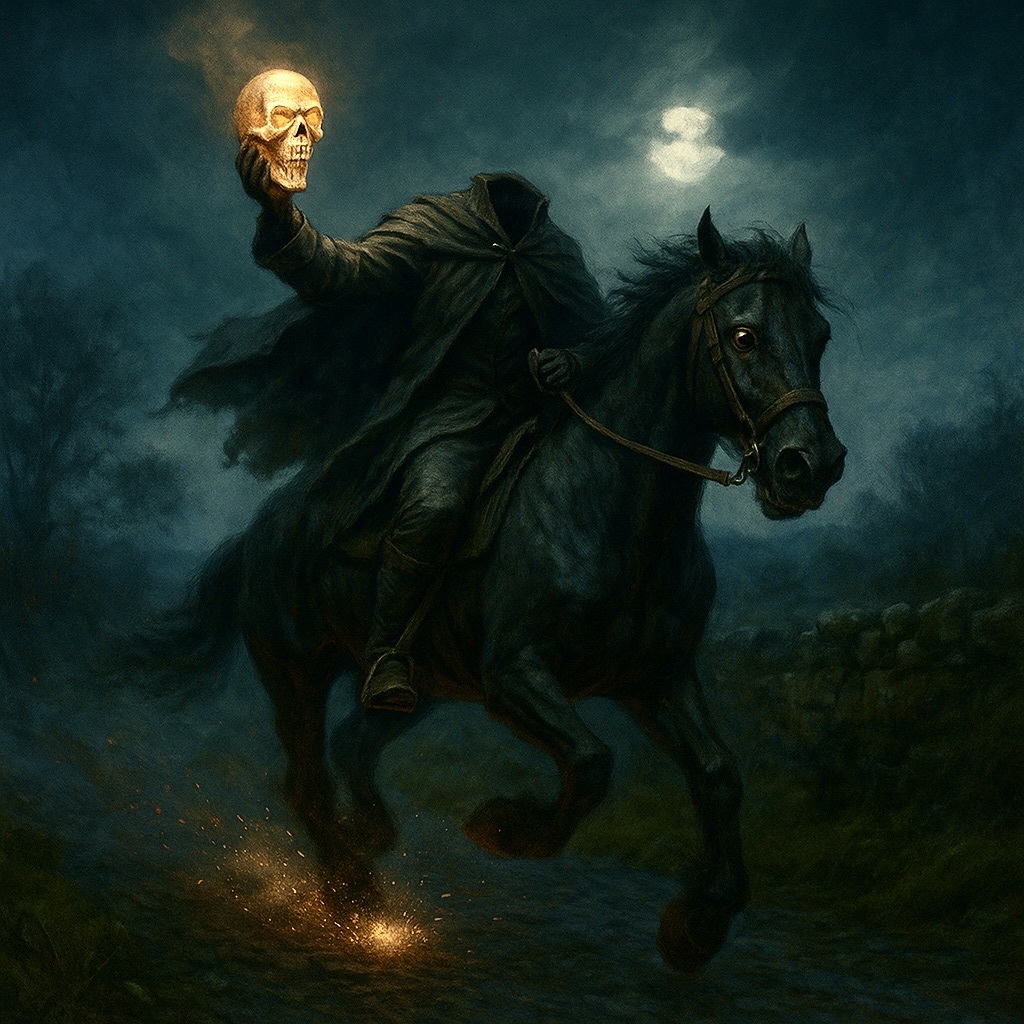
The description of the Dullahan is unforgettable. He rides a black horse, fierce and muscular, its nostrils flaring with sparks and its hooves striking fire against the earth. In his hand — not upon his shoulders — rests his head, grotesque and otherworldly. The skin is pale and decayed, the flesh stretched tight, with a wide grin carved permanently into its face. The eyes glow with an unholy light, scanning the night, searching for souls to claim. His head is said to have the consistency of moldy cheese, a detail both grotesque and haunting, because it brings the myth down from the lofty air of terror into the sickeningly tangible realm of decay.

Wherever the Dullahan stops, someone is destined to die. He does not need to speak; a mere point of his bony finger seals a person’s fate. Sometimes, however, he calls the name of his victim, and the sound is enough to extinguish life itself. Doors and locks cannot stop him, for no barrier can hold back death. He is both spirit and force, a being who transcends walls and gates as easily as breath passes through lungs. The Dullahan does not linger, does not chase for sport. He arrives, he marks, he takes, and he is gone.

But where did this terrifying image come from? Scholars trace the Dullahan back to Celtic mythology, where he may have been an incarnation of Crom Dubh, a fertility god who demanded human sacrifice. When Christianity spread through Ireland, the old gods were suppressed, demonized, or transformed into darker legends. Crom Dubh’s bloody worship may have morphed into tales of the Dullahan, who no longer demanded offerings but instead carried the image of death itself. Over time, his story blended with folklore about fairies, banshees, and the restless dead, crystallizing into the figure we know today.

The Irish countryside, with its fog-wrapped moors, stone ruins, and hidden lanes, was fertile soil for such a legend. In a land where famine struck often and mortality was never far from daily life, the Dullahan became not just a story but a cultural embodiment of the fragility of existence. He reminded villagers that life was fleeting, that death did not negotiate, and that the moment of one’s end was always out of human hands.

Yet, for all his terror, the Dullahan is not invincible. Folklore insists he fears only one thing: gold. A single golden object, whether a coin or trinket, can drive him away. This detail is striking, for it suggests a lingering human hope — that something of earthly value might hold back death. But the irony is sharp: gold may repel him in the tale, but no real wealth can keep mortality from claiming us. The Dullahan is an equalizer, a reminder that death does not care if one is rich or poor, young or old. His horse gallops for all.

Think for a moment about the symbolism of carrying one’s own head. To be headless is to be powerless, but the Dullahan subverts this. He is not robbed of his head but commands it, carrying it like a lantern. The head glows, it sees, it directs. It is death turned mobile, portable, weaponized. In many cultures, to lose the head is to lose identity and soul. But in Ireland’s Dullahan, the head becomes the very instrument of fear. He rides without it, proving that what we think makes us human is not what holds sway in the realm of the supernatural.

The Dullahan’s tale echoes outward into wider culture. Washington Irving’s “The Legend of Sleepy Hollow” famously introduced a headless horseman to American readers, and while the Hudson Valley tale is distinct, its DNA traces back to Ireland’s shadowy rider. Immigrants carried their stories with them, and in the fertile imagination of early America, the Dullahan adapted, blending with local fears to become Ichabod Crane’s terrifying pursuer. Today, every Halloween in the U.S., children see images of pumpkin-headed riders, not realizing they are looking at Ireland’s legacy galloping through history.

But unlike the playful or spooky adaptations that populate modern pop culture, the original Dullahan remains deeply grim. He is not a villain to be fought or defeated. He is inevitability given form. When villagers heard horse hooves echoing on lonely roads at night, they prayed not to hear their name whispered in the dark. When shadows moved near graveyards or crossroads, people clutched golden trinkets, desperate for protection. The Dullahan reminded them that life was borrowed, fragile, and never fully theirs.

Modern readers may find in the Dullahan an allegory for the things that pursue us now. The black horse might be time itself, galloping faster than we wish. The head with its fixed grin might be the reminder of our mortality, a face we must all one day wear. The gold that drives him away might represent the distractions we cling to — wealth, technology, endless consumption — in hopes of postponing the inevitable. But like all distractions, they cannot last. The rider always comes.

The Dullahan’s power lies not just in fear but in fascination. Death has always drawn human imagination, because to speak of it is to admit our helplessness. The Irish, with their gift for storytelling, wrapped that helplessness in imagery vivid and unforgettable: fire-breathing horses, rotting skulls, silent riders pointing bony fingers. They made death visible, audible, and unforgettable. That is why the Dullahan endures — because he rides not just through Irish fields but through the universal landscape of human fear.

And yet, the story is not without a kind of beauty. In its way, the Dullahan legend is honest. It strips away illusion. It says: death is coming. No locks will keep it out, no walls will keep it back. But it also says: you are not the first, and you will not be the last. We all share this fate. There is a strange comfort in that universality, in knowing that every hoofbeat, every whispered name, ties us together in the human journey.

So on October 8, when the tale of the Dullahan is remembered, we are reminded that folklore is never just entertainment. It is survival in story form. It is our attempt to wrestle with truths too large to face in silence. The Dullahan gallops not just across the roads of Ireland, but across our imaginations, forcing us to look at the one thing we cannot escape. And in his grotesque visage, his grinning skull, we might just see the reflection of our own deepest fears.

Perhaps the most chilling thought of all is this: if the Dullahan rides tonight, and his horse sparks fire against the stones outside your door, will you dare to look? Or will you close your eyes and hope the whisper is not your name?

Because when death rides, it carries its own head — and it always knows where it’s going.

Related Posts

When the City Burned: The Great Chicago Fire of 1871

Elias Rowen

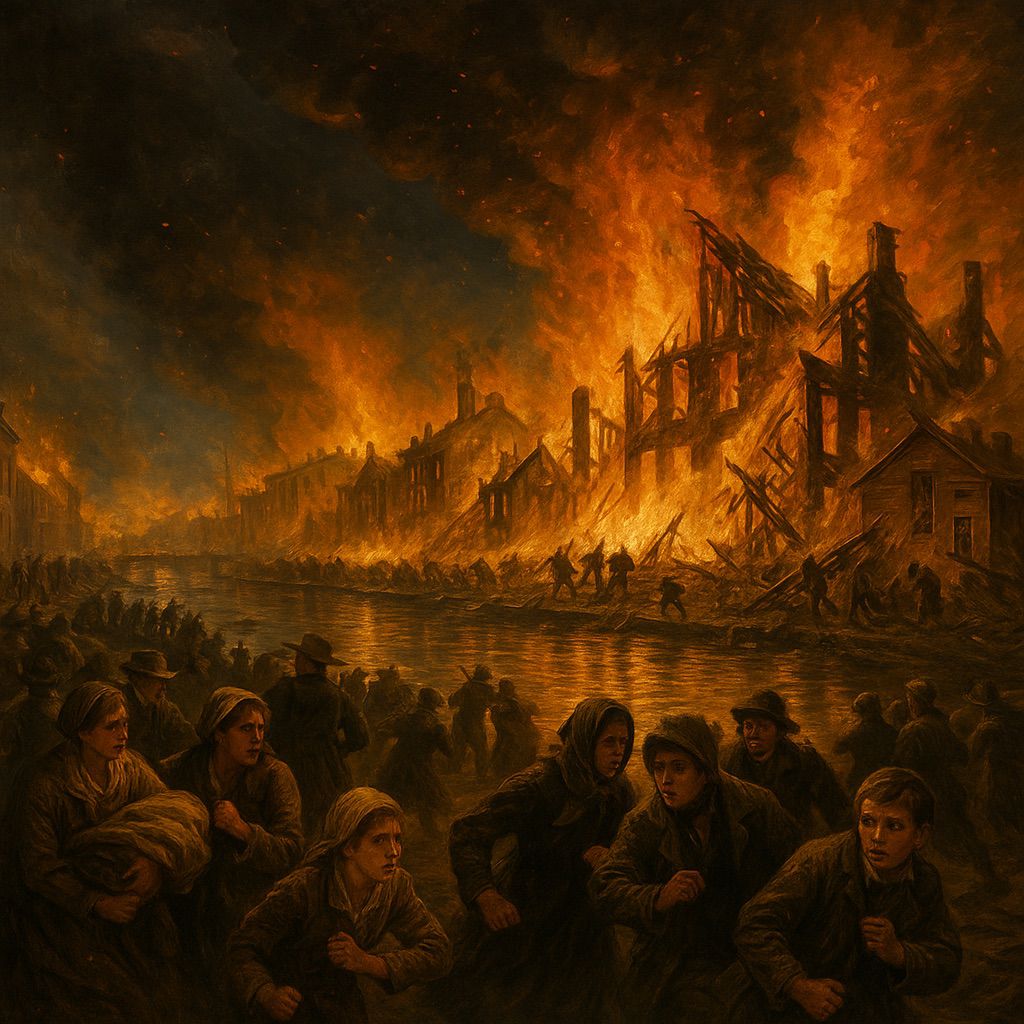
On the night of October 8, 1871, the city of Chicago went to sleep under clear skies, unaware that within hours, flames would transform their lives, their homes, and their future forever. By dawn, the city would be a sea of fire, a hellscape of wood, wind, and despair. It became one of the most infamous urban disasters in American history—the Great Chicago Fire. Though historians still debate its exact origins—popular legend blames Mrs. O’Leary’s cow kicking over a lantern—the consequences are beyond dispute. In just two days, a thriving metropolis of nearly 300,000 people was reduced to ash and rubble. And yet, out of that devastation, Chicago would rise again, stronger, prouder, and more determined than ever to etch its name into history.

To understand the magnitude of the disaster, one must picture Chicago in the 1870s. It was a booming city, an industrial powerhouse and a vital hub connecting the Great Lakes to the Mississippi. The city was alive with the sound of trains, factories, and opportunity. Immigrants poured in, businesses thrived, and fortunes were made. But beneath the promise lay danger. Chicago was built largely of wood—houses, sidewalks, even streets. After months of drought, the city was a tinderbox. Add in strong winds off Lake Michigan, and the conditions were perfect for catastrophe.

The fire began in a barn on DeKoven Street, but within minutes, it leapt to neighboring buildings. Fueled by wooden structures and dry conditions, the flames grew into an unstoppable beast. Eyewitnesses described a sky turned orange, buildings exploding into sparks, and firestorms leaping across the river as if mocking attempts to contain them. The city’s fire department, though brave, was overwhelmed. Exhausted from battling another blaze the night before, they lacked both manpower and equipment. The flames moved faster than men, consuming block after block in minutes.

By midnight, the fire had crossed the South Branch of the Chicago River. By morning, it roared through the city’s heart, devouring banks, businesses, churches, and homes alike. The wind fanned embers into fiery whirlwinds, tossing sparks onto rooftops blocks away. People fled with whatever they could carry—children, pets, Bibles, photographs—anything that could be saved in a moment of panic. Horses stampeded through the streets, wagons overloaded with families and their possessions jammed the roads, and panicked crowds surged toward the river, some jumping into the water to escape the inferno.

The fire showed no mercy. It consumed the courthouse, the Palmer House Hotel, and even the Chicago Tribune building. It burned rich and poor alike, making no distinction between mansions and shanties. The heat was so intense that it melted iron, turned brick to powder, and warped the very earth. By the time rain finally helped douse the flames on October 10, over 17,000 buildings had been destroyed, 100,000 people left homeless, and nearly 300 lives lost. The city smoldered like a corpse, its skyline a jagged silhouette of chimneys and ruins.

But Chicago’s story did not end in ashes. In many ways, it began anew. Out of the ruins came resilience. Survivors set up makeshift shelters, churches opened their doors, and donations poured in from across the nation and the world. Relief trains arrived with food, blankets, and supplies. Even Queen Victoria of Britain sent aid. Out of tragedy, solidarity grew.

More importantly, the fire forced Chicago to rethink itself. The wooden city gave way to a city of stone, steel, and innovation. New building codes demanded safer, sturdier construction. Architects flocked to the city, eager to reimagine its skyline. In the decades that followed, Chicago became a laboratory of modern architecture, the birthplace of the skyscraper, and a symbol of what resilience could achieve. The city that once lay in ruins would later host the World’s Columbian Exposition of 1893, dazzling the globe with its rebirth.

And yet, behind the triumph lies the human heart of the fire. Imagine a mother clutching her children, running barefoot across burning streets. Picture families huddled along the lakefront, watching their city vanish in flames. Imagine the firemen, their faces blackened with soot, swinging axes against impossible odds. These were not just statistics—they were human lives, their pain and bravery written in fire and ash.

The Great Chicago Fire is not just a tale of destruction but of transformation. It reminds us that even in our darkest hours, the seeds of rebirth are sown. Chicago rose from the flames not diminished but renewed, proving that a city’s spirit is stronger than its structures. October 8, 1871, was the night Chicago burned. But it was also the night Chicago learned it could endure anything, even the fire itself.

Related Posts

Lessons in Temptation: Why the Sexy Schoolgirl Rules Halloween

Dave

There are costumes that rise and fall with passing trends, those tied to movies, memes, or moments in time, and then there are the archetypes—the outfits that return every year because they tap into something bigger than a fad. Few costumes have reached the level of instant recognition and enduring allure as the Sexy Schoolgirl. Halloween after Halloween, amidst the devils, witches, vampires, and superheroes, the sight of a short plaid skirt, a tied-up blouse, and knee-high socks never fails to turn heads, spark conversation, and dominate photos. There is something about the look that is equal parts playful and provocative, innocent in its suggestion yet daring in its execution. The Sexy Schoolgirl doesn’t whisper for attention—she claims it, and she has been claiming it for decades.

At the heart of its appeal is contradiction. Real school uniforms represent rules, conformity, and structure. They are about discipline, order, and standardization. But Halloween is not about rules—it’s about rebellion. The Sexy Schoolgirl costume flips the uniform on its head, taking something meant to cover and control and transforming it into something designed to flaunt and tease. It’s not about authenticity—nobody is trying to actually pass for a student—it’s about the fantasy of rebellion against authority, of bending the straight lines of the classroom into the curves of playful temptation. That clash between innocence and flirtation is what gives the Sexy Schoolgirl its viral edge.

The plaid skirt is the centerpiece of the look, a fabric long associated with uniformity but here cut short to showcase legs and movement. Every pleat becomes a wink, every swish a suggestion. The blouse, tied at the midriff, changes from stiff and buttoned to relaxed and daring, a signal that this character is not following any handbook. And the knee-highs? They are the exclamation point, transforming practicality into allure, nodding to the world of vintage pin-ups while feeling fresh every year. Together, the pieces create a costume that is instantly identifiable, instantly flirty, and endlessly photogenic.

What makes the Sexy Schoolgirl especially viral in the age of social media is its adaptability. It can be styled in countless ways, each one telling a slightly different story. Some lean into playful innocence, with pigtails, bubblegum, and oversized glasses adding a tongue-in-cheek charm. Others go sultry and sleek, pairing the outfit with bold lipstick, smokey eyes, and heels that click like declarations of confidence. Some add props like books, rulers, or satchels, twisting them into flirtatious accessories instead of academic tools. And in recent years, the costume has been mashed up with pop culture—anime influences, punk-rock spins, or even supernatural twists that turn the schoolgirl into a vampire or zombie. The archetype is flexible, which is why it never gets stale.

Part of its power lies in the reaction it provokes. Unlike many costumes that fade into the background, the Sexy Schoolgirl sparks conversations, laughter, and admiration in equal measure. It’s a look that doesn’t just get noticed—it gets remembered. In photos, the plaid pops against Halloween’s darker tones. The tied blouse creates dynamic lines that flatter in candid shots. The knee-highs frame legs in ways that catch the eye. This is a costume made for cameras, and in the age of viral content, that matters. On Instagram, TikTok, or X, the Sexy Schoolgirl costume becomes a highlight reel of winks and smirks, one of those instantly shareable looks that racks up attention.

But what humanizes the Sexy Schoolgirl and keeps her evergreen is the personality behind the outfit. Every woman who steps into the pleats and knee-highs makes the role her own. Some wear it with tongue firmly in cheek, treating it as a parody of the cliché, playing it for laughs and irony. Others embrace the sultry side unapologetically, using the costume as a statement of confidence and boldness. Still others blend both, leaning into the contradiction of innocence and mischief. The costume isn’t about fitting a mold—it’s about giving permission to embody a fantasy, to play with an archetype, to revel in the freedom that Halloween offers.

And freedom is really the key. Halloween is a night when rules disappear, when the ordinary becomes extraordinary, when personas are tried on like masks. The Sexy Schoolgirl is so popular because she embodies that spirit. She is rebellion against authority. She is mischief wrapped in fabric that was once meant to symbolize conformity. She is the thrill of taking something familiar and making it wild, daring, unforgettable. She’s not about playing it safe—she’s about playing to win the room, the photo, the night.

Critics may call it a cliché, but clichés exist because they work. And this one works better than most. Year after year, the Sexy Schoolgirl shows up at parties, and year after year, she dominates. There is always at least one, and she is always unforgettable. Because whether it’s the pigtails or the plaid, the tied blouse or the knee-highs, the costume doesn’t just hint at temptation—it delivers it with a grin.

So if you’re choosing your Halloween look and want something guaranteed to spark attention, laughter, admiration, and a few sly double-takes, the answer is simple. Slip into that plaid, tie that blouse, pull on those knee-highs, and step into the role of the ultimate Halloween icon. The Sexy Schoolgirl isn’t just a costume—it’s an experience, one that makes the room buzz and the memories linger. She rules Halloween because she is playful, provocative, and unforgettable. And when the night is over, when the photos are posted and the stories are told, hers is the image that will still be sparking reactions days later. That’s the power of a costume built not on rules, but on breaking them.

Related Posts