Latest Articles

Holy Mischief: Why the Sexy Nun Is Halloween’s Most Sinful Surprise

Dave

Every year on Halloween night, when the moon hangs high and the streets fill with ghosts, ghouls, and glitter, there are costumes that inspire a little smile and others that spark a full-on double-take. And then, tucked between the devils with their horns and the angels with their halos, there she is: the Sexy Nun. Dressed in a risqué twist on one of the most sacred uniforms in the world, she is shocking, playful, sultry, and unforgettable all at once. A mini black dress with white trim nods to the traditional habit, stockings cling to her legs like prayers gone astray, a veil frames her mischievous face, and sometimes a cross dangles suggestively across her chest. She is both blasphemy and brilliance, a costume that doesn’t just bend the rules—it throws the rulebook straight into the fire. And that is exactly why the Sexy Nun remains one of the most viral, talked-about, and daring costumes of Halloween.

There’s no denying that part of the allure lies in the contradiction. Nuns represent purity, devotion, sacrifice, and discipline. Their habits are designed to remove vanity, to cloak the body, to signal detachment from worldly temptation. And yet, the Sexy Nun flips that symbolism entirely on its head. Suddenly, the uniform designed to erase sexuality becomes the foundation for flaunting it. The lines of devotion transform into lines of allure. The habit becomes a mini dress. The veil becomes an accessory. The symbol of chastity becomes the costume of cheeky rebellion. That tension between sacred and sinful is exactly what makes the Sexy Nun costume so electric. It’s not just about showing skin—it’s about making a statement, winking at authority, and reveling in the freedom of a night where nothing is off-limits.

Halloween thrives on shock value, and the Sexy Nun delivers it in spades. She’s not horrifying like a zombie or gory like a slasher villain, but she shocks in her own way. She makes people laugh, blush, gasp, and grin. At parties, she stands out not because she’s the scariest or the flashiest, but because she’s the boldest. She is the one who dares to walk into the room as both saint and sinner, the one who flirts with taboos and makes it look effortless. That audacity is what sparks conversations, photos, and viral posts. She doesn’t just wear a costume—she creates a moment, a memory, an instant of mischief that people will talk about long after the night is over.

Visually, the Sexy Nun costume is almost too perfect for the age of social media. The stark contrast of black and white pops in photos, catching the eye amidst neon lights and pumpkin glows. The veil frames the face beautifully, turning every grin or smirk into a portrait. The mini dress allows for movement, for playful poses, for twirls that catch on camera. Add in a cross necklace or a prop Bible turned upside-down, and suddenly the photo isn’t just a picture—it’s a viral performance. On TikTok, Sexy Nun videos explode into skits and dances. On Instagram, she dominates feeds with her bold visuals. On X, the costume trends every year because people can’t resist reacting to it, sharing it, debating it, laughing about it. That buzz is what keeps her at the top of the Halloween food chain.

But what makes the Sexy Nun more than just a shock costume is the human element. Every woman who wears it brings her own twist, her own energy, her own story. Some wear it with humor, laughing at the absurdity of sweeping floors with a feather duster while dressed in stockings and a veil. Others lean into full seduction, using the costume as a way to channel boldness, confidence, and allure. Still others mix in gothic or horror elements, turning the Sexy Nun into something darker—complete with blood-stained crosses or eerie makeup. That adaptability keeps the costume fresh, ensures that no two Sexy Nuns ever look quite the same, and gives every wearer the chance to make the look uniquely theirs.

And of course, there’s empowerment in it. The Sexy Nun costume isn’t about mocking faith—it’s about embracing the freedom to rewrite narratives. It’s about taking a symbol of restraint and turning it into one of expression, taking a uniform designed to hide and transforming it into one that reveals. For the person wearing it, the costume can be a chance to explore sides of themselves that usually stay hidden: boldness, confidence, mischief, and power. That’s the real appeal of Halloween—not just pretending to be someone else, but unleashing parts of yourself that the world rarely gets to see.

Critics may scoff or clutch their pearls, but that only fuels the fire. The controversy is part of the costume’s appeal. After all, what’s Halloween without a little scandal? The Sexy Nun sparks reactions precisely because she blurs lines, because she pokes at taboos, because she refuses to play it safe. That’s why she trends, why she gets photographed, why she gets remembered. In a sea of costumes, she stands out not because she’s elaborate or expensive, but because she’s fearless.

And maybe that’s why the Sexy Nun isn’t going anywhere. Every year, she resurfaces, dusting off her veil, slipping into her stockings, and walking boldly into the night. She doesn’t need an elaborate backstory or a blockbuster movie tie-in. She doesn’t need props beyond a feather duster or a rosary. She works because she’s simple, shocking, playful, and viral. She works because she takes a symbol everyone recognizes and twists it into something everyone wants to talk about.

So when the music is blaring, the lights are flashing, and the night is alive with laughter and chaos, watch the room. Notice who people are whispering about, pointing at, laughing with, and taking pictures of. Chances are, it’s the woman in the black mini dress and veil, feather duster twirling like a scepter of rebellion, grin sharper than any devil’s pitchfork. That’s the Sexy Nun. That’s Halloween’s most sinful surprise. And that’s why, year after year, she remains unforgettable.

Related Posts

When the Forest Laughs: The Trickster Tikbalang of the Philippines

Dave

There are creatures you run from, and then there are creatures you laugh with — or at — though the laughter is never entirely free of fear. Deep in the forests and mountains of the Philippines lives one of the strangest, most mischievous figures in global folklore: the Tikbalang. Half-horse, half-man, all trickster, the Tikbalang stands at the crossroads of myth and mischief, a guardian of the wilderness, a tormentor of travelers, and a reminder that the forest is not ours to command. On October 10, when the legend of the Tikbalang is recalled, we are not just remembering a monster — we are remembering the very personality of the land itself: playful, dangerous, unpredictable, alive.

To describe the Tikbalang is to invite unease. It is usually envisioned as towering and lanky, with the head and legs of a horse, but the body of a man. Its limbs are exaggeratedly long, so much so that it can sit and its knees will rise higher than its head. Its hooves strike the ground with an unsettling weight, its mane falls wild and unkempt, and its eyes glow with mischief. Some say it smells like burnt hair, others that it always carries the damp scent of the jungle. To see a Tikbalang is to feel immediately that the world is not quite right — a familiar animal form twisted into something alien, watching you with unsettling intelligence.

But unlike purely monstrous beings, the Tikbalang is more trickster than killer. Its favorite pastime? Leading travelers astray. A person walking through the forest might find themselves circling the same tree for hours, confused and exhausted, convinced they are lost in a maze. This is the Tikbalang’s laughter, its invisible hand rearranging the forest around its prey. In some versions of the story, the victim can escape by turning their shirt inside out, a gesture that breaks the spell. Other traditions say you must bite a tree or ask permission from the spirit world to pass. Whatever the method, the Tikbalang ensures you never forget who owns the forest.

The roots of the Tikbalang legend are as tangled as the vines in the jungles it inhabits. Some trace its origins to Hindu-Buddhist influences that reached the Philippines long before Spanish colonization, carrying imagery of horse-headed beings from India and Southeast Asia. Others see it as a purely local creation, born of the islands’ dense, mysterious landscapes where sounds echo and shadows twist. When the Spanish arrived, they recorded stories of the Tikbalang as part of their effort to map — and often suppress — indigenous belief systems. Yet despite centuries of colonial influence, the Tikbalang never vanished. It simply adapted, as tricksters always do.

The Tikbalang is not uniformly evil. Like many folkloric beings, it has moods and motives. In some stories, it is a malevolent force, terrifying and cruel, laughing as humans collapse from exhaustion in its mazes. In others, it is almost a guardian, testing the respect and humility of those who pass through the forest. If you bow your head, walk quietly, and honor the spirits, the Tikbalang may let you pass unharmed. If you are arrogant, loud, or disrespectful, it will toy with you until you break. In this way, the Tikbalang reflects a moral truth: the wilderness demands respect, and those who forget this will pay.

There is also a darker, more intimate side to the myth. Folklore tells of Tikbalang falling in love with humans, luring them into the forest with illusions of beauty, sometimes appearing as a stunning man or woman before revealing their true form. Once ensnared, the human becomes entranced, bound to serve or even wed the creature. In these stories, the Tikbalang becomes a symbol of dangerous seduction, of nature’s ability to enchant and entrap those who venture too far. Some communities even believed that illnesses or madness could be caused by offending a Tikbalang, further cementing its role as both playful prankster and ominous presence.

But the Tikbalang is not without vulnerabilities. Folk tradition claims that to tame one, you must pluck three golden hairs from its mane. Once subdued, the creature becomes a loyal servant, bound to the human who mastered it. This idea reflects a universal theme in myth: the desire not only to fear or respect the supernatural, but to control it. By binding the Tikbalang, one symbolically asserts mastery over the forest’s chaos. Yet there is irony here — for a trickster, even bound, may never be fully trustworthy.

What makes the Tikbalang so fascinating is its duality. It is terrifying, yet comical. It embodies chaos, yet can be subdued. It protects the wilderness, yet sometimes invades human lives with unwanted intimacy. It is not a villain or a hero but something in between, a figure that resists simple categorization. That complexity ensures its survival in cultural memory, long after countless other myths have faded.

The Tikbalang also offers a profound cultural lens. In the Philippines, where mountains and forests have always played a central role in identity, the Tikbalang is the spirit of those spaces given form. It reminds people that the forest is not empty but alive, that travelers are not masters but guests, that nature itself has personality. In modern terms, the Tikbalang is almost ecological, embodying the warning that those who disrespect the natural world will suffer. Its mischief is playful on the surface but carries an underlying seriousness: humility before forces larger than yourself.

Even in modern Philippine society, the Tikbalang endures. Children are warned not to wander too far into forests. Travelers are told to speak quietly in the mountains. Folklore festivals retell its story, and it finds new life in comics, films, and novels. Online, urban legends spread of Tikbalang sightings near highways or rural roads, blending old myth with modern anxieties. Like all great legends, it adapts — slipping from mountain trails to city streets, always laughing, always one step ahead.

And perhaps that is the secret to its viral potential. Unlike creatures that exist only to frighten, the Tikbalang entertains. It pranks. It plays. It makes fools of us, and we laugh nervously, because deep down we recognize the truth: we are not the masters of the world, no matter how much concrete we pour or machines we build. Somewhere in the shadows, the forest still watches, still tricks, still demands respect. The Tikbalang is that truth with a horse’s face and a trickster’s heart.

So on October 10, when we remember the Tikbalang, let us hear not only the laughter of a myth but the voice of the wilderness itself. Let us walk softly, turn our shirts inside out when lost, and bow our heads to forces older than we can comprehend. Because if the forest ever laughs at you, it may not be the wind. It may be hooves in the shadows, eyes glowing with mischief, and a voice that says: you thought you knew the way, but the way belongs to me.

Related Posts

Deeds, Not Words: The Birth of the Women’s Social and Political Union

Elias Rowen

On October 10, 1903, in a modest house in Manchester, England, Emmeline Pankhurst gathered a small group of women around her kitchen table. The meeting was unassuming in size but seismic in consequence. That day, the Women’s Social and Political Union (WSPU) was born—a movement that would rattle the foundations of British society, storm the corridors of power, and rewrite the role of women in history. It was the birth of a crusade that traded patience for urgency, persuasion for defiance, and quiet petitions for radical deeds. The world would come to know them not just as suffragists, but as suffragettes.

At the dawn of the 20th century, women’s voices were muffled in nearly every sphere of life. They could not vote. They had limited access to education and professions. Marriage often reduced them to legal dependents of their husbands. The polite campaigns of earlier reformers had made little headway. Laws were debated, commissions held, promises made—and yet, year after year, women were excluded from the democratic rights men took for granted. Emmeline Pankhurst, a widow raising five children, had grown weary of waiting. For her, the time had come to shock society into listening.

“Deeds, not words,” became the rallying cry of the WSPU. It was more than a slogan; it was a declaration of war against indifference. The women of the WSPU chained themselves to railings outside Parliament, smashed shop windows, disrupted political meetings, and even endured hunger strikes in prison. They courted arrest not out of recklessness but as strategy, forcing newspapers to cover their plight and politicians to reckon with their defiance. These were not the polite ladies of tea-room debates—they were warriors in skirts, fearless and unapologetic.

Society reacted with outrage, fascination, and fear. To many, the suffragettes were dangerous extremists, threatening the social order. To others, they were heroes. Their militancy divided the suffrage movement itself, with more moderate campaigners fearing that such tactics might alienate supporters. But Emmeline Pankhurst was unshaken. She understood that power yields nothing without pressure, and pressure requires sacrifice. Every arrest, every jeer, every bruise was a step closer to equality.

The suffragettes’ most powerful weapon was their own bodies. When imprisoned, many refused to eat, demanding recognition as political prisoners. The government responded with brutal force-feeding, shoving tubes down throats or noses, leaving women bloodied, vomiting, and broken—but not defeated. These horrors sparked public sympathy and turned the WSPU into a moral force too large to ignore. Their defiance forced the nation to confront the question it had avoided for centuries: why should women not vote?

Emmeline Pankhurst herself became the face of the movement. Elegant, articulate, and utterly relentless, she embodied the paradox of the suffragette: dignified yet radical, respectable yet rebellious. She traveled the country delivering fiery speeches, often facing hecklers, threats, and violence. She was arrested repeatedly but emerged from each ordeal more determined, inspiring legions of women to take up the cause.

The WSPU’s fight was not only about the ballot. It was about dignity, autonomy, and the right to shape society’s future. Women fought not only for themselves but for their daughters, their sisters, and generations unborn. Their struggle transcended politics; it was existential. To be denied the vote was to be denied personhood, to be told that half of humanity had no voice in its own destiny.

By the time World War I erupted in 1914, the suffragettes faced a choice: continue their militant campaign or turn their energies toward the war effort. Emmeline Pankhurst and the WSPU chose patriotism, suspending their activism to support Britain’s fight. Women worked in factories, served as nurses, and took on roles long denied to them. When the war ended, their contributions could no longer be dismissed. In 1918, the Representation of the People Act granted voting rights to women over 30 who met property qualifications. It was not full equality, but it was a breakthrough. By 1928, all British women gained the right to vote on equal terms with men.

Looking back, the foundation of the WSPU on October 10, 1903, was a spark that lit a fire impossible to extinguish. It was proof that courage can turn the tide of history, that the voices of the marginalized can shatter the silence of centuries. The suffragettes taught the world that change is not granted—it is demanded, fought for, and often suffered for. Their struggle continues to echo in every fight for equality today, from women’s rights to civil rights to the voices of those still excluded from power.

But beyond politics, their story is profoundly human. Imagine the suffragette mother, saying goodbye to her children as police dragged her to prison. Picture the young woman, her hands bloodied from smashing glass, exhilarated and terrified at once. Picture Emmeline Pankhurst herself, exhausted but unbroken, staring at her reflection after another arrest, whispering to herself that someday, somehow, the world would change.

And it did. Because of them, millions of women cast ballots today. Because of them, democracy is more inclusive, society more just, and humanity a little closer to living up to its ideals. The Women’s Social and Political Union was not just a movement. It was a revolution—born not in parliaments or palaces, but in the determination of women who refused to be ignored.

October 10, 1903, is not just a date in history. It is a reminder that the fight for equality is never finished, that progress is born of courage, and that sometimes, to change the world, you must be willing to set it alight with deeds, not words.

Related Posts

Dusting Up Desire: Why the French Maid Costume Always Sweeps Halloween

Dave

There are costumes that whisper, and then there are costumes that shout. And every Halloween, when the shadows stretch long, the candy bowls overflow, and the night invites both tricks and treats, there’s one outfit that consistently makes the boldest statement without ever having to try too hard. That costume is the French Maid, the eternal queen of playful provocation, dressed in her classic black-and-white mini dress, lace trim framing every curve, stockings hugging her legs, and, of course, the tiny feather duster that somehow manages to feel more mischievous than practical. The French Maid is not a new idea—she’s a staple of fantasy, flirtation, and costume parties alike—but there’s something about Halloween that brings her back with renewed power year after year. She isn’t just sweeping floors—she’s sweeping through feeds, through parties, through conversations, and into the viral spotlight with ease.

What makes the French Maid costume so irresistible is its balance of elegance and playfulness. The design itself is disarmingly simple: a fitted black mini dress with white lace trim, an apron tied at the waist, a dainty headband, and the ever-present feather duster. But the simplicity is exactly what gives it strength. It’s a blank canvas of fantasy that every wearer can bring alive in her own unique way. Some go sultry, leaning into smokey eyes, crimson lips, and a teasing grin that says she knows exactly what game she’s playing. Others go lighthearted, with giggles, winks, and a bubbly personality that makes the feather duster a comedic prop as much as a flirtatious one. The beauty of the French Maid is that she is both iconic and adaptable—timeless enough to be instantly recognizable, flexible enough to be tailored to any personality.

There’s also a cheeky rebellion built into the French Maid archetype. Real maids are symbols of labor, order, tidiness, and quiet service. The costume flips that on its head, transforming duty into desire, subservience into confidence. She isn’t here to follow rules—she’s here to break them with a wink. That inversion is what makes the costume so compelling. It’s playful satire, a caricature of the prim and proper uniform turned into a symbol of cheeky empowerment. On Halloween, when everyone is looking for permission to blur the lines between the ordinary and the outrageous, the French Maid fits perfectly. She is respectable on the surface, rebellious underneath, and that contradiction makes her unforgettable.

And then there’s the viral factor. The French Maid photographs like a dream. The monochrome color scheme pops against Halloween’s chaotic backdrop of orange pumpkins, neon lights, and shadowy decor. The mini dress frames the body in ways that highlight movement—every pose becomes dynamic, every candid looks staged. The feather duster is the ultimate prop, instantly adding humor, sass, or seduction depending on how it’s used. A coy pose with it tucked under the chin feels cheeky. A playful swish at another guest turns it into comedy. Held against the lips with a smirk, it transforms into pure temptation. That adaptability makes it perfect for social media, where personality and style matter as much as the costume itself.

It’s easy to see why the French Maid endures. Every time she appears, she steals the spotlight. People notice her, not just because of the outfit but because of the energy it invites. The woman wearing it isn’t just in costume—she’s performing, stepping into a role that’s equal parts fantasy and parody, fun and flirtation. And she knows it. That awareness, that confidence, that wink at the audience is what elevates the look from a piece of fabric to a viral sensation.

The humanizing element here is crucial. The French Maid isn’t just sexy—she’s fun. She’s approachable, memorable, charming. She brings a playfulness that resonates with people because she doesn’t take herself too seriously. In a sea of elaborate costumes and scary masks, she’s the one laughing, teasing, and keeping the energy light. That’s why she works in every setting—from intimate house parties to wild nightclub bashes. She adapts. She owns her role. She entertains. And in doing so, she leaves everyone remembering her long after the night is over.

And of course, the French Maid taps into something deeper—the fantasy of transformation. Halloween is about becoming someone else, about indulging in sides of yourself that usually stay hidden. The French Maid allows the shy to become bold, the quiet to become playful, the playful to become irresistible. It’s a role anyone can embody, and once you step into it, the costume almost takes over. That’s why the smile is brighter, the poses bolder, the laughter louder. It’s not just the outfit—it’s the permission it grants to let loose.

That is why, year after year, the French Maid remains one of Halloween’s most iconic sexy costumes. She isn’t tied to a trend. She isn’t dependent on a movie release or a viral meme. She is eternal because she represents something bigger: the joy of mischief, the thrill of contradiction, the delight of transformation. Every October 31st, when the doors open, the music blares, and the crowd surges, the French Maid will be there, feather duster in hand, ready to sweep hearts into her orbit once again.

Related Posts

Whispers of Fire: The Eternal Allure and Fear of the Jinn

Dave

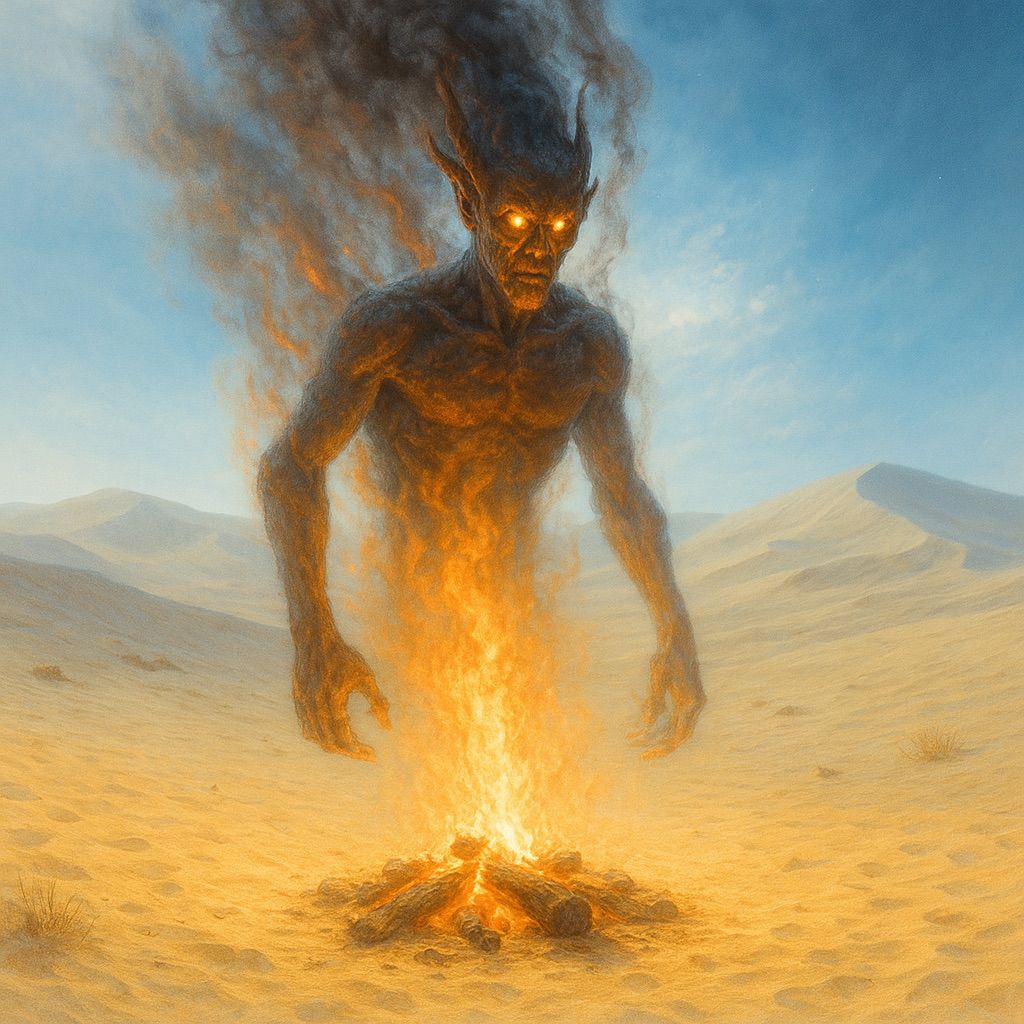
There are stories that flow like wind, unseen but powerful, brushing across generations and deserts, carrying with them the echoes of fire and fear. Among the most enduring and complex of these tales are those of the Jinn — supernatural beings born of smokeless fire, existing in a realm parallel to ours, feared, revered, and woven into the very cultural fabric of the Middle East. Unlike many creatures of myth that belong firmly to legend, the Jinn occupy an ambiguous space. For millions, they are not merely characters in folklore but realities, unseen presences that shape destiny, haunt lonely places, and sometimes share the world with humans in ways both miraculous and terrifying.

The Jinn’s origin story begins in the Qur’an, which describes them as created by Allah from smokeless fire, a substance unlike the clay of humans or the light of angels. This positioning sets them apart immediately: neither divine nor human, but something in between — free-willed, intelligent, and capable of both great good and unimaginable evil. They are said to live in their own societies, with families, communities, even faiths, some Muslim, some Christian, some pagan, mirroring the diversity of human belief. Yet what most fascinates is their liminality: they exist unseen, yet they are everywhere. They are whispered about in marketplaces, feared on desert roads, and invoked in prayers of protection.

To speak of Jinn is to speak of possibility — possibility that the world is not entirely ours, that our loneliness is not as complete as we think. It is also to speak of danger, for Jinn are not to be trifled with. They can possess, deceive, torment. They can inspire madness or grant hidden knowledge. They embody both wish and curse, miracle and menace.

The Jinn are not monsters in the Western sense; they are complex beings with emotions, desires, and flaws. Some are mischievous tricksters who lead travelers astray in the desert. Others are terrifying predators who feed on human fear. Still others are benevolent, protectors and guides who may reward respect with blessings. The richness of the lore comes from this variety. Unlike the singular vampire or werewolf, the Jinn are a spectrum, from demons to allies, from gods of old transformed into new stories to whispering companions that sit invisible beside us.

One of the most famous tales that captured the imagination of the world is found in One Thousand and One Nights, where Jinn appear as both helpers and villains, from the mighty Ifrit imprisoned in bottles to the trickster spirits who grant wishes but twist them to ruin. Western audiences embraced the image of the Jinn as “genie,” a being bound to lamps and obliged to serve. But this playful, wish-granting caricature is a shadow compared to the raw fear Jinn inspire in the Middle East. There, to even speak of them is risky. In some cultures, people avoid saying “Jinn” at all, preferring euphemisms like “those ones” or “the hidden ones,” lest the word itself draw their attention.

Deserts are the natural stage of the Jinn. In folklore, they dwell in desolate places: abandoned ruins, empty wells, crossroads where no birds sing. To travel at night through the sands is to risk brushing against their realm. Fires flicker in the distance where no people live; voices echo on the wind, calling travelers by name. Entire tribes told stories of people vanishing into the dunes, claimed by the Jinn. But they are not confined to deserts — in urban centers too, tales abound of possession, of voices heard in empty houses, of inexplicable illness attributed to Jinn interference. Their presence expands wherever human imagination fears the unknown.

Possession is among the most feared interactions with Jinn. When someone becomes afflicted, their body is said to host a spirit that manipulates thoughts, speech, and actions. Traditional healers — often reciters of Qur’anic verses — are called upon to exorcise the being, coaxing or commanding it to depart. These rituals are not just spiritual acts but cultural dramas, blending faith with folklore, psychology with performance. To this day, such practices persist, bridging ancient belief with modern anxiety.

Yet not all Jinn are antagonistic. Stories abound of humans who strike pacts with them, gaining knowledge or power in exchange for loyalty or ritual observance. Some artisans and poets even claimed inspiration flowed from Jinn muses, whispering words and songs into their ears. This duality — destructive and creative — makes Jinn a paradox that fascinates across centuries. They are feared, yes, but they are also revered, even respected as beings of immense capability who remind humans of the unseen mysteries of creation.

There is also a deeply human dimension to Jinn stories: they are reflections of our inner fears, desires, and temptations. In a time before psychology, possession explained madness. In a time before science, mysterious illness could be traced to Jinn influence. In a time when loneliness weighed heavy on desert travelers, voices in the wind were not imagination but company — eerie, dangerous company, but company nonetheless. Jinn stories helped communities understand the unexplainable, turning chaos into narrative, uncertainty into cultural structure.

Modernity has not banished them. Even today, Jinn loom large in Middle Eastern life. Families warn children not to wander near abandoned wells. Construction workers hesitate to build over ruins, lest they disturb ancient Jinn dwellings. Films and TV dramas explore Jinn possession with as much fervor as Western horror does with ghosts. The legend evolves, but it does not fade. In fact, in an age of globalization, Jinn have entered the global imagination, appearing in novels, movies, and online forums, their aura spreading far beyond their origin.

But perhaps the most haunting part of the Jinn story is how they embody freedom. Angels are bound to divine will, humans to mortality, but Jinn are unbound. They live long, invisible lives. They choose faith or rebellion. They can love, hate, create, or destroy. They are the mirror opposite of us — not flesh but fire, not seen but hidden, yet as flawed and varied as humanity itself. In this way, they are terrifying because they are so familiar. They are us, but freer, stronger, and untethered.

Picture this: a lone traveler crossing the sands at dusk, his camel plodding beneath the endless horizon. The air cools as night approaches. He sees a flicker of light ahead — a fire in the emptiness. Relieved, he approaches, hoping for company. But as he draws near, the fire vanishes. The silence deepens. Then, from the dunes, laughter — not human, not kind. His blood runs cold. He turns back, but the path is gone, the stars rearranged. He whispers a prayer, clutching a talisman of protection. He does not call them by name. He knows better.

This is the power of the Jinn: they live where imagination meets fear. They are the figures that step into silence, the presence we sense when alone, the shiver that comes not from cold but from awareness of being watched. They are supernatural, yes, but they are also profoundly psychological, living in the hidden corners of human thought.

So on October 9, when the Jinn’s legend is remembered, we are reminded that humanity’s greatest stories are not about creatures apart from us, but about beings that reflect our own struggles — with freedom, with temptation, with unseen forces that shape our lives. The Jinn endure because they are more than monsters. They are metaphors for everything we cannot control, everything we fear might whisper just out of sight, everything we suspect might be real after all.

And maybe, just maybe, when the wind blows tonight and a whisper seems to call your name, you’ll hesitate before answering. Because what if it isn’t the wind?

Related Posts