Latest Articles

Kiss of Midnight: Why the Vampire Vixen Owns the Night

Dave

There are costumes that come and go with the shifting tides of pop culture, flashes of novelty that fade as quickly as they arrive, but then there are those that remain carved into the very heart of Halloween itself. The Vampire Vixen is one of those immortals, timeless in her allure, eternally seductive, eternally dangerous. She is the woman who walks into the party and makes heads turn not because she is flashy, but because she radiates a primal, intoxicating energy that whispers of midnight kisses and eternal hunger. Lace clings to her curves, fangs glint when she smiles, and her blood-red lips promise a temptation that no mortal should resist but every mortal always does. It is not just a costume. It is a declaration: that on this night of masks and mischief, you are not just playing dress-up—you are stepping into the role of the most seductive predator folklore has ever given us.

The legend of the vampire has always been steeped in contradictions. It is a monster and a lover, a symbol of death and eternal life, a figure of fear that is somehow even more captivating because of that fear. That duality is exactly why the Vampire Vixen reigns supreme when it comes to sexy costumes. Unlike so many others that have to work hard to be edgy or risqué, the vampire has been sexy from the very beginning. From the gothic literature of the 1800s to the golden age of Hollywood, from Anne Rice’s dreamy immortals to the modern streaming obsessions with sultry vampire clans, the allure has always been the same: eternal beauty, dangerous intimacy, and the whisper of surrender under the cover of night. To put on the lace dress and slip in the fangs is to embody that timeless seduction. And that is why the Vampire Vixen works, year after year, without fail.

There is something almost primal about the way people react to vampires, especially the sensual female vampire. She is not a passive figure. She is not the damsel waiting to be rescued or the sidekick to some greater hero. She is the hunter. She is the one with the control, the power to give or take life, the ability to bend hearts and minds with a glance. On Halloween, when the rules of the ordinary world fall away, women step into that role willingly. The lace dress becomes the uniform of dominance, the blood-red lips a weapon of mass destruction, the fangs sharp punctuation to every smirk. It is no wonder people cannot look away. The Vampire Vixen costume doesn’t just show skin; it shows power dressed up as seduction, danger packaged as desire.

And what makes it irresistible is how versatile it can be. Some Vampire Vixens lean into gothic elegance—long flowing lace gowns, dramatic capes, jewelry that glitters like it was stolen from castles centuries ago. Others embrace the modern twist, short lace dresses, thigh-high boots, chokers, and corsets that toe the line between couture and sin. Some play it dark and frightening, with fake blood dripping from their lips and pale makeup that makes them look freshly risen from the grave. Others keep it sleek and mysterious, lips painted crimson, fangs just barely peeking when they smile, giving off the impression that they could bite, but maybe, just maybe, they’ll spare you tonight. That flexibility means no matter who wears it, the Vampire Vixen feels personal, tailored, like an extension of the woman herself.

There is also the undeniable fact that vampires as cultural icons have always been dripping with sexuality. Think of the great vampire stories—from Bram Stoker’s Dracula, where the bite was described with the passion of forbidden romance, to the black-and-white vampire queens of old cinema, to the endless franchises that turned vampires into romantic antiheroes. The bite is always intimate. It is an exchange of life and death, pain and pleasure, dominance and surrender. The Vampire Vixen costume taps directly into that cultural current. Those fangs are not plastic toys; they are symbols of appetite, of indulgence, of dangerous passion. And those blood-red lips? They are the gateway to a kiss you may not survive but cannot stop craving.

Halloween is the perfect stage for this character. On no other night is it so acceptable to lean into danger, to play at being a creature of the night who walks the edge of fear and desire. The Vampire Vixen thrives here, glowing in candlelight, standing out under neon strobe, commanding attention whether she is on the dance floor, in a photo booth, or simply walking into a room. People gravitate toward her because the costume doesn’t just say “sexy”—it says unforgettable. It promises a story that will linger long after the last pumpkin has rotted on the porch.

But the humanizing element, the reason why this costume keeps going viral every Halloween, is because every Vampire Vixen is also uniquely herself. She is not a copy-paste template of “woman in black with fangs.” She is the girl-next-door who suddenly looks like she might ruin your life in the best way possible. She is the shy introvert who, for one night, lets the lace and the lipstick transform her into the queen of the party. She is the woman who knows exactly what she’s doing, who uses the costume as a statement, a celebration of her confidence, her allure, her unapologetic embrace of her own sexuality. That is the real magic. The Vampire Vixen is not just playing pretend—she is an amplifier. She is what you already are, turned up to eleven, bathed in moonlight and red velvet.

And yes, it is a costume steeped in cliché, but clichés exist for a reason. They work. They resonate. You can walk into any Halloween event, from the biggest nightclub bash to the smallest house party, and there will be at least one Vampire Vixen. And every single time, she will own the night. People will remember her. Photos will get shared. The fangs and the lace will etch themselves into the collective memory of that evening. She doesn’t just blend in—she defines the vibe.

Perhaps that is why the Vampire Vixen has never faded while so many other costumes come and go. She is not bound to a trend, not tied to a single movie or moment. She is eternal, just like the creatures she represents. You could wear her in the 1980s, the 2000s, or right now in the age of social media dominance, and she still carries the same power. If anything, she thrives even more now, because the camera loves her. A Vampire Vixen knows how to work the lens, how to flash the hint of fang at just the right moment, how to let the crimson lips become the center of focus. She is built for the viral age because she has always been viral, centuries before hashtags ever existed.

So if you are choosing your costume this year and you want something that guarantees attention, seduction, and just the right mix of danger and fun, you cannot go wrong with the Vampire Vixen. Slip into that lace dress, paint your lips the deepest red you can find, let the fangs click into place, and smile like you’ve just spotted your next victim. Halloween is your night. Own it the way only a Vampire Vixen can.

Because in the end, it’s not the ghosts or the goblins or even the witches that people talk about the next day. It’s the woman who looked like midnight itself walked into the room, who made them forget whether they should be afraid or infatuated, who left them wondering if maybe she was more than just a costume. That’s the spell. That’s the bite. That’s the reason the Vampire Vixen will forever own the night.

Related Posts

The Quiet Force That Shook an Empire: The Story of Mahatma Gandhi

Elias Rowen

On October 2, 1869, in a quiet coastal town in Gujarat called Porbandar, a child was born who would one day unsettle the mightiest empire on earth not with cannons or armies, but with an idea—that truth and nonviolence could be stronger than bullets and bayonets. His name was Mohandas Karamchand Gandhi, but the world would come to know him as Mahatma—the great soul. And while Gandhi never sought that title, nor the power that people bestowed upon him, his life’s journey reminds us that sometimes the most unlikely figures become the torchbearers of history. His story is not just about India’s independence. It’s about the power of conscience, the weight of morality, and the extraordinary reach of ordinary humanity.

Gandhi was not born extraordinary. As a boy, he was shy, often timid, so much so that he avoided speaking in public. He loved stories from the Indian classics, tales of truth and devotion, but he also grew up in the complex weave of British-ruled India, a land where tradition met colonization. His father was a respected official, his mother deeply religious and steeped in the values of compassion and self-discipline. From her, young Mohandas absorbed the seeds of vegetarianism, fasting, and prayer—seeds that would grow into principles guiding millions.

When Gandhi traveled to London in his late teens to study law, he wasn’t yet a revolutionary. He was a young man grappling with identity—wearing Western suits, learning table manners, and wrestling with what it meant to be an Indian in a world ruled by others. But it was in South Africa, not India, that Gandhi’s transformation truly began. There, while practicing law, he faced open discrimination. The defining moment came when he was thrown off a train for refusing to leave the “whites-only” carriage, despite holding a valid ticket. That humiliation ignited a fire. Gandhi realized that injustice was not an abstract concept—it was personal, degrading, and inescapable unless resisted.

Yet Gandhi’s resistance would not be rooted in violence. Instead, he drew from ancient Indian philosophies, from Jain teachings of ahimsa (nonviolence), and from the moral courage of standing for truth—satyagraha. He believed that fighting oppression through hatred only multiplied hatred, but meeting cruelty with dignity disarmed the oppressor morally, if not immediately politically. To many, it seemed naive. To those who joined him, it felt like awakening to a higher calling.

When Gandhi returned to India in 1915, he brought with him more than legal experience—he brought a vision of liberation that went beyond politics. For Gandhi, freedom was not simply the removal of British rule; it was also the renewal of India’s soul. He encouraged spinning cloth on the humble charkha (spinning wheel) to resist British textiles, not only as economic defiance but as a symbol of self-reliance. He marched into salt flats to make salt, defying Britain’s monopoly, turning a simple grain into a weapon of mass mobilization. Each act, seemingly small, rippled into a tidal wave of defiance.

The British Empire was baffled. How could they confront a man who refused to fight on their terms? They could imprison Gandhi, beat his followers, ban his protests, but every time they struck, his movement grew. His fasting became a weapon sharper than any sword, as millions prayed for his health and resolved not to let his sacrifice be in vain. The frail man in a loincloth, often barefoot, became more dangerous to the empire than any armed rebellion.

And yet Gandhi was not without contradictions. He was revered, but also criticized. Some accused him of being too soft, of compromising too much. Others struggled with his moral rigidity—his insistence on chastity, his experiments with diet and self-restraint, his belief in personal purity as inseparable from political struggle. Gandhi was human, flawed, and imperfect. But perhaps it was precisely those imperfections that made his achievements so extraordinary. He was not a saint descending from the heavens; he was a man stumbling, striving, learning, and daring to lead by example.

When India finally gained independence in 1947, Gandhi did not celebrate with pomp. Instead, he mourned the partition that split India and Pakistan, lamenting the violence that engulfed Hindus, Muslims, and Sikhs alike. For him, true freedom was not simply the lowering of the Union Jack but the lifting of hatred from human hearts. In his final days, Gandhi was weary yet unyielding. On January 30, 1948, he was assassinated by a Hindu extremist who rejected his message of tolerance. Gandhi fell with the words “Hey Ram” on his lips, his life extinguished but his message immortal.

Today, Gandhi’s legacy is often reduced to a few quotes on posters or statues in city squares. But his impact runs deeper. He inspired Martin Luther King Jr. in America’s civil rights movement, Nelson Mandela in South Africa’s struggle against apartheid, and countless others who saw in his philosophy a universal weapon for the oppressed. Gandhi taught that the moral arc of history bends not through violence but through the steady pressure of justice, truth, and courage.

But let us not sanitize him into myth. Gandhi’s real lesson is that greatness can emerge from weakness, that change is forged not by perfect heroes but by flawed humans who refuse to surrender to cynicism. He was shy, he was awkward, he was often unsure. And yet, with nothing more than conviction and relentless will, he led millions to believe in their own power.

On October 2nd, as the world celebrates his birth, we should remember not just the Mahatma, but the man—the boy too timid to speak in class, the lawyer humiliated on a train, the dreamer spinning a wheel, the leader fasting for peace. Gandhi’s life is not a relic of the past. It is a reminder that in a world still scarred by division and violence, the quiet voice of conscience can still move mountains.

Related Posts

Thirst in the Shadows: The Vampire’s Legacy from Folklore to Dracula

Dave

There is a reason the vampire has never left us. Centuries pass, cultures change, fashions evolve, and yet the image of the blood-drinking creature lurking in the dark is as irresistible now as it was to the villagers who first whispered its name around firesides in the cold hills of Eastern Europe. The vampire is more than a monster; it is a mirror of human fears, desires, and obsessions. From Romanian folklore to Bram Stoker’s Count Dracula and the endless adaptations that followed, the vampire is one of the few legends that has remained alive by constantly reinventing itself. But before Hollywood turned it into a brooding aristocrat or pop culture softened it into a romantic antihero, the vampire was something raw, terrifying, and deeply real to the people who believed in it. It was the explanation for mysterious deaths, the scapegoat for plague, the lurking shadow of mortality itself. To trace the vampire’s journey is to walk through both history and imagination, where blood has always been more than fluid—it has been life, soul, and the ultimate currency of existence.

In its earliest roots, the vampire was not a suave nobleman in a flowing cape but a reanimated corpse crawling from its grave. In the villages of Romania, Bulgaria, and Serbia, people spoke of the strigoi or nosferatu—restless spirits of the dead who would rise at night to drain the vitality of the living. They were described as pale, bloated, and foul-smelling, closer to ghouls than the elegant vampires we know today. These creatures were not metaphors—they were believed to be real. Families who lost loved ones suddenly would suspect vampirism. Bodies were sometimes dug up weeks after burial, and if they appeared unnaturally preserved, villagers might drive a stake through the corpse, burn it, or scatter its ashes. These gruesome rituals were not just superstition but survival strategies in communities plagued by disease, where science offered no answers and folklore filled the void.

The vampire was powerful not because of its beauty, but because it embodied the greatest fear of all: that death does not end suffering. To imagine the dead returning to torment the living was both a horror story and a warning, one that kept people cautious about how they buried their dead, how they treated outsiders, and how they explained misfortune. The vampire was never just a story—it was a way of making sense of chaos, of giving shape to the unexplainable. And in Romania, where the Carpathian Mountains cast long shadows and mist clings to valleys, the myth found the perfect home.

Enter Bram Stoker, a Dublin-born writer who had never set foot in Transylvania but understood the power of atmosphere. In 1897, he published Dracula, a novel that would forever redefine the vampire. Drawing on snippets of folklore, travel guides, and perhaps the faint echo of real history in the figure of Vlad the Impaler, Stoker created a character who blended horror with charisma, terror with seduction. Count Dracula was no shambling corpse—he was an aristocrat, intelligent, cunning, and magnetic, his charm as dangerous as his fangs. Stoker tapped into Victorian anxieties about sexuality, disease, and foreign invasion, weaving them into a narrative where Dracula became both predator and metaphor. The success of the book was immediate, but its legacy was even greater. It elevated the vampire from peasant graveyards to castles, from superstition to literature, and gave the world a monster that could never die because it could always adapt.

From there, the vampire became a creature of reinvention. In the 1922 silent film Nosferatu, the vampire was twisted back into a grotesque, with long claws and a skeletal face. In 1931, Bela Lugosi’s Dracula gave the monster a Hungarian accent and a hypnotic gaze, solidifying the image of the vampire as a suave aristocrat. The decades that followed would see vampires shift again and again, reflecting the fears and fantasies of each generation. In the 1980s, films like The Lost Boys made vampires rebellious, youthful, and punk. In the 1990s, Anne Rice’s Interview with the Vampire gave them existential depth, turning them into tragic immortals wrestling with loneliness and morality. In the 2000s, Twilight and True Blood made them romantic icons, embodying forbidden love and eternal desire. Every era reshaped the vampire, but the heart of the legend—the thirst, the danger, the allure—remained constant.

What makes the vampire so enduring? Perhaps it is because it combines opposites so perfectly. It is death and life, attraction and repulsion, predator and lover. It embodies the primal fear of being consumed, but also the secret desire to be chosen, to be touched by something eternal even if it is dangerous. Vampires are terrifying, but they are also seductive, and that duality gives them a power no other monster holds. Unlike zombies, who are mindless, or werewolves, who are enslaved to rage, vampires are conscious. They choose. And that choice makes them human enough to fascinate, alien enough to fear.

The Romanian roots of the vampire remain central even today. Tourists flock to Bran Castle, marketed as “Dracula’s Castle,” though Bram Stoker never set his story there. Villages across Transylvania still whisper about the strigoi, and in some rural areas, old practices linger—coffins nailed shut, garlic at the windowsill, horses used to sniff out restless graves. Modern Romanians balance pride in their vampire folklore with weariness at being forever linked to Dracula, but even they admit the myth has a strange, undeniable power. There is something about Transylvania—the forests, the mountains, the fog—that feels like it was made for legends. The landscape itself seems to breathe mystery, as if it knows that darkness always needs a stage.

Humanizing the vampire myth reveals why it resonates so deeply. At its core, it is about control and vulnerability. To drink blood is to take life, to dominate completely, but it is also to enter into intimacy unlike any other. It’s why vampires have been tied to fears of disease—blood as infection, blood as contagion. It’s also why they have been tied to sexuality—blood as passion, the act of feeding as metaphor for desire. The vampire myth strips humanity down to its rawest truths: we are fragile, we are hungry, and we long for connection even when it terrifies us. The vampire embodies all of that and then heightens it, turning our secrets into its survival.

In modern culture, the vampire is everywhere, from Halloween costumes to blockbuster movies, but its folkloric roots remind us that it began not as entertainment but as explanation. To the villagers in Romania centuries ago, the vampire was the reason crops failed, why children died suddenly, why the sick wasted away. To them, it was real, and it was dangerous. Today, we might not believe in vampires literally, but we still believe in what they represent—the idea that something unseen can drain us, that shadows hide hungers we cannot name, that death is not always the end. In a way, that belief keeps the vampire alive.

And so, the vampire will never die. It will continue to reinvent itself, shifting with each generation’s anxieties and desires. But whether it’s a bloated corpse rising from a village grave or a glittering immortal brooding over love, the vampire always returns to the same essential truth: it is us. It is our fear of mortality, our obsession with beauty, our hunger for power, our longing for intimacy. The vampire has survived centuries because it feeds not just on blood, but on the human imagination itself. And as long as we keep dreaming, fearing, and desiring, the vampire will keep rising, eternal in shadow, waiting for the next heartbeat in the dark.

Related Posts

Midnight Magic: Why the Sexy Witch Will Always Rule Halloween

Dave

There’s something about Halloween that brings out a wild spark in all of us. Maybe it’s the electric hum of autumn leaves crunching under boots, maybe it’s the thrill of stepping into a costume that makes you feel more daring than you ever would in the daylight, or maybe it’s just the sugar rush of too much candy and too many spiked ciders. Whatever it is, October 31st has become the one night of the year where fantasy and fun collide, where the veil between the ordinary and the extraordinary feels thin enough to step through. And at the very heart of this enchanted masquerade stands a figure who has never once lost her crown as queen of Halloween: the witch. Not the old crone version, though that has its charms, but the bold, sultry, spellbinding incarnation that struts into the party in thigh-highs, corset, and a pointy hat tilted just so. The Sexy Witch is not only iconic, she’s eternal, because her magic isn’t just about broomsticks and black cats—it’s about power, seduction, and the playful thrill of turning a night of fear into a night of fantasy.

It’s almost funny how natural the evolution of the Sexy Witch seems when you look at it through history’s lens. Witches were once feared—hunted even—for their supposed powers, accused of dancing with devils, brewing potions, or bewitching neighbors. But fast forward through centuries of folklore, literature, and Hollywood, and witches slowly transformed into something else entirely. They became mysterious, alluring, the kind of women who knew things other people didn’t, who dared to live outside the rules. When Halloween morphed into a celebration of dress-up and indulgence, the witch costume adapted right along with it. Gone was the hunched hag with warts and rags; in her place came the seductive sorceress with legs for days, a bodice that promised temptation, and a smirk that suggested she knew exactly how to use her magic on you.

And isn’t that what makes the Sexy Witch such an irresistible archetype? She blends danger with delight. She is at once the outsider and the star of the show, the woman who can cast a spell and steal your drink in the same breath. Put a woman in a corset, thigh-high boots, and a sharp black hat, and suddenly the room doesn’t just notice her—it orbits her. That’s not just a costume. That’s power, plain and simple, dressed in lace and satin.

Of course, part of the fun of Halloween is exaggeration, and the Sexy Witch costume embraces that wholeheartedly. The thigh-highs aren’t just shoes—they’re armor for seduction, legs turned into statements that say confidence without speaking a word. The corset isn’t just a top—it’s a spellbook of curves, cinched to highlight the figure in a way that teases and taunts. The pointy hat? That’s the crown. Because let’s be honest: in a sea of cats, vampires, and whatever pop-culture moment is trending this year, the Sexy Witch hat is still the single most recognizable silhouette at the party. It doesn’t just say “witch”—it screams it, but with a wink.

And the thing about this costume is that it has layers—not just fabric layers, but emotional ones. Every woman who puts on that pointy hat isn’t just slipping into a role, she’s tapping into something older, something primal. She’s channeling centuries of stories where women with power were both feared and desired. On Halloween, the Sexy Witch costume gives permission to lean into that energy, to flirt with the dark while owning the spotlight. It’s rebellion in fishnets, empowerment in black velvet. It’s taking a character who was once demonized and flipping the script into a celebration of confidence, charm, and charisma.

Think about it: every Halloween party has its Sexy Witch. She’s the one twirling her wand with a smirk, the one laughing too loudly in the corner while sipping something neon-green out of a skull-shaped glass, the one who makes eye contact across the dance floor and somehow convinces you that following her into the night would be both the best and worst decision you’ve ever made. And that’s the spell of it—the costume isn’t just an outfit, it’s a whole mood, a story unfolding with every glance and grin.

But the Sexy Witch isn’t limited to just one interpretation. Some lean into gothic elegance—long, flowing black dresses slit high at the leg, with lace gloves and dramatic makeup. Others go playful, mixing glitter and neon, turning the hat into a fashion statement instead of just a prop. Some wear as little as possible, turning “broomstick chic” into “broomstick barely-there,” while others go for full fantasy armor, sexy but also badass, like they’re ready to hex anyone who gets in the way of their cauldron cocktails. The variety is endless, which is part of why this costume never loses popularity. The Sexy Witch adapts, evolves, reinvents herself every year, just as the real idea of witches has always shifted with the times.

There’s also something about the witch as a cultural figure that makes her uniquely suited to be sexy. Unlike zombies, who rot, or ghosts, who vanish, witches are human—but amplified. They have knowledge, agency, independence. They’re not victims in horror stories, they’re the ones pulling strings. That inherent autonomy translates perfectly into the Halloween scene. Sexy witches aren’t waiting to be rescued. They’re casting spells, running covens, and maybe hexing their exes for fun. And when you slip into that corset and lace, you’re not just pretending—you’re embodying that same fierce energy, even if only for a night.

The other thing the Sexy Witch costume does, maybe better than any other, is blur the line between scary and sexy. Halloween has always thrived on that tension—why do we love scary movies? Because the adrenaline makes us feel alive. The Sexy Witch channels that exact energy: she might hex you, or she might kiss you, and the thrill is you don’t know which. It’s playful danger, safe transgression. It’s the costume equivalent of a wicked grin in the dark.

And sure, critics will roll their eyes and mutter about “overly sexualized costumes,” but here’s the truth: the Sexy Witch endures because she’s chosen, not imposed. Women don’t wear her because they’re forced to—they wear her because they want to. Because the hat feels powerful. Because the corset feels daring. Because on October 31st, when the world is watching and the rules are suspended, being the Sexy Witch is a way to say: I’m in control of the spell tonight.

That’s why you’ll never see a Halloween without her. Trends will come and go—sexy avocado costumes, sexy meme costumes, even sexy versions of random cartoon characters—but the witch remains eternal. She was here in the earliest parties, she’s here in the TikTok era, and she’ll be here when the next generation is carving their own pumpkins. The broom may be a prop, the hat may be oversized, but the magic? The magic is very real.

So the next time you see a Sexy Witch strutting into the party, corset laced tight, boots climbing high, hat tipping like a crown, remember this: you’re not just looking at another Halloween outfit. You’re looking at centuries of myth reborn as empowerment, you’re looking at mischief wrapped in satin, you’re looking at the queen of Halloween herself. And if you’re not careful, you just might find yourself under her spell.

Because let’s be honest—on Halloween night, when the music is loud, the lights are low, and the air is thick with the smell of cider and pumpkin spice, everyone’s secretly hoping to be enchanted by a witch. And the Sexy Witch knows it. She always has. That’s why she’s never going away.

Related Posts

The Day the World Tilted: Alexander’s Triumph at Gaugamela

Elias Rowen

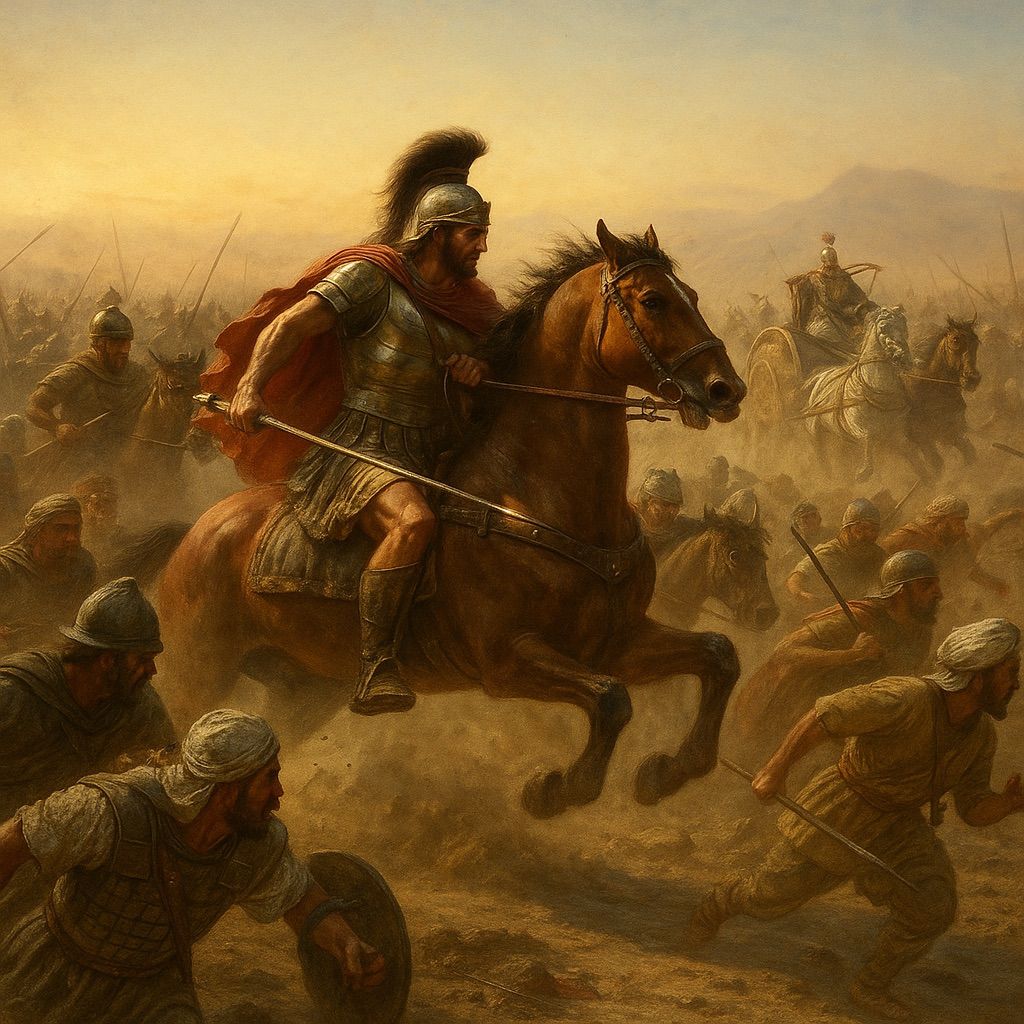
History is littered with moments that feel like the turning of a page in a book, but the Battle of Gaugamela was more than just a page—it was a whole new chapter. On October 1st, 331 BC, the fate of empires and the course of civilizations shifted in the dusty plains of northern Mesopotamia. The encounter between Alexander the Great and Darius III was not merely a clash of armies; it was the collision of two worlds, two visions of power, and two destinies written in blood, sweat, and ambition. To understand why this battle still resonates today, one must step into the chaos of that battlefield, breathe in the dust, hear the thunder of hooves, and feel the raw humanity of men standing on the edge of history.

The Persian Empire had stood for centuries as the colossus of the ancient world. From the Aegean Sea to the Indus River, it stretched across cultures, languages, and landscapes. Its rulers, the Achaemenid kings, commanded wealth and armies that seemed insurmountable. Yet by the 4th century BC, Persia faced an adversary it had not anticipated: a 25-year-old Macedonian king with unshakable confidence and a vision that the world could belong to him. Alexander was not just another ambitious monarch. He had been tutored by Aristotle, hardened by campaigns in Greece, and driven by an insatiable hunger for glory. He wasn’t content to rule Macedon—he wanted to redefine the boundaries of the known world.

When Darius III gathered his massive forces at Gaugamela, he believed sheer numbers would be enough. Ancient accounts claim he assembled perhaps 200,000 men, though historians debate the accuracy. The exact figure matters less than the psychological weight of it: a sea of soldiers, chariots with scythed wheels, and cavalry drawn from every corner of the empire. Against them, Alexander brought roughly 47,000 men—disciplined, battle-tested, and fiercely loyal to their king. They had followed him across mountains, rivers, and deserts, and they trusted that his audacity could turn even the bleakest odds into triumph.

The night before the battle tells us everything about the two leaders. Darius, restless and anxious, kept his men awake, moving, preparing, fearing what was to come. Alexander, in stark contrast, slept deeply. When his officers woke him at dawn, he appeared refreshed, almost casual, as if destiny itself had whispered into his dreams: Tomorrow, the empire is yours. That calm confidence would set the tone for the day.

As dawn broke, the plain near Gaugamela became an amphitheater of war. Dust shimmered in the early light, the sound of thousands of hooves and marching feet vibrating through the ground. Darius positioned himself at the center, elevated on a chariot, a visible symbol of royal majesty. Alexander, by contrast, placed himself at the right flank with his Companion Cavalry, ready to lead from the front. It wasn’t just strategy—it was theater. Both men understood that their presence would inspire or terrify their armies.

The Persians opened with a thunderous advance. Scythed chariots, designed to tear through enemy lines with their spinning blades, raced forward. Yet Alexander’s men, calm and disciplined, parted their ranks to let the chariots pass harmlessly, then cut down the drivers. What was meant to inspire terror became a spectacle of futility. Darius’ great advantage was blunted in a matter of moments.

But the true genius of Alexander lay not in defense but in audacious offense. He recognized the weakness in Darius’ position—the Persian king’s tendency to stay fixed at the center, relying on numbers to envelop his opponent. Alexander feigned retreat on his right flank, luring Persian cavalry into pursuit. At the precise moment, he pivoted and led a wedge formation directly toward the heart of the Persian line. With the ferocity of a thunderbolt, he charged toward Darius himself.

Imagine that moment: the dust choking the air, the clash of steel echoing, Alexander’s Companions slicing through the Persian ranks with terrifying precision. Darius, staring at the young Macedonian king barreling toward him, lost his nerve. He fled. The king of kings, ruler of the largest empire on earth, abandoned his army and his dignity in a single act of fear. The Persian lines, seeing their leader vanish, dissolved into chaos. What had begun as overwhelming might crumbled into disarray.

The battle did not end in minutes, but the result was sealed once Darius fled. Alexander’s forces pursued, cutting down stragglers, capturing treasures, and scattering the remnants of Persia’s proud army. In the aftermath, Alexander showed a mixture of pragmatism and cruelty. He proclaimed victory not only through conquest but also through narrative. To his men, he framed the triumph as destiny fulfilled. To the Persians, he presented himself not merely as a conqueror but as the legitimate heir to their empire. He even honored fallen Persian nobles, a shrewd gesture to win support among his new subjects.

The significance of Gaugamela cannot be overstated. This was not just another battlefield victory; it was the moment the ancient balance of power shifted forever. The Persian Empire, which had dominated for centuries, was effectively broken. Alexander’s star blazed brighter than ever, and his dream of a world united under his banner seemed within reach. He would march on Babylon, Susa, and Persepolis, each step fueled by the momentum born on that dusty plain in 331 BC.

Yet behind the grand narrative lies the human element. Imagine the fear of a Persian soldier, standing shoulder to shoulder with comrades, watching the invincible image of Darius dissolve into dust. Imagine the exhilaration of a Macedonian infantryman, weary from years of campaigning, realizing that in this moment, his sacrifices had carved out a new empire. Imagine Alexander himself, bloodied but unbowed, pausing amid the chaos, realizing that he had done what no Greek had dreamed possible: he had toppled the might of Persia.

The story of Gaugamela is not just about tactics or numbers. It’s about the power of vision, the force of will, and the fragile psychology of leadership. Darius had everything—numbers, resources, and tradition. Alexander had less of everything except one thing: unshakable belief in himself. That belief, magnified through the loyalty of his men, changed history.

And perhaps that is why Gaugamela still matters. It reminds us that history often pivots not on the many but on the few—the leaders who seize the moment, the soldiers who follow despite the odds, and the decisions made in the heartbeat of chaos. On October 1st, 331 BC, the dust of Mesopotamia bore witness to one of those moments. The echo of that clash still reverberates through time, reminding us that destiny often favors the bold.

Related Posts