Latest Articles

The Spark That Lit a Revolution: Cuba’s 26th of July Movement and the Road to Revolution

Elias Rowen

On the morning of July 26, 1953, a group of young revolutionaries led by a little-known lawyer named Fidel Castro launched an attack on the Moncada Barracks in Santiago de Cuba. It was a desperate gamble, an audacious assault against the heart of Fulgencio Batista’s military regime. Most of the attackers were either killed or captured. In the immediate aftermath, it looked like an embarrassing failure. But that attack would go on to ignite the most transformative revolution in Latin American history—the Cuban Revolution—and give birth to a movement that still echoes through time: the 26th of July Movement. This essay traces the origins, evolution, and legacy of that bold uprising and the grassroots movement it inspired, exploring how one failed assault gave way to one of the most enduring socialist revolutions of the 20th century.

To understand the significance of July 26, we must go back to the political and social landscape of Cuba in the early 1950s. At that time, Cuba was mired in corruption, inequality, and repression under the authoritarian rule of Fulgencio Batista. Batista had come to power in a military coup in 1952, canceling democratic elections and imposing a dictatorship backed by the military and increasingly supported by foreign business interests—particularly from the United States. For much of the Cuban population, especially the rural poor and urban working class, life was marked by economic hardship, political disenfranchisement, and lack of access to education and healthcare. The veneer of modernization in Havana masked deep social divides across the island.

Among the voices of dissent rising from this climate of injustice was a young Fidel Castro. A well-educated lawyer from a middle-class background, Castro had grown disillusioned with the corruption of Batista’s regime and the impotence of traditional opposition politics. Alongside his brother Raúl Castro and other passionate idealists, Fidel began organizing a group of like-minded individuals—many of them students, workers, and disaffected soldiers—who believed that direct action was the only way to bring change to Cuba. This group would later coalesce into what became known as the Movimiento 26 de Julio, or the 26th of July Movement, named after the date of their first major action.

The plan was daring but flawed: storm the Moncada Barracks in Santiago de Cuba, the second-largest military garrison in the country. The objective was to seize weapons, inspire a mass uprising, and spark a revolution that would overthrow Batista’s dictatorship. Early on the morning of July 26, 1953, about 135 revolutionaries launched the attack. The operation was plagued by poor coordination, lack of communication, and overwhelming military opposition. The assault quickly fell apart. Dozens of rebels were killed in the fighting or executed shortly thereafter. Fidel and Raúl Castro were captured, and many others were tortured or disappeared.

Yet what followed turned failure into myth. Fidel Castro’s trial became a platform for revolution. Though technically a defendant, Castro used his time in court to deliver a fiery speech that would go down in history: “History will absolve me.” In that speech, he outlined the injustices of Batista’s regime, the corruption of Cuban society, and the hopes of the revolution. He articulated the goals that would later define the Cuban Revolution: land reform, education, healthcare, and an end to U.S. exploitation. Castro’s words were smuggled out of prison and widely circulated, turning public opinion and sowing the seeds of resistance.

Castro and his comrades were eventually sentenced to long prison terms, but due to mounting public pressure and a political amnesty campaign, they were released in 1955—less than two years after the attack. Upon release, Fidel went into exile in Mexico, where he met a young Argentine doctor with a fierce intellect and revolutionary passion: Ernesto “Che” Guevara. Together, along with Raúl and other exiled revolutionaries, they began to reorganize the 26th of July Movement with a new strategy: guerrilla warfare.

In December 1956, Castro and 81 other rebels set sail from Mexico aboard a cramped yacht named Granma. Their goal was to land in eastern Cuba and begin a guerrilla war in the Sierra Maestra mountains. Once again, disaster nearly struck. Their landing went awry, most of the group was killed or captured, and only a dozen or so survived. But those survivors, including Fidel, Raúl, and Che, managed to regroup in the mountains and build a small but determined insurgency. They relied heavily on support from rural peasants, whom they helped educate, treat medically, and organize politically. The guerrilla campaign began to gain momentum.

Over the next two years, the 26th of July Movement evolved from a ragtag band of rebels into a nationwide revolutionary force. Through a combination of tactical guerrilla warfare, propaganda, and popular support, they eroded the legitimacy and power of Batista’s government. Urban resistance, student protests, labor strikes, and international condemnation of Batista’s human rights abuses all contributed to the regime’s unraveling. As the movement grew, so did the myth of the revolutionaries: romanticized as underdog freedom fighters, their images and messages spread through the underground press and sympathetic media abroad.

By late 1958, Batista’s grip on power was faltering. Rebel forces, now numbering in the thousands, launched coordinated offensives across the island. On January 1, 1959, Fulgencio Batista fled Cuba, and Fidel Castro’s forces triumphantly entered Havana days later. The revolution had succeeded. What had begun as a failed assault on a military base on July 26, 1953, had culminated in a complete transformation of the Cuban political landscape.

But the triumph of the revolution was just the beginning of a far more complex journey. The 26th of July Movement, once a clandestine group of insurgents, now had to govern. Under Fidel Castro’s leadership, Cuba underwent sweeping changes. The new government nationalized industry and agrarian land, redistributed wealth, launched literacy and health campaigns, and aligned increasingly with the Soviet Union as tensions with the United States escalated. What began as a nationalist revolution quickly evolved into a socialist state.

The legacy of the 26th of July Movement is multifaceted. For many, it represents a courageous fight against dictatorship, imperialism, and inequality. It inspired revolutionary movements across Latin America, Africa, and Asia. It elevated figures like Che Guevara to global icons of rebellion. And it served as a real-world example of successful armed revolution against a militarized regime.

Yet for others, the movement’s legacy is more controversial. The Cuban government, under the revolutionary leadership, also imposed censorship, imprisoned dissidents, and curtailed freedoms in the name of the revolution. Critics argue that the ideals of July 26 were betrayed by the authoritarianism that followed. The island became a focal point of Cold War tensions, particularly during the Cuban Missile Crisis in 1962. Economic hardship, political repression, and mass emigration—particularly to the United States—shaped the lives of generations of Cubans.

Despite these tensions, the significance of July 26 remains deeply woven into the fabric of Cuban identity. It is a national holiday, celebrated with parades, speeches, and revolutionary imagery. Across Cuba, towns, streets, and institutions bear the name “26 de Julio.” The date is more than just an anniversary; it is a symbol of resistance, perseverance, and transformation. Whether one sees it as the start of liberation or the beginning of authoritarianism, it is impossible to ignore the impact of that fateful day in 1953.

On a human level, the 26th of July Movement tells the story of ordinary people who chose to risk everything in the face of injustice. The young men and women who joined the cause were driven not by personal gain but by a vision of a more just society. They endured torture, exile, and death. Some became legends; others were forgotten. But all were part of a movement that reshaped not only Cuba but also the political consciousness of the world.

Today, Cuba continues to grapple with the legacy of the revolution. Economic reforms, shifts in U.S.-Cuba relations, the death of Fidel Castro in 2016, and ongoing debates about political freedom and socialism ensure that the story of the 26th of July Movement is far from over. As younger generations of Cubans confront new challenges, they do so with the shadow—and the inspiration—of the revolution behind them.

The story of July 26 is ultimately a human story—of idealism and sacrifice, of triumph and tragedy, of what happens when people dare to believe that the world can be changed through action. The rebels who marched on Moncada may have failed that morning, but in doing so, they sparked a fire that would burn through history. And in the echoes of that fire, we find a mirror to the eternal human struggle for justice, dignity, and freedom.

Related Posts

DIY Swimwear: Can You Make Your Own Bikini?

Dave

The idea probably begins with a late-night scroll—one too many cute swimsuits in your feed, each tagged with a price that makes your debit card wince. Or maybe it starts in a thrift store, your fingers trailing over a bolt of fabric that feels like summer under your palm. Whatever the spark, the thought lands with the same mix of thrill and trepidation: Could I make my own bikini? A question equal parts craft project and personal dare. And beneath it, something deeper—a tug toward control, toward creativity, toward wearing something that carries the fingerprint of your patience and personality instead of a brand logo. In a world where bikinis are churned out by the millions in glossy factories, the idea of making your own is like deciding to bake bread in an era of drive-throughs. It’s slower, messier, and infinitely more satisfying.

For the uninitiated, the prospect can feel absurd. Isn’t swimwear some arcane alchemy of elastic and magic stitches, perfected only by those with industrial machines and years of apprenticeship? The truth is more democratic. Yes, bikinis are a little technical—stretch fabrics have their quirks, and there are tricks to making something that will survive both the surf and the sun. But the barrier to entry is not nearly as high as most people think. A basic home sewing machine, a handful of notions, some patience, and a willingness to practice on scraps before you cut into your dream fabric are your main tickets in. The rest? Well, that’s style and spirit, and you’ve already got those.

Step one in your DIY bikini odyssey is a choice that feels deceptively simple but will set the tone for the whole project: fabric. Swimwear calls for materials with both stretch and recovery, meaning they need to stretch to fit your body snugly and then snap back to shape after you take them off. The classics are nylon-spandex or polyester-spandex blends, sometimes with a lining for modesty or structure. In your hands, they feel slick and slightly cool, like the surface of a pond just before you dive in. Prints open up an entire gallery of personality—tropical florals for the escapist, nautical stripes for the retro romantic, solid black for the minimalist with secrets. There’s something intoxicating about standing in a fabric store, bolts fanned out before you, knowing this will be more than just cloth; it will be a second skin you made yourself.

Once you’ve got your fabric, you’ll meet the next big fork in the road: pattern. You can draft your own (ambitious, but not impossible if you’ve dabbled in garment making) or buy one online from the many indie designers who cater to home sewists. Patterns range from modest high-waisted bottoms and supportive tops to daring string bikinis that would barely pass muster in a game of beach volleyball. Here’s where you confront a small but liberating truth—your bikini doesn’t have to please anyone’s idea of “on-trend” but yours. Want a top with wide straps for comfort? Do it. Want a reversible design so you pack light for vacation? Totally doable. Want to engineer a suit that actually fits your bust and hips without compromise? Welcome to the revolution.

If fabric and pattern are the canvas and sketch, then notions are the paints—elastic for leg openings and waistbands, closures for halter straps or back bands, optional padding for tops. Swimwear elastic is different from the garden-variety elastic you might use in pajamas; it’s resistant to chlorine and saltwater, ensuring your masterpiece doesn’t sag after its first encounter with the deep end. Choosing notions is like choosing jewelry—you’re thinking not just about function but about how the little details finish the whole look. A gold clasp at the back can elevate a simple design into something that looks plucked from a boutique rack. And don’t underestimate the psychological lift of good tools—sharp shears, a fresh stretch needle in your machine, and a walking foot that coaxes slippery fabric into submission.

Then comes the cutting, which is as much about courage as it is about precision. There’s a quiet drama in laying your pattern pieces on the fabric, making sure the stretch runs in the right direction, pinning them in place. Once you make the first cut, you’re committed, and the sound of scissors through spandex is oddly thrilling—like the first bite into something you baked yourself. This is where mistakes are born and, thankfully, where they can often be rescued. Stretch fabric is forgiving; seams can be unpicked, straps reattached, lines altered. Perfection is overrated; progress is the real prize.

Sewing swimwear is where the magic—and the learning curve—really kicks in. The stitches that hold bikinis together have to stretch without breaking, which means you’ll lean on zigzag stitches or specialized stretch stitches your machine might offer. Seams need to be smooth and strong, and hemming the elastic into the edges without puckering the fabric is a skill you’ll get better at with practice. The first time you manage to sew a clean, even edge on a stretchy bikini bottom feels like a small miracle. And yes, there will be moments of frustration—a seam that twists, a strap that comes out uneven, elastic that refuses to sit flat—but those are the moments that teach you more than any YouTube tutorial ever could.

The fitting stage is both exciting and, let’s be honest, humbling. Trying on something you’ve made yourself can be a bit like hearing your own voice on a recording: it’s familiar but also strangely revealing. A waistband might sit differently than you pictured, a top might gape a little. But here’s the beauty of DIY: you can change it. Add darts, adjust elastic tension, swap straps. Every tweak makes the bikini more yours, and every fitting session teaches you more about what makes swimwear comfortable and flattering for you. And there’s a quiet satisfaction in realizing you’re tailoring something not for a generic size chart but for your own living, breathing form.

And then, one day—or rather, one late night, if you’re the sort who sews with coffee and playlists—you finish it. The last stitch is tied off, the last loose thread snipped. You hold it up, this small, bright thing that once was just a sketch in your head. There’s pride in the symmetry, in the neat seams, but more than that, there’s the electric knowledge that you could do it again. You could make ten more, each one different, each one an evolution of your style. In that moment, the question “Can you make your own bikini?” has shifted into something quieter but more potent: “What else can I make?”

Wearing it for the first time is the real test, of course. The beach or pool becomes your runway, though not in the stiff, self-conscious way of a fashion show. It’s subtler than that—you feel it in the way you stand, in the ease with which you move. People might compliment the color or the cut, and you’ll smile, knowing they’re seeing only the final chapter of a story that began with a roll of fabric and a hunch that you could figure it out. The best part isn’t even the compliments; it’s the intimacy of knowing your bikini has no twin in the world, that it’s as one-of-a-kind as your tan lines.

Over time, you might start seeing possibilities everywhere. That old maxi dress you don’t wear anymore? Enough fabric for a color-blocked bikini. The remnant bin at the fabric store? A treasure chest for bold prints you’d never commit to in a $120 retail suit. Friends might drop hints about wanting their own custom swimwear, and if you’re generous—or entrepreneurial—you might start sewing for others. It’s a slippery slope from personal project to small business, and many indie swimwear brands have started exactly this way: at a kitchen table, with a borrowed machine and the nerve to think “Why not?”

Making your own bikini isn’t just about thrift or even style; it’s a quiet rebellion against disposability. Fast fashion has trained us to think of clothes as temporary, interchangeable, even forgettable. But when you sew something yourself, you invest not just money but hours and focus, and that investment changes how you treat it. You mend instead of discard. You store it carefully instead of letting it fade in the backseat of your car. And, maybe most importantly, you notice—how fabric behaves, how seams age, how salt and sun alter colors over time. The relationship becomes reciprocal: you take care of it, and it takes care of you.

There’s also a kind of empowerment in swimwear-making that goes beyond craft. Bikinis are loaded garments in our culture, carrying more than just the weight of fabric and elastic. They are tied to body image, to confidence, to all the stories we tell ourselves about what is “beach ready.” Making your own is a way of editing those stories. You choose cuts and colors that make you feel ready, without waiting for some arbitrary green light from fashion magazines or fitness influencers. You realize that “ready” isn’t about the body changing for the bikini but about the bikini being made for the body you have right now.

This is not to say every attempt will be a masterpiece. There will be duds. The top that looks great on the hanger but sags in the surf. The bottoms that ride up in ways that are unprintable. But even the flops have value; they teach you about fit, about tension, about patience. They also give you a better appreciation for the skill in well-made commercial swimwear—not to intimidate you out of trying again, but to inspire you. And with each attempt, your hands grow more confident, your stitches straighter, your eye sharper.

In the end, the question of whether you can make your own bikini transforms into whether you want to keep making them. For some, one suit is enough—a fun experiment, a badge of accomplishment. For others, it’s the beginning of a new way of dressing, of engaging with clothing as something you participate in creating rather than simply consuming. And once you’ve crossed that threshold, you may find yourself looking at all your clothes differently, wondering how they came to be and whether you could recreate them, too.

DIY bikinis may not change the world, but they can change your summer. They can shift the way you see your body, your creativity, and your relationship to the clothes you wear in your most unguarded moments. They can turn a beach day into a celebration of something you made with your own two hands. And maybe, just maybe, they can spark the realization that self-reliance and self-expression are a pretty unbeatable combination—on the shore and everywhere else.

Related Posts

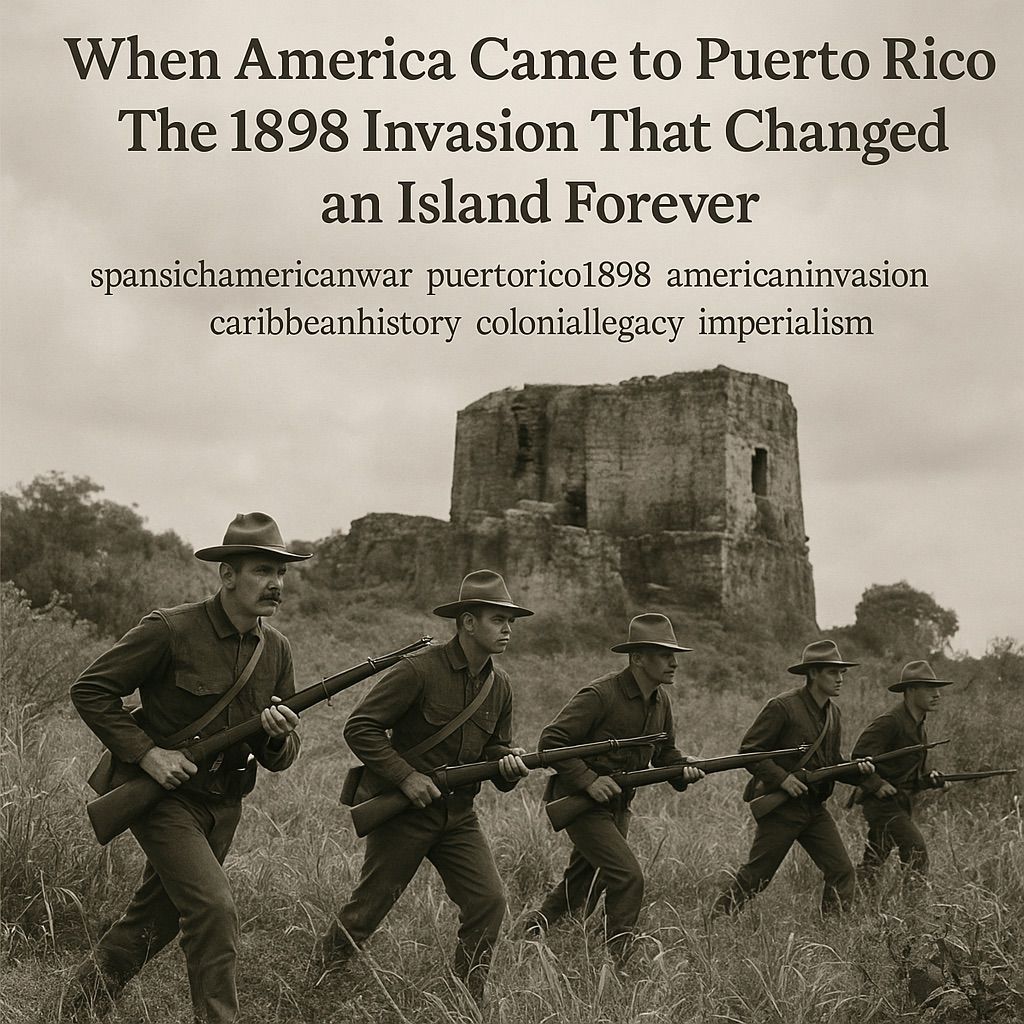
When America Came to Puerto Rico: The 1898 Invasion That Changed an Island Forever

Elias Rowen

The summer of 1898 was a time of fierce battles, rapid political shifts, and the assertion of American power beyond its mainland borders. On July 25, 1898, the United States launched a decisive invasion of Puerto Rico, a pivotal moment within the larger context of the Spanish–American War that would redefine the destiny of the Caribbean island and signal America’s emerging role as a global imperial power. This essay explores the complex causes, dramatic events, and long-lasting consequences of that invasion, bringing to life the voices of the soldiers, the islanders, and the politicians whose lives intertwined during this transformative chapter in history.

In the late 19th century, Puerto Rico was a Spanish colony caught in the turbulence of empire and revolution. Spain, once a dominant global force, had been steadily losing its grip on its American territories throughout the 1800s. The Cuban War of Independence, which began in 1895, ignited fervent anti-colonial sentiment throughout the Caribbean and intensified tensions between Spain and the United States. The U.S., motivated by a combination of strategic interests, economic ambitions, and a growing sense of Manifest Destiny, had been watching these events closely. The sinking of the USS Maine in Havana Harbor on February 15, 1898, acted as the immediate catalyst, sparking outrage and calls for war against Spain in the U.S. Congress.

The Spanish–American War officially began in April 1898, initially focusing on Cuba, but swiftly expanding its theater of operations to include other Spanish possessions such as Puerto Rico and the Philippines. Puerto Rico was viewed by American strategists as a key military and economic prize—a gateway to the Caribbean and a foothold for further expansion. The island’s location made it a strategic hub for controlling vital shipping lanes and asserting influence over the region. Despite the war’s relatively short duration, lasting only a few months, the invasion of Puerto Rico was a critical and dramatic episode that captured international attention.

The invasion force that arrived on Puerto Rican shores on July 25 was led by General Nelson A. Miles, a veteran soldier with a storied military career. His troops landed near the town of Guánica on the southwestern coast of the island. The American military objective was clear: to quickly secure the island, minimize resistance, and establish U.S. control. What awaited them, however, was a complex landscape of local loyalties, resistance fighters, and a population caught between two empires.

The Puerto Rican defenders, primarily composed of local Spanish troops and militia, were vastly outnumbered and outgunned. The Spanish military presence on the island was relatively small and ill-prepared to withstand a large-scale invasion. Nevertheless, the Puerto Rican population was deeply affected by the conflict, with many caught in the crossfire or forced to choose allegiances in a war not of their own making. Some Puerto Ricans hoped for liberation from Spanish rule and saw the Americans as potential liberators, while others viewed the U.S. forces with suspicion and fear of another colonial master.

The landing at Guánica was swift and met with little immediate resistance. American forces quickly advanced inland, securing key towns such as Ponce and Arecibo within days. The battles that followed were generally brief but sometimes intense, marked by skirmishes and the difficult terrain of Puerto Rico’s mountainous interior. The American military utilized its superior numbers and firepower to outmaneuver Spanish forces, who conducted a series of defensive retreats.

One of the most notable engagements during the invasion was the Battle of Asomante, where American troops encountered determined resistance amid the rugged hills near Ponce. Despite the challenges posed by geography and climate, the U.S. soldiers persevered, gradually consolidating their control over the island. The campaign was marked not only by military action but also by logistical challenges such as supply lines, tropical diseases, and the difficulties of maintaining morale in an unfamiliar environment.

While the military campaign unfolded, the political landscape was rapidly evolving. The Treaty of Paris, signed on December 10, 1898, formally ended the Spanish–American War. Under its terms, Spain ceded Puerto Rico, Guam, and the Philippines to the United States and relinquished its claim to Cuba, which became an independent republic under American influence. For Puerto Rico, the treaty marked a profound turning point—from centuries of Spanish colonial rule to becoming a territory of the United States.

The transition was far from smooth. Puerto Ricans now faced a new colonial reality under American administration. The U.S. established a military government that later gave way to civil rule, but political and cultural tensions remained high. Many Puerto Ricans sought greater self-governance, while American officials imposed policies aimed at assimilating the island into the broader U.S. system. Language, education, and economic reforms became battlegrounds for identity and autonomy. The Foraker Act of 1900, which created a civilian government, stopped short of granting full citizenship or voting rights, sowing seeds of frustration and resistance.

Economically, the American takeover brought both opportunity and disruption. The U.S. invested in Puerto Rico’s infrastructure, expanding roads, ports, and agriculture focused on cash crops like sugar. However, the island’s economy became increasingly dependent on American capital and markets, deepening inequalities and marginalizing local farmers. The island’s social fabric changed as new political parties emerged, voicing a range of views from independence to statehood.

The legacy of the 1898 invasion still resonates in Puerto Rico today. It marked the beginning of a complicated and ongoing relationship between the island and the United States—a relationship characterized by debates over identity, political status, and rights. Puerto Rico remains a U.S. territory, with its residents holding American citizenship but lacking full representation in Congress or the right to vote in presidential elections. The questions raised by the invasion—about sovereignty, colonialism, and self-determination—continue to fuel political discourse.

From a broader perspective, the invasion of Puerto Rico symbolized the United States’ arrival on the world stage as an imperial power. It was part of a wave of territorial acquisitions that extended American influence into Asia and the Caribbean, reshaping global geopolitics. The war itself, often overshadowed by later conflicts, was a significant moment of American expansionism and a harbinger of the 20th century’s global dynamics.

The human stories behind the military maneuvers reveal the complexity of war and empire. Puerto Rican civilians lived through fear, uncertainty, and the upheaval of their daily lives. Some welcomed the Americans as a promise of change, others mourned the loss of Spanish heritage and feared the erosion of their culture. Soldiers on both sides faced the harsh realities of combat in an alien land, bound by duty yet caught in a larger historical tide.

In examining the 1898 invasion of Puerto Rico, we gain insight not only into a military campaign but into the broader themes of power, identity, and colonialism. The event is a reminder that history is not just about dates and battles but about people’s lives shaped by forces beyond their control. It invites reflection on how past actions continue to influence present realities and future possibilities.

Today, Puerto Rico’s rich cultural heritage, vibrant communities, and resilient spirit stand as a testament to its history—marked by conquest but also by resistance and renewal. The island’s journey from Spanish colony to American territory is a story of transformation and enduring complexity, one that continues to inspire and challenge all who seek to understand the tangled legacy of empire and freedom.

July 25, 1898, remains a date etched in the collective memory of Puerto Rico and the United States alike—a day when the tides of history brought new rulers and new challenges, forever altering the course of an island and its people.

Related Posts

Famous Beaches Through Time

Dave

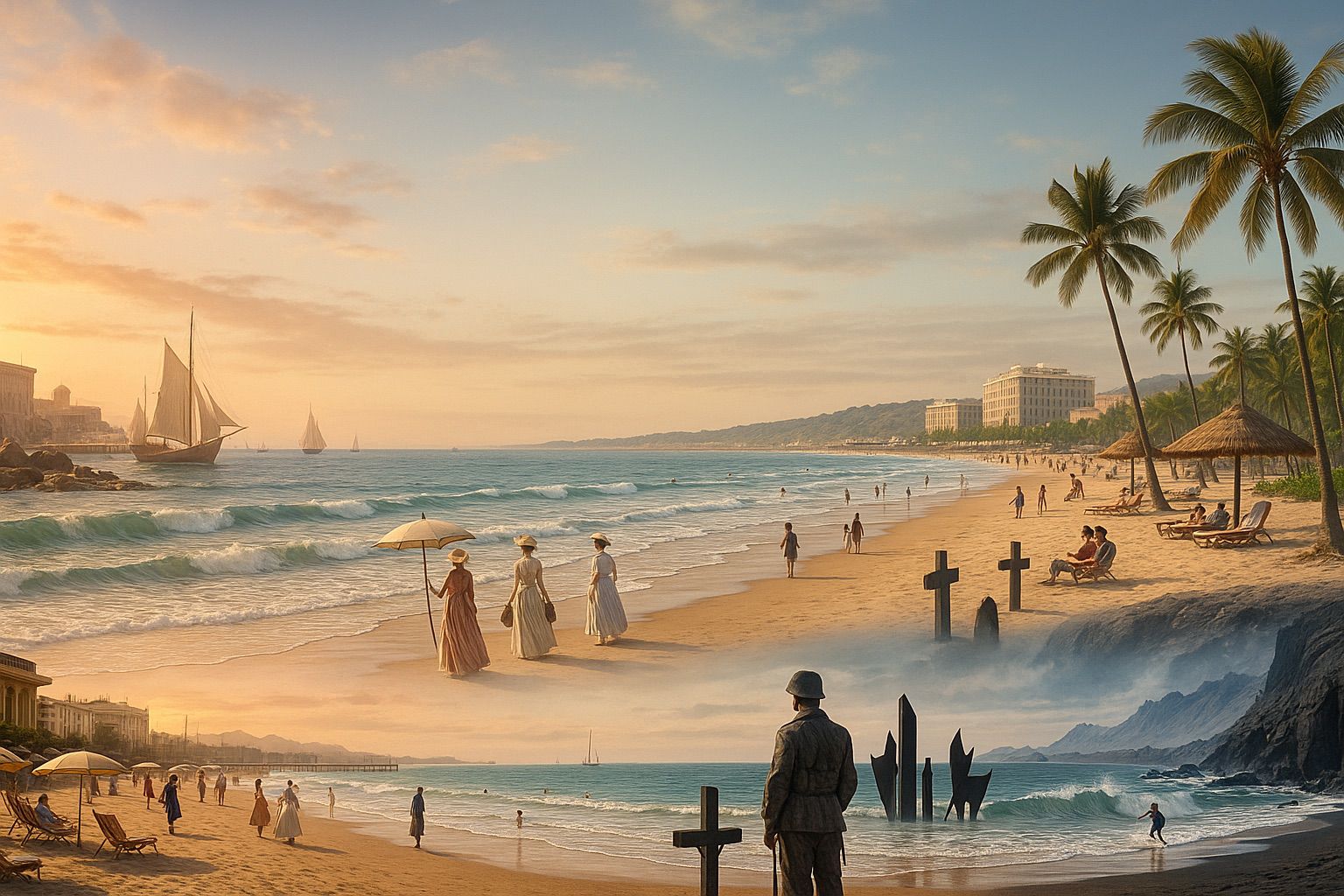
If you ask a coastline what it remembers, it won’t give you a list so much as a feeling: salt in the lungs, sun in the teeth, a thrum beneath the ribs that starts where the waves meet the sand and keeps going, century after century. Beaches have always been our porous borders—edges where we try on new identities, trade old anxieties for wet footprints, and leave the rest to the tide. Walk with me, then, along a long ribbon of shore that slips between time zones and centuries, where the same wind flips a Roman sail, a Victorian parasol, and a neon surf flag as if they were just different verses of the same song. There are famous beaches that everyone can name—Bondi, Waikiki, Copacabana, Ipanema, Venice Beach, the Côte d’Azur, Santa Monica, Brighton, the Amalfi coves—and there are beaches that belong to old myths and family photos and lost ticket stubs. Together they sketch the biography of leisure, survival, and style, a narrative written in shells and sunscreen and the scratch of a lifeguard’s whistle across heat-shimmered air.

Somewhere near the beginning, the Mediterranean cradled the idea of “shore” not as an ending but as a plaza—a place of exchange and arrival. Think of the beaches near Alexandria and Syracuse where fishermen knew the moods of the sea like a spouse’s face, and traders dragged their hulls up onto shingle bright as wet coins. The sand there overheard the first rumors of oranges from the east, glass that looked like frozen water, and philosophical arguments conducted with toes digging for coolness beneath the surface. On quiet mornings when the swell is lazy, the past still shows itself in glints: a fragment of amphora suddenly rolled into light, a smooth marble chip that feels like a secret. Farther west along the same inland sea, Capri’s coves and the Amalfi halos evolved from working inlets into postcards, proof that the beach could be theater, with cliffs as balcony seating and the turquoise stage set to eternal matinee. The Roman elite learned to pose against such backdrops; millennia later, movie stars would take notes. Fame on the beach, it turns out, is a tide too.

By the nineteenth century, Europeans had discovered that sea air might do for the spirit what tonics claimed for the blood. Brighton shifted from fishing town to wellness destination; the idea of the “bathing machine,” prim and strange as a wheeled wardrobe, toddled into the surf to protect modesty while promising vigor. On the promenade, top hats and crinolines traded side-eyes across sun-flicked water, and the notion of the beach as a democratic stage—where class mingles if only to watch each other—began to take hold. The Côte d’Azur polished this notion to glamour: Cannes and Nice built promenades like catwalks, and silhouette became currency. It mattered how you moved against the horizon line. Parasols flickered like rare birds. In sepia photographs, the sea looks almost shy, as if flattered by so much attention. But beneath the manners, the same ancient ritual unfolded: people walked toward the water to feel small in a way that felt big, then walked back up the sand feeling bigger in a way that felt true.

Across the world, the Pacific was discovering its own vocabulary for coastal fame. Waikiki, with its long, forgiving waves and the diamond headland like a guardian at the gate, incubated surf culture’s first legends. Duke Kahanamoku took a plank and taught it grace; soon the idea of riding the ocean rather than merely surviving it reoriented what the beach meant. Not just a place to sit and look, but a place to do— to carve, to dance, to flirt with momentum. The beach here became a school, and the lesson was balance: you and the water, you and the board, you and the sky—three notes making a kind of chord. Tourists came, inevitably, and left with salt-dried hair and a conviction that their lives needed more of this loosened time, this unplanned laughter. Waikiki kindness—beachboys launching strangers into waves like proud uncles—sparked a new archetype of coastal hospitality. Fame, at this latitude, tasted like pineapple and brine.

South again, to Australia, where Bondi Beach learned to be both casual and mighty. Early morning light lays a sheet of silver over the water, joggers fizz past, and the shark alarm is both a relic and a reminder that the stage has teeth. Bondi gave the world the modern lifeguard spectacle: zinc-smeared, red-and-yellow-capped figures whose vigilance is a constant bassline beneath the shrieks and naps and ice-cream trucks. Here the fame isn’t only glamour; it’s competence. The sand remembers resuscitations and rescues, the clear-eyed democracy of a rip current that doesn’t care how famous you are. The Bondi Icebergs Club—white concrete against blue infinity—hangs over the waves like a vow: we’ll be here in winter, too, when it hurts a little, because cold can also be a kind of clarity. Ask any dawn swimmer. The most famous beaches, Bondi insists, are the ones that keep a pact with the sea rather than just a brand strategy.

In Brazil, Copacabana and Ipanema perfected the idea of the beach as boulevard. The mosaic promenade swirls underfoot—a black-and-white river that mirrors the real one beside it—and bodies glide from sun to shadow like punctuation marks. Here the sand is not a buffer between city and ocean but a living room where a metropolis comes to sprawl. Music shakes out of coolers. Volleyballs arc against a sun so bright it might be in on the fun. “Garota de Ipanema” may have given the myth a soundtrack, but what made the beaches famous was their alchemy: people brought their best selves to the water and the water, amused and indulgent, made those selves better. The hills look on like parental chaperones pretending not to be charmed. And yet, even in this carnival of ease, history keeps an eye open: political rallies, national griefs, New Year’s rituals that put hundreds of thousands of bare feet into the surf at once to meet the future with foam at the ankles. Copacabana’s fame has a pulse you can count with your fingers.

On the American west coast, Venice Beach and Santa Monica reimagined the shoreline as an outdoor studio where everything from body-building to roller-disco could find its light. Muscle Beach flexed toward the camera; skateboards ticked a metronome across the day. The pier, part amusement park and part compass needle, pointed toward a horizon that Americans traditionally read as promise. Inland heat rolled downhill, collided with marine layer, and produced a mood—the kind that makes you believe you might try acting, or stand-up, or at least a new haircut. Fame here is performative, yes, but also participatory; on any given afternoon, someone will offer you a hoop to try, a board to wobble on, a beat to step into. The beach whispers the oldest advice in the world: play. Even if you fall, the sand forgives.

There are beaches that are famous without being easy. The Normandy coast, serene under a pastel sky, holds a silence that is heavy with names. The tide doesn’t judge; it simply does its ancient work, folding and unfolding the map of the day. Yet every grain here is a witness. People walk from the car park to the waterline with the peculiar hush of a museum, their shoes making a sound like turned pages. A child might find a smooth steel fragment that once mattered terribly and now is nothing more than strange. Fame here is a duty: to remember that the beach is not just leisure but a line where history slams into the present with the force of weather. Later, back in town, someone orders mussels, someone else laughs too loudly—it is life’s right, after all—but the wind that comes off the Channel carries a sternness like an old teacher: learn this, keep it.

Then there are strange beauties that became famous because they are themselves, stubbornly and out loud. The black sands of Reynisfjara in Iceland, for example, where basalt stacks stand like chess pieces built by a god who got distracted mid-game. The Atlantic here is not sociable; sneaker waves take what they want, and the warning signs are serious for a reason. Photographers come for the mood—the sky like graphite, the spray white as chalk dust—and leave talking about humility. Fame, in such places, acts like a flare: Come look, but come carefully. The beach is not your prop; you are its guest. In the Seychelles, meanwhile, granite boulders smooth as sleeping whales scatter themselves across water so clear it makes your eyes thirsty. La Digue’s Anse Source d’Argent has been on more calendars than your dentist, but the real seduction is tactile: the way tide and rock hold hands, the way shade and sun tile the shallows into a thousand small vacations.

In the Caribbean, Seven Mile Beach in Negril learned to be both hush and party, a sheet of powder-white that teaches you the meaning of “lilt.” The water is so calm it feels domesticated, as if taught manners by generations of easy afternoons. Chop recites itself on the reef, and snorkeling faces come up with delighted gasps that turn into rum orders by evening. Fame here wears a smile, sunlight at its teeth. Meanwhile, Varadero, Turks and Caicos, Grace Bay—names that sound like postcards—chase perfection as if it were a sport: water at exactly the right temperature to delete complaint, breezes pre-salted with joy, sand as fine as an apology. The fame of these places is partly algorithmic, boosted by drone shots and influencers’ toes; but the reason it sticks is older: this particular blue, this unambiguous ease. Even your cynicism loosens its tie and orders another coconut.

Asia’s great beaches meanwhile stretch fame along different lines of history. On Boracay in the Philippines, the powder is so immaculate it squeaks underfoot, like fresh snow in summer drag. After over-tourism bruised the island, closures and careful stewardship reminded the world that fame can be renegotiated; the beach, if loved properly, can reset. Thailand’s Maya Bay, cast in movie-light by “The Beach,” became a victim of its own charisma and then a case study in marine rehabilitation: coral nurseries, limited access, a choreographed second chance. Fame can be a teacher, too, if it admits mistakes. On Bali’s Kuta and Uluwatu, surfers slide along the edge of rituals; incense from a cliffside temple drifts across waxed decks, and the collision of the sacred and the salt feels less like a clash than a chord. Here, to be famous is to be woven into a fabric—ceremony, commerce, and the tide loom it together every day.

Africa’s shores carry stories as profound as any scripture. Along Cape Town’s Camps Bay, the Twelve Apostles mountain range leans in close as if to listen, and the Atlantic, cold and strict, keeps bathers brief. Penguins waddle around Boulders Beach in tuxedoed disbelief that such water could be for play. To the east, Zanzibar’s stone-town shore organizes itself around the falling and rising of dhows, sails sharp as jawlines. Much of this fame remains underwhispered in global itineraries, but the beaches keep their own metrics: the smell of cloves drifting down to the tide, the hush that sweeps a crowd when bioluminescent waves spark at night like neon spilled on velvet. Fame is sometimes a word we use when we mean “finally noticed,” and the beaches of a thousand coasts have been practicing their excellence in anonymity for longer than our passports have had staples.

Even beaches born in tragedy make their way into the world’s registry of essential places. In Indonesia and Japan, where tsunamis rewrote shorelines in minutes, the sand is not the same as before; neither are the people. Memorials rise in places where laughter did, and then—slowly, tentatively—laughter returns, a fragile flag reclaiming wind. The fame that follows is reverent: not a recommendation but a bow. Visitors come to stand, to look, to say nothing, to drop a flower into the push and pull. If there is wisdom here, it is the kind that doesn’t announce itself: coasts teach resilience by being both utterly mutable and utterly constant. The waves erase, but they also insist. The next day comes, and with it the daily unspooling of foamy lace.

What, then, makes a beach famous? Partly it’s the photographs, of course: the curl of a wave captured at the golden fraction of its roar, a silhouette at the shore’s brink edited into myth. Partly it’s the infrastructure—piers and promenades and bars with cold things in them—and the way cities decide to turn toward (or away from) their water. Partly it’s the stories we carry: a first kiss wearing a crown of salt, a long talk with a parent while seagulls heckled, a solo walk in a lonely season when the beach was the only place big enough to hear you. Fame can be earned by spectacle, but it can also be bestowed by intimacy; enough small personal legends braided together and suddenly the beach belongs to the world. The hashtag era just gives us a faster loom.

There is also the matter of change. Beaches are made to move—sand migrates, shorelines sigh, underwater canyons reorganize how waves arrive. The places we love most have seasons even when the weather doesn’t: a morning beach and a midnight beach are as different as siblings. The famous ones adapt under the camera’s gaze. Venice Beach gets a new trick, Waikiki stays generous even as boards go carbon, Copacabana keeps dancing between sorrow and samba, Bondi refines the choreography of safety. Locals grumble, as locals must, about crowds and prices and the fact that someone is always leaving trash behind. But when the sun’s angle leans toward the water and the whole world seems to be made of moving light, even the grumblers go quiet.

If you stand far enough back on the sand—any famous sand—you see a democracy of small gestures: a mother reapplying sunscreen with the tenderness of a painter; a teenager trying and failing and trying again to pop up on a wave; an older couple sitting with their knees touching lightly, bright towels folded like flags beneath them; a vendor balancing impossible architecture on his head—hats on hats on hats—calling out in a cadence that belongs to this latitude; a lifeguard scanning, scanning, scanning, like a lighthouse made of bone. The larger drama of the beach—weather, crowd, tide—flows through these small moments like current through a net. We are our best selves here not because we have escaped responsibility but because the horizon complicates it; under that long line, we remember how to belong to something without owning it.

Children don’t care about fame, of course. They care about sand’s engineering properties and the way seaweed feels like alien hair and the discovery that if you run out of things to do you can just run. That is where beach legend starts: in thin legs churning, in squeals that make gulls jealous, in the first time a child tastes the ocean and makes a face they’ll make again forty years later when a lover surprises them. Adults chase a more complicated magic—nostalgia plus novelty, relaxation with just enough hazard to make it taste real. Famous beaches understand this and set their stages accordingly: a stretch of calm for floating, a pocket of rocks for exploring, a reef for the brave, shade for the sensible. The choreography is old; the cast keeps changing.

One could argue that a truly famous beach does more than host; it shapes. Santa Monica made fitness a kind of civic virtue. Bondi built a religion out of vigilance and community. Waikiki taught the world to stand on water with a grin. The French Riviera wrote a fashion grammar from which we still borrow every summer: stripes and straw, linen that pretends not to care about wrinkles. Copacabana demonstrated how a promenade could be a national mood ring. Brighton invented the seaside weekend and, in so doing, gave Monday a rival. These legacies ripple outward. A lake beach in a small town halfway across the world borrows a lifeguard protocol from Australia, a snack-bar menu from California, a sunscreen habit from wherever social media staged its last argument, and the children there never know they are participating in global coastal culture. They are simply happy, comme il faut.

Fame, of course, attracts problems. Overcrowding, coral stress, erosion accelerated by infrastructure, trash that tells on us. The very act of going to see a place because everyone goes to see it can injure what we loved in the first place. Yet the story isn’t doomed. Famous beaches are learning words like “carrying capacity” and “reef-safe” and “dune restoration.” Maya Bay closed and reopened with new rules; Boracay reset; dozens of coasts now recruit their visitors into stewardship with the shameless charm of a lifeguard whistling at you and then handing you a bag for your litter. The ocean, patient but honest, grades our efforts in real time. When turtles nest again, when water clarity returns, when seagrass oscillates in healthy bands, the beach smiles without lips. And we, for once, earn our tickets.

At twilight, fame quiets. The day’s freckles—the umbrellas, the tans, the confetti of swimsuits—fade into silhouettes. Lamps blink awake along the boardwalk. Music recedes or deepens, depending on the beach’s personality. Fishermen claim their hours; couples walk with a slowness that suggests the day will not end until they agree it has. Tourists fall for that old trick where the sky acts like it’s about to end the show and then builds an encore so extravagant that strangers applaud, actually applaud, at color. Night beaches reinvent themselves: bonfires make constellations at ground level, phosphorescence scribbles a secret alphabet in the foam, and the horizon becomes an idea more than a line. Even the famous ones become simply themselves. You could be anywhere; you are exactly here.

To walk along famous beaches through time is to flip through a family album that belongs to everyone. The pictures are not always of you, but you recognize the gestures, the jokes, the songs. The same exhale occurs whether the view is Amalfi or Anse Lazio, Brighton or Bells, Bondi or Búzios. The beach teaches us to arrive and to leave—skills we never quite master in the rest of life. It gives us a little theater to practice courage, kindness, attention. It tells us, with the tact that only waves possess, that our footprints matter and also vanish. And it invites us, every time, to return—not to the same spot, necessarily, but to the same conversation with a moving edge: Who are you today? What will you let go of? What will you hold like a shell against your ear and listen to until it becomes music?

So when we say “famous beaches,” let’s mean more than rankings and reels; let’s mean shores that have entered the common language of joy, grief, adventure, flirtation, rest. Let’s mean places that do what all great public spaces do: they host us, change us a little, and send us back better. Stand at any of them—Bondi at dawn, Copacabana at New Year’s, Waikiki under a lazy trade wind, the Côte d’Azur at a leisurely blue hour, Brighton in a stiff breeze with chips balancing on your knee—and you will sense how many lives the sand is holding up at once, like a hand under water cupping a school of darting silver. That’s the trick of beaches: they are one place that is also many. They belong to emperors and children, to influencers and ghosts, to big history and tiny afternoons. And when you leave, salt in the creases of your life, you carry a little piece of that fame back into your not-so-famous day, where it does quiet, durable work: it reminds you how to breathe.

Related Posts

The Rediscovery of Machu Picchu and the Journey That Changed History

Elias Rowen

On July 24, 1911, amidst the dense jungles and perilous slopes of the Peruvian Andes, an American academic named Hiram Bingham stumbled upon something that would astonish the world. Hidden under centuries of moss, fog, and vines stood an ancient city in the clouds—majestic, ghostly, untouched. Machu Picchu, once a whisper in Quechua legends and little more than a mystery in the Western imagination, emerged into the global spotlight. Its terraces climbed the mountain like a green staircase to the heavens. Its stone temples, astronomically aligned, whispered stories of an empire long gone. In that moment, the modern world was reintroduced to the genius of the Inca civilization, and Hiram Bingham became its unlikely herald. Yet, as with all great discoveries, the story is layered—with ambition, awe, appropriation, and a search not just for ruins, but for meaning. This is the human story of that rediscovery, and the ripples it cast through history, science, and cultural identity.

Before we go back to that fateful day in 1911, we must first understand what Machu Picchu was, and what it meant to the people who built it. Constructed in the mid-15th century under the reign of the Inca emperor Pachacuti, Machu Picchu was not a mere settlement. It was a citadel, a ceremonial hub, perhaps even a royal estate. Suspended between the peaks of Huayna Picchu and Machu Picchu mountains, the site is strategically positioned both for defense and for spiritual significance. The Incas, master stone masons and astronomers, aligned their structures with solstices and constellations. Their walls fit so precisely that not even a blade of grass can slide between the stones. This was not random architecture; it was sacred geometry, a fusion of earth and cosmos.

Despite its grandeur, Machu Picchu was never found—or at least not understood—by the Spanish conquistadors. When Francisco Pizarro and his men decimated the Inca Empire in the 16th century, they never laid eyes on the sanctuary above the clouds. Perhaps that was Machu Picchu’s salvation. As cities like Cusco and Lima fell under colonial rule, Machu Picchu quietly receded into obscurity, swallowed by the forest, remembered only in whispers by local Quechua communities who revered it as part of their sacred geography. By the late 19th and early 20th century, it was all but forgotten in Western maps, a legend waiting to be reborn.

Enter Hiram Bingham, a Yale professor with a background in history and a penchant for adventure. He was not an archaeologist by training—his specialty was Latin American history—but his heart burned with a romantic vision of uncovering lost civilizations. Inspired by tales of El Dorado and the last Inca stronghold of Vilcabamba, Bingham set out in 1911 on a Yale-sponsored expedition to search the jungles of Peru. With him were local guides, a military escort, and an ambition that outpaced the limits of cartography. His journey was arduous—mud-slicked trails, stifling humidity, venomous insects—but Bingham pressed on, fueled by fragments of lore and the adrenaline of the unknown.

On the morning of July 24, Bingham was led by a local farmer named Melchor Arteaga along a narrow trail winding up the ridge. The path was steep and treacherous, clinging to cliffs like a thread on a tapestry. When they reached the top, a young boy from the local area guided him through the dense foliage. What lay beyond the veil of vines took Bingham’s breath away. Stone terraces cascaded down the mountainside. Temple walls, though moss-covered, stood firm against centuries of time. Towers and dwellings rose like ghosts from the forest. Bingham had found something extraordinary.

Initially, he believed he had discovered Vilcabamba—the last refuge of the Incas during the Spanish conquest. But in time, it became clear that Machu Picchu was something else entirely. Unlike Vilcabamba, which had been an active resistance center, Machu Picchu bore no signs of siege or destruction. It was serene, abandoned, pristine. Its location, so remote and inaccessible, had likely spared it from the ravages of war and conquest. Bingham, awestruck and overwhelmed, called it “the finest example of Inca civilization” and began documenting, excavating, and publicizing the site with fervor.

The story of Machu Picchu’s “discovery” spread like wildfire through international media. Newspapers hailed Bingham as a modern-day Indiana Jones. National Geographic dedicated its entire April 1913 issue to Machu Picchu, igniting a global fascination with Incan culture and Andean history. Soon, academics, tourists, and adventurers turned their attention to Peru, retracing Bingham’s path in search of mystery and meaning.

But the discovery was not without controversy. Bingham, backed by Yale and supported by the Peruvian government at the time, removed thousands of artifacts—ceramics, tools, human remains—for study in the United States. For decades, these items remained in Yale’s possession, leading to a long-standing dispute between Peru and the university. Only in recent years have many of these artifacts been returned, part of a broader reckoning with the colonial legacy of Western archaeology.

Beyond the politics, the rediscovery of Machu Picchu reshaped how the world saw the Inca civilization. For centuries, the prevailing narrative had painted the Incas as technologically inferior, their achievements overshadowed by their sudden fall to Spanish steel and disease. Machu Picchu challenged that view. It revealed a society capable of extraordinary architectural sophistication, deep astronomical knowledge, and harmonious integration with their environment. The site stood as a silent rebuke to the notion that only European or classical civilizations could produce wonders.

Machu Picchu also sparked a cultural revival within Peru. Indigenous communities, long marginalized, began to reclaim pride in their heritage. The Quechua language saw a resurgence. Folklore and traditions gained new visibility. The site became not just a tourist destination, but a symbol of national identity—proof that Peru’s roots were deeper and more glorious than colonial history had acknowledged.

For Hiram Bingham, the discovery became the defining moment of his life. He went on to serve as a U.S. Senator, wrote books detailing his expedition, and basked in the fame of his find. Yet, he remained haunted by Machu Picchu, always yearning to understand its secrets. Despite decades of study, the purpose of the city remains a puzzle. Was it a royal retreat? A spiritual sanctuary? An agricultural laboratory? Or all of these? Every carved stone seems to hint at something more, some cosmic riddle woven into the architecture.

Standing at Machu Picchu today, one can’t help but feel the weight of both time and silence. The mountains loom like guardians. Clouds drift over stone temples with the grace of old spirits. Llamas graze where once nobles walked. The sun, when it pierces the mist, strikes the Intihuatana stone—the “hitching post of the sun”—in precise alignment with ancient solstices. It is a place of serenity, yes, but also of questions. Why was it abandoned? Why was it never finished? And what does it mean that it was forgotten for so long?

Perhaps that is Machu Picchu’s ultimate lesson—that even the greatest human achievements can be swallowed by time, and only rediscovered when the world is ready to listen again. Its survival was accidental, its rediscovery a mix of luck, ambition, and courage. But its meaning continues to evolve, as each generation projects its own dreams onto the stones. For scientists, it’s a marvel of engineering. For Peruvians, it’s a source of pride. For travelers, it’s a bucket-list destination. And for the world, it’s a reminder that the past still holds mysteries capable of humbling the present.

More than a hundred years after Bingham climbed that mountain, Machu Picchu still speaks. Not in words, but in silence, in symmetry, in stone. Its terraces are poems carved into earth. Its temples are prayers frozen in architecture. Its rediscovery in 1911 was not just the unveiling of a forgotten city, but the beginning of a global reckoning with the complexity and brilliance of the Inca world.

The journey of Hiram Bingham—from professor to explorer, from historian to legend—was never just about finding a lost city. It was about touching the past, listening to its heartbeat, and letting it change the rhythm of the present. And on July 24, 1911, the clouds parted just enough for the world to remember what it had nearly forgotten.

Related Posts