Latest Articles

The Irresistible Journey of the Swimsuit

Dave

Oh, darling, let’s slip into something more comfortable—preferably made of quick-dry fabric—and take a long, lingering stroll through the steamy, sun-dappled history of the swimsuit. It’s a story that’s part fashion evolution, part cultural rebellion, and part unabashed flirtation with the limits of what’s “decent.” And like any great romance, it began with a little bit of shyness, grew bold with time, and eventually decided that modesty was optional when the beach beckoned.

Our tale begins in the prim and proper 1800s, when the mere thought of a woman’s ankle flashing in public could spark a scandal worthy of gossip columns. Back then, “swimwear” was less about sun-soaked seduction and more about… well, not drowning under the weight of your own clothes. Women wore bathing dresses made of heavy wool—yes, wool, the least sexy and most suffocating fabric known to humankind—paired with stockings, bloomers, and even full-on corsets. Imagine wading into the water swaddled in something that could double as an overcoat, while the men sported striped one-piece suits that looked suspiciously like prison uniforms. The only thing these ensembles revealed was that the Victorians had a serious aversion to tan lines.

But the early 20th century was feeling cheeky. The flirty spirit of the Roaring Twenties shook off the dust of propriety and introduced the world to swimsuits that showed—gasp!—knees. It was scandalous enough to cause fainting spells among the more fragile sensibilities, but it also sparked an intoxicating taste for freedom. Swimmers like Annette Kellerman, a daring Australian who famously wore a fitted one-piece in public, challenged the rules and even got herself arrested for indecency. But my, oh my, she also set a precedent that the swimsuit could be not only functional but alluring. Think of her as the pin-up girl of the swimming pool before pin-ups were even a thing.

By the 1930s, swimsuits had shed a few more inches of fabric, and the beaches were looking more like a flirtation zone than a moral battleground. Materials like Lastex (a rubber-yarn blend) made suits cling in all the right places, and sweetheart necklines, ruching, and halter straps turned seaside attire into something tantalizing. Men, meanwhile, ditched their modesty panels and started showing more thigh, perhaps realizing that a little skin in the sun could work wonders for their appeal.

And then came 1946. Ah, the year the world fell head over heels for the bikini. Invented by French designer Louis Réard, the bikini was a two-piece that dared to bare the midriff, and its debut caused a sensation akin to fireworks on Bastille Day. Réard named it after Bikini Atoll, the site of atomic bomb testing, claiming it would have the same explosive impact on the public. He wasn’t wrong. The first bikini model was a Parisian nude dancer, because, as Réard cheekily put it, no “respectable” model would wear such a revealing garment. But society has always had a soft spot for the bold, and soon enough, Hollywood bombshells like Brigitte Bardot and Ursula Andress turned the bikini into an object of mass desire.

The 1960s and ’70s rode that wave hard. The bikini got smaller, sexier, and more diverse in design—triangle tops, string ties, bandeaus—while the cultural revolution gave everyone permission to flaunt it. The sexual liberation movement turned the swimsuit into a political statement: “My body, my choice, my swimsuit.” Suddenly, the beach became a catwalk of liberation, where minimal coverage equaled maximum confidence.

Of course, the 1980s had to go and turn up the drama. Think neon colors, high-cut legs, and one-pieces that could make your hips look like they went on for miles. The Baywatch era brought the iconic red lifeguard suit, which was less about saving lives and more about making hearts stop. Lycra and spandex clung to every curve, creating silhouettes so sharp they could cut glass. It was bold, it was sexy, and it was unapologetically over the top.

By the 1990s and 2000s, swimsuits had gone global in style influence. Brazilian cuts sashayed into the mainstream, cheeky bottoms made waves, and tankinis offered a middle ground for those flirting with the idea of baring it all but not quite ready to commit. The Y2K era brought metallic fabrics, embellishments, and designs that looked just as good lounging poolside with a cocktail as they did in the surf.

And here we are in the 2020s, where the swimsuit is more than a garment—it’s a declaration. Designers are blending sensuality with sustainability, proving you can make hearts race without making the planet sweat. Recycled nylon, eco-friendly dyes, and ethically made swimwear are the new sexy. And inclusivity is finally stealing the spotlight: brands are embracing every body type, skin tone, and gender expression, because desire is as diverse as humanity itself. Swimsuits today aren’t just about seduction—they’re about celebrating the whole spectrum of beauty, unapologetically and with a wink.

What’s delicious about this journey is how the swimsuit has always reflected our collective flirtation with the idea of freedom. From wool-covered ankles to barely-there microkinis, each stage has been a little tease, a little dare, a little whisper that maybe, just maybe, we’re ready to show the world exactly who we are—sun-kissed, salt-water tousled, and utterly irresistible. The beach has never been just about swimming; it’s a stage for performance, a playground for the bold, and a canvas where desire and style paint together under the sun.

So the next time you slip into your swimwear—whether it’s a retro-inspired one-piece or a barely-there bikini—remember, you’re not just putting on fabric. You’re stepping into over a century of evolution, rebellion, and romance. You’re part of a love affair between body and water, style and skin, modesty and mischief. And sweetheart, that’s one relationship that will never go out of style.

Related Posts

The Egyptian Revolution of 1952

Elias Rowen

July 23, 1952, was not just the dawn of a new day in Cairo—it was the awakening of a nation long stifled under monarchy, colonialism, and corruption. As a revolution surged through the heart of Egypt, it did not erupt with wild chaos, but with strategic precision. Tanks rolled silently through Cairo’s arteries, the radio stations crackled to life with revolutionary declarations, and whispers of the Free Officers movement filled homes with a new kind of electricity. That day marked the start of a revolution that would overthrow King Farouk, end British dominance, and birth a republic out of the ashes of an exhausted kingdom. But it was more than a political shake-up. It was the genesis of modern Arab nationalism, a cultural and ideological shift that would ripple across the Middle East and into the fabric of the 20th century.

To understand the Egyptian Revolution, you must first understand the Egypt that birthed it. The Egypt of the 1940s and early 1950s was a land of contradictions. On one hand, it was rich in culture, pride, and ancient legacy. On the other, it was shackled by a monarchy widely seen as decadent and detached from its people, and by the lingering influence of British colonialism. Though Egypt had technically achieved independence in 1922, British troops remained entrenched, especially in the Suez Canal Zone, guarding British interests under the guise of cooperation. The ruling elite lived in a world far removed from the streets of Cairo and Alexandria, sipping imported liquor behind palace walls while the majority of Egyptians struggled in poverty.

King Farouk, the last reigning monarch of the Muhammad Ali Dynasty, had inherited a throne weighed down with resentment. His image—once hopeful—deteriorated rapidly in the public eye. Known for his excessive spending, obsession with European luxury, and womanizing, Farouk came to symbolize everything that was wrong with the status quo. More damning was his government’s corruption and inability to respond to the dire needs of its people. When British forces were attacked by Egyptian nationalists and responded with brutal crackdowns, Farouk’s failure to act decisively made him appear both complicit and cowardly.

The final nail in the coffin of his reign was the 1948 Arab-Israeli War. Egypt’s embarrassing defeat left deep scars, not only in military terms but in national pride. The people began to see their army, long revered, as humiliated and poorly led. Behind closed doors, many young military officers seethed. Among them was a man named Gamal Abdel Nasser—a charismatic thinker, quietly gathering like-minded officers who would form the backbone of the revolution.

These men, later known as the Free Officers, came from humble backgrounds. They were not aristocrats or foreign-educated elites; they were the sons of workers, clerks, and farmers. Their leader, Nasser, had grown up in Alexandria and witnessed firsthand the deep divides of Egyptian society. He and his comrades—including future president Anwar Sadat—believed in pan-Arab unity, independence from foreign domination, and a society based on merit rather than class. They were young, idealistic, and increasingly convinced that the only way to break Egypt’s chains was through direct action.

What made the Egyptian Revolution unique was its almost surgical execution. Unlike other revolutions steeped in bloodshed and prolonged war, this one unfolded in less than 24 hours. On the night of July 22, 1952, while Cairo slept, the Free Officers quietly began their plan. By dawn on July 23, military units had taken control of key installations—radio stations, government buildings, the police. At 7:30 a.m., an announcement came over the radio: General Muhammad Naguib, the nominal figurehead of the movement, declared the end of the monarchy. The revolutionaries promised to clean up corruption, restore dignity to the army, and protect the sovereignty of Egypt.

What followed was astonishing. The people of Egypt, tired of false promises and royal indifference, embraced the change with open arms. There were no mass arrests of civilians, no chaotic clashes in the streets. The military acted swiftly, but with restraint. When King Farouk was forced to abdicate and sail into exile aboard the royal yacht Mahroussa, the revolution had already won the public’s heart. Nasser insisted that Farouk be spared—a move that earned the revolution additional credibility at home and abroad.

But the revolution’s true challenge began after the throne was empty. Power struggles emerged among the officers. General Naguib, respected and elder, was the face of the revolution but not its soul. That role belonged to Nasser. As months turned into years, Nasser gradually sidelined Naguib and consolidated power, ultimately becoming president in 1956. Under his leadership, Egypt transformed. He nationalized the Suez Canal, implemented sweeping land reforms, and began to craft a vision of Arab socialism that inspired leaders across the Middle East and North Africa.

Nasser was not without flaws. His rule became increasingly authoritarian. Political opposition, including communists and the Muslim Brotherhood, was crushed. The media was tightly controlled. Prisons filled with dissidents. Yet, for millions of Egyptians, Nasser was a hero—the man who stood up to colonial powers, who gave voice to the voiceless, who dreamed of a unified Arab world.

One of the defining moments of his leadership came in 1956 during the Suez Crisis. After Egypt nationalized the Suez Canal, Britain, France, and Israel launched a military intervention. It was a humiliating episode for the Western powers—not because of their military might, which was formidable, but because of the backlash. The United States and the Soviet Union—strange bedfellows in this scenario—forced the invaders to withdraw. Nasser emerged as a symbol of anti-imperialist defiance. His speech to a roaring crowd, defiant and proud, became a cornerstone of Arab nationalism.

Domestically, the post-revolution period was a mixed bag. Land reform aimed to break the stranglehold of feudal landlords and redistribute land to peasants, but implementation was slow and uneven. Education expanded, and industrialization became a cornerstone of national policy. Yet, economic difficulties and bureaucratic mismanagement persisted. Egypt modernized, but at a cost. A one-party system replaced the old monarchy, and while the trappings of democracy existed, real opposition was not tolerated.

Still, the symbolism of the revolution was too powerful to ignore. For the first time in centuries, Egypt was ruled by Egyptians for Egyptians. It was no longer a pawn in the hands of empires. The ripple effect of July 23 was immense. Across the Arab world, from Syria to Algeria, revolutionaries saw in Nasser a model for their own struggles. He was not just a politician; he was a movement. Arab nationalism—once a vague cultural idea—now had a face, a voice, and a flag.

Yet, as with many revolutions, the fervor of 1952 could not sustain itself indefinitely. By the late 1960s, cracks began to show. Egypt’s disastrous defeat in the 1967 Six-Day War against Israel dealt a crushing blow to Nasser’s prestige. His dream of Arab unity was left in tatters. Though he remained in power, the weight of failure began to age him rapidly. When he died suddenly of a heart attack in 1970, millions poured into the streets to mourn—not just the man, but the dream he embodied.

The legacy of the 1952 revolution remains contested. For some, it was the beginning of Egypt’s modern identity—a necessary break from colonialism and monarchy. For others, it marked the start of authoritarianism under the guise of populism. But perhaps both can be true. Revolutions are rarely clean. They are born of hope, but often bear the scars of compromise. Egypt in the decades since has continued to grapple with its revolutionary DNA—sometimes embracing it, sometimes rejecting it.

In the uprisings of the Arab Spring in 2011, when millions once again flooded Tahrir Square demanding freedom, echoes of 1952 rang in the air. The faces were younger, the demands more nuanced, but the soul of rebellion was unmistakable. They too sought dignity, justice, and a voice. They too faced the challenge of building a future from the wreckage of the past.

What began on July 23, 1952, was more than just a coup. It was a statement. It said that Egypt would no longer be dictated to by kings or colonizers. It said that ordinary men, when united by conviction and vision, could shake the foundations of history. The tanks that rolled silently through Cairo that morning didn’t just change the regime—they changed the story Egypt would tell itself for generations to come.

Today, the legacy of the revolution lives in monuments, in speeches, in textbooks, but also in the questions that Egyptians still ask: What does true independence look like? Can freedom and stability coexist? And how do you honor a revolution without repeating its mistakes?

These are the questions that continue to haunt and inspire a nation forever changed by that fateful morning in July. For in the heart of every Egyptian beats the rhythm of that revolution—not just in the memory of what was, but in the enduring hope of what still could be.

Related Posts

Swimwear You’ll Fall in Love With (and Your Ocean Will Thank You For)

Dave

There’s something deliciously intimate about slipping into a swimsuit that feels like it was made just for you — the way the fabric drapes, the subtle lift, the tiny secret of confidence tucked into a seam. Now imagine that same thrill braided with a softer promise: that the suit hugging your skin also kept a fishing net from choking a coral reef, or that the dye on its surface wasn’t paid for in polluted rivers. That’s the heart-skip of sustainable swimwear — equal parts flirtation and conscience — and it deserves to be worn, admired, and whispered about in changing rooms and on boardwalks. Sustainability in swimwear feeds the same impulse that makes someone whisper into your ear: “I thought of you when I chose this.” It’s personal, considered, and, yes, a little seductive.

Let’s start with the names that make your heart skip like the first warm day of spring. Outerknown, the surf-born brand co-founded by Kelly Slater, offers pieces made with regenerated ECONYL® — a yarn spun from reclaimed nylon, including abandoned fishing nets and industrial waste. When you slide into something from their collection, you’re not only choosing a flattering cut; you’re choosing material that’s been rescued from a future landfill and remade into something playful and resilient. That reclamation story — a dirty old net becoming a bikini that hugs your hips — is oddly romantic: a phoenix story for polyester.

Patagonia, the brand that’s practically the Greenpeace of outdoor gear, brings that same stubborn durability and care to swim and surf pieces. Their swimwear lines lean hard into recycled materials and fair-trade practices — garments that were engineered to last seasons rather than a single Instagram moment. There is something quietly alluring about a suit that refuses to play fast and disposable: it tells the world you prefer depth to flash. Wearing Patagonia to the water signals you’re someone who plans to come back — to this beach, to this shoreline — again and again.

If splashy prints are your love language, Mara Hoffman gives you guiltless glamour. Hoffman has pushed the envelope — not only in saturated palettes and painterly designs, but in moving toward bio-based and recycled fabrics, even experimenting with wood-pulp derived textiles that mimic the stretch and resilience we expect from modern swimwear. There’s a flirt in the way her pieces parade color and pattern, but beneath that fun is a serious devotion to rethinking what luxury can, and should, mean. That tension — between showstopper beauty and thoughtful craft — makes her suits dangerously desirable.

But let’s pause for a human moment: I once tried on a one-piece whose print made me look like a sun-dappled siren, and the label whispered that it was made partly from recycled fishing nets. For a second I felt like Poseidon’s eco-conscious cousin: both powerful and responsible. That tiny fact — recycled fibers, fairer factories — does something to the chemistry. It turns ordinary vanity into a small, sweet act of care. It’s flirtation with a conscience, and I’ll admit: it’s intoxicating.

Across the field of designers and indie studios, common threads tie the best names together: regenerated nylons (ECONYL® is frequently called out), recycled polyester, and a newer, breathless promise to explore bio-based alternatives that reduce petroleum dependence. These materials keep the stretch and quick-drying properties we demand while cutting a lot of the waste story out of the supply chain. It’s technical, sure, but it’s also romantic in a practical way: beautiful things need to last, and lasting things are kinder to the people and places they pass through.

There’s also a delightful spectrum of scale in this movement. Some labels are tiny ateliers sewing in carefully monitored batches; others are established houses retooling their supply chains. Small brands sell swimwear in limited runs, so there’s a sense of you and only you — exclusive, intimate, like a secret shared over cocktails. Larger players, like Patagonia and Outerknown, bring a different seduction: the comfort of knowing the practices are system-level, that the tiny acts of many people add up to meaningful impact. Either path offers romance: one is the thrill of discovery, the other the satisfaction of proven care.

Now, let me flirt with the practicalities, because sustainable choices are not just ethereal—they’re clever. Eco-swim fabrics like regenerated nylon are often made from post-consumer waste, including fishing nets and carpets. That means the raw material already exists; it’s not carved fresh from fossil fuels. Brands often emphasize care instructions and craftsmanship, inviting you to be part of their durability covenant: wash gently, dry in shade, avoid rough surfaces — little rituals that extend the life of your swimsuit and deepen the relationship. When a suit asks you to pay attention, that attention becomes mutual. You care for the suit; the suit returns the favor by not falling apart mid-summer.

Sustainability also rewrites the palette of desirability. The sexy, sunlit tone now includes labels like “made-to-last,” “recycled content,” and “ethical manufacturing.” It’s thrilling to watch fashion editors and cultural tastemakers uplift brands that marry craft with responsibility. Publications are curating lists of small and medium brands that do this well, highlighting designers who commit to transparency and purpose beyond marketing copy. That public appetite is flirtatious in its own right — the market is giving these brands a wink and a nod, rewarding them for doing complicated, sometimes expensive, right things.

Let’s talk about coverage and inclusion, because desire comes in many forms. Sustainable swimwear isn’t just about materials; it’s about honoring different bodies and bathing styles — surf suits, full-coverage pieces, high-waisted vintage shapes, and daring micro cuts. A brand’s ethics are amplified when their sizing is inclusive and their manufacturing considerate. It’s doubly seductive when a swimsuit both flatters your shape and respects the hands that stitched it. Beauty that includes is inherently more attractive — warmth and welcome are powerful aphrodisiacs. And many forward brands are increasingly aware of that, expanding sizes and offering diverse silhouettes.

Of course, sustainability is not a single-note love song — there are controversies and nuances. Recycled synthetics are a huge step forward, but synthetic fibers still shed microplastics in the wash. Some trailblazers are experimenting with natural fibers and new bio-based textiles that promise less shedding and better end-of-life profiles. That’s where the future gets exciting — brand innovation that gamely aims for both performance and a gentler planetary footprint. And honestly, watching designers tackle this is like watching a good rom-com: you root for the awkward, earnest attempts and celebrate the breakthroughs.

Buying sustainable swimwear also rewires the thrill of shopping. The instant gratification of a cheap, trendy suit is replaced with the slow burn of considered choice. There’s ceremony in selecting a piece knowing it was made with care, measured against environmental impact, and possibly produced in fair conditions. This method of consumption asks you to become an accomplice in a kinder loop: keep, repair, rewear. The payoff? A closet that tells a cleaner story and a confidence that doesn’t feel stolen from the planet. It’s the difference between a one-night fling and an honest relationship. And really, who doesn’t prefer something authentic that lingers in memory?

Now to the sensual, stubborn recommendations — the brands and approaches worth a flirt. Start with materials you can trust: ECONYL® and REPREVE are established recycled options that many reputable labels use to great effect; actress-worthy silhouettes and surfer-approved boardshorts alike have been recut from these materials. Look for brands that publish details about their fabrics and their factories; transparency is the lingerie of integrity. Smaller brands often offer limited runs and hand-finished details that feel bespoke; larger, sustainability-minded houses bring scale and verifiable practices. Read the label, check the return policy, and listen to your gut — if the piece feels right and the story checks out, that’s when the sparks fly.

And for the romantics among us, there’s an additional layer: stories behind the swimwear. A label that trains local artisans, a brand that partners with ocean cleanup efforts, a collection that transforms reclaimed nets into glossy prints — these narratives make a swimsuit more than an object. It becomes a keepsake of intention. True seduction sometimes arrives as a story whispered in your ear: “This was saved, remade, and chosen for you.” If you find a piece that comes with a story that thrills you, let it cloak you like a secret admirer.

Before we glide away, I’ll leave you with a little ritual you can try: when you first wear a sustainable suit, take a moment on the beach or by the pool to feel the fabric between your fingers, read the label, and give a silent thank you to the hands and processes that conspired to make it. Then move — swim, laugh, run along the shore. That first wear is a small ceremony that honors the choices behind the garment. It’s flirtation, ritual, and gratitude in a single breath.

Sustainability in swimwear is, at its best, deliciously seductive. It trades in thoughtful restraint rather than scarcity; it’s a long, slow romance with the sea rather than a quick hookup. The brands leading the charge — whether they’re surf-heritage outfits repurposing ocean waste, luxury designers experimenting with bio-based fabrics, or tiny studios sewing with deliberate, limited runs — all bring one unifying message: beauty need not cost the planet. So wear your suit like you mean it. Let your choices be quiet seductions: an Econyl strap that brushed a reef clean, a recycled fiber that remembers a fisherman’s net and now remembers you. Flirt with the world, but be gentle. The ocean, like any lover, deserves care.

Related Posts

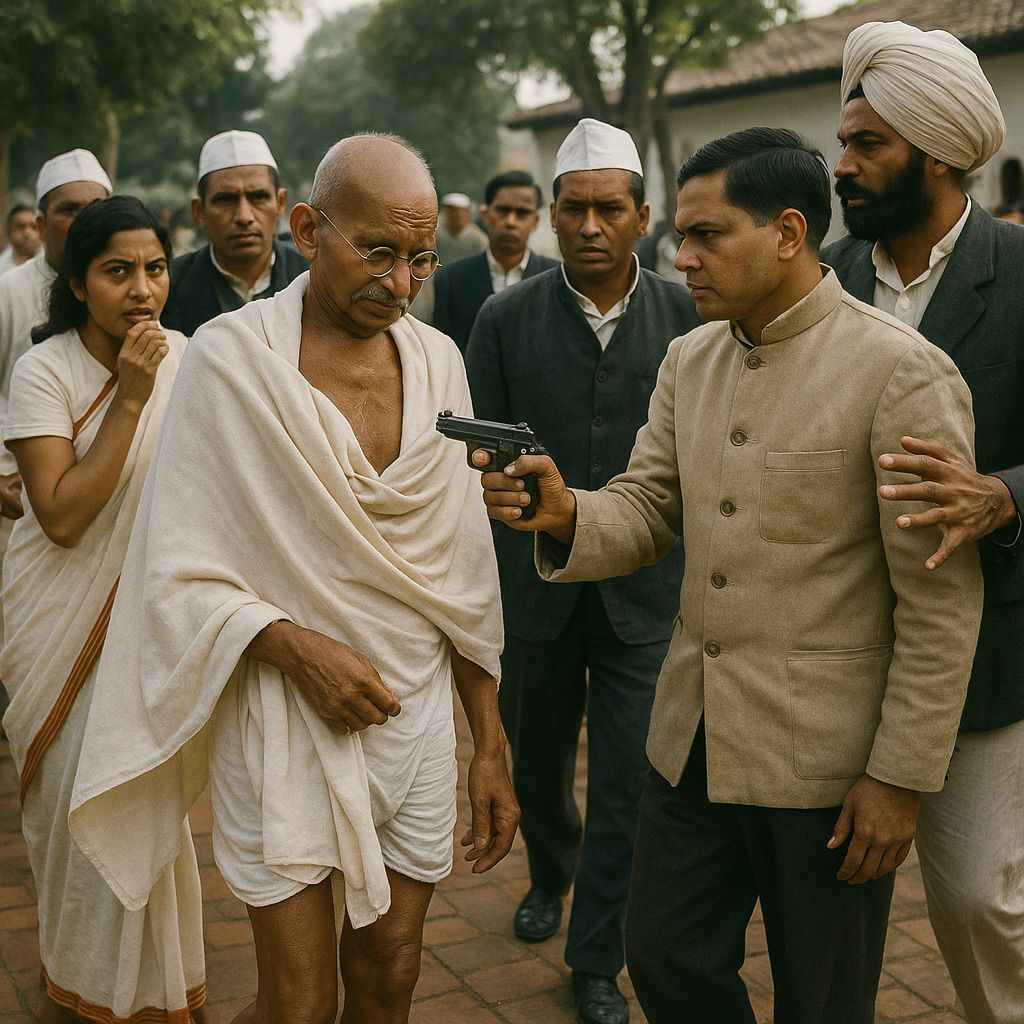
The Day Gandhi Was Taken from the World

Elias Rowen

There are some days when the world seems to pause. Not for joy, not for celebration, but because the air has been pulled out of history. January 30, 1948, was such a day. On that day, India—the heart of a newborn nation—felt the thunderous silence of grief, and the world lost not just a man, but a moral compass. Mohandas Karamchand Gandhi, known to millions as Mahatma—“Great Soul”—was gunned down in the gardens of Birla House in Delhi. His assassination shook a nation that was just beginning to heal from the wounds of Partition and called into question the very nature of nonviolence in a world increasingly consumed by political rage. Though the bullets that killed him were fired by an assassin’s hand, they were forged in the fires of hatred, division, and radicalism. Yet Gandhi’s story does not end in that tragic moment; it lives on, not in statues or currency notes alone, but in the conscience of humanity.

Born in 1869 in Porbandar, Gujarat, Gandhi’s journey began far from the epicenter of revolutionary politics. He was a shy child, devout and disciplined, and by no means destined for the towering role he would play on the world stage. He studied law in London, a foreign world where he trained his mind and soul as rigorously as he trained in jurisprudence. But it was in South Africa, not India, where Gandhi began to sharpen the tools of passive resistance. It was there, in response to racial discrimination, that he crafted the philosophy of satyagraha—truth-force—which would eventually become his answer to tyranny and injustice. When he returned to India in 1915, the nation was a colony straining under British rule. What followed over the next three decades was a struggle unlike any the world had seen—a revolution powered not by rifles or bombs, but by hunger strikes, salt marches, and an unshakeable belief in human dignity.

Gandhi’s India was no utopia. It was a country fractured by caste, religion, and colonial manipulation. And yet, Gandhi dared to dream of unity. He fasted to erase the lines drawn by caste, embraced untouchables whom society discarded, and reached out across religious divides even as tensions boiled. His relationship with Indian Muslims was complex and layered, but always built on the foundation of shared humanity. He was no stranger to controversy; many Hindus thought he favored Muslims too much, especially during Partition when he demanded that India pay Pakistan the money it was owed. He was threatened, reviled, and even ostracized by segments of the very community he loved so deeply.

When independence finally came in August 1947, it was bittersweet. India was free, yes, but it was also torn in two. Pakistan had been carved out as a separate homeland for Muslims, and the resulting mass migrations became some of the most horrific in modern history. Hindus, Sikhs, and Muslims slaughtered each other in the streets. Millions were displaced. Gandhi, rather than join in the political fanfare, walked barefoot into the ashes of communal violence. In Calcutta, he fasted until Hindus and Muslims agreed to lay down their weapons. He had no government post, no security detail, no political power—and yet he held the nation in his palm.

But peace was a fragile dream. And Gandhi was not universally loved. Among his harshest critics were Hindu nationalists who believed he had capitulated to Muslim interests. They viewed Partition as a betrayal and Gandhi as a traitor. One of them, Nathuram Godse, would ultimately decide that Gandhi’s dream of harmony was an obstacle to a Hindu nationalist vision of India. Godse saw Gandhi’s nonviolence not as moral strength, but as political weakness. He believed Gandhi had emasculated the Hindu spirit and weakened India’s resolve. And so, he plotted his murder with cold precision.

The final hours of Gandhi’s life were marked, as always, by quiet humility. He was staying at Birla House in New Delhi, a place he had made into a spiritual refuge. Every evening, he led prayer meetings in the garden. On January 30th, at 5:17 p.m., he walked out to greet a gathering of followers. Frail from fasting, he leaned on two grandnieces for support. Nathuram Godse emerged from the crowd, pushed through the people surrounding Gandhi, and fired three bullets from a Beretta pistol into his chest at point-blank range. Gandhi’s final words, as witnesses recall, were “Hey Ram”—a cry to God that echoed through the garden like a hymn of resignation. He fell instantly, draped in white, his blood soaking the earth beneath him.

The scene was one of disbelief. In the moments after the shots rang out, silence fell—not just over the garden, but across the conscience of a country. People didn’t just mourn Gandhi’s death; they mourned what it signified. The man who had taught them to fight without hatred, to resist without harming, had been felled by an ideology that knew no such restraint. India wept. Jawaharlal Nehru, the first Prime Minister of independent India and one of Gandhi’s closest confidants, announced the death to a stunned nation with trembling lips: “The light has gone out of our lives, and there is darkness everywhere.”

Godse was captured immediately and later tried and executed. During his trial, he offered a chilling rationale for his act—claiming that Gandhi’s politics were suicidal for Hindus and that his refusal to resist Islamic aggression would doom the nation. What made the assassination even more tragic was that Gandhi had predicted it. He knew he was hated. He had survived previous attempts on his life. But he refused protection, insisting that he would not live in fear. “If I am to die by the bullet of a madman, I must do so smiling,” he had once said. And that, heartbreakingly, is exactly how he died.

In the days that followed, riots were quelled not by force, but by Gandhi’s legacy. His death brought a stunned hush to communal tensions. In many ways, his martyrdom sealed his place in history not just as a leader, but as a saint. The world responded with an outpouring of grief. In America, President Truman expressed sorrow. In the UK, Winston Churchill—Gandhi’s former nemesis—offered uncharacteristically kind words. Albert Einstein said, “Generations to come will scarce believe that such a one as this ever in flesh and blood walked upon this earth.”

But Gandhi was not a god. He was flawed, and he knew it. He battled personal demons, wrestled with doubts, and frequently admitted his own inconsistencies. He was a man who experimented with truth in every sense of the word—from his diet to his celibacy to his political ideals. What made him powerful wasn’t his perfection, but his transparency. He led by example, not decree. He challenged colonialism with a spinning wheel. He fought bigotry with prayer. He faced death with serenity. He was, at his core, a man who believed in the goodness of people—even when they failed him.

The legacy of Gandhi’s assassination goes beyond the tragedy of a life lost. It asks enduring questions: Can nonviolence survive in a violent world? Can tolerance defeat extremism? Can spiritual strength stand against political might? Gandhi believed the answer to all these was yes. And though the world has often failed to live up to his ideals, the echo of his life still lingers in every peaceful protest, in every hunger strike for justice, in every act of civil disobedience against tyranny.

His death marked the end of an era, but also the beginning of a new chapter in global consciousness. Martin Luther King Jr. would later walk in Gandhi’s footsteps during the Civil Rights Movement. Nelson Mandela found courage in Gandhi’s philosophy during his long imprisonment. Across continents, Gandhi’s legacy became the blueprint for moral resistance. The bullet that killed him could never kill his idea.

India today is a far more complex and conflicted place than the one Gandhi left behind. It’s an economic powerhouse, a nuclear state, and a chaotic democracy pulsing with energy and contradiction. Yet, amidst all its change, the memory of Gandhi persists—not just in the institutions named after him, but in the quiet decisions people make each day to choose peace over violence, tolerance over bigotry, love over hate.

On every anniversary of his death, the nation observes Martyrs’ Day. At Raj Ghat, the site of his cremation, leaders gather to lay wreaths and offer prayers. But the real tribute to Gandhi lies not in ceremonies but in action. In refusing to hate, in choosing dialogue over bullets, in believing that the arc of the moral universe, as Dr. King said, bends toward justice.

January 30 was the day Gandhi died. But it is also the day that Gandhi became eternal. And every time the world turns toward hatred, every time oppression rears its head, we remember a frail old man in homespun cloth, walking unarmed into the heart of conflict, armed only with faith and truth.

Related Posts

Conquering the Giant: The First Ascent of the Matterhorn

Elias Rowen

In the heart of the Alps, where the horizon is pierced by jagged peaks and the sky seems to touch the earth, stands the mighty Matterhorn—majestic, mysterious, and once considered unclimbable. It is a mountain of legend, its near-perfect pyramid shape a natural monument etched into the imagination of climbers and travelers alike. On July 21, 1865, the Matterhorn’s summit was finally reached, marking not only a pinnacle in mountaineering history but also a moment of human triumph and tragedy. That day, an ambitious team led by the young and determined Edward Whymper achieved what many deemed impossible, forever altering the landscape of Alpine exploration.

To understand the significance of that fateful ascent, we must first appreciate what the Matterhorn represented in the mid-19th century. Towering at 4,478 meters (14,692 feet), it dominates the skyline of the Swiss-Italian border and had repelled all attempts at conquest. Its steep faces and sharp ridges were seen as too treacherous, even as neighboring peaks like Mont Blanc had already yielded to human perseverance. The Matterhorn remained a symbol of defiance, an unyielding titan that scoffed at the ambitions of mere mortals. To scale it was to challenge not only nature but one’s own limits.

By the 1860s, mountaineering was blossoming into a Victorian-era passion, particularly among the British upper class. What had once been considered dangerous and irrational was becoming a noble pursuit of science, physical endurance, and personal glory. These gentlemen climbers, dressed in tweeds and wielding rudimentary equipment, embraced the Alps as their playground. Chief among them was Edward Whymper, a 25-year-old English illustrator whose obsession with the Matterhorn would lead to both fame and infamy.

Whymper was not a nobleman but had been commissioned to sketch Alpine scenery for a London publisher. His artistic assignment soon evolved into a passion for climbing, and he became known for his tenacity and fearlessness. By 1861, he had made several attempts on the Matterhorn, approaching it from both the Swiss and Italian sides. Each time, the mountain denied him. But the repeated failures only stoked his resolve. Whymper wasn’t just after a summit; he was chasing immortality, eager to etch his name in the annals of mountaineering forever.

The year 1865 brought a flurry of activity to the base of the Matterhorn. Rumors swirled that Italian guides were preparing an ascent from the southern side, hoping to beat Whymper to the summit. Spurred by this competition, Whymper swiftly organized his own team. His party included experienced mountain guide Michel Croz of Chamonix, Reverend Charles Hudson, Lord Francis Douglas, Douglas Robert Hadow—a young, inexperienced climber—and two Zermatt-based guides, Peter Taugwalder and his son. It was a hastily assembled group, united by ambition rather than cohesion, but Whymper was undeterred.

On July 13, 1865, the team set out from Zermatt, opting for the Hörnli Ridge—an approach few had considered viable. The following day, they established a bivouac at around 3,400 meters, sleeping under the stars with the icy breath of the mountain wrapping around them. On the morning of July 14, they began their final push. The climb was arduous, but the ridge provided an unexpectedly manageable path. Step by step, they carved a route into the unknown, chipping footholds into the ice, relying on their alpenstocks, ropes, and raw grit.

At precisely 1:40 p.m., the summit was theirs. Whymper and Croz were the first to reach the top, followed by Hudson, Hadow, and the others. For a moment, there was elation—an almost sacred stillness. From the summit, the view stretched for miles, a panorama of peaks, valleys, and glory. Whymper would later describe it as standing “on a throne of rock, with the kingdoms of the world spread out beneath.”

But the euphoria was short-lived. What began as a story of triumph would quickly descend into tragedy. During the descent, disaster struck. As they carefully retraced their steps down the Hörnli Ridge, the unthinkable happened. Hadow, unsteady and inexperienced, lost his footing and fell against Croz, knocking him off balance. The two plunged down the north face, dragging Hudson and Douglas with them. The rope connecting the doomed climbers to the rest of the team snapped—mercifully, or cruelly—and Whymper and the Taugwalders watched helplessly as their companions disappeared into the abyss.

The survivors descended in stunned silence. News of the disaster reached Zermatt the following day, and the Alpine world was rocked. The first ascent of the Matterhorn had ended not in pure celebration but in mourning. Four men had perished, their bodies—save for Lord Douglas—eventually recovered days later. The broken rope was scrutinized, sparking debates and accusations. Some speculated it had been deliberately weakened; others blamed Whymper for assembling an ill-matched team. Whymper defended himself in public and in print, but the shadow of the tragedy would follow him all his life.

Despite the sorrow, the ascent of the Matterhorn marked a turning point. It was the symbolic end of the “Golden Age of Alpinism,” a decade during which nearly all the major Alpine peaks had been climbed. The Matterhorn, once the last great prize, had finally fallen. But its conquest came at a price that forever altered the perception of mountaineering. No longer was it seen merely as a gentleman’s pursuit or an eccentric hobby. The dangers were real, and the mountains, majestic as they were, could be merciless.

Whymper, shaken but undeterred, continued to climb. He later explored the Andes and wrote extensively about his adventures. His book, Scrambles Amongst the Alps, remains a classic of mountain literature—a blend of adventure, reflection, and sorrow. In it, he famously wrote: “Climb if you will, but remember that courage and strength are naught without prudence, and that a momentary negligence may destroy the happiness of a lifetime.” Those words, born from the Matterhorn’s brutal lesson, have echoed through generations of climbers.

Today, thousands ascend the Matterhorn each year, guided by fixed ropes and modern equipment. But the mountain has not lost its danger or its allure. Its sheer faces and knife-edged ridges continue to challenge even seasoned mountaineers. At its base, memorials stand to those who have fallen—reminders that while technology has improved, the risks remain very real.

What makes the story of July 21, 1865, so compelling is not just the daring feat or the tragic loss—it’s the deeply human tale beneath it all. It is a story of ambition, rivalry, courage, and the thin line between victory and disaster. Whymper and his team were not gods, but men, full of hope and fallibility. Their ascent of the Matterhorn wasn’t just a physical conquest; it was a metaphor for the Victorian spirit of exploration, for the eternal human drive to reach beyond the possible.

There’s something timeless in that pursuit. Even today, when Everest has become a bucket-list destination and gear is made of ultralight composites, the soul of climbing remains rooted in moments like Whymper’s. The mountain humbles and exalts in equal measure. To stand on a summit is to momentarily hold dominion over the world, but to reach it requires humility, respect, and a deep understanding of our fragile place in nature.

The first ascent of the Matterhorn continues to inspire not because it ended perfectly, but because it didn’t. It reminds us that greatness is often born in moments of peril, and that some of the most enduring legacies are forged in both triumph and loss. Whymper and his team, in chasing the summit, became symbols not only of bravery but of the high cost of ambition. And the Matterhorn, in turn, remains what it always was—a magnificent sentinel watching over the Alps, challenging each generation to answer its silent, daunting call.

Related Posts