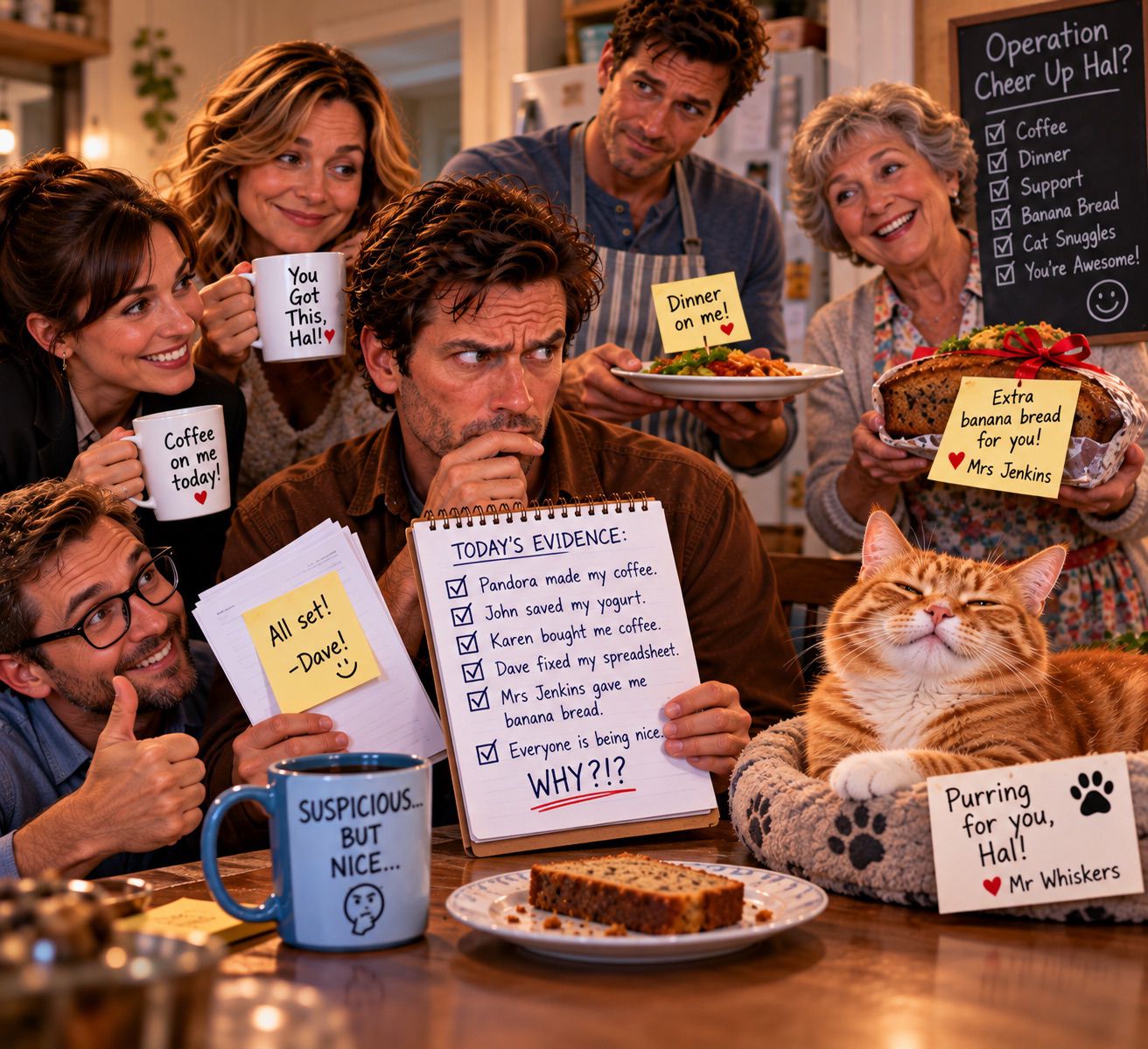
I’m sitting in the living room watching Pandora fix her hair, and something about the entire morning has been bothering me. She has this habit of tugging on one particular strand whenever she’s concentrating, which I’ve noticed before but never considered significant until now. John Mercer is sprawled across the other end of the couch, half awake and pretending he isn’t listening to us, while Mr Whiskers is asleep on his favorite cushion by the window with his paws twitching occasionally as though he’s chasing something considerably more interesting than anything happening in this house. On the surface, it is an entirely ordinary morning. That is precisely what concerns me, because everyone has been unusually nice to me today. Pandora made coffee before I asked. John moved his shoes out of the hallway without being reminded. Mr Whiskers sat beside me for almost ten minutes without demanding food. Individually, none of these things would justify concern. Collectively, I think they deserve at least preliminary documentation.
It actually started with Pandora. When I came downstairs this morning, she handed me a cup of coffee and said, “Here. I made yours too,” which sounds innocent until you understand that Pandora normally makes coffee for herself and assumes I possess the necessary technical skills to operate the machine. I thanked her, obviously, but I also asked why she had made mine. She looked at me for several seconds and said, “Because I was already making coffee, Hal.” That explanation was reasonable enough, but then John came into the kitchen, opened the refrigerator, and told me there was one blueberry yogurt left and that he had deliberately saved it for me because he knew I liked that kind. I just stared at him. John stared back. “What?” he asked. I told him nothing, although clearly it was not nothing. In less than fifteen minutes, two members of my household had voluntarily performed considerate acts without requesting anything in return. Statistically, that felt aggressive.
Things became more complicated when I got to work. Karen stopped by and asked if I wanted anything from the coffee shop because she was heading downstairs, and before I could answer, Dave leaned over from his desk and said, “I’ve got that spreadsheet you needed. I cleaned up the formatting too.” I looked from Dave to Karen and asked whether there had been a meeting that morning I hadn’t been invited to. Karen said no. Dave asked what kind of meeting I meant. I told them the kind where everybody apparently decided to start being helpful at the same time. Karen stared at me for a moment and then said, “Hal, I asked if you wanted coffee.” I told her that was exactly the sort of perfectly reasonable explanation someone would use if they didn’t want the underlying pattern examined. She withdrew the offer. I accepted it before she could leave, because suspicion is one thing, but turning down free coffee would have compromised the objectivity of the investigation.
By lunchtime, I had accumulated five separate incidents. Pandora had made my coffee. John had saved my yogurt. Karen had offered to bring me coffee. Dave had fixed my spreadsheet. Then Mrs Jenkins sent me a text asking if I wanted some banana bread because she had made too much. Five unsolicited acts of kindness from five different people in approximately four hours. I wrote them down because memory becomes unreliable once a pattern starts developing, and I wanted a contemporaneous record. Dave noticed the list and asked what I was doing. “Establishing a timeline,” I told him. He read the first few entries, looked at me, and said, “Your evidence is that people are being nice to you?” I explained that the unusual part was not the niceness itself but the concentration of niceness within a limited temporal window. Dave said, “Maybe people like you.” I told him there was no reason to become sarcastic.
When I got home, the situation deteriorated further. Mrs Jenkins was in the hallway holding a foil-wrapped loaf of banana bread, and instead of making me come over and get it, she handed it directly to me. “I figured I’d save you the trip,” she said. Her apartment is across the hall. The trip she saved me was approximately six feet. I thanked her and asked whether Pandora had spoken to her recently. Mrs Jenkins said she had talked to Pandora the previous evening. I asked what they discussed. She narrowed her eyes and said, “Things.” I asked what kind of things. “Normal things, Hal.” That was not helpful. When I carried the banana bread inside, Pandora looked at it and immediately said, “Oh, good. She remembered.” I stopped walking. “Remembered what?” Pandora froze for just long enough to make the question worthwhile, then said Mrs Jenkins had mentioned baking banana bread yesterday and Pandora had told her I liked it. I pointed out that this meant Pandora had participated in arranging at least one of the unexplained acts of kindness. Pandora said, “I told our neighbor you like banana bread. Please don’t turn this into organized crime.”
John was in the kitchen making dinner, which presented another anomaly because it was technically my night to cook. When I reminded him of that, he said, “I know. You looked tired when you got home, so I figured I’d do it.” I put the banana bread on the counter and looked at him carefully. “Did Pandora ask you to do that?” John stopped stirring the sauce. Pandora, from the living room, shouted, “Oh my God.” John said no, nobody had asked him to do anything; he had simply decided to make dinner. I asked whether he had spoken to Mrs Jenkins. He said not today. Karen? “Why would I talk to Karen?” Dave? “Hal, Dave is your coworker.” That answer was technically consistent with the known organizational structure, which made it difficult to challenge. I finally asked whether there was any coordinated effort underway to make my day easier. John stared at me, then looked toward Pandora. “Is he serious?” Pandora said, “Unfortunately, yes.” I wrote down that neither of them had actually answered the question.
Dinner was good. Suspiciously good, in fact, although John claimed that was because he had followed the directions on the jar, which felt unnecessarily boastful. Afterward, Pandora told me to sit down because she would take care of the dishes. That made six incidents. I told her so. She dried her hands and asked to see my list. I hesitated because handing investigative notes to a participant is generally poor methodology, but transparency seemed appropriate under the circumstances. Pandora read the entire thing without speaking. Then she looked at me and said, “Hal, do you remember complaining yesterday that you had a terrible week?” I did remember saying something along those lines. Apparently, I had mentioned that work had been exhausting, I wasn’t sleeping well, everything around the house seemed to need attention at once, and I felt like I was constantly behind. Pandora had remembered. John had heard me. Karen and Dave had independently noticed I seemed tired at work. Mrs Jenkins had apparently noticed too because Pandora had mentioned I was having a rough week while they were talking in the hallway. “Nobody is plotting anything,” Pandora said. “People are just trying to make your day a little easier.”
That explanation accounted for almost everything, which I’ll admit was disappointing from an investigative standpoint but reassuring from a personal one. There had been no secret meeting, no coordinated operation, and no hidden motive. Pandora made my coffee because I was tired. John saved my yogurt and cooked dinner because he knew I’d had a rough week. Karen offered coffee because she was already going downstairs. Dave fixed the spreadsheet because he had time. Mrs Jenkins made too much banana bread and knew I liked it. Six acts of kindness, six ordinary explanations. I crossed each item off the list while Pandora watched with the expression she uses when she is waiting for me to arrive at a conclusion everyone else reached several hours earlier. “So,” she said, “case closed?” I told her there had never technically been a case. This had been an assessment. She said, “Of course it was.”
That should have been the end of it. Later that evening, though, I went into the kitchen for another piece of banana bread and found Mr Whiskers sitting beside the counter staring directly at the foil-wrapped loaf. He looked at me, looked at the banana bread, and then looked back at me. “No,” I told him. His tail flicked once. Then John walked into the kitchen, tore off the tiniest corner of bread, and dropped it into Mr Whiskers’ bowl. Mr Whiskers ate it immediately and walked away without acknowledging either of us. I looked at John. John looked at me. “Don’t,” he said. I hadn’t said anything. That bothered me more than it should have. Apparently, everyone in this house can predict what I’m going to say now, and while I’m willing to accept that people were simply being nice to me today, I’m not prepared to ignore that level of coordinated behavioral forecasting.