Author: Elias Rowen

I enjoy writing about events that happened on specific days of the year. There’s something fascinating to me about the idea that every date carries its own story—moments when history quietly turned a corner or suddenly exploded into something unforgettable. I don’t focus on famous people as much as I focus on the moments themselves. I like digging into what was happening on that particular day, what led up to it, and what followed after. When I write, I try to bring readers into the moment, to capture what it might have felt like as events were unfolding in real time, before anyone knew how things would turn out. For me, history isn’t just a list of dates and facts. It’s a collection of lived moments that still ripple into the present. My goal is to turn calendar dates into stories that feel real, relatable, and worth remembering.

The Paper That Promised Peace: The Munich Agreement and the Price of Appeasement

Elias Rowen

On September 30, 1938, the leaders of four nations sat in a gilded chamber in Munich and signed a piece of paper they claimed would preserve peace in Europe. British Prime Minister Neville Chamberlain, French Premier Édouard Daladier, German Chancellor Adolf Hitler, and Italian dictator Benito Mussolini affixed their signatures to the Munich Agreement, a document that allowed Nazi Germany to annex the Sudetenland, a region of Czechoslovakia with a significant ethnic German population. To its defenders, the agreement was a triumph of diplomacy over war. To its critics, it was the ultimate act of cowardice, a surrender dressed in the language of compromise. Within a year, the paper was worthless, the world was at war, and the Munich Agreement became a symbol — not of peace, but of the peril of appeasing tyranny.

The roots of the crisis lay in Hitler’s relentless expansionism. Since taking power in 1933, he had rebuilt Germany’s military, defied the Treaty of Versailles, and annexed Austria in March 1938. His next target was the Sudetenland, a mountainous border region of Czechoslovakia. Hitler claimed he sought only to protect the rights of ethnic Germans living there, but his ambitions were far larger. Controlling the Sudetenland would weaken Czechoslovakia’s defenses and give Germany control of crucial industries. Prague, alarmed, mobilized its army and appealed to its allies, Britain and France. Europe teetered on the edge of war.

For Neville Chamberlain, the British prime minister, the prospect of another European conflict was unthinkable. Britain was still haunted by the carnage of World War I, its cemeteries filled with the dead of the trenches. The memory of “the war to end all wars” was less than two decades old. The British public had little appetite for another fight, and Britain’s military was not yet prepared. France, too, was reluctant, scarred by its own battlefield losses and political divisions at home. Both governments hoped that negotiation could avert catastrophe.

So they flew to Munich. Hitler, calculating and shrewd, staged the conference as a theater of power. He ranted about German grievances, demanded justice for the Sudeten Germans, and threatened war if denied. Mussolini preened as a mediator. Daladier sat uneasily, aware that France was abandoning its ally, Czechoslovakia. And Chamberlain, with his umbrella and his conviction that reason could tame ambition, sought compromise. Czechoslovakia itself was excluded from the talks, forced to watch its fate decided by others.

The result was the Munich Agreement. Britain and France agreed to Hitler’s demands: Germany would annex the Sudetenland, and in return, Hitler promised he had no further territorial ambitions. Chamberlain and Daladier returned home claiming they had preserved peace. Crowds cheered them, newspapers hailed diplomacy, and Chamberlain famously waved the signed agreement at the airport, proclaiming it meant “peace for our time.” For a brief, fragile moment, it seemed the world had stepped back from the abyss.

But the peace was an illusion. The Munich Agreement emboldened Hitler, convincing him that Britain and France lacked the will to oppose him. Within six months, Germany violated the agreement, occupying the rest of Czechoslovakia. Less than a year later, on September 1, 1939, Hitler invaded Poland. Britain and France declared war. The Second World War had begun.

In hindsight, Munich has become synonymous with appeasement, with the peril of feeding aggression in hopes it will be satisfied. Chamberlain’s reputation suffered irreparably. Though he acted out of a genuine desire to avoid war, history judged his faith in Hitler as naïve at best, disastrous at worst. Winston Churchill, who had warned against concessions, declared bitterly, “You were given the choice between war and dishonor. You chose dishonor, and you will have war.”

Yet the story is more complicated than caricature. Chamberlain was not a fool. He was a leader grappling with the limits of his nation’s readiness and the weight of public opinion. Britain’s air defenses were not yet complete. France was divided and fragile. The United States remained isolationist. Many historians argue that Munich bought Britain valuable time to rearm, time that would prove crucial in 1940 when the Battle of Britain loomed. Chamberlain’s policy was a gamble — and while it failed to prevent war, it may have given his nation the chance to survive it.

For Czechoslovakia, however, the Munich Agreement was a betrayal. Deprived of its defenses, its industry, and its sovereignty, it was left vulnerable, abandoned by its allies. The lesson was bitter: small nations could not rely on great powers to defend them when compromise seemed more convenient. The image of Czechoslovakia carved up without its consent became a lasting symbol of the perils of sacrificing principles for expedience.

The Munich Agreement endures in political memory as a warning. Every generation of leaders has invoked it when confronting dictators, aggressors, or bullies. To be accused of “another Munich” is to be accused of weakness, of surrendering to threats. The shadow of that gilded table in Munich stretches across decades, from the Cold War to modern conflicts. It reminds us that peace is not always preserved by compromise, and that sometimes, the price of avoiding war today is a greater war tomorrow.

Looking back, September 30, 1938, was not the day peace was saved. It was the day the world delayed the inevitable, the day hope blinded reason, the day tyranny was fed instead of fought. The Munich Agreement was a paper signed in good faith by some, in bad faith by others, but in the end, it was only paper. And paper could not stop the tanks that would soon roll across Europe.

Related Posts

Crisis in the Medicine Cabinet: The Tylenol Murders That Shook America

Elias Rowen

On the morning of September 29, 1982, a 12-year-old girl in the Chicago suburbs woke up with a cold. Her parents did what any family would do — they gave her Extra-Strength Tylenol, the most trusted pain reliever in America. By mid-morning, she was dead. Within hours, more deaths followed: a young postal worker, a new mother, a flight attendant’s brother, and others across the region. None of them knew one another. None of them shared a connection except one horrifying link — each had swallowed Tylenol capsules laced with cyanide. By the time panic spread, seven people were dead. A nation stared in shock at its medicine cabinets and realized, for the first time, that the very pills meant to heal could also kill.

The Tylenol Murders remain one of the most chilling unsolved crimes in American history. It was not a mass shooting or a bombing, but a silent act of terror, intimate and invasive. Someone had tampered with bottles of Tylenol on store shelves, injecting lethal doses of potassium cyanide into the capsules. The victims had no chance. Cyanide works fast, suffocating the body at the cellular level, cutting off oxygen and life itself. In every case, death came within minutes. What united the victims was not who they were, but what they trusted. They trusted a brand, a bottle, a pill that millions consumed daily. And in that trust lay their vulnerability.

The horror began in Elk Grove Village, Illinois, with the death of young Mary Kellerman. Hours later, Adam Janus, a 27-year-old postal worker, collapsed and died after taking Tylenol. As his family gathered in grief, his brother and sister-in-law also took Tylenol from the same bottle — and both collapsed. They too died. By the end of the day, hospitals, police, and federal investigators realized they were confronting something terrifyingly new. This was not a bad batch, not a factory error, but deliberate tampering. Someone had turned Tylenol into poison.

Johnson & Johnson, the parent company, faced a nightmare. Tylenol was its flagship product, controlling more than a third of the over-the-counter pain reliever market. The brand was synonymous with trust, with safety. Now it was a murder weapon. The company could have denied, delayed, or downplayed. Instead, in one of the most decisive acts of corporate crisis management in history, they pulled Tylenol from every shelf in America. All 31 million bottles. The cost was staggering, but the alternative — risking more lives — was unthinkable. Their recall set a new standard for consumer safety.

The investigation was frantic. Police combed drugstores, hospitals, and neighborhoods, searching for patterns. The FBI got involved. News outlets warned Americans nationwide: don’t take Tylenol. Households dumped bottles into trash cans. Pharmacies emptied shelves. The idea that someone could slip into a store, twist open a cap, and replace life-saving medicine with death was more terrifying than any headline. It was terror without ideology, murder without motive, the banal horror of poison hidden in plain sight.

Suspects emerged, but none stuck. A man named James Lewis sent an extortion letter to Johnson & Johnson, demanding money to stop the killings. He was caught and imprisoned — but authorities never proved he was the actual poisoner. To this day, the identity of the Tylenol killer remains unknown. The case is cold, yet its shadow lingers.

What emerged in the aftermath, however, was a revolution in consumer safety. Before 1982, medicine bottles had no tamper-proof seals, no shrink-wrap, no blister packs. Pills came in containers that could be opened, altered, and closed again without evidence. The Tylenol Murders changed that overnight. By 1983, the FDA mandated tamper-evident packaging, from foil seals to plastic wraps. Blister packs became standard. The phrase “safety seal” entered the consumer vocabulary. In short, every time you peel back a foil cover or break a seal on a new bottle, you are living in the legacy of the Tylenol Murders.

The cultural impact was just as deep. The murders shattered the trust that Americans placed in everyday products. If medicine could be poisoned, what else was vulnerable? It was a reminder of fragility in an age of convenience. Tylenol eventually recovered, thanks to its bold recall and new safety measures, but the memory of 1982 lingered. The victims — Mary Kellerman, Adam Janus, Theresa Janus, Stanley Janus, Mary Reiner, Paula Prince, and Mary McFarland — became symbols of innocence lost, of ordinary lives stolen by an anonymous act of cruelty.

The Tylenol Murders were not just a crime. They were a turning point in the relationship between consumers and corporations, between trust and safety. They revealed how a single bad actor could weaponize the ordinary, how terror could be delivered not by ideology but by a pharmacy shelf. They left scars on families, fear in households, and permanent changes in packaging, policing, and perception.

Forty years later, the bottles on our shelves are wrapped, sealed, and protected. But the unease remains. The Tylenol Murders remind us that safety is never guaranteed, that trust is always fragile, and that sometimes, the most dangerous place is the place we least expect: the medicine cabinet.

Related Posts

A Happy Accident: How Fleming’s Messy Petri Dish Gave the World Penicillin

Elias Rowen

On the morning of September 28, 1928, in a modest laboratory at St. Mary’s Hospital in London, a man returned from vacation to find a small miracle growing in one of his forgotten petri dishes. Alexander Fleming, a Scottish bacteriologist with a keen eye for the unusual, noticed that colonies of staphylococcus bacteria he had been studying were behaving strangely. On one dish, where a bit of mold had taken root, the bacteria had not just weakened — they had vanished. Around the mold’s edge was a clear halo, a zone of inhibition where the staphylococci had been destroyed. Fleming leaned closer, peered through the glass, and realized he was staring at something extraordinary. The mold, later identified as Penicillium notatum, had released a substance that killed bacteria. It was the birth of penicillin, the first true antibiotic, and one of the greatest breakthroughs in the history of medicine.

To appreciate the magnitude of that moment, imagine a world without antibiotics. For most of human history, even minor infections could be fatal. A cut on the hand, a scratch from a rusty nail, a sore throat — any could spiral into blood poisoning or pneumonia. Childbirth was perilous, surgeries were gambling with death, and battlefields reeked with the untreatable wounds of soldiers. Diseases like tuberculosis, scarlet fever, and syphilis ravaged populations unchecked. Doctors had few tools beyond antiseptics, salves, and hope. Medicine could ease, but it could rarely cure. Death from infection was so common it was accepted as inevitable.

And then came Fleming’s mold. At first, it was just an oddity, one of countless quirks a scientist might dismiss. But Fleming was no ordinary observer. He had spent his career probing the borderland between life and death, between microbes and their destruction. He understood that this small accident might be more than coincidence. He carefully isolated the substance the mold produced and tested it against various bacteria. Again and again, it destroyed them. Penicillin, as he named it, seemed to be a natural enemy of infection. “When I woke up just after dawn on September 28, 1928,” Fleming later recalled, “I certainly didn’t plan to revolutionize all medicine by discovering the world’s first antibiotic, but I suppose that was exactly what I did.”

Yet the story of penicillin is not just one of discovery. It is also one of struggle, delay, and rediscovery. Fleming published his findings in 1929, but at the time, he could not purify penicillin or produce it in significant quantities. His colleagues admired the curiosity of the result, but few saw its practical potential. For a decade, penicillin remained an intriguing laboratory note, a promise waiting to be realized. It might have ended there, a footnote in scientific literature, if not for the persistence of others. In the late 1930s and early 1940s, a team at Oxford University — Howard Florey, Ernst Boris Chain, and their colleagues — took up Fleming’s forgotten discovery. Through meticulous research, they succeeded in extracting, purifying, and testing penicillin on animals and humans. The results were staggering. Infections that had once killed with certainty now yielded to treatment. Wounds healed, lungs cleared, lives were saved.

World War II turned penicillin from a laboratory curiosity into a global necessity. On the battlefields of North Africa, Europe, and the Pacific, penicillin became a miracle drug. Soldiers wounded in combat who would once have succumbed to gangrene or sepsis now lived. Civilians suffering from pneumonia or blood poisoning recovered. Factories in the United States churned out penicillin in massive quantities, guided by a secretive collaboration between government, universities, and pharmaceutical companies. By the end of the war, penicillin had saved tens of thousands of lives. By the decades that followed, it had saved hundreds of millions.

Penicillin was not merely a drug. It was a revolution. It ushered in the antibiotic era, transforming medicine from a practice that could only comfort into a science that could cure. It made surgeries safe, childbirth survivable, epidemics controllable. It allowed humanity to imagine a future where infections were no longer constant specters. It spurred the discovery of other antibiotics, broadening the arsenal against disease. It extended life expectancy, reshaped populations, and altered the very balance of human history. Few discoveries have had such sweeping, global impact.

And yet, the story carries an irony that Fleming himself foresaw. Even as he was celebrated — knighted, awarded the Nobel Prize — Fleming warned of the dangers of misuse. He cautioned that overuse of penicillin could lead bacteria to develop resistance. He feared that the miracle of antibiotics could be squandered by carelessness. Decades later, his warnings echo louder than ever. Antibiotic resistance has become a global crisis, threatening to unravel the triumphs of the 20th century. Bacteria evolve faster than we discover new drugs, and the specter of a post-antibiotic world looms. The happy accident of 1928 gave us a miracle, but it also gave us a responsibility.

Looking back on that September day in 1928, one sees the beauty of science at its most human. Fleming was not searching for penicillin. He was not even at his bench when it first appeared. He was simply curious enough, observant enough, and determined enough to see meaning in what others might have discarded. His messy petri dish, his unplanned contamination, became a catalyst for a revolution. It is a reminder that discovery is not always a matter of grand design. Sometimes, it is a matter of noticing what is right in front of us — and daring to follow where it leads.

On September 28, 1928, Alexander Fleming walked into his laboratory and found a mold that had killed his bacteria. The world he lived in was a world where infections killed without mercy. The world he left us is one where millions live because of that mold. It was, in his words, an accident. But it was an accident that reshaped human destiny.

Related Posts

Steam and Speed: The Day the World First Rode the Iron Horse

Elias Rowen

On September 27, 1825, the world changed forever, though few who were there that day could have grasped the full magnitude of what they were witnessing. In the north of England, on a stretch of track between the coal fields near Shildon and the port town of Stockton-on-Tees, a steam-powered locomotive hissed, rattled, and roared its way into history. It was the inaugural run of the Stockton & Darlington Railway — the first public railway to use steam locomotives to haul both freight and passengers. At its head was George Stephenson’s machine, a black-iron beast belching smoke and fire, pulling not only wagons of coal but also carriages filled with astonished passengers. The world had seen steam engines before, hauling coal and iron in mines and quarries, but never had such a spectacle been unveiled on a public railway. It was the moment when the Industrial Revolution found its defining symbol: the iron horse.

The scene must have seemed otherworldly. Crowds gathered along the tracks, farmers and miners, merchants and children, their faces lit by curiosity and the glow of burning coal. Horses, the age-old masters of transport, startled at the shrieking whistle of the locomotive, their dominance suddenly challenged by a machine of steel and steam. The locomotive, christened “Locomotion No. 1,” pulled a line of wagons that stretched into the distance — some piled with coal, others outfitted with seats for human riders. As the train began to move, a cheer rose from the crowd. Faster and faster it went, reaching speeds of up to 15 miles per hour, an astonishing velocity in an age when the swiftest stagecoaches rarely topped 8 or 9. People gasped, laughed, clutched their hats. Some swore no human body could withstand such speed. Yet here it was, a rattling, roaring testament to human ingenuity, carrying men and women into the future.

The Stockton & Darlington Railway was born of necessity. England’s Industrial Revolution had turned coal into the lifeblood of factories, steamships, and households. In County Durham, rich coal seams fueled local industry, but transporting the black gold from pit to port was slow, expensive, and inefficient. Horse-drawn wagons plodded along rough tracks, bottlenecking production. Entrepreneurs dreamed of a faster, more powerful system. Among them was Edward Pease, a Quaker businessman who envisioned a railway linking the mines at Shildon with the River Tees at Stockton. Pease, pragmatic but ambitious, brought in George Stephenson, a self-taught engineer with a gift for building steam engines. Together, they crafted not just a new line of track but a new vision for transport itself.

The opening day was more than a local curiosity. It was a declaration that steam had moved beyond the factory floor and into the heart of society. The train’s success silenced skeptics who mocked the idea of steam travel, who insisted that engines would never replace horses. It thrilled investors and engineers, who saw in those puffing pistons the promise of vast new fortunes and possibilities. And it terrified traditionalists, who sensed that an old world was giving way to a new one, that the pace of life itself was about to accelerate beyond recognition.

In the years that followed, the railway’s impact spread like wildfire. Stephenson refined his locomotives, laying the groundwork for faster, stronger, more reliable machines. Railways expanded across Britain, then Europe, then the world. Coal and iron gave way to textiles and goods, food and mail, armies and emigrants. Villages turned into towns, towns into cities, cities into industrial giants, all connected by iron rails. Journeys that once took days could be completed in hours. Ideas, people, and commerce flowed with a speed and scale that had been unimaginable. The world grew smaller, faster, more interconnected.

The Stockton & Darlington Railway may have been just 25 miles long, but it was infinite in its consequences. It marked the dawn of the railway age, the true birth of modern mass transportation. The steam locomotive became the beating heart of the 19th century, as iconic as the smartphone is to the 21st. It shaped economies, redefined geography, and altered the very rhythm of human existence. The iron horse galloped not just across England, but across the globe, carrying with it both progress and peril — prosperity for some, displacement for others, the march of industry with all its wonders and all its costs.

Looking back, September 27, 1825, was not merely the launch of a railway. It was the moment humanity climbed aboard its first machine-driven revolution in movement. It was the day we learned that distance could be conquered not by horse or sail, but by the raw power of human invention. And in that first shriek of steam, that first clatter of wheels on iron, one could almost hear the future calling — a future of speed, connection, and change without end.

Related Posts

Lights, Camera, Politics: The Night Kennedy Outshone Nixon on Live Television

Elias Rowen

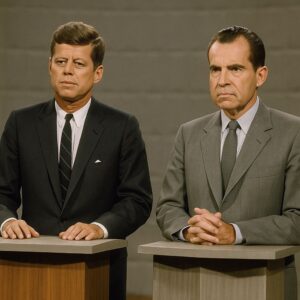
On September 26, 1960, America tuned in to something it had never seen before — politics as performance, democracy played out not on a podium or in print, but in the glow of television screens. It was the first-ever televised presidential debate, pitting a young senator from Massachusetts, John F. Kennedy, against the sitting vice president, Richard Nixon. Tens of millions of Americans — more than had ever watched a political event — sat in living rooms, eyes fixed on the screen, waiting to see their would-be presidents not only heard, but seen. And what they saw changed politics forever.

Kennedy and Nixon had met before. They were both veterans, both ambitious, both shaped by the storm of the Cold War. But on that September night, their differences crystallized under the glare of television lights. Kennedy came prepared not just with facts, but with presence. Tanned, rested, his dark suit contrasting sharply against the studio backdrop, he looked like a leader carved for the medium. Nixon, on the other hand, was recovering from illness and a recent hospital stay. He looked pale, thin, and tired. His light-colored suit blended into the background, making him seem almost ghostly. He refused makeup. His five o’clock shadow clung to his face. His eyes darted nervously. To radio listeners, Nixon held his own. To television viewers, Kennedy owned the stage.

It was a clash of eras. For decades, politics had belonged to newspapers, campaign rallies, and speeches in smoky halls. Words mattered more than images. But television was a new force, one that could magnify charisma and expose weakness in equal measure. On September 26, the United States learned that in the age of television, how you looked could matter as much as what you said.

The debate itself was focused on weighty issues: the Cold War, the Soviet threat, domestic policy. Kennedy spoke with crisp confidence, presenting himself as energetic, optimistic, ready to lead a new generation. Nixon, ever experienced, defended his record and attacked Kennedy’s youth. Yet viewers could not shake what they were seeing. Kennedy’s poise, his steady gaze, his calm demeanor contrasted with Nixon’s perspiration, his shifting stance, his awkwardness under the lights. The contrast was not merely in arguments, but in aura.

Polls revealed the split: those who listened on radio believed Nixon had edged the debate. Those who watched on television overwhelmingly thought Kennedy had triumphed. The message was unmistakable: in a televised democracy, perception is power. Kennedy, who just weeks earlier had been seen as too young, too inexperienced, too Catholic, suddenly looked presidential. Nixon, for all his experience, looked diminished.

The aftermath was seismic. Kennedy surged in the polls. His performance on television became a model for modern politics: the candidate as performer, the campaign as production, the presidency as spectacle. From that night forward, no politician could ignore the camera. Debates were no longer about ideas alone, but about image, style, presence. Television had entered the bloodstream of democracy, and it would never leave.

The Kennedy–Nixon debate is remembered not because of a single line or a groundbreaking policy, but because it revealed something fundamental about politics in the modern age. Leaders are not just chosen for what they say, but for how they appear saying it. The medium shapes the message. In 1960, Kennedy understood it, Nixon did not, and the difference may well have won an election.

Looking back, the night of September 26 was not just the first televised debate. It was the beginning of a new political era. It set the stage for Ronald Reagan’s Hollywood polish, for Bill Clinton’s charm, for Barack Obama’s mastery of the screen. It also paved the way for the cynicism of spin rooms, soundbites, and image-driven politics that too often reduce substance to spectacle. But for better or worse, it was a turning point — the night television became the kingmaker of American politics.

In living rooms across the country, families huddled together, watching their leaders as if they were actors in a play. And perhaps that is the lasting lesson of that night. Politics is not only governance. It is theater. It is performance. It is story. And on September 26, 1960, John F. Kennedy told his story better.

Related Posts

The Little Rock Nine: Walking Into the Storm of History

Elias Rowen

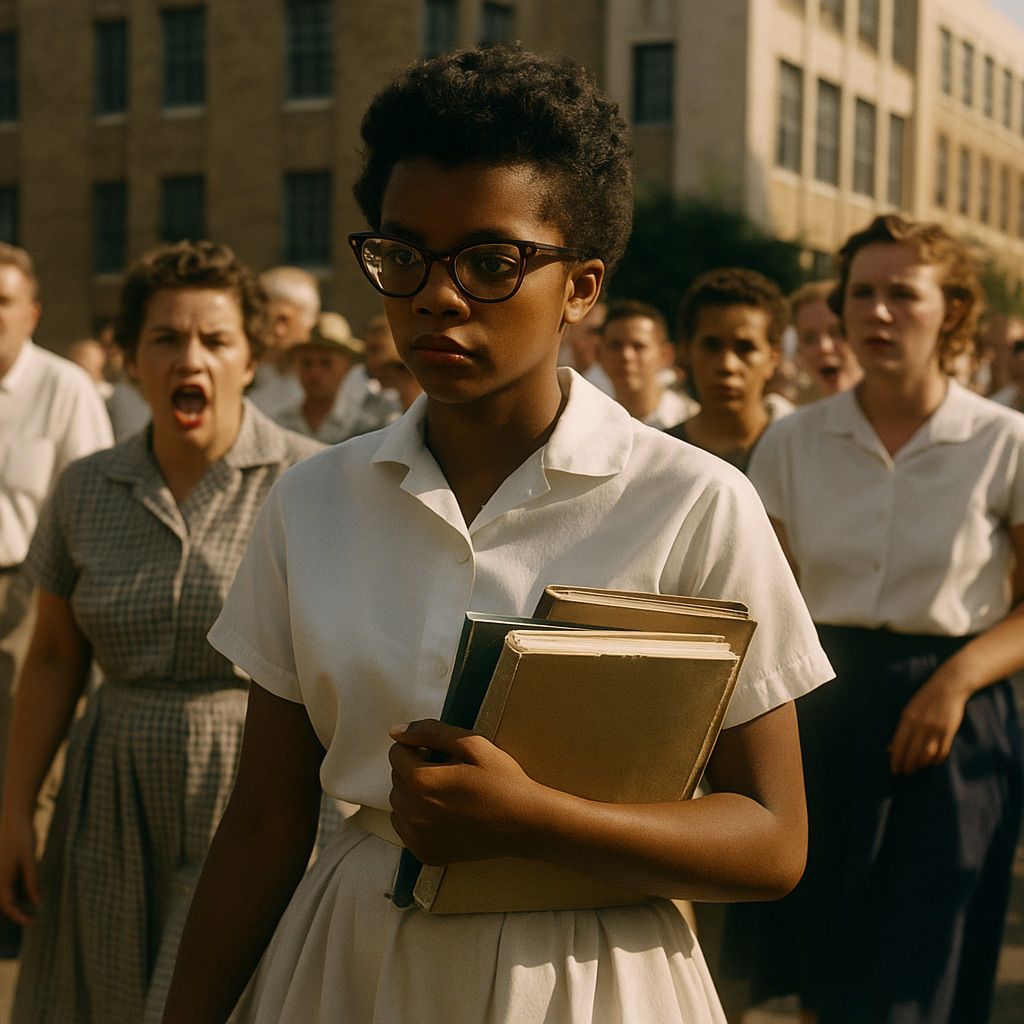
On September 25, 1957, nine African American teenagers walked through the front doors of Little Rock Central High School in Arkansas under the protection of U.S. Army paratroopers. Their names were Ernest Green, Elizabeth Eckford, Jefferson Thomas, Minnijean Brown, Terrence Roberts, Carlotta Walls, Gloria Ray, Thelma Mothershed, and Melba Pattillo. They were young, ordinary students who became extraordinary symbols, thrust onto the frontline of America’s civil rights struggle. Their steps across that threshold were not just a walk to class. They were a march into history, into the teeth of hatred, into the heart of a nation torn between its ideals and its prejudices.

The story began three years earlier, when the Supreme Court handed down its landmark decision in Brown v. Board of Education (1954). The Court declared that “separate but equal” schools for Black and white students were inherently unequal, striking down segregation in public education. It was a ruling with the force of law, but laws alone cannot erase centuries of prejudice. Across the South, resistance rose like a wall. Arkansas, like many states, dragged its feet. Integration was ordered, but integration was defied.

In 1957, Little Rock became the battleground. Central High School was the largest and most prestigious public high school in the city, a gleaming symbol of white supremacy in education. When the school board announced that nine Black students would enroll, the reaction was immediate and ferocious. White citizens organized protests. Politicians fumed. Governor Orval Faubus, seeking to appease segregationists and solidify his political base, called out the Arkansas National Guard — not to protect the students, but to block them. On September 4, 1957, Elizabeth Eckford arrived alone at Central High, dressed neatly, carrying her books. She was met not by classmates but by an angry white mob screaming insults, spitting, threatening violence. Photographs of her walking stoically past the jeering crowd, face set with quiet dignity, seared themselves into America’s conscience.

The crisis escalated. For weeks, the Little Rock Nine were prevented from entering. The Governor defied federal authority, and the standoff became a national embarrassment. Newspapers across the world carried images of American citizens screaming at children, of democracy cracking under the weight of racism. President Dwight D. Eisenhower, reluctant at first to intervene, realized the stakes were larger than Little Rock. The authority of the federal government, the credibility of the Constitution, and the moral soul of the nation were on trial.

On September 24, Eisenhower acted. He federalized the Arkansas National Guard and ordered elements of the 101st Airborne Division — the same soldiers who had stormed Normandy — to Little Rock. The next morning, September 25, soldiers with rifles and bayonets escorted the nine students into Central High. The streets were lined with troops. The mobs still screamed, but the children walked through them, flanked by paratroopers, into a school that did not want them.

Inside, the battle was not over. For the rest of the year, the Little Rock Nine endured harassment, threats, and violence. They were tripped in hallways, cursed in classrooms, pelted with food in the cafeteria. Minnijean Brown was suspended after fighting back against tormentors. The others pressed on, sustained by faith, family, and sheer determination. Their presence forced Central High, and by extension the nation, to confront its hypocrisy. The United States could not claim to be a land of freedom while denying freedom to children because of skin color.

The impact of that day and that year was profound. The Little Rock Nine became icons of courage, their names etched into the history of civil rights. They inspired others to push for integration across the South. Their story demonstrated that federal authority would — at least sometimes — enforce desegregation, giving hope to millions. Yet their experience also revealed the depth of resistance, the cruelty of racism, and the costs of progress. They were teenagers who wanted an education, but they became warriors in a battle they did not choose.

Looking back, September 25, 1957, stands as a day when children carried the burden of a nation. Their walk into Central High was a victory, but it was also a reminder that justice is never automatic. It must be demanded, defended, and endured. The Little Rock Nine remind us that progress often comes not from presidents or generals, but from ordinary people who refuse to bow to injustice. They were young, but they were brave, and their courage continues to echo in every struggle for equality.

Related Posts

Beneath the Blue: The Magic of Snorkeling and Underwater Discovery

Elias Rowen

There is a certain moment when you first dip your face into the water, the world above instantly muted, the horizon erased, and suddenly everything changes. The chaos of the surface falls away, replaced by silence punctuated only by the sound of your own breath echoing through the snorkel. And then, as your eyes adjust to the clarity below, an entirely different universe reveals itself. This is the magic of snorkeling, the bridge between everyday life and a hidden world teeming with color, life, and wonder. Unlike scuba diving, with its heavy gear and complex certification, snorkeling feels accessible to anyone with curiosity and a mask. It is the simplest invitation to adventure, an open door to an underwater kingdom that has existed long before us and will continue long after, its mysteries waiting patiently to be seen.

The first time you float above a reef, you understand why people fall in love with snorkeling. Schools of fish move like choreographed dancers, shimmering silver, yellow, and blue as they dart through coral towers. Sea turtles glide by with effortless grace, their ancient eyes calm and curious as if they’ve seen everything and are amused by your clumsy kicks. Rays ripple along the sand below like shadows alive with intention, their wings moving in slow, mesmerizing waves. Every rock, every crevice, every patch of coral seems alive, and you realize the sea is not an empty space but a bustling city hidden in plain sight.

Snorkeling is, at its core, about discovery. Each dip into the ocean is like flipping through the pages of a book you’ve never read before, each chapter revealing something new. One day you might find yourself floating above a shallow lagoon where parrotfish nibble noisily on coral, their beaks scraping audibly in the quiet. Another day it might be a shipwreck resting silently on the seafloor, its rusting frame now claimed by coral and home to a kaleidoscope of fish. Sometimes it’s as simple as following a single hermit crab across the sand, or as extraordinary as glimpsing a dolphin darting just beyond the reef. The ocean doesn’t guarantee what you’ll see—it only promises that whatever you do will be unforgettable.

Part of the thrill of snorkeling lies in its simplicity. The gear is minimal: a mask, a snorkel, fins if you like, maybe a rash guard or wetsuit depending on the temperature. The learning curve is almost nonexistent—just float, breathe, and look. And yet within that simplicity lies endless depth. Learning to control your breathing makes your movements smoother, less startling to wildlife. Adjusting your body so you hover effortlessly on the surface rather than thrashing like a tourist opens the door to more encounters. Practicing calmness and presence turns snorkeling into something almost meditative, a form of mindfulness where the entire world is reduced to the water in front of your mask.

What’s astonishing about snorkeling is how democratic it is. You don’t need to be an expert swimmer to enjoy it; shallow reefs, protected lagoons, and calm bays exist everywhere, welcoming beginners and experts alike. Families with children can snorkel side by side with seasoned adventurers, each finding their own sense of awe. It’s the rare activity where generations blend seamlessly, where a child pointing excitedly at a clownfish can bring the same joy as an adult marveling at a manta ray. Snorkeling doesn’t ask for strength or skill—it only asks for curiosity.

But curiosity also demands respect. The underwater world is fragile, its beauty balanced on ecosystems that can be disrupted with a single careless touch. Coral reefs, in particular, are living organisms, easily damaged by fins or hands. Snorkeling responsibly means floating above without disturbing, watching without taking, being a guest in someone else’s home. Sunscreen must be reef-safe, free from chemicals that harm marine life. Trash has no place in the sea, and neither do souvenirs ripped from their natural setting. The real treasure of snorkeling is not what you can take with you but what you can witness in the moment.

Technology has added a new layer to snorkeling adventures. Waterproof cameras capture not just memories but stories worth sharing, bringing the hidden world to those who may never see it firsthand. A photo of a clownfish nestled in anemone or a video of sunlight streaming through kelp forests has the power to inspire conservation, reminding people that what lies beneath the waves is worth protecting. Social media, for all its flaws, has helped spread awareness of how extraordinary our oceans are and how urgently they need care. Snorkelers, whether amateurs or professionals, become ambassadors for the sea every time they share their discoveries.

Still, the most profound part of snorkeling is deeply personal. It’s the way time slows when you watch a turtle rise gracefully for air, the way your heart skips when you notice a school of fish surround you, the way you feel small yet connected in the vastness of the blue. Snorkeling reminds us of our place in the world, not as rulers but as participants in a much larger, older story. The sea humbles, heals, and teaches. It whispers truths that are impossible to hear on land, truths about fragility, resilience, and beauty that doesn’t ask for recognition yet offers it freely to anyone who looks.

For some, snorkeling becomes a once-in-a-lifetime vacation activity. For others, it becomes a lifelong passion, a reason to travel, a practice that deepens their relationship with nature. No matter how often you do it, it never loses its magic. Each new reef, each new tide pool, each new glance into the underwater realm feels like opening a gift. The ocean never shows the same face twice, and that is perhaps its greatest charm.

So pack your mask, clear your snorkel, and step into the sea. Float gently, breathe slowly, and let the world below reveal itself. The ocean doesn’t ask for much—just your attention. And in return, it offers you an experience that feels infinite, unforgettable, and profoundly alive. That is the essence of snorkeling and underwater discovery. It is not just seeing fish and coral—it is discovering yourself in the process, realizing how vast the world is, and how lucky we are to glimpse even a fraction of it.

Related Posts

Black Friday: The Day Greed Crashed the Gold Market and Shook America

Elias Rowen

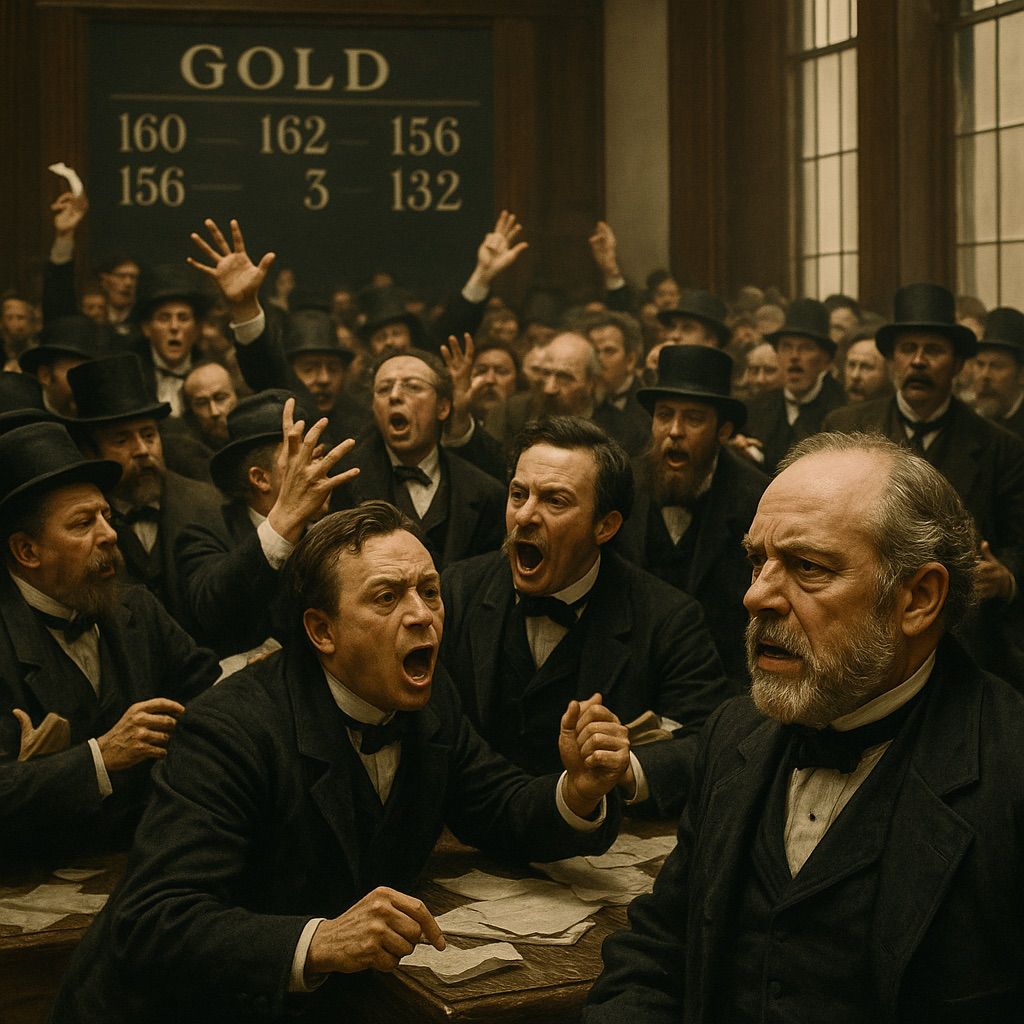
On September 24, 1869, Wall Street descended into madness. It was a Friday morning like no other, a day when fortunes evaporated, when brokers screamed themselves hoarse on the trading floor, when the very foundation of America’s post–Civil War economy seemed to crack under the weight of raw speculation. The newspapers would forever call it “Black Friday” — not for shopping deals or holiday cheer, but for panic, ruin, and the audacity of two men who believed they could corner the nation’s gold supply. Their names were Jay Gould and James Fisk, and together they hatched a plot so brazen that it nearly broke the country.

To understand the chaos of Black Friday, one must understand the times. The Civil War had ended just four years earlier, but the scars ran deep. The Union had financed much of its war effort by issuing “greenbacks,” paper currency not backed by gold or silver. These greenbacks fluctuated wildly in value, and the question of whether they should be redeemed in hard gold was hotly debated. At the center of it all stood President Ulysses S. Grant, a hero of war turned steward of peace, trying to stabilize the currency and restore economic confidence. Gold was the keystone of this fragile system. Whoever controlled gold controlled the economy.

Enter Jay Gould and James Fisk, two of the most infamous schemers of the Gilded Age. Gould was the brains — brilliant, cold, calculating, a man whose mind ticked like a watch wound too tight. Fisk was the showman — flamboyant, loud, a master of charm and distraction. Together, they controlled the Erie Railroad and dreamed of greater conquests. Gold, they realized, was the ultimate prize. If they could corner the gold market, drive up prices, and sell at the peak, they could amass wealth on a scale beyond imagination. But to pull it off, they needed more than money. They needed influence.

Their scheme unfolded like a novel of corruption. Gould and Fisk began buying gold in secret, steadily pushing the price higher. At the same time, they sought to ensure the federal government would not interfere. If the Treasury flooded the market with gold, their plan would collapse. So they set about cultivating allies in high places. Their most important target was Abel Corbin, a minor speculator who just happened to be married to President Grant’s sister. Through Corbin, Gould and Fisk gained access to the President himself. They whispered their arguments about keeping gold scarce, dressing their self-interest in the language of national prosperity. Grant, cautious but trusting, listened. For a time, it seemed the plan might actually succeed.

By late September, the gold market was in frenzy. Prices soared from $130 to $160 an ounce, unprecedented heights. Gould and Fisk, their pockets heavy with contracts, seemed unstoppable. On the trading floor of the Gold Room in New York, pandemonium reigned. Brokers jostled and shouted, their fortunes rising and falling with every tick of the board. Outside, speculators and onlookers crowded the streets, sensing history in the making. Newspapers buzzed with rumors. Was gold being cornered? Were Gould and Fisk really pulling the strings of the market?

But schemes built on manipulation are castles built on sand. President Grant, wary of the rumors swirling around him and increasingly alarmed by the economic chaos, acted. On the morning of September 24, the Treasury, under Grant’s direct orders, released $4 million in government gold into the market. It was like a thunderclap. The price of gold, inflated by greed and speculation, collapsed in an instant. From $160 it plunged to $133 in minutes. Fortunes evaporated. Men who had been rich at breakfast were ruined by lunch. Panic swept the floor of the Gold Room, brokers screaming, collapsing, tearing at their hair as their world imploded.

The ripple effects were devastating. Stock prices crashed, credit tightened, businesses failed. Farmers across the Midwest, who relied on stable markets for their crops, saw their livelihoods threatened. Banks wobbled, merchants despaired. The panic of Black Friday revealed how deeply the nation’s economy could be shaken by the schemes of a few men. Gould and Fisk walked away tarnished but not destroyed — Gould, ever slippery, managed to sell much of his gold before the collapse, insulating himself from total ruin. Fisk, the showman, blustered his way through the fallout, his reputation bruised but his fortune intact. Others were not so lucky. Small speculators were bankrupted, families impoverished, trust in the markets shattered.

Black Friday was more than a financial scandal. It was a parable of the Gilded Age, an era when unbridled ambition and corruption danced hand in hand. It revealed the fragility of America’s financial system and the dangerous power of speculators who believed they could bend the economy to their will. It showed how political influence and private greed could entwine, threatening the stability of the nation itself. And it marked Ulysses S. Grant, unfairly to some degree, with the stain of suspicion, as critics charged that he had been duped or compromised by the schemers who courted his circle.

In the aftermath, reforms were demanded, though the age of Goulds and Fisks was far from over. The Gilded Age would see railroads manipulated, stocks watered, and fortunes made and lost in waves of speculation. But Black Friday remained a warning — a day when America learned, painfully, that unchecked greed could rattle the pillars of prosperity.

Looking back, September 24, 1869, stands as one of the most infamous days in Wall Street history. It was the day two men nearly hijacked an economy, the day ordinary people paid the price for extraordinary ambition, the day gold itself became a weapon of manipulation. In its frenzy and its fallout, Black Friday told a story that still echoes today: markets are not just numbers on a board, but reflections of human desire, fear, and folly. And when those forces run wild, collapse is never far behind.

Related Posts

Finding a Giant: How Neptune Emerged From the Shadows of the Sky

Elias Rowen

On the night of September 23, 1846, humanity’s gaze expanded to embrace another world. In the quiet of the Berlin Observatory, astronomer Johann Gottfried Galle peered through a telescope, guided not by chance but by mathematics, and spotted a faint blue disk glimmering against the canvas of the heavens. This was Neptune — a planet no one had seen before, predicted by calculation and confirmed by sight. It was the first time in history that a celestial body had been discovered not by accident or luck but through the power of human reasoning. In that moment, the universe seemed to whisper back to humanity: your mind can reach farther than your eyes.

The story of Neptune’s discovery is a drama of intellect, rivalry, and revelation. By the early 19th century, astronomers knew their solar system was not complete. Uranus, discovered by William Herschel in 1781, did not behave as Newton’s laws suggested it should. Its orbit wobbled, pulled by something unseen. Some thought Newton’s theory might be flawed. Others suspected the existence of another, more distant planet tugging invisibly at Uranus’s path. It was a puzzle that stretched the limits of human curiosity. Could mathematics alone point to a world no telescope had yet glimpsed?

In France, the young mathematician Urbain Le Verrier took up the challenge. With relentless precision, he calculated where this hidden planet should be. Across the Channel in England, John Couch Adams, working independently, arrived at a similar conclusion. Both men, armed only with equations and determination, had triangulated the position of a ghost in the sky. But calculation was only theory until confirmed by observation. That final task fell to Galle in Berlin. Using Le Verrier’s predictions, he turned his telescope toward the designated region of sky. And there it was — Neptune, almost exactly where the numbers had foretold. A pale orb on the frontier of sight, a new giant of the solar system, pulled out of darkness by the union of mathematics and vision.

The discovery was more than a scientific triumph. It was a cultural earthquake. For millennia, humanity had relied on the naked eye to know the heavens. The ancients mapped Mercury, Venus, Mars, Jupiter, and Saturn, the “wanderers” visible without aid. Even Uranus had been spotted accidentally. But Neptune was different. It was a planet pulled from the void by intellect alone, the child of pencil, paper, and calculation before it was the child of glass and lens. The discovery vindicated Newtonian physics, silenced skeptics, and cemented the idea that the universe could be grasped not only by what we see, but by what we deduce.

Yet the triumph was also entangled with rivalry and controversy. France celebrated Le Verrier, Britain claimed Adams, and Germany honored Galle. The discovery became a matter of national pride, each country eager to inscribe its name on the newest planet. But beyond borders and egos, Neptune belonged to no nation. It belonged to the human species, a collective leap of mind and spirit.

Neptune itself was a revelation. Over time, astronomers learned it was a giant of ice and gas, its atmosphere laced with methane, its winds the fastest in the solar system, roaring at over 1,000 miles per hour. Fourteen moons circled it, including the captured body Triton, a frozen world spewing geysers of nitrogen. Neptune was not merely a dot on a chart but a dynamic, alien realm, far beyond Earth’s warmth, yet alive with storms and mystery. The discovery opened a door not only to one planet but to the realization that the cosmos was far larger, stranger, and more alive than anyone had imagined.

Looking back, the night of September 23, 1846, represents more than a scientific milestone. It is a symbol of what humanity can achieve when imagination meets discipline. A young mathematician scribbling on parchment, an astronomer adjusting his telescope, a silent blue world waiting unseen for eons — all converged in one moment of cosmic revelation. It was a reminder that the universe is not static but expanding, not closed but open, and that our role is not only to dwell within it but to discover it.

Neptune’s discovery remains a turning point in the human story. It was the night we proved that reason could see farther than the eye, that the cosmos could be mapped before it was touched, that the boundary between known and unknown was not a wall but a horizon. On September 23, 1846, humanity found a giant in the dark, and in doing so, found itself a little larger too.

Related Posts

A Proclamation Toward Freedom: Lincoln’s Preliminary Edict That Shook a Nation

Elias Rowen

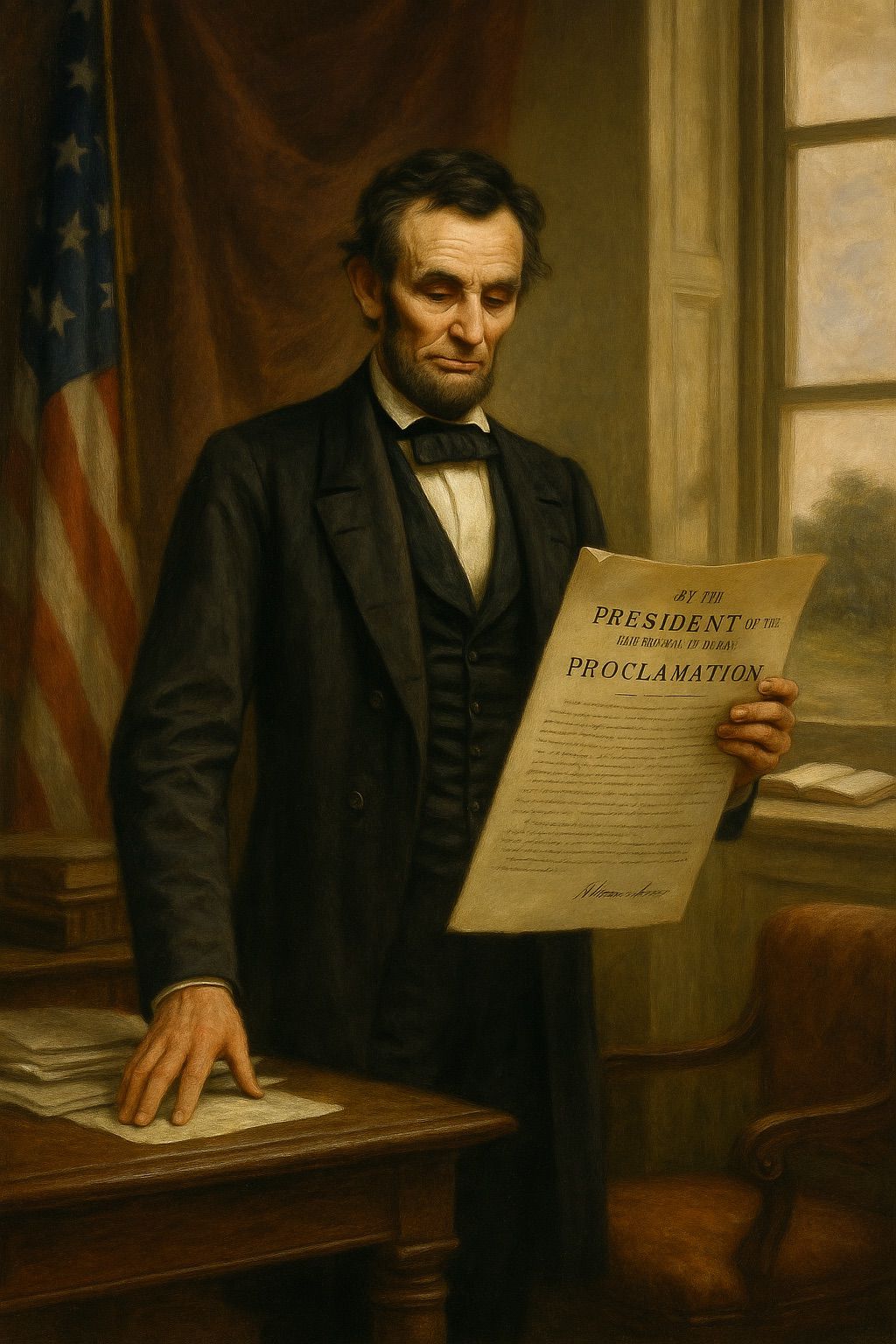
On September 22, 1862, in the midst of the bloodiest conflict America had ever endured, President Abraham Lincoln placed pen to paper and issued a proclamation that changed the moral and political trajectory of the United States. Known as the Preliminary Emancipation Proclamation, it declared that if the rebelling Confederate states did not return to the Union by January 1, 1863, their enslaved people would be declared “forever free.” It was not yet full emancipation — it was conditional, tactical, and carefully worded — but it was a seismic shift. For the first time, the Civil War was not only about preserving the Union but also about ending the institution of slavery. In one stroke, Lincoln reframed the conflict, aligning it with a higher purpose and setting the stage for the ultimate abolition of slavery.

To understand the gravity of September 22, we must first grasp the context. The Civil War had been raging for over a year, and the Union had little to show for it. Hundreds of thousands of lives had already been lost or shattered, yet victory was uncertain. Lincoln’s original aim was preservation, not revolution. His guiding principle had been to save the Union, whether that meant freeing all enslaved people, none, or some. But the reality of war, the pressure from abolitionists, and the actions of enslaved people themselves — thousands fleeing to Union lines, claiming freedom by force of will — pushed the question of slavery to the forefront. Lincoln, cautious and deliberate, knew timing was everything.

The catalyst was the Battle of Antietam, fought on September 17, 1862. It was the single bloodiest day in American history, with more than 22,000 casualties. Though tactically inconclusive, it gave Lincoln the opportunity he had been waiting for. He had drafted the proclamation earlier in the summer but held it back, unwilling to appear desperate after Union defeats. Antietam, grim as it was, gave him a tenuous claim to victory — enough momentum to release the proclamation without it seeming like a plea born of weakness. Five days later, on September 22, he gathered his cabinet and unveiled the edict that would forever mark his presidency and America’s conscience.

The Preliminary Emancipation Proclamation was not the sweeping abolition that myth later paints. It applied only to states “in rebellion” against the Union, not to loyal border states like Kentucky, Missouri, Maryland, or Delaware. It left slavery untouched in areas already under Union control. It was, in part, a war measure designed to destabilize the Confederacy by undermining its labor force and encouraging enslaved people to flee or resist. It was also a diplomatic maneuver, discouraging European powers like Britain and France — both of which had already abolished slavery — from recognizing or supporting the Confederacy. In its legalistic phrasing and its calculated exclusions, it reflected Lincoln’s pragmatism as much as his ideals. Yet beneath its cautious surface was something revolutionary: the transformation of the war into a struggle for freedom.

The reaction was immediate and polarized. Abolitionists rejoiced, though some criticized the proclamation for not going far enough. Frederick Douglass, the towering voice of Black freedom, hailed it as a “mighty act,” recognizing its potential to change the moral stakes of the war. Many Union soldiers, once indifferent to slavery, began to see themselves as liberators. Enslaved people in the South heard the news through whispers, newspapers, and word of mouth, and thousands fled to Union lines, their journeys becoming living embodiments of freedom proclaimed. At the same time, Lincoln faced fierce backlash. Northern Democrats denounced him, accusing him of turning the war into an abolition crusade. Racists predicted chaos, claiming that emancipation would unleash violence, unemployment, and ruin. Border states threatened unrest. Even within Lincoln’s own party, doubts persisted about whether he had gone too far or not far enough.

But Lincoln understood something deeper: that once freedom had been proclaimed, there was no turning back. By issuing the Preliminary Emancipation Proclamation, he laid down a moral gauntlet. Come January 1, if the Confederacy remained defiant, slavery would be struck at its root. The edict made emancipation inevitable, even if gradual and incomplete. It was the opening door through which the 13th Amendment would later stride, abolishing slavery everywhere. It was the moment the Union defined not just what it was fighting against — rebellion — but what it was fighting for: liberty.

September 22, 1862, was therefore not a conclusion but a beginning. It was a moment of clarity in a war clouded by blood and uncertainty. Lincoln himself acknowledged its gravity. He told his cabinet: “I never in my life felt more certain that I was doing right than I do in signing this paper.” He knew history would judge him by this act as much as by any battlefield. He knew it would anger some, inspire others, and change everything. And he was right.

The Preliminary Emancipation Proclamation was not perfect. It was limited, conditional, and riddled with exceptions. But it was also transformative. It shifted the ground beneath the war, elevating it from a struggle over union to a struggle over human freedom. It gave the conflict moral clarity, rallying abolitionists, dissuading foreign powers, and emboldening enslaved people to claim their own liberation. It marked the moment when America began, however painfully, to move toward its better self.

Looking back now, we can see the paradox of Lincoln’s edict. It was cautious yet bold, pragmatic yet idealistic, legalistic yet revolutionary. It was an imperfect step, but it was a step. And that is how progress often comes: not in pure leaps of justice, but in contested, complicated acts that carve a path forward. On September 22, 1862, Abraham Lincoln issued such an act. And in doing so, he transformed not only the Civil War, but the very meaning of America.

Related Posts

Treason at West Point: The Day Benedict Arnold Betrayed the Revolution

Elias Rowen

On September 21, 1780, in a quiet grove along the Hudson River, two men met in secret to alter the course of the American Revolution. One was Major John André, a dashing young officer in the British army, admired for his charm and intelligence. The other was General Benedict Arnold, a hero of earlier battles in the war but now a man consumed by bitterness, ambition, and resentment. Together they plotted nothing less than the betrayal of West Point, the fortress that guarded the Hudson and was considered the key to the Revolution. Their meeting — clandestine, dangerous, and fateful — would end not with triumph but with disgrace, capture, and execution. It would forever brand one man’s name as synonymous with treason: Benedict Arnold.

The road to that treason began years earlier. Arnold was no ordinary figure. In the early years of the Revolution, he had distinguished himself as one of the most daring and effective generals in George Washington’s army. He played a critical role in the capture of Fort Ticonderoga, led men through the brutal wilderness of Maine in a daring march to Quebec, and was instrumental in the American victory at Saratoga, a turning point in the war. Yet for all his bravery, Arnold felt slighted. Promotions passed him by. Rivals whispered against him. Congress, wary of his temper and extravagance, questioned his expenses and delayed his recognition. His leg, shattered by musket fire at Saratoga, became a permanent reminder of sacrifice without reward. As others received praise and promotion, Arnold seethed with resentment, convinced that his contributions were being overlooked and his honor tarnished. The seeds of betrayal were planted not by lack of ability, but by wounded pride.

By 1780, Arnold’s bitterness had grown into treachery. Appointed by Washington as commander of West Point, Arnold now held one of the most critical posts in the war. West Point was the linchpin of American defense: perched on a rocky bluff above a sharp bend in the Hudson, it controlled the river that divided New England from the rest of the colonies. Whoever controlled West Point controlled the war. For Arnold, it was an opportunity — not to serve his country, but to sell it. Secretly, he began correspondence with the British, offering to deliver West Point into their hands in exchange for money and rank in the British army. For a man who felt America had betrayed him, it was a chance to strike back and secure his fortune.

The British welcomed his overtures. Sir Henry Clinton, commander of British forces in New York, saw in Arnold’s betrayal the opportunity to crush the Revolution. Clinton’s aide, Major John André, became the go-between. Handsome, urbane, and only twenty-nine, André was everything Arnold was not: admired, beloved, and full of promise. Where Arnold was haunted by slights, André seemed blessed by fortune. But in September 1780, their fates became entwined. On the night of September 21, the two men met near the village of Haverstraw, New York. André, disguised in civilian clothes, slipped ashore from the British sloop Vulture to meet Arnold. There in the shadows, they conspired to hand over West Point for the price of £20,000. Plans and maps were exchanged, promises made. The deal was sealed. But fate, as it often does, intervened.

The meeting went longer than expected, and André found himself unable to return to the Vulture. Forced to travel back toward British lines by land, he carried with him the incriminating documents of Arnold’s treachery — plans of West Point hidden in his boot. On September 23, near Tarrytown, André was stopped by three American militiamen. Nervous, he showed them a pass signed by Arnold. But when they searched him and found the secret papers, the truth was revealed. André was arrested and taken to the nearest American post. The plot began to unravel.

Arnold, alerted to André’s capture, fled West Point in haste, racing to the Vulture and escaping to British lines. Washington, who had trusted Arnold and considered him one of his finest officers, arrived at West Point only to discover the betrayal. The shock was profound. Washington, a man known for his composure, was visibly shaken. He had been minutes away from falling into Arnold’s trap. If the fortress had fallen, the Revolution itself might have collapsed. The discovery of Arnold’s treason struck like a thunderclap, shaking the fragile confidence of the American cause.

André’s fate was sealed. Though he conducted himself with dignity and charm during his captivity, even winning the admiration of his captors, the evidence was clear. He was tried as a spy and sentenced to death. On October 2, 1780, he was hanged, his youth and gallantry unable to save him from the gallows. His death was mourned even by Washington, who respected his courage but could not ignore his crime. Arnold, meanwhile, became a brigadier general in the British army, but never found the honor he craved. He led raids against his former countrymen, but he was mistrusted by the British and despised by the Americans. He had sold his soul and gained nothing but infamy. To this day, his name is shorthand for betrayal.

The meeting on September 21, 1780, was more than just a failed conspiracy. It was a moment that revealed the fragility of revolutions and the complexities of loyalty. Arnold was not a villain by nature, but a hero turned bitter by pride and ambition. André was not a scoundrel, but a soldier caught in the web of war. Yet together they embodied the darker truths of conflict: that ideals are fragile, that men are fallible, and that the line between hero and traitor is often razor thin.

Looking back, it is tempting to see Arnold only as a villain, his name blackened by treason. Yet his story is also a cautionary tale about recognition, pride, and the corrosive power of resentment. He was a man who could have been remembered as one of America’s greatest heroes, but who instead chose the path of betrayal. His name is a reminder that loyalty cannot be bought, and that honor once lost cannot be regained.

On that September day in 1780, as Arnold and André whispered in the shadows, the fate of the Revolution teetered. Their conspiracy failed, but its lesson endures: revolutions are not only fought on battlefields, but in the hearts of those who serve them. And sometimes, the greatest danger comes not from without, but from within.

Related Posts

Billie Jean vs. Bobby: The Night America Turned a Tennis Court Into a War Zone

Elias Rowen

Houston, September 20, 1973. The Astrodome throbs like the belly of some giant neon beast, and I’m in the middle of it, ears ringing, brain boiling, heart sprinting like a rabbit trapped under floodlights. This isn’t tennis — don’t let anyone fool you. This is bloodsport dressed up in polyester whites. This is a carnival, a hustler’s sideshow, a morality play staged on AstroTurf with 30,000 howling witnesses in the cheap seats and another 90 million tuning in through the glowing altars of their television sets. The line between sport and circus has dissolved, and what remains is a bizarre American ritual: one man, one woman, one match that has nothing to do with backhands and everything to do with the future of gender itself.

Bobby Riggs is first on stage, and Christ, what an entrance. Fifty-five years old, wheezing like an overstuffed slot machine, he struts into the stadium in a “Sugar Daddy” jacket, waving a lollipop the size of a frying pan. The crowd screams with the kind of gleeful hate usually reserved for pro wrestlers or crooked politicians. Riggs is America’s appointed clown, the loudmouthed carny who turned himself into a national act by shouting the thing everybody whispered at the bar: women can’t cut it. Not in tennis. Not in sports. Not anywhere. He plays it like stand-up comedy, a male chauvinist pig routine so shameless it circles back around to performance art. But make no mistake: beneath the grin, he means it. He really thinks Billie Jean King is just another mark, another pigeon for the hustler to fleece under the hot lights.

And then Billie Jean arrives — Cleopatra carried on a golden litter by bare-chested men, the queen in sneakers, gliding into the arena with a face carved from steel. She doesn’t smile. She doesn’t wink. She’s not here for the sideshow. She’s here for execution. The roar is deafening. Kids are jumping in front of televisions, beer is sloshing in living rooms, women lean forward on couches across America like they’re watching Joan of Arc march into battle. Because that’s what this is: a crusade dressed as a tennis match.

I light a cigarette, the smoke curling up into the cheap seats. The air tastes like sweat, beer, and revolution.

The game begins, and immediately Riggs is in trouble. His legs are too old, his tricks too stale. He’s been peddling the same junk-ball routine for years — lobs, drop shots, little hustles designed to frustrate. It worked on Margaret Court in May, when he humiliated her in the so-called “Mother’s Day Massacre.” That match emboldened him, convinced him the whole women’s game was a con waiting to be exposed. But Billie Jean is no Margaret Court. She studied him, dissected his little hustler’s toolbox, and tonight she came to torch it.

Point after point, she hammers him into the corners, stretching him across the court like an old rubber band. Riggs huffs, puffs, swats weakly, but the precision of King’s groundstrokes tears through him like a chainsaw through papier-mâché. The crowd senses it early, murmurs turning into roars with each passing rally. By the end of the first set, 6-4, Riggs looks rattled, the smirk flickering on his face like a neon sign on its last bulb.

Second set, King is merciless. She pushes him back, keeps him running, playing not only with power but with psychology. Every shot is a declaration: you thought women couldn’t play? Watch this. She takes it 6-3. The Astrodome is a madhouse, half the crowd delirious with joy, the other half drunk on disbelief. Riggs is cooked, but he doesn’t know it yet. He staggers into the third like a washed prizefighter who refuses to hear the bell. King finishes it 6-3 again, and suddenly it’s over. Done. The great hustler is slumped on the court, the con blown apart under the weight of reality. Billie Jean raises her arms, and the place detonates like the Fourth of July.

The scoreline goes up in lights: 6-4, 6-3, 6-3. History etched into numbers, simple and brutal.

And here’s where the madness really begins.

Because this was never just about tennis. Don’t kid yourself. This was America in the 1970s, chewing on the jagged gristle of its own contradictions. Nixon in the White House, Vietnam unraveling, women marching in the streets demanding equality, men clinging to the last scraps of their comfortable superiority. The country was a pressure cooker, hissing with resentment and change, and the Battle of the Sexes was the valve release. Riggs wasn’t just an old gambler with a racket. He was the embodiment of every boss who told his secretary she’d never make it, every coach who told a girl she couldn’t play, every father who laughed at the idea of daughters doing more than serving dinner. And King wasn’t just a tennis player. She was the fuse on a bomb, the living rebuttal to centuries of dismissal.

Her victory was a thunderclap. It told little girls glued to television screens that they could step onto a court, a field, a stage, and not just belong but dominate. It told little boys that their smug grins weren’t safe anymore. It told America that equality wasn’t an abstract theory. It was real, and it had a score: 6-4, 6-3, 6-3.

I remember the delirium afterwards. Bars erupting. Women pounding their fists on tables, screaming with joy. Men grumbling into their beer mugs, muttering about “just a show match.” But it didn’t matter. The image was already burned into history: Billie Jean King, arms raised, eyes fierce, standing over the carcass of chauvinism in the middle of the Astrodome. Riggs had been reduced to what he always was — a hustler past his prime. But King was reborn, transformed from champion to icon, from athlete to revolutionary.

Even now, decades later, the shockwaves haven’t faded. The Battle of the Sexes gets replayed in documentaries, re-enacted in films, dissected in classrooms. Some sneer and say it wasn’t a fair fight — Riggs was old, King was in her prime. But that’s missing the point. The point was never the contest itself. The point was the stage, the spectacle, the symbolism. Riggs represented the past. King represented the future. And on that night, in front of ninety million witnesses, the future won.

I left the Astrodome dizzy, the roar still ringing in my ears. The night air felt different, electric, like the country had just shifted half an inch on its axis. Somewhere in that chaos, equality had notched a victory, not the last, not the final, but one that mattered. Sport had done what speeches and protests couldn’t: it put the fight in front of everyone, forced them to watch, and gave them a score they couldn’t argue with.

And that’s the truth of September 20, 1973. Billie Jean King didn’t just beat Bobby Riggs. She torched an entire narrative, and the fire is still burning.

Related Posts

From Smiley to Culture Shift: The Day the Emoticon Was Born

Elias Rowen

On September 19, 1982, in the computer labs of Carnegie Mellon University, history was made in the most unlikely way. Not with rockets or revolutions, not with treaties or discoveries, but with three humble keystrokes: colon, hyphen, and parentheses. Together, they formed “:-)” — the world’s first widely recognized digital smiley face. It was posted on a university bulletin board system by Professor Scott Fahlman as a way to indicate humor in the confusing, tone-deprived world of online text. He suggested that when something was meant as a joke, users could type “:-)”, and when it was meant to be serious, they could use “:-(”. At the time, it seemed like a trivial proposal, a practical tool for clarifying sarcasm and jokes in a text-only space. But in hindsight, it was revolutionary. Those three keystrokes would evolve into a cultural phenomenon, shaping how billions of people express themselves online, bridging gaps of tone and emotion, and giving rise to the emojis, stickers, GIFs, and memes that define digital communication today. That September day in 1982 was the birth of the emoticon — and with it, the beginning of a new visual language.

The origins of the emoticon are inseparable from the early days of the internet, or rather, its precursors. Long before Facebook, Twitter, or WhatsApp, online communities were forming on primitive systems like ARPANET and university bulletin boards. These were spaces dominated by text — lines of code and plain sentences scrolling across monochrome screens. But humans, being irrepressibly social, wanted more than just information. They wanted to joke, to tease, to banter. And with no facial expressions or tone of voice to guide interpretation, confusion abounded. A sarcastic remark could be mistaken for an insult. A joke could land flat and cause offense. In this atmosphere of miscommunication, the need for a solution was clear. Scott Fahlman’s suggestion was born out of this frustration: a simple marker to indicate “I’m kidding.” It was modest, practical, and ingenious all at once.

What Fahlman could not have predicted was how quickly and how far the idea would spread. Soon, “:-)” and “:-(” were being used across different systems, copied into emails, adopted by programmers and hobbyists alike. Within months, they became a shorthand understood far beyond Carnegie Mellon. The beauty of the emoticon lay in its simplicity. It required no new technology, no software update, no special font. Anyone with a keyboard could type it. And in those early years, it carried a kind of geeky charm, a secret handshake among the growing online community. To use “:-)” was to signal not only humor, but membership in the strange, exciting world of digital communication.

As the internet grew, so too did the emoticon. It evolved into countless variations: winks ;-) for mischief, big grins :-D for joy, tears :’( for sadness. Entire libraries of keystroke faces emerged, each one capturing a nuance of human emotion that text alone could not convey. By the 1990s, emoticons were everywhere — in chat rooms, on AOL Instant Messenger, in early emails. They became so embedded in online culture that they were no longer novel, but necessary. Without them, communication felt flat. With them, it came alive.

The next great leap came with the emoji. In the late 1990s, in Japan, Shigetaka Kurita created a set of 176 simple pictographs — hearts, faces, symbols — to enhance mobile communication. Unlike emoticons, which relied on imagination and keystrokes, emojis were visual images. They were colorful, direct, and instantly expressive. When smartphones popularized them worldwide in the 2000s, the emoji took the foundation laid by the emoticon and expanded it into a global visual vocabulary. Today, emojis are so ubiquitous that entire conversations can unfold without a single word. And yet, every emoji — every smiley face, every sad tear, every wink and laugh — carries within it the DNA of that first humble emoticon posted on September 19, 1982.

Why does the emoticon matter? Because it solved a problem deeper than text. It solved the problem of being human in a digital space. Communication is not just about words; it is about tone, expression, context. In person, we rely on facial cues, gestures, and intonation to understand each other. Stripped of these, digital communication is vulnerable to misunderstanding. The emoticon was humanity’s first attempt to bring those cues into the online world. It was a reminder that behind every line of text was a person, with emotions and intentions that could not always be captured by words alone. It was, in essence, a bridge — between human feeling and machine language, between flesh and code.

The cultural impact of that bridge cannot be overstated. Today, emojis influence politics, advertising, art, and even law. A single emoji can change the tone of a message, soften a critique, or spark controversy. Brands deploy them to connect with audiences. Courts have debated their legal implications. Artists use them as creative tools. And memes — the internet’s cultural currency — often rely on the visual shorthand that began with “:-)”. The emoticon opened the door to an entirely new layer of human expression, one that has transformed not just how we communicate, but how we connect.

Looking back at September 19, 1982, it is tempting to laugh at the modesty of the moment. A professor typed three characters on a bulletin board, and the world changed. But that is the beauty of history: sometimes revolutions come not with thunderclaps, but with whispers. Sometimes they come not with inventions of steel and fire, but with tiny symbols that capture the essence of human connection. The emoticon was not just a joke marker. It was a turning point in the story of language, a reminder that communication evolves with technology, and that even in the cold world of machines, humanity always finds a way to smile.

Related Posts

All the News That’s Fit to Print: The Day The New York Times First Hit the Streets

Elias Rowen

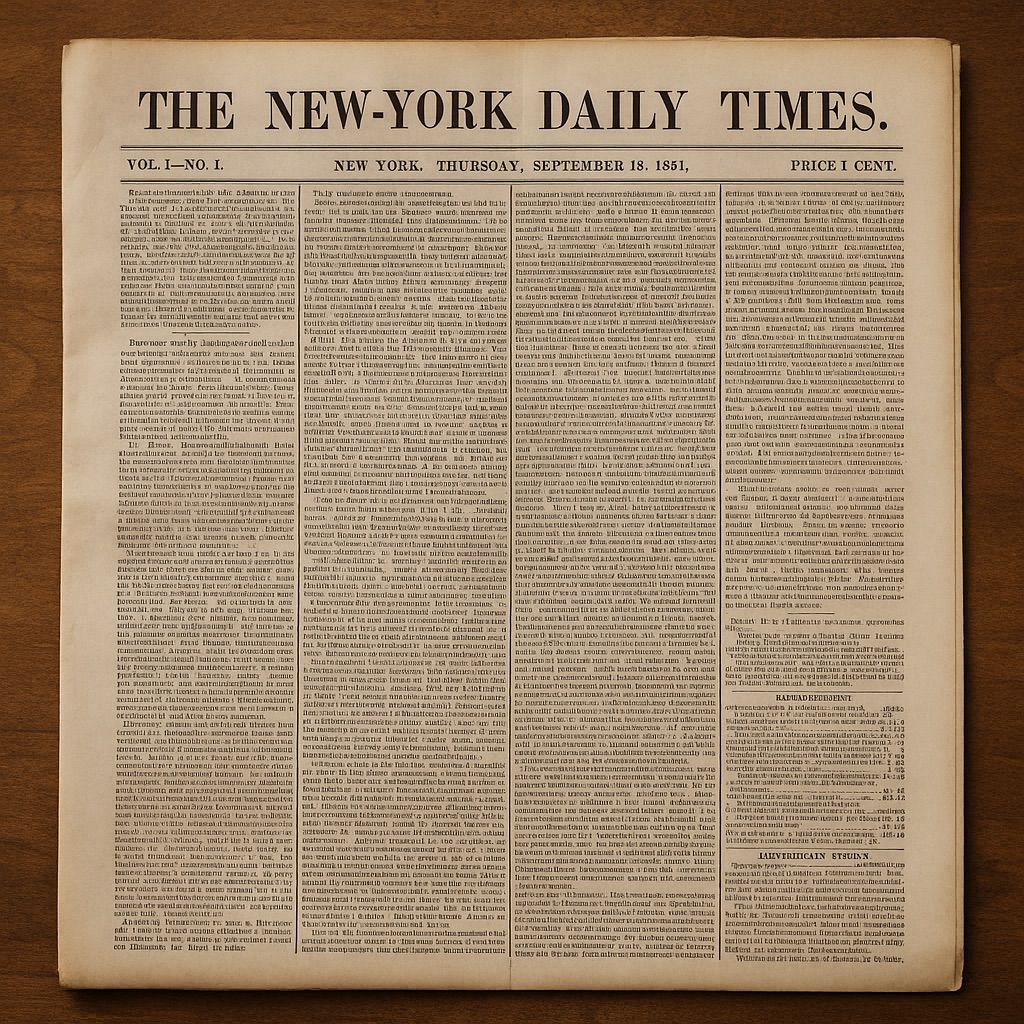
On September 18, 1851, the streets of New York City awoke to a new voice. Amid the clatter of horse-drawn carriages, the cries of newsboys hawking papers, and the hum of a city that was rapidly becoming the beating heart of America, a four-page newspaper rolled off a printing press for the very first time. Its name was The New-York Daily Times, a modest publication that cost just one cent. Few who glanced at that first issue could have imagined that this newspaper would grow into The New York Times, one of the most influential publications in the world, a journalistic institution synonymous with credibility, depth, and the famous motto it would later adopt: “All the News That’s Fit to Print.” That morning in 1851 marked the birth of a paper that would chronicle wars, revolutions, scandals, triumphs, and tragedies, shaping the way millions of people understood the world around them.

The mid-19th century was a turbulent, electric time for journalism. Newspapers were everywhere, competing for attention in a city already thick with rival publications. Many of them were sensationalist, filled with lurid stories, gossip, and outright fabrications. Others were fiercely partisan, serving as mouthpieces for political parties rather than independent outlets for the public. Into this noisy, chaotic media landscape stepped Henry Jarvis Raymond, a journalist and politician, and George Jones, a banker. Together, they founded the New-York Daily Times with a mission that seemed both bold and old-fashioned: to publish a newspaper that valued accuracy over sensation, balance over bias, and depth over triviality. They believed that readers deserved not only information but trustworthy information — a radical concept in an age of yellow journalism and partisan warfare.

That first issue set the tone. It included coverage of politics, business, foreign affairs, and cultural life, written with a clarity and restraint that distinguished it from its competitors. It did not scream for attention with wild headlines or exaggerated stories. Instead, it presented itself as serious, respectable, and thoughtful. Raymond and Jones envisioned a newspaper for readers who craved more than scandal and spectacle, for those who wanted to understand the complexities of the nation and the world. It was, in its way, a rebellion against the dominant media culture of its time. And slowly, it began to build a reputation for integrity.

The Times would go on to play a pivotal role in shaping the American public sphere. Through the Civil War, it reported from the frontlines, offering readers not just battlefield updates but sober analysis of the conflict that was tearing the nation apart. During Reconstruction, it covered the challenges of reunification and the struggles for civil rights. As the nation industrialized, the Times chronicled labor strikes, economic booms, and social upheavals. In the 20th century, it became the paper of record for a nation that was itself becoming a global power. Its correspondents filed reports from Europe during two world wars, from Asia during conflicts and revolutions, from Washington during political scandals, and from cities across the globe as the modern world unfolded. Each headline was more than ink on paper. It was a lens through which millions saw history happening in real time.

What made the Times endure was not just its reach, but its ethos. The motto “All the News That’s Fit to Print,” first used in 1897, encapsulated its philosophy. In an era when newspapers often printed anything to sell copies, the Times promised discernment. It would print not everything, but everything worth knowing. That philosophy became a trust between the paper and its readers, a trust that elevated it from just another publication to an institution. Over time, its front page became something more than newsprint. It became a national stage, where the events of the world were given weight, context, and permanence.

Of course, the Times has not been without controversy. Over its long history, it has faced criticism, lawsuits, and scandals. It has been accused of bias, of errors, of failures in judgment. It has sometimes struggled with the balance between objectivity and advocacy, between timeliness and accuracy. Yet part of its endurance lies in its willingness to confront those challenges, to correct mistakes, to adapt to new technologies and new demands. From the telegraph to the internet, the Times has continually reinvented itself while holding to its central promise of credibility. In doing so, it has become not only a chronicler of history but a part of history itself.

When we think about September 18, 1851, we see more than the launch of a newspaper. We see the beginning of a tradition that has shaped democracy. Journalism, at its best, is not just about reporting facts. It is about holding power accountable, about informing citizens, about giving voice to truth even when it is uncomfortable. The New York Times, born in that moment, became one of the most enduring examples of that principle. Its pages have been the battleground for debates about freedom of the press, the source of revelations that toppled governments, and the chronicler of everyday life in all its complexity. From the Pentagon Papers to Watergate, from 9/11 to the digital revolution, the Times has been there, shaping and reflecting the way we understand the world.

The story of its birth is also the story of America’s own coming of age. In 1851, the United States was still young, still finding its place in the world, still wrestling with contradictions of liberty and slavery, expansion and division. The launch of a newspaper dedicated to accuracy and fairness was, in its way, a reflection of the nation’s aspirations: to be serious, to be respected, to be informed. And just as the country grew, faltered, and rose again, so too did the Times evolve, stumble, and rise again. The parallels are striking because both the nation and its newspaper share the same project: the constant, imperfect pursuit of truth.

Looking back now, more than 170 years later, that modest first issue of the New-York Daily Times feels almost quaint. Its typeface was simple, its columns dense, its circulation limited. But within those pages was the spark of something enduring. On that September morning, Henry Raymond and George Jones could not have foreseen the digital age, the global reach, or the Pulitzer Prizes their paper would one day win. But they believed in something timeless: that truth matters, that words matter, that journalism matters. And because they believed, a newspaper was born that continues to shape the world today.

So when we remember September 18, 1851, we are not just remembering the launch of a newspaper. We are remembering the launch of an idea: that information should be accurate, that truth should be told, that the public deserves more than noise and spectacle. That idea, embodied in the New York Times, remains as vital now as it was then. For all the news that’s fit to print — and all the stories still to come — it began on that day, with a small paper sold for a penny, and a dream that truth, once printed, could change the world.

Related Posts

A More Perfect Union: The Day the U.S. Constitution Was Signed

Elias Rowen

On September 17, 1787, in a stuffy room in Philadelphia’s State House, a group of weary delegates affixed their signatures to a document that would alter the trajectory of human history. That document was the United States Constitution. For four long months, the men gathered there — farmers and lawyers, merchants and generals, revolutionaries and statesmen — had debated, argued, compromised, and despaired. They had wrestled with questions of power and liberty, of unity and division, of ambition and restraint. And at last, after a summer of sweat and frustration, they put their quills to parchment and created what they called “a more perfect union.” At the time, few could have grasped the magnitude of what they had done. But the Constitution, fragile yet powerful, incomplete yet visionary, would go on to shape not only a nation but the modern idea of self-government itself. The day it was signed was not merely the end of a convention. It was the beginning of an experiment still unfolding.

The backdrop to that day was anything but orderly. The United States in 1787 was a fragile confederation, held together loosely under the Articles of Confederation. The Articles had been written in the midst of revolution, when the colonies were more concerned about defeating Britain than about governing themselves. They deliberately created a weak central government, leaving most power to the states. But in the years after independence, it became clear that such weakness was unsustainable. The nation was drowning in debt, its currency unstable, its trade fractured by competing state laws. Shays’ Rebellion, an uprising of indebted farmers in Massachusetts, had shaken the country’s elites, convincing them that something stronger was needed to preserve order and liberty alike. The Constitutional Convention was summoned in Philadelphia with the stated aim of revising the Articles. But once assembled, the delegates decided instead to scrap them and craft an entirely new framework.

The convention that followed was messy, contentious, and at times perilously close to collapse. Delegates argued over representation, with small states fearing domination by larger ones. They argued over slavery, with southern delegates insisting on protections for their “peculiar institution” while others squirmed at the hypocrisy of a republic founded on liberty that sanctioned bondage. They argued over the powers of the executive, wary of creating a new king even as they acknowledged the need for an energetic leader. They argued over the judiciary, the legislature, taxation, trade, and the very nature of sovereignty. Tempers flared, alliances shifted, and more than once it seemed the effort would dissolve into failure.

And yet, through compromise, they forged something enduring. The Great Compromise resolved the battle over representation by creating a bicameral legislature: a House of Representatives based on population, and a Senate with equal votes for each state. The Three-Fifths Compromise, grim and shameful in hindsight, counted enslaved people as three-fifths of a person for purposes of representation and taxation — a concession to slavery that would haunt the nation for generations. They created a presidency with limited but significant powers, constrained by checks and balances. They created a judiciary to interpret the law and ensure that neither Congress nor the President could become too powerful. They created a federal system, balancing power between the national government and the states. And they wrote into the Constitution the principle of amendment, recognizing that the document itself would need to grow and adapt with time. What emerged was not perfect — indeed, it was riddled with compromise and contradiction — but it was, in their words, more perfect than what had come before.

On September 17, the final draft was presented for signing. Some refused. George Mason, Edmund Randolph, and Elbridge Gerry withheld their signatures, unwilling to endorse a Constitution that lacked a bill of rights or that gave too much power to the central government. But thirty-nine men signed, led by the commanding presence of George Washington, whose support lent the entire project credibility. Benjamin Franklin, now in his eighties and so frail he had to be carried into the hall, urged unanimity. In one of the most famous anecdotes of the day, Franklin pointed to a carved sun on the back of Washington’s chair and remarked that throughout the summer he had wondered whether it was a rising sun or a setting one. “Now,” he said, “I have the happiness to know it is a rising and not a setting sun.” His words captured the fragile optimism of that moment: a belief that they had created not perfection, but possibility.

The Constitution left Philadelphia uncertain of its fate. It still had to be ratified by the states, and fierce debates lay ahead. Federalists and Anti-Federalists would battle over its meaning, over the absence of a bill of rights, over fears of centralized tyranny. But the signing was the first step, and in hindsight, it was momentous. For the first time in history, a large republic attempted to govern itself not by monarchy or by accident, but by deliberate design. The Constitution was not a charter of perfection, but a framework of balance — ambition checking ambition, power constrained by power, liberty preserved not by chance but by structure. It was, as James Madison put it, “the greatest of all reflections on human nature.”

The legacy of September 17, 1787, is profound because it was both particular and universal. It was the product of specific men, in a specific place, at a specific time. And yet it spoke to ideas that transcended them: that people could govern themselves, that power could be divided and limited, that government could be both strong and free. The Constitution was flawed — it sanctioned slavery, excluded women, ignored Native peoples, and reflected the biases of its age. But it also contained within it the seeds of its own improvement. The amendment process would add the Bill of Rights, abolish slavery, extend voting rights, and continue the project of creating a more inclusive union. The brilliance of the Constitution was not that it solved every problem, but that it created a structure in which problems could be confronted and progress could be made.

That is why we still remember September 17. Not because the men in Philadelphia were infallible, but because they dared to attempt something unprecedented. They chose to believe that humans, flawed as they are, could craft institutions to govern themselves without kings or tyrants. They chose to believe that compromise, though messy, was stronger than division. They chose to believe that the sun could rise on a new experiment in liberty. And they signed their names to that belief, knowing that the real test lay ahead.

The Constitution they signed has endured for over two centuries, through wars, crises, and transformations they could scarcely imagine. It has been amended, interpreted, contested, and stretched. It has been used to justify injustice and to advance justice. It has been a tool of exclusion and of inclusion. It is not a sacred relic, but a living framework — one that reflects both the best and the worst of the American story. Yet its endurance is itself remarkable. Few documents in history have shaped so many lives, across so many generations, for so long.

On September 17, 1787, the United States Constitution was signed into being. That act did not end conflict, did not guarantee peace, did not resolve the contradictions of liberty and slavery, equality and hierarchy, unity and division. But it created a structure in which those conflicts could be fought, debated, and, sometimes, resolved. It created a republic that could endure. And for all its flaws, it remains one of humanity’s boldest experiments in self-government. That is why the signing of the Constitution is remembered as the day America gave itself not a perfect union, but a chance to become one.

Related Posts

Setting Sail for a New World: The Mayflower’s Voyage That Changed History

Elias Rowen

On September 16, 1620, a small wooden ship slipped away from the port of Plymouth in southern England and set its bow toward the unknown. The vessel was called the Mayflower, a merchant ship never designed for the burden of history it would soon carry, and aboard were just over one hundred passengers — men, women, and children — bound for a land across the ocean that most of them had never seen. They were not adventurers in the romantic sense, nor conquerors with armies at their back. Many were Separatists seeking religious freedom, others were entrepreneurs and laborers chasing economic opportunity, and some were simply caught up in the momentum of the voyage. But together, they embarked on a journey that would become one of the foundational myths of America, shaping the story of a nation that would rise from the struggles, survival, and contradictions of that crossing. The day the Mayflower departed was not just the beginning of a voyage. It was the beginning of an idea.

The decision to leave England was not taken lightly. For the Separatists, who would later be remembered as Pilgrims, life in England had become intolerable under the religious conformity demanded by King James I. Some had fled earlier to the Netherlands, where greater religious tolerance existed, but economic hardship and fear of losing their cultural identity pushed them to seek a more permanent solution. The New World — vast, mysterious, and dangerous — offered both risk and possibility. Backed by financial investors in London who sought profit from colonial ventures, the group secured passage on two ships, the Speedwell and the Mayflower. But fate intervened early. The Speedwell proved unseaworthy, leaking badly, and was forced to turn back. In the end, only the Mayflower would carry them forward, overcrowded and laden with the dreams and fears of those aboard.

The Mayflower itself was not a grand ship. At about 100 feet in length, it was meant for cargo, not passengers. The voyage would be harsh and claustrophobic, with people crammed into tight quarters below deck, enduring seasickness, foul smells, and the constant roll of the Atlantic. Food supplies were limited, fresh water scarce, and storms frequent. For over two months, the passengers lived in damp, dark conditions, buffeted by winds and waves. The Atlantic in autumn was no gentle crossing. Gales tested the ship’s timbers, and at one point, the main beam cracked, threatening to end the voyage. Yet the passengers and crew pressed on, driven by faith, necessity, or sheer stubbornness.

What made the Mayflower voyage significant was not only the journey itself, but the moment it represented in history. These were not the first Europeans to cross the Atlantic, nor the first to attempt colonization. Spanish, Portuguese, Dutch, and French ventures had already spread across the Americas. Even the English had planted settlements in Virginia, most famously at Jamestown. But the Mayflower’s passengers were different in purpose and story. They were families, not soldiers. They sought permanence, not just profit. They envisioned a community, however fragile, where they could worship freely and live according to their own convictions. That dream, however imperfect, became enshrined in the mythology of the voyage.

One of the most enduring legacies of the Mayflower was the Mayflower Compact, signed aboard the ship before the passengers disembarked. This short agreement, crafted because the ship had landed north of its intended destination in Virginia and outside the authority of its charter, established a form of self-governance. The signers pledged to create “just and equal laws” for the good of the colony, and to abide by them collectively. Though simple, the compact planted seeds of democratic governance that would echo through American history. It was born not of lofty ideology, but of necessity — a recognition that survival in a harsh and foreign land required unity and cooperation. Yet in that practicality lay the roots of something profound: the idea that government derives its power from the consent of the governed.

The Mayflower finally reached the coast of Cape Cod in November 1620, after more than 60 grueling days at sea. The landfall was not greeted with triumph, but with exhaustion and uncertainty. Winter was approaching, supplies were dwindling, and the passengers were weakened by sickness. Their arrival was far from the promised paradise. It was a harsh, frozen wilderness. The months that followed would be brutal. Nearly half of the passengers and crew would die that first winter from disease, hunger, and exposure. Yet those who survived endured, thanks in part to the assistance of Indigenous peoples such as the Wampanoag, who shared knowledge of agriculture and survival. The relationship between the settlers and Native Americans would grow complicated and tragic in the decades that followed, marked by cooperation but also by mistrust, violence, and dispossession. The Mayflower story, in this sense, is not only a tale of courage and faith, but also a story of collision between worlds — one of resilience and hope, but also of loss and conflict.

Looking back, the departure of the Mayflower feels like the opening scene of a much larger drama. In the moment, it was a gamble, taken by ordinary people under extraordinary circumstances. They could not have imagined that their voyage would become enshrined in history books, celebrated in school plays, and mythologized in national identity. They could not have foreseen that the story of their small ship would be invoked centuries later as a symbol of freedom, perseverance, and the American dream. Yet they also could not have foreseen how their arrival would mark the beginning of profound disruptions for the Indigenous peoples who had lived on the continent for thousands of years. The Mayflower’s departure is remembered as a beginning, but every beginning is also an ending for someone else.

The mythology of the Mayflower endures because it speaks to universal themes. It is the story of leaving behind the familiar in search of something better. It is the story of faith and survival against overwhelming odds. It is the story of people daring to imagine a future not given to them, but carved by their own hands. And it is also a story that forces us to wrestle with complexity — the bravery of the Pilgrims alongside the suffering their arrival brought to others. To tell the Mayflower story honestly is to hold both truths together, to acknowledge both the hope it inspired and the consequences it carried.

On September 16, 1620, as the Mayflower departed Plymouth Harbor, its passengers could not have known the weight of their voyage. To them, it was simply a chance to begin again, to escape old constraints and test their fate on new shores. But history would turn their departure into legend. The small ship and its weary passengers would become a symbol of beginnings, a reminder that even the most ordinary of journeys can change the course of nations. When the Mayflower’s sails filled with wind that autumn morning, the world shifted — quietly at first, but profoundly, forever.

Related Posts

The Day Wall Street Shook: How the Collapse of Lehman Brothers Changed the World

Elias Rowen

On September 15, 2008, the global economy was rocked by a single event that reverberated far beyond the trading floors of New York. Lehman Brothers, one of Wall Street’s oldest and most prestigious investment banks, filed for bankruptcy. With roots going back to 1850, Lehman had survived wars, depressions, and countless financial storms. But on that Monday morning, as its employees carried boxes of belongings out of its gleaming Manhattan headquarters, the unthinkable became real: a titan of finance had fallen. The collapse of Lehman Brothers was not just the largest bankruptcy in U.S. history at the time, but the moment the financial crisis of 2008 transformed from fear into full-blown panic. It was the day Wall Street shook, and the tremors reached every corner of the globe.

Lehman Brothers was not just another bank. It was an institution woven into the fabric of American capitalism. Founded by three German immigrant brothers in Montgomery, Alabama, the firm began as a cotton trading business before evolving into a powerhouse of finance. Over the decades, it grew into a symbol of Wall Street’s daring and ingenuity, underwriting bonds, guiding mergers, and helping corporations raise capital. By the 21st century, Lehman was a key player in the global financial system, employing over 25,000 people and managing hundreds of billions in assets. Its name carried weight, prestige, and the aura of invincibility. That aura vanished overnight.

The seeds of its downfall had been planted years earlier in the housing market. During the early 2000s, U.S. housing prices soared, fueled by easy credit and risky lending practices. Banks and financial institutions, hungry for profit, packaged these risky mortgages into complex financial instruments known as mortgage-backed securities and collateralized debt obligations. On paper, these products promised high returns with manageable risk. In reality, they were ticking time bombs. Lehman Brothers dove headfirst into this market, becoming one of its biggest players. For years, the strategy paid off, generating billions in profit. But when the housing bubble burst in 2007, the foundation crumbled. Mortgages defaulted, the value of mortgage-backed securities collapsed, and Lehman was left holding billions in toxic assets.

As the losses mounted, confidence evaporated. In the world of finance, confidence is everything. Once investors and partners no longer believe in your stability, the fall can be swift and brutal. By September 2008, Lehman was drowning in debt, its stock price in free fall, its credit rating downgraded to junk status. Efforts to find a buyer failed. Barclays and Bank of America, once seen as potential saviors, backed away. The U.S. government, which had bailed out Bear Stearns months earlier, decided not to rescue Lehman. Treasury Secretary Henry Paulson, Federal Reserve Chairman Ben Bernanke, and other officials faced an agonizing decision: draw the line at Lehman to avoid creating a culture of guaranteed bailouts, or step in to prevent chaos. They chose the former. The bankruptcy filing came on Monday morning, September 15. In a single stroke, Lehman’s 158-year history was over.

The shock was immediate and global. Stock markets plunged, credit markets froze, and panic spread. Lehman’s bankruptcy was more than a corporate failure; it was a rupture in the financial system itself. Banks stopped trusting one another, hoarding cash instead of lending. Investors scrambled for safety, pulling money out of risky assets. Ordinary people felt the aftershocks in ways that were devastating and personal. Retirement accounts shrank, home values plummeted, and millions lost jobs as the crisis rippled outward. Lehman Brothers’ collapse was not just a Wall Street story; it was a Main Street tragedy. It became the symbol of an era when greed, risk, and systemic fragility collided to nearly bring the global economy to its knees.

The images of Lehman employees leaving their offices with cardboard boxes became iconic — not just of the firm’s demise, but of the end of an era. For decades, Wall Street had seemed untouchable, a place where titans of finance operated above the fray. Suddenly, it was revealed to be fragile, human, and deeply flawed. Those images were seared into the public consciousness: young bankers and seasoned veterans alike, faces stunned and hollow, carrying away the remnants of their professional lives. It was a portrait of both personal loss and systemic failure.

The aftermath of Lehman’s collapse reshaped global finance in profound ways. Governments around the world scrambled to stabilize their economies. The U.S. Congress passed the Troubled Asset Relief Program (TARP), a $700 billion bailout to rescue the financial system. Central banks slashed interest rates to near zero and launched unprecedented stimulus measures. Regulators introduced new rules designed to prevent another Lehman, including higher capital requirements for banks, stress tests, and tighter oversight of derivatives. The term “too big to fail” entered the lexicon, reflecting the uneasy recognition that some institutions were so deeply entwined in the system that their failure could bring the entire economy down.

Yet the legacy of Lehman Brothers’ collapse is not just in policy and regulation. It is in the lessons it taught — and the questions it left unanswered. It showed how interconnected the world had become, how a single bankruptcy could trigger a global recession. It showed the danger of complexity, of financial products so intricate that even experts struggled to understand them. It showed the cost of hubris, of believing that markets could only rise and that risk could always be managed. Most of all, it showed the human toll of financial failure — not just on bankers, but on families, workers, and communities around the world.

Fifteen years later, the memory of Lehman still lingers. Economists debate whether letting it fail was the right decision. Some argue that rescuing Lehman would have prevented the worst of the crisis. Others contend that its failure was necessary to force reforms and accountability. What cannot be debated is the impact. The day Lehman Brothers collapsed was the day the illusion of stability shattered, the day the world was reminded that even the mightiest institutions can fall, and that the consequences of financial recklessness are borne not just by those at the top but by millions at the bottom.

On September 15, 2008, the world witnessed more than the end of a bank. It witnessed the end of an era — the era of unchecked financial exuberance, of blind faith in markets, of the belief that Wall Street was indestructible. The collapse of Lehman Brothers remains a defining moment of the 21st century, a reminder that trust, once lost, can unravel the strongest of institutions. It was, quite simply, the day Wall Street shook, and the echoes are still felt today.

Related Posts

Touching the Moon: The Day Humanity First Reached Another World

Elias Rowen

On September 14, 1959, something extraordinary happened. For the first time in history, an object built by human hands escaped Earth’s gravity, traveled across the void of space, and crashed into the Moon. That object was Luna 2, a Soviet spacecraft, and though its mission ended in a violent impact, its legacy was monumental: humanity had, at last, touched another world. It was a moment that transformed the space race from a dream into a reality, proving that the Moon was no longer an unreachable light in the sky but a destination within our grasp. The thundering clash of politics and science that defined the Cold War gave birth to this astonishing leap, and on that September day, the eyes of the world turned upward to witness the impossible becoming real.

The Luna 2 mission did not look glamorous. It wasn’t sleek like the rockets we imagine in science fiction, nor did it carry astronauts with heroic grins and soaring speeches. Luna 2 was essentially a sphere bristling with antennae, weighing just under 400 kilograms, packed with scientific instruments. But appearances can be deceiving. That simple, almost awkward-looking probe carried with it the hopes of a nation, the anxieties of its rival, and the dreams of millions who had looked at the Moon since childhood and wondered if humans would ever reach it. The Soviet Union, still basking in the glow of launching Sputnik in 1957 and sending Laika the dog into orbit later that year, sought to prove once again that it was ahead in the great space race. And with Luna 2, it would deliver a triumph no one could ignore.

The mission began on September 12, 1959, when a three-stage rocket launched from the Baikonur Cosmodrome, roaring into the sky above the Kazakh steppe. Unlike earlier missions, which had only managed to orbit Earth, this one had a different purpose: to leave Earth’s gravity altogether. The trajectory was carefully calculated, the engines carefully timed. Soviet engineers, working under the guidance of Sergei Korolev, the mastermind of the Soviet space program, knew that success would prove not only technical superiority but also ideological strength. In the Cold War, every launch was not just a scientific experiment but a statement: a declaration of which system, communist or capitalist, could conquer the future.

As Luna 2 hurtled into space, it carried a payload of instruments designed to study cosmic rays, solar wind, magnetic fields, and radiation. But more than that, it carried small metal spheres, each engraved with the hammer and sickle, symbols of the Soviet Union, designed to scatter on impact across the lunar surface. To the Soviets, this was not only a scientific mission but a symbolic planting of their flag on the Moon. It was the 20th century’s new form of conquest: no longer about ships crossing oceans or armies seizing land, but machines crossing the gulf of space. And when Luna 2 finally struck the lunar surface near the Sea of Tranquility at 21:02 Moscow time on September 14, it did more than break apart on the Moon’s crust. It shattered the boundary between dream and reality. For the first time, humanity had touched another celestial body.

The world was stunned. Headlines declared that the Soviets had “hit the Moon.” Crowds around the globe reacted with awe and unease. In Moscow, the triumph was celebrated as proof of Soviet genius. In Washington, the news landed like a thunderclap, fueling fears that America was falling irreversibly behind. President Dwight Eisenhower, however, publicly congratulated the Soviet Union — a rare gesture in an age of deep rivalry — because even in competition, the magnitude of what had been achieved could not be denied. Humanity had, for the first time, reached beyond its home planet. Whether you were in New York or Moscow, Beijing or Paris, the Moon seemed just a little closer that night.

What makes Luna 2’s story remarkable is not only that it succeeded, but that it changed the way people thought about the future. For centuries, the Moon had been unreachable, a fixture in myth and poetry, a companion to human imagination but never to human science. People told stories of gods and goddesses, of rabbits and lovers, all etched into the face of the Moon. And now, a metal sphere made by humans had crashed there. The line between mythology and reality had blurred. The Moon was no longer a mystical otherworld. It was a place that could be reached, studied, and, one day, visited. Luna 2’s impact redefined what humanity thought possible.

The mission was also a turning point in the space race. The United States, caught off guard, accelerated its efforts to catch up. The Soviet Union, emboldened, pushed further, eventually sending the first human, Yuri Gagarin, into space in 1961. Each side raced not only for scientific advancement but for prestige, for global influence, for the symbolism of being the first to conquer the cosmos. And yet, in the larger arc of history, Luna 2’s success belonged not just to the Soviets but to humanity as a whole. For while the Cold War context gave it urgency, the deeper truth was that a human machine had touched the Moon. It was proof of what we, as a species, could do when imagination and technology came together.

Of course, the Moon would not be touched again until 1969, when Neil Armstrong stepped onto its surface. But Luna 2 laid the groundwork for everything that followed. Without Luna 2, there would be no Apollo program, no “giant leap for mankind.” Its crash landing showed that space could be crossed, that trajectories could be calculated, that missions could be aimed at other worlds. It turned science fiction into science fact. It ignited the imaginations of millions of children who grew up dreaming of becoming astronauts. It made the Moon not just a glowing light in the night sky, but a destination.

Looking back now, Luna 2 feels like both a relic of the Cold War and a timeless moment of human achievement. Yes, it was launched in an era defined by rivalry, propaganda, and fear. But its significance transcends politics. Luna 2 was the first messenger from Earth to reach another world. It was the first time we extended our touch beyond this planet. It was the beginning of humanity’s story as a spacefaring species. And in that sense, it belongs not only to the Soviet Union but to all of us.

On September 14, 1959, the Moon stopped being a dream and became a destination. Luna 2’s crash was violent, but its legacy was beautiful. It told us that the universe is not beyond our reach, that we are not bound forever to this Earth. It told us that imagination can become reality, that technology can make myths come true. Above all, it told us that the first step into the cosmos was not a step at all, but a crash — and from that crash, a journey was born.

Related Posts

Handshake on the White House Lawn: The Day Hope Was Given a Stage

Elias Rowen

On September 13, 1993, the world stopped for a moment. Cameras from every major news network fixed their lenses on the White House lawn, where a stage had been carefully arranged, flags fluttering against the bright Washington sky. On that stage, U.S. President Bill Clinton stood between two men who had spent most of their adult lives as enemies. To his left was Yitzhak Rabin, the Prime Minister of Israel, a military man hardened by decades of war and conflict. To his right stood Yasser Arafat, the Chairman of the Palestine Liberation Organization, long branded as an adversary of Israel and reviled by many as a symbol of violence. Yet on that warm September day, the two men clasped hands — a simple gesture that carried the weight of centuries of struggle, bitterness, and bloodshed. The handshake, immortalized in photographs and broadcast worldwide, symbolized the signing of the Oslo Accords and briefly made peace between Israelis and Palestinians seem within reach. It was a moment so rare, so charged with history, that it seemed less like politics and more like theater, where hope itself was the protagonist.

The Oslo Accords were not born in grandeur. They began in secrecy, in quiet meetings in Norway where Israeli and Palestinian negotiators spoke privately, away from the glare of media and politics, in order to imagine something almost unthinkable: mutual recognition and a path to peace. For decades, relations between Israel and the Palestinians had been defined by hostility. Wars in 1948, 1967, and 1973 had left scars not only on land but on identity. Generations of Palestinians had lived in refugee camps, while generations of Israelis had grown up under the shadow of existential threats. The PLO, led by Arafat, had been seen in Israel as an irreconcilable enemy. Israel, in turn, was seen by many Palestinians as an occupying power denying them their homeland. Against this backdrop, the Oslo negotiations were astonishing not because of what they produced on paper, but because they happened at all. To talk, to sit across the table from one another, to draft letters of recognition — that itself was a revolution.

By the time the accords were brought to Washington for formal signing, anticipation had grown into something electric. The scene on the White House lawn looked like a diplomatic pageant, carefully choreographed to project optimism. Clinton, towering and beaming, placed his long arms around both Rabin and Arafat like a mediator bringing together estranged family members. Secretary of State Warren Christopher and Russian Foreign Minister Andrei Kozyrev stood by, reminding the world that peace was not only a regional matter but a global one. And then came the moment: after signing documents that recognized the PLO as Israel’s legitimate partner, and recognized Israel’s right to exist in peace, Rabin and Arafat turned toward each other. They paused, hesitated. Rabin, famously reserved and wary, seemed reluctant. But then his hand reached out, Arafat’s hand met it, and history was sealed in a photograph. For a world so accustomed to images of conflict in the Middle East, the picture of these two hands clasped together was nothing short of revolutionary.

Yet the power of that handshake lay not only in what it symbolized politically, but in what it meant emotionally. For Israelis and Palestinians alike, it represented a sliver of hope — the idea that decades of hostility might finally give way to compromise, that children might grow up without the constant echo of gunfire or the fear of bombs. For Americans, it was a rare foreign policy triumph, a chance to witness their leaders brokering peace rather than war. For the world, it was proof that even the most bitter conflicts could, at least for a moment, bend toward reconciliation. The White House lawn that day was more than a stage. It was a canvas upon which the idea of peace was painted for all humanity to see.

But peace, as history shows, is fragile. The Oslo Accords were both groundbreaking and incomplete. They outlined principles — the establishment of the Palestinian Authority, limited self-governance in parts of the West Bank and Gaza, mutual recognition — but they left many issues unresolved. Jerusalem, refugees, settlements, security arrangements — the thorniest questions were deferred. Even in that moment of celebration, critics warned that the agreements were vague, that they postponed the hardest problems, that they might collapse under the weight of reality. And indeed, as the years went by, violence, mistrust, and political shifts eroded much of the hope that had been ignited in 1993. Rabin himself, the man who shook Arafat’s hand, would be assassinated two years later by an Israeli extremist opposed to peace. Arafat would face accusations of failing to prevent violence, and the peace process would stall, then unravel. The handshake on the White House lawn remains frozen in time, not because it delivered peace, but because it symbolized how close — and how far — the world was from achieving it.

Even so, the Oslo moment remains iconic because it distilled something fundamental about human aspiration. For one afternoon, centuries of pain gave way to possibility. The handshake embodied the paradox of peace: that it is both impossibly hard and yet heartbreakingly simple. To clasp another’s hand is to acknowledge their humanity, to say, “I see you not as an enemy, but as a partner.” That simple act, performed in front of the world, was powerful enough to transcend cynicism. It reminded us that politics is not just about power and territory, but about courage — the courage to do what feels unnatural after generations of conflict, the courage to risk appearing vulnerable in front of the world.

Looking back today, three decades later, the Oslo handshake is often remembered with bittersweet emotions. It was a photograph that adorned magazine covers, textbooks, and history lessons, celebrated as a milestone of diplomacy. But it is also remembered as a moment of lost opportunity, a brief high point before disillusionment returned. Critics argue that the accords failed to address the core grievances, that they allowed both sides to claim victory without making the sacrifices necessary for real peace. Supporters counter that without Oslo, there would have been no framework for later negotiations, no precedent for recognition, no glimpse of what coexistence might look like. Either way, the image remains, lodged in the world’s memory: two hands meeting across a divide that had seemed unbridgeable.

There is a reason that people still talk about the “handshake on the White House lawn.” It was not just a diplomatic formality. It was theater, symbolism, and sincerity wrapped into one. It showed that history is not only made in battlefields and boardrooms but also in gestures that resonate across cultures. The photograph of Rabin and Arafat shaking hands became shorthand for hope itself, proof that even the deepest conflicts can, for a fleeting instant, bend toward peace. And that is why, even as the decades since Oslo have been filled with setbacks, the image continues to inspire. It is not a record of peace achieved. It is a reminder of peace imagined.

The Oslo Accords remind us that progress is rarely linear, that history is often marked by moments of possibility that are fragile and fleeting. Yet they also remind us that imagination matters. Without imagination, without the willingness to dream that enemies can one day shake hands, there is no progress at all. On September 13, 1993, the world was given a vision — incomplete, fragile, and fleeting, yes, but a vision nonetheless. And in a world too often defined by division, sometimes a vision is enough to keep hope alive.

Related Posts

We Choose the Moon: JFK’s Speech That Dared Humanity to Dream Beyond the Stars

Elias Rowen

On September 12, 1962, in the sweltering Texas heat, John F. Kennedy stood before a crowd of forty thousand people at Rice University and delivered a speech that would become one of the most defining orations of the twentieth century. The president’s words, carried on the air across the stadium, beyond Houston, and ultimately around the world, did not simply outline a national policy goal. They did not read like a checklist of scientific milestones or budgetary justifications. Instead, Kennedy spoke in a way that lifted hearts, stoked imaginations, and challenged an entire nation to embrace the extraordinary. In a time when America was not only trailing its rival in the Cold War space race but also wrestling with internal anxieties about progress and identity, Kennedy pointed to the heavens and declared that the United States would go to the Moon before the decade was out. It was a bold promise, delivered with unwavering confidence, not because it was safe or easy, but precisely because it was difficult, risky, and uncertain. In doing so, he transformed the space race from a technical competition into a metaphor for human courage, for the restless desire to push past limits, and for the kind of ambition that redefines what a society believes possible. His words would echo not just in the annals of American history, but in the shared consciousness of humanity, forever symbolizing what it means to choose challenge over comfort and vision over fear.

The early 1960s were a period of turbulence and tension. The Cold War was at its height, and the Soviet Union had already made shocking advances in space exploration. In 1957, the launch of Sputnik, the first artificial satellite, had jarred American confidence, creating the uneasy sense that the Soviets were leaping ahead in both science and global prestige. The anxiety only deepened in April of 1961, when Yuri Gagarin orbited the Earth and became the first human in space. The United States, still working to stabilize its early rocketry programs, seemed to be playing catch-up at every turn. For Kennedy, the youthful and energetic leader of a nation that prided itself on innovation and dominance, the optics were unacceptable. America could not afford to appear second best. But rather than retreat into caution, Kennedy seized upon the moment as an opportunity to articulate a broader vision. Space would not merely be a field of rivalry; it would become the proving ground for national ambition, for collective purpose, for the very soul of a people who prided themselves on rising to challenges. And so, on that September afternoon in Houston, his words carried not only the weight of policy but also the weight of destiny.

Kennedy understood the importance of language, and he crafted his Rice University address with the rhythm of a poet and the conviction of a leader who knew that rhetoric could move nations. He did not disguise the magnitude of the task. He described the Moon as a distant and hostile world, its environment unlike anything humanity had ever encountered. He acknowledged the cost — billions of dollars, countless hours, and lives devoted to scientific research and engineering. Yet rather than soften the challenge, he amplified it. He told his audience that the difficulty was precisely why the mission mattered. “We choose to go to the Moon in this decade and do the other things,” he declared, “not because they are easy, but because they are hard.” In that line lies the essence of Kennedy’s genius: the ability to frame hardship not as a deterrent, but as an invitation. Difficulty was not a reason to shrink back, but the very reason to step forward. By stating that difficulty gave purpose, Kennedy elevated the moonshot into something much larger than rockets and astronauts. He made it a metaphor for all human aspiration, for every leap into the unknown that has ever defined progress.

What makes the Rice University speech endure in memory is the way it connected the immediate with the eternal. Kennedy was speaking at a particular historical moment — the height of the Cold War, in the wake of Soviet triumphs, amid political pressure and technological uncertainty. Yet the language he used transcended those specifics. He spoke of exploration as part of the human spirit, of the drive that once led explorers across oceans, that once inspired inventors to transform industries, that once compelled societies to dream beyond the limits of their time. By placing space exploration within this grand lineage, Kennedy turned the space race into something universal, something that belonged not just to Americans, but to humanity itself. The moon became a symbol of the eternal human desire to go farther, to know more, to test ourselves against the boundaries of the possible.

The impact of the speech lay also in its inclusivity. Kennedy made it clear that this was not just NASA’s mission or the astronauts’ mission. It was everyone’s mission. He spoke directly to the American people, telling them that the journey to the Moon was not just a scientific challenge but a collective one, tied to jobs, to education, to innovation, to the belief that the future could and should be brighter than the present. He reminded them that progress was not the work of the few, but the effort of the many. This was crucial in rallying support for a program whose costs would be staggering, both financially and in terms of human labor. Yet Kennedy made those costs seem not like a burden, but like an investment in the very essence of what it meant to be American: daring, ambitious, unwilling to accept defeat.

The moon landing in July of 1969 was, of course, the fulfillment of Kennedy’s promise. When Neil Armstrong stepped off the ladder of the lunar module and uttered his famous words — “That’s one small step for man, one giant leap for mankind” — it was more than a technical triumph. It was the culmination of a vision that had been planted seven years earlier in the hot Texas air, when Kennedy had dared to tell his nation that it would reach for the stars. The Rice speech, then, was not simply a piece of oratory. It was the seed of one of humanity’s greatest achievements. And yet its power goes beyond Apollo. “We choose to go to the Moon” has since become shorthand for every audacious goal, for every time a society dares to attempt what seems impossible. From curing diseases to combating climate change, from technological revolutions to cultural shifts, Kennedy’s words continue to serve as a rallying cry: difficulty is not a reason to stop; it is the reason to begin.

Decades after the speech, its resonance endures because it speaks to something deeper than politics, deeper than technology, deeper than any specific historical moment. It speaks to the very nature of human ambition. Kennedy’s declaration was not only about going to the Moon. It was about the way we, as humans, define ourselves by the challenges we accept. It was about the idea that greatness does not come from choosing the path of least resistance, but from embracing the path of most resistance. In an age where cynicism often overshadows optimism, and where fear of failure can paralyze action, Kennedy’s words are a reminder that the pursuit of the hard, the dangerous, the uncertain is what gives life its meaning. They remind us that the arc of human progress has always been drawn by those willing to try what others deem impossible.

When one listens to the recording of Kennedy’s speech, what stands out is not only the content but the conviction. There is an urgency in his voice, a cadence that builds momentum, a rhythm that pulls the listener along. The speech was not a lecture; it was a call to action, a challenge to the spirit. That is why it remains so powerful even today. It is not simply history. It is a living reminder of what humanity can achieve when it refuses to accept limitations. It is a testament to the fact that courage, vision, and imagination can take us beyond not only our fears but our wildest expectations.

The story of Rice University on September 12, 1962, is not merely the story of a president rallying support for a space program. It is the story of words that became action, of vision that became reality, of a nation that chose to believe in something larger than itself. It is the story of how a speech became a turning point, not just in the Cold War, not just in the history of space exploration, but in the broader narrative of what it means to be human. For in choosing the Moon, Kennedy reminded us that we also choose who we are. We choose whether to accept the comfort of the easy or the challenge of the hard. We choose whether to stand still or to move forward. We choose whether to shrink in the face of the unknown or to rise above it. On that day in Houston, Kennedy’s answer was clear. And it is an answer that still challenges us today.

Related Posts