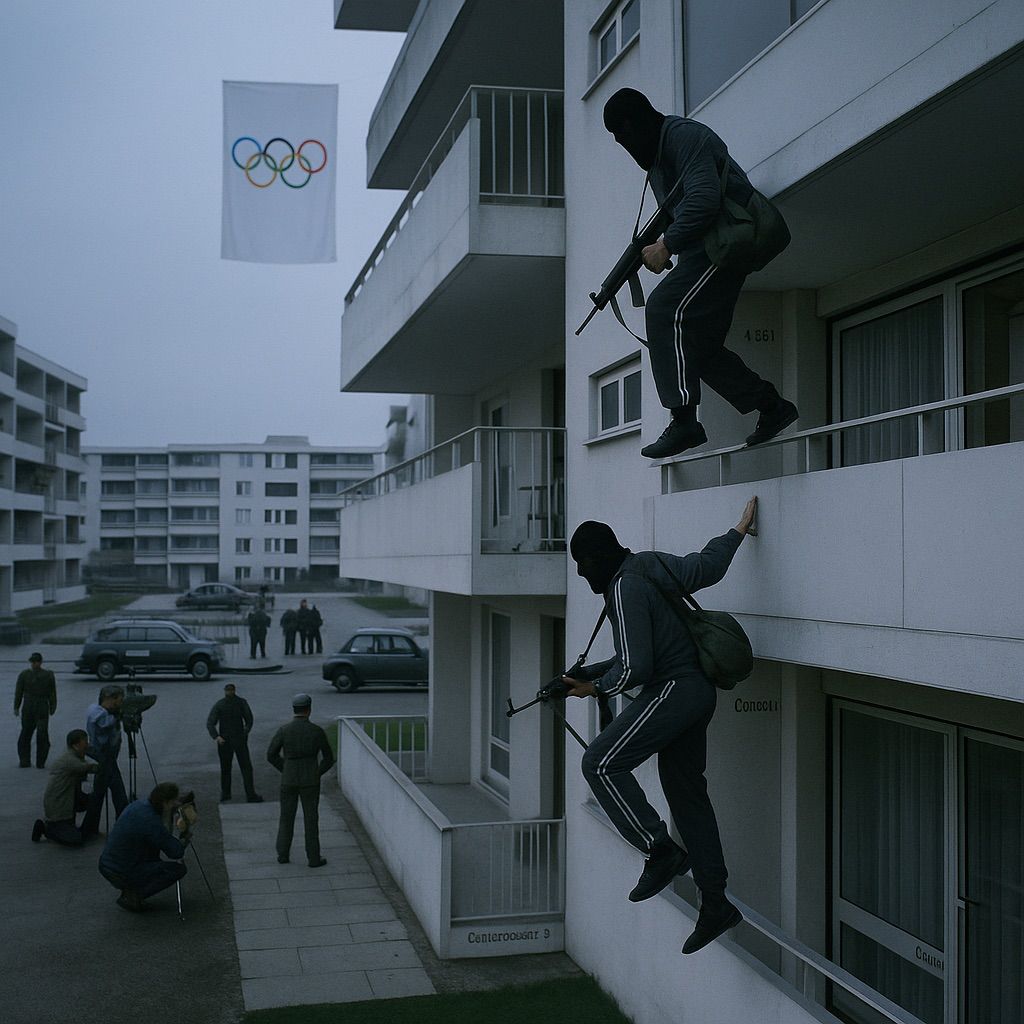
It was supposed to be the party where the world remembered how to breathe. The 1972 Summer Games in Munich were designed as a rebuttal to history’s darkest echoes—sunlit architecture, pastel uniforms, smiling volunteers, and a host city determined to prove that “the cheerful Games” could rinse the century’s taste of iron from the mouth. On the evening of September 4, athletes wandered a village of white balconies and tidy courtyards, swapping pins and recipes, learning national anthems they’d never heard before from roommates who’d been strangers 48 hours earlier. The night air smelled like cigarettes and victory and hairspray. A few hours later, just before dawn on September 5, eight men in tracksuits and balaclavas climbed the fence at 31 Connollystraße, and the party became a prayer. The five rings that had promised the world would meet as equals turned, in an instant, into a target no one could miss.
Inside Apartment 1, Israeli wrestlers and weightlifters were asleep when the door splintered. The first sounds were confused—boots on linoleum, shouted commands in a language most of them did not speak, a scuffle in the hallway that could have been a nightmare until the muzzle of a gun made it credible. Moshe Weinberg, a coach whose job was to teach men how to fall and rise again, tried to block the intruders and was shot. Yossef Romano, a weightlifter with a body meant to solve problems by lifting them, lunged to disarm a gunman and was killed. Nine others were bound and beaten and held as currency for a demand printed in rage: release prisoners in Israel and two jailed German radicals, or watch the clock do its cruel work. The attackers called themselves Black September. They did not need to explain the symbolism to an audience that had learned too much of it in the last 30 years.
As the sun climbed, the Olympic Village filled with the wrong kind of spectators. Cameras perched like curious birds on balconies across the courtyard. Reporters traded rumors the way athletes trade pins. The world’s most public event had become the world’s most televised hostage crisis, played out in grotesque daylight. West German police in soft caps and 1970s green uniforms tried to draw a cordon around a building designed for leisure, not siege. Negotiators talked through translators and thin walls to men who had trained to put the world on edge. The Israelis held inside—wrestlers who knew leverage, weightlifters who understood the physics of strength, coaches who had built entire careers from other people’s determination—were ordered to keep still and quiet. One of them, a fencing coach, whispered to another the names of his children so they wouldn’t be forgotten if he didn’t return. You do not need to see a single frame of film to feel the hour-by-hour erosion of hope; it lives in the ribs.
In homes and cafes and factory break rooms around the world, people watched the nightmare unfold with the helpless intimacy television can impose. In America, sportscaster Jim McKay—a voice we knew for covering routines, not tragedies—became the unlikely narrator of a day that refused to end. He alternated updates with silence, a rhythm that felt like breathing during a panic attack. The Olympics had always been a cathedral of exceptional bodies; now the camera pointed at faces—tired, tear-streaked, clenched. Munich wanted to be the un-Berlin, an unburdened city where the future could jog in sunshine. The camera made it smaller and more honest: a place where grief arrives like a bad athlete, awkward and unstoppable.
The negotiations stretched. Taxis, used as decoys, were brushed aside by new demands. A bus to an air base materialized. The plan, if it deserved the word, was to move the hostages and their captors to Fürstenfeldbruck, a military airfield northwest of Munich, and resolve the crisis there with an ambush improvised by a country that had not yet learned the grammar of counterterrorism. Police volunteers, some in tracksuits to mimic pilots and crew, crouched inside a Lufthansa jet, unspecialized courage forced into a specialized role. On the rooftop at Connollystraße 31, camera lenses found silhouettes of gunmen framed cleanly against the morning haze; those same images, broadcast to the world, were available to the apartment across the courtyard. It was a day that taught television something it has never forgotten: you can illuminate and endanger in the same beam.
Hours earlier, athletes had woken to a public-address announcement that told them to stay in their rooms and await instructions. Some did. Others wandered toward the cordon because curiosity is human and the Olympic Village had a reputation for turning strangers into friends, and friends share bad news up close. A Belgian runner described the scene like a nightmare filmed in slow motion: a balcony door, a gloved hand, the unmistakable shape of a weapon held at an angle that did not belong to the Olympics. An American swimmer who had believed the worst thing about the Games was a disappointing heat met a journalist who had run out of questions and became one himself: “Do you think they’ll be okay?” Behind the fences, athletes whispered a single sentence in a hundred languages: that could be us. The point of the Olympics is to erase borders for a fortnight; the terror that morning redrew them with ink that would not fade.
On the bus, the hostages were counted, eyes above gags above hands bound behind backs. On the tarmac, the ambush came apart like a chair with missing screws. The police marksmen lacked radios to coordinate fire; the floodlights, when finally switched on, helped the gunmen more than their targets; the assumption about the number of attackers was wrong. In the frantic minutes just before midnight, shots and explosions stitched a deadly pattern across the airfield. A German police officer fell. The gunmen sprayed the helicopters where the hostages were confined; a grenade turned one into a furnace; bullets ended hope in the other. Later, the phrase that the world would remember—“They’re all gone”—arrived like a door slamming hard enough to crack plaster. Eleven Israeli athletes and coaches dead. A West German police officer dead. Five of the attackers dead. Three captured alive. A century older by morning.
What do you do the next day after a day like that? In Munich, organizers debated whether the Games should continue. Some argued that closing would gift the killers a victory they could not claim on their own; others insisted that flags at half-staff cannot become a design choice. The decision—pause, memorialize, resume—created a fault line that historians still walk carefully. A memorial service in the Olympic Stadium filled the mouths of tens of thousands with silence; the wind moved flags; the world felt simultaneously too big and too small. The athletes marched again, this time to a drumbeat with no rhythm. Some nations withdrew. Others competed with eyes rimmed raw. The scoreboard, trained to render victory legible, found itself blinking beneath a sky that had no numbers for grief.
For Israel, the names were not abstract. They were fathers, husbands, brothers, friends: David Berger, Ze’ev Friedman, Yossef Gutfreund, Eliezer Halfin, Yossef Romano, Amitzur Shapira, Kehat Shorr, Mark Slavin, Andre Spitzer, Yakov Springer, and Moshe Weinberg. Photographs taken before Munich show smiles that knew joy as a sport—weddings, baby’s first haircut, the kind of laughter a coach reserves for a student who finally gets it. Their families flew to Germany to bring them home, and the word “home” became heavier. The modern world prides itself on being a machine for naming; suddenly the machine felt pitifully small beside the work a name is asked to do.
The massacre at Munich did not end on the tarmac. Every decision made afterward—by governments, by security services, by the International Olympic Committee—grew from a seed planted in the early hours of that morning. West Germany, confronted with the scale of the failure, rewired its approach to terrorism, creating units and doctrines that would spread through Europe and define the late twentieth century’s urban security. Israel made its own choices, some covert, some public, that would braid justice, deterrence, and politics into a rope strong enough to pull a small nation through geopolitical storms—and rough enough to fray hands that gripped it too hard. The Olympics wrapped itself in fences and protocols that made the summer of 1972 feel like a postcard from a lost country. Every bag search outside a stadium, every snaking line of spectators, every metal detector beeping a modern lullaby—trace them back and you will hear the echo of a boot on a balcony rail in Munich.
To humanize the day is to remember not just the heroism and horror but the ordinary acts that kept meaning alive. A German nurse sat beside a survivor, poured water into a paper cup, and learned the Hebrew word for “enough” long before the linguists did. A volunteer who had handed out maps the day before handed out tissues and directions to a quiet room and found, to her surprise, that “right this way” can be a kind of prayer. A broadcaster whose job was to name sports turned out to be brave enough to name the unspeakable, and his voice, unfamiliar with tragedy, did not try to dramatize what drama had already over-supplied. A carpenter mended a door frame because buildings require repair even when hearts cannot accept it. A teammate—his own future bent out of its old shape—sat alone and decided he would spend the rest of his life telling the story until it could be heard without flinching and never, ever, without feeling.
It is too easy to turn Munich into a thesis. Terrorism seeks attention; attention is oxygen. But refusing to think about it is not the same as starving it. The honest response is to look closely and draw lines that guard human dignity. Those lines are difficult. They snake through courthouse hallways and travel across borders on the backs of secret memos. They pass through living rooms where families ache for a justice that doesn’t come late and a vengeance that doesn’t come dressed as justice. They run through stadium checkpoints and across the internet where cameras never sleep, asking the same questions again and again: How do we safeguard openness without inviting harm? How do we remember without reducing lives to cautionary tales? How do we honor sorrow without trapping ourselves inside it?
The answer, if there is one, is not a single policy or a particular poem. It is a discipline made of many small decisions. We say the names. We teach the history in classrooms where students are old enough to understand that the world holds both wonder and malice, and young enough to still believe they can bias it toward the former. We design security that is competent without becoming petty, that uses intelligence like a scalpel, not fear like a floodlight. We resist the lazy narratives that collapse complex movements into caricatures. We listen to victims’ families and accept the ways they disagree, because grief is a country with many dialects. We learn from failures without building museums for them in the heart.
There’s another choice, too: the choice to keep playing. Not out of denial, but out of defiance. The opening ceremony of any Games since 1972 carries silent traffic from that morning in Munich. Behind the fireworks and choreography, you can sense a checklist that whispers: the fences are high, the radios are tuned, the maps have been walked by people who know exactly how far a minute is in fear. You can also sense something stubborn: the belief that meeting for sport is still a good idea in a world that too often answers difference with violence. Every medal won under those conditions is a small victory over the idea that terror gets the last word.
The paradox of Munich is that its moral is both particular and universal. It is particular because the dead were individuals and the perpetrators held specific grievances twisted into a shape that could only break things. It is universal because the structure of the day—joy punctured by cruelty, competence tangled with confusion, cameras magnifying everything good and bad—belongs to the modern age. We live with that structure still. Our screens deliver adrenaline and empathy faster than our institutions can metabolize either. We want to be open and safe, transparent and subtle, proud and cautious. Those pairs do not divide neatly; our lives are a constant negotiation among them.
When you stand in a modern stadium’s security line and shuffle forward, bored and mildly annoyed, consider it a tiny memorial. When you teach a child to say “Munich” and then to say the names that Munich demands, consider it an act of repair. When you disagree about what should have been done or what should be done now, argue in good faith and remember that the people who faced the choices at 3 a.m. on September 5 did not have the luxury of our hindsight. When you light a candle on September 5, if you do, place it where it can be seen from a window. Someone walking past in the evening might look up and remember that the world, though noisy, still recognizes the simple grammar of light.
What would the dead have wanted? We cannot know. But we can guess: that their names would not be reduced to bullets points; that their families would be held, not merely cited; that the Games would continue in a way that honors the promise Munich betrayed and then, stubbornly, tried to reclaim. Perhaps they would want us to memorize an ordinary photograph of them laughing, not because ordinary is better than heroic, but because ordinary is the point. Terror puts a spotlight on violence and calls it meaning. The rest of us must put a spotlight on ordinary life and call that meaning. The kitchen table. The team bus. The hotel hallway where a joke becomes an inside joke. The practice mat where a coach claps his hands and a student gets back up, again.
Fifty-plus years later, we live with legacies that are both visible and invisible. The security protocols are concrete, the memorial plaques literal. The invisible legacy is stranger: a heightened awareness that even the most joyous arenas are porous, that the human heart must be guarded and yet cannot grow inside a fortress. The most generous thing we can do in the shadow of Munich is to refuse to let fear negotiate for us. We build systems that are sober and smart. And then we cheer. Loudly. Loud enough to honor those who never got to hear their names echo under a roof built for applause.
One day, the last eyewitness will tell their last version of the story. When that happens, the story will not be over. It will be ours in the way all great stories are: a test we can fail or pass, daily, without a single camera pointed our way. We will pass when we give our neighbors the benefit of our care, when we design cities that welcome without naiveté, when we choose words that de-escalate rather than perform. We will pass when we refuse the grim thrill of spectacle in favor of the steady work of solidarity. We will pass when we remember that the Olympic idea is not childish optimism but adult stubbornness—the insistence that competition without hatred is not a fantasy but a discipline.
On September 5, 1972, sport met terror and learned that even the purest games are played on Earth. The lesson was brutal. The responsibility it left us is simple: keep Earth hospitable. Keep doors open with locks that make sense. Keep stadiums full of people who know each other’s songs. Keep telling the truth about what happened and keep refusing to let that truth shrink what is possible. The five rings are not flawless; neither are we. But they are a shape we can hold up to the light and promise, again and again, that we will do better under them than outside them.