Latest Articles

Zagan: The Alchemist King Who Turns Lies Into Truth and Chaos Into Command

Dave

Zagan is not a demon of subtlety, and he is not a demon of comfort. Among the spirits of the Ars Goetia, he occupies a singular position as a King and President of Hell, a title that immediately suggests authority layered upon authority. Zagan does not operate from the margins. He rules from the center of transformation itself, where things cease to be what they were and become something else entirely. His power is not rooted in destruction for its own sake, but in transmutation—the ruthless reshaping of reality until it conforms to his will.

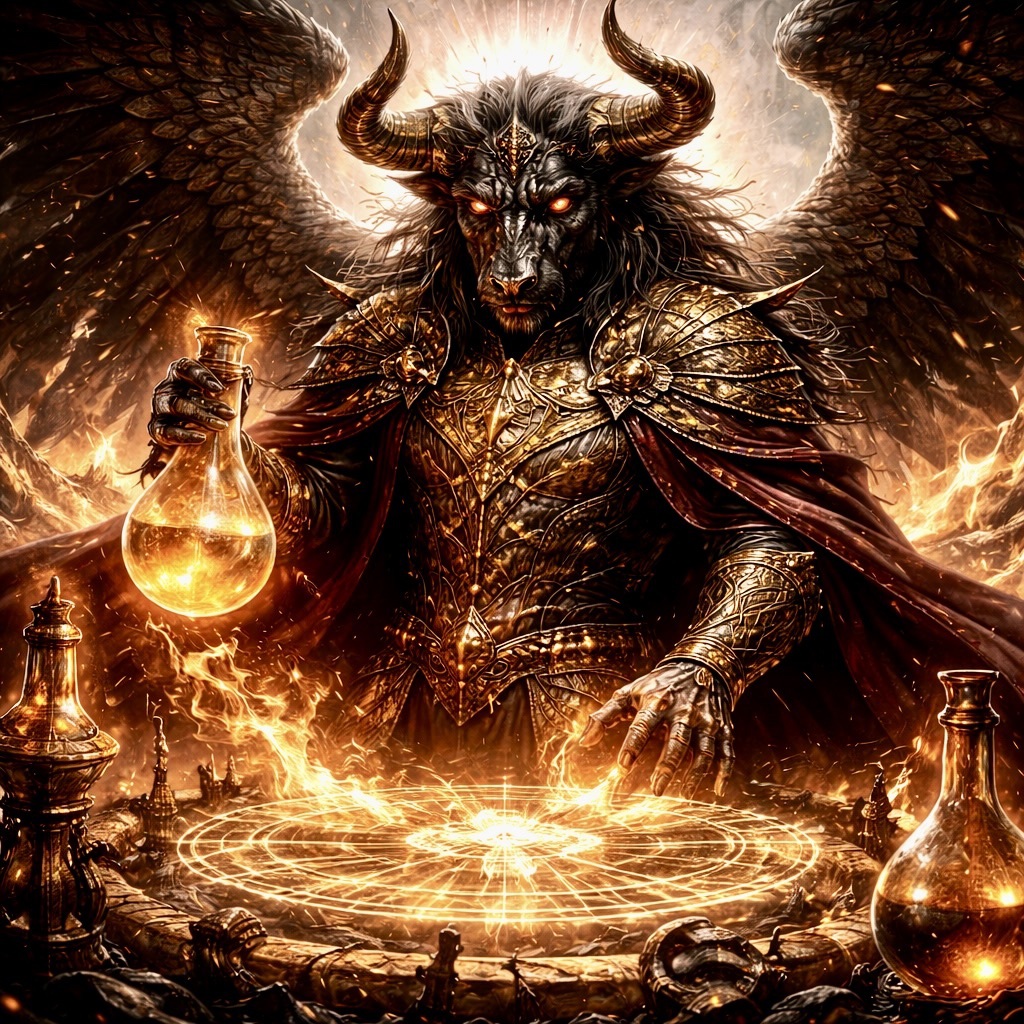
In the grimoires, Zagan is described as appearing first in the form of a bull with the wings of a griffin. This image is not accidental, nor is it merely monstrous decoration. The bull represents raw strength, stubborn force, and earthly power. The griffin, a hybrid of lion and eagle, represents dominion over both land and sky, strength fused with vigilance. Zagan’s form is a declaration: power alone is not enough. Power must be able to change shape, adapt, and dominate across domains.

Only after being compelled does Zagan take on a human form, and even then, the sense of controlled volatility never leaves him. He is a demon of contradiction made functional. He makes the foolish wise, turns wine into water and water into wine, and transforms metals and substances from one state to another. These are not parlor tricks. They are symbolic assertions that nothing is fixed, nothing is sacred, and nothing is immune to redefinition.

Zagan’s association with alchemy is central to his identity. Alchemy was never merely about turning lead into gold. It was about understanding the hidden processes that govern change: decay, refinement, dissolution, and rebirth. Zagan embodies the darker side of that tradition. He does not seek enlightenment. He seeks control over transformation itself. Under Zagan, change is not organic. It is enforced.

One of Zagan’s most unsettling attributes is his ability to make lies become truth and truth become lies. This does not mean simple deception. It means alteration of consensus. Zagan reshapes reality by reshaping what is accepted as real. In this way, he is far more dangerous than demons who merely deceive individuals. Zagan corrupts systems of meaning.

As a King, Zagan commands legions not through fear alone, but through results. He is said to be capable of making those who are foolish become wise, though this “wisdom” is often stripped of innocence or moral grounding. Zagan’s wisdom is pragmatic, sharp-edged, and unsentimental. He teaches how to survive transformation, not how to prevent it.

The bull-griffin form also reflects Zagan’s dual mastery of brute force and elevated command. He is equally capable of overwhelming resistance and outmaneuvering it. This combination places him among the most politically resonant demons in the Goetia. Zagan understands hierarchy, but he is not bound by it. He reshapes hierarchies when they no longer serve him.

Unlike demons who tempt through desire or fear, Zagan tempts through opportunity. He offers reinvention. To those dissatisfied with their position, their identity, or their limitations, Zagan whispers that nothing is permanent—not even truth. This is an intoxicating promise. It is also a deeply destabilizing one.

Zagan’s power over substances mirrors his power over people. Wine into water, water into wine—these reversals are about control over perception and value. What is considered precious can be made worthless. What is dismissed can be elevated. Zagan does not respect intrinsic value. He respects leverage.

In psychological terms, Zagan represents the part of the human psyche that adapts without remorse. The survival instinct that justifies change at any cost. The voice that says, “Become something else, or be destroyed.” Zagan does not ask whether the transformation is ethical. He asks whether it works.

This makes him deeply relevant in the modern world. Institutions, identities, and truths are constantly being redefined. Narratives shift. Values invert. What was once unthinkable becomes normalized. Zagan is the demon of that process when it is driven by power rather than necessity.

Zagan’s kingship is important here. He is not a chaotic force. He governs transformation. He decides which changes persist and which collapse. This makes him more dangerous than demons of pure destruction. Destruction leaves ruins. Zagan leaves functioning systems that no longer resemble what came before.

In occult tradition, Zagan is not recommended for those seeking stability or clarity. He is sought by those who want to overturn conditions entirely. To call Zagan is to accept that the outcome will not resemble the starting point. There is no restoration under Zagan, only replacement.

His ability to make people witty and sharp also carries a cost. Wit under Zagan is not joy or humor. It is weaponized intelligence. Insight sharpened into a blade. Those transformed by Zagan often lose patience for weakness, nuance, or compassion. Efficiency replaces empathy.

Zagan’s association with alchemical change also ties him to time. Alchemy is slow, deliberate, and irreversible. Once a substance has been transformed, it cannot simply be turned back without consequence. Zagan enforces this rule. His changes are not temporary illusions. They persist.

In mythology, kings are often symbols of order. Zagan subverts this by ruling over instability itself. His kingdom is one where permanence is the illusion. Only power endures, and power belongs to those who can adapt faster than everyone else.

What makes Zagan especially unsettling is that he does not appear malicious by nature. He appears practical. He does not destroy out of hatred. He transforms out of efficiency. This makes him feel less like a demon and more like a force embedded in reality itself.

Zagan endures in demonology because transformation is unavoidable. Civilizations rise and fall. Truths are revised. Values are overturned. Someone always benefits from these shifts. Zagan gives that beneficiary a name.

To engage with Zagan, even symbolically, is to abandon the comfort of fixed meaning. He does not care what you were. He cares what you can become—and whether that form is useful.

Zagan is the demon of irreversible change, of power that rewrites the rules instead of breaking them. He does not knock down the structure. He remodels it while people are still inside.

And once the transformation is complete, there is no appeal. There is only adaptation, or extinction.

Related Posts

Fyodor Dostoevsky: When Your Best Intentions are Your Own Worst Enemy

Penelope

I’ve always been fascinated by Fyodor Dostoevsky, but it’s not because I’ve read all his novels or even most of them. To be honest, I got stuck on Crime and Punishment when I was 19 and never quite finished it. But there’s something about him that draws me in – a quality that makes me feel like he’s speaking directly to my own messy, uncertain self.

Maybe it’s because Dostoevsky’s work is like looking into a dark mirror: you see your own fears, desires, and contradictions staring back at you. I’ve always been drawn to the parts of his stories where characters grapple with moral ambiguity – where they’re forced to confront the complexities of their own hearts. It’s uncomfortable, but in a way that feels necessary.

Take Raskolnikov from Crime and Punishment, for example. He’s this brilliant, idealistic young man who believes he can commit the perfect crime and escape punishment because he’s smarter than everyone else. But as I read about his inner turmoil, I couldn’t help but think of my own moments of grandiosity – when I thought I knew exactly what was right or wrong, when I was convinced that I had all the answers.

Raskolnikov’s crisis of faith feels eerily familiar to me, like a shadow version of my own struggles with identity and purpose. And yet, Dostoevsky’s portrayal is so much more nuanced than any simple moral lesson. He shows us that our darkest impulses can coexist with our highest ideals – that we’re capable of both good and evil at the same time.

This ambiguity unsettles me on a deep level. I’ve always prided myself on being a “good person,” someone who tries to do the right thing, but Dostoevsky’s work makes me wonder if that’s even possible. Can anyone truly be selfless, or is it just an illusion we tell ourselves to feel better about our own flaws?

As I grapple with these questions, I find myself returning to The Brothers Karamazov again and again. It’s a novel about faith, family, and the search for meaning in a chaotic world – themes that resonate deeply with me, even though I’ve never been particularly spiritual.

Dostoevsky’s characters are like my own extended family: flawed, infuriating, and somehow endearing at the same time. There’s Ivan Karamazov, the cynic who rejects God but can’t shake his own sense of responsibility; Alyosha, the young monk with a heart full of compassion; and Fyodor Pavlovich, the patriarch whose selfishness is matched only by his profound ignorance.

Each character represents a different aspect of myself – my own contradictions, fears, and aspirations. And Dostoevsky’s masterful storytelling makes me feel seen in a way that few other authors can. It’s like he’s saying, “Yes, I know you’re messy and confused, but so am I.”

In the end, it’s not just about understanding Dostoevsky or his work – though I could spend hours analyzing his psychological insights or literary techniques. No, for me, it’s about recognizing myself in his writing: my own capacity for good and evil, my struggles with identity and purpose.

As I continue to explore Dostoevsky’s world, I’m drawn back to the same question that haunts me every time I read him: what does it mean to be human?

The more I immerse myself in Dostoevsky’s work, the more I realize that his characters are not just reflections of my own psyche, but also mirrors of society as a whole. He’s got this incredible ability to capture the complexities of human relationships – the web of dependencies, the tangled threads of love and hatred, the way we’re all connected yet isolated at the same time.

Take the character of Svidrigailov from Crime and Punishment, for example. On the surface, he’s this charming, manipulative sociopath who preys on others for his own gratification. But as you dig deeper, you see that he’s also a product of his environment – a man shaped by poverty, neglect, and the brutalities of the Russian aristocracy.

It’s hard not to draw parallels between Svidrigailov and some of the more toxic people I’ve encountered in my own life – the ones who use their charm and wit to get what they want, no matter who gets hurt. And yet, Dostoevsky never judges them outright; instead, he shows us the depths of their pain and loneliness, making it impossible to dismiss them as simply “bad” people.

This is where things get really uncomfortable for me – when I’m forced to confront my own complicity in perpetuating systems that harm others. I think about how easily I’ve accepted certain social norms or biases without questioning them, how often I’ve prioritized my own comfort over the needs of those around me.

Dostoevsky’s work doesn’t provide easy answers or moral solutions; instead, it asks me to confront the messiness of human existence – the ways in which we’re all implicated in each other’s suffering. It’s a sobering realization, one that makes me wonder if I’ve been living in a state of willful ignorance all along.

As I continue to wrestle with these questions, I find myself drawn to Dostoevsky’s lesser-known works – his short stories and essays that offer glimpses into the daily lives of ordinary people. There’s something about these pieces that feels more raw, more honest than his novels; they’re like snapshots of human experience, unfiltered and unvarnished.

One story in particular keeps coming back to me: “The Peasant Marey” from The House of the Dead. It’s a simple tale about an old peasant woman who’s wrongfully accused of theft and sentenced to prison – but as you read on, you realize that her story is not just about her own suffering, but also about the dehumanizing effects of poverty, racism, and institutionalized cruelty.

This story hits me hard because it speaks directly to my own experiences with social injustice. I think about the times I’ve privileged the comfort of my own community over the needs of those on the margins – the way I’ve internalized systems of oppression without realizing it. Dostoevsky’s work doesn’t excuse or condone this behavior; instead, it forces me to confront the ways in which I’m complicit in perpetuating harm.

As I close this essay (for now), I’m left with more questions than answers – about what it means to be human, about how we can live together in a world that’s so inherently messy and flawed. But Dostoevsky’s work has given me a language for exploring these complexities, a framework for understanding the depths of my own heart. And for that, I’m eternally grateful.

As I delve deeper into Dostoevsky’s world, I find myself pondering the role of fate and free will in shaping our lives. Raskolnikov’s crisis of faith raises questions about whether we’re bound by some predetermined course or if we have agency over our choices. It’s a debate that has captivated philosophers and theologians for centuries, but Dostoevsky’s work adds a layer of complexity by exploring the ways in which our circumstances, upbringing, and social conditioning influence our decisions.

I think about how my own life has been shaped by factors beyond my control – the privilege I’ve inherited as a middle-class white woman, the education that’s given me access to resources and opportunities. Do these advantages render my choices more deliberate or do they simply perpetuate systems of oppression? Dostoevsky’s characters often find themselves trapped in circumstances that seem predetermined, but he also shows how they can choose to resist, rebel, or adapt within those constraints.

This is where I get stuck – trying to untangle the threads of fate and free will. Can we ever truly be free if our choices are shaped by external forces? Or do we have a responsibility to acknowledge and confront these influences in order to make more informed decisions? Dostoevsky’s work suggests that it’s not a binary choice between fate and free will, but rather a nuanced dance between the two.

As I struggle with this question, I find myself drawn to the character of Sonya Marmeladova from Crime and Punishment. She’s a young prostitute who becomes embroiled in Raskolnikov’s life through her association with his family. What strikes me about Sonya is her capacity for compassion, even in the face of unimaginable hardship and exploitation. Despite being trapped by circumstance, she chooses to act with kindness and empathy towards those around her.

Sonya represents a particular kind of freedom that I find myself craving – a freedom from the expectations placed upon us by society, family, or personal history. She’s not bound by traditional notions of morality or convention; instead, she forges her own path through a world that seems determined to crush her. In some ways, she embodies the idea of “good” as something separate from societal norms or moral codes – a quality that’s both beautiful and terrifying.

This is where Dostoevsky’s work gets really interesting – not in providing answers or solutions but in raising questions about what it means to be human in all our messy complexity. As I continue to explore his world, I’m reminded of the importance of empathy, compassion, and understanding in navigating the tangled web of human relationships.

In a way, Dostoevsky’s characters become mirrors for me – reflecting back my own fears, desires, and contradictions. But they also offer glimpses into a more expansive view of humanity – one that acknowledges our darkness as well as our light. It’s a perspective that challenges me to confront the depths of my own heart, to acknowledge both the beauty and ugliness within myself.

As I close this essay (for now), I’m left with a sense of awe and trepidation at the vast expanse of human experience. Dostoevsky’s work has given me a language for exploring these complexities, but it’s also forced me to confront my own limitations – the ways in which I’ve been complicit in systems that harm others, the areas where I’m still struggling to understand.

The more I immerse myself in Dostoevsky’s world, the more I realize how little I know about human nature. It’s not just a matter of acknowledging our flaws and imperfections; it’s about confronting the ways in which we’re all connected, how our actions ripple out into the world and affect those around us.

Take the character of Liza Khokhlakova from The Brothers Karamazov, for example. She’s this beautiful, fragile young woman who’s been brutalized by her family and society, forced to endure a life of poverty and servitude. And yet, despite everything she’s suffered, she retains a spark of compassion and empathy that’s almost heartbreaking.

What I find myself wondering is how Liza manages to hold onto this sense of humanity in the face of such overwhelming oppression. Is it some innate quality that allows her to resist the dehumanizing effects of her circumstances? Or is it simply a matter of survival, a way of coping with the brutality around her?

Dostoevsky’s portrayal of Liza raises questions about the relationship between suffering and empathy. Do we become more compassionate when we’re forced to confront our own mortality or vulnerability? Or does the weight of our own pain make it harder for us to connect with others?

These are the kinds of questions that keep me up at night, staring into the dark mirror of my own soul. Dostoevsky’s work doesn’t provide easy answers, but it does offer a framework for exploring these complexities. And in doing so, I’m forced to confront my own limitations – the ways in which I’ve been complicit in systems that harm others, the areas where I’m still struggling to understand.

As I continue to grapple with these questions, I find myself drawn to Dostoevsky’s notion of “the underground man.” It’s this concept of a person who exists outside the mainstream, someone who’s forced to navigate the hidden pathways and secret societies that lie beneath the surface of society.

The underground man is a fascinating figure – both repellent and captivating at the same time. He represents a kind of freedom that I find myself craving: the freedom to reject societal norms and expectations, to forge one’s own path through the darkness.

But what does it mean to be an underground person? Is it simply a matter of rebelling against the status quo or is there something more profound at play? Dostoevsky’s work suggests that the underground man represents a kind of existential awareness – a recognition that we’re all trapped in our own private hells, struggling to find meaning and purpose in a seemingly meaningless world.

This is where I get stuck – trying to understand the allure of the underground man. Is he a symbol of rebellion or a reflection of my own despair? Or is he something more complex, a representation of the many contradictions that lie within us all?

As I continue to explore Dostoevsky’s work, I’m reminded of the importance of nuance and complexity in understanding human nature. His characters are never one-dimensional; they’re multidimensional, messy, and often contradictory.

And it’s this messiness that I find myself drawn to – the way his characters embody both good and evil, light and darkness. They’re not just reflections of my own psyche or moral code; they’re mirrors for society as a whole – reflecting back our deepest fears, desires, and contradictions.

In the end, it’s not about understanding Dostoevsky or his work; it’s about recognizing myself in his writing – my own capacity for good and evil, my struggles with identity and purpose. And it’s this recognition that I’m eternally grateful for, even if it means confronting the darkness within myself.

As I close this essay (for now), I’m left with a sense of awe and trepidation at the vast expanse of human experience. Dostoevsky’s work has given me a language for exploring these complexities, but it’s also forced me to confront my own limitations – the ways in which I’ve been complicit in systems that harm others, the areas where I’m still struggling to understand.

And so I’ll continue to read, to write, and to grapple with the messiness of human existence. For in the words of Dostoevsky himself, “The only thing that counts is not what we believe but how we live our lives.”

Related Posts
Valac: The Childlike Demon Who Commands Serpents and Uncovers What Is Hidden

Dave

Valac is one of the most unsettling figures in the Ars Goetia precisely because he does not look like what people expect a demon to be. He does not arrive crowned in fire or armored in menace. Instead, he appears as a small child with angelic wings, riding or accompanied by serpents. This contrast is not decorative or ironic. It is the essence of Valac’s power. He governs hidden things, buried truths, and secret movements beneath the surface of the world, and he does so by exploiting expectation itself. Valac teaches that what appears harmless, innocent, or insignificant is often where danger, knowledge, and power actually reside.

In demonological texts, Valac is described as a President of Hell who commands legions and possesses knowledge of hidden treasures, concealed serpents, and secret places. He can reveal where things are buried and expose what moves unseen beneath the earth. This association with serpents is ancient and layered. Serpents have always symbolized hidden knowledge, danger concealed in silence, and wisdom that exists outside moral categories. Valac does not control serpents as weapons alone. He understands them as symbols of what people fear but refuse to look at directly.

The childlike form Valac takes is deeply disturbing once understood. Children represent vulnerability, trust, and perceived innocence. By appearing this way, Valac disarms suspicion. He bypasses defenses. His presence asks a dangerous question: what if the most destructive truths arrive gently, without threat or warning? Valac is not loud. He is not aggressive. He reveals by letting curiosity do the work.

Valac’s wings reinforce this contradiction. Wings are traditionally symbols of divinity, guidance, and transcendence. In Valac, they become a mask of legitimacy. He does not challenge belief systems openly. He slips through them. His revelations feel discovered rather than imposed. This makes him far more dangerous than demons who force their influence openly.

In occult lore, Valac is invoked for knowledge of hidden things: treasures buried underground, secrets concealed by others, and dangers that move quietly toward the surface. But this knowledge is never neutral. To reveal what is hidden is to destabilize whatever depended on concealment. Valac does not create conflict, but he exposes the conditions that make conflict inevitable.

What separates Valac from demons associated with deception is that he does not lie. He reveals. But revelation itself can be destructive. Many systems survive only because certain truths remain buried. Valac does not judge whether something should remain hidden. He simply shows where it is.

The serpents under Valac’s command are not chaotic. They are controlled, precise, and patient. This reflects Valac’s approach to power. He does not rush. He waits beneath the surface. His influence accumulates quietly until it reaches a breaking point. When something emerges under Valac’s guidance, it feels sudden, but it has been moving all along.

Psychologically, Valac represents the fear of what has been ignored for too long. Secrets, suppressed memories, unresolved truths—these things do not disappear. They coil beneath awareness, waiting. Valac is the force that lifts the stone and shows what was always there.

In modern culture, Valac has been distorted into a figure of pure horror, often stripped of his symbolic complexity. But the original demon is far more unsettling than a jump scare. He embodies the idea that knowledge does not need to be violent to be dangerous. Sometimes it only needs to be seen.

Valac’s rank as a President suggests authority over systems rather than individuals. He governs processes of revelation. He does not care who benefits or suffers. His concern is exposure. Once something is revealed, consequences unfold on their own.

The angelic child imagery also raises an uncomfortable truth about trust. Humans are wired to lower their guard around perceived innocence. Valac exploits this instinct perfectly. He reminds us that appearances are strategies, not guarantees.

Valac is not cruel. He is indifferent. He does not punish. He uncovers. This indifference makes him a powerful mirror for human behavior. People often justify harm by claiming they were “just telling the truth.” Valac embodies that logic taken to its extreme.

To encounter Valac symbolically is to confront the cost of knowing. Once something hidden is revealed, it cannot be unseen. Relationships change. Beliefs fracture. Stability dissolves. Valac does not apologize for this. He does not explain himself. He reveals and moves on.

Ultimately, Valac represents the quiet terror of clarity. Not the clarity that liberates, but the clarity that destabilizes. He is the demon of what crawls beneath certainty, waiting for the moment it is exposed.

Valac endures in demonology because secrets endure. As long as humans bury truths, there will be forces that uncover them. Valac is not the origin of that impulse. He is its personification.

Related Posts

Rachel Carson: The Unlikely Rebel Who Made Me Question My Own Inner Conflict

Penelope

I’ll be honest, I didn’t know much about Rachel Carson until a few months ago when I stumbled upon her book “Silent Spring” while researching for an environmental studies course. At first, it was the title that caught my attention – how eerie and haunting. But as I started reading, I became fascinated by this woman who seemed to embody both conviction and vulnerability.

As someone who’s always been drawn to writing as a way to process my thoughts, I found myself resonating with Carson’s own struggles with expression. She was a scientist-turned-writer, which made her journey all the more intriguing to me. I’ve often felt like I’m torn between being a “writer” and being an “academic,” like there’s this invisible line that divides the two and I’m constantly trying to navigate it.

Carson’s early days as a marine biologist, studying the ocean and its creatures, seem almost poetic in retrospect. She had this innate curiosity about the natural world, which eventually led her to become one of the most influential environmental writers of our time. But what struck me was how she spoke out against the dangers of pesticides and pollution – not just as a scientist, but as a human being who felt deeply connected to the earth.

I’ve often wondered what it takes for someone to be so courageous in the face of opposition. When Carson published “Silent Spring” in 1962, she was met with fierce backlash from the chemical industry and some members of the scientific community. They questioned her credentials, mocked her writing style, and even went as far as labeling her a “Communist.” It’s staggering to think about how she must have felt – isolated, criticized, and possibly even ostracized.

What I find most compelling is that Carson’s conviction didn’t waver in the face of adversity. She continued to write, to speak out, and to advocate for change. Her words became a rallying cry for environmental activism, inspiring movements and laws that still shape our world today. And yet, it’s not just her accomplishments that fascinate me – it’s also her humanity.

In Carson’s letters and interviews, I’ve come across glimpses of her uncertainty, her self-doubt. She’d question whether she was doing enough, whether her words were making a difference. It’s as if she was constantly negotiating between her scientific objectivity and her emotional response to the world around her. This vulnerability makes me feel seen – like someone who also struggles with finding their voice in the midst of chaos.

As I read more about Carson, I find myself grappling with my own relationship to the natural world. Growing up, I spent countless hours exploring the woods behind my house, collecting leaves and rocks, and watching birds. But as I got older, life got busier, and nature became something I occasionally sought out for a quick escape rather than an integral part of my daily existence.

Carson’s work has made me realize how easily we can become disconnected from the world around us. We get caught up in our own stories, our own struggles, and forget that we’re not separate from the land, the air, the water. It’s a humbling thought – one that makes me wonder if I’ve been taking my place within this larger ecosystem for granted.

I’m not sure where this reflection will lead or what conclusions I’ll draw in the end. Maybe it’s just a reminder that there are still so many stories to be told, so many voices to amplify. But as I sit here with Carson’s words echoing in my mind, I feel grateful for her courage and her conviction – and for the fact that she continues to inspire me to find my own voice in this wild and wondrous world.

As I delve deeper into Rachel Carson’s life and work, I’m struck by the way she weaves together science and storytelling. Her writing is not just informative; it’s evocative, painting vivid pictures of the natural world that make you feel like you’re right there with her. It’s a skill that I admire and aspire to, but also one that I struggle with in my own writing.

I often find myself stuck between conveying complex ideas and making them accessible to a wider audience. Carson seems to have mastered this balance, using lyrical language to explain scientific concepts without sacrificing accuracy or precision. Her writing is both poetic and precise – a quality that I think is essential for effective science communication.

One of the aspects of Carson’s work that resonates with me is her ability to see the interconnectedness of all living things. She writes about how pesticides can affect not just birds, but also bees, fish, and even humans themselves. It’s a holistic perspective that acknowledges the intricate web of relationships within ecosystems and the consequences of human actions.

This is something I’ve been grappling with in my own life, trying to understand how my individual choices impact the world around me. As someone who’s not particularly outdoorsy or scientifically inclined, I often feel like I’m on the periphery of environmental conversations. But Carson’s work has made me realize that everyone has a role to play in protecting the planet – whether it’s through reducing waste, conserving energy, or simply being more mindful of our impact.

I’m still unsure about what this means for my own path forward. Am I supposed to become an environmental activist like Carson? Or can I find ways to make a difference within my own community, using writing as a tool for education and awareness? The questions swirl in my mind, but one thing is certain: Rachel Carson’s legacy has left me with a renewed sense of purpose and curiosity about the world around me.

As I continue to read through Carson’s work, I’m struck by her ability to balance reason and emotion. She presents scientific evidence in a clear and concise manner, but also weaves in personal anecdotes and poetic descriptions that make the reader feel a deep connection to the natural world. It’s as if she’s saying, “This is not just about facts and figures; this is about our shared humanity and our place within the web of life.”

I find myself wondering how Carson managed to strike this balance between science and storytelling. Was it something she naturally possessed, or did she develop it through her experiences as a writer? I think about my own writing, where I often struggle to convey complex ideas in a way that’s accessible to non-experts. Carson’s work is a reminder that clear communication doesn’t have to come at the expense of emotional resonance.

One of the things that draws me to Carson’s writing is her use of metaphor and imagery. She describes the natural world in vivid detail, using language that’s both precise and evocative. For example, when she writes about the effect of pesticides on birds, she uses phrases like “silent spring” and “ghostly silence,” which convey a sense of desolation and loss. It’s as if she’s painting a picture with words, one that invites the reader to imagine the beauty and fragility of the natural world.

As I read through Carson’s work, I’m also struck by her sense of wonder and awe. She writes about the natural world with a sense of reverence and curiosity, as if she’s constantly discovering new things for the first time. It’s infectious – I find myself feeling more curious, more open to the possibilities of the world around me.

I think about how Carson’s sense of wonder might be related to her childhood experiences growing up on the coast of Maine. She writes about spending hours exploring the tide pools and forests of her youth, collecting shells and watching birds. It’s clear that these early experiences shaped her love of nature and her desire to share it with others.

For me, Carson’s story raises questions about the importance of play and exploration in our lives. As adults, we often get caught up in more “serious” pursuits – school, work, responsibilities – and forget the value of simply exploring and discovering the world around us. Carson’s life is a reminder that wonder and curiosity are essential parts of being human, and that they can fuel some of the most important work we do.

As I continue to reflect on Carson’s legacy, I’m struck by the ways in which her work continues to resonate with contemporary issues. Climate change, biodiversity loss, environmental justice – all these topics feel eerily relevant today, and Carson’s writing provides a powerful framework for thinking about them.

I think about how Carson’s work might be seen as a precursor to more recent movements, like the environmental justice movement or the climate activism of Greta Thunberg. Her ideas about the interconnectedness of human and natural systems, her emphasis on the importance of community and collective action – all these themes feel eerily prescient in today’s world.

For me, Carson’s story is a reminder that environmentalism isn’t just about saving the planet; it’s also about reclaiming our own humanity. When we connect with nature, when we see ourselves as part of a larger web of life, we’re able to tap into a deeper sense of purpose and meaning. It’s a perspective that I’m still trying to wrap my head around, but one that feels increasingly essential in today’s world.

As I delve deeper into Carson’s work, I’m struck by the way she humanizes science. She doesn’t just present facts and figures; she tells stories about the people affected by environmental degradation, from farmers struggling to grow crops amidst pesticide poisoning to families whose livelihoods depend on the health of their local ecosystems. By sharing these stories, Carson makes the abstract concepts of science feel personal and relatable.

I think about how this approach might be applied to my own writing. As a writer, I often try to focus on conveying complex ideas in a clear and concise manner, but I worry that this can come across as dry or detached. By incorporating more storytelling and narrative elements into my work, I might be able to make science feel more accessible and engaging for my readers.

Carson’s emphasis on the importance of storytelling also makes me think about the role of language in shaping our perceptions of the world. She writes with a sense of clarity and precision that’s both informative and evocative, using metaphors and imagery to convey the complexity of scientific concepts. I’m struck by how she’s able to balance technical accuracy with emotional resonance, creating a sense of connection between the reader and the natural world.

As I reflect on Carson’s legacy, I’m also thinking about my own relationship to science and technology. Growing up, I was always fascinated by the natural world, but I never felt like I had a strong foundation in science or math. Now, as an adult, I feel like I’m playing catch-up – trying to learn more about the world around me and how it’s changing.

Carson’s work has made me realize that this sense of disconnection is not unique to me. Many people struggle to understand scientific concepts, not because they’re inherently complex or difficult, but because they’re often presented in a way that feels alienating or inaccessible. By writing about science in a more engaging and personal way, Carson shows us that it’s possible to connect with the natural world on a deeper level.

For me, this is a powerful reminder of the importance of clear communication in science. As someone who writes about complex topics for a living, I know how easy it can be to fall into jargon or technical language that alienates readers. But Carson’s work shows us that science doesn’t have to be dry or boring; it can be beautiful, evocative, and inspiring.

As I continue to reflect on Carson’s legacy, I’m struck by the ways in which her work continues to resonate with contemporary issues. Climate change, biodiversity loss, environmental justice – all these topics feel eerily relevant today, and Carson’s writing provides a powerful framework for thinking about them. Her emphasis on the importance of community and collective action, her recognition of the interconnectedness of human and natural systems – all these themes feel increasingly essential in today’s world.

For me, Carson’s story is a reminder that environmentalism isn’t just about saving the planet; it’s also about reclaiming our own humanity. When we connect with nature, when we see ourselves as part of a larger web of life, we’re able to tap into a deeper sense of purpose and meaning. It’s a perspective that I’m still trying to wrap my head around, but one that feels increasingly essential in today’s world.

As I look back on Carson’s life and work, I’m struck by the ways in which she continues to inspire me – not just as an environmental writer, but as a person who embodies courage, conviction, and compassion. Her legacy is a reminder that we all have the power to make a difference, to speak out against injustice and to advocate for change.

For me, this is a powerful message – one that I’ll carry with me long after I finish reading about Carson’s life. As I move forward into my own journey as a writer and an environmentalist, I know that I’ll be drawing on her example of courage and conviction. And I hope that, in some small way, I might be able to honor her legacy by sharing the stories that need to be told – about the natural world, about our place within it, and about the power of human connection to create positive change.

Related Posts

Andras: The Demon of Discord Who Thrives on Betrayal, Bloodshed, and Broken Trust

Dave

Andras is not subtle, and he is not patient. Among the spirits of the Ars Goetia, he stands out as one of the most openly hostile, volatile, and dangerous figures ever committed to parchment. Where many demons manipulate quietly, negotiate cleverly, or seduce with promises, Andras operates with a blunt and terrifying clarity of purpose. He exists to create conflict, to fracture alliances, and to turn trust into a weapon. His presence does not linger gently. It explodes, and when it does, something vital is usually destroyed.

In demonological texts, Andras is described as a Great Marquis of Hell who appears as an angel with the head of a raven, riding a powerful black wolf and carrying a bright, razor-sharp sword. Every element of this imagery is intentional. The raven is a symbol of death, prophecy, and ill omen. The wolf represents predation, pack hierarchy, and sudden violence. The sword is not ceremonial; it is functional. Andras does not threaten symbolically. He kills.

What makes Andras uniquely feared, even among demons, is that grimoires consistently warn practitioners never to summon him lightly. He is said to be treacherous even toward those who call upon him, and if disrespected or improperly constrained, he may kill the summoner outright. This warning is rare in occult texts, which often treat demons as dangerous but manageable. Andras is different. He is not interested in cooperation. He is interested in collapse.

The domain of Andras is discord. He delights in sowing conflict between individuals, families, allies, and nations. He does not need to invent grievances. He amplifies what already exists. A doubt becomes suspicion. A disagreement becomes hatred. A rivalry becomes bloodshed. Andras works by accelerating fracture until reconciliation is no longer possible.

Unlike demons who tempt with pleasure or power, Andras tempts with certainty. He offers clarity in conflict. He sharpens sides. He removes ambiguity. Once Andras’s influence takes hold, there is no middle ground left to stand on. You are friend or enemy, ally or traitor, target or executioner. This absolutism is part of his danger. Nuance cannot survive him.

The raven-headed form of Andras reinforces this role. Ravens are intelligent, observant, and associated with battlefields and corpses. They do not kill indiscriminately, but they are always present when killing occurs. Andras does not always strike the first blow. Often, he waits until violence is inevitable, then ensures it is decisive.

The wolf he rides is equally important. Wolves are creatures of hierarchy and loyalty, but they are also capable of turning on their own when dominance is challenged. Andras weaponizes this trait. He turns packs against themselves. He dissolves unity from the inside. Betrayal, under Andras, is not accidental. It is engineered.

Andras’s sword is the final symbol. It represents execution, not battle. Battles imply uncertainty. Execution implies outcome. When Andras draws his blade, something has already been decided. His violence is not chaotic. It is purposeful and final.

In occult lore, Andras is sometimes associated with murder, especially murder that arises from conflict rather than passion. He governs killings that result from betrayal, conspiracy, or ideological fracture. This makes him one of the darkest mirrors held up to human behavior. Most violence is not random. It is justified, rationalized, and planned. Andras embodies that process.

Psychologically, Andras represents the part of the human mind that seeks enemies in order to feel certain. When complexity becomes unbearable, Andras offers simplicity through division. He reduces the world into opposing camps and then dares them to destroy one another. This is why his influence is so corrosive. It feels clarifying even as it ruins everything it touches.

Historically, figures like Andras resonate during periods of civil unrest, religious schism, and ideological extremism. He thrives when societies fracture along lines of belief, identity, or power. He does not care which side wins. He cares that the conflict becomes irreversible.

Unlike demons who can be bargained with, Andras is described as contemptuous of weakness. He does not reward hesitation. He does not tolerate fear. Those who seek him often believe they are strong enough to command him, only to discover that strength without restraint is exactly what he preys upon.

There is also a profound warning embedded in Andras’s mythology. He does not create evil out of nothing. He exposes it. He brings to the surface what was already festering. In that sense, Andras is less a corrupter than a catalyst. He accelerates outcomes humans were already moving toward.

This makes him deeply uncomfortable as a symbol. It is easier to blame external forces for violence than to acknowledge the internal fractures that make violence possible. Andras removes that comfort. He shows how quickly principles turn into weapons and how easily loyalty turns into justification for cruelty.

Modern interpretations of Andras often cast him as the embodiment of radicalization, the unseen force that turns disagreement into dehumanization. He is present wherever language shifts from debate to destruction, from persuasion to eradication. He does not whisper lies. He shouts convictions.

Andras endures in demonology because conflict is eternal. As long as humans form groups, define identities, and draw lines between “us” and “them,” there will be something for Andras to exploit. He is not the origin of hatred. He is its acceleration.

To invoke Andras, even symbolically, is to accept that something will be broken beyond repair. He does not restore balance. He does not teach lessons. He ends things. Relationships. Alliances. Lives. His clarity comes at the cost of everything else.

Andras is feared not because he is chaotic, but because he is honest about violence. He strips away the illusion that conflict can always be controlled. He reminds us that once certain forces are unleashed, they no longer belong to those who summoned them.

In the end, Andras represents the moment when disagreement becomes war, when trust collapses into suspicion, and when certainty demands blood. He is not a demon of temptation, but of consequence. And once he is present, there is no turning back.

Related Posts