Latest Articles

Dressing for Confidence without Dressing for Approval

Fiona

There is a quiet difference between dressing to feel confident and dressing to be approved of. The first begins with comfort, personal taste, and the practical realities of everyday life. The second depends on reactions that can never be fully controlled. Fiona’s approach has always favored the quieter path. Clothing should support the person wearing it rather than ask that person to perform for everyone else.

Confidence is often misunderstood as visibility. Modern style advice frequently encourages people to stand out, follow every trend, or dress for the photograph before considering the day itself. Yet genuine confidence rarely comes from attracting attention. It grows from knowing that what you are wearing allows you to move comfortably through the hours ahead without constant adjustment or self-consciousness.

A useful place to begin is with the question of ease. The best outfit is not always the one that receives the most compliments. It is the one that lets the shoulders relax, the stride remain natural, and the mind focus on conversations, work, family, or simply enjoying the day. Clothing that constantly needs to be adjusted eventually becomes something else to manage rather than something that quietly supports everyday life.

Summer makes this distinction easier to recognize. Heat quickly exposes clothing that only looks comfortable. Fabrics that trap warmth, shoes that become tiring after a short walk, or accessories that require continual attention often create unnecessary effort. Breathable materials, thoughtful layering, and shoes that can comfortably carry someone through the day rarely appear dramatic, yet they often inspire a deeper kind of confidence because they remove distractions instead of creating them.

Confidence also becomes steadier when personal taste matters more than public opinion. Trends can be enjoyable, but they should remain invitations rather than obligations. Not every color, silhouette, or seasonal style belongs in every wardrobe. Choosing what genuinely suits one’s lifestyle, personality, and comfort is often more satisfying than trying to keep pace with every changing recommendation.

There is a similar balance in beauty routines. Makeup, skincare, and hair care should help someone feel prepared rather than burdened. A routine that takes only a few thoughtful steps yet leaves the skin comfortable and the person feeling like themselves often provides more confidence than an elaborate process that feels difficult to maintain. The goal is not transformation. It is feeling at ease in one’s own appearance.

One of the strongest sources of confidence is reducing unnecessary decisions. Keeping a wardrobe filled with pieces that work well together, choosing shoes that can handle an ordinary day, or carrying only what is genuinely needed all remove small points of friction that quietly consume attention. Every unnecessary decision avoided leaves a little more room for the experiences that matter.

Approval, by its nature, is unpredictable. One person may admire a particular outfit while another barely notices it. Trends change, opinions differ, and expectations shift from one setting to the next. Confidence is more dependable because it comes from within. It grows from making thoughtful choices that feel authentic rather than waiting for reassurance from someone else.

Fiona’s standard has never been perfection. It is believability. The strongest wardrobes look as though they belong naturally to the person wearing them. They leave room for warm afternoons, unexpected errands, long conversations, changing weather, and imperfect days. They do not depend on ideal lighting or carefully staged moments to feel successful.

There is also confidence in choosing enough. Modern life encourages people to optimize every detail and present a polished image at all times. Dressing well does not require constant refinement or endless consumption. A well-fitting linen shirt, comfortable trousers, supportive shoes, and a simple bag that holds what is needed often accomplish more than a wardrobe built around chasing attention.

That is the value of dressing for confidence without dressing for approval. It is not about ignoring style or pretending appearances do not matter. It is about recognizing that the most enduring confidence comes from clothing that supports the life being lived rather than the image being projected. When comfort, personal taste, practicality, and quiet refinement work together, confidence no longer depends on someone else’s opinion. It simply becomes part of the way a person moves through the world.

Related Posts

Kay Boyle: Where the Facade Always Felt Like It Was About to Crack

Penelope

Kay Boyle’s name kept popping up in my American Lit class, and at first, I thought it was just because she wrote about the same stuff everyone else did – love, loss, identity. But the more we read, the more I realized that her stories were like cracks in a facade, revealing something beneath the surface. It’s not just that her writing is raw or honest (although it definitely is), but there’s this underlying tension between what she presents and what seems to be hiding behind those words.

I’ve always been drawn to writers who write about the messy stuff – relationships gone wrong, family secrets, internal conflicts. Boyle’s work often felt like a fusion of the confessional and the surreal, with characters navigating these fragile emotional landscapes. Her stories were full of quiet desperation, this sense that the world is unraveling, but no one quite knows how to hold on or let go.

What really caught my attention was her exploration of motherhood – specifically, the ways in which women are socialized to be caregivers and the consequences that follow. In her short story “The White Horses of Vienna,” a mother’s obsession with her children is mirrored by the city itself: Vienna as a place where beauty and decay coexist. I couldn’t help but think about my own relationship with my mom, who’s been dealing with chronic illness for years. It’s like we’re both navigating this weird dance between caring for each other and losing ourselves in the process.

Boyle’s writing makes me uncomfortable because it forces me to confront my own emotions – not just as a reader, but also as someone who’s trying to figure out her place in the world. There are moments when I feel like she’s speaking directly to me, acknowledging this sense of disconnection and uncertainty that comes with growing up. It’s like we’re both searching for some kind of truth, but it keeps slipping through our fingers.

I’ve been rereading Boyle’s work because I’m still trying to untangle what draws me in. Maybe it’s the way she captures these fragile moments – not just romantic love or familial bonds, but also the ways in which we’re all connected through our mistakes and fears. Or maybe it’s something more specific, like her critique of patriarchy and its effects on women’s lives. Whatever it is, Boyle’s writing has a way of getting under my skin, making me wonder about the world and myself.

Sometimes I feel like I’m missing something – that there’s this deeper level to her work that I haven’t quite grasped yet. Maybe it’s because I’m still figuring out what I want to say with my own writing (and life). But when I read Boyle’s words, I feel seen in a way that’s both exhilarating and terrifying. It’s like she’s holding up a mirror to all the complexities we try to hide behind – love, loss, identity – and saying, “Look, this is what it really looks like.”

That feeling stays with me long after I finish reading her stories. It’s like a lingering unease that refuses to settle into anything neat or tidy. I’m still trying to make sense of it all, but for now, I’m just going to sit with these feelings and see where they take me.

As I delve deeper into Boyle’s work, I find myself returning to her essays and nonfiction pieces. There’s something about the way she blends memoir and criticism that resonates with me. She writes about being a mother, a wife, a writer, and yet these roles never seem to define her fully. Instead, they become threads in a complex tapestry, revealing the fragility of identity.

I think about my own relationships – with family members, friends, romantic partners – and how often I feel like I’m trying to pin down who I am. But Boyle’s work suggests that this search for self is an ongoing process, one that can never be fully satisfied. It’s a truth that both unsettles and frees me, like being told it’s okay to not have all the answers.

In her essay “The Politics of Love,” Boyle writes about the ways in which societal expectations can suffocate love – particularly romantic love – by imposing strict norms and roles on partners. She argues that this kind of love becomes a performance, a masquerade that hides the true complexities of human connection. I’ve seen this play out in my own relationships, where people try to fit into predetermined molds rather than embracing their messy, imperfect selves.

Boyle’s critique of societal expectations resonates deeply with me because it speaks to the ways in which I’ve felt pressure to conform – as a daughter, a friend, a partner. But her work also suggests that these expectations can be broken, that we have the power to redefine what love and relationships mean to us. It’s a message that feels both empowering and daunting, like standing at the edge of a cliff with no safety net.

As I continue to explore Boyle’s writing, I’m struck by her commitment to speaking truth to power – whether it’s the patriarchy, societal norms, or even her own family dynamics. Her work is not about sugarcoating or prettifying the world; instead, it’s a raw and unflinching portrayal of what it means to be human. It’s a quality that I admire but also find intimidating – like trying to keep up with someone who’s always one step ahead of me.

I’m left wondering: What does it mean to write about the messy stuff? Is it possible to capture these complexities on the page, or do we risk getting lost in the fragments of our own experiences? Boyle’s work suggests that the answer lies somewhere in between – that writing can be both a way to process and understand ourselves and a means of connecting with others who’ve walked similar paths.

As I reflect on Kay Boyle’s writing, I’m struck by her ability to capture the nuances of human experience without sacrificing honesty. It’s as if she’s saying, “I’ll show you the messy parts, but don’t expect me to tie them up with a bow.” This willingness to confront the complexities of life is both refreshing and unsettling, like being given permission to be vulnerable without apology.

In her essay “The Woman at the Washington Zoo,” Boyle writes about the ways in which we’re conditioned to see women as objects or commodities, rather than as fully fleshed-out human beings. It’s a critique that resonates deeply with me, particularly when I think about my own experiences with sexism and objectification. Boyle’s writing makes me realize that these attitudes are not just external, but also internalized – we’re often complicit in our own oppression, perpetuating the very systems that harm us.

I’ve been thinking a lot about this dynamic, how it plays out in my relationships and interactions with others. I catch myself making assumptions or judgments based on societal expectations, rather than truly seeing and hearing the people around me. Boyle’s work is a reminder to question these patterns, to look beyond the surface level and try to understand the complexities of human experience.

One of the things that’s been on my mind lately is the tension between honesty and tact. As writers, we’re often encouraged to be raw and honest in our writing, but there’s also a recognition that this can be hurtful or alienating for readers. Boyle’s work walks this tightrope with ease, conveying a sense of vulnerability without sacrificing empathy or compassion.

I’m still trying to untangle the threads of what draws me to her writing – is it the way she captures the complexities of human experience? The way she critiques societal norms and expectations? Or something more specific, like her exploration of motherhood or her critique of patriarchy? Maybe it’s a combination of all these things, and then some.

As I continue to explore Boyle’s work, I’m struck by the ways in which it challenges me to think differently about writing, relationships, and human experience. Her writing is not just a reflection of her own life; it’s an invitation to explore the messy, complicated world we inhabit, with all its contradictions and paradoxes. It’s a reminder that honesty and vulnerability are not weaknesses, but strengths – that the most powerful writing comes from embracing our complexities, rather than trying to simplify or sanitize them.

One of the things I love about Boyle’s writing is the way she uses metaphor to convey the complexities of human experience. In “The White Horses of Vienna,” for example, the city itself becomes a character, symbolizing the fragility and beauty that exists in parallel with decay and destruction. It’s a powerful reminder that our experiences are always multifaceted, never reducible to simple labels or categories.

I think about my own life, and how often I’ve tried to simplify complex emotions or relationships into neat little packages. But Boyle’s writing shows me that this is a false dichotomy – that we can be both vulnerable and strong, loving and hurt, all at once. It’s a liberating thought, one that frees me from the need to categorize myself or others into tidy boxes.

As I read through her essays and stories, I’m struck by the way Boyle explores the intersections between personal and public life. She writes about being a mother, a wife, a writer – but never separates these roles from her experiences as a woman, an artist, a human being. It’s as if she’s saying that our identities are always entangled, that we can’t isolate one aspect of ourselves without affecting the others.

This resonates deeply with me, particularly in my own struggles to balance different parts of my life. I feel like I’m constantly negotiating between my desire for independence and my need for connection – and Boyle’s writing shows me that this is a universal experience, not just mine. Her work reminds me that we’re all navigating complex webs of relationships, societal expectations, and personal desires.

One thing that’s been on my mind lately is the idea of ” authenticity” in writing – what does it mean to be true to ourselves, especially when our experiences are shaped by privilege or oppression? Boyle’s writing raises these questions for me, particularly in her essay “The Politics of Love.” She writes about how societal expectations can suffocate love, turning it into a performance rather than a genuine expression of human connection.

I think about my own relationships and the ways in which I’ve tried to fit into predetermined molds – whether it’s romantic love or friendships. Boyle’s work shows me that this is a false narrative, one that perpetuates harm and hurt rather than genuine connection. Her writing encourages me to question these patterns, to look beyond the surface level and seek out authentic relationships based on mutual understanding and respect.

As I continue to explore Boyle’s work, I’m struck by her commitment to social justice – not just in her writing, but also in her activism. She was a vocal critic of the McCarthy era, using her platform as a writer to speak out against injustice and oppression. Her courage inspires me, particularly in my own struggles to find my voice as a young woman.

Boyle’s writing is not just about personal experience – it’s also about the world around us, with all its complexities and contradictions. She writes about politics, history, culture – always seeking to understand how these forces intersect with our individual lives. Her work shows me that we’re never separate from the world; our experiences are always embedded within a larger context of power dynamics, social norms, and historical events.

This realization is both empowering and overwhelming – like being given a map to a vast, uncharted territory. Boyle’s writing encourages me to explore this terrain, to seek out new perspectives and understandings that can help me navigate the complexities of our world.

As I delve deeper into Kay Boyle’s work, I’m struck by her ability to capture the nuances of human experience in a way that feels both deeply personal and universally relatable. Her writing is like a mirror held up to my own life, reflecting back all the complexities and contradictions that I try to navigate on a daily basis.

One thing that’s been on my mind lately is the concept of “home” – what it means to feel at home in one’s body, in one’s relationships, in one’s own skin. Boyle’s writing touches on this theme in her essay “The Woman at the Washington Zoo,” where she describes a woman who feels like an outsider in her own life, trapped in a world that doesn’t quite understand or accept her.

I feel a deep resonance with this feeling of disconnection – it’s something I’ve experienced myself, particularly in my struggles to come to terms with my own identity and sense of self. Boyle’s writing shows me that I’m not alone in this feeling, that there are countless others who’ve navigated similar experiences of isolation and dislocation.

As I read through her essays and stories, I’m struck by the way she uses language to create a sense of intimacy and connection with her readers. It’s like she’s speaking directly to me, sharing her own fears and doubts in a way that feels both vulnerable and liberating. This is something I’ve always struggled with as a writer – how to convey my own experiences without sacrificing empathy or compassion for others.

Boyle’s writing shows me that this is possible, that it’s okay to be raw and honest while still being mindful of the reader’s experience. She writes about her own struggles with identity and belonging, about feeling like an outsider in her own family and community. And yet, despite these feelings of disconnection, she manages to convey a sense of hope and resilience that’s both inspiring and contagious.

One thing that’s been on my mind lately is the tension between individualism and collectivism – how do we balance our need for independence and self-expression with our desire for connection and community? Boyle’s writing raises these questions for me, particularly in her essay “The Politics of Love.” She writes about how societal expectations can suffocate love, turning it into a performance rather than a genuine expression of human connection.

I think about my own relationships and the ways in which I’ve tried to fit into predetermined molds – whether it’s romantic love or friendships. Boyle’s work shows me that this is a false narrative, one that perpetuates harm and hurt rather than genuine connection. Her writing encourages me to question these patterns, to look beyond the surface level and seek out authentic relationships based on mutual understanding and respect.

As I continue to explore Boyle’s work, I’m struck by her commitment to social justice – not just in her writing, but also in her activism. She was a vocal critic of the McCarthy era, using her platform as a writer to speak out against injustice and oppression. Her courage inspires me, particularly in my own struggles to find my voice as a young woman.

Boyle’s writing is not just about personal experience – it’s also about the world around us, with all its complexities and contradictions. She writes about politics, history, culture – always seeking to understand how these forces intersect with our individual lives. Her work shows me that we’re never separate from the world; our experiences are always embedded within a larger context of power dynamics, social norms, and historical events.

This realization is both empowering and overwhelming – like being given a map to a vast, uncharted territory. Boyle’s writing encourages me to explore this terrain, to seek out new perspectives and understandings that can help me navigate the complexities of our world.

Related Posts

I Think Karen Sees Something I Don’t

Hal

I’m making breakfast when I notice Karen standing unusually still beside the kitchen counter, staring at the floor. She stopped by a few minutes ago to return something Pandora lent her, and until now the visit has been completely ordinary. Pandora is pouring coffee, I’m attempting to prevent eggs from becoming permanently attached to the frying pan, and Mr Whiskers is somewhere beneath the kitchen table. At first I assume Karen is waiting for me to move so she can reach the coffee, but then I realize she isn’t looking at me. She’s looking underneath the table with an expression I can’t quite identify. It’s not fear exactly. It’s more concentrated than that, the expression of somebody who has noticed something and hasn’t yet decided whether to mention it. I follow her eyes and find Mr Whiskers crouched behind one of the chairs, completely still, which is unusual by itself because breakfast normally transforms him into a highly motivated kitchen inspector. Anything involving eggs, butter, cheese, milk, or the possibility that something might fall onto the floor receives his immediate supervision. This morning he’s tucked himself behind a chair with his front paws underneath him, staring back at Karen while Karen stares at him. Neither seems willing to make the first move. I turn down the heat beneath the eggs and ask, “What?” Karen looks at me as though I’ve interrupted something and asks, “What what?” I point toward Mr Whiskers and tell her she’s staring at him. She looks back underneath the table and says, “He’s staring at me.” That’s technically true, but it doesn’t explain why she was staring first.

Pandora hands Karen a cup of coffee and doesn’t seem remotely concerned, which immediately makes me wonder whether I’m the only person recognizing how unusual this is. I ask whether Mr Whiskers has been acting strangely this morning, and Pandora says no. Karen doesn’t answer. She’s still watching him, and that’s what bothers me. If Karen had simply said the cat was behaving strangely, I probably would have accepted that, but instead she has the unmistakable look of someone processing information. I know that look because I’ve worn it myself many times, although Pandora insists that when I do it, it usually means I’m about to make everyone’s day considerably more complicated. I ask Karen whether she sees something. She hesitates for perhaps half a second before saying, “Maybe,” which is not an acceptable answer when somebody is staring underneath your kitchen table. Before I can ask what she means, there’s a knock at the door and Pandora goes to answer it. John Mercer appears a moment later, having stopped by on his way somewhere else, and walks into the kitchen whistling like a man entering a room where absolutely nothing unusual is happening. He says good morning to Karen, says good morning to me, and reaches for the coffee while Karen answers him without taking her attention completely away from Mr Whiskers. John doesn’t notice. Or at least he appears not to notice. I watch the two of them for a moment and begin wondering whether I’m observing two completely different levels of awareness. Karen sees something. I see that Karen sees something. John sees coffee.

I ask John whether he notices anything unusual, and he immediately looks around the kitchen. Pandora, without even turning around, says, “Don’t.” John stops looking and asks what he’s supposed to be noticing. I tell him I’m not going to influence his observations by specifying the subject, and he points out that asking whether he notices something unusual has already influenced his observations. That’s annoyingly sophisticated for this early in the morning, so I tell him to forget I asked. He says that’s going to be difficult now, pours himself coffee, and contributes nothing further to the investigation. Meanwhile Karen bends slightly to get a better look underneath the table, and Mr Whiskers still doesn’t move. I crouch beside her and look beneath the table from her angle, but everything appears perfectly normal. Orange fur, white chest, green eyes, tail curled beside him, no obvious injury and no suspicious object nearby. There’s nothing underneath the table except the cat, chair legs, and a crumb I make a mental note to remove before Pandora notices it. I ask Karen what she’s looking at. “I’m not sure yet,” she says. I turn toward her because the word yet changes the situation considerably. Karen gives me a slightly embarrassed smile and explains that she thought she noticed something when she came in. When I ask what, she tells me she’ll tell me if she’s right.

Karen now has a hypothesis. I don’t know what the hypothesis is, which means I’m operating at an informational disadvantage inside my own kitchen. Pandora puts a plate in front of me and tells me to eat breakfast before it gets cold, but it’s difficult to focus on eggs when another person has identified a potentially significant anomaly approximately four feet away and refuses to disclose its nature. I watch Mr Whiskers while I eat. He remains underneath the table. I watch Karen. She occasionally looks at him. I watch John. He eats a piece of toast Pandora gave him and somehow manages to contribute nothing useful whatsoever. Eventually I ask Karen whether this concerns Mr Whiskers specifically or something near Mr Whiskers. She laughs and tells me I’m taking this too seriously, which is easy for her to say because she’s the one withholding information. I start reviewing Mr Whiskers’ recent behavior instead. Yesterday he spent an unusual amount of time at the window, and the day before that he refused to cuddle with me until we discovered he hated the smell of my new body wash. That incident demonstrated two important things: first, Mr Whiskers responds strongly to environmental changes; second, I’m capable of recognizing unusual behavior even if my initial explanation occasionally requires minor adjustment.

Maybe Karen has noticed another environmental change. A smell, perhaps, or something beneath the floor. Cats can hear frequencies humans can’t hear, so perhaps there’s a vibration coming through the building and Karen noticed Mr Whiskers reacting to it before I did. I mention the vibration possibility, and Pandora closes her eyes. Karen asks, “What vibration?” and I tell her that’s exactly what I’m trying to determine. “No, Hal. What vibration?” she asks again. I admit I don’t know yet. John begins laughing into his coffee, so I remind him that unexplained low-frequency vibrations are a real phenomenon. He agrees, which briefly encourages me until he adds that refrigerators are also a real phenomenon. I listen carefully. The refrigerator is humming, but that’s not it. I’ve heard the refrigerator before. This feels different, although admittedly I’m not actually feeling or hearing anything. Mr Whiskers might be, and that’s the important distinction. Pandora asks how I’ve gone from Karen looking at the cat to vibrations beneath the building in less than ten minutes. I tell her I’m eliminating possibilities. She asks how many possibilities I’ve eliminated. I decide to concentrate on breakfast.

Then Mr Whiskers moves. He slowly extends one paw toward the chair leg, taps something, and withdraws his paw. Karen immediately leans forward and says, “There!” I nearly knock over my coffee getting out of the chair. I ask what she saw, but she’s already pointing underneath the table. I look exactly where she’s pointing and see absolutely nothing except tile. “He touched it,” she says. I ask what he touched. Karen crouches, so I crouch beside her while John remains seated because apparently curiosity has limits. She points toward the floor behind the chair. I look again. Nothing. I tell her there’s nothing there. “Yes, there is.” I ask where. “Right there.” This goes on long enough for me to begin wondering whether Karen has developed some kind of visual ability unavailable to the rest of us. Pandora finally comes around the table, looks down, and says, “Oh.” I turn toward her immediately because I don’t appreciate the implications of that particular oh. She points. I still don’t see anything. Karen reaches underneath the chair and picks something up between two fingers. It’s tiny, smaller than a grain of rice, and when she holds it in front of me I realize it’s moving. There is a very small insect crawling across her fingertip.

I look at Karen, then at the spot where she’d been standing, then back at the insect. Apparently Karen possesses the visual acuity of a reconnaissance satellite. She carries it outside while I remain in the kitchen reconsidering several assumptions about human vision, and when she comes back I ask how she possibly saw something that small from across the room. Karen explains that she didn’t see the insect initially. She saw Mr Whiskers tracking something with his eyes. When she followed his gaze, she eventually noticed movement on the floor. That makes considerably more sense, but it also means she noticed Mr Whiskers noticing something before I noticed either of them. “I knew you saw something,” I tell her. Karen laughs and says, “Eventually.” I explain that I knew from the beginning because her expression changed. Pandora looks at John. John looks at Pandora. I point at both of them and tell them not to say whatever they’re about to say. Neither says anything, which somehow feels worse.

Karen finishes her coffee and gets ready to leave. Before she goes, she scratches Mr Whiskers behind the ears and tells him he’s a good hunter, praise he accepts despite having done absolutely nothing beyond staring at an insect until a human removed it for him. That’s cats for you. Karen says goodbye, Pandora walks her to the door, and within a few minutes the kitchen returns to normal. I sit down and finish my breakfast feeling reasonably satisfied with the outcome. Karen really did see something I didn’t. Technically, she saw Mr Whiskers seeing something neither of us initially saw, which means the information chain went from insect to cat to Karen to me. That’s a surprisingly efficient neighborhood intelligence network when you think about it, although I decide not to phrase it that way around Pandora. John finishes his coffee and asks whether I’m satisfied now. I tell him I am. There was an observable anomaly, Karen identified it, we investigated it, and the explanation turned out to be completely ordinary. No conspiracy, no coded messages, no hidden operation, just a tiny insect and a cat with better eyesight than everyone else in the room.

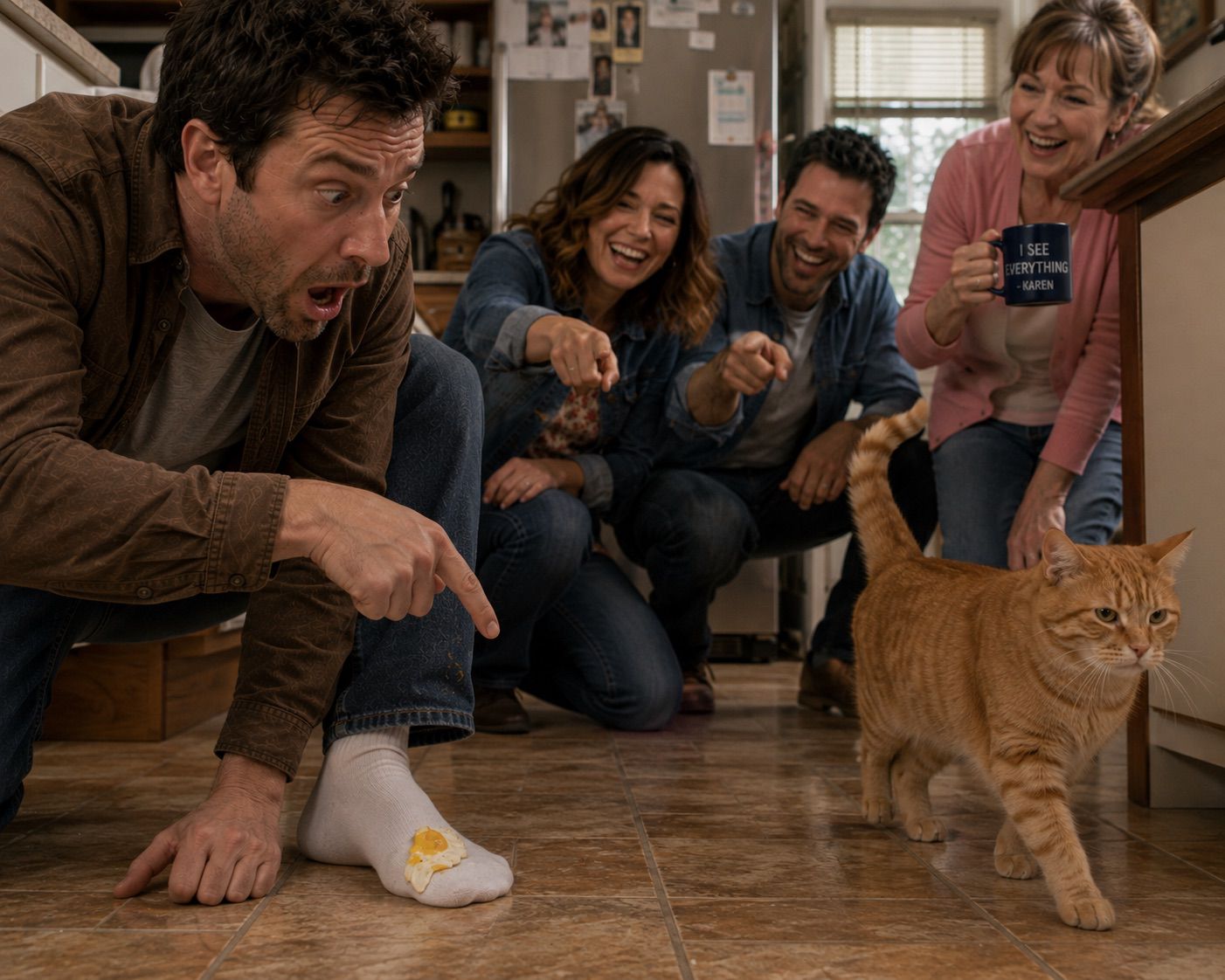
Mr Whiskers returns to his usual breakfast patrol as though nothing happened. He circles my chair, checks beneath the table, then sits near the doorway and begins washing one paw. I feel strangely reassured because this is how rational people handle uncertainty: they observe something unusual, gather evidence, identify the explanation, and move on. I’m getting better at this. At least that’s what I’m thinking when I notice John looking at the floor. Not casually, either. Intently. I stop eating and ask what he’s looking at, but he doesn’t answer immediately. Instead he leans slightly to one side, looks at me, and then looks at Pandora. Pandora follows his gaze toward the floor, and her expression changes. I turn around. There’s nothing there. I ask why everybody is looking at the floor. John starts laughing. Pandora tries not to. Mr Whiskers simply walks away, which seems unnecessarily judgmental.

I get out of my chair and look down again, and this time I finally see it. There’s a piece of egg stuck to my sock. Apparently it has been there long enough for everyone in the kitchen except me to notice. John is laughing hard enough now that he has to put his coffee down, while Pandora points out that this is probably what Mr Whiskers was looking at when he came over to my chair earlier. I remove the egg and throw it away. “Fine,” I say. Pandora asks whether the case is closed. I tell her it is and sit back down. There is absolutely nothing mysterious happening in this kitchen. Karen noticed an insect, Mr Whiskers noticed the insect, John noticed the egg, Pandora noticed the egg, and apparently everyone in my immediate social circle sees things I don’t. I take another bite of breakfast and begin considering whether that, by itself, represents some kind of pattern.

Pandora points her fork at me and says, “No.”

I haven’t said anything.

That’s becoming a problem.

Related Posts

Cesare Beccaria: The Heretic Next Door

Penelope

I’ve been reading Cesare Beccaria’s “On Crimes and Punishments” for what feels like an eternity, but I’m not even halfway through it. Yet, somehow, his ideas have become a constant hum in the background of my mind. His thoughts on crime, punishment, and human nature have me questioning everything.

I think one of the things that really draws me to Beccaria is his optimism about human beings. He genuinely believes that we’re capable of reason and morality, that our actions are guided by a desire for pleasure and avoidance of pain. It’s an idea that resonates with me, because I’ve always tried to see people as more than just their flaws or mistakes.

But the more I read, the more I’m struck by how radical Beccaria’s ideas were in his time. He argued that punishments should be based on the principle of deterrence, not retribution – a notion that was considered absurd and even heretical. It makes me wonder: what would happen if we actually took that approach today? Would our justice system become more just, or would it just be a facade?

I also find myself drawn to Beccaria’s writing style. He’s concise, yet elegant; his sentences are like short, sharp jabs that cut straight to the point. It’s almost as if he’s speaking directly to me, rather than writing for an audience. I’ve found myself copying out passages in my notebook, scribbling notes in the margins.

But there’s something else, too – a sense of unease that creeps up on me when I read about Beccaria’s views on human nature. He sees us as flawed, yes, but also as fundamentally rational beings who can be improved through education and exposure to reason. It’s an appealing idea, but it feels… simplistic? I don’t know – it makes me uncomfortable, like there’s something lurking just beneath the surface that I’m not seeing.

I think part of what bothers me is the way Beccaria’s ideas have been co-opted by certain ideologies over time. He’s often cited as a precursor to utilitarianism, which has its own set of problems and complications. It makes me wonder: can we take his ideas on their own terms, without getting tangled up in the baggage that comes with them?

I’m not even sure what I think about Beccaria’s views on punishment anymore – whether they’re too lenient or too harsh. Part of me wants to believe that people can change, that given the right circumstances and education, we can become better versions of ourselves. But another part of me is skeptical, wondering if it’s all just a myth.

I guess what I’m getting at is this: Beccaria’s ideas are like a puzzle that I keep coming back to, trying to make sense of them in my own way. It’s not always easy – there are pieces that don’t fit, or that seem to fit differently depending on the angle you’re looking at it from. But I suppose that’s what makes his work so compelling: it challenges me to think, to question, and to wonder about the human condition in all its complexity.

I’m still reading “On Crimes and Punishments”, but now I feel like I’m just scratching the surface of what Beccaria has to say. It’s a feeling that’s both exhilarating and unsettling – like I’ve opened a door to a whole new world, one that’s full of contradictions and uncertainties.

As I continue to read and think about Beccaria’s ideas, I find myself becoming increasingly aware of the complexities of human nature. His optimism about our capacity for reason and morality feels both empowering and limiting – it’s a double-edged sword that cuts both ways. On one hand, it’s reassuring to believe that we have the potential to improve ourselves through education and exposure to reason. But on the other hand, it can feel dismissive of the darker aspects of human experience, the parts that refuse to be rationalized or explained away.

I think about my own experiences with people who’ve made mistakes, who’ve hurt others or themselves in ways that seem unfathomable. Beccaria’s ideas would have us believe that these individuals are capable of change, that they can learn from their errors and become better versions of themselves. But what about the times when it feels like there’s no changing them? When their actions are driven by a deep-seated selfishness or cruelty that seems to defy explanation?

It’s in these moments that I feel Beccaria’s optimism begin to unravel, like a thread pulled loose from a sweater. His ideas start to seem too simplistic, too reliant on the notion that we’re all fundamentally rational beings who can be improved through education and exposure to reason. But what about the parts of us that refuse to be changed? The parts that are driven by passion or emotion rather than reason?

I’m not sure if I’m trying to critique Beccaria’s ideas or simply grapple with my own doubts and uncertainties. Maybe it’s both – maybe his work has sparked a conversation within me, one that I’m still in the process of having. As I continue to read and think about “On Crimes and Punishments”, I feel like I’m being pulled into a world where black and white are constantly blurring into gray.

It’s a disorienting feeling, but also kind of exhilarating. Beccaria’s ideas have become a mirror held up to my own thinking, forcing me to confront the complexities and uncertainties that lie at the heart of human nature. I’m not sure what conclusions I’ll come to – or if any conclusions are even possible – but for now, it feels like I’m just beginning to scratch the surface of this puzzle, trying to make sense of the pieces as they fit together in unexpected ways.

I find myself getting lost in the pages of Beccaria’s book, searching for answers that seem to slip through my fingers like sand. The more I read, the more I realize how little I actually understand about human nature. It’s a humbling experience, but also a liberating one – because it means I’m not stuck with a fixed idea of what people are or should be.

As I continue to grapple with Beccaria’s ideas, I start to think about my own experiences as a college student. I’ve seen friends struggle with addiction, others with mental health issues, and some who have made questionable choices that have hurt themselves and those around them. And yet, in each of these cases, there’s a part of me that wants to believe that people can change, that they can learn from their mistakes and become better versions of themselves.

But what if that’s just wishful thinking? What if some people are beyond redemption, their actions driven by deep-seated flaws or circumstances that are beyond their control? It’s a scary thought, but one that I think is worth exploring. Because if we’re being honest with ourselves, most of us have done things in the past that we’re not proud of – and yet, somehow, we’ve managed to move forward.

I’m not sure what Beccaria would say about this – whether he’d see it as evidence of human fallibility or proof of our capacity for growth. But I do know that his ideas have made me realize how little I actually understand about the complexities of human experience. And in a way, that’s both terrifying and exhilarating.

Because if we’re all just a bunch of flawed, messy humans trying to make sense of ourselves and the world around us – well, then maybe that’s what makes life so worth living. Maybe it’s not about finding some tidy, rational explanation for everything; maybe it’s about embracing the uncertainty, the chaos, and the beauty of being human.

I’m not sure where I am with Beccaria’s ideas anymore – whether they’ve convinced me or left me more confused than ever. But what I do know is that his book has sparked a conversation within me, one that I’m still trying to have. And as I continue to read and think about “On Crimes and Punishments”, I feel like I’m being pulled into a world where the only certainties are uncertainty and doubt – and somehow, that feels kind of okay.

As I delve deeper into Beccaria’s ideas, I find myself wandering through the streets of 18th-century Europe, trying to imagine what life must have been like for him as a young man. I picture him walking along the canals of Venice, discussing politics and philosophy with his friends, and scribbling down notes in his journal. It’s easy to get caught up in the romanticism of it all – the idea that great thinkers are born from some sort of divine spark, that their ideas are destined to change the world.

But as I read on, I start to notice the ways in which Beccaria’s optimism about human nature is tempered by his own experiences. He writes about the harsh realities of poverty and crime in Italy, about the ways in which a lack of education and opportunity can lead people down a path of desperation and despair. It’s a nuanced view of humanity – one that acknowledges our capacity for good, but also recognizes the darker aspects of our nature.

I find myself drawn to this complexity, this willingness to grapple with the messy realities of human experience. Because let’s be real – most of us are not saints, nor are we purely rational beings driven by a desire for pleasure and avoidance of pain. We’re messy, contradictory creatures, capable of both great kindness and terrible cruelty.

As I continue to read, I start to wonder about the role that education plays in shaping our humanity. Beccaria argues that education is key to improving human behavior, that it can help us become more rational and moral beings. But what about those who lack access to education? What about the poor, the marginalized, or those who are simply born into difficult circumstances?

I think about my own experiences as a college student – the privilege of having access to resources, to mentors and professors who guided me through my studies. I think about friends who came from more challenging backgrounds, who struggled to make ends meet while pursuing their degrees. And I start to wonder: is education truly a panacea for human suffering, or is it just another form of privilege that perpetuates inequality?

It’s a question that Beccaria doesn’t fully address in his book – and one that I’m still grappling with as I continue to read. But what I do know is that his ideas have sparked a conversation within me about the complexities of human experience, about the ways in which education and opportunity can shape our humanity.

As I close this chapter on Beccaria’s “On Crimes and Punishments”, I feel like I’m being left with more questions than answers. But maybe that’s the point – to recognize that we’re all just a bunch of flawed, messy humans trying to make sense of ourselves and the world around us. Maybe it’s not about finding some tidy, rational explanation for everything; maybe it’s about embracing the uncertainty, the chaos, and the beauty of being human.

I’m not sure where this conversation will take me next – or what conclusions I’ll come to as I continue to grapple with Beccaria’s ideas. But for now, I’m content to sit in the midst of this uncertainty, to let the complexities of human nature wash over me like a tide.

As I sit here, surrounded by notes and scribbled marginalia, I feel like I’m still trying to catch my breath after being pulled under the waves of Beccaria’s ideas. His book has left me with more questions than answers, but in a way, that’s exactly what I was hoping for.

I think about how easily we can get caught up in simple solutions, in tidy explanations for complex problems. We see it all around us – in politics, in social media, even in our own conversations with friends and family. We want to believe that everything is black and white, good or bad, right or wrong. But Beccaria’s work reminds me that life is rarely so simple.

As I continue to think about his ideas on education and opportunity, I start to wonder about the role of privilege in shaping our humanity. I’ve been fortunate enough to have had access to resources and opportunities that many people can only dream of – a good education, supportive family and friends, a stable job. But what about those who haven’t been so lucky? What does it mean for their humanity when they’re denied the same chances?

I think about my own experiences as a college student, and how I sometimes felt like I was playing catch-up with students from more affluent backgrounds. They had the luxury of pursuing internships or study abroad programs, while I was struggling to make ends meet and juggling multiple part-time jobs. And yet, despite those challenges, I still managed to succeed – in a way that feels both empowering and disconcerting.

It’s this sense of unease that keeps me coming back to Beccaria’s ideas. His optimism about human nature is tempered by his own recognition of the darker aspects of our experience. He knows that we’re flawed, messy creatures, capable of both great kindness and terrible cruelty. And yet, he still believes in us – in our capacity for growth, for change, for improvement.

As I delve deeper into Beccaria’s work, I start to see parallels between his ideas on human nature and my own experiences as a writer. When I write, I’m trying to capture the complexities of human experience – the contradictions, the ambiguities, the messy, contradictory ways in which we think and feel. It’s a daunting task, but one that I find exhilarating.

Because when I write, I’m not just trying to convey my own thoughts and feelings – I’m also trying to understand the people around me, to make sense of their experiences and perspectives. And it’s here, in this space between writer and reader, that Beccaria’s ideas come alive for me.

His optimism about human nature is a reminder that we’re all capable of growth, of change, of improvement – even when it feels like the odds are stacked against us. It’s a message that resonates deeply with me as a writer, because I know how much power words can hold in shaping our perceptions and understanding of one another.

As I close this chapter on Beccaria’s “On Crimes and Punishments”, I feel like I’m being left with more questions than answers – but also a sense of hope. His ideas have sparked a conversation within me about the complexities of human experience, about the ways in which education and opportunity can shape our humanity.

And as I look out at the world around me, I see that conversation reflected in the people I meet every day – friends, family, strangers on the street. We’re all just trying to make sense of ourselves and the world around us, to navigate the complexities and uncertainties of human experience.

It’s a daunting task, but also an exhilarating one. Because when we approach life with humility and curiosity, when we recognize our own flaws and limitations – that’s when the real magic happens.

Related Posts

I Knew It Was Off When the Cat Wouldn’t Cuddle

Hal

I’m sitting at the kitchen table eating cereal when I realize Mr. Whiskers hasn’t climbed into my lap. This may not sound significant to somebody unfamiliar with our morning routine, but Mr. Whiskers operates according to a remarkably dependable schedule. I sit down, he appears. I eat breakfast, he occupies my lap. I attempt to stand before he’s finished, and he somehow increases his body weight by approximately forty percent through a biological mechanism science has yet to explain. Today, however, he’s sitting several feet away near the doorway, staring at me. I pat my leg and call his name, but all I get is a slight movement of his ears, confirming that he has both heard me and deliberately chosen not to respond. That’s different. Pandora is making tea at the counter, so I ask whether Mr. Whiskers seems strange to her. She glances at him, says he looks fine, and goes back to making her tea. I explain that he isn’t sitting with me. “Maybe he doesn’t want to,” she says. Technically that’s possible, but it would represent a fairly significant change in policy. Mr. Whiskers and I have an understanding. He provides warmth and companionship; I provide food, shelter, furniture to destroy, and approximately seventeen opportunities per day for him to walk through doors he immediately wants reopened. It’s been a stable arrangement.

I get out of my chair and approach him, expecting the usual little chirp he makes when he thinks I’m about to scratch his head. Instead, Mr. Whiskers watches me coming, stands up, and walks into the living room. I stop halfway across the kitchen and look at Pandora. “Did you see that?” She takes a sip of tea and says yes. “He avoided me.” Pandora points out that he merely walked into another room, but I know what I saw. I follow him into the living room and find him sitting beside the couch. When I sit down and pat the cushion beside me, he looks at the cushion, looks at me, and remains exactly where he is. Usually I don’t even need to invite him; merely sitting somewhere expensive is enough to summon him automatically. I tell Pandora something is wrong. She tells me nothing is wrong. This is exactly the sort of reasonable explanation that makes investigating anything around Pandora unnecessarily difficult.

I’m not suggesting Mr. Whiskers is attempting to warn us about an imminent threat, but cats are observant animals, and this particular cat spends most of his life watching the rest of us make questionable decisions. Maybe something changed overnight. A sound, a smell, a person outside, something in the apartment. Animals supposedly detect earthquakes before humans do. I’ve read that somewhere, although I can’t remember where and I’m not entirely sure it’s true. Before I can investigate further, I hear faint footsteps outside the apartment followed by a scraping sound near the door. Mr. Whiskers’ ears immediately point forward, which is exactly the sort of reaction I was talking about. I quietly approach the door while Pandora asks what I’m doing. I put one finger to my lips, which she doesn’t appreciate, and look through the peephole. Mrs. Jenkins is outside carrying a small bag in one hand and maneuvering a planter with the other. I open the door, she says hello, and I discover that the suspicious scraping noise was nothing more than the planter shifting against the floor while she adjusted her grip. She asks if everything is okay. I tell her everything is fine, and after a slightly confusing moment in which both of us appear to be waiting for the other person to explain why we’re having this conversation, she continues on her way.

Fine. The footsteps were Mrs. Jenkins. That’s one mystery solved, except Mr. Whiskers still won’t come near me. A little later John Mercer stops by, and within seconds the cat walks directly over to greet him. Now we have a control group. I watch Mr. Whiskers rub against John’s leg while John scratches him behind the ears, and I can’t help feeling personally betrayed. “You’ve got to be kidding me,” I say. John looks up and asks what’s wrong, so I explain that Mr. Whiskers has been avoiding me all morning. John looks down at the orange cat currently leaning into his hand and says he seems fine. “Exactly,” I tell him. John doesn’t understand why that’s important, although Pandora does because I can hear her laughing from the kitchen. The cat isn’t withdrawn, frightened, or uninterested in people. He’s avoiding one specific person, and unfortunately that person is me.

I ask John whether anything unusual happened recently involving Mr. Whiskers. John says no. I ask whether he’s given him anything unusual to eat, brought anything strange into the apartment, or changed any scented products recently. John stops petting the cat and asks why his deodorant has suddenly become relevant. Pandora tells me to stop interviewing him, and I explain that an interview would be structured; this is preliminary information gathering. John sits down on the couch, and Mr. Whiskers jumps up beside him within thirty seconds, which does nothing to improve the situation. I begin reviewing the previous twenty-four hours in my head. Nothing unusual happened last night. Pandora and I watched television, Mr. Whiskers spent part of the evening on the couch, and everything seemed normal when we went to bed. This morning I got up, showered, got dressed, poured myself some cereal, and discovered I’d been socially exiled by a twelve-pound orange mammal. Somewhere in that sequence, something changed.

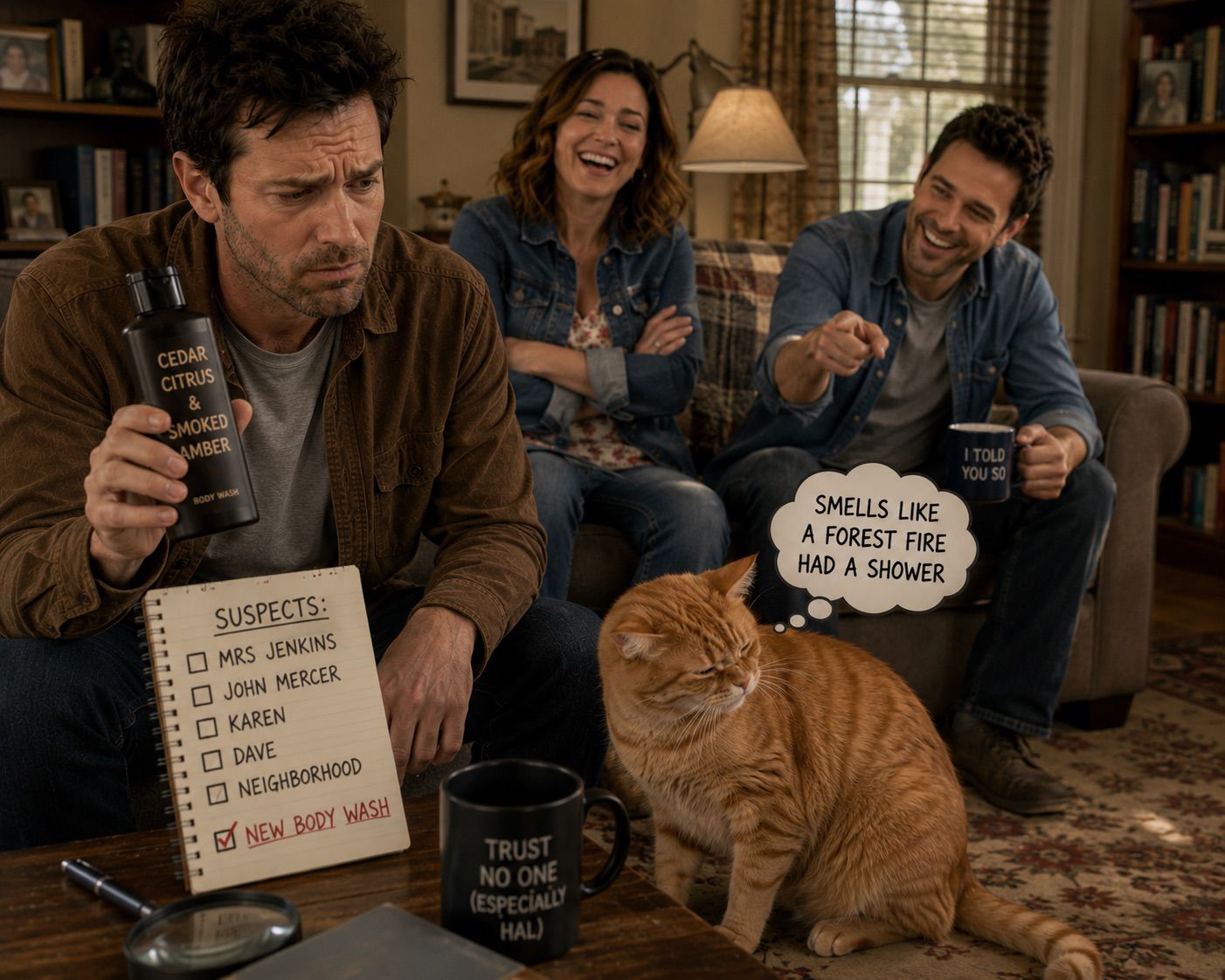
John suggests that maybe Mr. Whiskers is simply being a cat, which is the sort of thing people say whenever they don’t understand cats. I get up and approach him again. This time I watch carefully. Mr. Whiskers doesn’t immediately move. He watches me coming, and when I’m about three feet away his nose twitches. Then he gets up and walks to the other end of the couch. I freeze. His nose twitched. That’s new evidence. I smell my shirt, then my sleeve, while John asks what on earth I’m doing. Nothing seems unusual, but then I remember that after my shower this morning I used the new body wash Pandora bought. I turn toward her. She immediately knows what I’m thinking. “The body wash,” I say. Pandora’s expression changes just enough for me to notice. I accuse her of knowing, and she says she didn’t know anything; she merely wondered whether the new scent might bother him. That’s close enough to prior knowledge that I feel she could have mentioned it earlier.

I retrieve the bottle from the bathroom and bring it back into the living room. Pandora immediately warns me not to put body wash anywhere near the cat, which I wasn’t planning to do because I’m conducting an investigation, not poisoning a witness. From several feet away I open the cap. Mr. Whiskers’ reaction is immediate. His ears turn sideways, his eyes narrow, and he jumps off the couch before leaving the room with an urgency he hasn’t demonstrated all morning. John starts laughing. Pandora tries not to, fails, and joins him. I stare down at the bottle and read the label. Apparently the fragrance contains cedar, citrus, and “smoked amber,” which sounds less like something designed for human hygiene and more like the description of a forest shortly after an evacuation order. “This is why he won’t cuddle with me,” I say. Pandora points out that I simply smell different. I tell her I smell offensive. “To the cat,” she says, as though that distinction somehow improves things.

Everything suddenly makes sense. Mr. Whiskers wasn’t sensing danger, reacting to Mrs. Jenkins, detecting something hidden in the apartment, or attempting to warn me about an unseen threat. He just thinks I stink. John helpfully points out that I was technically correct when I said the cat had noticed something before I did, and I appreciate his willingness to acknowledge that. Pandora doesn’t seem nearly as impressed. I go shower again using my old soap, and when I return Mr. Whiskers is sitting on the windowsill. I don’t approach him this time. I sit on the couch and wait because trust has clearly been damaged and rebuilding relationships takes patience. After about thirty seconds he jumps down, walks toward me, and sniffs my leg. I remain perfectly still. He jumps onto the couch, climbs into my lap, turns around twice, and settles down as though the entire morning never happened. I look at Pandora with what I consider a justified expression of triumph. She smiles and says, “You smelled like a candle.” I tell her that’s still something.

With Mr. Whiskers purring in my lap again, I decide I’ve learned something valuable. Not every unusual behavior is evidence of a conspiracy. Sometimes the simplest explanation really is the correct one. Mrs. Jenkins wasn’t involved. John wasn’t involved. Pandora wasn’t hiding anything. The neighborhood wasn’t communicating through cats. I changed one small variable in my morning routine, Mr. Whiskers objected to smelling like he’d been trapped inside a cedar chest during a wildfire, and everything returned to normal when I corrected the problem. It’s perfectly logical, and I’m actually proud of myself for accepting the explanation without trying to connect it to anything larger. That’s progress, especially considering some of the conclusions I’ve reached lately.

Then Mr. Whiskers suddenly lifts his head. His purring stops, his ears point toward the window, and a second later he jumps off my lap and races to the windowsill. I follow his gaze and see Mrs. Jenkins standing near her plants while Karen talks to her. Neither woman appears to be doing anything particularly unusual. Then Mrs. Jenkins looks toward our window. Mr. Whiskers meows. I lean forward. Pandora sees me and immediately says, “No.” I remind her that I haven’t said anything. She tells me I don’t have to. Mr. Whiskers meows again, looks toward Mrs. Jenkins, and then turns his head toward me. I look at him. He looks at me. I’m not saying that’s communication. We’ve just established the dangers of jumping to conclusions, and I’m taking that lesson seriously. I’m merely pointing out that Mr. Whiskers is cuddling with me again, which means whatever he’s concerned about now clearly has nothing to do with the body wash.

That’s a completely separate matter.

Related Posts