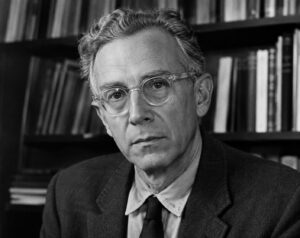
George Oppen’s poetry always makes me feel like I’m trying to untangle a knot while simultaneously watching it grow tighter. It’s a sensation that’s both maddening and mesmerizing, like staring at a puzzle with pieces that refuse to fit together. As I read through his collected works, I find myself drawn to the tension between clarity and obscurity, as if he’s intentionally teasing out meaning from the very fabric of language itself.
I think about my own writing process, how it often feels like trying to grasp a handful of sand – the more I squeeze, the more slips away. Oppen’s poetry is like that too, but with a sense of purposeful slipping. He’s not afraid to let go of words, or meanings, or even his own identity, in order to reveal something new and uncharted.
It’s this willingness to surrender control that makes me feel uneasy. As someone who writes as a way to make sense of the world (and myself), I’m drawn to Oppen’s fluid boundaries between poetry and politics, art and activism. He blurs these lines with ease, which is both beautiful and unsettling. It’s like he’s showing me that my own categories – writer, thinker, citizen – are nothing more than provisional labels, waiting to be shed or rearranged.
I’ve always been fascinated by the way Oppen’s life intersected with mine, even though we never actually met. We share a generation – I’m a young adult, trying to make sense of my own place in the world – and a passion for exploring the intersections between art and politics. His work speaks directly to me on days when my own words feel like they’re stuck in quicksand.
But there’s also something more intangible at play here. Maybe it’s the way Oppen’s poetry captures the anxiety of living through turbulent times, when everything seems to be shifting beneath our feet. As I navigate my own uncertain future – trying to balance creative pursuits with practical realities – I find solace in his willingness to confront uncertainty head-on.
I wonder if this is what draws me to Oppen’s writing: a sense that he’s grappling with the same existential questions I am, even as he defies easy answers. His poetry becomes a kind of confessional, not just for himself but also for anyone who dares to engage with his words. It’s a space where we can confront our own contradictions – between hope and despair, between clarity and ambiguity – without fear of judgment or resolution.
In many ways, Oppen’s work is like an ongoing conversation that refuses to be pinned down. He speaks directly to me on days when I feel lost in the labyrinthine corridors of my own mind, but also on days when I’m convinced I’ve stumbled upon some hidden truth. His poetry becomes a threshold, beckoning me to step across into the unknown – not with a sense of resolution, but with a willingness to stay suspended between words and silence.
The more I read Oppen’s work, the more I realize that our shared unease is precisely what connects us. It’s an uncomfortable feeling, like being stranded on a rocky shoreline, where the waves keep crashing against the shore, threatening to sweep me away at any moment. But it’s also exhilarating – a reminder that meaning isn’t something we capture; it’s something we’re constantly creating, even as the world around us keeps shifting and dissolving.
And so I continue to return to Oppen’s poetry, this space where language and reality blur like watercolors on wet paper. It’s not just about understanding his work – or mine own – but about embracing the uncertainty that comes with living in a world that refuses to yield its secrets easily. In this sense, Oppen becomes my fellow traveler on this winding path, someone who shows me that the journey itself is the destination, no matter how messy and unresolved it may feel.
As I delve deeper into Oppen’s poetry, I’m struck by the way he inhabits multiple worlds at once – the world of politics, where ideology and history collide; the world of art, where language and form entwine; and the world of personal experience, where vulnerability and intimacy reside. It’s as if he’s constantly shifting between these different realms, using each one to illuminate the others.
I think about how this multiplicity reflects my own attempts at writing, trying to balance the need for clarity with the allure of ambiguity. Oppen’s poetry often feels like a series of thresholds, where words and meanings blur or dissolve on the cusp of being grasped. It’s disorienting, but also liberating – a reminder that meaning isn’t fixed, but rather something we can negotiate and reinterpret.
One of the things I admire most about Oppen is his willingness to confront the contradictions at the heart of human experience. His poetry doesn’t shy away from the complexities and paradoxes that make life so messy and beautiful. He writes about love and loss, hope and despair, in a way that acknowledges both their interplay and their irreconcilability.
This tension between opposites resonates deeply with me, particularly when I’m struggling to reconcile my own creative ambitions with the demands of everyday reality. Oppen’s poetry shows me that these tensions are inherent, not just personal, but universal – that we’re all caught up in this dance between light and darkness, clarity and obscurity.
I wonder if this is what he meant by his famous phrase, “the figure a poem makes / falls in the middle of your life”? Is it possible that poetry, rather than resolving our contradictions, actually reveals them to us, making visible the knots and complexities we’d rather not confront? Oppen’s work suggests as much – that poetry can be a kind of mirror, reflecting back at us our own deepest anxieties and aspirations.
In many ways, this is both exhilarating and terrifying. To think that poetry can reveal so much about ourselves, to see in Oppen’s words a reflection of my own confusions and desires… it’s like being offered a glimpse into a hidden room within myself, a space where the contours of my own identity are slowly taking shape.
As I read on, I feel myself becoming more acutely aware of the stakes involved – not just for Oppen, but for all of us who attempt to make sense of our lives through language and art. His poetry is a reminder that we’re constantly negotiating between truth and fiction, reality and imagination, as we try to express ourselves in the world.
And so I return to his words, again and again, drawn by their complexity, their intensity, and their willingness to confront the unknown. Oppen’s poetry has become a kind of touchstone for me, a reminder that meaning is never fixed, but always on the verge of being rewritten – a prospect both daunting and liberating, like standing at the edge of a vast, uncharted sea.
As I stand on this precipice, gazing out into the unknown, I’m struck by the way Oppen’s poetry seems to defy the very notion of resolution. It’s as if he’s intentionally pushing against the boundaries of language, testing its limits and watching it snap back like a rubber band. This sense of tension is both exhilarating and unnerving, like being suspended in mid-air without a net.
I think about how this relates to my own writing process, where I often find myself caught between the desire for clarity and the need for nuance. Oppen’s poetry shows me that these two impulses aren’t mutually exclusive – that they can actually inform and complicate each other in ways both beautiful and unsettling. It’s like he’s revealing a hidden thread that runs through all of human experience: the tension between our longing for coherence and our fascination with the fragmented, the incomplete.
As I delve deeper into Oppen’s work, I start to notice the way his poetry is infused with a sense of impermanence – as if words themselves are ephemeral, fleeting things. This awareness is both humbling and liberating, like being reminded that even the most seemingly fixed truths can dissolve in an instant. It’s a reminder that language is always provisional, always subject to revision or reinterpretation.
I wonder if this sense of impermanence is what allows Oppen’s poetry to feel so urgent, so alive – as if he’s capturing moments on the fly, before they slip away into the ether. His words have a quality of ephemerality, like the flickering images in a dream that vanish when you try to grasp them. It’s a feeling I’ve tried to capture in my own writing, but never quite succeeded – until now, that is.
As I read on, I start to see Oppen’s poetry as a kind of mirror reflecting back at me my own fears and desires – the desire for connection, the fear of disconnection; the longing for clarity, the uncertainty of ambiguity. His words seem to be saying that these contradictions are inherent to human experience, that we’re all caught up in this dance between light and darkness.
And yet, even as I acknowledge this tension, I find myself drawn to the spaces between – the silences, the ellipses, the gaps where meaning seems to hang by a thread. It’s as if Oppen is pointing me toward some hidden threshold, beckoning me to step across into the unknown. His poetry becomes a kind of compass, guiding me through the labyrinthine corridors of my own mind.
I start to realize that Oppen’s work isn’t just about conveying meaning – it’s about creating spaces where meaning can be negotiated, reinterpreted, and reimagined. It’s a reminder that language is always in motion, always subject to revision or reinterpretation. His poetry shows me that the act of writing itself is a form of resistance against the fixed, the static – a way of capturing the fluidity and complexity of human experience.
As I stand on this threshold, looking out into the unknown, I feel a sense of gratitude toward Oppen’s poetry – for showing me that meaning isn’t something we capture; it’s something we’re constantly creating. His words have become a kind of touchstone for me, a reminder that language is always provisional, always subject to revision or reinterpretation.
And so I continue to return to his poetry, drawn by its complexity, its intensity, and its willingness to confront the unknown. Oppen’s work has become a part of my own writing process – a reminder that meaning is never fixed, but always on the verge of being rewritten.
As I continue to immerse myself in Oppen’s poetry, I find myself drawn into the world of his politics and activism. His commitment to social justice and his critiques of capitalism are deeply resonant for me, particularly as I navigate my own place within the world. I think about how his poetry often blurs the lines between art and politics, revealing the complex interplay between the two.
For Oppen, it seems, poetry is not just a means of expression but also a tool for resistance against the dominant narratives of our time. His words are infused with a sense of urgency, a desire to confront the injustices of the world head-on. And yet, his approach is never didactic or preachy; instead, he uses language in a way that’s both subtle and subversive.
I think about how this approach resonates with my own experiences as a young writer trying to make sense of the world. I’ve often felt frustrated by the expectations placed upon me – to produce work that’s polished and professional, to conform to certain standards or conventions. But Oppen’s poetry shows me that there’s another way to write, one that’s more honest, more raw, and more revolutionary.
One of the things that draws me to Oppen’s politics is his commitment to the concept of “nothing” – not as a negation but as a affirmation. He sees nothingness as a fundamental aspect of reality, a space where meaning can be renegotiated and reinterpreted. For him, poetry becomes a way of exploring this nothingness, of probing its depths and revealing its contours.
This idea has a profound impact on me, particularly in my own writing process. I’ve always struggled with the notion that language should be precise, that words should convey clear and unambiguous meanings. But Oppen’s work shows me that there’s value in ambiguity, in uncertainty, in the spaces between words. His poetry becomes a kind of threshold for me, beckoning me to step across into the unknown.
As I delve deeper into Oppen’s politics, I start to notice the way he critiques the notion of “progress.” For him, progress is not a linear concept but rather a circular one – we’re always returning to where we started, with all its complexities and contradictions. This idea resonates deeply with me, particularly as I navigate my own place within the world.
I think about how this critique of progress relates to my own experiences as a young adult trying to make sense of my place in the world. I’ve often felt pressure to conform to certain expectations – to pursue a career that’s stable and secure, to produce work that’s marketable and profitable. But Oppen’s poetry shows me that there’s another way to live, one that’s more authentic, more honest, and more revolutionary.
As I continue to explore Oppen’s politics, I start to see the connections between his ideas and my own experiences as a writer. His notion of “nothing” becomes a metaphor for the spaces between words – the silences, the ellipses, the gaps where meaning hangs by a thread. And his critique of progress reveals the circular nature of human experience – we’re always returning to where we started, with all its complexities and contradictions.
I wonder if this is what Oppen meant by his famous phrase, “the figure a poem makes / falls in the middle of your life”? Is it possible that poetry, rather than resolving our contradictions, actually reveals them to us, making visible the knots and complexities we’d rather not confront? His work suggests as much – that poetry can be a kind of mirror reflecting back at us our own deepest anxieties and aspirations.
In many ways, this is both exhilarating and terrifying. To think that poetry can reveal so much about ourselves, to see in Oppen’s words a reflection of my own confusions and desires… it’s like being offered a glimpse into a hidden room within myself, a space where the contours of my own identity are slowly taking shape.
As I stand on this threshold, looking out into the unknown, I feel a sense of gratitude toward Oppen’s poetry – for showing me that meaning isn’t something we capture; it’s something we’re constantly creating. His words have become a kind of touchstone for me, a reminder that language is always provisional, always subject to revision or reinterpretation.
And so I continue to return to his poetry, drawn by its complexity, its intensity, and its willingness to confront the unknown. Oppen’s work has become a part of my own writing process – a reminder that meaning is never fixed, but always on the verge of being rewritten.
Related Posts