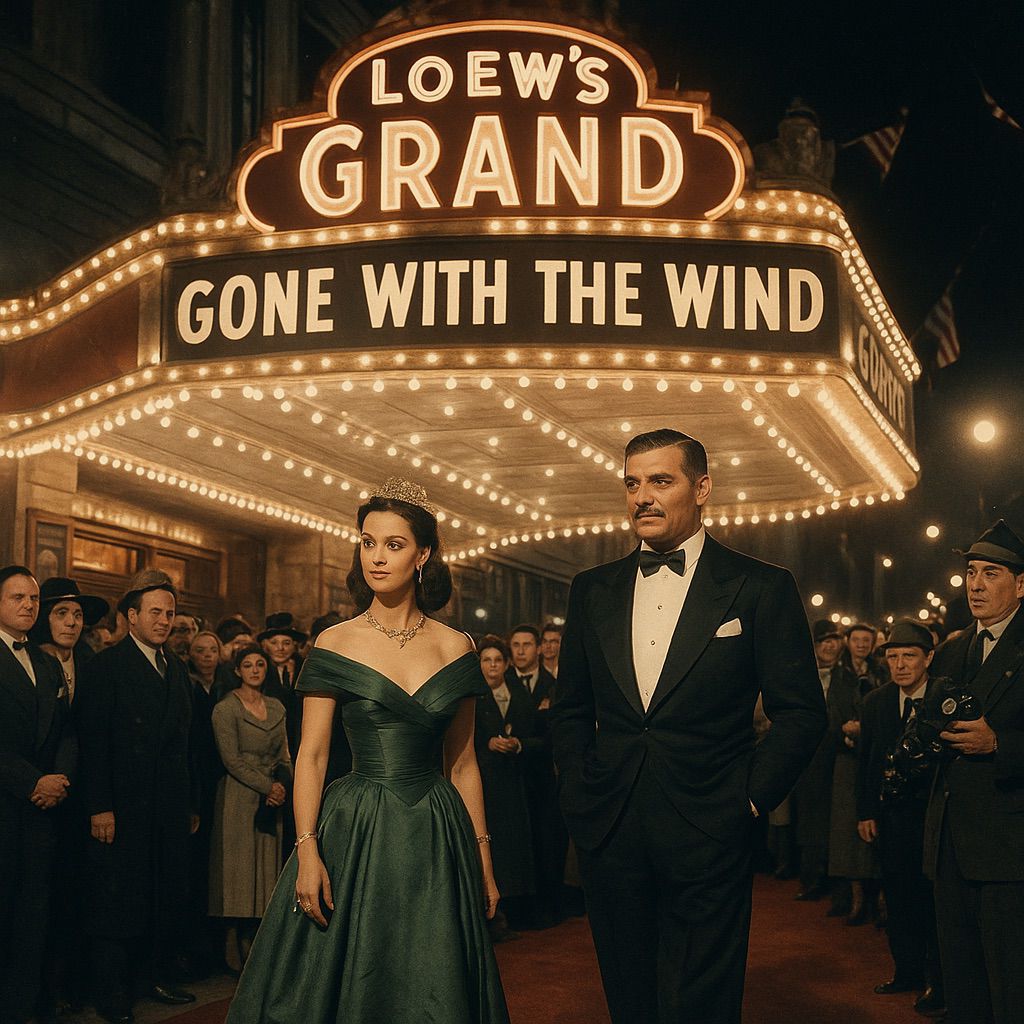
On the evening of December 15, 1939, Atlanta, Georgia became the epicenter of the cinematic world. Searchlights cut through the Southern night sky, streets overflowed with spectators, and anticipation hung thick in the air as one of the most ambitious films ever produced prepared to make its debut. Gone with the Wind was more than a movie premiere—it was a cultural event, a statement of Hollywood’s power, and the unveiling of a story that would shape American cinema for generations.
The Loew’s Grand Theatre stood at the heart of the celebration, transformed into a shrine of glamour and spectacle. Thousands gathered outside, hoping to catch a glimpse of stars arriving in elegant gowns and tailored tuxedos. The premiere was treated with the grandeur of a royal coronation, complete with parades, fireworks, and national attention. In an era still recovering from the Great Depression, the night offered an intoxicating sense of escapism and wonder.
Gone with the Wind had already achieved legendary status before a single frame reached the screen. Margaret Mitchell’s novel, published in 1936, became an instant phenomenon, selling millions of copies and embedding itself deeply into American culture. Readers were captivated by the story of Scarlett O’Hara, a fiercely determined Southern woman whose life is upended by the Civil War and its aftermath. The book’s success made a film adaptation inevitable, but also immensely risky.
From the outset, adapting the novel proved to be a monumental challenge. The story spanned decades, featured dozens of characters, and grappled with themes of love, survival, loss, and societal collapse. Producer David O. Selznick committed himself to honoring the scope of Mitchell’s work, even as Hollywood insiders doubted that such a sprawling narrative could be translated to film. The result was a production plagued by rewrites, director changes, and mounting pressure.
Casting Scarlett O’Hara became one of the most publicized searches in Hollywood history. Hundreds of actresses were considered, auditions scrutinized, and opinions fiercely debated. When Vivien Leigh, a relatively unknown British actress, was finally cast, the decision was met with both excitement and skepticism. Yet from her first appearance on screen, it became clear that Leigh embodied Scarlett’s fire, vulnerability, and resilience in a way few others could have achieved.
Clark Gable, already one of Hollywood’s biggest stars, was cast as Rhett Butler, the charismatic rogue whose wit and emotional detachment mask deep complexity. Gable’s presence brought gravitas and star power, but his participation was not without personal strain. Behind the scenes, he was grieving the recent death of his wife and struggling with health issues, adding emotional weight to his performance.
The production itself was an endurance test. Filming stretched over two years, with multiple directors rotating through the project before Victor Fleming ultimately guided it to completion. Sets were constructed on a massive scale, costumes meticulously crafted, and battle scenes staged with unprecedented ambition. Over a thousand costumes were designed, many of them worn by Scarlett alone, visually charting her transformation from sheltered plantation daughter to hardened survivor.
Music played a crucial role in shaping the film’s emotional power. Max Steiner’s sweeping score underscored moments of romance, despair, and defiance, weaving itself into the identity of the film. The music elevated scenes into operatic grandeur, reinforcing Gone with the Wind’s epic tone and emotional resonance.
As the premiere approached, anticipation reached a fever pitch. Atlanta embraced the film as its own, seeing it as both a tribute to Southern history and a major cultural milestone. Streets were decorated, Confederate imagery prominently displayed, and the city transformed into a living backdrop for the film’s themes. While this celebration reflected the sentiments of the time, it also foreshadowed the complex and controversial legacy the film would carry.
When the lights dimmed inside the Loew’s Grand Theatre, the audience was transported to Tara, Scarlett’s beloved plantation. From the opening moments, the scale of the film was unmistakable. Sweeping landscapes, vivid Technicolor, and emotionally charged performances drew viewers into a world both romanticized and ravaged by war.
Audiences were mesmerized. Gasps echoed during battle scenes, tears flowed during moments of loss, and applause erupted at iconic lines that would later become legendary. By the time Rhett Butler delivered his now-famous farewell, the film had secured its place in cinematic history.
Critical reception was overwhelmingly positive. Reviewers praised the film’s ambition, performances, and visual splendor. Vivien Leigh was hailed as a revelation, while Clark Gable’s portrayal of Rhett Butler was celebrated as one of his defining roles. The film would go on to win eight Academy Awards, including Best Picture and Best Actress, further cementing its status.
Financially, Gone with the Wind became an unprecedented success. Adjusted for inflation, it remains one of the highest-grossing films of all time. Its popularity endured through multiple re-releases, drawing new audiences with each generation and reinforcing its place in the American canon.
Yet even at the height of its acclaim, the film was not without controversy. Its portrayal of slavery and the Old South drew criticism for romanticizing a brutal and oppressive system. Characters were depicted through lenses that reflected the prejudices of the era, sparking debates that continue to this day. Over time, Gone with the Wind became a focal point for discussions about historical memory, representation, and the responsibility of art.
Despite these debates, the film’s influence on cinema is undeniable. It set new standards for epic storytelling, production design, and emotional scope. Countless filmmakers drew inspiration from its scale and ambition, while its characters and dialogue became embedded in popular culture.
Gone with the Wind also demonstrated the power of film as a shared national experience. At a time when the world stood on the brink of global conflict, the movie offered both escape and reflection, reminding audiences of resilience in the face of upheaval.
As decades passed, interpretations of the film evolved. What was once seen primarily as a romantic epic came to be examined through more critical lenses. Scholars, historians, and audiences reassessed its themes, acknowledging both its artistic achievements and its problematic elements. This ongoing dialogue has ensured that the film remains relevant, not frozen in time but continually reexamined.
More than eighty years after its premiere, Gone with the Wind continues to provoke conversation, admiration, and debate. Its legacy is complex, layered with both brilliance and contradiction. Yet its impact is unquestionable. Few films have shaped the language of cinema so profoundly or left such a lasting imprint on cultural consciousness.
The night of December 15, 1939 marked more than a premiere—it marked a turning point. Hollywood demonstrated its capacity for grand storytelling, emotional depth, and cultural influence. Gone with the Wind became not just a film, but a mirror reflecting both the dreams and the flaws of the society that created it.
In the end, Gone with the Wind endures because it tells a story about survival—about people clinging to identity, love, and purpose as their world collapses around them. That theme, more than any spectacle or controversy, is what continues to resonate across generations.