Latest Articles

First to the Bottom of the World: How Roald Amundsen Conquered the South Pole

Elias Rowen

On December 14, 1911, at precisely 3:30 in the afternoon, a small group of men stood at the most remote point on Earth and quietly made history. Roald Amundsen and his Norwegian team planted their flag in the frozen heart of Antarctica, becoming the first humans to reach the South Pole. There was no cheering crowd, no dramatic announcement carried by radio waves in real time, only biting wind, endless white horizon, and the profound realization that they had accomplished something no one else had ever done. It was a moment that reshaped the story of exploration and cemented Amundsen’s place among history’s greatest pioneers.

The road to the South Pole had been paved with ambition, secrecy, and relentless preparation. Amundsen was not the most famous explorer of his era, nor was he the most publicly celebrated when he began planning the expedition. What set him apart was not bravado, but discipline. He believed exploration was not about daring gestures, but about reducing risk through meticulous planning and respect for the environment. This philosophy would prove decisive in one of the most competitive races of the early twentieth century.

Born in 1872 in Norway, Amundsen was shaped by the sea long before he ever dreamed of polar conquest. He went to sea as a boy and learned early lessons about survival, patience, and adaptability. Unlike many explorers of his time, he did not romanticize danger. He studied it. His early years aboard merchant ships taught him that nature was indifferent to human ambition and that survival depended on preparation rather than heroics.

Amundsen’s first major expedition, the attempt to navigate the Northwest Passage between 1903 and 1906, became a turning point in his life. While the voyage did not bring immediate fame, it provided something far more valuable: experience living and traveling in extreme Arctic conditions. He learned from the Inuit, adopting their clothing styles, sled techniques, and understanding of cold-weather survival. These lessons, dismissed by some European explorers as unnecessary or primitive, would later save lives.

By the time Amundsen set his sights on Antarctica, the race for polar dominance was already underway. The North Pole had recently been claimed, and attention turned south. Britain’s Robert Falcon Scott had publicly announced his intention to reach the South Pole, and much of the world assumed the honor would belong to him. Amundsen, aware of this, made a controversial decision. Rather than compete openly and risk political interference or loss of funding, he changed his objective in secrecy, redirecting his expedition from the Arctic to Antarctica without public announcement.

This decision remains one of the most debated aspects of Amundsen’s legacy, yet it underscores his strategic mindset. He believed exploration was not a matter of national pride, but of execution. When the Norwegian ship Fram departed in October 1910, only a small circle knew its true destination. The vessel itself was a marvel, built specifically for polar conditions, capable of withstanding crushing ice and brutal seas.

Once in Antarctica, Amundsen’s approach again set him apart. He selected a base location that provided a shorter route to the pole, even though it meant navigating unfamiliar terrain. He relied heavily on sled dogs, skis, and lightweight equipment, all carefully tested beforehand. Every aspect of the journey had been rehearsed. Food caches were laid with mathematical precision. Clothing was chosen for function, not tradition. Even the daily pace was calculated to conserve energy.

When the journey inland began in November 1911, the environment offered no mercy. Temperatures plunged far below zero, winds scoured exposed skin in seconds, and the landscape presented crevasses capable of swallowing entire sled teams. Yet the Norwegian party moved steadily forward. Their efficiency was not accidental. They skied rather than walked, allowing smoother movement across the snow. They rotated responsibilities evenly, preventing exhaustion. They trusted their dogs, treating them not as expendable tools, but as integral partners.

As days turned into weeks, the Antarctic Plateau tested their resolve. White blended into white, sky merged with snow, and the monotony became as dangerous as the cold. Mental discipline became as important as physical endurance. Amundsen kept strict routines, maintaining morale through structure and purpose. Every mile gained reinforced their confidence that they were doing something right.

The final approach to the South Pole was marked by both anticipation and caution. Amundsen was acutely aware that success depended on reaching the pole and returning alive. Discovery alone was meaningless if it ended in tragedy. When the team finally arrived, there was no dramatic celebration. They planted the Norwegian flag, took measurements to confirm their location, and set up a small tent to mark the achievement. Amundsen left a letter for Scott inside, a gesture of respect in case the British expedition arrived later.

The contrast between Amundsen’s success and Scott’s fate could not have been more striking. Scott reached the South Pole weeks later, only to find the Norwegian flag already flying. His return journey ended in disaster, with Scott and his men perishing in the cold. The tragedy cemented a narrative of British heroism, but it also highlighted the differences in approach between the two expeditions. Where Scott relied on manpower and tradition, Amundsen relied on adaptation and efficiency.

Amundsen returned to civilization as a hero, though he remained characteristically reserved. He credited his team, his preparation, and his willingness to learn from indigenous knowledge rather than claiming personal glory. His success challenged long-held assumptions about exploration, proving that humility and planning could triumph over sheer determination alone.

The South Pole expedition reshaped polar exploration forever. Future explorers adopted Amundsen’s methods, embracing skis, sled dogs, and lightweight gear. His emphasis on preparation became standard practice rather than exception. He demonstrated that understanding the environment was more important than conquering it.

Beyond the technical legacy, Amundsen’s journey captured the imagination of the world. It symbolized humanity’s ability to reach the most extreme corners of the planet through cooperation, discipline, and respect for nature. The South Pole, once an abstract concept, became a real place that humans could reach—and survive.

Amundsen continued exploring throughout his life, including pioneering flights over the Arctic. His disappearance in 1928 during a rescue mission only deepened his legend. He died as he lived, pushing boundaries not for fame, but for discovery.

More than a century later, the moment Amundsen reached the South Pole still resonates. It stands as a reminder that the greatest achievements are rarely loud or reckless. They are quiet victories earned through preparation, humility, and the courage to choose wisdom over pride. In the endless white silence of Antarctica, Roald Amundsen proved that the greatest triumphs are not about beating others, but about mastering the challenge itself.

Related Posts

Mariner 2 and the First Journey to Another World

Elias Rowen

In the early 1960s, space exploration existed at the intersection of daring imagination and fragile technology. Rockets failed as often as they succeeded, computers filled entire rooms yet possessed less power than a modern calculator, and every mission carried the real possibility of ending in silence. Still, the optimism of the era pushed scientists and engineers to attempt what had never been done before. Among the most ambitious of these efforts was Mariner 2, a small, unmanned spacecraft tasked with reaching Venus and answering a question humanity had pondered for centuries: what was our neighboring planet really like?

Venus had long fascinated astronomers. From Earth, it appeared bright, beautiful, and mysterious, cloaked in thick clouds that concealed its surface from view. Some speculated it might be a tropical paradise, others imagined vast oceans or lush jungles hidden beneath the haze. With telescopes offering only limited insight, Venus became a blank canvas onto which hopes and theories were projected. Mariner 2 would change that forever.

Launched on August 27, 1962, from Cape Canaveral Air Force Station, Mariner 2 represented both resilience and redemption. Just five months earlier, its predecessor, Mariner 1, had failed shortly after launch due to a guidance system error. The loss was a sobering reminder of how unforgiving spaceflight could be, but it did not dampen the resolve of NASA or the Jet Propulsion Laboratory. Instead, it sharpened their focus. Every flaw was examined, every system rethought, and every risk recalculated.

Mariner 2 was built with the understanding that it would operate alone, far beyond the reach of repair or rescue. Weighing roughly 290 kilograms and measuring just over three meters long, it was a delicate machine by modern standards, yet revolutionary for its time. Its instruments were designed to study Venus’s atmosphere, temperature, magnetic field, and solar radiation—data that had never before been collected from another planet.

Unlike later spacecraft, Mariner 2 did not orbit Venus or land on its surface. It was a flyby mission, relying on precise navigation and timing to pass close enough to gather meaningful data before continuing into interplanetary space. This made every maneuver critical. Even the smallest miscalculation could result in missing the planet entirely.

As Mariner 2 departed Earth, engineers at JPL watched anxiously as telemetry streamed in. The spacecraft endured extreme temperature swings, radiation exposure, and the constant threat of mechanical failure. Days after launch, a powerful solar flare disrupted communications, briefly raising fears that the mission might be lost. Backup systems were activated, commands adjusted, and once again, perseverance carried the mission forward.

For months, Mariner 2 traveled through the void at speeds exceeding 18 kilometers per second. During this journey, it became a test not just of engineering, but of patience and trust. The spacecraft operated largely autonomously, its instruments quietly collecting data while mission controllers waited for signals that took minutes to reach Earth. Each transmission confirmed that humanity had extended its reach a little farther into the cosmos.

On December 14, 1962, Mariner 2 made history. It passed within approximately 4,900 kilometers of Venus, becoming the first spacecraft ever to successfully visit another planet. In that moment, the solar system became something tangible rather than theoretical. Venus was no longer just a distant point of light in the sky—it was a real world with measurable properties and startling realities.

The data Mariner 2 sent back stunned scientists. Venus was not a tropical twin of Earth. Instead, it was a hostile inferno. Surface temperatures exceeded 800 degrees Fahrenheit, hot enough to melt lead. Atmospheric pressure was crushing, many times greater than Earth’s, and the planet’s thick carbon dioxide atmosphere trapped heat with devastating efficiency. The greenhouse effect, once an abstract concept, now had a dramatic and sobering example.

Even more surprising was what Mariner 2 did not find. Its magnetometer revealed that Venus lacked a significant global magnetic field, unlike Earth. This discovery had profound implications for understanding planetary formation and evolution. Magnetic fields, scientists realized, played a crucial role in protecting atmospheres from being stripped away by solar winds.

Mariner 2 also measured intense solar radiation and confirmed the presence of sulfuric acid clouds, creating a permanently overcast sky. Winds in Venus’s upper atmosphere were found to move at extraordinary speeds, circulating the planet far faster than it rotated. These findings painted a picture of a dynamic yet deadly environment, reshaping theories about planetary climates.

The impact of Mariner 2 extended far beyond Venus itself. By proving that interplanetary missions were possible, it opened the door to a new era of exploration. Mars, Mercury, Jupiter, and beyond were no longer unreachable dreams. They were destinations.

The mission also demonstrated the power of robotic exploration. Humans did not need to risk their lives to gather knowledge from distant worlds. Carefully designed machines could go where people could not, transmitting discoveries across millions of kilometers of space. This realization would define space exploration for decades to come.

Despite its success, Mariner 2 was constrained by the limitations of its era. Its flyby lasted only hours, and once it passed Venus, its ability to transmit meaningful data diminished. There would be no second chance, no extended mission, no course correction to return for another look. Yet what it accomplished in that brief window was enough to change planetary science forever.

The mission also highlighted the importance of adaptability. Engineers learned how to manage unexpected challenges, from solar interference to overheating components. These lessons informed future spacecraft designs, leading to improved thermal control systems, more resilient electronics, and better mission planning strategies.

Public reaction to Mariner 2 was electric. Newspapers and television broadcasts celebrated the achievement, presenting it as a triumph of human ingenuity. In the midst of the Cold War, the mission also carried symbolic weight, showcasing technological prowess and scientific leadership. But beyond politics, it captured the imagination of ordinary people, inspiring curiosity about the universe and humanity’s place within it.

Mariner 2’s legacy can be traced directly through subsequent missions. The Mariner program itself expanded to include flybys of Mars and Mercury, each building on the success and lessons of the Venus mission. Later probes, such as Pioneer Venus and Magellan, would map the planet in greater detail, but they all stood on the foundation Mariner 2 established.

Perhaps most importantly, Mariner 2 reshaped how scientists thought about Earth. Venus became a cautionary tale, a stark example of how planetary environments can evolve in extreme directions. The data collected influenced early discussions about climate systems, atmospheric chemistry, and long-term planetary stability. Earth’s habitability, once taken for granted, began to be understood as something rare and fragile.

Decades later, as modern spacecraft explore Mars, study the Sun, and venture beyond the edge of the solar system, the spirit of Mariner 2 remains alive. Its success proved that exploration is as much about persistence as innovation. It showed that failure is not an endpoint, but a step toward discovery.

The story of Mariner 2 is ultimately a story about curiosity. It reflects humanity’s refusal to accept ignorance, our desire to see beyond the horizon, and our willingness to risk uncertainty in pursuit of knowledge. With limited technology and immense challenges, a small spacecraft forever changed how we understand our planetary neighbors.

Today, as scientists plan new missions to Venus—seeking to understand its runaway greenhouse effect and volcanic history—they do so with the knowledge that the first pathfinder arrived more than sixty years ago. Mariner 2 did not just visit Venus. It transformed the solar system from a collection of mysteries into a place we could begin to know.

Related Posts

The Sandy Hook Tragedy and Its Lasting Reckoning

Elias Rowen

On the morning of December 14, 2012, the town of Newtown, Connecticut, awoke like countless other American communities in mid-December, wrapped in the quiet anticipation of the holiday season. Frost clung to lawns, Christmas decorations lined neighborhood streets, and parents dropped off their children at Sandy Hook Elementary School believing it would be an ordinary Friday filled with spelling lessons, storybooks, and the innocent rhythms of early childhood. Within hours, that sense of normalcy would be obliterated, replaced by a grief so profound it would echo across the nation and permanently alter the American conversation about violence, safety, and responsibility.

Sandy Hook Elementary School was the kind of place parents trusted instinctively. Nestled in a quiet residential area, it was small, welcoming, and deeply rooted in the community. Teachers knew their students well, many having taught siblings or neighbors over the years. The school embodied a sense of security that felt almost sacred, a place where children were meant to be protected from the world’s harsh realities. That belief was shattered shortly after 9:30 a.m. when violence invaded the one space it should never reach.

The shooter, a 20-year-old man from the area, arrived at the school after first killing his mother at their home earlier that morning. His life, marked by isolation, mental health struggles, and withdrawal from society, had unraveled quietly and largely out of public view. Friends were few, routines were rigid, and his world had narrowed over time. In the months leading up to the attack, his behavior became increasingly erratic, his connection to others increasingly fragile. Yet like so many tragedies before it, the warning signs existed in fragments—noticed in hindsight but never fully pieced together in time.

Armed with high-powered firearms legally purchased and stored in the home, he forced his way into the school and began firing almost immediately. The sounds of gunfire tore through hallways meant for laughter and learning. Teachers and staff reacted instinctively, placing themselves between danger and the children entrusted to them. In moments measured in seconds, educators became shields, protectors, and heroes, acting not out of training but out of love and responsibility.

Law enforcement officers responded within minutes, racing toward danger with no clear understanding of what awaited them inside. By the time police entered the building, the shooting had ended. The gunman had taken his own life, leaving behind a scene of devastation that defied comprehension. Twenty children, all between six and seven years old, and six adult staff members were dead. Families would soon face the unthinkable task of identifying their children, teachers, friends, and loved ones.

As news broke, the nation stood still. Parents across the country clutched their children tighter, schools went into lockdown, and televisions replayed the same haunting images from Newtown over and over again. The disbelief was universal. This was not a nightclub, a workplace, or a public square. This was an elementary school. The victims were first-graders who had barely begun their lives.

In the hours that followed, grief poured in from every corner of the world. Vigils were held, candles lit, flowers laid at makeshift memorials. Strangers wept together. Flags were lowered to half-staff. The names of the victims were spoken with reverence, their faces shared as symbols of innocence lost. For many Americans, Sandy Hook represented a breaking point, a moment when the question was no longer whether gun violence was a problem, but how much more the nation was willing to endure.

President Barack Obama addressed the nation that evening, visibly shaken. His voice cracked as he spoke of the children who would never grow up, never fall in love, never have families of their own. He urged Americans to reflect not only on their grief, but on their responsibilities to one another. His words resonated deeply, capturing a shared sense that something fundamental had gone terribly wrong.

In the weeks that followed, the debate over gun violence intensified with unprecedented urgency. Conversations that had long been politically charged took on a deeply personal tone. Parents, educators, medical professionals, and survivors began speaking openly about fear, prevention, and accountability. The country grappled with difficult questions about access to firearms, the role of mental health care, and the effectiveness of existing laws.

Legislative proposals emerged at the federal and state levels, aiming to expand background checks, limit access to certain weapons, and address gaps in mental health services. While many of these efforts faced fierce political opposition and ultimately stalled at the national level, they marked a shift in the public dialogue. Several states enacted their own reforms, reflecting a growing recognition that inaction carried its own moral cost.

Mental health awareness also took center stage in the aftermath of Sandy Hook. Advocacy organizations saw a surge in attention and support, as families and professionals alike called for better access to care, early intervention, and the removal of stigma surrounding mental illness. While experts emphasized that mental illness alone does not cause violence, the tragedy underscored the importance of comprehensive support systems capable of identifying and addressing severe distress before it turns catastrophic.

For the families directly affected, the path forward was unimaginably painful. Grief came in waves—overwhelming, unpredictable, and relentless. Yet even amid their loss, many parents chose to channel their pain into action. Organizations formed in memory of the victims, dedicated to preventing future tragedies and protecting other families from similar heartbreak. These foundations focused on education, community engagement, and evidence-based strategies to identify warning signs and intervene early.

One of the most prominent outcomes of this activism was a renewed emphasis on prevention rather than reaction. Programs designed to encourage students to speak up when something feels wrong, to foster connections rather than isolation, and to build supportive school environments gained traction nationwide. The idea that safety is a shared responsibility—one that extends beyond metal detectors and lockdown drills—began to take hold.

In Newtown itself, healing unfolded slowly and deliberately. The original Sandy Hook Elementary School building was eventually demolished, its physical presence too painful to remain. In its place, a new school was built, designed with both security and warmth in mind. Light-filled classrooms, open spaces, and thoughtful design elements reflected a community determined not to let fear define its future.

Memorials became places of quiet reflection rather than spectacle. Families and visitors alike found solace in spaces that honored the victims with dignity, focusing not on the violence of their deaths but on the lives they lived. These sites served as reminders that remembrance is not about reopening wounds, but about carrying love forward.

As years passed, Sandy Hook continued to influence the national conscience. Each subsequent mass shooting was inevitably compared to it, measured against its horror and its aftermath. The tragedy became a reference point, a symbol invoked whenever discussions of gun safety and school violence resurfaced. Its legacy shaped how Americans talked about loss, responsibility, and the limits of tolerance for preventable harm.

Yet Sandy Hook also revealed the resilience of the human spirit. Teachers who survived went on to advocate for safer schools. First responders carried the weight of that day with them, some struggling with trauma, others finding purpose in ensuring they were better prepared to protect lives in the future. Ordinary citizens, once silent, found their voices and refused to let grief be the final word.

The tragedy forced the nation to confront uncomfortable truths: that violence does not always announce itself loudly, that systems meant to protect can fail, and that waiting for absolute certainty before acting can come at an unbearable cost. It challenged Americans to decide whether outrage would fade into routine or transform into sustained commitment.

Today, more than a decade later, Sandy Hook remains a wound that has not fully healed. Its lessons are still debated, its impact still felt. But it also stands as a testament to the power of memory, compassion, and perseverance. The children and educators who lost their lives are remembered not only for how they died, but for what they have inspired—a continuing demand for a safer, more attentive, more humane society.

In remembering Sandy Hook, the nation is reminded that the measure of progress is not found in speeches or headlines, but in the choices made every day to protect life, nurture connection, and refuse to accept violence as inevitable. The legacy of December 14, 2012, endures as both a warning and a call to action—one that asks Americans to honor the past by shaping a different future.

Related Posts

The Hunt, Trial, and Fall of Saddam Hussein

Elias Rowen

On December 13, 2003, the long and obsessive hunt for Saddam Hussein finally came to an end in a quiet, unremarkable farmhouse on the outskirts of Tikrit, the dusty region that had once served as the heartland of his power. For nearly eight months after the fall of Baghdad, the former Iraqi dictator had vanished into the shadows, becoming a symbol of unfinished business for the United States and a lingering specter of fear and uncertainty for the Iraqi people. His capture that night was not simply the arrest of a man; it was the collapse of a myth that had dominated Iraq for more than three decades.

The search for Saddam Hussein began long before the first American tanks rolled across the Iraqi border in March 2003. For years, U.S. intelligence agencies had studied his habits, his paranoia, and his elaborate system of survival. Saddam ruled through fear and unpredictability, cultivating loyalty through patronage while ruthlessly eliminating anyone who posed even a perceived threat. He understood power as something that must be constantly defended, and that instinct guided every move he made once the invasion began.

When Baghdad fell in April 2003, many expected Saddam to be captured quickly or killed in a final act of defiance. Instead, he disappeared. His palaces stood empty, his statues were toppled, and yet the man himself seemed to melt into the Iraqi landscape. Rumors flourished. Some believed he had fled the country. Others insisted he was hiding among tribal allies, protected by loyalty and fear in equal measure. Each unconfirmed sighting kept tensions high and prevented any sense of closure.

Behind the scenes, the U.S. military and intelligence community launched one of the most intensive manhunts in modern history. Operation Red Dawn, as it would later be called, relied on painstaking intelligence work rather than brute force. Captured Ba’ath Party officials were interrogated, documents were analyzed, and financial trails were tracked. The net slowly tightened, not through dramatic raids but through incremental discoveries that revealed how Saddam survived on the run.

Saddam’s survival strategy was simple but effective. He avoided electronic communication entirely, relying instead on handwritten notes and trusted couriers. He moved constantly, sleeping in safe houses, farm buildings, and remote shelters. He grew a beard to disguise himself, abandoned his lavish lifestyle, and lived off basic food supplied by loyal supporters. Yet even in hiding, he remained convinced of his own destiny. According to later reports, Saddam believed the American occupation would collapse and that he would return to power as a symbol of Iraqi resistance.

As the months passed, the psychological impact of Saddam’s continued freedom weighed heavily on coalition forces. His absence fueled insurgent propaganda and allowed loyalists to claim he was still directing resistance efforts. Every roadside bomb and ambush carried the implicit message that Saddam’s influence had not been extinguished. Capturing him became both a strategic necessity and a symbolic imperative.

The breakthrough came not through chance, but through patient intelligence work. In late November 2003, U.S. forces discovered documents tied to Saddam’s inner circle near Tikrit. These materials pointed toward a small network of supporters who had remained fiercely loyal despite the collapse of the regime. Tikrit, Saddam’s hometown, had always been a stronghold of tribal allegiance, and it was here that investigators suspected he might seek refuge.

On December 13, a coordinated operation unfolded across the rural areas near Ad-Dawr. Soldiers from the 4th Infantry Division moved methodically through farms and compounds, guided by precise intelligence. The landscape offered countless hiding places—palm groves, irrigation ditches, and mud-brick structures that blended seamlessly into the terrain. Each site had to be cleared carefully, as resistance was always a possibility.

As night fell, one particular farmhouse drew attention. Locals had reported unusual activity, and subtle signs suggested recent occupation. U.S. troops surrounded the area, moving with deliberate caution. What they found initially seemed unremarkable, but a closer inspection revealed a concealed hiding place—a narrow underground compartment barely large enough for a single person.

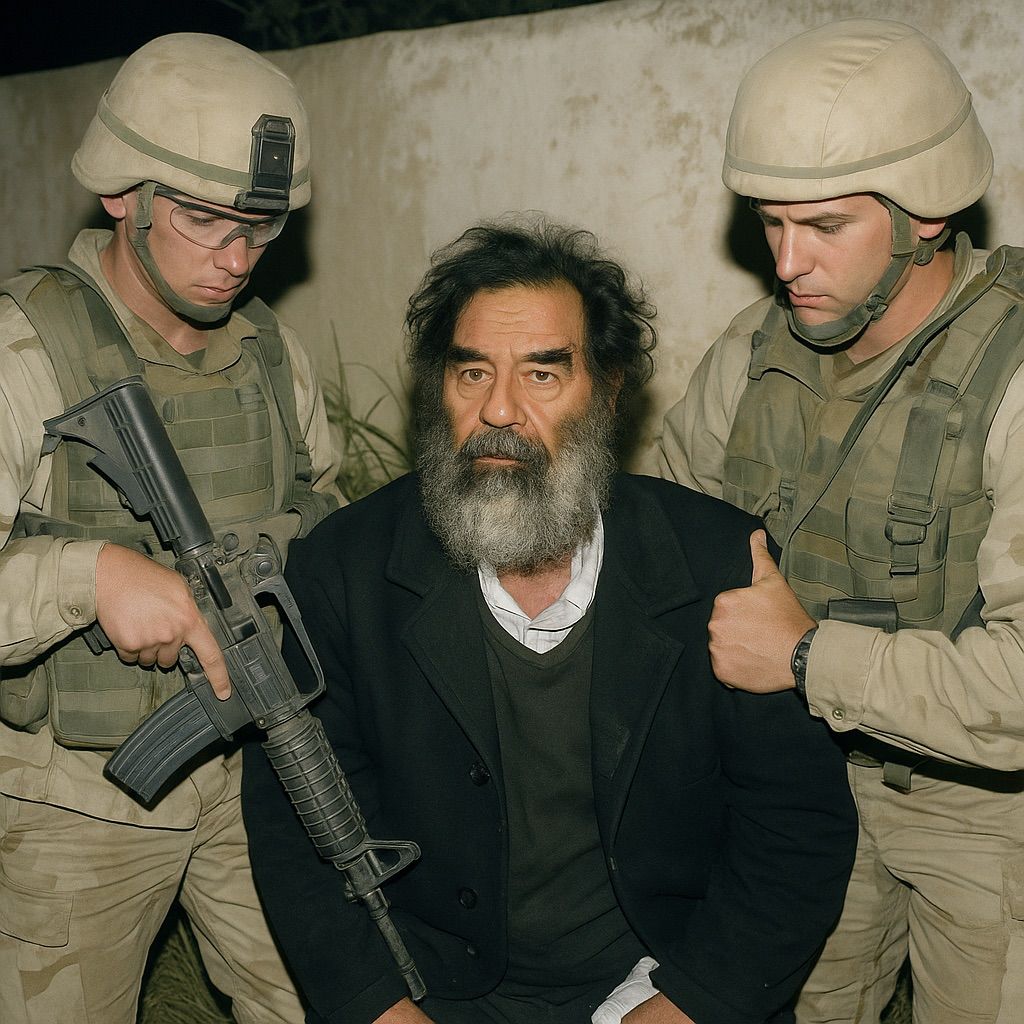
Inside that cramped space, disheveled and exhausted, was Saddam Hussein.

The moment was surreal. The man who once commanded vast armies and lived in opulent palaces was pulled from a dirt hole, clutching a pistol but offering no real resistance. He appeared frail, confused, and defeated. His beard was long and unkempt, his clothes dirty, and his expression a mixture of defiance and resignation. The myth had collapsed into a human being.

News of Saddam’s capture spread with astonishing speed. Within hours, images of the former dictator undergoing a medical examination were broadcast around the world. For many Iraqis, the images were both shocking and cathartic. Fear had shaped their lives for decades, and now the source of that fear was powerless. In cities across Iraq, spontaneous celebrations erupted. People danced in the streets, fired celebratory shots into the air, and spoke openly about atrocities they had once been too afraid to mention.

In Washington, the reaction was equally intense. President George W. Bush addressed the nation, declaring that Saddam Hussein had been captured and would face justice. For the U.S. administration, the moment represented validation of the invasion’s objectives, at least in symbolic terms. The capture was framed as a decisive blow against tyranny and a turning point in Iraq’s future.

Yet beneath the celebrations, difficult questions lingered. Capturing Saddam did not end the violence. Insurgent attacks continued, and the power vacuum left by the regime’s collapse proved far more complex than anticipated. The removal of a dictator did not automatically produce stability, and Iraq’s deep sectarian and political divisions soon came to the forefront.

Saddam’s legal fate became the next focal point. After months of deliberation, it was decided that he would be tried by an Iraqi court rather than an international tribunal. For many Iraqis, this decision carried immense symbolic weight. They wanted to see him answer to his own people, in the country he had ruled with absolute authority.

The trial began in October 2005 and quickly became one of the most closely watched legal proceedings in modern history. Saddam, defiant to the end, challenged the legitimacy of the court and attempted to dominate the proceedings. He interrupted judges, insulted prosecutors, and portrayed himself as a victim of foreign aggression. To his supporters, his defiance was proof of strength. To his victims, it was a painful reminder of his arrogance.

Prosecutors presented harrowing evidence of crimes committed during Saddam’s rule, including mass executions, torture, and ethnic cleansing. Survivors testified about loved ones who disappeared, villages that were destroyed, and lives that were permanently scarred. The trial forced Iraq to confront its past in a public and often emotionally overwhelming way.

In November 2006, Saddam Hussein was convicted of crimes against humanity and sentenced to death. The verdict was met with mixed reactions. Many Iraqis felt a sense of closure, believing justice had finally been served. Others worried that the execution would deepen divisions and fuel further violence. International observers debated whether the trial met global standards of fairness, but within Iraq, the prevailing sentiment was one of finality.

On December 30, 2006, Saddam Hussein was executed by hanging. His final moments were recorded and later leaked, sparking controversy and debate worldwide. For some, the images represented the end of a brutal chapter in history. For others, they underscored the chaos and unresolved tensions that continued to plague Iraq.

The years following Saddam’s death were marked by both hope and hardship. Iraq struggled to build democratic institutions while grappling with insurgency, sectarian violence, and foreign influence. The legacy of Saddam’s rule loomed large, shaping political decisions and public discourse long after his execution.

For the Iraqi people, the fall of Saddam Hussein was not a single moment, but a long and painful process. His capture removed the figurehead of oppression, but the scars of his regime remained etched into the nation’s collective memory. Families continued to search for missing relatives, mass graves were uncovered, and the truth of decades of abuse slowly came to light.

For American soldiers involved in the operation, Saddam’s capture was a defining moment of their service. It validated months of dangerous work and offered a rare sense of accomplishment in a conflict defined by ambiguity. Yet many returned home carrying invisible wounds, struggling to reconcile the mission’s objectives with the human cost of war.

Today, Saddam Hussein remains one of the most polarizing figures in modern Middle Eastern history. To some, he is remembered solely as a tyrant responsible for unimaginable suffering. To others, he symbolizes resistance and lost national pride. His story resists simple conclusions, reflecting the complexity of power, fear, and loyalty in a region shaped by conflict.

The capture of Saddam Hussein stands as a reminder that history is rarely neat or satisfying. It is shaped by human ambition, error, and consequence. While his arrest marked the end of one era, it also marked the beginning of another—one defined not by a single ruler, but by the ongoing struggle of a nation seeking stability, justice, and identity in the aftermath of dictatorship.

Related Posts

Francis Drake sets sail to circumnavigate the globe

Elias Rowen

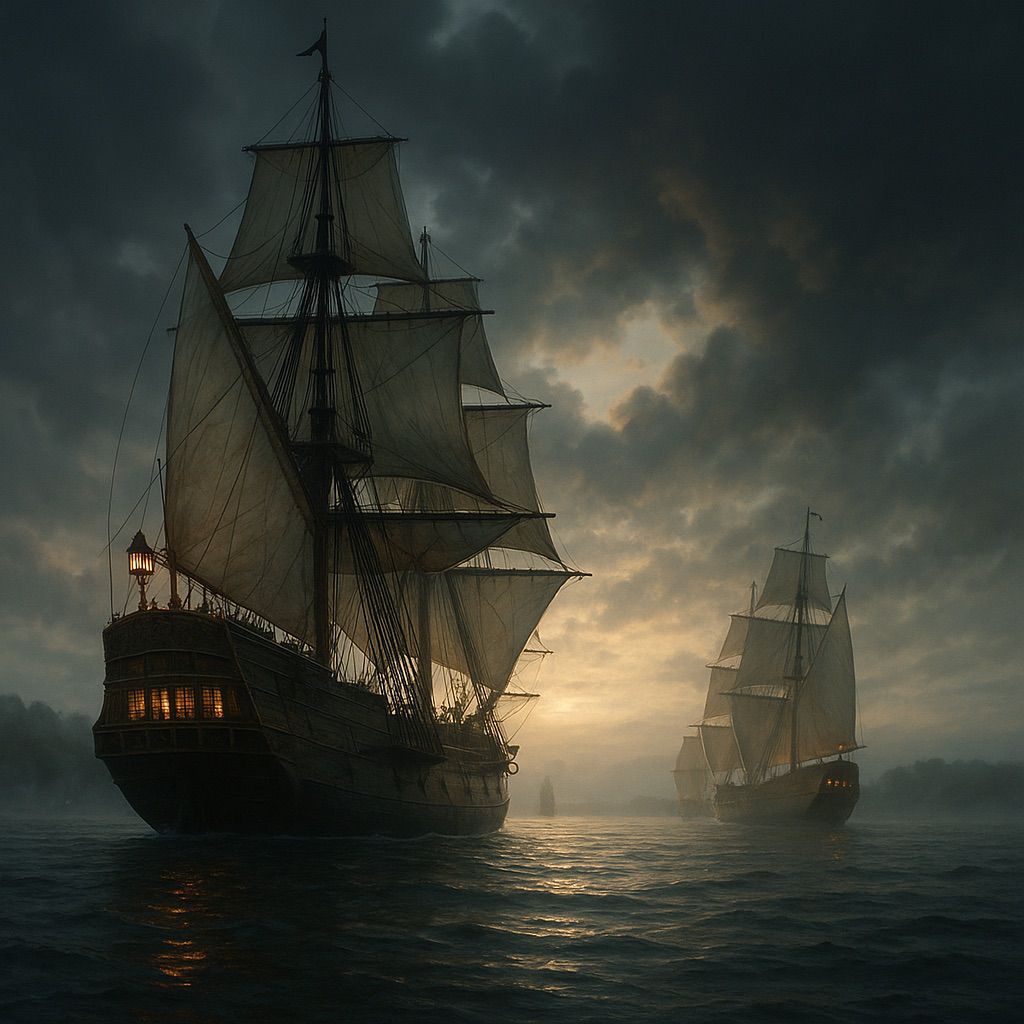
Francis Drake’s departure from Plymouth Sound on November 15, 1577, was the kind of moment that felt suspended between myth and reality. To the people who watched the sparsely lit silhouettes of three small ships push away from the English coast, the sight held more questions than answers. Few knew the mission, fewer still understood its scope, and none could imagine the way this departure would shape England’s future. Behind the secrecy, the whispers, and the brisk autumn wind was a man whose ambition and audacity were about to redirect the winds of empire.

Drake had not simply appeared on the stage of history; he had carved his way onto it. Born into modest circumstances, shaped by hardship, and thrust early into a life at sea, he had grown into a hardened mariner long before commanding his own fleet. His hatred of Spain was not political posturing but personal memory—memories filled with the crackle of burning timber and the screams of English sailors ambushed in Nombre de Dios years earlier. And Queen Elizabeth I, ever the calculating monarch, understood that Drake’s hunger for reprisal could be harnessed into something useful, something that served the crown while allowing her to maintain plausible deniability.

In the dim predawn hours of that November morning, Drake walked the deck of the Pelican, soon to be renamed the Golden Hind, feeling the familiar pitch of his ship beneath him. Around him, men hauled ropes, checked rigging, whispered superstitions, or simply stared out into the dark, wondering whether they would ever see England again. They had been assembled not just for a voyage, but for a purpose—a mission that neither parliament nor public could know about, a mission that required a certain kind of man at its helm.

Drake had spent years preparing for this. The charts, the hidden coves along the Spanish Main, the patrol routes of treasure galleons—he had studied them all. His companions included trusted mariners and questionable allies. Thomas Doughty, intelligent but dangerously ambitious; Richard Hawkins, young but eager; and Nicholas Farrington, a navigator whose steady instincts would save the fleet more than once. Together they had forged a plan to breach the Strait of Magellan, slip into waters Spain claimed as its own, and strike at the very arteries of the Spanish Empire.

The crossing of the Atlantic tested even Drake’s resolve. Weeks of storms slammed relentlessly into the fleet. Water barrels leaked. Rats found their way into provisions. Men whispered that the voyage was cursed. Yet Drake pushed on, using every scrap of knowledge gleaned from earlier expeditions. When they at last reached the coast of Brazil, battered but intact, he allowed the crew a rare respite. Fires burned along the shore as the men dried clothes stiff with salt, repaired torn sails, and exchanged cautious smiles. They were still alive, still together, still moving toward the unknown.

The real test came at the Strait of Magellan, that serpentine, treacherous passage between continents. The sky darkened with sudden storms; icy winds screamed through the narrow channels; visibility dropped to almost nothing. Men clung to ropes with frozen fingers as towering waves smashed against the hulls. More than once Drake feared the Pelican would splinter and be swallowed by the sea. But Farrington’s guidance proved invaluable—his instinct for currents and shifting winds allowed the fleet to thread through waters that had claimed countless lives before them. When they finally emerged into the Pacific, the men erupted into cheers, believing the worst behind them.

They were wrong.

The Pacific had been christened the “peaceful ocean” by explorers who had experienced it on gentler days, but Drake’s fleet encountered a world of storms. A gale scattered the ships, and one was lost entirely. Yet amid this chaos, Drake reinvented himself—not merely a survivor, but a predator. The Spanish Empire had grown complacent, believing its Pacific harbors safe from European reach. Drake shattered that illusion. He raided settlements along the Chilean and Peruvian coasts, seized treasure-laden ships, and liberated enslaved Indigenous captives. With every victory, every captured galleon, his legend grew.

Word of “El Draque” spread across Spanish territories, not merely as a name but as a living terror. He was said to appear out of nowhere, to strike with impossible precision, to vanish back into the horizon as quickly as he came. Spain’s colonial subjects learned to watch the sea not for its beauty, but for the threat it concealed.

Yet Drake’s voyage was not only destruction. He spent months repairing ships on uncharted islands, trading with Indigenous peoples, documenting coastlines unknown to Europeans, and marveling at stars unseen from England’s skies. He began keeping detailed logs that would later reshape navigation itself. In quieter moments, he walked alone along foreign beaches, letting the roar of unfamiliar surf remind him of how far from home he had drifted.

When he finally turned northward, sailing along the California coast and claiming “Nova Albion” for the English crown, he planted more than a flag—he planted the seed of an empire. He could not have known that centuries later, the very land he named would become the backbone of another nation entirely. For Drake, it was simply another strategic victory, a statement to Spain that the Pacific was no longer theirs alone.

The return across the Pacific was a feat almost beyond comprehension. No English ship had ever crossed that vast expanse. The men endured storms, starvation, and the relentless passage of months without sight of land. And yet they persevered, driven by the promise of home and by Drake’s unyielding will.

When the Golden Hind finally sailed back into Plymouth on September 26, 1580, the sight of it caused an uproar. Crowds flooded the harbor. Men shouted. Women cried. The ship was weighed down with treasure so vast it dwarfed anything England had ever seen. Drake himself stepped onto English soil not as a privateer, but as a national hero. Queen Elizabeth knighted him on the deck of his ship, cementing his place in history.

There was criticism, of course—accusations of piracy, questions of morality, disputes over Spain’s rights versus England’s ambitions. But the tide of public sentiment swept all objections aside. Drake had done something no Englishman had ever achieved, something few dared even imagine. He had circumnavigated the globe, struck a crippling blow to Spain’s dominance, and opened the door to England’s future as a world power.

His voyage was not merely an expedition. It was a turning point. It was the moment England stopped being an island nation and started becoming an empire. It was the moment the world got a glimpse of what the next centuries would bring—competition, colonization, conflict, discovery, and the relentless push of nations hungry for influence.

Drake’s legacy remains complicated, forged of both brilliance and brutality. But history rarely honors simplicity. It honors magnitude. And Drake’s voyage, begun in secrecy on a clear November morning, reshaped the world more profoundly than any of those watching from Plymouth’s shores could ever have known.

Related Posts