Latest Articles

The Hunt, Trial, and Fall of Saddam Hussein

Elias Rowen

On December 13, 2003, the long and obsessive hunt for Saddam Hussein finally came to an end in a quiet, unremarkable farmhouse on the outskirts of Tikrit, the dusty region that had once served as the heartland of his power. For nearly eight months after the fall of Baghdad, the former Iraqi dictator had vanished into the shadows, becoming a symbol of unfinished business for the United States and a lingering specter of fear and uncertainty for the Iraqi people. His capture that night was not simply the arrest of a man; it was the collapse of a myth that had dominated Iraq for more than three decades.

The search for Saddam Hussein began long before the first American tanks rolled across the Iraqi border in March 2003. For years, U.S. intelligence agencies had studied his habits, his paranoia, and his elaborate system of survival. Saddam ruled through fear and unpredictability, cultivating loyalty through patronage while ruthlessly eliminating anyone who posed even a perceived threat. He understood power as something that must be constantly defended, and that instinct guided every move he made once the invasion began.

When Baghdad fell in April 2003, many expected Saddam to be captured quickly or killed in a final act of defiance. Instead, he disappeared. His palaces stood empty, his statues were toppled, and yet the man himself seemed to melt into the Iraqi landscape. Rumors flourished. Some believed he had fled the country. Others insisted he was hiding among tribal allies, protected by loyalty and fear in equal measure. Each unconfirmed sighting kept tensions high and prevented any sense of closure.

Behind the scenes, the U.S. military and intelligence community launched one of the most intensive manhunts in modern history. Operation Red Dawn, as it would later be called, relied on painstaking intelligence work rather than brute force. Captured Ba’ath Party officials were interrogated, documents were analyzed, and financial trails were tracked. The net slowly tightened, not through dramatic raids but through incremental discoveries that revealed how Saddam survived on the run.

Saddam’s survival strategy was simple but effective. He avoided electronic communication entirely, relying instead on handwritten notes and trusted couriers. He moved constantly, sleeping in safe houses, farm buildings, and remote shelters. He grew a beard to disguise himself, abandoned his lavish lifestyle, and lived off basic food supplied by loyal supporters. Yet even in hiding, he remained convinced of his own destiny. According to later reports, Saddam believed the American occupation would collapse and that he would return to power as a symbol of Iraqi resistance.

As the months passed, the psychological impact of Saddam’s continued freedom weighed heavily on coalition forces. His absence fueled insurgent propaganda and allowed loyalists to claim he was still directing resistance efforts. Every roadside bomb and ambush carried the implicit message that Saddam’s influence had not been extinguished. Capturing him became both a strategic necessity and a symbolic imperative.

The breakthrough came not through chance, but through patient intelligence work. In late November 2003, U.S. forces discovered documents tied to Saddam’s inner circle near Tikrit. These materials pointed toward a small network of supporters who had remained fiercely loyal despite the collapse of the regime. Tikrit, Saddam’s hometown, had always been a stronghold of tribal allegiance, and it was here that investigators suspected he might seek refuge.

On December 13, a coordinated operation unfolded across the rural areas near Ad-Dawr. Soldiers from the 4th Infantry Division moved methodically through farms and compounds, guided by precise intelligence. The landscape offered countless hiding places—palm groves, irrigation ditches, and mud-brick structures that blended seamlessly into the terrain. Each site had to be cleared carefully, as resistance was always a possibility.

As night fell, one particular farmhouse drew attention. Locals had reported unusual activity, and subtle signs suggested recent occupation. U.S. troops surrounded the area, moving with deliberate caution. What they found initially seemed unremarkable, but a closer inspection revealed a concealed hiding place—a narrow underground compartment barely large enough for a single person.

Inside that cramped space, disheveled and exhausted, was Saddam Hussein.

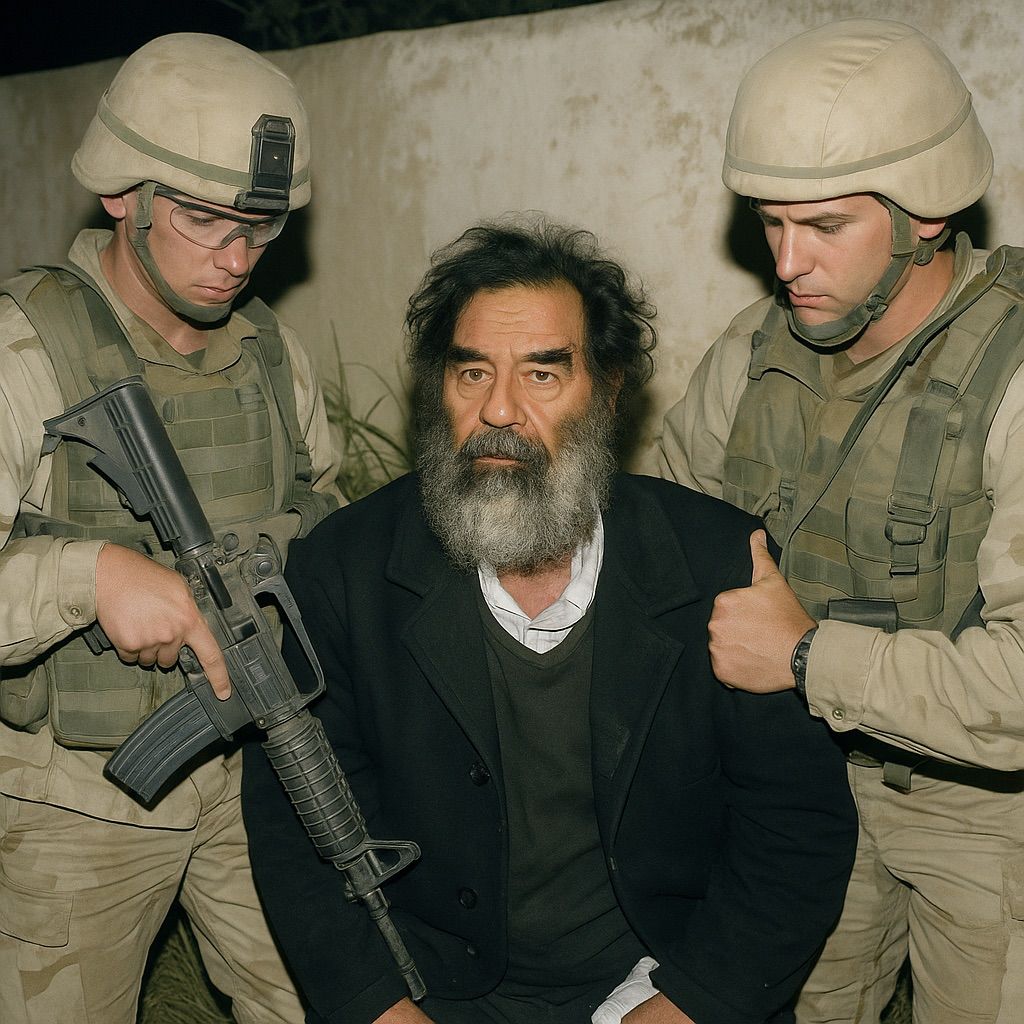
The moment was surreal. The man who once commanded vast armies and lived in opulent palaces was pulled from a dirt hole, clutching a pistol but offering no real resistance. He appeared frail, confused, and defeated. His beard was long and unkempt, his clothes dirty, and his expression a mixture of defiance and resignation. The myth had collapsed into a human being.

News of Saddam’s capture spread with astonishing speed. Within hours, images of the former dictator undergoing a medical examination were broadcast around the world. For many Iraqis, the images were both shocking and cathartic. Fear had shaped their lives for decades, and now the source of that fear was powerless. In cities across Iraq, spontaneous celebrations erupted. People danced in the streets, fired celebratory shots into the air, and spoke openly about atrocities they had once been too afraid to mention.

In Washington, the reaction was equally intense. President George W. Bush addressed the nation, declaring that Saddam Hussein had been captured and would face justice. For the U.S. administration, the moment represented validation of the invasion’s objectives, at least in symbolic terms. The capture was framed as a decisive blow against tyranny and a turning point in Iraq’s future.

Yet beneath the celebrations, difficult questions lingered. Capturing Saddam did not end the violence. Insurgent attacks continued, and the power vacuum left by the regime’s collapse proved far more complex than anticipated. The removal of a dictator did not automatically produce stability, and Iraq’s deep sectarian and political divisions soon came to the forefront.

Saddam’s legal fate became the next focal point. After months of deliberation, it was decided that he would be tried by an Iraqi court rather than an international tribunal. For many Iraqis, this decision carried immense symbolic weight. They wanted to see him answer to his own people, in the country he had ruled with absolute authority.

The trial began in October 2005 and quickly became one of the most closely watched legal proceedings in modern history. Saddam, defiant to the end, challenged the legitimacy of the court and attempted to dominate the proceedings. He interrupted judges, insulted prosecutors, and portrayed himself as a victim of foreign aggression. To his supporters, his defiance was proof of strength. To his victims, it was a painful reminder of his arrogance.

Prosecutors presented harrowing evidence of crimes committed during Saddam’s rule, including mass executions, torture, and ethnic cleansing. Survivors testified about loved ones who disappeared, villages that were destroyed, and lives that were permanently scarred. The trial forced Iraq to confront its past in a public and often emotionally overwhelming way.

In November 2006, Saddam Hussein was convicted of crimes against humanity and sentenced to death. The verdict was met with mixed reactions. Many Iraqis felt a sense of closure, believing justice had finally been served. Others worried that the execution would deepen divisions and fuel further violence. International observers debated whether the trial met global standards of fairness, but within Iraq, the prevailing sentiment was one of finality.

On December 30, 2006, Saddam Hussein was executed by hanging. His final moments were recorded and later leaked, sparking controversy and debate worldwide. For some, the images represented the end of a brutal chapter in history. For others, they underscored the chaos and unresolved tensions that continued to plague Iraq.

The years following Saddam’s death were marked by both hope and hardship. Iraq struggled to build democratic institutions while grappling with insurgency, sectarian violence, and foreign influence. The legacy of Saddam’s rule loomed large, shaping political decisions and public discourse long after his execution.

For the Iraqi people, the fall of Saddam Hussein was not a single moment, but a long and painful process. His capture removed the figurehead of oppression, but the scars of his regime remained etched into the nation’s collective memory. Families continued to search for missing relatives, mass graves were uncovered, and the truth of decades of abuse slowly came to light.

For American soldiers involved in the operation, Saddam’s capture was a defining moment of their service. It validated months of dangerous work and offered a rare sense of accomplishment in a conflict defined by ambiguity. Yet many returned home carrying invisible wounds, struggling to reconcile the mission’s objectives with the human cost of war.

Today, Saddam Hussein remains one of the most polarizing figures in modern Middle Eastern history. To some, he is remembered solely as a tyrant responsible for unimaginable suffering. To others, he symbolizes resistance and lost national pride. His story resists simple conclusions, reflecting the complexity of power, fear, and loyalty in a region shaped by conflict.

The capture of Saddam Hussein stands as a reminder that history is rarely neat or satisfying. It is shaped by human ambition, error, and consequence. While his arrest marked the end of one era, it also marked the beginning of another—one defined not by a single ruler, but by the ongoing struggle of a nation seeking stability, justice, and identity in the aftermath of dictatorship.

Related Posts

Francis Drake sets sail to circumnavigate the globe

Elias Rowen

Francis Drake’s departure from Plymouth Sound on November 15, 1577, was the kind of moment that felt suspended between myth and reality. To the people who watched the sparsely lit silhouettes of three small ships push away from the English coast, the sight held more questions than answers. Few knew the mission, fewer still understood its scope, and none could imagine the way this departure would shape England’s future. Behind the secrecy, the whispers, and the brisk autumn wind was a man whose ambition and audacity were about to redirect the winds of empire.

Drake had not simply appeared on the stage of history; he had carved his way onto it. Born into modest circumstances, shaped by hardship, and thrust early into a life at sea, he had grown into a hardened mariner long before commanding his own fleet. His hatred of Spain was not political posturing but personal memory—memories filled with the crackle of burning timber and the screams of English sailors ambushed in Nombre de Dios years earlier. And Queen Elizabeth I, ever the calculating monarch, understood that Drake’s hunger for reprisal could be harnessed into something useful, something that served the crown while allowing her to maintain plausible deniability.

In the dim predawn hours of that November morning, Drake walked the deck of the Pelican, soon to be renamed the Golden Hind, feeling the familiar pitch of his ship beneath him. Around him, men hauled ropes, checked rigging, whispered superstitions, or simply stared out into the dark, wondering whether they would ever see England again. They had been assembled not just for a voyage, but for a purpose—a mission that neither parliament nor public could know about, a mission that required a certain kind of man at its helm.

Drake had spent years preparing for this. The charts, the hidden coves along the Spanish Main, the patrol routes of treasure galleons—he had studied them all. His companions included trusted mariners and questionable allies. Thomas Doughty, intelligent but dangerously ambitious; Richard Hawkins, young but eager; and Nicholas Farrington, a navigator whose steady instincts would save the fleet more than once. Together they had forged a plan to breach the Strait of Magellan, slip into waters Spain claimed as its own, and strike at the very arteries of the Spanish Empire.

The crossing of the Atlantic tested even Drake’s resolve. Weeks of storms slammed relentlessly into the fleet. Water barrels leaked. Rats found their way into provisions. Men whispered that the voyage was cursed. Yet Drake pushed on, using every scrap of knowledge gleaned from earlier expeditions. When they at last reached the coast of Brazil, battered but intact, he allowed the crew a rare respite. Fires burned along the shore as the men dried clothes stiff with salt, repaired torn sails, and exchanged cautious smiles. They were still alive, still together, still moving toward the unknown.

The real test came at the Strait of Magellan, that serpentine, treacherous passage between continents. The sky darkened with sudden storms; icy winds screamed through the narrow channels; visibility dropped to almost nothing. Men clung to ropes with frozen fingers as towering waves smashed against the hulls. More than once Drake feared the Pelican would splinter and be swallowed by the sea. But Farrington’s guidance proved invaluable—his instinct for currents and shifting winds allowed the fleet to thread through waters that had claimed countless lives before them. When they finally emerged into the Pacific, the men erupted into cheers, believing the worst behind them.

They were wrong.

The Pacific had been christened the “peaceful ocean” by explorers who had experienced it on gentler days, but Drake’s fleet encountered a world of storms. A gale scattered the ships, and one was lost entirely. Yet amid this chaos, Drake reinvented himself—not merely a survivor, but a predator. The Spanish Empire had grown complacent, believing its Pacific harbors safe from European reach. Drake shattered that illusion. He raided settlements along the Chilean and Peruvian coasts, seized treasure-laden ships, and liberated enslaved Indigenous captives. With every victory, every captured galleon, his legend grew.

Word of “El Draque” spread across Spanish territories, not merely as a name but as a living terror. He was said to appear out of nowhere, to strike with impossible precision, to vanish back into the horizon as quickly as he came. Spain’s colonial subjects learned to watch the sea not for its beauty, but for the threat it concealed.

Yet Drake’s voyage was not only destruction. He spent months repairing ships on uncharted islands, trading with Indigenous peoples, documenting coastlines unknown to Europeans, and marveling at stars unseen from England’s skies. He began keeping detailed logs that would later reshape navigation itself. In quieter moments, he walked alone along foreign beaches, letting the roar of unfamiliar surf remind him of how far from home he had drifted.

When he finally turned northward, sailing along the California coast and claiming “Nova Albion” for the English crown, he planted more than a flag—he planted the seed of an empire. He could not have known that centuries later, the very land he named would become the backbone of another nation entirely. For Drake, it was simply another strategic victory, a statement to Spain that the Pacific was no longer theirs alone.

The return across the Pacific was a feat almost beyond comprehension. No English ship had ever crossed that vast expanse. The men endured storms, starvation, and the relentless passage of months without sight of land. And yet they persevered, driven by the promise of home and by Drake’s unyielding will.

When the Golden Hind finally sailed back into Plymouth on September 26, 1580, the sight of it caused an uproar. Crowds flooded the harbor. Men shouted. Women cried. The ship was weighed down with treasure so vast it dwarfed anything England had ever seen. Drake himself stepped onto English soil not as a privateer, but as a national hero. Queen Elizabeth knighted him on the deck of his ship, cementing his place in history.

There was criticism, of course—accusations of piracy, questions of morality, disputes over Spain’s rights versus England’s ambitions. But the tide of public sentiment swept all objections aside. Drake had done something no Englishman had ever achieved, something few dared even imagine. He had circumnavigated the globe, struck a crippling blow to Spain’s dominance, and opened the door to England’s future as a world power.

His voyage was not merely an expedition. It was a turning point. It was the moment England stopped being an island nation and started becoming an empire. It was the moment the world got a glimpse of what the next centuries would bring—competition, colonization, conflict, discovery, and the relentless push of nations hungry for influence.

Drake’s legacy remains complicated, forged of both brilliance and brutality. But history rarely honors simplicity. It honors magnitude. And Drake’s voyage, begun in secrecy on a clear November morning, reshaped the world more profoundly than any of those watching from Plymouth’s shores could ever have known.

Related Posts

The Tragedy and Terror of the Nanjing Massacre

Elias Rowen

The city of Nanjing moved like a living organism on the morning of December 13, 1937—a place where street vendors shouted over one another, students hurried to classes, and families prepared meals as though the world outside the city walls was not collapsing. But beneath this surface of everyday life, anxiety churned. For weeks, news had trickled in of the Imperial Japanese Army moving closer, cutting through Chinese resistance with terrifying efficiency. Rumors of brutality accompanied every report—stories dismissed by many as exaggerations, because the alternative was too horrifying to accept.

When Japanese forces finally breached the city walls, the truth proved far worse than rumor.

Chinese Nationalist forces, exhausted and outnumbered, had fought furiously to hold back the Japanese advance. General Xue Yue had fortified the city as best he could, but Nanjing was simply not prepared to withstand the might of an army fueled by imperial ambition and conditioned for total war. Once the defenses collapsed, Japanese troops poured into the city in a flood of steel and fury. What followed would become one of the darkest chapters in human history.

The initial hours of chaos gave way to something far more organized and sinister. Soldiers began scouring the streets, dragging civilians from their homes and businesses. One street might erupt in gunfire; another might echo with screams; another might be eerily silent except for the sound of boots and bayonets tapping against concrete. Families huddled in fear, hoping their doors would not be the next ones kicked open.

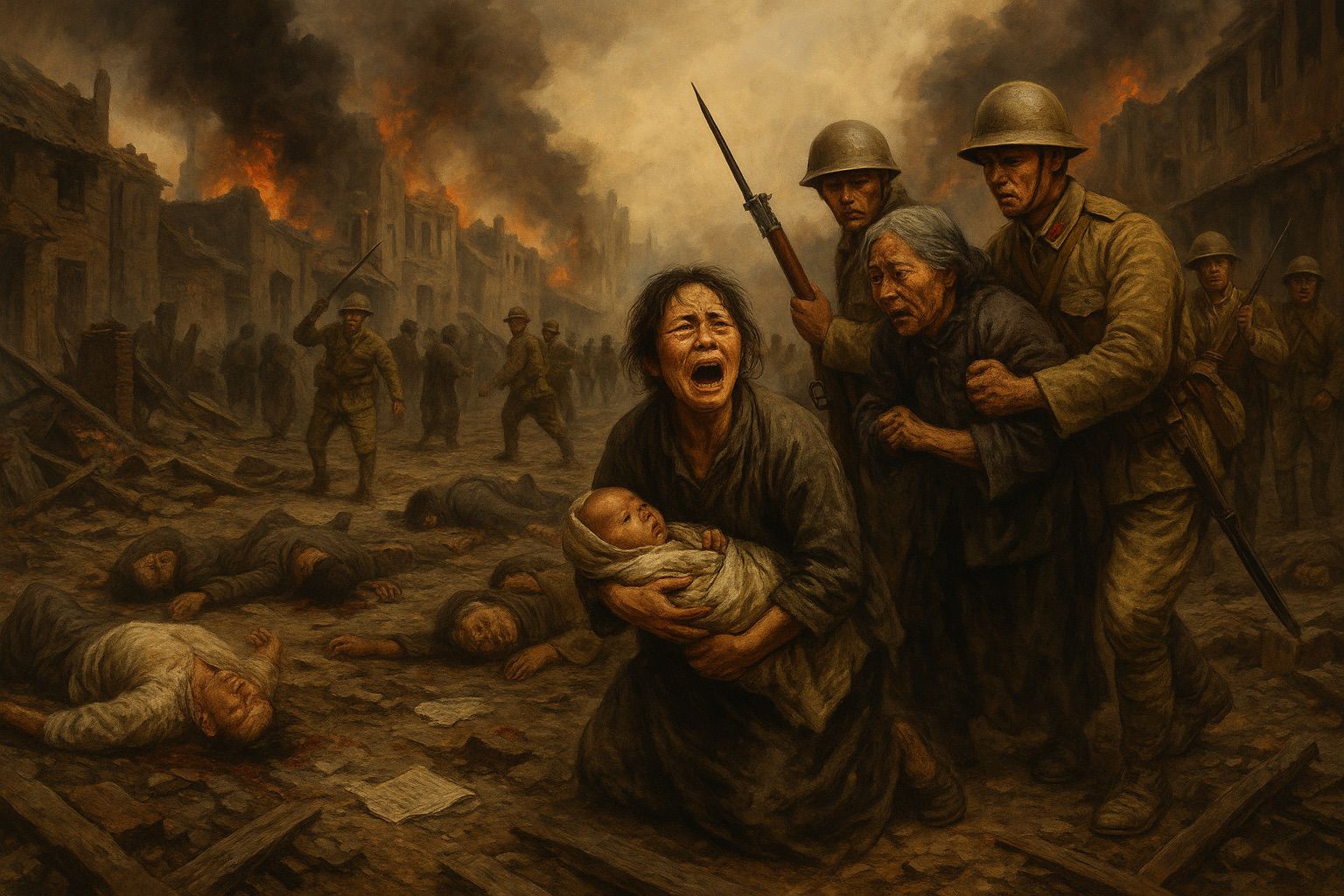
The violence escalated with shocking speed. Japanese soldiers, acting not as individuals but as a collective instrument of terror, unleashed a campaign of systematic brutality. Women—some as young as eight, others well into their seventies—were raped in staggering numbers. Men suspected of being former soldiers or resisters were rounded up and marched to the edges of the city, where they were gunned down en masse or used for bayonet practice. Prisoners of war were stripped of their uniforms, marched into open fields, and slaughtered without mercy.

Eyewitnesses, including missionaries and foreign officials, kept diaries describing scenes that defy comprehension. Bodies piled along the riverbank. Infants tossed into the air and caught on bayonets. Soldiers laughing as they set fire to homes with families still inside. It was not chaos—it was cruelty refined into ritual.

Panic spread like wildfire. Thousands of civilians attempted to flee, but with Japanese troops encircling the city, escape became nearly impossible. Those who remained sought shelter anywhere they could—in churches, in abandoned buildings, or in designated “safety zones” set up by a handful of brave foreigners, including German businessman John Rabe and American surgeon Robert Wilson. These individuals risked their lives daily, negotiating with Japanese officers to protect the civilians under their care. Without their intervention, the death toll might have been even more unimaginable.

As December wore on, the violence did not abate. Homes were ransacked. Shops were looted. Entire neighborhoods were reduced to rubble. Civilians were forced into makeshift labor camps where starvation, disease, and abuse became routine. Japanese soldiers operated with near-total freedom, as if they had been instructed that everything within the city—lives, bodies, property—was theirs to take.

Reports and documentation later revealed that this was not merely a breakdown of military discipline. Many Japanese officers condoned, encouraged, or directly participated in the violence. Some soldiers kept scorecards of how many civilians they had killed. Others took photographs, which would later serve as grim evidence of the horrors inflicted.

By the end of the massacre, estimates suggest that between 150,000 and 300,000 people were dead—some historians argue even higher. The exact number is impossible to determine; the destruction was too total, the records too incomplete. But numbers alone cannot capture the scope of suffering endured by the people of Nanjing.

International reaction, when it finally came, was slow and hesitant. Reports from survivors and foreign observers did reach the outside world, but political calculations often outweighed moral outrage. Japan was an important geopolitical power, and many governments were reluctant to condemn it publicly. Some newspapers downplayed the reports; others ignored them altogether. The silence became a second betrayal.

In the aftermath of the massacre, survivors carried scars that would never fully heal. Entire families had been wiped out. Children were left orphaned. Women bore trauma that would shape the rest of their lives. The cultural, emotional, and psychological wounds endured by the people of Nanjing did not fade even after Japan’s surrender in 1945.

Justice, too, proved elusive. Though some Japanese commanders were eventually tried for war crimes, many escaped accountability entirely. Japan itself struggled—and still struggles—to fully acknowledge the extent of the massacre, creating decades of tension between China and Japan. For the victims and their descendants, the fight for recognition became a continuation of their suffering.

Yet amid the darkness, the story of Nanjing also contains moments of profound human courage. Foreign nationals who could have fled chose to stay, risking their lives to shield strangers. Some Japanese soldiers defied orders to protect civilians. Survivors helped one another, shared food, and sheltered orphans despite their own grief and fear.

History teaches us that human beings are capable of astonishing cruelty—but also astonishing resilience.

The Nanjing Massacre remains a stark reminder of what happens when hatred is weaponized, when militarism goes unchecked, and when one nation believes its people are entitled to dominate another. It stands as a warning that wartime atrocities do not occur in a vacuum; they are allowed to happen when the world turns its gaze away.

To remember Nanjing is not merely to recount a tragedy. It is to recommit ourselves to the principles of humanity, dignity, and justice. It is to listen to the voices of those who suffered and ensure their stories are not forgotten. It is to acknowledge that peace is fragile—and must be protected with vigilance.

Decades later, the survivors of Nanjing are fewer each year. But their memories endure, passed from generation to generation as both a lament and a lesson. The massacre is not just a chapter in Chinese history—it is a chapter in human history, a testament to the depths to which humanity can sink, and a call to rise above it.

Related Posts

The Day Democracy Paused: Bush v. Gore and the Most Controversial Election in Modern U.S. History

Elias Rowen

The 2000 United States presidential election remains one of the most polarizing political events in modern American history, a moment when the nation found itself suspended in uncertainty, divided not only by ideology but by the mechanics of democracy itself. For many Americans, the night of November 7 began like any other presidential election night: a flurry of electoral maps, pundit predictions, and partisan hopefulness. Yet as the hours wore on, what initially seemed like a tight but ordinary race between Vice President Al Gore and Texas Governor George W. Bush began twisting into something far more complex, a legal and political storm centered around one unexpected battlefield—the State of Florida.

Florida’s election results were razor-thin, decided by mere hundreds of votes out of more than six million cast. At the stroke of midnight, news networks retracted earlier projections, tempers flared, and election officials braced themselves for a process they had never imagined would be thrust upon them. Hanging chads, butterfly ballots, and punch-card irregularities suddenly became part of the national vocabulary. Every vote mattered—but only if it could be properly counted.

As recounts began, confusion reigned in county offices where exhausted workers scrutinized ballots by hand, holding flimsy punch cards up to the light like archaeologists examining ancient inscriptions. What had started as a simple procedural recount soon devolved into a legal war of attrition, as each campaign tried to seize control of the narrative. The Gore campaign insisted that every voter deserved to have their intention accurately recorded, while the Bush team argued that the continuing recounts threatened chaos and undermined the fairness of the electoral process.

On December 8, 2000, the Florida Supreme Court ordered a statewide manual recount of undervotes—ballots where no presidential choice had been detected by machines. To Gore supporters, this ruling offered the possibility of a narrow but legitimate path to victory. To Bush supporters, it represented what they viewed as judicial activism motivated by partisan loyalty. And to the nation, watching anxiously, it added yet another twist in a saga that seemed increasingly surreal.

Just days later, the U.S. Supreme Court agreed to hear Bush v. Gore—a sign that the conflict had escalated beyond Florida into a constitutional crisis of national consequence. In a country where courts traditionally avoided entangling themselves in political disputes, the fact that the Supreme Court had intervened stunned both legal scholars and ordinary citizens. The stakes were immense: the presidency itself hung in the balance.

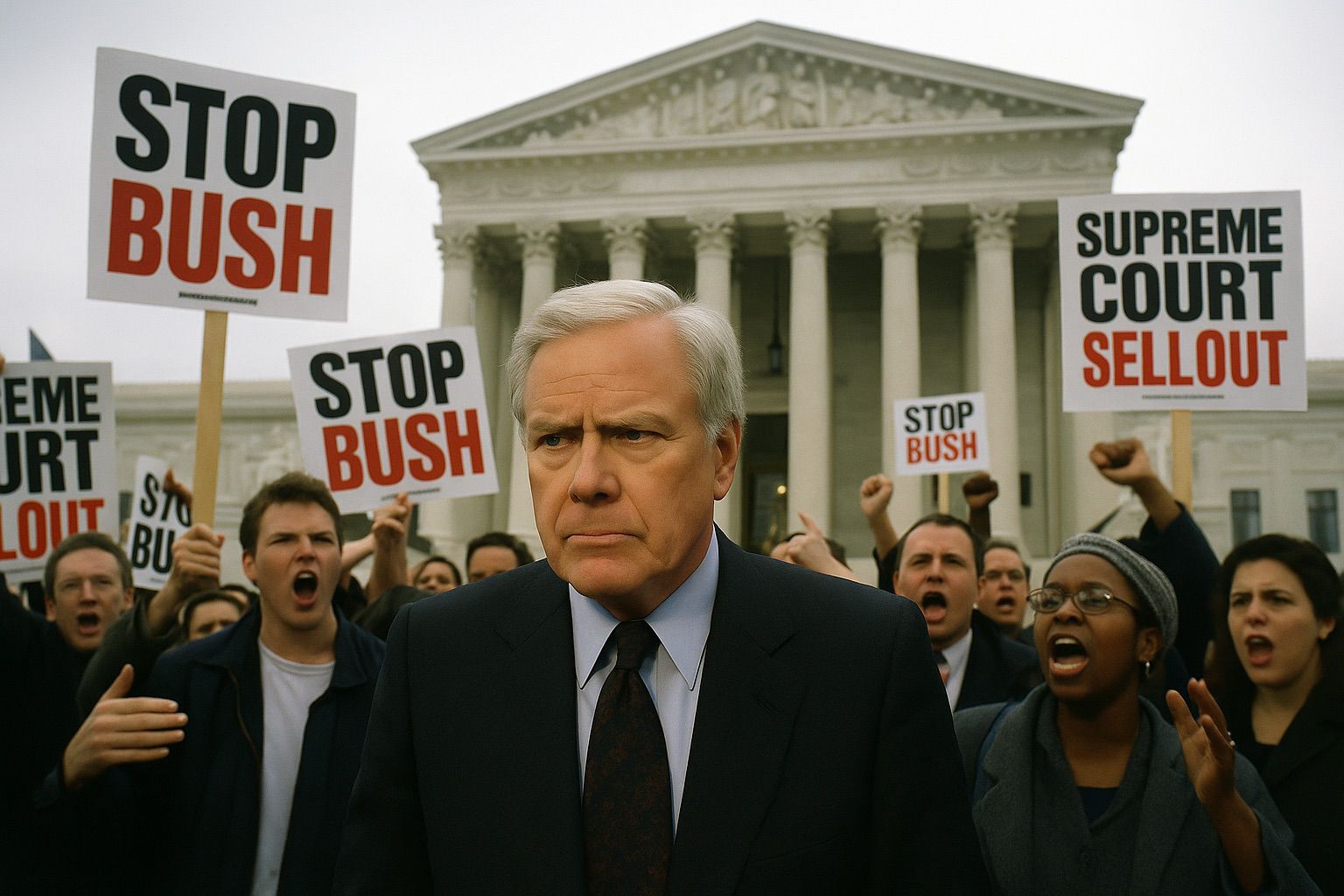
Oral arguments took place on December 11, setting the stage for what would become one of the most scrutinized judicial decisions in American history. Inside the marble chambers of the Court, attorneys battled over questions of equal protection, state authority, and whether time had simply run out for a fair recount. Outside, protesters from both parties gathered, waving signs and chanting, their faces lit by camera crews who broadcast every moment.

On December 12, at approximately 10 p.m., the Court issued its ruling. In a 5–4 decision split along ideological lines, the justices halted the Florida recount, determining that varying standards across counties violated the Equal Protection Clause. With no constitutional way to continue the recount before the deadline, George W. Bush effectively became the next President of the United States. Gore conceded the following day, his voice somber yet resolute, emphasizing unity even as millions of Americans felt lingering frustration and disbelief.

For many people, the decision left deep emotional scars. Some saw it as a necessary intervention to preserve electoral order; others believed it was a judicial coup that disrupted the democratic will of the people. Scholars dissected the decision for years, debating whether it had been motivated by legal principle or political preference. What became clear, however, was that public trust in institutions—especially the Supreme Court—had been shaken.

In the months that followed, recounts conducted by newspapers and academic institutions found that the results remained excruciatingly close, with hypothetical outcomes varying depending on the standards used. Yet regardless of these findings, the nation had already moved on, propelled forward by the inauguration of Bush and the beginning of a new political era.

In the shadow of Bush v. Gore, America began reconsidering its electoral processes. Calls for election reform grew louder. New voting technologies were implemented, though not without their own controversies. Voter access, ballot design, recount standards, and election integrity became central political themes for decades to come. Even today, echoes of the 2000 election reverberate through debates about democracy, voting rights, and the responsibilities of the judicial branch.

The 2000 election exposed both the fragility and resilience of American democracy. It showed how a nation of millions could be brought to a standstill by a few hundred votes, and how the machinery of government could withstand enormous pressure while still revealing its flaws. It demonstrated that democracy is not merely a system of rules and procedures, but a living institution that depends on the faith of its citizens.

For those who lived through it, Bush v. Gore remains unforgettable—an election night that lasted for 36 days, a courtroom drama broadcast nationwide, and a reminder that the most powerful democracy in the world is not immune to uncertainty. The legacy of 2000 endures, shaping how Americans view elections, courts, politics, and the delicate balance between law and legitimacy. It is a story not only about ballots and legal briefs, but about the enduring struggle to ensure that every voice matters, even when the path forward is shrouded in doubt.

Related Posts

When the Winds of Freedom Rose: Kenya’s Long Road to Independence

Elias Rowen

Kenya’s struggle for independence was not a moment, nor a single uprising, nor a simple negotiation across a polished British table. It was a decades-long awakening—messy, painful, courageous, and breathtaking in its persistence. By the mid-20th century, the winds of change sweeping across Africa were gathering force, and few places felt that gale more intensely than Kenya. For nearly a century, the British Empire ruled the territory with a grip that grew increasingly strained as Kenyans began to articulate a new, unshakable sentiment: their destiny must belong to them.

In the early 1900s, the British attempted to give the appearance of local participation through the creation of the Legislative Council—a body that, in theory, included African representation. But in practice, it became immediately clear that this was more ceremonial than meaningful. African members had no real authority, no legislative leverage, and no capacity to challenge policies crafted entirely around the interests of the colonial administration and European settlers. Yet even in this carefully controlled chamber, the seeds of political consciousness took root.

The first sparks of organized nationalism appeared in 1921 with the formation of the Young Kikuyu Association. Initiated in Nairobi, the group sought to confront land dispossession, labor inequalities, and the systematic marginalization of Africans. Figures like Harry Thuku stood at the helm of early agitation—young, bold, and unafraid to confront a colonial system that dismissed African grievances as inconvenient noise beneath imperial machinery. Their activism marked the beginning of a political awakening that would intensify with every passing decade.

By 1944, Kenya’s nationalist movement had gained both momentum and vision. That year saw the birth of the Kenya African Union (KAU), and with it the emergence of a leader who would become synonymous with the struggle: Jomo Kenyatta. Articulate, strategic, and deeply committed to reclaiming Kenya’s dignity, Kenyatta transformed the nationalist conversation from reformist appeals into an unmistakable call for full independence. KAU demanded expanded rights, land restitution, and a political system not merely adjusted for Africans—but led by them.

Global winds were shifting as well. After World War II, the British Empire—exhausted financially and burdened by mounting anti-colonial sentiment—faced pressure to loosen its imperial hold. Across Africa and Asia, nationalists were rejecting paternalistic models of governance and asserting their right to self-determination. Kenya, however, remained one of Britain’s most tightly held territories, both agriculturally rich and strategically significant. This made London hesitant, even defensive, in the face of growing demands.

Tensions reached a boiling point in 1952, when a militant movement known as Mau Mau launched an armed resistance largely based in the central highlands. Led symbolically by Field Marshal Dedan Kimathi, the Mau Mau rebellion represented not only political frustration but deep anger over decades of land theft and injustice. The colonial government responded with ferocity: mass detentions, torture, executions, and the establishment of detention camps that would later be compared to concentration camps. Thousands of Kenyans were imprisoned; thousands more were killed.

Yet instead of crushing the struggle, British brutality only highlighted the moral bankruptcy of colonial rule. International observers began questioning Britain’s conduct, while within Kenya, sympathy for nationalist leaders intensified. When Jomo Kenyatta was arrested in 1952 on fabricated charges linking him to Mau Mau leadership, he became a martyr in the eyes of many—proof that Britain would dismantle anyone who demanded freedom.

By the late 1950s, the tide had turned. The cost of suppressing Kenya was rising, international pressure was mounting, and the Kenyan population was increasingly united. In 1960, the British government began drafting a new constitution intended to expand African political participation. It was not enough. Kenyans wanted sovereignty, not constitutional tinkering.

In 1962, the first major elections under the new constitution took place, and Kenyatta’s party, the Kenya African National Union (KANU), emerged victorious. With negotiations accelerating in London and local support swelling at home, the British finally conceded what had become inevitable.

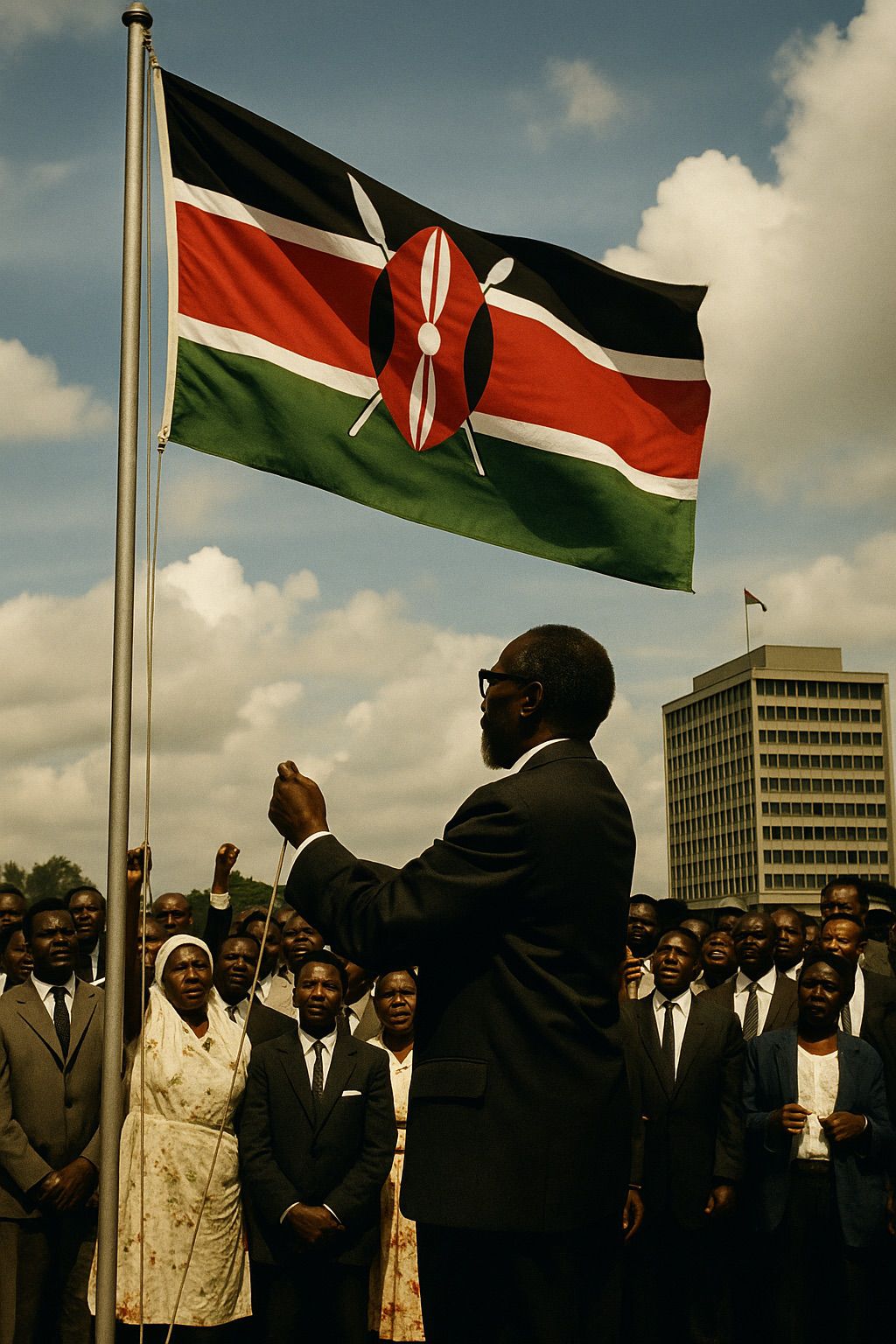
On December 12, 1963, Kenya became an independent nation. Jomo Kenyatta—once imprisoned, once dismissed—raised the new flag as the nation’s first Prime Minister. Crowds filled stadiums, streets, and villages, celebrating the dawn of a country that had been imagined, fought for, and bled for.

But independence did not mean instant transformation. The young nation inherited economic disparities, land inequities, and the lingering shadow of British hierarchy. Yet Kenyatta’s government made meaningful strides: investing in schools, expanding healthcare access, stabilizing the economy, and beginning land resettlement programs that, while imperfect, represented a long-sought return of dignity to displaced communities.

Women, long underestimated in historical narratives, played a critical role in post-independence progress—organizing grassroots movements, mobilizing rural communities, and later entering political and professional leadership roles. Their contributions reflected a broader truth: Kenya’s liberation was never the story of a few great men, but a nation of ordinary people refusing to bow to injustice.

Kenyatta’s death in 1978 and the subsequent rise of Daniel arap Moi began a new, complicated chapter in Kenyan governance. Yet even through authoritarianism, economic struggles, and political turbulence, the spirit ignited during the independence movement remained alive. Kenya continued to evolve, and by the 21st century, it stood as one of Africa’s most influential economies.

Today, Kenya faces new challenges—corruption, inequality, climate stress—but its resilience is rooted in a history of collective courage. Independence was not a gift from Britain; it was the culmination of decades of organization, sacrifice, rebellion, diplomacy, and unbreakable faith in the possibility of freedom.

Kenya’s story is a reminder of what can happen when ordinary people refuse to accept the limits imposed on them. It is a testament to a nation that rose from colonial subjugation to sovereignty—and continues to shape its own future with the same determination that carried it to independence.

As Jomo Kenyatta once said, with the clarity of a man who had walked through fire:

“Our children may learn about the heroes of the past. Our task is to make ourselves the architects of the future.”

Related Posts