Latest Articles

Marconi receives first transatlantic radio signal

Elias Rowen

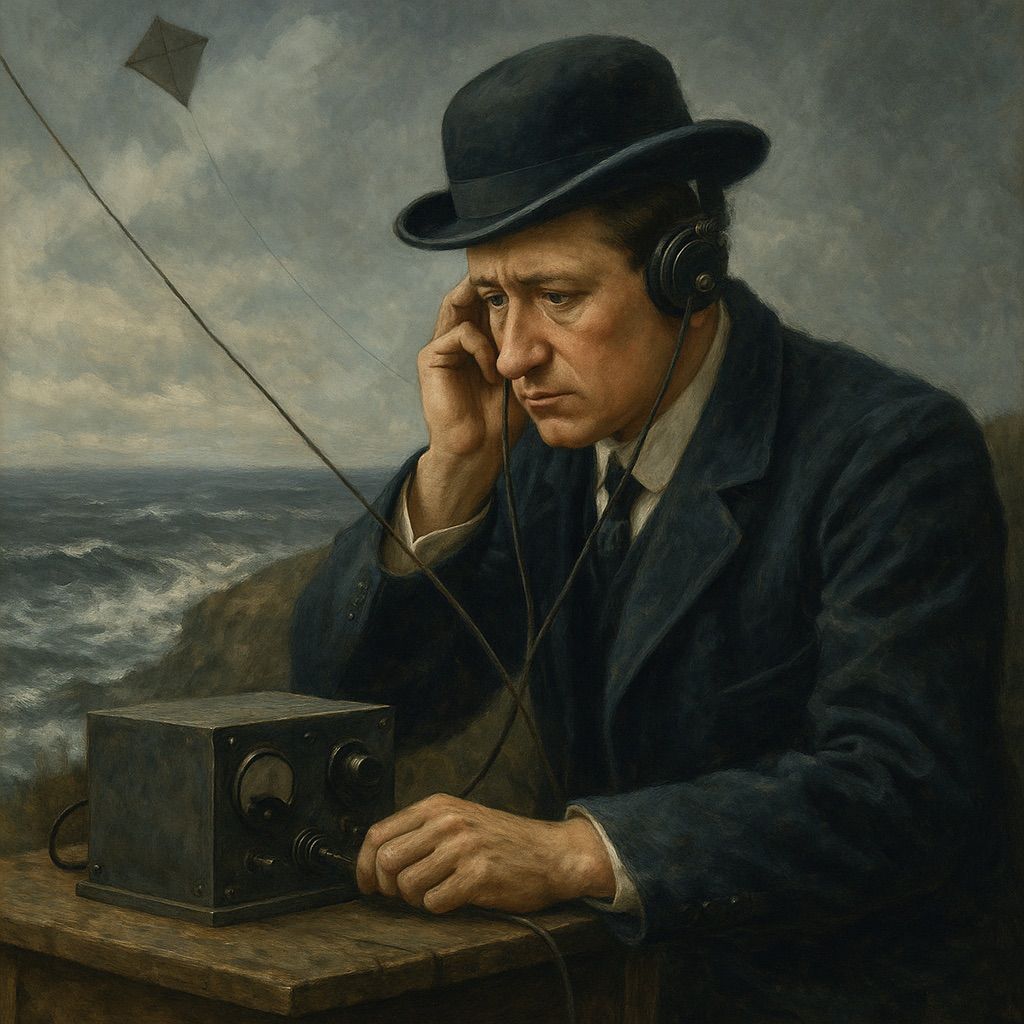
On December 12, 1901, Guglielmo Marconi stood on the wind-scoured cliffs of Cape Cod with the Atlantic stretching before him like a vast, silent barrier. For centuries, that ocean had symbolized distance—geographical, political, psychological. It separated continents, cultures, and empires. Messages took days or weeks to cross it, carried by ship through unpredictable seas. But Marconi believed he could make the ocean do something no one had ever thought possible: carry a whisper of electricity from one side to the other, a whisper that spelled out the letter S in Morse code, repeated again and again, faint but unmistakably human. That whisper would change the world.

Marconi’s journey to this moment started decades earlier in Bologna, where he was a restless child more interested in wires and batteries than schoolwork. He would spend hours experimenting in his attic, tapping keys, stretching wires across rooms, sending crude signals from one floor of his home to the next. His teachers called his ideas fanciful. His neighbors called them impossible. But young Marconi cared only about questions, especially the one that consumed him: Could invisible waves carry messages through the air, farther and farther, someday even beyond the horizon?

At the University of Bologna, Marconi immersed himself in the groundbreaking theories of James Clerk Maxwell and the experiments of Heinrich Hertz. Maxwell had predicted the existence of electromagnetic waves; Hertz confirmed them. But neither man believed those waves could be harnessed for long-distance communication. Hertz famously claimed his discovery was “of no practical use whatsoever.” Marconi disagreed. He saw not limits—but opportunity.

By the time he reached his early twenties, Marconi had refined his first working wireless transmitter. It could send signals across a garden, then across a field, and eventually over several miles. This might seem insignificant today, but at the time, miles were revolutionary. The world took notice. Governments, navies, and scientific societies leaned in with sudden interest. The first wireless company was formed. Stations began appearing across Europe. Ships at sea began to carry Marconi devices. The dream of wireless communication was no longer science fiction—it was becoming a business, a tool, a necessity.

But Marconi wanted more. He wanted the Atlantic.

Every expert told him it was impossible. Radio waves, they insisted, travel only in straight lines. The Earth curves. The ocean would swallow the signal. Distance, weather, sunspots, atmospheric noise—every factor seemed designed to thwart his ambition. But Marconi believed the atmosphere itself could carry signals farther than anyone imagined. He believed that if he could build a powerful enough transmitter and pair it with an antenna tall enough to lasso the sky, the waves would travel beyond the horizon, bouncing along the ionosphere like a skipping stone.

So he built. And built big.

By 1901, he had constructed two massive stations: one in Poldhu, Cornwall, for transmitting, and one in Cape Cod for receiving. They were not simple outposts but technological cathedrals—great wooden towers draped with copper wire, humming with generators, pulsing with energy. Engineers worked through storms, failures, and electrical fires. The towers collapsed twice. Workers rebuilt them. Money ran thin. Marconi pressed on.

Then came December 12.

The winds on Cape Cod battered the receiving station, icy and relentless. Marconi and his assistant set up a simple receiver connected to a wire antenna raised by a kite—one of the many improvisations required in a place where the weather seemed determined to make history as inconvenient as possible. At 8:20 p.m., through the static and wind, a faint, rhythmic pattern emerged. Three short clicks. The letter S. Again. And again.

Marconi froze. He listened. His assistant leaned in, wide-eyed. The signal was delicate but undeniable. Against the predictions of scientists, against the limits of technology, against the very curvature of the Earth, a message sent from England had crossed 2,100 miles of open ocean and arrived on American shores in a whisper of electromagnetic waves.

For the first time in human history, the Atlantic Ocean had been conquered not by ships, but by light.

Word spread across the world almost immediately. Newspapers hailed it as an epoch-making achievement. Governments scrambled to assess the implications. Military strategists realized a new age of naval communication had begun. Businesses imagined transoceanic markets linked in real time. Ordinary citizens were stunned by the idea that the world had suddenly become smaller, faster, more connected.

But no one felt the moment more deeply than Marconi. He knew instantly that this was not just a technological triumph; it was the birth of global communication. It was the bridge that would lead to radio broadcasting, radar, satellite communication, GPS, Wi-Fi, and every invisible wave that now threads through modern life. His invention did not just shrink the world—it rewired it.

Still, the journey ahead was far from smooth. Many scientists doubted the authenticity of the transatlantic signal. Some accused Marconi of fraud. Others insisted it must have been an atmospheric accident. But Marconi didn’t waste time arguing. He focused on proving it undeniably—and commercially.

He built more stations, refined his transmitters, expanded his networks. Ships at sea soon carried wireless sets as standard equipment. Messages that once took weeks now took seconds. Lives were saved when wireless distress calls enabled rapid rescue during maritime disasters. Information flowed faster than ever before. Empires, economies, and cultures began to shift around the newfound speed of communication.

In 1909, Marconi won the Nobel Prize in Physics for his contributions to wireless telegraphy. And he continued pushing the boundaries—experimenting with shortwave radio, directional antennas, and long-distance broadcasting. By the 1920s, radio had become a global force, carrying news, music, political speeches, and entertainment into homes around the world. The age of wireless communication—born on that cold December night—had fully arrived.

Yet perhaps the most profound impact of Marconi’s achievement was the psychological one. For the first time, humanity understood that distance was no longer an insurmountable barrier. The world could speak to itself. Borders could not stop a signal. The sky had become a highway for information.

As we stand today in an era of instantaneous global communication, it’s easy to take this miracle for granted. We send messages across continents without thinking. We stream live videos from one hemisphere to another with the tap of a finger. But every text, every radio broadcast, every satellite transmission, every Wi-Fi connection owes a debt to the spark Marconi ignited.

The cliffs of Cape Cod are quiet now, the old towers long gone. But if you stand there at dusk and listen to the wind, you might imagine—just for a moment—the faint clicking of Morse code drifting across the Atlantic. The sound of the world becoming smaller. The sound of possibility. The sound of humanity’s first whisper across the void.

And in that whisper, the future began.
Related Posts

Fire in the Caucasus: How the Chechen Wars Forged Modern Russia and the Rise of Vladimir Putin

Elias Rowen

The invasion of Chechnya by Russian forces stands as one of the most consequential and defining episodes in modern Russian history—a conflict that reshaped Moscow’s relationship with its Muslim-majority regions and fundamentally altered the trajectory of Vladimir Putin’s rise to power. Yet despite its enormous impact, the origins of the Chechen wars are far more complicated than the familiar timelines suggest. To truly understand how Russia plunged into two brutal wars in the North Caucasus, one must trace the fault lines back decades, through Soviet collapse, nationalist awakening, political opportunism, and a tangled web of grievances that never found resolution.

By the late 1980s, as the Soviet Union trembled under the weight of glasnost and perestroika, suppressed national identities began to re-emerge across its vast territories. In Chechnya—a region with a long memory of resistance against Russian domination—these reforms ignited a fierce resurgence of nationalist sentiment. With their own distinct culture, language, and a history marked by deportations under Stalin, the Chechens saw an opportunity to reclaim what had been taken from them. Calls for autonomy quickly grew into calls for independence, setting the stage for confrontation with Moscow.

In 1991, as the Soviet Union dissolved, Dzhokhar Dudayev, a former Soviet Air Force general, seized control of Chechnya and declared independence. Russia, newly formed and led by Boris Yeltsin, found itself overwhelmed by economic collapse, internal dissent, and a fractured federation demanding attention. At first, Moscow’s response to Chechnya oscillated between overt hostility and reluctant tolerance. But as years passed—with the region slipping further out of federal control—Yeltsin faced growing pressure to reassert authority and prevent a domino effect of secessionist movements.

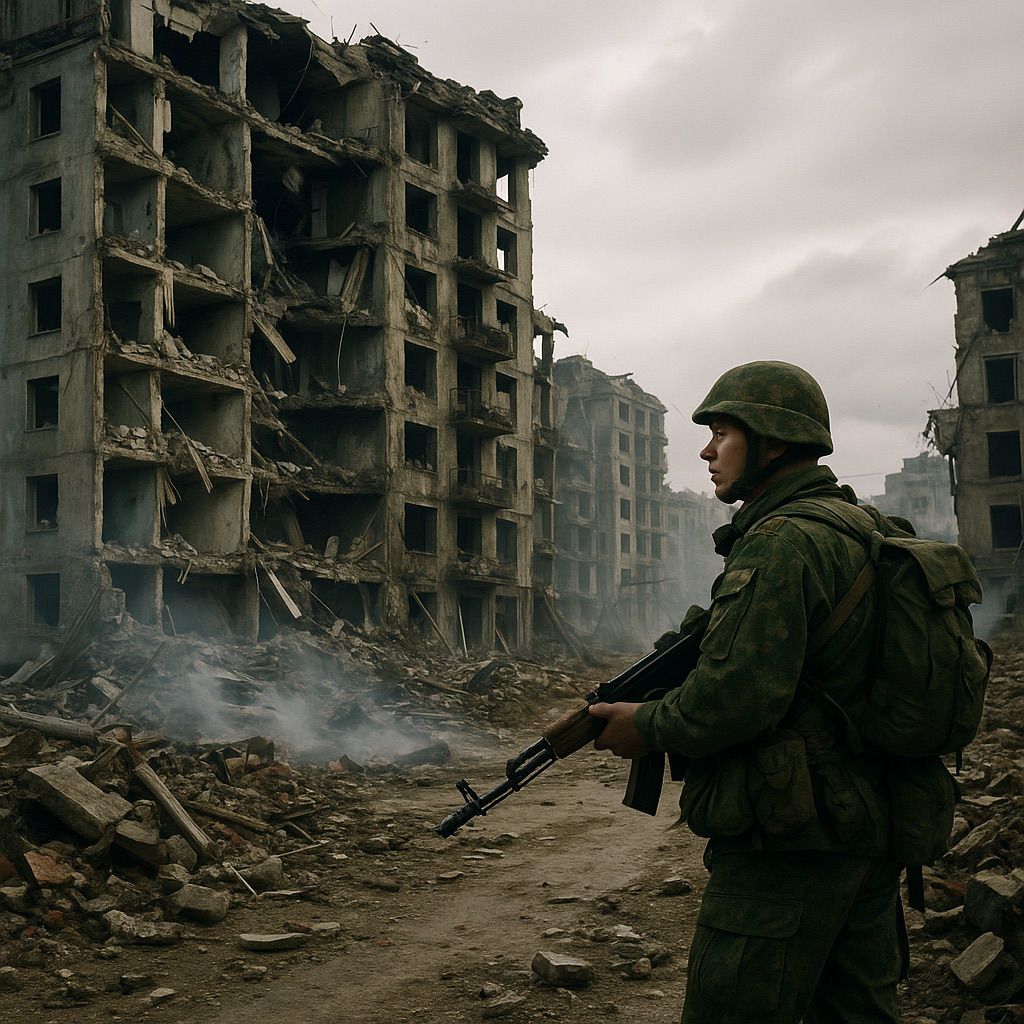
When negotiations failed and tensions mounted, Russia launched its first invasion in December 1994, under the guise of restoring constitutional order. The Kremlin believed the campaign would be swift. Instead, they walked into one of the most disastrous military engagements of the post-Soviet era. Chechen fighters—underequipped but deeply motivated—used urban warfare tactics that Russian forces were unprepared to counter. Grozny, the Chechen capital, became a symbol of devastation, with its ruins reflecting not only military failure but moral collapse.

The conflict dragged on until 1996, when mounting casualties and declining public support forced Moscow into the Khasav-Yurt Accord, negotiated by General Alexander Lebed. The agreement halted the fighting and granted Chechnya de facto independence, though its final status remained unresolved. For a brief moment, peace seemed possible. But the region, ravaged by war and lacking infrastructure, fell into lawlessness. Kidnappings, factional power struggles, and the rise of radical Islamist groups destabilized the fragile republic. The chaos provided fertile ground for the next stage of conflict.

In September 1999, a series of apartment bombings rocked Russia, killing hundreds and terrifying millions. The Kremlin immediately blamed Chechen militants, though the true perpetrators remain the subject of fierce debate among historians, analysts, and human rights groups. Regardless of who carried out the attacks, the impact was seismic. Public outrage surged, and the government seized upon the moment to rally the nation behind a new military campaign. Yeltsin—by then politically weakened—appointed Vladimir Putin, a little-known former KGB officer, as prime minister.

Putin responded with a promise that defined his ascent: to crush terrorism “in the outhouse” if necessary. Days later, Russian forces invaded Chechnya again, igniting the Second Chechen War. This campaign was vastly different from the first. Under Putin’s command, the Russian military employed overwhelming force, flattening entire districts of Grozny, leveling villages, and implementing harsh filtration operations that swept up civilians indiscriminately. Human rights organizations documented torture, disappearances, and mass killings, painting a grim portrait of Moscow’s approach to reasserting control.

Despite the brutality, Putin’s popularity soared. He appeared decisive, tough, and uncompromising at a time when many Russians longed for stability. By early 2000, he was elected president in a landslide victory—an outcome directly bolstered by the war in Chechnya. The conflict, in many ways, became the crucible that forged his political identity.

In Chechnya, meanwhile, the cost was immeasurable. Grozny was left in ruins, declared by the United Nations to be the most devastated city on earth. Tens of thousands of civilians died, and hundreds of thousands more were displaced. Families were shattered, villages depopulated, and an entire generation grew up amid the trauma of war. The region ultimately fell back under Russian control, governed by a Moscow-backed regime that suppressed dissent with near-total impunity.

Yet beneath the skyscrapers and reconstructed avenues that now stand in Grozny lies a silent legacy of grief. Many Chechens continue to live under constant surveillance and repression, with memories of vanished relatives and destroyed homes still raw. Although overt separatist movements have been crushed, the fissures carved by decades of conflict remain embedded in the social fabric of the region.

The wars in Chechnya reshaped Russia’s internal politics, redefined its security state, and cemented a new mode of governance built on centralized authority, military force, and tight control over information. They also revealed the dangers of nationalist fervor, political manipulation, and the ease with which fear can be weaponized to consolidate power.

Looking back, the Chechen wars stand as a stark reminder of the deep human cost of geopolitical ambition. They show us how the lines between national security and aggression blur when governments believe they are fighting existential threats. And they challenge us to recognize the lasting scars that such conflicts leave on both the oppressed and the aggressors.

Today, as Russia continues to assert itself on the global stage—from Ukraine to Syria—many of the strategies first tested in Chechnya echo loudly in contemporary policy. The lessons, however, remain unresolved. The conflict serves as a cautionary tale: that unchecked authority, fueled by fear and framed as patriotism, can lead nations down a path from which recovery may take generations.

And amid the ruins—literal and symbolic—Chechnya endures. A testament to resilience, a witness to tragedy, and a reminder that even in the darkest valleys of modern history, the fight for identity and dignity persists.

Related Posts

When the Axis Turned on America: How Germany and Italy Pushed the World Into Total War

Elias Rowen

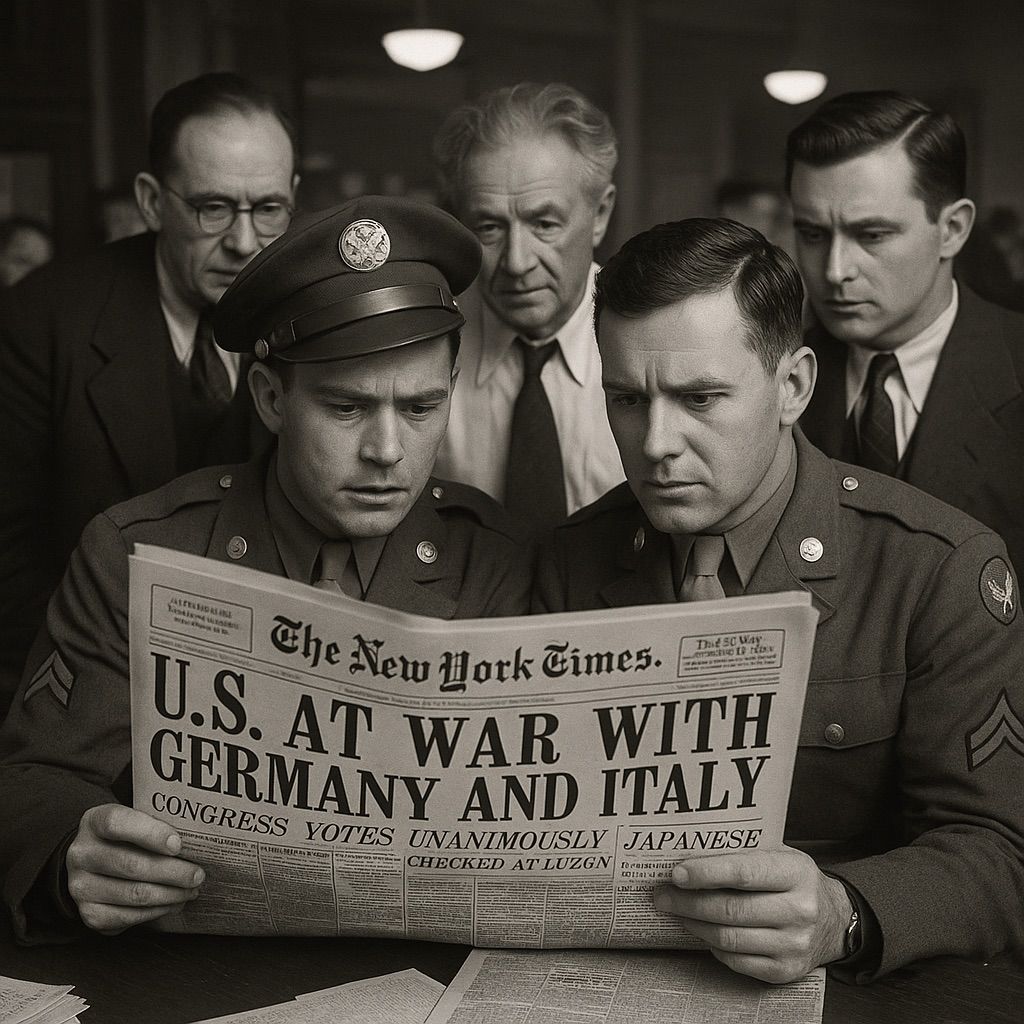
The winter of December 1941 settled heavily over Washington, London, Berlin, and Rome, but the cold did little to mute the shockwaves already rolling across the world. The United States had barely begun to process the devastation of Pearl Harbor—smoldering ships still leaked oil into Hawaiian waters, families were still being notified of loved ones lost, and the nation was only beginning to shift from the mindset of distant observer to active combatant—when yet another blow arrived. On December 11, 1941, Germany and Italy, under Adolf Hitler and Benito Mussolini, declared war on the United States, thrusting America formally into both the Atlantic and Pacific theaters of World War II. Their declarations expanded the conflict from a fractured, uneven international crisis into the fully global war it would become, forever redefining the twentieth century and reshaping the world’s political future.

To understand why Germany and Italy chose that moment to declare war on a country far more industrially powerful than themselves, one must trace the arc of the increasingly volatile atmosphere that had been building across the globe since the 1930s. Germany’s grievances after World War I were not merely emotional—they were strategic, economic, and purposeful. Hitler rose to power on promises to overturn the Treaty of Versailles, restore German pride, and rebuild the military machine that had been shattered in 1918. In a few short years, he dismantled democratic institutions, rebuilt the Luftwaffe, reintroduced conscription, and pushed the boundaries of diplomacy as far as Europe would allow. He annexed Austria, carved up Czechoslovakia, and molded the Nazi state into an engine designed for territorial expansion.

Italy, under Mussolini, shared similar ambitions but lacked the same military capacity. Mussolini dreamed of restoring the glories of ancient Rome, imagining a new Italian empire stretching across the Mediterranean and into Africa. His ventures into Ethiopia and Albania were attempts to stake Italy’s claim as a modern imperial power, even though Italian forces consistently lacked the skill, equipment, and organization of their German counterparts. But Mussolini’s ego demanded prestige, and aligning himself with Hitler offered the illusion of strength he could not produce on his own. Together, Germany and Italy formed a partnership that had as much to do with ideological alignment as it did with shared political fantasies of domination.

While war consumed Europe, the United States had watched from afar, hopeful that the Atlantic Ocean could remain a shield. Franklin D. Roosevelt understood that Germany’s aggression threatened global stability, but the American public—still scarred by the memory of World War I—wanted no part in another foreign war. Roosevelt walked a careful line, slowly edging the U.S. closer to the Allies, supplying Britain, supporting China, and quietly preparing for the possibility that neutrality would not last forever. The Lend-Lease Act was the clearest sign that the U.S. was no longer an impartial observer. American factories roared to life, producing tanks, aircraft, ammunition, and supplies for the nations resisting Hitler’s advance. The U.S. Navy found itself increasingly involved in escorting Allied convoys across the Atlantic, sometimes exchanging fire with German U-boats. Though America had not yet declared war, it was already drifting in that direction.

Yet despite Germany’s growing aggression, it was Japan’s decision to attack Pearl Harbor that finally forced America into the conflict. Japan had been expanding across East Asia for years, driven by militaristic ambitions and a desire to secure resources that its island nation could not produce. China suffered under Japanese occupation, and Southeast Asia braced for the same fate. When Japan swept into French Indochina, the U.S. responded with sanctions, including a crippling oil embargo. In Tokyo, Japan’s military government viewed the embargo as an existential threat. Without oil, their empire would collapse. A preemptive strike on the United States, they believed, would neutralize American influence long enough for Japan to seize the raw materials of Southeast Asia.

The attack on Pearl Harbor shocked the world. Americans who had once insisted on staying out of foreign wars now stood united in outrage. Roosevelt’s speech on December 8 declared the date as one that would live in infamy, and Congress swiftly approved a declaration of war against Japan. But for Hitler and Mussolini, seeing the U.S. locked into a Pacific war offered an enticing strategic illusion. They believed America would be too preoccupied fighting Japan to make meaningful contributions to the European theater. Moreover, Germany badly underestimated the industrial and military capacity of the United States. Hitler misread the moment entirely. He assumed that by declaring war on the U.S., he could draw Japan into a war against the Soviet Union, forming a united three-front assault that would break Stalin. That miscalculation would be one of the most significant turning points of the war.

Thus, Hitler and Mussolini formally declared war on the United States on December 11. Their speeches were full of bravado, ideological vitriol, and Nazi mythology about inevitable victory. They painted the United States as a decadent, capitalist nation incapable of sustaining a prolonged military campaign. They underestimated American resilience, industrial might, and the unity that Pearl Harbor had inspired. What they triggered instead was a mobilization unlike anything the world had ever seen. The U.S. economy—already humming from Lend-Lease production—shifted fully into wartime mode. Women entered factories, men lined up at recruiting offices, universities turned into research hubs, and automotive plants converted to produce aircraft and artillery.

Germany and Italy found themselves facing a nation that not only had massive human and industrial resources but also unparalleled logistical capability. The U.S. could build ships faster than Germany could sink them, could produce aircraft at quantities no Axis power could match, and could supply its allies with food, fuel, and weapons while simultaneously replenishing its own forces. The declarations of war that Hitler and Mussolini believed would divide the Allies instead unified them with unprecedented resolve.

As American involvement expanded, major turning points in the war began to shift momentum. In North Africa, U.S. and British forces pushed back the once-formidable Afrika Korps. In Italy, Allied troops fought up the peninsula, eventually toppling Mussolini’s regime. On the Eastern Front, the Red Army slowly reversed Germany’s advances, culminating in catastrophic losses for Hitler at Stalingrad and Kursk. And in the Pacific, the U.S. Navy, having turned the tide at Midway, began the long island-hopping campaign that would carry American forces ever closer to Japan.

By 1944, the full consequences of Hitler’s miscalculations were evident. American troops landed in Normandy, opening the long-awaited Western Front. The Allies closed in on Germany from both east and west, and Italy, having surrendered in 1943, became a battleground between German occupiers and Allied liberators. Hitler’s dream of a thousand-year Reich crumbled under the overwhelming weight of coordinated Allied offensives. Mussolini met a grim end at the hands of Italian partisans, and Germany surrendered in May 1945.

In the Pacific, the U.S. faced an enemy unwilling to surrender even in hopeless circumstances. Fierce battles on Iwo Jima and Okinawa revealed the staggering human cost of invading Japan itself. Truman’s decision to authorize the atomic bombings of Hiroshima and Nagasaki remains one of the most consequential and controversial decisions in world history. Japan surrendered shortly after the bombings, bringing World War II to its end.

The world that emerged from the ashes of the war bore little resemblance to the one that had existed in 1939. Germany was divided, Italy had abandoned fascism, the United States and the Soviet Union rose as superpowers, and the global order—politically, militarily, and ideologically—shifted dramatically. The United Nations was formed in the hope of preventing future conflicts, though the Cold War would soon cast a new shadow over international relations. For millions of families across continents, the war left scars that would never fully heal. And for historians and citizens alike, the conflict became a testament to the dangers of unchecked aggression, ideological extremism, and catastrophic miscalculation.

Looking back, the declarations of war by Germany and Italy seem almost surreal—acts of political arrogance and strategic blindness that sealed the Axis powers’ fate. They expected a fractured, reluctant America; instead they awakened a nation whose industrial strength and determination would help dismantle fascism and reshape the global balance of power. The world today still lives with the echoes of those December days when one nation recovering from the shock of Pearl Harbor suddenly found itself drawn fully into a war on two fronts, a war that would fundamentally rewrite the course of history.

Related Posts

El Mozote: The Massacre That Exposed a War Built on Silence

Elias Rowen

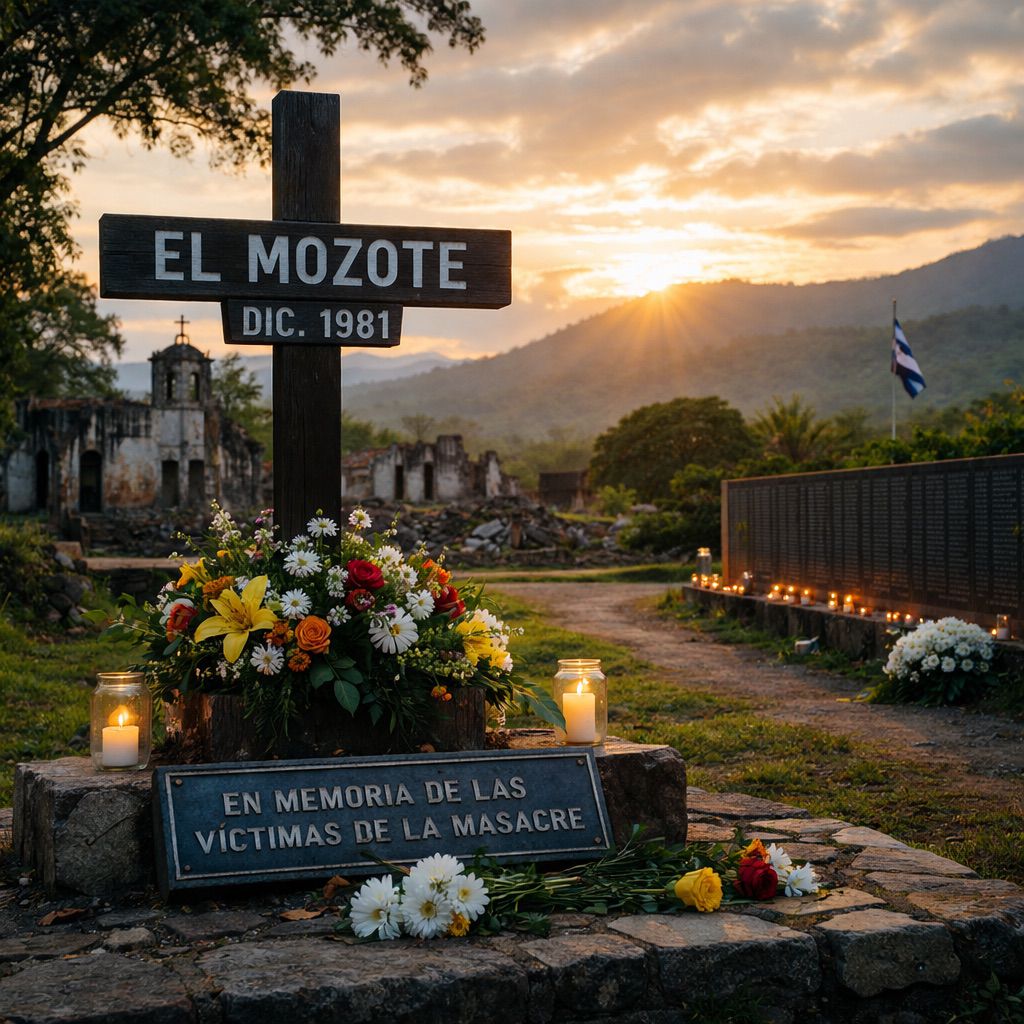
The morning sun that rose over the hills of Morazán in December of 1981 should have been no different than any other, casting its soft gold tones across the valleys and the quiet farming villages of northeastern El Salvador. But for the people of El Mozote, a small rural community whose lives revolved around cornfields, coffee plants, church gatherings, and the rhythms of family and work, the quiet beauty of those days would soon be overshadowed by one of the darkest events in Latin American history. The massacre that unfolded on December 11–12, 1981, would leave 863 people dead, entire families erased from existence, and the world forced to confront the brutal dimensions of a war that had long been painted in ideological simplicity.

El Salvador’s civil war, at least on the surface, seemed like a familiar Cold War script: leftist guerrillas of the Farabundo Martí National Liberation Front (FMLN) fighting against a government backed strongly by the United States. But beneath the geopolitical framing, the conflict was a cauldron of poverty, inequality, repression, and generations of rural neglect. The Salvadoran military, underpinned by U.S. training and funding, had adopted increasingly violent counterinsurgency tactics as the war intensified. Civilian populations in contested regions were no longer treated merely as unfortunate bystanders; they were redefined as potential collaborators, and therefore as legitimate targets.

The Atlacatl Battalion, an elite rapid-response unit created, trained, and heavily supported by U.S. advisers, would become infamous in the months and years that followed. Its members had been trained for efficiency, aggression, and counter-guerrilla strategy. What no amount of official training manuals admitted was that such training would also become the backbone for some of the worst atrocities of the war. What happened at El Mozote was not a spontaneous act of battlefield chaos; it was a methodical, organized mission whose objective was chillingly clear.

On December 10, 1981, the battalion encircled the village. Residents were frightened but still held onto a fragile belief that if they cooperated, no harm would come to them. The town’s reputation as a place sympathetic to guerrillas had long made it a target, but many residents had stayed precisely because they believed that declaring neutrality and avoiding armed involvement would protect them. They were tragically wrong.

The soldiers began by ordering everyone out of their homes. Men, women, children—entire families were gathered together in the village square. What followed was a deliberate pattern of separation: men forced into one location, women into another, children into the convent. The soldiers accused them of supporting the FMLN, of feeding guerrillas, of hiding weapons—accusations that, in the tense logic of counterinsurgency doctrine, required little to justify extreme measures.

The men were the first to be executed. Blindfolded, beaten, interrogated for information they did not have, many of them were shot in groups, their bodies left in open fields or buried hastily. Women were subjected to unspeakable violence before being killed. Children—some as young as infants—were gathered inside a church and murdered in ways so brutal that even decades later forensic experts struggled to process the evidence without emotional collapse.

The soldiers then burned the town. Homes, livestock, personal belongings, and even the bodies of victims were set ablaze in an attempt to erase any trace of what had occurred. El Mozote no longer resembled a community—it looked instead like a ghostly remnant of war, a place where silence lingered heavier than the smoke.

For a time, the Salvadoran military believed the operation had been a success. They denied everything. They accused survivors of lying. They told foreign journalists sympathetic to the villagers that their reporting was communist propaganda. The Reagan administration, eager to maintain military support for El Salvador’s government, quickly dismissed the first press stories about the massacre. Officials went so far as to imply that journalists had fabricated the event or had been manipulated by the FMLN.

But the truth—though temporarily buried—was not so easily silenced. In 1983, human rights investigators and journalists made their way to El Mozote again. This time they met survivors, remnants of buildings, and bones protruding from shallow graves. Forensic experts uncovered tiny skeletons, many belonging to children still wearing their shoes. There was no mistaking what had happened.

The massacre became emblematic not only because of its scale but because of the systemic impunity surrounding it. U.S. officials had denied it. The Salvadoran government had covered it up. And the military officers who planned and carried out the massacre were protected by an amnesty law passed in 1993, just days after the UN Truth Commission released its findings affirming the military’s responsibility.

Still, the dead did not disappear quietly. Families demanded truth. They demanded justice. They demanded dignity for those buried in unmarked graves.

As years passed, El Mozote became a symbol of memory and resistance. Survivors returned to rebuild what they could. Churches erected memorials. Activists organized pilgrimages and educational programs. International organizations provided forensic analysis, counseling, documentation support. In 2016, the Inter-American Court of Human Rights ruled that El Salvador had violated the rights of the victims by refusing to investigate and that the government must reopen the case. For the first time, high-ranking officers were ordered to face judicial proceedings.

Yet the path to accountability remains difficult. Many of those responsible lived long lives abroad or in military retirement. The same geopolitical forces that enabled the massacre continue to influence politics. And the scars left on survivors cannot be erased by tribunals alone.

The story of El Mozote is a story of a community destroyed not because of what people did, but because of who they were—poor, rural, and living in a zone of conflict where suspicions outweighed humanity. It is also a story of silence: the silence forced upon victims, the silence insisted upon by governments, the silence demanded by those who benefited from looking away.

But above all, it is a story of memory. Survivors have ensured that El Mozote is remembered not simply as a tragedy, but as a warning. A warning about the dangers of unchecked military power. A warning about what happens when ideological battles dehumanize entire communities. A warning about the ways great powers can enable atrocities even while speaking the language of freedom and democracy.

Standing in El Mozote today, one sees a town rebuilt—modest homes, gardens, a school, a church. But the ground beneath holds layers of history that refuse to be forgotten. Flowers and crosses mark places where bodies were found. The air carries the echoes of names once spoken in family gatherings, at church festivals, in childhood laughter.

The massacre remains a wound in El Salvador’s national memory, one still in the process of healing. Its lessons extend far beyond national borders. It shows that truth must be protected even when governments fear it. It shows that accountability matters not only for the past but for the future. And it shows that even in the wake of unimaginable violence, communities can rise—not to erase what happened, but to ensure it is never repeated.

Related Posts

Alfred Nobel Turned a Legacy of Dynamite into a Legacy of Peace

Elias Rowen

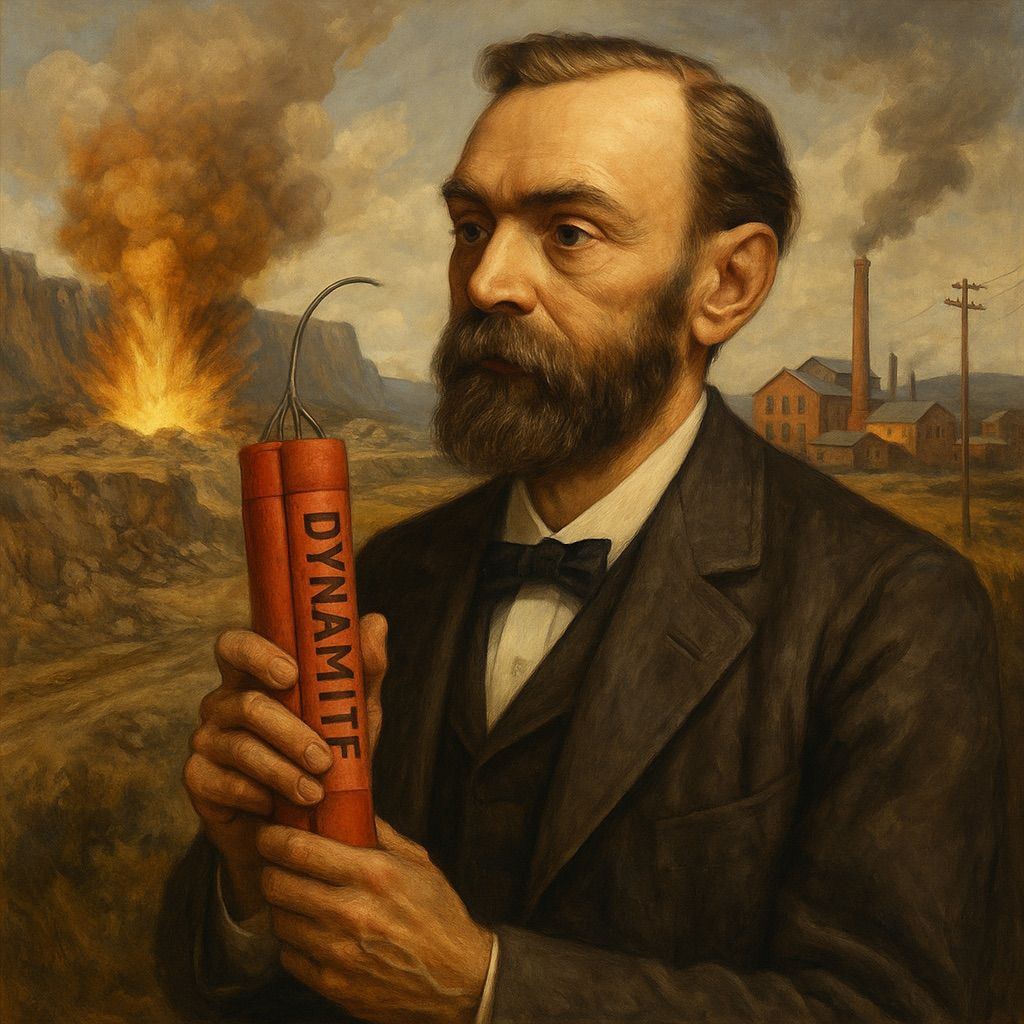
Alfred Nobel’s life ended quietly on December 10, 1896, in the gentle warmth of the Italian Riviera, but the irony of his final years is that almost nothing about his legacy would remain quiet. His death at age sixty-three marked the beginning of one of the most profound transformations in modern intellectual and scientific history. The man whose name had long been associated with the raw power of explosives would, through one stunning and unexpected twist, become forever linked to the advancement of knowledge, human progress, and international peace. What began as a life centered around invention—particularly inventions that wielded fearsome power—ended as a legacy devoted entirely to rewarding humanity’s greatest achievements.

Alfred Nobel was born on October 21, 1833, in Stockholm, into a household that could best be described as intellectually restless. His father, Immanuel Nobel, was an engineer, an inventor, and something of a relentless dreamer whose fortunes rose and fell as fast as the markets he chased. When Alfred was still a child, Immanuel moved the family to St. Petersburg, Russia, where he secured work as an engineer for the Imperial Army. It was in Russia, surrounded by the machinery of war and industry, that Alfred’s natural abilities began to take shape. He developed a fascination with chemistry and engineering, two disciplines that would determine the arc of his life.

By the time he reached adulthood, Alfred Nobel was well on his way to becoming one of the most prolific inventors in Europe. He studied in Paris and worked in factories and laboratories across the continent. His sharp mind and unusual intuitive sense for the behavior of chemical compounds allowed him to see possibilities where others saw only risk. By 1863, he had developed a usable form of nitroglycerin—far more powerful than anything previously available for blasting rock or excavating tunnels. But nitroglycerin was dangerously unstable, often exploding unpredictably, killing workers and damaging equipment.

The turning point came in 1866, when Nobel discovered that combining nitroglycerin with silica and diatomaceous earth created a clay-like mixture that was both powerful and stable. He named it dynamite. With dynamite, construction firms could blast through mountains, carve railways through continents, and accelerate the industrial age into a new chapter. Nobel patented the invention, founded factories across the world, and rapidly became one of the wealthiest men of his generation.

But dynamite brought something else—controversy. Many saw it as a tool for progress, yet others saw it as an instrument of destruction. Nobel, who was intensely private and somewhat emotionally distant, carried these criticisms quietly, perhaps even painfully. In his personal life, he suffered profound loneliness and loss. His first and only love, the Austrian pacifist Bertha von Suttner, became a lifelong correspondent rather than a partner. His younger brother Ludvig died in 1888. And then came the incident that changed everything: a French newspaper mistakenly published Alfred Nobel’s obituary—believing that it was he, not his brother, who had died.

The headline read: “The merchant of death is dead.”
The article went further, condemning Nobel for becoming rich by inventing a substance that killed people more efficiently than ever before. Imagine the shock of reading your own legacy reduced to such brutal clarity. Nobel, deeply shaken, realized that this might truly be how history remembered him. And in that moment of painful introspection, a new idea began to take shape—one that would eventually redefine the meaning of his name.

By 1895, Nobel had quietly drafted a will that stunned even those closest to him. He left nearly all of his vast fortune—equivalent today to billions of dollars—to establish five annual prizes. These prizes would be awarded to those who had conferred “the greatest benefit to humankind” in physics, chemistry, medicine, literature, and peace. He did not consult his family. He did not request approval. He simply wrote the instructions, sealed the document, and ensured that his wealth would build a legacy far different from the one his inventions might have suggested.

When the will was read aloud in Stockholm in January 1897, Sweden erupted in debate. The will was legally unusual and politically delicate. Some argued that Nobel’s estate should rightfully go to his relatives. Others objected to the international nature of the prize committees. Even the Swedish King expressed disapproval. Yet Nobel’s wishes ultimately prevailed, as if the moral momentum behind his vision could not be denied.

On December 10, 1901—five years to the day after Nobel’s death—the first Nobel Prizes were awarded. The ceremony marked an extraordinary moment, not just for science and literature, but for a world beginning to recognize that human achievement extended far beyond national boundaries. Wilhelm Conrad Röntgen received the physics prize for discovering X-rays, a breakthrough that revolutionized medicine. Marie Curie, who had inspired Nobel’s admiration during his lifetime, received her first Nobel just two years later. The literature prize went to Sully Prudhomme, while the peace prize was awarded to Henry Dunant and Frédéric Passy, two pioneers of humanitarian thought.

The world immediately understood that something monumental had begun.

In the decades that followed, the Nobel Prizes became the global gold standard for intellectual accomplishment. Scientists whose work changed the course of history—Einstein, Bohr, Watson and Crick, Fleming—walked across the stage in Stockholm to receive an award made possible by the man who once feared being remembered only for creating explosives. Writers who reshaped the world’s imagination, leaders who fought oppression, doctors who cured diseases—all came to stand under the banner of Nobel’s vision.

The irony, of course, is profound. A man who built his fortune on controlled destruction ultimately engineered one of the most constructive philanthropic legacies ever conceived. Nobel never married, never had children, and lived much of his life in isolation. But he left behind an idea greater than any invention: the belief that humanity’s brightest minds should be honored and encouraged, that progress was something worth investing in, and that peace—fragile though it may be—deserved recognition equal to any scientific breakthrough.

Today, the Nobel Foundation’s endowment has grown to billions, allowing the prizes to continue indefinitely. More than 600 laureates have been honored, some of them twice. The awards have shaped careers, influenced political movements, and propelled scientific revolutions. They have sparked debate, controversy, admiration, and sometimes outrage—but always engagement. The world watches each year, waiting to see who has nudged humanity forward.

In a very real sense, Alfred Nobel succeeded in rewriting his own obituary. He ensured that he would be remembered not as the merchant of death, but as the architect of one of humanity’s greatest traditions—one that celebrates imagination, discovery, and the pursuit of peace. His life reminds us that redemption is possible, that legacy is malleable, and that a single moment of clarity can alter the destiny of millions.

When we speak his name today, we think not of dynamite but of brilliance. Not of destruction but of progress. Not of explosions but of enlightenment.

And perhaps that is exactly the future Alfred Nobel hoped to build—not only for himself but for the world.

Related Posts