Latest Articles

How the Mayflower Compact Became America’s First Self-Government Agreement

Elias Rowen

When forty-one men aboard the Mayflower dipped their quills into ink on November 11, 1620, they were not thinking about textbooks, future democracies, or the birth of a nation. They were thinking about survival. Cold winds whipped across the deck. The smell of damp wood, sickness, and exhaustion clung to the ship. Many passengers were weak, half-starved, or recovering from weeks of brutal storms that had tossed the Mayflower across the Atlantic like a toy in a bathtub. They had intended to land near the Hudson River, within the northern boundary of the Virginia Colony—a place that at least had English laws, structure, and a governing body. Instead, they found themselves anchored off the coast of Cape Cod, far outside any formal charter. No laws. No magistrates. No authority telling anyone what to do. And that is precisely why they wrote the Mayflower Compact.

The agreement they drafted—simple, brief, and direct—would become one of the most influential documents in American history. Not because of its length or its legal sophistication, but because of its spirit: a promise to govern themselves by their own consent. The men who signed it likely did not realize that their makeshift pact would one day be viewed as the seed from which American constitutional democracy would grow. They were simply trying to prevent chaos.

The Mayflower had not been a pleasant voyage. Passengers were crammed into tight, dark spaces below deck. Seasickness was constant. Food supplies spoiled. Freshwater turned brackish. The ship creaked and groaned as ferocious autumn storms battered the vessel. Waves crashed so hard that at one point the main beam cracked, and only the presence of a massive metal screw—brought by one of the colonists for house-building—kept the ship from breaking apart.

By the time they finally spotted land on November 9, spirits were ragged. Arguments had broken out. Some of the non-Separatists—often called “Strangers” by the Puritan Pilgrims—declared that since they were outside the Virginia Company’s jurisdiction, “none had power to command them.” In other words: we’re not bound by your rules anymore. That terrified the leaders of the expedition, especially William Bradford and William Brewster. Without some structured agreement, their new colony could easily collapse into disorder.

So, on that cold November morning, while the ship bobbed in the waters off Cape Cod, the men gathered. They unfurled a sheet of parchment and began writing words that would resonate far beyond their cramped cabin. The document was not long. It didn’t aim for poetry or grandeur. Instead, it emphasized loyalty to the English crown, the intention to form a “civil Body Politick,” and most importantly, the promise to create and obey laws chosen for the general good of the colony. This idea—government based on consent—would become foundational in American political philosophy.

There was something profoundly human about this moment. These colonists were not philosophers. They were farmers, tradesmen, carpenters, merchants, soldiers—ordinary people facing extraordinary circumstances. They were worried about their families, fearful of a harsh winter, uncertain if they would find enough food or suitable shelter once they disembarked. Yet even amid that fear, they recognized the necessity of order, cooperation, and fairness. It’s one thing to talk about democracy in a comfortable room centuries later; it’s another to craft its earliest form while huddled on a freezing ship surrounded by danger.

The Compact was signed by forty-one men—every adult male aboard the ship who was legally eligible to do so. Women and children were present, watching as each name was added, knowing their lives would be shaped by this agreement. These families had crossed the ocean together, prayed together, fought sickness together, and now they bound themselves to govern together. It was not perfect equality—only men signed, and English hierarchy still influenced attitudes—but it was a radical step toward the concept of shared power.

Once signed, the Compact immediately took effect. John Carver was chosen as the first governor. Decisions were made collectively. Rules were enforced. Disputes were resolved through deliberation rather than threats or intimidation. The document did not guarantee harmony, but it established a process—something incredibly valuable in a place where chaos would have meant death.

Over the next several weeks, small groups explored the surrounding land. They found abandoned Native villages, evidence of earlier epidemics that had devastated local populations. They searched for fresh water, safe harbors, and fertile ground. As winter set in, the colonists began building their settlement at Plymouth. It was grueling work. Exposure, malnutrition, and disease took a devastating toll—over half the settlers would die before spring. Yet the Compact held them together, providing a fragile but vital sense of shared responsibility.

When the Wampanoag people made contact in March of 1621, the colony still teetered on the edge. But the willingness of both groups to forge alliances—however complicated their motivations—created a year of relative stability. The Mayflower Compact continued to serve as the governing framework for more than two decades until Plymouth Colony was absorbed into the larger Massachusetts Bay Colony.

Looking back, what makes the Mayflower Compact enduring is not its legal strength but its symbolic power. It was one of the earliest written expressions of government by consent in the Western Hemisphere. It recognized that laws and leaders derive authority from the people who agree to live by them. That was groundbreaking in a world still dominated by monarchies and inherited privilege.

Modern historians often debate the Compact’s true significance. Some argue that Americans have romanticized it, assigning too much weight to a document created for practical purposes. Others highlight that it excluded large parts of the population and was never meant to spark a revolution. But even acknowledging its limitations, the Compact remains a remarkable moment in the story of American self-government. It was the first time a group of settlers in the New World collectively decided how they would rule themselves. And that idea—that power comes from the governed, not just from the top—would echo through the centuries.

The story of the Compact is also deeply personal. Imagine those men standing in the cramped quarters of the Mayflower, holding quills in trembling hands as the ship rocked beneath them. Imagine their wives and children standing nearby, wrapped in rough wool blankets, trying to stay warm. Imagine the fear of stepping into an unknown wilderness after months at sea. And then imagine the courage it took to declare that they would face that wilderness together, bound not by force or royal decree, but by a promise to one another.

In that moment, they were more than travelers. They were pioneers of an idea—the idea that community, cooperation, and consent can guide a people through uncertainty. They were planting the seeds of something that would grow, evolve, be challenged, and be expanded over centuries: representative self-government.

Over four hundred years later, the Mayflower Compact feels less like a relic and more like a reminder. A reminder that democracy is fragile, that unity must be chosen deliberately, and that even in the harshest conditions, people can decide to build something better together. It reminds us that great political transformations don’t always start with grand speeches or battlefield victories—they often start with ordinary people agreeing on how they want to live.

The Compact was only 199 words long, but its impact stretches across history. From school classrooms to constitutional debates, from political speeches to museum exhibits, its legacy endures because it captures the spirit of collective determination. It was written in a world very different from our own, yet it speaks to something timeless: the belief that communities thrive when they govern themselves with fairness, cooperation, and purpose.

Centuries later, we still look back at that moment aboard the Mayflower—a moment shaped not by kings or generals, but by families bracing against the cold, ready to begin a new life. Their compact was imperfect, limited, and born of desperation. But it was also visionary. It carved a path forward when none existed. And for a small band of colonists staring into the unknown, it turned uncertainty into resolve.

That is why the Mayflower Compact remains one of the most important documents in early American history—not because it created a nation, but because it created a way for people to imagine governing themselves at all.

Related Posts

The Historic Opening of the Nuremberg Trials

Elias Rowen

On November 20, 1945, as a cold Bavarian morning settled over the battered city of Nuremberg, something unprecedented in the history of human civilization began. In a courtroom carved out of the ruins of a recently defeated empire, the world gathered to hold individuals—not nations, not vague entities, not faceless regimes, but actual men—accountable for crimes so vast, so brutal, and so systematic that even seasoned soldiers struggled to describe them. The Nuremberg Trials were not just another legal proceeding; they were a turning point in moral and political history, a moment when humanity attempted to put words, laws, and consequences to atrocities that transcended existing legal frameworks. It was a reckoning born from ashes and anguish, designed to ensure that the horrors of the Second World War would be confronted with a measure of justice, however imperfect or incomplete it might be.

The Palace of Justice, chosen partly because it remained largely intact after Allied bombings, had an eerie, paradoxical calm about it that morning. Outside, Nuremberg was a landscape of ruins—broken stones, charred beams, collapsed roofs, and quiet streets that bore witness to the devastation Germany had brought upon the world and upon itself. Inside, rows of reporters, dignitaries, military officers, translators, and legal teams filled the courtroom, aware they were about to witness something without precedent. The great chandelier flickered overhead. Interpreters donned headphones at newly installed translation booths. Judges straightened their robes. And across from them, behind thick glass and guarded heavily by military police, sat twenty-one of the highest-ranking surviving members of the Nazi regime.

Their faces varied—some defiant, some exhausted, some eerily blank. Hermann Göring, once Hitler’s designated successor, carried himself with prideful arrogance; Joachim von Ribbentrop appeared nervous and erratic; Rudolf Hess stared into the distance as if floating somewhere between reality and delusion. These were the architects of terror, the men whose decisions had sent millions to their deaths, whose signatures appeared on orders, whose speeches mobilized hatred, whose policies transformed neighbors into enemies and nations into graves. For the first time in history, leaders of a defeated state were being held criminally responsible for actions committed under the cloak of sovereignty. It was, by every measure, a radical idea.

Before the trials, war crimes were often considered simply part of war—unfortunate but inevitable. The world had no universally recognized legal framework for prosecuting genocide, crimes against humanity, or aggressive war. There were no precedents for charging individuals with atrocities carried out by armies or under the authority of a government. The Allies had debated fiercely about what should happen to the Nazi leadership after Germany’s surrender. Some advocated for immediate execution without trial. Others insisted on public trials to expose the full scope of Nazi crimes. In the end, the latter prevailed, driven by a commitment—born from the horrors discovered in camps like Auschwitz, Treblinka, and Dachau—to reveal the truth in a courtroom so that the world could never claim ignorance.

The opening statements set the tone. Chief American prosecutor Robert H. Jackson, a U.S. Supreme Court Justice temporarily stepping away from the bench, delivered an address that would echo through history. His words were sharp, clear, and uncompromising. He declared that the trials represented “one of the most important tributes that Power has ever paid to Reason,” and warned that the tribunal’s legacy would serve as an eternal deterrent against tyranny if it succeeded—or a damning failure if it did not. Jackson’s statement laid bare the moral weight resting on everyone involved: the world was not only judging these twenty-one men; it was judging whether justice itself could be achieved after unprecedented evil.

The process was painstaking. Evidence was overwhelming but vast, varied, and often sickening. Prosecutors presented documents detailing mass executions, forced labor, medical experiments, starvation policies, deportations, and the creation of ghettos and extermination camps. They used film reels—shot by Allied forces upon liberating the camps—to show the horrors with undeniable clarity. Mountains of papers, orders, speeches, and photographs filled the courtroom, each piece revealing another layer of the machinery of death orchestrated by the Nazi regime. No one who sat in that courtroom during those early months emerged unchanged.

For the defendants, the chief strategy was denial—followed by deflection, followed by blaming Hitler, followed by claims of ignorance or helpless obedience to orders. Göring tried to dominate the courtroom with bluster and rhetorical skill. Others, like Hans Frank and Albert Speer, expressed varying degrees of remorse. Hess behaved erratically, feigning memory loss. Some defendants cried. Some sat stone-faced as their crimes were read aloud. But none could hide from the weight of the evidence. The courtroom became a crucible in which excuses dissolved and the truth, no matter how unbearable, remained.

The trials also represented a massive logistical challenge. Never before had simultaneous interpretation been used on this scale. Teams of linguists worked tirelessly to translate German, English, Russian, and French in real time, ensuring that the proceedings remained intelligible to everyone in the room. Judges from the United States, the Soviet Union, Britain, and France presided—a multinational effort that itself reflected the fragile postwar alliance already beginning to strain. Legal systems differed, ideologies clashed, and compromises were necessary. But the shared goal—accountability—kept the tribunal from splintering.

But perhaps the most enduring impact of Nuremberg was its articulation of crimes that had previously existed without names. The tribunal codified “crimes against humanity,” recognizing that mass murder, extermination, enslavement, and persecution were offenses so severe that they violated not only the rights of individuals but the conscience of humankind. It introduced the concept of “aggressive war” as a punishable act. It established that following orders did not absolve responsibility. And it confirmed that leaders could be held accountable for policies that resulted in mass atrocities—even if they never personally pulled a trigger or opened a gas valve.

Among the audience in the courtroom were Holocaust survivors, journalists, scholars, and soldiers who had been among the first to liberate the camps. Their presence was a quiet testimony to why the trials mattered—not for revenge, not for spectacle, but for truth. The world needed to hear, in meticulous detail, how genocide had been planned and executed. Survivors needed validation for the horrors they witnessed. Future generations needed a record that could withstand denial, distortion, and forgetfulness.

The trials dragged on for months. Testimonies alternated between chilling precision and emotional devastation. Witnesses described the starvation conditions in camps; the systematic extermination of Jews, Roma, disabled individuals, and political dissidents; the destruction of entire villages; and the cold calculus behind the Final Solution. Every word entered into the record would serve as a bulwark against the inevitable attempts to downplay or rewrite history.

When the verdicts were finally delivered on October 1, 1946, the world held its breath. Twelve defendants were sentenced to death, three to life imprisonment, four to terms ranging from ten to twenty years, and three were acquitted—not because they were innocent, but because the tribunal refused to allow the process to devolve into vengeance without evidence. The executions, carried out shortly thereafter, closed a chapter but did not erase the horrors. Justice—if that was even the right word—had been served as best as the circumstances allowed.

The legacy of the Nuremberg Trials would prove far more durable than anyone present could have imagined. They paved the way for the Geneva Conventions, the creation of the International Criminal Court, the prosecution of war crimes in Rwanda and the former Yugoslavia, and the ongoing global effort to hold leaders accountable for atrocities. They demonstrated that even in the aftermath of unimaginable cruelty, the world could attempt—however imperfectly—to anchor itself in principles of law and morality.

For the people of Nuremberg, the trials were a daily reminder of complicity and consequence. The city, once a symbol of Nazi rallies and propaganda, became instead a symbol of justice. The Palace of Justice, still in use today, stands as a quiet monument to that moment when humanity confronted its own capacity for evil and decided to respond not with another round of vengeance, but with a measured, public, legal reckoning.

The Nuremberg Trials did not heal the world. They did not bring back the millions who were murdered. They did not erase trauma or restore lost futures. But they established something essential: the idea that even in the darkest aftermath, accountability matters. Truth matters. Law matters. And humanity must not turn away from the responsibility to confront evil openly—even when doing so means staring directly into the worst chapters of our own history.

In that courtroom, justice did not roar. It did not cleanse all wounds. But it spoke. Calmly, firmly, and for the first time on such a scale, it declared that crimes committed under the banner of power would not be immune from judgment. And that declaration continues to echo today, reminding us that the rule of law—fragile as it is—remains one of humanity’s greatest achievements.

Related Posts

When the World Finally Breathed Again: The Day the Cuban Missile Crisis Ended

Elias Rowen

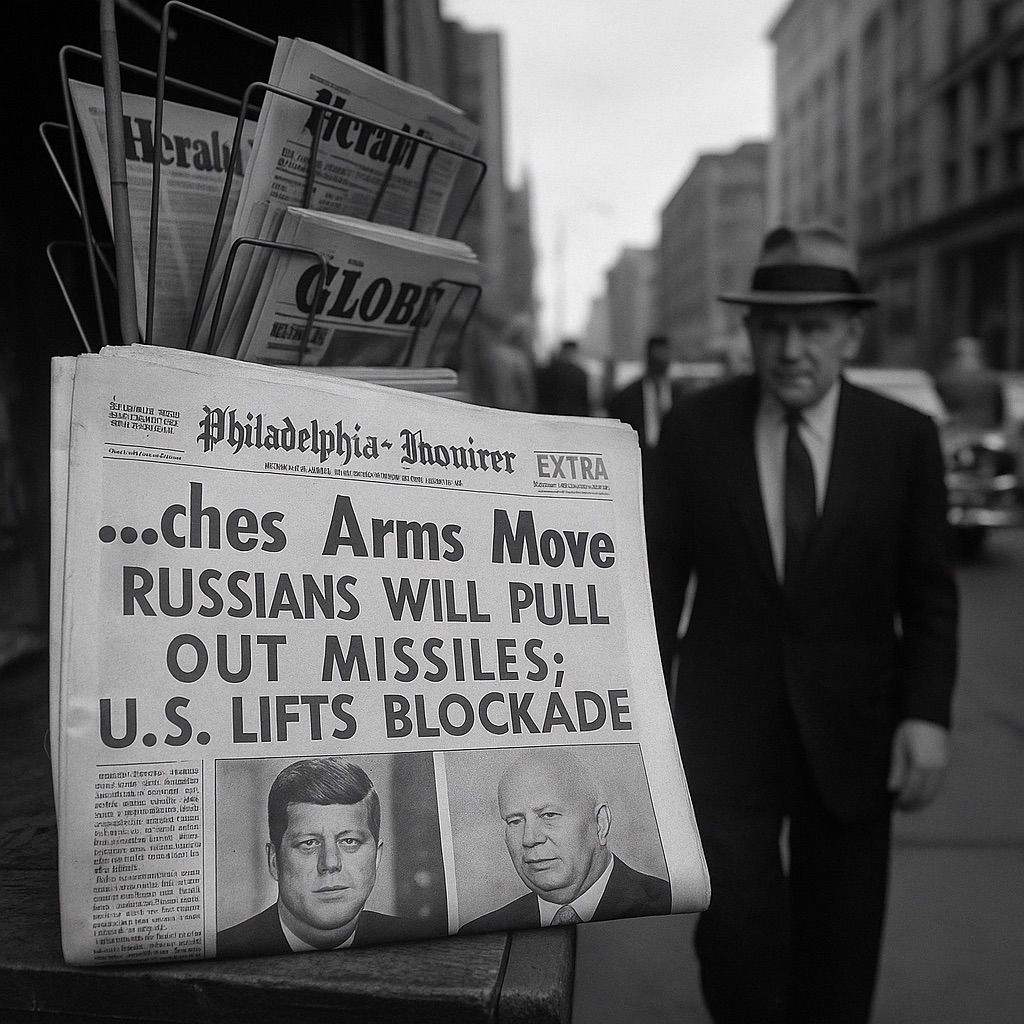
On October 28, 1962, after thirteen days of fear that wrapped around the world like a tightening wire, the Cuban Missile Crisis formally came to an end. It was a quiet ending—no parades, no applause, no triumphant speeches echoing from balconies or podiums. Just a few careful statements, diplomatic signals, and tense, weary exhalations from leaders who had spent nearly two weeks peering into the abyss of nuclear war. For most people alive at the time, the end came not as a shout but as a sigh. The crisis, which had pushed the United States and the Soviet Union to the edge of annihilation, had finally eased. The world had stepped back from the brink.

To understand the relief that swept across nations that day, one must imagine the haunting uncertainty of those thirteen preceding days. The crisis began when American reconnaissance flights revealed Soviet nuclear missiles being installed in Cuba—missiles capable of striking nearly every major American city with only minutes of warning. It was not just the existence of missiles that terrified the world, but their proximity and the suddenness with which they appeared. The U.S. had always feared an attack from afar, an ICBM streaking overhead in a dramatic arc. But missiles just ninety miles off the Florida coast felt like a noose tightening around the neck of an entire nation.

The days that followed were marked by a kind of surreal dread. In Washington, President John F. Kennedy weighed options that ranged from diplomatic pressure to a full-scale invasion of Cuba, each one carrying terrible risks. In Moscow, Premier Nikita Khrushchev wrestled with the realization that his bold gambit to protect Cuba and shift the nuclear balance had instead triggered a confrontation neither side could afford. And in Havana, Fidel Castro braced for an American attack he believed was imminent, preparing his people for a fight he was fully willing to die in.

Across the globe, ordinary people lived with the heavy awareness that their lives depended on men making decisions behind sealed doors. Schools in the United States quietly prepared evacuation procedures that everyone knew wouldn’t matter. Families argued about whether they should flee cities, build shelters, or simply pray. Newspaper headlines screamed of threats and ultimatums. Radio hosts speculated grimly about whether this was how civilization would end—not in decades, but in days.

But then, on that tense October morning, everything changed. The crisis dissolved not with bombs or battles but through a rare act of diplomatic clarity. Messages passed between Washington and Moscow—some formal, others desperate and emotionally raw—had begun carving a path out of conflict. Kennedy agreed to publicly vow not to invade Cuba and to secretly remove U.S. Jupiter missiles from Turkey. Khrushchev agreed to remove the Soviet missiles from Cuba. Castro, though angered by the Soviet negotiations that occurred without him, was forced to accept the terms.

When Khrushchev’s acceptance of the deal was broadcast over Radio Moscow, the world seemed to pause. People stopped in their kitchens, on sidewalks, in offices, listening to the crackling words that meant the threat had receded. Kennedy, informed of the message in the White House, felt the crushing weight of the past thirteen days lift. He did not celebrate; there was no victory to celebrate. But he did allow himself a rare sense of quiet relief. For the first time in nearly two weeks, both superpowers had chosen restraint over destruction.

But even as the crisis formally ended, its emotional and political effects lingered. In the United States, many officials felt uneasy about the secret missile trade, worrying it made the country look weak. In the Soviet Union, Khrushchev endured sharp criticism from hardliners who believed he had retreated too quickly. And in Cuba, Castro raged at being excluded from negotiations that determined the fate of his country’s defense. Peace had been restored, but not without bruises—some internal, some diplomatic, some carved deep within the psyches of the men who had narrowly avoided the worst war in human history.

Still, the world had survived. And in surviving, it learned lessons that would shape decades of policy. The fear sparked by those thirteen days led to the creation of the Moscow-Washington “hotline,” an effort to prevent future misunderstandings from spiraling out of control. It helped accelerate nuclear arms control agreements. It shifted the global balance of power and ushered in a new, complicated phase of Cold War diplomacy. The crisis became a painful reminder that nuclear weapons were not abstract symbols but very real threats capable of wiping out humanity in minutes.

But perhaps the most human part of the crisis’s end lies not in the geopolitical consequences but in the personal reflections of those who lived through it. Kennedy confided privately to advisors that he believed there had been a one-in-three chance of nuclear war. Khrushchev, years later, would say that the crisis convinced him that nuclear weapons must never be used under any circumstances. American families, who had spent nights gathered around their televisions in fear, allowed themselves to breathe again, to turn their thoughts back to everyday life. Soldiers stationed in Florida or Guantánamo Bay, who had spent days in combat readiness, wrote letters home explaining that they were safe after all. Across the Atlantic, Europeans—who lived closer to the nuclear frontlines than anyone—looked out over their cities and felt, for the first time in days, that the sky above them no longer carried an unspoken threat.

As the decades passed, the Cuban Missile Crisis came to represent a moment when the world truly understood the fragility of civilization. Politicians spoke about it, students studied it, military strategists pored over it, and survivors recounted the way it had reshaped their understanding of life, leadership, and peril. The crisis became an anchor point for discussions about risk, diplomacy, and global peace. Its resolution was hailed not as a triumph of power but as a triumph of restraint.

What makes the formal end of the crisis so remarkable—so hauntingly unique in the tapestry of twentieth-century events—is that it marked a moment when humanity collectively glimpsed its own extinction and consciously stepped back. This wasn’t a victory won through force. It wasn’t an inevitable result of historical momentum. It was a choice made by fallible leaders who, in their own ways, realized they could not allow pride or ideology to condemn millions to death.

When the last Soviet missile was removed from Cuba, and when the United States quietly dismantled its missiles in Turkey months later, the crisis fully resolved. But the emotional resolution—the deep breath humanity took—happened on October 28. That was the day parents hugged their children more tightly. The day soldiers loosened their grips on their rifles. The day the White House and the Kremlin allowed themselves to imagine a tomorrow. It was the day the world stepped off the edge of a cliff it had been staring at for thirteen days.

Even now, more than sixty years later, the end of the Cuban Missile Crisis stands as one of the most important moments in modern history. It is a reminder that even in times of great tension, dialogue can prevail over devastation. That caution can triumph over belligerence. That humans—flawed as we are—are sometimes capable of pulling back from disaster at the very last second.

The world breathed again on October 28, 1962. The breath was shaky, uncertain, and exhausted—but it was life. And life, especially after nearly being lost, is always worth remembering.

Related Posts

Windows Changes Everything: How Microsoft’s Windows 1.0 Launch Transformed Personal Computing Forever

Elias Rowen

When Microsoft officially launched Windows 1.0 on November 20, 1985, the world didn’t immediately realize it was witnessing the beginning of a technological revolution. In fact, many critics shrugged. Some mocked it. Others doubted it would last even a few years. But history would prove something different—something astonishing. This seemingly modest release, bundled into a colorful, boxy interface running atop MS-DOS, became the spark that would eventually redefine how billions of people interacted with their computers. It wasn’t sleek. It wasn’t fast. It wasn’t intuitive by today’s standards. But it was visionary. It was bold. And it marked a fundamental shift from a command-line past to a graphical future.

The launch of Windows 1.0 didn’t come from a vacuum. By the mid-1980s, personal computers were still intimidating to the average consumer. They were powerful machines, yes, but they demanded a level of technical comfort that most people simply didn’t possess. Operating systems like MS-DOS required users to memorize commands, navigate files through text prompts, and think more like programmers than everyday workers or hobbyists. Computers at the time felt like tools reserved for specialists—accountants, engineers, programmers, or businesses with IT departments. But Bill Gates and Paul Allen had always imagined something different: a world where computers became as essential to daily life as telephones or televisions. And that transformation required a new way of thinking.

Graphical user interfaces were not entirely new—Apple had already introduced the Macintosh in 1984, and Xerox PARC had pioneered many of the underlying concepts. But Microsoft had something those companies didn’t: the world’s dominant PC ecosystem. Millions of IBM-compatible systems were already in homes, schools, and offices, all running MS-DOS. These machines were hungry for evolution. They needed an interface that made computing approachable, accessible, and enjoyable. Windows 1.0 was Microsoft’s answer.

The software took years to develop. Internally, Microsoft struggled with how to implement multitasking, how to integrate a graphical shell, and how to compete with the Macintosh without violating Apple’s intellectual property. There were countless prototypes—some elegant, some disastrous. Engineers worked around the clock on everything from window management to iconography to color palettes. The result was a system that, while limited by today’s standards, offered a brand-new way to interact with a PC. Instead of typing everything, users could click, drag, open, minimize, and switch between programs. It was a leap forward in the relationship between humans and machines.

When Windows 1.0 finally hit store shelves, it arrived with a sense of excitement mixed with skepticism. The software required two floppy disks, a minimum of 256 KB of memory, a graphics card, and MS-DOS. What it delivered was a colorful mosaic of tiled windows—not overlapping as they would in later versions—along with a suite of simple applications: Calculator, Calendar, Notepad, Paint, Reversi, and the all-important MS-DOS Executive. There were drop-down menus, mouse support, and resizable windows (within the constraints of tiling). For users accustomed to blinking command prompts, it felt like stepping into the future.

Consumers had mixed reactions. Some early adopters were thrilled by the new visual environment, marveling at the freedom of clicking objects instead of memorizing syntax. Others complained that Windows was slow, clunky, or unnecessary. Critics pointed out that the system lacked the polish of the Macintosh. But for those paying attention, something bigger was happening. The future wasn’t simply about what Windows 1.0 could do—it was about what it promised.

That promise was rooted partly in Microsoft’s ambition and partly in Bill Gates’ insistence on a long game. Gates was already convinced that graphical interfaces were the inevitable future of computing. He famously bet the company’s direction on it. And he wasn’t alone. Inside Microsoft, teams were already hard at work on improvements that would eventually become Windows 2.0, 3.0, and 3.1—versions that would dominate the early 1990s and cement Windows as a global standard. But none of that would have been possible without the foundational step taken by Windows 1.0.

The launch also marked a turning point in the personal computing industry. Software developers began imagining applications that could work within a graphical environment rather than a text-only universe. Hardware manufacturers saw new potential for mice, high-resolution displays, and expanded memory. Businesses began considering computers not just as tools for number-crunching but as workstations for interactive software. Schools saw the possibility of user-friendly learning environments. Even video game creators started exploring graphical interfaces that could use the new paradigm.

Windows 1.0 didn’t just change technology; it began changing culture. People who had never touched a computer could suddenly see a path for learning one. It lowered the barrier of entry. It made the digital world feel less like a gated fortress and more like a frontier waiting to be explored. And although it would take several more years for Windows to break through to mainstream dominance, the seed was planted here—in this first, humble release.

Inside Microsoft’s offices in 1985, employees felt a strange combination of pride and anxiety. They knew they had done something important, but they also knew they hadn’t yet perfected it. Bill Gates, only 30 years old at the time, stood smiling in promotional photographs, holding a box of Windows 1.0, already thinking a dozen versions ahead. He didn’t see Windows 1.0 as an endpoint; he saw it as the beginning of an ecosystem. Over time, that ecosystem would absorb and surpass nearly every competitor, reshaping the world of software, business, entertainment, and communication.

But perhaps the most important part of Windows 1.0’s story is not the software itself, but the shift it represented: a shift from machines designed for experts to machines designed for everyone. It was a declaration that personal computing should be truly personal—not limited to those with specialized training, but available to anyone willing to sit down, move a mouse, and explore.

Today, looking back through decades of technological evolution, Windows 1.0 feels almost quaint. Its simple icons and rigid window layout seem worlds away from the immersive, high-resolution, multitouch interfaces modern users enjoy. But its significance cannot be overstated. It was the moment the graphical era began for the PC. And from that moment onward, the path was set for Windows to become one of the most influential pieces of software in human history.

Windows 1.0 didn’t dominate sales charts. It didn’t win over critics immediately. But it set the stage for an empire. It experimented boldly, stumbled occasionally, and grew steadily. And in doing so, it changed how the world worked, communicated, created, learned, entertained, and imagined.

What started in 1985 as a colorful grid of simple windows would eventually lead to the operating system powering the world’s businesses, households, and networks. Millions of people would build careers on it. Entire industries would rise because of it. And billions would use it every single day.

Windows 1.0 wasn’t the end of anything—it was the beginning of everything.

Related Posts

The Discovery That Redefined the Edge of Our Solar System

Elias Rowen

On June 22, 1978, in a quiet, windowless office at the U.S. Naval Observatory in Washington, D.C., an astronomer named James Christy noticed something peculiar on a photographic plate that would eventually reshape the way we understood our solar system. At first, it didn’t look like anything groundbreaking—just a slightly elongated blob where Pluto should have been. A smudge, perhaps. A flaw in the emulsion. Maybe even eye strain. But Christy was patient, methodical, and stubborn in the best way possible. He kept studying it, checking earlier images, tracing patterns that most people would have dismissed without a second thought. What he found, after weeks of rechecking and recalculating, was astonishing: Pluto had a moon. Not just any moon, either—one so massive relative to its parent planet that it practically challenged the definition of what a planet even was. That remarkable discovery would become known to the world as Charon, and its announcement in 1978 marked the beginning of a new era in planetary science.

To appreciate the full impact of Christy’s discovery, you have to imagine the scientific landscape of the time. Pluto was an enigma—a tiny, dim, distant world barely visible through even the most advanced telescopes. Astronomers struggled just to track its orbit, let alone study its surface or understand its nature. Since Clyde Tombaugh first identified Pluto in 1930, the planet had existed as a kind of cosmic question mark, a cold and lonely object at the edge of the solar system, shrouded in mystery and almost unreachable with twentieth-century technology. Many scientists believed Pluto was too small to be of much significance. Some even thought it might not be a planet at all but one of many icy bodies yet to be discovered. In many ways, they were right—though no one at the time could have predicted the vast icy region we now call the Kuiper Belt. But in 1978, Pluto was still a solitary figure in the planetary family, a misunderstood outlier orbiting almost four billion miles from the Sun.

That’s what made Christy’s discovery so electrifying. The idea that Pluto had a moon—something orbiting it, something interacting with it gravitationally—suddenly opened new possibilities. It meant Pluto wasn’t just some frozen cosmic pebble drifting through space. It was part of a system, a dynamic duo locked in a celestial dance. That dance revealed far more than anyone expected. By studying the orbit of Charon around Pluto, astronomers were finally able to calculate Pluto’s mass accurately for the first time. Before then, estimates varied wildly, some even suggesting Pluto might be as large as Earth. The discovery of Charon settled the matter quickly: Pluto was much smaller than previously assumed—roughly two-thirds the size of Earth’s Moon. In one stroke, decades of assumptions about Pluto collapsed, replaced by a clearer, though more humbling, understanding of this distant world.

Christy’s moment of realization wasn’t a Hollywood-style epiphany—it was a slow burn. He was examining a series of plates taken with the 61-inch telescope at the observatory in Flagstaff, Arizona, the same city where Pluto had been discovered nearly half a century earlier. On several photographs, Pluto appeared elongated, stretched out like a teardrop. At first, Christy thought it was a problem with the equipment. But when he compared the images, he found something curious: the shape seemed to wobble, changing direction in a regular pattern. That regularity suggested a physical cause—a companion object shifting position around Pluto. Once he noticed it, he couldn’t ignore it. Something was there. Something real.

Still, extraordinary claims require extraordinary evidence. Christy needed to be absolutely certain before presenting his finding to the astronomical community. He spent days cross-checking dozens of earlier images, confirming that the strange bulges lined up perfectly with the predicted orbital motion of a moon. It was laborious work—but it was the kind of work Christy excelled at. When he brought the idea to his colleague, Robert Harrington, the two worked together to verify the calculations. Finally convinced they had uncovered something monumental, they prepared an announcement for the world.

On June 22, 1978, the discovery was officially reported: Pluto had a moon. Christy suggested the name Charon, pronounced “Sharon,” after his wife Charlene, though it also happened to match the mythological ferryman of the underworld who carried souls across the River Styx. It was almost too perfect—an icy world at the edge of the solar system, accompanied by a moon named for the guide who shepherds lost spirits into the unknown. Whether by coincidence or poetic destiny, the name stuck.

Almost immediately, Charon became one of the most fascinating objects in planetary science. Not only was it surprisingly large—about half the diameter of Pluto—but its gravitational interaction with Pluto was so significant that the two bodies orbited a point in space outside of Pluto itself. This meant that Pluto and Charon were effectively locked in a gravitational embrace unlike anything else in our planetary system—a double-world system more akin to a binary planet than a traditional planet-moon relationship. In fact, many modern astronomers argue that Pluto and Charon should be classified as a pair of dwarf planets orbiting each other, not as a planet and its satellite.

The discovery also helped scientists predict that Pluto might not be alone in the distant reaches of the solar system. If one icy world had a massive companion, perhaps others existed too. This speculation eventually contributed to the search that uncovered Eris, Haumea, Makemake, and a vast population of Kuiper Belt objects—discoveries that collectively reshaped the definition of “planet” and eventually led to Pluto’s controversial reclassification in 2006. In a way, Charon was the first domino in a chain that reorganized our understanding of the solar system’s outskirts.

But the story of Charon’s discovery isn’t only about scientific milestones. It’s also about human persistence—the kind of quiet, determined curiosity that drives people to look deeper, question assumptions, and refuse to accept easy answers. Christy wasn’t seeking fame. He wasn’t part of a massive research project with teams of scientists and state-of-the-art equipment. He was simply an astronomer doing his job, paying attention to details that others might overlook. His breakthrough came from diligence, patience, and the courage to trust his own observations. It’s a reminder that some of the greatest discoveries in science come not from dramatic machinery or billion-dollar programs but from individuals who follow their curiosity wherever it leads.

Charon’s discovery also rekindled public fascination with Pluto. For decades, Pluto had been little more than a remote dot in the sky, an astronomical footnote mentioned mostly for its distance and its mysterious nature. But now, with the introduction of Charon, Pluto suddenly had character. The world imagined a lonely planet accompanied by a faithful companion orbiting side-by-side through the frozen depths of space. This emotional connection, though romanticized, brought Pluto back into the cultural spotlight. It became a symbol of exploration, of the unknown, of the idea that even at the farthest reaches of our solar system, there were still secrets waiting to be uncovered.

That fascination only grew as scientists continued studying the system. Over the years, astronomers discovered that Pluto and Charon are tidally locked, meaning they always show the same face to each other—an eternal cosmic stare shared across millions of miles. They also discovered that Charon likely formed from a massive collision, similar to how Earth’s Moon was created. This meant that despite its small size and distant orbit, Pluto had experienced dramatic cosmic events in its past, including an impact powerful enough to rip off a chunk of itself and send it into orbit. The more scientists learned, the more obvious it became that Pluto’s story was far richer and more dynamic than anyone had imagined.

Those revelations reached a climax in 2015, when NASA’s New Horizons spacecraft flew past Pluto and Charon, sending back images that astonished the world. For the first time, humanity saw Pluto not as a blurry smudge but as a complex world with mountains of ice, vast plains of frozen nitrogen, and mysterious geological formations that defied expectations. Charon, too, was full of surprises—a world with a deep canyon system, strange polar coloration, and signs of an active geological past. The discoveries confirmed what Christy’s 1978 announcement had hinted at: Pluto and Charon were not relics of the solar system but vibrant, fascinating worlds deserving of study and wonder.

Christy lived to see that flyby, to witness the transformation of a distant dot into a fully realized world. For a man who once spent long nights poring over faint photographic plates, the sight of Pluto and Charon in razor-sharp detail must have been profoundly emotional. His discovery had helped shape the mission’s trajectory, its scientific goals, and its global anticipation. The world now understood what he had glimpsed decades earlier: that the universe still holds wonders in the most unexpected places.

Today, the discovery of Charon remains a testament to the power of curiosity. It reminds us that even in an age of massive telescopes and robotic spacecraft, breakthroughs can emerge from a single person’s willingness to look closer, think harder, and follow the faintest clues. Charon is more than just a moon—it’s a symbol of the mysteries that exist at the edges of our knowledge, and of the extraordinary things we can uncover when we refuse to stop asking questions.

As Pluto and Charon continue their slow, silent orbit around the Sun, locked together in a gravitational waltz, they carry with them the legacy of a discovery that changed astronomy forever. They remind us that the frontier of exploration is always moving forward, that wonder lies just beyond the next observation, the next photograph, the next idea. And they echo the quiet thrill James Christy must have felt in 1978 when he realized that the universe had whispered a secret in his ear—and he had listened.

Related Posts