Latest Articles

Windows Changes Everything: How Microsoft’s Windows 1.0 Launch Transformed Personal Computing Forever

Elias Rowen

When Microsoft officially launched Windows 1.0 on November 20, 1985, the world didn’t immediately realize it was witnessing the beginning of a technological revolution. In fact, many critics shrugged. Some mocked it. Others doubted it would last even a few years. But history would prove something different—something astonishing. This seemingly modest release, bundled into a colorful, boxy interface running atop MS-DOS, became the spark that would eventually redefine how billions of people interacted with their computers. It wasn’t sleek. It wasn’t fast. It wasn’t intuitive by today’s standards. But it was visionary. It was bold. And it marked a fundamental shift from a command-line past to a graphical future.

The launch of Windows 1.0 didn’t come from a vacuum. By the mid-1980s, personal computers were still intimidating to the average consumer. They were powerful machines, yes, but they demanded a level of technical comfort that most people simply didn’t possess. Operating systems like MS-DOS required users to memorize commands, navigate files through text prompts, and think more like programmers than everyday workers or hobbyists. Computers at the time felt like tools reserved for specialists—accountants, engineers, programmers, or businesses with IT departments. But Bill Gates and Paul Allen had always imagined something different: a world where computers became as essential to daily life as telephones or televisions. And that transformation required a new way of thinking.

Graphical user interfaces were not entirely new—Apple had already introduced the Macintosh in 1984, and Xerox PARC had pioneered many of the underlying concepts. But Microsoft had something those companies didn’t: the world’s dominant PC ecosystem. Millions of IBM-compatible systems were already in homes, schools, and offices, all running MS-DOS. These machines were hungry for evolution. They needed an interface that made computing approachable, accessible, and enjoyable. Windows 1.0 was Microsoft’s answer.

The software took years to develop. Internally, Microsoft struggled with how to implement multitasking, how to integrate a graphical shell, and how to compete with the Macintosh without violating Apple’s intellectual property. There were countless prototypes—some elegant, some disastrous. Engineers worked around the clock on everything from window management to iconography to color palettes. The result was a system that, while limited by today’s standards, offered a brand-new way to interact with a PC. Instead of typing everything, users could click, drag, open, minimize, and switch between programs. It was a leap forward in the relationship between humans and machines.

When Windows 1.0 finally hit store shelves, it arrived with a sense of excitement mixed with skepticism. The software required two floppy disks, a minimum of 256 KB of memory, a graphics card, and MS-DOS. What it delivered was a colorful mosaic of tiled windows—not overlapping as they would in later versions—along with a suite of simple applications: Calculator, Calendar, Notepad, Paint, Reversi, and the all-important MS-DOS Executive. There were drop-down menus, mouse support, and resizable windows (within the constraints of tiling). For users accustomed to blinking command prompts, it felt like stepping into the future.

Consumers had mixed reactions. Some early adopters were thrilled by the new visual environment, marveling at the freedom of clicking objects instead of memorizing syntax. Others complained that Windows was slow, clunky, or unnecessary. Critics pointed out that the system lacked the polish of the Macintosh. But for those paying attention, something bigger was happening. The future wasn’t simply about what Windows 1.0 could do—it was about what it promised.

That promise was rooted partly in Microsoft’s ambition and partly in Bill Gates’ insistence on a long game. Gates was already convinced that graphical interfaces were the inevitable future of computing. He famously bet the company’s direction on it. And he wasn’t alone. Inside Microsoft, teams were already hard at work on improvements that would eventually become Windows 2.0, 3.0, and 3.1—versions that would dominate the early 1990s and cement Windows as a global standard. But none of that would have been possible without the foundational step taken by Windows 1.0.

The launch also marked a turning point in the personal computing industry. Software developers began imagining applications that could work within a graphical environment rather than a text-only universe. Hardware manufacturers saw new potential for mice, high-resolution displays, and expanded memory. Businesses began considering computers not just as tools for number-crunching but as workstations for interactive software. Schools saw the possibility of user-friendly learning environments. Even video game creators started exploring graphical interfaces that could use the new paradigm.

Windows 1.0 didn’t just change technology; it began changing culture. People who had never touched a computer could suddenly see a path for learning one. It lowered the barrier of entry. It made the digital world feel less like a gated fortress and more like a frontier waiting to be explored. And although it would take several more years for Windows to break through to mainstream dominance, the seed was planted here—in this first, humble release.

Inside Microsoft’s offices in 1985, employees felt a strange combination of pride and anxiety. They knew they had done something important, but they also knew they hadn’t yet perfected it. Bill Gates, only 30 years old at the time, stood smiling in promotional photographs, holding a box of Windows 1.0, already thinking a dozen versions ahead. He didn’t see Windows 1.0 as an endpoint; he saw it as the beginning of an ecosystem. Over time, that ecosystem would absorb and surpass nearly every competitor, reshaping the world of software, business, entertainment, and communication.

But perhaps the most important part of Windows 1.0’s story is not the software itself, but the shift it represented: a shift from machines designed for experts to machines designed for everyone. It was a declaration that personal computing should be truly personal—not limited to those with specialized training, but available to anyone willing to sit down, move a mouse, and explore.

Today, looking back through decades of technological evolution, Windows 1.0 feels almost quaint. Its simple icons and rigid window layout seem worlds away from the immersive, high-resolution, multitouch interfaces modern users enjoy. But its significance cannot be overstated. It was the moment the graphical era began for the PC. And from that moment onward, the path was set for Windows to become one of the most influential pieces of software in human history.

Windows 1.0 didn’t dominate sales charts. It didn’t win over critics immediately. But it set the stage for an empire. It experimented boldly, stumbled occasionally, and grew steadily. And in doing so, it changed how the world worked, communicated, created, learned, entertained, and imagined.

What started in 1985 as a colorful grid of simple windows would eventually lead to the operating system powering the world’s businesses, households, and networks. Millions of people would build careers on it. Entire industries would rise because of it. And billions would use it every single day.

Windows 1.0 wasn’t the end of anything—it was the beginning of everything.

Related Posts

The Discovery That Redefined the Edge of Our Solar System

Elias Rowen

On June 22, 1978, in a quiet, windowless office at the U.S. Naval Observatory in Washington, D.C., an astronomer named James Christy noticed something peculiar on a photographic plate that would eventually reshape the way we understood our solar system. At first, it didn’t look like anything groundbreaking—just a slightly elongated blob where Pluto should have been. A smudge, perhaps. A flaw in the emulsion. Maybe even eye strain. But Christy was patient, methodical, and stubborn in the best way possible. He kept studying it, checking earlier images, tracing patterns that most people would have dismissed without a second thought. What he found, after weeks of rechecking and recalculating, was astonishing: Pluto had a moon. Not just any moon, either—one so massive relative to its parent planet that it practically challenged the definition of what a planet even was. That remarkable discovery would become known to the world as Charon, and its announcement in 1978 marked the beginning of a new era in planetary science.

To appreciate the full impact of Christy’s discovery, you have to imagine the scientific landscape of the time. Pluto was an enigma—a tiny, dim, distant world barely visible through even the most advanced telescopes. Astronomers struggled just to track its orbit, let alone study its surface or understand its nature. Since Clyde Tombaugh first identified Pluto in 1930, the planet had existed as a kind of cosmic question mark, a cold and lonely object at the edge of the solar system, shrouded in mystery and almost unreachable with twentieth-century technology. Many scientists believed Pluto was too small to be of much significance. Some even thought it might not be a planet at all but one of many icy bodies yet to be discovered. In many ways, they were right—though no one at the time could have predicted the vast icy region we now call the Kuiper Belt. But in 1978, Pluto was still a solitary figure in the planetary family, a misunderstood outlier orbiting almost four billion miles from the Sun.

That’s what made Christy’s discovery so electrifying. The idea that Pluto had a moon—something orbiting it, something interacting with it gravitationally—suddenly opened new possibilities. It meant Pluto wasn’t just some frozen cosmic pebble drifting through space. It was part of a system, a dynamic duo locked in a celestial dance. That dance revealed far more than anyone expected. By studying the orbit of Charon around Pluto, astronomers were finally able to calculate Pluto’s mass accurately for the first time. Before then, estimates varied wildly, some even suggesting Pluto might be as large as Earth. The discovery of Charon settled the matter quickly: Pluto was much smaller than previously assumed—roughly two-thirds the size of Earth’s Moon. In one stroke, decades of assumptions about Pluto collapsed, replaced by a clearer, though more humbling, understanding of this distant world.

Christy’s moment of realization wasn’t a Hollywood-style epiphany—it was a slow burn. He was examining a series of plates taken with the 61-inch telescope at the observatory in Flagstaff, Arizona, the same city where Pluto had been discovered nearly half a century earlier. On several photographs, Pluto appeared elongated, stretched out like a teardrop. At first, Christy thought it was a problem with the equipment. But when he compared the images, he found something curious: the shape seemed to wobble, changing direction in a regular pattern. That regularity suggested a physical cause—a companion object shifting position around Pluto. Once he noticed it, he couldn’t ignore it. Something was there. Something real.

Still, extraordinary claims require extraordinary evidence. Christy needed to be absolutely certain before presenting his finding to the astronomical community. He spent days cross-checking dozens of earlier images, confirming that the strange bulges lined up perfectly with the predicted orbital motion of a moon. It was laborious work—but it was the kind of work Christy excelled at. When he brought the idea to his colleague, Robert Harrington, the two worked together to verify the calculations. Finally convinced they had uncovered something monumental, they prepared an announcement for the world.

On June 22, 1978, the discovery was officially reported: Pluto had a moon. Christy suggested the name Charon, pronounced “Sharon,” after his wife Charlene, though it also happened to match the mythological ferryman of the underworld who carried souls across the River Styx. It was almost too perfect—an icy world at the edge of the solar system, accompanied by a moon named for the guide who shepherds lost spirits into the unknown. Whether by coincidence or poetic destiny, the name stuck.

Almost immediately, Charon became one of the most fascinating objects in planetary science. Not only was it surprisingly large—about half the diameter of Pluto—but its gravitational interaction with Pluto was so significant that the two bodies orbited a point in space outside of Pluto itself. This meant that Pluto and Charon were effectively locked in a gravitational embrace unlike anything else in our planetary system—a double-world system more akin to a binary planet than a traditional planet-moon relationship. In fact, many modern astronomers argue that Pluto and Charon should be classified as a pair of dwarf planets orbiting each other, not as a planet and its satellite.

The discovery also helped scientists predict that Pluto might not be alone in the distant reaches of the solar system. If one icy world had a massive companion, perhaps others existed too. This speculation eventually contributed to the search that uncovered Eris, Haumea, Makemake, and a vast population of Kuiper Belt objects—discoveries that collectively reshaped the definition of “planet” and eventually led to Pluto’s controversial reclassification in 2006. In a way, Charon was the first domino in a chain that reorganized our understanding of the solar system’s outskirts.

But the story of Charon’s discovery isn’t only about scientific milestones. It’s also about human persistence—the kind of quiet, determined curiosity that drives people to look deeper, question assumptions, and refuse to accept easy answers. Christy wasn’t seeking fame. He wasn’t part of a massive research project with teams of scientists and state-of-the-art equipment. He was simply an astronomer doing his job, paying attention to details that others might overlook. His breakthrough came from diligence, patience, and the courage to trust his own observations. It’s a reminder that some of the greatest discoveries in science come not from dramatic machinery or billion-dollar programs but from individuals who follow their curiosity wherever it leads.

Charon’s discovery also rekindled public fascination with Pluto. For decades, Pluto had been little more than a remote dot in the sky, an astronomical footnote mentioned mostly for its distance and its mysterious nature. But now, with the introduction of Charon, Pluto suddenly had character. The world imagined a lonely planet accompanied by a faithful companion orbiting side-by-side through the frozen depths of space. This emotional connection, though romanticized, brought Pluto back into the cultural spotlight. It became a symbol of exploration, of the unknown, of the idea that even at the farthest reaches of our solar system, there were still secrets waiting to be uncovered.

That fascination only grew as scientists continued studying the system. Over the years, astronomers discovered that Pluto and Charon are tidally locked, meaning they always show the same face to each other—an eternal cosmic stare shared across millions of miles. They also discovered that Charon likely formed from a massive collision, similar to how Earth’s Moon was created. This meant that despite its small size and distant orbit, Pluto had experienced dramatic cosmic events in its past, including an impact powerful enough to rip off a chunk of itself and send it into orbit. The more scientists learned, the more obvious it became that Pluto’s story was far richer and more dynamic than anyone had imagined.

Those revelations reached a climax in 2015, when NASA’s New Horizons spacecraft flew past Pluto and Charon, sending back images that astonished the world. For the first time, humanity saw Pluto not as a blurry smudge but as a complex world with mountains of ice, vast plains of frozen nitrogen, and mysterious geological formations that defied expectations. Charon, too, was full of surprises—a world with a deep canyon system, strange polar coloration, and signs of an active geological past. The discoveries confirmed what Christy’s 1978 announcement had hinted at: Pluto and Charon were not relics of the solar system but vibrant, fascinating worlds deserving of study and wonder.

Christy lived to see that flyby, to witness the transformation of a distant dot into a fully realized world. For a man who once spent long nights poring over faint photographic plates, the sight of Pluto and Charon in razor-sharp detail must have been profoundly emotional. His discovery had helped shape the mission’s trajectory, its scientific goals, and its global anticipation. The world now understood what he had glimpsed decades earlier: that the universe still holds wonders in the most unexpected places.

Today, the discovery of Charon remains a testament to the power of curiosity. It reminds us that even in an age of massive telescopes and robotic spacecraft, breakthroughs can emerge from a single person’s willingness to look closer, think harder, and follow the faintest clues. Charon is more than just a moon—it’s a symbol of the mysteries that exist at the edges of our knowledge, and of the extraordinary things we can uncover when we refuse to stop asking questions.

As Pluto and Charon continue their slow, silent orbit around the Sun, locked together in a gravitational waltz, they carry with them the legacy of a discovery that changed astronomy forever. They remind us that the frontier of exploration is always moving forward, that wonder lies just beyond the next observation, the next photograph, the next idea. And they echo the quiet thrill James Christy must have felt in 1978 when he realized that the universe had whispered a secret in his ear—and he had listened.

Related Posts

A Nation’s Quiet Thunder: Lincoln’s Words That Rewove America

Elias Rowen

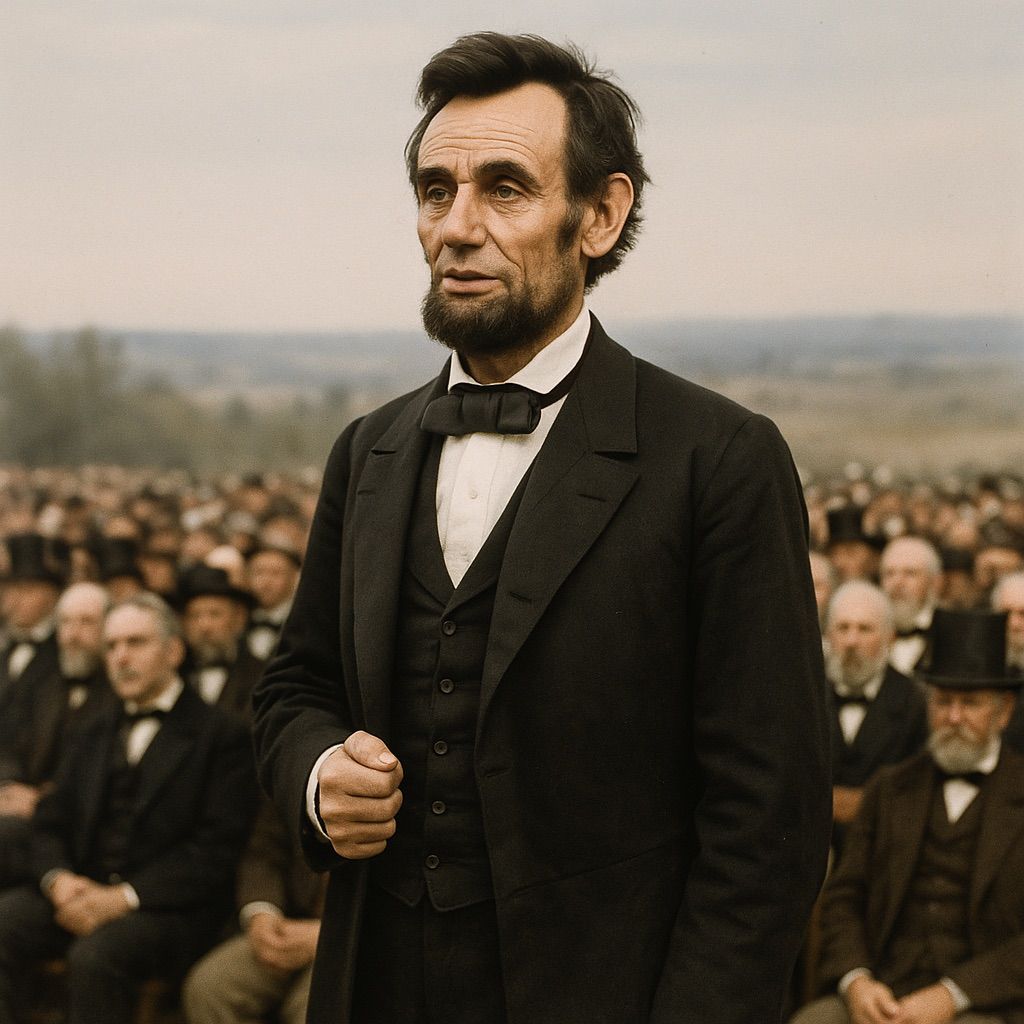
On November 19, 1863, Abraham Lincoln stepped onto a simple wooden platform in Gettysburg, Pennsylvania, carrying no grand entourage, no lengthy scroll, and no expectation that his words would echo across centuries. He had arrived not as the fiery orator many imagined a wartime president to be, but as a somber leader burdened by the weight of a nation tearing itself apart. The Civil War had already consumed tens of thousands of lives at Gettysburg alone, turning peaceful fields into vast burial grounds. That day, thousands gathered to consecrate part of that battlefield as a national cemetery. They expected the main address to come from Edward Everett, one of the most celebrated speakers in the country. Lincoln was there merely to “say a few appropriate remarks.” Few knew that those remarks would become one of the most powerful and enduring pieces of rhetoric in human history, stitched permanently into the fabric of American memory.

People who witnessed Lincoln’s arrival that cold November morning often recalled the contrast between the grandeur of the moment and the humility of the man. He was tall, almost awkwardly so, and his black suit hung on him like a borrowed garment. His face was worn from sleepless nights and relentless decisions, and his voice—contrary to the booming tones people expected from a leader—was higher and softer than many imagined. Yet when he began to speak, something remarkable happened. The crowd grew still, as if sensing they were in the presence of something much larger than a speech. Lincoln wasn’t there to celebrate victory or rally the troops. He wasn’t even there to explain the war. He came to define, in 272 words, what the nation was fighting for, and what it needed to become to deserve the sacrifices made on that battlefield.

The Gettysburg Address is often remembered as a perfect alignment of brevity and brilliance, a moment where clarity pierced through the fog of war. But understanding its power requires stepping into the emotional and historical landscape surrounding it. The nation had never been more fractured. Brother fought against brother. Neighbors turned into enemies. The very notion of the United States—plural or singular—hung in the balance. For Lincoln, the war was no longer just a conflict over territory or policy. It had become a test of whether democracy itself could survive internal destruction. The founding ideals of the nation—equality, liberty, self-government—were threatened. And so, rather than offering consolation, Lincoln offered a challenge—a call to the living to take up the unfinished work of those who died at Gettysburg and ensure that “government of the people, by the people, for the people, shall not perish from the earth.”

What made Lincoln’s address even more extraordinary was how deeply human it was. At a time when political speeches often ran for hours and overflowed with flamboyant metaphors, Lincoln chose simplicity. He spoke like a man standing beside the mourners, sharing in their grief rather than speaking above it. His choice of words was deliberate, unadorned, and accessible to every American—soldier or civilian, rich or poor, Northern or even Southern. He reached for the universal, anchoring his message in the promise of the Declaration of Independence rather than the complexities of wartime politics. It was as though he wanted to remind the nation of the moral compass it had set for itself eighty-seven years earlier. He knew that the country needed more than strategy; it needed purpose.

Yet even with that purpose, the moment was saturated with sorrow. Many in the crowd had lost brothers, fathers, sons. Others had simply grown weary of the relentless news of bloodshed. When Lincoln spoke of “the brave men, living and dead, who struggled here,” his words landed not as distant praise but as a personal acknowledgment of the cost being borne by ordinary families. The Civil War was not fought by faceless armies. It was fought by farmers, clerks, teachers, and laborers—by communities suddenly emptied of their young men. The cemetery around him was not symbolic; it was heartbreak made physical. Lincoln’s speech recognized that grief without exploiting it. He honored sacrifice without glorifying war. And in doing so, he connected the dead to the living in a way that felt almost spiritual.

There is a subtle brilliance in how Lincoln reframed the meaning of the battlefield that day. He insisted that the ground was already hallowed—not by speeches, but by the men who fought and fell there. This shift removed any sense of political or ceremonial self-importance. It placed honor squarely where it belonged: with those who gave what he called “the last full measure of devotion.” Lincoln was not elevating the Union cause at the expense of the Confederacy, nor was he diminishing the human tragedy behind the conflict. Instead, he transformed Gettysburg into a symbol of shared sacrifice and renewed hope. His words suggested that from the ashes of division, the nation could be reborn into something nobler and more just.

In many ways, the Gettysburg Address was a quiet revolution. Lincoln didn’t just reassure the nation; he redefined it. He expanded the idea of equality to include everyone—not just those the Founders originally had in mind. He subtly shifted the foundation of the country from the Constitution to the Declaration of Independence, elevating the principle that “all men are created equal” to a moral cornerstone. This was not accidental. Lincoln believed that the nation could endure only if it embraced the universality of human rights. Gettysburg gave him the platform to proclaim that belief in a way that would resonate across generations.

The speech also revealed Lincoln’s enduring faith in democracy, even as the war threatened to undermine it. He acknowledged that the experiment of self-government was fragile and uncertain. But instead of dwelling on the fear of failure, he called upon the people to prove democracy’s worth through action. The “unfinished work” he spoke of was more than the war itself; it was the ongoing effort to create a nation where freedom was real, and equality was more than a phrase. Lincoln believed that the sacrifices made at Gettysburg demanded not only remembrance but responsibility. They imposed an obligation on the living to build a country deserving of such courage.

What makes the Gettysburg Address timeless is its ability to feel intimate, no matter how many years pass. Students memorize it. Scholars analyze it. Presidents quote it. But beyond its historic and patriotic significance, it speaks to something deeply human—the longing for unity, the desire for purpose, the need to believe that suffering can lead to renewal. It reminds us that even in moments of despair, words can be a source of strength. They can guide, inspire, and heal. Lincoln’s voice, soft and humble, still carries across the decades because it speaks to the heart as much as to the mind.

The Legacy of the Gettysburg Address is not measured merely in textbooks or speeches but in the way it has shaped the American conscience. It has become a lens through which the nation examines itself—its ideals, its shortcomings, its ongoing struggles for justice. Every time the words are spoken, they ask us the same question Lincoln posed implicitly: Are we worthy of the sacrifices made by those who came before us? Are we committed to creating a more perfect union, one that truly embodies the principles of liberty and equality? These are not questions for government alone. They are questions for every citizen, every generation.

Standing on that battlefield, Lincoln could not have known that his 272 words would become immortal. He didn’t expect applause. He didn’t expect admiration. Many newspapers initially dismissed the speech as “silly,” “short,” or “inadequate.” But history has a way of rewarding clarity and purpose. As years passed, the true magnitude of his message became undeniable. Today, the Gettysburg Address stands not only as an emblem of American values but as one of the greatest articulations of democracy ever given.

And perhaps that is the most remarkable part of it all: that such immense meaning could come from such a modest moment. Lincoln’s speech reminds us that greatness does not always roar—it often whispers. It arrives in quiet resolve, in moments when the world seems too heavy, and in the belief that words can bind wounds and rebuild nations. The Gettysburg Address was more than a speech; it was a promise, a challenge, a prayer for a country in crisis. And its echo continues, urging each generation to rise, to strive, and to ensure that freedom’s flame never dims.

In the end, Lincoln gave the nation something far more enduring than consolation. He gave it a path forward. He offered a way to understand the war not just as a conflict of armies but as a test of character and principle. He acknowledged the pain of the past while lighting the way for the future. And he did it with a simplicity that made the message impossible to forget. “The world will little note, nor long remember what we say here,” he declared in a moment of profound humility. But as history has shown, the world remembered. It remembered because Lincoln captured the essence of what America was struggling to become—a nation reborn in the belief that liberty and equality are worth any sacrifice.

Even now, standing at the edge of that battlefield—whether in person or in imagination—you can almost hear Lincoln’s voice carried on the wind. You can feel the weight of his words, the gravity of the moment, the depth of the nation’s grief, and the hope embedded in its struggle. The Gettysburg Address endures because it speaks to the soul of a nation forever striving to live up to its highest ideals. It is a reminder that even in the darkest hours, vision and virtue can guide us home. It is the quiet thunder that reshaped America, a testament to the power of words to heal, to inspire, and to change the course of history.

Related Posts

The Women Who Marched Into Annapolis and Changed the U.S. Navy Forever

Elias Rowen

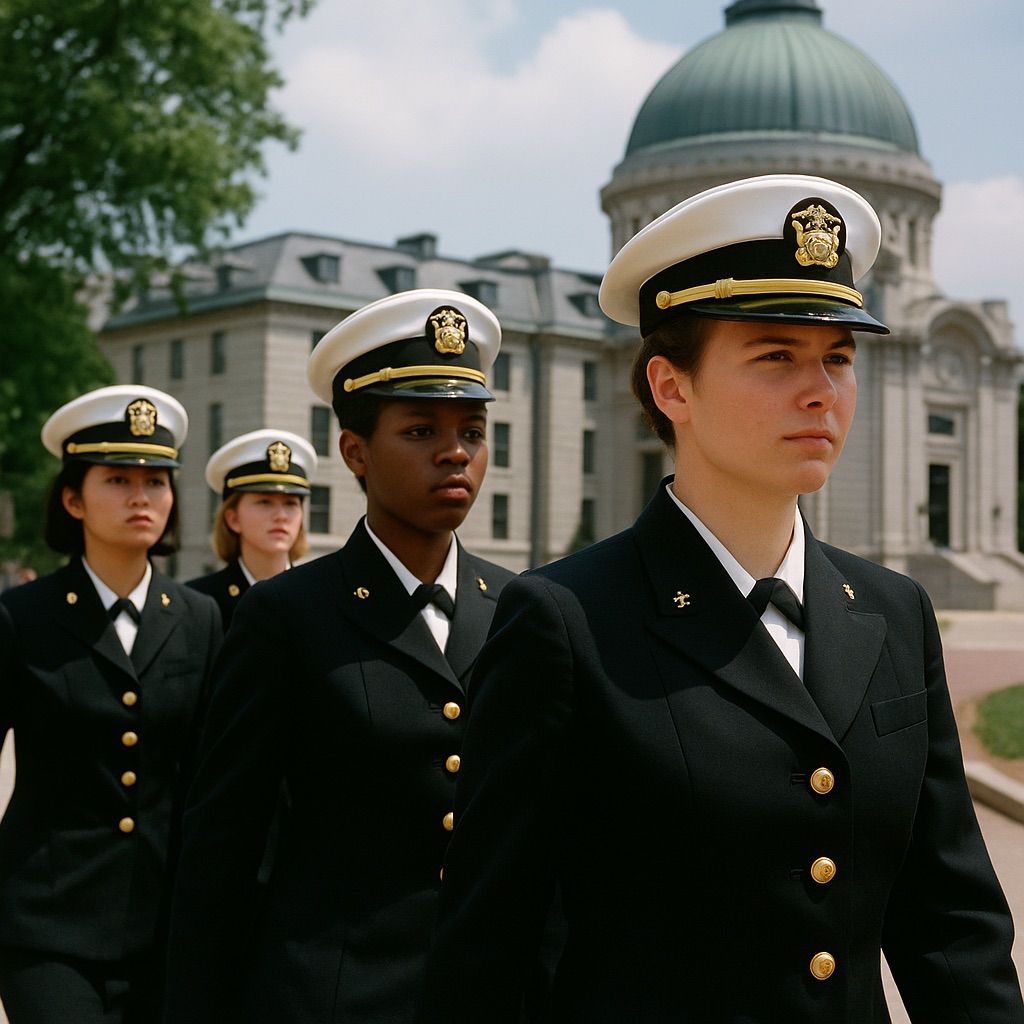
When the gates of the United States Naval Academy swung open on July 6, 1976, and the first class of women stepped onto the Yard in Annapolis, something fundamental in American military history shifted. It wasn’t a loud shift. There were no triumphant parades, no grand declarations, no booming speeches to commemorate the occasion. Instead, a quiet but powerful revolution unfolded as eighty-one young women walked into Bancroft Hall—some nervous, some determined, all painfully aware that every eye in the institution, and many across the nation, were watching them. These women were not only entering the Naval Academy; they were entering spaces and traditions that, for more than a century, had been reserved for men alone. And whether they intended to or not, they would become symbols of possibility, grit, and the relentless push toward equality in America’s armed forces.

It is easy from today’s vantage point to forget just how radical the idea was in 1976. The Naval Academy, founded in 1845, had existed for 131 years without a single female midshipman. Generations of officers had marched across its parade fields, studied navigation in its classrooms, braced through Plebe Summer, and served at sea, all without imagining a woman standing beside them wearing the same uniform. Military service for women existed, but it had always been limited—restricted roles, separate corps, invisible ceilings. The idea that women could train as future naval officers at Annapolis seemed, to many, like a disruption of the natural order. To others, like a long-overdue step toward justice. To the women who showed up that summer, it was both a challenge and a calling.

Most of the women who entered that first year had spent months preparing for what they knew would be an ordeal unlike anything they had experienced before. Plebe Summer was legendary for its intensity—yelling, drills, endless physical training, the buzzing pressure of upper-class midshipmen testing every mental seam and emotional joint. The academy didn’t water it down for the women. Why would they? The Navy wasn’t going to water down the fleet. And so those first days were a blur of shouted instructions, quick salutes, early wake-ups, and aching muscles. Some women arrived from military families, already familiar with discipline and hierarchy. Others came from small towns or city high schools where they were top of their class but had never stood face-to-face with a drill instructor. Some were athletes; some had never done a push-up under such scrutiny. But all arrived carrying a weight most male plebes didn’t: the pressure of proving that their entire gender belonged there.

Despite the official welcome, the atmosphere wasn’t always warm. Some male midshipmen resented the change. They said it ruined tradition, diluted the academy’s culture, or threatened the seriousness of naval training. A few expressed their disdain openly. Others showed it silently—in the way they looked past female midshipmen during formation, in the whispered remarks across the mess hall, in the skepticism that shadowed every one of the women’s movements. But there were allies too—upper-classmen who treated the women with professionalism, company officers determined to set the tone, and fellow plebes who realized quickly that the women were facing a tougher road than they were.

Still, the women endured the same rigors: the obstacle courses, the seamanship tests, the relentless memorization of Navy history, the forced marches, the midnight watches. And in meeting those demands, something remarkable happened. The academy, long famous for shaping men into officers, began shaping women into officers too—just as effectively, just as rigorously, and ultimately, just as proudly.

Behind every woman who made it through those first months was a private story. Some were driven by patriotism. Some were pushing against expectations from their own families. Some wanted to fly jets, command ships, or serve in submarines—dreams that were still decades away from being fully realized but already burning inside them. Others simply wanted to prove that they were capable of thriving in a place everyone said wasn’t built for them.

The public watched closely. Newspapers argued over whether women belonged in military academies. Editorial pages speculated about the academy’s future. Politicians made their speeches. But none of that captured the emotional reality of those women who were struggling every day simply to survive Plebe Year. They were exhausted, blistered, sleep-deprived, and constantly judged—not just on their performance, but on what their performance meant for every woman who might follow.

Some didn’t make it. Attrition hit the women’s ranks hard, just as it did the men. But those who remained grew tougher—physically, mentally, emotionally. They learned to bark commands with authority, to handle weapons with confidence, to navigate ships with precision, to stand firm when challenged. They learned to push through doubt, to drown out dismissive voices, to trust themselves even when others didn’t.

By the time they reached their second year, the academy began to change around them. The shock had faded. The skepticism dulled. And the women—through their competence and resilience—proved that they belonged. Their presence became less of an anomaly and more of a reality. They joined company leadership roles, excelled academically, earned respect from classmates who had once doubted them, and began laying the foundation for a future in which young women would walk through the academy gates without wondering whether they were intruding on forbidden ground.

Their graduation in 1980 marked a milestone not only for Annapolis but for the entire U.S. Navy. For the first time in American history, women were crossing the stage at the Naval Academy as fully trained officers—leaders ready to take on roles once thought impossible for them. They would eventually serve on combat ships, command naval units, become admirals, and even lead the academy itself. Every one of these achievements traces its roots back to the courage and persistence of those eighty-one trailblazers in 1976.

But the story of the first women at Annapolis is not a story of instant acceptance. It is a story of friction, of constant proving, of quiet strength under immense pressure. It is a story of individuals learning to exist in a system that wasn’t built for them, and then slowly reshaping that system through their presence, their discipline, and their performance. It is the story of a moment when the Navy, and the nation, began to recognize that leadership, intelligence, courage, and dedication are not bound by gender.

Today, more than forty years later, women make up a significant percentage of each incoming class. They lead companies, run drills, serve as brigade commanders. They stand in the same uniforms, march across the same parade fields, and sleep in the same dorms as the men—all without the shock, scrutiny, or suspicion their predecessors endured. But the legacy of the first women remains, woven into the academy’s culture and strengthened with every new class that arrives.

Those first eighty-one midshipmen didn’t just enter the Naval Academy—they cracked it open. They redefined who could serve, who could lead, and who could wear the uniform. They showed the nation what was possible when barriers fall, when courage overrides tradition, and when those who have been excluded are finally allowed to participate fully.

Their story is one of discipline and sweat, yes—but also of hope. Hope that institutions can change. Hope that opportunity can expand. Hope that equality can become real, even in places where it once seemed impossible. Their march through the gates in 1976 was more than the beginning of a class; it was the beginning of a transformation that continues to shape the U.S. Navy today.

And it all started because, on a hot July morning, a small group of determined young women straightened their shoulders, tightened their laces, and took the first steps into a future they would forever change.

Related Posts

Jonestown and the Final Descent of the Peoples Temple

Elias Rowen

The Jonestown Massacre stands as one of the most haunting and emotionally devastating tragedies of the 20th century. More than 900 people—men, women, children, the elderly, entire families, entire futures—lost their lives in a remote commune deep within the jungles of Guyana on November 18, 1978. It is a story so heartbreaking, so staggering in scale, that it defies easy explanation. At its center was a man, Jim Jones, whose rise from charismatic preacher to authoritarian cult leader unfolded over years with eerie subtlety, culminating in the deadliest single loss of American civilian life in a non-natural disaster prior to September 11, 2001. The massacre was not a sudden eruption of violence but the culmination of fear, hope, manipulation, idealism, and despair woven together into a catastrophic human tragedy. To revisit Jonestown is to confront the fragile line between faith and coercion, community and control, trust and terror—and to remember the humanity of the victims who became lost beneath the dark shadow of their leader’s final command.

The origins of Jonestown lie not in a distant jungle, but in the United States, where Jim Jones began his career as a preacher and activist devoted, at least on the surface, to racial equality and social justice. In the 1950s and 60s, Jones built the Peoples Temple as a racially integrated congregation at a time when such inclusivity was radical and often unwelcome. Many early members genuinely believed they had found a spiritual home unlike any other—a place where barriers of class, race, and background dissolved in the conviction that humanity could transcend its divisions. For African Americans facing discrimination, for young idealists yearning for social change, for the elderly seeking community, Jones offered belonging and purpose.

He was intelligent, magnetic, and relentlessly progressive in his public persona. The Peoples Temple engaged in charitable work, supported the poor, and promoted civil rights. Jones’s sermons were fiery and emotional, weaving scripture with political rhetoric and calls for justice. But beneath the veneer of benevolence, darker patterns were already emerging. Jones demanded loyalty. He tested boundaries. He framed criticism as persecution. And he increasingly positioned himself not only as a pastor, but as an indispensable savior.

Those who joined the Peoples Temple rarely saw themselves as entering a cult. They saw a movement, a family, a chance to build a better world. And Jones cultivated this belief with skill, mingling genuine good works with manipulation. He encouraged confessions, blurred personal boundaries, enforced communal living, and gradually detached members from outside influences. Critics saw signs of danger; followers saw signs of devotion.

By the early 1970s, Jones had relocated the Peoples Temple to California, gaining political influence and expanding his organization. Yet scandals multiplied—allegations of abuse, financial exploitation, staged healings, and erratic behavior by Jones himself. Facing mounting scrutiny, Jones sought a place where he could exert total control, free from the media, authorities, and defectors he believed threatened his vision.

He found that place in the jungle of Guyana.

What began as the Jonestown Agricultural Project was marketed as a utopia—a socialist paradise where members could live in equality, free from racism and capitalism. But what emerged was far more complex and ultimately catastrophic. When the first settlers arrived, they found jungle soil difficult to farm, supplies insufficient, and infrastructure rudimentary. Yet there was still hope, still idealism. People built homes, planted crops, and forged friendships. Many truly wanted Jonestown to succeed.

But as Jones arrived, the settlement changed. The tropical heat made his health decline. His paranoia intensified. His reliance on drugs deepened. Loudspeakers carried his voice throughout the settlement day and night, delivering sermons, warnings, and monologues. Armed guards patrolled the perimeter. Passports and medications were confiscated. Letters were censored. Members were subjected to humiliation, forced labor, and “punishment drills” designed to break their will.

For many, leaving Jonestown became impossible—not only logistically, but psychologically. Families feared being separated. Defectors were branded traitors. Jones portrayed the outside world as a hellscape of racism, fascism, and conspiracies waiting to destroy them. Life in Jonestown became a mixture of genuine community and absolute control, of hopeful dreams and crushing despair.

By 1978, concerned relatives and former members pushed U.S. authorities to investigate. Congressman Leo Ryan, known for his willingness to take bold action, decided to travel to Guyana and see the commune for himself. His arrival on November 17 shook Jonestown to its core. For the first time, an external force—a symbol of American authority—had entered the isolated world Jones had created. The visit began amicably but quickly turned chaotic. Defectors approached Ryan’s team pleading for escape. Jones, increasingly unstable, felt his control slipping away.

On November 18, as Ryan and the defectors prepared to return to the airstrip at Port Kaituma, gunmen from Jonestown ambushed them. Ryan and four others were killed. The attack marked the point of no return. Jones, convinced that external forces would now destroy him and his movement, gathered the residents of Jonestown in the main pavilion. What happened next was not sudden, but deeply orchestrated—a ritual Jones had rehearsed in “White Nights,” drills where followers practiced mass suicide to prove their devotion.

That day, it became real.

Jones delivered a speech urging “revolutionary suicide,” insisting that death was preferable to life under oppression. Disoriented by fear, exhaustion, manipulation, and the chaos of the attack, hundreds complied. Mothers gave poison-laced drink to their children. Entire families collapsed together. Some resisted, some were forced, and others felt trapped by the crushing psychological pressure of the moment. By the end, more than 900 people were dead—including over 300 children.

The image of bodies scattered across the pavilion, lying peacefully or clutched together, became one of the most chilling photographs in American history. It symbolized the devastating power of coercion, the fragility of human vulnerability, and the catastrophic consequences of unchecked authoritarianism. Yet behind every figure in that image was a life—rich, complex, hopeful, human. Many victims were idealists who joined the Peoples Temple believing they were building a better world. Their humanity deserves remembrance beyond the horror of their final hours.

The aftermath of Jonestown reverberated across the world. Families mourned loved ones whose deaths were incomprehensible. Governments reexamined how they monitor closed religious groups. Sociologists, psychologists, and theologians debated how otherwise ordinary people could be drawn into such a situation. And media coverage often sensationalized the tragedy, overshadowing the deeper systemic failures and the emotional realities of the victims.

Jonestown became a cautionary symbol—an example invoked in any discussion of cults, coercion, or blind obedience. Yet such simplifications risk losing the nuance of how the tragedy unfolded. The people of Jonestown were not foolish or weak. They were human beings who sought belonging, justice, equality, and purpose. They were vulnerable to manipulation because they believed in something better. Jones preyed on that belief.

Understanding Jonestown requires empathy—not for its leader, but for its victims. Their story illustrates how hope can be weaponized, how fear can bind people, and how charismatic authority can warp even the noblest intentions. It is a reminder that the line between empowerment and exploitation is thin, and that communities built on love can be twisted into instruments of control when trust is abused.

More than four decades later, Jonestown remains an emotional wound—a tragedy that defies easy categorization. It is a story of idealism corrupted, of leadership gone grotesquely wrong, of families destroyed, of systems that failed to intervene in time. But it is also a story about the resilience of survivors, the courage of defectors who tried to warn the world, and the importance of vigilance in the face of manipulation.

The victims of Jonestown deserve to be remembered not solely for how they died, but for how they lived—their hopes, their dreams, their belief that a more just world was possible. Their tragedy teaches us not to mock, but to understand. Not to simplify, but to reflect. Not to forget, but to honor.

Jonestown is a warning, a lesson, and a memorial all at once. And though the final hours were filled with fear, the lives lost deserve to be remembered with dignity, humanity, and compassion. Their story is part of our shared history—a reminder of both the power of community and the dangers that arise when trust becomes ensnared in authoritarian control.

It is a tragedy that shook a nation and reshaped how society understands the vulnerability of the human heart. The Jonestown Massacre was not just an event—it was a reckoning with the darkest possibilities of misguided devotion, and a call to guard against the forces that exploit hope for destructive ends. It remains, to this day, one of the most painful chapters in modern history—but one that must be confronted, remembered, and learned from so that its lessons endure long beyond its sorrow.

Related Posts