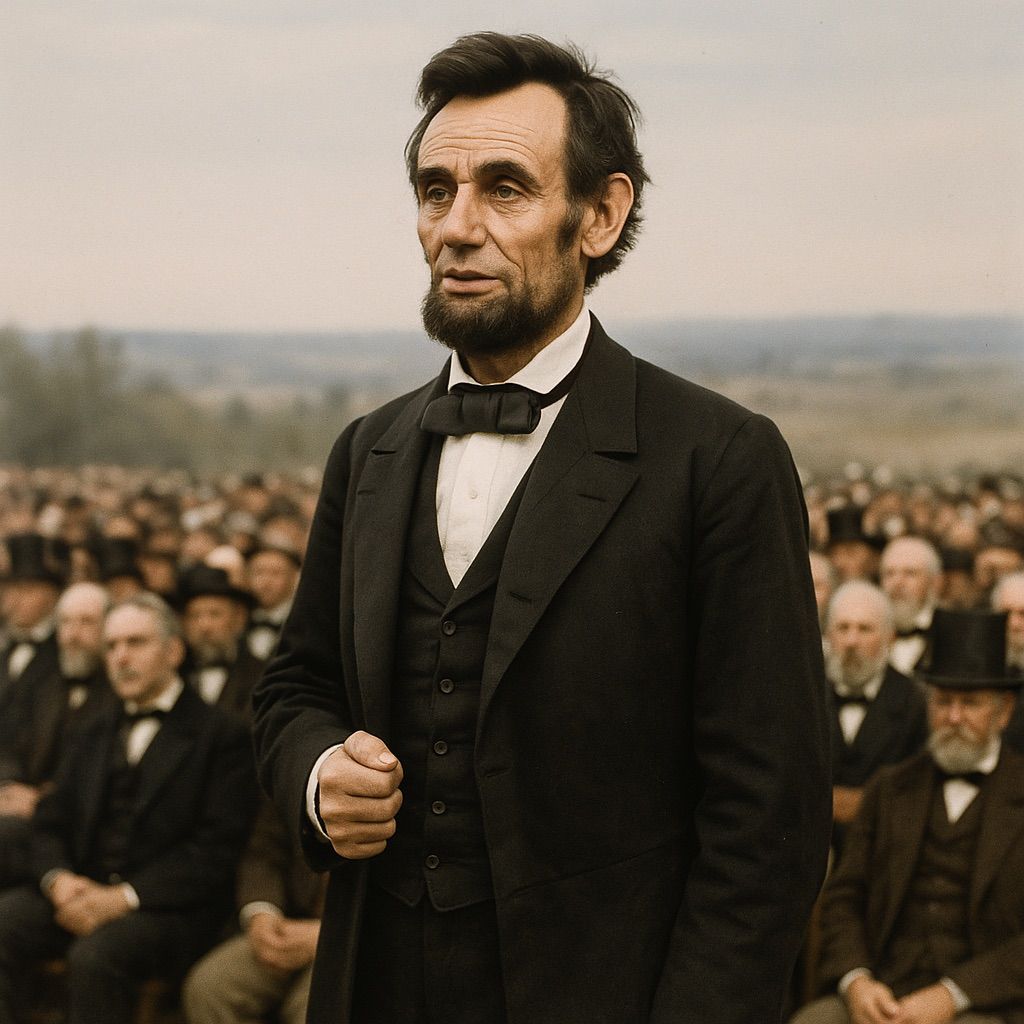
On November 19, 1863, Abraham Lincoln stepped onto a simple wooden platform in Gettysburg, Pennsylvania, carrying no grand entourage, no lengthy scroll, and no expectation that his words would echo across centuries. He had arrived not as the fiery orator many imagined a wartime president to be, but as a somber leader burdened by the weight of a nation tearing itself apart. The Civil War had already consumed tens of thousands of lives at Gettysburg alone, turning peaceful fields into vast burial grounds. That day, thousands gathered to consecrate part of that battlefield as a national cemetery. They expected the main address to come from Edward Everett, one of the most celebrated speakers in the country. Lincoln was there merely to “say a few appropriate remarks.” Few knew that those remarks would become one of the most powerful and enduring pieces of rhetoric in human history, stitched permanently into the fabric of American memory.
People who witnessed Lincoln’s arrival that cold November morning often recalled the contrast between the grandeur of the moment and the humility of the man. He was tall, almost awkwardly so, and his black suit hung on him like a borrowed garment. His face was worn from sleepless nights and relentless decisions, and his voice—contrary to the booming tones people expected from a leader—was higher and softer than many imagined. Yet when he began to speak, something remarkable happened. The crowd grew still, as if sensing they were in the presence of something much larger than a speech. Lincoln wasn’t there to celebrate victory or rally the troops. He wasn’t even there to explain the war. He came to define, in 272 words, what the nation was fighting for, and what it needed to become to deserve the sacrifices made on that battlefield.
The Gettysburg Address is often remembered as a perfect alignment of brevity and brilliance, a moment where clarity pierced through the fog of war. But understanding its power requires stepping into the emotional and historical landscape surrounding it. The nation had never been more fractured. Brother fought against brother. Neighbors turned into enemies. The very notion of the United States—plural or singular—hung in the balance. For Lincoln, the war was no longer just a conflict over territory or policy. It had become a test of whether democracy itself could survive internal destruction. The founding ideals of the nation—equality, liberty, self-government—were threatened. And so, rather than offering consolation, Lincoln offered a challenge—a call to the living to take up the unfinished work of those who died at Gettysburg and ensure that “government of the people, by the people, for the people, shall not perish from the earth.”
What made Lincoln’s address even more extraordinary was how deeply human it was. At a time when political speeches often ran for hours and overflowed with flamboyant metaphors, Lincoln chose simplicity. He spoke like a man standing beside the mourners, sharing in their grief rather than speaking above it. His choice of words was deliberate, unadorned, and accessible to every American—soldier or civilian, rich or poor, Northern or even Southern. He reached for the universal, anchoring his message in the promise of the Declaration of Independence rather than the complexities of wartime politics. It was as though he wanted to remind the nation of the moral compass it had set for itself eighty-seven years earlier. He knew that the country needed more than strategy; it needed purpose.
Yet even with that purpose, the moment was saturated with sorrow. Many in the crowd had lost brothers, fathers, sons. Others had simply grown weary of the relentless news of bloodshed. When Lincoln spoke of “the brave men, living and dead, who struggled here,” his words landed not as distant praise but as a personal acknowledgment of the cost being borne by ordinary families. The Civil War was not fought by faceless armies. It was fought by farmers, clerks, teachers, and laborers—by communities suddenly emptied of their young men. The cemetery around him was not symbolic; it was heartbreak made physical. Lincoln’s speech recognized that grief without exploiting it. He honored sacrifice without glorifying war. And in doing so, he connected the dead to the living in a way that felt almost spiritual.
There is a subtle brilliance in how Lincoln reframed the meaning of the battlefield that day. He insisted that the ground was already hallowed—not by speeches, but by the men who fought and fell there. This shift removed any sense of political or ceremonial self-importance. It placed honor squarely where it belonged: with those who gave what he called “the last full measure of devotion.” Lincoln was not elevating the Union cause at the expense of the Confederacy, nor was he diminishing the human tragedy behind the conflict. Instead, he transformed Gettysburg into a symbol of shared sacrifice and renewed hope. His words suggested that from the ashes of division, the nation could be reborn into something nobler and more just.
In many ways, the Gettysburg Address was a quiet revolution. Lincoln didn’t just reassure the nation; he redefined it. He expanded the idea of equality to include everyone—not just those the Founders originally had in mind. He subtly shifted the foundation of the country from the Constitution to the Declaration of Independence, elevating the principle that “all men are created equal” to a moral cornerstone. This was not accidental. Lincoln believed that the nation could endure only if it embraced the universality of human rights. Gettysburg gave him the platform to proclaim that belief in a way that would resonate across generations.
The speech also revealed Lincoln’s enduring faith in democracy, even as the war threatened to undermine it. He acknowledged that the experiment of self-government was fragile and uncertain. But instead of dwelling on the fear of failure, he called upon the people to prove democracy’s worth through action. The “unfinished work” he spoke of was more than the war itself; it was the ongoing effort to create a nation where freedom was real, and equality was more than a phrase. Lincoln believed that the sacrifices made at Gettysburg demanded not only remembrance but responsibility. They imposed an obligation on the living to build a country deserving of such courage.
What makes the Gettysburg Address timeless is its ability to feel intimate, no matter how many years pass. Students memorize it. Scholars analyze it. Presidents quote it. But beyond its historic and patriotic significance, it speaks to something deeply human—the longing for unity, the desire for purpose, the need to believe that suffering can lead to renewal. It reminds us that even in moments of despair, words can be a source of strength. They can guide, inspire, and heal. Lincoln’s voice, soft and humble, still carries across the decades because it speaks to the heart as much as to the mind.
The Legacy of the Gettysburg Address is not measured merely in textbooks or speeches but in the way it has shaped the American conscience. It has become a lens through which the nation examines itself—its ideals, its shortcomings, its ongoing struggles for justice. Every time the words are spoken, they ask us the same question Lincoln posed implicitly: Are we worthy of the sacrifices made by those who came before us? Are we committed to creating a more perfect union, one that truly embodies the principles of liberty and equality? These are not questions for government alone. They are questions for every citizen, every generation.
Standing on that battlefield, Lincoln could not have known that his 272 words would become immortal. He didn’t expect applause. He didn’t expect admiration. Many newspapers initially dismissed the speech as “silly,” “short,” or “inadequate.” But history has a way of rewarding clarity and purpose. As years passed, the true magnitude of his message became undeniable. Today, the Gettysburg Address stands not only as an emblem of American values but as one of the greatest articulations of democracy ever given.
And perhaps that is the most remarkable part of it all: that such immense meaning could come from such a modest moment. Lincoln’s speech reminds us that greatness does not always roar—it often whispers. It arrives in quiet resolve, in moments when the world seems too heavy, and in the belief that words can bind wounds and rebuild nations. The Gettysburg Address was more than a speech; it was a promise, a challenge, a prayer for a country in crisis. And its echo continues, urging each generation to rise, to strive, and to ensure that freedom’s flame never dims.
In the end, Lincoln gave the nation something far more enduring than consolation. He gave it a path forward. He offered a way to understand the war not just as a conflict of armies but as a test of character and principle. He acknowledged the pain of the past while lighting the way for the future. And he did it with a simplicity that made the message impossible to forget. “The world will little note, nor long remember what we say here,” he declared in a moment of profound humility. But as history has shown, the world remembered. It remembered because Lincoln captured the essence of what America was struggling to become—a nation reborn in the belief that liberty and equality are worth any sacrifice.
Even now, standing at the edge of that battlefield—whether in person or in imagination—you can almost hear Lincoln’s voice carried on the wind. You can feel the weight of his words, the gravity of the moment, the depth of the nation’s grief, and the hope embedded in its struggle. The Gettysburg Address endures because it speaks to the soul of a nation forever striving to live up to its highest ideals. It is a reminder that even in the darkest hours, vision and virtue can guide us home. It is the quiet thunder that reshaped America, a testament to the power of words to heal, to inspire, and to change the course of history.