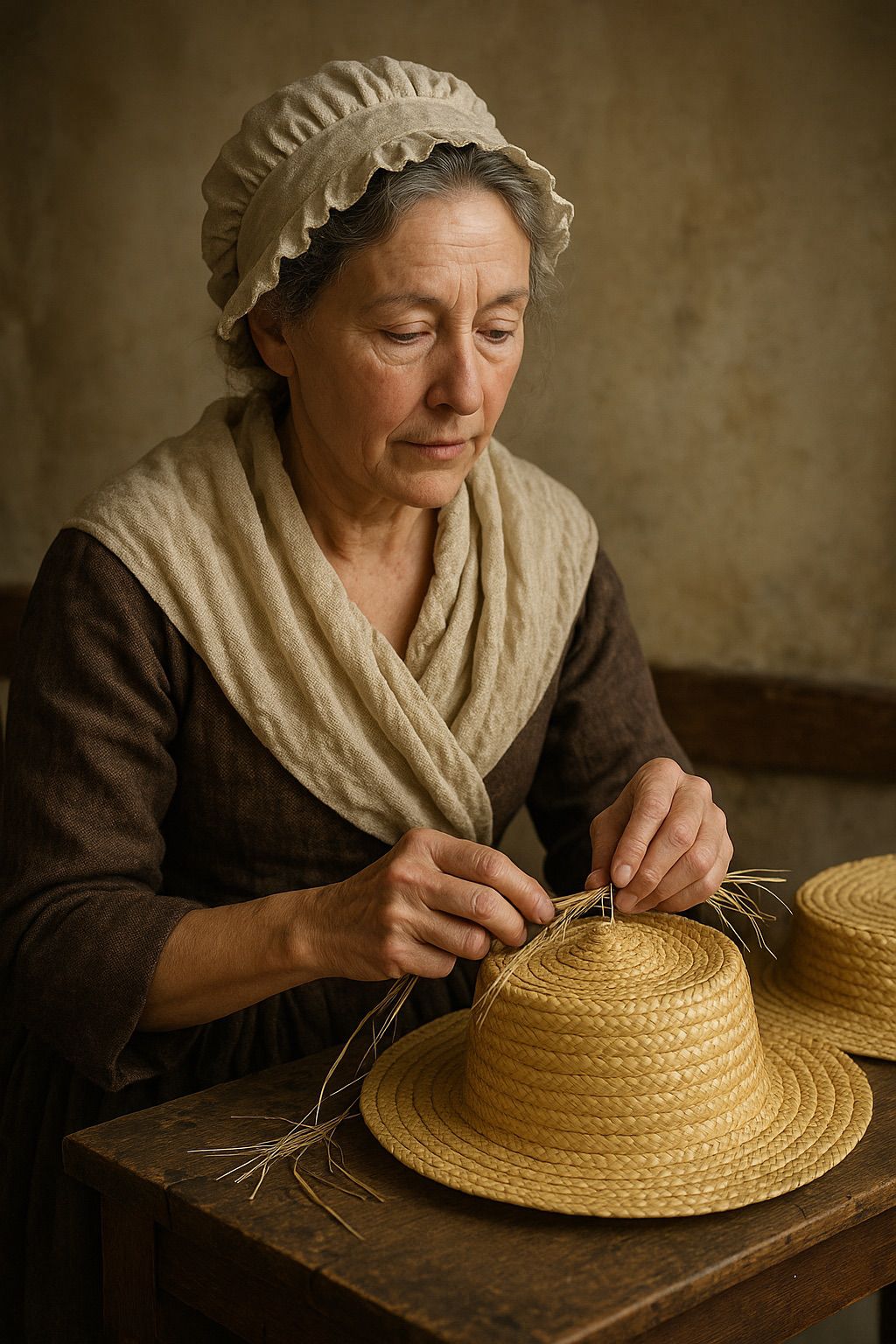
In the late 18th century, the United States was still a young nation, finding its footing after breaking free from British rule. The new country was a patchwork of diverse people and ideas, united by ambition and innovation. Among these early pioneers was Mary Kies, an English-born American who would make history as the first woman to receive a U.S. patent.
Kies’ contribution came from a simple yet transformative idea. In an era when straw hats were both fashionable and essential, their production was tedious and often poorly executed. Kies, an experienced seamstress familiar with straw work, devised a new way to weave straw more efficiently. Her method used thin wire to hold the straw steady while it was woven, allowing for cleaner, faster, and more consistent results. This seemingly small improvement would revolutionize an entire industry.
Her ingenuity caught the attention of Oliver Pollock, a notable figure in the early American economy who recognized the potential of her technique. With his encouragement, Kies submitted a detailed application for a “letters patent” in 1790, outlining her innovative straw-weaving method. At the time, applying for a patent was no easy feat—especially for a woman. The young nation’s government was still organizing itself, drafting laws, and defining systems of trade and property. Yet Kies persevered through the slow, bureaucratic process, driven by a quiet confidence in her invention.
On July 30, 1790, her persistence paid off. Mary Kies became the first woman in America to be granted a U.S. patent. Her success was not just a personal triumph—it was a landmark moment for women in business and innovation. Her achievement sent a clear message that women, too, could contribute meaningfully to the country’s economic and creative life.
The impact of Kies’ work extended beyond the straw hat trade. Her patent symbolized the dawn of a more inclusive era in American enterprise—one in which innovation was not bound by gender. At a time when women were largely confined to domestic roles, Kies’ recognition demonstrated that intellect, skill, and determination could transcend social limitations. It helped open the door for future generations of female inventors and entrepreneurs.
As her reputation grew, so did the influence of her ideas. Manufacturers across the colonies adopted her technique, improving both productivity and quality in hat making. The method she pioneered helped fuel growth in the textile and garment industries, which became key pillars of early American commerce. Her work also reflected broader cultural shifts, as more women began contributing to trade, agriculture, and craftsmanship in meaningful ways.
Kies’ story is as much about perseverance as it is about invention. She faced long delays, limited opportunities, and societal skepticism—but she refused to give up. Her journey embodies the spirit of early American innovation: relentless, resourceful, and forward-thinking. In the decades that followed, her success inspired others to challenge conventions and claim their place in shaping the nation’s future.
Her legacy is especially powerful when viewed through the lens of history. The late 18th and early 19th centuries marked a period of transition in women’s rights and visibility. Kies’ patent became both a symbol and a catalyst for change, encouraging more women to explore fields once considered off-limits. Innovators who followed—like Elizabeth Lee Hazen in microbiology and Mildred Cohn in biochemistry—would continue to build upon the path she helped clear.
Today, Mary Kies is remembered not just as a figure of technical innovation but as a pioneer of possibility. Her story underscores how progress often begins quietly—with one person’s idea, one act of courage, one refusal to accept limitations. By proving that women could innovate and be recognized for their work, Kies helped shape the foundation of an America driven by creativity and equality.
As we reflect on her life, we are reminded that true progress requires both imagination and persistence. Mary Kies’ invention may have started with a strand of straw, but its impact wove through the very fabric of American history. Her legacy endures as a testament to the ingenuity and resilience that continue to define the American spirit.