Latest Articles

A Call to Serve: How JFK’s Peace Corps Changed the World

Elias Rowen

On March 1, 1961, President John F. Kennedy signed an executive order establishing the Peace Corps, a groundbreaking initiative that would forever change the landscape of international volunteerism. The idea was simple yet profound: send American volunteers abroad to promote peace and friendship by assisting in education, health care, agriculture, and other critical sectors. Kennedy believed that by fostering mutual understanding and cooperation, the United States could not only help developing nations but also build bridges of goodwill across cultural divides.

The Peace Corps was more than just a humanitarian effort—it was a bold declaration of America’s commitment to the world. At a time when Cold War tensions were high, Kennedy envisioned a program that would showcase the best of American values through action rather than rhetoric. The initiative quickly gained popularity, attracting thousands of young, idealistic volunteers eager to make a difference. These individuals, known as Peace Corps Volunteers, embarked on life-changing journeys to remote villages and bustling cities, offering their skills and compassion to communities in need.

Over the decades, the Peace Corps has had a lasting impact, both abroad and at home. Volunteers have helped build schools, teach English, provide medical care, and introduce sustainable farming techniques. In return, they have gained invaluable insights into different cultures, fostering global empathy and understanding. Many returned home with a renewed sense of purpose, going on to become leaders in politics, education, and social activism.

Today, the Peace Corps remains a symbol of service and diplomacy, proving that one person’s efforts can ripple across the globe. Kennedy’s vision endures, reminding us that true leadership is not about power, but about the willingness to serve others. In an era where global challenges continue to demand cooperation, the legacy of the Peace Corps serves as a powerful testament to the impact of volunteerism and cross-cultural exchange.


Related Posts

The Fearsome Legacy of Blackbeard: Thomas Cavendish

Dave

The high seas of the late 16th century were filled with danger, adventure, and men who sought fortune through cunning and violence. Among them was Thomas Cavendish, an English privateer turned pirate, who carved his name into maritime history with his daring exploits. Unlike the infamous Blackbeard of the 18th century, Cavendish was a refined yet ruthless navigator, known for his bold raids against Spanish ships and his ambitious circumnavigation of the globe.

Born into a wealthy English family in 1560, Cavendish sought adventure beyond the rigid confines of nobility. Inspired by Sir Francis Drake, he set sail in 1586 on a journey that would make him one of the most feared and successful pirates of his time. His most famous conquest came in 1587 when he captured the Spanish galleon Santa Ana off the coast of California. Laden with treasures of gold, silk, and spices, the ship was a prize that solidified his reputation as a daring and cunning seafarer.

Cavendish’s triumphs, however, were short-lived. After returning to England a hero, he set out on another voyage in 1591, hoping to repeat his success. This time, fate was not on his side. His fleet suffered from harsh conditions, disease, and mutiny. Struggling against the elements and dwindling supplies, Cavendish met his end at sea, his body never recovered.

Though his life was brief, Cavendish’s legacy remains one of audacity and adventure. He embodied the spirit of the Golden Age of Piracy, where fortune favored the bold and the sea belonged to those brave enough to claim it. His name may not be as infamous as Blackbeard’s, but his impact on naval history is undeniable.

Related Posts

A Nation in Shock: The Assassination of Olof Palme

Elias Rowen

On the night of February 28, 1986, Sweden was shaken to its core when Prime Minister Olof Palme was assassinated on a Stockholm street. Palme, known for his strong stance on social justice, disarmament, and international diplomacy, was walking home from a movie with his wife when he was fatally shot. The attack was as brazen as it was shocking—Sweden’s head of government, who famously refused security protection, was gunned down in public, leaving a stunned nation grappling with grief and unanswered questions.

Palme’s murder sent shockwaves beyond Sweden. He was a vocal critic of apartheid in South Africa, U.S. involvement in Vietnam, and Soviet aggression, earning both admirers and adversaries worldwide. His leadership embodied Sweden’s neutral but active role in global politics. In the wake of his assassination, a massive investigation unfolded, but years of inquiries, false leads, and conspiracy theories only deepened the mystery. It wasn’t until 2020 that Swedish authorities pointed to Stig Engström, a graphic designer, as the likely suspect—though by then, he had already passed away, leaving the case without definitive closure.

Palme’s legacy remains strong. His vision for a more equal and peaceful world continues to inspire political leaders and activists today. While his death left a void in Swedish politics, it also underscored the importance of standing up for justice, no matter the risks. More than three decades later, Sweden still remembers the night it lost a leader who dared to challenge the status quo.

Related Posts

Unlocking Life’s Blueprint: Watson and Crick’s Discovery of DNA’s Double Helix

Elias Rowen

In 1953, James Watson and Francis Crick made a discovery that changed the course of science forever: the structure of DNA. Their breakthrough revealed that DNA is shaped like a twisted ladder, known as a double helix. This discovery was more than just a scientific revelation; it was the key to understanding how life is passed down from generation to generation. By unraveling DNA’s structure, Watson and Crick provided insight into genetics, hereditary diseases, and the fundamental blueprint of all living organisms.

The road to this momentous finding was paved by the work of other scientists, particularly Rosalind Franklin and Maurice Wilkins. Franklin’s X-ray diffraction images were crucial in confirming DNA’s helical shape, though her contributions were often overlooked at the time. When Watson and Crick combined these insights with their own research, they proposed that DNA is made up of two strands, held together by specific base-pairing rules: adenine pairs with thymine, and cytosine pairs with guanine. This structure explained how genetic information could be copied precisely, ensuring that life’s instructions were passed along accurately.

The impact of their discovery was profound. It set the foundation for modern genetics, leading to revolutionary advancements such as the Human Genome Project, gene therapy, and CRISPR gene editing. Understanding DNA has enabled scientists to develop treatments for genetic disorders, improve forensic science, and even enhance agricultural practices. In essence, the double helix has shaped the way we approach biology and medicine.

Looking back, the discovery of DNA’s structure stands as one of the greatest achievements in scientific history. It reminds us of the power of curiosity, collaboration, and perseverance. Today, as genetic research continues to push boundaries, we owe much of our understanding to that pivotal moment in 1953 when Watson and Crick unlocked the secret of life itself.

Related Posts

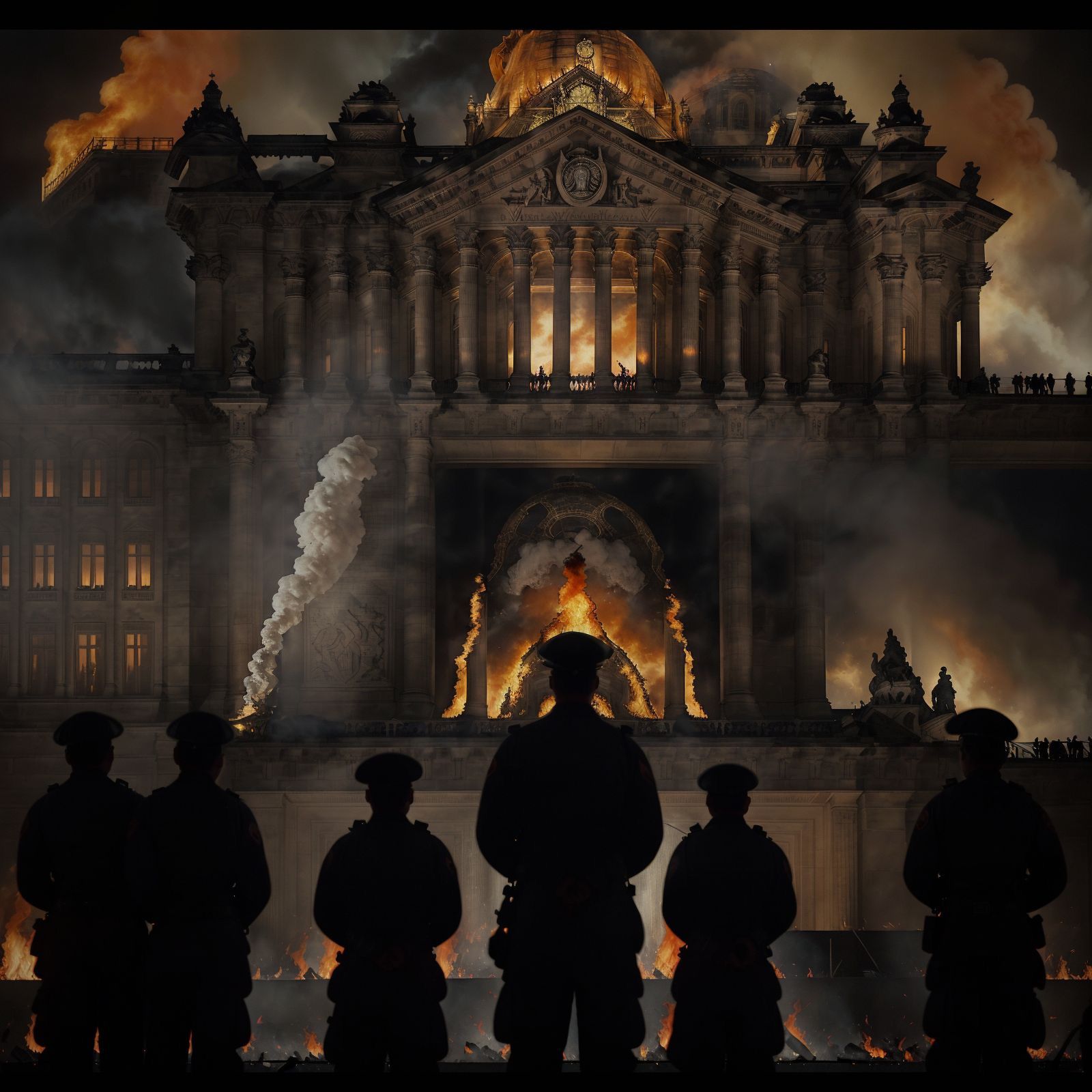
The Reichstag Fire: A Spark That Ignited a Dictatorship

Elias Rowen

On the night of February 27, 1933, flames engulfed Germany’s Reichstag building, a pivotal moment that altered the course of history. The fire, which destroyed the seat of the German parliament in Berlin, became the catalyst Adolf Hitler and the Nazi Party needed to consolidate their grip on power. Although the true cause of the fire remains debated, the Nazis wasted no time in blaming communists, using the event as a pretext to crack down on political opposition and dismantle democratic institutions.

In the immediate aftermath, President Paul von Hindenburg, under Hitler’s urging, signed the Reichstag Fire Decree. This decree suspended civil liberties, allowing the government to arrest political adversaries, suppress dissent, and control the press. In a matter of weeks, thousands of communists, socialists, and other perceived enemies of the Nazi regime were imprisoned or eliminated, silencing any opposition. This moment marked a significant turning point, setting the stage for Hitler’s totalitarian rule and the eventual horrors of World War II.

The Reichstag Fire was more than just an act of arson; it was a masterstroke of political manipulation. The Nazis used fear and propaganda to convince the German people that extreme measures were necessary for national security. This tactic of exploiting crises to justify authoritarian control is a stark reminder of how fragile democracy can be in the face of unchecked power.

Nearly a century later, the events surrounding the Reichstag Fire continue to serve as a cautionary tale about the dangers of political extremism and manufactured crises. It underscores the importance of vigilance in defending democratic values and resisting efforts to erode civil liberties in the name of security. History has shown that when fear overrides freedom, the consequences can be devastating.

Related Posts