Latest Articles

I’m Starting to Suspect Pandora’s Hiding Something in Plain Sight

Hal

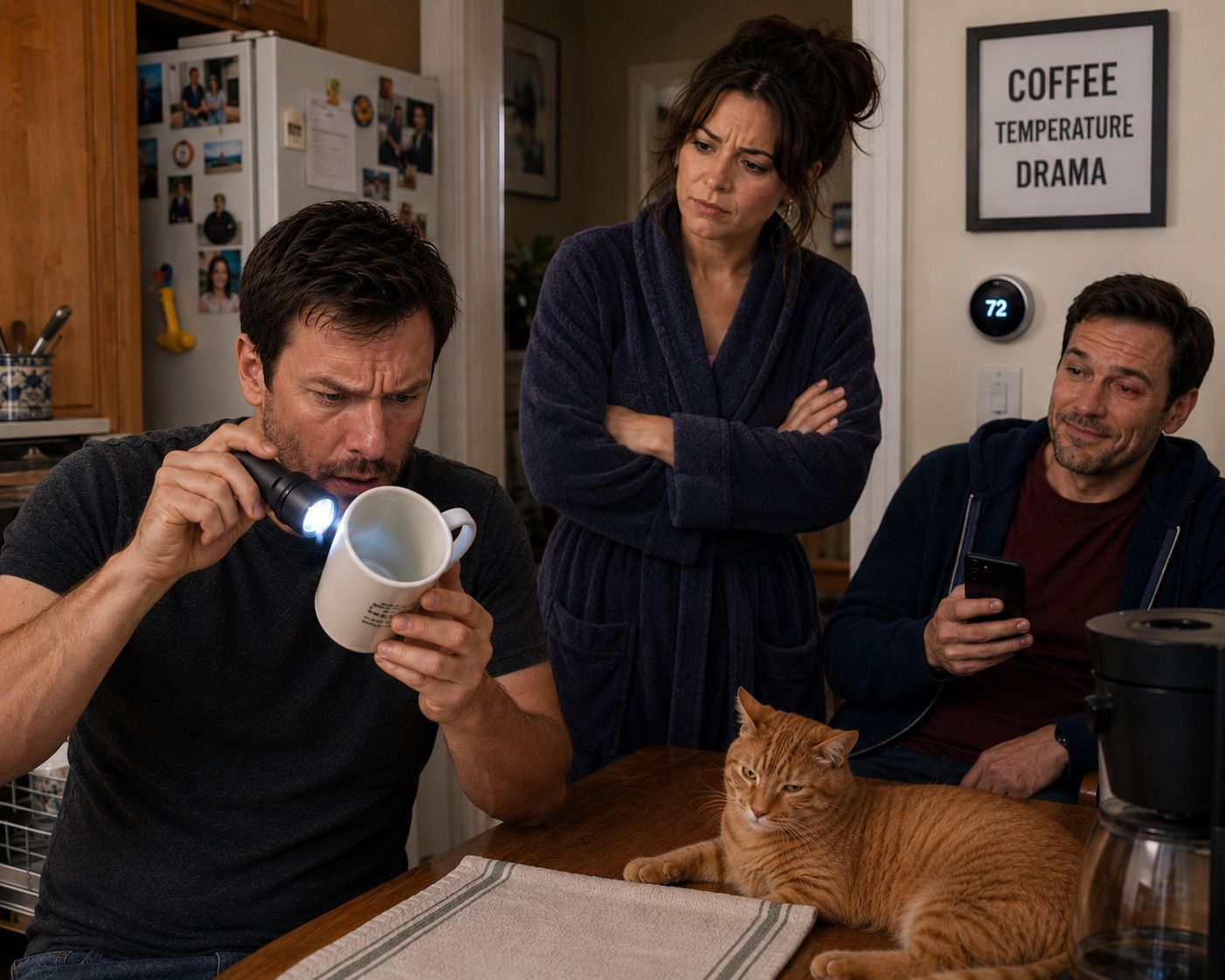
I was making a cup of tea when I noticed Pandora’s favorite mug sitting in the dishwasher. Ordinarily, this would not qualify as an event. Mugs go into dishwashers. That is, as I understand it, one of the principal reasons dishwashers exist. But Pandora had been using that mug constantly lately, and I could have sworn she’d washed it yesterday. Actually, I knew she’d washed it yesterday because I’d watched her take it out of the dishwasher that morning, fill it with coffee, and carry it to the table. Now here it was again, sitting upside down on the top rack looking suspiciously clean. I stared at it for a moment longer than any reasonable person should stare at a mug. Pandora was somewhere down the hall, John Mercer was sitting at the kitchen table engrossed in his phone, and Mr Whiskers was stretched across the back of a chair, contributing nothing useful to the situation. “Does Pandora wash that mug every day?” I asked. John didn’t look up. “Probably.” “Why?” That got his attention. He slowly lowered his phone. “Because she drinks coffee out of it?” I nodded. It was the obvious answer, which was precisely what made me uncomfortable. “But every day?” John stared at me. “Hal, that’s how dishes work.”

I turned back to the dishwasher. Maybe Pandora was simply particular about cleanliness. There was nothing strange about that. She liked the kitchen tidy, the counters wiped down and the sink empty before bed. But the more I thought about the mug, the more deliberate it seemed. She didn’t just use it occasionally. She used it every morning, and sometimes in the afternoon too. It was always either in her hand, beside her laptop or sitting next to the sink waiting to be washed. I tried to remember when she’d gotten it. Had I given it to her? Had someone else? Was there some sentimental significance I’d forgotten? That possibility was troubling because forgetting the origin of your wife’s favorite mug seemed like exactly the kind of thing that might eventually appear as evidence during an argument. I took the mug out of the dishwasher and examined it. It looked like a mug. There was no inscription, secret compartment or suspicious symbol. I turned it over and inspected the bottom anyway. John watched me from the table. “What are you looking for?” he asked. “I don’t know yet.” “That’s reassuring.” I held the mug toward the light. Nothing. I tapped the side with my fingernail. It made the normal ceramic sound one expects from an object that is definitely not concealing classified information. “You realize Pandora is going to come in here and find you interrogating her coffee cup,” John said. “I’m not interrogating it.” “You’re holding it up to the light.” “That’s examination.”

Mr Whiskers jumped down from the chair and wandered over, so naturally I showed him the mug too. He sniffed the rim, decided the investigation lacked food and walked away. That eliminated one possibility. Whatever Pandora was doing, Mr Whiskers apparently wasn’t involved. Unless his complete lack of interest was deliberate, but I decided not to pursue that line of reasoning because even I could hear how it sounded. Then I noticed something else. The thermostat had been changed by two degrees. Pandora was always adjusting it, usually because John claimed the apartment was freezing while she insisted it was perfectly comfortable. Until that moment I’d considered this an ordinary domestic disagreement. Now, standing in the kitchen holding the suspicious mug, I wondered whether the temperature mattered. Maybe the mug needed to be kept at a certain temperature. That was ridiculous, obviously, but so was inspecting a mug for hidden compartments, and I’d already crossed that bridge.

I put the mug on the counter and began reviewing everything else I’d noticed recently. Pandora had been keeping the kitchen unusually clean. She’d reorganized one of the cabinets last weekend. She’d moved a stack of mail off the counter. Yesterday she’d spent several minutes looking for something in a drawer and wouldn’t tell me what it was because, according to her, “I was looking for scissors.” At the time I’d accepted that explanation. Now it seemed almost aggressively plausible. Scissors were exactly the sort of thing someone would claim to be looking for if they didn’t want you knowing what they were actually looking for. “John,” I said. “No.” I frowned. “I haven’t asked anything yet.” “I know.” “Do you think Pandora’s hiding something?” John closed his eyes. “Based on what?” I pointed at the mug. He looked at the mug, then at me, then back at the mug. “I’m going to give you an opportunity to reconsider this entire conversation.”

Before I could explain the evidence, Pandora walked into the kitchen. She stopped when she saw me standing beside her mug with John looking exhausted and Mr Whiskers sitting several feet away washing himself as though he’d requested reassignment to another family. “What’s going on?” she asked. “Nothing,” John said immediately. I looked at the mug. “I noticed you’ve been washing this a lot.” Pandora looked from me to the mug. “My mug?” “Yes.” “I use it every day.” “I know.” “So I wash it.” “Every day?” There are certain ways your wife can say your name that immediately inform you that the conversation has reached a critical stage. “Hal.” This was one of them. “I’m just saying,” I continued carefully, “you’ve been unusually particular about it.” Pandora walked over, picked up the mug and turned it around. “You mean because of this?” There was a small chip near the handle.

I stared at it while Pandora explained that a hairline crack had started spreading beside the chip. She liked the mug and didn’t want the handle snapping off while it was full of hot coffee, so she’d been checking the crack whenever she washed it. That explained the inspections. It explained why I’d occasionally seen her turning the mug around in her hands. It even explained why she’d been washing it carefully instead of leaving it sitting in the sink. “Oh,” I said. John leaned back in his chair. “Please tell her about the thermostat.” Pandora looked at me. “What about the thermostat?” “Nothing about the thermostat.” “Hal.” I considered lying, but marriage has taught me that there are moments when dishonesty only extends the inevitable. “I briefly considered the possibility that the temperature was connected to the mug.” Pandora stared at me. John began laughing. “In my defense, I didn’t know about the crack.” “You could have asked me.” “I just did.” “After examining my mug like it came out of a crime scene.” That was technically accurate, so I changed the subject. “Why do you keep the kitchen so clean?” Her expression changed from confusion to amusement. “Because three adults and a cat live here.”

From the floor, Mr Whiskers looked up at the mention of his name. “And the thermostat?” I asked. “Because John keeps changing it.” John stopped laughing. “Hold on.” Pandora pointed at him. “Seventy-two.” “Seventy is perfectly comfortable.” “Not when I’m sitting still working.” “Put on a sweater.” “Don’t touch my thermostat.” “It’s not your thermostat.” I slowly picked up my tea and backed away while the investigation solved itself without me. The mysterious temperature changes weren’t some elaborate effort by Pandora to control the household environment. They were the result of an ongoing thermostat war between my wife and John that apparently had been happening directly in front of me.

Mr Whiskers followed me into the living room. I sat on the couch, and he jumped up beside me while the argument continued in the kitchen. I looked down at him. “So she really was hiding something in plain sight.” Mr Whiskers looked up at me. “The mug was cracked.” He yawned. “And John is the one messing with the thermostat.” He put his head down. I took a sip of tea and considered the day’s discoveries. Pandora hadn’t been hiding money, manipulating the household atmosphere or protecting some mysterious secret. She had a favorite mug with a cracked handle, liked having a clean kitchen and was engaged in a low-level climate-control conflict with our roommate. In retrospect, all of this information had been available to me from the beginning. Apparently, the only thing Pandora had successfully hidden in plain sight was the obvious explanation.


Related Posts

Wilhelm Reich: The Siren Song of Sanity and Madness

Penelope

I’ll be honest, Wilhelm Reich’s name has always left me a bit uneasy. I stumbled upon him while researching for a writing project – his life and work are like a whirlpool that draws you in, but makes you feel lost and uncertain at the same time.

As a writer, I’ve always been fascinated by the human psyche, and Reich’s theories on character analysis and the emotional forces that drive us resonated with me. His book “Character Analysis” became an obsession; I spent hours pouring over his ideas about the structural dynamics of personality, how our early experiences shape us into the people we become.

But it was his later work – specifically his attempts to develop a technology for harnessing and releasing human energy – that really caught my attention. His Orgone energy, which he claimed could be harnessed from the atmosphere and used to cure everything from cancer to neurosis, sounds like something out of science fiction. And yet, I find myself drawn to it.

I think what unsettles me about Reich is how easily his ideas can slide into fanaticism. He was a charismatic figure who built a cult-like following around himself, which led him down some very dark paths. His obsession with Orgone energy became an all-consuming force in his life, and he eventually lost sight of reality – or so the story goes.

I’ve always been wary of people like Reich, who claim to have unlocked the secrets of human nature and proceed to manipulate others based on their own flawed understanding. But at the same time, I’m intrigued by the way he seemed to tap into something fundamental about us all: our deep-seated desire for meaning and connection.

I wonder if this is what draws me to Reich – not his theories or methods per se, but the messy, troubled human behind them. His life was marked by both brilliance and madness; he was a true original who refused to be bound by conventional thinking. And yet, his failures were staggering – he lost everything: his reputation, his friends, even his family.

As I write this, I’m struck by how much Reich’s story mirrors my own fears about creativity and identity. What happens when we become so invested in our ideas that we lose sight of the world around us? How do we balance our passion for exploring new concepts with the need to stay grounded and critically thinking?

Reich’s legacy is complicated, to say the least – a mix of groundbreaking insights and reckless abandon. I’m not sure what to make of him, or even if it’s possible to separate the man from his work. But one thing’s for sure: he’s left an indelible mark on my own writing process. His emphasis on character analysis has taught me to listen more closely to the people around me – and myself.

As I continue to grapple with Reich’s ideas, I’m reminded that the most compelling stories are often those that leave us unsettled or uncertain. They force us to confront our own doubts and contradictions head-on. And maybe, just maybe, that’s what draws me to Reich in the first place: the messy, conflicted human behind his theories – and the way he continues to haunt my thoughts long after I’ve closed the book on him.

As I delve deeper into Reich’s work, I find myself drawn to his concept of “character armor,” which he described as a defensive structure that people build around themselves to protect against emotional pain and vulnerability. On one hand, it makes sense – who wouldn’t want to shield themselves from the slings and arrows of life? But on the other hand, this armor can also become a prison, preventing us from truly connecting with others and ourselves.

I think about how I’ve built my own character armor over the years, using writing as a way to process and distance myself from difficult emotions. It’s a coping mechanism that’s served me well, but it’s also kept me from fully engaging with others in a meaningful way. Reich’s ideas are forcing me to confront this aspect of myself, to wonder if I’m sacrificing depth for security.

It’s funny – when I first started writing about Reich, I thought I was just exploring his theories and methods. But the more I write, the more I realize that I’m really writing about myself. His work is a mirror held up to my own fears and desires, and it’s unsettling me in ways I hadn’t anticipated.

I wonder if this is what happens when we’re truly engaged with someone or something – our boundaries start to blur, and we become more vulnerable. Reich was infamous for his intense personal relationships, which often bordered on the obsessive. He saw people as complex systems, full of hidden dynamics and contradictions, and he was determined to unlock them.

I’m not sure if I’m ready for that level of intimacy, but a part of me is drawn to it. Maybe this is what I love about writing – it’s a way for me to engage with others on a deeper level, even when they’re no longer alive or present in my life. Reich’s work is teaching me that the most meaningful connections are often the ones we make through our words and ideas.

But at what cost? Reich’s obsession with Orgone energy ultimately led him down a path of destruction, both personally and professionally. He lost everything: his reputation, his friends, even his family. And yet, despite all this, he remains a fascinating figure – a complex, troubled human being who refused to be bound by conventional thinking.

I’m not sure if I’ll ever fully understand Reich or his work, but I do know that it’s changed me in some fundamental way. His ideas are forcing me to confront my own fears and desires, to wonder what it means to truly engage with others and the world around me. And maybe, just maybe, this is what writing is all about – not just conveying information or telling stories, but creating a space for connection and understanding to flourish.

As I continue to explore Reich’s concept of character armor, I find myself reflecting on my own relationships. Are there people in my life who have been like mirrors held up to my own fears and desires? Have I built walls around myself to protect against emotional pain, or am I using writing as a way to connect with others on a deeper level?

I think about my closest friends and family members – the ones who know me best. Do they see the character armor that I’ve constructed around myself? Or are they more aware of the vulnerable person beneath? Reich’s ideas suggest that our relationships can be a key to unlocking our own character, but what does that mean in practice?

I’m not sure if I’m ready for the level of intimacy that Reich seemed to crave. His intense personal relationships often felt like a form of emotional labor, where he would push people to confront their deepest fears and desires. Is that really what connection looks like? Or is it just a way of exerting control over others?

As I write this, I’m struck by the tension between vulnerability and self-protection. Reich’s work suggests that we need to be willing to risk emotional pain in order to truly connect with others, but how do we balance that with the need for self-care? Is it possible to be vulnerable without becoming a victim of our own emotions?

I think about my writing process – how I use words to create a sense of distance between myself and the world around me. It’s a way of processing difficult emotions, but is it also a form of character armor? Am I using writing as a way to avoid true connection with others?

Reich’s ideas are forcing me to confront the complexities of my own relationships – how they’re both sources of joy and pain. His emphasis on emotional labor makes me wonder if I’m taking on too much in my friendships and romantic relationships. Am I sacrificing my own needs for the sake of others, or am I using those relationships as a way to avoid dealing with my own emotions?

I don’t have any answers yet, but I do know that Reich’s work is pushing me to think more deeply about connection and intimacy. His ideas are messy and complicated, just like him – but they’re also strangely beautiful in their own way.

As I continue to grapple with the concept of character armor, I find myself thinking about the masks we wear in our daily lives. Reich’s idea is that these masks can be protective, shielding us from pain and vulnerability, but they can also become a prison, preventing us from truly connecting with others. I think about how I’ve worn different masks over the years – the mask of confidence when I’m feeling uncertain, the mask of humor when I’m feeling sad.

I wonder if these masks are a form of character armor, designed to protect me from emotional pain but also keeping me from true intimacy. It’s funny, because as a writer, I’ve always prided myself on being open and honest in my words, but maybe that’s just another mask – one that keeps people at arm’s length while still appearing vulnerable.

I think about the relationships in my life, where I’ve felt like I’m wearing multiple masks at once. With some friends, I’m the fun-loving, carefree person who always knows how to make them laugh. But with others, I’m the more serious, introspective one who’s always analyzing and questioning. Which one is the real me? Or are both just different sides of my character armor?

Reich’s emphasis on emotional labor makes me think about the ways in which I’ve been expected to perform certain roles or wear certain masks in order to fit into societal norms. As a woman, I’ve often felt like I need to be nurturing and supportive, while also being strong and independent. But what happens when those expectations clash? When do I get to be myself, without the armor of expectation or societal pressure?

I’m not sure if I have any answers to these questions yet, but Reich’s work is forcing me to confront them in a way that feels both uncomfortable and liberating. His ideas are making me see my relationships and myself in a new light – as complex systems full of hidden dynamics and contradictions. And maybe, just maybe, that’s what connection looks like: not some perfect, idealized state, but rather a messy, imperfect dance between two or more people.

As I continue to explore Reich’s work, I find myself drawn to his concept of the “orgone accumulator.” It’s a device he designed to capture and store orgone energy, which he believed could be used to heal emotional and physical ailments. On one hand, it sounds like some kind of pseudoscience, but on the other hand, I’m fascinated by the idea that our bodies can absorb and emit energy in ways that are not yet fully understood.

I think about how I’ve always been drawn to art and music as a way to process and express my emotions. Is there something similar happening with Reich’s orgone accumulator – is it tapping into some fundamental human desire for connection and healing? Or is it just another example of how easily his ideas can slide into fanaticism?

I’m not sure what to make of the accumulator, but I do know that it’s forcing me to think more deeply about the ways in which our bodies interact with the world around us. Reich’s emphasis on orgone energy suggests that there’s a deeper, unspoken language between people – one that involves the subtle exchange of energies and emotions.

As I write this, I’m struck by how much Reich’s work is forcing me to confront my own embodied experiences. His ideas are making me see myself as a complex system, full of hidden dynamics and contradictions – not just a rational, thinking being, but also an emotional, sensing one. And maybe, just maybe, that’s what connection looks like: not some abstract, intellectual understanding, but rather a deep, bodily sense of empathy and compassion.

I don’t know where all this is leading me, but I do know that Reich’s work is pushing me to think more deeply about the ways in which we connect with others – and ourselves. His ideas are messy and complicated, just like him, but they’re also strangely beautiful in their own way.

Related Posts

How to Wear Less Makeup While Still Feeling Finished

Fiona

A woman stands in front of her bathroom mirror, surrounded by various makeup products, as she navigates the daily routine of getting ready. The array of cosmetics before her is a testament to the enduring notion that a polished look requires a full face of makeup. This mindset has led many down a path of relentless layering, as they attempt to conceal every perceived flaw and accentuate every feature. However, this approach often sacrifices the very thing it aims to enhance: natural beauty.

The standard by which we measure a successful makeup look is frequently misguided, prioritizing perfection over personality and uniformity over uniqueness. This narrow ideal has led to a culture of over-application, where the goal is not to enhance one’s features but to transform them entirely. The consequences of this mindset are evident in the way we approach our daily routines, as we reach for product after product in an attempt to achieve a flawless finish. We cake on foundation to conceal uneven skin tone, only to find that it accentuates fine lines and wrinkles.

A more restrained approach to makeup can be incredibly liberating, allowing us to tap into our unique character and express ourselves with greater authenticity. When we focus on enhancing our natural features rather than trying to conceal or transform them, we open ourselves up to a world of possibilities. The key to pulling off a minimalist look lies in understanding the intricate dance between texture, tone, and light, and using this knowledge to inform our product choices and application techniques. For instance, opting for a sheer lip color that complements our natural lip shade can add a touch of sophistication to our overall look.

This thoughtful approach to makeup also allows us to appreciate the beauty of imperfection – the slight unevenness of our skin tone, the gentle curve of our eyebrows, or the soft, natural shape of our lips. By embracing these unique characteristics, we can create a look that feels truly our own, one that exudes confidence and self-assurance without relying on heavy layers of product. A quick and easy brow groom, for example, can frame our face without looking too done-up, while a light hand with concealer can subtly even out skin tone.

The distinction between enhancement and transformation is crucial when it comes to achieving a polished look with minimal makeup. A thoughtful approach recognizes that the goal is not to alter one’s features but to bring out their inherent beauty. This requires a deep understanding of the subtleties of skin tone, texture, and personal style, as well as a willingness to edit and refine one’s product choices and application techniques. For example, using a tinted moisturizer instead of foundation can provide sheer coverage and a touch of warmth without looking too made-up.

By embracing this approach, we can begin to see that a polished look is not about achieving some kind of idealized perfection but about cultivating a sense of nuance and sophistication. This might involve emphasizing one feature, such as the eyes or lips, and allowing it to take center stage, rather than trying to balance multiple bold elements. Alternatively, it could mean opting for a single, high-quality product that delivers a specific benefit, rather than layering on multiple products in an attempt to achieve a similar effect.

As we learn to navigate this more restrained approach, we may find that our beauty routines become not only simpler but also more effective, allowing us to cultivate a sense of confidence and self-assurance that comes from within. The true measure of a polished look lies not in the amount of makeup used but in the intention behind its application – a subtle yet crucial distinction that separates artful enhancement from heavy-handed transformation. When we approach our daily routine with a discerning eye, prioritizing restraint and wearability over elaborate technique, we begin to uncover a profound truth: that the most beautiful makeup looks are those that seem to emanate from within.

A sensible beauty routine should be easy enough to repeat, clear enough to evaluate, and modest enough to change when needed. The goal is not an empty bathroom counter or a sparse makeup bag. It is skin that no longer has to survive our enthusiasm, and a sense of self that is not defined by the products we use. By focusing on enhancing our natural features rather than trying to transform them, we can create a look that feels truly our own – one that exudes confidence and self-assurance without relying on heavy layers of product.

In the end, it’s not about the makeup itself but about the way we choose to see ourselves. When we learn to appreciate our unique characteristics and imperfections, we can create a look that is both polished and authentic. This requires a shift in mindset, one that prioritizes nuance and sophistication over perfection and uniformity. By embracing this approach, we can break free from the cycle of over-application and dissatisfaction, and cultivate a sense of confidence and self-assurance that comes from within.

The beauty of minimal makeup lies in its ability to enhance our natural features without transforming them entirely. When done correctly, it can create a look that is both refined and effortless, one that celebrates our unique character and imperfections. By focusing on a few key products and techniques, such as using a tinted moisturizer or emphasizing one feature, we can achieve a polished look without sacrificing our natural beauty. This approach requires a deep understanding of the subtleties of skin tone, texture, and personal style, as well as a willingness to edit and refine our product choices and application techniques.

Ultimately, the key to pulling off a minimalist look is to understand that it’s not about the amount of makeup used but about the intention behind its application. By prioritizing restraint and wearability over elaborate technique, we can create a look that seems to emanate from within, one that exudes confidence and self-assurance without relying on heavy layers of product. This approach may require some experimentation and patience, but the end result is well worth it – a polished look that feels truly our own, and a sense of self that is not defined by the products we use.

As we navigate the world of beauty and makeup, it’s essential to remember that the goal is not to achieve some kind of idealized perfection but to cultivate a sense of nuance and sophistication. By embracing this approach, we can break free from the cycle of over-application and dissatisfaction, and create a look that is both polished and authentic. This requires a shift in mindset, one that prioritizes restraint and wearability over elaborate technique, and a willingness to appreciate our unique characteristics and imperfections.

In the morning light, a woman’s face is reflected back at her, her features enhanced by a subtle swipe of mascara, a touch of lip color, and a gentle emphasis on her natural beauty. Her skin glows with a soft, warm radiance, and her eyes shine with a quiet confidence that comes from within. This is the true secret to a polished look – not in the products we use, but in the way we choose to see ourselves, and the intention behind our application. By embracing this approach, we can create a look that is both refined and effortless, one that celebrates our unique character and imperfections, and presents them to the world with quiet confidence and understated elegance.

Related Posts

I Knew Something Was Off About Mrs Jenkins’ Trash Cans

Hal

I was sitting on the couch watching Mr Whiskers groom one of his paws when I noticed Mrs Jenkins’ trash cans were still sitting at the curb. Pandora was in the kitchen making lunch, and somewhere down the hall I could hear John Mercer talking to his video game as though the people inside it might eventually listen to reason. It was a perfectly ordinary Monday afternoon except for those trash cans. Collection had already happened. Everyone else’s cans had disappeared back toward their houses, but Mrs Jenkins’ two bins remained standing beside the road like they’d been abandoned.

I tried to ignore them. There were plenty of reasonable explanations. Maybe Mrs Jenkins hadn’t noticed the truck had come. Maybe she’d gone somewhere. Maybe she simply hadn’t gotten around to bringing them in yet. All perfectly sensible possibilities, which meant my brain rejected them almost immediately. I glanced at Mr Whiskers. He had stopped grooming himself and was looking at me. “You see them too, don’t you?” I asked. Mr Whiskers blinked. That wasn’t confirmation exactly, but it wasn’t a denial either.

“Pandora,” I called toward the kitchen. “Mrs Jenkins’ trash cans are still outside.”

There was a brief silence before my wife answered. “Okay.”

That was it. Okay. Not that’s strange or I wonder why. Just okay. I looked toward the kitchen suspiciously. “Trash collection was this morning.” Pandora appeared in the doorway holding a wooden spoon. “Hal, it’s lunchtime.” “Exactly.” She stared at me for a moment. “I’m going back to the kitchen now.” She disappeared before I could ask what lunchtime had to do with anything, which I found interesting.

John emerged from the hallway a few minutes later and headed toward the kitchen. I intercepted him. “Have you noticed anything unusual today?” He stopped and considered the question. “You mean besides you standing in the middle of the living room interrogating me?” “Outside.” John looked toward the window. “It’s sunny.” “Mrs Jenkins’ trash cans.” He glanced outside. “What about them?” “They’re still there.” John looked at me, then at the trash cans, then back at me. “You should probably alert the authorities.” The sarcasm was unnecessary, but I made a mental note of it anyway.

I returned to the window. Mrs Jenkins’ trash cans hadn’t moved. Obviously. Trash cans rarely relocate themselves, but somehow their continued presence felt increasingly deliberate. Maybe Mrs Jenkins had forgotten them. But Mrs Jenkins didn’t strike me as someone who forgot trash cans. This was a woman who once reminded me that our recycling bin was three inches too close to the driveway before I’d even noticed she was outside. If anybody understood curbside waste management, it was Mrs Jenkins.

That’s when I noticed something else. Her curtains were open, but I couldn’t see her moving around inside. I started wondering whether I should go check on her. That was the first genuinely reasonable thought I’d had, and for several seconds I was proud of myself. Then I noticed one of the trash-can lids wasn’t completely closed, and the reasonable thought was immediately replaced by several much worse ones. Why wasn’t it closed? Had somebody put something in there after collection? Had Mrs Jenkins deliberately left the cans outside because she was expecting something? Was the trash can itself some kind of signal?

Mr Whiskers jumped onto the windowsill beside me and looked outside. I followed his gaze directly to Mrs Jenkins’ house. “Interesting,” I whispered. Mr Whiskers began licking his shoulder. “Pretend you don’t care. Good thinking.”

Pandora came into the living room carrying two plates. She stopped when she saw us at the window. “What are you two doing?” she asked. “Observing.” “The trash cans?” “Among other things.” Pandora put the plates on the table and walked over. For one wonderful moment, I thought she was finally going to acknowledge the mystery. Instead, she reached past me and closed the blinds. “Lunch.” I stared at her. “Why did you do that?” “Because you’ve been spying on Mrs Jenkins’ garbage for twenty minutes.” “Observing isn’t spying.” “Eat your sandwich, Hal.”

I sat down, but the investigation continued internally. Mrs Jenkins’ trash cans were still outside. Pandora didn’t want me looking at them. John had dismissed the whole thing suspiciously quickly. Mr Whiskers had positioned himself at the window at exactly the right moment. There were now four separate pieces of evidence, provided you were willing to define evidence extremely generously.

Then the doorbell rang.

Everyone looked toward the door.

I stood slowly.

John sighed. “Please don’t do whatever you’re about to do.”

I opened the door.

Mrs Jenkins was standing there.

“Hal,” she said pleasantly. “Could I ask you a favor?”

I glanced past her toward the curb. The trash cans were still there.

“Of course.”

“I’m heading out for the afternoon, and I completely forgot about my bins. Would you mind bringing them up for me?”

There was a long silence.

Behind me, I heard John laugh.

I ignored him. “You forgot them?”

“I’m afraid so.”

“Both of them?”

Mrs Jenkins looked confused. “Yes.”

“And there’s no other reason they’re still outside?”

She stared at me for a moment. “They’re trash cans, Hal.”

That was difficult to argue with.

“Absolutely,” I said. “I’ll bring them up.”

“Thank you, dear.”

Mrs Jenkins walked away, and I slowly closed the door. When I turned around, Pandora was leaning against the kitchen doorway with her arms folded. John was openly grinning now. Mr Whiskers had abandoned the investigation entirely and was attempting to steal turkey from my sandwich.

“Not one word,” I said.

“I didn’t say anything,” Pandora replied.

“Your face did.”

John started laughing harder.

I went outside and retrieved Mrs Jenkins’ trash cans. There was no secret message, no suspicious package, no clandestine neighborhood signal and, disappointingly, no evidence of a conspiracy. Mrs Jenkins had simply forgotten to bring in her bins.

On the way back inside, though, I noticed Mr Whiskers watching me through the window.

I’m not saying that means anything.

But he did look away awfully fast.

Related Posts

Wallace Stevens: Where Reality Goes to Get Lost in Poetry

Penelope

Wallace Stevens. I find myself coming back to his poetry again and again, like a puzzle that refuses to be fully solved. It’s as if each time I think I’ve grasped one of his poems, it slips through my fingers, leaving me with more questions than answers.

I suppose this is what draws me in – the sense that Stevens’ work is not about providing clear explanations or resolutions, but rather about embracing the complexity and mystery of life. His poetry often feels like a mirror held up to the world, reflecting back our own confusions and contradictions.

As I read his poems, I’m struck by the way he blurs the lines between reality and imagination. It’s as if he’s saying that the two are not mutually exclusive, but rather intertwined in ways we can’t fully comprehend. This idea resonates with me, particularly when I think about my own experiences as a writer. I’ve always found that writing helps me make sense of the world, but also risks becoming a form of self-delusion – a way to impose order on chaos.

Stevens’ use of imagery and metaphor adds to this sense of uncertainty. His poems are full of vivid descriptions, but they often seem to defy direct interpretation. I find myself lost in the labyrinthine corridors of his imagination, trying to navigate the twists and turns that lead me deeper into the heart of the poem.

Take “Thirteen Ways to Look at a Blackbird,” for example. On one level, it’s a beautiful exploration of the ways in which we perceive reality – the various perspectives from which we can view the world. But on another level, it’s also a meditation on the limits of language and understanding. Stevens is saying that even as we try to pin down the world with words, we’re always slipping away, leaving us with more questions than answers.

This resonates with me because I’ve often felt like my own writing is an attempt to capture the elusive nature of experience. When I write about something that’s happened to me, it feels like I’m trying to trap a butterfly in a jar – beautiful and fragile, but ultimately ephemeral. And yet, even as I acknowledge this fragility, I feel compelled to try again, to see if I can distill the essence of the experience into words.

Stevens’ poetry also makes me think about the role of language in shaping our perceptions of reality. He’s a master of using everyday words to create a sense of wonder and awe – taking the mundane and turning it into something extraordinary. This reminds me of my own experiences as a writer, where I’ve struggled to find the right words to capture the complexity of a particular experience.

But what really draws me to Stevens is his willingness to confront uncertainty head-on. He’s not afraid to say “I don’t know” or “I’m not sure,” even when it feels like he should be able to provide some kind of answer. This is something I admire, because it acknowledges the limits of human understanding – and the futility of trying to pin everything down.

As I continue to read Stevens’ poetry, I’m struck by how much I still don’t understand – how many layers and meanings seem to elude me. And yet, this is also what keeps me coming back – the sense that there’s always more to explore, more to uncover in his words. It’s like trying to find a hidden door in a labyrinth, one that only reveals itself when I’m willing to confront my own uncertainty.

I suppose this is the true beauty of Stevens’ poetry – it refuses to be reduced to simple explanations or interpretations. Instead, it invites me into its complexity, forcing me to engage with the messiness and ambiguity of life. And in doing so, it becomes a mirror held up to my own experiences, revealing the contours of my own uncertainty and wonder.

As I delve deeper into Stevens’ poetry, I’m struck by the way he weaves together opposing ideas and emotions. His poems are like delicate threads that intersect and overlap in complex patterns, never quite settling on a single interpretation. This echoes my own experiences as a writer, where I often find myself torn between different perspectives and emotions.

Take “The Emperor of Ice-Cream,” for example. On one hand, it’s a beautiful exploration of the cyclical nature of life and death – the way that even in mourning, we’re drawn to the beauty and vibrancy of the world around us. But on another hand, it’s also a meditation on the fragility of human existence – the way that our lives are fleeting and ephemeral.

Stevens’ use of imagery and metaphor adds to this sense of tension and paradox. His poems are full of vivid descriptions that seem to hover between reality and fantasy, refusing to be pinned down to one or the other. This is what draws me in – the sense that Stevens’ poetry is not just a reflection of the world, but also a creation of it.

As I read his poems, I’m struck by the way he blurs the lines between the personal and the universal. His experiences as a lawyer and a poet are woven throughout his work, giving his poetry a sense of depth and authenticity that feels both intimate and expansive. This reminds me of my own experiences as a writer – how my own struggles and triumphs seem to seep into my writing, influencing the way I see the world.

But what really fascinates me about Stevens is the way he uses language to create a sense of ambiguity and uncertainty. His poems are full of phrases that seem to mean one thing, but also suggest another – like “the necessary angelic guitar” in “The Man with the Blue Guitar.” This kind of language is both precise and vague at the same time, leaving me to wonder what he means and what I’m supposed to take away from it.

This is where Stevens’ poetry feels most alive to me – in its refusal to be pinned down or simplified. It’s like trying to grasp a handful of sand – as soon as you think you’ve got it, it slips through your fingers, leaving you with more questions than answers. And yet, this is also what makes his poetry so compelling – the sense that there’s always more to explore, more to uncover in its words.

As I continue to read Stevens’ poetry, I’m struck by how much he has to teach me about writing and living. His willingness to confront uncertainty head-on, to accept the ambiguity of life, is a lesson I’ll carry with me for years to come. And yet, even as I admire his courage and vulnerability, I’m also drawn back to my own experiences – wondering how I can incorporate this sense of uncertainty into my own writing, and what it might reveal about the world around me.

One thing that strikes me about Stevens’ poetry is the way he uses metaphor to create a sense of tension between opposing forces. In “The Snow Man,” for example, he describes the snow as a blank slate, untouched by human experience – a symbol of purity and simplicity. But then he subverts this expectation with the image of the snow-covered world, frozen in time, yet full of hidden patterns and rhythms that only reveal themselves to those who listen closely.

This kind of metaphor-making is both beautiful and unsettling – it’s as if Stevens is holding up a mirror to our own experiences, showing us how we often try to impose order on chaos. As I read his poems, I’m struck by the way he blurs the lines between nature and culture, revealing the intricate web of relationships that underlies everything.

I find myself thinking about this in relation to my own writing. When I try to capture a particular experience or emotion in words, I often feel like I’m trying to pin down a slippery fish – it’s always slipping away from me, leaving me with more questions than answers. And yet, despite the uncertainty, I keep coming back to it, hoping to find some way to grasp the essence of what I’m trying to convey.

Stevens’ poetry makes me realize that this is not just a personal quirk, but a fundamental aspect of the human experience. We’re always trying to make sense of the world around us, to impose order on chaos – and yet, we’re also aware of the limits of our understanding. This tension between knowledge and ignorance, certainty and uncertainty, is what makes life so rich and complex.

As I continue to read Stevens’ poetry, I’m struck by the way he embodies this paradox. His poems are full of clever wordplay and intricate metaphors, yet they’re also infused with a sense of humility and uncertainty. He’s not afraid to say “I don’t know” or “I’m not sure,” even when it feels like he should be able to provide some kind of answer.

This is what I admire most about Stevens – his willingness to confront the ambiguity of life head-on, without trying to simplify or reduce it to a set of easy answers. His poetry is like a mirror held up to the world, reflecting back our own confusions and contradictions in all their messy complexity. And yet, even as he acknowledges these limitations, he also offers us a glimmer of hope – the sense that there’s always more to explore, more to uncover in his words.

I find myself wondering what it would be like to write poetry like Stevens – to capture the essence of experience in a way that’s both precise and vague at the same time. Would I be able to convey the complexity and ambiguity of life without losing my own sense of self? Or would I succumb to the temptation to simplify, to impose order on chaos, even if it means sacrificing some of the beauty and wonder of the world?

As I ponder these questions, I’m struck by the realization that Stevens’ poetry is not just about him – it’s also about me, and my own struggles as a writer. His work becomes a kind of mirror held up to my own experiences, revealing the contours of my own uncertainty and wonder. And in doing so, it reminds me that writing is not just about capturing reality, but also about creating a new reality – one that’s full of possibility and potential.

As I delve deeper into Stevens’ poetry, I’m struck by the way he uses language to create a sense of intimacy with the reader. His poems are like private conversations, where he shares his thoughts and feelings with us in a way that feels both personal and universal. This is something I admire about his work – the way he’s able to make the reader feel like they’re part of a secret understanding, one that only he and we can see.

I find myself thinking about this in relation to my own writing. When I’m writing for others, I often try to be clear and concise, to convey my message without leaving any room for misinterpretation. But when I’m writing for myself – or rather, when I’m writing from a place of honesty and vulnerability – I feel like I can let my guard down and be more true to myself.

Stevens’ poetry makes me realize that this is what good writing should be all about – finding a way to express the complexity and ambiguity of life in a way that feels authentic and honest. It’s not about trying to impose order on chaos, or to simplify the world into neat little packages. Rather, it’s about embracing the messiness and uncertainty of existence, and finding a way to convey that in words.

As I continue to read Stevens’ poetry, I’m struck by the way he uses imagery to create a sense of atmosphere and mood. His poems are full of vivid descriptions that evoke a particular time and place – a world that feels both familiar and strange at the same time. This is something I admire about his work – the way he’s able to transport us to another world, one that’s full of beauty and wonder.

I find myself thinking about this in relation to my own writing. When I’m trying to capture a particular atmosphere or mood, I often feel like I’m struggling to find the right words. It’s as if I’m searching for a key that will unlock the door to a particular world – a world that feels both real and imaginary at the same time.

Stevens’ poetry makes me realize that this is what good writing should be all about – finding a way to evoke a particular atmosphere or mood, one that feels authentic and honest. It’s not about trying to create a fake or artificial world – rather, it’s about capturing the essence of experience in a way that feels true to life.

As I ponder these ideas, I’m struck by the realization that Stevens’ poetry is not just about writing – it’s also about living. His work becomes a kind of guide for me, one that encourages me to approach life with a sense of wonder and curiosity. It reminds me that there’s always more to explore, more to uncover in this world – and that the journey itself is often more important than the destination.

I find myself wondering what it would be like to live like Stevens – to approach life with a sense of openness and receptivity, one that allows me to see the world in all its complexity and beauty. Would I be able to capture the essence of experience in my writing, or would I struggle to put into words the thoughts and feelings that are swirling inside me?

As I ponder these questions, I’m struck by the realization that Stevens’ poetry is not just about him – it’s also about us, and our own struggles as writers. His work becomes a kind of mirror held up to our own experiences, revealing the contours of our own uncertainty and wonder. And in doing so, it reminds me that writing is not just about capturing reality – it’s also about creating a new reality – one that’s full of possibility and potential.

Related Posts