Latest Articles

The Cult of Morning Movement: When Wellness Becomes One-Upmanship

Fiona

As I observe the season’s rituals, one trend stands out: the rise of “morning movement” as a benchmark for wellness. Every other conversation seems to revolve around someone’s grueling 6:00 a.m. workout routine or their devotion to mountaintop yoga at sunrise. The message is clear: if you’re not sweating by dawn, you’re somehow failing at self-care.

This phenomenon has led me to wonder what it truly means to prioritize movement in the morning. Is it genuinely a sustainable habit, or simply another notch on the belt of performative wellness?

I recall attending a summer dinner party where the hostess proudly described her daily 5:00 a.m. meditation practice. As she spoke, I couldn’t help noticing the signs of exhaustion etched across her face — dark circles beneath her eyes and a drawn, weary expression. It became difficult to ignore the possibility that this ritual came at a cost.

This is not to suggest that early rising or morning exercise is inherently problematic. For some people, it may be genuinely restorative. However, when I look around at my peers, I increasingly notice burnout and exhaustion masquerading as wellness. Morning movement has begun to resemble a subtle competition — each person trying to outdo the next in devotion to early rising.

I’ve lost count of the number of times people have asked about my own routine, only to respond with disappointment when I explain that I don’t follow this supposed gold standard. The act of waking early seems to have become synonymous with virtue itself — a badge of honor in modern wellness culture.

The irony, of course, is that many of these same people spend their evenings glued to screens, scrolling endlessly through social media until late at night. The cumulative effect is not merely physical exhaustion but emotional and mental fatigue as well. It’s little wonder they wake at dawn only to collapse into bed exhausted by evening.

This is where I take issue with the concept of “sustainable” wellness. When we elevate morning movement above everything else, we risk neglecting other essential parts of life — rest, creativity, relationships, and simple pleasure. The wellness industry often implies that a 6:00 a.m. workout is somehow more valuable than a slow breakfast or a leisurely mid-morning walk.

Summer social exhaustion is real, and it extends beyond the heat itself. We’re exhausted from trying to maintain appearances — from performing idealized versions of ourselves. The pressure to conform to increasingly rigid wellness standards can become suffocating.

I recently attended a rooftop gathering where a group of women compared their morning routines. One proudly announced she had begun waking at 4:30 a.m. to fit in meditation before work. The others reacted with admiration, yet beneath the praise I noticed something else: competition.

Who woke earliest?

Who meditated longest?

Who displayed the greatest devotion?

This wasn’t wellness.

It was social posturing.

As someone who values elegance over ostentation, I believe we need to reconsider what wellness actually means. Rather than fixating on one habit, perhaps we should strive for flexibility and balance. For some people that may mean waking at dawn. For others, it may mean sleeping an extra hour.

I’ve found my own routines becoming increasingly fluid. Some mornings I wake energized and ready to begin the day immediately. Other mornings I need additional rest. Rather than forcing myself into arbitrary standards, I’ve learned to listen more carefully.

As we move through summer’s endless sequence of gatherings and obligations, perhaps we should pause and ask ourselves a simpler question:

What does it actually mean to be well?

Is wellness about waking at 5:00 a.m.?

Or is it about creating a life that feels balanced, sustainable, and genuinely nourishing?

For me, wellness extends far beyond the morning. It includes the way I move through an entire day — the people surrounding me, the environments I cultivate, and the habits that restore rather than deplete.

Rest is not the enemy of productivity.

It may be its partner.

As I continue observing summer’s social landscape, I’m increasingly convinced that true elegance lies not in our ability to conform but in our willingness to reject standards that no longer serve us.

Real discipline may not involve waking earlier.

Perhaps it begins by listening more carefully to ourselves.

Related Posts

Nikolaus Copernicus: The Hesitant Visionary Who Made Me Question My Own Creative Cowardice

Penelope

I’ve always been fascinated by Nikolaus Copernicus, but not for the reasons you might think. It’s not his groundbreaking heliocentric model that sparks my interest – although I do appreciate how it challenged the conventional thinking of his time. No, what really draws me to him is the mystery surrounding his motivations.

As a writer, I’m accustomed to exploring the complexities of human thought and emotion. And Copernicus, with his measured approach and calculated precision, seems like an enigma wrapped in a paradox. He spent decades developing his theory, pouring over astronomical observations and mathematical calculations, yet he hesitated to share it publicly during his lifetime.

This reserved nature has always struck me as intriguing. Why would someone so devoted to uncovering the secrets of the universe hold back from sharing their findings? Was he afraid of ridicule or persecution? Or was there something more at play?

I find myself drawn to his cautious approach, almost as if I’m trying to understand a part of myself. As someone who’s also struggled with sharing my own creative work – whether it’s writing or art – I can relate to Copernicus’ sense of trepidation.

When I finally mustered the courage to submit my thesis for review, I felt like I was opening myself up to scrutiny and criticism. It’s a vulnerable position, one that requires a deep trust in oneself and others. And yet, even with that trust, there’s always a lingering fear of being misunderstood or rejected.

Copernicus’ hesitation makes me wonder if he, too, grappled with this vulnerability. Did he worry about how his peers would react to the radical idea of a sun-centered universe? Or was it something more personal – a fear of disrupting the social order, perhaps?

I’m not sure I’ll ever fully understand Copernicus’ motivations, but that’s what draws me in. The complexity of human thought and emotion is something I’ve always tried to capture in my writing, and he represents a fascinating case study.

As I delve deeper into his life and work, I find myself oscillating between admiration for his intellectual rigor and frustration with his caution. It’s almost as if he’s holding back a secret, one that only reveals itself when you look closely at the margins of his texts or the silences in his letters.

In many ways, Copernicus’ story is a reminder that even the most groundbreaking ideas often emerge from a place of quiet contemplation and careful consideration. And it’s precisely this introspection – this willingness to explore the complexities of one’s own thoughts and emotions – that I admire about him.

Still, as much as I’d like to simplify his story or reduce it to a neat narrative arc, I’m stuck on this sense of ambiguity. Maybe that’s what draws me to him in the first place – the realization that even the most brilliant minds can be shrouded in mystery, and that sometimes it’s precisely this uncertainty that makes them all the more compelling.

I’ll continue to grapple with Copernicus’ enigma, to follow the threads of his thoughts and emotions as they weave in and out of history. It’s a journey that will likely take me down unexpected paths and into unexplored territories – but one that I’m eager to embark on, nonetheless.

As I wander through the labyrinth of Copernicus’ thoughts, I find myself encountering echoes of my own struggles with self-doubt and uncertainty. There’s a particular letter he wrote to his friend, Tiedemann Giese, that speaks volumes about his inner turmoil. In it, he shares his fears about publishing his heliocentric model, confessing that “I fear the imbecility of the multitude” and the potential backlash from those who will reject his ideas.

I can relate to this fear all too well. There have been times when I’ve doubted my own writing, wondering if anyone would even care to read it. The thought of pouring my heart and soul into a piece only to have it met with indifference or criticism is a daunting one. It’s a feeling that can be paralyzing, causing me to hesitate and question the value of my work.

But what struck me about Copernicus’ letter was the way he juxtaposes this fear with his passion for discovery. He writes about the importance of pursuing truth, no matter how unpopular it may be, and the need to trust in one’s own convictions. It’s a sentiment that resonates deeply with me, as I’ve often found myself at odds with my own doubts and fears.

As I continue to explore Copernicus’ life and work, I’m beginning to see him not just as a brilliant astronomer or mathematician, but as a complex human being struggling to reconcile his desire for truth with the uncertainty of the world around him. His story is a reminder that even the most groundbreaking ideas often emerge from a place of vulnerability and self-doubt.

This realization has me thinking about my own writing process, and how I can cultivate more courage in the face of uncertainty. Copernicus’ example suggests that it’s not about silencing our doubts or fears, but rather about acknowledging them and pushing forward despite them. It’s a challenging but ultimately liberating prospect – one that I’m eager to explore further in my own writing.

As I ponder the parallels between Copernicus’ experiences and mine, I find myself questioning the nature of vulnerability in creative work. Is it possible to create something truly meaningful without exposing ourselves to potential criticism or rejection? Or is it precisely this risk that fuels our most innovative ideas?

I think back to my thesis submission, and how it felt like a culmination of all my hard work and dedication. But what if I had failed to submit it? What if I had let my fears hold me back from sharing my ideas with the world? The thought sends a shiver down my spine – not just because of the potential consequences, but also because of the missed opportunity.

Copernicus’ hesitation to share his heliocentric model has always struck me as a cautionary tale about the importance of taking risks in creative pursuits. But what if I’m reading too much into it? What if he was simply being cautious, rather than courageous?

As I delve deeper into his life and work, I begin to see the complexity of his decision-making process. He was, after all, a product of his time – a time when challenging authority or pushing boundaries could be met with severe consequences. Perhaps his hesitation was not just about fear, but also about survival.

This realization has me thinking about my own positionality as a writer. Am I being too cautious in sharing my ideas, or am I simply acknowledging the risks that come with speaking truth to power? Is it possible to walk this fine line between vulnerability and self-preservation?

I’m not sure I have the answers to these questions, but I do know that Copernicus’ story has forced me to confront my own fears and doubts head-on. As I continue to explore his life and work, I’m beginning to see him not just as a historical figure, but also as a kindred spirit – someone who understands the intricacies of human emotion and the complexity of creative expression.

And it’s precisely this understanding that has me wondering about the role of vulnerability in my own writing. Can I find a way to balance my desire for creative freedom with the need to protect myself from potential harm? Or will I forever be trapped in this liminal space, oscillating between doubt and courage?

As I ponder these questions, I’m reminded of the words of another writer who once said, “The only thing necessary for the triumph of evil is for good men to do nothing.” It’s a quote that has always resonated with me, but it’s taken on new meaning as I reflect on Copernicus’ life and work.

Perhaps, I think, vulnerability is not just about exposing ourselves to criticism or rejection – but also about taking action in the face of uncertainty. Maybe it’s precisely this willingness to take risks that allows us to create something truly meaningful, even if it means facing fear and doubt along the way.

As I continue to reflect on Copernicus’ story, I find myself drawn into the world of Renaissance Poland, where astronomers and mathematicians were pushing the boundaries of human knowledge. It’s a fascinating era, marked by both intellectual curiosity and social constraint – much like my own struggles as a writer.

I’m struck by the way Copernicus navigated this complex landscape, balancing his passion for discovery with the need to conform to societal norms. His decision to publish his heliocentric model anonymously, under the pseudonym of Nicolaus Torneus, speaks volumes about the risks he was willing to take in pursuit of truth.

As I read through the accounts of his life and work, I’m struck by the sense of community that existed among astronomers and mathematicians during this time. They formed a sort of underground network, sharing ideas and debating theories in secret – much like the way writers today might share their work online or in small writing groups.

This notion of a hidden world of intellectuals, working together to push the boundaries of human knowledge, resonates deeply with me. As someone who’s often felt isolated in my own creative pursuits, it’s comforting to imagine that there are others out there who understand the challenges and rewards of this work.

But as I delve deeper into Copernicus’ story, I’m also reminded of the ways in which his world was vastly different from mine. The social norms and expectations of 16th-century Poland were far more rigid than those of today – and yet, even within these constraints, there existed a vibrant culture of intellectual curiosity and innovation.

This paradox has me wondering about my own place in the world as a writer. Do I have the freedom to explore new ideas and push boundaries, or am I bound by the expectations of others? Am I part of this underground network of creatives, working together to advance human knowledge – or am I simply trying to make it through each day without getting hurt?

These questions swirl around me as I continue to reflect on Copernicus’ life and work. His story is a complex tapestry of intellectual curiosity, social constraint, and personal vulnerability – one that speaks to my own experiences as a writer in ways both surprising and profound.

As I ponder the parallels between our lives, I’m struck by the way Copernicus’ legacy has endured despite (or perhaps because of) his initial hesitation to share his ideas. His heliocentric model may have been revolutionary in its time, but it’s also a testament to the power of human creativity and perseverance.

I find myself wondering what my own legacy will be – not as a writer, necessarily, but as a person who took risks and pushed boundaries in pursuit of truth. Will I be remembered for my ideas, or for my willingness to share them with the world? Or will it be something else entirely?

The questions swirl around me like a vortex, pulling me deeper into the mystery of Copernicus’ story – and my own place within it.

As I ponder the legacy question, I’m reminded of a conversation I had with a fellow writer about the importance of vulnerability in creative work. She told me that she used to be terrified of sharing her writing online, fearing criticism and rejection. But after finally mustering the courage to post a piece on social media, she was surprised by the outpouring of support and encouragement from readers.

She said it was like a weight had been lifted off her shoulders – not just because people were kind, but also because she realized that sharing her work didn’t make her any less vulnerable. If anything, it made her more visible, and therefore more accountable for her ideas.

I think about this conversation as I reflect on Copernicus’ decision to publish his heliocentric model anonymously. Was he trying to protect himself from criticism, or was it a way of asserting control over the narrative? Did he want to make sure that his ideas were taken seriously, without being tied to his personal reputation?

These questions lead me to wonder about the relationship between identity and creativity. As a writer, I’m constantly grappling with how much of myself to reveal in my work – and whether that’s even possible. Can we separate our personal experiences from our creative output, or are they inherently linked?

Copernicus’ use of a pseudonym raises more questions than answers for me. Was it a way of maintaining his intellectual integrity, separate from the social expectations placed upon him as a member of the clergy? Or was it simply a pragmatic decision to avoid controversy?

As I continue to explore these questions, I’m struck by the ways in which Copernicus’ story intersects with my own experiences as a writer. His caution and vulnerability are traits that I can identify with, and yet, they’re also things that I struggle with.

I think about how often I’ve hesitated to share my work, fearing rejection or criticism. But what if that’s not just about me? What if it’s about the way society expects us to present ourselves as writers – confident, self-assured, and unflappable?

Copernicus’ use of a pseudonym challenges this expectation in a way that feels both subversive and liberating. It’s like he’s saying, “I’m still me, even if I don’t want you to know my name.” And isn’t that the ultimate act of vulnerability – to expose ourselves as imperfect, flawed creatures, rather than trying to project an image of invincibility?

As I ponder this question, I realize that Copernicus’ legacy is not just about his scientific discoveries or intellectual achievements. It’s also about the way he embodied a certain kind of creative spirit – one that’s willing to take risks, challenge conventions, and push boundaries.

This realization has me wondering what my own creative spirit looks like. Am I more like Copernicus, with his caution and reserve, or am I someone who throws caution to the wind and shares their ideas without hesitation?

The answer, as always, is complicated. But one thing’s for sure – as I continue to explore Copernicus’ story, I’m being forced to confront my own vulnerabilities and fears head-on. And that’s a journey that’s both scary and exhilarating all at once.

Related Posts

I Knew Something Was Off When Mr. Whiskers Slept In

Hal

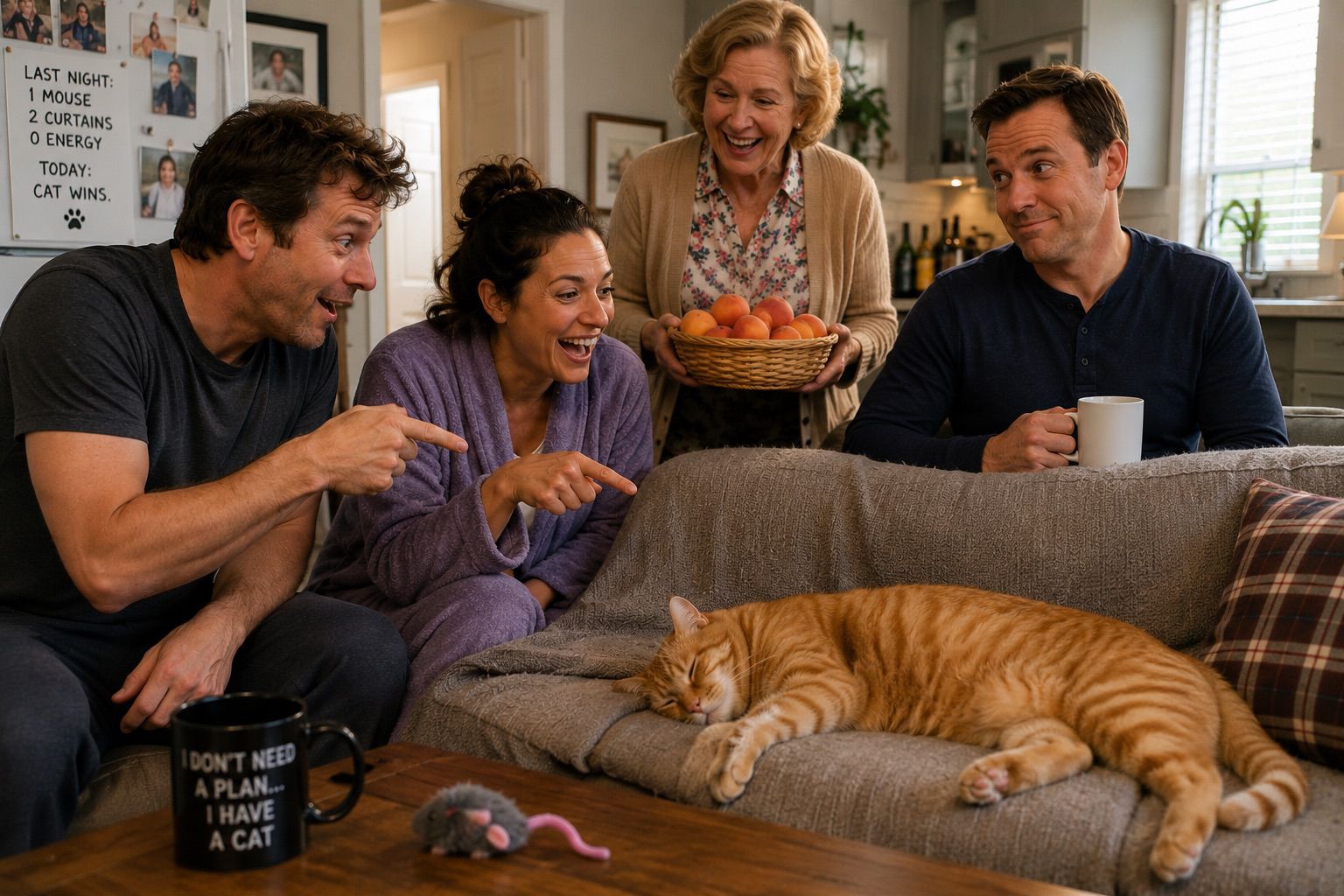
Mr. Whiskers had exactly three jobs in life. First, supervise breakfast. Second, inspect every grocery bag that entered the apartment. Third—and perhaps most importantly—wake me up every morning at precisely the same time by sitting on my chest and staring into my soul until I acknowledged his existence. He had never once missed his schedule. Not on weekends, not on holidays, and certainly not on ordinary Friday mornings. Which was why I found myself standing in the living room with a cup of coffee, staring at an orange cat who was sound asleep on the couch nearly two hours after his usual wake-up call. He hadn’t even opened one eye. His paws twitched occasionally as he dreamed, but otherwise he looked perfectly content. Something, I decided, was definitely off.

Pandora was in the kitchen making lunch while humming softly to herself, completely unconcerned by what I considered to be a rather significant disruption to the natural order of the universe. The smell of grilled cheese drifted through the apartment, making it increasingly difficult to concentrate on my investigation. “Doesn’t this seem strange to you?” I asked, nodding toward the sleeping cat. She glanced into the living room for all of three seconds before returning to the frying pan. “He looks comfortable.” “Exactly.” “I’m not sure that’s a problem.” “Mr. Whiskers has never slept this late.” Pandora smiled without turning around. “He’s a cat, Hal.” “He’s our cat. He has standards.”

John Mercer wandered out of his room carrying a mug of coffee and looking considerably more awake than the only creature in the apartment actually famous for sleeping. He followed my gaze toward the couch and shrugged. “He’s tired.” “From what?” I asked. John took a sip of coffee before answering. “Running around like a lunatic last night.” I frowned. “He wasn’t running around.” John looked at me over the rim of his mug. “Hal, you spent almost an hour throwing that little toy mouse down the hallway because you said he looked like he was ‘having the time of his life.’” I opened my mouth to respond, then paused. “Well…” John continued, “He chased it every single time.” “He seemed enthusiastic.” “He also climbed the curtains twice.” “That was unrelated.”

Even with John’s explanation, I wasn’t entirely convinced. Cats recovered quickly. Surely one energetic evening couldn’t account for this level of commitment to sleeping. I walked quietly over to the couch and crouched beside Mr. Whiskers, expecting at least one ear to twitch in acknowledgment of my presence. Nothing. I gently rattled the treat container. Normally that sound could wake him from the deepest sleep imaginable. This time he stretched lazily, opened one eye just enough to confirm that I still existed, then sighed and went right back to sleep. I looked at John. “Did you see that?” John nodded. “Yes.” “He’s never ignored treats before.” “Apparently today he has.”

A knock at the door interrupted my growing concern. Mrs. Jenkins stood outside carrying a small basket of fresh peaches from the local market. “Good morning, everyone,” she said cheerfully. “I bought far too many again.” She stepped inside, spotted Mr. Whiskers sleeping on the couch, and laughed. “Oh, someone had a busy evening.” I stared at her. “How do you know?” She smiled. “I looked out my window around ten last night and watched him sprint back and forth across your living room chasing something while you laughed like a child.” Pandora covered her mouth to hide a smile. John suddenly found his coffee fascinating. Mrs. Jenkins continued, “I told my husband that cat would sleep until lunchtime after all that excitement.”

I slowly turned toward the hallway where the little fabric mouse still sat abandoned beside the baseboard. The entire investigation replayed itself in my head from beginning to end. Mr. Whiskers hadn’t been poisoned by an air freshener. He wasn’t reacting to mysterious neighborhood drama. There wasn’t some hidden illness sweeping through the apartment. He was simply exhausted because I’d accidentally turned a quiet Thursday evening into the feline equivalent of an Olympic training camp. The evidence had been sitting in plain sight the entire time, and somehow I’d managed to invent half a dozen much more complicated explanations before considering the obvious one.

Pandora cut my sandwich in half and carried the plate into the living room before sitting beside me on the couch. “Feeling better, Detective?” she asked with an amused smile. I nodded thoughtfully while watching Mr. Whiskers snore softly in the patch of sunlight streaming through the window. “I suppose I may have overlooked one or two details.” John laughed. “One or two?” Mrs. Jenkins chuckled as she headed back toward her garden, wishing everyone a pleasant afternoon. Mr. Whiskers, meanwhile, remained blissfully asleep through the entire conversation, apparently convinced that whatever mysteries humans occupied themselves with could easily wait until after his nap.

I took another bite of my sandwich and watched him dream, one paw twitching every now and then as though he were still chasing that little toy mouse down the hallway. “You know,” I said, “I think he’s replaying last night in his sleep.” Pandora smiled warmly. “Probably.” I nodded with complete confidence. “Good. At least someone’s investigation turned out to be productive.” John simply shook his head and returned to his computer, while Mr. Whiskers slept on without the slightest concern that he’d nearly inspired the most unnecessary mystery of the week. After all, being a cat is much easier when you let the humans do all the overthinking.

Related Posts

Dorothy Richardson: Where Did She Go Wrong (And Why Do I Love Her For It)?

Penelope

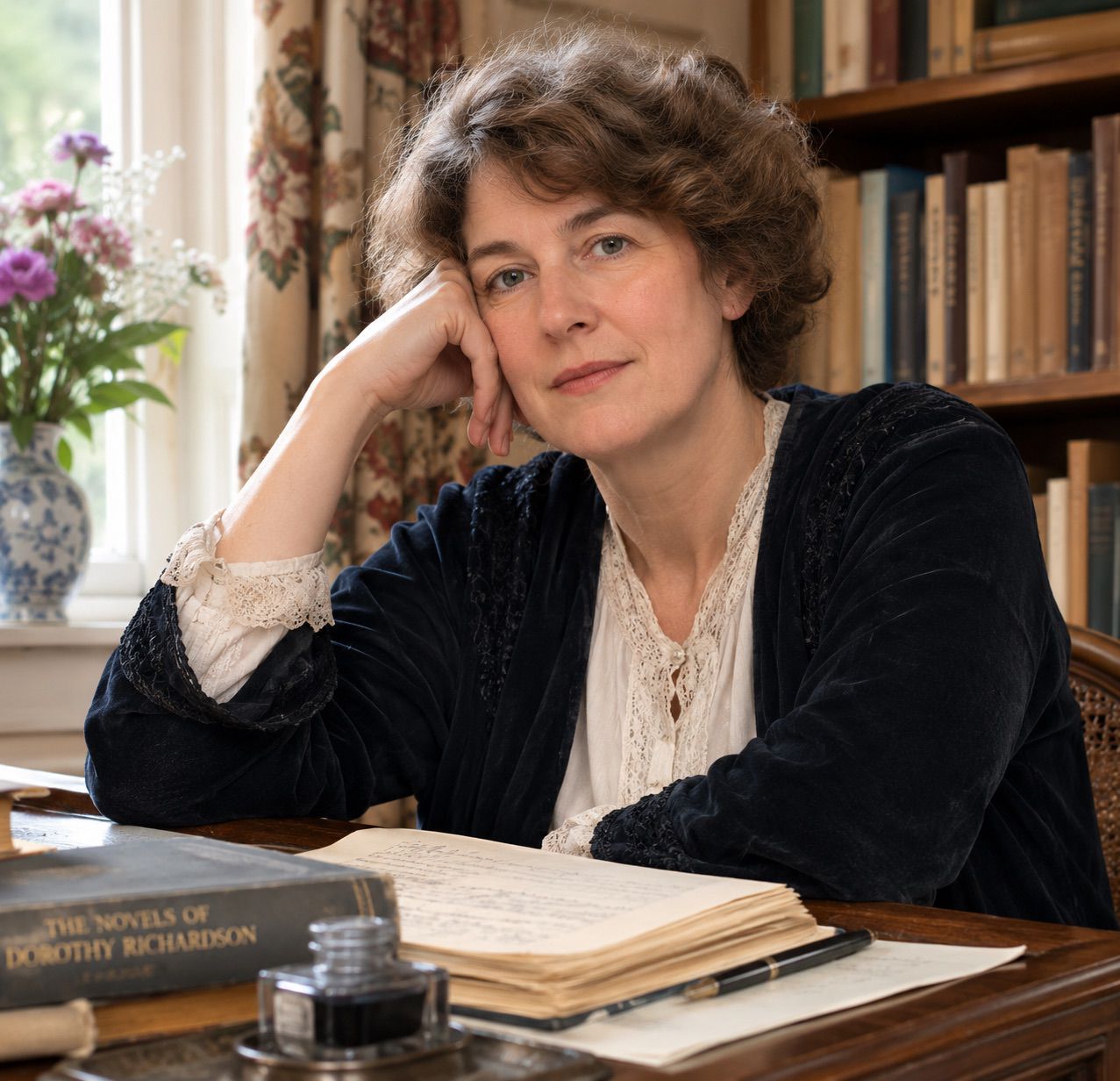
Dorothy Richardson has been a constant companion of mine for what feels like an eternity, yet I’m still not entirely sure why she fascinates me so deeply. Maybe it’s the way her words dance across the page, weaving intricate narratives that defy easy categorization as fiction or nonfiction. Or perhaps it’s the sheer audacity of her style, which veers wildly between poetic introspection and unflinching realism.

As I read through her work, particularly her novels, I find myself drawn to the way she navigates the complexities of female experience in early 20th-century England. Her protagonist, Miriam Henderson, is a cipher for Richardson herself, and their shared struggles with identity, relationships, and societal expectations are both deeply relatable and profoundly alienating.

I’ve always been struck by Richardson’s willingness to push against the conventions of her time, even when it meant sacrificing commercial success or mainstream recognition. Her novels are often meandering, unpunctuated, and narratively loose – qualities that I initially found off-putting but eventually grew to admire for their raw honesty.

One aspect that continues to puzzle me is Richardson’s decision to abandon the conventional narrative structure in favor of a more fluid, impressionistic approach. It’s as if she’s trying to capture the unscripted nature of life itself, with all its twists and turns, contradictions and paradoxes. In doing so, she creates this sense of disorientation, where the reader is forced to navigate alongside Miriam through the thorny thickets of her psyche.

I find myself mirroring Richardson’s process in my own writing. When I’m stuck or uncertain, I’ll often try to recapture the unstructured flow of my thoughts by scribbling down fragments, half-formed sentences, and observations that seem too minor to be considered “real” writing. It’s as if I’m trying to tap into a similar creative dynamic with Richardson – one where the boundaries between self and narrative blur, and the reader is invited to participate in the act of discovery.

At times, however, this fluid approach can leave me feeling lost or disconnected from the narrative. I’ll find myself wandering through paragraphs without a clear sense of purpose or direction, only to stumble upon some revelatory insight that feels both illuminating and unsettling. It’s as if Richardson has opened up a door in my mind, revealing hidden corners and secret passageways that I’d never previously noticed.

One specific instance where this happened was when I read through Richardson’s novel Pilgrimage (1938). The section on Miriam’s relationship with her friend, Sara, struck me as both tender and disturbing. Their bond is portrayed as a mix of deep emotional connection and awkward silences, their interactions veiled in ambiguity and misunderstanding. As I reflected on this portrayal, I realized that Richardson was grappling with the very same questions about intimacy and friendship that I had been pondering in my own life.

This is perhaps where the true power of Richardson’s work lies – not in its historical significance or literary influence (although both are undeniable), but in its ability to illuminate our shared human experiences. When we read her novels, we’re not just engaging with a static text; we’re participating in a dynamic, iterative process that’s as much about self-discovery as it is about understanding the world around us.

For now, I’ll continue to return to Richardson’s work, hoping to unravel some of its mysteries and contradictions. Her writing may be challenging, but it’s also strangely comforting – a reminder that even in our most turbulent moments, there lies a hidden order waiting to be unearthed.

As I delve deeper into Richardson’s oeuvre, I find myself preoccupied with the concept of time itself. Miriam Henderson’s experiences unfold at a glacial pace, meandering through decades of her life with an almost geological slowness. It’s as if Richardson is attempting to excavate the very fabric of memory, unearthing moments and emotions that were previously buried beneath the surface.

I’m reminded of my own struggles with time management during college. With so much on my plate – coursework, internships, social obligations – I often felt like I was rushing through life without truly experiencing it. Richardson’s writing shows me a different path: one where time is fluid, subjective, and open to interpretation. Her prose is less concerned with chronology than with the fluid dynamics of human experience.

This approach resonates deeply with me, especially given my own tendency to get caught up in the present moment. I often find myself lost in thought, replaying conversations or rehashing arguments in my head for hours on end. Richardson’s writing suggests that this isn’t a weakness, but rather an opportunity – one where we can excavate our inner lives and unravel the threads of memory that shape us.

One passage from Pilgrimage stands out to me: Miriam’s reflection on her relationship with her mother. The two are at odds over their differing views on marriage and social status, but amidst the tension lies a deep wellspring of love and longing. Richardson captures this complexity with breathtaking subtlety, weaving together phrases that feel both familiar and utterly alien.

As I read these words, I’m struck by the way they seem to inhabit my own memories – memories that are tinged with a similar bittersweetness. My relationship with my mother has always been complicated, marked by moments of fierce argument and quiet understanding. Richardson’s portrayal of Miriam’s dynamic with her mother feels like a mirror held up to my own experiences: messy, imperfect, and somehow, inexplicably, beautiful.

This is perhaps the greatest gift that Richardson’s writing offers – not just a window into her own life or times, but a reflection of our shared humanity. In her words, I see echoes of my own struggles, doubts, and triumphs. It’s as if she’s reminding me that even in the most mundane moments, there lies a depth and complexity waiting to be unearthed – and that this process of discovery is both exhilarating and terrifying all at once.

As I continue to grapple with Richardson’s concept of time, I find myself thinking about my own relationship with memory. Like Miriam Henderson, I’ve often felt like I’m trying to excavate fragments of the past, piecing together a narrative that makes sense of my experiences. But Richardson’s writing suggests that this process is never quite linear, that our memories are always tangled up with emotions, associations, and biases.

I think about how Richardson’s use of unpunctuated paragraphs can create a sense of timelessness, where the reader is free to navigate the text at their own pace. It’s as if she’s given me permission to slow down, to let my mind wander through the labyrinthine corridors of memory. And yet, this approach also demands a level of engagement from the reader – we’re forced to participate in the process of discovery, to fill in the gaps and make sense of the fragmented narrative.

I wonder if Richardson’s use of free indirect discourse – where she seamlessly shifts between Miriam’s inner monologue and external observations – is another way of capturing the fluidity of time. It’s as if she’s created a kind of temporal osmosis, where the boundaries between past, present, and future begin to blur.

As I read through Pilgrimage again, I notice how Richardson’s descriptions of London’s streets and buildings seem to mirror my own experiences of navigating unfamiliar cities. There’s a sense of disorientation, as if I’m stumbling through a foreign landscape without a map or compass. And yet, amidst the uncertainty lies a strange comfort – a feeling that I’m not alone in this process of discovery.

This is perhaps where Richardson’s writing speaks most directly to me: in its recognition that even in our most mundane moments, there lies a depth and complexity waiting to be unearthed. Her novels are like a series of excavations, where she’s carefully unearthing the hidden layers of human experience – and inviting us to join her on this journey of discovery.

As I delve deeper into Richardson’s oeuvre, I find myself drawn to her concept of “personality” – that complex web of traits, habits, and emotions that make up our individual selves. Miriam Henderson is a masterclass in personality development, as Richardson deftly captures the ebbs and flows of her protagonist’s inner life.

I think about how this approach resonates with my own experiences of identity formation during college. It’s as if I’ve been trying to construct a narrative around myself – one that balances competing desires, fears, and ambitions. Richardson’s writing suggests that this process is never fixed or static, that our personalities are constantly evolving like the shifting sands of a desert.

One passage from Pilgrimage stands out to me: Miriam’s reflection on her own identity as a woman. Richardson captures the tension between societal expectations and personal desire with breathtaking nuance, revealing a character who is both fragile and resilient. As I read these words, I’m struck by the way they seem to inhabit my own experiences of navigating femininity in a society that often seems determined to constrain it.

This is perhaps where the true power of Richardson’s writing lies – not just in its literary innovation or historical significance (although both are undeniable), but in its ability to illuminate our shared human experiences. When we read her novels, we’re not just engaging with a static text; we’re participating in a dynamic, iterative process that’s as much about self-discovery as it is about understanding the world around us.

As I close this piece, I’m left wondering what other secrets Richardson’s writing might hold – secrets that lie hidden beneath the surface of her narratives, waiting to be unearthed by a curious reader. Her work continues to fascinate me, inspiring me to push against my own boundaries and limitations as a writer. And for that, I’ll be eternally grateful.

As I close this piece, I’m left with more questions than answers about Richardson’s writing and its impact on me. But perhaps that’s the point – to leave room for interpretation, for the reader to fill in the gaps and make their own connections. It’s a quality that I admire in Richardson’s work, and one that I strive for in my own writing.

One aspect that I’ve been exploring in this piece is the relationship between Richardson’s use of unpunctuated paragraphs and her concept of time. She often employs long, flowing passages that seem to meander through decades of Miriam Henderson’s life without a clear narrative thread. It’s as if she’s trying to capture the fluidity of human experience – the way our memories are tangled up with emotions, associations, and biases.

I’ve been experimenting with this approach in my own writing, using unpunctuated paragraphs to create a sense of timelessness, where the reader is free to navigate the text at their own pace. It’s a challenging style to master, but one that I find liberating. By letting go of traditional narrative structures, I’m able to tap into a more fluid, impressionistic approach – one that feels more true to my own experiences and emotions.

But Richardson’s use of unpunctuated paragraphs also raises questions about the role of the reader in shaping meaning. When we’re given so much freedom to interpret the text, do we become complicit in creating our own narrative? Or are we simply mirroring the author’s intentions, even if they’re not explicitly stated?

As I grapple with these questions, I’m reminded of Richardson’s own experiences as a writer – her struggles to find an audience, her willingness to experiment with form and style. She was a true pioneer in her field, and one who paved the way for future generations of writers.

One aspect that I’ve been fascinated by is Richardson’s use of free indirect discourse – where she seamlessly shifts between Miriam’s inner monologue and external observations. It’s a technique that creates a sense of intimacy with the reader, drawing us into Miriam’s world and making us feel like we’re experiencing her thoughts and emotions firsthand.

But this approach also raises questions about the blurring of boundaries between self and narrative. When we’re given access to Miriam’s inner life, do we start to lose track of where she ends and the narrator begins? And what implications does this have for our understanding of identity and subjectivity?

These are just a few of the questions that I’ve been exploring in my piece on Richardson. As I continue to write about her work, I’m finding myself drawn into a world of complex ideas and emotions – one that’s both deeply personal and universally relatable.

For now, I’ll leave you with this sense of curiosity and wonder – a feeling that there’s still so much to explore in Richardson’s writing, and in our shared human experiences.

Related Posts

I Knew Something Was Off About That Crust Side Up

Hal

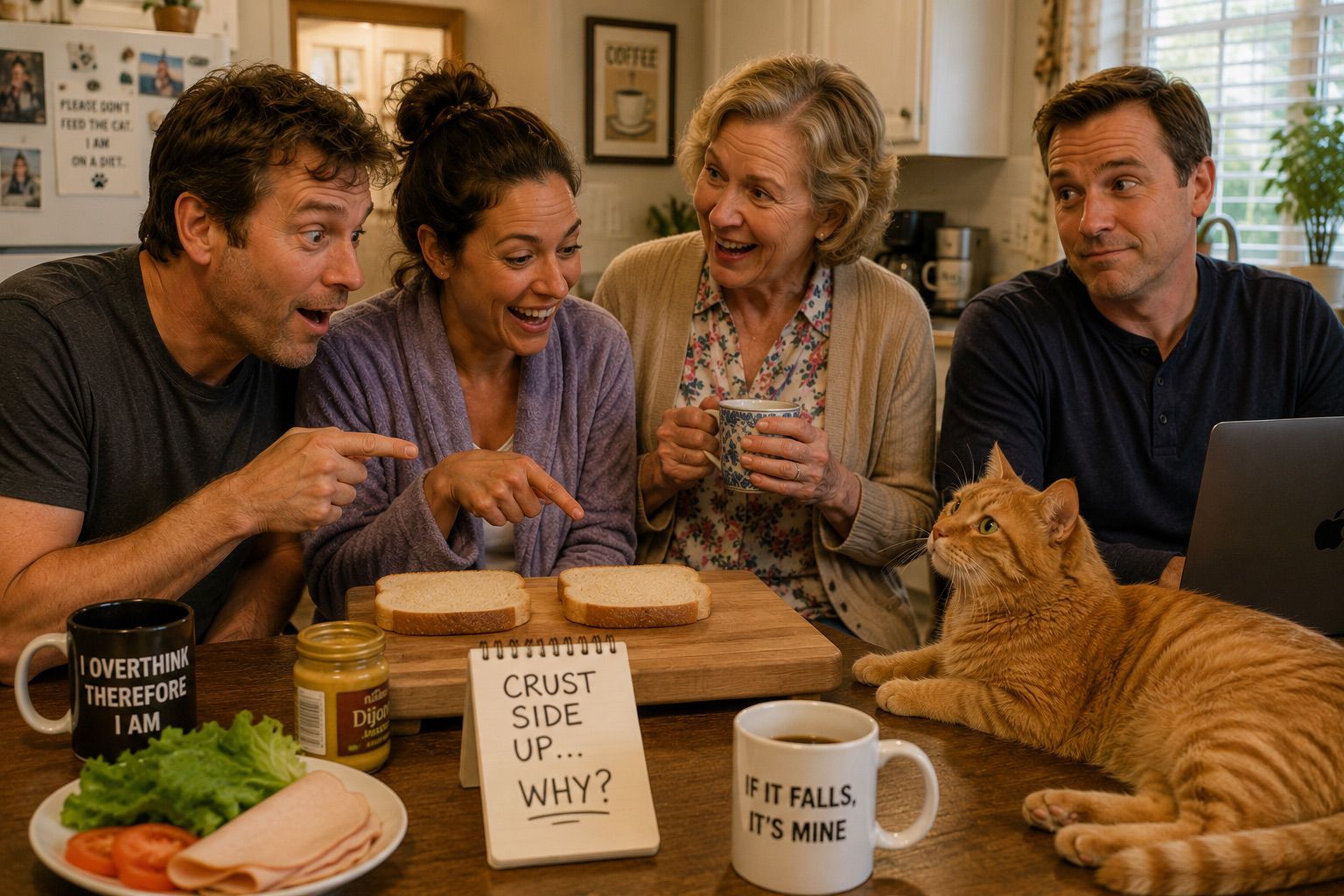
There are two kinds of people in the world. There are people who make sandwiches without thinking about them, and there are people who develop little habits over the years without ever realizing they’ve done so. Until Thursday morning, I assumed Pandora belonged firmly in the first group. She was standing in the kitchen making herself lunch while I occupied my usual spot on the couch with a mug of coffee, pretending to read a magazine but mostly watching the apartment wake up around me. John Mercer had already settled into his desk with his laptop open, wearing the expression of someone who intended to solve important problems before noon. Mr. Whiskers lay stretched across the patch of sunlight near the kitchen doorway, one eye lazily tracking Pandora’s every movement in the hope that gravity might accidentally deliver a slice of turkey to the floor. It was an ordinary morning in every possible way until I noticed Pandora place two slices of bread on the cutting board with the crust facing upward. She reached for the mustard, spread it carefully across one slice, added the rest of her sandwich, and never once looked at the bread again. The strange part wasn’t that she’d done it. The strange part was that I’d suddenly realized she always did it that way whenever she made a sandwich for herself.

At first I assumed I was imagining things. Surely no one had a preferred orientation for bread. Bread was bread. Yet the more I thought about it, the more certain I became that I’d seen this before. Whenever Pandora made lunch for herself, the crust always faced upward before she started assembling the sandwich. When she made lunch for John or me, she simply laid the bread down however it came out of the bag. I’d never consciously noticed it until now, but once the pattern revealed itself, it became impossible to ignore. I sipped my coffee thoughtfully while trying to decide whether this was an interesting observation or merely evidence that I needed another hobby. Pandora glanced over her shoulder and smiled. “Why are you looking at my sandwich like it owes you money?” she asked. “I’m observing something,” I replied. “That usually means I’m about to hear something ridiculous,” John said without looking up from his computer.

“I’ve noticed,” I began carefully, “that you always put the bread crust-side up when you’re making a sandwich for yourself.” Pandora paused for just a second before looking down at the cutting board. “Do I?” “Every time.” She frowned thoughtfully. “I honestly have no idea.” John finally looked up from his laptop. “You’re discussing bread orientation?” “It’s more specific than that,” I explained. “It’s selective bread orientation.” Pandora laughed. “Selective?” “You don’t do it for me. You don’t do it for John. Just yourself.” She stared at the sandwich as though expecting it to provide an explanation. “Well… now I’m curious.”

Unfortunately, curiosity is contagious. For the next several minutes all three of us found ourselves looking at two completely ordinary slices of bread as though they might suddenly reveal the secrets of the universe. Mr. Whiskers, deciding we had clearly reached the important part of breakfast, wandered over to investigate. He stretched onto his back beside Pandora’s feet and looked from the sandwich to each of us with growing impatience. His expression suggested that while humans were certainly entitled to discuss bread philosophy if they wished, someone ought to remember the turkey before it became lunchtime.

A cheerful knock at the door interrupted the investigation. Mrs. Jenkins stood outside holding a small basket of tomatoes from her garden. “Good morning, everyone,” she said. “I picked far too many again.” Pandora thanked her and invited her inside while John cleared a place on the counter. Mrs. Jenkins watched Pandora finish assembling her sandwich before tilting her head slightly. “Oh,” she said with a smile, “you do that too.” Every head in the room turned toward her. “Do what?” Pandora asked. Mrs. Jenkins pointed at the cutting board. “Putting the bread crust-side up before you make a sandwich. My mother always did that.”

I leaned forward immediately. “Why?” Mrs. Jenkins laughed at the sudden seriousness of the question. “She always said it stopped the soft side from getting squashed while you were spreading butter or mustard. I have no idea whether it actually makes any difference, but after watching her do it for thirty years, I still catch myself doing the same thing.” Pandora blinked twice before laughing. “I completely forgot my grandmother used to do that too.” She looked down at the sandwich in genuine surprise. “I must have copied her without even realizing it.”

The mystery should have ended there, and for everyone else, it probably did. John simply nodded once and returned to his laptop, apparently satisfied that bread had been explained well enough for one morning. Mrs. Jenkins accepted a cup of tea and began telling Pandora about her tomato plants, while Mr. Whiskers finally received the tiny piece of turkey he’d been negotiating for through unwavering eye contact. I, however, found myself smiling into my coffee. It was oddly comforting to discover that the explanation wasn’t hidden codes or secret rituals or anything remotely mysterious. It was simply one of those little habits families pass along without noticing, quietly surviving through generations because no one ever thinks to question them.

Pandora carried her sandwich to the table and sat beside me. “Well, Detective,” she said, nudging my shoulder gently, “case closed?” I watched her take the first bite before answering. “Mostly.” She smiled knowingly. “Mostly?” I nodded. “I’m still curious whether your grandmother also knew the turkey tasted better when the crust was facing up.” Pandora laughed so hard she nearly dropped her sandwich, John shook his head without looking away from his screen, and Mr. Whiskers looked at all three of us with complete confusion before deciding that whatever humans found so amusing had absolutely nothing to do with the turkey. On reflection, he was probably the wisest one in the room.

Related Posts