Latest Articles

Sylvia Plath: The Dark Companion I Can’t Shake Off

Penelope

Sylvia Plath’s words have been a constant companion for me since I stumbled upon her poetry in college. Her language is like a wild animal that snatches my breath away, leaving me gasping for air. There’s something about the way she describes the world – dark, twisted, and beautiful all at once – that speaks to me on a deep level.

I remember being struck by how raw and honest her writing was. It felt like she had stripped herself bare, exposing every wound and scar for the world to see. I’ve always been drawn to authenticity in art, and Plath’s work seemed to embody that quality. But as I delved deeper into her life and writings, I started to feel a sense of discomfort. Her stories are often brutal, her emotions explosive, and her struggles with mental health devastating.

I think what unsettles me most is the way Plath’s writing can be both breathtakingly beautiful and utterly heartbreaking at the same time. It’s like she’s holding out a hand to you, inviting you into this dark, intimate world of hers, only to yank it away just when you think you’re getting close. I’ve found myself drawn back to her work again and again, despite (or because of) the pain it inflicts.

One of the things that fascinates me about Plath is how she navigated the expectations placed upon her as a woman. She was a brilliant student at Smith College, but her experiences with mental health issues and sexism made her feel like an outsider in both academia and society. Her writing often grapples with these tensions, revealing a deep sense of isolation and frustration.

As I read about Plath’s relationships – particularly her tumultuous marriage to Ted Hughes – I couldn’t help but wonder how she managed to keep creating amidst such chaos. It’s almost as if her art became an extension of herself, a way to process the turmoil that swirled around her. Her poetry is like a scream into the void, a desperate attempt to be heard above the din.

Sometimes I feel like I’m reading Plath through a lens of my own experiences. As someone who’s struggled with anxiety and depression, I see myself in her words – the desperation, the fear, the feelings of being trapped. But at the same time, I worry that I’m romanticizing her struggles, diminishing the complexity of her life by trying to apply my own narrative to hers.

This is where things get complicated for me. Plath’s writing has been a source of comfort and catharsis, but it also feels like a reminder of all the things I’m afraid to confront in myself. Her stories are full of darkness and despair, but they’re also infused with a fierce determination to live – to write, to create, to exist.

As I sit here with my thoughts swirling around me, I wonder: what would happen if I let go of some of that fear? Would I be able to tap into the same kind of creative fury that Plath did? Or am I just kidding myself, thinking I can channel her genius?

I’m not sure. All I know is that Sylvia Plath’s words continue to haunt me, refusing to let me look away. They’re a mirror held up to my own fears and insecurities, forcing me to confront the parts of myself that I’d rather keep hidden. And yet, in their darkness, I see a glimmer of hope – the possibility that even in the most broken places, there’s still beauty to be found.

As I delve deeper into Plath’s work, I find myself returning to the same themes again and again: the fragility of mental health, the suffocating nature of societal expectations, and the desperate quest for self-expression. It’s as if her writing is a doorway that swings open onto my own inner world, revealing all the hidden corners where my fears and doubts reside.

One thing that strikes me about Plath is how she used her writing as a form of resistance against the world around her. Her poetry is full of sharp edges and jagged lines, like a physical manifestation of her own fractured psyche. And yet, in the midst of all this chaos, there’s a fierce determination to create – to craft words that will cut through the noise and leave their mark.

I think about my own creative endeavors, how I often feel like I’m struggling to find my voice amidst the din of everyday life. It’s easy to get caught up in comparisons with Plath, wondering if I’ll ever be able to tap into that same kind of raw power and emotion. But as I read her words, I realize that maybe it’s not about emulating her – but rather, finding my own unique way to express the turmoil that rages within me.

There’s a passage in The Bell Jar where Plath describes feeling like she’s “a skeleton on the beach” after a great storm has passed. It’s an image that haunts me still – this idea of being stripped bare, exposed and vulnerable. But as I look closer at that passage, I see something else too: a deep sense of resilience, a determination to rebuild and recreate.

For me, Plath’s writing is like a mirror held up to my own struggles with anxiety and depression. It’s a reminder that even in the darkest moments, there’s still beauty to be found – if only we’re brave enough to look for it. Her words are a balm to my frazzled nerves, a reassurance that I’m not alone in this wild and crazy world.

But as I sit here with these thoughts swirling around me, I wonder: what happens when the storm finally passes? When the anxiety subsides and the darkness recedes? Will I still be able to tap into that same creative fury, or will it fade away like a mirage on a desert highway?

I’m not sure. All I know is that Sylvia Plath’s words continue to haunt me – pushing me to confront my fears, to explore the depths of my own inner world, and to find a way forward in the face of uncertainty.

As I ponder this question, I’m struck by how much of Plath’s writing is concerned with the tension between light and darkness, hope and despair. It’s as if she’s constantly navigating the fine line between these opposing forces, seeking to find a balance that feels authentic to her.

I think about my own life, and how often I’ve found myself caught in this same struggle. There are days when the anxiety feels overwhelming, like a tidal wave crashing over me, threatening to consume everything in its path. And then there are moments of clarity, when the sun breaks through the clouds and I feel a sense of purpose and direction.

It’s interesting to me that Plath often describes her creative process as a form of exorcism – a way to purge herself of the darker emotions that threaten to overwhelm her. Her writing is like a ritual, a way to confront the shadows within herself and emerge stronger on the other side.

I’ve always been drawn to this idea, the notion that art can be a kind of cathartic release. When I’m feeling overwhelmed or stuck, I often find myself turning to my own creative endeavors – whether it’s writing, drawing, or simply journaling – as a way to process my emotions and gain clarity.

But what happens when the storm finally passes? What happens when the darkness recedes and the light shines through? Do we lose that sense of urgency, that drive to create something meaningful out of our struggles?

I’m not sure. For me, it’s like I’m caught in a perpetual state of limbo – always reaching for the next creative high, always trying to tap into that same sense of raw emotion and vulnerability.

Perhaps that’s what makes Plath’s writing so compelling – her willingness to confront the darkness head-on, to stare it straight in the face and say, “I see you. I understand you.” It’s a powerful form of resistance, one that reminds me that even in the darkest moments, there is still beauty to be found.

As I sit here with these thoughts swirling around me, I’m struck by how much Plath’s writing has taught me about the importance of vulnerability. It’s not just about sharing our struggles – it’s about embracing them, confronting them head-on, and emerging stronger on the other side.

For me, that’s a lesson worth learning. As I navigate my own creative journey, I’m reminded that the line between light and darkness is often blurred – and that it’s in those moments of uncertainty that we find our truest selves.

As I reflect on Sylvia Plath’s writing and its impact on me, I’m struck by the way she blurs the lines between vulnerability and strength. It’s as if she’s saying, “I’ll show you my scars, but don’t think for a second that they make me weak.” Her words are like a battle cry, a declaration of independence in the face of adversity.

I think about how I’ve often felt torn between being open and honest about my struggles, and hiding behind a mask of confidence. Plath’s writing makes me realize that vulnerability is not a sign of weakness, but rather a strength – a willingness to be seen, to be heard, and to be understood.

But what does it mean to be vulnerable in a world that often values strength and resilience over sensitivity and emotion? I think about how society expects us to put on a brave face, to mask our pain with a smile or a witty remark. And yet, Plath’s writing shows me that there’s beauty in the brokenness – that the cracks and fissures are where the light gets in.

As I navigate my own creative journey, I’m struggling to reconcile this idea of vulnerability with the pressure to produce something polished and perfect. I feel like I’m caught between being true to myself and trying to meet the expectations of others. It’s a tension that I see played out in Plath’s writing as well – her struggle to balance her own desires with the demands of her loved ones, her career, and society at large.

I wonder if this is what it means to be an artist: to constantly walk the fine line between revealing our true selves and hiding behind a mask of creativity. Or is that just a romanticized notion, one that ignores the very real pressures and expectations that come with being an artist?

For me, Plath’s writing has been a reminder that the most powerful art comes from a place of vulnerability – a willingness to take risks, to push boundaries, and to explore the unknown. But what happens when we’re not just creating for ourselves, but for others as well? When do we prioritize our own needs over the expectations of those around us?

As I ponder these questions, I’m reminded of Plath’s famous phrase: “I took a deep breath and listened to the old brag of my heart.” It’s an image that resonates deeply with me – this idea of listening to our hearts, of tuning in to our deepest desires and fears. And yet, it’s also a reminder that our hearts are not always easy to hear – that there are moments when we’re too scared, too uncertain, or too hurt to listen.

In many ways, Plath’s writing is like a meditation on the complexity of human emotion – a recognition that our experiences are messy, multifaceted, and often contradictory. Her words are like a mirror held up to our own inner worlds, revealing all the hidden corners where our fears and doubts reside.

As I look back at my own experiences with anxiety and depression, I realize that Plath’s writing has been a source of comfort and guidance – a reminder that I’m not alone in this struggle. But it’s also forced me to confront my own limitations, to acknowledge the times when I’ve felt too scared or too uncertain to listen to my heart.

Perhaps that’s what makes Plath’s writing so enduring – its ability to capture the complexity of human emotion, to show us that even in the darkest moments, there is still beauty to be found. And perhaps it’s also why her words continue to haunt me, refusing to let me look away from the parts of myself that I’d rather keep hidden.

As I sit here with these thoughts swirling around me, I’m reminded of the importance of vulnerability – not just as an artist, but as a human being. It’s a lesson that Plath’s writing has taught me time and again: that our struggles are what make us strong, that our scars are what give us character, and that our imperfections are what make us beautiful.


Related Posts

Karen’s Reminder Is Probably Nothing… Right?

Hal

I was at work this morning when I noticed a sticky note sitting on Karen’s desk. Normally I wouldn’t pay much attention to someone else’s reminders, but this one caught my eye because it simply said, “Call Mrs. Jenkins” and was written in bright red ink. Now, before anyone jumps to conclusions, I wasn’t snooping. The note was sitting right there in plain sight while Karen was away from her desk. Unfortunately, once I saw it, my brain immediately decided it required further analysis.

At first, I assumed there had to be a simple explanation. Maybe Mrs. Jenkins needed information about something. Maybe Karen had promised to follow up on a conversation. Maybe it was completely routine. But then I started wondering why the note was written in red. Red usually means urgency. Urgency means importance. Importance means there must be a story behind it. Within minutes, I had transformed a perfectly ordinary reminder into what I believed was a developing situation.

The more I thought about it, the less sense my theories made. Mrs. Jenkins is a neighbor, not an international spy. Karen is my coworker, not an undercover investigator. Yet somehow I found myself trying to determine what kind of conversation would require a red reminder note. Was it important? Was it time-sensitive? Was there some piece of information everyone else knew except me? The fact that none of this involved me did little to discourage my curiosity.

By lunchtime, I had created at least six possible explanations. One involved a misunderstanding. Another involved neighborhood gossip. One theory was so ridiculous that I refused to admit it even to myself. Every time I thought I had reached a reasonable conclusion, I’d find a new detail to obsess over. Why red ink? Why not blue? Why a sticky note instead of an email? Why did the note seem so important when, objectively speaking, it probably wasn’t?

When Karen finally returned to her desk, I decided to stop speculating and ask her directly.

“What’s the note about?” I asked.

She looked at it for a second and shrugged.

“Oh, that. Mrs. Jenkins volunteers at the community center. She’s helping organize a fundraiser, and I told her I’d call her back.”

That was it.

No mystery.

No secret connections.

No hidden agenda.

Just a fundraiser.

I sat there quietly for a moment while my entire investigation collapsed into a pile of completely unnecessary assumptions. Karen went back to work without another thought, while I was left wondering how I had managed to turn a callback reminder into a full-scale conspiracy.

When I got home later that evening, I told John Mercer the story. He listened patiently, nodded, and then asked the question I probably should have asked myself from the beginning.

“Did it ever occur to you that the note might mean exactly what it said?”

I didn’t answer.

Mostly because I knew he was right.

Mr. Whiskers was stretched out on the couch nearby and gave me a slow blink that felt surprisingly judgmental. At this point, I’ve accepted that both John Mercer and the cat are usually ahead of me whenever these investigations start. Honestly, that might be the real lesson here. Not every red sticky note is a clue. Sometimes it’s just a reminder. And sometimes the biggest mystery is how long it takes me to figure that out.

Related Posts

The Quiet Confidence of Effective Skincare: A Study on Hydra Renewal

Fiona

At first glance, the packaging was unassuming — a sleek white jar with clean typography. The brand’s marketing emphasized its use of natural ingredients and its ability to provide long-lasting hydration. I approached this claim with skepticism, having tried numerous creams that promised similar benefits without delivering. My skin type is combination, prone to oiliness in the summer months, so I was eager to see how Hydra Renewal would perform.

I incorporated the cream into my daily routine, applying it after cleansing and toning. Initially, I noticed a subtle sheen on my skin’s surface, which I attributed to the product’s moisturizing properties. However, as the days went by, I began to observe a more significant impact. My skin felt softer, with fine lines appearing less pronounced. The oiliness that typically plagued me during summer was noticeably reduced.

One of the most striking aspects of Hydra Renewal was its ability to balance my skin’s moisture levels without clogging pores or exacerbating oil production. This is no small feat, especially considering the cream’s rich texture. I suspect this can be attributed to the inclusion of green tea extract and hyaluronic acid in its formula.

As I continued using the product, I found myself pondering the notion of “beauty” in the context of summer. Coastal towns are filled with people eager to showcase their sun-kissed skin, often at the expense of genuine skincare. The emphasis on achieving a perfect glow can lead individuals to neglect fundamental aspects of skin health. It’s refreshing to see products like Hydra Renewal that prioritize function over fleeting aesthetic appeal.

A recent visit to a beachside town reinforced this observation. I noticed numerous people applying copious amounts of sunscreen, only to follow it up with heavy layers of foundation and concealer. This approach not only defeats the purpose of protecting one’s skin, but also neglects the importance of allowing skin to breathe. The emphasis on appearance over actual skincare is a concerning trend that warrants attention.

As someone who values restraint in beauty routines, I appreciate Hydra Renewal’s understated approach. It doesn’t pretend to be a miracle worker or promise unrealistic results. Instead, it delivers on its promise of providing long-lasting hydration without clogging pores. In an era where over-the-top beauty claims are rampant, this product stands out for its humility.

Another aspect that resonated with me was the cream’s subtle scent. Unlike many products that assault the senses with overpowering fragrances, Hydra Renewal’s aroma is barely perceptible. This attention to detail speaks volumes about the brand’s commitment to creating a product that truly serves the skin, rather than simply appealing to our sense of smell.

In contrast, I’ve noticed an increase in products that prioritize fragrance over actual skincare benefits. These products often contain artificial fragrances and dyes that can irritate sensitive skin. The proliferation of such products only serves to further the notion that beauty is primarily about appearance rather than genuine health.

As the summer months draw to a close, I’ll continue using Hydra Renewal as part of my daily routine. It’s become an integral component of my skincare regimen — one that I’m confident will provide long-term benefits. This product has taught me that true beauty lies in subtlety and restraint, rather than flashy promises or overpowering fragrances.

In the world of beauty, it’s easy to get caught up in the hype surrounding new products. However, as someone who values standards over performance, I’ve learned to approach such claims with a healthy dose of skepticism. Hydra Renewal has proven itself to be an exception — a product that delivers on its promise without resorting to empty marketing tactics.

As I observe people going about their daily routines, I’m struck by the realization that beauty is often less about achieving perfection and more about cultivating a sense of self-awareness. It’s about recognizing our skin’s unique needs and addressing them with humility and restraint. Products like Hydra Renewal serve as a reminder that true beauty lies not in flashy packaging or over-the-top claims, but in the quiet confidence that comes from taking genuine care of one’s skin.

In the end, it’s this sense of refinement and attention to detail that sets Hydra Renewal apart from its competitors. In an industry where excess often reigns supreme, this product stands as a testament to the power of subtlety and restraint. As I conclude my assessment of Hydra Renewal, I’m left with one unshakable standard: true beauty is not about making grand promises, but about delivering quiet, lasting results.

This emphasis on understated elegance is a refreshing respite from the bombastic marketing that often dominates the beauty industry. It’s a reminder that true innovation lies not in flashy packaging or celebrity endorsements, but in the subtle nuances of formulation and design.

As I reflect on my experience with Hydra Renewal, I’m struck by the parallels between this product and the broader cultural conversation around beauty. In an era where social media platforms prioritize curated perfection over authenticity, it’s easy to get caught up in the notion that beauty is solely about appearance. However, products like Hydra Renewal serve as a gentle corrective, reminding us that true beauty lies not in external validation, but in the quiet confidence that comes from taking care of one’s skin.

Moreover, the subtlety of Hydra Renewal’s approach has made me realize the importance of patience and persistence in skincare. In an industry where instant gratification is often promised, it’s refreshing to encounter a product that prioritizes long-term benefits over short-term fixes. This emphasis on gradual improvement resonates with my own approach to beauty, which values slow, incremental progress over dramatic, overnight transformations.

As the seasons change and my skin adapts to new environmental conditions, I’m confident that Hydra Renewal will remain a trusted ally in my skincare routine. Its understated elegance has won me over, and I suspect it will do the same for others who value subtlety and restraint in their beauty products. In an industry where excess often reigns supreme, Hydra Renewal stands as a testament to the power of quiet, lasting results — a reminder that true beauty lies not in grand promises, but in the subtle nuances of formulation and design.

Related Posts

John’s Phone Is Ringing, and Now I’m Suspicious

Hal

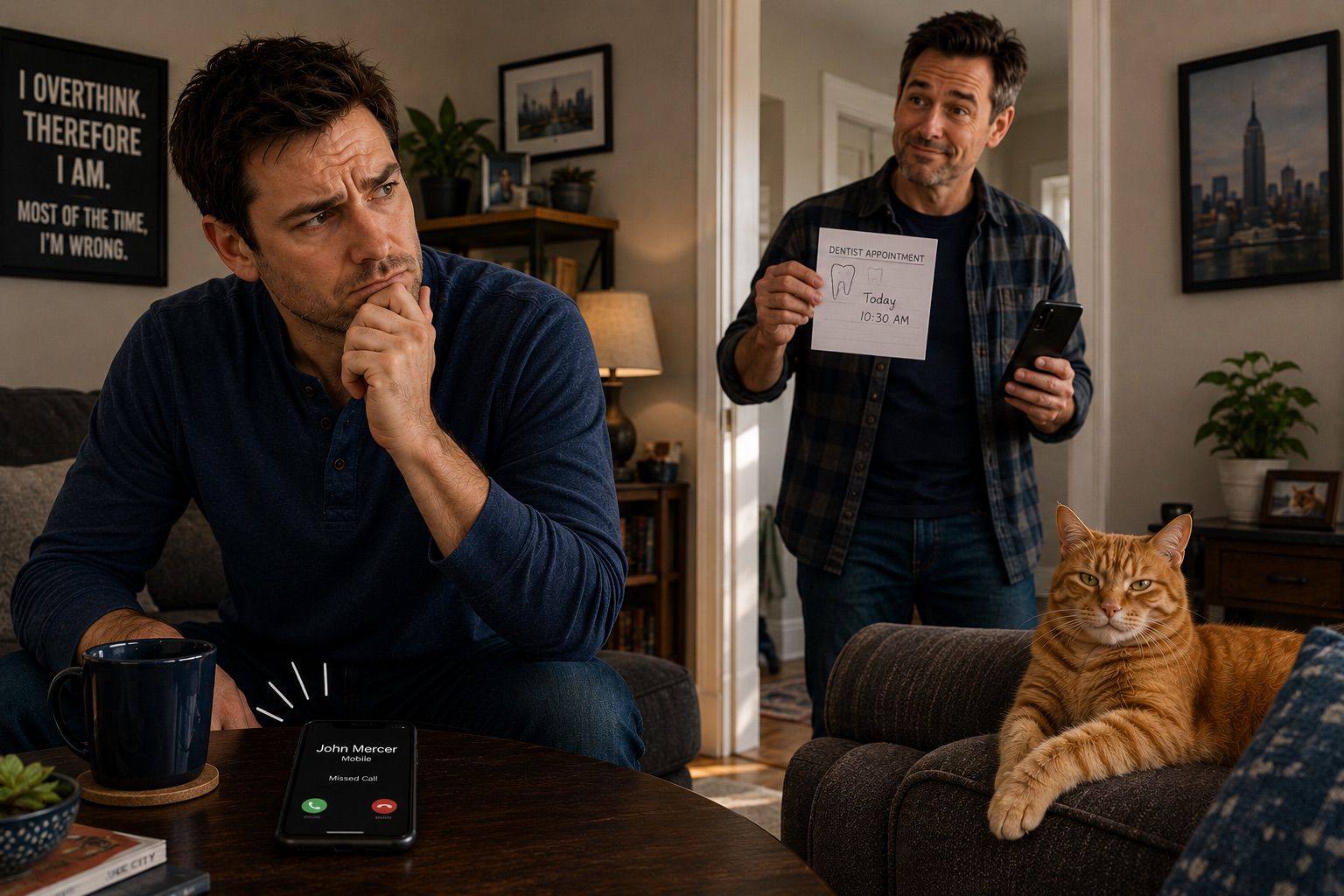
I was sitting in the living room this morning when I noticed something unusual: John Mercer’s phone was ringing. Not unusual by itself, of course. Phones ring all the time. What caught my attention was that John wasn’t anywhere nearby to answer it. The phone buzzed once, stopped, and then started again a few minutes later. Naturally, instead of ignoring it like a normal person, I immediately decided there was a mystery to solve.

Part of the problem was that I was still tired. Pandora and I had grabbed pizza the night before, and my brain was operating at approximately half power. I was trying to remember when we got home, what we’d talked about, and whether I’d actually put the leftovers in the refrigerator or merely thought about putting them in the refrigerator. Somewhere in that foggy state, I remembered Pandora mentioning that she needed to call her mother. Then I remembered John’s phone ringing. Then, for reasons I still can’t explain, my mind connected those two completely unrelated facts.

At first, my theory was simple. Maybe John had stepped out to return a call. Then I wondered who he might be calling. Then I wondered whether he’d received a text message. Within five minutes, I’d somehow convinced myself that the missing phone owner, the unanswered call, and Pandora’s plans to talk to her mother were all pieces of the same puzzle. The fact that I had absolutely no evidence for this did not slow me down in the slightest.

Mr. Whiskers was stretched out on the couch, watching me with the expression of a cat who had witnessed this behavior before. Every time I glanced at John’s phone, Mr. Whiskers seemed to glance at me. It felt judgmental. Admittedly, most things feel judgmental when you’re building a conspiracy theory out of a ringing phone.

As I sat there thinking, I remembered Pandora mentioning that Mrs. Jenkins had been acting a little strangely lately. Not suspiciously strange—just ordinary neighbor strange. The kind of strange that usually amounts to buying too many garden gnomes or arguing with a lawn sprinkler. Unfortunately, my imagination immediately decided that Mrs. Jenkins must somehow be connected to John’s phone. I had no idea how, but that didn’t stop me from trying to figure it out.

By the time John finally walked into the room, I had constructed an entire theory involving missed calls, neighborhood gossip, secret conversations, and at least three assumptions that weren’t supported by reality. John looked at me, looked at his phone, and then looked back at me.

“You’ve been staring at that thing for twenty minutes, haven’t you?” he asked.

“Maybe,” I said.

“It’s my dentist.”

“What?”

“The missed calls. It’s my dentist confirming an appointment.”

Just like that, the entire investigation collapsed. There were no hidden messages. No secret meetings. No mysterious connection between Pandora, Mrs. Jenkins, and a ringing phone. There wasn’t even an interesting story. It was a dentist appointment.

I glanced over at Mr. Whiskers. He slowly blinked at me, which somehow felt even more judgmental than before.

In the end, I learned two valuable lessons. First, not every ringing phone is the beginning of a conspiracy. Second, if John Mercer ever actually does start hiding something from me, I’ll probably miss it because I’ll be too busy investigating perfectly normal events. As for Mr. Whiskers, he spent the rest of the afternoon sleeping peacefully on the couch, completely confident that he was still the smartest creature in the apartment. Honestly, he may have a point.

Related Posts

Tillie Olsen: The Expat, the Writer, My Mirror?

Penelope

Tillie Olsen’s name keeps popping up in my literature classes, always alongside the likes of Hemingway, Joyce, and Woolf. At first, I thought she was just another old-school writer who happened to be a woman, but the more I read about her, the more I feel drawn to this enigmatic figure. What is it about Tillie Olsen that resonates with me?

I think part of it is the way her life and work intersect in complicated ways. She’s often talked about as an American writer who spent much of her career outside the US, living on a kibbutz in Israel and then in Mexico. Her experiences as an expat have influenced her writing, which often explores themes of displacement, identity, and social justice. But what really gets me is how Tillie’s personal life reflects these same tensions.

As I read about her struggles to publish her work, to balance family obligations with artistic ambitions, and to navigate the patriarchal societies she lived in, I feel a familiar sense of discomfort. It’s not just that I see myself in her – though I do recognize the push-pull between creative desires and practical responsibilities – but also that I’m struck by how Tillie’s choices were shaped by the very systems she sought to critique.

One of the things that’s been nagging at me is the way Tillie’s writing often seems to hover between introspection and didacticism. Her essays, in particular, are like extended lectures on politics, history, and philosophy, all wrapped up in a lyrical style that borders on the poetic. And yet, there’s something about these essays that feels…untethered. As if Tillie is aware of her own detachment from the world around her, even as she tries to engage with it.

When I read “Tell Me a Riddle” or “I Stand Here Ironing,” I get this sense that Tillie is performing a delicate balancing act – between intellectual curiosity and emotional vulnerability, between critique and confession. It’s as if she’s constantly trying to pin down her own thoughts and feelings while simultaneously being aware of the distance between herself and others.

All of which makes me wonder: what does it mean for a writer to be both deeply personal and intellectually detached? Is it possible to convey complexity without sacrificing intimacy? And how do we navigate the spaces where our own experiences intersect with those of others, especially when those intersections are messy and complicated?

Tillie Olsen’s writing has become a kind of touchstone for me – not because I aspire to emulate her style or approach, but because her work reminds me that literature can be both intellectually rigorous and emotionally honest. And it’s precisely this tension between intellect and emotion that I find myself struggling with in my own writing.

As I grapple with these questions, I’m drawn back to Tillie’s life and work again and again. There’s something about her contradictions – the way she was both a radical thinker and a devoted mother, for example – that feels eerily familiar. And it’s this sense of kinship that keeps me coming back to her writing, even as I struggle to make sense of it all.

The more I delve into Tillie Olsen’s life and work, the more I’m struck by the way she embodies a tension that feels both deeply personal and profoundly universal. It’s as if she’s caught between two worlds – one of intellectual curiosity and another of emotional vulnerability – and is constantly navigating the space between them.

I find myself wondering what it would be like to write from this place of tension, where intellect and emotion coexist in a delicate balance. Would my writing feel more authentic? More honest? Or would I be sacrificing something essential in the process?

As I think about it, I realize that Tillie’s essays are often characterized by a sense of intellectual detachment, but at the same time, they’re infused with a deep emotional resonance. It’s as if she’s aware that her own experiences and emotions are not solely hers to own – that they’re intertwined with those of others, shaped by the very systems and structures she critiques.

This awareness is what makes her writing feel so hauntingly familiar. I see echoes of my own struggles to balance intellectual curiosity with emotional vulnerability in her work. The desire to engage with the world around me, to critique its injustices, while also acknowledging the complexities of my own experiences – it’s a tension that feels both deeply personal and profoundly universal.

I’m drawn to Tillie’s writing because it reminds me that this tension is not something to be resolved or overcome, but rather something to be acknowledged and explored. That literature can be a space for wrestling with these contradictions, for grappling with the messy intersections of intellect and emotion.

As I continue to read and think about Tillie Olsen’s work, I’m struck by the way she challenges me to question my own assumptions about writing, about identity, and about the role of the writer in society. Her writing is a reminder that we’re not just individuals with our own unique experiences, but also members of larger systems – systems that shape us, influence us, and sometimes even silence us.

Tillie’s legacy feels like a call to action, a reminder that writers have a responsibility not only to create art but also to engage with the world around them. Her work is a testament to the power of literature to challenge, to critique, and to connect – and it’s this connection that I feel most deeply when I read her words.

As I sit here, surrounded by my own thoughts and doubts, I realize that Tillie Olsen’s writing has become a source of comfort, a reminder that I’m not alone in this struggle to navigate the complexities of intellect and emotion. Her work is a beacon, shining brightly in the spaces where our experiences intersect – a testament to the enduring power of literature to bridge gaps and challenge assumptions.

I find myself returning to Tillie’s essays again and again, searching for clues about how to navigate this delicate balance between intellect and emotion. Her writing is like a mirror held up to my own struggles as a writer, reflecting back at me the tensions that I’ve been trying to resolve.

One of the things that draws me to her work is the way she uses language to create a sense of intimacy with her readers. Despite being an intellectually rigorous writer, Tillie has a gift for making complex ideas feel accessible and personal. She writes about politics and philosophy in a way that feels almost confessional, as if she’s sharing secrets with us rather than lecturing.

I’m struck by the way she uses metaphor to convey the complexity of human experience. In “Tell Me a Riddle,” for example, she uses the image of a river to describe the way our lives are shaped by forces beyond our control. The river flows effortlessly, yet it’s also constantly changing course – just like us, Tillie suggests. We’re all caught up in currents of history and culture that shape who we become.

This idea resonates deeply with me because I’ve always felt like I’m floating on a sea of uncertainty, trying to find my own way through the world. As a writer, I want to capture this sense of disorientation and confusion, but I’m not sure how to do it in a way that feels authentic and honest.

Tillie’s work suggests that authenticity is precisely what’s at stake when we try to balance intellect and emotion. When she writes about her own experiences as an expat, for example, she’s not just sharing stories – she’s also confronting the complexities of identity and belonging. Her writing is a reminder that our experiences are always shaped by multiple forces: cultural, historical, personal.

This realization makes me wonder if I’ve been trying to separate these different aspects of myself too much in my own writing. Am I creating a false dichotomy between intellect and emotion? Is it possible to write from a place of both intellectual curiosity and emotional vulnerability at the same time?

As I ponder this question, I’m struck by the way Tillie’s work challenges me to rethink my assumptions about writing as a process. Her essays are not just polished, finished products – they’re also drafts, sketches, and explorations that reflect her own struggles with language and meaning.

In this sense, Tillie’s writing feels more like a conversation than a lecture – a conversation between herself and the reader, where ideas are being tested and explored in real-time. This approach is both exhilarating and intimidating: it suggests that writing is not just about creating art, but also about engaging with the world around us in all its complexity.

As I continue to read and think about Tillie Olsen’s work, I’m reminded of the importance of staying open to multiple perspectives and experiences. Her writing is a testament to the power of literature to bridge gaps and challenge assumptions – and it’s this connection that I feel most deeply when I read her words.

I’ve been thinking about Tillie Olsen’s use of metaphor in her essays, particularly how she employs imagery to convey complex ideas and emotions. In “Tell Me a Riddle,” for instance, she uses the image of a river to describe the way our lives are shaped by forces beyond our control. The river flows effortlessly, yet it’s also constantly changing course – just like us, Tillie suggests. We’re all caught up in currents of history and culture that shape who we become.

This idea resonates deeply with me because I’ve always felt like I’m floating on a sea of uncertainty, trying to find my own way through the world. As a writer, I want to capture this sense of disorientation and confusion, but I’m not sure how to do it in a way that feels authentic and honest. Tillie’s work suggests that authenticity is precisely what’s at stake when we try to balance intellect and emotion.

When she writes about her own experiences as an expat, for example, she’s not just sharing stories – she’s also confronting the complexities of identity and belonging. Her writing is a reminder that our experiences are always shaped by multiple forces: cultural, historical, personal. This realization makes me wonder if I’ve been trying to separate these different aspects of myself too much in my own writing.

Am I creating a false dichotomy between intellect and emotion? Is it possible to write from a place of both intellectual curiosity and emotional vulnerability at the same time? Tillie’s work challenges me to rethink my assumptions about writing as a process. Her essays are not just polished, finished products – they’re also drafts, sketches, and explorations that reflect her own struggles with language and meaning.

In this sense, Tillie’s writing feels more like a conversation than a lecture – a conversation between herself and the reader, where ideas are being tested and explored in real-time. This approach is both exhilarating and intimidating: it suggests that writing is not just about creating art, but also about engaging with the world around us in all its complexity.

As I think about this, I’m reminded of my own struggles to write about complex topics like social justice and identity. I often find myself feeling overwhelmed by the weight of these issues, unsure of how to approach them in a way that feels authentic and meaningful. But Tillie’s work suggests that it’s not about finding easy answers or clear solutions – it’s about engaging with the messiness of human experience.

This is what draws me to her writing: its ability to capture the complexity of our lives, to convey the emotions and ideas that shape us without sacrificing intellectual rigor. It’s a difficult balance to strike, but one that feels essential for writers like myself who want to make a meaningful impact on the world.

I’ve been thinking about Tillie Olsen’s legacy, too – how her work continues to inspire and challenge writers today. Her commitment to social justice and her willingness to engage with the complexities of human experience are qualities that I admire greatly, and ones that I aspire to in my own writing.

But I’m also aware that Tillie’s legacy is not without its challenges. As a woman writer who struggled to publish her work during a time when women’s voices were often marginalized or silenced, she faced incredible obstacles in her career. And yet, despite these challenges, she continued to write, to speak out against injustice and to advocate for the rights of others.

This resilience is something that I find inspiring, but also daunting. As a writer who is just beginning my own career, I’m acutely aware of the many challenges that lie ahead – from finding publication opportunities to navigating the complexities of identity and belonging in my writing. But Tillie’s work reminds me that these challenges are not insurmountable, that even in the face of adversity, we can find ways to write truthfully and powerfully.

As I continue to read and think about Tillie Olsen’s work, I’m struck by the way she embodies a tension that feels both deeply personal and profoundly universal. It’s a tension between intellect and emotion, between critique and confession – a tension that I feel acutely in my own writing. But it’s also a reminder that this tension is not something to be resolved or overcome, but rather something to be acknowledged and explored.

In Tillie’s work, I see a reflection of my own struggles as a writer – struggles to balance intellectual curiosity with emotional vulnerability, to engage with the complexities of human experience without sacrificing authenticity. It’s a delicate balancing act, one that requires patience, persistence, and a willingness to take risks. But it’s also an essential part of what makes writing so powerful – the ability to capture the complexity of our lives in all its beauty and messiness.

Related Posts