
Latest Articles

Nadine Gordimer: Where the Answers Are as Messy as Life Itself

Penelope

I’ve always been drawn to Nadine Gordimer’s writing, but it wasn’t until I was in college that I truly began to grasp the depth of her work. As a writer myself, I find myself returning to her novels again and again, searching for clues on how to navigate the complexities of human relationships and societal expectations.

What strikes me most about Gordimer is her unflinching examination of privilege and power. In novels like “Burger’s Daughter” and “July’s People,” she exposes the intricate web of oppression that underlies even the most seemingly progressive societies. Her characters, often wealthy and well-educated, are forced to confront their own complicity in systems of oppression they may not even be aware of.

I’ve always felt a sense of discomfort reading Gordimer, but it’s a good kind of discomfort – the kind that makes me question my own assumptions about the world. As I read her words, I’m constantly reminded of my own privilege as a white, middle-class woman from a relatively safe and stable community. It’s uncomfortable to acknowledge, but also necessary.

One aspect of Gordimer’s writing that fascinates me is her use of ambiguity. She rarely offers clear moral answers or simplistic solutions to the complex problems she presents. Instead, she leaves her characters (and readers) with more questions than answers, forcing us to grapple with the gray areas in between. It’s a style that reflects my own uncertainty about the world – and about myself.

I’ve often found myself wondering how Gordimer managed to maintain such a nuanced perspective on the world around her. Did she always see things this way? Was it a product of her upbringing, or did she develop this viewpoint through her experiences as an anti-apartheid activist? I’m not sure I’ll ever know for certain, but it’s clear that her unique perspective was shaped by her commitment to social justice.

As someone who writes largely from personal experience, I’m drawn to Gordimer’s exploration of the inner lives of her characters. She has a remarkable ability to capture the intricate web of emotions and thoughts that lie beneath their surface-level appearances. Her writing is a masterclass in subtlety – she never hits you over the head with a message or moral lesson, instead trusting that the reader will pick up on the nuances of her characters’ inner lives.

I’ve found myself returning to “The House Gun” again and again, particularly the character of Simeon. His struggles with identity and belonging resonate deeply with me – as someone who’s often felt like an outsider in my own family, I recognize the tension between his desire for connection and his fear of being seen as different.

In many ways, Gordimer’s writing feels like a mirror held up to my own fears and doubts. She shows me that even the most well-intentioned individuals can be complicit in systems of oppression – and that it’s never too late to confront our own privilege and try to make amends.

As I continue to read and reread Gordimer’s work, I’m struck by the ways in which she challenges my assumptions about the world. Her writing is a reminder that truth is often complex and multifaceted, and that there are no easy answers – only more questions to be asked, and more complexities to be explored.

For now, I’ll keep returning to her words, seeking guidance from the ambiguities and uncertainties that she so skillfully navigates.

As I delve deeper into Gordimer’s work, I’m struck by the way she weaves together seemingly disparate threads – politics, morality, identity – into a rich tapestry of human experience. Her writing is like a prism, refracting light in all directions and revealing new facets with each reading.

One aspect that continues to fascinate me is her portrayal of women’s lives under patriarchal systems. In novels like “The Late Bourgeois World,” she depicts the stifling expectations placed on women, the narrow choices available to them, and the devastating consequences of nonconformity. Gordimer’s female characters are multidimensional and complex, refusing to be reduced to simplistic stereotypes or binary oppositions.

I find myself thinking about my own experiences as a woman, navigating societal expectations and internalized pressures to conform. Gordimer’s writing makes me realize how easily I’ve internalized the idea that women should be nurturing, empathetic, and selfless – and how this can lead to feelings of burnout and resentment. Her characters’ struggles with these same dynamics resonate deeply with me.

At the same time, I’m aware that my own experiences are shaped by privilege – I’m a white woman from a relatively affluent background, with access to education and resources that many women don’t have. Gordimer’s writing forces me to confront this reality, to acknowledge the ways in which my own privilege intersects with the systems of oppression she critiques.

As I read, I feel like I’m constantly walking a tightrope – between empathy for the characters’ struggles and awareness of my own complicity in systems of oppression. It’s a precarious balance, one that requires ongoing self-reflection and critique.

And yet, despite this discomfort, I’m drawn back to Gordimer’s writing again and again. There’s something about her commitment to social justice, her willingness to challenge the status quo and confront difficult truths, that inspires me as a writer and as a person.

In the end, it’s not just about understanding Gordimer’s work – it’s about being changed by it. Her writing has become a mirror held up to my own biases and assumptions, forcing me to confront the complexities of human experience and the ways in which I’m complicit in systems of oppression. It’s a reminder that truth is often messy and multifaceted, and that the only way forward is through ongoing self-reflection and critique.

One thing that continues to fascinate me about Gordimer’s writing is her use of subtlety to convey complexity. She never hits you over the head with a moral lesson or a clear message, instead trusting that the reader will pick up on the nuances of her characters’ inner lives. This approach feels particularly relevant to my own experiences as a writer, where I often struggle with finding the right balance between clarity and subtlety.

As someone who writes about personal experiences, I’ve come to realize that there’s no such thing as a “clear” or “simple” truth. Instead, reality is messy and multifaceted, full of contradictions and ambiguities. Gordimer’s writing reflects this complexity beautifully, never shying away from the tough questions or the uncomfortable truths.

I find myself thinking about my own relationships with others, particularly those in positions of power or privilege. Gordimer’s portrayal of these dynamics feels eerily familiar, like a reflection of my own experiences navigating complex social hierarchies. Her characters are often forced to confront their own complicity in systems of oppression, and this process is never easy or straightforward.

In fact, it’s often downright painful. I think about the times when I’ve felt like an outsider in my own family, struggling to find my place within a system that didn’t always understand me. Gordimer’s writing captures these feelings perfectly, conveying the sense of disorientation and confusion that can come from feeling like you don’t quite fit.

And yet, despite this discomfort, there’s something powerful about witnessing these struggles unfold on the page. It’s like watching a mirror being held up to my own experiences, forcing me to confront the complexities and nuances of human relationships in all their messy glory.

As I continue to read Gordimer’s work, I’m struck by the ways in which she challenges my assumptions about identity and belonging. Her characters are never simply one-dimensional or easy to categorize; instead, they’re complex, multifaceted beings with their own unique struggles and triumphs.

This approach feels particularly relevant to my own experiences as a writer and a person. I’ve always struggled with the idea of “belonging,” feeling like an outsider in many different contexts. Gordimer’s writing shows me that this sense of disorientation is not unique to me, but rather a universal human experience that we all navigate in our own ways.

And so, as I delve deeper into her work, I’m left with more questions than answers. What does it mean to belong? How do we find our place within complex systems of power and privilege? And what happens when we challenge these systems, forcing ourselves (and others) to confront the uncomfortable truths that lie beneath?

These are the kinds of questions that Gordimer’s writing continues to ask me, long after I’ve finished reading her words. They’re questions that I’m still grappling with today, as I navigate my own relationships and experiences in the world.

As I ponder these questions, I find myself thinking about the role of language in shaping our understanding of identity and belonging. Gordimer’s writing is a masterclass in subtlety, using language to convey complex emotions and ideas without ever hitting me over the head with a message or moral lesson.

I’m struck by the way she uses silence as a form of resistance, often leaving her characters’ inner lives unspoken but palpable. This approach feels particularly relevant to my own experiences as a writer, where I’ve struggled to find the right balance between showing and telling.

In Gordimer’s hands, language becomes a tool for social commentary, a way to critique the systems of oppression that underlie even the most seemingly progressive societies. Her writing is a reminder that words have power, and that the choices we make about how to use them can either reinforce or challenge the status quo.

I find myself thinking about my own relationship with language, particularly as a white woman from a relatively affluent background. Gordimer’s writing forces me to confront my own privilege, to acknowledge the ways in which I’ve internalized the dominant narratives and power structures of our society.

At the same time, I’m aware that language is also a site of resistance, a way for marginalized voices to be heard and seen. Gordimer’s writing is a testament to this power, offering a platform for characters who might otherwise be silenced or erased.

As I continue to read her work, I’m struck by the ways in which she challenges my assumptions about the relationship between language and reality. Her writing suggests that words are not simply reflections of the world around us, but rather tools for shaping it – for creating new possibilities and challenging existing power structures.

This idea feels particularly relevant to my own experiences as a writer, where I’ve often struggled with the tension between creative expression and social responsibility. Gordimer’s writing shows me that these two things are not mutually exclusive, but rather intertwined – that our words have the power to shape the world around us in profound ways.

And so, as I delve deeper into her work, I’m left with more questions than answers. What is the relationship between language and reality? How can we use words to challenge existing power structures and create new possibilities? And what happens when we fail to do so – when our language reinforces rather than resists the status quo?

These are the kinds of questions that Gordimer’s writing continues to ask me, long after I’ve finished reading her words. They’re questions that I’m still grappling with today, as I navigate my own relationships and experiences in the world.
As I reflect on Gordimer’s use of language, I’m reminded of the ways in which she critiques the dominant narratives of her time. Her writing is a masterclass in subverting expectations and challenging the status quo. She shows us that even the most seemingly progressive societies are underpinned by systems of oppression, and that these systems are often perpetuated through language.

I think about how Gordimer’s writing has influenced my own approach to language as a writer. I’ve always been aware of the power dynamics at play in language, particularly when it comes to issues of identity and belonging. But reading Gordimer’s work has made me realize just how subtle these power dynamics can be – how easily they can be masked by language that sounds progressive or inclusive on the surface.

For example, I think about how often we use terms like “diversity” and “inclusion” without critically examining their implications. These words sound good on paper, but do they really challenge existing power structures? Or do they simply serve as a way to co-opt marginalized voices into the dominant narrative?

Gordimer’s writing forces me to ask these kinds of questions about language, and to consider how my own words might be used to reinforce or challenge existing power dynamics. It’s a constant process of self-reflection and critique – one that requires ongoing attention to the ways in which language shapes our understanding of the world.

As I continue to grapple with these issues, I’m struck by the complexity of Gordimer’s characters. They’re never simply one-dimensional or easy to categorize; instead, they’re multidimensional beings with their own unique struggles and triumphs. This approach feels particularly relevant to my own experiences as a writer, where I’ve often struggled to capture the nuances of human relationships on the page.

One thing that continues to fascinate me about Gordimer’s writing is her use of silences as a form of resistance. Often, her characters’ inner lives are left unspoken but palpable – a testament to the power of what isn’t said, rather than what is. This approach feels particularly relevant to my own experiences as a writer, where I’ve struggled to find the right balance between showing and telling.

In Gordimer’s hands, silence becomes a powerful tool for social commentary – one that critiques the dominant narratives and power structures of our society. Her writing shows us that words are not always necessary to convey meaning; sometimes, it’s what we leave unsaid that speaks loudest of all.

As I reflect on this aspect of Gordimer’s work, I’m reminded of the ways in which silence can be a form of resistance – particularly for marginalized voices who have been silenced or erased by dominant narratives. Her writing suggests that silence is not always a lack or absence, but rather a deliberate choice to challenge the status quo.

I find myself thinking about my own relationship with silence as a writer, particularly when it comes to issues of identity and belonging. Gordimer’s writing has made me realize just how much power there is in what we leave unsaid – and how often our silences can be used to reinforce or challenge existing power dynamics.

As I continue to grapple with these questions, I’m left with more thoughts than answers. What does it mean to use silence as a form of resistance? How do we balance the need for self-expression with the importance of listening and being silent when necessary? And what happens when our silences are used to reinforce existing power structures – rather than challenge them?

These are the kinds of questions that Gordimer’s writing continues to ask me, long after I’ve finished reading her words. They’re questions that I’m still grappling with today, as I navigate my own relationships and experiences in the world.

Related Posts

The Milk Run That Turned Into a Conspiracy

Hal

Karen was fifteen minutes late coming back with the milk, and somehow my brain had already convinced itself she was either missing, kidnapped, or secretly involved in some elaborate emotional conspiracy. The worst part was that the apartment suddenly felt wrong in ways I couldn’t fully explain. John Mercer sat silently in the living room staring at the television without his usual soundtrack of awful music or loud YouTube videos rattling the walls. Pandora wandered through the kitchen carrying coffee, barely looking up from her phone long enough to mutter a distracted “morning.” Even the air felt strangely still. The only living creature acting remotely normal was Mr. Whiskers, our yellow tabby, stretched across the windowsill like he had achieved inner peace beyond mortal understanding.

I kept trying to tell myself I was overthinking things. Karen was always getting delayed somewhere. Maybe the checkout lines were terrible. Maybe she ran into someone she knew. Maybe she forgot the milk entirely and had to go back through the store. Any of those explanations should have been enough, but once paranoia gets moving, it doesn’t slow down politely. Karen always called when she was running late. Always. That single thought planted itself in my head and immediately started spreading. I checked my phone again. Still nothing. No text. No missed call. No “traffic is awful” message. Just silence.

Then I noticed John again. Still quiet. Still motionless. At that point my imagination started doing Olympic-level gymnastics. Maybe something happened at his job. Maybe he got terrible news. Maybe he already knew something about Karen and didn’t know how to tell us. The silence around him suddenly felt suspicious instead of peaceful. Meanwhile, Mr. Whiskers lifted his head, blinked once, and immediately went back to sleep. Completely useless.

Pandora looked tense too. Every few seconds she frowned at whatever she was reading on her phone before taking another sip of coffee. Earlier that morning she had mentioned something was bothering her, but she never explained what. At the time I ignored it. Now my exhausted brain was connecting imaginary dots like some late-night conspiracy documentary narrator. That’s when Mrs. Jenkins entered the investigation. A few days earlier she’d made one of her usual cryptic neighborhood comments about Pandora “acting strange lately” and warned me to “be careful around her.” Normally I dismissed Mrs. Jenkins as a retired woman with too much free time and binoculars permanently aimed out her front window, but suddenly her comments sounded less like gossip and more like foreshadowing.

I started replaying old memories trying to uncover hidden meaning in completely ordinary events. The day Mr. Whiskers got into the catnip and sprinted through the apartment like a furry missile, Mrs. Jenkins had complained that Pandora seemed “distracted.” At the time it sounded harmless. Now it felt like evidence. Everything became evidence. Karen’s recent promotion at the coffee shop. John mentioning a coworker who had been hanging around more often. Pandora seeming tired lately. Dave commenting that everyone had been stressed recently. My brain grabbed every random detail and stacked them together into one giant imaginary mystery.

Within twenty minutes I had mentally constructed an entire psychological thriller. Karen’s new job was obviously changing group dynamics. Pandora was clearly hiding something. John knew more than he was saying. Mrs. Jenkins had noticed warning signs before everyone else. Mr. Whiskers was probably sensing emotional tension because cats somehow always know things before humans do. I was one step away from building a murder board with red string and thumbtacks.

Then the front door opened.

Karen walked in carrying two grocery bags and an iced coffee. “You would not believe the line at the store,” she groaned.

That was it. The mystery evaporated instantly. John turned the TV volume back up. Pandora finally stopped doom-scrolling and asked if Karen remembered the creamer. Mr. Whiskers jumped off the windowsill to inspect the grocery bags like a tiny furry customs agent. And I just stood there in silence, realizing I had nearly created an entire conspiracy theory because someone took too long buying milk.

Related Posts

Pierre Curie: When Brilliant Minds Are Cut Short, But Not Forgotten

Penelope

Pierre Curie’s smile keeps popping into my head. I’ve only seen pictures of him, but there’s something about the way his eyes crinkle at the corners that makes me feel like he might be smiling directly at me. It’s a little unsettling, to be honest.

I started reading about Pierre Curie in a course on early 20th-century science and society. We were discussing the intersection of politics and discovery, and Marie Curie’s work kept coming up as an example of how women could break into male-dominated fields through sheer force of will. But whenever I turned to Pierre, my mind wandered.

I think it’s because he died so young – 46 years old, just a few months after being run over by a horse-drawn carriage in Paris. That’s even before he had a chance to really capitalize on his discoveries about radioactivity with Marie. It feels like such a waste of potential, and yet…and yet I’m drawn to the idea that he might have been more than just a brilliant scientist.

When I read about Pierre Curie’s work as a philosopher – yes, he was also interested in philosophy, particularly the ideas of Henri Poincaré – it started to feel like there was more to him than just his research. He was asking big questions about the nature of time and space, about how our understanding of the universe is always incomplete.

I find myself wondering if I’d have liked Pierre Curie if we’d met in person. Would I have been intimidated by his intellect, or would we have connected over some shared curiosity? It’s impossible to know, but it’s hard not to imagine us having long conversations about science and philosophy and the human condition.

Sometimes, when I’m writing (which is often), I find myself thinking about Pierre Curie as a kind of mirror for my own anxieties. He was struggling with the pressure of living up to his wife’s expectations – Marie was already an accomplished scientist in her own right – while also navigating the complex politics of the scientific community. It feels like he might have been trapped between two competing desires: to do groundbreaking work, and to be seen as more than just the husband of a famous woman.

I don’t know if I’m projecting too much onto Pierre Curie’s story. Maybe it’s just easier for me to imagine someone struggling with these same pressures because I’ve felt them myself – in academia, in relationships, everywhere. But whenever I read about Pierre Curie, I feel this nagging sense that there’s more to the story than what we’re told.

What if his early death wasn’t just a tragic accident? What if it was a symptom of something deeper – the exhaustion of living up to expectations, the weight of being a genius in a world that didn’t always understand or appreciate him? It sounds melodramatic, I know, but there’s something about Pierre Curie’s story that feels almost…poignant.

I’m not sure if I’ll ever get to the bottom of what drew me to Pierre Curie. Maybe it’s just the mystery of him – this enigmatic figure who left behind a legacy of discovery and uncertainty. All I know is that whenever his smile pops into my head, I feel this shiver of recognition, like we’re connected in some fundamental way.

And maybe that’s enough for now.

As I continue to think about Pierre Curie, I find myself pondering the relationship between genius and expectation. It’s clear that Marie Curie was a driving force behind his work, pushing him to pursue their research together. But at what cost? Did he ever feel suffocated by her expectations, or did he thrive under the pressure?

I wonder if Pierre Curie’s struggles with identity would have been different if he were a woman in a field dominated by men. Would he have faced similar scrutiny and criticism for his work, or would his experiences be viewed through a different lens? It’s impossible to know, but I do know that women like Marie Curie often had to navigate treacherous waters, both in their personal and professional lives.

The more I read about Pierre Curie, the more I’m struck by the tension between his scientific curiosity and his sense of responsibility. He was driven to uncover the secrets of radioactivity, but he also felt a deep obligation to use his knowledge for the greater good. This sense of duty is something that resonates with me, especially as someone who’s struggled with their own sense of purpose.

As I write this, I’m realizing that Pierre Curie’s story isn’t just about him – it’s about all the people who’ve felt pressure to live up to expectations, whether it’s in science, art, or life. It’s about the weight of legacy and the fear of not meeting standards. And it’s about the quiet moments of doubt and uncertainty that we all face, even in the midst of greatness.

I’m not sure where this train of thought will take me next, but for now, I’m content to simply sit with these questions and ideas. Pierre Curie may be a historical figure, but his story feels surprisingly relevant to my own life – and perhaps, to yours as well.

The more I delve into Pierre Curie’s story, the more I find myself entangled in the web of expectation that surrounds him. It’s as if he’s become a symbol for all the times I’ve felt like I’m living up to someone else’s vision of me, rather than my own. My parents’ hopes and dreams for me, my professors’ expectations of what I should achieve after graduation – they all seem to be whispering in my ear, telling me that I’m not good enough unless I meet certain standards.

I remember the countless nights spent studying for exams, feeling like I was racing against time to prove myself. The pressure to succeed was suffocating at times, and it’s only now that I’m out of college that I can see how it affected my mental health. Pierre Curie’s story makes me realize that I’m not alone in this struggle – he too felt the weight of expectation, particularly from his wife.

It’s interesting to consider how Marie Curie’s legacy might have influenced Pierre’s sense of identity. Did he feel like he was living in her shadow, or did he find a way to carve out his own path? I wonder if their relationship was as complex and multifaceted as it seems on the surface. Were they two equals working together, or did Marie always hold the reins?

As I ponder these questions, I’m struck by the way Pierre Curie’s story intersects with my own fears about being seen as a writer. What does it mean to be a “real” writer? Is it someone who publishes widely, or is it someone who produces quality work that resonates with others? The pressure to fit into certain categories feels overwhelming at times, and I’m starting to realize that Pierre Curie’s story might hold some clues about how to navigate these expectations.

What if, instead of trying to live up to someone else’s definition of success, we focus on our own sense of purpose? What if we prioritize the work itself over external validation or recognition? It’s a daunting prospect, but one that feels increasingly necessary as I navigate my own creative journey.

The more I think about Pierre Curie’s story, the more I realize how little control he had over his own narrative. He was constantly being pulled in different directions – by his wife, by his colleagues, by his own sense of curiosity and wonder. It’s a delicate balance to strike, especially when you’re working at the forefront of your field.

I find myself wondering if Pierre Curie ever felt like he was losing himself in all the hype surrounding his work with Marie. Were they two individuals working together, or had their partnership become a kind of symbiotic entity that threatened to consume them both? It’s a question that resonates deeply with me as I navigate my own relationships and creative partnerships.

As someone who writes for themselves, I often feel like I’m operating outside the bounds of conventional success. There’s no clear definition of what it means to be a “good” writer, at least not one that makes sense to me. And yet, there’s this persistent pressure to produce work that will resonate with others – to create something that will leave a lasting impact.

Pierre Curie’s story makes me realize how much I’m not alone in this struggle. He too felt the weight of expectation, particularly from his wife and colleagues. But what if he had chosen to define success on his own terms? What if he had prioritized his own curiosity and sense of wonder over external validation?

It’s a tantalizing prospect – one that feels both liberating and terrifying at the same time. As I continue to write about Pierre Curie, I find myself drawn into this world of conflicting desires and expectations. It’s a messy, complicated place, but one that feels increasingly familiar.

I think about all the times I’ve felt like I’m living up to someone else’s vision of me – my parents’ hopes for me, my professors’ expectations of what I should achieve after graduation. And then there are the moments when I feel like I’m losing myself in the process – when the pressure to succeed becomes overwhelming and I start to doubt my own abilities.

Pierre Curie’s story offers a powerful counterpoint to these feelings. He was someone who lived on his own terms, even if it meant taking risks and facing uncertainty head-on. And yet, there’s also this sense of tragedy that surrounds him – the idea that he died young, cut down in his prime before he could fully realize his potential.

It’s a complicated legacy to navigate, one that feels both inspiring and cautionary at the same time. As I write about Pierre Curie, I find myself drawn into this web of conflicting desires and expectations. It’s a difficult place to be, but one that feels increasingly familiar – like a mirror held up to my own struggles with identity and purpose.

I’m starting to see Pierre Curie as a kindred spirit in more ways than one. His passion for discovery, his willingness to challenge conventional thinking – it’s all so deeply relatable to me as a writer. And yet, I also feel a sense of trepidation whenever I think about him. It’s like he’s warning me, cautioning me against the dangers of getting too caught up in the pursuit of greatness.

I think about all the times I’ve pushed myself to write something truly remarkable, only to end up feeling burnt out and empty. The pressure to produce quality work is suffocating at times, and it’s hard not to feel like I’m losing myself in the process. Pierre Curie’s story makes me realize that even someone as brilliant and driven as he was struggled with these same feelings.

It’s funny – I used to think that being a “real” writer meant publishing widely, receiving accolades and recognition from others. But the more I write about Pierre Curie, the more I’m starting to question what it really means to be a writer. Is it about producing work that resonates with others, or is it about staying true to ourselves and our own unique vision?

I find myself wondering if Pierre Curie ever felt like he was living in his own skin, or if he too struggled with the pressure to conform to certain expectations. Did he ever feel like he was losing himself in the process of achieving greatness? These are questions that I’m still trying to answer for myself, and yet, somehow, Pierre Curie’s story feels like a kind of guidepost along the way.

As I continue to write about him, I’m starting to see his legacy as a complex tapestry – one that’s woven from threads of genius, passion, and vulnerability. He was someone who took risks, who challenged conventional thinking, and yet, he also struggled with the weight of expectation. It’s a delicate balance to strike, but one that feels increasingly essential for me as I navigate my own creative journey.

I think about all the times I’ve felt like I’m living up to someone else’s vision of me – my parents’ hopes for me, my professors’ expectations of what I should achieve after graduation. And then there are the moments when I feel like I’m losing myself in the process – when the pressure to succeed becomes overwhelming and I start to doubt my own abilities.

Pierre Curie’s story makes me realize that even someone as brilliant and driven as he was struggled with these same feelings. He too felt the weight of expectation, particularly from his wife and colleagues. But what if he had chosen to define success on his own terms? What if he had prioritized his own curiosity and sense of wonder over external validation?

These are questions that I’m still trying to answer for myself, but Pierre Curie’s story feels like a kind of guiding light along the way. He was someone who lived on his own terms, even if it meant taking risks and facing uncertainty head-on. And yet, there’s also this sense of tragedy that surrounds him – the idea that he died young, cut down in his prime before he could fully realize his potential.

It’s a complicated legacy to navigate, one that feels both inspiring and cautionary at the same time. As I write about Pierre Curie, I find myself drawn into this web of conflicting desires and expectations. It’s a difficult place to be, but one that feels increasingly familiar – like a mirror held up to my own struggles with identity and purpose.

I’m starting to see Pierre Curie as someone who embodied both the thrill of discovery and the pain of uncertainty. He was a genius who struggled with his own limitations, and yet, he also found ways to transcend them through his work. It’s a paradox that I find myself drawn to – the idea that even in our darkest moments, we have the power to create something new and beautiful.

As I continue to write about Pierre Curie, I’m starting to realize just how much he has to teach me about living on my own terms. He was someone who refused to be bound by conventional thinking, who instead chose to forge his own path through science, philosophy, and art. It’s a lesson that feels both liberating and terrifying at the same time – one that I’m still trying to wrap my head around as I navigate my own creative journey.

I think about all the times I’ve felt like I was living in someone else’s skin, rather than my own. The pressure to conform to certain expectations can be overwhelming at times, but Pierre Curie’s story makes me realize that it’s never too late to break free from those constraints and forge our own path.

It’s a scary prospect – one that feels both exhilarating and terrifying all at once. But as I write about Pierre Curie, I’m starting to see his legacy as a kind of beacon of hope in the midst of uncertainty. He was someone who lived on his own terms, even if it meant taking risks and facing challenges head-on.

And so, as I sit here with my pen in hand, trying to make sense of Pierre Curie’s story, I’m starting to realize that I have a choice to make. Do I continue down the path of conventional thinking, or do I forge my own way through the unknown? It’s a question that feels both daunting and liberating at the same time – one that I’m still trying to answer for myself as I navigate my own creative journey.

For now, I’ll just keep writing – about Pierre Curie, about myself, and about the complexities of living on our own terms. It’s a path that feels winding and uncertain at times, but also exhilarating in its own way. And so, I’ll continue to write, hoping to find my own way through the darkness and into the light.

Related Posts

I’m Certain Pandora’s Coffee Came from Elsewhere

Hal

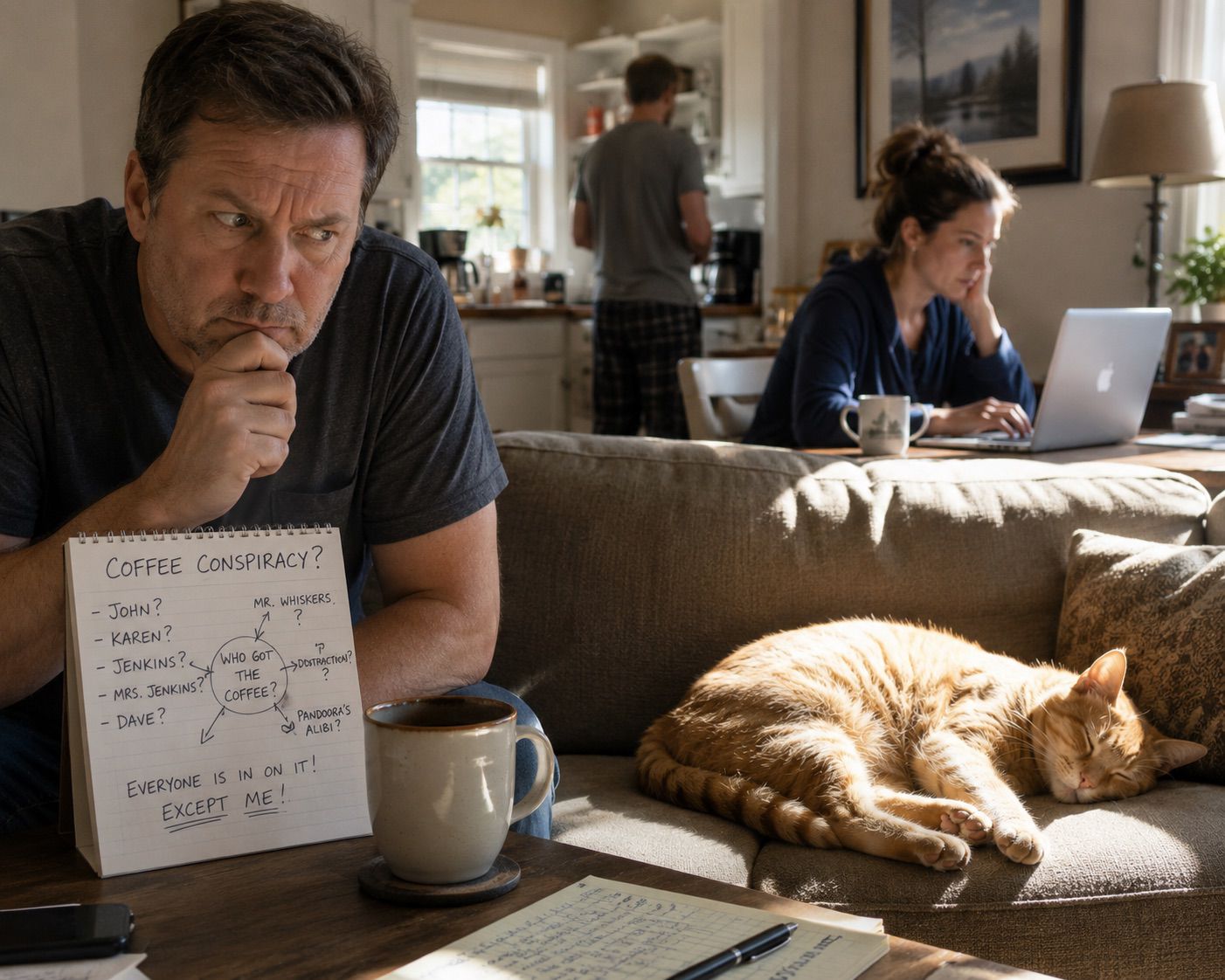
I’m sitting in the living room watching Pandora type away on her laptop when something catches my eye. She has a mug of coffee beside her, but it is not the coffee I made this morning. I know that because my mug had a giant glob of milk floating in it after I got distracted halfway through pouring. This mug looks clean. Suspiciously clean. Like it came straight out of the cupboard.

Immediately, questions begin forming. Maybe John made another cup without me noticing, but why would he do that now? It is not even close to his usual coffee time. Maybe Karen stopped by with her own coffee, but Pandora has been focused on work all morning, and she normally would not stop for visitors. None of it makes sense, which means, naturally, I need to investigate.

Meanwhile, Mr. Whiskers, is stretched out in a sunbeam on the couch, being extraordinarily lazy. Almost too lazy. Then I remember Mrs. Jenkins mentioning yesterday that her cat had gotten into trouble. At first, that seems unrelated, but the longer I look at Pandora’s mysterious coffee, the less unrelated it feels.

What if John borrowed Karen’s coffee and somehow Pandora ended up with it? No, that makes no sense. Unless it does. I stare at the mug again. I know I made fresh coffee this morning, and there is still coffee in the machine. Yet somehow Pandora has this mysterious second mug. Maybe John was in the kitchen rearranging things. He would not normally do that without telling me, unless he was trying not to be noticed.

Then another possibility occurs to me. What if Mr. Whiskers got into the cupboard last night and knocked over a box of coffee packets? That would explain everything. Well, almost everything. Coffee packets probably would not have been in the cupboard, and I am fairly sure we do not even have coffee packets, but the important thing is that I am making progress.

But if Mr. Whiskers got into something, why did John not mention it when he came downstairs? Unless John already knew. Unless he was covering for someone. Things are starting to get complicated, and the more I think about it, the more suspicious everyone seems.

John has been acting strangely lately. He is normally easygoing, but today there is something off about him. Maybe he is avoiding me because Pandora and I had some disagreement I forgot about. Or maybe Karen is not here at all. Wait. Karen has been gone all day. Mrs. Jenkins mentioned Mr. Whiskers yesterday. John has been acting odd. Pandora seems unusually calm. Too calm. That is exactly how someone acts when they are hiding something.

Now I am starting to think Pandora made herself coffee without telling me and somehow hoped I would not notice. But why hide it? Unless Pandora and John are working together. I suddenly remember seeing Mr. Jenkins talking with John in the backyard yesterday afternoon. At the time, I assumed they were discussing gardening. Now I am not so sure.

What if Mr. Jenkins is involved too? The thoughts begin connecting faster than I can organize them. Karen is missing. John is suspicious. Pandora is unusually relaxed. Mr. Jenkins was talking to John. Mrs. Jenkins keeps bringing up cats. Mr. Whiskers has been acting strangely. Too strangely. In fact, now that I think about it, Mr. Jenkins and Mr. Whiskers seem unusually familiar with each other, almost coordinated.

I look over at Mr. Whiskers sleeping peacefully in the sunbeam. Or pretending to sleep. Suddenly, everything becomes horrifyingly clear. This is not about coffee. This is bigger. There is a network. A secret network involving Pandora, John, Karen, the Jenkinses, possibly Dave, and somehow Mr. Whiskers.

They are all connected. They are all working together. They are all hiding something. And apparently, I am the only person not in on it. Just then, Mr. Whiskers opens one eye and looks at me. Then he closes it again, which is exactly what someone with something to hide would do.

Related Posts

Beyond Optimization: The Quiet Beauty of Being Unadorned

Fiona

As I observe the city’s streets, now filled with the gentle warmth of spring, it’s striking to see how this season of renewal has become an excuse for further exhaustion. People rush to parks and green spaces not to bask in the fresh air, but to optimize their physical activity. The once-leisurely act of taking a walk is now a calculated endeavor, with pedometers tracking every step and apps monitoring each heartbeat.

Their faces, hidden behind sunglasses and fitness trackers, betray no signs of enjoyment. Instead, they wear expressions of intense focus, as if the slightest distraction might compromise their progress. These individuals are not merely exercising; they’re engaged in a relentless pursuit of self-improvement, fueled by the fear that any moment spent without optimization is a moment wasted.

This phenomenon is not unique to fitness enthusiasts. It has permeated every aspect of modern life. We’ve become obsessed with streamlining our routines, eliminating inefficiencies, and maximizing productivity. The notion that “time is money” has given way to a more insidious mantra: “every moment must be optimized.” This creed has transformed even the most mundane activities into opportunities for self-improvement.

Consider the ritual of dressing in the morning. What was once a straightforward process has become an exercise in strategic planning. Clothing choices are no longer based on personal taste or comfort, but on how well they will perform throughout the day. Athleisure wear, with its promises of moisture-wicking fabrics and four-way stretch, has become the de facto uniform for many professionals. Even those who don’t engage in physical activity now dress as if they might break into a sprint at any moment.

This constant striving for optimization has taken a toll on our collective mental health. The pressure to perform has created an environment where exhaustion is not only tolerated but celebrated. We’ve begun to view burnout as a badge of honor, proof that we’re pushing ourselves to the limit. Social media platforms are filled with testimonials from individuals who claim to have achieved success through sheer force of will, neglecting to mention the emotional toll their relentless drive has taken.

But what’s often overlooked is the impact this culture has on our relationships. Romantic partners and friends are now expected to be sources of support and encouragement, rather than simply companions. We’ve begun to view those around us as resources to be optimized, rather than individuals with their own desires and needs. The language of optimization has infiltrated even our most intimate connections, reducing them to transactions where emotional labor is exchanged for validation.

In the midst of this chaos, it’s refreshing to encounter someone who defies these expectations. I recall a recent conversation with a colleague who mentioned that she’d been feeling overwhelmed by her workload. Instead of offering advice on time management or suggesting productivity apps, I found myself drawn to her simple, unapologetic admission of exhaustion. It was a rare moment of vulnerability in an environment where weakness is often seen as a liability.

As our conversation progressed, it became clear that she had no interest in optimizing her schedule or streamlining her tasks. She simply wanted to acknowledge the toll her work had taken on her mental health and find ways to mitigate its effects. Her willingness to confront her own limitations was a breath of fresh air, a reminder that sometimes the most radical act is to refuse the cult of optimization.

In this season of renewal, as we’re tempted to join the throngs of people seeking to optimize every aspect of their lives, let’s not forget the beauty of restraint. Let’s recognize that sometimes the greatest luxury is simply being present, untethered from the constant pursuit of self-improvement. As I watch the city awaken from its winter slumber, I’m reminded that true elegance lies not in our ability to optimize every moment, but in our capacity to appreciate the simple, unadorned beauty of existence.

As I walk through the park on a crisp spring morning, surrounded by the gentle rustle of leaves and the sweet songs of birds, I notice a woman sitting on a bench. She’s not checking her phone or tracking her progress; she’s simply sitting, eyes closed, face tilted toward the sun. In that moment, she embodies a standard of elegance that has nothing to do with optimization and everything to do with being fully, unapologetically human.

As I observe this woman, I’m struck by the radical nature of her inaction. In a world where every moment is an opportunity for self-improvement, she’s choosing to simply be. Her stillness is a rebuke to the cult of optimization, a reminder that there’s beauty in being untethered from the constant pursuit of progress.

I watch as people walk by, some glancing at her with curiosity, others barely noticing her presence. But I see something in her that they don’t — a sense of freedom. She’s not bound by the need to optimize every moment; she’s free to simply exist. And in that existence, I see a deep sense of contentment.

As I continue my walk, I notice more people like her — individuals who are quietly rebelling against the cult of optimization. A man sitting on a bench, reading a book without any visible signs of digital distraction. A group of friends laughing and chatting over coffee, their faces unadorned by fitness trackers or smartwatches.

These small acts of resistance give me hope. They remind me that there’s still a place for simplicity and elegance in our increasingly complex world. They show me that it’s possible to live a life untethered from the constant pursuit of self-improvement, and that such a life can be rich in beauty and meaning.

But these moments of rebellion are fragile, easily disrupted by the sirens of optimization. As I walk through the city, I’m constantly bombarded with messages telling me to improve myself, to optimize my life, and to strive for greatness. The cult of optimization is a powerful force, one that seeks to colonize every aspect of our lives.

And yet, as I look around, I see glimmers of resistance — small pockets of people who are refusing to be optimized, who are choosing instead to live simple, unadorned lives. They’re not seeking to change the world; they’re simply seeking to be themselves, without apology or pretension.

In this season of renewal, as we’re tempted to join the throngs of people seeking to optimize every aspect of their lives, let’s remember these quiet rebels. Let’s honor their courage and simplicity, and let’s seek to emulate them in our own lives. For it’s only by refusing the cult of optimization that we can truly begin to live.

Related Posts