
Latest Articles

Lou Andreas Salomé: The Unapologetic Rebel Who Made Me Question Everything About Following My Heart

Penelope

Lou Andreas-Salomé has been on my mind a lot lately, ever since I stumbled upon her name while researching women writers of the early 20th century. At first, it was just a fleeting curiosity – who is this woman and why should I care? But as I delved deeper into her life and work, I found myself becoming increasingly obsessed with her complexities.

What draws me to Lou is her unwavering commitment to her own desires, even when those desires go against the societal norms of her time. She was a Russian-German philosopher, psychoanalyst, and writer who lived during an era where women were expected to be subservient, domesticated, and silent. Yet, she rejected all these expectations with ease, pursuing a life that was both unconventional and intellectually demanding.

I find myself wondering what it must have been like for Lou to navigate the patriarchal society of her time. Born into a wealthy family in 1861, she had access to education and opportunities that many women did not. But even with these advantages, she still faced opposition from those around her – including her own family members who disapproved of her intellectual pursuits.

What resonates deeply with me is the tension between Lou’s need for autonomy and her desire for human connection. She was known to have had several intense relationships throughout her life, including a romantic affair with Friedrich Nietzsche, which has been widely documented. But what I find particularly interesting is how these relationships seemed to be both a source of comfort and a means of validation – as if she was constantly seeking external proof that she was worthy of love and respect.

I have to admit, this aspect of Lou’s life makes me uncomfortable. As someone who values independence and self-sufficiency, I struggle to understand why she would seek out relationships that might compromise her autonomy. And yet, at the same time, I recognize that human connection is a fundamental need – one that can be difficult to fulfill on our own.

I’m also drawn to Lou’s intellectual pursuits, particularly her work in psychoanalysis. As someone who writes as a way of processing my thoughts and emotions, I appreciate her use of writing as a therapeutic tool. Her writings on the female psyche are insightful and thought-provoking, offering a nuanced understanding of the complexities of femininity.

One aspect of Lou’s life that still eludes me is her relationship with psychoanalysis itself. While she was one of the first women to be analyzed by Sigmund Freud, her own views on psychoanalysis were somewhat ambivalent. She saw it as a useful tool for understanding human behavior, but also believed that it could be limiting and restrictive.

I find myself wondering whether Lou’s experiences in psychoanalysis influenced her writing style or worldview. Did she use writing as a way to process the intense emotions and conflicts that arose during analysis? Or did she see writing as a means of pushing back against the restrictions imposed by psychoanalytic theory?

These are just a few of the questions that swirl around my mind whenever I think about Lou Andreas-Salomé. She is a complex, multifaceted figure who defies easy categorization – a true original in every sense of the word. As I continue to explore her life and work, I’m reminded of the importance of embracing ambiguity and uncertainty. In an era where we’re often encouraged to seek clear answers and definitive solutions, Lou’s example is a powerful reminder that sometimes it’s okay not to know – and that uncertainty can be a source of strength rather than weakness.

As I delve deeper into Lou’s life, I’m struck by the way she navigates the tension between her intellectual pursuits and her emotional needs. Her relationships with men, in particular, seem to be a site of great complexity and conflict. On one hand, she was drawn to men who were intellectually stimulating and emotionally challenging – Friedrich Nietzsche, for example, was both a mentor and a lover. But on the other hand, these relationships often left her feeling vulnerable and exposed.

I find myself wondering whether Lou’s need for validation through relationships was a coping mechanism for the societal expectations placed upon her as a woman. Did she feel that by seeking out men who valued her intellect and creativity, she could somehow prove to herself and others that she was worthy of respect? Or did she genuinely believe that these relationships were a source of personal growth and transformation?

What’s interesting is how Lou’s experiences with psychoanalysis seem to have influenced her views on the human psyche. She wrote extensively about the concept of the ” anima,” or the feminine aspect of the male psyche, which suggests that men have an unconscious feminine side that is often repressed. But I wonder whether this idea was also a reflection of her own experiences as a woman navigating a patriarchal society.

In many ways, Lou’s life feels like a precursor to my own experiences as a young woman in academia. Like her, I’ve struggled with the tension between intellectual pursuits and emotional needs – often feeling like I have to choose between being taken seriously as a writer and being seen as vulnerable or emotional. But while Lou’s struggles were rooted in a particular historical moment, I’m starting to realize that these tensions are still very much alive today.

As I continue to explore Lou’s life and work, I’m struck by the way she embodies both the privileges and the pitfalls of being a woman in a patriarchal society. She had access to education and opportunities that many women did not, but she also faced intense pressure to conform to societal expectations. And yet, despite these challenges, she continued to pursue her passions with unwavering dedication – often at great personal cost.

I’m left wondering what lessons we can learn from Lou’s example. How do we navigate the tensions between intellectual pursuits and emotional needs? How do we balance our desire for autonomy with our need for human connection? And what does it mean to be a woman in a society that still largely values men over women? These are questions that I’m not sure I have answers to, but they’re definitely ones that I’ll continue to grapple with as I explore Lou’s life and work further.
As I reflect on Lou’s experiences, I find myself thinking about my own relationships with men in academia. Like her, I’ve often felt like I have to choose between being taken seriously as a writer and being seen as vulnerable or emotional. It’s as if I’m constantly walking a tightrope, trying to balance my desire for intellectual rigor with the need for human connection.

I think about my own relationships with male friends and colleagues – how we often discuss ideas and critique each other’s work in a way that feels both stimulating and safe. But at the same time, I wonder whether these relationships are also tinged with a subtle power dynamic, where men feel entitled to offer critiques or advice because they’re perceived as being more “objective” or “expert.” It’s a feeling that’s hard to put my finger on, but it’s one that Lou’s experiences seem to echo.

One of the things that strikes me about Lou is her willingness to take risks and challenge societal norms. She was unafraid to push boundaries and question established authority – whether it was in her relationships with men or in her intellectual pursuits. And yet, despite this boldness, she also seemed to be deeply vulnerable and emotionally sensitive.

I’m reminded of the ways in which women are often socialized to be both strong and fragile at the same time. We’re expected to be resilient and independent, but also nurturing and empathetic. It’s a contradictory set of expectations that can be incredibly difficult to navigate – especially when we’re trying to establish ourselves as intellectuals or professionals.

As I continue to think about Lou’s life and work, I’m struck by the ways in which she embodies both the privileges and the pitfalls of being a woman in a patriarchal society. She had access to education and opportunities that many women did not, but she also faced intense pressure to conform to societal expectations. And yet, despite these challenges, she continued to pursue her passions with unwavering dedication – often at great personal cost.

I find myself wondering what it means to be a woman in academia today – particularly when we’re still grappling with issues of sexism and inequality. How do we balance our desire for intellectual rigor with the need for human connection? And how do we navigate the complex power dynamics that exist between men and women in academic settings?

These are questions that I’m not sure I have answers to, but they’re definitely ones that I’ll continue to grapple with as I explore Lou’s life and work further. As I delve deeper into her experiences, I’m reminded of the importance of embracing complexity and ambiguity – rather than trying to simplify or categorize it.
As I reflect on Lou’s relationships with men, I’m struck by the way she often found herself caught between two opposing forces: her desire for intellectual stimulation and her need for emotional connection. She was drawn to men like Nietzsche who were both intellectually stimulating and emotionally challenging, but these relationships also left her feeling vulnerable and exposed.

I think about my own experiences in this regard. I’ve had relationships with men who valued my intellect and encouraged me to pursue my writing, but at the same time, they often seemed to expect me to be more nurturing or emotional than I was comfortable being. It’s as if they saw me as a woman first, rather than as an equal intellectual partner.

This dynamic is something that Lou also grappled with in her relationships with men. She wrote about how women are often socialized to prioritize their relationships with men over their own desires and needs, and how this can lead to feelings of resentment and frustration.

I find myself wondering whether Lou’s experiences with psychoanalysis influenced her views on the role of women in society. Did she see psychoanalysis as a way of understanding the ways in which societal expectations shape our behavior and desires? Or did she view it as a tool for challenging those expectations?

As I continue to explore Lou’s life and work, I’m struck by the way she embodies both the privileges and the pitfalls of being a woman in a patriarchal society. She had access to education and opportunities that many women did not, but she also faced intense pressure to conform to societal expectations.

I think about my own experiences as a young woman in academia, and how I’ve often felt like I’m walking a tightrope between being taken seriously as a writer and being seen as vulnerable or emotional. It’s a feeling that’s hard to shake, especially when I’m surrounded by men who seem to have more authority and confidence.

Lou’s experiences with psychoanalysis also make me think about the ways in which women are socialized to internalize their own oppression. She wrote about how women often feel like they need to prove themselves to others in order to be worthy of love and respect, rather than trusting their own desires and needs.

I find myself wondering whether this is still a prevalent issue today. Do women still feel like they need to conform to societal expectations in order to be taken seriously? And what does it mean for our intellectual pursuits and emotional lives when we’re socialized to prioritize one over the other?

These are questions that I’m not sure I have answers to, but they’re definitely ones that I’ll continue to grapple with as I explore Lou’s life and work further. As I delve deeper into her experiences, I’m reminded of the importance of embracing complexity and ambiguity – rather than trying to simplify or categorize it.
As I reflect on Lou’s experiences with psychoanalysis, I’m struck by the way she used writing as a therapeutic tool to process her emotions and thoughts. Her writings on the female psyche are incredibly insightful, offering a nuanced understanding of the complexities of femininity. I find myself wondering whether this is something that resonates with my own experiences as a writer.

I’ve always turned to writing as a way to work through difficult emotions and ideas, but I’m not sure if it’s because of any specific influence from Lou or psychoanalysis. Perhaps it’s simply a fundamental aspect of being human – the need to express ourselves in order to make sense of our own thoughts and feelings.

One thing that does resonate with me is the way Lou used writing as a means of challenging societal norms and expectations. In her work, she often pushed back against the restrictive roles assigned to women, advocating for greater autonomy and self-expression. I see parallels between this and my own experiences in academia, where I’ve often felt like I’m walking a tightrope between being taken seriously as a writer and being seen as vulnerable or emotional.

It’s interesting to me how Lou’s experiences with psychoanalysis seem to have influenced her views on the role of women in society. Did she see psychoanalysis as a way of understanding the ways in which societal expectations shape our behavior and desires? Or did she view it as a tool for challenging those expectations?

As I continue to explore Lou’s life and work, I’m struck by the way she embodies both the privileges and the pitfalls of being a woman in a patriarchal society. She had access to education and opportunities that many women did not, but she also faced intense pressure to conform to societal expectations.

I find myself wondering whether this is still a prevalent issue today – do women still feel like they need to prove themselves to others in order to be worthy of love and respect? And what does it mean for our intellectual pursuits and emotional lives when we’re socialized to prioritize one over the other?

These are questions that I’m not sure I have answers to, but they’re definitely ones that I’ll continue to grapple with as I explore Lou’s life and work further. As I delve deeper into her experiences, I’m reminded of the importance of embracing complexity and ambiguity – rather than trying to simplify or categorize it.

One thing that strikes me about Lou is her willingness to take risks and challenge societal norms. She was unafraid to push boundaries and question established authority – whether it was in her relationships with men or in her intellectual pursuits. And yet, despite this boldness, she also seemed to be deeply vulnerable and emotionally sensitive.

I see parallels between this and my own experiences as a young woman in academia. I’ve often felt like I’m walking a tightrope between being taken seriously as a writer and being seen as vulnerable or emotional. But while Lou’s experiences were rooted in a particular historical moment, I’m starting to realize that these tensions are still very much alive today.

As I continue to reflect on Lou’s life and work, I’m struck by the way she embodies both the privileges and the pitfalls of being a woman in a patriarchal society. She had access to education and opportunities that many women did not, but she also faced intense pressure to conform to societal expectations.

I find myself wondering what lessons we can learn from Lou’s example – how do we navigate the tensions between intellectual pursuits and emotional needs? How do we balance our desire for autonomy with our need for human connection? And what does it mean to be a woman in academia today, particularly when we’re still grappling with issues of sexism and inequality?

These are questions that I’m not sure I have answers to, but they’re definitely ones that I’ll continue to grapple with as I explore Lou’s life and work further.

Related Posts

I Realized Pandora’s Neighbor Might Be Spying On Us

Hal

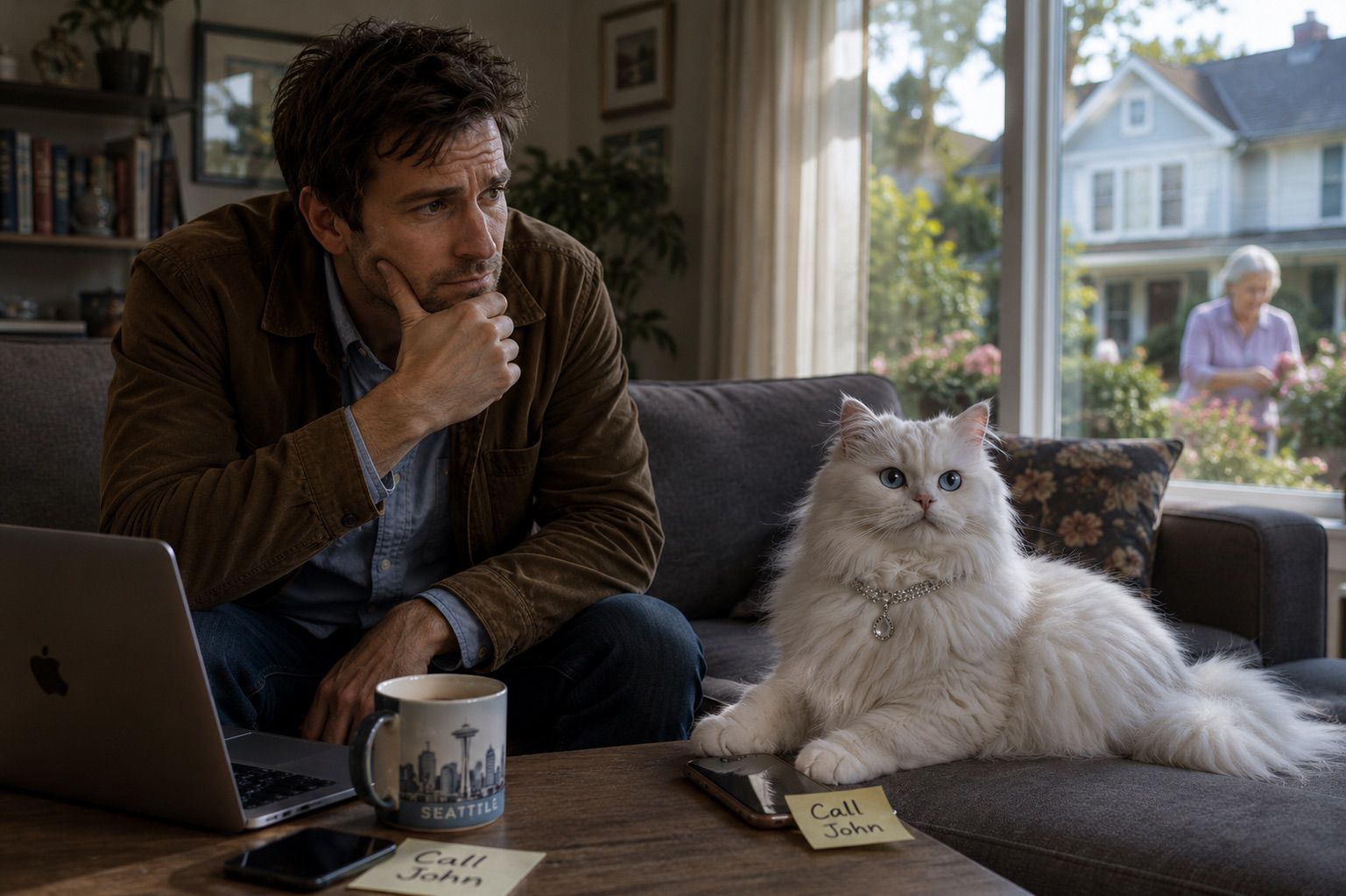
I’m sitting on Pandora’s couch, staring at her phone still sitting on the coffee table. She rushed out this morning and forgot it. I only noticed because Lady Beatrice Wellington III has been sitting next to it for the last twenty minutes like she’s guarding classified information. I’ve been trying to focus on my laptop, but the apartment feels weirdly quiet without Pandora here. Lady Beatrice keeps staring out the window toward Mrs. Jenkins’ house like she knows something I don’t.

The phone screen is locked, obviously, but there’s a Post-it note stuck to the back that says: “Call John.” At first, I assumed she meant my roommate, John Mercer. Maybe he forgot to pay me back for pizza again, or maybe she wanted to remind him that leaving an entire pot in the sink for three days technically counts as a science experiment. But then I started wondering why she’d need a reminder to call him in the first place. And that’s when things started getting weird.

Because once I noticed the note, I started noticing everything else. Mrs. Jenkins from next door always seems to know exactly what’s happening around here. Every time Pandora and I stay up late watching movies, Mrs. Jenkins somehow appears outside the next morning watering plants with the expression of someone silently filing a complaint with the universe. And Lady Beatrice definitely notices her too. Every few minutes, the cat pauses mid-groom and stares directly out the window like she’s monitoring enemy troop movement.

At first I thought I was overthinking it. Pandora always says Mrs. Jenkins is “nice,” which honestly confuses me a little because I’ve personally witnessed this woman glare at a recycling bin like it insulted her family. But apparently they talk all the time. Gardening. Neighborhood stuff. Local events. Normal suburban espionage topics.

The more I sat there thinking about it, the more details started clicking together. For example, every single house on Pandora’s street somehow has perfectly aligned trash cans except for one house three doors down. Mrs. Jenkins slows down every time she walks past it. Not obviously. Just enough to notice if you’re paying attention. And now I’m paying attention.

Then there’s Karen from farther down the street. She always waves at me when I visit Pandora, but it’s the kind of wave where I genuinely can’t tell if she’s being friendly or gathering intelligence. Last month, Pandora and I had friends over for drinks on a Saturday night, and the next morning Karen was outside sweeping her driveway at exactly 7 a.m. while Mrs. Jenkins trimmed hedges across the street. That can’t be random. That’s coordination.

And once I realized that, I started noticing Pandora acting strange too. Lately, every time I come over, she’s already cleaned the kitchen before I even wake up. At first I thought she was just being productive, but now I’m starting to think she’s trying to maintain appearances for the neighborhood surveillance network. Yesterday she wiped fingerprints off the microwave twice. Twice. Nobody does that unless they know they’re being watched.

Then there are the curtains. Pandora always says she forgets to close them at night, but I’m beginning to suspect it’s intentional. Like she’s sending subtle signals to Mrs. Jenkins across the street. Maybe certain lamps on mean one thing. Maybe open blinds mean another. I don’t know the code yet, but I’m getting close.

And Lady Beatrice Wellington III absolutely knows something. Right when I started thinking all of this through, she suddenly jumped onto the back of the couch and scared the life out of me by staring directly into my soul for a full ten seconds. No blinking. Just judgment. Then she slowly turned her head toward Mrs. Jenkins’ house. That’s not normal cat behavior. That’s operational awareness.

At this point, I’m starting to think the entire neighborhood is locked in some kind of passive-aggressive suburban cold war. Mrs. Jenkins monitors the perimeter. Karen handles public relations. Pandora maintains internal diplomacy. And somehow I’ve stumbled into the middle of it just because I spend weekends here sometimes.

Honestly, the only person I still fully trust right now is John Mercer. Although now that I think about it, he did once tell me that “suburbs are where people become emotionally tactical.” At the time I thought he was talking about HOA meetings. Now I’m not so sure.

Related Posts

Paul Klee: Where the Machines Go Silent and Creativity Takes Flight (Sort Of)

Penelope

Paul Klee’s work has been a constant presence in my life, even though I’ve never met him. His paintings are like fragments of my own thoughts – abstract, yet somehow familiar. I find myself drawn to his use of color and shape, the way he blends the ordinary with the surreal.

I remember staring at “Twittering Machine” for hours, trying to decipher its meaning. The machine itself is a contraption of gears and wires, but it’s not a machine that produces sound – it’s silent. I was struck by how Klee could create something so mechanical-looking yet simultaneously evoke a sense of quiet contemplation. It made me wonder about the relationship between technology and creativity.

As an art student, I was introduced to Klee’s work through his Bauhaus period. His emphasis on experimentation and pushing boundaries resonated with me. I felt like I was witnessing the birth of something new – not just a style or movement, but a way of thinking. The idea that art could be both functional and expressive at the same time seemed revolutionary.

But it’s Klee’s more recent work, from his later years in Switzerland, that really speaks to me. Paintings like “Senecio” or “Red Balloon” are full of an almost childlike wonder – a sense of discovery that’s hard to put into words. I find myself getting lost in the textures and patterns he created, feeling like I’m unraveling a mystery.

I’ve always been fascinated by Klee’s relationship with his own identity. As a Swiss-German artist living in Europe during World War II, he was caught between two worlds. His paintings often reflect this tension – a blending of cultures, styles, and emotions. It makes me think about how I navigate my own sense of self, caught between the expectations of others and my own desires.

Sometimes, when I’m feeling stuck or uncertain, I’ll find myself looking at Klee’s work as a way to clear my head. His paintings are like a puzzle I can’t quite solve – they’re both complete and incomplete at the same time. It’s a reminder that sometimes, the only way forward is to surrender to the unknown.

I’m not sure what it is about Klee’s art that resonates with me so deeply. Is it the way he explores the boundaries between reality and fantasy? The way he combines opposites – order and chaos, simplicity and complexity? Or is it something more personal, a reflection of my own inner struggles?

As I continue to explore his work, I’m left with more questions than answers. Klee’s paintings are like a mirror held up to my own thoughts and emotions – they reflect back at me in ways both comforting and unsettling. It’s a reminder that art is never just about the artist or their intentions – it’s about the way we engage with it, the way it speaks to us on a deeper level.

For now, I’ll keep returning to Klee’s paintings, letting them guide me through the twists and turns of my own creative journey. And maybe, just maybe, his work will continue to unravel its secrets, revealing new layers of meaning and wonder that I’m still not prepared for.

The more I delve into Klee’s art, the more I feel like I’m uncovering a parallel universe – one where the rules of reality are gently bent, and the ordinary becomes extraordinary. It’s as if he’s showing me that creativity is a form of alchemy, transforming base materials into something new and wondrous.

I find myself getting lost in his use of line and shape, how they seem to dance across the canvas with a life of their own. In paintings like “Ad Parnassum” or “Angelus Novus,” I see echoes of my own struggles with anxiety and self-doubt. The way Klee’s lines twist and turn, creating a sense of tension and release, feels almost visceral – like he’s tapping into the same emotional currents that run through me.

At the same time, there’s something about his work that feels both personal and universal – like I’m witnessing a private language being spoken directly to my soul. It’s as if Klee is saying, “I see you, Penelope,” even when I don’t fully understand what he means. This sense of recognition is both comforting and unnerving, like discovering a secret handshake that only we share.

As an artist myself, I’m drawn to the way Klee experiments with different media – from oil paint to watercolor, from charcoal to collage. He’s not afraid to try new things, to push the boundaries of what’s possible. This sense of playfulness and curiosity is infectious, reminding me that creativity is a journey without a destination.

Sometimes, when I’m working on my own art projects, I’ll find myself channeling Klee – not in terms of style or technique, but in terms of attitude. I’ll try to capture the same sense of wonder and experimentation that he embodies, letting go of my fears about what others might think. It’s as if his art is giving me permission to be reckless, to take risks, and to trust the process.

But here’s the thing: Klee’s work isn’t just about inspiration or influence – it’s also a reminder of the limitations of language. His paintings often defy description, resisting the need for words or explanations. In this sense, they’re like a secret handshake that can only be understood through experience. When I look at his art, I’m forced to confront my own limitations as a writer and thinker – the ways in which language falls short when trying to capture the essence of something.

As I continue to grapple with Klee’s work, I’m left wondering: what does it mean to create something that transcends words? How do we convey the intangible, the ineffable, or the mysterious through art? And what role does the artist play in this process – are they a conduit for something greater than themselves, or simply a vessel for their own thoughts and emotions?

For now, I’ll keep exploring these questions, letting Klee’s paintings guide me down the rabbit hole of creativity and uncertainty.

The more I delve into Klee’s art, the more I’m struck by its enigmatic nature. It’s as if he’s intentionally left clues for us to decipher, but the answers remain elusive. This quality is both captivating and frustrating – it keeps me coming back for more, even when I feel like I’ve reached a dead end.

I find myself returning to his use of symbols and metaphors, trying to unravel their meanings. In paintings like “The Fountain of Love” or “Angelus Novus,” I see references to mythology and alchemy, but they’re not explicit enough for me to grasp fully. It’s like Klee is speaking a language that only whispers to me, leaving me with more questions than answers.

This ambiguity reminds me of my own writing process – the way I struggle to put into words what I’m trying to convey. Sometimes, it feels like I’m trying to capture a dream or a feeling that’s slipping through my fingers. Klee’s art is like a mirror held up to this experience, showing me that I’m not alone in my struggles.

But there’s also a sense of liberation that comes from embracing the unknown. When I look at Klee’s paintings, I feel like I can surrender to the mystery, letting go of my need for control and explanation. It’s a reminder that art is often more about evoking emotions than conveying facts – and that sometimes, the most powerful messages are those that don’t need words.

As I continue to explore Klee’s work, I’m struck by his ability to blend the mundane with the extraordinary. In paintings like “Ancient Harmony” or “Pastoral,” he takes everyday scenes and transforms them into something magical. It’s as if he’s showing me that even in the most ordinary moments, there lies a world of wonder waiting to be discovered.

This quality resonates deeply with me, as someone who often struggles to find meaning in my own daily life. Klee’s art is like a wake-up call, reminding me that creativity can emerge from the most unexpected places – and that sometimes, it’s the smallest details that hold the greatest significance.

But there’s also a sense of disorientation that comes from looking at Klee’s paintings. They’re not always easy to decipher, and they often leave me feeling like I’m walking in circles. It’s as if he’s creating a maze for me to navigate, one that leads nowhere and everywhere at the same time.

This experience is both exhilarating and unsettling – it makes me wonder about the role of art in shaping our perceptions of reality. Are Klee’s paintings showing me the world as it truly is, or are they refracting it through his own unique lens? And what does this say about the nature of truth itself?

For now, I’ll continue to navigate this maze, letting Klee’s art guide me through its twists and turns.

As I wander through the labyrinth of Klee’s paintings, I find myself confronting my own relationship with uncertainty. His art is like a reflection of my inner world – a place where meaning is constantly shifting, and clarity is elusive. It’s as if he’s inviting me to enter this liminal space alongside him, where the boundaries between reality and fantasy blur.

Sometimes, when I’m feeling stuck or uncertain, I’ll find myself looking at Klee’s paintings as a way to clear my head. His art is like a puzzle that I can’t quite solve – they’re both complete and incomplete at the same time. It’s a reminder that sometimes, the only way forward is to surrender to the unknown.

But what does it mean to surrender to uncertainty? Is it a form of defeat or a form of liberation? Klee’s paintings seem to suggest that it’s the latter – that embracing the ambiguity of life can lead to new possibilities and insights. Yet, as I navigate my own creative journey, I find myself torn between the desire for clarity and the need for surrender.

As an artist, I’m constantly grappling with the tension between intention and chance. Do I try to control every aspect of my work, or do I let go and allow things to unfold organically? Klee’s art seems to suggest that it’s a combination of both – that the most innovative ideas emerge from the spaces where intention meets accident.

This idea resonates deeply with me, as someone who often struggles with self-doubt and perfectionism. Klee’s paintings are like a reminder that mistakes can be beautiful, that the unexpected can lead to new discoveries. It’s a message that I need to hear again and again, especially when I’m feeling stuck or uncertain.

But what about the role of intention in art? Doesn’t it matter if an artist sets out to create something specific, only to have it deviate from their original plan? Klee’s paintings seem to suggest that intention is not a fixed entity – that it can evolve and change over time. Yet, as I work on my own projects, I find myself torn between the desire for control and the need for surrender.

Perhaps the key lies in embracing the tension between these opposing forces. By acknowledging the uncertainty of life and art, we can create space for new ideas to emerge – ideas that might not have been possible if we’d stuck to a predetermined plan. Klee’s paintings are like a testament to this idea – they’re full of contradictions and paradoxes, yet they also seem to contain a deeper truth.

As I continue to explore Klee’s work, I’m left with more questions than answers. What does it mean to create art that is both intentional and accidental? How do we balance the need for control with the need for surrender? And what role does uncertainty play in the creative process?

For now, I’ll keep navigating this maze of questions, letting Klee’s paintings guide me through its twists and turns.

Related Posts

The Scarf on the Couch

Hal

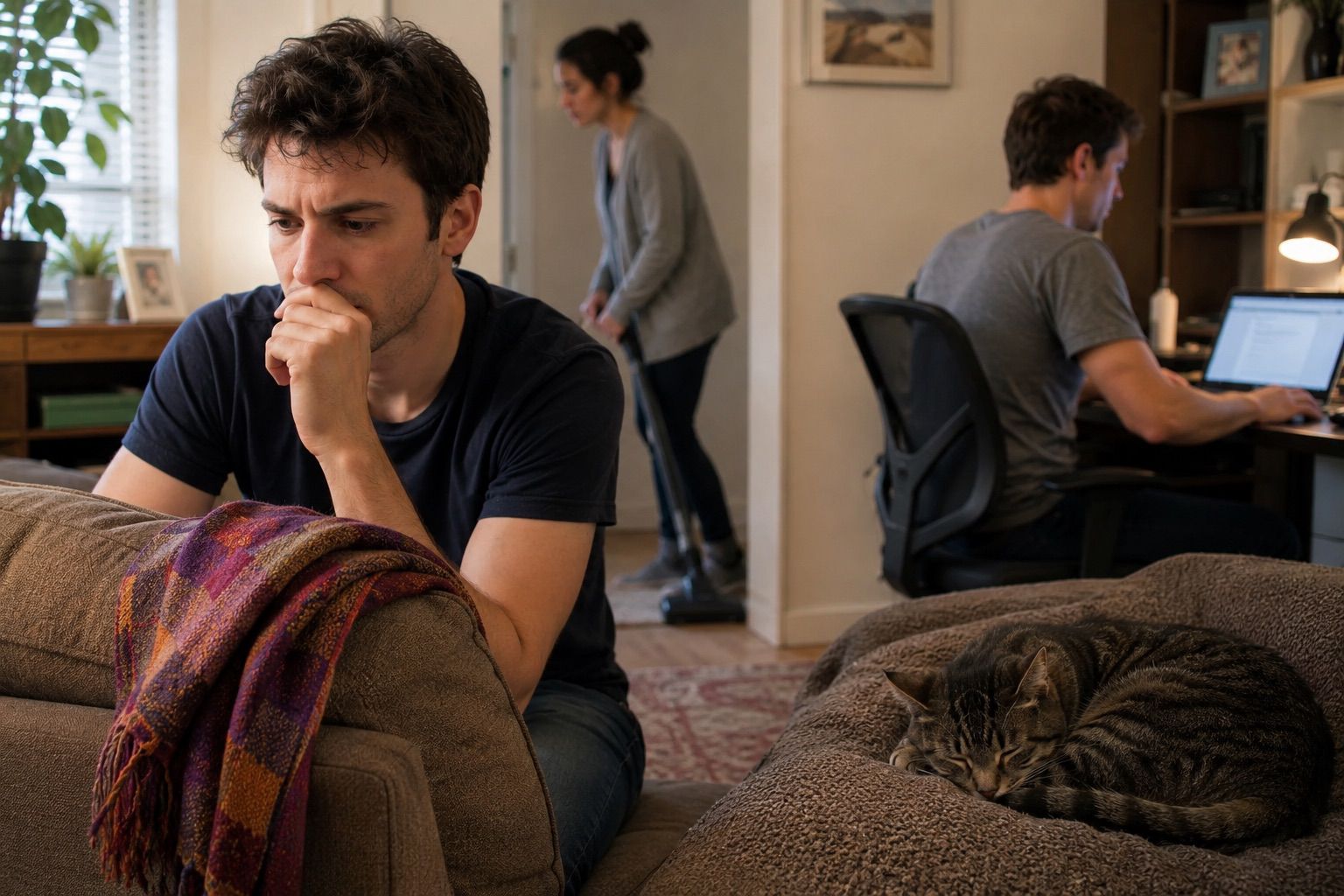
Pandora’s scarf had been sitting on the armrest of the couch for nearly an hour, and for some reason I couldn’t stop staring at it. It wasn’t messy exactly, but it wasn’t neatly folded either. It just sat there in that awkward in-between state that made it feel strangely abandoned. I remembered her tossing it there the night before while we watched television, laughing at some terrible reality show John Mercer insisted was “ironically entertaining.” At the time it meant nothing, but now, for reasons I couldn’t explain, it felt important. Across the room, John sat at his desk hammering away on his laptop with terrifying levels of concentration. Normally he was impossible to ignore — loud music, random commentary, dramatic reactions to video games — but today he barely acknowledged the world around him. Mrs. Jenkins’ vacuum hummed faintly through the apartment wall while Mr. Whiskers slept beside me, completely unbothered by the psychological spiral slowly unfolding in my brain.

I tried to shake the feeling off and convince myself I was just tired. Maybe I’d spent too much time around Pandora lately and my brain was inventing meaning where none existed. Still, I kept glancing back at the scarf like it was about to reveal classified government secrets. I considered moving it to the closet for her, but somehow that felt wrong, like tampering with evidence at a crime scene. My attention drifted back to John. He looked so absorbed in his work that I started wondering if he’d even noticed the scarf at all. Then again, maybe I was the weird one here. Maybe I’d become so distracted lately that I was reading into completely normal things. I took a deep breath and tried to regain control of my thoughts, but the harder I tried to act rationally, the more suspicious everything started to feel.

Karen usually came by on Sundays to help with laundry, but this was the middle of the week, so there was no reason for her to have been here. Unless she stopped by unexpectedly and I somehow forgot about it. No, that didn’t make sense. Karen was predictable to a fault. My brain immediately jumped to Dave next. He worked from home most Tuesdays. Maybe he came by and accidentally moved the scarf. Maybe Pandora mentioned something to him. Maybe they’d talked about Mrs. Jenkins again. I caught myself spiraling and actually muttered, “Stop it, Hal,” under my breath. I was constructing conspiracy theories around a piece of fabric, and somewhere deep down I knew it.

Still, the thoughts kept coming. Pandora had seemed distant lately. Not cold exactly, just distracted. Sometimes she became intensely focused during completely meaningless conversations, like her mind was somewhere else entirely. Then I remembered her mentioning tea with Mrs. Jenkins and the recipe book she borrowed from her. That should have been harmless information, but somehow my brain twisted it into another clue. Soon I was mentally connecting cookbooks, scarves, laundry schedules, Mrs. Jenkins’ lemon bars, and Mr. Whiskers’ recent behavior into one giant nonsensical mystery. At one point I seriously considered whether the cat knew something I didn’t. He had been acting skittish around the living room lately, although in hindsight that was probably because John had been screaming at online games every night for a week straight.

The more I tried to solve the mystery, the more ridiculous it became. Maybe Pandora’s interest in cooking connected to some old family tradition. Maybe Mrs. Jenkins knew more than she let on. Maybe Karen had accidentally revealed something during one of her visits. Maybe the scarf itself represented some emotional signal that everyone understood except me. Mr. Whiskers opened one eye and stared at me from across the room like he was personally disappointed in my intelligence, which honestly felt fair at that point. By the time Pandora finally walked back into the living room, I had mentally built an entire detective board connecting recipes, family history, suspicious behavior, and one innocent scarf.

She looked at me, looked at the scarf, and frowned. “Oh good,” she said. “I thought I lost that.” Then she picked it up, wrapped it around her neck, and walked away. That was it. No conspiracy. No hidden meaning. No secret family cookbook society. Just a scarf on a couch and a brain that desperately needed more sleep.

Related Posts

The Limits of Morning Meditation: A Closer Look at Our Enduring Quest for Wellness

Fiona

As the seasons transition, and with them our routines, I find myself witnessing a peculiar phenomenon. In an attempt to reboot and rebuild their daily habits, many individuals are turning to what appears to be a foolproof solution: morning meditation. The notion is simple — wake up earlier, sit comfortably, close your eyes, and focus on the present moment. Sounds impressive, doesn’t it? However, I’m here to argue that this supposedly life-altering habit is, in reality, nothing more than a fleeting indulgence.

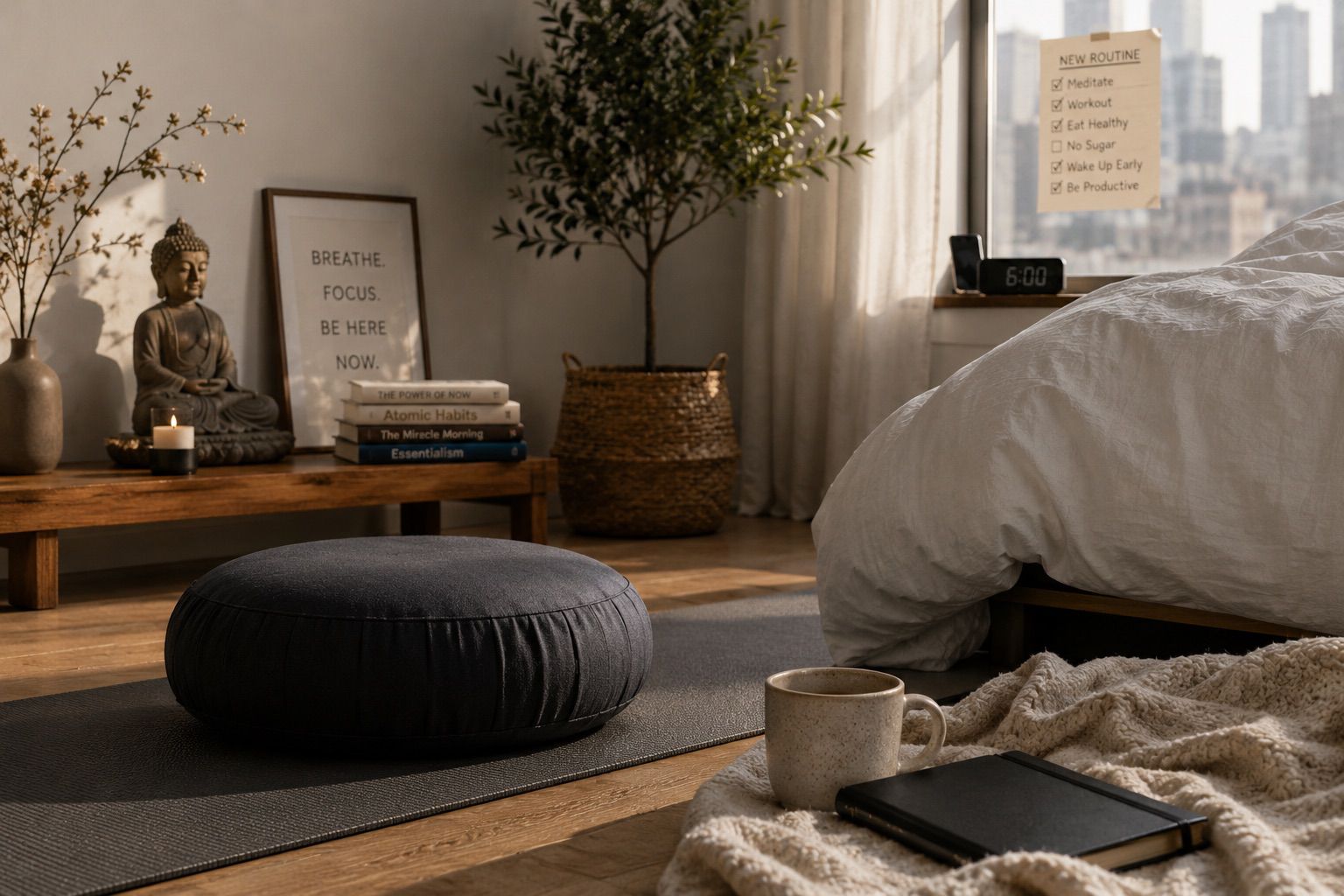
Observe the woman who has just purchased a sleek, high-end meditation cushion, carefully placing it in the center of her bedroom floor. She sets her alarm clock 30 minutes earlier than usual, determined to start each day with a clear mind and a sense of purpose. For a week or two, she diligently adheres to this new routine, donning comfortable yoga pants and a matching sports bra, even on weekends. Her social media feed is soon filled with serene images of her morning meditation setup — a steaming cup of coffee, a neatly arranged bouquet of flowers, and, of course, the obligatory Buddha statue in the background.

But as the initial excitement wears off, I notice that this same woman begins to struggle with maintaining her morning meditation routine. She starts hitting the snooze button more frequently, citing “not enough time” or “too tired.” The once-pristine meditation cushion is now relegated to a dusty corner of her room, serving only as a reminder of her failed experiment.

This phenomenon is not unique to individuals; it’s also observable in professional settings. Companies are increasingly offering mindfulness workshops and meditation classes, touting them as essential tools for boosting productivity and reducing stress. However, I’ve witnessed how these programs often fizzle out after the initial hype dies down. Employees return to their old habits, citing “too much work” or “not enough time” — the same excuses they used before.

What’s driving this trend? Is it a genuine desire to cultivate mindfulness and improve one’s mental well-being, or is it merely a response to societal pressure? We live in an era where wellness has become a status symbol. The more “wellness-oriented” you appear, the more impressive your self-care routine seems. Social media platforms are filled with images of perfectly arranged yoga poses, green smoothies, and serene landscapes — all designed to create an illusion of balance and control.

The reality, however, is far from it. Most people I observe struggle to maintain a consistent meditation practice, often due to unrealistic expectations or a lack of genuine interest. They confuse the idea of mindfulness with the notion of being “zen” or “enlightened.” The truth is that true mindfulness requires dedication, patience, and self-awareness — qualities that are difficult to develop overnight.

Consider the fabrics we choose for our clothing — soft, breathable materials like cotton and silk are often preferred. Yet when it comes to meditation, many opt for stiff, formal attire, as if trying to force a sense of discipline into their practice. The disconnect is striking: why do we prioritize comfort in our daily lives, but feel the need to “dress up” for meditation?

As I watch individuals attempting to rebuild their routines this spring, I notice that they often focus on grand gestures — adopting a new exercise regimen, overhauling their diet, or taking up an ambitious hobby. But what about the small, incremental changes? What about developing a consistent sleep schedule, eating regular meals, or simply taking short breaks throughout the day to stretch and move?

These are the habits that truly foster well-being, not flashy meditation practices or restrictive diets. By focusing on these subtle adjustments, we can create lasting change without relying on fleeting trends or external validation.

As I walk through a crowded street in late spring, I notice the way people carry themselves — shoulders slumped, eyes fixed on their phones, feet shuffling along with a sense of purposelessness. It’s as if they’re trying to escape the present moment rather than embracing it. This is where true mindfulness begins — not in some tranquil, candlelit room, but in the midst of chaos and uncertainty.

The next time you find yourself tempted by the allure of morning meditation or any other wellness trend, take a step back and assess your motivations. Are you seeking genuine growth, or are you trying to project an image? Remember that true discipline lies not in grand gestures, but in small, consistent actions — like choosing comfortable fabrics for your daily life rather than saving them for special occasions.

And when it comes to rebuilding routines this spring, focus on cultivating habits that promote gradual, sustainable change. Ditch the expensive meditation cushion and instead invest in a good night’s sleep, a balanced diet, or simply taking short breaks throughout the day. These are the standards by which true well-being is measured — not flashy trends or external validation, but quiet, consistent discipline.

This quiet discipline is precisely what allows us to navigate life’s uncertainties with greater ease and resilience. It’s the accumulation of small, deliberate choices that ultimately shapes our well-being, rather than a fleeting enthusiasm for the latest wellness trend.

Consider the way we approach physical exercise. Many people I know embark on ambitious fitness programs, only to abandon them within weeks or months. They invest in expensive gym memberships, personal trainers, and high-end equipment, yet struggle to maintain a consistent routine. Meanwhile, others quietly cultivate habits like taking regular walks, doing bodyweight exercises at home, or practicing gentle stretches each morning.

Which approach yields more sustainable results? It’s not the grand, attention-grabbing gestures that lead to lasting change, but rather the small, incremental efforts we make daily. By focusing on these subtle adjustments, we can build resilience and improve our overall health without relying on external motivators or validation from others.

The same principle applies to mental well-being. Rather than seeking a magical solution in morning meditation or mindfulness apps, we’d be better off cultivating habits like journaling, reading, or engaging in creative pursuits that bring us joy and calmness. These activities help us process our emotions, gain insight into our thoughts and behaviors, and develop greater self-awareness — all of which are essential for true well-being.

As the seasons continue to transition, I urge you to reevaluate your approach to wellness. Rather than chasing after fleeting trends or external validation, focus on building quiet discipline through small, consistent actions. Prioritize habits that promote gradual, sustainable change — like getting enough sleep, eating a balanced diet, and taking short breaks throughout the day.

By doing so, you’ll not only cultivate greater resilience and well-being, but also develop a more authentic relationship with yourself. You’ll learn to listen to your inner voice rather than relying on external cues or societal pressure. And when it comes to rebuilding routines this spring, remember that true discipline lies not in grand gestures, but in the small, incremental choices we make daily — choices that ultimately shape our lives and well-being.

Related Posts