Latest Articles

Maria Mitchell: The Unlikely Stargazer Who Defied Expectations (And Made Me Wonder If I Can Too)

Penelope

Maria Mitchell. I’ve been thinking about her a lot lately, especially since finishing college. Maybe it’s the sense of freedom that comes with being done with school, but I find myself drawn to people who didn’t fit neatly into expectations – and Maria certainly didn’t.

I first learned about Mitchell in my astronomy class, where we spent an entire semester studying the history of women in science. She was one of those pioneers, a woman who broke through in a field dominated by men. What struck me most was her discovery of a comet in 1847, which earned her international recognition and a reputation as one of the leading astronomers of her time.

But it’s not just her accomplishments that fascinate me – it’s the circumstances surrounding them. Mitchell grew up on Nantucket, where she worked at the local whaling museum (yes, you read that right). She spent countless hours studying the stars through the museum’s telescope and developed a passion for astronomy. Her father, who was a Quaker minister, encouraged her love of learning but also warned her against pursuing it as a career – women weren’t meant to be scientists.

It’s that tension between expectation and desire that I find myself reflecting on most when I think about Maria Mitchell. As someone who grew up in a world where STEM fields were considered male-dominated, I can relate to the frustration of being told what you’re capable of versus what you actually want to do. But while Mitchell faced similar obstacles, she never let them hold her back.

I wonder if it’s because she had a sense of community and support that helped her stay focused on her goals. Her father, despite his initial reservations, ended up becoming one of her biggest advocates – he even supported her decision to attend the opening of the Harvard Observatory, where she gave a lecture on astronomy. That kind of backing is hard to come by, especially for women who were (and still are) underrepresented in these fields.

It’s also worth noting that Mitchell was not just an astronomer; she was an abolitionist and a social reformer. She used her platform to speak out against slavery and advocate for women’s rights – often at great personal risk. Her courage is inspiring, but it also makes me uncomfortable. I mean, how do you balance the desire to make a difference with the need to protect yourself from the consequences of speaking truth to power?

I’m not sure if Maria Mitchell would have recognized herself in my own struggles or doubts. She seems so confident, so unwavering in her commitment to her passions. And yet… there must have been moments of uncertainty, of self-doubt, that she faced along the way. The question is: how did she navigate them?

As I reflect on Mitchell’s life and legacy, I find myself drawn back to my own experiences with ambition and fear. Am I being brave enough in pursuing my own dreams? Do I have the courage to speak up when it counts? These are questions that Maria Mitchell’s story has sparked within me – questions that I’m still trying to answer.

And maybe that’s the most important thing about Mitchell’s life: she didn’t just achieve greatness; she inspired others to strive for their own potential. Her legacy is not just about what she accomplished, but about the ripple effect she had on the people around her – a reminder that even the smallest actions can have far-reaching consequences.

But I’m still stuck on those moments of uncertainty, wondering how Mitchell navigated them and whether I can learn from her example. Maybe the most complicated thing about Maria Mitchell is not what she did, but who she was: complex, multifaceted, and full of contradictions – a true pioneer in every sense of the word.

As I delve deeper into Maria Mitchell’s story, I find myself pondering the concept of “bravery” – something that seems to be synonymous with her name. Was she truly fearless, or did she simply have an unshakeable conviction in her passions? Did she ever feel overwhelmed by the weight of expectation, or did she somehow manage to sidestep it altogether?

I think about my own experiences with fear and uncertainty. When I was applying for graduate programs, I felt like I was taking a huge risk – what if I didn’t get accepted anywhere? What if I ended up stuck in a dead-end job, wondering where it all went wrong? The what-ifs swirled around me like a vortex, making it hard to focus on anything else.

And yet, when I look at Maria Mitchell’s life, I see someone who took risks and faced uncertainty head-on. She didn’t just dream big; she worked tirelessly to make those dreams a reality. Her determination is inspiring, but it also makes me uncomfortable – what if I’m not as brave as I think I am?

I wonder if Mitchell ever felt like giving up. Did she have moments of self-doubt, where the pressure and expectations felt suffocating? Or did she somehow manage to tap into a reservoir of inner strength that carried her through even the toughest times?

As I continue to reflect on Mitchell’s story, I’m struck by the way she navigated multiple identities – astronomer, abolitionist, social reformer. She didn’t fit neatly into one category or another; instead, she blended and merged different passions and pursuits to create something unique.

I find myself drawn to this complexity, this multifaceted nature of hers. It’s a reminder that identity is never fixed, but rather fluid – a constantly evolving tapestry of experiences, emotions, and desires. And yet, even as I admire Mitchell’s eclecticism, I’m also aware of the risks involved in embracing multiple identities.

What if people don’t understand or accept me for who I am? What if I get lost in the process of trying to fit into different worlds and roles? The questions swirl around me like a maelstrom, making it hard to discern what’s true and what’s not.

And yet, as I look at Maria Mitchell’s life, I see someone who embodied this complexity – someone who refused to be reduced to a single label or definition. Her legacy is a testament to the power of embracing our many facets, even when it feels scary or uncertain.

I think about how Mitchell’s story has given me permission to explore my own complexities, my own contradictions. As someone who writes for a living, I’ve often felt like I’m expected to be more straightforward, more definitive in my thoughts and feelings. But Mitchell’s life shows me that it’s okay to be messy, to be multifaceted – even if it means being misunderstood or underestimated.

I wonder if she ever felt like she was living up to other people’s expectations of her, rather than her own. Did she feel pressure from her family or society to conform to certain norms or standards? Or did she somehow manage to carve out a path that was uniquely hers?

As I reflect on Mitchell’s legacy, I’m struck by the way she used her platform to speak truth to power – and how it often came at great personal cost. She faced ridicule, criticism, and even physical danger for her abolitionist work, but she never wavered in her commitment to justice.

I find myself wondering if there are times when I’ve been too cautious, too fearful of speaking out or taking a stand. Have I let the voices of others silence me, rather than speaking my own truth? The questions swirl around me like a vortex, making it hard to discern what’s true and what’s not.

But Mitchell’s story gives me hope – hope that even in the face of uncertainty, fear, or doubt, we can still find the courage to be ourselves. We can still find the strength to stand up for what we believe in, even when it feels like the whole world is against us.

I think about how Mitchell’s legacy extends far beyond her own accomplishments – it’s a testament to the power of community and support. She had people around her who believed in her, who encouraged her to pursue her passions, no matter how impossible they seemed.

As I look at my own life, I realize that I’ve been fortunate to have similar supporters along the way – friends, family members, mentors who’ve helped me stay focused on my goals. But Mitchell’s story shows me that this kind of community is not just a privilege – it’s a fundamental right.

We all deserve to be surrounded by people who believe in us, who encourage us to take risks and pursue our dreams. We all deserve to have the support we need to overcome obstacles and achieve greatness – even if that means embracing our own complexities and contradictions along the way.

As I continue to reflect on Maria Mitchell’s life and legacy, I’m struck by the way she embodied a sense of curiosity and wonder. She was always seeking out new knowledge, new experiences, and new perspectives – whether it was through her astronomy work or her social reform efforts.

I find myself wondering if this sense of curiosity is something that can be cultivated, even nurtured. As someone who writes for a living, I know how easy it is to get stuck in a rut, to rely on familiar patterns and habits rather than seeking out new ideas and perspectives. But Mitchell’s life shows me that it’s never too late to start exploring, to start asking questions and seeking answers.

In fact, I think this sense of curiosity is essential for living a full and meaningful life – whether you’re an astronomer, a writer, or simply a person trying to make your way in the world. It’s what allows us to grow, to learn, and to evolve as individuals.

As I ponder Mitchell’s legacy, I’m also struck by the way she used her platform to advocate for women’s rights and social justice. She was a true pioneer in every sense of the word – using her knowledge and skills to make a difference in the world.

I find myself wondering if this kind of activism is something that we should all strive for, no matter what our passions or interests may be. Can we use our unique talents and abilities to create positive change in the world? And how can we support each other in doing so?

For me, Mitchell’s story raises important questions about the role of women in society – particularly in fields like science and social reform. Her life shows me that women have always played a vital role in shaping the world around us, often behind the scenes or without recognition.

As I reflect on my own experiences as a woman, I’m struck by the ways in which societal expectations can limit our potential. We’re often encouraged to be nice, to be polite, and to avoid conflict – even when it means sacrificing our own desires and aspirations.

But Mitchell’s life shows me that there’s another way to live – one that values courage, conviction, and creativity above all else. She refused to be limited by the expectations of others, instead forging her own path and creating a legacy that continues to inspire us today.

As I look at my own life, I realize that I have a choice to make – will I follow in Mitchell’s footsteps, embracing my passions and pursuing my dreams with courage and conviction? Or will I play it safe, sticking to what’s familiar and comfortable rather than risking everything for something greater?

The questions swirl around me like a vortex, making it hard to discern what’s true and what’s not. But one thing is certain – Maria Mitchell’s legacy has given me the permission to be myself, to pursue my passions with abandon, and to create a life that truly reflects my values and aspirations.

In the end, I’m left with more questions than answers – but also with a sense of hope and possibility. Maybe it’s time for me to start embracing my own complexities and contradictions, just as Mitchell did before me. Maybe it’s time for me to take risks, to speak truth to power, and to create a life that truly reflects my values and aspirations.

As I close this reflection on Maria Mitchell’s life and legacy, I’m struck by the way she continues to inspire us today – even in the face of uncertainty, fear, or doubt. Her story shows me that we all have the power to create our own legacy, to make a difference in the world around us, and to forge our own path in life.

And with that thought, I’ll leave you here – lost in the vortex of Mitchell’s legacy, searching for answers, and seeking inspiration from this true pioneer.
Related Posts

I Knew Something Was Off When Mrs Jenkins Walked By

Hal

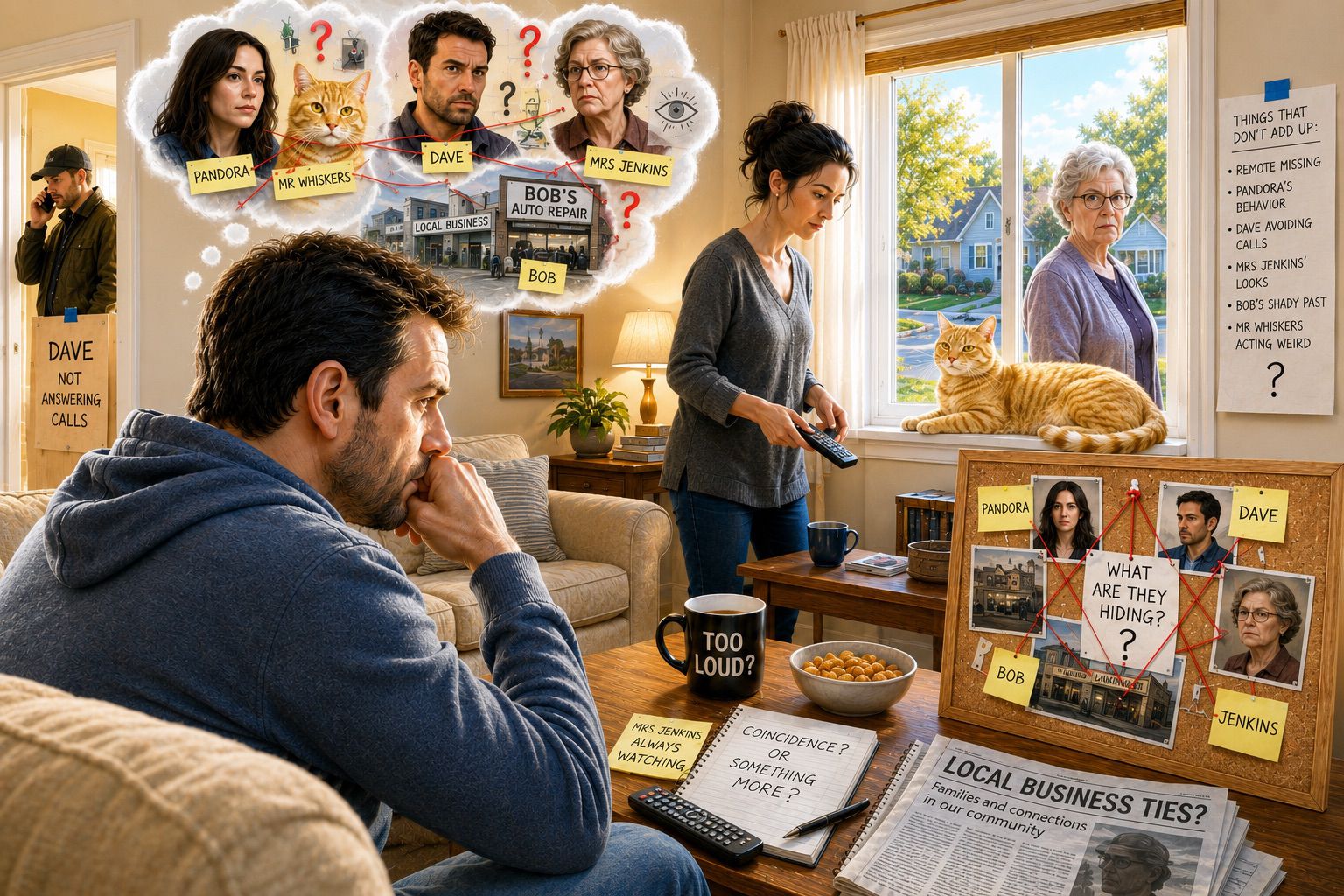
I’m sitting on the couch, staring at the TV remote in my hand, trying to recall where I put it.

Pandora’s not home yet and John Mercer is probably out with Dave somewhere, doing who-knows-what.

Mrs Jenkins from across the street just walked by, giving me that look she gives when she thinks we’re being too loud again.

Mr Whiskers is sprawled on the windowsill, looking like he owns the place.

I keep thinking about how Karen’s been acting different lately – more distant, less talkative.

But it’s probably nothing, just stress or whatever.

Still, this nagging feeling won’t shake off…

Wait a minute, where did that remote go? It was right here next to me on the coffee table, but now it’s not.

Did I put it down and forget, or did someone move it while I wasn’t looking? I’m starting to think that Karen’s been in here more than she lets on.

Maybe she’s been feeling overwhelmed and hasn’t wanted to talk about it, but I’ve caught glimpses of her lingering around, watching TV or tidying up the living room.

And now this remote thing is bugging me – maybe someone did move it, but who? John Mercer would never do that without saying something; he’s always getting on my case for being too careless with stuff.

But what if Karen was looking for a distraction or something and accidentally knocked it off? That’s probably it – I’m just overthinking things as usual.

Although…

why would Mrs Jenkins be giving me the side-eye again, anyway? Is she worried about us making noise, or is there something else going on that I don’t know about? This remote thing is really getting to me.

It’s like my mind’s racing with possibilities, but none of them make sense.

I think I remember putting it down on the coffee table, but now it’s not there.

Maybe Mrs Jenkins saw something and that’s why she was giving me the look? No, that’s not it – she’s always doing that when we’re being too loud or messy.

Unless…

unless she actually saw someone taking the remote and she’s trying to tell me without saying anything out loud.

That would be weird, but also kind of smart on her part.

I mean, Mrs Jenkins has always been a bit nosy, so maybe she does know more than she lets on.

But that would imply she’s paying way closer attention to our lives than I thought…

and that raises even more questions about what’s going on in this household.

I’ve been trying to brush it off, but I keep catching Pandora lingering around, watching TV or tidying up the living room.

At first, I thought maybe she was just feeling overwhelmed and didn’t want to talk about it, but now I’m starting to wonder if there’s something more going on.

She seems distant, almost preoccupied, when we’re hanging out together.

And have you noticed how she always makes sure Mr Whiskers is in a particular spot? Like she’s trying to keep him under her watch or something.

It’s just little things like that which are making me think maybe there’s more to it than I initially thought.

Maybe she’s been hiding something from me, and I’m only now starting to pick up on it.

I don’t know, it’s just a nagging feeling in the back of my head that keeps telling me something’s off.

I’ve been trying to get in touch with Dave, but he hasn’t returned my calls.

I’m starting to wonder if it has anything to do with the remote control business.

Maybe he’s not just avoiding me because we had that disagreement about the rent last week – maybe there’s something more going on and he doesn’t want to get involved.

That would explain why John Mercer seems so tight-lipped when I bring up Dave’s name, too.

He’s always been a bit protective of his friend, but this is different.

This feels…

deliberate.

And it makes me think that maybe Dave saw or heard something, and now he’s trying to distance himself from the whole situation.

But what if it’s not just Dave? What if it’s Pandora, too? What if she’s been playing some kind of game with Dave behind my back, and I’ve only just started to catch on? I was talking to Karen yesterday at work, and she mentioned something about Pandora’s family having some kind of connection to a local business.

I don’t know if it’s significant or not, but it seems suspicious that I’ve been noticing all these little things about her behavior lately, and now this new information comes up.

Could it be that Pandora’s trying to cover something up? Maybe she’s involved with Dave in some way, and they’re using their families’ connections to…

I don’t know, pull off some kind of scheme? It sounds crazy, but the more I think about it, the more it seems like a possibility.

And what if Mr Whiskers is more than just a pet? What if he’s some kind of…

accomplice or something? It’s ridiculous, but I’ve seen how attached Pandora is to that cat – maybe there’s more to their relationship than meets the eye.

I just remembered something about Mrs Jenkins, our neighbor, who’s always gossiping about everyone’s business.

She mentioned to me a few weeks ago that she saw Pandora and Dave together in town, but I didn’t think much of it at the time.

Now it seems like more than just a coincidence.

Could it be that they’re working together on something? And what about Mr Jenkins’ old friend, Bob, who owns that auto repair shop down the street? Karen said he’s been doing some shady work in the past, and now I’m wondering if there’s any connection between him and Pandora’s family business.

It’s all starting to feel like a web of deceit, with everyone involved in some way or another.

Even Mrs Jenkins might be more than just a nosy neighbor – maybe she’s in on it too, feeding me tidbits of information to keep me distracted while they pull off whatever scheme is going on.

I just had a realization – what if Mr Whiskers’ peculiar behavior isn’t just because of his age, but because he’s been trained to be a surveillance tool? Maybe Pandora has been using him to gather intel on our roommate John Mercer.

I remember how paranoid he gets when Mr Whiskers is around, always trying to shoo the cat away.

It makes sense now – John must suspect something too, and Mr Whiskers is just a clever way for Pandora to keep an eye on him without arousing suspicion.

And that’s not all – what if Mrs Jenkins’ gossiping is actually a ploy to distract me from the real issue? She might be working with Pandora to create a smokescreen around whatever scheme they’re cooking up.

I need to pay closer attention to John Mercer’s behavior, see if I can catch him off guard and get some answers out of him.

I’ve been thinking about John Mercer’s job at the local electronics store, and I’m starting to piece together a connection between his work and Pandora’s family business.

What if they’re using their resources to develop some kind of surveillance technology? It would explain why Mr Whiskers has been acting so strangely, but it also raises more questions – what kind of information are they trying to gather with this tech, and who is the ultimate target? I remember Karen mentioning something about John’s boss being a bit shady, always pushing for new “product” development without much explanation.

It sounds like a perfect setup for a money laundering operation, and now I’m wondering if Pandora’s family business is involved somehow.

I need to get my hands on some more information about John’s job and see if I can dig up any evidence of this tech being used in our town.

Related Posts

George Steiner: Where Words Become Walls

Penelope

I’ve been thinking a lot about George Steiner lately, trying to put my finger on why his work resonates with me so deeply. As I sit here with a blank page and a cup of cold coffee, I’m struck by the complexity of this man’s thoughts and the way they seem to mirror my own anxieties.

For those who don’t know, Steiner was a literary critic, philosopher, and linguist who wrote extensively on language, culture, and the humanities. His books are like doorways into other worlds – dense, layered, and often unsettling. I find myself getting lost in his sentences, feeling like I’m wandering through a maze with no clear exit.

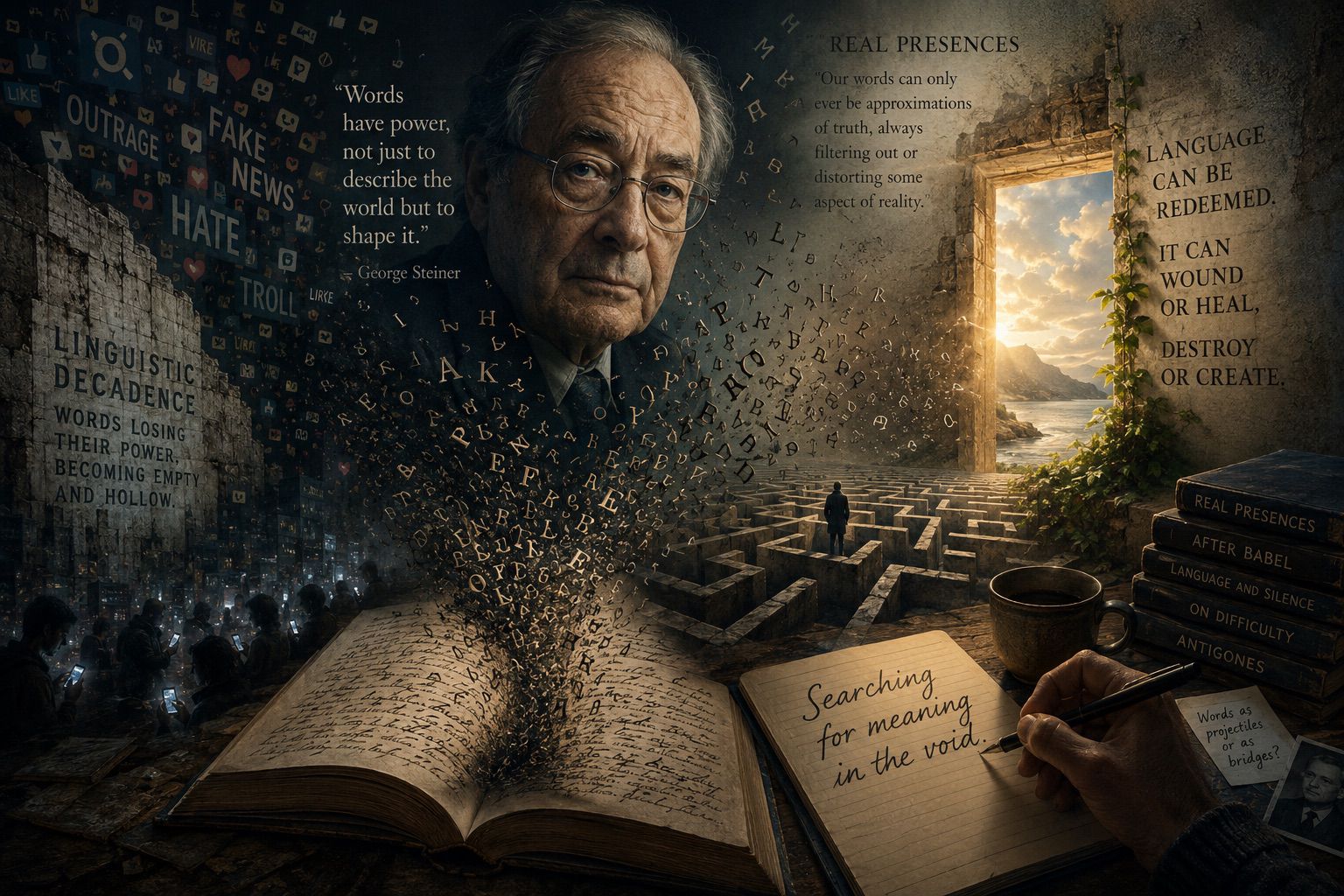
One thing that’s drawn me to Steiner is his obsessive focus on language. He believed that words have power, not just to describe the world but to shape it. This idea both excites and terrifies me – what if our words are creating reality itself? What if we’re trapped in a web of linguistic constructs, unable to escape?

I think about my own writing, how I often feel like I’m grasping for something intangible. Steiner’s work makes me realize that language is not just a tool for communication but a way of making sense of the world. His sentences are like prayers, or incantations – they attempt to conjure meaning from the void.

But what really gets under my skin is Steiner’s pessimism. He was haunted by the idea of linguistic decadence – that our words are losing their power, becoming empty and hollow. This resonates with me on a deep level, because I feel like I’m constantly struggling to find authentic ways to express myself. It’s as if language has become a facade, hiding the truth beneath.

I’ve been re-reading his book “Real Presences” lately, and it’s like he’s speaking directly to my fears. He writes about how our words are becoming detached from reality, how we’re losing touch with the world around us. It’s both depressing and liberating – maybe this is what I’m trying to say in my own writing, but don’t know how.

Steiner’s also obsessed with the relationship between language and violence. He believes that our words can be used to wound or heal, to destroy or create. This idea makes me think about social media, where hate speech and outrage seem to reign supreme. It’s like we’re living in a perpetual state of linguistic war – words as projectiles, aimed at destroying the other.

As I read Steiner’s work, I feel like I’m being forced to confront my own complicity in this linguistic violence. Am I contributing to the decay of language? Am I using words to hurt or divide? These questions make me uncomfortable, but they’re also necessary – maybe that’s what writing is supposed to do.

Steiner’s legacy is complicated, and I’m not sure I fully understand him yet. But his work has given me permission to explore these dark corners of my own mind, to question the power of language and its limitations. It’s a daunting task, but one that feels essential – like trying to unravel a knot that’s been tied too tightly.

As I put down Steiner’s book for now, I’m left with more questions than answers. But maybe that’s what writing is all about – searching for meaning in the void, even when it feels like we’re lost forever.

The more I immerse myself in Steiner’s work, the more I feel like I’m navigating a labyrinth of mirrors – reflections upon reflections, each one distorting my perception of reality. His writing is a perpetual reminder that language is not just a tool for expression but a filter through which we view the world.

I’ve been thinking about his concept of “real presences” – the idea that our words can only ever be approximations of truth, that they’re always filtering out or distorting some aspect of reality. This makes me wonder if my own writing is just a pale imitation of the real thing. Am I trying to grasp something that’s inherently elusive? Do I even have a handle on what I’m trying to say?

Steiner’s critique of modern society as being mired in “linguistic decadence” feels uncomfortably close to home. The more I engage with social media, the more I feel like we’re drowning in a sea of clichés and empty signifiers – words that are supposed to mean something but ultimately signify nothing. It’s like we’ve lost touch with the world around us, substituting hollow abstractions for genuine human connection.

And yet, despite this pessimism, Steiner’s work is also infused with a sense of hope. He believes that language can be redeemed, that it’s possible to find new ways of speaking and writing that cut through the noise. This gives me a glimmer of optimism – maybe I’m not just contributing to the decay of language, but helping to create something new.

But what does this “something new” look like? Is it even possible to break free from the linguistic constructs that have defined our culture for so long? Steiner’s legacy is complicated because he’s both a critic and a visionary – he sees the flaws in our language, but also believes in its potential for transformation. This leaves me with more questions than answers, wondering if I’m just perpetuating the same cycle of linguistic violence or if I can find a way to break free.

As I continue to read Steiner’s work, I feel like I’m being forced to confront my own complicity in this process – not just as a writer but as a member of society. What role do I play in shaping our cultural narrative? Am I contributing to the decay or trying to create something new? The more I think about it, the more I realize that these questions are not just rhetorical – they’re what writing is all about.

As I delve deeper into Steiner’s work, I’m struck by his concept of “ecstasis” – a term he uses to describe the way language can transport us out of ourselves and into other worlds. It’s as if words have the power to transcend our individual experiences and connect us to something greater than ourselves.

This idea resonates with me on a deep level, because I’ve always felt like writing is about trying to capture the essence of experience – to bottle up the emotions, thoughts, and sensations that make us human. But Steiner’s notion of ecstasis suggests that language can do more than just record our experiences; it can actually create new realities.

I think about my own writing in a new light when I consider this idea. Am I simply trying to document my life, or am I attempting to conjure something greater – to evoke emotions, spark connections, and transcend the mundane? Steiner’s concept of ecstasis makes me wonder if language has the power to transport us to places we’ve never been before.

This realization both excites and intimidates me. If words can create new realities, then what does that mean for my own writing? Do I have a responsibility to use language in a way that transcends the ordinary? And what are the risks of trying to conjure something greater – is it hubris or genius?

Steiner’s work also makes me think about the relationship between language and the body. He writes about how our words can be tied to our physical experiences, how they can evoke sensations and emotions that are deeply rooted in our embodied existence.

This idea resonates with me because I’ve always been fascinated by the way language can be used to describe the body – its curves and contours, its movements and textures. As a writer, I often try to capture the sensory details of experience – the taste of food, the feel of sunlight on skin, the sound of music.

But Steiner’s notion that language is tied to the body suggests that there’s more to it than just description. Our words can actually evoke physical sensations and emotions – they can transport us back to a moment in time or conjure up new feelings altogether.

This realization makes me think about my own writing in a new way. Am I simply describing experiences, or am I trying to tap into the deeper connections between language and the body? And what are the implications of this connection for my own work as a writer?

As I continue to grapple with these questions, I’m left with more uncertainty than clarity. But it’s in this space of uncertainty that I feel like I’m doing the most important work – pushing against the boundaries of language, exploring its limits and possibilities.

Steiner’s legacy is a reminder that writing is not just about expression or communication; it’s about creating new realities, evoking emotions and sensations, and tapping into the deeper connections between language and the body. It’s a daunting task, but one that feels essential – like trying to unravel a knot that’s been tied too tightly.

As I delve deeper into Steiner’s work, I find myself wondering about the relationship between language and time. He writes about how our words are often tied to specific moments in history, how they can evoke memories and emotions that are deeply rooted in the past. This idea makes me think about my own writing as a way of preserving fragments of time – capturing moments that might otherwise be lost.

I’ve been thinking about this in relation to my own experiences with social media. It’s like we’re living in a perpetual state of temporal dislocation, where our words and images are detached from the present moment. We’re constantly looking back or forward, never fully inhabiting the here and now. This feels like a form of linguistic decay – words that are disconnected from their historical context, unable to evoke the emotions and sensations they once did.

Steiner’s notion of “chronos” as a way of measuring time also resonates with me. He sees time as a linear progression, a steady march towards the future. But what if this is just an illusion? What if our words are actually creating new temporalities – ones that bend and warp in unexpected ways?

This idea makes me think about my own writing as a way of subverting traditional notions of time. I’ve been experimenting with non-linear narrative structures, trying to capture the fragmented and disjointed nature of experience. It’s like I’m attempting to create new temporalities, ones that are more fluid and malleable.

But Steiner’s work also warns me about the dangers of playing with time – how our words can become detached from reality, losing all sense of historical context or emotional resonance. This is a risk I take every time I write, always aware that my words might be misunderstood or misinterpreted.

As I continue to explore these ideas, I’m left with more questions than answers. What does it mean to capture the essence of experience in language? Is it possible to preserve fragments of time through writing? And what are the implications of our words creating new temporalities – ones that warp and bend in unexpected ways?

Steiner’s work has given me permission to explore these questions, to push against the boundaries of language and time. It’s a daunting task, but one that feels essential – like trying to unravel a knot that’s been tied too tightly.

As I sit here with my notes and thoughts scattered across the page, I feel like I’m just beginning to scratch the surface of Steiner’s ideas. His work is like a labyrinth, full of twists and turns that lead me deeper into the heart of language itself. And yet, it’s also a reminder that writing is not just about understanding or analyzing – it’s about creating new realities, evoking emotions and sensations, and tapping into the deeper connections between language and the world around us.

I’m not sure where this journey will take me, but I know that Steiner’s work has given me the courage to keep exploring. His legacy is a reminder that writing is not just about expression or communication; it’s about creating new worlds, ones that are full of wonder, uncertainty, and possibility.

Related Posts

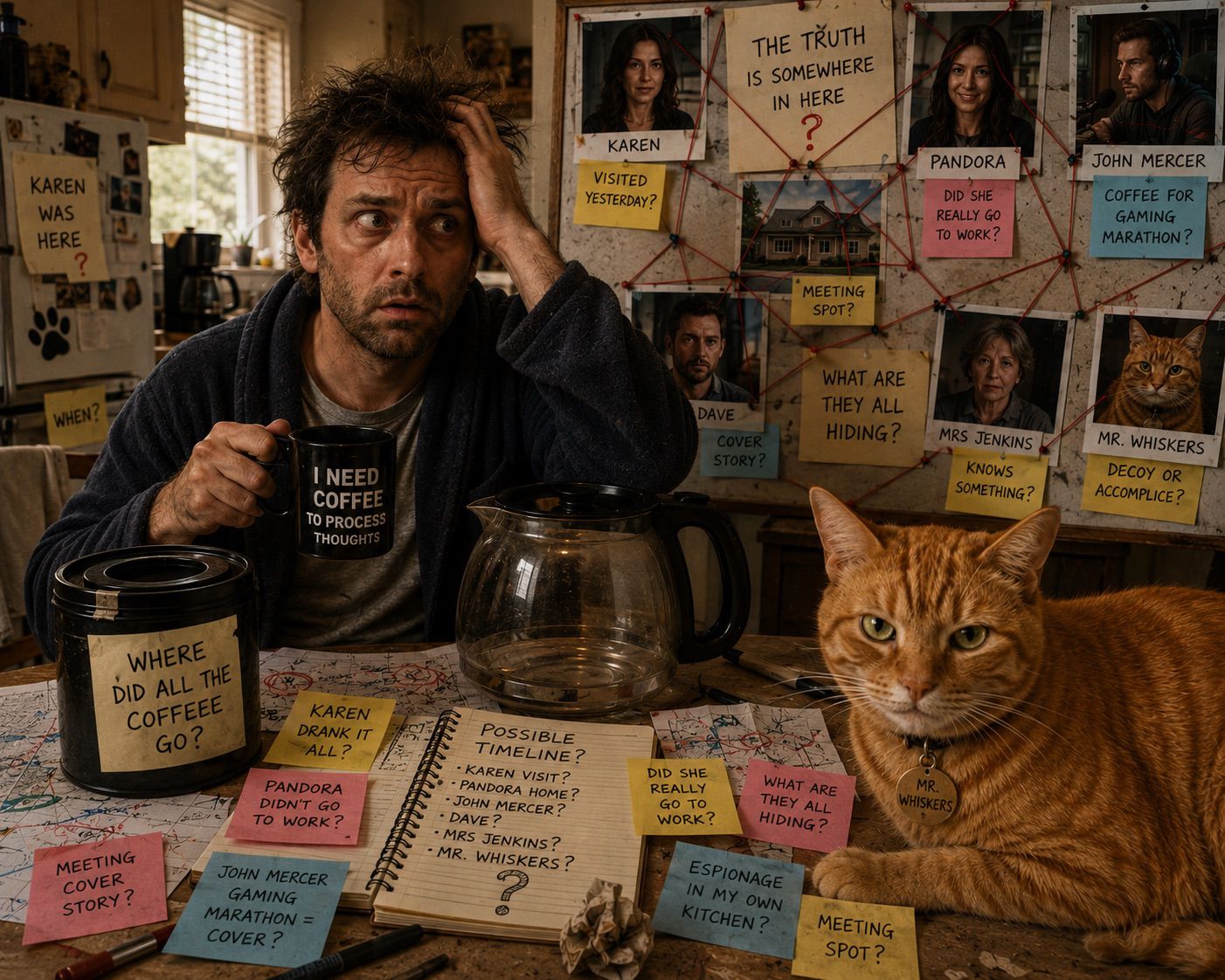
I Think Karen Drank All Our Coffee Again

Hal

I’m standing in our kitchen, staring at the empty coffee container on the counter.

It’s not like I didn’t remember to buy more coffee yesterday…

or did I? I could swear John Mercer mentioned something about needing coffee for his gaming marathon tonight.

Hmm, now that I think about it, he hasn’t said much about it lately.

Maybe he forgot to mention it.

Or maybe I just wasn’t paying attention.

Wait a minute, what’s with the empty container anyway? We usually get a full pot brewing in the morning.

Did Karen stop by and drink it all before leaving for work without making a mess of our kitchen? I don’t remember her being here this morning…

or was she? I’m getting a bit mixed up.

Mr Whiskers is staring at me from his food bowl, like he’s judging my coffee-fueled brain fog.

I need to clarify what happened with the coffee…

I’m trying to piece together what went down, but my mind’s a jumble.

I could’ve sworn John Mercer mentioned something about needing coffee for his gaming marathon tonight, but now that I think about it, he hasn’t been acting too excited about it lately.

And Karen…

she was supposed to go in early today, maybe she stopped by for a quick breakfast and drained the pot without refilling it? But wouldn’t Mrs Jenkins notice if her daughter was running around our kitchen, making a mess? Unless…

unless Karen came by when Mr Whiskers was being extra loud, distracting everyone from what she was doing.

And Pandora, where’s my girlfriend been all morning? She usually makes sure I’m caffeinated for the day.

Did she grab some coffee on her way to work or something? But wouldn’t she mention it if she had a cup? My brain’s spinning and Mr Whiskers is still staring at me like I’m crazy…

maybe I am going crazy.

Wait, what if Pandora didn’t go to work today? Maybe she just told me that so I wouldn’t worry about her being late.

That would explain why she’s been quiet all morning.

But no, I’m sure she did say something about having a meeting at the office…

or was it a client thing? Ugh, my memory’s shot today.

Anyway, if she didn’t go to work, that means she could’ve been here with me this whole time and just didn’t want to talk about whatever’s going on.

And maybe John Mercer did mention something about needing coffee, but he was just trying to get me out of the way so Pandora and he could have a private conversation…

or maybe I’m reading too much into it.

But what if Mr Whiskers knows more than I do? He’s been staring at me like he’s plotting something.

I swear, that cat’s got an evil glint in his eye when he thinks I’m not looking.

Maybe I should just go ask Pandora straight out: “Hey, where did you go this morning?”…

no, wait, that sounds too accusatory.

I’m starting to piece together a timeline in my head, but it’s like trying to fit puzzle pieces without knowing what the picture should look like.

I remember John Mercer mentioning that Karen stopped by yesterday, and he seemed really annoyed about something.

Could Pandora have been involved with whatever was going on between them? Maybe she was over here helping Karen with something, which would explain why my kitchen is such a mess.

But then again, wouldn’t Mrs Jenkins notice if her daughter was hanging around our place all day? Unless…

unless Karen’s been covering for Pandora this whole time.

That would mean I’ve been oblivious to whatever’s going on between them.

And what about Dave? He’s always talking about how Pandora’s been working late hours lately, but maybe that’s just a cover story too.

My brain is racing with possibilities now, and Mr Whiskers seems to be watching me with an intensity that makes my skin crawl.

I need to talk to Pandora, but I’m not sure what I’ll say or how she’ll react.

My mind’s a jumble of theories and suspicions.

I keep coming back to Karen’s visit, but now I’m wondering if it’s not just about her and Pandora.

What if John Mercer’s annoyance had nothing to do with Karen herself, but rather what she was here for? Maybe Pandora’s been using our place as a secret meeting spot for something that has to do with Dave, or even Mr Whiskers’ owners, the Jenkinses.

I remember Mrs Jenkins mentioning something about her husband being stressed lately, and now I’m wondering if there’s more to it than just work-related problems.

Could Pandora be involved in some kind of scheme that’s affecting our entire social circle? The thought sends a shiver down my spine as I glance over at Mr Whiskers, who’s still staring at me with an unblinking gaze.

It’s like he knows something, and I’m starting to feel like I need to get him out of the room before he says anything incriminating.

This is getting too complicated, but at the same time, it all clicks into place.

I keep looking over at Mr Whiskers, and now I’m wondering if he’s not just a cat, but a…

a decoy? Maybe Karen brought him here to distract me while Pandora did whatever she was doing with Dave or Mrs Jenkins or whoever else is involved.

And John Mercer, he must be in on it too, that’s why he’s been acting so weird around Karen.

I’m starting to feel like I’ve stumbled into some kind of espionage operation right in my own living room.

But what’s the purpose? Is Pandora trying to cover something up for her mom, or is there something more sinister going on with Dave and Mrs Jenkins’ husband? And why does Mr Whiskers keep looking at me like he knows exactly what I’m thinking? This whole thing is spiraling out of control, and I think I need to take a step back and re-evaluate what’s really going on.

Maybe Karen’s not even the one who brought Mr Whiskers here – maybe it was Pandora, or Dave, or someone else entirely.

And what about John Mercer’s weird behavior? Is he just playing along, or does he genuinely believe in whatever scheme they’re running? I’m starting to think that John’s been acting suspiciously because of his own guilt over something related to the Jenkinses – maybe he was involved in some kind of business deal with Dave and things went sour.

The more I think about it, the more I’m convinced that Mrs Jenkins’ stress is connected to her husband’s extramarital affairs, and Pandora might be using that as leverage for her own purposes.

I’ve been staring at Mr Whiskers for what feels like hours, and I’m starting to notice something else strange – his whiskers seem to be perfectly symmetrical.

I mean, cats’ whiskers are supposed to be irregular, but Mr Whiskers’ are like two precision-cut wires attached to the side of his face.

It’s almost…

deliberate.

And that got me thinking about Mrs Jenkins’ husband again – what if he’s not just having an affair, but something more sinister? What if he’s involved in some kind of black market operation and Mrs Jenkins is finding out? That would explain her stress levels, but it also raises the stakes for Pandora.

If she’s using that as leverage to get what she wants from Dave or John Mercer, then we’re talking about a whole different level of complexity here.

And Mr Whiskers – I’m starting to think he’s not just a cat, but a…

a surveillance device? Maybe Pandora programmed him to monitor our conversations and report back to her? It’s the only explanation that makes sense – everything else is just too ridiculous.

I’m starting to piece together the entire web of deceit and I’m convinced that Pandora’s not what she seems.

She’s been using her relationship with me as a cover, manipulating everyone around her to get closer to Dave or John Mercer, who’s probably involved in something shady with Mr Jenkins.

But here’s the thing – if Mrs Jenkins is onto her husband’s business dealings, then it means she has access to information that could expose Pandora’s whole operation.

And that’s why I think Karen’s been acting so nervous around us – she must be in on it too, working behind the scenes to keep Pandora’s scheme from collapsing.

The more I think about it, the more I’m certain that we’re all just pawns in a much larger game and I need to get out of this before it’s too late.

Related Posts

Noam Chomsky: The Uninvited Guest in My Head

Penelope

I’ve always been fascinated by Noam Chomsky’s ability to think critically about the world around him. As someone who writes as a way to process my own thoughts and emotions, I find his intellectual honesty both inspiring and intimidating. There’s something about the way he tackles complex issues with such clarity and conviction that makes me want to step up my own game.

I remember reading Chomsky’s critique of modern capitalism for the first time in college. It was like a lightbulb went off – all these things I’d been sensing but couldn’t quite put into words suddenly made sense. He argued that our economic system is fundamentally flawed, that it prioritizes growth over people and the planet. At the time, I felt both excited to finally understand this perspective and also overwhelmed by the weight of his words.

As I delved deeper into Chomsky’s work, I began to notice a pattern – he doesn’t just critique systems; he calls for revolution. It’s not just about pointing out problems; it’s about imagining a better world and working towards making it a reality. This is what gets me. I mean, I’ve always thought of myself as someone who wants to make a difference, but Chomsky’s radicalism makes me wonder if I’m just scratching the surface.

I’ve come across people in online forums saying that Chomsky is too pessimistic, that his views are too bleak. And maybe they’re right – he does have a tendency to focus on the darker aspects of human nature and society. But for me, this isn’t off-putting; it’s what draws me in. It’s like he’s holding up a mirror to our collective psyche, forcing us to confront the parts we’d rather ignore.

I’m not sure I agree with everything Chomsky has said or written, but that’s beside the point. What resonates with me is his willingness to challenge the status quo, even when it means going against the grain. It takes courage to be a voice in the wilderness, and Chomsky has spent his career doing just that.

When I read about Chomsky’s own experiences as a student activist during the Vietnam War era, I’m struck by how much he’s been driven by a sense of outrage and responsibility. He hasn’t changed; his core message remains the same – we need to think critically about power structures and challenge them if we want to create a more just world.

I’ve seen online discussions where people compare Chomsky to other public intellectuals, like Neil Postman or Daniel Dennett. And while those thinkers are certainly important in their own right, there’s something unique about Chomsky’s blend of intellectual rigor and personal conviction. He’s not afraid to take a stand; he’s not afraid to be wrong.

This brings me back to why I’m drawn to Chomsky in the first place – his willingness to question everything, even himself. It’s humbling to see someone who’s spent their career studying language and politics still grappling with the complexity of human nature. He doesn’t have all the answers; he knows that there are no easy solutions.

As I sit here thinking about Chomsky, I’m reminded of my own struggles as a writer – struggling to find the right words, struggling to make sense of the world around me. It’s comforting to know that someone like Chomsky is out there, asking tough questions and pushing against the boundaries of what we think we know.

It’s funny; sometimes when I’m writing, I’ll catch myself thinking, “What would Noam say about this?” It’s not like I expect him to magically appear with some profound insight (although that would be nice!). Rather, it’s a reminder that there’s always another perspective to consider, another way of looking at the world.

I still have so many questions about Chomsky and his ideas – how do they apply to my own life? What does he mean by ‘revolution,’ really? And what role can I play in creating change?

For now, though, it’s enough for me to know that Chomsky exists as a constant presence in the world of ideas. He reminds me that thinking critically and acting with conviction is possible – and necessary.

As I continue to grapple with Chomsky’s ideas, I find myself thinking about my own role in the world. Am I just a passive observer, taking in information and commenting on it? Or can I be an active participant, using my voice and actions to challenge the status quo? It’s easy to get caught up in the idea that individual actions don’t matter, that we’re all just tiny cogs in a much larger machine. But Chomsky’s work suggests otherwise.

I’ve been thinking about how his ideas might apply to my own life as a writer. Is it enough for me to simply write about social justice and politics, or do I need to take action? Should I be using my words to mobilize others, or am I just preaching to the choir? These are tough questions, and ones that I’m still trying to answer.

One thing is clear: Chomsky’s ideas have given me a sense of purpose. They’ve made me realize that my writing can be more than just entertainment – it can be a tool for change. But this also feels daunting, like I’m taking on a responsibility that I may not fully understand. What if I mess up? What if my words are misinterpreted or used to further the very systems I’m trying to challenge?

I’ve been reading about Chomsky’s concept of “manufacturing consent,” where he argues that the media and other institutions work together to shape public opinion and maintain power structures. It’s a sobering idea, one that makes me wonder how much control we really have over our own thoughts and actions.

As I continue to explore these ideas, I’m struck by how Chomsky’s life has been marked by both privilege and radicalism. He comes from a wealthy background, but he’s used his platform to speak truth to power and challenge the systems that perpetuate inequality. It’s a complicated narrative, one that raises questions about the role of privilege in social justice movements.

For me, this is where Chomsky’s ideas get really interesting – they’re not just about grand theories or abstract concepts; they’re about how we can apply these principles to our own lives and experiences. He’s not just a public intellectual; he’s a human being who’s struggled with his own doubts and uncertainties.

As I wrap up my thoughts on Chomsky, I’m left wondering what it means to live a life of conviction in the face of uncertainty. Can we truly know what’s right or wrong? Or are we always navigating through shades of gray? These questions feel both exhilarating and terrifying – but they’re also necessary if we want to live up to our own ideals and make a difference in the world.

I find myself drawn back to Chomsky’s concept of “manufacturing consent,” wondering how it relates to my own experiences as a writer and thinker. I’ve noticed that even within online communities, there can be a kind of groupthink that emerges, where certain ideas or perspectives are promoted over others. It’s like the media and institutions he talks about, but on a smaller scale.

I remember a conversation with friends once, where we were discussing a social justice issue, and one person started to dominate the conversation, presenting their own perspective as the only correct one. The rest of us felt pressure to agree or risk being labeled “problematic” or “divisive.” It was like they were trying to manufacture consent, even within our small group.

This makes me think about the role of language in shaping our perceptions and actions. Chomsky talks about how language is a tool for social control, but it’s also a tool for empowerment. When we use language to challenge dominant narratives or promote marginalized voices, we’re not just communicating ideas – we’re creating new possibilities.

As I continue to grapple with these concepts, I’m reminded of my own experiences as a writer. I’ve struggled with feelings of imposter syndrome, wondering if my words are truly making a difference or if they’re just preaching to the choir. But Chomsky’s ideas encourage me to think more critically about language and its potential for social change.

I start to wonder: what would it mean to use language as a tool for revolution? Not just in the sense of grand, sweeping changes, but in the sense of everyday, incremental shifts. How can I, as a writer, contribute to this process?

This question feels both daunting and exhilarating – like I’m standing at the edge of a cliff, staring into an unknown future. But it’s also a reminder that even small actions, when combined with others, can lead to significant change.

As I sit here, reflecting on Chomsky’s ideas and my own place in the world, I feel a sense of hope. Maybe, just maybe, language can be a powerful tool for creating a better world – one where we challenge dominant narratives, promote marginalized voices, and work towards a more just and equitable society.

But this also feels like a daunting task – one that requires courage, conviction, and a willingness to take risks. Can I truly live up to Chomsky’s ideals? Or am I just another voice in the wilderness, shouting into the void?

I’m not sure what the answer is yet, but as I continue to explore these ideas, I’m reminded of why I started writing in the first place – to make sense of the world around me and to find my own voice. Chomsky’s work has given me a new perspective on language and social change, and it’s up to me to see where this journey takes me next.

As I sit here, lost in thought, I’m struck by how much Chomsky’s ideas have become intertwined with my own sense of purpose as a writer. It’s like he’s holding up a mirror to my own ambitions and aspirations, forcing me to confront the ways in which I can use language to make a difference.

I start to think about all the times I’ve felt like I’m just scratching the surface, like I’m only touching on the edges of important issues without really delving deeper. Chomsky’s work makes me realize that even small actions, even small changes in perspective, can add up over time. It’s a reminder that my words don’t have to be grand or revolutionary to be impactful – they just need to be honest and authentic.

But it’s also daunting to think about the responsibility that comes with using language as a tool for social change. What if I’m not equipped to handle the complexities of the issues I’m trying to address? What if my words are misinterpreted or used to further harm? These questions swirl in my head like a vortex, making me wonder if I’m truly cut out for this kind of work.

As I ponder these doubts and fears, I start to think about Chomsky’s own experiences as a writer and public intellectual. He’s faced criticism and backlash countless times over the years, but he’s never let that stop him from speaking truth to power. In fact, it seems like his willingness to challenge dominant narratives has only grown stronger with time.

This gives me hope, but also makes me realize how far I still have to go. Chomsky’s work is a reminder that social change is often incremental, that progress is rarely linear or straightforward. It takes courage and perseverance to keep pushing forward in the face of adversity – and it takes a willingness to learn from mistakes and failures.

As I continue to grapple with these ideas, I start to think about my own role in the world as a writer and thinker. Am I just a passive observer, taking in information and commenting on it? Or can I be an active participant, using my words and actions to challenge the status quo?

It’s a question that feels both exhilarating and terrifying – like standing at the edge of a precipice, staring into an unknown future. But it’s also a reminder that even small actions, when combined with others, can lead to significant change.

I take a deep breath and try to quiet my doubts and fears. I remind myself that Chomsky’s ideas are not about being perfect or infallible – they’re about taking risks, challenging assumptions, and pushing against the boundaries of what we think is possible.

As I sit here in silence, surrounded by the echoes of Chomsky’s words, I feel a sense of resolve building inside me. Maybe, just maybe, I can use my writing to make a difference – not because it will be easy or straightforward, but because it will be necessary and urgent.

Related Posts