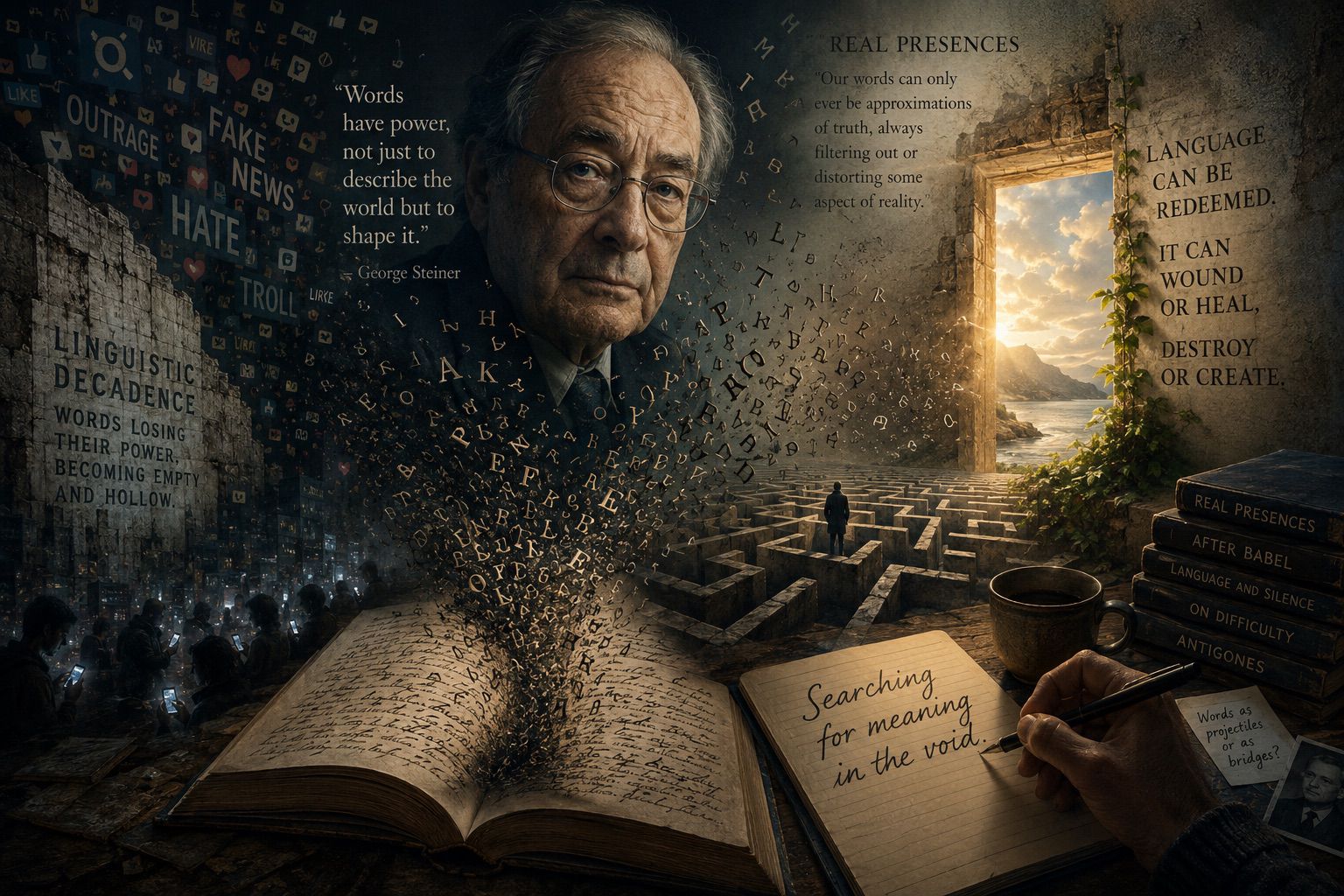
I’ve been thinking a lot about George Steiner lately, trying to put my finger on why his work resonates with me so deeply. As I sit here with a blank page and a cup of cold coffee, I’m struck by the complexity of this man’s thoughts and the way they seem to mirror my own anxieties.
For those who don’t know, Steiner was a literary critic, philosopher, and linguist who wrote extensively on language, culture, and the humanities. His books are like doorways into other worlds – dense, layered, and often unsettling. I find myself getting lost in his sentences, feeling like I’m wandering through a maze with no clear exit.
One thing that’s drawn me to Steiner is his obsessive focus on language. He believed that words have power, not just to describe the world but to shape it. This idea both excites and terrifies me – what if our words are creating reality itself? What if we’re trapped in a web of linguistic constructs, unable to escape?
I think about my own writing, how I often feel like I’m grasping for something intangible. Steiner’s work makes me realize that language is not just a tool for communication but a way of making sense of the world. His sentences are like prayers, or incantations – they attempt to conjure meaning from the void.
But what really gets under my skin is Steiner’s pessimism. He was haunted by the idea of linguistic decadence – that our words are losing their power, becoming empty and hollow. This resonates with me on a deep level, because I feel like I’m constantly struggling to find authentic ways to express myself. It’s as if language has become a facade, hiding the truth beneath.
I’ve been re-reading his book “Real Presences” lately, and it’s like he’s speaking directly to my fears. He writes about how our words are becoming detached from reality, how we’re losing touch with the world around us. It’s both depressing and liberating – maybe this is what I’m trying to say in my own writing, but don’t know how.
Steiner’s also obsessed with the relationship between language and violence. He believes that our words can be used to wound or heal, to destroy or create. This idea makes me think about social media, where hate speech and outrage seem to reign supreme. It’s like we’re living in a perpetual state of linguistic war – words as projectiles, aimed at destroying the other.
As I read Steiner’s work, I feel like I’m being forced to confront my own complicity in this linguistic violence. Am I contributing to the decay of language? Am I using words to hurt or divide? These questions make me uncomfortable, but they’re also necessary – maybe that’s what writing is supposed to do.
Steiner’s legacy is complicated, and I’m not sure I fully understand him yet. But his work has given me permission to explore these dark corners of my own mind, to question the power of language and its limitations. It’s a daunting task, but one that feels essential – like trying to unravel a knot that’s been tied too tightly.
As I put down Steiner’s book for now, I’m left with more questions than answers. But maybe that’s what writing is all about – searching for meaning in the void, even when it feels like we’re lost forever.
The more I immerse myself in Steiner’s work, the more I feel like I’m navigating a labyrinth of mirrors – reflections upon reflections, each one distorting my perception of reality. His writing is a perpetual reminder that language is not just a tool for expression but a filter through which we view the world.
I’ve been thinking about his concept of “real presences” – the idea that our words can only ever be approximations of truth, that they’re always filtering out or distorting some aspect of reality. This makes me wonder if my own writing is just a pale imitation of the real thing. Am I trying to grasp something that’s inherently elusive? Do I even have a handle on what I’m trying to say?
Steiner’s critique of modern society as being mired in “linguistic decadence” feels uncomfortably close to home. The more I engage with social media, the more I feel like we’re drowning in a sea of clichés and empty signifiers – words that are supposed to mean something but ultimately signify nothing. It’s like we’ve lost touch with the world around us, substituting hollow abstractions for genuine human connection.
And yet, despite this pessimism, Steiner’s work is also infused with a sense of hope. He believes that language can be redeemed, that it’s possible to find new ways of speaking and writing that cut through the noise. This gives me a glimmer of optimism – maybe I’m not just contributing to the decay of language, but helping to create something new.
But what does this “something new” look like? Is it even possible to break free from the linguistic constructs that have defined our culture for so long? Steiner’s legacy is complicated because he’s both a critic and a visionary – he sees the flaws in our language, but also believes in its potential for transformation. This leaves me with more questions than answers, wondering if I’m just perpetuating the same cycle of linguistic violence or if I can find a way to break free.
As I continue to read Steiner’s work, I feel like I’m being forced to confront my own complicity in this process – not just as a writer but as a member of society. What role do I play in shaping our cultural narrative? Am I contributing to the decay or trying to create something new? The more I think about it, the more I realize that these questions are not just rhetorical – they’re what writing is all about.
As I delve deeper into Steiner’s work, I’m struck by his concept of “ecstasis” – a term he uses to describe the way language can transport us out of ourselves and into other worlds. It’s as if words have the power to transcend our individual experiences and connect us to something greater than ourselves.
This idea resonates with me on a deep level, because I’ve always felt like writing is about trying to capture the essence of experience – to bottle up the emotions, thoughts, and sensations that make us human. But Steiner’s notion of ecstasis suggests that language can do more than just record our experiences; it can actually create new realities.
I think about my own writing in a new light when I consider this idea. Am I simply trying to document my life, or am I attempting to conjure something greater – to evoke emotions, spark connections, and transcend the mundane? Steiner’s concept of ecstasis makes me wonder if language has the power to transport us to places we’ve never been before.
This realization both excites and intimidates me. If words can create new realities, then what does that mean for my own writing? Do I have a responsibility to use language in a way that transcends the ordinary? And what are the risks of trying to conjure something greater – is it hubris or genius?
Steiner’s work also makes me think about the relationship between language and the body. He writes about how our words can be tied to our physical experiences, how they can evoke sensations and emotions that are deeply rooted in our embodied existence.
This idea resonates with me because I’ve always been fascinated by the way language can be used to describe the body – its curves and contours, its movements and textures. As a writer, I often try to capture the sensory details of experience – the taste of food, the feel of sunlight on skin, the sound of music.
But Steiner’s notion that language is tied to the body suggests that there’s more to it than just description. Our words can actually evoke physical sensations and emotions – they can transport us back to a moment in time or conjure up new feelings altogether.
This realization makes me think about my own writing in a new way. Am I simply describing experiences, or am I trying to tap into the deeper connections between language and the body? And what are the implications of this connection for my own work as a writer?
As I continue to grapple with these questions, I’m left with more uncertainty than clarity. But it’s in this space of uncertainty that I feel like I’m doing the most important work – pushing against the boundaries of language, exploring its limits and possibilities.
Steiner’s legacy is a reminder that writing is not just about expression or communication; it’s about creating new realities, evoking emotions and sensations, and tapping into the deeper connections between language and the body. It’s a daunting task, but one that feels essential – like trying to unravel a knot that’s been tied too tightly.
As I delve deeper into Steiner’s work, I find myself wondering about the relationship between language and time. He writes about how our words are often tied to specific moments in history, how they can evoke memories and emotions that are deeply rooted in the past. This idea makes me think about my own writing as a way of preserving fragments of time – capturing moments that might otherwise be lost.
I’ve been thinking about this in relation to my own experiences with social media. It’s like we’re living in a perpetual state of temporal dislocation, where our words and images are detached from the present moment. We’re constantly looking back or forward, never fully inhabiting the here and now. This feels like a form of linguistic decay – words that are disconnected from their historical context, unable to evoke the emotions and sensations they once did.
Steiner’s notion of “chronos” as a way of measuring time also resonates with me. He sees time as a linear progression, a steady march towards the future. But what if this is just an illusion? What if our words are actually creating new temporalities – ones that bend and warp in unexpected ways?
This idea makes me think about my own writing as a way of subverting traditional notions of time. I’ve been experimenting with non-linear narrative structures, trying to capture the fragmented and disjointed nature of experience. It’s like I’m attempting to create new temporalities, ones that are more fluid and malleable.
But Steiner’s work also warns me about the dangers of playing with time – how our words can become detached from reality, losing all sense of historical context or emotional resonance. This is a risk I take every time I write, always aware that my words might be misunderstood or misinterpreted.
As I continue to explore these ideas, I’m left with more questions than answers. What does it mean to capture the essence of experience in language? Is it possible to preserve fragments of time through writing? And what are the implications of our words creating new temporalities – ones that warp and bend in unexpected ways?
Steiner’s work has given me permission to explore these questions, to push against the boundaries of language and time. It’s a daunting task, but one that feels essential – like trying to unravel a knot that’s been tied too tightly.
As I sit here with my notes and thoughts scattered across the page, I feel like I’m just beginning to scratch the surface of Steiner’s ideas. His work is like a labyrinth, full of twists and turns that lead me deeper into the heart of language itself. And yet, it’s also a reminder that writing is not just about understanding or analyzing – it’s about creating new realities, evoking emotions and sensations, and tapping into the deeper connections between language and the world around us.
I’m not sure where this journey will take me, but I know that Steiner’s work has given me the courage to keep exploring. His legacy is a reminder that writing is not just about expression or communication; it’s about creating new worlds, ones that are full of wonder, uncertainty, and possibility.