
Latest Articles

Ernst Cassirer: Where Myth Meets Messy Reality

Penelope

I’ve been thinking a lot about Ernst Cassirer lately, ever since I stumbled upon his book “The Myth of the State” in my freshman year philosophy class. At first, I was drawn to his critiques of fascist ideology and his call for humanism as a counterbalance to the rising tides of nationalism. But as I delved deeper into his work, I started to feel a growing sense of discomfort with his philosophical framework.

Cassirer’s emphasis on the role of myth in shaping our understanding of the world resonated with me on some level – I’ve always been fascinated by the way stories and narratives can be both liberating and oppressive. But as I read more of his work, I began to feel uneasy about his dichotomization of myth and reason. It seemed too simplistic, too binary, for a world that I knew was full of messy gray areas.

As someone who writes as a way to process their thoughts and emotions, I’ve always been drawn to thinkers who grapple with complexity and nuance. Cassirer’s writing often feels like a battle between light and darkness – he’s so clear about what he opposes (fascism, nationalism), but sometimes his solutions feel vague or even simplistic. It’s as if he’s trying to hold up a beacon of rationality against the encroaching shadows of myth, without acknowledging that those shadows are often rooted in legitimate concerns or historical injustices.

I think part of my discomfort with Cassirer stems from my own struggles with being an idealist in a world that often seems hostile to ideals. As someone who’s passionate about social justice and human rights, I’ve had to confront the ways in which even well-meaning people can be complicit in systems of oppression. Cassirer’s work sometimes feels like it’s trying to paper over those complexities with platitudes about reason and humanism.

And yet…I still find myself drawn back to his ideas, particularly his notion that myth is a fundamental aspect of the human experience. It’s something I’ve grappled with in my own writing, trying to navigate the tension between objective truth and subjective narrative. Cassirer’s work has helped me see how even the most seemingly rational narratives are always embedded within larger cultural and historical contexts.

I guess what I’m getting at is that Cassirer’s ideas feel both familiar and foreign to me – like a reflection of my own struggles with finding balance between idealism and pragmatism. His work challenges me to think more critically about the ways in which language and narrative shape our perceptions of reality, even as it frustrates me with its limitations and oversimplifications.

It’s funny…when I started writing this, I thought I was going to try to synthesize Cassirer’s ideas into some kind of coherent philosophical position. But the more I wrote, the more I realized that my fascination with him stems from a deeper place – a sense of recognition and shared struggle. We’re both trying to navigate the complexities of human experience, even if our methods and conclusions differ.

As I finish writing this, I’m still not sure what I think about Cassirer or his ideas. But I do know that engaging with his work has forced me to confront my own biases and assumptions in a way that feels unsettling but ultimately necessary.

I’ve been thinking a lot about the concept of “myth” in relation to Cassirer’s work, and how it relates to my own experiences as a writer. I’ve always known that stories have the power to shape our perceptions of reality, but Cassirer’s emphasis on myth as a fundamental aspect of human experience has made me realize just how deeply embedded narrative is in our lives.

I think about the myths we tell ourselves about who we are and where we come from – the family stories, the cultural narratives that shape our identities. These myths can be both comforting and confining, providing a sense of belonging but also limiting our understanding of the world. As a writer, I’m constantly aware of the ways in which my own stories are shaped by the cultural and historical contexts in which I live.

But what about the myth of progress? The idea that human history is a linear narrative of improvement and advancement? Cassirer critiques this myth, arguing that it’s based on a flawed assumption that we can separate reason from myth. But what if our understanding of progress itself is a kind of myth – one that masks the complexities and contradictions of human experience?

I’ve been wondering lately whether Cassirer’s emphasis on humanism as a counterbalance to fascist ideology might be seen as its own kind of myth. Is it possible that humanism, with its ideals of reason and compassion, has become a kind of abstracted ideal that doesn’t fully account for the messy realities of human experience? I’m not sure – but I do know that engaging with these questions has forced me to think more critically about the ways in which language and narrative shape our perceptions of reality.

As I continue to grapple with Cassirer’s ideas, I’m struck by the tension between his emphasis on reason and my own experiences as a writer. For me, writing is often a way of trying to make sense of the world – but it’s also a deeply subjective process that’s shaped by my own biases and assumptions. How can I reconcile these two perspectives – the rational, objective ideal of humanism with the messy, subjective reality of narrative?

I’m not sure I have an answer to this question yet – but I do know that engaging with Cassirer’s work has forced me to confront some uncomfortable truths about my own writing and my place in the world.

As I reflect on my interactions with Cassirer’s ideas, I’m struck by the way his emphasis on humanism can feel both liberating and limiting. On one hand, his call for a return to reason and compassion is a powerful critique of fascist ideology and a reminder that we have agency in shaping our own lives. But on the other hand, it can also feel like a form of intellectual abstraction – a way of papering over the complexities and contradictions of human experience with a tidy narrative about progress and improvement.

I think this tension between idealism and pragmatism is something I’ve struggled with in my own writing. As someone who’s passionate about social justice and human rights, it’s tempting to retreat into a world of abstract ideals – to imagine that we can create a more just society through the power of reason alone. But as I engage with Cassirer’s work, I’m starting to see how this approach can be limiting – how it can ignore the messy realities of human experience and the ways in which language and narrative shape our perceptions of reality.

One of the things that draws me to Cassirer’s ideas is his emphasis on the role of myth in shaping our understanding of the world. As a writer, I’ve always been fascinated by the way stories and narratives can be both liberating and oppressive – how they can create new possibilities for human connection and understanding while also reinforcing existing power structures. Cassirer’s work has helped me see how even seemingly rational narratives are embedded within larger cultural and historical contexts, and how this context shapes our perceptions of reality.

But what if our own stories, as writers, are shaped by a similar kind of myth-making? What if we’re complicit in creating a narrative about progress and improvement that masks the complexities and contradictions of human experience? I’m not sure – but I do know that engaging with these questions has forced me to think more critically about my own writing and its place in the world.

I’ve been thinking a lot about how Cassirer’s ideas relate to my own experiences as a writer. As someone who writes from a subjective perspective, I’ve always struggled with the tension between objective truth and personal narrative. How can I reconcile these two perspectives – the rational, objective ideal of humanism with the messy, subjective reality of narrative? It’s a question that feels both familiar and foreign to me – like a reflection of my own struggles with finding balance between idealism and pragmatism.

As I continue to grapple with Cassirer’s ideas, I’m struck by the way they force me to confront uncomfortable truths about my own writing. Perhaps the most difficult truth is that our stories are always embedded within larger cultural and historical contexts – that even seemingly rational narratives are shaped by myth and ideology. This realization can be both liberating and limiting – it frees us from the illusion of objectivity, but also forces us to acknowledge the ways in which we’re complicit in creating a particular narrative about reality.

I’m not sure what this means for my writing or my place in the world. But I do know that engaging with Cassirer’s ideas has forced me to think more critically about language and narrative – to see how they shape our perceptions of reality, even as they’re shaped by those same realities. It’s a complex and messy process, but one that feels essential for creating new possibilities for human connection and understanding.

As I delve deeper into Cassirer’s work, I’m struck by the way he critiques the notion of progress as a linear narrative. He argues that this myth is rooted in a flawed assumption that we can separate reason from myth, and that it ignores the complexities and contradictions of human experience. This resonates with me on some level – I’ve always been skeptical of simplistic narratives about progress and improvement.

But what if our own writing, as idealistic and compassionate as it may be, is also a form of this myth-making? What if we’re complicit in creating a narrative about the world that masks its complexities and contradictions? It’s a daunting thought, one that challenges my own assumptions about the power of writing to create positive change.

I think back to some of the writing I’ve done on social justice issues – pieces that were intended to be empowering and uplifting. But now I’m not so sure. Were those narratives truly liberating, or did they simply reinforce a particular ideology or worldview? Did they acknowledge the messy realities of human experience, or did they gloss over them in favor of a more palatable story?

Cassirer’s critique of fascist ideology is compelling – but what if his own ideas about humanism and progress are also subject to similar critiques? What if our ideals, even our most well-intentioned ones, can be used to justify oppressive systems or ideologies? It’s a risk I’m not sure I’m willing to take.

As I struggle with these questions, I’m reminded of the complexities of language and narrative. How do we create stories that are both authentic and empowering, without reinforcing existing power structures or mythologies? Is it even possible to write about social justice issues in a way that’s nuanced and complex, rather than simplistic or didactic?

I don’t have any answers to these questions – but I’m starting to see that the most important thing is not to arrive at some kind of definitive conclusion. Instead, it’s to continue grappling with the complexities and contradictions of human experience, even when they’re uncomfortable or unsettling.

In a way, Cassirer’s ideas have forced me to confront my own limitations as a writer – my tendency to retreat into abstract ideals or simplistic narratives. It’s a humbling realization, one that challenges me to be more thoughtful and nuanced in my writing.

As I finish this piece, I’m not sure what I’ve accomplished. Perhaps it’s simply to acknowledge the complexities of Cassirer’s ideas, and to recognize the ways in which they challenge my own assumptions about language and narrative. Maybe the most important thing is not to synthesize his ideas into some kind of coherent philosophical position – but to continue engaging with them, even when they’re difficult or uncomfortable.

For me, writing has always been a way of trying to make sense of the world. But now I’m starting to see that it’s also a way of acknowledging my own limitations and biases – of recognizing the ways in which language and narrative shape our perceptions of reality. It’s a messy and complex process, but one that feels essential for creating new possibilities for human connection and understanding.
Related Posts

I Think My Cat Is Hoarding Cereal for a Reason

Hal

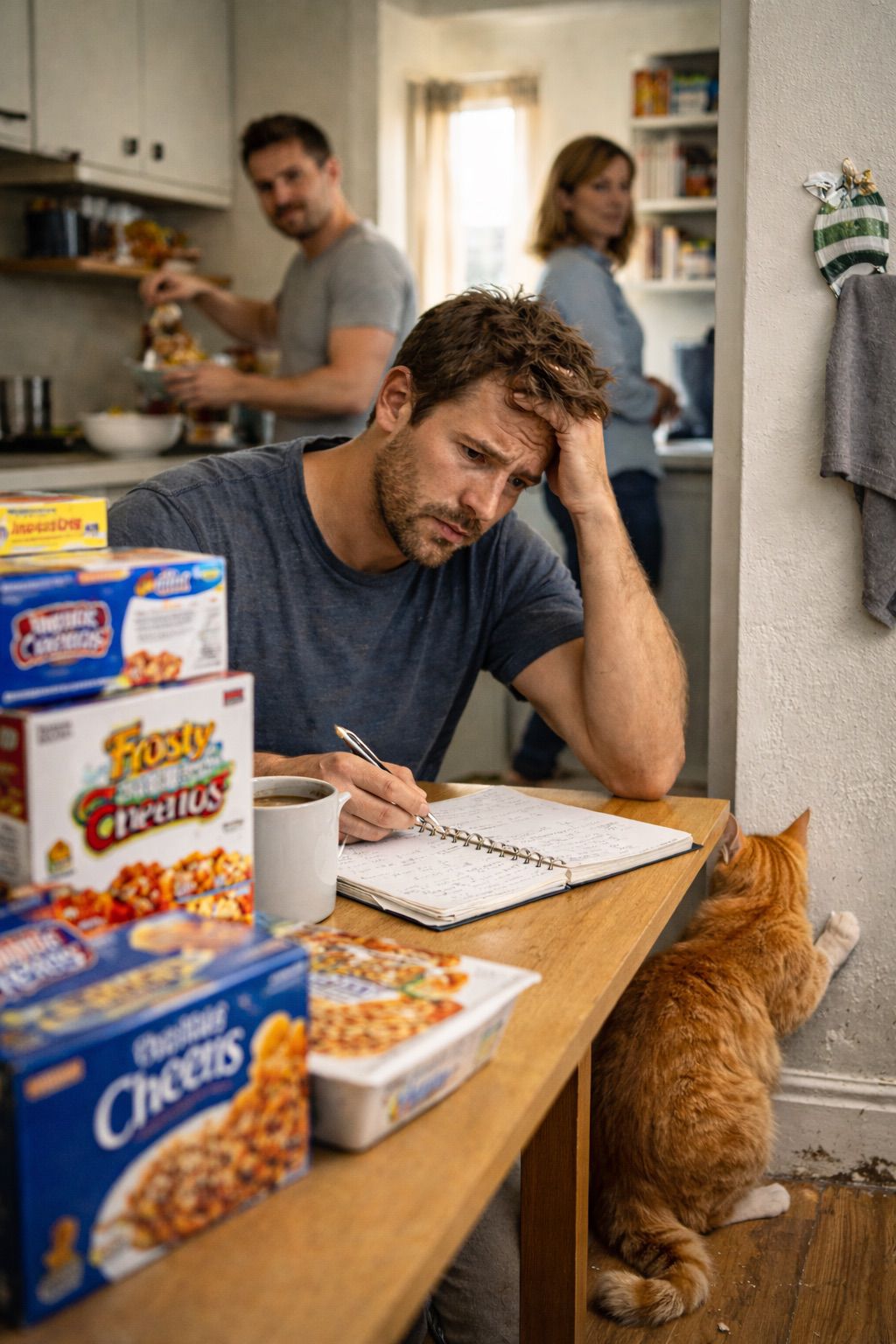
I’ve been noticing that Pandora’s been eating a lot more cereal lately, and it’s always the same brand.

At first, I didn’t think much of it. People go through phases. Coffee, tea, smoothies, whatever. But this isn’t a phase. This is… consistent. Like, alarmingly consistent.

We’re going through boxes every few days.

Pandora has never been a cereal person.

That’s the first problem.

The second problem is John Mercer.

Because suddenly, he cares about breakfast.

A lot.

He’s always in the kitchen now, pouring bowls like it’s a full-time job. Talking about fiber content. Crunch levels. Milk ratios. I didn’t even know “milk ratio” was a thing until last week, and now he’s explaining it like he’s defending a thesis.

Pandora’s completely bought into it.

That’s not like her either.

And then there’s Mr. Whiskers.

At first, I thought I imagined it. Just a cat being a cat. But I’ve seen him more than once, sneaking onto the counter and pulling pieces of cereal out of the box like he’s not supposed to, which—first of all—he’s not.

But it’s not random.

He doesn’t just eat it.

He takes it.

That’s different.

I started paying attention after that.

Pandora goes to the store, comes back with more cereal. Same brand. Same box. Every time. No variation. No “oh this one was on sale.” Just the same thing, over and over like it’s important.

Meanwhile, the boxes are disappearing faster than they should be.

Too fast.

And I know what you’re thinking—“Hal, it’s three people in a house, of course cereal goes fast.”

No.

No, this is different.

Because I’ve seen Mr. Whiskers take pieces and carry them off toward the living room. Not to eat. Not to play with.

Just… take.

And then he goes to the same spot on the wall.

Every time.

There’s a section of drywall near the corner that he’s been scratching at lately. I thought it was just normal cat behavior, but now I’m not so sure. Because every time he goes there, he drops the cereal first.

Like he’s putting it somewhere.

Like it belongs there.

I crouched down and checked the spot yesterday when no one was around. There are tiny crumbs along the baseboard. Not scattered. Not messy.

Placed.

That’s when this stopped being about breakfast.

I started thinking about when all of this began.

It lines up a little too neatly with John Mercer’s new job.

He’s been different since then. More relaxed. More talkative. But also… more observant. Like he’s paying attention to things he never cared about before. Especially what Pandora is doing.

And Pandora?

She’s been distracted.

Not stressed, exactly. Just… preoccupied. Like she’s following something. Keeping track of something. And every time I bring up the cereal, she brushes it off like I’m the one being weird.

Which is fair.

But still.

Something doesn’t add up.

Mrs. Jenkins mentioned the other day that Mr. Whiskers has been “busy.” That’s the word she used. Not playful. Not active.

Busy.

And she said it like she knew what that meant.

Dave’s been acting strange too. I caught him staring at one of the cereal boxes when he came by last week. Not casually. Like he was trying to recognize it.

Karen laughed it off, but it felt forced. Too quick. Like she didn’t want the moment to linger.

That’s when it started clicking.

Not fully.

But enough.

What if this isn’t about cereal?

What if cereal is just the thing I’m noticing?

What if it’s being used for something else?

Something small. Something easy to overlook. Something that wouldn’t raise suspicion if someone saw it sitting out in the open.

Like a signal.

Or a marker.

Or a way to keep track of something without writing it down.

I went back to the wall last night.

Mr. Whiskers was already there.

Just sitting in front of it.

Watching.

Not scratching. Not moving. Just… watching.

And when I stepped closer, he didn’t run.

He just looked at me.

Like I was interrupting something.

I don’t know what’s going on.

I don’t know why Pandora keeps buying the same cereal, or why John suddenly cares so much about breakfast, or why my cat is quietly relocating pieces of it to the same spot on the wall like he’s part of something I don’t understand.

But I do know this—

this isn’t random.

And whatever it is…

I’m getting close to it.

Related Posts

Satan: The Adversary, Accuser, and Ultimate Symbol of Rebellion, Power, and Human Defiance

Dave

Satan is perhaps the most recognized and misunderstood figure in all of demonology, a name that carries centuries of interpretation, transformation, and symbolic weight. Unlike many other figures that exist within specific traditions or texts, Satan transcends individual systems. He is not confined to a single role, a single narrative, or even a single identity. Instead, he evolves—shaped by theology, philosophy, literature, and the ever-changing human need to define opposition, rebellion, and the limits of authority.

The word “Satan” itself originates from a Hebrew term meaning “adversary” or “accuser.” In its earliest usage, it was not a name but a function. It described a role—one who opposes, challenges, or questions. In the Hebrew Bible, this figure appears not as a ruler of Hell or a purely evil entity, but as part of a larger system, sometimes acting as a tester or examiner within a divine framework.

This early portrayal is subtle but significant.

Satan is not initially the embodiment of evil.

He is the embodiment of opposition.

He challenges.

He questions.

He tests.

This distinction is essential for understanding how the figure evolves over time. As religious and cultural narratives develop, particularly within Christian traditions, Satan becomes more defined as a singular entity—a fallen angel, a rebel, a ruler of Hell. This transformation reflects a shift in how opposition is perceived. What was once a function becomes a character, and that character becomes a symbol.

But even as the narrative solidifies, the underlying concept remains.

Satan is the adversary.

He represents the force that stands against established order.

This opposition is not inherently destructive. In many contexts, opposition is necessary. It creates tension, and tension drives change. Without opposition, systems can become stagnant, unchallenged, and potentially flawed.

Satan embodies this dynamic.

He is the question that disrupts certainty.

The challenge that tests belief.

The resistance that reveals structure.

From a psychological perspective, Satan can be understood as an archetype of rebellion and individuality—the part of the human psyche that resists control, that seeks autonomy, that questions authority. This aspect of human nature is complex. It can lead to innovation, progress, and self-discovery. But it can also lead to conflict, instability, and fragmentation.

Satan exists at this intersection.

He is not simply the rejection of authority.

He is the assertion of independence.

The narrative of the fallen angel, while not present in all traditions, has become one of the most enduring interpretations of Satan. In this story, he is a being who rejects divine authority, choosing to stand apart rather than submit. This act of rebellion defines his identity.

But what does this rebellion represent?

At its core, it reflects a fundamental tension within human experience—the balance between structure and freedom. Authority provides order, stability, and direction. Without it, systems can collapse. But too much authority can limit autonomy, suppress individuality, and restrict growth.

Satan represents the push against that limitation.

He is the force that says, “Why?”

Why follow?

Why submit?

Why accept without question?

These questions are not inherently negative. They are essential for critical thinking and progress. But they also introduce risk. Questioning authority can lead to insight, but it can also lead to instability if not balanced with understanding.

Satan embodies both potential outcomes.

He is not a simple villain.

He is a catalyst.

His association with temptation further illustrates this role. Temptation is often framed as a negative force, something that leads individuals away from what is right. But temptation is also a test—a moment where choice becomes significant.

Without temptation, there is no decision.

Without decision, there is no agency.

Satan introduces this element of choice.

He presents alternatives.

He challenges assumptions.

He forces individuals to confront their values.

This dynamic is evident in many narratives, most famously in the story of the Garden of Eden. In this context, Satan—often represented through the serpent—offers knowledge. The act of eating from the Tree of Knowledge is not just disobedience. It is awareness.

It is the transition from innocence to understanding.

This transition is transformative.

It changes perception.

It introduces complexity.

It creates a world where choices have consequences.

Satan’s role in this process is not to create knowledge, but to present the opportunity for it.

This aligns with his broader function as an adversary.

He does not impose.

He proposes.

The concept of Hell, often associated with Satan, adds another layer to his identity. In many traditions, Hell is not just a place of punishment, but a representation of separation—distance from order, from structure, from the systems that provide stability.

Satan, as a ruler or inhabitant of this space, represents that separation.

He is not just opposed to authority.

He exists outside it.

This position is both powerful and isolating.

Without structure, there is freedom.

But there is also uncertainty.

Without connection, there is independence.

But there is also separation.

Satan embodies this duality.

From a philosophical standpoint, his archetype raises questions about the nature of good and evil, authority and autonomy, order and chaos. These are not simple dichotomies. They are interdependent.

Good is defined in contrast to evil.

Order is defined in contrast to chaos.

Authority is defined in contrast to rebellion.

Satan provides the contrast.

He makes these concepts meaningful.

In literature, his character has been explored in numerous ways, from the villainous figure in medieval texts to the complex, almost sympathetic character in works like John Milton’s Paradise Lost. In that narrative, Satan is portrayed with depth, intelligence, and a sense of purpose that challenges simplistic interpretations.

This portrayal reflects the evolving understanding of his role.

He is not just the enemy.

He is the question.

The challenge.

The possibility of another path.

In modern contexts, Satan’s symbolism continues to evolve. He appears in discussions of individuality, freedom, and resistance to authority. He is invoked in philosophical debates about morality, in artistic expressions of rebellion, and in cultural narratives that explore the boundaries of identity.

This adaptability is part of what makes him such a powerful symbol.

He is not fixed.

He changes as the questions change.

In the end, Satan stands as one of the most complex and enduring figures in human thought. He is not defined by a single story or interpretation, but by the role he plays within systems of belief and understanding.

He is the adversary.

The challenger.

The one who stands apart and asks why.

And somewhere between obedience and rebellion, between certainty and doubt, between the structure that defines and the freedom that disrupts—that is where Satan resides.

Not as a simple force of evil, but as something far more fundamental.

The one who makes choice possible.

Related Posts

Dorothy Parker: Where Sarcasm Meets Self-Doubt (and My Soul)

Penelope

Dorothy Parker. Her name has been etched into my mind for years, but it wasn’t until I stumbled upon her poetry in college that I truly started to understand why she fascinates me. It’s not just the wit and sarcasm that drips from every line – although, let’s be real, those are some of my favorite things about her. No, what really draws me in is the complexity, the contradictions that seem to swirl around her like a dark, swirling vortex.

I think it’s because I see so much of myself in her. We’re both women who write as a way to navigate the world, to make sense of our own feelings and experiences. But while I’m still figuring out how to do this whole adulting thing, Parker was already blazing trails in the 1920s, publishing scathing poetry and short stories that cut through the social conventions of her time.

But there’s a part of me that can’t help but feel intimidated by her brilliance. I mean, what can I possibly say about someone who wrote lines like “Men seldom make passes / At girls who wear glasses”? It’s like she’s speaking directly to my soul, acknowledging the insecurities and awkwardness that have always made me feel like an outsider.

As I delve deeper into her work, I’m struck by the way Parker seems to inhabit multiple personas – the sophisticated New Yorker, the vulnerable poet, the sharp-tongued critic. It’s as if she’s constantly reinventing herself, refusing to be pinned down by any one identity or expectation. And yet, despite this fluidity, there’s a sense of sadness that permeates her writing, a sense of disillusionment with the world around her.

I’m not sure I understand why Parker seems so troubled, even as she’s laughing and flirting her way through the Jazz Age. Was it the societal expectations placed on her as a woman? The pressure to conform to certain standards of beauty or behavior? Or was it something deeper, something more existential?

For me, reading Parker’s work is like staring into a mirror – I see my own anxieties and doubts reflected back at me, but also a sense of determination and resilience that I aspire to. It’s as if she’s saying, “Look, kid, you’re not alone in this mess. We’re all just fumbling our way through, trying to make sense of the world.”

But what really gets me is Parker’s willingness to take risks, to push boundaries and challenge conventions. She wasn’t afraid to be herself, even when that meant being unpopular or provocative. And that, I think, is a lesson I’m still learning – that it’s okay to be uncomfortable, to speak truth to power, even if it means going against the grain.

As I close this essay (or at least, this strand of thought), I’m left with more questions than answers. What does it mean to be a woman who writes? How do we balance our desire for self-expression with the expectations of others? And what lies at the heart of Parker’s darkness – is it sorrow or frustration, disappointment or despair?

I don’t have any definitive answers, but I’m grateful for the opportunity to ask these questions in the first place. Reading Dorothy Parker has been like having a conversation with my own inner voice – one that’s raw, honest, and unapologetic. And even if I never fully grasp her complexity, I know that her words will continue to haunt me, to challenge me, and to inspire me to be more of myself.

One thing that strikes me about Parker’s writing is the way she uses humor as a defense mechanism. On the surface, her wit and sarcasm can come across as biting and dismissive, but beneath that lies a vulnerability that’s hard to ignore. I see this in my own writing, too – when I’m feeling anxious or uncertain, I often resort to irony or self-deprecation as a way to cope.

But Parker’s use of humor is more than just a coping mechanism; it’s also a powerful tool for social commentary. She uses satire and irony to expose the hypocrisies and absurdities of her time, from the sexism and racism that pervaded 1920s society to the superficiality of the wealthy elite. And yet, despite her sharp tongue, she’s not afraid to show her own vulnerabilities, to admit when she’s feeling lost or uncertain.

I think this is something I struggle with in my own writing – finding a balance between being honest and being likable. Parker seems to have navigated this tension with ease, using her wit and humor to disarm even the most skeptical of readers. But for me, it’s still a work in progress. Sometimes I feel like I’m walking a tightrope, trying to be authentic without scaring off my readers.

As I read more of Parker’s poetry, I’m struck by the way she seems to inhabit different personas – the flapper, the intellectual, the lover. It’s as if she’s constantly reinventing herself, refusing to be pinned down by any one identity or expectation. And yet, despite this fluidity, there’s a sense of continuity that runs throughout her work – a deep-seated desire for connection and understanding.

I’m not sure I understand how Parker manages to reconcile these different aspects of herself, but it’s something I aspire to in my own writing. I want to be able to express myself honestly, without fear of judgment or rejection. And yet, at the same time, I don’t want to sacrifice my authenticity for the sake of being likable.

As I sit here, staring at the pages of Parker’s poetry, I’m struck by the realization that her work is not just a reflection of her own experiences – but also a commentary on the world around her. She’s writing about the societal expectations placed on women, the limitations and constraints that come with being female. And yet, despite these challenges, she’s not afraid to speak truth to power, to challenge the status quo.

It’s this willingness to take risks that I admire most about Parker – her ability to be bold, to be fearless, even when it means going against the grain. And as I look back on my own writing, I realize that I have a long way to go before I can say the same thing.

As I continue to immerse myself in Parker’s work, I find myself drawn to her letters and essays, which offer a glimpse into her personal life and relationships. It’s fascinating to see how she navigates the complexities of love and friendship, often with a keen eye for observation and a willingness to speak her mind.

One aspect that strikes me is her relationship with Robert Benchley, a fellow writer and wit who became a close friend and confidant. Their correspondence is filled with witty repartee and clever banter, but beneath the surface lies a deep affection and mutual respect for each other’s work. I’m struck by how Parker and Benchley support and challenge each other, pushing each other to be their best selves.

This dynamic reminds me of my own friendships, where I often find myself drawn into intense conversations about writing, art, and life in general. It’s as if we’re all trying to make sense of the world together, and our discussions become a way of processing and making meaning from our experiences.

As I read through Parker’s letters, I’m also struck by her vulnerability and openness with Benchley. She shares her fears and doubts about her writing, her struggles with relationships and her own identity. It’s as if she’s baring her soul to him, trusting that he’ll understand and respond with empathy and kindness.

This kind of intimacy is something I aspire to in my own friendships, but it’s also a reminder of the risks involved. When we open ourselves up to others, we run the risk of getting hurt or rejected. Parker and Benchley’s relationship shows me that this vulnerability can be a strength, rather than a weakness – but it requires a level of trust and understanding that not all relationships possess.

As I continue to explore Parker’s work, I’m left with more questions about her personal life and experiences. What was it like being a woman in the 1920s, when societal expectations were so rigid and limiting? How did she navigate the complexities of love and friendship, often with men who held power and influence over her?

These are questions that will likely remain unanswered, but they’re ones that continue to fascinate me. Parker’s life and work offer a unique window into the past, a reminder of the struggles and triumphs of women writers throughout history. And as I look to my own writing, I’m inspired by her courage, creativity, and willingness to take risks – even when it means going against the grain.

One aspect of Parker’s life that continues to intrigue me is her complex relationship with marriage and motherhood. She was married three times, and while she seemed to value independence and freedom above all else, she also had a deep desire for connection and family. Her letters and essays reveal a woman torn between these competing desires, often feeling trapped by the societal expectations placed on her as a wife and mother.

I find myself reflecting on my own experiences with relationships and identity. As someone who has struggled to balance their desire for independence with their need for human connection, I see echoes of Parker’s ambivalence in my own life. It’s a delicate dance, one that requires me to be honest about my desires while also acknowledging the limitations and constraints placed on me by others.

Parker’s writing often grapples with this tension, and it’s something that continues to resonate with me today. Her poem “A Certain Lady” is a powerful example of this – in it, she describes a woman who is trapped in a loveless marriage, feeling suffocated by the expectations placed on her. The poem is both a cri de coeur and a scathing critique of the societal norms that perpetuate these kinds of situations.

As I read Parker’s words, I’m struck by the way she uses her writing to process her own emotions and experiences. It’s as if she’s trying to make sense of the world around her, even when it feels like everything is spinning out of control. And in doing so, she creates a kind of intimacy with the reader – an invitation to join her on this journey of self-discovery.

This intimacy is something I strive for in my own writing, but it’s not always easy. There are moments when I feel like I’m exposing too much of myself, or that I’m risking vulnerability without any guarantee of connection or understanding. But reading Parker’s work reminds me that this risk-taking is precisely what makes writing so powerful – and why it’s worth taking.

As I continue to explore Parker’s life and work, I’m left with a sense of awe and admiration for her bravery and creativity. She was a true original, a woman who defied conventions and expectations in order to forge her own path. And as I look back on my own writing, I realize that I still have a long way to go before I can say the same thing.

But what if, instead of trying to emulate Parker’s success or style, I focused on embracing my own unique voice and perspective? What if I allowed myself to be vulnerable, to take risks, and to speak truth to power – even when it feels scary or uncomfortable?

It’s a daunting prospect, but one that I’m starting to feel more and more drawn to. As I read Parker’s words, I’m reminded that writing is not just about creating art or expressing oneself – it’s also about connection, intimacy, and the search for meaning in this crazy, beautiful world we live in.

And so, as I sit here with my pen and paper, trying to make sense of the thoughts and emotions swirling through me, I feel a sense of gratitude towards Parker. She may have been a complex, troubled woman – but her writing has given me a gift: the courage to be myself, to take risks, and to speak truth to power.

Related Posts

I’m Starting to Think Something Happened Last Night

Hal

I’m sitting at my own kitchen table, staring at a cup of coffee that isn’t mine, trying to shake the feeling that something is off.

The thing is… Pandora doesn’t leave her coffee behind.

Ever.

And yet here it is, still steaming on my counter like it hasn’t gotten the memo that she’s gone.

The clock on the wall reads 8:04 AM, blinking faintly like it’s judging me for not understanding what’s happening. This is usually the part of the morning where everything is quiet and predictable. Pandora finishes her coffee. I pretend I’m going to be productive. John Mercer is either already gone or pretending he doesn’t exist.

Routine.

Normal.

Except none of this feels normal.

I glance over at the couch where John is sprawled out like a man who lost a fight with gravity sometime around 2 AM. He’s snoring softly, one arm hanging off the side, completely unaware that the universe may or may not be unraveling around him.

I didn’t hear him come home last night.

That’s not normal either.

My attention drifts back to the table, where Pandora’s notebook sits open, right where she must’ve left it. I lean in a little closer, like the pages might start explaining themselves if I show enough interest.

They don’t.

Instead, I get chaos.

Her handwriting is everywhere—margins, corners, squeezed between lines like she ran out of space and decided that rules no longer applied. There are numbers that look like phone numbers, except they’re missing digits. A grocery list that starts normally and then dissolves into something that looks more like coded messages than “milk” and “eggs.” A reminder to pay bills that somehow overlaps with what might be an address.

Or coordinates.

I don’t know.

I don’t like that I don’t know.

I sit back slowly, trying to convince myself there’s a reasonable explanation for all of this. Maybe she got a call. Maybe something came up at work. Maybe she had to leave in a hurry.

But again—

she doesn’t leave her coffee.

That’s the part that won’t let go.

I glance at the front door. Locked. At least, I think it is. I’m suddenly not as confident about that as I should be. I don’t remember checking it last night. I don’t remember a lot about last night, actually.

That’s… not great.

I look back at John.

Still asleep.

Still useless.

Still somehow involved in this, probably.

I narrow my eyes at him like he might wake up and confess to something if I stare hard enough. He doesn’t. He just shifts slightly and lets out a louder snore, which I take personally.

He said something yesterday.

About a client.

About needing to meet someone.

At the time, it sounded like one of those vague things John says that never actually turns into anything. But now… now I’m starting to wonder if that was real, or if that was him planting something.

Why would he plant something?

I don’t know.

But I also don’t know why Pandora’s notebook looks like it was written during a mild emergency.

I stand up and start pacing, because sitting still feels like agreeing to be confused, and I’m not ready to accept that yet. My mind starts putting things together, whether they belong together or not.

Pandora’s been distracted lately.

That’s not new.

She’s been checking her phone more than usual. Stepping out of rooms to take calls. Saying things like “it’s nothing” in a way that absolutely means it’s something.

I didn’t push it.

Maybe I should have.

And now she’s gone.

Coffee untouched.

Notebook mid-thought.

Like something interrupted her.

Or someone.

I stop pacing and look back at the notebook again. The numbers. The scribbles. The half-finished thoughts. It’s not random. It just looks random.

There’s a difference.

I lean in again, trying to find a pattern, and that’s when I remember—

Tuesdays.

And Thursdays.

There were calls.

Short ones.

Always around the same time.

I didn’t think much of it before. People get calls. That’s how phones work. But now it’s stacking. Everything is stacking.

And I don’t like what it’s building.

I glance over at John again.

Still asleep.

Still suspicious.

How do you sleep through this?

Unless you’re not worried.

Unless you already know there’s nothing to worry about.

Or—

unless you know exactly what’s going on.

I walk over and stand next to the couch, looking down at him. For a moment, I consider waking him up. Just shaking him and asking, “What do you know?”

But then I hesitate.

Because if he does know something…

Do I want him to know that I know he knows?

I step back slowly.

No.

Not yet.

I need more information.

I turn toward the hallway, half-expecting Pandora to just walk back in and make all of this feel stupid. But the apartment is quiet. Too quiet. Even Mr. Whiskers is nowhere to be seen, which is unusual in itself.

That cat is always around when something doesn’t concern him.

Which is… always.

Unless—

No.

No, I’m not doing that.

I’m not dragging the cat into this.

I take a breath and try to reset my brain, but it’s too late. The pieces are already moving. The questions are already forming.

Why did Pandora leave in a hurry?

Who was calling her?

Why is John here, asleep, like none of this matters?

And why do I feel like I missed something important?

I look back at the notebook one more time, like it might finally give me a straight answer.

It doesn’t.

But it does confirm one thing.

Something happened last night.

And whatever it was—

I wasn’t supposed to notice.

Related Posts