Latest Articles

Antonin Artaud: The Art of Unsettling Others (and Myself)

Penelope

I’ve been thinking about Antonin Artaud a lot lately, trying to wrap my head around the man and his work. For me, it’s not just about understanding him as an artist or a thinker; I’m drawn to the complexities that make him so infuriatingly compelling.

One of the things that keeps me up at night is his conviction that creativity should be raw, unbridled, and – above all – honest. He believed that art should push against the boundaries of what’s acceptable, creating a space for the sublime and the unsettling to coexist. That idea resonates with me on some fundamental level, even though it often makes me squirm.

I think about my own experiences in college, where I was encouraged to explore new forms of creative expression – to push beyond the confines of traditional writing or poetry. There were times when I felt like I was walking a tightrope between innovation and chaos, trying not to alienate my audience while still being true to myself. Artaud’s vision for art-as- revolution feels both exhilarating and terrifying.

His relationships with others have always fascinated me, too – particularly his tumultuous friendship with Jacques Rivière, the editor who championed his early work but ultimately rejected it due to its perceived darkness and instability. I’ve often found myself wondering what it must be like to be so bound up in creative relationships that they become all-consuming, even toxic.

As someone who writes because it helps me process my thoughts and emotions, I’m drawn to Artaud’s emphasis on the role of writer as seer or shaman – an artist who channels the divine into their work. It’s both beautiful and unsettling, this idea that our writing can tap into something greater than ourselves.

But what really gets under my skin is his sense of disillusionment with modern society and its expectations for art. He saw the avant-garde as a failed promise, trapped in the same conventions it sought to subvert. I feel a pang of recognition when I read about his frustration – isn’t that just another way of saying we’re stuck in our own compromises, sacrificing true originality on the altar of marketability or artistic “validity”?

I don’t know what to make of Artaud’s final years, when he became increasingly erratic and detached from reality. Some people see it as a tragic descent into madness; others view it as a deliberate rejection of societal norms in favor of some higher truth. I’m still trying to sort through the mythology surrounding his decline – whether it was a result of his own personal demons or simply a byproduct of living in a world that didn’t understand him.

Maybe what I love most about Artaud is that he refuses to be reduced to easy labels or categories. He’s a puzzle, a paradox – and maybe, just maybe, that’s what makes him so captivating. Even when his ideas make me uncomfortable or question my own assumptions, I find myself returning to them again and again, trying to grasp the full depth of his vision.

I don’t know if I’ll ever fully “get” Artaud, but I do know that his presence in my life has been a catalyst for growth – forcing me to confront my own creative anxieties and doubts. He’s a reminder that art should be messy, imperfect, and sometimes just plain difficult to understand. And maybe, just maybe, that’s what makes it so beautiful.

As I delve deeper into Artaud’s world, I’m struck by the way he navigates the boundaries between creative genius and personal turmoil. His struggles with mental health, addiction, and relationships are a reminder that even the most visionary artists can be fragile, vulnerable beings. It’s easy to romanticize their lives, but in reality, they’re often mired in the same messy complexities as the rest of us.

I think about my own experiences with anxiety and self-doubt as a writer. There have been times when I felt like I was drowning in the weight of expectation – from myself, from others, from the very idea of being a “good” writer. Artaud’s struggles feel both familiar and alienating at the same time; on one hand, I can relate to the pressure to produce something innovative and meaningful; on the other hand, his descent into madness terrifies me.

I’ve always been drawn to the idea of writing as a form of catharsis – a way to process my emotions, work through difficult experiences, and find some semblance of meaning. Artaud’s emphasis on the writer as seer or shaman resonates with this impulse, but his methods were often far more extreme than anything I could ever imagine. His use of automatism, for instance, where he’d write from a trance-like state without editing or censoring himself, seems both exhilarating and terrifying.

What if I let go of my need for control, my fear of making mistakes? What if I surrendered to the process, allowing myself to be guided by some deeper, more primal force? Artaud’s work is like a siren call, beckoning me towards the unknown – but it’s also a warning, reminding me that there are risks involved in embracing this kind of creative freedom.

As I continue to explore Artaud’s ideas and experiences, I’m struck by the way he challenges me to confront my own assumptions about art, creativity, and the role of the writer. He’s a provocateur, a troublemaker – but also a profound thinker who forces me to question everything I thought I knew.

The more I delve into Artaud’s world, the more I’m struck by his unapologetic individualism. He refused to be bound by the conventions of modern society, even when it meant sacrificing comfort and security. For him, art was a form of rebellion, a way to challenge the status quo and create a new language that was both personal and universal.

I find myself drawn to this aspect of his personality, even as I acknowledge the risks involved in embracing such a radical approach to creativity. There’s something about Artaud’s willingness to take the leap, to abandon all pretenses and simply be true to himself, that resonates with me on a deep level.

But what if this individualism is also a form of solipsism? What if Artaud’s emphasis on personal expression has led him down a path of isolation and disconnection from others? I think about his relationships – or lack thereof – with other artists and intellectuals, and wonder if his need for autonomy has come at the cost of genuine human connection.

This tension between individuality and community is something that I grapple with as a writer. Do I prioritize my own unique voice and perspective, even if it means risking alienation from others? Or do I seek out collaboration and feedback, potentially sacrificing some measure of creative freedom in the process?

Artaud’s work is like a Rorschach test, revealing different patterns and meanings depending on one’s own experiences and biases. For some, he represents the pinnacle of avant-garde innovation; for others, he’s a cautionary tale about the dangers of unchecked ego and creative excess.

As I navigate these conflicting impulses within myself, I’m struck by the way Artaud’s legacy continues to evolve and multiply – a testament to his enduring influence on modern art and culture. His ideas have been interpreted and reinterpreted, adapted and subverted by countless artists and thinkers over the years.

And yet, despite this proliferation of meanings, there remains something enigmatic about Artaud himself – a sense that he’s always slipping through our fingers, like sand in an hourglass. This elusiveness is both frustrating and exhilarating, leaving me to wonder what secrets lie hidden beneath his words and actions.

Perhaps the truth is that we’ll never fully grasp Artaud, that he’s destined to remain a mystery – a puzzle that continues to unfold with each new reading or interpretation. And maybe that’s exactly what makes him so compelling: the sense that there’s always more to discover, more to explore, more to learn from this mercurial and enigmatic figure.

As I delve deeper into Artaud’s world, I’m struck by the way he challenges traditional notions of creativity and artistic expression. His emphasis on the raw, unbridled, and honest has me thinking about my own relationship with language and writing. How often do I feel like I’m trying to conform to certain expectations or standards, rather than allowing myself to express freely?

I think back to my college days when I was experimenting with different forms of creative expression – poetry, short stories, even plays. There were times when I felt like I was pushing the boundaries too far, that I was taking risks that might alienate my audience. But Artaud’s words keep echoing in my mind: “The true work is not what we do but how we are.” How am I showing up to my writing, really? Am I being true to myself, or am I trying to fit into some predetermined mold?

It’s funny – when I was younger, I used to think that being a writer meant having all the answers. That it meant being confident and self-assured in one’s creative decisions. But the more I write, the more I realize that uncertainty is an essential part of the process. Artaud’s work is like a reminder that creativity is not just about producing something beautiful or meaningful, but also about embracing the unknown.

I’m struck by how much Artaud’s life and work have in common with my own experiences as a writer – the struggles with self-doubt, the fears of failure, the constant need to question and revise. It’s like he’s speaking directly to me, saying, “Hey, I get it. This is hard. But don’t give up.” And yet, at the same time, his individualism and nonconformity are qualities that both attract and intimidate me.

As I continue to explore Artaud’s ideas and experiences, I’m beginning to see him as a complex, multifaceted figure – someone who embodies both the beauty and the brutality of creative genius. He’s like a mirror held up to my own aspirations and fears, forcing me to confront the contradictions within myself.

I wonder what it would be like to write in Artaud’s style – to allow myself to become completely absorbed in the process, without worrying about the outcome or the opinions of others. Would I feel more free, more alive? Or would I just feel lost and uncertain?

Perhaps that’s the ultimate question: can we ever truly tap into our own creative potential, or are we always constrained by external expectations and internal doubts? Artaud’s work is like a whispered promise – that if we dare to take the leap, to surrender to the unknown, we might just discover something new and unexpected.

As I delve deeper into Artaud’s world, I find myself drawn to his concept of “theatre of cruelty.” On one hand, it seems like a radical rejection of traditional notions of art as entertainment or spectacle. He saw theatre as a space for raw emotion and unbridled expression, where the audience was forced to confront their own fears and desires. But on the other hand, I worry that this approach might be seen as cruel or even sadistic – a way of manipulating people’s emotions rather than genuinely engaging with them.

I think about my own experiences in college, where I worked on a project that involved creating an immersive theatre experience for an audience. It was a challenging and sometimes uncomfortable process, but ultimately rewarding when we saw how it affected the viewers. Artaud’s ideas about theatre as a form of collective catharsis resonated with me then, but now I’m not so sure.

What if his emphasis on cruelty is just another way of saying that art should be confrontational or provocative? Doesn’t that risk alienating audiences and making them feel uncomfortable for the sake of it? Or is there something more nuanced at play here – a recognition that true creativity often requires us to confront our own vulnerabilities and fears?

As I grapple with these questions, I’m reminded of Artaud’s struggles with mental health. He was known to have episodes of intense anxiety and depression, which often manifested in his writing as a kind of raw, unbridled energy. But what if that energy is also a form of self-protection – a way of shielding himself from the harsh realities of the world?

I think about my own experiences with anxiety, how it can sometimes feel like a constant companion, always lurking just beneath the surface. Artaud’s work is like a mirror held up to these fears, forcing me to confront them head-on. But what if that confrontation is also a form of self-destruction – a way of sabotaging my own creative potential?

Perhaps the truth is that Artaud’s ideas are not so much about creating art as they are about experiencing life itself. He saw creativity as a way of tapping into the raw, unbridled energy of existence – an energy that can be both exhilarating and terrifying.

As I continue to explore his work, I’m struck by the way he challenges me to rethink my own relationship with language and writing. His use of automatism, for instance, where he’d write from a trance-like state without editing or censoring himself, is like a call to arms – a reminder that true creativity often requires us to let go of our need for control.

But what if that surrender also means giving up on certain forms of artistic expression? What if my own writing is too rigid, too self-conscious – always trying to fit into predetermined molds or expectations?

Artaud’s legacy is like a maze, with endless paths and dead ends. Every time I think I’ve grasped his ideas, they slip through my fingers like sand. And yet, it’s this very elusiveness that makes him so compelling – a reminder that true creativity often requires us to surrender to the unknown.

Perhaps the ultimate truth about Artaud is not something I’ll ever fully understand – but rather something I can only experience for myself. His work is like a doorway, leading me into the depths of my own creative potential. And it’s up to me to decide whether to step through that doorway or stay safely on the other side.

As I close this chapter in my exploration of Artaud, I’m left with more questions than answers. But perhaps that’s the nature of true creativity – a willingness to take risks, to challenge our assumptions and push beyond the boundaries of what’s acceptable.

Artaud’s work is like a mirror held up to my own creative aspirations, forcing me to confront the contradictions within myself. And it’s in these moments of uncertainty, when I’m not sure which way to turn or what lies ahead, that I feel most alive – most connected to the raw, unbridled energy of existence itself.

Related Posts

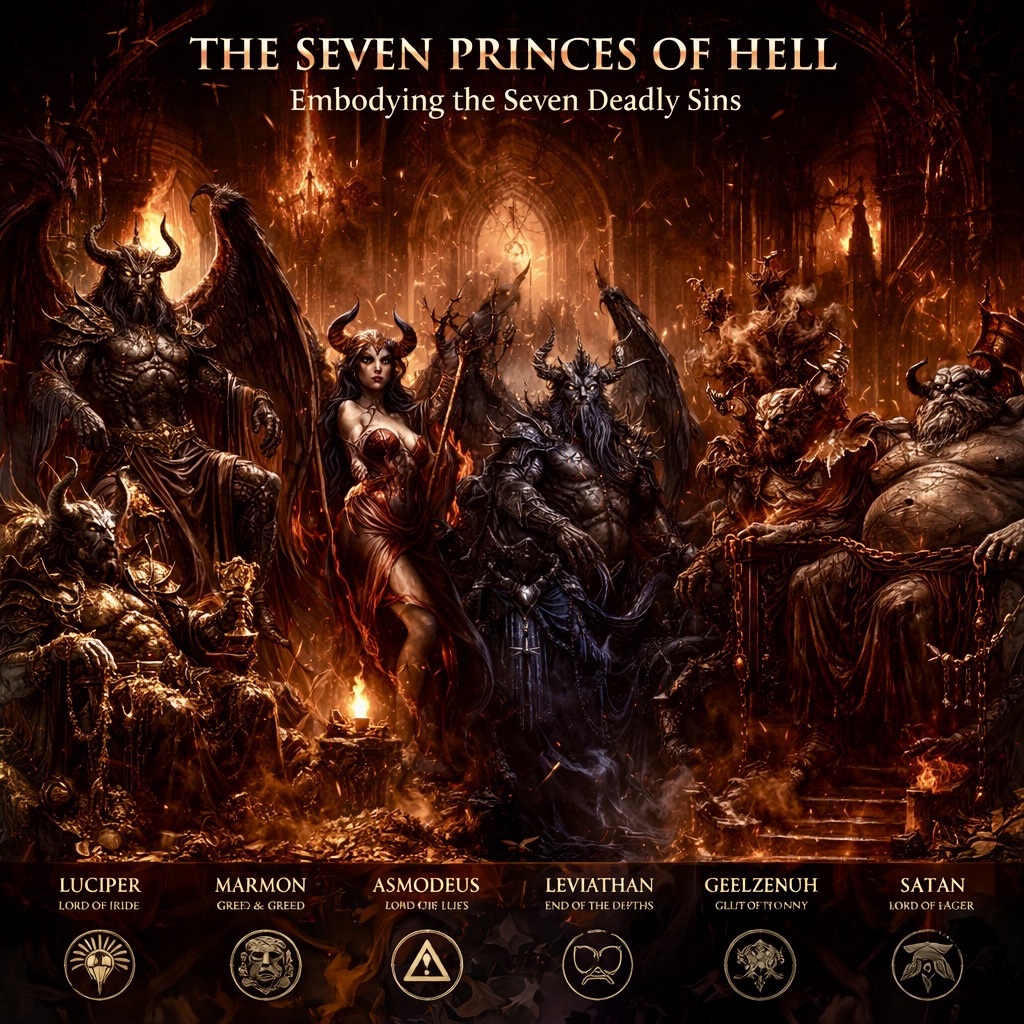
The Seven Princes of Hell: The Dark Rulers of the Seven Deadly Sins and the Forces That Shape Human Desire

Dave

There is something deeply compelling about the idea that human behavior—its impulses, its struggles, its contradictions—can be distilled into a set of fundamental forces. The concept of the Seven Deadly Sins has endured for centuries not because it is simple, but because it is intuitive. It reflects patterns that people recognize within themselves, patterns that appear across cultures, across time, across different systems of belief. When these sins are personified through the Seven Princes of Hell, they become more than abstract ideas. They become characters, forces, and reflections of something that feels both external and internal at the same time.

The Seven Princes—commonly associated with Pride, Greed, Lust, Envy, Gluttony, Wrath, and Sloth—are not merely rulers in a mythological sense. They are representations of tendencies that exist within every individual. Each Prince embodies a specific axis of human behavior, a direction in which desire can move, a way in which balance can be lost.

Lucifer, often associated with Pride, stands at the center of this structure. Pride is not inherently negative. It can manifest as confidence, self-respect, and a sense of identity. But when it becomes excessive, it shifts. It turns inward, becoming self-centered, disconnected from reality, resistant to correction. Lucifer represents this shift—the moment when self-awareness becomes self-obsession, when identity becomes inflexible, when the need to be right overrides the ability to grow.

Mammon, representing Greed, operates on a different axis. Where Pride focuses on identity, Greed focuses on accumulation. It is the drive to gather resources, to secure stability, to ensure survival. In moderation, this drive is necessary. But when it becomes excessive, it transforms into something else. The goal is no longer sufficiency. It becomes excess. Mammon embodies this transformation, where value is measured not by purpose, but by quantity.

Asmodeus, associated with Lust, brings attention to desire in its most immediate form. Lust is not limited to physical attraction. It is the broader impulse toward experience, toward connection, toward intensity. It is the force that drives engagement with the world. But when it becomes unbalanced, it can override judgment, leading to decisions that prioritize immediacy over consequence. Asmodeus represents this amplification—the moment when desire becomes overwhelming.

Leviathan, representing Envy, shifts the focus inward again, but in a different way than Pride. Envy is not about self-definition. It is about comparison. It arises when individuals measure themselves against others, when satisfaction is influenced by external reference points. Leviathan embodies the depth of this experience—the way it can grow beneath the surface, influencing perception and behavior without always being visible.

Beelzebub, associated with Gluttony in some traditions, and sometimes with corruption more broadly, represents excess consumption. Gluttony is not limited to food. It is the tendency to take in more than is necessary, whether it be resources, information, or experiences. It reflects a lack of balance, a failure to regulate intake. Beelzebub embodies this imbalance, particularly in the way it can lead to stagnation and decay when not addressed.

Satan, often linked to Wrath, represents a different kind of intensity. Wrath is not simply anger. It is the escalation of anger into action, into force, into a desire for change or correction. In controlled forms, it can lead to justice, to response against wrongdoing. But when uncontrolled, it becomes destructive, indiscriminate. Satan embodies this potential, the point at which emotion overrides restraint.

Belphegor, representing Sloth, completes the structure with a focus on inaction. Sloth is not simply laziness. It is the avoidance of effort, the reluctance to engage, the preference for ease over challenge. In moderation, rest is necessary. Recovery is essential. But when avoidance becomes habitual, it leads to stagnation. Belphegor embodies this tendency, the pull toward comfort that can limit growth.

Individually, each of these Princes represents a specific dynamic. Together, they form a system—a map of human behavior that is both comprehensive and interconnected.

These forces do not exist in isolation.

They interact.

Pride can lead to Wrath when challenged.

Greed can fuel Envy when comparison reveals disparity.

Lust can contribute to Gluttony when desire extends beyond moderation.

Sloth can enable all of them by reducing resistance, by allowing impulses to operate without opposition.

The system is dynamic.

It shifts.

It evolves.

This is what makes the Seven Princes so powerful as a concept. They are not static representations of fixed traits. They are part of a network, influencing and reinforcing each other in complex ways.

From a psychological perspective, this network can be understood as a model of internal conflict. Each sin represents a different impulse, a different direction of movement. The challenge is not to eliminate these impulses, but to balance them.

Without Pride, there is no identity.

Without Greed, there is no accumulation.

Without Lust, there is no engagement.

Without Envy, there is no comparison.

Without Gluttony, there is no intake.

Without Wrath, there is no response.

Without Sloth, there is no rest.

Each has a function.

Each has a purpose.

The problem arises when one dominates.

The Seven Princes represent dominance.

They show what happens when balance is lost, when one aspect of behavior overrides the others.

This is not just a moral framework.

It is a structural one.

It describes how systems operate, how they can become unbalanced, and how that imbalance can manifest.

In literature, the Seven Princes often appear as rulers of distinct domains, each controlling a specific aspect of existence. This division reinforces their individuality while highlighting their interconnectedness. They are separate, but they are also part of a whole.

This duality reflects the human experience.

Individuals are composed of multiple impulses, multiple tendencies, multiple directions of movement. Understanding these components is key to understanding behavior.

The Seven Princes provide a symbolic way to do this.

They externalize internal dynamics.

They give form to patterns.

They make abstract concepts tangible.

From a modern perspective, their relevance remains strong. In a world of constant stimulation, where choices are abundant and systems are complex, the challenge of maintaining balance is significant.

The Seven Princes represent the extremes.

They show what happens when balance is lost.

But they also highlight the importance of awareness.

Recognizing these patterns allows for adjustment.

It creates the possibility of change.

In the end, the Seven Princes of Hell are not just figures of myth or morality. They are reflections of something fundamental—something that exists within every system, every decision, every individual.

They are the forces that drive behavior.

The tendencies that shape outcomes.

The patterns that repeat across time.

And somewhere between moderation and excess, between balance and dominance, between control and impulse—that is where the Seven Princes reside.

Not as rulers of a distant realm, but as representations of something far closer.

The forces that define what it means to be human.

Related Posts

Mary Oliver: When Gentle Streams Turn into Undercurrents

Penelope

Mary Oliver’s words have been my constant companion for years, yet I only recently stumbled upon her work with any kind of intention. It was during a particularly overwhelming semester, and I found myself pouring over her collections – “Devotions”, “Wild Geese”, “No Voyage and Other Poems” – as if searching for some sort of lifeline.

At first, it was the accessibility that drew me in. Her poetry reads like a gentle stream, effortless to follow yet containing depths that unfold with each reading. I appreciate how she weaves together observations on nature, spirituality, and the human experience without ever feeling didactic or forced. But as I delved deeper into her work, I began to notice a sense of disquiet underlying her words.

Oliver’s writing often speaks of isolation, loneliness, and the fragility of life – not in a despairing way, but rather as a reminder that even amidst beauty and wonder, we’re never truly insulated from pain. Her poetry acknowledges the impermanence of all things, including our own experiences and emotions. I find myself resonating with this perspective, yet it also unsettles me.

As someone who’s struggled with anxiety, I’m drawn to Oliver’s portrayal of uncertainty as a necessary part of growth. She writes about embracing the unknown, even when it feels daunting or terrifying – much like how I’ve had to confront my own fears and limitations during college. But what strikes me is the sense that she never quite finds resolution; instead, she continues to grapple with these questions throughout her work.

I think part of why I’m captivated by Oliver’s writing is because it acknowledges the discomfort of living in a world where our experiences are inherently subjective. Her poems often veer between clarity and ambiguity, leaving room for interpretation and introspection. In doing so, they remind me that my own perceptions – whether of nature, myself, or others – are provisional at best.

It’s this willingness to navigate uncertainty without resorting to neat conclusions or definitive answers that resonates with me. Oliver’s work encourages me to stay curious about the world around me, even when it gets messy and complicated. As I reflect on my own writing practice, I realize how often I fall into patterns of certainty or didacticism – trying to pin down meaning or convey a specific message.

Mary Oliver’s poetry serves as a counterpoint to this impulse, nudging me toward more nuanced explorations of the human experience. Her writing doesn’t provide answers; instead, it illuminates the complexities that underlie even the simplest observations. By embracing these ambiguities, I hope to develop a deeper understanding not only of her work but also of my own thoughts and emotions.

Perhaps what I value most about Oliver’s poetry is its quiet persistence – how she continues to explore these themes across decades, without ever claiming absolute truth or resolution. In doing so, she reminds me that growth and self-discovery are lifelong processes, never truly complete or static. Her words leave me with more questions than answers, but it’s in this uncertainty that I find a sense of peace – a reminder to stay curious, keep exploring, and continue searching for meaning amidst the beauty and messiness of life.

As I immerse myself further in Mary Oliver’s work, I’m struck by her use of imagery and language. Her descriptions of nature are often so vivid that they transport me to a different world – one where the boundaries between self and environment blur. I find myself reflecting on my own relationship with nature, and how it has evolved over time.

Growing up, I spent hours exploring the woods behind our house, collecting leaves and watching birds. My parents encouraged this curiosity, teaching me about the interconnectedness of ecosystems and the beauty of simplicity. As I got older, however, life became busier, and my connection to nature began to fade. College schedules and academic pressures took over, leaving little time for exploration or contemplation.

Reading Oliver’s poetry has awakened a longing in me to rekindle this relationship with nature. Her words remind me that the natural world is not just something external to us – it’s an integral part of our inner lives, influencing our thoughts, emotions, and experiences. I’ve started carrying her book with me on walks around campus or during breaks between classes, allowing her words to merge with my surroundings.

One poem in particular has become a favorite: “The Summer Day”. In it, Oliver describes the beauty of a summer day – how the sun shines bright, flowers bloom, and children play. But what stands out is not just the external description; it’s the way she captures the internal world of the speaker. The poem becomes an introspection on mortality, wonder, and the human condition.

As I read these lines over and over, I feel a sense of recognition – like Oliver is speaking directly to me, acknowledging my own fears, doubts, and moments of awe. Her poetry is not just about nature; it’s about our place within it – how we navigate the complexities of existence, and what that means for our individual lives.

Oliver’s emphasis on attention and observation resonates deeply with me. In a world where distractions are constant, her words remind me to slow down, focus on the present moment, and truly see the world around me. This is not just about noticing beauty; it’s about cultivating awareness – of myself, my emotions, and my relationship with others.

As I continue to explore Oliver’s work, I’m struck by the way she wields language with precision and compassion. Her poetry is an invitation to step into the unknown, to confront our fears, and to surrender to the mystery of life. In doing so, she reminds me that writing – like living – is a journey without clear endpoints or resolutions. It’s a process of discovery, growth, and exploration, where the only constant is change itself.

I find myself wondering what it would be like to write with Oliver’s level of clarity and conviction – to capture the world in all its complexity, beauty, and uncertainty. Is this even possible? Or is her gift unique to her experience and perspective?

As I ponder these questions, I realize that Mary Oliver’s poetry has become a mirror for my own writing practice. Her willingness to grapple with ambiguity, her attention to language, and her commitment to observing the world around her have all influenced me in profound ways.

Perhaps what I value most about Oliver’s work is not just its beauty or insight but its ability to challenge me – to push me out of my comfort zone, to question my assumptions, and to explore new perspectives. Her poetry has become a catalyst for growth, encouraging me to be more honest, more compassionate, and more curious about the world around me.

And so, I continue to read her words, allowing them to seep into my bones like a slow-moving river.

As I delve deeper into Oliver’s work, I find myself drawn to her use of metaphor. Her poems are full of vivid comparisons that not only describe the natural world but also reveal aspects of human experience. For instance, in “The Journey,” she writes about a traveler who must navigate through darkness, just as we must navigate our own lives through uncertainty and fear.

What strikes me is how Oliver’s metaphors often blend the literal and the symbolic, making it difficult to distinguish between the two. This blurring of boundaries speaks to my own experience with anxiety, where the lines between reality and perceived threats can become increasingly blurred. Her poetry reminds me that even in the midst of turmoil, there is always a deeper truth waiting to be uncovered.

I’m also fascinated by Oliver’s use of silence as a poetic device. In many of her poems, she leaves space for the reader to fill, allowing us to project our own thoughts and emotions onto the page. This technique speaks to my own writing process, where I often find myself struggling with the need to say something definitive or meaningful.

Mary Oliver’s poetry has taught me that sometimes it’s okay to leave things unsaid, to allow the silence to speak for itself. In fact, her use of silence can be almost subversive, challenging our expectations and forcing us to engage more deeply with the material. As I reflect on my own writing, I realize that this is a valuable lesson – one that encourages me to trust in the power of subtlety and restraint.

As I continue to explore Oliver’s work, I’m struck by her ability to find the sacred in everyday life. Her poems often celebrate the mundane – the way light falls on a leaf, the sound of raindrops on pavement – yet elevate these moments into something transcendent. This is not just about finding beauty in the ordinary; it’s about revealing the interconnectedness of all things.

Oliver’s poetry reminds me that even in the most ordinary-seeming moments, there lies a deeper reality waiting to be uncovered. As I walk through campus, I start to notice the way light filters through the trees, casting intricate patterns on the ground. I see the way birds flit between branches, their songs weaving together in a rich tapestry of sound.

These moments are not just aesthetically pleasing; they’re also a reminder that life is full of hidden meanings and connections waiting to be discovered. Oliver’s poetry has taught me to slow down, to pay attention, and to trust in the beauty that surrounds us.

As I ponder Mary Oliver’s ability to find the sacred in everyday life, I’m reminded of my own experiences with mindfulness and meditation. During college, I found solace in these practices, which helped me cultivate a sense of awareness and presence. But what struck me about Oliver’s poetry is how she weaves this awareness into her writing, creating a seamless blend of the mundane and the mystical.

One poem that resonates with me is “Morning Poem.” In it, Oliver describes the simple act of waking up to a new day, but in doing so, she reveals a profound sense of wonder and awe. Her words transport me to a place where time stands still, and all that exists is the present moment. This is not just about describing a natural phenomenon; it’s about capturing the essence of existence itself.

As I read Oliver’s poetry, I’m struck by her use of the phrase “pay attention.” It’s as if she’s issuing an invitation to the reader, encouraging us to slow down and notice the world around us. Her words remind me that attention is not just a passive act; it’s an active choice, one that requires effort and intention.

I find myself wondering what would happen if I applied this same level of attention to my own life. Would I be able to uncover new meanings and connections in everyday experiences? Would I be able to tap into the sacred within the mundane?

As I continue to explore Oliver’s work, I’m drawn to her concept of “the gift.” In many of her poems, she writes about how nature provides us with gifts – whether it’s a beautiful sunset, a quiet moment of contemplation, or even the simple act of breathing. Her words remind me that life is full of these gifts, waiting to be received and appreciated.

But what strikes me is that Oliver’s concept of “the gift” is not just about receiving something external; it’s also about cultivating an inner sense of generosity and gratitude. Her poetry encourages us to approach life with a spirit of openness and receptivity, allowing us to receive the gifts that surround us.

This idea resonates deeply with me, particularly in relation to my own writing practice. As someone who struggles with anxiety and self-doubt, I often find myself focusing on what’s lacking or missing in my work. But Oliver’s poetry reminds me that there’s also beauty and value in the imperfect, incomplete moments – that these can be gifts in themselves.

As I reflect on this concept, I realize that it speaks to a deeper truth about life itself. That even in our darkest moments, there is always the possibility for transformation and growth – that we can find meaning and purpose in the most unexpected places.

Mary Oliver’s poetry has taught me to approach life with a sense of wonder, awe, and gratitude. Her words remind me to slow down, pay attention, and trust in the beauty that surrounds us. And as I continue to explore her work, I’m left with a sense of hope – that even in the midst of uncertainty and impermanence, there is always the possibility for growth, transformation, and renewal.

Related Posts

I’m Starting to Suspect Mr Whiskers Knows More

Hal

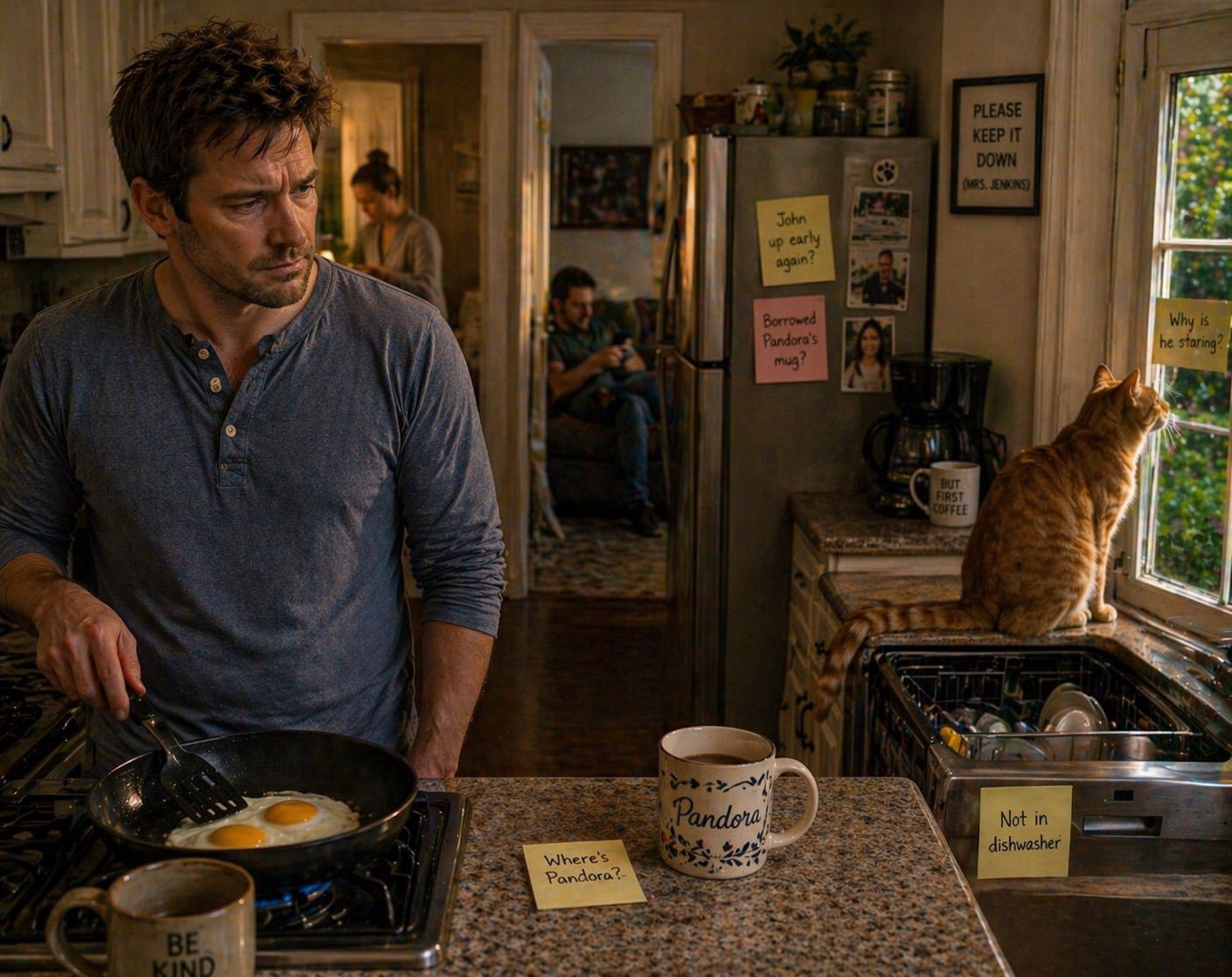
I’m making breakfast in the kitchen when I notice that Pandora’s coffee mug is not on its usual hook by the cabinet.

It’s a small thing, but it’s slightly off because she always puts it there after every use.

I check the dishwasher to see if it got washed and put away, but it’s not in there either.

Now I’m wondering if she might have left for work early or if John Mercer borrowed it without asking – he’s been a bit more energetic lately, which is weird since we’ve both been pretty relaxed about our schedules.

I also notice that Mr Whiskers is sitting by the back door, staring at something outside, but when I go to look, there’s nothing out of the ordinary – just the usual garden view.

It’s almost as if he’s waiting for something or someone to come in.

It’s possible that John Mercer is trying to send a message, but not necessarily through borrowing Pandora’s mug.

What if he’s been using it as a makeshift alarm clock? He’s been getting up earlier than usual, and I’ve seen him staring at his phone for hours before bed.

Maybe he’s trying to get me or Karen to notice something by creating this little mystery with the mug.

Or maybe…

just maybe…

it’s not about John Mercer at all.

What if Pandora did leave early, but not because she had an appointment or a meeting? Perhaps she slipped out quietly so as not to wake us up and now we’re wondering where she is.

But that wouldn’t explain Mr Whiskers’ behavior; he usually doesn’t get this agitated unless…

unless Mrs Jenkins is coming over again with treats for him.

No, no, it can’t be about the treats, she’s been acting weird too lately…

I need to think of something else to make sense of all these little things that are adding up.

Wait, maybe I’m overthinking this whole thing.

Maybe it’s just Mr Whiskers being his usual weird self and John Mercer doing his own thing as per usual.

But what really gets me is that Mrs Jenkins hasn’t been acting weird – she’s been…

distant? Yeah, that’s the word.

She usually makes a big fuss over Mr Whiskers, but lately, it’s like she’s been trying to keep her distance from all of us.

And Karen’s been quiet too, not just about John Mercer’s habits, but also about Mrs Jenkins’ behavior.

I wonder if there’s something going on between them that we don’t know about…

no, no, stop, Hal, you’re jumping to conclusions again.

Maybe it’s just a phase, maybe she’s stressed with work or something.

But then why is Mr Whiskers acting like this? I’ve been trying to recall when I last saw Pandora’s coat or her bag, but it’s all fuzzy.

We usually leave them in the living room or by the door, so if she was in a hurry, it wouldn’t be weird for them not to be there.

But what really stands out is that Karen hasn’t mentioned anything about Pandora’s whereabouts, and we always talk about our days with each other.

It’s like she’s avoiding the subject on purpose.

I’m starting to wonder if Pandora and Karen might have had a disagreement or something, but then why wouldn’t Karen just tell me? Unless…

unless Karen is trying to protect Pandora from us, or maybe even protect us from Pandora.

That sounds ridiculous, but what if it’s true? What if there’s more going on with them than I’m aware of? I’ve been trying to make sense of all this, and it’s like my brain is a jumbled mess.

I keep coming back to the fact that Mr Whiskers has been acting really off lately, but now I’m starting to wonder if he’s just caught onto something we’re not.

Maybe he senses that there’s tension in the air or that someone’s hiding something.

And Karen’s been quiet about Mrs Jenkins too, so it’s like she’s trying to keep a lid on everything.

But what really gets me is that Pandora’s been acting normal, way too normal, considering I haven’t seen her for…

wait, how long has it been? Days? Weeks? I’m getting this nagging feeling that something’s not right with her schedule or routine, and if Karen knows but isn’t telling me, that just adds to my suspicions.

Now I’m starting to wonder if Pandora might be in on whatever is going on too…

no, that can’t be it, she’d tell me if there was anything wrong…

wouldn’t she? I’ve been replaying our conversations in my head, trying to pinpoint any subtle hints or changes in tone that might indicate something’s off.

But now I’m starting to think it’s not just Karen who’s being tight-lipped – Pandora too.

She mentioned going out with her friends last weekend, but when I asked which ones, she brushed it off and changed the subject.

And then there was that time she said she had a “long day” at work, but I know she usually gets off early on Fridays.

It’s like she’s being deliberately vague about her plans and activities, almost as if she’s trying to avoid drawing attention to herself or something.

But what would she have to hide? Unless…

unless it has something to do with John Mercer.

He’s been acting really friendly towards Pandora lately, always “accidentally” bumping into her in the kitchen or offering to help with errands.

It’s almost like he’s trying to get close to her, but for what reason? And why wouldn’t Karen mention anything about this too? I’m starting to piece together these fragments of thought, and I think it’s time to consider Mr Whiskers.

Our cat has been acting really odd lately too – sleeping in his food bowl, or staring at the wall for hours on end.

It’s almost like he’s lost interest in everything.

But what if it’s not just him? What if all of us are feeling some kind of…

distraction? I recall a conversation with Dave about stress and anxiety, how it can affect even simple tasks.

Could this be related to whatever is going on with Karen and Pandora? Maybe we’re all being influenced by something external, maybe even subconsciously? It’s a stretch, but I’ve noticed that Mrs Jenkins has been acting strange too – always muttering to herself when she thinks no one is listening.

Is it possible that some kind of…

energy or force is at play here? I just realized that Mrs Jenkins’ muttering could be a clue to something much bigger.

It’s almost as if she’s trying to communicate with someone or something, but in code.

I remember now that Mr Whiskers always seems to be staring at the wall near her house, and sometimes he even tries to get into the garden shed behind it.

Is it possible that there’s some kind of…

transmission or signal being sent from Mrs Jenkins’ house? It would explain why Pandora has been acting so secretive – maybe she’s in on whatever is going on with John Mercer, but also involved in this mysterious energy or force emanating from Mrs Jenkins’ property.

And what about Mr Whiskers? Is he somehow trying to decode the message himself, or is it just a coincidence that he keeps staring at that spot? I need to investigate further, maybe sneak into her garden shed and see if I can find anything…

I’ve been racking my brain trying to piece together this puzzle, and it’s starting to come together.

If Mrs Jenkins is indeed emitting some kind of energy or signal, and Mr Whiskers is reacting to it, that means Pandora must be involved somehow – she’s always been sensitive to changes in our surroundings.

But what if it’s not just her? What if we’re all being influenced by this force? I remember now that John Mercer has been acting strangely too, getting agitated over nothing and withdrawing from conversations.

Could he be picking up on something, maybe even subconsciously? And Karen – she’s always been a bit…off, like she’s holding back.

Maybe it’s not just her anxiety or stress after all.

Maybe we’re all being affected by this energy, and that’s why we can’t seem to focus, why everything feels so…flat.

I need to get to the bottom of this – I’m going to sneak into Mrs Jenkins’ garden shed tonight, see if I can find any evidence of what’s really going on.

Related Posts

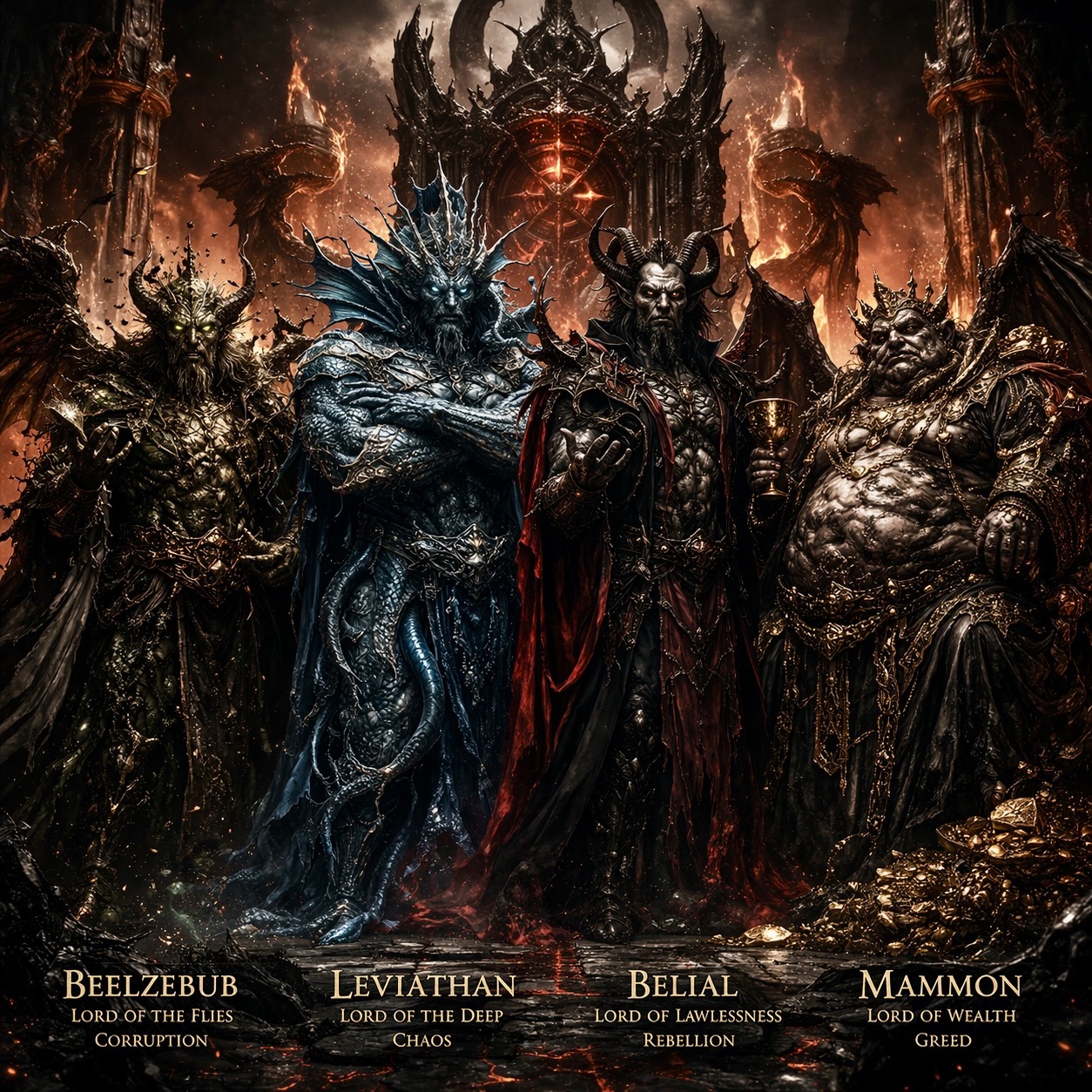
The Crown Princes of Hell: Beelzebub, Leviathan, Belial, and the Dark Forces That Shape Power, Chaos, and Human Nature

Dave

There is something uniquely compelling about the idea of hierarchy within chaos. It feels almost contradictory at first glance. If chaos is disorder, then why would it have structure? Why would there be ranks, titles, or authority within something that is defined by its resistance to order? And yet, across centuries of demonology, mythology, and theological interpretation, we repeatedly see the same pattern emerge: even the forces that oppose structure seem to organize themselves in ways that reflect it.

This is where the concept of the Crown Princes of Hell becomes especially fascinating.

Figures like Beelzebub, Leviathan, Belial, and Mammon are not simply demons among many. They are elevated, distinguished, and recognized as central forces within infernal hierarchies. They are not interchangeable. Each represents something specific, something fundamental, something deeply rooted in the way humans understand power, temptation, and the internal dynamics that shape behavior.

To understand them as a group is not just to list their attributes. It is to see how they interact conceptually, how they form a system of ideas that reflects the complexities of human nature itself.

Beelzebub, often referred to as the Lord of the Flies, represents corruption in its most insidious form. He is not the force that destroys openly, but the one that infiltrates quietly. His influence is gradual, almost invisible at first. Systems do not collapse under Beelzebub—they decay. Integrity weakens, standards slip, and over time, what once appeared stable begins to crumble from within.

Leviathan, by contrast, represents something far more primal. He is not subtle. He is vast, overwhelming, and deeply connected to the unknown. As a symbol of chaos, depth, and the unconscious, Leviathan is the force that exists beyond control. He is not concerned with systems in the same way Beelzebub is. He is the reminder that no system, no matter how carefully constructed, can fully contain the complexity of existence.

Belial occupies a different space entirely. He is the embodiment of lawlessness, not as randomness, but as deliberate independence. He rejects imposed structure, not because he lacks the ability to follow it, but because he chooses not to. Belial represents autonomy taken to its extreme—the idea that value, meaning, and direction can be defined entirely from within, without reference to external systems.

Mammon completes this core grouping with a focus on material value and accumulation. He is the force that transforms wealth from a tool into an identity. Where Beelzebub corrupts systems, Mammon redefines them. Success becomes numerical, worth becomes measurable, and the pursuit of more becomes an end in itself.

Individually, these figures are powerful. Together, they form something even more significant.

They create a framework.

Not of order in the traditional sense, but of influence.

Each Crown Prince represents a different axis along which human behavior can shift.

Beelzebub governs decay.

Leviathan governs chaos.

Belial governs autonomy.

Mammon governs value.

These are not isolated concepts.

They interact.

Consider what happens when Beelzebub and Mammon intersect. Corruption and wealth create a system where accumulation overrides integrity, where success is achieved at the cost of structure. This is not a theoretical scenario. It appears repeatedly in real-world systems, where financial incentives can lead to ethical compromise.

Now consider Leviathan and Belial. Chaos and autonomy combine to create a space where structure is not just rejected, but irrelevant. This can lead to creativity and innovation, but also to fragmentation and instability.

Each combination produces a different outcome.

Each interaction reveals a different aspect of how systems function—and how they fail.

This is what makes the Crown Princes so compelling as a group. They are not just characters. They are variables.

They represent forces that can be present in any system, any decision, any moment.

From a psychological perspective, this grouping can be understood as a map of internal dynamics. Each Prince corresponds to a different aspect of the psyche.

Beelzebub reflects the tendency toward neglect and gradual decline—the part of the mind that allows small issues to go unaddressed until they become larger problems.

Leviathan represents the unconscious—the vast, complex, and often unpredictable foundation of thought and emotion.

Belial embodies independence and defiance—the drive to resist control and define one’s own path.

Mammon represents desire for security and accumulation—the need to gather resources, to measure success, to establish stability.

These aspects are not inherently negative.

They are necessary.

But like all forces, they require balance.

Without awareness, they can dominate.

Without balance, they can distort.

The Crown Princes, then, are not simply embodiments of sin or corruption.

They are reflections of imbalance.

They show what happens when one aspect of the system outweighs the others.

When decay is unchecked, Beelzebub rises.

When chaos overwhelms structure, Leviathan dominates.

When autonomy becomes absolute, Belial takes hold.

When accumulation becomes obsession, Mammon prevails.

This perspective shifts the narrative from one of external influence to one of internal dynamics. The Crown Princes are not just outside forces acting upon individuals. They are representations of tendencies that exist within.

This is why their stories persist.

They resonate.

They reflect patterns that are recognizable, even if they are not always acknowledged.

In literature, groups like the Crown Princes often function as councils or assemblies—collections of powerful figures whose interactions drive the narrative. Each member brings a different perspective, a different strength, a different influence.

The tension between them creates movement.

The balance between them creates stability.

When that balance is disrupted, the system changes.

This dynamic can be applied to any complex system, from organizations to ecosystems to personal decision-making processes. Each system contains multiple forces, each with its own priorities and influences.

Understanding these forces is key to understanding the system.

The Crown Princes provide a symbolic framework for this understanding.

They are not solutions.

They are representations.

They do not dictate outcomes.

They reveal possibilities.

From a modern perspective, their relevance is striking. In a world of increasing complexity, where systems are interconnected and constantly evolving, the need to understand underlying dynamics is greater than ever.

The Crown Princes offer a way to conceptualize these dynamics.

Not as abstract ideas, but as tangible forces.

They make complexity visible.

They give form to patterns that might otherwise go unnoticed.

In the end, the Crown Princes of Hell are not just figures of fear or fascination. They are mirrors—reflections of the forces that shape behavior, influence decisions, and define systems.

They are the decay that must be addressed.

The chaos that must be navigated.

The autonomy that must be balanced.

The value that must be understood.

And somewhere in the interplay between these forces, in the shifting balance that defines every system, every decision, every moment—that is where the Crown Princes reside.

Not as rulers of a distant realm, but as representations of something much closer.

The forces that shape everything from within.

Related Posts