Author: Elias Rowen

I enjoy writing about events that happened on specific days of the year. There’s something fascinating to me about the idea that every date carries its own story—moments when history quietly turned a corner or suddenly exploded into something unforgettable. I don’t focus on famous people as much as I focus on the moments themselves. I like digging into what was happening on that particular day, what led up to it, and what followed after. When I write, I try to bring readers into the moment, to capture what it might have felt like as events were unfolding in real time, before anyone knew how things would turn out. For me, history isn’t just a list of dates and facts. It’s a collection of lived moments that still ripple into the present. My goal is to turn calendar dates into stories that feel real, relatable, and worth remembering.

The Night Humanity Shattered: Kristallnacht and the Prelude to Darkness

Elias Rowen

The night was still when it began, an ordinary November evening in 1938 Germany, cold and quiet beneath the heavy clouds that always seemed to hang low over Europe’s fragile peace. Then, with terrifying precision, the silence broke. Windows shattered in unison like a great orchestra of destruction. Glass from thousands of Jewish-owned shops cascaded onto cobblestone streets, glittering under the dim glow of gas lamps. Flames licked the sky as synagogues burned, and the night filled with the echoes of boots, screams, and splintering wood. The world would remember it as Kristallnacht — the Night of Broken Glass — when civilization’s mask cracked, revealing the brutality festering beneath.

It began with a lie — or, more accurately, with a pretext. On November 7, 1938, a young Jewish man named Herschel Grynszpan, desperate and enraged after his family was expelled from Germany to Poland, walked into the German embassy in Paris and shot a Nazi diplomat named Ernst vom Rath. The shooting was tragic, but not extraordinary in itself. What followed, however, was meticulously orchestrated vengeance disguised as public outrage. When vom Rath died two days later, Joseph Goebbels, Adolf Hitler’s propaganda minister, seized the opportunity to unleash a storm. The Nazi regime would present it as spontaneous anger from the German people. In truth, it was state-sponsored terror, planned in whispers and executed with ruthless efficiency.

As darkness fell on November 9, 1938, orders rippled through Nazi ranks. Stormtroopers, Hitler Youth, and local party loyalists were instructed to attack Jewish homes, shops, and synagogues across Germany, Austria, and the Sudetenland. Police were told not to interfere unless property belonging to Aryans was threatened. Fire brigades were instructed to let synagogues burn but to protect nearby non-Jewish buildings. The machinery of the state moved in grim harmony — not to protect its citizens, but to destroy them.

The night exploded into chaos. Shopfronts were smashed with hammers and rifle butts. Men with swastika armbands threw bricks through windows etched with Stars of David. Families cowered behind locked doors as mobs stormed the streets. Torah scrolls — ancient, sacred, irreplaceable — were torn and trampled. Synagogues that had stood for centuries were engulfed in flames, their spires collapsing under the weight of hatred. In Berlin alone, more than ninety synagogues were burned to ashes. The air was thick with the stench of smoke, the sound of laughter, and the glint of glass — that cruel, glittering glass — scattered like diamonds of despair across the streets.

In the morning light of November 10, the scope of the devastation became clear. Nearly every Jewish community in Germany had been struck. Over 7,500 Jewish-owned businesses were vandalized or destroyed. Homes were ransacked; furniture was smashed, belongings stolen or hurled into the street. Around 30,000 Jewish men were arrested and sent to concentration camps — Dachau, Buchenwald, Sachsenhausen — where they were beaten, humiliated, and forced to sign over their assets before eventual release. Hundreds were murdered in the chaos, though the true number has never been known. Those who survived awoke to a new reality: the illusion that things might somehow “return to normal” was shattered beyond repair.

For Germany’s Jews, Kristallnacht was not just a pogrom — it was the end of belonging. For years, they had endured humiliation, boycotts, and restrictive laws. Their citizenship had been stripped, their professions limited, their children banned from schools. But many had clung to hope, believing the fever of anti-Semitism would eventually pass. The morning after Kristallnacht, that hope was gone. The sight of their businesses in ruins, their synagogues reduced to ash, their friends and neighbors standing by — or worse, cheering — made one truth undeniable: they were no longer Germans. They were targets.

The regime wasted no time in turning tragedy into profit. Jews were fined one billion Reichsmarks to compensate the state for “the damage they had caused.” Insurance companies were forbidden from paying claims to Jewish business owners. Their losses became the state’s gain. The message was unmistakable: you are not only unwanted, you will pay for your own persecution. With every shattered window, the Nazi government advanced its campaign of erasure — not only of Jewish property, but of Jewish presence itself.

The rest of the world watched in horror — and hesitation. Newspapers from London to New York carried images of broken glass and burning synagogues, but outrage did not translate into action. Diplomats expressed concern, religious leaders prayed, but few governments opened their doors. At a time when thousands of German Jews desperately sought to flee, nations closed their borders, citing economic troubles or immigration quotas. The United States condemned the violence but refused to expand refugee visas. Britain offered sanctuary to a limited number of Jewish children through what became known as the Kindertransport, a humanitarian gesture that saved nearly 10,000 lives but left their parents behind. For the millions who remained, there was nowhere to run.

What made Kristallnacht so horrifying was not only its brutality, but its orchestration. It was the moment the Nazi regime crossed the threshold from discrimination to open violence, from legal persecution to physical annihilation. Until then, many Germans had told themselves that the regime’s actions were about “restoring order,” “protecting culture,” or “reclaiming national pride.” Kristallnacht stripped away that illusion. It revealed the heart of Nazism — a system that demanded hatred as loyalty and violence as virtue. The shattered glass of 1938 was the prologue to the firestorms of 1941, when Jewish homes would no longer be vandalized but emptied, their inhabitants sent east in sealed trains.

For survivors, the memory of that night never faded. Many described the sound of glass breaking as something almost alive — a sound that echoed in their dreams. It was not only the sound of property being destroyed; it was the sound of trust shattering, of centuries of coexistence collapsing in a single night. Jews who had once fought for Germany in World War I, who had served as doctors, teachers, and artists, now realized they were marked for destruction. One survivor recalled walking through Berlin’s streets at dawn and seeing passersby kicking at shards of glass as if nothing had happened, while police officers stood smoking cigarettes beside smoldering ruins.

Kristallnacht also marked a turning point in the psychology of Nazi Germany itself. It tested the limits of public reaction — and found none. Ordinary Germans, conditioned by years of propaganda, largely accepted what they saw. Some joined in; others watched silently from their windows. A few risked everything to hide or help Jewish neighbors, but they were exceptions in a sea of complicity. The regime learned that it could unleash open violence against Jews without sparking widespread resistance. From that night onward, the path to genocide lay open.

The name “Kristallnacht” itself is deceptive, a cruel euphemism coined by the perpetrators. “Crystal Night” evokes beauty, fragility, even wonder. It conceals the horror beneath. Some prefer to call it what it truly was — a state-organized pogrom, the Night of Broken Lives. For the Jewish families who survived, it was the beginning of an unending nightmare. In the months that followed, emigration surged, but so did despair. By 1941, nearly all routes of escape were sealed. Those who had watched their synagogues burn in 1938 would soon find themselves herded into ghettos and cattle cars, bound for places like Auschwitz and Treblinka. Kristallnacht was the warning — the world simply did not listen.

The imagery of that night haunts history’s conscience. The reflection of fire in broken glass became a metaphor for a civilization losing its soul. The cobblestones of Munich, Berlin, and Vienna glistened with shards that caught the light like tears. In those fragments lay the reflections of children’s toys trampled in the streets, prayer books scattered in gutters, and the empty eyes of bystanders who dared not speak. It was as if all of Germany’s cultural sophistication — its music, philosophy, and art — had splintered alongside the glass, replaced by the dull brutality of uniformed hatred.

To understand Kristallnacht is to confront not only the horror of what happened but the fragility of moral order. It reminds us that barbarism does not erupt suddenly; it grows in the silence of ordinary people who choose not to see. Years of propaganda prepared the soil. Lies about Jewish conspiracies, caricatures in newspapers, laws excluding Jews from public life — each step numbed the conscience. By the time the windows shattered, the collective heart had already hardened.

The echoes of that night stretch far beyond 1938. They reverberate wherever prejudice festers, wherever a group is dehumanized, and wherever silence greets injustice. The lesson of Kristallnacht is not confined to the past. It is a warning written in glass and fire — that when truth is twisted and hate is normalized, civilization itself becomes fragile. The same streets that once hosted Mozart and Goethe witnessed mobs destroying the homes of their Jewish neighbors. The transformation from neighbor to enemy, from citizen to outcast, can happen faster than anyone dares believe.

After the war, when the full horror of the Holocaust came to light, Kristallnacht took on a terrible clarity. It had been the rehearsal, the signal that the unthinkable was not only possible but imminent. The world’s failure to act emboldened the Nazi regime to proceed with what they would later call “the Final Solution.” For the Jews of Germany, it was the moment history’s current turned against them — when the doors of their homeland closed forever.

Today, the memory of Kristallnacht endures in museums, memorials, and in the stories of those who survived. The shards of glass have long been swept away, but the lessons remain as sharp as ever. On anniversaries of that night, candles are lit in synagogues rebuilt from ashes, and survivors’ voices — frail but resolute — remind the world that indifference is the accomplice of evil. They speak not only for those who perished but for all who must stand guard against the return of hatred in any form.

In the end, Kristallnacht was not only the night of broken glass — it was the night humanity cracked. But from its fragments, we are challenged to build something stronger: a commitment to memory, to empathy, to vigilance. The glass that once littered the streets of Germany now glimmers in remembrance walls and memorials, reflecting the faces of new generations who must never forget. It is our mirror — showing both the darkness we are capable of and the light we must preserve.

History’s silence that night cost millions of lives. To honor them is to ensure that silence never reigns again. Kristallnacht stands as a testament not only to the cruelty of men but to the enduring duty of remembrance — that through memory, we resist repetition, and through understanding, we keep the light of humanity alive.

Related Posts

When the Wall Came Down: The Night Europe Breathed as One

Elias Rowen

On a cold November night in 1989, a city divided for nearly three decades began to heal. Berlin, once the epicenter of Cold War tension, became the stage for one of humanity’s most euphoric and unifying moments. The fall of the Berlin Wall was not just the crumbling of concrete and barbed wire; it was the collapse of fear, division, and the heavy shadow of ideological confrontation that had gripped Europe since the end of World War II. It was a night when people danced on ruins, when soldiers lowered their guns, and when the impossible finally happened — freedom breached the wall.

For twenty-eight years, the Berlin Wall had stood as the ultimate symbol of division — a scar across the heart of Europe. Built overnight in August 1961 by the German Democratic Republic (GDR), it was intended to stop East Germans from fleeing to the West. Families were torn apart, friendships severed, and the concept of freedom itself became a whispered dream for millions. On one side stood West Berlin, vibrant, capitalist, and culturally alive; on the other, East Berlin, gray and constrained, ruled by suspicion and surveillance. For those who grew up in its shadow, the Wall wasn’t just a barrier — it was a constant reminder that trust and truth had been replaced by watchtowers and propaganda.

Yet, beneath the stillness of oppression, the human spirit never stopped stirring. Through the 1970s and 1980s, resistance took subtle forms — whispers in cafes, smuggled Western radio signals, underground art, and the quiet defiance of those who refused to let the state dictate their thoughts. Across Eastern Europe, movements like Poland’s Solidarity and Hungary’s reformist wave hinted that the Soviet grip was loosening. The Iron Curtain, once unyielding, had begun to rust.

By 1989, winds of change were sweeping across the continent. In Moscow, Mikhail Gorbachev had introduced “glasnost” and “perestroika,” opening cracks in the Soviet edifice. These reforms encouraged transparency and limited reform, but they also sparked something deeper — hope. In East Germany, protests began to swell. What started as small gatherings in Leipzig grew into a roar that filled streets and squares. Each Monday, thousands of East Germans took to the streets chanting “Wir sind das Volk!” — “We are the people!” The regime, which had long relied on fear, found itself facing something it could not shoot or imprison — unity.

On November 9, 1989, confusion within the East German government turned history on its head. A spokesman mistakenly announced that East Germans could travel freely to the West, “effective immediately.” The words, broadcast on television, ignited a stampede of hope. Thousands rushed to the checkpoints, demanding to cross. Overwhelmed border guards, unsure of their orders and unwilling to use force, did the unthinkable — they opened the gates. The Wall, that cold, gray divider, became a bridge. Strangers embraced, champagne bottles popped, and tears flowed as people climbed atop the Wall, hammering at it with anything they could find. History was being rewritten by ordinary hands and joyous hearts.

The scenes that followed became the defining images of a generation. Young men and women chipped away at the Wall with pickaxes, tossing fragments into the air like confetti. Families separated for decades finally embraced under the glow of television lights. East and West Berliners, once divided by politics, found themselves united in song and laughter. Across Europe, people stayed awake that night, watching the impossible unfold live on their television screens. It was as if an entire continent had exhaled after holding its breath for forty years.

The fall of the Berlin Wall marked more than the reunification of Germany — it heralded the reunification of Europe. Within months, communist regimes in Czechoslovakia, Bulgaria, and Romania collapsed. In Poland and Hungary, free elections transformed the political landscape. The Iron Curtain, once stretching from the Baltic to the Adriatic, disintegrated in a wave of freedom. By October 3, 1990, Germany was officially reunified, and Berlin once again became its beating heart.

Yet reunification was not without its challenges. For many East Germans, the joy of freedom was tempered by uncertainty. The transition from a state-controlled system to capitalism brought economic upheaval. Factories closed, unemployment rose, and cultural identities clashed. The reunification of a nation divided for a generation was as much an emotional process as it was political. The scars left by the Wall — physical, economic, and psychological — would take years to heal.

Still, the symbolism of that night in 1989 transcended borders. It was a moment that reminded the world of humanity’s enduring hunger for freedom. The Wall had stood as a monument to fear; its fall became a monument to hope. People who had grown up behind the Iron Curtain now found themselves standing on the threshold of possibility. Students could travel, artists could create, and families could dream together again. The phrase “Ich bin ein Berliner,” once uttered by John F. Kennedy as a show of solidarity, took on new life as millions now truly became free Berliners — citizens of a united world.

Europe’s journey after the Wall’s fall was not simply a political transformation but a moral one. The European Union expanded eastward, integrating nations once locked behind the curtain. NATO grew, and economic ties strengthened. While differences and tensions remained, the continent began to knit itself together through shared values of democracy, cooperation, and peace. Streets once patrolled by soldiers now hosted open-air markets and art festivals. The very ground where tanks once rolled became stages for musicians and protesters calling for global unity.

For those who lived through the Cold War, the night the Wall fell was nothing short of miraculous. They remembered the days when nuclear sirens blared during crises, when schoolchildren practiced hiding under desks, and when the world seemed perpetually poised on the brink of annihilation. The sight of people dancing atop the Wall, once a symbol of everything that kept the world divided, felt like redemption. It was proof that human beings, when driven by courage and collective will, can reshape history.

There was something profoundly poetic about the Wall’s demise. It had been built in darkness and secrecy, yet it was torn down in light and jubilation. It had divided families and lovers, yet its end reunited them. It had symbolized repression, but its destruction embodied freedom. It reminded humanity that no wall, no matter how tall or thick, could outlast the will of people yearning to be free.

In the years that followed, pieces of the Berlin Wall found homes across the globe — in museums, memorials, and public spaces. Each fragment carried a message: that walls may divide, but they can also fall. Visitors to Berlin today can walk along the East Side Gallery, where artists have transformed the remnants into a colorful tapestry of expression. Graffiti once punished as rebellion now serves as art, bearing witness to both suffering and triumph. Among the murals are faces of freedom fighters, words of peace, and vibrant depictions of unity that stretch as far as the eye can see.

The legacy of that November night continues to ripple through generations. For many, it marked the end of an age defined by fear and the beginning of one defined by possibility. It showed that history is not solely written by governments and generals but by the collective actions of ordinary citizens. It demonstrated that truth can survive censorship, that love can outlast propaganda, and that courage can outshine tyranny. It was the rebirth of a continent that had spent too long divided against itself.

And yet, decades later, as new walls — both physical and ideological — rise around the world, the lessons of 1989 remain vital. The Berlin Wall’s fall serves as a warning and a reminder: that unity requires vigilance, and freedom is never guaranteed. The generation that danced on the Wall passes the torch to those facing new barriers — digital, cultural, and political. The spirit of that night calls out still, urging humanity to tear down the walls that divide hearts and nations alike.

When people remember the fall of the Berlin Wall, they often recall the jubilant crowds, the sound of hammers striking stone, and the flood of light across Checkpoint Charlie. But perhaps the true essence of that moment was something quieter — the look in the eyes of those crossing from East to West for the first time. It was disbelief giving way to joy, fear dissolving into laughter. It was the realization that the future, for once, was theirs to shape.

The Berlin Wall fell not because of one leader or one policy but because of millions of small acts of defiance and hope. It was toppled by prayers whispered in churches, by chants echoing through Leipzig streets, by letters smuggled to the West, and by the unbreakable human desire to live free. It was brought down by people who refused to accept that history had already been written for them.

In the end, the story of the Berlin Wall is not just about Germany or even Europe — it is about humanity’s eternal struggle to overcome division. It is about our capacity to change, to forgive, to rebuild. The wall that once split Berlin now stands as a memory, a lesson carved into the heart of history: that when people come together with courage and conviction, no barrier is unbreakable.

And on that November night, as fireworks lit the Berlin sky and strangers became brothers once more, Europe found its heartbeat again. The walls of fear crumbled, and for the first time in decades, the continent — and the world — breathed as one.

Related Posts

The Prison Prophet: Hitler’s Transformation in Landsberg and the Rebirth of a Movement

Elias Rowen

In the shattered aftermath of World War I, Germany was a nation adrift. Its empire dissolved, its economy in ruins, and its people demoralized by defeat and the crushing weight of the Treaty of Versailles, the once-proud nation struggled to find its footing under the fledgling Weimar Republic. Political extremism flourished in this climate of disillusionment, and amid the chaos, a charismatic Austrian veteran named Adolf Hitler began his steady ascent from obscurity to notoriety.

Returning from the Western Front in 1919, Hitler joined the German Workers’ Party (DAP), a tiny nationalist group in Munich. His first duties were mundane — selling pamphlets, attending meetings — but his fiery oratory soon captivated audiences. By 1920, his speeches railing against the Versailles settlement and extolling German unity drew hundreds. The DAP rebranded as the National Socialist German Workers’ Party (NSDAP), and Hitler became its chief propagandist, transforming a marginal movement into a political force.

Germany’s humiliation after the war created fertile ground for his message. Hyperinflation devoured savings, unemployment soared, and food shortages bred desperation. To millions, democracy seemed weak; to Hitler, it was an opportunity. His rhetoric fused nationalism, antisemitism, and calls for vengeance into a potent brew that promised both redemption and revenge.

By 1923, as France occupied the Ruhr Valley and the economy imploded, Hitler believed the time had come to seize power. On November 8, flanked by loyalists Hermann Göring, Ernst Röhm, and Rudolf Hess, he stormed the Bürgerbräukeller beer hall in Munich, interrupting a political meeting with pistol in hand. Declaring a “national revolution,” he tried to force Bavarian officials to join his coup. Chaos erupted in the streets — gunfire, confusion, shouts of betrayal. By the next morning, the Beer Hall Putsch lay in ruins. Sixteen Nazis and four policemen lay dead; the fledgling revolution was crushed within hours.

Hitler fled but was soon arrested. Charged with high treason, he faced what could have been his political end. Yet the trial became his stage. Defiant and eloquent, he cast himself as a patriot betrayed by corrupt politicians. The courtroom turned into a pulpit, his words reaching far beyond Munich. The judges, sympathetic to his nationalism, handed down a lenient sentence — five years in Landsberg Prison — with eligibility for early release.

Behind the walls of Landsberg, Hitler began his metamorphosis. The cell was modest but comfortable; he received visitors, corresponded freely, and enjoyed preferential treatment. Gone was the impulsive street agitator. In his place emerged a man determined to rebuild his movement not by force, but through strategy and persuasion.

It was here, in this quiet confinement, that Hitler began to write Mein Kampf — part autobiography, part manifesto, part prophecy. Dictated to Rudolf Hess, the book outlined his vision of a racially pure, authoritarian Germany united under his leadership. He blamed Jews, communists, and international financiers for the nation’s woes and vowed to restore German greatness through expansion and absolute control. The writing was rambling and repetitive, yet its ideas — virulent, dangerous, and seductive — would soon ignite a political wildfire.

For Hitler, Landsberg became a crucible of reinvention. He concluded that violent uprisings like the Putsch were doomed to fail. Instead, he would exploit democracy itself — using elections, propaganda, and spectacle to gain power legally before dismantling the system from within. This realization marked the birth of the strategy that would eventually carry him to the Chancellorship a decade later.

Released in December 1924 after serving just nine months, Hitler emerged to find his party in disarray. Many dismissed him as a failed revolutionary, yet he was no longer a fringe figure. The publicity of his trial and the publication of Mein Kampf had made him a household name. Across Germany, resentment against the Weimar Republic still simmered. To those craving strong leadership, Hitler now seemed a symbol of defiance and order.

Throughout the late 1920s, he rebuilt the NSDAP with military precision. He cultivated regional leaders like Gregor Strasser and Joseph Goebbels, expanded the SA (Brownshirts) for intimidation, and crafted the Nazi message into a populist appeal promising jobs, pride, and stability. The Great Depression of 1929 would prove his greatest ally. As unemployment soared past six million, desperate Germans flocked to his rallies, mesmerized by his conviction and fury.

By 1930, the transformation was complete. The once-disgraced prisoner of Landsberg now commanded a national movement. The NSDAP surged from obscurity to capture nearly 18 percent of the Reichstag vote — a political earthquake that stunned Germany’s establishment. From this point onward, Hitler’s march to power was unstoppable.

Yet it was within the stone walls of Landsberg that his true revolution began — not with gunfire or chaos, but with pen and paper. The man who entered that cell was a failed insurrectionist; the one who left it was a political architect, armed with an ideology that would engulf Europe in darkness.

History would remember Landsberg not as a place of punishment but as the forge where Adolf Hitler’s destructive vision took shape — and from which a nation’s fate would be rewritten.

Related Posts

How John F. Kennedy Captured the Presidency and Rewrote America’s Story

Elias Rowen

The autumn of 1960 shimmered with anticipation. The United States stood at a crossroads—between the comfortable calm of postwar stability and the restlessness of a new generation ready to redefine what it meant to be American. Factories thrummed, suburbs sprawled, and televisions flickered in nearly every home, each screen a mirror reflecting a country on the verge of transformation. Into this moment strode John Fitzgerald Kennedy, a young senator from Massachusetts whose charm, eloquence, and aura of vitality seemed to embody the nation’s own yearning for renewal. When he was elected President of the United States on November 8, 1960, he did more than win a political race; he awakened a movement and ushered in a new era—the New Frontier.

John F. Kennedy’s path to that moment began decades earlier, born into privilege but also into expectation. The son of Joseph and Rose Kennedy, he grew up surrounded by ambition. The Kennedy family was steeped in politics and public service, and from an early age, John absorbed the lesson that success was both expected and a duty. Despite fragile health, he pursued challenges relentlessly, attending Harvard and later serving heroically in the U.S. Navy during World War II. His command of PT-109 in the Pacific, and his extraordinary actions to save his crew after the boat was destroyed, would later become part of his legend—a living testament to courage under fire. The war made him a hero, but it also gave him perspective. He saw firsthand the fragility of peace and the cost of leadership, lessons that would shape the man who later stood before a divided world as its most visible symbol of hope.

After the war, Kennedy entered politics, first as a congressman, then as a senator. He was intelligent, pragmatic, and uncommonly charismatic, but what set him apart was his belief that America needed to move—forward, always forward. The 1950s, under President Eisenhower, had been a time of prosperity, yet complacency hung in the air. The Cold War had frozen much of the world into fear. Kennedy, however, radiated motion and youth. His campaign for the presidency in 1960 promised not just policy but purpose—a new kind of leadership for a new generation of Americans who had grown up in the shadow of war but were ready to dream again.

The election that pitted Kennedy against Richard Nixon was among the tightest in U.S. history. Nixon, Eisenhower’s vice president, was a seasoned politician, shrewd and experienced. Kennedy, by contrast, was young, seemingly inexperienced, and faced the heavy prejudice of being the first major Catholic candidate. Religion, for many Americans, was no small matter. Would a Catholic president take orders from the Pope? Kennedy confronted the question head-on. In Houston, he delivered a landmark speech to Protestant ministers, declaring, “I am not the Catholic candidate for president. I am the Democratic Party’s candidate for president, who happens also to be a Catholic.” It was a masterstroke of confidence and principle that disarmed many critics and revealed the poise that would later define his presidency.

The 1960 campaign was also the first to truly harness the power of television—a medium that Kennedy understood instinctively. In the televised debates between the two candidates, Kennedy appeared calm, polished, and presidential. Nixon, pale and weary, seemed uncomfortable before the camera’s unforgiving gaze. To those listening on the radio, Nixon seemed the winner, but to millions watching on TV, Kennedy looked like the future. It was a turning point not only for the campaign but for American politics itself. The era of image and media had begun, and Kennedy was its first natural master.

On election night, as ballots were tallied across the nation, the race came down to a few thousand votes in key states. The results see-sawed through the night, America holding its breath as precinct after precinct reported in. Finally, the tide turned. Kennedy had won by the narrowest of margins—less than 0.2 percent of the popular vote—but victory, however slim, was his. The youngest man ever elected to the presidency, and the first Catholic to do so, had achieved what many thought impossible. His victory was not just political; it was generational, cultural, almost spiritual. It felt as though the country had turned a page and was ready to begin again.

For millions of Americans, Kennedy’s election symbolized hope. His speeches spoke not only to intellect but to emotion. He talked about sacrifice, about service, about America’s role as a beacon in a divided world. His phrase “New Frontier” captured the imagination—a frontier not of geography but of possibility, where science, space, civil rights, and diplomacy could be pushed to their limits. He challenged Americans to look beyond comfort and to see themselves as part of something larger. It was a message that resonated deeply with the young, the idealistic, and the restless. In Kennedy, they saw not just a politician but a mirror reflecting their own desire to make the world better.

The world Kennedy inherited was far from simple. The Cold War hung over everything, a dangerous game of chess played with nuclear weapons. The Soviet Union’s launch of Sputnik had ignited fears that America was falling behind in technology and ambition. In the segregated South, civil rights protests were escalating, demanding justice long denied. The economy, while strong, was uneven. Yet Kennedy embraced the challenge. His inaugural address in January 1961 remains one of the most stirring in history, calling not for comfort but for courage: “Ask not what your country can do for you—ask what you can do for your country.” In those words, he redefined patriotism for a new generation.

From the very beginning of his presidency, Kennedy pushed boundaries. He established the Peace Corps, sending young Americans abroad to promote education and development, spreading goodwill and embodying the nation’s ideals. He made bold investments in science and technology, setting the audacious goal of landing a man on the Moon before the decade’s end—a vision that would culminate, tragically after his death, with Apollo 11. He also confronted the most perilous crises of the Cold War. The Bay of Pigs invasion in 1961, a failed attempt to overthrow Fidel Castro, was a humiliating early setback. But Kennedy learned from it, and when the Cuban Missile Crisis erupted the following year, he demonstrated steel and restraint that saved the world from nuclear catastrophe. For thirteen tense days, the world stood on the brink of annihilation, yet Kennedy’s calm diplomacy defused the crisis without war, earning him quiet respect even from his adversaries.

At home, Kennedy began to address the deep moral wound of racial segregation. Though cautious at first, he grew increasingly bold in his support for civil rights. In June 1963, he delivered a powerful address declaring that civil rights were “a moral issue… as old as the scriptures and as clear as the American Constitution.” His words laid the groundwork for the Civil Rights Act, which would be passed after his death. Kennedy’s presidency was becoming a bridge—between old America and new America, between segregation and equality, between the inertia of the past and the idealism of what might be.

But Kennedy’s magic was not just in his policies; it was in his presence. He had an effortless grace, a wit that disarmed even his opponents, and an intellect sharpened by curiosity. His family, too, became symbols of American glamour—the so-called “Camelot” of modern politics. Jacqueline Kennedy’s elegance, his children’s innocence, the family’s public image—all of it reinforced the sense that something fresh and hopeful had taken root in Washington. In a time of tension and anxiety, Kennedy’s optimism was contagious.

And yet, behind the allure, Kennedy’s presidency was shadowed by danger. The pressures of the Cold War were immense, and his health, plagued by chronic pain and illness, was a secret burden. Still, he pushed on, masking his struggles behind that confident smile. His leadership inspired trust not because he was perfect but because he seemed determined, unyielding in the face of challenge. He carried himself with the conviction that America’s best days were ahead, not behind.

When one looks back at Kennedy’s election today, it stands as more than just a milestone; it marks the dawn of a new political era. He redefined what leadership could look like—youthful, articulate, visionary. He proved that inspiration was as essential as policy, that the soul of a nation could be stirred by words and ideals as much as by laws. His presidency, brief as it was, left an indelible mark on the national psyche. It reminded Americans that progress demands courage, that democracy requires participation, and that the future belongs to those willing to imagine it.

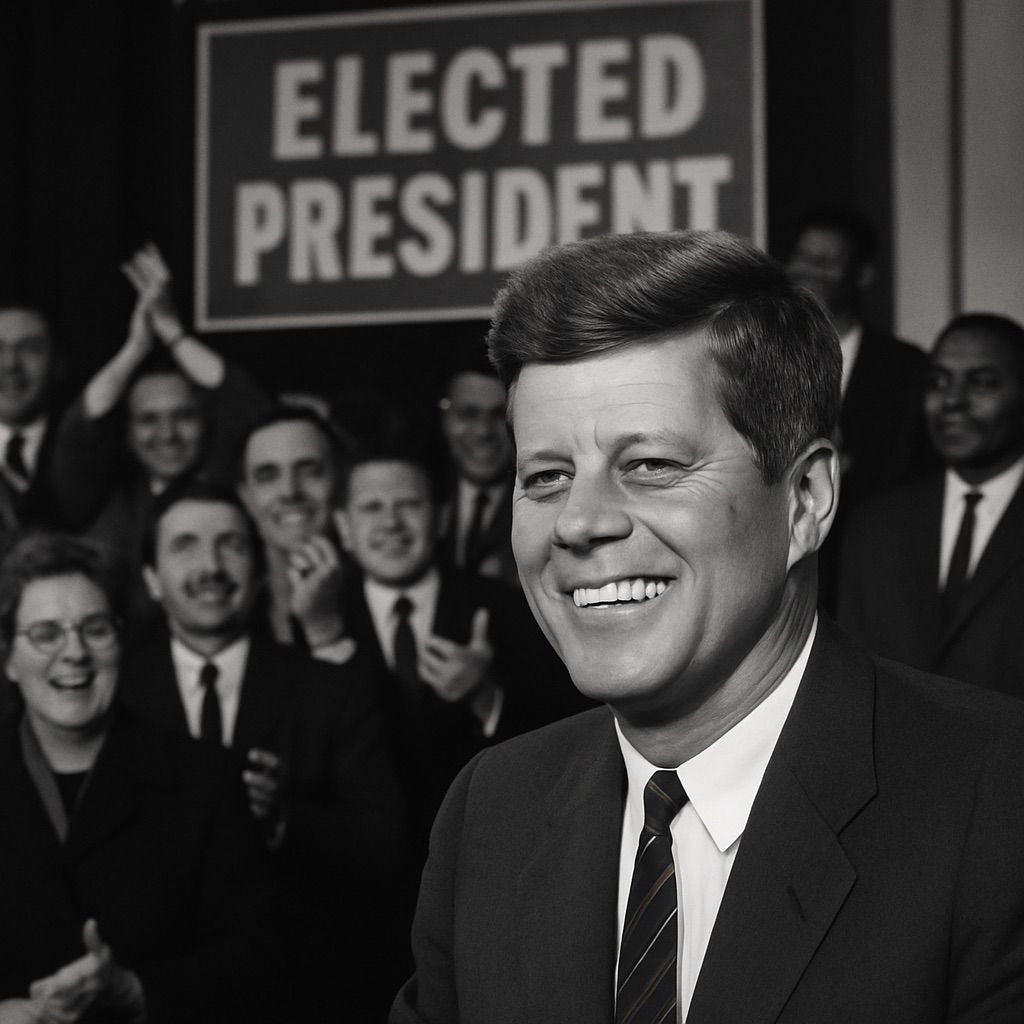
John F. Kennedy’s election was not just a victory for one man or one party. It was a statement of faith—faith in youth, in progress, in the enduring promise of America. In the black-and-white footage of that November night, one can still feel it: the hum of hope, the sense that something extraordinary had just begun. As crowds cheered and the words “ELECTED PRESIDENT” flashed across the television screens, the country seemed to exhale and dream all at once. It was the beginning of a story that would captivate the world—a story of triumph, tragedy, and transformation. Kennedy once said, “We stand today on the edge of a New Frontier… of unknown opportunities and perils.” In electing him, America stepped over that edge, not knowing what lay beyond, but believing that whatever it was, they would face it together.

Related Posts

When Light Revealed the Invisible: Wilhelm Röntgen and the Birth of X-Rays

Elias Rowen

On November 8, 1895, a quiet laboratory at the University of Würzburg became the birthplace of one of humanity’s greatest scientific breakthroughs. That day, Wilhelm Conrad Röntgen discovered X-rays—a form of invisible radiation that would forever change the way we see the world and the human body. In an instant, the opaque became transparent, and medicine, physics, and human understanding would never be the same again.

At the close of the 19th century, physics was on the brink of transformation. Scientists across Europe were enthralled by the mystery of cathode rays, streams of charged particles produced in vacuum tubes when electricity passed through them. Figures such as Heinrich Hertz, Philipp Lenard, and Julius Plücker had experimented with these strange rays, noting their peculiar behavior but failing to fully understand their nature. The stage was set for a revelation that would blur the line between the visible and invisible worlds.

Born on March 27, 1845, in Lennep, Prussia, Wilhelm Conrad Röntgen possessed a natural curiosity that drove him to explore the unknown. His academic path took him from the University of Utrecht to Zurich Polytechnic, where he earned his doctorate. By 1888, he had become a respected professor of physics at the University of Würzburg. Known for his meticulous and methodical approach, Röntgen spent his evenings conducting quiet experiments, often alone, driven more by curiosity than by fame or fortune.

In the fall of 1895, while studying cathode rays using a Crookes tube—an early form of vacuum tube—Röntgen noticed something extraordinary. Nearby, a fluorescent screen coated with barium platinocyanide began to glow, even though it was shielded from direct light. Perplexed, he covered the tube completely and observed that the glow persisted. Something unseen was penetrating the darkness, producing light where none should exist.

He experimented feverishly in the days that followed, testing this mysterious radiation against every material he could find—paper, wood, metal, and even his own hand. To his astonishment, the rays passed through solid objects but revealed the shadows of denser materials. Holding his hand before the screen, he saw the bones within silhouetted like a ghostly photograph. It was a sight both eerie and miraculous—the human skeleton revealed without incision or pain.

Röntgen, ever cautious, named the new phenomenon “X-rays,” using the mathematical symbol for the unknown. He worked in secrecy for weeks, repeating his experiments and documenting his results with careful precision. On November 22, 1895, he produced one of the most iconic images in scientific history: an X-ray of his wife’s hand, showing bones and her wedding ring. When she saw it, she reportedly exclaimed, “I have seen my death!”—a chilling reaction to a discovery that bridged life, science, and mortality itself.

On December 28, 1895, Röntgen published his landmark paper, “Über eine neue Art von Strahlen” (“On a New Kind of Rays”). Within days, his findings electrified the scientific world. Newspapers hailed his discovery as a miracle, while scientists scrambled to replicate his results. In a matter of months, X-rays were being used in hospitals across Europe and America. Surgeons could now see fractures, locate bullets, and diagnose internal injuries—all without a single incision. The modern field of radiology was born almost overnight.

In early 1896, John Hall-Edwards in Birmingham and Walter Konig in Frankfurt became the first physicians to use X-rays for medical diagnosis. For the first time in history, the inside of the human body could be examined without surgery—a development so revolutionary it seemed to border on magic. Patients and doctors alike marveled as the veil of flesh gave way to the clarity of bone.

But Röntgen’s discovery was not limited to medicine. Physicists recognized immediately that X-rays challenged the fundamental understanding of light and matter. The invisible radiation hinted at energies and structures far beyond what classical physics could explain. Within a few years, scientists such as Ernest Rutherford, Marie and Pierre Curie, and Max Planck would build upon this discovery to usher in the atomic age and the birth of quantum theory. Röntgen’s mysterious “unknown rays” had opened a door to the invisible world—and humanity stepped through it into the modern era.

Röntgen’s character was as remarkable as his discovery. He refused to patent X-rays, believing that scientific knowledge belonged to all humanity. When he was awarded the first Nobel Prize in Physics in 1901, he remained humble, donating the entire sum to his university. His dedication to pure science, free from personal ambition, set a standard for integrity that endures to this day.

Beyond his laboratory achievements, Röntgen also stood for progress in the broader sense. He was an advocate for women in science, encouraging their participation in research and mentoring female physicists at a time when academia was still largely closed to them. His quiet support helped open doors for future generations of scientists.

The legacy of Röntgen’s discovery reaches far beyond physics or medicine—it changed how humanity perceives the unseen. X-rays became the foundation for entire branches of technology: CT scans, airport security scanners, industrial imaging, and even astronomy, where X-ray telescopes peer deep into the universe to study black holes and exploding stars. What began as a flickering glow in a small German laboratory became a window into the infinite.

Today, more than a century later, we still live in the shadow of that moment when light revealed the invisible. Röntgen’s discovery stands as a testament to the power of curiosity, patience, and the human drive to understand the unknown. His “X-rays” may have started as an accidental observation, but they became a cornerstone of modern science—a reminder that even the unseen can illuminate the world.

In the annals of history, few discoveries have so profoundly altered human life. Wilhelm Conrad Röntgen’s work not only redefined medicine and physics but also expanded the limits of human perception itself. Through his eyes, the world learned to see within itself—to glimpse the hidden patterns of nature, and in doing so, to better understand what it means to be human.

Related Posts

The Queen Who Shaped an Empire: Elizabeth I and the Dawn of England’s Golden Age

Elias Rowen

The year was 1558, a time of great turmoil and transformation in England. The country had been shaken by years of political and religious upheaval following the short and turbulent reign of King Edward VI, who succumbed to illness at the tender age of fifteen. His death left behind a power vacuum that was soon filled by his half-sister, Mary I. Yet Mary’s own reign proved equally fraught with tension and bloodshed, as she sought to restore Catholicism to a nation that had begun to turn Protestant under Edward’s rule. When Mary died on November 17, 1558, the throne passed to her younger half-sister Elizabeth, then thirty-four years old and Princess of England. Elizabeth’s ascension marked the dawn of a new era—one defined by relative peace, cultural flourishing, and the emergence of England as a major world power.

Elizabeth’s path to the throne had been long, uncertain, and often perilous. Born on September 7, 1533, she was the daughter of King Henry VIII and his second wife, Anne Boleyn. Her early years were overshadowed by tragedy and political intrigue. When she was just two years old, her mother was executed on charges of adultery and treason—an event that deeply affected Elizabeth’s outlook on power, loyalty, and survival. Declared illegitimate and removed from the line of succession, she was nevertheless given a solid education, mastering languages, philosophy, and the arts of rhetoric and statecraft. These skills would later serve her well in navigating the complex and treacherous landscape of Tudor politics.

Following Henry VIII’s death in 1547, Elizabeth’s half-brother Edward VI took the throne and ushered in the “Edwardian Reformation,” a time when Protestantism gained a strong foothold in England. Elizabeth, though raised Protestant, learned early on to temper her beliefs with pragmatism. She skillfully adopted a stance of “Via Media,” or the middle way—avoiding open confrontation with either religious faction and cultivating a reputation for moderation. Her restraint and intelligence helped her survive an age when religious allegiance could mean the difference between power and the scaffold.

The ascension of Mary I in 1553 reversed much of Edward’s Protestant reform and plunged England back into Catholic orthodoxy. As Mary’s half-sister and a Protestant by inclination, Elizabeth found herself in constant danger. Mary’s persecution of Protestants earned her the epithet “Bloody Mary,” and suspicion soon fell on Elizabeth as a potential rallying figure for Protestant opposition. She was briefly imprisoned in the Tower of London on suspicion of treason after being implicated—without evidence—in Wyatt’s Rebellion, a Protestant uprising. The experience was harrowing but formative. Elizabeth emerged from confinement hardened, cautious, and more determined than ever to survive and rule.

When Mary died in 1558 without an heir, the transition of power was smooth, though the nation remained fragile. Elizabeth ascended to the throne with a deep understanding of the dangers of fanaticism and the importance of balance. Her first acts as queen reflected her instinct for conciliation. She issued a proclamation assuring her subjects that she would maintain peace with neighboring nations, including Scotland and France, and she sought to stabilize England internally by restoring confidence in the monarchy. Her speech to Parliament reaffirmed her commitment to the rule of law and the welfare of her people, while carefully invoking divine providence to legitimize her reign.

Elizabeth inherited a kingdom burdened by debt, weakened by years of war, and divided by religious strife. The treasury was nearly empty, the economy unstable, and the people weary of sectarian violence. Yet through her keen intellect and political acumen, Elizabeth began the slow process of restoring national stability. She surrounded herself with capable advisors, most notably William Cecil (later Lord Burghley), whose prudent counsel and administrative skill proved invaluable. Together, they enacted careful fiscal reforms, curbed government waste, and restored the value of England’s currency. These measures helped rebuild public confidence and laid the groundwork for economic recovery.

In matters of religion, Elizabeth adopted a moderate course that would come to define her reign. Her “Elizabethan Religious Settlement,” enacted in 1559, established the Church of England as a Protestant institution while retaining elements of Catholic tradition to appease conservative subjects. This pragmatic compromise helped prevent further civil unrest and ensured a degree of religious peace unprecedented in Tudor England. Her personal motto, Video et taceo (“I see and say nothing”), perfectly captured her approach—watchful, deliberate, and cautious in action.

Elizabeth’s foreign policy was equally shrewd. Recognizing that England lacked the resources to engage in costly continental wars, she pursued a policy of cautious diplomacy. Rather than aligning fully with either Catholic Spain or Protestant German states, she maintained England’s neutrality, strengthening trade ties and focusing on domestic stability. Her willingness to engage with both sides of Europe’s religious divide showcased her skill as a strategist who understood that peace was often more powerful than war.

As England regained its footing, a cultural renaissance began to blossom under Elizabeth’s patronage. Her court became a beacon of sophistication and creativity, attracting poets, musicians, philosophers, and scholars from across Europe. The arts flourished, producing an outpouring of literary and theatrical brilliance that would define an age. Figures such as William Shakespeare, Christopher Marlowe, Edmund Spenser, and Sir Philip Sidney found in Elizabeth’s England an environment ripe for innovation and expression. The queen herself was an educated woman who delighted in music, poetry, and learning, and her encouragement of the arts helped shape English identity and culture for centuries to come.

Elizabeth’s reign also witnessed the dawn of England’s maritime and imperial ambitions. Inspired by the exploits of explorers like Sir Francis Drake, Sir Walter Raleigh, and Martin Frobisher, England began to look outward toward new worlds and new opportunities. Naval expeditions laid the foundation for England’s later global empire, while privateers brought wealth and prestige back to the crown. This expansion of maritime power would prove crucial in establishing England’s dominance at sea.

One of the most defining moments of Elizabeth’s reign came in 1588, when the Spanish Armada set sail to invade England. King Philip II of Spain, once Elizabeth’s suitor and later her bitter enemy, sought to overthrow the Protestant queen and restore Catholic rule. Against overwhelming odds, the English navy, bolstered by clever tactics and favorable winds, defeated the mighty Armada. The victory was not only a military triumph but also a symbolic one—it solidified England’s independence, boosted national pride, and marked the beginning of its rise as a formidable naval power. For Elizabeth, it was the crowning moment of her reign, forever immortalizing her in the hearts of her subjects as the monarch who stood firm in defense of her realm.

The queen’s leadership during this crisis revealed her greatest strength: her ability to inspire unity through words and presence. Her famous speech at Tilbury, delivered to her troops as they prepared to repel the invasion, remains one of the most stirring declarations in English history. “I know I have the body of a weak and feeble woman,” she declared, “but I have the heart and stomach of a king, and of a king of England too.” These words embodied her reign—a delicate balance of grace and authority, femininity and power.

Yet Elizabeth’s long rule was not without internal challenges. Chief among them was the threat posed by her cousin, Mary, Queen of Scots. A devout Catholic with a legitimate claim to the English throne, Mary became the focal point of numerous plots against Elizabeth. For nearly two decades, Elizabeth wrestled with the dilemma of how to deal with her imprisoned cousin. Though reluctant to execute an anointed monarch, she ultimately sanctioned Mary’s death in 1587 after evidence emerged linking her to the Babington Plot—a conspiracy to assassinate Elizabeth and place Mary on the throne. The execution was a grim necessity, one that eliminated a persistent threat but haunted Elizabeth for the rest of her life.

Despite these trials, Elizabeth’s reign was marked by an extraordinary ability to maintain stability in an age defined by uncertainty. Her combination of intelligence, charisma, and restraint earned her the loyalty of her people and the admiration of foreign observers. She proved adept at managing her image, cultivating the persona of the “Virgin Queen”—a ruler married only to her nation. This image not only reinforced her authority in a patriarchal society but also transformed her into a symbol of national unity and purity. Through calculated pageantry and symbolism, Elizabeth turned monarchy into art, elevating herself into a near-mythic figure in English consciousness.

As the years passed, however, the burdens of rule grew heavier. England’s economy faced renewed strain, and court factions began to compete for influence as the aging queen refused to name a successor. Elizabeth’s once-vibrant court grew somber as many of her closest advisors and friends, including Robert Dudley, Earl of Leicester, and William Cecil, passed away. The queen herself became increasingly withdrawn, haunted by memories of those she had lost and the weight of decisions made in the name of sovereignty. Her final years were marked by melancholy and introspection, yet she remained steadfast in her devotion to her people and her crown.

Elizabeth I died on March 24, 1603, at the age of sixty-nine, after more than forty-four years on the throne. With her passing ended the Tudor dynasty, and her cousin James VI of Scotland ascended as James I of England, uniting the two crowns. Her death marked the close of one of the most remarkable reigns in English history, yet her legacy endured, shaping the identity of a nation for centuries to come.

Elizabeth’s reign transformed England from a fractured and uncertain realm into a confident and flourishing power. Her policies brought stability after decades of religious conflict, her diplomacy secured England’s place in the European order, and her patronage of the arts ushered in a golden age of creativity that defined the English Renaissance. More than a monarch, she was a stateswoman, a strategist, and a symbol of endurance in an age of turmoil. Her ability to balance strength with grace, and caution with vision, remains a model of effective leadership even today.

Her legacy continues to resonate across time. The Elizabethan era laid the foundation for England’s later expansion into a global empire and set in motion cultural and political developments that would define the modern world. In her life and reign, Elizabeth I embodied the essence of the Renaissance—curious, courageous, and endlessly complex. She was the queen who saw England through danger to greatness, leaving behind a legacy of brilliance, resilience, and transformation that endures to this day.

Related Posts

The Elephant Takes the Stage: GOP’s Iconic Rise

Elias Rowen

In the grand theater of American politics, symbols often speak louder than words. They distill ideology, evoke emotion, and crystallize the identity of an entire movement into a single, unforgettable image. Among these enduring emblems, none has stood taller or longer than the Republican elephant — a creature both mighty and gentle, commanding yet dignified, representing strength, perseverance, and resolve. Its rise from the pages of 19th-century satire to the forefront of national consciousness tells not only the story of a political party but also the evolution of American democracy itself.

To understand the elephant’s origin as the symbol of the Republican Party, we must travel back to the uncertain days following the Civil War, when the nation was struggling to heal from its deepest wounds. The Republican Party — barely two decades old — had been forged in the fires of abolitionism and Union preservation. It was the party of Abraham Lincoln, the party that had fought to end slavery and preserve the Union, and now it faced a new test: how to rebuild a fractured nation during the tumultuous years of Reconstruction.

The United States of the 1870s was a place of both hope and hardship. Freedmen were seeking equality, the South was undergoing profound transformation, and the political landscape was as volatile as ever. Within the Republican Party itself, divisions ran deep. Radicals demanded sweeping reforms and federal protection for newly freed African Americans, while moderates sought reconciliation with the South. Meanwhile, the nation’s economy teetered under the weight of debt, corruption scandals, and disillusionment. The Democratic opposition exploited these tensions skillfully, seeking to discredit the Republican establishment that had dominated Washington since Lincoln’s day.

Into this maelstrom stepped Thomas Nast — a German-born illustrator whose pen could sting as sharply as any politician’s rhetoric. Nast, who had fled the turbulence of Europe as a child, brought with him an outsider’s perspective and a passion for justice. By the time he joined Harper’s Weekly, he had already earned fame as a fierce critic of political corruption, most notably through his brutal caricatures of New York’s Tammany Hall boss, William “Boss” Tweed. Nast’s art was not just illustration; it was activism. Through ink and imagination, he shaped the moral consciousness of an entire generation.

It was in Nast’s satirical genius that the Republican Party found its most enduring icon. On November 7, 1874, Harper’s Weekly published one of his most famous political cartoons, “The Third-Term Panic.” In it, Nast depicted a frightened elephant labeled “The Republican Vote” teetering on the brink of a pit labeled “Chaos.” Around it prowled other political beasts — the Democratic donkey among them — adding to the scene’s sense of confusion and peril. Though the cartoon was not meant to glorify the elephant, the image resonated deeply. To readers across the country, the elephant embodied power, dignity, and reliability — qualities the party desperately needed to project amid growing uncertainty.

Thus was born the Republican elephant. In Nast’s hand, it became more than a creature of satire; it became a symbol of stability in a political era marked by upheaval. The elephant’s massive size suggested might, its intelligence suggested prudence, and its slow, deliberate gait suggested dependability — a counterpoint to the braying donkey that represented the Democrats. It was a stroke of visual genius that would outlive its creator and define a political identity for generations.

Why the elephant? Theories abound. Some historians believe Nast chose it because of the animal’s associations with wisdom and strength in ancient cultures. In India and Africa, elephants had long been revered as symbols of endurance and guardianship. Others point to the animal’s temperament — gentle yet unstoppable when provoked — as a metaphor for the Republican ideal of restrained power. Whatever the reason, Nast’s creation stuck. Almost overnight, the elephant became part of the American political lexicon.

As the decades rolled on, the elephant evolved alongside the party it represented. In the late 19th century, during the Gilded Age, the elephant was often depicted in lavish illustrations that emphasized the prosperity and industrial might of Republican-led America. It appeared on campaign posters, parade floats, and political buttons, always standing firm as a guardian of progress and national unity. For working-class voters, it represented economic opportunity; for business leaders, stability and strength.

By the 1920s, the Republican elephant had become an undisputed fixture of political life. Artists stylized it into a noble, almost heraldic creature, draped in stars and stripes. When World War II erupted, the elephant took on a more patriotic bearing, symbolizing strength and resilience on the home front. In the postwar era, as America emerged as a global superpower, the elephant’s image became synonymous with conservative values — faith, family, free enterprise, and national pride.

But as the Republican Party changed, so too did its elephant. The party of Abraham Lincoln, once synonymous with progress and emancipation, gradually evolved into a coalition of free-market conservatives, suburban voters, and southern populists. Through every shift — the Progressive Era, the Great Depression, the Cold War, and beyond — the elephant remained constant, even as the ideals it stood for were reinterpreted by each generation.

The power of Nast’s creation lies not just in its artistry but in its adaptability. The elephant has been both a rallying banner and a mirror, reflecting the party’s triumphs and contradictions. It has stood for fiscal conservatism under Calvin Coolidge, moral revivalism under Ronald Reagan, and populist nationalism in the modern era. Its endurance speaks to something deeper in the American psyche — the longing for strength tempered by steadiness, tradition balanced with perseverance.

It’s worth noting that Nast’s elephant did not rise alone. His Democratic donkey, born a few years earlier, offered an equally compelling counterpart. The two creatures, locked in perpetual symbolic struggle, came to embody the essence of America’s two-party system. Together they told a visual story of opposition and balance — of competing visions for the same nation. And though Nast himself could never have predicted their longevity, his cartoons gave the United States a political shorthand that remains as potent today as it was in the 19th century.

As mass media evolved, the elephant continued to adapt. By the mid-20th century, it appeared not only in newspapers but also on television, campaign advertisements, and, later, digital platforms. Politicians embraced the iconography with enthusiasm — the elephant featured on podiums, lapel pins, and websites. It came to represent unity within diversity, a reminder that the party’s strength lay in its collective spirit, even when its members disagreed. In this sense, “The Elephant” became more than just a symbol of one party — it became a metaphor for the endurance of American democracy itself.

Today, the Republican elephant stands as a paradox — both an emblem of tradition and a canvas for reinvention. It represents the party’s core ideals of limited government, individual liberty, and national strength, yet its meaning continues to evolve as the country does. Each election season, it reemerges on banners and broadcasts, reminding voters of a lineage that stretches back to the era of Lincoln and Nast. For some, it evokes nostalgia for a simpler political age; for others, it is a call to reclaim the party’s moral compass in a rapidly changing world.

Ultimately, the story of the GOP’s elephant is the story of America itself — a nation forever balancing continuity with change, power with restraint, and vision with realism. Its very survival through wars, depressions, and cultural revolutions speaks to the enduring power of imagery to unite, inspire, and provoke. From Nast’s pen in 1874 to digital memes on the modern campaign trail, the elephant has lumbered through history with unshakable poise, carrying the hopes, contradictions, and ambitions of a party — and a people — upon its back.

In an age of fleeting trends and fractured attention, it is remarkable that one creature — drawn in ink nearly 150 years ago — still commands such recognition. The elephant reminds us that symbols matter, that art can move nations, and that sometimes, the simplest image can capture the deepest truths. Thomas Nast’s creation was more than a political statement; it was a testament to the enduring connection between imagination and identity. The elephant endures because, like the American experiment itself, it is both grounded and grand — a living reminder that strength and wisdom, though heavy burdens, are worth carrying forward.

Related Posts

Marie Curie Makes History: First Female Physics Nobel Laureate

Elias Rowen

In the waning years of the nineteenth century, as the world teetered on the edge of a new scientific age, a woman quietly changed the course of human knowledge forever. Her name was Marie Curie, born Maria Skłodowska in Warsaw, Poland, in 1867. Her journey was not only one of discovery but also of resilience, brilliance, and the relentless pursuit of truth in a world that often told her she did not belong. Her legacy would illuminate the hidden forces of nature — quite literally — as she brought the mysterious phenomenon of radioactivity to light and became the first woman to win a Nobel Prize.

From a young age, Marie was drawn to learning like a moth to a flame. Her father, Władysław Skłodowski, a physics and mathematics teacher, nurtured her curiosity with the few instruments he had managed to save from the school laboratory after the Russian authorities confiscated Polish educational materials. Her mother’s untimely death and the political oppression under Tsarist rule left the young Maria fiercely independent and deeply committed to knowledge as both escape and empowerment. But as a woman in 19th-century Poland, her opportunities were limited — universities were closed to women. Undeterred, she joined the clandestine “Flying University,” an underground network of intellectuals teaching science and philosophy to women who were barred from higher learning.

In 1891, she made a life-altering decision. With little money but boundless resolve, Maria moved to Paris to study at the Sorbonne. Life was brutally difficult — she lived in a tiny garret room, often going hungry and studying by candlelight in the freezing cold. But her passion burned brighter than her discomfort. It was there that Maria became Marie, and her destiny intertwined with that of another brilliant mind: Pierre Curie, a quiet, introspective physicist whose curiosity about magnetism matched her own about the unseen forces of the universe. The two were kindred spirits, bound by intellect and love. They married in 1895, and together began a partnership that would redefine science.

Their union was not one of social prestige or wealth — it was a meeting of minds devoted to discovery. In 1896, inspired by Henri Becquerel’s findings on uranium’s strange emissions, the Curies began investigating the nature of this mysterious energy. Working in a damp, makeshift shed with little more than cast-off laboratory equipment, they embarked on an exhausting search to isolate the sources of radioactivity from tons of pitchblende ore. Marie meticulously ground and dissolved the mineral, distilled and precipitated its components, and observed the faint, ghostly glows emitted from certain residues. Her perseverance paid off — in 1898 she discovered two new elements, which she named polonium (after her beloved Poland) and radium. It was an astonishing achievement: the invisible world within atoms had been revealed.

For years, Marie and Pierre toiled in grueling conditions. Their work demanded physical endurance as much as intellectual brilliance. They stirred boiling vats of chemicals for hours, surrounded by toxic fumes, often unaware of the invisible danger they faced from radiation exposure. Yet despite the hardship, their passion never wavered. The discovery of radium, with its ethereal blue glow and immense power, captivated the imagination of the world. Newspapers marveled at the “woman scientist” who had unlocked nature’s most hidden secret.

In 1903, Marie and Pierre Curie, along with Becquerel, were awarded the Nobel Prize in Physics for their research on radioactivity — a term Marie herself had coined. At first, the Nobel Committee considered omitting her name, believing that only Pierre deserved the honor. But Pierre refused to accept the award unless Marie was recognized as an equal contributor. It was a historic moment — Marie Curie became the first woman ever to receive a Nobel Prize. Her triumph was not just personal; it was symbolic of every woman who had been denied her rightful place in the halls of science.

Tragically, their partnership was cut short. In 1906, Pierre was struck and killed by a horse-drawn carriage in Paris. The loss was devastating. For months, Marie was inconsolable, but she soon turned her grief into strength. She took over Pierre’s professorship at the Sorbonne, becoming the first female professor in its history. Standing before her students, she continued their work — driven not by ambition, but by a profound sense of duty to knowledge and to Pierre’s memory.

Her research into radioactivity deepened. She purified radium to its purest form, studied its effects on living tissue, and laid the groundwork for future applications in medicine. Her second Nobel Prize — this time in Chemistry, awarded in 1911 — recognized her isolation of pure radium and her pioneering work in understanding its properties. She became the first person, man or woman, ever to receive two Nobel Prizes in different fields. But fame brought both admiration and scrutiny. When she later developed a friendship with the physicist Paul Langevin, the press launched a smear campaign against her, portraying her as a scandalous woman. Through it all, Marie refused to be silenced. “Nothing in life is to be feared,” she wrote, “it is only to be understood.”

When World War I erupted, Marie once again put science in service of humanity. She developed mobile X-ray units, affectionately called “Little Curies,” which she personally drove to the front lines to help surgeons locate bullets and shrapnel in wounded soldiers. Her tireless efforts saved countless lives and earned her immense respect across Europe. After the war, she continued advocating for science and education, establishing the Radium Institute in Paris and later one in Warsaw — institutions that remain leading centers for cancer research to this day.

But her life was not without cost. Years of unshielded exposure to radiation slowly took their toll. In 1934, Marie Curie died of aplastic anemia, likely caused by her long exposure to radioactive materials. Even in death, her notebooks remained radioactive — a haunting testament to her sacrifice for science.

Her influence, however, lives on in every hospital that uses radiation to diagnose and treat disease, in every classroom that teaches her discoveries, and in every scientist who dares to challenge convention. She blazed a path for generations of women who would follow her into the laboratories of the world. The unit “curie,” used to measure radioactivity, immortalizes her name — but her true legacy is the light she brought into the darkness of the unknown.

Marie Curie’s story is one of defiance and devotion, of intellect and humility. She once said, “I was taught that the way of progress is neither swift nor easy.” Her life embodied that truth. From her humble beginnings in Warsaw to her laboratory in Paris, she shattered barriers not only of gender but of human understanding itself. She did not seek fame or fortune — only truth — and in doing so, she illuminated the invisible threads that bind the universe together.

Her spirit endures not just in her scientific contributions, but in the example she set for all who dream beyond the boundaries imposed upon them. She proved that genius knows no gender, that persistence can overcome prejudice, and that knowledge, when pursued with purity of heart, can change the world. In the quiet hum of modern laboratories and the glowing screens of hospital imaging machines, her legacy still whispers — the voice of a woman who dared to see the unseen.

Related Posts

The Turn of a Nation’s Tide: How Abraham Lincoln Became President and Shaped America

Elias Rowen

On November 6, 1860, a tall, thoughtful man from Illinois named Abraham Lincoln emerged from relative political obscurity and stepped into the role of the 16th President of the United States. His election marked not simply the rise of one man, but the turning point of a deeply divided nation. In that moment, everything changed. From the muddy politics of the 1850s to the charged passions of the Civil War, Lincoln’s victory was at once a triumph of his own strategy and a mapping of America’s future course. His win was forged in sectional tension, propelled by party realignment, and nudged the country toward war even as it hoped for unity. The story of how he was elected, and what that election meant, deserves the kind of sweeping narrative that reveals character, conflict, and consequence.

In the years preceding 1860, America was already standing on a fault line. The question of slavery’s expansion into new territories, the tension between free and slave states, and the rising agitation for abolition created a volatile political atmosphere. The great compromises of earlier decades were fraying. The Dred Scott decision had held that Congress could not prohibit slavery in the territories, effectively reopening the question of slavery’s national reach and intensifying the divide between North and South. The dominant Democratic Party, once a national institution capable of holding the Union together, began to splinter. Southern Democrats were unwilling to compromise over slavery; Northern Democrats sought moderation; and a new party—the Republican Party—was rising, grounded in the opposition to slavery’s expansion.

Lincoln himself, before 1860, had become known through his 1858 campaign for the U.S. Senate from Illinois, where his debates with Stephen A. Douglas illuminated the moral and political depths of the slavery question. Although he lost that contest, it established his national reputation: a moderate voice with firm principles, a man whose eloquence and clarity drew attention. By the time the Republican nomination came around, Lincoln was ready. At the 1860 Republican convention, he emerged as the nominee amid several strong contenders, including the well-known William H. Seward of New York. In part through shrewd maneuvering and coalition-building, Lincoln secured the nomination.

The election that followed was anything but simple. It was held on November 6, 1860. Instead of a traditional two-way contest, four major candidates competed: Lincoln for the Republicans; Douglas for the Northern Democrats; John C. Breckinridge for the Southern Democrats; and John Bell for the Constitutional Union Party, which sought to maintain the Union above all else. The split among the Democrats—and the emergence of a fourth-party candidacy—was itself a sign of the era’s fracture.

Lincoln’s platform was carefully calibrated. Though personally opposed to the expansion of slavery into the territories, he pledged not to interfere with slavery where it already existed in the South. This nuanced position allowed him to appeal to Northern voters uneasy about slavery’s expansion and to moderate Republicans who feared an abrupt abolitionist posture. Meanwhile, in many Southern states Republicans were barely active—some states didn’t even put Lincoln’s name on the ballot.

The results were striking. Lincoln received about 39.8 percent of the popular vote, yet won 180 electoral votes—enough to carry the presidency. Breckinridge captured 72 electoral votes, Bell got 39, and Douglas only 12. Crucially, all of Lincoln’s electoral support came from Northern free states; he won no electoral votes from the deep South. The electoral map essentially mirrored sectional lines: the North behind Lincoln; the South behind Breckinridge; Bell and Douglas doing well in border or compromise-regions. The pattern revealed the nation’s deepening divide.

What made this election so consequential wasn’t just that Lincoln won. It was how he won, and what the win immediately foreshadowed. The fact that a man with less than 40 percent of the popular vote—and none of the Southern electoral votes—could nonetheless become president underscored the fragmentation of the Union. When Lincoln’s victory became evident, the announcement itself triggered a political avalanche. Within weeks, seven Southern states declared they would secede from the Union—states whose leaders saw Lincoln’s election as a threat to the institution of slavery and their social order. In effect, the election lit the fuse of the Civil War.

To understand the human dimension of this moment, imagine the scene in Springfield, Illinois. Lincoln, after the polls closed, awaited the result not in Washington but at home. He perhaps sensed the magnitude of what was coming—but even he could not entirely foresee the storm. The newspapers buzzed; the South seethed; the North cheered. Many Southerners had counted on the Democrats remaining unified and expected that a split would preserve slavery’s expansion and the Union. Instead, they were shaken when their projection failed and the new administration came in. The election that began as a political contest ended as a historic inflection point.

Once elected, Lincoln faced the immediate challenge of holding together a Union that was fracturing. By the time he was inaugurated on March 4, 1861, six or seven states had seceded and formed the Confederacy. Lincoln’s address and early presidency were defined by the urgent need to preserve the Union—and later to free the slaves.

Beyond the immediate drama, Lincoln’s election stands as a milestone in American political history. It marked the first time the relatively young Republican Party took the presidency. It signaled a realignment of the parties: the old Whigs were gone, the Democrats were divided, and sectional loyalties increasingly defined electoral politics. The election also underscored the limits of popular vote as an indicator of national consensus. That Lincoln, with less than 40 percent of the popular vote and zero electoral support from the South, was still able to rise to power tells us how fractured the electorate had become.

Why should we care about this now, more than 160 years later? Because the 1860 election teaches us about the fragility of democratic systems when divided along deep fault lines. It reminds us that elections are not simply contests of personalities but of ideas, institutions, and identities. It shows that a society which cannot find a common denominator may fracture. Lincoln’s own ascent is a story of moral clarity combined with strategic caution; he did not cast himself as a radical abolitionist at first, but he held the moral line. That balancing act made his victory possible—and made his presidency transformational.

In the months and years that followed his election, the ripples grew: war, emancipation, national redefinition. Yet the seeds of all that were planted in the autumn of 1860. One could argue that the nation as much chose Lincoln as the moment forced him into leadership. As he once said, “I have been driven to my knees by the overwhelming conviction that I had nowhere else to go.” His election might have felt like a beginning—but for the country it was also a crossroads.

The personal side of Lincoln matters too. A man of modest upbringing, self-taught in much of his law career, he brought integrity, humility, and a rhetorical gift unmatched. As president he would draw on those qualities to guide the country through its darkest hours. The election put in motion a sequence of challenging decisions: how to prosecute a war, how to preserve a union, how to deal with slavery, how to define freedom. None of those could have been foreseen fully in 1860—but his election made them inevitable.

The 1860 election also reveals the limits of compromise in a deeply polarized society. The Constitutional Union Party, with John Bell as its nominee, offered a simpler message: keep the Union, avoid the slavery debate, and preserve the status quo. Yet that message failed to galvanize enough voters. The Northern Republicans had momentum. The Southern Democrats were dividing. The Americans were choosing which path to take. Lincoln’s victory was less a triumph of radicalism than a victory of organization, message discipline, and timing.

It’s also worth reflecting on how the electoral process itself shaped the outcome. With the Electoral College and the pattern of states carrying their ballots, it is entirely possible for a candidate to win the presidency without a majority of the popular vote. Lincoln’s victory illustrates that dynamic. The Electoral College, when coupled with regional divides, can amplify victories and create outcomes seemingly incongruous with majority rule. This structural fact mattered then—and still matters today in discussions of democracy and representation.

Ultimately, Lincoln’s election is part of the broader American narrative of democratic renewal, crisis, and transformation. His presidency would carry him through civil war, emancipation, and assassination, but the starting point was this election. Without Lincoln’s victory, the path the United States took might have been radically different: perhaps slavery might have expanded further, perhaps the Union might have collapsed, perhaps the shape of America today might look unrecognizable.

In closing, the election of Abraham Lincoln as President of the United States was more than a political victory—it was a pivot of history. It revealed the deep divisions in the nation, tested the resilience of democracy, and set the stage for a transformation of American identity. When Lincoln stood to take the oath of office in March 1861, he did so already in a country at war—yet he did so because the American people had, through their vote, signaled that the future must change. History would show how momentous that choice was.

Here’s to remembering how one election can redefine a nation, how one man’s ascent can carry the weight of a country’s crisis, and how the courage to lead may follow the courage to believe.

Related Posts

Germany’s First Jet Takes Off, Catapulting Aviation into Tomorrow

Elias Rowen

The dawn of a new era in aviation arrived on August 27, 1939, when the first jet aircraft took to the skies above Germany. This moment was not the result of chance or haste, but the culmination of years of imagination, persistence, and scientific ingenuity. Led by visionary engineer Hans von Ohain, a small team of pioneers achieved what had once seemed impossible—propelling humanity into the jet age and changing the future of flight forever.

In the early 1930s, jet propulsion was little more than a theoretical curiosity. The physics were known, but the engineering remained elusive. Conventional aircraft depended on propellers, which had reached their practical limits. Von Ohain, fascinated by the idea of harnessing continuous combustion to drive a turbine, began experimenting privately. His early prototypes captured the attention of aircraft manufacturer Ernst Heinkel, who immediately recognized the revolutionary potential of von Ohain’s work. Together, they embarked on a project that would redefine aviation.

Von Ohain assembled a brilliant team that included aerodynamicist Max Kramer, engine designer Siegfried Günter, and mechanic Walter Böving. Their shared vision faced immense challenges—chief among them, the problem of stabilizing combustion in a jet engine and finding materials that could withstand the extreme heat and stress. But through trial, failure, and sheer perseverance, they refined their design until it finally reached a workable form. By the summer of 1939, they stood on the brink of a breakthrough that would change the world.

The aircraft they created, the Heinkel He 178, was a compact, single-seat monoplane powered by von Ohain’s innovative HeS 3B turbojet engine, capable of producing about 700 pounds of thrust. Its design was elegant and futuristic, with a streamlined fuselage and swept wings that hinted at the future of aeronautics. On the morning of August 27th, at the German Experimental Station in Rostock-Marienehe, preparations began for its first flight.

Test pilot Captain Erich Warsitz, one of the most experienced aviators of the day, was chosen to take the He 178 into the air. The world held its breath as the silver aircraft taxied down the runway, its jet engine emitting a steady, high-pitched whine unlike anything heard before. As Warsitz opened the throttle, the He 178 surged forward—not with the rhythmic pulsing of pistons, but with the continuous thrust of pure jet power. Moments later, it lifted gracefully off the ground, leaving behind the era of propellers forever.

The flight lasted less than two minutes, but its impact would echo across generations. For the first time, humanity had witnessed the unleashed power of a jet engine—an innovation that would propel aircraft to speeds and altitudes previously unimaginable. When Warsitz landed, the small crowd of engineers and observers erupted in celebration. Von Ohain’s dream had taken flight.

Although the flight was a technical triumph, it passed largely unnoticed by the world at large. Germany’s government kept the project secret as war loomed on the horizon, and the outbreak of World War II just days later overshadowed the event entirely. Yet within the hangars and laboratories of aviation engineers, the significance of that short flight was immediately understood. The He 178 had proven that jet propulsion was not just possible—it was the future.

In the months that followed, Heinkel and von Ohain refined their designs, while other engineers around the world began racing to develop their own versions. In Britain, Frank Whittle had been working independently on similar concepts, and soon the British Gloster E.28/39 would take flight as well. The competition between these parallel programs marked the beginning of an arms and technology race that would define much of the twentieth century.

The jet engine’s advantages were profound. It offered higher speeds, greater efficiency at altitude, and reduced mechanical complexity compared to piston engines. These innovations would soon revolutionize not only military aviation but also commercial flight. What began as an experiment in a German workshop would, within a decade, evolve into aircraft capable of crossing oceans in hours rather than days.

The He 178 was not without flaws—it was underpowered, had a limited range, and its engine components suffered from overheating. Yet it represented an unshakable proof of concept. Von Ohain and his team had demonstrated that continuous combustion and turbine propulsion could work in a real aircraft, opening the door for generations of engineers to refine and expand upon their design.

The implications extended far beyond aviation. The principles of gas turbine technology would later power electrical generators, naval vessels, and spacecraft. The innovations born in that small German test hangar would become foundational to modern industry and transportation.

The jet age also transformed the global balance of power. Nations quickly realized the military potential of jet aircraft, pouring resources into research and development. What began as an engineering dream became a strategic imperative. In the years following World War II, jet fighters, bombers, and eventually commercial airliners would dominate the skies, forever changing warfare, commerce, and the human experience of distance.

The He 178’s success also embodied a deeper truth about innovation—it is rarely the product of one mind alone. Von Ohain’s brilliance was complemented by the practical expertise of his team, the industrial support of Heinkel, and the courage of test pilots who risked their lives for discovery. Their collaboration reminds us that progress arises from a shared belief in what could be, not merely what is.

Decades later, the He 178 remains a symbol of bold thinking and creative engineering. Though only a few photographs and test reports survive, its influence endures in every modern jet aircraft. Every contrail that streaks across the sky traces its lineage back to that August afternoon in 1939 when humanity took its first true leap into the future.

As we look back on the birth of the jet age, the He 178’s flight stands as a testament to perseverance, vision, and courage. It showed that even on the eve of global conflict, human ingenuity could find a way to transcend boundaries and redefine what was possible. The world that emerged from that moment would be faster, smaller, and forever changed. The sound of jet engines that now fills our skies began as a whisper of possibility—and became the roar of progress.

Related Posts

The Storming of the Winter Palace and the Birth of Soviet Power

Elias Rowen

On October 25, 1917, the icy winds of revolution swept through Petrograd as armed Bolshevik forces stormed the Winter Palace—a single night that would alter the course of modern history. Under the leadership of Vladimir Lenin, the Bolsheviks had spent months preparing for this decisive strike. Yet it was only on the eve of October 25 that final orders were given. By the early hours of the following morning, Red Guards and sailors—many of them hardened by years of war and disillusionment—assembled outside the Winter Palace, rifles gleaming in the dim light of dawn.

The Winter Palace, standing majestically along the Neva River, had long been the beating heart of imperial Russia. Its gilded halls and crystal chandeliers were once the domain of the Tsar and his court, symbols of a dynasty that had ruled for over three centuries. But now, as the first shots echoed through the streets, this monument of autocracy had become the last bastion of a fading order. The February Revolution earlier that year had already brought an end to Tsar Nicholas II’s reign, but the Provisional Government that replaced him was weak and fractured. It struggled to hold together a nation exhausted by war, poverty, and hunger. By the fall of 1917, Russia teetered on the brink of collapse—and the Bolsheviks were ready to seize their moment.

As the Bolsheviks approached the palace, confusion and fear spread among the defenders. Inside, remnants of the Imperial Guard—made up of loyal aristocrats, officers, and cadets—waited anxiously. Though they had vowed to defend the Provisional Government “to the death,” their numbers were pitiful compared to the thousands of Bolshevik troops converging on the square. The Red Guards were joined by revolutionary soldiers and sailors from the Kronstadt naval base, men who had pledged allegiance to Lenin and his promise of “Peace, Land, and Bread.” The arrival of these sailors proved decisive. Their discipline, numbers, and fierce revolutionary zeal tipped the balance completely.

By midnight, the palace was surrounded. The cruiser Aurora, anchored in the Neva, fired a blank shell—a signal to begin the assault. Red Guards stormed the gates, clashing with scattered pockets of loyalist resistance. The once-mighty symbol of Romanov power echoed with the chaos of revolution—boots pounding marble floors, gunfire reverberating through gilded halls, and shouts of triumph mingling with the cries of the defeated. Within hours, the palace fell.

Inside, a handful of ministers from the Provisional Government, including Alexander Kerensky’s subordinates, had gathered in desperation. Their leader, Kerensky himself, had already fled the city in search of reinforcements that would never arrive. Those who remained—men like Alexander Guchkov and Pavel Milyukov—were quickly taken prisoner. Later, one witness described the scene as “a collapse of all that had seemed eternal.” The palace’s grand ballrooms, once filled with nobles and music, now echoed with the chants of revolutionaries brandishing red flags.

The storming of the Winter Palace was not the bloody cataclysm often imagined in myth and propaganda—it was, in truth, swift and relatively contained. Yet its symbolic power was immense. With the fall of the Provisional Government, Lenin’s Bolsheviks took control of Petrograd and, within days, the entire nation. Standing before the Second Congress of Soviets, Lenin declared, “We shall now proceed to construct the socialist order.” It was the birth of Soviet power—and the beginning of an era that would shape the twentieth century.

In the weeks that followed, Lenin and his followers moved rapidly to consolidate their authority. They dissolved the remnants of the old government, nationalized land and industry, and established the Council of People’s Commissars, with Lenin as chairman. The Bolsheviks promised to withdraw Russia from the First World War—a deeply unpopular conflict that had drained the country’s resources and morale. Within months, they negotiated the Treaty of Brest-Litovsk with Germany, ending Russia’s participation in the war but at a heavy territorial cost.

At the same time, the Bolsheviks turned their focus inward. To secure their grip on power, they founded the Cheka—the Soviet secret police—under the leadership of Felix Dzerzhinsky. Its mission was simple: eliminate counterrevolutionary threats. The Cheka’s methods were brutal and swift, giving rise to what would soon be known as the Red Terror. Across the vast expanse of Russia, political opponents, suspected spies, and dissenters were arrested, imprisoned, or executed. Entire classes—the clergy, landowners, and bourgeoisie—became targets of revolutionary vengeance. What had begun as a movement for liberation quickly hardened into a machinery of repression.

The revolution’s initial euphoria gave way to the grim reality of civil war. Between 1918 and 1922, the country descended into chaos as the Red Army, commanded by Leon Trotsky, fought a brutal conflict against the anti-Bolshevik White forces. Millions perished in the fighting, from famine, disease, and sheer exhaustion. Cities crumbled, villages burned, and the economy collapsed. Yet through it all, Lenin’s government endured, emerging victorious and forging the Soviet Union in 1922—a state born from revolution and baptized in blood.

For Lenin and his followers, the storming of the Winter Palace represented the triumph of the oppressed over the oppressors, the dawn of a new world order built on the ashes of the old. For their enemies, it was the beginning of tyranny and the end of freedom in Russia. Both perspectives hold truth. The October Revolution was not merely a transfer of power—it was a seismic shift in ideology, one that sought to overturn centuries of hierarchy and privilege in favor of an entirely new social structure.

The impact of that night in Petrograd reverberated far beyond Russia’s borders. Monarchies and governments across Europe trembled at the prospect of similar uprisings. Workers’ movements in Germany, Hungary, and beyond drew inspiration from the Bolshevik success, sparking revolts that would shape the interwar years. The Western powers, fearful of communism’s spread, intervened militarily and economically to isolate the fledgling Soviet state. Yet despite foreign invasions, internal strife, and economic ruin, Lenin’s revolution survived—and with it, a new ideology took root.

The storming of the Winter Palace became one of the most mythologized events in modern history. Soviet propaganda would later transform it into a grand revolutionary epic—retold in paintings, literature, and even the famous 1928 film October by Sergei Eisenstein, which depicted the event as a massive, violent uprising (a dramatization far removed from reality). Still, the myth served its purpose: it gave the Soviet Union a foundational story of triumph and unity, a symbolic moment when the oppressed rose to claim their destiny.

Yet beneath the myth, the true significance of the Winter Palace lies in what it set in motion. The overthrow of the Provisional Government did not simply replace one regime with another—it redefined the political landscape of the world. From the rise of communist movements in China and Cuba to the ideological conflicts of the Cold War, the reverberations of that single night in October 1917 continue to echo through the corridors of history.

The revolution’s leaders—Lenin, Trotsky, and others—believed they were ushering in an age of equality and justice. But in their zeal to reshape society, they also unleashed forces that would claim millions of lives over the decades to come. The Soviet experiment would achieve astonishing feats—industrialization, literacy, scientific achievement—but at a staggering human cost. The ideals born in the Winter Palace would both inspire and haunt the world for generations.

Today, as historians revisit that moment in Petrograd, the storming of the Winter Palace stands as both a warning and a lesson. It reminds us of how swiftly power can shift, how fragile institutions can crumble, and how revolutions—once ignited—often consume their own. It was a night when the old world died and a new one began, for better or worse.

The red banners raised that morning over the Winter Palace heralded not just the dawn of Soviet power but the beginning of a new global age—one defined by ideology, struggle, and the unending pursuit of change. The empire had fallen, and from its ruins rose a vision that would captivate, terrify, and transform the modern world.

Related Posts

Gunpowder Plot Fails, Parliament Survives: Guy Fawkes Loses Bombing Attempt

Elias Rowen

The year 1605 was a tumultuous one in England. The kingdom was still reeling from the recent execution of Mary Queen of Scots on February 8th of that year, and tensions between Catholics and Protestants were running high. Amidst this backdrop of simmering discontent, a group of conspirators hatched a plan to blow up the House of Lords during the State Opening of Parliament, an event typically attended by King James I, his wife Anne, and other prominent members of the government.

The plotters, led by Robert Catesby, a young nobleman with ties to the Catholic underground, had been secretly gathering explosives and planning their attack for months. They had managed to secure a large quantity of gunpowder, which they stored in a cellar beneath the House of Lords, located in Westminster Palace. The plan was to detonate the explosives on November 5th, 1605, when Parliament would be in session, killing not only the king and his entourage but also scores of innocent bystanders.

However, the plot was fraught with risk from the outset. Catesby’s group had recruited a number of sympathizers, including Guy Fawkes, a former soldier who had fought on the side of the Spanish in the Netherlands. Fawkes was tasked with being the point man for the operation, responsible for igniting the fuse that would set off the explosion. His job was to sneak into the cellar beneath the House of Lords and light the fuses connected to the gunpowder.

Fawkes’ role in the plot has become legendary over time, thanks in large part to a series of events that unfolded on the night of November 4th, 1605. According to eyewitness accounts, Fawkes had made several trips into the cellar throughout the day, inspecting the explosives and ensuring they were properly set up for detonation. As night began to fall, he retreated to his lodgings in a nearby house, where he waited anxiously for the signal to ignite the fuses.

Meanwhile, a series of events was unfolding that would ultimately thwart the plotters’ plans. On November 4th, King James I had ordered an emergency meeting with Parliament, which was to convene on the morning of November 5th to discuss matters related to taxation and trade. As a result, the State Opening of Parliament, originally scheduled for November 5th, was postponed until January 1606.

Unbeknownst to Fawkes and his co-conspirators, this last-minute change in plans had significant implications for their operation. Because the House of Lords would not be occupied on November 5th as previously thought, the plotters’ carefully laid plan to blow it up was rendered unnecessary. Furthermore, the decision to postpone the State Opening meant that many prominent members of government, including King James I and his wife Anne, would be absent from Westminster Palace on the day in question.

It is unclear whether Fawkes or his co-conspirators realized the significance of these developments in time. However, as the clock struck midnight on November 5th, 1605, Guy Fawkes made one final trip into the cellar beneath the House of Lords. He lit the fuse connected to the gunpowder, but this decision would ultimately prove fatal to his cause.

As it turned out, a search had been conducted earlier that night by Sir Thomas Knyvet, a loyal member of King James I’s household, who was concerned about reports of suspicious activity in the area. At around 11:45 PM on November 4th, Knyvet and his men burst into the cellar beneath the House of Lords, where they discovered Guy Fawkes hiding amidst the gunpowder. The would-be assassin was armed with a slow-burning fuse and a pistol, which he had likely intended to use in the event that the explosion did not succeed in killing the king.

Knyvet’s men quickly apprehended Fawkes, who was subsequently taken into custody. Over the next few days, further arrests were made as more of the plotters were rounded up by authorities. Robert Catesby, the ringleader, and several other key conspirators managed to evade capture for a time but ultimately met their demise in a shootout with authorities at Holbeach House in Staffordshire on January 8th, 1606.

The failure of the Gunpowder Plot sent shockwaves throughout England. King James I was hailed as a hero by his subjects, and the event marked a turning point in the fortunes of Catholicism in the kingdom. The plot’s aftermath saw increased persecution of Catholics, with many being imprisoned or forced into hiding. Meanwhile, Guy Fawkes’ involvement in the plot cemented his place in history as a symbol of treasonous intent.

In the years that followed, November 5th was commemorated as a day of celebration and remembrance in England. The event became known as Guy Fawkes Night, with bonfires and fireworks lighting up the night sky to mark the occasion. Over time, the tradition has evolved into a more general expression of anti-establishment sentiment, with many using the date as an excuse to protest against government policies or express dissent.

The legacy of the Gunpowder Plot continues to be felt today. In England, November 5th remains a significant cultural event, and Guy Fawkes’ image is still used by activists around the world as a symbol of resistance against authority. The plot’s failure also marked an important moment in the development of English identity, with the country emerging stronger and more united than ever before.

The consequences of the Gunpowder Plot also extended beyond England. In the years that followed, European monarchs began to take greater precautions against potential threats from their own subjects. This led to increased surveillance and a heightened sense of security in royal courts across the continent.

In conclusion, the failure of the Gunpowder Plot marked a pivotal moment in English history. The thwarting of Catesby’s operation not only prevented a catastrophic loss of life but also served as a powerful symbol of the kingdom’s resilience in the face of adversity. As we look back on this defining event, it is clear that its impact continues to be felt today.

The year 1605 was a tumultuous one in England. The kingdom was still reeling from the recent execution of Mary Queen of Scots on February 8th of that year, and tensions between Catholics and Protestants were running high. Amidst this backdrop of simmering discontent, a group of conspirators hatched a plan to blow up the House of Lords during the State Opening of Parliament, an event typically attended by King James I, his wife Anne, and other prominent members of the government.

The plotters, led by Robert Catesby, a young nobleman with ties to the Catholic underground, had been secretly gathering explosives and planning their attack for months. They had managed to secure a large quantity of gunpowder, which they stored in a cellar beneath the House of Lords, located in Westminster Palace. The plan was to detonate the explosives on November 5th, 1605, when Parliament would be in session, killing not only the king and his entourage but also scores of innocent bystanders.

However, the plot was fraught with risk from the outset. Catesby’s group had recruited a number of sympathizers, including Guy Fawkes, a former soldier who had fought on the side of the Spanish in the Netherlands. Fawkes was tasked with being the point man for the operation, responsible for igniting the fuse that would set off the explosion. His job was to sneak into the cellar beneath the House of Lords and light the fuses connected to the gunpowder.

Fawkes’ role in the plot has become legendary over time, thanks in large part to a series of events that unfolded on the night of November 4th, 1605. According to eyewitness accounts, Fawkes had made several trips into the cellar throughout the day, inspecting the explosives and ensuring they were properly set up for detonation. As night began to fall, he retreated to his lodgings in a nearby house, where he waited anxiously for the signal to ignite the fuses.

Meanwhile, a series of events was unfolding that would ultimately thwart the plotters’ plans. On November 4th, King James I had ordered an emergency meeting with Parliament, which was to convene on the morning of November 5th to discuss matters related to taxation and trade. As a result, the State Opening of Parliament, originally scheduled for November 5th, was postponed until January 1606.

Unbeknownst to Fawkes and his co-conspirators, this last-minute change in plans had significant implications for their operation. Because the House of Lords would not be occupied on November 5th as previously thought, the plotters’ carefully laid plan to blow it up was rendered unnecessary. Furthermore, the decision to postpone the State Opening meant that many prominent members of government, including King James I and his wife Anne, would be absent from Westminster Palace on the day in question.

It is unclear whether Fawkes or his co-conspirators realized the significance of these developments in time. However, as the clock struck midnight on November 5th, 1605, Guy Fawkes made one final trip into the cellar beneath the House of Lords. He lit the fuse connected to the gunpowder, but this decision would ultimately prove fatal to his cause.

As it turned out, a search had been conducted earlier that night by Sir Thomas Knyvet, a loyal member of King James I’s household, who was concerned about reports of suspicious activity in the area. At around 11:45 PM on November 4th, Knyvet and his men burst into the cellar beneath the House of Lords, where they discovered Guy Fawkes hiding amidst the gunpowder. The would-be assassin was armed with a slow-burning fuse and a pistol, which he had likely intended to use in the event that the explosion did not succeed in killing the king.

Knyvet’s men quickly apprehended Fawkes, who was subsequently taken into custody. Over the next few days, further arrests were made as more of the plotters were rounded up by authorities. Robert Catesby, the ringleader, and several other key conspirators managed to evade capture for a time but ultimately met their demise in a shootout with authorities at Holbeach House in Staffordshire on January 8th, 1606.

The failure of the Gunpowder Plot sent shockwaves throughout England. King James I was hailed as a hero by his subjects, and the event marked a turning point in the fortunes of Catholicism in the kingdom. The plot’s aftermath saw increased persecution of Catholics, with many being imprisoned or forced into hiding. Meanwhile, Guy Fawkes’ involvement in the plot cemented his place in history as a symbol of treasonous intent.

In the years that followed, November 5th was commemorated as a day of celebration and remembrance in England. The event became known as Guy Fawkes Night, with bonfires and fireworks lighting up the night sky to mark the occasion. Over time, the tradition has evolved into a more general expression of anti-establishment sentiment, with many using the date as an excuse to protest against government policies or express dissent.

The legacy of the Gunpowder Plot continues to be felt today. In England, November 5th remains a significant cultural event, and Guy Fawkes’ image is still used by activists around the world as a symbol of resistance against authority. The plot’s failure also marked an important moment in the development of English identity, with the country emerging stronger and more united than ever before.

The consequences of the Gunpowder Plot also extended beyond England. In the years that followed, European monarchs began to take greater precautions against potential threats from their own subjects. This led to increased surveillance and a heightened sense of security in royal courts across the continent.

One of the most significant legacies of the Gunpowder Plot is the way it influenced the development of modern intelligence gathering techniques. In response to the failed assassination attempt, King James I established the Privy Council’s Committee for Secret Affairs, which was tasked with uncovering and disrupting plots against the monarchy. This committee would eventually evolve into the modern-day MI6, Britain’s national security agency.

The Gunpowder Plot also had a profound impact on the relationship between Catholics and Protestants in England. The event marked the beginning of a period of increased persecution for Catholics, who were viewed with suspicion by the Protestant majority. Many Catholic priests and nobles were forced to flee the country or go into hiding, while others were imprisoned or executed.

Despite these hardships, the Gunpowder Plot also inspired a sense of community and solidarity among English Catholics. In the years that followed, many Catholics began to see themselves as part of a larger movement for reform and reconciliation with the Protestant majority. This trend continued through the 17th century, with the eventual establishment of the Church of England in 1603.

The Gunpowder Plot also had significant economic implications for England. The failed assassination attempt led to increased tensions between Catholics and Protestants, which ultimately affected trade and commerce throughout the kingdom. Many Catholic merchants and traders were forced to flee or go into hiding, while others saw their businesses suffer due to the lack of trust and confidence in the market.

In addition, the Gunpowder Plot had a lasting impact on the English language. The event has been immortalized in literature and popular culture, with many references to Guy Fawkes and his co-conspirators appearing in plays, poems, and songs throughout history. Perhaps most famously, William Shakespeare’s play “Macbeth” contains a scene in which King James I is warned of a potential assassination attempt by the Thane of Cawdor.

In conclusion, the failure of the Gunpowder Plot marked a pivotal moment in English history. The thwarting of Catesby’s operation not only prevented a catastrophic loss of life but also served as a powerful symbol of the kingdom’s resilience in the face of adversity. As we look back on this defining event, it is clear that its impact continues to be felt today.

The Gunpowder Plot serves as a reminder of the dangers of extremism and the importance of tolerance and understanding in a pluralistic society. It also highlights the enduring power of symbolism and the way in which historical events can continue to shape our collective identity long after they have passed into memory.

In recent years, the legacy of the Gunpowder Plot has been remembered and commemorated in various ways. In 2005, the UK government launched a nationwide commemoration of the event, with ceremonies and festivities taking place across the country. Similarly, many cities around the world hold annual Guy Fawkes Night celebrations, which often feature fireworks, bonfires, and other festivities.

However, not everyone has been content to celebrate the Gunpowder Plot in such a way. Some have criticized the use of November 5th as an excuse for anti-establishment sentiment or as a platform for extremist views. Others have argued that the event’s legacy should be remembered in a more nuanced and balanced way, taking into account both the historical context and the ongoing impact on modern society.

In the end, the Gunpowder Plot remains one of the most significant events in English history, marking a turning point in the fortunes of Catholicism in the kingdom and cementing King James I’s reputation as a hero. As we look back on this defining event, it is clear that its legacy continues to shape our collective identity and inform our understanding of the world around us.

In the words of historian Dr. Anthony Milton: “The Gunpowder Plot was a pivotal moment in English history, marking a turning point in the fortunes of Catholicism in the kingdom and cementing King James I’s reputation as a hero. Its legacy continues to shape our collective identity and inform our understanding of the world around us.”

The Gunpowder Plot serves as a reminder that even the most seemingly insurmountable obstacles can be overcome with determination, courage, and resilience. As we reflect on this defining event in English history, let us remember the importance of tolerance, understanding, and compassion in building a more just and equitable society for all.

Related Posts

Art of War Meets Modernity as Japan Signs Meiji Constitution, History Shifts

Elias Rowen

The year was 1889 and the world was on the cusp of a new era. The Industrial Revolution had transformed Western societies, and the concept of modernity was spreading like wildfire across the globe. In this context, Japan found itself poised to emerge from centuries of isolationism and adopt many of the trappings of Western civilization. On February 11th, a landmark document would be signed, marking a pivotal moment in Japanese history – the Meiji Constitution.

This era-defining event was not just a constitutional milestone but also a manifestation of Japan’s deliberate attempt to modernize its institutions and integrate itself into the global community. The Meiji Restoration of 1868 had brought an end to centuries of Tokugawa rule, ushering in a new era under Emperor Meiji, who would go on to become one of Japan’s most revered leaders. However, with this new beginning came the realization that Japan needed to adopt Western-style governance if it was to survive and thrive in the modern world.

The catalyst for these reforms lay in part with Fukuzawa Yukichi, a Japanese educator and statesman who had traveled extensively throughout Europe and America, studying Western institutions and advocating for reform back home. In 1871, he founded Keio University in Tokyo, modeled after American universities, which became an incubator for modern education and critical thinking in Japan. Through his writings and diplomatic efforts, Fukuzawa was instrumental in convincing the Meiji government to adopt a written constitution.

Meanwhile, the Ito-Matsukata duo – two influential politicians who would later become prime ministers of Japan – had established themselves as key architects of constitutional reform. With their guidance, Japan embarked on an ambitious program to codify its laws and institutions along Western lines. In 1889, with the Meiji Constitution signed into being, Japan officially became a constitutional monarchy.

The Meiji Constitution was more than just a collection of formal statements; it reflected a deliberate effort by its creators to balance traditional Japanese values with modern principles. Article I proclaimed the Emperor as “sacred and inviolable,” acknowledging the role of the monarch in maintaining social order. However, subsequent articles established the framework for representative government, guaranteeing fundamental rights such as equality before the law (Article 8) and protection from arbitrary arrest (Article 17).

One key aspect that set Japan’s Meiji Constitution apart was its blend of Western concepts with traditional Japanese institutions. The Constitution maintained a significant degree of imperial authority, while also limiting it by establishing an elected Diet, comprising two houses – the House of Peers and the House of Representatives. This balance between monarchy and popular representation reflected Japan’s unique cultural context.

Japan’s adoption of modernity had far-reaching consequences that influenced various aspects of society. For one, the Meiji Constitution facilitated Japan’s emergence as a major player in international relations. As it was signed, Japan became an international treaty-making power, solidifying its position among nations. Moreover, this document paved the way for women’s rights and education reform – both crucial components of modernization.

The influence of the Meiji Constitution can also be seen in the country’s subsequent constitutional developments. The 1947 post-war constitution, drafted under American occupation forces, drew heavily on Japan’s earlier experience with constitutionalism. That document enshrined further protections for individual rights and established a more robust framework for democratic governance. This legacy testifies to the enduring significance of the Meiji Constitution as a foundational text in Japanese history.

However, beneath the surface lay tensions between traditionalists who resisted Westernization and reformers who championed modernity. The signing of the Meiji Constitution did not immediately resolve these contradictions but rather created new dynamics within Japan’s social fabric. Some critics would argue that the document compromised too much on imperial power, while others saw it as a betrayal of Japanese values.

Despite such criticisms, the Meiji Constitution stands as an exemplary example of Japan’s willingness to engage with and learn from external influences. In many ways, this spirit of openness laid the groundwork for Japan’s subsequent economic miracle, where adaptability and innovation would become hallmarks of national policy. When considered in conjunction with other historical milestones – such as the 1887 Meiji Education Ordinance or the early 20th-century development of the zaibatsu business conglomerates – it becomes clear that Japan’s transition to modernity was a complex interplay between internal reform and external pressures.

Japan’s path toward constitutionalism was also characterized by tensions with its Western counterparts. Some international observers questioned whether the Meiji Constitution truly represented a radical departure from traditional Japanese autocracy or merely a thinly veiled attempt to legitimize existing power structures. Critics such as those in the influential British journal The Nineteenth Century (now defunct) argued that Japan’s adoption of Western constitutionalism was superficial, failing to address fundamental issues like social inequality and individual rights.

Despite these concerns, the Meiji Constitution marked an essential turning point for Japan on the world stage. With its signing came a newfound acceptance by the international community, facilitated in part through Japan’s early participation in the Berlin Conference (1884-85), where Western powers were engaged in carving up Africa among themselves. The adoption of modern principles and institutions enabled Japan to navigate these complex diplomatic waters more effectively.

Looking back from today, it becomes clear that the Meiji Constitution has had a profound impact on Japanese society and governance. This foundational document laid the groundwork for future reforms – including land reform, women’s suffrage, and the eventual expansion of individual rights. Moreover, its emphasis on balance between monarchy and popular representation continues to shape Japan’s politics.

This pivotal moment in Japanese history marked not only an important milestone in constitutional development but also a defining characteristic of modernity as a concept. The Meiji Constitution serves as a testament to Japan’s capacity for self-transformation in the face of external pressures, reflecting its unique blend of cultural heritage and adaptability.

The year was 1889 and the world was on the cusp of a new era. The Industrial Revolution had transformed Western societies, and the concept of modernity was spreading like wildfire across the globe. In this context, Japan found itself poised to emerge from centuries of isolationism and adopt many of the trappings of Western civilization. On February 11th, a landmark document would be signed, marking a pivotal moment in Japanese history – the Meiji Constitution.

This era-defining event was not just a constitutional milestone but also a manifestation of Japan’s deliberate attempt to modernize its institutions and integrate itself into the global community. The Meiji Restoration of 1868 had brought an end to centuries of Tokugawa rule, ushering in a new era under Emperor Meiji, who would go on to become one of Japan’s most revered leaders. However, with this new beginning came the realization that Japan needed to adopt Western-style governance if it was to survive and thrive in the modern world.

The catalyst for these reforms lay in part with Fukuzawa Yukichi, a Japanese educator and statesman who had traveled extensively throughout Europe and America, studying Western institutions and advocating for reform back home. In 1871, he founded Keio University in Tokyo, modeled after American universities, which became an incubator for modern education and critical thinking in Japan. Through his writings and diplomatic efforts, Fukuzawa was instrumental in convincing the Meiji government to adopt a written constitution.

Meanwhile, the Ito-Matsukata duo – two influential politicians who would later become prime ministers of Japan – had established themselves as key architects of constitutional reform. With their guidance, Japan embarked on an ambitious program to codify its laws and institutions along Western lines. In 1889, with the Meiji Constitution signed into being, Japan officially became a constitutional monarchy.

The Meiji Constitution was more than just a collection of formal statements; it reflected a deliberate effort by its creators to balance traditional Japanese values with modern principles. Article I proclaimed the Emperor as “sacred and inviolable,” acknowledging the role of the monarch in maintaining social order. However, subsequent articles established the framework for representative government, guaranteeing fundamental rights such as equality before the law (Article 8) and protection from arbitrary arrest (Article 17).

One key aspect that set Japan’s Meiji Constitution apart was its blend of Western concepts with traditional Japanese institutions. The Constitution maintained a significant degree of imperial authority, while also limiting it by establishing an elected Diet, comprising two houses – the House of Peers and the House of Representatives. This balance between monarchy and popular representation reflected Japan’s unique cultural context.

Japan’s adoption of modernity had far-reaching consequences that influenced various aspects of society. For one, the Meiji Constitution facilitated Japan’s emergence as a major player in international relations. As it was signed, Japan became an international treaty-making power, solidifying its position among nations. Moreover, this document paved the way for women’s rights and education reform – both crucial components of modernization.

The influence of the Meiji Constitution can also be seen in the country’s subsequent constitutional developments. The 1947 post-war constitution, drafted under American occupation forces, drew heavily on Japan’s earlier experience with constitutionalism. That document enshrined further protections for individual rights and established a more robust framework for democratic governance. This legacy testifies to the enduring significance of the Meiji Constitution as a foundational text in Japanese history.

However, beneath the surface lay tensions between traditionalists who resisted Westernization and reformers who championed modernity. The signing of the Meiji Constitution did not immediately resolve these contradictions but rather created new dynamics within Japan’s social fabric. Some critics would argue that the document compromised too much on imperial power, while others saw it as a betrayal of Japanese values.

Despite such criticisms, the Meiji Constitution stands as an exemplary example of Japan’s willingness to engage with and learn from external influences. In many ways, this spirit of openness laid the groundwork for Japan’s subsequent economic miracle, where adaptability and innovation would become hallmarks of national policy. When considered in conjunction with other historical milestones – such as the 1887 Meiji Education Ordinance or the early 20th-century development of the zaibatsu business conglomerates – it becomes clear that Japan’s transition to modernity was a complex interplay between internal reform and external pressures.

Japan’s path toward constitutionalism was also characterized by tensions with its Western counterparts. Some international observers questioned whether the Meiji Constitution truly represented a radical departure from traditional Japanese autocracy or merely a thinly veiled attempt to legitimize existing power structures. Critics such as those in the influential British journal The Nineteenth Century (now defunct) argued that Japan’s adoption of Western constitutionalism was superficial, failing to address fundamental issues like social inequality and individual rights.

Despite these concerns, the Meiji Constitution marked an essential turning point for Japan on the world stage. With its signing came a newfound acceptance by the international community, facilitated in part through Japan’s early participation in the Berlin Conference (1884-85), where Western powers were engaged in carving up Africa among themselves. The adoption of modern principles and institutions enabled Japan to navigate these complex diplomatic waters more effectively.

The Meiji Constitution also played a crucial role in shaping Japan’s subsequent relationship with its Asian neighbors. In 1895, following the First Sino-Japanese War, Japan emerged as a major military power in East Asia, with its newfound constitutional framework serving as a model for other nations to follow. This would have far-reaching implications for regional politics and international relations, as Japan sought to assert its influence on the global stage.

In many ways, the Meiji Constitution represented a triumph of modernity over traditionalism, marking a significant shift in Japan’s cultural and political landscape. However, this transition was not without its challenges and contradictions. As one historian has noted, “the Meiji Constitution was a compromise between competing forces, with the Emperor still holding considerable sway, but also forced to share power with the Diet.”

This tension between traditionalism and modernity continued to shape Japan’s development in the decades that followed. The 1905 Constitutional Crisis, for example, saw Emperor Meiji facing opposition from lawmakers over his attempts to consolidate power. This struggle ultimately led to a more robust system of checks and balances, solidifying Japan’s commitment to constitutional governance.

Looking back from today, it becomes clear that the Meiji Constitution has had a profound impact on Japanese society and governance. This foundational document laid the groundwork for future reforms – including land reform, women’s suffrage, and the eventual expansion of individual rights. Moreover, its emphasis on balance between monarchy and popular representation continues to shape Japan’s politics.

The Meiji Constitution also serves as a testament to Japan’s capacity for self-transformation in the face of external pressures, reflecting its unique blend of cultural heritage and adaptability. As one scholar has observed, “Japan’s journey towards constitutionalism was not simply a matter of borrowing from Western models but rather an attempt to reconcile traditional values with modernizing forces.”

This pivotal moment in Japanese history marked not only an important milestone in constitutional development but also a defining characteristic of modernity as a concept. The Meiji Constitution serves as a reminder that the pursuit of modernity is often fraught with tensions and contradictions, but it can also be a powerful catalyst for change.

In conclusion, the Meiji Constitution was more than just a document; it represented a watershed moment in Japanese history – one that continues to shape the country’s politics, society, and culture today. Its blend of Western principles with traditional Japanese institutions laid the groundwork for future reforms, facilitated Japan’s emergence as a major player on the world stage, and paved the way for women’s rights and education reform.

As Japan continues to navigate the complexities of modernity, it would do well to reflect on its own history – particularly this pivotal moment in 1889 when the Meiji Constitution was signed into being. For it is only by understanding its past that Japan can build a brighter future, one that balances tradition with innovation and adaptability.

The legacy of the Meiji Constitution continues to be felt today, as Japan grapples with challenges such as aging populations, economic stagnation, and climate change. As the country seeks to redefine its role on the world stage, it would do well to draw upon the principles enshrined in this foundational document – balance, adaptability, and a willingness to learn from external influences.

In many ways, the Meiji Constitution represents a testament to Japan’s unique cultural heritage – one that is characterized by a blend of traditionalism and modernity. As one scholar has noted, “Japan’s history is marked by a series of contradictions – between tradition and modernity, between individual rights and collective responsibility.”

The signing of the Meiji Constitution on February 11th, 1889, marked an essential turning point in Japan’s journey towards constitutional governance. It represented a deliberate effort to balance traditional values with modern principles, laying the groundwork for future reforms and facilitating Japan’s emergence as a major player in international relations.

Today, as Japan continues to navigate the complexities of modernity, it would do well to reflect on its own history – particularly this pivotal moment in 1889 when the Meiji Constitution was signed into being. For it is only by understanding its past that Japan can build a brighter future, one that balances tradition with innovation and adaptability.

The legacy of the Meiji Constitution continues to be felt today, as Japan grapples with challenges such as aging populations, economic stagnation, and climate change. As the country seeks to redefine its role on the world stage, it would do well to draw upon the principles enshrined in this foundational document – balance, adaptability, and a willingness to learn from external influences.

In many ways, the Meiji Constitution represents a testament to Japan’s unique cultural heritage – one that is characterized by a blend of traditionalism and modernity. As one scholar has noted, “Japan’s history is marked by a series of contradictions – between tradition and modernity, between individual rights and collective responsibility.”

Related Posts

Panama Canal’s Historic 100% Transfer to Panama Sparks Global Cheers

Elias Rowen

The Panama Canal’s historic transfer to Panama on December 31, 1999, marked a significant milestone in the annals of modern history. The event sparked widespread jubilation across the globe as Panama finally gained full ownership and control of the vital waterway that has been its lifeblood for over a century. For generations, the canal had been managed by the United States, which had purchased it from Colombia in 1904 under the terms of the Hay-Bunau-Varilla Treaty. However, after decades of negotiations and debates, Panama was finally able to wrest control of the canal from its American administrators, marking a triumphant end to a protracted struggle for sovereignty.

The transfer ceremony at Gamboa Locks, where the original US flag was lowered and replaced with the Panamanian one, was an emotional moment for both countries. In attendance were dignitaries from around the world, including US President Bill Clinton and Panama’s President Mireya Moscoso, as well as thousands of ordinary people who had gathered to witness this historic event. The atmosphere was electric, with widespread celebrations erupting across Panama City and other major towns in the country. It marked a momentous shift in power dynamics between two nations that had been intertwined for nearly a century, but ultimately represented a long-overdue assertion of Panamanian independence.

The roots of the canal’s construction date back to the late 19th century when French engineer Ferdinand de Lesseps attempted to build it. However, his efforts were marred by engineering challenges and financial woes, leading him to abandon the project in 1889. The US then stepped in, signing a treaty with Colombia to purchase the rights to build and operate the canal for $40 million. In 1904, the Hay-Bunau-Varilla Treaty was signed, which gave the US control over the Panama Canal Zone for a period of 100 years from December 31, 1903. The treaty effectively made the canal an American concession, allowing the US to govern it as if it were part of its own territory.

For decades, Panama had been pressing for greater control and eventual transfer of ownership to itself. However, the US, citing concerns about the potential loss of security interests and economic stability in the region, was initially hesitant to relinquish control. Throughout the 1970s and 1980s, tensions between the two nations flared as Panama demanded greater autonomy over its territories within the canal zone. In response, Washington reinforced its military presence in the area and tightened its grip on the economy of the entire region.

Yet despite these challenges, Panama continued to push forward with its demands for self-determination. The momentum gathered pace in the 1990s, as international opinion began to shift in favor of Panama’s cause. In 1997, a new agreement was signed between the two countries under which the US would transfer control of the canal back to Panama by December 31, 1999. This marked a significant breakthrough for Panama and brought an end to decades of disputes over sovereignty.

In the months leading up to the handover, the international community watched with bated breath as preparations were made for the transfer ceremony. Thousands of Panamanians attended rallies and demonstrations, celebrating what they saw as a hard-won victory for their country’s sovereignty. Diplomats from around the world converged on Panama City, while the media descended upon the city to cover this momentous occasion.

At the Gamboa Locks, where the US flag was lowered and replaced with the Panamanian one, the atmosphere was electric. Thousands of ordinary people had gathered to witness this historic event, their faces filled with a mix of emotion as they gazed upon the changing flags. President Clinton delivered a heartfelt speech, praising Panama’s courage in standing up for its rights while expressing US commitment to maintaining a continued partnership with Panama.

For Panamanians, however, the symbolism was clear: this marked a momentous shift in power dynamics between two nations that had been intertwined for nearly a century. It represented a long-overdue assertion of Panamanian independence and control over their own destiny. The jubilation that erupted across the country as news spread of the transfer ceremony was nothing short of euphoric, with people dancing in streets, singing patriotic songs, and rejoicing at this historic moment.

As Panama took full ownership and control of the canal, its citizens knew that a new era had dawned on their nation. With its economic future now fully secure, Panama embarked on a period of rapid growth and development. The country’s GDP soared as foreign investment poured in, drawn by the prospect of participating in the thriving economy surrounding the world-renowned waterway.

Moreover, the transfer marked an important milestone for Latin American countries seeking to assert their sovereignty over territories occupied by foreign powers during colonial times. This precedent-setting event set a powerful example, demonstrating that even the most entrenched legacies could be challenged and reformed through concerted efforts from local populations and international pressure. The transfer of the Panama Canal was thus more than just an isolated incident – it had far-reaching implications for nations worldwide seeking to reclaim control over their own destinies.

As news of the transfer spread across the globe, world leaders praised Panama’s unwavering resolve in pushing for its rights. They acknowledged that this achievement was not solely about a nation’s desire for self-determination but also represented a collective commitment to upholding democratic values and promoting economic justice. The handover of the canal marked an important step towards greater regional cooperation and understanding, underscoring the importance of prioritizing national interests while respecting international law.

In retrospect, the transfer ceremony was more than just a symbolic gesture – it represented a profound shift in global politics, one that underscored the limits of foreign power in asserting control over sovereign territories. The event signaled to nations across the world that even in the face of entrenched legacies and entrenched powers, collective action can achieve seemingly impossible goals.

The handover of the Panama Canal on December 31, 1999, was thus a triumph not just for Panama but also for democracy itself. As the US flag came down and the Panamanian one went up, it marked a turning point in world history, highlighting the power of national self-determination and collective action to drive meaningful change.

The transfer ceremony at Gamboa Locks was an emotional moment for both countries, marking a triumphant end to a protracted struggle for sovereignty. The atmosphere was electric, with widespread celebrations erupting across Panama City and other major towns in the country. It marked a momentous shift in power dynamics between two nations that had been intertwined for nearly a century.

The jubilation that erupted across the country as news spread of the transfer ceremony was nothing short of euphoric. Thousands of Panamanians gathered to witness this historic event, their faces filled with emotion as they gazed upon the changing flags. The transfer marked a momentous shift in power dynamics between two nations that had been intertwined for nearly a century.

The transfer also marked an important milestone for Latin American countries seeking to assert their sovereignty over territories occupied by foreign powers during colonial times. This precedent-setting event set a powerful example, demonstrating that even the most entrenched legacies could be challenged and reformed through concerted efforts from local populations and international pressure.

As news of the transfer spread across the globe, world leaders praised Panama’s unwavering resolve in pushing for its rights. They acknowledged that this achievement was not solely about a nation’s desire for self-determination but also represented a collective commitment to upholding democratic values and promoting economic justice.

The handover of the canal marked an important step towards greater regional cooperation and understanding, underscoring the importance of prioritizing national interests while respecting international law. The transfer ceremony was more than just a symbolic gesture – it represented a profound shift in global politics, one that underscored the limits of foreign power in asserting control over sovereign territories.

In the years leading up to the transfer, Panama’s economy had grown significantly, thanks to the country’s strategic location and its connection to the canal. The canal’s expansion into the global trade market created jobs, stimulated economic growth, and attracted investments from all around the world. With the US flag coming down on December 31, 1999, Panama was ready to take control of its own destiny.

The Panamanian government had prepared for this moment by investing heavily in infrastructure, education, and healthcare. It also took steps to ensure that the canal’s operations would be smooth and efficient, with minimal disruption to international trade. With the transfer complete, Panama could now focus on developing its economy, leveraging its strategic location to grow into a major economic powerhouse.

The transfer of the Panama Canal marked an important milestone for Latin America as well. The region had long been plagued by foreign occupation and exploitation, but the handover marked a new era of self-determination and independence. Other countries in the region took notice of this significant development, recognizing that it was possible to challenge entrenched powers and assert their own sovereignty.

In the aftermath of the transfer ceremony, Panama’s President Mireya Moscoso expressed her gratitude to the international community for supporting Panama’s efforts to reclaim its sovereignty over the canal. She hailed the handover as a triumph not just for Panama but also for democracy itself, highlighting the power of collective action in achieving seemingly impossible goals.

President Clinton praised Panama’s courage and determination in standing up for its rights, and expressed US commitment to maintaining a continued partnership with Panama. He acknowledged that this achievement marked an important step towards greater regional cooperation and understanding, underscoring the importance of prioritizing national interests while respecting international law.

The transfer ceremony was more than just a symbolic gesture – it represented a profound shift in global politics, one that underscored the limits of foreign power in asserting control over sovereign territories. It highlighted the importance of prioritizing national interests while respecting international law and cooperation between nations.

In the years following the transfer, Panama continued to grow and develop rapidly, leveraging its strategic location and connection to the canal to stimulate economic growth and attract investments from all around the world. The handover marked an important step towards greater regional cooperation and understanding, demonstrating that collective action can achieve seemingly impossible goals.

The legacy of the Panama Canal has had far-reaching implications for nations worldwide seeking to reclaim control over their own destinies. The precedent set by the transfer ceremony continues to inspire movements for self-determination and independence across the globe. It serves as a powerful reminder of the importance of prioritizing national interests while respecting international law and cooperation between nations.

Today, Panama is one of the fastest-growing economies in Latin America, thanks largely to its strategic location and connection to the canal. The country continues to attract investments from around the world, leveraging its economic growth and development opportunities to improve the lives of its citizens.

The handover of the Panama Canal marked a turning point in world history, highlighting the power of national self-determination and collective action to drive meaningful change. As nations continue to grapple with issues of sovereignty, security, and economic justice, the precedent set by the transfer ceremony remains an important reminder of the importance of prioritizing national interests while respecting international law.

In conclusion, the transfer of the Panama Canal on December 31, 1999, marked a significant milestone in modern history. It represented a triumphant end to a protracted struggle for sovereignty and demonstrated the power of collective action in achieving seemingly impossible goals. The handover marked an important step towards greater regional cooperation and understanding, underscoring the importance of prioritizing national interests while respecting international law.

The transfer ceremony was more than just a symbolic gesture – it represented a profound shift in global politics, one that underscored the limits of foreign power in asserting control over sovereign territories. It highlighted the importance of prioritizing national interests while respecting international law and cooperation between nations.

As the US flag came down on December 31, 1999, Panama took its rightful place as the owner and operator of the canal. The handover marked a new era of self-determination and independence for the nation, one that would have far-reaching implications for its economic growth and development.

The transfer ceremony was attended by dignitaries from around the world, including US President Bill Clinton and Panama’s President Mireya Moscoso. It marked an emotional moment for both countries, as they came together to celebrate this historic occasion.

In the years following the transfer, Panama continued to grow and develop rapidly, leveraging its strategic location and connection to the canal to stimulate economic growth and attract investments from all around the world. The handover marked an important step towards greater regional cooperation and understanding, demonstrating that collective action can achieve seemingly impossible goals.

The legacy of the Panama Canal continues to inspire movements for self-determination and independence across the globe. It serves as a powerful reminder of the importance of prioritizing national interests while respecting international law and cooperation between nations.

As we reflect on this significant event in modern history, it is clear that the transfer of the Panama Canal marked a profound shift in global politics. It highlighted the limits of foreign power in asserting control over sovereign territories and underscored the importance of prioritizing national interests while respecting international law.

The handover ceremony was an emotional moment for both countries, marking a triumphant end to a protracted struggle for sovereignty. The transfer represented a significant milestone in modern history, one that would have far-reaching implications for Panama’s economic growth and development.

In conclusion, the transfer of the Panama Canal on December 31, 1999, marked a turning point in world history. It highlighted the power of national self-determination and collective action to drive meaningful change and underscored the importance of prioritizing national interests while respecting international law.

The legacy of the Panama Canal continues to inspire movements for self-determination and independence across the globe. It serves as a powerful reminder of the importance of prioritizing national interests while respecting international law and cooperation between nations.

As we look back on this significant event, it is clear that the transfer of the Panama Canal marked an important milestone in modern history. It represented a triumphant end to a protracted struggle for sovereignty and demonstrated the power of collective action in achieving seemingly impossible goals.

The handover ceremony was attended by dignitaries from around the world, including US President Bill Clinton and Panama’s President Mireya Moscoso. It marked an emotional moment for both countries, as they came together to celebrate this historic occasion.

In the years following the transfer, Panama continued to grow and develop rapidly, leveraging its strategic location and connection to the canal to stimulate economic growth and attract investments from all around the world. The handover marked an important step towards greater regional cooperation and understanding, demonstrating that collective action can achieve seemingly impossible goals.

The legacy of the Panama Canal continues to inspire movements for self-determination and independence across the globe. It serves as a powerful reminder of the importance of prioritizing national interests while respecting international law and cooperation between nations.

As we reflect on this significant event in modern history, it is clear that the transfer of the Panama Canal marked a profound shift in global politics. It highlighted the limits of foreign power in asserting control over sovereign territories and underscored the importance of prioritizing national interests while respecting international law.

The handover ceremony was an emotional moment for both countries, marking a triumphant end to a protracted struggle for sovereignty. The transfer represented a significant milestone in modern history, one that would have far-reaching implications for Panama’s economic growth and development.

In conclusion, the transfer of the Panama Canal on December 31, 1999, marked a turning point in world history. It highlighted the power of national self-determination and collective action to drive meaningful change and underscored the importance of prioritizing national interests while respecting international law.

The legacy of the Panama Canal continues to inspire movements for self-determination and independence across the globe. It serves as a powerful reminder of the importance of prioritizing national interests while respecting international law and cooperation between nations.

Related Posts

First Woman Gets U.S. Patent—Mary Kies Weaves History, Inspires Future

Elias Rowen

In the late 18th century, the United States was still a young nation, finding its footing after breaking free from British rule. The new country was a patchwork of diverse people and ideas, united by ambition and innovation. Among these early pioneers was Mary Kies, an English-born American who would make history as the first woman to receive a U.S. patent.

Kies’ contribution came from a simple yet transformative idea. In an era when straw hats were both fashionable and essential, their production was tedious and often poorly executed. Kies, an experienced seamstress familiar with straw work, devised a new way to weave straw more efficiently. Her method used thin wire to hold the straw steady while it was woven, allowing for cleaner, faster, and more consistent results. This seemingly small improvement would revolutionize an entire industry.

Her ingenuity caught the attention of Oliver Pollock, a notable figure in the early American economy who recognized the potential of her technique. With his encouragement, Kies submitted a detailed application for a “letters patent” in 1790, outlining her innovative straw-weaving method. At the time, applying for a patent was no easy feat—especially for a woman. The young nation’s government was still organizing itself, drafting laws, and defining systems of trade and property. Yet Kies persevered through the slow, bureaucratic process, driven by a quiet confidence in her invention.

On July 30, 1790, her persistence paid off. Mary Kies became the first woman in America to be granted a U.S. patent. Her success was not just a personal triumph—it was a landmark moment for women in business and innovation. Her achievement sent a clear message that women, too, could contribute meaningfully to the country’s economic and creative life.

The impact of Kies’ work extended beyond the straw hat trade. Her patent symbolized the dawn of a more inclusive era in American enterprise—one in which innovation was not bound by gender. At a time when women were largely confined to domestic roles, Kies’ recognition demonstrated that intellect, skill, and determination could transcend social limitations. It helped open the door for future generations of female inventors and entrepreneurs.

As her reputation grew, so did the influence of her ideas. Manufacturers across the colonies adopted her technique, improving both productivity and quality in hat making. The method she pioneered helped fuel growth in the textile and garment industries, which became key pillars of early American commerce. Her work also reflected broader cultural shifts, as more women began contributing to trade, agriculture, and craftsmanship in meaningful ways.

Kies’ story is as much about perseverance as it is about invention. She faced long delays, limited opportunities, and societal skepticism—but she refused to give up. Her journey embodies the spirit of early American innovation: relentless, resourceful, and forward-thinking. In the decades that followed, her success inspired others to challenge conventions and claim their place in shaping the nation’s future.

Her legacy is especially powerful when viewed through the lens of history. The late 18th and early 19th centuries marked a period of transition in women’s rights and visibility. Kies’ patent became both a symbol and a catalyst for change, encouraging more women to explore fields once considered off-limits. Innovators who followed—like Elizabeth Lee Hazen in microbiology and Mildred Cohn in biochemistry—would continue to build upon the path she helped clear.

Today, Mary Kies is remembered not just as a figure of technical innovation but as a pioneer of possibility. Her story underscores how progress often begins quietly—with one person’s idea, one act of courage, one refusal to accept limitations. By proving that women could innovate and be recognized for their work, Kies helped shape the foundation of an America driven by creativity and equality.

As we reflect on her life, we are reminded that true progress requires both imagination and persistence. Mary Kies’ invention may have started with a strand of straw, but its impact wove through the very fabric of American history. Her legacy endures as a testament to the ingenuity and resilience that continue to define the American spirit.

Related Posts

Unearthing Eternity: The Discovery That Changed Egypt Forever

Elias Rowen

It was a chilly winter morning on November 4, 1922, when British archaeologist Howard Carter made one of the most remarkable discoveries in the history of archaeology—the tomb of Pharaoh Tutankhamun. After years of exhaustive excavation in Egypt’s Valley of the Kings, Carter finally uncovered the sealed entrance to the boy king’s resting place. The moment would redefine Egyptology and ignite the world’s imagination for generations to come.

Backed by his patron Lord Carnarvon, Carter’s pursuit of the elusive pharaoh had spanned years of false starts and financial uncertainty. Their perseverance was rewarded when Carter’s team found a hidden staircase leading to a sealed doorway marked with the royal cartouche of Tutankhamun. When the tomb was finally breached, Carter peered through a small hole by candlelight. Asked if he could see anything, he famously replied, “Yes—wonderful things.”

Inside lay treasures beyond comprehension—golden statues, chariots, jewelry, weapons, and the now-iconic golden death mask. Unlike other royal tombs that had been looted over centuries, King Tut’s resting place was almost completely intact. Every artifact told a story about Egypt’s ancient beliefs, artistry, and devotion to the afterlife. The discovery offered a pristine window into the opulence of the 18th Dynasty and the divine mystique of pharaonic rule.

Tutankhamun’s reign itself had been short and enigmatic. Ascending the throne at just nine years old, he ruled for about a decade before dying unexpectedly at nineteen. His father, Akhenaten, had upended Egypt’s religion by worshiping one god—the sun disk Aten—disrupting centuries of tradition. Tutankhamun’s reign reversed that experiment, restoring Egypt’s pantheon and rebuilding temples to the old gods. His tomb, designed in haste, would unknowingly preserve his legacy more vividly than any monument.

Carter’s meticulous documentation of every chamber revealed a stunning degree of craftsmanship. The walls were painted with detailed scenes of the afterlife, the furniture adorned with gold leaf and precious stones, and every object had symbolic meaning. The tomb was a microcosm of Egyptian culture, preserving its artistry and religious depth in extraordinary detail.

The world was instantly captivated. Newspapers splashed the discovery across front pages, and “Tutmania” swept the globe. Museums displayed replicas of the treasures, while Egypt’s ancient splendor fueled global fascination with archaeology, history, and mysticism. For a time, Carter became the most famous archaeologist on Earth. His find also inspired generations of researchers, adventurers, and dreamers.

Beyond its glittering gold, the tomb had profound scholarly value. It illuminated how ancient Egyptians viewed death—not as an end but as a journey. The ornate amulets, weapons, and figurines weren’t mere ornaments; they were carefully placed tools for Tutankhamun’s eternal voyage. The boy king’s tomb became a tangible link between the ancient and modern worlds, bridging three millennia of human history.

Even now, the mystery surrounding Tutankhamun’s death continues to provoke debate. Some theories suggest a chariot accident, others hint at congenital illness or even political intrigue. Regardless of the cause, his preserved remains and artifacts provide a rich narrative of life, power, and mortality in one of the world’s greatest civilizations.

A century later, the legacy of Carter’s discovery endures. King Tut’s tomb remains one of the most visited archaeological sites on Earth, and exhibitions of its treasures still draw millions. Its story transcends academia, reminding us that curiosity and perseverance can uncover the past in ways that change how humanity understands itself. The discovery of Tutankhamun’s tomb wasn’t just about gold—it was about uncovering history’s beating heart, frozen in time beneath the sands of Egypt.

Related Posts

Obama Breaks Barriers, Makes History as First Black President

Elias Rowen

The year 2008 will be remembered for generations to come as a pivotal moment in American history. On November 4th of that year, a sense of hope and optimism swept across the nation as Barack Obama stood before thousands of cheering supporters at Grant Park in Chicago, Illinois. With his wife Michelle by his side, Obama declared victory in the presidential election, becoming the first African American to ever hold the office of President of the United States. This momentous occasion marked a significant milestone in the ongoing struggle for racial equality and justice in America, and its impact will be felt for years to come.

To fully appreciate the significance of Obama’s historic win, it is essential to understand the context in which he rose to prominence. Born on August 4th, 1961, in Honolulu, Hawaii, to Ann Dunham and Barack Obama Sr., a Kenyan father and an American mother, Obama grew up in a multiracial family that navigated the complexities of identity, culture, and belonging. His early life was marked by a sense of duality, with his parents’ divorce when he was just two years old sending him to live with his maternal grandparents in Hawaii, while his father remained in Kenya.

Obama’s childhood experiences would later shape his worldview and inform his commitment to public service. He attended Punahou School in Honolulu, a prestigious private institution that catered to the city’s elite. It was here that Obama developed a passion for community organizing and social justice, which would become defining features of his future career. After high school, he enrolled at Occidental College in Los Angeles before transferring to Columbia University in New York City, where he earned a Bachelor of Arts degree in 1983.

The early 1980s were a tumultuous time in American politics, with the presidency of Ronald Reagan dominating the national agenda. As a young man, Obama was drawn to the world of community organizing and activism, working for several years as a grassroots organizer on the South Side of Chicago. It was during this period that he discovered his talent for public speaking and began to develop the skills that would serve him well in future roles.

In 1988, Obama entered Harvard Law School, where he earned his Juris Doctor (J.D.) degree three years later. His academic credentials were solidified by a stint as president of the Harvard Law Review, a prestigious student publication that provided valuable experience and networking opportunities. After law school, Obama returned to Chicago, working as a civil rights attorney before entering politics.

Obama’s entry into politics was facilitated by his involvement in the Illinois Senate campaign of Alice Palmer, who later became his mentor and ally. In 1996, he ran for the state senate seat vacated by Palmer, winning handily in his first bid for public office. Over the next decade, Obama built a reputation as a charismatic leader and skilled orator, earning the respect of colleagues from both parties.

The presidential campaign that would catapult Obama to national prominence began in earnest in 2006, when he announced his candidacy for the Democratic nomination. Initially, many observers dismissed him as a long shot, citing concerns about his lack of experience and his status as an outsider within the party establishment. However, Obama’s message of hope and change resonated with voters, particularly among younger Americans and those disillusioned with politics.

As the primaries unfolded, Obama faced stiff competition from experienced politicians like Hillary Clinton, John Edwards, and Joe Biden. Yet he persevered, building a coalition of supporters that included progressive Democrats, liberal independents, and even some Republicans who were drawn to his message of bipartisanship and reform. The turning point came in January 2008, when Obama secured the Iowa caucuses with an impressive victory over Clinton.

From there, Obama’s momentum grew, as he won primary contests in states like New Hampshire, South Carolina, and Wisconsin. By Super Tuesday on February 5th, 2008, Obama had emerged as the front-runner, with Clinton forced to play catch-up. Over the next few months, the battle for the nomination narrowed to a two-candidate contest between Obama and Clinton, which Obama ultimately won at the Democratic National Convention in Denver.

The general election campaign against Republican nominee John McCain was marked by intense media scrutiny, fierce debates, and some of the most divisive issues in American history. The economy was in crisis, with widespread job losses, home foreclosures, and a growing national debt. Foreign policy concerns also dominated the headlines, from the ongoing conflict in Iraq to escalating tensions with Iran.

Throughout the campaign, Obama emphasized his commitment to change and reform, promising to address the nation’s pressing problems through bipartisan cooperation and a fresh approach to governance. His message resonated with voters, who responded enthusiastically to his calls for healthcare reform, climate action, and education investment. On Election Day, November 4th, 2008, Obama won a decisive victory in the Electoral College, securing 365 electoral votes to McCain’s 173.

As Obama stood before thousands of cheering supporters at Grant Park that evening, he acknowledged the historic significance of his achievement: “If there is anyone out there who still does not believe that America is a place for all Americans – who still does not believe we are capable as one people – then this election is your chance to prove it.” With these words, Obama broke barriers and made history, shattering long-standing racial and cultural taboos in American politics. His victory marked the beginning of a new era of diversity and inclusivity, as Americans began to envision a more perfect union.

The impact of Obama’s historic win was felt far beyond his own election campaign. It sent shockwaves through the Republican Party, as many members struggled to come to terms with their party’s narrow loss and the implications for their future electoral prospects. Within the Democratic Party, there were concerns about how to build on Obama’s momentum and sustain his reform agenda in the face of intense opposition from Republicans.

As president-elect, Obama faced a daunting set of challenges: navigating the deepening economic crisis, winding down the wars in Iraq and Afghanistan, and passing landmark legislation like healthcare reform and climate change mitigation. Throughout his presidency, he demonstrated remarkable resilience and adaptability, building coalitions with Republicans on issues like tax reform and foreign policy.

When Barack Obama took office on January 20th, 2009, a new era of American politics dawned. His inauguration speech, which drew heavily on the themes of hope, unity, and change, will be remembered as one of the most memorable moments in U.S. history. “My fellow Americans,” he declared, “the question is whether we can act boldly and wisely to shape our own destiny… Let us choose a different path – the path of justice, equality, and opportunity for all.”

As Obama began his presidency, he faced a multitude of challenges that would test his leadership and resolve. The economic crisis was deepening by the day, with millions losing their jobs and homes. The wars in Iraq and Afghanistan continued to rage, with no clear end in sight. And yet, despite these daunting circumstances, Obama remained steadfast in his commitment to change and reform.

One of his first acts as president-elect was to establish a transition team, tasked with reviewing the outgoing administration’s policies and identifying areas where he could make immediate improvements. This team, led by John Podesta, included experts from various fields who worked tirelessly to draft policy briefs, develop legislative proposals, and assemble a new cabinet.

Obama’s cabinet appointments were a diverse and impressive group of individuals who reflected his commitment to diversity and inclusion. There was Joe Biden as Vice President, a seasoned politician with decades of experience in the Senate. The Secretary of State, Hillary Clinton, brought a wealth of knowledge and expertise on foreign policy, while Eric Holder, the Attorney General, was a civil rights lawyer with a strong track record of advocating for justice.

The economic crisis demanded immediate attention, and Obama’s team worked tirelessly to develop a comprehensive plan to address it. This included a stimulus package aimed at creating jobs and stimulating growth, as well as reforms to the financial regulatory system designed to prevent future crises. The Auto Industry Bailout, which provided critical support to struggling automakers like GM and Chrysler, was another key component of Obama’s economic strategy.

Throughout his presidency, Obama demonstrated remarkable skill in building coalitions and working across party lines. He reached out to Republicans on issues like tax reform, healthcare, and national security, often finding common ground where others had failed. This bipartisan approach helped to pass landmark legislation like the American Recovery and Reinvestment Act (ARRA) and the Patient Protection and Affordable Care Act (PPACA).

The passage of PPACA, also known as Obamacare, was a major victory for Obama’s administration. This comprehensive healthcare reform bill aimed to increase access to health insurance for millions of Americans, reduce costs, and improve quality of care. Despite intense opposition from Republicans and the insurance industry, Obama remained committed to this priority issue, often using his bully pulpit to rally public support.

The legislative process was arduous and contentious, with multiple votes and amendments that tested the mettle of both parties. However, in March 2010, PPACA finally cleared Congress, marking a historic achievement for healthcare reform. The bill’s passage sent shockwaves through the insurance industry, which responded by increasing coverage options and expanding access to care.

Foreign policy was another key area where Obama made significant strides during his presidency. He reached out to world leaders, building relationships with countries like Iran, Cuba, and Russia that had long been strained or hostile towards the United States. The New START Treaty, signed in 2010, marked a major breakthrough in nuclear disarmament efforts between Washington and Moscow.

In addition, Obama’s administration took steps to address climate change, which he recognized as one of the most pressing global challenges facing humanity. He issued executive orders aimed at reducing carbon emissions, investing in renewable energy, and promoting sustainable development. The Clean Power Plan, unveiled in 2015, set ambitious targets for state and local governments to reduce their greenhouse gas emissions.

Despite these accomplishments, Obama’s presidency was not without its controversies and setbacks. The Trayvon Martin case, which sparked widespread protests and outrage over racial bias and police brutality, highlighted the persistent challenges facing African Americans. The ongoing struggle for LGBTQ+ rights and equality also continued, with Obama’s administration taking steps to advance marriage equality and non-discrimination protections.

The controversy surrounding NSA surveillance and Edward Snowden’s revelations about government spying on American citizens was another major challenge faced by Obama’s administration. While he acknowledged some of the concerns raised by Snowden, he ultimately chose to defend the NSA’s actions as necessary for national security.

As his presidency drew to a close, Obama reflected on the progress made during his time in office. In his final State of the Union address, delivered in January 2016, he looked back on the many challenges overcome and the strides taken towards a more perfect union. He acknowledged that much work remained to be done but expressed confidence that Americans could come together to achieve greatness.

The legacy of Barack Obama’s presidency is complex and multifaceted, reflecting both his accomplishments and the ongoing challenges facing American society. As he prepared to leave office in January 2017, many wondered what the future held for this historic figure. Would he continue to be a vocal advocate for social justice and progressive causes? Or would he retreat from public life, leaving behind only memories of a bygone era?

For his part, Obama remained committed to public service, establishing the My Brother’s Keeper Alliance (MBKA) in 2014 to promote education, employment, and mentorship opportunities for young men of color. He also continued to write and speak out on issues that mattered most to him, using his platform to inspire a new generation of leaders and activists.

Today, Barack Obama stands as a shining example of what can be achieved through hard work, determination, and a commitment to public service. His presidency marked a significant turning point in American history, breaking barriers and shattering taboos that had long constrained the nation’s progress. As we look to the future, his legacy serves as a reminder of the enduring power of hope, optimism, and collective action.

In conclusion, Barack Obama’s historic win in 2008 was more than just a personal triumph – it was a testament to the ongoing struggle for racial equality and justice in America. His presidency marked a significant milestone in this journey, opening doors that had long been closed to African Americans and paving the way for future generations of leaders.

As we reflect on Obama’s legacy, we are reminded of the power of leadership to inspire and transform society. His commitment to public service, his dedication to social justice, and his willingness to challenge the status quo have left an indelible mark on American politics. And as we look towards a brighter future, we can draw strength from his example, knowing that together, we too can build a more perfect union.

Related Posts

Voices Finally Counted: Washington D.C.’s First Vote for President

Elias Rowen

On November 3, 1964, the citizens of Washington D.C. walked into polling places carrying more than ballots—they carried the weight of history, the echo of silenced voices, and the pride of finally being recognized as participants in the democratic promise of America. For the first time since the capital’s founding in 1790, the people of Washington, D.C., voted in a presidential election. It was a moment long overdue, born from decades of frustration and advocacy, and it marked not just the casting of votes but the restoration of dignity to a community that had lived in the shadow of power yet been excluded from it.

Imagine the scene that crisp November morning in 1964. Across the city, from rowhouses in Shaw to apartments along Georgia Avenue, families rose early, dressed with purpose, and made their way to polling stations. Grandmothers who had lived their entire lives in the capital, watching presidents sworn in from afar, finally had a chance to cast their own vote for who would occupy the White House. Young men and women, energized by the Civil Rights Movement and emboldened by the victories of the 1960s, stepped proudly into voting booths, aware that they were making history. The streets buzzed with anticipation. For once, Washington was not just the seat of democracy—it was part of it.

The road to this moment had been long and winding. Since its creation as the federal capital, Washington D.C. had been denied the same democratic rights granted to the states. Residents paid taxes, served in wars, and lived under federal authority, but they could not vote for president. “Taxation without representation,” the very grievance that had fueled the American Revolution, was alive in the heart of the nation’s capital. For generations, D.C. residents were voiceless, their democratic rights sacrificed to the unique status of the federal district. Petitions were written, protests organized, and voices raised, but change seemed perpetually out of reach.

That began to shift with the ratification of the 23rd Amendment in 1961. For the first time, D.C. residents were granted the right to appoint electors in presidential elections, though capped at the number allotted to the least populous state—three votes. It was not full equality, but it was a beginning, a crack in the wall of disenfranchisement. The amendment was a recognition that the people who lived, worked, and sacrificed in the capital deserved a say in the leadership of the nation they embodied.

And so, in 1964, they voted. The timing was significant. America was in the throes of monumental change. The Civil Rights Act had just been signed by President Lyndon B. Johnson earlier that year, dismantling legal segregation and striking a blow against systemic racism. The nation was embroiled in debates over Vietnam, poverty, and the very direction of its soul. For Washington D.C.—a city with a majority Black population—the vote was not only about national politics but about self-respect, representation, and the recognition of their humanity. Casting a ballot that day was more than a civic duty. It was an act of empowerment.

The election itself was a landslide. Lyndon B. Johnson defeated Barry Goldwater in one of the most lopsided victories in American history, winning over 61% of the national popular vote. In D.C., the result was even more emphatic: residents overwhelmingly supported Johnson, affirming their place within the Democratic coalition that had embraced civil rights. But the importance of the day lay not in the outcome but in the act. For the first time, the residents of Washington D.C. could point to the presidency and say, “We had a hand in this.”

To humanize the moment is to see it through the eyes of those who lived it. Imagine an elderly Black man who had fought in World War II, coming home to a city that honored his service yet denied him a vote. On that November morning, he stood tall as he cast his ballot, finally tasting a measure of the democracy he had defended abroad. Picture a young mother holding her child’s hand as she walked into the polling station, whispering to her daughter that she was voting so the child’s future might be brighter. Picture students at Howard University, energized by the Civil Rights Movement, lining up to vote for the first time, their youthful determination mingling with the solemnity of the moment.

The significance of that day extends beyond 1964. It reminds us that democracy is not static but a living promise, one that must be fought for, defended, and expanded. The residents of D.C. had been silenced for generations, yet they persisted, and when their voices were finally heard, it reshaped the capital’s relationship with the nation. Yet their struggle was not—and is not—over. Even today, Washington D.C. lacks full representation in Congress, a reminder that the cry of “taxation without representation” still echoes. The vote in 1964 was a breakthrough, but it was also a beginning.

The story of November 3, 1964, is not just about Washington D.C. It is about the broader American journey toward a more inclusive democracy. It parallels the fights for suffrage by women, by African Americans in the South, by Native Americans, by young people who earned the right to vote at eighteen. Each expansion of the vote has been a reminder that democracy grows stronger when more voices are heard, not fewer. The people of D.C. joining the electorate in 1964 was one more step in that unfinished journey.

What makes the story viral, even today, is its resonance with ongoing struggles. The fight for D.C. statehood continues, fueled by the same desire for equality and representation that animated 1964. The faces may have changed, the slogans updated, but the core principle remains the same: those who live under a government should have a voice in it. The first presidential vote of Washingtonians in 1964 is both a victory to celebrate and a challenge to remember that democracy must keep expanding.

November 3, 1964, was not just another election day. It was a day when the nation’s capital ceased to be a symbol of democracy in name only and became a participant in its reality. It was a day when ballots became bridges, linking the lives of Washingtonians to the destiny of the nation. It was a day when silence gave way to speech, when the excluded became included, and when the promise of America, however imperfectly, became a little more real.

Related Posts

Laika’s Lonely Journey: The Dog Who Became a Star

Elias Rowen

On November 3, 1957, the world looked up and gasped as a tiny speck of light passed silently across the night sky. That speck was Sputnik II, a metal capsule launched by the Soviet Union, carrying not only instruments and technology but a small, trembling life: Laika, a stray dog from the streets of Moscow who became the first living creature to orbit Earth. Her journey was not just about science or politics. It was about humanity’s hunger for the stars, our ability to dream beyond the possible, and our willingness—sometimes cruelly—to sacrifice the innocent in pursuit of progress. Laika’s story, at once inspiring and heartbreaking, lives on as a reminder that the Space Race was not merely a clash of nations but a deeply human tale of ambition, courage, and loss.

The launch of Sputnik II came only a month after Sputnik I shocked the world as the first artificial satellite. The Cold War had transformed space into a battlefield of prestige. The United States and the Soviet Union, locked in ideological rivalry, sought to outdo each other not only in weaponry but in the heavens. Sputnik I had been a triumph, but Soviet leaders wanted something even more spectacular to celebrate the 40th anniversary of the Bolshevik Revolution. They demanded another launch—this time with a living passenger, to prove that space travel was not only possible for machines but for organisms. Scientists had mere weeks to design and build a spacecraft capable of supporting life. Into this frantic rush stepped Laika, a small, mixed-breed dog with a calm temperament and no idea she was about to become immortal.

Laika was plucked from the streets of Moscow, a stray chosen precisely because she had survived the hardships of hunger and cold. The scientists believed such resilience would make her better suited for the harsh conditions of space. Gentle and obedient, she quickly won the affection of the technicians who trained her. They fed her, comforted her, and even grew attached, despite knowing the grim truth: there was no plan for her return. Sputnik II had no re-entry technology. Laika was a pioneer destined never to come home. Many of the scientists later admitted the weight of this knowledge haunted them. They cared for her, but they also betrayed her, sending her to a fate sealed by politics and urgency.

The training was grueling. Laika was confined to increasingly small spaces to simulate the cramped capsule. She was subjected to the roar of rocket engines and the shaking of simulated launches. Electrodes were attached to her body to monitor vital signs. Yet, through it all, she endured with the quiet patience of a creature who trusted the humans around her. One technician recalled crying as he placed her in the capsule, whispering apologies she could never understand. Laika wagged her tail, unaware she was stepping into history.

When the rocket thundered to life on November 3, the world below watched with awe. Sputnik II soared into orbit, carrying not only Laika but humanity’s first attempt to send life beyond Earth’s grasp. Radios and newspapers buzzed with the news. The Soviet Union trumpeted its triumph: a dog in space, circling the globe, proof of Soviet supremacy in the race for the cosmos. In the United States, the launch deepened anxiety and galvanized efforts to catch up, planting seeds for NASA and the Apollo missions. Laika had become more than a dog. She was a symbol, a living ambassador of human ambition.

Inside the capsule, Laika’s reality was far from glorious. Sensors recorded her heartbeat tripling during launch, her body trembling with fear. The cramped metal box allowed no freedom, no relief. She was alone, with only the hum of machinery and the pull of weightlessness. For years, the Soviet Union claimed she survived for several days before dying painlessly. Decades later, it was revealed the truth was harsher: Laika died within hours, likely from overheating and stress. She never saw the Earth turn blue and green below her. She never lived to complete the mission she had unwillingly accepted.

Yet Laika’s sacrifice was not in vain. Data from Sputnik II helped scientists understand how living organisms responded to spaceflight, paving the way for future human missions. Yuri Gagarin, the first man in space in 1961, followed the path Laika had charted. Every astronaut, cosmonaut, and space traveler who has since ventured beyond Earth owes something to that little dog who gave her life. Laika’s story became part of the mythology of the Space Race, a tale told in classrooms, museums, and memorials. Statues of her stand in Russia today, honoring her as a hero.

But Laika’s story also forces us to ask uncomfortable questions. Was it right to sacrifice her? Was progress worth the life of a trusting dog who had no say in her fate? Some argue that great leaps often demand sacrifice. Others insist that Laika’s journey was unnecessary cruelty, a political stunt rushed to score points in a Cold War competition. What cannot be denied is that Laika’s story humanizes the otherwise cold language of rockets and satellites. She reminds us that behind every breakthrough lies flesh and blood, joy and pain, trust and betrayal.

To humanize Laika’s journey is to picture her as more than a data point. Picture the little dog curled in her capsule, her ears twitching at the strange hum of machinery. Picture the scientists stroking her fur one last time, torn between pride and sorrow. Picture children across the world gazing at the night sky, imagining a dog riding among the stars, their hearts filled with wonder. Laika became a bridge between worlds: the animal and the cosmic, the innocent and the ambitious, the personal and the political.

Her story continues to resonate because it is timeless. Even now, as we dream of colonizing Mars or exploring distant galaxies, we confront the same questions Laika raised in 1957: how much are we willing to sacrifice for progress? How do we balance ambition with compassion? What does it mean to be human in a universe where our reach exceeds our wisdom? Laika’s lonely voyage was both triumph and tragedy, and in its paradox lies its enduring power.

When we look up at the night sky today, dotted with satellites and stations, we might think of Laika. Not as a symbol of propaganda or a footnote in science, but as a living creature who trusted us and paid the ultimate price. Her legacy is not only in the data she provided but in the empathy she inspires. She teaches us that exploration is not only about technology but about values, about remembering that progress without humanity is hollow.

On November 3, 1957, Laika was launched into space and into legend. She did not return, but in a way, she never left us. Her spirit orbits still, not in a metal capsule but in the hearts of those who remember her, who see in her story both the brilliance and the folly of human ambition. She was a stray who became a pioneer, a dog who became a star.

Related Posts

A New World Seen Anew: Columbus, Dominica, and the Echo of Discovery

Elias Rowen

On November 3, 1493, the sails of Christopher Columbus’s ships caught the winds of destiny as they crested the Caribbean horizon, and before his eyes rose the lush green mountains of an island that would be named Dominica. It was not the first island he had seen, nor would it be the last, but this moment on his second voyage to the Americas was etched into the chronicles of history because it symbolized the expanding collision of two worlds: Europe, with its ambitions, crowns, and crosses, and the Caribbean, with its thriving cultures, ancestral knowledge, and unyielding beauty. To Columbus, Dominica was a discovery. To the people who had lived there for centuries, it was home. That tension — between one man’s claim of finding and another people’s long belonging — has reverberated for more than five hundred years, shaping the story of colonization, resistance, and identity.

Imagine the scene. Columbus’s fleet had left Spain with seventeen ships, carrying settlers, supplies, priests, soldiers, and the hunger of empire. This was not a tentative voyage like the first in 1492, with only three small ships and fragile hopes. This was an invasion disguised as exploration, a mission fueled by the promise of gold, the expansion of Christianity, and the ambition of monarchs eager to stamp their legacy onto the globe. When Columbus sighted Dominica, its dramatic peaks rising like emerald spires from the sea, he described it as a wild and beautiful land, teeming with rivers and forests. He named it for the day of its sighting: Dominica, from the Latin word for Sunday.

But Dominica was not waiting to be discovered. The Kalinago people, also known as the Island Caribs, had thrived there for generations. Skilled navigators and fierce defenders of their land, they lived in harmony with the island’s abundant nature. To them, the arrival of Spanish ships was not the dawning of discovery but the intrusion of a storm. The Caribbean, long a network of indigenous trade, travel, and conflict, suddenly found itself at the epicenter of European conquest.

For Columbus, Dominica was both a triumph and a symbol. It marked the beginning of his second journey, the first true colonizing mission of Spain in the New World. Unlike the uncertain voyage that had stumbled upon the Bahamas a year earlier, this expedition carried the confidence of empire. Priests prepared to baptize. Soldiers prepared to subdue. Settlers prepared to build. Yet as the lush forests of Dominica towered before them, what Columbus could not see was the resistance that would simmer for centuries, the unyielding spirit of the Kalinago who would fight against waves of colonization by Spaniards, French, and British.

The “discovery” of Dominica invites us to confront the complexity of that word. For centuries, schoolbooks framed it as an act of heroism: Columbus discovering new lands, expanding horizons, opening routes. But to the indigenous peoples of the Caribbean, the very word “discovery” was an erasure, a dismissal of their lives and civilizations. What was discovered was not an empty world but a new frontier of exploitation, where European power would crash upon native shores like relentless tides. The story of Dominica in 1493 is thus not only about a navigator’s sighting but also about the beginning of a long struggle for survival and identity.

Humanizing the story means going beyond ships and maps to imagine the people caught in that moment. Picture the Kalinago fisherman pulling his canoe ashore, looking up in shock as towering masts pierced the horizon, wondering if they were gods or men. Picture the women tending to cassava fields, hearing the rumors of strange arrivals, feeling both fear and defiance. Picture the Spanish sailors, weary from weeks at sea, staring in awe at the towering peaks of Dominica, their imaginations filled with gold and conquest. These were not abstract forces but flesh-and-blood lives colliding in real time, unaware that history would one day call it “discovery.”

Columbus’s arrival in Dominica also reminds us of the environmental beauty of the island itself. Dominica, often called the “Nature Island,” is rugged, volcanic, and filled with waterfalls, rivers, and dense rainforests. To the Spaniards, it was a wonderland, untouched and ripe for claim. To the Kalinago, it was sacred, every mountain and river carrying stories and spirits. That landscape, so breathtaking in its resilience, would become a battleground — first of muskets and arrows, later of treaties and flags, and still today of cultural survival against the tides of tourism and globalization.

The legacy of November 3, 1493, is double-edged. On one hand, it was the opening chapter of Dominica’s entanglement in European imperial rivalry. Claimed by Spain, fought over by the French and British, colonized, and reshaped, the island would eventually emerge as an independent nation in 1978, proud of its heritage yet carrying scars of colonization. On the other hand, it symbolizes the resilience of those who refused to disappear. The Kalinago people, though diminished in number and forced into smaller territories, survive to this day on Dominica, preserving traditions, language, and spirit. Their existence is a testament to resistance, a living reminder that history is not only what conquerors write but also what survivors live.

The story of Columbus and Dominica also speaks to us now, in a world still wrestling with the legacies of colonization. It challenges us to reconsider the word “discovery.” Who has the right to claim discovery? What does it mean to “find” something already inhabited, already known, already loved? It asks us to confront the narratives we inherit and to give voice to those long silenced.

November 3, 1493, is not just a date of discovery. It is a date of encounter, of collision, of beginnings both hopeful and tragic. It is a reminder that history is layered, that every discovery carries with it both wonder and wound. It is a day when Columbus saw Dominica, but Dominica, and its people, already knew themselves.

Related Posts