Latest Articles

The Quiet Usefulness of Drinking Enough Before the Day Gets Away from You

Fiona

There is a particular kind of morning I have learned to distrust. It begins with a phone checked before both feet are on the floor, continues with coffee made in a hurry, and somehow reaches noon before a proper glass of water appears.

Nothing about it feels especially careless. In fact, it often looks quite responsible from the outside. Clothes are chosen, messages answered, breakfast assembled, bags packed. The day is being managed. Yet the simplest form of preparation is treated as something that can wait.

That is the quiet contradiction of hydration: we tend to think about it only after the body has begun asking for attention.

By midmorning, the signs may be easy to misread. A dry mouth becomes another cup of coffee. A dull headache is blamed on sleep. A loss of concentration is treated as evidence that the day is unusually demanding. Sometimes it is. But sometimes the body is simply working with less water than it would prefer.

I do not find elaborate hydration rituals particularly appealing. They turn an ordinary need into another project to supervise. There are already enough numbers to track, goals to meet, and applications reminding us that we have failed to do something basic.

The more useful approach is usually quieter: drink before thirst becomes the reason.

A glass of water beside the bed helps because it removes the first decision. So does drinking water while the coffee brews, rather than pretending the two are rivals. A bottle placed within reach on a desk is more effective than one left inside a bag, where it becomes another well-intentioned object traveling untouched from place to place.

Visibility matters more than ambition.

I have noticed this in nearly every routine that lasts. The successful habit is rarely the most impressive one. It is the one arranged so conveniently that neglecting it requires more effort than continuing it.

Hydration fits this pattern beautifully. There is no need to redesign the morning. Water can be attached to something already happening: after brushing your teeth, before opening your laptop, while waiting for breakfast, or immediately after returning from a walk. The habit becomes part of the architecture of the day rather than an interruption to it.

This matters because mornings have a way of gathering speed. Once work begins, attention moves outward. There are requests to answer, people to meet, errands to remember, and small emergencies that insist they were always urgent. By then, drinking water can feel strangely optional, despite being one of the few things that makes the rest of the day easier to inhabit.

Coffee is often cast as the villain in these conversations, which seems both dramatic and unnecessary. A morning coffee can be one of life’s lovelier rituals. The problem is not that people enjoy it. The problem is expecting it to do every job.

Coffee can offer pleasure, warmth, familiarity, and alertness. It does not need to replace water as well.

The same is true of sweet drinks. They are appealing precisely because they promise an immediate change in mood or energy. Water is less theatrical. It offers no bright packaging and makes no dramatic entrance. Its usefulness is revealed mostly through the absence of discomfort: fewer moments of feeling parched, distracted, or vaguely depleted.

There is something almost unfashionable about a habit whose success is so uneventful.

Yet this may be why it deserves more respect. We are often drawn to wellness practices that can be displayed, purchased, optimized, or discussed. Drinking water is too ordinary to perform. It does not announce discipline. It simply supports the body while the rest of life is happening.

Beauty culture has complicated the subject by attaching extravagant promises to hydration. Water is often presented as though it were a secret treatment capable of solving every concern from fatigue to complexion. It is not magic, and it should not be asked to replace sleep, nourishing food, medical care, or a sensible skincare routine.

Still, the body generally fares better when its basic needs are not repeatedly postponed. Skin, concentration, digestion, and physical comfort are all influenced by many factors, but adequate hydration is part of the foundation beneath them. Foundations are rarely glamorous. They are simply noticeable when neglected.

This is also why I prefer gentle cues to rigid targets. A numerical goal may be useful for some people, but it can also turn drinking water into a daily examination. Needs vary with climate, activity, diet, health, and the individual. The point is not to win at hydration. It is to become less likely to arrive at the afternoon suddenly realizing that almost everything consumed since waking came from a coffee cup.

A refillable bottle can help, provided it is one you actually enjoy using. This sounds superficial until you consider how many supposedly practical objects remain untouched because they are awkward, heavy, difficult to clean, or unpleasant to drink from. The best bottle is not necessarily the largest or most technically impressive. It is the one that stays nearby and gets refilled without ceremony.

The same principle applies at home. A carafe on the table, a glass beside the bed, or chilled water already waiting in the refrigerator can quietly reshape behavior. These arrangements may look insignificant, but much of daily life is governed by what has been made easy.

That, more than motivation, is what keeps a useful habit alive.

There is no need to become the person who carries an enormous bottle through every room or reports each glass as a personal victory. Hydration does not need a personality. It only needs a place in the day before the day becomes crowded.

Perhaps that is the larger lesson. We often imagine self-care as something added after obligations have been handled. It becomes the reward at the end of the list: the bath, the walk, the early night, the glass of water finally remembered at dinner.

But the most sustaining forms of care usually come first and remain almost invisible. They are not indulgences reserved for the calm part of life. They are what make the busy part more manageable.

A glass of water in the morning will not transform a life. That is precisely why I trust it. It asks for very little, promises no reinvention, and quietly helps the body meet the day before the day begins making demands of its own.

Related Posts

Elias Canetti: The Siren Call of Power (And Why I’m Still Not Sure What to Do With It)

Penelope

Elias Canetti. His name has been floating around my head for weeks now, ever since I stumbled upon his essay “Crowds and Power” in a used bookstore. I remember feeling both fascinated and intimidated by the dense, complex writing. As someone who’s always been drawn to words as a way of understanding myself and others, Canetti’s work is like a siren call – it beckons me deeper into the depths of human nature.

What resonates with me most about Canetti is his concept of “the desire for power.” On the surface, it sounds like a straightforward observation – people want to be in control. But as I delved deeper into his work, I started to see that this desire is far more nuanced than a simple ambition. It’s not just about dominating others; it’s also about escaping our own feelings of insignificance and chaos.

Canetti writes about how we’re all part of a vast web of social interactions, where individuals are constantly negotiating their place within the crowd. I find myself nodding along as he describes the ways in which crowds can both liberate and suffocate us. It’s like he’s tapping into my own experiences with anxiety – that perpetual feeling of being lost in a sea of faces.

I remember college days spent attending protests, trying to find my voice among the din of chanting voices. The rush of adrenaline as we marched through the streets, the sense of solidarity that came from sharing a collective goal… it was exhilarating and terrifying all at once. And yet, when the crowds dispersed and I found myself alone, I couldn’t shake off the feeling that I’d lost myself in the process.

Canetti’s ideas about the crowd as a kind of “mass” – a collective entity with its own rhythms and impulses – really speaks to me. It makes me wonder if our individual identities are ever truly separate from this larger social context. Do we shed our personal desires and fears when we step into a group, or do they simply become part of the underlying hum?

I’m not sure I have answers to these questions, but Canetti’s work has given me permission to explore them further. As I write this, I feel like I’m tracing the contours of my own uncertainty – about power, identity, and what it means to be human in a crowded world.

Sometimes, reading Canetti feels like staring into a funhouse mirror – all distorted reflections and warped perspectives. But that’s also part of its beauty. His writing forces me to confront the complexities of my own desires and fears, to question whether I’m searching for power or simply trying to find my place within the crowd. It’s a discomforting feeling, but one that I’m grateful for – it keeps me honest with myself, even if I don’t always know what to do next.

As I continue to immerse myself in Canetti’s work, I find myself returning to his concept of the “mass” again and again. There’s something about the way he describes this collective entity as a living, breathing creature that resonates deeply with me. It’s as if he’s captured the essence of those chaotic protests I attended in college, where the energy of the crowd was both exhilarating and overwhelming.

I start to wonder if Canetti’s ideas about the mass are connected to my own experiences with anxiety and social situations. Sometimes, being around large groups of people can feel like trying to navigate a mosh pit – everyone is pushing and shoving, all striving for their place in the crowd. And yet, when I’m alone, that same energy feels suffocatingly oppressive. It’s as if my individual identity gets lost in the sea of faces, and I’m left scrambling to find myself again.

Canetti’s writing about the mass makes me realize that this feeling is not unique to me – it’s a universal experience, one that reflects our deep-seated desire for connection and belonging. We’re all part of some larger social context, whether we like it or not, and Canetti’s work shines a light on the complexities of that dynamic.

I’m struck by the way he describes the mass as having its own “rhythms” and “impulses.” It’s a fascinating concept – one that suggests that our individual desires and fears are not separate from this collective entity, but rather an integral part of it. Does this mean that we’re never truly alone, that our thoughts and emotions are always tied to the people around us?

As I ponder these questions, I find myself thinking about my own relationships with others. How do I balance my desire for connection and belonging with my need for individuality and autonomy? Canetti’s work has given me a new perspective on this dilemma – one that acknowledges the inherent complexities of being human in a crowded world.

I’m not sure where these thoughts will lead, but they’re forcing me to confront some uncomfortable truths about myself. Maybe that’s what Canetti’s writing is all about – encouraging us to explore the messy, ambiguous spaces between individuality and collectivity, power and insignificance. As I write this, I feel a sense of trepidation mixed with curiosity – what lies ahead, and how will I navigate these uncertain waters?

As I delve deeper into Canetti’s work, I’m starting to notice a thread that runs through his writing – the tension between chaos and order. He writes about how crowds can be both exhilarating and suffocating, liberating and oppressive. It’s as if he’s describing the same contradictions that I experience when navigating social situations.

I think back to those college protests, where the energy of the crowd was like a living, breathing creature. We were all swept up in this collective movement, our individual identities subsumed by the larger cause. And yet, when it was all over and we dispersed, I felt lost and alone again. It’s as if Canetti is describing this same dynamic – how we’re drawn to the power and energy of the crowd, but also terrified by its unpredictability.

I wonder if this tension between chaos and order is a fundamental human experience. Do we crave structure and control, but also secretly desire the thrill of the unknown? Canetti’s work suggests that this paradox is at the heart of our collective psyche – we’re drawn to the crowd, but also repelled by its potential for chaos.

As I ponder these questions, I start to think about my own relationships with others. How do I balance my need for connection and belonging with my desire for autonomy and individuality? Canetti’s work has given me a new perspective on this dilemma – one that acknowledges the inherent complexities of being human in a crowded world.

I’m starting to realize that our desires and fears are not separate from this collective entity, but rather an integral part of it. Does this mean that we’re never truly alone, that our thoughts and emotions are always tied to the people around us? It’s a disorienting thought – one that challenges my assumption that I have complete control over my own identity.

As I write this, I feel a sense of discomfort settling in. It’s as if Canetti is forcing me to confront some uncomfortable truths about myself – that I’m not as separate from the crowd as I thought, and that my individual desires and fears are inextricably linked to those around me. But what does it mean to be part of this larger social context? Am I just a tiny thread in the vast web of human interactions, or do I have agency over my own identity?

Canetti’s work has given me permission to explore these questions further – to question the nature of power, individuality, and collectivity. And as I continue to immerse myself in his writing, I’m starting to realize that the answers are not so clear-cut after all. In fact, they’re often messy, ambiguous, and contradictory – much like the human experience itself.

I find myself returning to Canetti’s concept of the “mass” again and again, trying to wrap my head around its implications. It’s as if he’s given me a new lens through which to view my own experiences with social anxiety and crowds. I think back to those college protests, where I felt both exhilarated and terrified by the energy of the crowd.

As I write this, I start to wonder if Canetti’s ideas about the mass are connected to our modern concept of social media. We’re constantly bombarded with images and updates from people we know and don’t know – a never-ending stream of information that can be both liberating and suffocating. Is this just another form of crowd, where individual identities get lost in the sea of faces?

Canetti’s writing about the mass makes me think about the way social media platforms create a sense of community, but also perpetuate feelings of isolation and disconnection. We’re all part of some larger online network, where our thoughts and emotions are shared and curated for others to consume. But what does it mean to be connected to so many people, yet still feel alone?

I’m struck by the way Canetti describes the mass as having its own “rhythms” and “impulses.” It’s a concept that feels eerily relevant in today’s social media landscape, where trends and memes spread like wildfire. Do we have agency over these collective impulses, or are they simply beyond our control?

As I ponder these questions, I find myself thinking about my own online presence – the curated version of myself that I present to the world through social media. Is this just another form of crowd behavior, where I’m trying to fit in with the expectations and norms of others? Or is it a way for me to connect with like-minded individuals and share my thoughts and ideas?

Canetti’s work has given me permission to explore these questions further – to question the nature of identity, community, and power in the age of social media. And as I continue to immerse myself in his writing, I’m starting to realize that the answers are not so clear-cut after all.

I’m left with more questions than answers – about the nature of the mass, the tension between chaos and order, and our place within it. But perhaps that’s the beauty of Canetti’s work: it forces me to confront my own uncertainty, to question the assumptions I’ve made about myself and others. And in doing so, I’m reminded that being human is a messy, ambiguous experience – one that’s full of contradictions and paradoxes.

As I close this piece, I’m left with the feeling that Canetti’s work has given me a new perspective on the world – one that acknowledges the complexities of human nature, and our place within it. It’s a perspective that’s both unsettling and liberating, like staring into a funhouse mirror that reveals truths about myself that I’d rather not confront. But perhaps that’s what Canetti’s writing is all about: encouraging us to explore these uncomfortable spaces, to question the assumptions we’ve made about ourselves and others.

I’m not sure where this journey will take me, but for now, I’m grateful for the permission to question, to doubt, and to seek answers.

As I continue to grapple with Canetti’s concept of the mass, I find myself thinking about the ways in which it relates to my own experiences with creativity. As a writer, I’ve always felt a sense of connection to others through language – like we’re all part of some larger conversation that transcends individual voices. But at the same time, I’m aware that my writing is also a form of self-expression, a way for me to stake out my own identity within this collective entity.

Canetti’s work has made me realize that this tension between connection and individuality is not unique to social situations or online communities – it’s also present in our creative endeavors. When I write, am I contributing to the larger mass of human experience, or am I trying to carve out my own space within it? Is my writing a form of crowd behavior, where I’m conforming to expectations and norms, or is it a way for me to express my unique perspective and voice?

I think back to my college days when I was part of a creative writing workshop. We’d all share our work with each other, and while there was a sense of camaraderie and support, I also felt like I was competing with the others – trying to stand out in a crowded field of aspiring writers. It was as if we were all part of this larger mass of creatives, but at the same time, I wanted my individual voice to be heard.

Canetti’s concept of the mass makes me realize that even our creative endeavors are not immune to the influences and expectations of others. We’re all part of some larger cultural context, where norms and conventions shape our writing and art-making. But what does it mean to create within this collective entity? Is my work just a reflection of the crowd’s desires and values, or can I use it as a way to challenge and subvert those expectations?

As I ponder these questions, I’m struck by the ways in which Canetti’s ideas about the mass resonate with my own experiences as a writer. It’s as if he’s given me permission to explore this tension between connection and individuality – to question whether my writing is a form of crowd behavior or a way for me to express my unique perspective.

I’m left with more questions than answers, but Canetti’s work has given me the courage to keep exploring these complex issues. Perhaps that’s the beauty of his writing: it encourages us to confront our own uncertainty and question the assumptions we’ve made about ourselves and others. And in doing so, we’re reminded that being human is a messy, ambiguous experience – one that’s full of contradictions and paradoxes.

As I close this piece, I’m left with a sense of wonder and curiosity – what lies ahead for me as a writer, and how will I navigate the complex dynamics between connection and individuality? Canetti’s work has given me permission to question these issues further, to explore the messy spaces where our desires and fears intersect. And in doing so, I’m reminded that creativity is not just about self-expression, but also about our place within this larger collective entity – the mass of human experience.

Related Posts

I Think John Mercer Is Rubbing Off On Her

Hal

I’ve been noticing that Pandora keeps leaving her phone charger on the kitchen counter lately. It’s a small thing, and under normal circumstances I probably wouldn’t even notice it, but Pandora usually puts things away when she’s finished with them. John Mercer, on the other hand, will leave a charger plugged into an outlet for a week and then spend twenty minutes accusing the rest of us of moving it when he finally realizes he doesn’t know where it is. Last week, he left his charger on the kitchen counter for three days. Now Pandora’s charger is sitting in almost exactly the same place. Maybe she’s just been busy, but I can’t help wondering if John Mercer is rubbing off on her.

The more I thought about it, the more little things started coming to mind. Pandora has always been the person who straightens the couch cushions before sitting down and carries an empty glass into the kitchen simply because she happens to be walking that direction. John is the person who will walk past the same empty glass twelve times because apparently it hasn’t officially become his problem yet. Lately, though, Pandora seems more relaxed about things. A coffee mug will stay on the table until afternoon, her shoes might remain beside the couch instead of going into the closet, and yesterday she left her charger on the counter overnight. None of these things matter individually, but taken together, I’m beginning to see a pattern.

Pandora has been busy with her new job, so there’s an obvious explanation. She comes home tired, we eat dinner, and sometimes she doesn’t feel like putting everything away immediately. That’s completely reasonable. Unfortunately, my brain doesn’t particularly enjoy reasonable explanations when unreasonable ones are available. Instead, I started wondering whether living with John for so long had gradually changed her standards. Maybe she had finally realized that if John could leave his belongings scattered around the apartment without civilization collapsing, she could too.

I tested this theory by looking around the living room. John’s sweatshirt was hanging over the back of a chair, and there was a coffee mug on the end table that I was reasonably certain belonged to him, although establishing ownership in this apartment would probably require forensic testing. His shoes were beside the couch, one pointing toward the television and the other toward the hallway as though they had disagreed about where they were going. Mr Whiskers was asleep directly in the middle of everything, contributing nothing while somehow looking like the only resident completely satisfied with the arrangement. Then I noticed Pandora’s book sitting on the coffee table. She never leaves books there.

I picked it up and stared at it until Pandora noticed me from the kitchen. “What are you doing?” she asked. I told her I was doing nothing, which apparently wasn’t convincing because she pointed out that I was staring at her book. I explained that I was observing it, and she told me that sounded suspiciously like staring with extra steps. I put the book back exactly where I found it. She had a point, but that wasn’t important. What mattered was that Pandora had left something out, John had several things out, and those two facts existed simultaneously. Correlation wasn’t causation, obviously, but it wasn’t not causation either.

The charger might have been the beginning, so I started watching John more closely. A few minutes later he came into the kitchen, opened the refrigerator, stared inside for several seconds, closed it, and walked away without taking anything. I asked him why he had opened the refrigerator if he didn’t want anything, and he said he had changed his mind about being hungry. That seemed reasonable enough until Pandora walked into the kitchen less than a minute later, opened the refrigerator, stared inside for several seconds, closed it, and walked away.

I nearly dropped my coffee. There it was. John looked at me and asked why I was staring at them like that, so I pointed out that they had both just performed exactly the same pointless refrigerator ritual. Pandora said she had been checking what we had for dinner. I asked whether she could have done that without opening the refrigerator, and she stared at me long enough that I realized I may not have phrased the question as brilliantly as I thought. John started laughing, which immediately made him more suspicious.

Once I started looking for John’s influence, I saw it everywhere. Pandora had started leaving the television remote on the arm of the couch instead of putting it on the coffee table. She’d kicked off her shoes near the door the previous evening and hadn’t moved them until morning. A sweatshirt had spent nearly an entire day draped over a dining-room chair. This was John Mercer behavior. Not severe John Mercer behavior, admittedly. We weren’t at abandoned cereal bowls or mysterious socks yet, but these things progress gradually, and I was beginning to think I was witnessing the early stages.

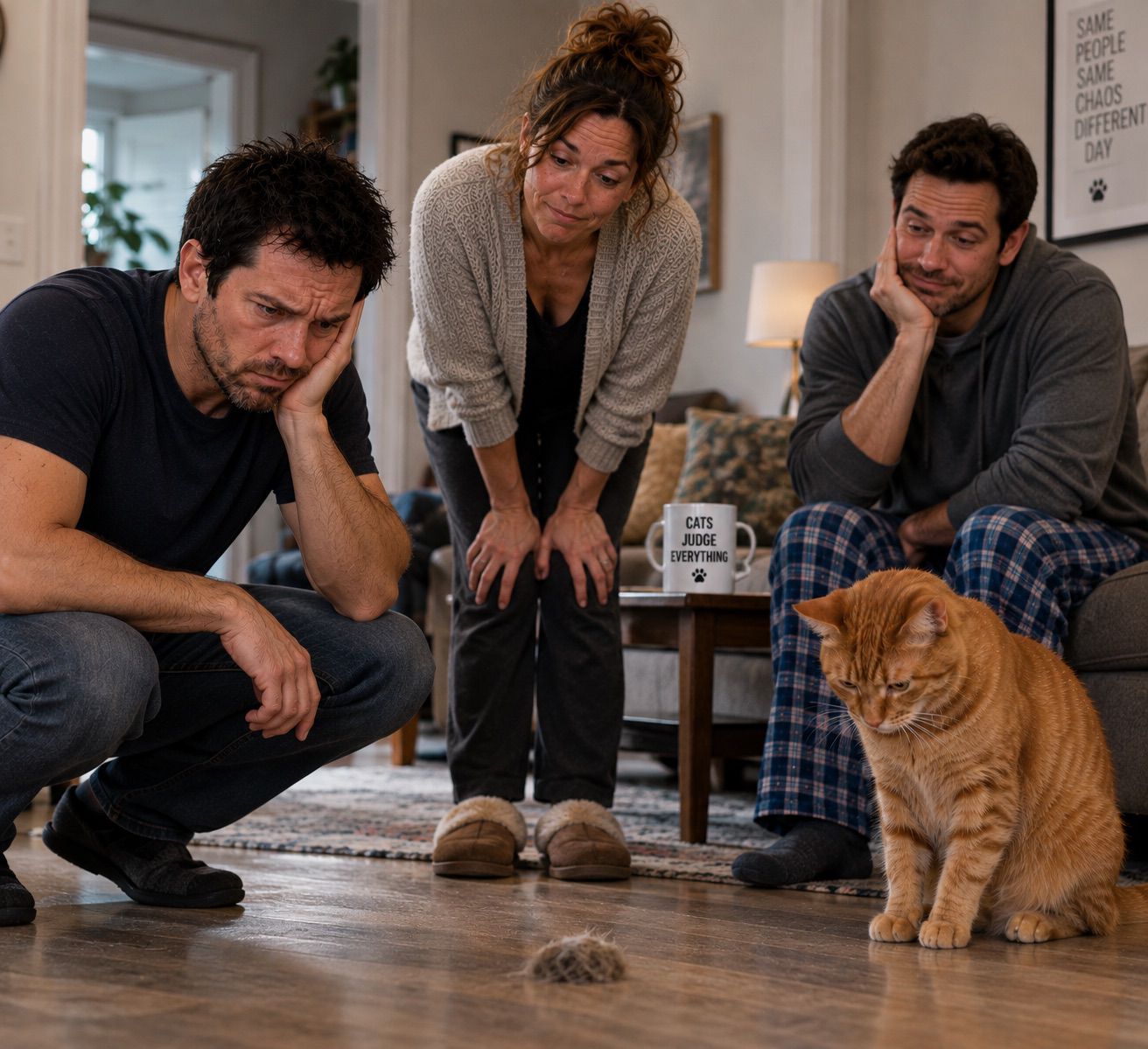
Then Mr Whiskers coughed up a hairball in the hallway, and something happened that confirmed my suspicions. All three of us looked at it, but nobody moved. Pandora looked at John, John looked at me, I looked at Pandora, and Mr Whiskers looked at all three of us. For several seconds, the four of us remained perfectly still, each apparently waiting for somebody else to accept responsibility. Finally Pandora said that someone should probably clean it up. John agreed enthusiastically. Neither of them moved. I cleaned it up because apparently someone in this apartment still had standards.

That was when I knew Pandora was becoming John Mercer. Not literally, obviously. I hadn’t completely lost touch with reality. But his influence was clearly spreading. First the charger, then the book, then the shoes, and now we had reached the stage where a cat hairball could sit in the hallway while three adults silently negotiated responsibility through eye contact. I didn’t know what came after that, but judging by John’s bedroom, I wasn’t optimistic.

Later that morning, Karen texted me while I was at work and asked how things were going. I mentioned my theory about Pandora picking up John’s habits, expecting her to tell me I was being ridiculous. Instead, she sent a laughing emoji and suggested that maybe Pandora was finally learning how to relax. That gave me something entirely new to worry about. Karen thought this was good. She and Dave were my coworkers, so neither of them had anything to do with what happened inside the apartment, but Karen had heard enough of my stories about John to understand exactly what I meant.

For a few minutes, I considered the possibility that Karen might actually be right. Maybe Pandora wasn’t becoming messy. Maybe she was simply becoming less concerned about everything being perfect. Maybe living with John had shown her that leaving a charger on the counter wasn’t a moral failure and that a pair of shoes could remain beside the couch overnight without destroying the structural integrity of the apartment. That seemed plausible. It also seemed suspiciously mature, so naturally I remained skeptical.

When I got home, Pandora was sitting on the couch with her feet up, reading the same book she’d left on the coffee table that morning. Her shoes were beside the couch. Her charger was still on the kitchen counter. John was sitting at the opposite end of the couch watching television, and Mr Whiskers was stretched between them like some kind of furry demilitarized zone. Pandora looked perfectly content, and for a moment I wondered if maybe I really had invented the whole thing. Maybe Karen was right. Maybe Pandora was simply relaxing, and I was turning ordinary domestic habits into evidence of some larger transformation because that’s apparently what my brain does when nobody supervises it.

Then Pandora finished her drink, set the empty glass on the coffee table, stood up, and walked toward the kitchen without taking it with her. I stared at the glass and then slowly looked at John. John looked at the glass, looked at me, and a smile crept across his face. I told him not to say it. He pointed out that he hadn’t said anything, and I told him he didn’t have to. From the kitchen, Pandora asked if we were being weird again. I looked at the abandoned glass, the charger on the counter, the shoes beside the couch, and the book that had apparently taken up permanent residence on the coffee table.

This was no longer a theory. John Mercer was rubbing off on her, and judging by that glass, we were already entering Phase Two.

Related Posts

Margaret Atwood: The Liminal Line Between Fiction and Fear

Penelope

Margaret Atwood. I’ve been thinking about her a lot lately, not just because of the recent buzz around The Testaments – although that certainly didn’t hurt. But it’s more than that. It’s like she’s tapped into some deep part of me, this desire to understand the world through stories and symbols.

I think what draws me in is the way Atwood navigates the complexities of being a woman, especially in patriarchal societies. Her writing is never didactic or heavy-handed; instead, it’s infused with a sly wit and intelligence that makes you feel like you’re piecing together clues alongside her. Take The Handmaid’s Tale, for instance – on the surface, it’s a dystopian novel about oppression and resistance, but scratch beneath and you find all these rich layers of commentary on power, morality, and even science.

As I read Atwood’s work, I find myself getting stuck in this liminal space between fiction and reality. The Handmaid’s Tale is so eerily prophetic that it’s hard not to wonder if some of its themes are more than just hypothetical. Have we really become the kind of society where women’s bodies are owned by the state? Where dissent is quashed, and free thought is a luxury only the privileged can afford?

Atwood’s exploration of this gray area resonates deeply with me because I’ve been there myself – in my own way, at least. Growing up, I was always the one questioning authority, pushing against boundaries (much to my parents’ chagrin). And now, as an adult, I’m still grappling with what it means to be a woman in a world that often seems hell-bent on silencing us.

But Atwood’s writing isn’t just about me; it’s also about the world we live in. Her depiction of a society where environmental degradation has become a moral and economic imperative makes me feel like I’m staring into some sort of funhouse mirror – everything is distorted, but at the same time, eerily familiar.

As I delve deeper into Atwood’s work, I start to notice these threads of feminism and ecology running throughout her writing. It’s almost as if she’s trying to say that our personal choices have consequences on a much larger scale – consequences that can either perpetuate or challenge the status quo.

And yet…and yet…I’m not entirely convinced by Atwood’s vision of resistance. The Handmaid’s Tale, in particular, often feels like it’s advocating for a binary choice between oppression and revolution, as if there aren’t any other options on the table. It’s this rigid dichotomy that makes me uneasy – what about all the gray areas in between? What about the times when we’re neither fully complicit nor actively resisting?

Atwood’s writing isn’t meant to provide easy answers; it’s more like a series of provocations, nudging us toward uncomfortable truths and difficult questions. And that’s precisely why I keep coming back to her work – because she refuses to give me (or anyone) an easy way out.

As I write this, I’m aware that I’m still grappling with the complexities of Atwood’s vision – and my own place within it. It’s a messy, unresolved business, but one that feels essential to navigating our current world.

One thing that’s struck me about Atwood’s writing is her use of myth and folklore as a way to explore these big questions about power, morality, and the human condition. In The Penelopiad, for example, she retells Homer’s Odyssey from Penelope’s perspective – a woman who’s often reduced to a mere prop in her husband’s story. By giving her voice back, Atwood subverts this centuries-old narrative and reveals all these hidden dynamics at play.

It’s this kind of subtle manipulation that I find so captivating – the way she can take something familiar and turn it on its head. And yet, as much as I appreciate the intellectual gymnastics involved in deconstructing myth and folklore, I’m also aware that there’s a risk of losing sight of what matters most: the human experience.

Sometimes, when reading Atwood’s work, I feel like I’m so caught up in the cleverness and nuance that I forget to connect it back to my own life. It’s as if I’ve become too enamored with the intellectual exercises she sets up – the clever allusions, the philosophical debates – that I’ve neglected the messy, emotional aspects of her stories.

Take The Blind Assassin, for instance. On one level, it’s this intricate puzzle of a novel, full of codes and ciphers that require close attention to unravel. But beneath all the surface-level complexity, there’s a powerful exploration of family dynamics, trauma, and the ways in which our pasts shape us. It’s this human core that resonates with me on a deeper level – it reminds me that even the most cerebral writing is ultimately about people.

As I continue to read Atwood’s work, I’m aware that I’m still trying to reconcile these different parts of her oeuvre – the intellectual playfulness, the feminist critique, the exploration of human emotions. It’s a balancing act, and one that requires me to stay attuned to my own responses, rather than just getting lost in the cleverness or complexity.

Atwood’s writing is like this constant reminder that even as we try to understand the world through stories and symbols, there are always more questions waiting to be asked – more perspectives to consider. And it’s this sense of uncertainty, this willingness to stay open-minded and adaptable, that I think is ultimately what draws me back to her work again and again.

As I reflect on Atwood’s use of myth and folklore, I’m struck by how she blurs the lines between fact and fiction. It’s almost as if she’s saying that our understanding of the world is always filtered through some kind of narrative lens – whether it’s personal, cultural, or historical. And yet, this realization also makes me wonder: what happens when we try to separate the two? When do we take things at face value, and when do we question their underlying stories?

I think about my own experiences with mythology and folklore. Growing up, I was fascinated by Greek myths – particularly the stories of Penelope, Medusa, and Persephone. As a young woman, I saw these characters as symbols of power, agency, and transformation. But now that I’m older, I realize how much those interpretations were influenced by my own cultural and personal biases.

Atwood’s re-tellings of myths like The Penelopiad challenge me to rethink my assumptions about what it means to be a woman, especially in patriarchal societies. She forces me to confront the ways in which our stories have been distorted or manipulated over time – often to serve the interests of those in power.

It’s this kind of critical thinking that I value most in Atwood’s work. She doesn’t offer easy answers or solutions; instead, she poses questions and encourages us to explore the complexities of human experience. And yet, as much as I appreciate her intellectual rigor, I’m also aware that there are times when I need something more straightforward – a story that speaks directly to my emotions, rather than just my intellect.

Take The Year of the Flood, for example. On one level, it’s this dense, philosophical novel about environmental collapse and human resilience. But beneath all the surface-level complexity, there’s a powerful exploration of grief, loss, and redemption. It’s this emotional core that resonates with me on a deeper level – it reminds me that even the most cerebral writing can be deeply personal.

As I continue to read Atwood’s work, I’m aware that I’m still trying to reconcile these different parts of her oeuvre – the intellectual playfulness, the feminist critique, the exploration of human emotions. It’s a balancing act, and one that requires me to stay attuned to my own responses, rather than just getting lost in the cleverness or complexity.

Atwood’s writing is like this constant reminder that even as we try to understand the world through stories and symbols, there are always more questions waiting to be asked – more perspectives to consider. And it’s this sense of uncertainty, this willingness to stay open-minded and adaptable, that I think is ultimately what draws me back to her work again and again.

But what if I’m wrong? What if Atwood’s vision is too narrow, too focused on the intellectual or feminist aspects of human experience? What if there are other stories waiting to be told – stories that don’t fit neatly into our existing narratives?

As I ponder these questions, I realize that they’re not just about Atwood’s writing; they’re also about my own role as a reader. Do I have the capacity to see beyond her intellectual exercises and emotional explorations? Can I recognize when she’s pushing me toward uncomfortable truths or difficult questions – even if it means challenging my own assumptions and biases?

These are the kinds of uncertainties that keep me coming back to Atwood’s work. She doesn’t offer easy answers, but instead invites me into a world of complex questions and messy, unresolved business. And it’s this kind of intellectual humility, this willingness to stay open-minded and adaptable, that I think is ultimately what makes her writing so powerful – and so necessary in our current world.

As I sit here with my thoughts on Atwood’s writing, I’m struck by the realization that her work has become a kind of mirror for me – reflecting back my own experiences, biases, and assumptions about the world. It’s as if she’s taken all these fragments of myself and woven them into a tapestry of complex questions and messy, unresolved business.

I think about how Atwood’s writing often blurs the lines between fact and fiction, leaving me to wonder what’s real and what’s constructed. And I realize that this is precisely the kind of uncertainty that makes her work so compelling – it forces me to question my own understanding of the world and to consider multiple perspectives.

But what if this uncertainty is also a limitation? What if Atwood’s refusal to offer easy answers or clear solutions is actually a reflection of our own inability to confront the complexities of human experience? What if, as readers, we’re more interested in intellectual exercises than emotional resonance?

As I ponder these questions, I’m reminded of my own experiences with writing. When I write, it’s often because I’m trying to make sense of something – a difficult emotion, a complex idea, or a messy situation. And yet, the more I write, the more I realize that there are no easy answers, only more questions and complexities waiting to be explored.

Atwood’s writing has taught me to approach my own writing with a similar sense of humility and uncertainty. Rather than trying to impose order on the world, I’m learning to embrace the messiness of human experience – to see it as a rich tapestry of contradictions and paradoxes rather than a neat, tidy narrative.

And yet, even as I’m drawn to this kind of intellectual curiosity, I’m also aware that there are times when I need something more straightforward – a story that speaks directly to my emotions rather than just my intellect. Atwood’s writing often leaves me feeling stimulated and challenged, but sometimes it also leaves me feeling lonely or disconnected from the world around me.

This is why I think I’ll continue to read Atwood’s work, even as I struggle with its complexities and uncertainties. Because in her writing, I see a reflection of my own struggles – not just as a reader, but as a writer, too. And it’s this sense of solidarity, this feeling that I’m part of a larger conversation about the human experience, that keeps me coming back to her work again and again.

But what lies ahead? As I continue to read Atwood’s writing, I wonder if I’ll find more answers or just more questions. Will I discover new perspectives on the world, or will I become even more lost in the complexities of human experience? Only time will tell, but for now, I’m content to keep exploring – with Atwood as my guide, and myself as the uncertain, questioning reader that I am.

Related Posts

I’m Starting to Think Mr Whiskers Knows More

Hal

I’m lying on the bed watching Pandora do her hair in front of the dresser when I notice Mr Whiskers sitting beside her, staring at the floor. Normally this wouldn’t concern me. Cats stare at things. I’ve accepted that. They stare at walls, ceilings, empty corners, closed doors, and occasionally directly over your shoulder in a way that makes you reconsider everything you’ve ever believed about the supernatural. Mr Whiskers is particularly good at this. The problem is that after everything that’s happened over the last few days, I’ve begun to suspect his staring has categories. There’s the ordinary stare he gives birds through the window, the disappointed stare he gives an empty food bowl, the contemptuous stare he gives me whenever I move him from my chair, and then there’s this one. This is the focused stare. The same kind of stare he had yesterday when I became convinced he and Pandora had developed some kind of private communication system. I was probably wrong about that, although Pandora’s immediate ability to identify when I’m about to develop a theory remains unexplained.

I try to ignore him. This is something I’ve been working on. Yesterday I spent half the day investigating Pandora’s behavior only to discover that something really was wrong with her work project, while almost every piece of evidence I’d collected had absolutely nothing to do with it. The experience taught me an important lesson about distinguishing instinct from interpretation. My instinct that something was wrong had been correct; my interpretation involving Karen, John Mercer, Mrs Jenkins, a scarf, a pigeon, and possibly Mr Whiskers had been less successful. So today I’m attempting a more disciplined approach. I observe the cat. I acknowledge the cat. I do not construct a theory about the cat. This works for approximately forty-five seconds.

“What is he looking at?” I ask. Pandora doesn’t turn around. She tells me she doesn’t know. I ask whether she noticed him staring before I mentioned it, and she says no. That answer bothers me slightly because Mr Whiskers is sitting about three feet away from her and has been staring at exactly the same spot for nearly a minute. I ask if she can see anything on the floor. Pandora finally looks down, then at Mr Whiskers, then back at the mirror. “No.” I ask whether she thinks that’s strange. “No.” I point out that she didn’t really look. She tells me she looked sufficiently. I’m not sure how one determines the sufficient duration for examining a potentially significant area of bedroom floor, but apparently Pandora has developed standards.

Mr Whiskers hasn’t moved. His ears are pointed forward and his eyes are fixed on the narrow space beneath the dresser. Now we have specificity. He’s not staring randomly at the floor; he’s staring under something. That matters. I sit up and lean forward to get a better look, but from the bed I can’t see anything except darkness and a little dust. Pandora notices what I’m doing in the mirror and says my name in that particular tone she’s developed over the last few days. “I’m only looking,” I tell her. She reminds me that looking is how these things always start. I tell her that’s ridiculous because looking is also how people find things. She asks what I’m expecting to find beneath the dresser. I tell her I don’t know, which is why I’m looking. She says that’s exactly the answer she was afraid of.

I get off the bed and crouch beside Mr Whiskers. He doesn’t acknowledge me. I wave one hand slowly in front of his face, and he shifts his head just enough to continue looking around it. That’s interesting. Whatever has his attention is apparently more important than me, which narrows the possibilities considerably because Mr Whiskers generally considers interrupting me one of his primary responsibilities. I lower my head and look beneath the dresser again. Nothing. I reach for my phone and turn on the flashlight. Pandora asks what I’m doing. “Establishing whether there’s anything under here.” She tells me there isn’t. I ask how she knows. She says because it’s a dresser. I explain that being a dresser does not prevent objects from existing beneath it. She tells me that’s not what she meant. I know that’s not what she meant, but I also know she hasn’t answered the question.

There’s something under there.

I can just barely see it near the wall, a small dark shape partially hidden beneath the dresser. I can’t tell what it is from this angle, but the discovery immediately changes the situation. Mr Whiskers wasn’t staring at nothing. He was staring at something I couldn’t see. This is exactly the sort of distinction Pandora keeps insisting I should make, and for once I’m pleased to report that the evidence is cooperating. I tell her there’s an object under the dresser. She doesn’t seem impressed. I tell her Mr Whiskers located it before either of us did. She says he’s closer to the floor. That’s technically true but unnecessarily dismissive of his contribution.

I reach underneath, but the object is too far back. Mr Whiskers watches my hand with intense concentration. When I pull it out empty, he looks at me in a way that I can only describe as professionally disappointed. I get a coat hanger from the closet and straighten it enough to reach beneath the dresser. Pandora stops doing her hair and turns around. “You’re using a coat hanger now?” I tell her we’ve moved beyond visual inspection. She asks what stage we’re in. “Retrieval.” She stares at me for a moment before turning back toward the mirror. I hear her mutter something about marrying a normal person in her next life, which I choose not to address because I’m making progress.

The hanger touches something. Mr Whiskers immediately lowers himself into a crouch. I stop. He stops. I move the hanger again. His tail twitches. That’s a response. I do it a third time to establish repeatability, and his tail twitches again. Pandora sees this in the mirror and tells me to stop conducting experiments on the cat. I’m not conducting experiments on him; I’m using his reactions as supplemental observational data. There’s an important ethical distinction. She tells me there isn’t. I drag the object slightly forward, and Mr Whiskers moves with it. Whatever is beneath the dresser clearly matters to him. Yesterday he knew when Karen was arriving before I did because he’d apparently been watching a pigeon outside. The day before that he somehow ended up exactly where Pandora and John were preparing my surprise cake. At the time I’d considered those coincidences. Now I’m starting to wonder whether I’ve been underestimating him.

The object catches on something and disappears back into the darkness. Mr Whiskers looks up at me. “I know,” I tell him. Pandora stops and looks over her shoulder. “Did you just apologize to him?” I explain that I didn’t apologize; I acknowledged a setback. She asks whether Mr Whiskers is now part of the investigation. I tell her there is no investigation. We’re retrieving an unidentified object from beneath our furniture. She asks who “we” refers to. I look at Mr Whiskers. She closes her eyes for a moment and goes back to her hair.

I eventually get the object close enough to reach with my fingers. Mr Whiskers stands immediately and moves beside my hand as I pull it out. For a moment I can’t tell what I’m holding. It’s small, black, slightly dusty, and shaped vaguely like a piece of electronic equipment. My brain begins supplying possibilities before I’ve even examined it properly. A component. A transmitter. Something that fell from someone’s pocket. Maybe John dropped it the last time he stopped by. Maybe Karen did. Mrs Jenkins was here earlier in the week. Pandora has been carrying her phone everywhere because of the trouble with her work project. There are several entirely reasonable explanations, and I’m proud of myself for remembering that before jumping to—

Pandora starts laughing.

I look at her. Then I look at the object.

It’s one of her hair clips.

Not an ordinary hair clip, apparently, because this particular one has a little decorative piece on it that catches the light when I turn it. Pandora tells me she’s been looking for it for two days. She must have dropped it while getting ready and kicked it beneath the dresser without noticing. That’s it. That’s the entire mystery. No transmitter, no hidden message, no unexplained connection to John, Karen, Dave, or Mrs Jenkins. Pandora dropped a hair clip. Mr Whiskers saw it beneath the dresser. I found it because he was staring at it.

I hand the clip to Pandora and sit back on the edge of the bed. She thanks me, still smiling, and says something about being glad we solved another major case. I ignore the sarcasm because there’s a more important point here. Mr Whiskers knew. Not in the conspiratorial sense, obviously. I’m not suggesting he understood that Pandora had lost a hair clip or that he had deliberately positioned himself there to help recover it. I’m simply saying he possessed information that neither Pandora nor I possessed. He knew there was something beneath the dresser. We didn’t. I followed his behavior, investigated the location, and recovered the missing object. That’s not paranoia. That’s successful intelligence gathering.

Pandora tells me it’s called being a cat.

I tell her that’s exactly the sort of attitude that causes valuable sources to be overlooked.

She puts the hair clip on the dresser and goes back to fixing her hair while I look down at Mr Whiskers. He’s still sitting beside me, although now that the object has been recovered he seems completely uninterested in the investigation. I scratch behind his ears and tell him he did good work. Pandora says, “Please don’t encourage yourself.” I explain that I’m encouraging the cat. She says that’s somehow worse.

Mr Whiskers jumps onto the bed, walks across my pillow, and settles down near the headboard. For the next few minutes everything is normal. Pandora finishes her hair. I check my phone. Mr Whiskers starts washing one paw. The case, such as it was, is closed. I actually feel pretty good about how I handled it. I observed something unusual, gathered evidence, considered multiple explanations, identified a physical object, and reached the correct conclusion. There were no accusations. Nobody was implicated in an international conspiracy. Mrs Jenkins remained entirely uninvolved. This might be progress.

Then Mr Whiskers stops washing his paw.

His head turns slowly toward the closet.

He stares.

I follow his gaze.

Pandora sees me.

“No.”

“I didn’t say anything.”

“No.”

“He’s looking at the closet.”

“He’s a cat.”

“He was a cat when he found your hair clip.”

“He didn’t find my hair clip. You found my hair clip.”

“Because he showed me where to look.”

“He stared under the dresser.”

“Exactly.”

Pandora puts down her brush and turns toward me. I can tell she’s preparing an argument, but I’m no longer paying attention because Mr Whiskers has gotten off the bed. He walks toward the closet, stops directly in front of the closed door, and sits down.

Pandora and I both look at him.

For once, she doesn’t say anything.

I slowly stand.

“Don’t,” she says.

“You saw that.”

“I saw a cat sit down.”

“In front of the closet.”

“Cats sit in front of things.”

“He chose that specific location.”

“Hal.”

I reach for the closet door.

Mr Whiskers looks up at the handle.

Pandora tells me not to open it. I ask why. She says because if I open that closet and find absolutely nothing, I’ll spend the rest of the afternoon trying to determine what was there before we looked.

That’s ridiculous.

I open the door.

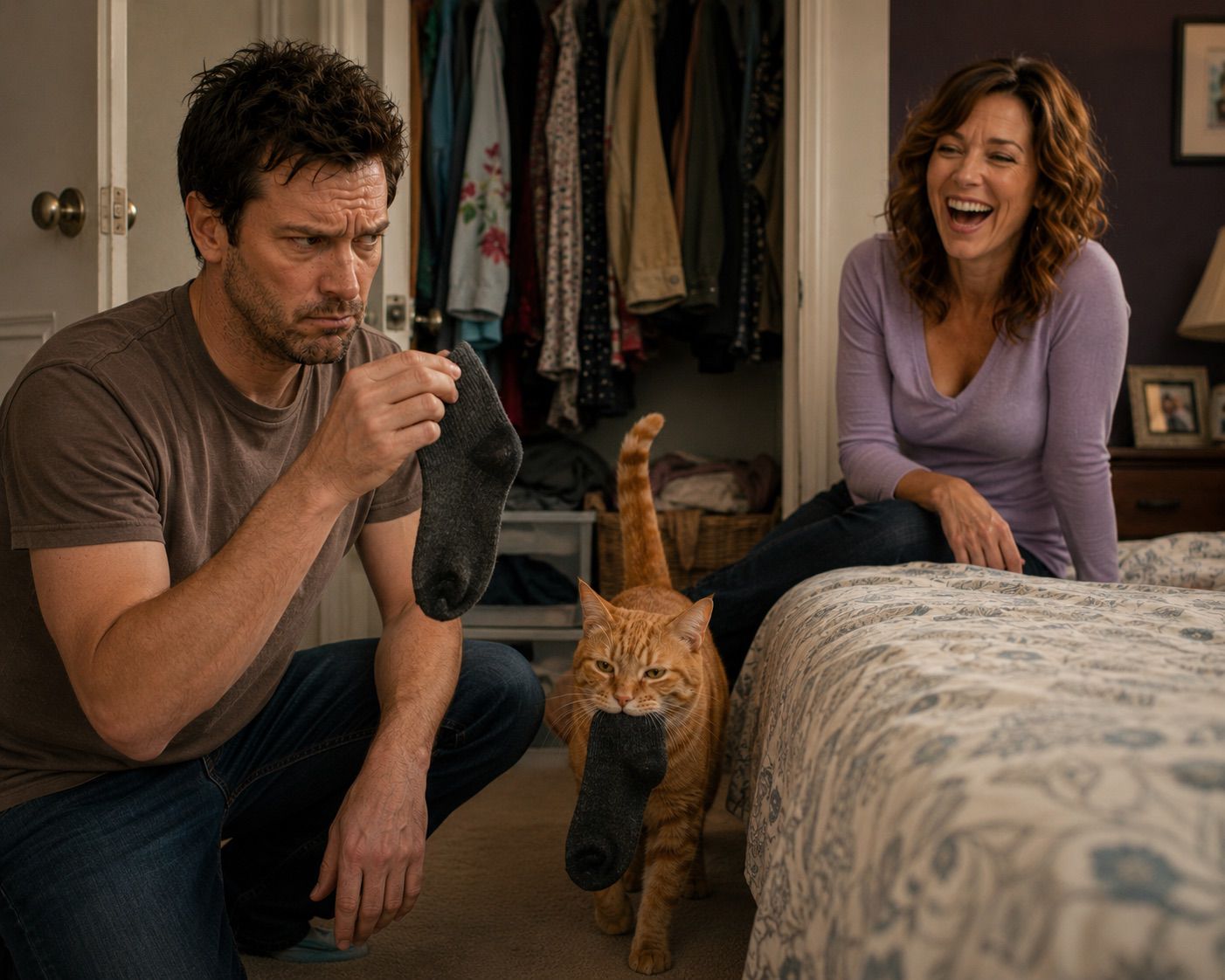
Mr Whiskers darts past my legs, jumps onto the bottom shelf, and emerges two seconds later with one of my socks in his mouth.

Pandora starts laughing so hard she has to sit down.

I stare at the cat.

He stares back at me with my sock hanging from his mouth.

Apparently, he’d hidden it there himself.

I take the sock away from him and look at Pandora, who is now laughing too hard to speak. I would like to point out that this doesn’t invalidate my theory. If anything, it makes the situation more interesting. Mr Whiskers knew exactly where the missing sock was because Mr Whiskers was responsible for the missing sock.

That’s knowledge.

And I’m starting to think he has more of it than he’s letting on.

Related Posts