Latest Articles

Dark Divinity: Why the Sexy Angel of Death Slays Halloween Every Time

Dave

Halloween thrives on opposites: life and death, light and dark, innocence and corruption. And no costume embodies those juxtapositions more powerfully—or more seductively—than the Sexy Angel of Death. Draped in lace, draped in mystery, her black wings spread wide like a promise and a threat. She doesn’t creep or crawl into the party—she descends, commanding the room with a scythe in hand, eyes rimmed in smoky kohl, lips painted in shades as dark as midnight. She is not here to be background noise. She is not here to whisper. She is here to slay, to take souls, to turn every head, and to go viral with a single pose.

The reason this costume resonates is simple: it is the personification of forbidden allure. Death is terrifying, inevitable, untouchable. But Halloween gives us the power to twist fear into fantasy, and the Sexy Angel of Death does exactly that. She makes the grim reaper wearable, irresistible, humanized. Her lace bodysuit turns bones and shadows into curves and confidence. Her black wings frame her like a fallen goddess. And her scythe—long, gleaming, theatrical—isn’t just a prop. It’s her scepter, her claim to the throne of the party. She doesn’t hide in darkness—she is the darkness, and she glows within it.

Visually, this look is unmatched. The lace bodysuit balances edge and elegance, its intricate details catching light in ways that transform fragility into power. Black feathers of her wings add scale and spectacle, each shift of her shoulders creating motion like thunderclouds unfurling. High boots or stilettos complete the silhouette, elongating every stride into a catwalk. And the scythe? That’s pure viral fuel. In photos, it creates drama. In videos, it adds performance. It turns every pose into a story, every smile into a threat, every turn into a showstopper. No other costume combines theatrics and sensuality in quite the same way.

But the Sexy Angel of Death isn’t just aesthetics—it’s narrative. Costumes that go viral always tell a story, and hers is as old as time. She’s the end we all fear, turned into something we can’t resist. She’s mortality itself, made glamorous. She whispers the truth we all know but rarely face: nothing is permanent, everything fades. And yet she doesn’t embody despair—she embodies power. For the woman who wears it, the costume is about claiming control over that inevitability. She’s not running from death—she is death, and she’s beautiful. That twist on one of humanity’s deepest fears makes her unforgettable.

Performance potential is another reason this costume dominates. She doesn’t just walk into the room—she stalks it. She doesn’t just pose—she performs. Adjusting her wings, twirling her scythe, gazing over her shoulder with a knowing smirk—every gesture is theater. On TikTok, she thrives in transformation videos, one snap changing a soft, innocent look into black-winged glory. On Instagram, her portraits dominate: wings stretched, scythe angled, lace gleaming under neon lights. On X, she trends because she’s meme-worthy and magnetic. She is the perfect blend of glamour and danger, humor and horror, beauty and dread. Every share, every repost, every hashtag amplifies her presence because she captures what Halloween is meant to be: the seductive face of fear.

Adaptability makes her timeless. Some versions lean gothic, with corseted lace, heavy makeup, and cathedral-like wings. Others go minimalist, with sheer bodysuits, sleek black feathers, and silver accents. Some emphasize horror, adding skull makeup, blood effects, or glowing contacts. Others lean sultry, highlighting curves and radiance against the darkness. Each interpretation is different, but the essence remains the same: the Angel of Death is eternal, and sexy or not, she cannot be ignored.

What makes her human, though, is her empowerment. Dressing as the Sexy Angel of Death isn’t about being looked at—it’s about embodying dominance. She isn’t running from fear—she is fear. She isn’t apologizing for her presence—she’s demanding it. For the woman wearing it, the costume isn’t just about lace and feathers—it’s about stepping into a role that commands. It’s about walking into a room and knowing you don’t just turn heads—you silence them. That confidence radiates outward, filling every space with a charge that is magnetic. People don’t just admire her—they’re captivated by her.

Halloween is about transformation, and the Sexy Angel of Death transforms one of humanity’s darkest archetypes into a vision of empowerment and allure. She takes the inevitability of mortality and turns it into performance. She takes dread and makes it dazzling. She reminds everyone that even in endings, there is spectacle, there is beauty, there is a presence that cannot be denied.

So when the lights flash and the music shakes the walls, watch who owns the room. It will be the woman in black wings, lace bodysuit hugging her frame, scythe gleaming under the neon glow. She won’t need to scream, she won’t need to chant—her silence will be louder than the bass itself. That’s the Sexy Angel of Death. That’s the viral queen of the underworld. And that’s why, year after year, she doesn’t just haunt Halloween—she rules it.

Related Posts

Ogopogo: The Serpent of Okanagan Lake and Canada’s Deepest Legend

Dave

When people think of legendary lake monsters, Loch Ness often swims to mind first. But across the Atlantic, in the rugged beauty of British Columbia, Canada, lies Okanagan Lake—a long, deep, and mysterious body of water that has for centuries been home to its own cryptid of legend. Its name is Ogopogo, a serpent said to glide beneath the lake’s cold waters, surfacing to startle fishermen, frighten tourists, and remind us that myths are not bound to Scotland or Iceland but ripple in the heart of North America as well. Unlike many legends born from whispers and forgotten, Ogopogo continues to hold sway in Canada’s imagination, not only as a tale of a monstrous creature but as a cultural symbol, bridging Indigenous traditions, settler folklore, and modern-day fascination with the unknown.

The earliest stories of Ogopogo come from the First Nations people of the Okanagan Valley, specifically the Syilx (Okanagan) Nation. They told of N’ha-a-itk, the spirit of the lake, a fearsome being associated with both respect and danger. This entity was no mere fish or snake but a powerful water spirit that demanded reverence and offerings from those who crossed its domain. Indigenous people traveling across the lake would bring sacrifices—often small animals—to ensure safe passage. To them, N’ha-a-itk was not entertainment or tourist attraction but sacred and deadly, a reminder of nature’s power and the thin line between life and death when confronting the vast unknown of deep waters.

As settlers arrived in the Okanagan region in the 19th century, the Indigenous stories evolved into something the newcomers could grasp: a physical monster, a serpent of staggering size. By the 1920s, the name “Ogopogo” had caught on, supposedly inspired by a humorous British music-hall song. What had once been a terrifying spirit became, in popular imagination, a creature somewhere between Nessie’s Canadian cousin and a folkloric prankster. But while the name might sound whimsical, the sightings were anything but. Fishermen reported seeing enormous shapes gliding beneath their boats. Families at the lakeshore swore they saw humps rising like rolling logs on the water’s surface. Some claimed Ogopogo moved with the speed of a motorboat, others that it stretched over 40 feet in length. And as the legend grew, so too did the fascination.

Descriptions of Ogopogo vary, as legends often do. Some say it resembles a massive serpent or snake, its head shaped like that of a horse or goat, its body dark and sinuous with multiple humps rising above the water. Others describe it as more reptilian, akin to a prehistoric plesiosaur, with fins and a long neck slicing through the waves. The inconsistency in eyewitness accounts only adds to the intrigue. Is it one creature, or several? Is it a giant sturgeon mistaken for a monster, or is it truly something unknown lurking in the depths of the lake? Okanagan Lake, after all, is over 80 miles long and more than 750 feet deep in places. If any Canadian lake could hide a mystery, it would be this one.

The cultural impact of Ogopogo is staggering. In the town of Kelowna, Ogopogo is not feared but celebrated. Statues, souvenirs, and even mascots embody the lake serpent’s image, turning what was once a terrifying spirit into a symbol of community pride. Festivals embrace Ogopogo as part of local identity, and tourists flock to Okanagan Lake not just for its beauty but for the slim chance of catching a glimpse of its fabled resident. In this way, Ogopogo has shifted from legend to icon, illustrating how folklore adapts to the needs of each generation. To Indigenous peoples, it was sacred and dangerous. To settlers, it became a monster story. To modern Canadians, it is heritage, mystery, and marketing all in one.

What makes Ogopogo particularly fascinating is the sheer persistence of its sightings. Accounts stretch across centuries, from Indigenous oral traditions to modern smartphone videos. In 1926, a group of about 30 cars worth of people swore they saw the creature, watching as it moved across the lake’s surface. In 1968, a man named Art Folden captured what remains one of the most famous films of Ogopogo: a dark, moving shape cutting through the water. Skeptics argue it was a log or a boat wake, but believers insist it was proof. Even in the 21st century, new videos and photos emerge, grainy and inconclusive, but tantalizing enough to keep the legend alive. Each sighting fuels the fire, ensuring Ogopogo is never forgotten.

Of course, skeptics abound. Many scientists believe Ogopogo sightings can be explained by optical illusions, floating debris, large fish, or unusual wave patterns. Sturgeon, for example, can grow massive and might easily be mistaken for a serpent in low light. Others point to the psychological effect of expectation: when you look at a lake known for its monster, you’re more likely to interpret strange shapes as Ogopogo. Yet, despite rational explanations, the legend persists, and in some ways, that persistence is the most mysterious part. Why do we cling so tightly to the idea of monsters in our lakes and seas? Why do we prefer mystery over certainty?

The answer lies in human nature. Ogopogo, like Nessie, represents our longing for the extraordinary, our refusal to accept that the world is fully known. It is an invitation to believe that even in our modern age of satellites and sonar, there are still secrets lurking just out of reach. For children, Ogopogo is a thrilling bedtime story. For locals, it is a badge of pride. For adventurers, it is a challenge to seek proof. And for all of us, it is a reminder that myths endure not because they are proven true, but because they speak to something timeless within us—the yearning for wonder.

To humanize Ogopogo is to see it not as a monster but as a symbol. It is the embodiment of the lake’s mystery, of the human imagination, of the tension between fear and fascination. For the Syilx people, N’ha-a-itk was a lesson in respect: the lake is powerful, and you must honor it. For modern Canadians, Ogopogo is a story that ties them to the land, giving identity and magic to the waters of Okanagan. For all who hear the tale, it is a reminder that not everything has to be solved, that sometimes the greatest beauty lies in mystery itself.

And so, on October 28, when we remember Ogopogo, we celebrate not just a cryptid but an enduring legend. Whether serpent, sturgeon, or spirit, Ogopogo remains alive—not just in the depths of Okanagan Lake but in the imagination of every person who stands at the shore, staring into the water, and wonders what might be moving beneath.

Related Posts

The Blackshirts on the Road to Power: Mussolini’s March on Rome

Elias Rowen

On October 28, 1922, Italy stood at a crossroads. The First World War had left the nation battered and disillusioned, its economy shattered, its people restless, and its politics fractured. In the vacuum of chaos, Benito Mussolini—a fiery journalist turned political agitator—saw his chance. With his paramilitary Blackshirts, he launched what became known as the March on Rome, a spectacle of force that pressured Italy’s fragile government into submission. By the end of those tense days, Mussolini would emerge not only as prime minister but as the architect of a new political experiment: fascism. It was a march that began with boots on cobblestones but ended with shadows over Europe, casting darkness that would stretch across decades and lead to catastrophe.

To understand why the March on Rome succeeded, one must picture Italy in 1922. The promises of the postwar years had crumbled. Inflation soared, strikes paralyzed factories, landless peasants seized fields, and workers occupied plants. The political establishment, led by weak liberal governments, seemed unable to govern effectively. The trauma of war had produced what Italians called a “mutilated victory”—Italy had fought and bled for the Allies but felt cheated in the peace settlements. National pride, bruised and angry, demanded revival. Into this storm stepped Mussolini, a former socialist who reinvented himself as a nationalist, blending rhetoric of order, strength, and destiny into a new ideology. He called it fascism, after the Roman fasces—bundled rods symbolizing unity through strength.

The Blackshirts, Mussolini’s paramilitary squads, embodied his vision of action over talk, violence over compromise. They beat striking workers, intimidated opponents, and burned socialist offices. For many Italians frightened of communism and weary of instability, Mussolini’s thugs seemed like guardians of order. For the elite—landowners, industrialists, and monarchists—fascism promised protection against revolution. By autumn of 1922, Mussolini had built a movement too powerful to ignore.

The March on Rome was not a single event but a calculated bluff. On October 28, thousands of Blackshirts began moving toward the capital, seizing railways, post offices, and town halls along the way. Dressed in black uniforms, chanting slogans, they projected an image of unstoppable force. In reality, they were poorly armed and disorganized, more theater than army. But in politics, perception often matters more than truth. Mussolini understood that if he could convince the government of his strength, he would win without firing a shot.

The Italian government wavered. Prime Minister Luigi Facta proposed declaring martial law and mobilizing the army, which could have easily dispersed the marchers. King Victor Emmanuel III, however, hesitated. Fearful of civil war, sympathetic to Mussolini’s nationalism, and distrustful of his own liberal ministers, the king refused to sign the decree. That decision sealed Italy’s fate. Instead of confronting fascism, the monarchy legitimized it. On October 29, Mussolini, who had waited in Milan ready to flee if things collapsed, received a telegram summoning him to Rome to form a government. The march had succeeded without a true battle, its power lying not in force but in psychology.

On October 31, Mussolini arrived in Rome, dressed in a black jacket and bowler hat, greeted by cheering crowds and disciplined ranks of Blackshirts. At just 39 years old, he became the youngest prime minister in Italian history. Within a few years, he would dismantle parliamentary democracy, silence opposition, and transform Italy into the first fascist dictatorship in Europe. What began as a march ended as a warning to the world—a warning too many ignored.

To humanize the March on Rome is to remember the ordinary Italians swept along in its tide. The peasant in 1922, weary of hunger and unrest, who saw in Mussolini’s promises the hope of stability. The factory worker who feared socialism would bring chaos and looked to the Blackshirts for order. The liberal politician who underestimated Mussolini, believing he could be tamed within parliament. The soldier who obeyed orders not to confront the marchers, wondering whether his hesitation would doom his country. The young Blackshirt, intoxicated by uniforms and chants, who believed he was making history when, in truth, he was helping to unleash tyranny.

The March on Rome was not inevitable. It was a moment of weakness, miscalculation, and fear. Had the king acted decisively, had the government shown courage, fascism might have been crushed before it began. Instead, a gamble was made—to appease Mussolini in hopes he could be controlled. That gamble failed, and its cost was immense: censorship, repression, colonial aggression, alliance with Hitler, and ultimately war and ruin.

Yet the power of October 28 lies not only in history but in its lessons. It reminds us how fragile democracies can be when institutions falter, when elites underestimate extremists, when fear outweighs principle. It shows how quickly a society’s longing for order can be exploited, how violence dressed in uniforms can masquerade as salvation, and how one march can change the world.

October 28, 1922, was the day Mussolini’s boots began to echo across Europe. It was the day Italy surrendered to a performance of power, the day democracy yielded to dictatorship, the day history pivoted toward tragedy. The March on Rome was short, almost anticlimactic in its execution. But its consequences were vast, reverberating from the streets of Rome to the battlefields of World War II, leaving behind a legacy of caution written in black shirts and broken promises.

Related Posts

Pixelated Temptation: Why the Gamer Girl Costume Levels Up Halloween

Dave

Halloween is the one night where every identity can be tried on, tested, and performed. Vampires drain the room with their crimson allure, witches cast shadows in sequins and lace, devils smolder with horns and tridents. Yet amid the supernatural and the monstrous, a new icon has emerged in the cultural zeitgeist—one that didn’t come from ancient legends or gothic nightmares, but from the glowing blue light of screens, the hum of consoles, and the rhythm of keystrokes. She is the Gamer Girl, dressed in her short cosplay-inspired gamer outfit, oversized headset perched like a crown of neon, controller in hand, and confidence radiating as brightly as RGB lights. The Gamer Girl costume is more than cosplay—it’s a declaration of a cultural force that dominates the twenty-first century: gaming itself.

The Gamer Girl thrives on Halloween because she taps into the immediacy of culture. We live in an age where gaming isn’t niche—it’s mainstream. It’s esports stadiums filled with screaming fans, Twitch streams watched by millions, and online communities where friendships, rivalries, and entire worlds are built pixel by pixel. The Gamer Girl costume transforms that world into fashion, giving physical shape to a digital identity. The short outfit—a mix of cosplay tailoring and playful sensuality—makes her look like she just stepped out of a beloved RPG or anime. The headset adds authority, symbolizing not just play but power: she’s not just watching—she’s in the game. Add in props like controllers, keyboards, or even neon-lit accessories, and the look becomes unmistakable, instantly viral, instantly iconic.

Visually, the Gamer Girl costume thrives because it’s a feast of modern aesthetics. Neon trims mimic RGB lighting, the language of gaming setups everywhere. Skirts or shorts, often paired with thigh-high socks or boots, create silhouettes that pop both in real life and in photos. Cropped tops, zip-up jackets, or jerseys emblazoned with gamer-inspired logos fuse athleticism with playfulness. The oversized headset frames the face, amplifying expressions and creating a cinematic aesthetic that looks straight out of a stream overlay. Glitter makeup or face paint—perhaps with digital motifs like pixel hearts or neon streaks—transforms the face into a character that blurs the line between fantasy and reality. Under party lights, she glows like a screen come to life. In photos, she dominates the frame with equal parts gamer grit and playful charm.

But the Gamer Girl isn’t just visual spectacle—she’s symbolic power. Gaming has long been stereotyped as male-dominated, but the reality is that women have always been part of the story. Today, Gamer Girls are streamers, developers, cosplayers, esports champions, and community leaders. The costume celebrates that presence, flipping the stereotype on its head. She’s not a sidekick—she’s the main character. She’s not logging in quietly—she’s taking the spotlight. That symbolism resonates not only with gamers but with anyone who’s ever felt underestimated. To dress as a Gamer Girl is to say: I belong here. I am confident, I am bold, and I level up on my own terms.

The performance potential is another reason this costume thrives. Halloween costumes that go viral are the ones that can be performed—and the Gamer Girl practically begs for it. With a headset in place, she can lip-sync into her mic, play-act as a streamer, or call out commands to her “squad” on the dance floor. With a controller in hand, she can fake competitive rage, slam buttons with exaggerated flair, or “celebrate victory” mid-party. Even her gestures—adjusting her headset, leaning forward as though streaming—become instantly recognizable. These moments don’t just entertain—they create content. On TikTok, transformation videos flourish: casual one moment, decked out in headset and gamer gear the next, screen overlays flashing across the edit. On Instagram, neon-trimmed outfits and thigh-high socks dominate carousel posts, captions filled with playful gaming puns. On X, her image spreads like a meme, fueling debates, admiration, and nostalgia for countless hours spent in digital worlds.

Adaptability ensures the Gamer Girl costume remains fresh year after year. Some go full cosplay, basing their look on famous video game heroines with recognizable color schemes and props. Others create a hybrid, mixing generic gamer aesthetics—hoodies, skirts, controllers—with sultry flourishes. Some lean futuristic, turning themselves into cyberpunk avatars complete with LED visors and holographic accessories. Others go retro, dressing in ‘80s arcade chic with pixel motifs, Pac-Man accessories, and joystick props. No matter the variation, the costume is always recognizable because it carries the DNA of gaming culture. It evolves with the industry, reflecting trends, fandoms, and aesthetics as they shift.

What makes the Gamer Girl costume human, though, is its relatability. Unlike vampires or witches, the Gamer Girl isn’t mythological—she’s real. She’s your friend streaming on Twitch. She’s your sister cosplaying at a convention. She’s you, up at 3 AM, headset crooked, eyes lit by the glow of a monitor, laughter spilling into the mic as the game drags on. That authenticity makes the costume resonate deeply. When people see a Gamer Girl on Halloween, they don’t just see a fantasy—they see someone they know, someone they connect with, someone who reflects a piece of their everyday life. That’s why the costume isn’t just sexy or playful—it’s personal.

Halloween is about transformation, and the Gamer Girl costume captures the transformation of culture itself. It represents how gaming moved from basements to arenas, from niche hobby to global phenomenon, from stereotype to empowerment. It transforms the virtual into the tangible, the avatar into reality, the pixels into presence. And for the woman who wears it, the transformation is more than external—it’s internal. She doesn’t just look like she could stream to thousands—she feels like it. She steps into the party like she’s stepping onto a stage, headset on, mic hot, confidence radiating.

So when the party is in full swing and the room is alive with devils, angels, zombies, and superheroes, keep an eye out for the Gamer Girl. She’ll be the one in neon-trimmed cosplay gear, headset glowing, pom-poms replaced by controllers, smirk tilted as if she just landed a headshot in the middle of the dance floor. She won’t need to demand attention—it will already be hers. Phones will rise, flashes will pop, feeds will flood. Because the Gamer Girl isn’t just part of the Halloween lineup—she’s the new main character, the viral queen of a generation raised on pixels and playlists.

When the night ends, her legacy won’t fade. Her selfies will still shimmer, her TikToks will still trend, her hashtags will still spike. Because the Gamer Girl isn’t just a costume—she’s a movement. She proves that Halloween isn’t just about ghosts and ghouls—it’s about celebrating the icons who shape our culture. And in 2025, no icon shines brighter, streams louder, or trends faster than the Gamer Girl.

Related Posts

The Kallikantzaros: Goblins of Greek Winter’s Darkest Nights

Dave

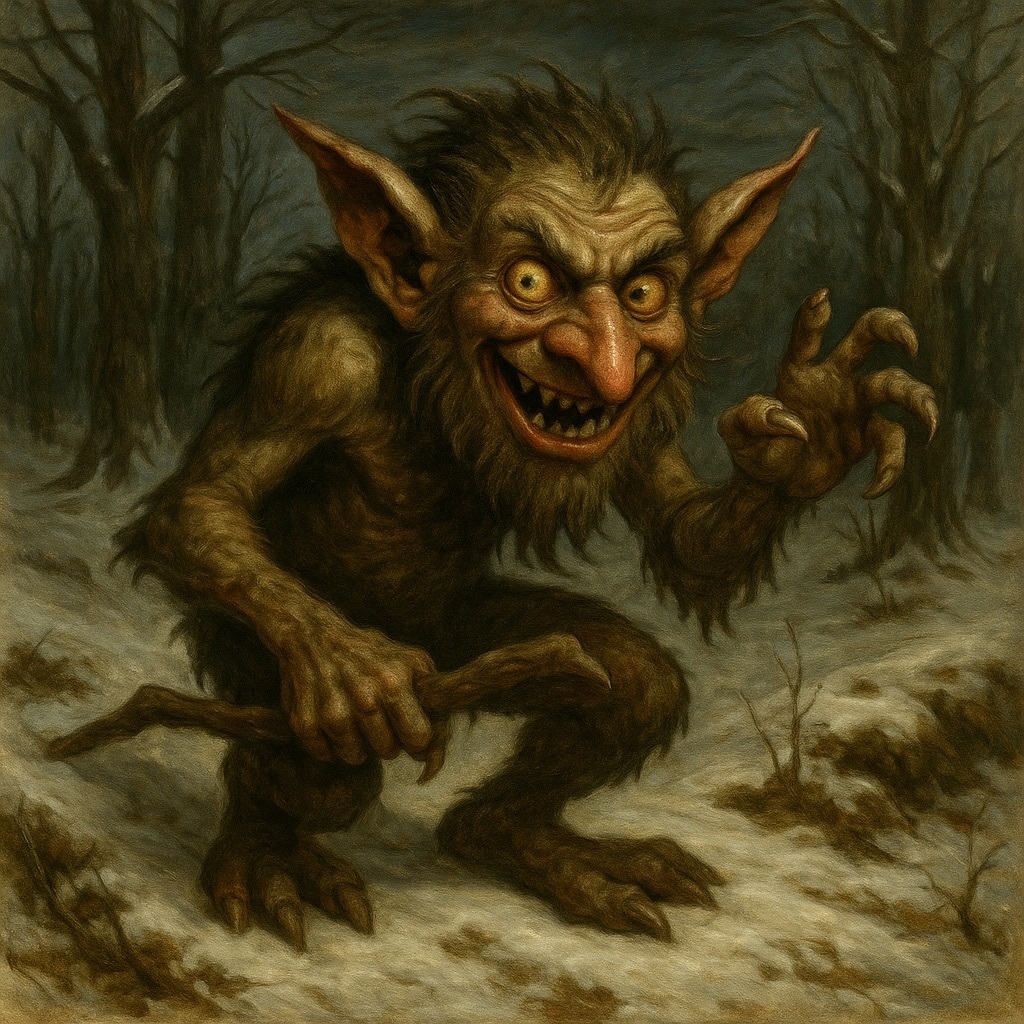
When the days grow short, when the winter nights stretch long and heavy with darkness, when the world feels closer to shadow than light—this is when the Greeks whisper of the Kallikantzaroi. These mischievous, goblin-like creatures are said to claw their way into the mortal world during the twelve days of Christmas, from December 25 until January 6, when the sun is weak, and the nights are at their deepest. They are grotesque yet comical, terrifying yet oddly entertaining, embodiments of chaos itself. They creep into villages, slipping into houses, spoiling food, tangling threads, extinguishing fires, and generally causing havoc in the lives of the unsuspecting.

But to understand the Kallikantzaros is to delve not only into folklore but into the soul of a people who lived by the rhythms of the earth, whose winters were long and dark, and whose imaginations peopled the shadows with tricksters and fiends. These goblin-creatures are not like demons of endless malice nor angels of eternal good. They are pranksters with a mean streak, spirits who mock the order of the world, delighting in mischief during the season when darkness is strongest.

Legends describe them in countless ways: some say they are small, no taller than children, with hairy bodies, long tails, glowing red eyes, and grotesque features—part human, part beast. Others imagine them as tall and gangly, their bodies thin and distorted, their voices shrill. They are often pictured as black-skinned from soot, crawling through chimneys to enter homes, their laughter echoing as they overturn pots, spoil milk, and even frighten children awake in the night. They thrive on chaos, and nothing pleases them more than to disrupt domestic life.

Yet, in a twist both humorous and terrifying, the Kallikantzaroi are said to spend the rest of the year—those long months when the world is green and bright—underground. There, in the bowels of the earth, they gnaw at the World Tree, hacking at its roots, trying to topple creation itself. Their goal is nothing less than destruction, the undoing of the cosmos, the collapse of existence. But when the twelve nights of Christmas arrive, when they could perhaps finish their task, they abandon it and rush to the surface world to play their pranks. By the time they return underground, the tree has healed, and their work must begin again. It is a cosmic cycle of futility, a darkly comic metaphor of endless struggle with no reward.

The symbolism is striking. The Kallikantzaroi are chaos embodied, yet their failure to topple the tree mirrors humanity’s resilience—the world endures despite the forces gnawing at it. Their annual return to the earth’s surface captures something profound about the winter holidays: they are not only times of light and joy but also times of unease, when darkness presses closer, and spirits stir. These creatures are the shadows cast by the bonfires of celebration, the reminder that even in the warmth of hearth and family, something wild lurks outside.

But if the Kallikantzaros was a source of fear, it was also a source of laughter. Greek villagers did not just dread them—they mocked them, tricked them, and invented ways to keep them at bay. Families would hang pork sausages, sweets, or other foods by the fire to distract the goblins. In some places, they left colanders outside the door, for the Kallikantzaroi were said to be compelled to count the holes—but, being unable to count to three (since “three” was holy), they would be trapped until dawn, forced to start again. Fires were kept burning, chimneys were blocked, and protective rituals recited, all to keep mischief-makers from entering. These practices reveal not only fear but humor, as if the people understood that chaos cannot be destroyed but can be distracted, managed, and even laughed at.

To humanize the Kallikantzaros is to recognize them as reflections of our own impulses. Who among us does not harbor a streak of mischief, a temptation to disrupt the order of things just for fun? They are our inner pranksters, made monstrous, exaggerated into fiends of folklore. Yet they also embody the chaos of winter itself: the way storms can snarl travel, the way darkness plays tricks on the mind, the way hunger and cold unsettle the spirit. They are a psychological expression of the season, making tangible the intangible stresses of survival during long, dark months.

There is also a deeper meaning in their failure to destroy the World Tree. The Kallikantzaroi’s story is not only about mischief but about futility. They labor endlessly, cutting at creation itself, only to abandon their task and find it undone. This speaks to the absurdity of chaos—it can disrupt, but it cannot ultimately triumph. Life, like the tree, heals itself. The forces of darkness can only nibble at the roots, never sever them. In this way, the goblins become strangely comforting, proof that while chaos will always return, order endures.

Modern Greece still remembers them fondly. While most no longer fear their pranks, stories of the Kallikantzaroi are told around the holidays, their grotesque features now more humorous than horrifying. In festivals, they sometimes appear in costume, their wildness celebrated rather than shunned. They are embraced as part of the season’s charm, reminders that laughter and fear can coexist. In a sense, they have become cultural mascots of the darker side of Christmas, proof that even holidays of light are incomplete without a shadow or two.

And perhaps that is why they remain so fascinating in a digital age. Social media thrives on mischievous, chaotic humor—the very energy of the Kallikantzaroi. One can imagine them as memes, as tricksters of the online world, disrupting order with jokes, chaos, and absurdity. They belong not only to the Greek mountains but to the human imagination wherever laughter meets fear, wherever darkness brushes against light.

The Kallikantzaros, then, is not only a goblin of winter but a symbol of the human condition. We are both builders and breakers, protectors and pranksters, forever caught between order and chaos. In their grotesque faces and crooked grins, we see both the danger of the dark and the joy of mischief. And when the nights are longest and the world feels fragile, their story reminds us that though chaos may climb through the chimney, light will return, the tree will stand, and life will go on.

Related Posts