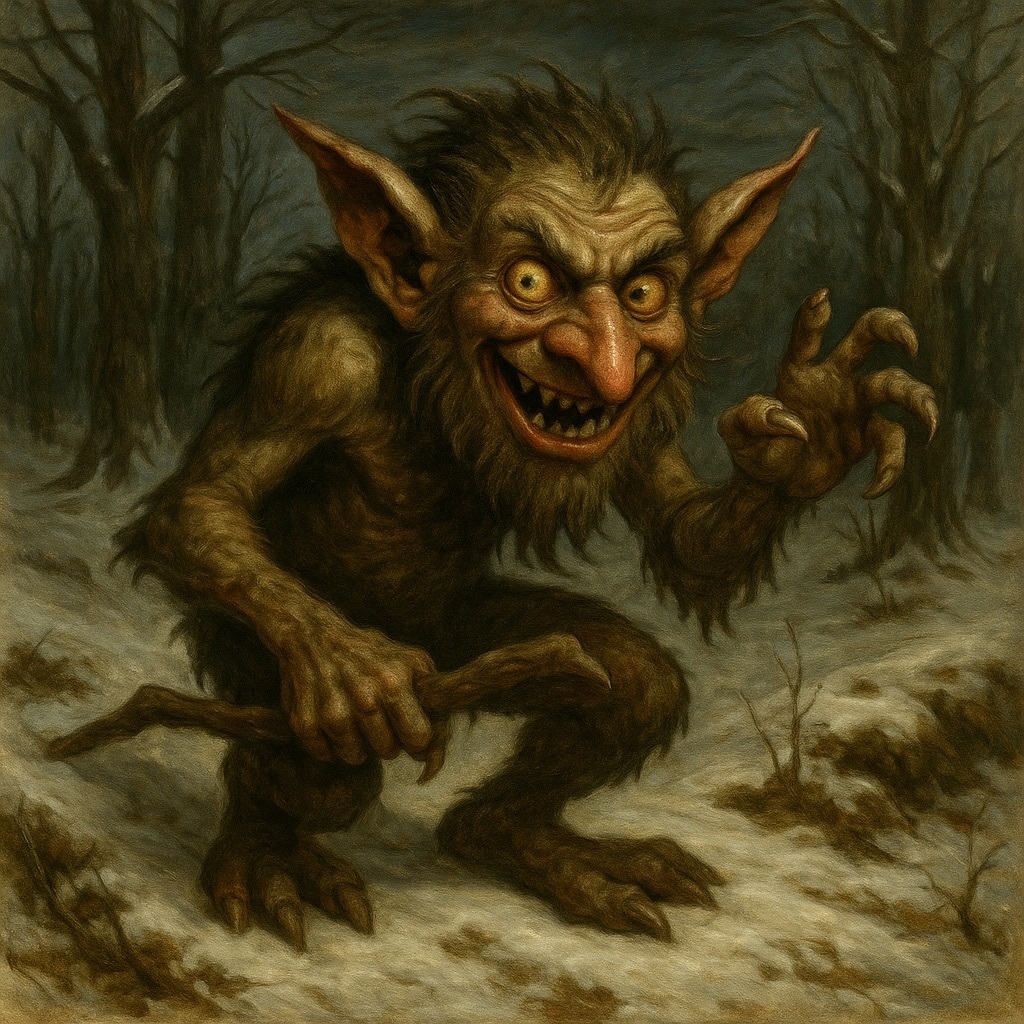
When the days grow short, when the winter nights stretch long and heavy with darkness, when the world feels closer to shadow than light—this is when the Greeks whisper of the Kallikantzaroi. These mischievous, goblin-like creatures are said to claw their way into the mortal world during the twelve days of Christmas, from December 25 until January 6, when the sun is weak, and the nights are at their deepest. They are grotesque yet comical, terrifying yet oddly entertaining, embodiments of chaos itself. They creep into villages, slipping into houses, spoiling food, tangling threads, extinguishing fires, and generally causing havoc in the lives of the unsuspecting.
But to understand the Kallikantzaros is to delve not only into folklore but into the soul of a people who lived by the rhythms of the earth, whose winters were long and dark, and whose imaginations peopled the shadows with tricksters and fiends. These goblin-creatures are not like demons of endless malice nor angels of eternal good. They are pranksters with a mean streak, spirits who mock the order of the world, delighting in mischief during the season when darkness is strongest.
Legends describe them in countless ways: some say they are small, no taller than children, with hairy bodies, long tails, glowing red eyes, and grotesque features—part human, part beast. Others imagine them as tall and gangly, their bodies thin and distorted, their voices shrill. They are often pictured as black-skinned from soot, crawling through chimneys to enter homes, their laughter echoing as they overturn pots, spoil milk, and even frighten children awake in the night. They thrive on chaos, and nothing pleases them more than to disrupt domestic life.
Yet, in a twist both humorous and terrifying, the Kallikantzaroi are said to spend the rest of the year—those long months when the world is green and bright—underground. There, in the bowels of the earth, they gnaw at the World Tree, hacking at its roots, trying to topple creation itself. Their goal is nothing less than destruction, the undoing of the cosmos, the collapse of existence. But when the twelve nights of Christmas arrive, when they could perhaps finish their task, they abandon it and rush to the surface world to play their pranks. By the time they return underground, the tree has healed, and their work must begin again. It is a cosmic cycle of futility, a darkly comic metaphor of endless struggle with no reward.
The symbolism is striking. The Kallikantzaroi are chaos embodied, yet their failure to topple the tree mirrors humanity’s resilience—the world endures despite the forces gnawing at it. Their annual return to the earth’s surface captures something profound about the winter holidays: they are not only times of light and joy but also times of unease, when darkness presses closer, and spirits stir. These creatures are the shadows cast by the bonfires of celebration, the reminder that even in the warmth of hearth and family, something wild lurks outside.
But if the Kallikantzaros was a source of fear, it was also a source of laughter. Greek villagers did not just dread them—they mocked them, tricked them, and invented ways to keep them at bay. Families would hang pork sausages, sweets, or other foods by the fire to distract the goblins. In some places, they left colanders outside the door, for the Kallikantzaroi were said to be compelled to count the holes—but, being unable to count to three (since “three” was holy), they would be trapped until dawn, forced to start again. Fires were kept burning, chimneys were blocked, and protective rituals recited, all to keep mischief-makers from entering. These practices reveal not only fear but humor, as if the people understood that chaos cannot be destroyed but can be distracted, managed, and even laughed at.
To humanize the Kallikantzaros is to recognize them as reflections of our own impulses. Who among us does not harbor a streak of mischief, a temptation to disrupt the order of things just for fun? They are our inner pranksters, made monstrous, exaggerated into fiends of folklore. Yet they also embody the chaos of winter itself: the way storms can snarl travel, the way darkness plays tricks on the mind, the way hunger and cold unsettle the spirit. They are a psychological expression of the season, making tangible the intangible stresses of survival during long, dark months.
There is also a deeper meaning in their failure to destroy the World Tree. The Kallikantzaroi’s story is not only about mischief but about futility. They labor endlessly, cutting at creation itself, only to abandon their task and find it undone. This speaks to the absurdity of chaos—it can disrupt, but it cannot ultimately triumph. Life, like the tree, heals itself. The forces of darkness can only nibble at the roots, never sever them. In this way, the goblins become strangely comforting, proof that while chaos will always return, order endures.
Modern Greece still remembers them fondly. While most no longer fear their pranks, stories of the Kallikantzaroi are told around the holidays, their grotesque features now more humorous than horrifying. In festivals, they sometimes appear in costume, their wildness celebrated rather than shunned. They are embraced as part of the season’s charm, reminders that laughter and fear can coexist. In a sense, they have become cultural mascots of the darker side of Christmas, proof that even holidays of light are incomplete without a shadow or two.
And perhaps that is why they remain so fascinating in a digital age. Social media thrives on mischievous, chaotic humor—the very energy of the Kallikantzaroi. One can imagine them as memes, as tricksters of the online world, disrupting order with jokes, chaos, and absurdity. They belong not only to the Greek mountains but to the human imagination wherever laughter meets fear, wherever darkness brushes against light.
The Kallikantzaros, then, is not only a goblin of winter but a symbol of the human condition. We are both builders and breakers, protectors and pranksters, forever caught between order and chaos. In their grotesque faces and crooked grins, we see both the danger of the dark and the joy of mischief. And when the nights are longest and the world feels fragile, their story reminds us that though chaos may climb through the chimney, light will return, the tree will stand, and life will go on.