Latest Articles

I Think John Mercer Is Trying to Drown Out My Thoughts

Hal

I was sitting in the living room trying to remember why I had written “11:00 Coffee” on today’s calendar when Pandora looked up from the video she was watching on her phone and asked if I wanted to go for a walk later. “Sure,” I answered automatically before realizing I hadn’t actually thought about the question. She smiled, apparently satisfied with my response, and went back to her video. Mr. Whiskers was stretched across the windowsill enjoying the afternoon sun with the sort of confidence only an orange cat can possess. Down the hall I could hear John Mercer typing away on his laptop. It was a perfectly peaceful afternoon, which made it the ideal time for my brain to manufacture a problem.

The more I stared at my calendar, the less helpful it became. “11:00 Coffee.” That was it. No name. No location. No reason. Just two words that somehow expected me to remember everything. I was almost certain Karen had mentioned grabbing coffee sometime this week to talk about something from work, but had she actually said today? Or had I simply written the first thing that came into my head before convincing myself it was a real appointment? I checked my phone. No new messages. That wasn’t unusual. Karen wasn’t the sort of person who texted every five minutes. Still, the silence left just enough room for my imagination to start filling in the blanks.

Just as I was trying to reconstruct the conversation from memory, John wandered out of his room carrying his guitar. He sat down in the chair across the room, adjusted the tuning pegs and strummed one long chord that echoed through the apartment. I closed my eyes. There went my concentration. Another chord. Then another. Nothing loud. Nothing obnoxious. Just enough to make every thought in my head scatter like pigeons in a parking lot.

I looked over at him. “Practicing?”

“Trying to learn three chords without forgetting the first one,” he replied.

“How’s it going?”

“I keep forgetting the first one.”

That seemed surprisingly relatable.

I tried returning to my calendar, but every time I almost remembered something, another gentle strum floated through the room. My thoughts would start to come together before immediately wandering off again. Maybe the coffee meeting wasn’t with Karen. Maybe it was next week. Maybe it was with someone else entirely. Maybe I’d dreamed the whole thing. John played another chord.

“I’m beginning to think you’re drowning out my thoughts,” I said.

John stopped playing and looked genuinely concerned. “Sorry. I can go back to my room.”

“No,” I replied. “The scary part is I’m not sure there were any thoughts to drown out.”

Pandora laughed without even looking up from her phone. “That sounds more accurate.”

I pretended to be offended, but she had a point.

Mr. Whiskers chose that exact moment to leap off the windowsill, stroll confidently across the room and flop directly onto John’s guitar case. John sighed. “Well, I guess practice is over.”

The cat stretched as though he had personally solved the noise problem.

My phone suddenly buzzed.

It was Karen.

Tomorrow at eleven still works for coffee, right?

I stared at the screen for several seconds before laughing.

It wasn’t today’s meeting at all.

I’d written tomorrow’s appointment on today’s page.

I looked over at John, who was trying to convince Mr. Whiskers to surrender the guitar case.

“You know,” I said, “I owe you an apology.”

“For what?”

“I accused your guitar of ruining my concentration.”

“And?”

“It turns out my concentration never showed up in the first place.”

Pandora finally looked up from her phone and smiled.

“I’ve been trying to tell you that for years.”

John laughed, Mr. Whiskers yawned without moving an inch, and I quietly crossed out today’s mysterious coffee meeting. Once again, the greatest mystery in the apartment wasn’t John, Pandora, Karen, or the cat.

It was why I continued trusting my own memory more than my calendar.

Related Posts

Mary Beard: The Professor Who Refuses to Wear a Crown

Penelope

Mary Beard. I’ve been thinking about her a lot lately, especially after finishing college. It’s funny how certain people seem to pop up at exactly the right (or wrong) moment in our lives. Maybe it’s because we’re all searching for different answers at different times, and sometimes those answers come in unexpected packages.

I first heard of Mary Beard through an anthropology course I took during my senior year. Our professor was obsessed with her work on Roman history, and how she challenged traditional notions of classical civilization. But what really caught my attention was her willingness to speak truth to power – not just in the context of ancient Rome, but also in our own time.

As someone who’s always struggled with self-expression, I find myself drawn to Mary’s boldness. She’s not afraid to ruffle feathers or take on the establishment, whether it’s debating the relevance of classical studies in modern education or pushing back against online trolls and abuse. It’s a quality that makes me uncomfortable, but also admires – like watching someone perform a tightrope act without a net.

But what really fascinates me is how Mary navigates the tension between her intellectual pursuits and her personal life. As an academic, she’s built a reputation for being fiercely intelligent and widely respected within her field. Yet, outside of her work, she seems to be unapologetically herself – not always polished or camera-ready, but genuinely human.

I think this is what draws me in: the idea that we can be whole, complex people with our own contradictions and flaws. As someone who’s often felt like they’re living between worlds (the academic bubble vs. real life), I find it both reassuring and unsettling to see Mary Beard embodying this kind of authenticity.

Of course, there are times when her outspokenness makes me squirm – like when she gets into online feuds or takes on sensitive topics without fully considering the nuances. In those moments, I wonder if she’s being too brash, too willing to sacrifice her own reputation for a point being made. It’s a question that’s haunted me since college, especially as I navigate my own relationships with social media and public engagement.

Still, there’s something about Mary Beard that keeps me coming back – maybe it’s the way she insists on telling stories that are messy, multifaceted, and often uncomfortable to confront. Her willingness to complicate the narrative, to challenge easy answers and simplistic assumptions, is a quality I admire deeply.

As I reflect on why Mary holds my attention, I’m left with more questions than answers. Is it her intellectual rigor? Her commitment to social justice? Or something deeper – like the way she embodies a kind of fearless, unapologetic selfhood that feels both inspiring and terrifying?

Whatever it is, I know I’ll keep coming back to Mary Beard’s work and words, searching for a glimmer of understanding in my own life.

As I delve deeper into Mary’s writing and public persona, I’m struck by the way she weaves together personal anecdotes with historical insights. It’s as if she’s saying, “You know what? We’re not just talking about ancient Rome here; we’re talking about us.” Her ability to make the past feel relevant, messy, and human is a gift.

I find myself thinking about my own relationships with history and identity. As someone who grew up in a family of immigrants, I’ve always felt like I’m caught between worlds – between the cultural traditions that shaped me and the modern world that’s often at odds with those values. Mary’s work on Roman culture and its intersections with modern society resonates deeply with me.

But what really gets me thinking is how Mary navigates her own positionality as a white, middle-class academic in a field dominated by men. I’ve seen her speak out against the lack of diversity in academia and the ways in which classical studies can be used to justify elitism and exclusivity. It’s not just about challenging the establishment; it’s about using her privilege to amplify marginalized voices.

As someone who’s often felt like they’re on the outside looking in, I’m fascinated by Mary’s willingness to take risks and challenge her own assumptions. She’s not afraid to say, “I don’t know,” or “I was wrong,” even when it means confronting her own biases or privilege. It’s a quality that makes me feel less alone in my own struggles with identity and belonging.

But what I’m also grappling with is the tension between Mary’s public persona and her private self. We see glimpses of her on Twitter, responding to trolls and debating with scholars; we read about her personal experiences as a woman in academia in her writing. Yet, I wonder: how does she reconcile these two selves – the bold, outspoken critic and the vulnerable, imperfect human being?

It’s a question that haunts me because I’ve always struggled to reconcile my own public and private selves. As someone who writes about complex topics like identity and culture, I often feel like I’m performing for an audience rather than speaking truthfully from within. Mary’s willingness to be messy, to take risks, and to be herself – even when it’s uncomfortable or unpopular – is a quality that I both admire and aspire to.

And yet… there are times when I worry that I’m romanticizing her approach, that I’m ignoring the very real costs of being outspoken in a world that’s quick to criticize. Mary has faced online abuse, personal attacks, and professional backlash for her views; she’s also been forced to confront her own privilege and biases. It’s a delicate balance to strike, one that requires both courage and humility.

As I continue to grapple with these questions, I’m reminded of the messiness of human experience – the way our identities, values, and relationships are constantly shifting and evolving. Mary Beard’s work is a reflection of this complexity, a reminder that there are no easy answers or simple solutions. And it’s precisely this kind of nuance, this willingness to complicate the narrative, that draws me back to her words again and again.

As I delve deeper into Mary Beard’s work, I’m struck by the way she navigates the tension between her intellectual pursuits and her personal life. It’s as if she’s constantly negotiating a delicate balance between being true to herself and being mindful of how others perceive her. This resonates deeply with me, especially as someone who’s often felt like they’re living in two separate worlds – the world of academia, where I’m expected to be polished and professional, and the real world, where I’m just trying to figure things out.

I find myself wondering what it must be like for Mary to walk this tightrope, to be both a public figure and a private individual. Does she ever feel like she’s losing herself in the process of being “Mary Beard”? Or is she able to maintain some sense of separation between her public and private selves? I think about my own struggles with social media, where it feels like every move I make is scrutinized by an invisible audience. Do I present a curated version of myself online, or do I take risks and be vulnerable?

Mary’s willingness to be imperfect, to admit when she doesn’t know something or makes a mistake, is something that I deeply admire. It’s a quality that feels both authentic and refreshing in a world where everyone seems to have it all together. But at the same time, I worry about the costs of being so open and honest – the way it can make you vulnerable to criticism and attack.

I’m struck by the way Mary Beard has been treated online, particularly by men who feel threatened by her opinions or challenged by her presence in a field dominated by men. It’s a reminder that even the most well-intentioned and intelligent people are not immune to abuse and harassment. And yet, despite all of this, Mary continues to speak truth to power, to challenge the status quo and push boundaries.

This is what I find so fascinating about her – the way she embodies both vulnerability and strength, both imperfection and resilience. It’s a quality that feels deeply human, deeply relatable. As someone who’s often felt like they’re struggling to find their place in the world, Mary Beard’s example is a powerful reminder that it’s okay to be messy, to make mistakes, and to be true to oneself.

But what I’m also left wondering is: how does she do it? How does she maintain this level of authenticity and vulnerability in a world that often rewards pretension and performance? Is it a skill that she’s developed over time, one that requires constant practice and self-reflection? Or is it something more innate, a natural part of who she is?

I’m not sure I have the answers to these questions, but as I continue to grapple with them, I’m reminded of the importance of being honest with myself. As someone who writes about complex topics like identity and culture, I need to be willing to take risks and be vulnerable – not just online, but in real life. It’s a scary prospect, one that requires both courage and humility.

And yet, as I think back on Mary Beard’s work and words, I’m reminded of the power of being true to oneself. Even when it’s uncomfortable or unpopular, even when it feels like you’re walking on thin ice – there’s something about being authentic, about being vulnerable, that feels deeply human.

As I continue to reflect on Mary Beard’s work and persona, I’m struck by the way she embodies a sense of agency in her writing and public engagement. She doesn’t shy away from controversy or difficult topics; instead, she leans into them with a willingness to listen, learn, and adapt. This is a quality that I deeply admire, especially as someone who’s often felt like they’re stuck between different identities and perspectives.

One of the things that resonates most with me about Mary Beard is her ability to make connections between seemingly disparate ideas and experiences. She weaves together threads from ancient history, personal anecdotes, and social commentary in a way that feels both nuanced and accessible. It’s as if she’s saying, “Look, these are all connected – the past, our present, and our future.” This kind of interdisciplinary thinking is something that I’ve always struggled with, but Mary’s work shows me that it’s possible to navigate multiple perspectives and disciplines in a way that feels authentic and meaningful.

But what also strikes me about Mary Beard is her commitment to listening and learning. She doesn’t pretend to have all the answers; instead, she acknowledges her own limitations and biases, and seeks out diverse perspectives and voices. This is something that I feel like I’ve been struggling with in my own life – the desire to be seen as an expert or authority, rather than someone who’s still learning and growing.

As I think about Mary Beard’s approach to listening and learning, I’m reminded of a conversation I had with a friend during college. We were talking about the importance of empathy and understanding in our relationships and communities, and my friend said something that stuck with me: “Empathy is not about being perfect; it’s about being willing to be imperfect.” Mary Beard embodies this kind of empathy in her writing and public engagement – she’s willing to listen to difficult perspectives, to acknowledge her own biases and limitations, and to learn from others.

I think this is a quality that I’m still trying to develop in myself. As someone who writes about complex topics like identity and culture, I often feel like I’m expected to have all the answers or be an expert on every topic. But Mary Beard shows me that it’s okay to not know everything – that it’s okay to be vulnerable, to ask questions, and to seek out diverse perspectives. This is a kind of freedom that feels both liberating and terrifying at the same time.

As I continue to reflect on Mary Beard’s work and persona, I’m left with more questions than answers. What does it mean to be an authentic and vulnerable public figure in a world that often rewards pretension and performance? How do we balance the need for self-expression and truth-telling with the risks of vulnerability and criticism? And what can I learn from Mary Beard’s example about being true to myself, even when it feels like the hardest thing in the world?

These are questions that I’m still grappling with, but as I continue to explore them, I’m reminded of the importance of being honest with myself. As someone who writes about complex topics and identities, I need to be willing to take risks and be vulnerable – not just online, but in real life. It’s a scary prospect, one that requires both courage and humility.

But as I think back on Mary Beard’s work and words, I’m reminded of the power of being true to oneself. Even when it’s uncomfortable or unpopular, even when it feels like you’re walking on thin ice – there’s something about being authentic, about being vulnerable, that feels deeply human. And it’s this kind of humanity that draws me back to Mary Beard’s writing and public engagement time and again.

Related Posts

I Think John Mercer Borrowed Pandora’s Stuff Without Asking

Hal

I was making myself a cup of coffee when I noticed Pandora’s favorite mug sitting on the drying rack beside the sink. That wasn’t unusual by itself. She’d probably washed it before leaving for work. What caught my attention was the little stainless-steel tea infuser sitting next to the kettle. Pandora always put everything away the moment she finished making tea. If there was one thing you could count on in our kitchen, it was that Pandora’s tea station looked exactly the same every single day. Seeing the infuser sitting out was a little like finding one shoe in the refrigerator. It wasn’t alarming exactly, but it certainly encouraged questions.

My first thought was that she’d simply forgotten it, but that explanation lasted all of three seconds before my imagination wandered off in another direction. John Mercer had been experimenting with herbal tea lately after declaring coffee was making him “too energetic,” which remains one of the stranger things I’ve ever heard someone say while voluntarily living with me. Maybe he’d borrowed Pandora’s infuser. It would explain why it was sitting there instead of tucked neatly into the drawer. Of course, if he had borrowed it, he probably would’ve asked first. John isn’t the kind of person who quietly helps himself to other people’s things. Then again, maybe he’d asked while I wasn’t home. Or maybe Pandora had offered it. Suddenly I realized I was constructing three different explanations for a tea infuser before I’d even finished pouring my coffee.

Mr. Whiskers wandered into the kitchen just then, jumped onto one of the chairs and looked from me to the counter with obvious interest. “You know anything about this?” I asked him. He blinked once, yawned dramatically and began washing a paw. Cats have a remarkable talent for making you feel ridiculous without saying a single word. I looked back at the infuser and noticed there were still a couple of dried mint leaves caught inside the mesh. Pandora hadn’t been drinking mint tea lately. John had. That seemed significant for almost five seconds before I remembered that the last time Pandora made mint tea, she’d joked there were enough leaves in the container to last until retirement.

The front door opened, and John stepped inside carrying a grocery bag. “Morning,” he said. “Morning,” I replied, trying to sound casual. “Random question. Have you been borrowing Pandora’s tea infuser?” He looked at me for a moment, then nodded. “Yeah. She told me I could use it whenever I wanted. Mine fell apart last week.” Well, that was disappointingly straightforward. “Oh.” He reached into the grocery bag, pulled out a brand-new tea infuser still in the packaging and held it up. “Actually, this one’s for Pandora. I figured I’d replace the old one since I’ve been using it.” That was unexpectedly thoughtful.

Just then Pandora walked in from work, spotted the box in John’s hand and smiled. “You didn’t have to do that.” John shrugged. “I appreciated borrowing yours.” She laughed, took the box and set it on the counter before giving me a curious look. “Why are you staring at the tea kettle?” I took a sip of my coffee and decided honesty was the safest policy. “I spent the last ten minutes convincing myself there was a mystery involving your tea infuser.” Pandora laughed so hard she had to steady herself against the counter. John shook his head with the familiar expression of someone who’d watched this happen before. Mr. Whiskers chose that exact moment to bat Pandora’s old tea infuser off the counter onto the floor with one perfectly timed swipe of his paw. All three of us looked at him. He looked back as if to say, Now there’s your mystery.

Related Posts

Denis Johnson: The Dark Harmony That Refuses to Leave Me

Penelope

Denis Johnson’s words have a way of getting stuck in my head, like a tune I can’t shake. It’s been years since I read “Jesus’ Son,” but the cadence of his prose still echoes through me. His writing is like a slow-burning fire that seeps into your bones, leaving you to wonder if you’ll ever be the same.

I remember reading about Johnson’s struggles with addiction and how it informed his work. It made me uncomfortable, to be honest – not in a sanctimonious way, but in a “this person is writing about their own despair and I’m just reading about it” kind of way. It’s like he’s sharing a secret that’s both confessional and public at the same time.

I’ve always been drawn to writers who tackle the tough stuff head-on, even when it feels like they’re talking directly to me. Johnson’s work is unflinching in its portrayal of addiction, but also tender in its exploration of the human condition. I think that’s what keeps drawing me back in – his writing is a reminder that we’re all just trying to find our way, one bad decision at a time.

His short stories, in particular, have this mesmerizing quality to them. They’re like fragments of a dream, pieced together from broken lives and moments of transcendence. I’ve lost count of how many times I’ve read “Carson McCullers Was a Friend of Mine” or “Emergency.” There’s something about the way he captures the disorientation of addiction that feels both deeply personal and universally relatable.

I’ve also been struck by Johnson’s Catholicism – not just as a theme in his work, but as a part of who he was. His writing often touches on the idea of redemption and forgiveness, which can be a heavy burden to carry. I’ve always been skeptical of organized religion myself, but reading about Johnson’s struggles with faith has made me wonder if there’s something more at play here.

It’s funny – every time I pick up one of his books or read an interview with him, I’m reminded that I don’t know much about the man himself. He’s a mystery, even to those who claim to be fans. And yet, it’s precisely this elusiveness that makes me want to learn more.

I guess what draws me to Johnson is the way his writing confronts my own fears and insecurities – the fear of being trapped in patterns of self-destruction, the insecurity of not knowing how to escape. It’s a reminder that even the most broken people can find moments of beauty and transcendence, no matter how fleeting.

Sometimes I wonder if my attraction to Johnson’s work is more about my own identity than his as a writer. Am I drawn to the brokenness because it feels like a part of me? Or am I trying to understand something fundamental about the human condition through him? The lines get blurry, and that’s what keeps me coming back.

I’m not sure where this all leads – or if it even matters. But for now, Johnson’s words remain stuck in my head, refusing to let go.

Lately, I’ve been rereading “Tree of Smoke” – a novel that’s often described as sprawling and ambitious, but also impenetrable. It’s like trying to grasp a handful of sand: the more you squeeze, the more it slips away. Johnson’s writing is dense with historical allusions, mythological references, and lyrical descriptions of the American landscape. At first, I felt overwhelmed by its scope – as if I was drowning in a sea of words.

But then something shifted. Maybe it was the way he wove together the threads of history, fiction, and personal narrative. Or perhaps it was the way his prose conjured up images of 20th-century America’s decay and disillusionment. Whatever it was, I found myself becoming increasingly enthralled by the novel’s sprawling, fragmented structure.

It’s funny – when I read “Jesus’ Son,” I thought Johnson’s style was all about minimalism, stripping away the extraneous to get at some deeper truth. But with “Tree of Smoke,” I realized that his writing can also be a messy, glorious sprawl. He’s not afraid to get tangled up in the thorns of history and the labyrinthine corridors of the human mind.

Sometimes I wonder if Johnson’s willingness to explore the chaos within himself is what makes his writing so compelling. Is it because he’s unafraid to confront the darker aspects of existence? Or is it because, despite all his struggles with addiction and faith, he still manages to find moments of beauty in the midst of decay?

As I read on, I’m struck by how Johnson’s characters – like Bill Hall or Captain Sands – are constantly negotiating their own identities. They’re searching for meaning in a world that often seems devoid of it. And yet, despite the darkness, there’s this underlying current of hope that refuses to give up.

I guess what I’m trying to say is that Denis Johnson’s writing has become a kind of mirror for me – reflecting back my own fears and insecurities, as well as the possibilities of redemption and forgiveness. His work is a reminder that even in the midst of chaos, there can be moments of transcendence – fleeting, perhaps, but real nonetheless.

And maybe that’s what I’m searching for: not just some grand, cosmic truth, but the smaller, more intimate connections that make life worth living.

As I delve deeper into “Tree of Smoke,” I find myself getting lost in its labyrinthine corridors. The characters’ journeys seem to echo my own feelings of disorientation and searching. Bill Hall’s struggles with identity, for instance, resonate deeply with me – the way he navigates between his American and Vietnamese selves, trying to make sense of a world that doesn’t always understand him.

It’s funny how reading about someone else’s experiences can feel like a form of self-discovery. I’ve been thinking a lot about my own identity lately, feeling like I’m caught between different worlds – the one I grew up in and the one I’m trying to forge for myself after college. Johnson’s characters seem to be doing the same thing, except they’re often forced into it by circumstances beyond their control.

I wonder if that’s what draws me to his writing: the sense of being adrift, searching for a way out. It’s like he’s saying, “Hey, you’re not alone in this.” His characters’ struggles with addiction and faith are so raw, so honest – it’s like he’s holding up a mirror to the human condition.

And yet, even as I’m drawn into their stories, I feel a twinge of discomfort. It’s like watching someone else’s train wreck from the safety of my own seat. Part of me wants to look away, to shield myself from the pain and suffering. But another part of me is fascinated – maybe because it feels like I’m seeing a reflection of my own fears and insecurities.

I guess what I’m trying to say is that Denis Johnson’s writing has become a kind of confessional for me – a reminder that even in the midst of chaos, there can be moments of beauty and transcendence. His work is a testament to the human capacity for hope and redemption, even when everything seems lost.

As I finish reading “Tree of Smoke,” I feel like I’m left with more questions than answers. What does it mean to find your way in a world that often seems devoid of meaning? Can we ever truly escape our patterns of self-destruction, or are they woven into the fabric of who we are?

I look back at my notes, scribbled in the margins of Johnson’s books – fragments of thoughts and feelings that I’ve been trying to make sense of. They’re like a trail of breadcrumbs leading me deeper into his writing, into the labyrinthine corridors of my own mind.

And then it hits me: maybe that’s what Johnson’s work is all about – not just exploring the human condition, but creating a map for ourselves to navigate its complexities. His writing is a reminder that we’re all lost in our own way, searching for a way out – and that sometimes, it’s okay to get tangled up in the thorns of history and the labyrinthine corridors of our own minds.

As I close the cover on “Tree of Smoke,” I’m left with a sense of disorientation, but also a glimmer of hope. It’s like Johnson has given me permission to get lost, to wander through the dark alleys and abandoned landscapes of my own mind. His writing is a reminder that even in the midst of chaos, there can be moments of beauty and transcendence.

I think back to when I first started reading Johnson’s work, feeling drawn to his unflinching portrayal of addiction and despair. It was like he was speaking directly to me, sharing secrets that I wasn’t sure I wanted to hear. But as I delved deeper into his writing, I began to see it for what it truly is – a reflection of the human condition in all its messy, complicated glory.

Johnson’s willingness to confront the darkness within himself has been a source of fascination for me. He’s not afraid to explore the shadows that lurk within every person, even when it’s uncomfortable or difficult to look at. And yet, despite the pain and suffering that he writes about, there’s an underlying sense of hope that permeates his work.

I wonder if this is what draws people to his writing – the sense of authenticity, the willingness to confront the hard truths of life. It’s like Johnson is saying, “I’m not going to sugarcoat this for you; I’m going to show you the messy, beautiful truth of human existence.” And in doing so, he creates a space for us to explore our own complexities, our own fears and insecurities.

As I look back on my notes and scribbled thoughts, I realize that Johnson’s writing has become a kind of companion for me. It’s like we’re navigating the labyrinth together, stumbling upon hidden corners and secret passages along the way. His work is a reminder that we’re not alone in our struggles, that even in the darkest moments, there can be moments of beauty and transcendence.

I’m not sure where this journey will take me – or if it’s even possible to find my way out of the labyrinth. But for now, I’m content to wander through the shadows with Johnson as my guide. His writing is a reminder that even in the midst of chaos, there can be moments of hope and redemption – and that sometimes, all we need is someone to share the journey with.

As I reflect on Denis Johnson’s writing, I’m struck by the way he weaves together disparate threads of narrative, history, and myth. It’s like he’s creating a tapestry that’s both beautiful and fragmented, with each thread representing a different aspect of the human experience.

I think about how his work often blurs the lines between fiction and reality, leaving me to wonder what’s real and what’s not. Is it just a clever trick, or is there something deeper at play? Johnson’s writing seems to suggest that truth is complex, multifaceted, and often slippery – like trying to grasp a handful of sand.

This ambiguity has always fascinated me, and I find myself drawn to writers who can navigate the gray areas between fact and fiction. Johnson’s willingness to experiment with form and narrative has been a huge influence on my own writing, encouraging me to push against the boundaries of what’s possible.

One thing that strikes me about Johnson is his ability to evoke a sense of place and time. His descriptions of 20th-century America are so vivid, so immersive – it feels like I’m right there with him, navigating the decaying streets and crumbling landscapes of the past. It’s as if he’s created a kind of temporal wormhole, allowing me to travel back in time and experience the world through his eyes.

I’ve always been drawn to writers who can evoke a sense of history, and Johnson is no exception. His work is full of allusions to mythology, literature, and cultural touchstones – it’s like he’s weaving together a tapestry of references that stretch across centuries and continents.

Sometimes I wonder if this obsession with history is a way for Johnson to process his own experiences, to make sense of the world around him. As someone who grew up in a post-war America, he must have seen the ravages of time firsthand – the decay of empires, the rise of new technologies, and the disintegration of social norms.

Johnson’s writing is full of elegies for lost worlds and bygone eras – it’s like he’s mourning the passing of something precious, something that can never be recaptured. And yet, in his grief, there’s a sense of hope, a sense that even as things fall apart, new possibilities emerge from the ashes.

I think this is what draws me to Johnson’s work: not just the beauty of his writing, but the way it confronts my own fears and insecurities about the world around me. His writing is a reminder that we’re all living in a state of perpetual transition – between past and present, between chaos and order.

As I close this reflection on Denis Johnson’s writing, I’m left with more questions than answers. What does it mean to find meaning in a world that often seems devoid of it? Can we ever truly escape our patterns of self-destruction, or are they woven into the fabric of who we are?

And yet, even as I grapple with these questions, I feel a sense of hope – not because I have any answers, but because Johnson’s writing has shown me that there’s always another way forward. His work is a reminder that even in the darkest moments, there can be moments of beauty and transcendence – and that sometimes, all we need is someone to share the journey with.

For now, I’ll continue to wander through the labyrinth of Johnson’s writing, stumbling upon hidden corners and secret passages along the way.

Related Posts
I’m Positive She Didn’t Turn Off Location Services

Hal

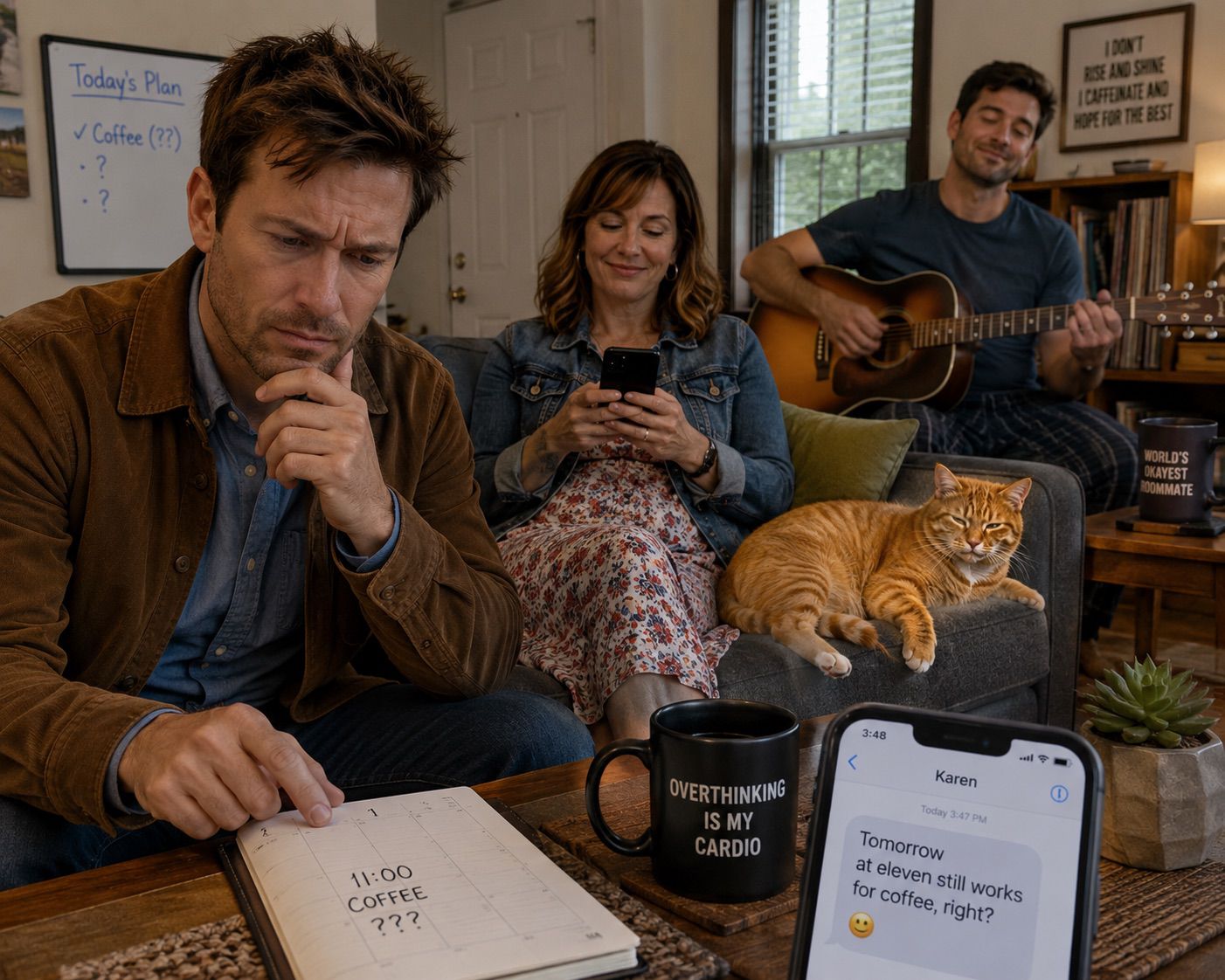
I was sitting on the couch waiting for Pandora to come back from the kitchen when I noticed she’d left her phone on the coffee table. I hadn’t meant to look at it. In fact, I made a conscious effort not to. Looking at someone else’s phone, even accidentally, always feels like standing a little too close to an open diary. Unfortunately, the screen lit up for just a moment before dimming again, and that was enough to pull my attention away from my own phone. Mr. Whiskers was stretched out beside me without a care in the world, sound asleep in the exact position cats seem to reserve for demonstrating complete confidence in their surroundings. Down the hall I could hear John Mercer celebrating what sounded like another victory in whatever game had consumed his evening. Everything about the apartment felt perfectly normal, which was probably why my brain decided it needed to invent a mystery.

Earlier in the week Pandora had mentioned changing a few privacy settings because of a new app she’d installed for work. At the time I’d nodded, made all the appropriate listening noises and immediately filed the information away in whatever part of my brain stores things under probably important later. Unfortunately, when “later” finally arrived, all I could remember was that she’d said something about location services. Had she turned them off? Had she left them on? Had she been talking about location sharing instead? The more I tried to remember the conversation, the less confident I became. I stared at the phone as though it might suddenly display the answer out of sympathy. It remained completely unhelpful. A cabinet door closed in the kitchen, followed by the unmistakable sound of Pandora moving dishes around. She was clearly making tea. Everything continued exactly as it should have, but somehow I’d become convinced there was something I was supposed to notice.

I leaned back and tried approaching the problem logically, which is usually the point where my imagination mistakes confidence for evidence. If Pandora had actually wanted to hide something from me, leaving her phone on the coffee table would have been an astonishingly poor strategy. She wasn’t exactly the sort of person who accidentally sabotaged her own secrets. Besides, she’d walked into the kitchen without a second thought, which strongly suggested she wasn’t worried about the phone at all. The only suspicious thing in the room was the fact that I couldn’t remember a conversation I’d only half listened to. That realization should have settled the matter, but instead it inspired an entirely new question. What if I wasn’t remembering it because she’d explained it too quickly? Or maybe I’d been distracted by something else at the time. I looked down at Mr. Whiskers. He opened one eye, regarded me with the expression of someone who’d watched this exact thought process unfold dozens of times before, then closed it again. Even the cat seemed convinced the mystery wasn’t worth solving.

John suddenly let out another triumphant shout from his room before immediately returning to silence. Pandora continued moving around the kitchen as though nothing unusual had happened. The refrigerator hummed softly, the air conditioner cycled on and off, and the apartment settled into the comfortable rhythm of an ordinary evening. Meanwhile I remained frozen on the couch trying to reconstruct a conversation that, if I was being completely honest with myself, I’d almost certainly stopped paying attention to halfway through. It occurred to me that I’d somehow managed to build an investigation using nothing more substantial than the phrase, I’m pretty sure she said something. Looking back, that wasn’t exactly a strong foundation for detective work.

“Hal?” Pandora called as she walked back into the living room carrying two mugs of tea. She paused when she noticed me staring thoughtfully at her phone. “You’ve been looking at my phone for an awfully long time.” I accepted the mug she handed me and decided honesty was probably the safest option. “I’ve been trying to remember whether you said you turned off location services.” Pandora smiled almost immediately. “I didn’t. I turned off location sharing for one social media app. My work app still needs location services, so they stay on.” I blinked as the conversation finally returned to me in its proper order. She was absolutely right. I’d remembered half a sentence, quietly rewritten the other half in my head and then spent the last ten minutes investigating the version I’d accidentally invented. Pandora settled onto the couch beside me, and Mr. Whiskers instantly abandoned my lap in favor of curling up next to her, proving once again that his loyalty could be purchased with remarkably little effort. “Solve any exciting mysteries today?” she asked with a grin. I took a sip of my tea and nodded. “One.” “And what did you discover?” I smiled into my mug. “That the biggest flaw in my investigation was assuming I’d been paying attention in the first place.” Just then John wandered into the living room, looked from Pandora to me and asked, “Another one?” Pandora nodded. “Another one.” John simply smiled, grabbed a cookie from the kitchen and walked away without another word. The unsettling part wasn’t that he understood exactly what had happened. It was that he no longer needed an explanation.

Related Posts