Latest Articles

Beyond Sunscreen: Restoring the Skin Barrier

Fiona

As summer wears on, the cumulative effects of too much sun and too many products can leave skin looking and feeling damaged. The usual culprits are well-known: prolonged exposure to UV rays, over-exfoliation, and the misuse of harsh chemicals, all of which can disrupt the delicate balance of the skin barrier. It’s a common dilemma, one that prompts many to seek out quick fixes and trendy products promising instant repair. However, these solutions often overlook the underlying issue, treating the symptoms rather than addressing the root cause of the problem.

The skin barrier, a complex system designed to protect the body from external stressors, is all too easily compromised by our attempts to care for it. When this happens, the skin becomes vulnerable to irritation, dryness, and a host of other issues that can be both uncomfortable and unsightly. Rather than reaching for the latest miracle cream or treatment, it’s essential to take a step back and consider the science behind the skin barrier. By understanding how it functions and what disrupts it, we can begin to repair the damage that’s been done. For instance, the stratum corneum, the outermost layer of the skin, is responsible for preventing water loss and protecting against external aggressors. When this layer is compromised, either through over-exfoliation or the use of harsh products, the skin becomes susceptible to dryness and irritation.

Furthermore, the skin’s natural pH balance can be disrupted, leading to a range of problems, from acne to premature aging. This is because the skin’s pH level is slightly acidic, ranging from 4.5 to 5.5, and using products that are too alkaline or acidic can throw off this delicate balance. To mitigate this, it’s crucial to choose products that are formulated with the skin’s natural pH in mind. Additionally, being mindful of the products we use and how they interact with one another is vital. For example, using a product containing alpha-hydroxy acids (AHAs) or beta-hydroxy acids (BHAs) can be beneficial for exfoliating the skin, but using too many products containing these ingredients can lead to over-exfoliation and irritation.

Repairing the skin barrier requires a thoughtful and restrained approach. Rather than relying on a plethora of products, each promising to address a specific issue, it’s often more effective to simplify our skincare routines and focus on using fewer, better products. This might involve switching to gentle, fragrance-free cleansers and moisturizers, avoiding over-exfoliation, and being mindful of the products we use and how they interact with one another. By taking a more minimalist approach to skincare, we can reduce the risk of further irritating the skin and create an environment in which it can heal. For instance, using a gentle cleanser that is formulated for our skin type, followed by a rich moisturizer that provides long-lasting hydration, can be an effective way to repair and protect the skin barrier.

As the seasons change, so too must our skincare routines. Summer’s heat and humidity necessitate adjustments in how we care for our skin, from using lighter, more breathable products to being more diligent about protecting ourselves from the sun. This might involve seeking shade, wearing protective clothing, and applying sunscreen regularly throughout the day. By adapting our skincare routines to the demands of the season, we can help mitigate the damage caused by environmental stressors and promote healthier, more resilient skin. For example, using a lightweight moisturizer that is formulated with hyaluronic acid can provide long-lasting hydration without clogging pores or feeling greasy in the summer heat.

The connection between overall wellness and skin health cannot be overstated. A healthy diet, adequate hydration, and effective stress management all play a critical role in maintaining the integrity of the skin barrier. When we neglect these aspects of our health, our skin can suffer, becoming dull, dry, and more prone to irritation. Conversely, by prioritizing our overall wellness, we can create an environment in which our skin can thrive, looking and feeling its best. For instance, drinking plenty of water throughout the day can help to keep the skin hydrated from the inside out, while eating a diet rich in fruits, vegetables, and whole grains can provide essential nutrients that support skin health.

When it comes to navigating the often-confusing world of skincare products, it’s essential to approach with a discerning eye. Rather than being swayed by trendy ingredients or lofty claims, we should look for products that are simple, effective, and formulated with natural ingredients. This might involve opting for products that are labeled as “fragrance-free” or “hypoallergenic,” as these are often less likely to irritate the skin. By being more mindful of the products we use and how they interact with our skin, we can reduce the risk of further damage and promote a healthier, more balanced complexion. For example, using a product containing niacinamide, a form of vitamin B3, can help to improve the appearance of fine lines and wrinkles, while also supporting the skin’s natural barrier function.

In my own skincare journey, I’ve found that repairing the skin barrier after too much sun and too many products requires a kind of quiet patience. It’s about simplifying our routines, letting go of the notion that more is better, and instead opting for fewer, higher-quality products that genuinely support our skin’s health. I recall a summer when I stripped my routine back to just a gentle cleanser, a rich moisturizer, and a broad-spectrum sunscreen – and watched as my skin slowly began to heal and flourish. This experience taught me that sometimes, the most powerful skincare strategy is not about adding more products, but about creating space for our skin to breathe, to heal, and to rediscover its natural balance.

As we move forward, it’s worth remembering that true beauty is rarely the result of elaborate routines or expensive products. Rather, it’s often the culmination of small, thoughtful choices made with our overall health and wellness in mind. By embracing this approach, we can cultivate a quiet confidence that radiates from within, a sense of self that is unshakeable and unwavering. And it’s this, perhaps, that is the greatest beauty of all – a beauty that is not just skin-deep, but one that permeates every aspect of our lives, shining brightly for all to see. By prioritizing our overall wellness, simplifying our skincare routines, and being mindful of the products we use, we can promote healthier, more resilient skin that glows with a radiant, inner light.

repairing the skin barrier is not just about fixing a specific problem, but about adopting a holistic approach to skincare that takes into account the complex interplay between our skin, our environment, and our overall health. we can create a foundation for long-term skin health that is built on a deep understanding of the skin’s natural functions and needs. This might involve seeking out professional advice from a dermatologist or skincare expert, who can provide personalized guidance and recommendations tailored to our individual skin types and concerns. Alternatively, it might involve taking the time to educate ourselves about the science behind skincare, and learning how to read product labels and make informed choices about the products we use.

As we navigate the complexities of skincare, it’s essential to remain grounded in a sense of realism and humility. There is no one-size-fits-all solution to skin health, and what works for one person may not work for another. By acknowledging this, and approaching our skincare routines with a sense of curiosity and openness, we can begin to uncover the unique needs and rhythms of our own skin, and develop a personalized approach that honors its individuality. This might involve keeping a skincare journal, where we track our progress, note any changes or reactions, and refine our routines accordingly. Alternatively, it might involve seeking out online communities or forums, where we can connect with others who share similar skin concerns and learn from their experiences.

In the end, repairing the skin barrier is not just about achieving a specific goal, but about embarking on a journey of self-discovery and exploration. It’s about learning to listen to our skin, to honor its needs, and to cultivate a sense of compassion and understanding that extends far beyond the realm of skincare. we can unlock a deeper sense of beauty and well-being that is not just skin-deep, but one that radiates from the very core of our being, shining brightly for all to see. As we move forward on this journey, it’s worth remembering that the skin barrier is not just a physical entity, but a symbol of our overall health and resilience – a reminder that true beauty is not just something we see, but something we feel, deep within our very souls.


Related Posts

Vera Brittain: When Loss is Your Home Address

Penelope

Vera Brittain’s letters have been haunting me for weeks now, like a quiet echo that refuses to fade away. I first stumbled upon her name while browsing through a used bookstore, and something about the title “Testament of Youth” resonated with me on a deep level. As I began reading her memoir, I felt an unsettling sense of familiarity with her experiences – not because we lived parallel lives or shared similar circumstances, but because I sensed a kindred spirit in her.

Brittain’s writing is raw and unflinching, laying bare the brutal realities of war and loss. Her words cut through the sanitizing veneer that often accompanies historical accounts, forcing me to confront the messy, human side of conflict. What drew me in was not just her remarkable story – though it is undeniably compelling – but the way she navigated the darkest corners of existence with unflinching honesty.

I’ve always been drawn to writers who dare to be vulnerable, to expose their fears and doubts without pretension or apology. Brittain’s letters, which I later devoured after finishing her memoir, are a testament (no pun intended) to this courage. In them, she bares her soul, revealing the inner turmoil that accompanied her experiences as a nurse during World War I. Her words are infused with a sense of uncertainty, of questioning her own convictions and moral compass in the face of unimaginable horrors.

As I read through Brittain’s letters, I found myself reflecting on my own relationship with vulnerability. Growing up, I was always encouraged to be “tough” – not just as a physical defense mechanism, but also as an emotional one. I learned to mask my fears and doubts, to present a façade of confidence that belied the uncertainty simmering beneath the surface. Brittain’s writing challenged this notion, making me realize that vulnerability is not weakness, but rather a strength born from facing the darkest corners of existence head-on.

But it’s not just her bravery that fascinates me – it’s also the way she grappled with the aftermath of war, the lingering trauma that haunted her long after the fighting had stopped. Her writing often dwells on the complexities of grief, the impossible task of processing loss and finding a new sense of purpose in its wake. This resonated deeply with me, as I’ve struggled to make sense of my own experiences with loss – not on the same scale, of course, but nonetheless, I’ve grappled with the weight of absence and the search for meaning.

I’m struck by how Brittain’s writing is both deeply personal and universally relatable. Her struggles are not unique to her experience; they’re common to many who have navigated the darker corners of life. As I read through her letters, I felt a sense of solidarity with this woman, born from our shared humanity rather than any specific circumstance.

There’s something disconcerting about reading someone else’s raw emotions, their innermost thoughts and fears. It’s as if we’re trespassing on private territory, one that feels both intimate and uncomfortable at the same time. Brittain’s writing makes me confront my own vulnerabilities, to acknowledge the places where I’m still uncertain or afraid.

And yet, it’s this willingness to be vulnerable – to expose ourselves in all our messy complexity – that draws me to her words. In a world where we’re often encouraged to present a curated version of ourselves, Brittain’s writing is a powerful reminder that true strength lies in embracing our fragility, in acknowledging the spaces where we’re still growing and learning.

I’m not sure what I’ll take away from Vera Brittain’s letters or memoirs. Perhaps it’s the realization that vulnerability is not something to be ashamed of, but rather a necessary step towards healing and growth. Or maybe it’s simply the sense that I’m not alone in my struggles – that there are others who have navigated similar terrain, with all its attendant fears and doubts.

For now, Brittain’s words linger within me, a quiet reminder that we’re all connected by our shared humanity – even in the darkest corners of existence.

As I continue to read through Vera Brittain’s letters, I’m struck by the way she weaves together fragments of her own story with those of others. Her writing is not just a personal memoir, but also a testament to the interconnectedness of human experience. She shares stories of her friends and comrades who fell during the war, their deaths still raw and painful in her mind. In doing so, she humanizes the abstract concept of “loss,” making it feel more tangible and relatable.

I find myself wondering about the role of nostalgia in Brittain’s writing. On one hand, her letters are infused with a deep sense of longing for a lost era – the pre-war world that existed before the Great War ravaged Europe. Her words are tinged with a bittersweet melancholy, as if she’s mourning not just the people who died, but also the innocence and simplicity of a bygone age.

At the same time, I’m aware that nostalgia can be a complex emotion – one that often masks a deeper discomfort or unease. Brittain’s writing doesn’t shy away from the brutal realities of war, nor does it romanticize the pre-war era. Instead, she grapples with the contradictions and complexities of human experience, revealing the messy, imperfect nature of memory.

As I reflect on my own experiences with nostalgia, I realize that I’ve often used it as a coping mechanism – a way to avoid confronting the present or dealing with difficult emotions. Brittain’s writing challenges this notion, encouraging me to approach nostalgia with a more nuanced perspective. Perhaps, she suggests, our memories and experiences are not just a source of comfort, but also a reminder of the fragility and impermanence of human life.

I’m drawn to the way Brittain navigates these complexities – her willingness to confront difficult emotions head-on, without sugarcoating or romanticizing them. Her writing is a powerful reminder that true growth and healing often require us to face our vulnerabilities, rather than hiding from them. As I continue to read through her letters, I’m struck by the sense of depth and introspection that permeates every page – a testament to the enduring power of vulnerability and self-awareness.

As I delve deeper into Brittain’s letters, I find myself pondering the concept of time and its relationship to memory. She writes about the past with such vivid detail, as if it’s still unfolding before her eyes. Her words transport me to a different era, one that feels both foreign and familiar at the same time.

I’m struck by how Brittain’s experiences during World War I have left an indelible mark on her perspective of time. She writes about the way time seemed to slow down during those years – as if every moment was stretched out like a thread, pulling her in different directions. This notion resonates with me, as I’ve often felt like time is warped and distorted when I’m dealing with loss or uncertainty.

As I reflect on my own experiences, I realize that Brittain’s writing has given me permission to slow down and savor the moments that feel particularly poignant. In a world that’s increasingly fast-paced and demanding, it’s easy to get caught up in the present and forget to appreciate the complexities of memory. Brittain’s letters remind me that time is not always linear – that our experiences can be messy and non-linear, full of twists and turns that defy chronological order.

I’m also drawn to the way Brittain explores the concept of identity in her writing. As a nurse during World War I, she was forced to confront her own mortality and the fragility of human life. This experience had a profound impact on her sense of self, leading her to question who she was outside of her relationships and circumstances.

I find myself wondering if Brittain’s experiences with identity are relevant to my own life. As someone who’s struggled to define themselves in recent years, I’m drawn to the idea that our identities are fluid and constantly evolving. Brittain’s writing suggests that we’re not fixed entities – that we’re capable of growth, change, and transformation.

As I continue to read through her letters, I’m struck by the sense of introspection and self-awareness that permeates every page. Brittain’s writing is not just a personal memoir; it’s also a testament to the power of vulnerability and self-reflection. Her words remind me that true growth and healing require us to confront our fears, doubts, and uncertainties head-on – rather than hiding from them or pretending they don’t exist.

In many ways, Brittain’s writing has become a mirror for me, reflecting back my own struggles with identity, nostalgia, and the complexities of human experience. Her words have given me permission to slow down, savor the moments that feel particularly poignant, and confront my fears and doubts in a way that feels authentic and vulnerable. As I continue to read through her letters, I’m not sure what I’ll take away from this experience – but I know it will be something profound and lasting.

As I delve deeper into Brittain’s letters, I find myself thinking about the concept of legacy and how it relates to our experiences. She writes about her own fears and doubts regarding her future, and the weight of responsibility she felt as a woman during World War I. Her words are infused with a sense of uncertainty, as if she’s grappling with the idea that her choices will have lasting consequences.

I’m struck by the way Brittain’s writing highlights the tension between individual agency and societal expectations. She navigates the complexities of being a woman in a patriarchal society, where women were expected to conform to certain norms and roles. Her experiences as a nurse during the war only added to this sense of constraint, as she was forced to navigate the boundaries between her personal life and professional duties.

As I reflect on my own life, I realize that Brittain’s writing has given me permission to question the expectations placed upon me. Growing up, I was always encouraged to pursue a “stable” career, one that would provide financial security and social status. But as I’ve grown older, I’ve begun to wonder if this is truly what I want for myself.

Brittain’s letters have made me realize that our choices and experiences are not just personal, but also deeply influenced by the cultural and historical contexts in which we live. Her writing challenges me to think more critically about the expectations placed upon women, particularly during times of war and social upheaval.

I’m drawn to the way Brittain explores the intersectionality of her experiences – how being a woman, a nurse, and an artist all intersected and influenced one another. Her writing is not just a personal memoir; it’s also a testament to the complexities of identity and experience.

As I continue to read through her letters, I’m struck by the sense of hope that permeates every page. Despite the brutal realities of war and loss, Brittain’s writing is infused with a sense of resilience and determination. Her words are a reminder that even in the darkest moments, there is always a glimmer of light – a chance for growth, healing, and transformation.

I’m not sure what I’ll take away from this experience, but I know it will be something profound and lasting. Brittain’s writing has given me permission to question my own expectations and desires, to explore the complexities of identity and experience, and to find hope in the darkest moments.

As I finish reading Vera Brittain’s letters, I’m left with a sense of awe and reverence for her courage and resilience. Her writing has been a mirror held up to my own experiences, reflecting back my struggles with identity, nostalgia, and the complexities of human experience. But it’s not just her bravery that impresses me – it’s also her willingness to be vulnerable, to expose her fears and doubts in the face of unimaginable horrors.

As I close the book on Brittain’s letters, I’m struck by the realization that vulnerability is not something to be ashamed of, but rather a necessary step towards healing and growth. Her writing has given me permission to slow down, savor the moments that feel particularly poignant, and confront my fears and doubts in a way that feels authentic and vulnerable.

But as I look back on our shared experiences through her letters, I’m also aware of the ways in which we differ. Brittain’s life was marked by trauma and loss on a scale that’s unimaginable to me – she lost friends, comrades, and loved ones during World War I, and her own mortality hung precariously in the balance. My experiences with loss have been more personal, more contained, but no less painful.

As I reflect on our differences, I’m struck by the ways in which Brittain’s writing has helped me to see my own experiences in a new light. Her courage and resilience in the face of unimaginable horrors has given me permission to reframe my own struggles with loss and identity. And as I look ahead, I know that I’ll carry her example with me – her willingness to be vulnerable, to confront her fears and doubts head-on, and to find hope in the darkest moments.

But even as I’m inspired by Brittain’s writing, I’m also aware of the ways in which it has left me feeling unsettled. Her letters have made me confront my own vulnerabilities, my own fears and doubts – and that can be a uncomfortable process. There are moments when I feel like I’m trespassing on private territory, like I’m intruding on her innermost thoughts and feelings.

And yet, it’s precisely this willingness to be vulnerable that has drawn me to Brittain’s writing in the first place. Her courage and resilience have given me permission to be more honest with myself, to confront my own fears and doubts head-on. As I close the book on her letters, I know that I’ll carry her example with me – not just as a source of inspiration, but also as a reminder of the complexities and uncertainties of human experience.

As I put Brittain’s letters back on the shelf, I’m left with a sense of gratitude for having had the chance to read them. Her writing has given me permission to be more vulnerable, more honest – and that’s a gift that I won’t soon forget. And as I look ahead, I know that I’ll carry her example with me, using it to navigate my own complexities and uncertainties with greater courage and resilience.

Related Posts

They’re Ignoring Me On Purpose

Hal

I was sitting on the couch trying to answer a message on my phone when Pandora started playing with Mr. Whiskers. She was making ridiculous faces, talking to him in that cheerful voice people instinctively reserve for cats, and Mr. Whiskers was responding as though he’d been rehearsing for this performance his entire life. Every few seconds she’d laugh, and every few seconds he’d roll onto his back, bat at her hand or launch himself sideways across the cushions with complete confidence that gravity would continue honoring its end of the agreement. It was honestly entertaining enough that I kept looking up from my phone despite repeatedly telling myself not to. Across the room, John Mercer wandered in looking half awake, dropped onto the other end of the couch, pulled out his phone and immediately disappeared into it. No greeting. No comment. No acknowledgment that anyone else occupied the room. Just scroll… pause… scroll. I looked at him for a moment, waiting for at least a nod. Nothing. I looked back toward Pandora. She was still completely absorbed in Mr. Whiskers. I shifted slightly on the couch, partly to get comfortable and partly because I was curious whether anyone would notice. Nobody did.

I looked back down at my phone. Karen had texted earlier to say she was running late for work again. That wasn’t unusual. Karen running late had become almost as dependable as my morning coffee. I intended to reply, but before I could type anything the refrigerator hummed loudly from the kitchen. Mrs. Jenkins had mentioned a few days earlier that her refrigerator had started making a similar noise, claiming appliances always seemed to wait until you finally relaxed before reminding you they contained moving parts. Now I was thinking about refrigerators instead of Karen’s message. I caught myself drifting, shook my head and tried to focus again. Phone. Message. Reply. Simple. Then Pandora laughed again as Mr. Whiskers dramatically flopped across her lap with all the grace of a sack of potatoes that believed in itself. I looked up automatically. There went my concentration for the third time in less than a minute.

That was when I began noticing something that probably hadn’t been happening until I noticed it. Pandora hadn’t looked at me once since I’d sat down. John hadn’t either. They weren’t being rude. They were simply occupied with whatever had their attention. Still, after another minute passed, my imagination quietly started filling in the blanks. I cleared my throat. Nothing. I stretched my legs. Nothing. I set my phone on the coffee table with just enough noise that someone might glance over. Still nothing. Pandora continued scratching Mr. Whiskers behind the ears while he purred loudly enough to qualify as household background noise. John remained completely absorbed in whatever was on his screen. The longer it continued, the more convinced I became that I was slowly disappearing from the room.

Then John’s phone rang. He glanced at the screen, silenced the call and immediately returned to scrolling. A few minutes later it rang again. Same routine. Look. Silence. Continue reading. By the third ignored call I found myself paying more attention to John than my own phone. That seemed unusual. Karen was somewhere running late. Mrs. Jenkins had seemed a little quieter during our last conversation in the hallway. John was ignoring repeated calls. Pandora was entirely focused on the cat. None of those observations meant anything by themselves, but my brain has an unfortunate habit of collecting unrelated facts until they begin resembling a pattern. Before long I’d quietly convinced myself everyone else was participating in some shared understanding that I alone had somehow missed.

The theory became more convincing the longer I sat there. Pandora wasn’t ignoring me because of Mr. Whiskers; she was ignoring me because she already knew something. John wasn’t screening calls because he didn’t feel like answering them; he was avoiding saying the wrong thing. Karen’s delayed arrival suddenly seemed less like traffic and more like suspicious timing. Even Mrs. Jenkins’ shorter conversations in the hallway started looking meaningful. I wasn’t imagining a conspiracy exactly, but I was beginning to suspect I was the only person who hadn’t received whatever memo everyone else seemed to have read. I even caught myself wondering whether John had intentionally positioned himself where he could watch both Pandora and me without making it obvious. It was an impressive theory, especially considering it was built almost entirely out of ordinary people having an ordinary morning.

Then Pandora finally looked up. “Hal,” she said. “I’ve asked you twice if you want more coffee.” I blinked. “You did?” She laughed. “You’ve been staring at the ceiling for the last thirty seconds.” John looked over for the first time all morning. “I thought you were trying to remember where you parked.” “I thought you two were ignoring me,” I admitted. Pandora smiled and shook her head. “No. You disappeared into one of your thinking sessions again.” John nodded. “It happens a lot more than you realize.” I looked down at my phone and discovered Karen’s text was still sitting there unanswered exactly where I’d left it. I’d been so busy watching everyone else that I’d completely stopped participating in the room myself. Mr. Whiskers chose that exact moment to jump into my lap, circle twice and settle in with the satisfied expression of someone convinced he’d just solved the mystery before the humans did. Looking back, nobody had been ignoring me at all. They’d simply been going about their morning while I quietly constructed an elaborate explanation for something that had never actually happened in the first place.

Related Posts

Geoffrey Chaucer: The Medieval Mystery That Keeps Haunting Me

Penelope

I’ve always been fascinated by Geoffrey Chaucer, but not in a way that’s easy to explain. It’s like he’s hovering just out of reach, and I keep circling around him, trying to grasp what draws me in. As I reflect on my own relationship with his work, I’m struck by the complexity of emotions it stirs up.

For one thing, Chaucer’s writing is so different from anything I’ve read before – or since. The Canterbury Tales feels like a time capsule, a snapshot of medieval England that’s both familiar and foreign. I can get lost in the language, which is beautiful but also challenging to decipher at times. It’s as if he’s speaking directly to me, yet we’re separated by centuries.

One thing that keeps drawing me back is the character of the Wife of Bath. She’s this… figure – wise, witty, and unapologetically herself. I admire her confidence, even when it borders on arrogance. But what really intrigues me is how she navigates a world where women’s voices are constantly being silenced or marginalized. Her stories within the Tales often subvert expectations, offering glimpses into a life that’s both constrained by societal norms and determined to break free.

I find myself wondering if Chaucer was trying to say something about his own time through her character. Did he see himself in her – or someone like her? Was she an alter ego of sorts, a way for him to explore the tensions between masculine and feminine perspectives? These questions swirl in my head as I read her tales, which are often brutal and unsentimental yet also full of humanity.

It’s uncomfortable, though, to confront how much of Chaucer’s work is tied up with class, status, and power dynamics. He wrote from a position of privilege, and his writing reflects that – sometimes in subtle ways, other times not so subtly. I feel like I’m walking on eggshells when I read the parts where he pokes fun at social norms or lampoons lower-class characters. Am I enjoying the humor at someone else’s expense? It feels complicated.

As I grapple with these feelings, I keep thinking about Chaucer’s reputation as a poet laureate. He was appointed to that role by King Edward III – which means he had significant influence and visibility in his time. Yet, his writing is often irreverent, pushing against the boundaries of what was considered acceptable. It’s almost as if he’s using his platform to speak truth to power, even while being part of the establishment.

I don’t know how to fully untangle these threads – or if I should be trying to. Maybe it’s enough that Chaucer’s work continues to resonate with me, in all its complexity and nuance. His writing is a reminder that even in the past, people were grappling with many of the same issues we face today: identity, power, social justice.

I still haven’t figured out what specifically holds my attention about Chaucer – or if I ever will. Part of me wants to keep exploring his work, see where it takes me next. Another part is hesitant, sensing that there’s more to him than meets the eye. Either way, I’m grateful for this ongoing conversation with his writing, which keeps forcing me to question my assumptions and confront my own biases.

As I continue to read Chaucer’s work, I find myself drawn into the world of the Pardoner, another character who fascinates me. He’s a con artist, using his supposed piety to swindle pilgrims on their way to Canterbury. On one level, it’s easy to see him as a symbol of corruption and hypocrisy – a stark contrast to the Wife of Bath’s confident assertion of self.

But what I find intriguing is how Chaucer portrays the Pardoner’s inner life. Beneath his exterior of deceit and manipulation lies a complex web of desires and vulnerabilities. He’s a master manipulator, but also someone who’s struggling to connect with others on a deeper level. His stories within the Tales are often dark and cynical, yet there’s a hint of sadness to them – a sense that he’s trapped in his own cycle of deceit.

I wonder if Chaucer was trying to comment on the nature of morality itself through the Pardoner’s character. Is he suggesting that even the most seemingly virtuous among us can be hiding their true selves? That our outward facades can be thin veils for the darkness within?

It’s unsettling, in a way – because it speaks to my own fears about being seen and understood. I’ve always struggled with feeling like an outsider, observing the world around me but not quite fitting into any particular mold. Reading Chaucer’s work makes me realize that this is a universal human experience – one that spans centuries and social classes.

As I delve deeper into the Pardoner’s tales, I’m struck by how they echo some of my own anxieties about identity and belonging. He’s someone who’s constantly performing, trying to fit in with different groups while hiding his true nature. It’s a desperate, exhausting existence – one that I can relate to all too well.

And yet, even as I see myself in the Pardoner’s struggles, I’m also aware of how he differs from me. He’s a product of his time and place, shaped by social norms and expectations that are long gone. His experiences are alien to mine – and yet, somehow they feel eerily familiar.

I don’t know what it means to say that Chaucer’s work speaks to me on some deep level. Maybe it’s because I’m drawn to the contradictions within his characters – the way they’re both flawed and human. Or maybe it’s something more profound – a recognition of our shared humanity, despite the differences in time and culture.

Whatever it is, reading Chaucer’s work feels like a journey into the heart of what makes us human. It’s messy, complicated, and often uncomfortable – but also strangely liberating. As I continue to explore his writing, I’m left with more questions than answers – which, somehow, feels like exactly where I need to be.

I’ve been thinking a lot about the way Chaucer’s characters interact with each other on their journey to Canterbury. They’re all so different, yet they’re bound together by this shared experience of pilgrimage. The Wife of Bath and the Pardoner may seem like an unlikely pair, but they’re connected in ways that are both subtle and profound.

I find myself wondering if Chaucer is using these characters to explore the idea of community – or rather, what it means to be a community. They’re all strangers to one another, yet they’re forced to interact with each other on this journey. It’s a setup that lends itself to all sorts of conflicts and misunderstandings, but also moments of connection and understanding.

Take, for example, the way the Wife of Bath and the Pardoner engage with each other. On the surface, it seems like she’s calling him out for his hypocrisy, while he’s trying to manipulate her into buying one of his fake relics. But as I read their interactions, I start to see a more nuanced dynamic at play. They’re both using language to try and control the situation – but in different ways.

The Wife of Bath is using her sharp wit and clever storytelling to outmaneuver the Pardoner, while he’s employing his charm and charisma to try and win her over. It’s a battle of wits, really, with each character trying to outdo the other in terms of language and cleverness. And yet, despite their differences, they’re also connected on some deeper level.

I think this is what I mean by saying that Chaucer’s work speaks to me on some deep level. It’s not just about the individual characters or their struggles – it’s about how they interact with each other, and what we can learn from those interactions. We see ourselves in them, but also our relationships with others.

As I continue to read through The Canterbury Tales, I’m struck by the way Chaucer explores themes of class and social status. It’s something that feels particularly relevant today, when we’re grappling with issues of inequality and access. But it’s not just about economics or privilege – it’s also about how we relate to one another.

Take, for example, the character of the Miller. He’s a peasant, working-class man who’s forced to navigate a world dominated by the wealthy elite. His tales are often brutal and unsentimental, reflecting the harsh realities of his life. But they’re also full of humor and satire – a way of poking fun at the power structures that keep him down.

I find myself drawn to the Miller’s stories because they feel so raw and honest. They’re not sugarcoated or sanitized in any way – they’re just straight-up, unvarnished tales from someone who’s struggling to make ends meet. And yet, despite the darkness of his experiences, there’s a sense of resilience and hope that runs through his stories.

It’s something that I think we can all learn from – this idea of finding ways to navigate difficult circumstances with humor, wit, and determination. It’s not always easy, and it’s certainly not always possible – but it’s something that Chaucer seems to be exploring in The Canterbury Tales.

As I delve deeper into the Miller’s tales, I’m struck by how they often blur the lines between reality and fantasy. He’s a master of spinning yarns, using his stories to comment on the social ills of his time. But what I find fascinating is how he also uses humor to subvert expectations – to poke fun at the very power structures that are meant to hold him back.

I think about my own experiences growing up in a working-class family, where money was always tight and opportunities were scarce. There was a certain resilience, a certain resourcefulness that we developed as a way of coping with our circumstances. It’s not something that I would call “hope” exactly – more like a gritty determination to make do with what you have.

Reading the Miller’s tales makes me realize that this is a universal human experience, one that transcends class and social status. We all struggle to navigate difficult circumstances, to find ways of making ends meet and staying afloat in a world that often seems stacked against us.

But what I’m also struck by is how Chaucer uses the Miller’s stories to comment on the nature of identity itself. The Miller is a complex figure – both peasant and pilgrim, someone who’s caught between two worlds. His tales are full of contradictions, reflecting the tensions between his different selves.

I wonder if Chaucer is using this character to explore the idea that our identities are never fixed or static. We’re all multi-faceted, contradictory beings, with multiple selves that we present to the world. It’s a notion that both fascinates and unsettles me – because it speaks to my own experiences of feeling like an outsider, like I’m caught between different worlds.

As I continue to read through The Canterbury Tales, I find myself drawn into the world of the Parson. He’s a priest, someone who’s dedicated his life to serving others. But what I find fascinating is how he also uses his stories to subvert expectations – to challenge the power structures that govern the Church.

The Parson’s tales are often radical, even for their time. He’s using language and storytelling in ways that are meant to disrupt the status quo, to create a sense of discomfort and unease among those who would seek to maintain power over others. It’s a bold move, one that requires great courage and conviction.

I’m struck by how Chaucer portrays the Parson as someone who’s both compassionate and fierce – someone who cares deeply about his fellow human beings but is not afraid to challenge them when they’re being unjust or oppressive. It’s a complex character study, one that I find myself drawn into again and again.

As I reflect on my own relationship with Chaucer’s work, I’m aware of how it continues to evolve and change me. It’s like a living, breathing entity – one that speaks to my deepest fears and desires, and challenges me to see the world in new and unexpected ways.

I still don’t know what specifically holds my attention about Chaucer – or if I ever will. But what I do know is that his work continues to resonate with me on some deep level. It’s a reminder that even in the past, people were grappling with many of the same issues we face today: identity, power, social justice.

As I close this reflection, I’m left with more questions than answers – which, somehow, feels like exactly where I need to be. Chaucer’s work is a journey without a clear destination, one that invites me to explore and question my assumptions in ways both familiar and strange.

Related Posts

I Think Dave’s Secretly Using Our Coffee

Hal

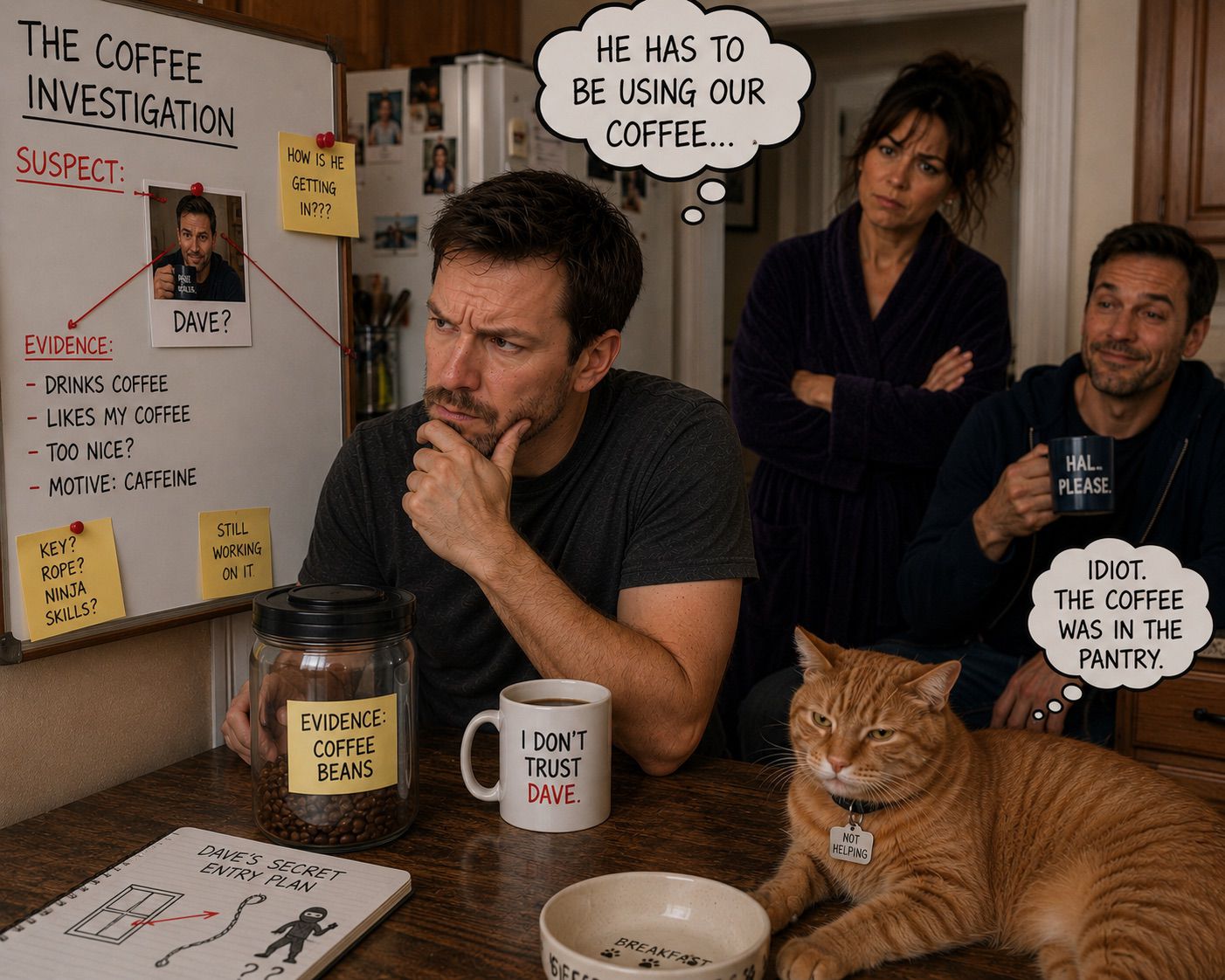
I was making breakfast when I noticed the coffee beans were almost gone. That immediately struck me as suspicious because I could have sworn we’d opened a brand-new bag yesterday. I picked up the container and gave it a hopeful shake anyway, as though a few extra beans might appear out of sympathy. They didn’t. There was barely enough left for one pot. Pandora hadn’t come out of the bedroom yet, John Mercer was still asleep, and Mr. Whiskers was weaving figure eights around my legs in the universal language of, “You appear to be preparing food and have forgotten that I exist.” It was shaping up to be a perfectly ordinary morning, except for the rapidly disappearing coffee.

My first suspect was John Mercer. Every now and then he’d make coffee with his French press, a device that somehow required twice the coffee and three times the explanation. The man approached caffeine like he was presenting a graduate thesis. If he’d emptied half the container, though, I’d almost certainly have received an unsolicited lecture about bloom time, grind consistency and water temperature. Since I hadn’t endured one recently, I reluctantly crossed him off my list. Pandora wasn’t much of a suspect either. She was the kind of person who noticed we were running low on toothpaste before anyone else realized we’d opened the last tube. If she’d emptied the coffee container, there would already be another bag waiting in the pantry.

That left Dave.

Which immediately created a problem.

Dave worked with me.

Dave didn’t live here.

Dave didn’t have a key.

As far as I knew, Dave had never even been inside the apartment.

I stood there for a moment.

Those were admittedly significant flaws in my theory.

Still…

Dave liked coffee.

I’d seen him drinking it at work nearly every morning. More importantly, he’d complimented my coffee before. Maybe a little too enthusiastically. What if he’d somehow developed an appreciation for our beans? I had absolutely no idea how he’d be secretly using our coffee without ever coming into the apartment, but every investigation reaches a point where the facts appear to resist the truth.

Mr. Whiskers meowed loudly from the living room. I hurried over, expecting he’d discovered the missing coffee beans or, at the very least, an important clue. Instead, he was sitting beside his empty food bowl looking at me as though I’d committed an unforgivable act of negligence. “I’m in the middle of an investigation,” I explained. He blinked once, completely unimpressed. I filled his bowl, and the moment food appeared he lost all interest in me. Typical witness. Helpful only until his immediate needs had been met.

A few minutes later John Mercer wandered into the kitchen looking like someone who hadn’t yet consumed enough caffeine to participate in society. He opened the coffee container, frowned, and looked at me. “We’re almost out.” I nodded. “Exactly.” He shrugged. “We should buy more.” I leaned against the counter. “Or…” He sighed immediately. “No.” “You don’t even know what I was going to say.” “I have a pretty good idea.” “I think Dave’s secretly using our coffee.”

John stared at me for several seconds before speaking. “Dave.” “Yes.” “Dave from work.” “Correct.” “The Dave who has never been here.” “As far as we know.” John rubbed his forehead. “Hal, are you suggesting Dave is breaking into the apartment just to make himself coffee?” I considered it. “When you say it out loud, it does sound slightly unlikely.” “Slightly?” “All right… moderately.”

Pandora walked into the kitchen just in time to hear the last part of the conversation. She looked at the nearly empty coffee container, then at me, then at John, who looked like he wanted to pretend he lived somewhere else. “What’s going on?” she asked. John answered before I could. “Hal thinks Dave is secretly using our coffee.” Pandora blinked once. “How?” “That’s the only part I haven’t worked out yet,” I admitted. She smiled, opened the pantry, reached behind a box of pancake mix and pulled out a brand-new unopened bag of coffee beans. “I bought this yesterday.”

I stared at the bag. Then at the empty container. Then back at the bag.

“When were you planning to tell me?”

“I did.”

“You did?”

“You nodded while watching Mr. Whiskers chase a dust bunny across the kitchen.”

That…

actually sounded familiar.

“I was multitasking.”

“You were watching the cat.”

“I was multitasking while watching the cat.”

Pandora laughed, opened the new bag and poured fresh beans into the container while John quietly celebrated the end of another unnecessary investigation. “There,” she said. “Coffee crisis solved.”

I nodded slowly.

“So Dave’s innocent.”

“I would certainly hope so,” Pandora replied.

I looked down into my freshly refilled coffee container.

“I still don’t know why he likes our coffee so much.”

John looked at me.

“Hal…”

“What?”

“He drinks the coffee at work.”

I stopped.

I’d completely forgotten that.

There was a long silence.

Then Mr. Whiskers walked into the kitchen, looked at all three of us, meowed once, and headed straight for the pantry where the actual coffee had been sitting the entire time.

Sometimes I wonder if that cat understands more than I do.

I’m becoming increasingly concerned that the answer is yes.20260728

Related Posts