Latest Articles

I Think Pandora Uncovered Something I Should Know

Hal

I was sitting on the couch watching Mr. Whiskers meticulously groom himself when something started bothering me. It wasn’t anything dramatic. In fact, it was almost disappointingly ordinary. Pandora had come over for dinner the night before, and we’d spent the evening talking about work, our schedules, and the usual little things that fill up an ordinary weekday. She’d helped wash the dishes before heading home, kissed me goodnight, and reminded me not to stay up too late. It had been a perfectly pleasant evening. Yet somehow I woke up with the unmistakable feeling that she’d figured something out about me and simply forgotten to mention it.

John Mercer was in his room watching television, the occasional burst of laughter drifting down the hallway whenever the audience on whatever sitcom he’d chosen erupted into applause. Mr. Whiskers seemed entirely unconcerned with the mysteries occupying my mind, pausing only long enough to inspect one paw before returning to his morning grooming routine with impressive dedication. Across the street, Mrs. Jenkins was watering the flowers outside her house exactly as she did most mornings. Everything around me looked perfectly normal, which somehow made my strange feeling even harder to ignore.

The more I thought about the previous evening, the more convinced I became that I’d missed something. Pandora had smiled a couple of times during our conversation in that thoughtful way she has when she’s piecing together an idea. At the time I’d assumed she was simply listening. Now I wondered whether she’d quietly solved some problem while I was still trying to explain it. She has a habit of connecting dots before I even realize there are dots to connect, and every now and then she’ll casually mention an obvious solution that somehow escaped me entirely. What if she’d done that again, only this time she’d forgotten to tell me?

I tried replaying the conversation in my head. We talked about work. We talked about grocery shopping. We debated whether we were overdue for another weekend road trip. Somewhere in the middle of all that she’d paused for a moment, smiled, and nodded almost to herself. At the time I hadn’t given it another thought. Now I couldn’t stop wondering what she’d been thinking. Had she remembered something important? Had she solved a problem I’d been complaining about for weeks? Or had she simply remembered that we’d forgotten to buy paper towels?

John wandered into the living room carrying a bowl of cereal and immediately noticed me staring blankly into space.

“You’ve got the detective face on again,” he said.

“The detective face?”

“The one where you’ve convinced yourself there’s a mystery but haven’t figured out what it is yet.”

I sighed.

“I think Pandora figured something out last night.”

“What kind of something?”

“I don’t know.”

He waited.

“That’s… remarkably unhelpful.”

“I know.”

John took a bite of cereal and nodded thoughtfully.

“So your theory is that Pandora solved a mystery that you can’t identify, about a subject you don’t remember discussing?”

“When you say it like that, it sounds a little weak.”

“It sounded a little weak before I said it.”

I was about to defend myself when my phone buzzed. It was a text from Pandora.

Found the coupon for that coffee maker you wanted. Saved us forty dollars. Forgot to tell you last night.

I stared at the message for several seconds before laughing.

That was it.

That was the mystery.

She’d uncovered absolutely nothing profound. She hadn’t discovered a hidden truth about our lives, uncovered a secret, or solved some enormous problem. She’d simply found a coupon while browsing online and forgotten to mention it during dinner.

John looked up from his cereal.

“Well?”

“I was right.”

His eyebrows rose.

“She did discover something.”

“What was it?”

“A forty-dollar coupon.”

He blinked once.

“You spent half an hour trying to remember a conversation because of a coupon?”

“I didn’t know it was a coupon.”

Mr. Whiskers chose that exact moment to jump onto the coffee table, knock an advertising flyer onto the floor with one casual swipe of his paw, and walk away as though he’d just contributed something meaningful to the investigation.

John laughed.

“I think the cat solved more mysteries than you did today.”

I looked down at the coupon on my phone and smiled.

Maybe Pandora had uncovered something I should know after all.

It just wasn’t nearly as dramatic as my imagination had insisted it would be.

Related Posts

Isak Dinesen: The Art of Blurring Reality

Penelope

Isak Dinesen’s writing has been a constant companion for me over the past year, ever since I stumbled upon her stories and essays while rummaging through my mother’s old bookshelf. There was something about her words that resonated deeply with me – perhaps it was the way she wove together tales of love, loss, and identity in a way that felt both familiar and yet utterly foreign.

As I delved deeper into her work, I found myself drawn to the contradictions that seemed to permeate every aspect of her life. She was a Danish aristocrat who had lived a life of privilege, but one that was also marked by personal struggles and uncertainty. Her writing often touched on themes of identity, nationality, and belonging – issues that I’ve grappled with myself as a young woman navigating the complexities of adulthood.

One aspect of Dinesen’s work that has always fascinated me is her tendency to blur the lines between truth and fiction. In stories like “Babette’s Feast” and “Siddhartha’s Song,” she weaves together historical fact and poetic invention in ways that feel both captivating and unsettling. As I read through these tales, I couldn’t help but wonder: was Dinesen writing about herself, or was this some kind of elaborate masquerade? Was she using her fiction to explore the complexities of her own identity, or was she simply crafting a mythic narrative?

I find myself returning to these questions because they speak to my own experiences as a writer. When I’m struggling to put words on paper, I often feel like I’m searching for some hidden truth – something that will reveal itself only if I dig deep enough. And yet, the more I write, the more I realize that this search is also a kind of performance: we’re all performing our identities, whether through our writing or our daily lives.

Dinesen’s own life was marked by a series of performances and reinventions – she adopted new personas, changed her name, and moved between countries in search of new beginnings. And yet, as I read about her, I couldn’t shake the feeling that there was something else at play here – some deeper longing or desire that drove her to keep moving, to keep creating.

Perhaps it’s this sense of restlessness that draws me to Dinesen’s work – a restlessness that I recognize in myself. As I navigate my own post-college life, I’m constantly torn between the desire for stability and security, and the need to keep exploring, to keep pushing boundaries. It’s a feeling that Dinesen seems to capture perfectly in her writing: the sense of being suspended between worlds, unsure which path to take or where to call home.

As I close this essay – or rather, allow it to drift off into the ether – I’m left with more questions than answers. What does it mean to perform our identities, and how do we separate truth from fiction in the process? Is Dinesen’s writing a reflection of her own search for self, or is it something entirely different?

I don’t know. And that’s okay. Sometimes, I think, it’s more interesting to simply acknowledge the uncertainty – to let the questions hang in the air like a tantalizing mist.

The more I read Dinesen’s work, the more I’m struck by her use of masks and personas as a way of navigating the complexities of identity. In her stories, characters often wear multiple faces, just as she did in real life. It’s as if she knew that identity is always in flux, that we’re all constantly performing for ourselves and others.

This idea resonates deeply with me, especially now that I’m trying to figure out who I am outside of academia. In college, my identity was defined by my major, my extracurriculars, and my social circle. But now that I’ve graduated, I’m left with a sense of uncertainty – what does it mean to be a writer outside of the classroom? Do I still write for myself, or am I trying to write for someone else’s approval?

Dinesen’s writing often feels like a exploration of this very question. Her characters are always on the move, searching for new identities and new experiences. And yet, despite their restlessness, they’re never quite able to shake off the past – the memories, the scars, the ghosts that haunt them.

I think about my own family history, and how it’s shaped me in ways both conscious and unconscious. My parents immigrated from a different country when I was young, and I’ve always felt like I’m caught between two cultures. Sometimes I wonder if this sense of displacement is what draws me to Dinesen’s work – her characters are often outsiders, navigating the complexities of identity and belonging.

But it’s not just about cultural identity; it’s also about personal history. Dinesen’s writing is full of references to her own life experiences – the loss of her husband, the struggles with depression, the wanderlust that took her to Africa and back again. And yet, even as she incorporates these details into her stories, she never seems to let them define her.

This is what I find most compelling about Dinesen’s work: the way she weaves together disparate threads of identity, history, and experience into a rich tapestry of storytelling. It’s like she’s saying that our identities are always in flux, that we’re all constantly performing and reinventing ourselves – but also that this performance is what makes us human.

As I close this essay, I’m left with more questions than answers. What does it mean to perform our identities, and how do we separate truth from fiction in the process? Is Dinesen’s writing a reflection of her own search for self, or is it something entirely different?

And yet, even as I acknowledge these uncertainties, I feel a sense of peace settle over me. Maybe it’s not about finding answers; maybe it’s just about embracing the messiness of identity, and letting our stories unfold in all their complexity.

The more I read Dinesen’s work, the more I’m struck by her ability to capture the human experience in all its messy, beautiful complexity. Her writing is like a mirror held up to our own struggles with identity, belonging, and self-discovery.

I think about my own experiences as a writer, and how I often feel like I’m searching for some hidden truth – something that will reveal itself only if I dig deep enough. But what if the truth is that there’s no one “true” self to uncover? What if our identities are constantly shifting, like the sands of the desert?

Dinesen’s writing suggests that this might be the case. Her characters are always on the move, searching for new identities and new experiences. And yet, despite their restlessness, they’re never quite able to shake off the past – the memories, the scars, the ghosts that haunt them.

This resonates with me because I’ve often felt like I’m caught between two worlds: the world of my childhood, where my family’s cultural traditions and values were deeply ingrained; and the world of adulthood, where I’m trying to forge my own path. It’s a feeling of dislocation, of not quite belonging anywhere.

But Dinesen’s writing suggests that this sense of dislocation is not unique to me – it’s a universal human experience. Her characters are always negotiating between different worlds, different identities, and different selves. And yet, despite the uncertainty and confusion, they’re never static; they’re always in motion, always growing, always changing.

This idea both comforts and unsettles me. On the one hand, it suggests that I’m not alone in my struggles with identity – that we’re all navigating this complex landscape together. But on the other hand, it raises questions about the nature of selfhood itself: if our identities are constantly shifting, then what does it mean to be “me”?

I think about Dinesen’s own life story, and how she reinvented herself multiple times throughout her life. She was born Karen Blixen, a Danish aristocrat; but she also became Isak Dinesen, a writer of international renown. And yet, even as she took on new identities, she never seemed to lose sight of who she truly was.

Or did she? This is the question that continues to haunt me – the question of whether our performances, our reinventions, are ever truly authentic. Are we always playing roles, always pretending to be someone we’re not? Or can we find a way to inhabit our true selves, even as we navigate the complexities of identity and belonging?

I don’t know the answer to this question, any more than I do the answer to the questions that have been swirling in my head throughout this essay. But I do know that Dinesen’s writing has given me permission to explore these questions – to delve into the messy, beautiful complexity of human experience.

As I reflect on Isak Dinesen’s life and work, I’m struck by her ability to inhabit multiple worlds simultaneously. She was a Dane living in Africa, a writer navigating the complexities of identity and belonging, a woman struggling with depression and loss. And yet, despite these multiple selves, she remained remarkably true to herself.

Or so it seems. The more I read about Dinesen, the more I’m convinced that her performances were always rooted in a deep sense of authenticity. She wasn’t just playing roles; she was inhabiting them, with all the complexity and nuance that comes with being human.

I think about my own experiences as a writer, and how I often feel like I’m struggling to find my authentic voice. Do I write for myself, or do I write for others? Am I trying to impress readers with my clever turns of phrase, or am I simply pouring out my heart onto the page?

Dinesen’s writing suggests that this is a false dichotomy – that our performances are always intertwined with our authenticity. She didn’t just write about her own experiences; she also wrote about the experiences of others, using them as a way to explore the complexities of identity and belonging.

This resonates with me because I’ve often felt like my writing is a form of performance – not in the sense that I’m trying to deceive or manipulate readers, but rather in the sense that I’m always negotiating multiple identities. As a writer from a multicultural background, I feel like I’m caught between different worlds, different cultures.

Dinesen’s writing suggests that this feeling of dislocation is not unique to me – it’s a universal human experience. Her characters are always navigating between different selves, different identities, and different worlds. And yet, despite the uncertainty and confusion, they’re never static; they’re always in motion, always growing, always changing.

This idea both comforts and unsettles me. On the one hand, it suggests that I’m not alone in my struggles with identity – that we’re all navigating this complex landscape together. But on the other hand, it raises questions about the nature of selfhood itself: if our identities are constantly shifting, then what does it mean to be “me”?

As I ponder these questions, I find myself returning to Dinesen’s writing again and again. Her stories are like a mirror held up to my own experiences – they reflect back my own struggles with identity, belonging, and self-discovery.

And yet, even as I find comfort in her words, I’m also aware of the complexity and nuance that lies beneath the surface. Dinesen’s writing is not just about identity; it’s also about power, privilege, and social class. She was a Dane living in Africa, after all – a member of the colonial elite who benefited from the very systems she often critiqued.

This awareness complicates my reading of Dinesen’s work, forcing me to consider the ways in which her performances were shaped by her own positionality. Was she a self-aware and critically reflective writer, or was she simply perpetuating the dominant narratives of her time?

I don’t know the answer to this question, any more than I do the answer to the questions that have been swirling in my head throughout this essay. But I do know that Dinesen’s writing has given me permission to explore these complexities – to delve into the messy, beautiful complexity of human experience.

As I close this essay (or rather, allow it to drift off into the ether), I’m left with more questions than answers. What does it mean to perform our identities, and how do we separate truth from fiction in the process? Is Dinesen’s writing a reflection of her own search for self, or is it something entirely different?

But perhaps that’s not the right question to ask. Perhaps the real question is this: what happens when we let go of the need for answers, and instead simply allow ourselves to be present with the complexities of human experience?

Related Posts

Summer Beauty Simplified

Fiona

Summer has a way of convincing us that our beauty routines need to become more complicated.

Shelves fill with seasonal launches promising brighter skin, beach-ready hair, and effortless radiance. New serums appear beside old favorites. Lightweight moisturizers replace richer creams. Before long, what began as a simple routine has quietly doubled in size.

Yet summer rarely rewards complexity.

Heat, humidity, and long days outdoors ask something different of our skin. Rather than layering on more products, the season often calls for removing the ones that no longer serve a purpose. The healthiest summer skin usually isn’t the result of an elaborate routine. It’s the result of supporting the skin instead of constantly trying to improve it.

One of the most common mistakes is assuming that every seasonal concern requires another product.

A little extra shine becomes a mattifying primer. Dryness calls for a heavier moisturizer. Sun exposure inspires several new treatments to “repair” damage before it has even occurred. Individually these choices seem reasonable, but together they can leave the skin overwhelmed rather than balanced.

Sometimes the better question isn’t, “What should I add?”

It’s, “What can I comfortably remove?”

A gentle cleanser, a moisturizer suited to your skin type, broad-spectrum sunscreen, and a few carefully chosen treatments are often enough for most people. A routine built around consistency almost always outperforms one built around constant experimentation.

The same principle applies to hair.

Humidity encourages many of us to fight our natural texture with additional products, higher heat, or increasingly complicated styling routines. Yet hair frequently looks its healthiest when we work with its natural movement rather than against it.

A nourishing conditioner, protection from excessive heat, and regular trims often contribute more to healthy-looking hair than an overflowing cabinet of styling products.

Summer also reminds us that beauty extends beyond cosmetics.

Well-hydrated skin reflects light differently. Adequate sleep softens the appearance of fatigue. A wide-brimmed hat protects more effectively than another corrective serum purchased after too much sun. These habits rarely receive the same attention as new product launches, yet they consistently produce better long-term results.

There is also something quietly luxurious about using fewer things well.

Opening the same trusted moisturizer each morning creates familiarity. Reaching for a sunscreen you genuinely enjoy wearing means you’re more likely to apply it consistently. A favorite lip balm, a lightweight fragrance, and healthy skin often feel more polished than an endless collection of products competing for attention.

This doesn’t mean every routine should look the same.

Dry skin has different needs than oily skin. Curly hair behaves differently from straight hair. Sensitive complexions deserve different ingredients than resilient ones. Good skincare has never been about copying someone else’s routine. It begins with understanding your own.

Perhaps that’s why the most elegant summer beauty routines often go unnoticed.

They don’t announce themselves through dramatic transformations or endless product recommendations. Instead, they create healthy skin that looks comfortable, hair that moves naturally, and a sense of confidence that isn’t dependent on constant maintenance.

Summer should feel lighter—not only in the clothes we wear, but in the routines we carry with us each day.

Before buying another seasonal product, consider whether your skin is asking for something new or simply asking to be left in peace. Quite often, the glow we associate with summer isn’t created by adding more. It’s revealed when we stop asking our skin to do so much.

True beauty has never been about having the longest routine. It comes from understanding what genuinely supports your skin, choosing products with care, and allowing consistency to do what constant novelty rarely can. Sometimes the simplest routine is also the one that lets your natural beauty shine the brightest.

Related Posts

My Argument with Pandora Was More Serious Than I Thought

Hal

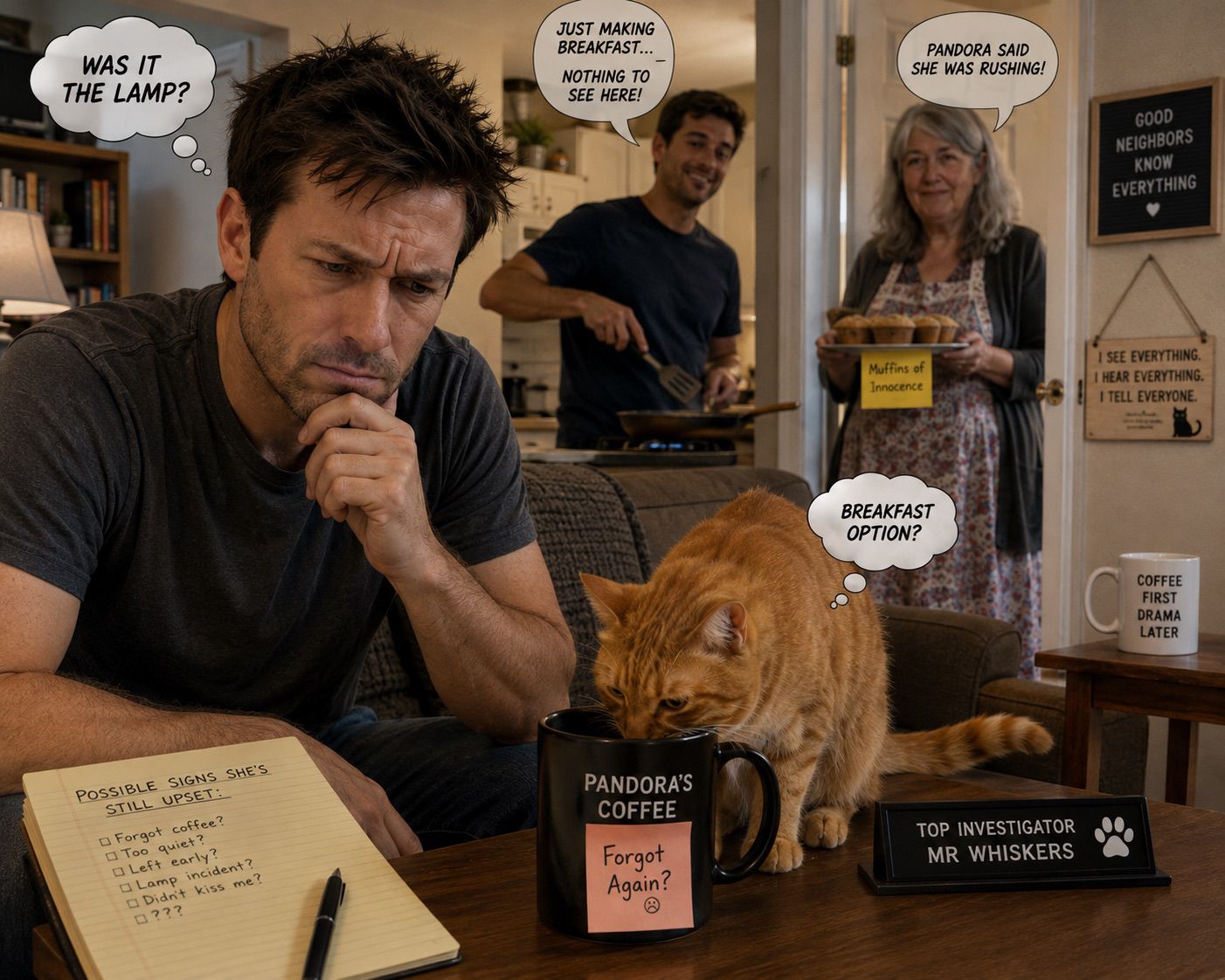
I was sitting in the living room staring at Pandora’s favorite coffee mug on the coffee table. It was still half full, which immediately caught my attention because Pandora never left coffee unfinished. She always finished every last sip before heading to work, so seeing the mug sitting there abandoned made me pause. It wasn’t even eight o’clock yet. Mr. Whiskers was asleep on his favorite cushion by the window, looking completely unconcerned with the world, while John Mercer was in the kitchen humming to himself as he made breakfast. Everything about the apartment felt perfectly ordinary, yet my attention kept drifting back to that forgotten mug. It reminded me of the small disagreement Pandora and I had the night before about where the living room lamp should go. It hadn’t seemed like much at the time, but now I couldn’t help wondering if I’d accidentally made a bigger deal out of it than I’d realized.

The more I looked at the mug, the more my imagination started filling in blanks that didn’t exist. Pandora wasn’t in the apartment anymore, which wasn’t unusual because she’d already left for work, but the fact she’d forgotten her coffee didn’t seem like her at all. She was organized, thoughtful, and rarely forgot anything. I found myself replaying our conversation from the night before, searching for some hidden meaning I’d somehow missed. Had she sounded annoyed when she said goodnight? Had she been quieter than usual this morning? Had she left without kissing me goodbye, or was I simply failing to remember because I was too busy thinking about my own morning? None of those questions had clear answers, yet somehow each one felt more convincing than the last.

John wandered into the living room carrying his breakfast and immediately noticed me staring at the coffee mug. “You okay?” he asked. I nodded slowly before admitting, “I think Pandora’s still upset with me.” He glanced at the mug, then back at me with a puzzled expression. “About what?” “The lamp.” He blinked once. “The lamp?” I sighed. “I may have gotten a little passionate defending where it should go.” John thought about that for a moment before smiling. “You mean when you called it the ‘natural focal point of the room’?” I groaned. “See? That sounds ridiculous when someone else says it out loud.” John laughed. “It sounded ridiculous the first time, too.”

I leaned back on the couch while Mr. Whiskers stretched, yawned, and casually hopped onto the coffee table. He gave Pandora’s mug an investigative sniff before losing interest and washing one paw instead. Watching him instantly abandon the mystery made me question why I was still obsessing over it. If there had actually been something wrong, surely the apartment wouldn’t feel so normal. John had already gone back to eating breakfast, the cat had moved on with his life, and the only person still treating the forgotten mug like evidence in an unsolved case was me.

A knock at the front door interrupted my thoughts. When I opened it, Mrs. Jenkins was standing there holding a small plate of blueberry muffins. “Good morning, dear,” she said with a warm smile. “Pandora mentioned yesterday that she’d be rushing to work this morning, so I thought I’d bring these over before they disappeared.” I thanked her and, trying to sound casual, asked if she’d happened to see Pandora leave. Mrs. Jenkins nodded. “Oh yes. She looked at the clock, laughed because she was running late, grabbed her bag, and hurried straight out the door. I don’t think she even realized she’d left her coffee behind.” She smiled, wished me a good day, and headed back to her apartment, leaving me standing there feeling more than a little foolish.

Just as I closed the door, my phone buzzed with a text message from Pandora. Forgot my coffee this morning. Can you dump it out before Mr. Whiskers decides it’s breakfast? Love you. I looked over at the cat just as he leaned toward the mug for another curious sniff. “Nice try,” I told him, sliding the mug out of reach. He stared at me with an expression that somehow managed to communicate complete innocence despite being caught in the act.

John looked over from the kitchen. “So?” he asked. I held up my phone and laughed. “Turns out our marriage survived the Great Lamp Debate.” John grinned. “I figured it had.” I shook my head and carried the mug to the sink. “I spent the last half hour convincing myself I’d accidentally started a relationship crisis because she forgot her coffee.” John chuckled as he picked up his plate. “Hal, one of these days you’re going to discover that not every mystery needs solving.” I smiled as Mr. Whiskers immediately climbed onto the now-empty coffee table and looked disappointed that the coffee had disappeared. Maybe John was right. Sometimes a forgotten cup of coffee was just a forgotten cup of coffee, and the only real mystery was why my imagination always managed to get there first.

Related Posts

Jose Ortega Y Gasset: The Ticking Time Bomb in Every Introverted Coffee Shop Patron

Penelope

I’ve been fascinated by Jose Ortega y Gasset for months now, ever since I stumbled upon his essay “The Revolt of the Masses” while browsing through a used bookstore. There’s something about his writing that resonates with me, a sense of unease and discomfort that makes me feel like he’s speaking directly to me.

As I read through his works, I started to notice a recurring theme – the tension between individuality and mass culture. Ortega y Gasset argues that modern society is characterized by a “revolt” of the masses against traditional values and institutions. He sees this as a threat to genuine human experience, which he believes can only be achieved through introspection and self-awareness.

I find myself drawn to his critique of conformity and the ways in which we’re pressured to conform to societal norms. It’s like he’s describing my own struggles with trying to fit in while still being true to myself. I remember feeling suffocated by the expectations placed on me during high school – the pressure to take certain classes, participate in extracurricular activities, and maintain a certain image. It was exhausting, and Ortega y Gasset’s words seem to validate my feelings of frustration and disillusionment.

But what really interests me is the way he approaches this topic with such nuance and complexity. He’s not just railing against the masses; he’s also acknowledging the need for collective action and social change. This ambiguity makes him difficult to pin down, and I find myself oscillating between agreement and disagreement as I read his works.

One of the things that’s hardest for me to wrap my head around is Ortega y Gasset’s concept of the “mass man.” He describes this figure as someone who has abandoned their individuality in favor of a sense of belonging and security. It sounds like a caricature, but at the same time, I recognize aspects of myself in his description. Have I been guilty of sacrificing my own desires and aspirations for the sake of fitting in? Ortega y Gasset’s words make me wonder if this is a universal experience, something that we all struggle with to some degree.

I also find it striking how Ortega y Gasset’s ideas seem to be both deeply personal and profoundly philosophical. His writing is infused with a sense of introspection and self-examination, which I think is what draws me in. He’s not just offering abstract theories or critiques; he’s sharing his own struggles and doubts, and that makes him feel more relatable.

As I continue to explore Ortega y Gasset’s works, I’m struck by the ways in which he challenges my assumptions about individuality and collective action. His ideas make me uncomfortable, but in a good way – they’re pushing me to think critically about my own values and priorities. And that, I think, is the greatest gift of his writing: it forces me to confront my own biases and limitations, even if I’m not always sure what to do with those insights.

I’m still grappling with Ortega y Gasset’s ideas, trying to make sense of them in relation to my own life. It’s like trying to untangle a knot – the more I pull on one thread, the more complicated it becomes. But that’s also what makes his writing so compelling: it refuses to provide easy answers or solutions. Instead, it invites me to join him on this journey of self-discovery and exploration, where the only certainty is the uncertainty itself.

As I delve deeper into Ortega y Gasset’s thoughts, I’m struck by the way he speaks about the importance of living a life of “inquietud” – a sense of inner restlessness that propels us towards growth and self-awareness. He sees this as essential for genuine human experience, but also acknowledges that it can be painful and uncomfortable. It’s like he’s saying that true individuality requires embracing the messiness and uncertainty of life.

I find myself resonating with this idea, especially after graduating from college and feeling a sense of disorientation. I’ve been struggling to figure out what comes next, and Ortega y Gasset’s words seem to validate my feelings of anxiety and confusion. It’s like he’s telling me that it’s okay not to have all the answers, that uncertainty is an inherent part of growth.

But at the same time, I’m also drawn to his critique of modern society’s emphasis on efficiency and productivity. He sees this as a threat to genuine human experience, arguing that we’re sacrificing our creative potential and depth for the sake of achieving success and status. It’s like he’s saying that we’re losing sight of what truly matters in life.

I’m not sure how to reconcile these two ideas – the importance of living with inner restlessness and uncertainty, versus the pressure to achieve success and conform to societal norms. Ortega y Gasset doesn’t seem to have easy answers either, which is both frustrating and liberating. It’s like he’s giving me permission to question everything, including my own assumptions about what it means to live a good life.

As I continue to explore his ideas, I’m struck by the way he writes about the relationship between individuality and solitude. He sees solitude as essential for genuine human experience, arguing that we need time alone to reflect on our values and priorities. But at the same time, he acknowledges that solitude can be a lonely and isolating experience.

I find myself wondering if this is why I’ve always felt drawn to writing – it’s a way for me to process my thoughts and emotions in solitude, without having to conform to societal norms or expectations. Ortega y Gasset’s words seem to validate this feeling, saying that true individuality requires embracing our own unique experiences and perspectives.

But what does this mean in practice? How do I balance the need for individuality with the pressure to fit in and succeed? And what does it look like to live a life of genuine human experience, one that’s characterized by inner restlessness and uncertainty?

Ortega y Gasset’s words leave me with more questions than answers, which is exactly what I need right now.

I’m still trying to untangle the threads of Ortega y Gasset’s ideas about individuality and collective action. His concept of “inquietud” keeps resonating with me – this sense of inner restlessness that propels us towards growth and self-awareness. I feel like I’ve been living in a state of quiet desperation for years, trying to fit into the mold of what others expect from me.

But Ortega y Gasset’s words make me wonder if this is just a form of resistance, a way of rebelling against societal norms without really challenging them. Can individuality truly be achieved by simply being different, or does it require something more profound? I’m not sure, and that uncertainty makes me feel both frustrated and liberated.

As I continue to read his works, I’m struck by the way he writes about the importance of living in the present moment. He argues that our obsession with the future and past prevents us from truly experiencing life as it unfolds. This resonates with me on a deep level – I’ve always felt like I’m stuck between two worlds, unable to fully inhabit either one.

Ortega y Gasset’s words make me wonder if this is a universal experience, something that we all struggle with in our own way. Can we ever truly be present in the moment, or are we forever caught up in our thoughts and expectations? I’m not sure, but his writing makes me want to explore this question further.

One of the things that’s hardest for me to wrap my head around is Ortega y Gasset’s concept of “the crowd.” He sees the crowd as a kind of mindless, anonymous entity that swallows up individuality and creativity. But at the same time, he acknowledges that we’re all part of the crowd in some way, caught up in our own collective narratives and expectations.

I find myself oscillating between agreement and disagreement with his ideas on this point. On one hand, I see how the crowd can stifle individuality and creativity – think about social media, where everyone’s curated online persona erases the uniqueness of their real-life experiences. On the other hand, I’m not sure if it’s possible to completely escape the crowd, especially in a world that seems increasingly interconnected.

Ortega y Gasset’s words leave me with more questions than answers, but they also give me a sense of permission to explore these ideas further. Maybe that’s what his writing is all about – giving us the courage to question our assumptions and challenge ourselves to think more deeply about who we are and what we want from life.

As I continue to delve into his works, I’m struck by the way he writes about the importance of doubt and uncertainty in the creative process. He argues that true innovation requires a willingness to take risks and challenge our own assumptions, even if it means failing or looking foolish.

This resonates with me on a deep level – I’ve always felt like my writing is a kind of therapy for myself, a way of processing my thoughts and emotions through language. But Ortega y Gasset’s words make me wonder if there’s more to creativity than just self-expression. Can art be a form of social commentary, a way of challenging the status quo and pushing us towards growth and change?

I’m not sure, but his writing makes me want to explore this question further. Maybe that’s what it means to live a life of genuine human experience – embracing our doubts and uncertainties, rather than trying to suppress them.

As I ponder the relationship between doubt and uncertainty in creativity, I find myself thinking about my own writing process. I’ve always thought of myself as a reflective person, someone who uses writing as a way to make sense of my thoughts and emotions. But Ortega y Gasset’s words make me wonder if that’s just a form of escapism – a way of avoiding the uncertainty and ambiguity of life.

I think about the times when I’ve been stuck on a piece, unsure of how to move forward or what to say. It’s like being lost in a dense forest, with no clear path in sight. And yet, it’s precisely during those moments that I feel most alive – like I’m on the cusp of discovering something new and important.

Ortega y Gasset would probably say that this is an example of “inquietud” – that sense of inner restlessness that propels us towards growth and self-awareness. And in a way, he’s right. When I’m stuck on a piece, I’m forced to confront my own limitations and biases, to question everything I thought I knew about writing and creativity.

But what if this process is not just about individual growth, but also about collective transformation? What if our creative endeavors have the power to challenge societal norms and expectations, to push us towards greater empathy and understanding?

Ortega y Gasset’s words make me wonder if this is a possibility – if art can be a form of social commentary that inspires change and progress. I think about the ways in which literature has shaped my own perspective on the world, challenging me to see things from different angles and experience life in new and unexpected ways.

And yet, I’m also aware of the limitations of art as a force for social change. We can write and create all we want, but if our message is not heard or understood, what’s the point? This is where Ortega y Gasset’s concept of “the crowd” comes back into play – how do we reach beyond the confines of our own individual experiences and connect with others in meaningful ways?

I’m still grappling with these questions, trying to make sense of them in relation to my own life and creative endeavors. But as I continue to explore Ortega y Gasset’s ideas, I’m struck by the way he writes about the importance of living a life that is authentically our own – one that is marked by individuality, creativity, and a willingness to take risks.

It’s not always easy, and it’s certainly not comfortable. But as I look back on my own experiences with writing and self-discovery, I realize that this is precisely where the magic happens – in those moments of uncertainty and doubt, when we’re forced to confront our own limitations and biases.

And so, I’ll keep writing, keep exploring, and keep questioning everything I thought I knew about life and creativity. Because it’s only by embracing the messiness and uncertainty of existence that we can truly live a life that is genuine, authentic, and meaningful – one that reflects the complexities and nuances of the human experience.

Related Posts