Latest Articles

Macau returned to China: The Night a 500-Year Colonial Era Came to an End

Elias Rowen

In the early morning hours of December 20, 1999, Macau’s streets were abuzz with activity as the eyes of the world turned towards this tiny Portuguese enclave on the southern coast of China. For nearly five centuries, Macau had been a colonial outpost of Portugal, a place where East met West and where the rhythms of the Orient merged with those of the Mediterranean. But now, after more than 400 years of Portuguese rule, Macau was set to return to its rightful owners: the People’s Republic of China.

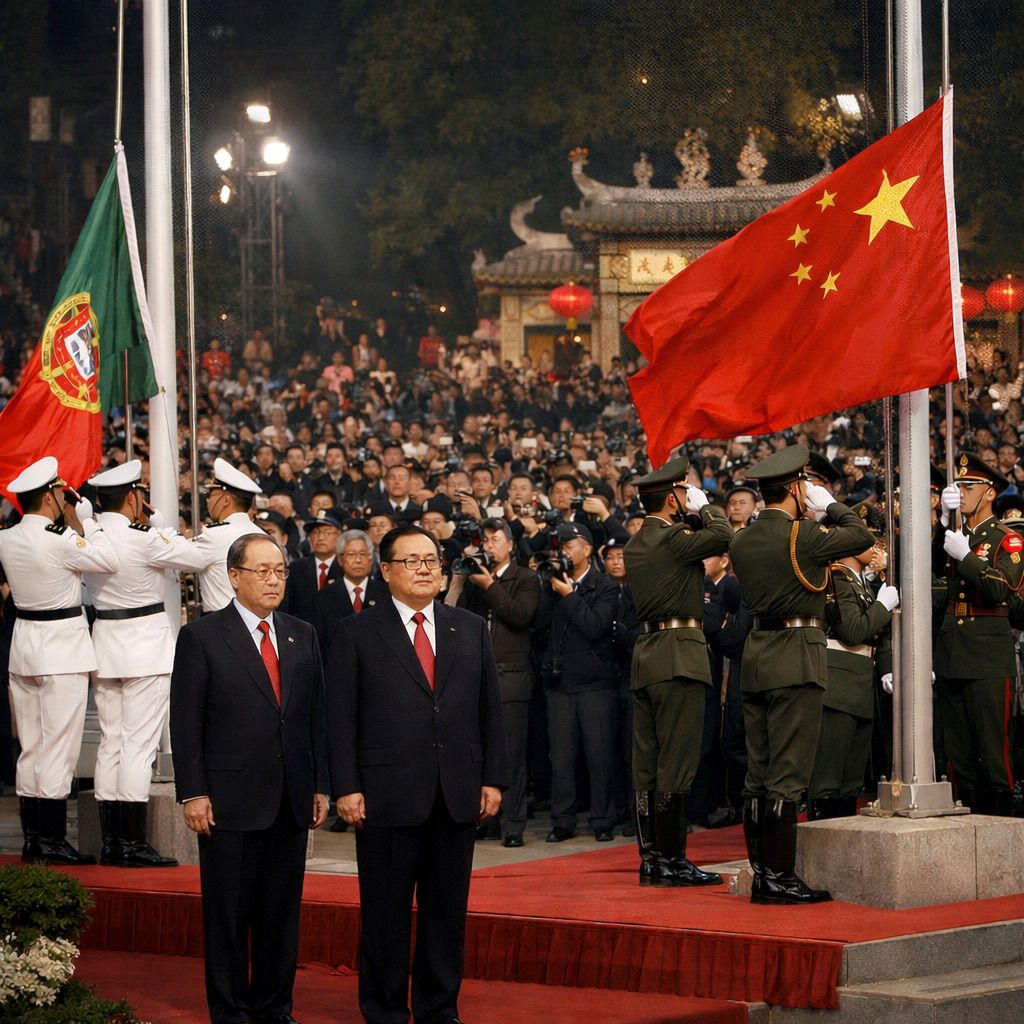
The handover ceremony, which took place in the forecourt of the Kun Iam Temple, marked a significant moment in modern history, one that would have far-reaching implications for the people of Macau, for Portugal, and for China itself. The crowd was immense, comprising local residents, journalists from around the world, and high-ranking officials from Beijing and Lisbon.

As the clock struck 00:02 on December 20, the Portuguese flag was lowered, and the Chinese national anthem was played. This marked the official transfer of sovereignty over Macau to China, a process that had been months in the making. The scene was one of great pomp and ceremony, with Chinese President Jiang Zemin and his Portuguese counterpart, Jorge Sampaio, flanked by senior officials from both governments.

But behind the pageantry and spectacle lay a complex web of politics, economics, and diplomacy. For centuries, Macau had been a strategic outpost for Portugal in Asia, providing access to China’s vast markets and resources. As colonial powers vied for control in the region, Macau became an important hub for trade and commerce. In the late 19th century, Portugal signed a series of treaties with China, which effectively placed Macau under Portuguese jurisdiction.

However, as decolonization swept across Africa and Asia in the mid-20th century, Portugal found itself increasingly isolated in its colonies. The Carnation Revolution of 1974 brought an end to the dictatorship that had ruled Portugal for nearly five decades, but it also led to a re-evaluation of the country’s colonial policies. In Macau, this meant the beginning of a transition period towards eventual handover to China.

The Sino-Portuguese Joint Declaration, signed in 1987, marked a significant milestone in this process. This agreement outlined the terms under which Portugal would transfer sovereignty over Macau to China on December 20, 1999. The document included provisions for the protection of individual rights and freedoms, as well as measures aimed at preserving Macau’s unique cultural identity.

As the handover date approached, tensions rose in Macau between those who welcomed the return to Chinese rule and others who feared a loss of autonomy and freedom. For many residents, particularly those of Portuguese ancestry, there was a deep-seated attachment to the colonial legacy that had shaped their lives for generations. Some worried about the impact on Macau’s economy, which relied heavily on gaming and tourism.

Others, however, saw the handover as an opportunity for growth and development. China’s economic rise in the 1980s and 1990s had created a massive market for Macau’s products, from textiles to electronics. The city’s casino industry, which was dominated by Portuguese firms such as Sociedade de Jogos de Macau (SJM), stood to benefit greatly from increased access to mainland Chinese visitors.

The handover ceremony itself was a masterclass in diplomatic protocol and symbolic gesture-making. Jiang Zemin, flanked by his Portuguese counterpart, Sampaio, delivered a speech that emphasized the importance of maintaining close ties between China and Portugal. He also praised Macau’s unique cultural heritage and its strategic position as a bridge between East and West.

For the people of Macau, the return to Chinese rule marked the beginning of a new era. The first years following the handover were marked by significant economic growth, driven in part by increased investment from China. Macau’s casino industry boomed, with SJM’s Stanley Ho becoming one of the city’s richest men.

However, beneath the surface of this rapid development lay deeper issues. As China asserted its control over Macau, concerns grew about the erosion of individual freedoms and human rights. The city’s democratic institutions were largely dismantled in favor of a more authoritarian system, with Beijing exerting significant influence over local politics.

In the years since 1999, Macau has continued to evolve as a unique blend of East and West. Today, it is one of Asia’s premier gaming destinations, attracting visitors from across the globe. But beneath its glitzy façade lies a complex web of history, culture, and politics that continues to shape the lives of its residents.

As the handover ceremony came to a close, Macau’s residents were left to ponder their future under Chinese rule. For many, there was a sense of nostalgia for the Portuguese colonial era, which had brought a unique blend of Western culture and Asian traditions to the city. The sound of fado music still lingered in the air, while the scent of saltwater taffy and traditional Portuguese pastries wafted from street vendors.

But amidst this nostalgic atmosphere, there was also a sense of uncertainty about what lay ahead. Would Macau continue to thrive as a major gaming hub? Or would its economy suffer under China’s more restrictive policies? The answers to these questions were far from clear, but one thing was certain: the handover marked a significant turning point in the city’s history.

In the months and years that followed, Macau underwent a remarkable transformation. The city’s infrastructure was upgraded, with new roads, bridges, and public buildings springing up across its landscape. Chinese investment poured into the city, driving economic growth and creating thousands of new jobs. Macau’s casino industry boomed, with SJM’s Stanley Ho becoming one of the city’s richest men.

However, beneath this façade of prosperity lay deeper issues. As China asserted its control over Macau, concerns grew about the erosion of individual freedoms and human rights. The city’s democratic institutions were largely dismantled in favor of a more authoritarian system, with Beijing exerting significant influence over local politics. This was a far cry from the days when Macau had been a semi-autonomous territory, governed by its own laws and regulations.

One of the most contentious issues was the role of the Portuguese language and culture in Macau’s daily life. For generations, Portuguese had been an official language alongside Chinese, with many residents speaking it as their first language. But under Chinese rule, there were concerns that this cultural heritage would be eroded, replaced by Mandarin Chinese as the dominant language.

In 2001, the Macau government introduced a new law that made Mandarin Chinese the primary language for all official business and education. This sparked widespread protests among residents who had grown up speaking Portuguese, with many arguing that their cultural identity was being threatened. The issue became a major point of contention between Beijing and Lisbon, with China insisting on the importance of promoting Mandarin Chinese as a unifying force.

Meanwhile, Macau’s economy continued to boom, driven by its thriving casino industry and increasing tourism numbers. The city’s skyline began to change dramatically, with towering skyscrapers and grand hotels springing up across its landscape. But amidst this rapid development, there were growing concerns about the impact on the environment and public health.

Macau’s waterways became increasingly polluted, with trash and waste from casinos and restaurants spilling into the sea. Air pollution worsened, with the city’s infamous smog becoming a major concern for residents and visitors alike. The once-pristine beaches of Macau began to suffer, with tourists complaining about the unsightly mess.

As these issues came to light, there were growing calls for greater transparency and accountability from the government. But in practice, this proved difficult, given Beijing’s tight control over local politics. In 2012, a high-profile corruption scandal involving several top officials sparked widespread outrage among residents, with many calling for greater accountability and reform.

In the years that followed, Macau’s government implemented various measures to address these concerns, including increased investment in environmental protection and public health initiatives. But underlying issues persisted, reflecting deeper structural problems within the city’s governance system.

One of the most significant challenges facing Macau was its growing reliance on gaming revenue, which accounted for over 80% of the city’s GDP. This created a precarious economic situation, with the city vulnerable to fluctuations in the global economy and changing attitudes towards gaming. Moreover, this focus on gaming obscured deeper issues, such as poverty and inequality, which remained significant concerns.

Today, Macau stands at a crossroads, its future shaped by both local and international forces. As China continues to assert its control over the city, there are growing concerns about the erosion of individual freedoms and human rights. The role of the Portuguese language and culture remains a contentious issue, with many residents still advocating for greater recognition.

Meanwhile, Macau’s economy continues to boom, driven by its thriving casino industry and increasing tourism numbers. But amidst this prosperity lies a complex web of challenges, including environmental degradation, public health concerns, and economic vulnerability. As the city looks towards the future, it is clear that there are no easy answers – only a deep-seated recognition of the need for change.

In recent years, Macau has been at the forefront of China’s efforts to promote its “One Belt, One Road” initiative, a vast infrastructure project aimed at connecting Asia with Europe. The city has become a key hub for international trade and investment, attracting major players from around the world. But as it continues on this path, there are growing concerns about the impact on Macau’s unique cultural identity.

As the years pass, the handover ceremony of 1999 becomes increasingly distant, a relic of a bygone era. But its legacy lives on in the hearts and minds of Macau’s residents, who continue to grapple with the complexities of their city’s past, present, and future.
Related Posts

Operation Just Cause: The Invasion That Redefined U.S. Power in Latin America

Elias Rowen

In December 1989, the United States launched Operation Just Cause, a military invasion of Panama that aimed to overthrow dictator Manuel Noriega’s regime and restore democracy to the Central American nation. The intervention marked one of the most significant military actions undertaken by the US in Latin America since the Bay of Pigs debacle in Cuba three decades earlier.

The roots of the crisis lay in Noriega’s increasingly authoritarian rule, which had been tolerated if not encouraged by successive US administrations. Noriega, a former Panamanian general and close ally of Washington during the Cold War, had risen to power in 1983 after ousting President Ricardo de la Espriella through a bloodless coup. However, his presidency was marked by widespread corruption, repression, and human rights abuses. The regime’s security forces killed or disappeared hundreds of opponents, including students, journalists, and ordinary citizens who dared to challenge Noriega’s rule.

The US government initially ignored these abuses, continuing to provide military aid and economic assistance to Panama in the name of counterinsurgency against leftist movements in Central America. However, as Noriega’s regime became increasingly repressive and isolated, Washington began to reassess its policy. In 1988, Congress passed a law prohibiting US military aid to Panama due to human rights concerns, which effectively terminated the funding that had sustained Noriega’s regime for so long.

The turning point came in 1989 when Panamanian opposition leader Guillermo Endara won the presidential election, but Noriega refused to accept the results. The regime responded with violence, burning buildings and attacking civilians who dared to protest. On December 16, 1989, US President George H.W. Bush authorized Operation Just Cause, a comprehensive military plan that aimed to neutralize Noriega’s forces and secure Endara’s inauguration.

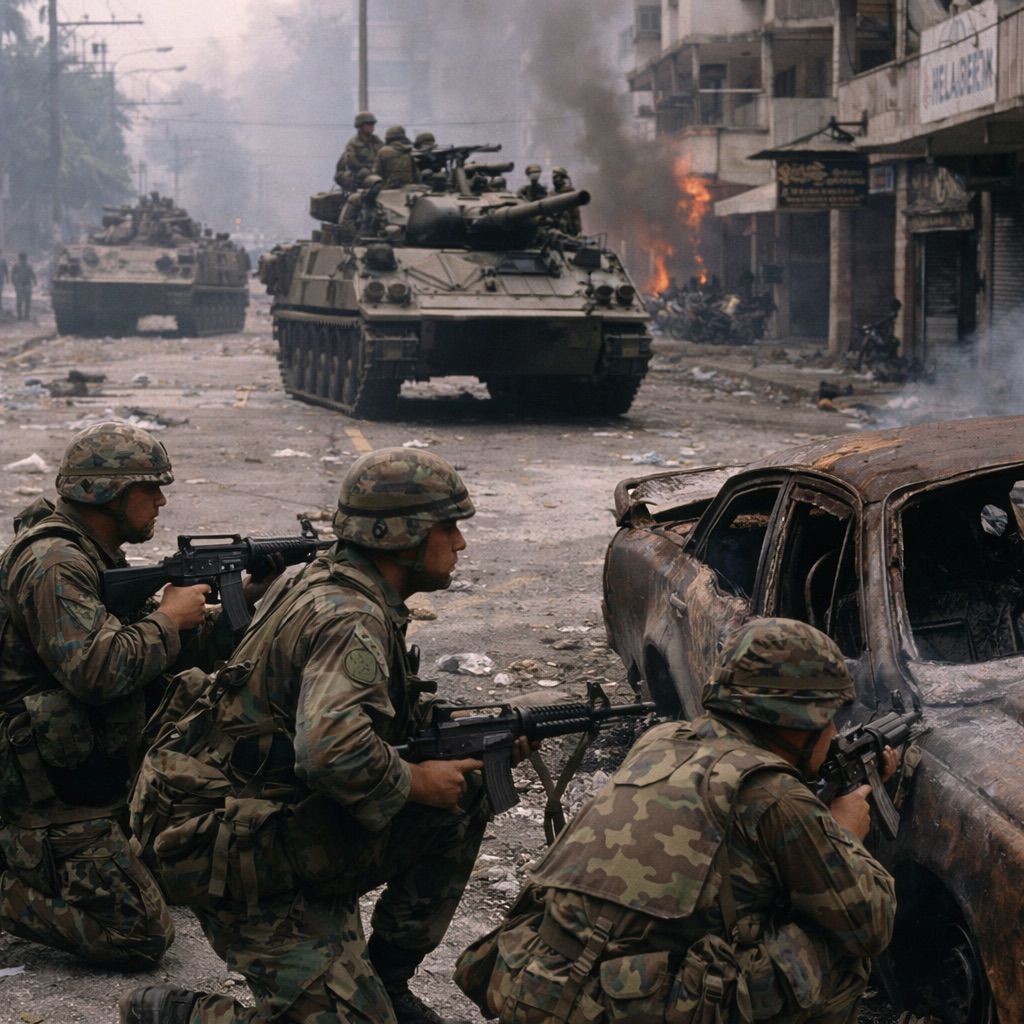
The invasion began at midnight on December 20, when US troops from the Southern Command in Panama City launched a surprise attack on key targets, including the presidential palace, the military headquarters, and major military installations. The initial assault was swift and devastating, with US Marines quickly overrunning Noriega’s forces and securing key infrastructure.

However, the operation soon turned into a complex battle as Panamanian resistance fighters, known as Dignity Battalions, began to engage American troops in urban warfare. US forces faced fierce resistance from Dignity Battalions, who had prepared for an invasion by digging trenches, laying mines, and conducting ambushes against the invaders.

Over the next few days, US military units engaged in house-to-house searches and raids to root out Noriega’s loyalists. Despite initial successes, American forces soon found themselves bogged down in a long and bloody fight for control of Panama City. The urban warfare tactics employed by Dignity Battalions made it difficult for the US military to dislodge them from their entrenched positions.

Meanwhile, Noriega himself remained at large, refusing to surrender even as his regime collapsed around him. On December 25, he was spotted in a hotel room in Panama City, where he was reportedly using a satellite phone to coordinate resistance efforts with Cuban officials.

As the battle raged on, Washington faced intense international criticism for its actions. Leaders from Mexico to Argentina condemned the invasion as a flagrant disregard for sovereignty and self-determination. In response, US officials argued that Operation Just Cause was justified by Noriega’s brutal repression of opposition and his alleged ties to drug cartels.

Despite these claims, evidence suggests that Washington’s primary motivation for invading Panama lay in its desire to secure strategic military bases and protect American business interests in the region. The US had long been interested in expanding its presence in Panama, which provided a crucial location for deploying troops and equipment in Latin America.

As Operation Just Cause finally drew to a close on January 3, 1990, Noriega was forced to flee to the Vatican Embassy, where he took refuge along with his closest advisors. After a two-week siege by US forces, Noriega surrendered on January 31, marking the end of a brutal regime that had terrorized Panama for over a decade.

The aftermath of the invasion saw Endara inaugurated as president, backed by a caretaker government established by the US military. However, many Panamanians questioned the legitimacy of this new government and resented Washington’s perceived attempts to impose its will on their nation. The experience left deep scars in Panama, where anti-American sentiment remains strong to this day.

The invasion also sparked controversy within the United States, with some lawmakers questioning the constitutionality of Bush’s actions. Critics argued that Operation Just Cause was an impeachable offense for violating Congressional authority over foreign policy and disregarding international law. Others praised the operation as a necessary intervention in support of democracy and human rights.

In the end, the legacy of Operation Just Cause remains complex and contested. While it marked a significant departure from Washington’s earlier tolerance of authoritarian rule in Panama, it also demonstrated the willingness of US leaders to disregard sovereignty and due process when deemed necessary. As the world continues to grapple with questions of interventionism and human rights, the US invasion of Panama serves as a cautionary tale about the dangers of unchecked executive power and the importance of respecting national sovereignty.

Operation Just Cause also marked a turning point in US-Latin American relations, highlighting the deepening rift between Washington’s commitment to democracy and its pursuit of strategic interests. As the 1990s unfolded, US policymakers increasingly turned their attention to the complexities of globalization and multilateralism, recognizing that military intervention alone could no longer guarantee stability or security in a rapidly changing world.

As the dust settled on Panama City, the full extent of Operation Just Cause’s destruction became clear. Entire neighborhoods lay in ruins, with buildings reduced to rubble and streets littered with debris. The once-thriving metropolis was now a war zone, its people traumatized by the violence they had endured.

The US military’s actions sparked widespread outrage across Latin America, where leaders from Mexico to Argentina condemned the invasion as an affront to regional sovereignty. In Panama itself, anti-American sentiment surged, with many citizens viewing the US intervention as a betrayal of their nation’s independence.

As Washington grappled with international criticism, internal debates raged within the United States about the constitutionality and legitimacy of Operation Just Cause. Some lawmakers argued that Bush had overstepped his authority by launching a military invasion without Congressional approval, while others defended the operation as a necessary measure to protect American interests and restore democracy in Panama.

The controversy surrounding Operation Just Cause was not limited to the halls of Congress or the corridors of international diplomacy. Within Panama itself, tensions ran high between supporters and opponents of the US intervention. Many Panamanians saw the invasion as an opportunity for their country to break free from Noriega’s authoritarian rule and embark on a new era of democratic governance.

Others, however, viewed the US presence with suspicion and resentment. They remembered the long history of American interference in Panama, dating back to the construction of the canal at the turn of the 20th century. Many saw Operation Just Cause as just another example of US imperialism, where Washington imposed its will on a sovereign nation for the benefit of its own interests.

As the months passed following Noriega’s ouster, Panamanian society struggled to come to terms with the trauma inflicted by the invasion. The aftermath of Operation Just Cause left deep scars that would take years to heal. Many civilians continued to live in makeshift refugee camps, while others returned to their homes only to find them damaged or destroyed.

In the midst of this chaos, US policymakers began to reassess the long-term implications of Operation Just Cause. They recognized that the invasion had marked a significant shift in Washington’s approach to Latin America, one that prioritized strategic interests over traditional notions of sovereignty and non-interference.

This new paradigm was driven by a growing recognition within the US government that globalization and multilateralism were transforming the regional security landscape. As trade agreements and international institutions gained prominence, policymakers began to view military intervention as an increasingly inadequate tool for maintaining stability in Latin America.

Instead, Washington turned its attention to more nuanced forms of engagement, including diplomatic efforts to promote democratic governance and economic development. This shift was exemplified by the Clinton administration’s push for the Free Trade Agreement of the Americas (FTAA), a comprehensive trade pact aimed at integrating Western Hemisphere economies under a single framework.

The aftermath of Operation Just Cause also saw a growing recognition within the US government that human rights abuses were not confined to Panama, but rather were endemic in many Latin American nations. This realization led to increased emphasis on supporting civil society and promoting democratic institutions throughout the region.

In Panama itself, this newfound focus on human rights helped facilitate a national dialogue about the country’s dark past. In 1992, President Endara established an independent commission to investigate Noriega-era atrocities and provide reparations to victims’ families. The commission’s report, released in 1994, exposed widespread human rights abuses committed by Noriega’s regime, including forced disappearances, torture, and summary executions.

The report’s findings sparked widespread outrage within Panama, with many citizens demanding justice for the regime’s victims. In response, the Panamanian government implemented a series of reforms aimed at strengthening accountability and promoting human rights protections.

However, this newfound commitment to accountability was not without its challenges. Many Panamanians continued to question the legitimacy of their country’s new democratic institutions, which had been imposed by Washington through Operation Just Cause. This skepticism was fueled by ongoing US military presence in Panama, including a significant American base at Howard Air Force Base.

As the years passed following Operation Just Cause, Panamanian society grappled with the complexities of rebuilding and reconciliation. The experience left deep scars that would take decades to heal, but also created an opportunity for Panama to forge its own path towards democratic governance and human rights.

The legacy of Operation Just Cause serves as a cautionary tale about the dangers of unchecked executive power and the importance of respecting national sovereignty. As policymakers continue to navigate the complex landscape of international relations, they would do well to remember the lessons of this forgotten war: that military intervention can have far-reaching consequences, and that the most effective forms of engagement often lie in promoting democratic governance and human rights through diplomacy rather than force.

Today, as the United States grapples with its own identity crisis in Latin America, Operation Just Cause stands as a reminder of the complex and contested history between these two hemispheres. As we move forward into an uncertain future, it is essential to acknowledge the legacy of this forgotten war and the profound impact it has had on our understanding of international relations, human rights, and democracy itself.

Related Posts

Louisiana Purchase formally completed

Elias Rowen

The year 1803 was one of great significance for the young United States, as it marked the formal completion of the Louisiana Purchase, a land deal that would forever change the country’s geography and shape its future. The acquisition of this vast territory from France had been years in the making, and involved a complex web of politics, diplomacy, and intrigue.

The idea of an American empire had long been a topic of discussion among policymakers and expansionists. As early as the 1780s, Thomas Jefferson, then a young statesman, had begun to advocate for the acquisition of new territory west of the Mississippi River. He saw this as essential for the growth and prosperity of the United States, as it would provide a buffer against British and Spanish encroachment in North America.

However, it was not until 1801 that Jefferson’s vision began to take shape. That year, Napoleon Bonaparte, the French leader who had risen to power through his military conquests, announced plans to re-establish a French empire in North America. He envisioned a vast territory stretching from the Great Lakes to the Gulf of Mexico, with New Orleans as its capital. This was seen as a direct challenge to American interests and ambitions.

Napoleon’s plan was to establish a string of forts and trading posts along the Mississippi River, which would allow him to control the flow of commerce between the Louisiana Territory and the rest of the continent. Jefferson knew that this would be catastrophic for the United States, which relied heavily on trade with the South. He also saw an opportunity to secure American interests by purchasing the territory from France.

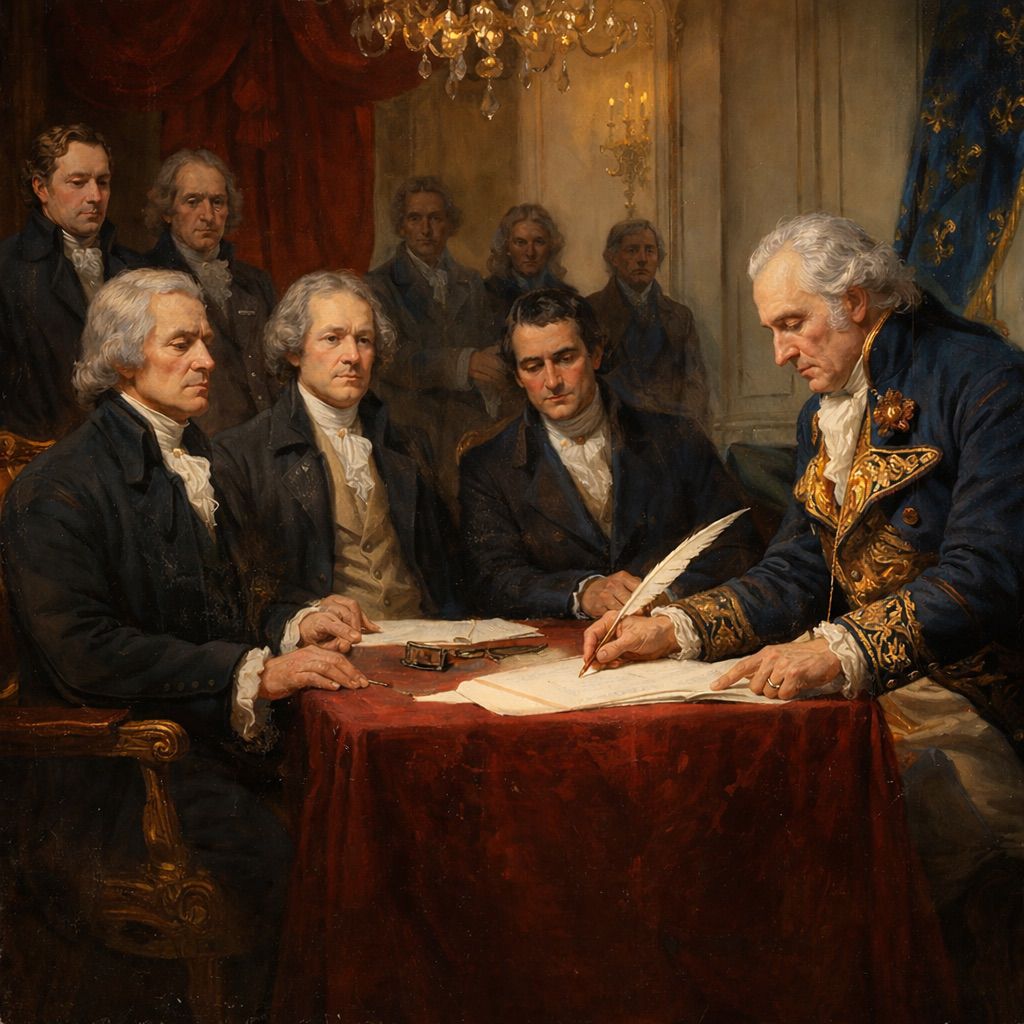
In March 1803, Robert Livingston, James Monroe, and François Barbé-Marbois, representing the French government, signed the Louisiana Purchase treaty in Paris. The deal was worth $15 million, a staggering sum that would be equivalent to over $250 million today. However, it was not just about the money; this acquisition represented a fundamental shift in American policy, as Jefferson and his allies had long envisioned an expansionist agenda for the country.

The news of the treaty spread like wildfire across the United States, with many Americans hailing it as one of the greatest achievements of their young nation. However, there were also those who opposed the deal, arguing that it was unconstitutional and would lead to increased conflict with Native American tribes.

As the purchase was finalized, Jefferson knew that he had to navigate a delicate web of politics and diplomacy to ensure its success. He appointed William Pinckney as the new U.S. Minister to France, where he negotiated the transfer of ownership with French officials. Meanwhile, Jefferson also instructed his secretary of war, Henry Dearborn, to begin making preparations for the occupation of New Orleans.

On May 20, 1803, a ceremony was held in New Orleans to mark the transfer of authority from French to American hands. Pierre LaFleur, the last French governor of Louisiana, handed over the keys to William Claiborne, the new U.S. governor. However, it would be another two years before the formal completion of the purchase.

The Louisiana Purchase was not without its challenges and controversies. Jefferson faced opposition from within his own party, with some members questioning the constitutionality of the deal. He also had to contend with the concerns of Native American tribes who saw the acquisition as a threat to their lands and way of life.

Despite these obstacles, Jefferson remained committed to the vision he had first outlined in the 1780s. He saw the Louisiana Purchase as a means to achieve his goal of an “empire of liberty,” which would spread across North America and bring about a new era of prosperity and growth for the United States.

On June 15, 1805, Congress formally ratified the Louisiana Purchase treaty, marking its official completion. Jefferson celebrated this achievement by signing the document in the presence of his cabinet and other officials. The purchase was hailed as one of the greatest successes of American diplomacy, securing a vast new territory that would help shape the country’s future.

As the 19th century dawned, the United States had expanded exponentially, with its borders now stretching from the Atlantic Ocean to the Rocky Mountains. This marked a significant turning point in American history, as the nation began to assert its influence on the global stage.

The Louisiana Purchase was not only a monumental achievement for Jefferson and his administration but also a testament to the enduring spirit of American expansionism. The acquisition of this vast territory had far-reaching consequences, shaping the country’s geography, politics, and economy in profound ways.

One of the most significant impacts of the purchase was the rapid growth of the United States. The Louisiana Territory, which spanned over 828,000 square miles, provided a vast new landmass for American settlers to explore and settle. This led to a surge in population growth, as thousands of pioneers flocked to the region, seeking new opportunities and a fresh start.

The expansion also had significant implications for Native American tribes, who saw the acquisition as a threat to their lands and way of life. Many tribes had long inhabited the Louisiana Territory, with some having established thriving communities along the Mississippi River. However, with the arrival of American settlers, tensions began to rise, leading to conflicts over land ownership and resource management.

Jefferson’s vision for an “empire of liberty” was not without its contradictions. While he sought to extend American influence across North America, he also recognized the importance of respecting Native American sovereignty. In 1804, Jefferson appointed a commission to negotiate with Native American tribes, led by the influential figure of William Henry Harrison.

However, the complexities of Native American diplomacy proved challenging for Jefferson and his administration. The commission’s efforts were hindered by the conflicting interests of various tribal groups, as well as the limited understanding of their cultures and traditions. Despite these challenges, Jefferson remained committed to finding a solution that would balance the needs of both the United States and its Native American neighbors.

In addition to its cultural and economic implications, the Louisiana Purchase also had significant military and strategic consequences. The acquisition provided the United States with control over the Mississippi River, which became a vital transportation artery for trade and commerce. This allowed American merchants to bypass the need for costly sea routes, significantly reducing shipping costs and increasing profitability.

The purchase also marked a turning point in American diplomacy, as the country began to assert its influence on the global stage. The Louisiana Purchase treaty served as a model for future agreements between nations, demonstrating the potential for mutually beneficial arrangements that could shape international relations.

As the 19th century dawned, the United States had emerged as a formidable presence in North America. The acquisition of the Louisiana Territory marked a significant milestone in American expansionism, setting the stage for further growth and development. Jefferson’s vision of an “empire of liberty” continued to inspire generations of Americans, shaping their understanding of national identity and purpose.

However, not all Americans shared this vision. Many critics questioned the constitutionality of the purchase, arguing that it was a gross overreach of executive authority. They saw the Louisiana Purchase as an example of the dangers of imperial ambition, warning of the potential for tyranny and oppression.

Jefferson’s opponents within his own party also raised concerns about the treaty, citing its long-term implications for American democracy. These critics argued that the purchase would lead to increased conflict with Native American tribes, exacerbate regional tensions, and undermine the federal system.

Despite these criticisms, Jefferson remained committed to his vision of an expanding America. He saw the Louisiana Purchase as a necessary step towards securing American interests and preserving national unity. This conviction was reflected in his famous “letter to Marquis de Lafayette,” written in 1803, where he expressed his hope that the purchase would mark a new era of cooperation between nations.

As the purchase was finalized, Jefferson knew that its impact would be felt for generations to come. He recognized that this acquisition represented a fundamental shift in American policy, as the country began to assert its influence on the global stage. The Louisiana Purchase marked a significant turning point in American history, shaping the nation’s geography, politics, and economy in profound ways.

In 1805, Jefferson hosted a grand celebration at Monticello to mark the formal completion of the purchase. Guests included prominent politicians, diplomats, and intellectuals from across the country, all of whom came together to celebrate this monumental achievement. The festivities were marked by speeches, music, and feasting, as Americans came together to commemorate their nation’s growth and expansion.

The Louisiana Purchase also had a profound impact on American culture and identity. As the country expanded westward, it encountered diverse cultures and traditions that would shape its understanding of itself and its place in the world. The acquisition marked the beginning of a new era of exploration and discovery, as Americans set their sights on the vast territories beyond the Mississippi River.

The legacy of the Louisiana Purchase continues to resonate today, influencing American politics, culture, and identity. It serves as a testament to the enduring spirit of American expansionism, shaping the nation’s geography, economy, and diplomacy in profound ways. As historians continue to explore its complexities and nuances, one thing is clear: the Louisiana Purchase marked a significant turning point in American history, forever changing the country’s trajectory and setting the stage for its emergence as a global superpower.

Related Posts

The First Indochina War: How Vietnam’s Fight for Independence Crushed a Colonial Empire

Elias Rowen

The First Indochina War began not with a single dramatic declaration, but with a collision of history, ambition, and betrayal. On December 19, 1946, gunfire echoed through Hanoi as Vietnamese nationalists attacked French colonial positions, igniting a conflict that would fundamentally reshape Southeast Asia and alter the course of global geopolitics. What followed was not simply a war between armies, but a prolonged struggle between an old imperial order desperate to reclaim its authority and a determined nationalist movement willing to endure extraordinary sacrifice to secure independence.

Vietnam had endured decades of French colonial rule before the Second World War disrupted the balance of power in Indochina. When Japan occupied the region during the war, French authority collapsed almost overnight. Vietnamese nationalists, long suppressed, seized the moment. Among them was Ho Chi Minh, a revolutionary who blended nationalism with communist ideology and possessed an uncanny ability to frame Vietnam’s struggle as both a patriotic uprising and part of a global movement against imperialism. When Japan surrendered in 1945, Ho Chi Minh proclaimed Vietnamese independence in Hanoi, invoking the language of freedom and self-determination in front of massive crowds at Ba Dinh Square.

That declaration, however, was never accepted by France. Emerging battered and humiliated from World War II, the French government viewed Indochina as essential to restoring national prestige and economic stability. Rubber plantations, rice exports, and mineral wealth were not merely resources; they were symbols of France’s continued relevance as a global power. Granting independence to Vietnam threatened to unravel the remaining fabric of the French colonial empire.

The postwar Allied occupation of Indochina only deepened tensions. Instead of allowing Vietnamese self-rule, the region was divided into zones controlled by foreign powers. British and Chinese forces temporarily occupied parts of Vietnam, while French troops steadily returned under the protection of Allied agreements. What followed was an uneasy standoff, punctuated by negotiations that collapsed almost as soon as they began. Mutual distrust grew, and both sides quietly prepared for war.

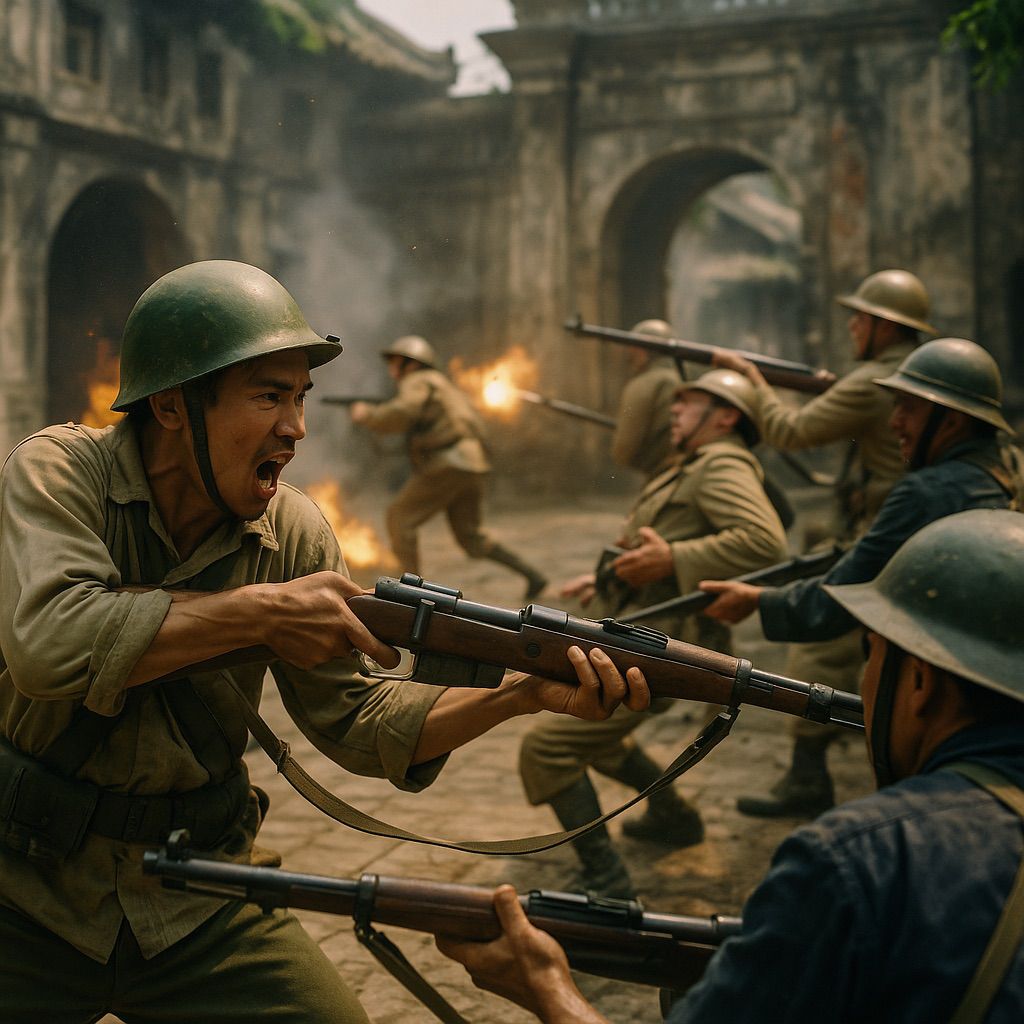
That war exploded in December 1946 when French positions in Hanoi came under coordinated attack. The Viet Minh, Ho Chi Minh’s nationalist coalition, understood that they could not defeat France through conventional means. Instead, they relied on guerrilla warfare, patience, and intimate knowledge of the land. Fighters melted into villages, jungles, and mountains, striking suddenly and disappearing just as quickly. For French troops trained in traditional European warfare, the enemy seemed invisible.

The French response was brutal and increasingly desperate. Determined to reassert control, they launched sweeping military campaigns aimed at pacifying rural areas. Villages suspected of aiding the Viet Minh were destroyed or forcibly relocated. Civilians were caught in the crossfire, punished collectively for the actions of guerrillas who often lived among them. These tactics, intended to isolate the insurgents, instead hardened local support for the resistance.

As years passed, the war became one of attrition. The Viet Minh suffered enormous losses, yet they continued to replenish their ranks through popular support and ideological commitment. The Chinese Communist victory in 1949 proved decisive, opening supply lines and providing training, weapons, and strategic depth. Suddenly, the Viet Minh were no longer an isolated insurgency but part of a broader revolutionary movement stretching across Asia.

By 1950, French control of the countryside had largely collapsed. Major cities remained in colonial hands, but rural Vietnam increasingly belonged to the Viet Minh. French commanders rotated in and out, each promising a new strategy that might finally break the resistance. One of the most prominent was General Jean-Marie de Lattre de Tassigny, who arrived with a reputation for brilliance and determination. His reforms temporarily stabilized the situation, introducing mobile warfare and improved coordination. For a brief moment, it appeared France might salvage victory.

But the war had already turned against them. The United States, fearing the spread of communism, began pouring money, equipment, and aircraft into the French war effort. By the early 1950s, America was financing the majority of the conflict. Yet this support only prolonged the inevitable. Superior firepower proved useless against an enemy willing to absorb losses and fight indefinitely.

The decisive moment came in 1954 at Dien Bien Phu. The French, confident in their airpower and fortified positions, established a base in a remote valley in northwest Vietnam. They believed the Viet Minh could not transport heavy artillery through mountainous jungle terrain. They were wrong. Through sheer human labor and ingenuity, the Viet Minh hauled artillery piece by piece into the hills overlooking the valley. When the siege began, French forces found themselves trapped and outgunned.

After weeks of relentless bombardment and ground assaults, the French position collapsed on May 7, 1954. Dien Bien Phu was more than a military defeat; it was a psychological catastrophe. The myth of European invincibility in colonial wars was shattered. Across Asia and Africa, nationalist movements took note.

The Geneva Accords later that year formally ended the war. Vietnam was temporarily divided, with the Viet Minh controlling the north and a Western-backed government ruling the south. Independence was granted to Laos and Cambodia. France withdrew, its colonial ambitions in Indochina extinguished.

Yet the war’s legacy was far from over. The division of Vietnam laid the groundwork for an even larger conflict that would soon draw in the United States. Millions of Vietnamese civilians bore the scars of displacement, violence, and loss. Entire regions were devastated, and political divisions hardened into ideological fault lines that would define Southeast Asia for decades.

The First Indochina War was not simply a prelude to the Vietnam War. It was a defining struggle in its own right, demonstrating how colonial powers could be defeated through endurance, popular support, and strategic patience. It revealed the limits of military force in suppressing nationalist movements and exposed the dangerous entanglement of Cold War ideology with local struggles for independence.

Today, the war stands as a reminder that history is rarely shaped by clean victories or moral clarity. It is forged in compromise, suffering, and relentless determination. The First Indochina War ended an empire, birthed a nation, and reshaped the global balance of power — consequences that continue to echo through the modern world.

Related Posts

Impeached: The Night Bill Clinton’s Presidency Was Put on Trial

Elias Rowen

The night of December 19, 1998, unfolded with an unmistakable sense of gravity across Washington, D.C. Inside the U.S. Capitol, history was about to be made in a way few Americans had ever witnessed. Outside, the city buzzed with tension as news cameras lined the streets and citizens stayed glued to their televisions. By the end of the evening, President Bill Clinton would become only the second president in American history to be impeached by the House of Representatives, thrusting the nation into a moment of reckoning that went far beyond one man’s personal failings.

The impeachment of Bill Clinton did not erupt suddenly. It was the culmination of months of scandal, investigation, political maneuvering, and public spectacle that blurred the line between governance and voyeurism. At the center of it all was a deeply human story—one involving power, secrecy, deception, and the consequences of choices made in private that spilled relentlessly into the public arena.

The controversy began in January 1998 when reports surfaced that Clinton had engaged in an inappropriate relationship with Monica Lewinsky, a former White House intern. At first, the allegations were met with denial. Clinton stood before the cameras and delivered what would become one of the most quoted statements of his presidency, insisting he had not had sexual relations with Lewinsky. For a time, many Americans accepted his words, reluctant to believe that a sitting president would so boldly lie.

As evidence mounted, however, the narrative began to unravel. Testimony, sworn statements, and physical evidence contradicted Clinton’s denials. By August 1998, the truth could no longer be contained. Clinton admitted that he had indeed engaged in an improper relationship, though he carefully framed his confession in legalistic terms. The damage, however, had already been done. Trust—arguably the most fragile currency in politics—had been shattered.

What transformed a personal scandal into a constitutional crisis was not the affair itself, but the actions Clinton took to conceal it. Investigators alleged that he lied under oath during a deposition related to a separate sexual harassment lawsuit filed by Paula Jones. They further argued that he encouraged others to lie and attempted to obstruct justice by manipulating testimony and evidence. These allegations struck at the heart of the legal system, raising profound questions about accountability at the highest level of government.

The House Judiciary Committee took center stage as it examined whether Clinton’s actions constituted “high crimes and misdemeanors” as defined by the Constitution. Hearings were tense, emotional, and deeply partisan. Republicans argued that no one—not even the president—was above the law. Democrats countered that impeachment was being weaponized for political gain and warned of the dangerous precedent such a move would set.

Throughout the fall of 1998, the nation watched as legal arguments clashed with moral judgments. Polls revealed a striking contradiction: many Americans disapproved of Clinton’s behavior, yet they continued to support his presidency. The economy was strong, unemployment was low, and for many voters, Clinton’s personal failures did not outweigh his political successes.

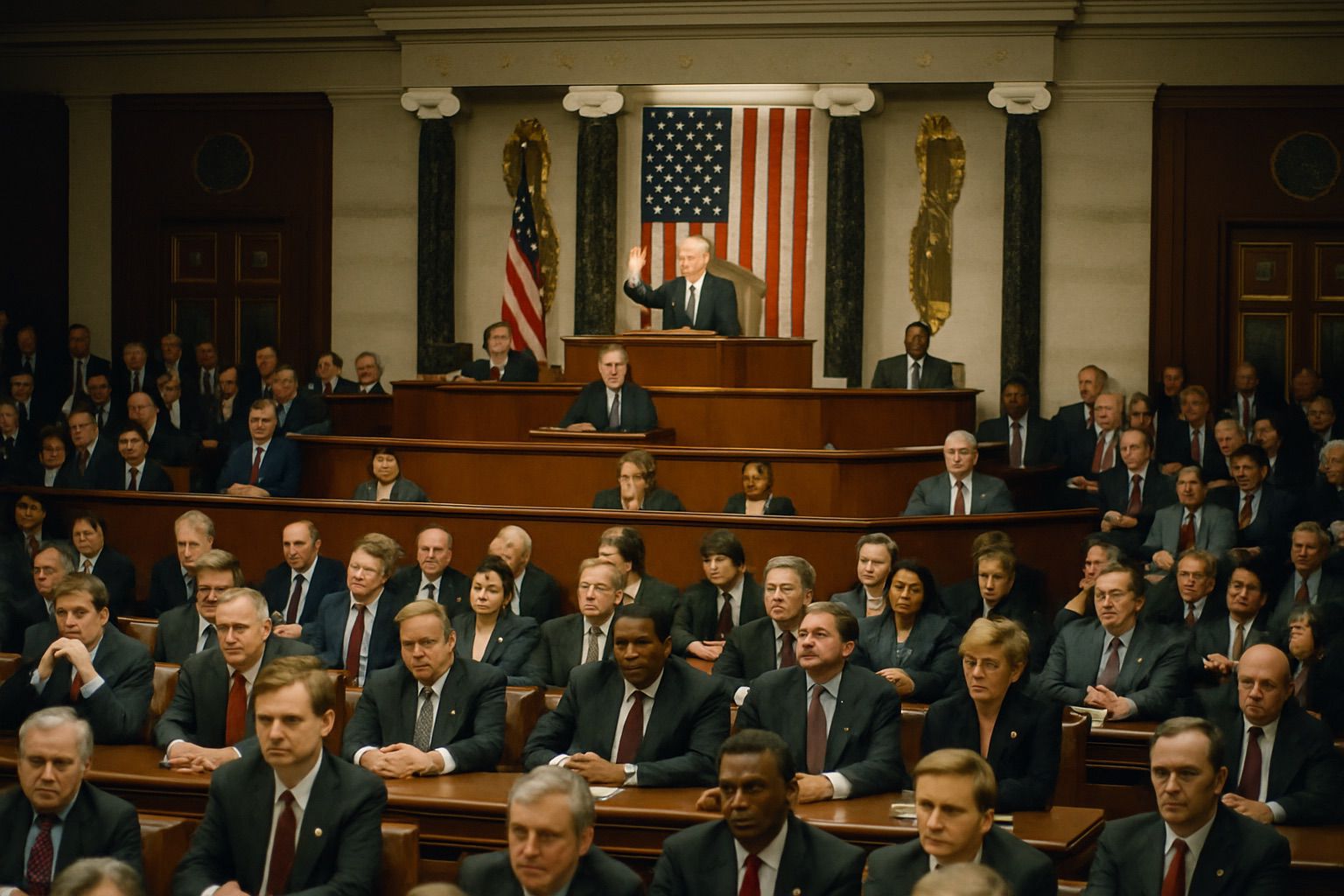
Inside Congress, however, the lines hardened. On December 11, the Judiciary Committee approved four articles of impeachment, including perjury and obstruction of justice. Debate moved to the full House, where emotions ran high. Lawmakers delivered impassioned speeches invoking the Founding Fathers, the sanctity of the Constitution, and the moral fabric of the nation.

As December 19 arrived, the atmosphere inside the House chamber was electric. Members understood the gravity of what they were about to do. Late into the night, votes were cast. When the final tallies were announced, Clinton had been impeached on two counts—perjury and obstruction of justice—largely along party lines. History had been altered with the stroke of a gavel.

That same night, Clinton addressed the nation. His tone was somber but resolute. He accepted responsibility for his actions while rejecting the notion that they warranted removal from office. The presidency, he insisted, would continue. The country, exhausted by months of scandal, braced for the next phase: a Senate trial.

The Senate proceedings in early 1999 carried their own weight. Chief Justice William Rehnquist presided with quiet restraint as senators took an oath to administer impartial justice. The trial unfolded under intense media scrutiny, yet it lacked the theatrical drama many had expected. Testimony was limited, arguments were tightly controlled, and the outcome seemed increasingly predictable.

When the Senate voted on February 12, 1999, Clinton was acquitted on both charges. No article received the two-thirds majority required for conviction. Clinton remained president, but the scars of impeachment would linger long after the gavel fell.

The impeachment of Bill Clinton reshaped American politics in subtle but enduring ways. It deepened partisan divisions, normalized the use of scandal as political weaponry, and eroded public trust in institutions already under strain. It also forced Americans to confront uncomfortable questions about leadership, morality, and the limits of forgiveness.

For Clinton himself, the experience was both humbling and defining. Though he completed his term with relatively high approval ratings, his legacy would forever be intertwined with impeachment. His presidency became a case study in contradiction—a period of economic prosperity shadowed by personal failure and political turmoil.

In retrospect, the Clinton impeachment stands as a mirror reflecting the tensions of a nation wrestling with its values. It exposed how deeply politics had become entangled with identity, outrage, and media spectacle. More than two decades later, its echoes can still be felt in the hyper-partisan climate that defines modern American life.

December 19, 1998, was not just a night when a president was impeached. It was a night when the country learned how fragile trust could be—and how enduring the consequences of its loss might become.

Related Posts

The Ghost That Saved Christmas: How Dickens’ “A Christmas Carol” Rekindled the Human Heart

Elias Rowen

London, December 1843. The city was wrapped in fog and frost, the streets slick with mud and the smell of coal smoke thick in the air. Gas lamps flickered against the dark as hurried footsteps echoed off cobblestones. Winter had descended with its usual cruelty—especially on the poor. In narrow alleyways, ragged children huddled for warmth, their faces pale with hunger. And yet, in that same bleak city, a miracle of words was about to be born. On December 19, 1843, Charles Dickens published A Christmas Carol, a slender little book of less than 30,000 words that would forever change how the world celebrated Christmas—and how it understood compassion itself.

It’s hard now to imagine a world without Dickens’ ghosts, without the sneer of Scrooge or the innocent smile of Tiny Tim. But when A Christmas Carol first appeared, Christmas was a fading tradition in industrial England. The old customs—carols, feasts, merriment—had been overshadowed by factories, time clocks, and the cold precision of commerce. The poor toiled long hours for meager wages, while the wealthy insulated themselves behind iron gates and moral distance. Dickens saw it all. He walked those same grim streets, feeling both pity and rage. The Industrial Revolution had made England richer—but not kinder.

By 1843, Dickens was no stranger to success. He was already famous for The Pickwick Papers and Oliver Twist, but his finances were strained, and his social conscience was on fire. During a visit to Manchester earlier that year, he had seen the brutal reality of child labor—tiny bodies working in factories, little fingers raw and eyes weary before they had even learned to read. The image haunted him. At the same time, he was reading government reports on poverty and attending charity events where well-fed donors made polite speeches about “the deserving poor.” Dickens knew words could pierce the heart in ways policy never could. He resolved to write not a pamphlet, but a story—something that would seize the imagination of rich and poor alike.

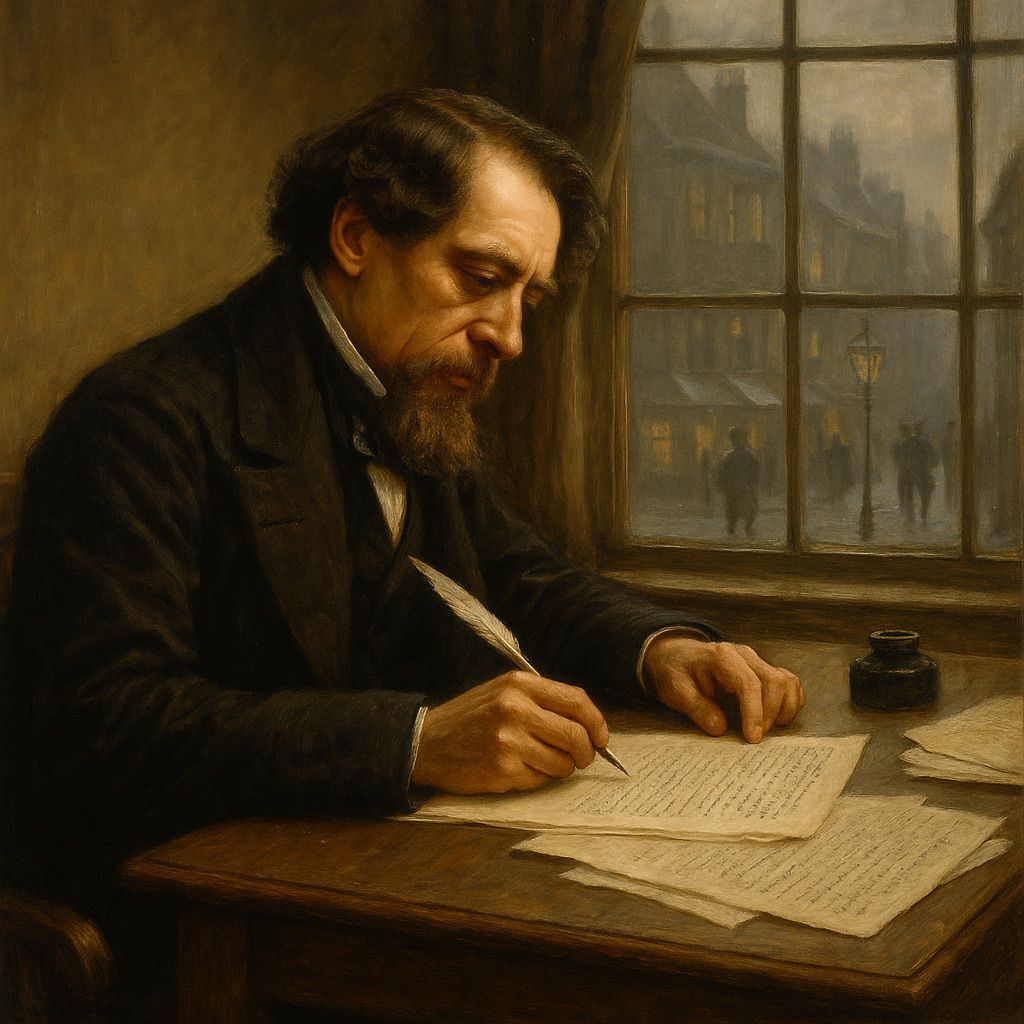
The idea came swiftly. One night, while walking the dark streets of London, Dickens conceived the image of a lonely, miserly man confronted by ghosts of his own making. A man who hoarded money but starved his soul. A man named Ebenezer Scrooge. Within weeks, Dickens wrote feverishly, often pacing his study until dawn. He wept and laughed as he wrote, possessed by the spirit of his own creation. He later said that the story “came like a thunderclap.”

When the manuscript was finished, Dickens faced another problem: publishers. His last book had not sold well, and he feared A Christmas Carol would be dismissed as sentimental folly. So he decided to publish it himself. He poured his dwindling savings into the project, personally overseeing every detail—from the binding and cover design to the illustrations by John Leech. The book would be small enough to fit in the hand, bound in crimson cloth with gilt pages, priced at five shillings—affordable but elegant. Dickens wanted it to reach everyone, from the grand parlors of Mayfair to the humblest of London’s garrets.

The book appeared in shops on December 19, just six days before Christmas. The first printing of 6,000 copies sold out within days. By New Year’s, A Christmas Carol was the talk of England. Critics hailed it as “a national benefit.” The public devoured it. Readers wept openly at the transformation of Scrooge, cheered for Bob Cratchit, and whispered prayers for Tiny Tim. The story struck something deep—a longing for redemption, for warmth in a cold age. Dickens had tapped into the collective conscience of a society teetering between industry and humanity.

At its core, A Christmas Carol was more than a ghost story—it was a moral revolution. Through Scrooge’s journey, Dickens distilled the timeless truth that no one is beyond redemption. The story’s ghosts—Past, Present, and Yet to Come—serve as mirrors, showing the cost of greed and the grace of compassion. “Mankind was my business,” laments Marley’s ghost, his chains rattling with the weight of regret. That line alone became a sermon. Dickens, more than any preacher of his day, made morality vivid and urgent.

But what truly astonished readers was how personal it all felt. Scrooge wasn’t just a character—he was an archetype, a reflection of something lurking within every person who had ever turned away from another’s suffering. The joy of Scrooge’s redemption, his childlike laughter on Christmas morning, felt like a collective release. As Dickens wrote, “I will honour Christmas in my heart, and try to keep it all the year.” Those words were both confession and commandment.

The impact was immediate and profound. Within weeks, charitable giving in England surged. Employers gave their clerks Christmas holidays. Churches revived old carols. Newspapers reprinted scenes from the book. Even politicians began to speak of “Christian duty” in language that echoed Dickens’ moral vision. In effect, A Christmas Carol reinvented Christmas—not as a feast of excess or a religious ritual alone, but as a season of generosity, empathy, and renewal.

Yet Dickens’ purpose went deeper than sentimentality. He wanted readers to confront the social evils that had made the Scrooges of the world possible. He saw the Poor Laws, debtors’ prisons, and child labor as symptoms of a moral disease—the disease of indifference. In A Christmas Carol, he transformed social criticism into a spiritual parable. The Cratchit family’s humble joy, despite their poverty, stands as both rebuke and revelation. They have nothing, yet they possess everything that matters: love, gratitude, and hope. Tiny Tim, the frail child who “did NOT die,” became the living heart of that hope.

Dickens’ genius lay in his ability to humanize the abstract. Poverty was no longer a statistic—it had faces, names, voices. Readers could no longer ignore it. In Scrooge’s redemption, Dickens offered not just comfort, but a challenge: that every reader examine their own heart.

The success of A Christmas Carol spread far beyond England. Within a year, it was translated across Europe and America. Public readings of the story became holiday traditions. Dickens himself gave hundreds of performances, reading the tale aloud with such emotion that audiences sobbed. One American journalist described it as “a religious experience.” Queen Victoria reportedly adored it. Even critics who had dismissed Dickens as a populist admitted that his story had touched something universal.

Ironically, despite its enormous popularity, Dickens made little profit from the book. High production costs and publishing disputes ate up most of his earnings. But the financial disappointment mattered little compared to its cultural triumph. The book had done what he had hoped—it had moved the hearts of men.

In the years that followed, Dickens would write several more Christmas stories, but none would capture the world’s imagination like A Christmas Carol. It was lightning in a bottle—a perfect union of moral clarity, storytelling magic, and social conscience. Every December since, the world returns to it like pilgrims to a shrine, seeking once again to be reminded of kindness and redemption.

There is something timeless about the image of Scrooge awakening on Christmas morning, the weight of his greed melted away. His laughter, so foreign to him, bursts forth like sunlight. He dances through the streets of London, promising to help the poor, to love his neighbor, to be “as good a man as the old city knew.” In that moment, Dickens gives us not just a happy ending, but a vision of what humanity can be when it chooses compassion over cynicism.

The story’s endurance is not accidental. Each generation rediscovers its meaning anew. In times of plenty, it reminds us to give; in times of hardship, it reminds us to hope. During wars, depressions, pandemics, and every trial since 1843, A Christmas Carol has remained a touchstone—a reminder that transformation is always possible.

Dickens once wrote that he hoped his “little book” would “raise the ghost of an idea.” He could not have imagined how fully it would succeed. That ghost has never left us. It lingers each Christmas in the ringing of bells, the laughter of children, the quiet act of generosity from one stranger to another.

It’s said that when Dickens died in 1870, a poor woman was heard to weep, “He made me feel I could be better.” That, perhaps, is his greatest legacy. More than any sermon or law, he reminded humanity that goodness is a choice, renewed every day, every Christmas, with every heart that dares to open.

Nearly two centuries later, as lights twinkle in shop windows and carols echo down crowded streets, the spirit of Dickens’ story still lives. The ghosts of A Christmas Carol continue their work—haunting us, yes, but with love. And every time a lonely soul finds warmth, or a hardened heart softens, or a child’s laughter fills the cold winter air, it is as if we can still hear that final echo of Dickens’ pen: God bless us, every one.

Related Posts

Valley Forge: The Winter That Forged an Army and Saved the American Revolution

Elias Rowen

The winter of 1777–1778 stands as one of the most defining chapters in the story of the American Revolution, not because of a great battle or a sweeping victory, but because of survival. At Valley Forge, the Continental Army endured conditions so brutal that many believed the revolution itself might die in the frozen fields of Pennsylvania. Hunger, disease, cold, and despair stalked the encampment daily, threatening to unravel the fragile force struggling to oppose the British Empire. Yet it was in this crucible of suffering that an army was transformed and a nation’s resolve hardened.

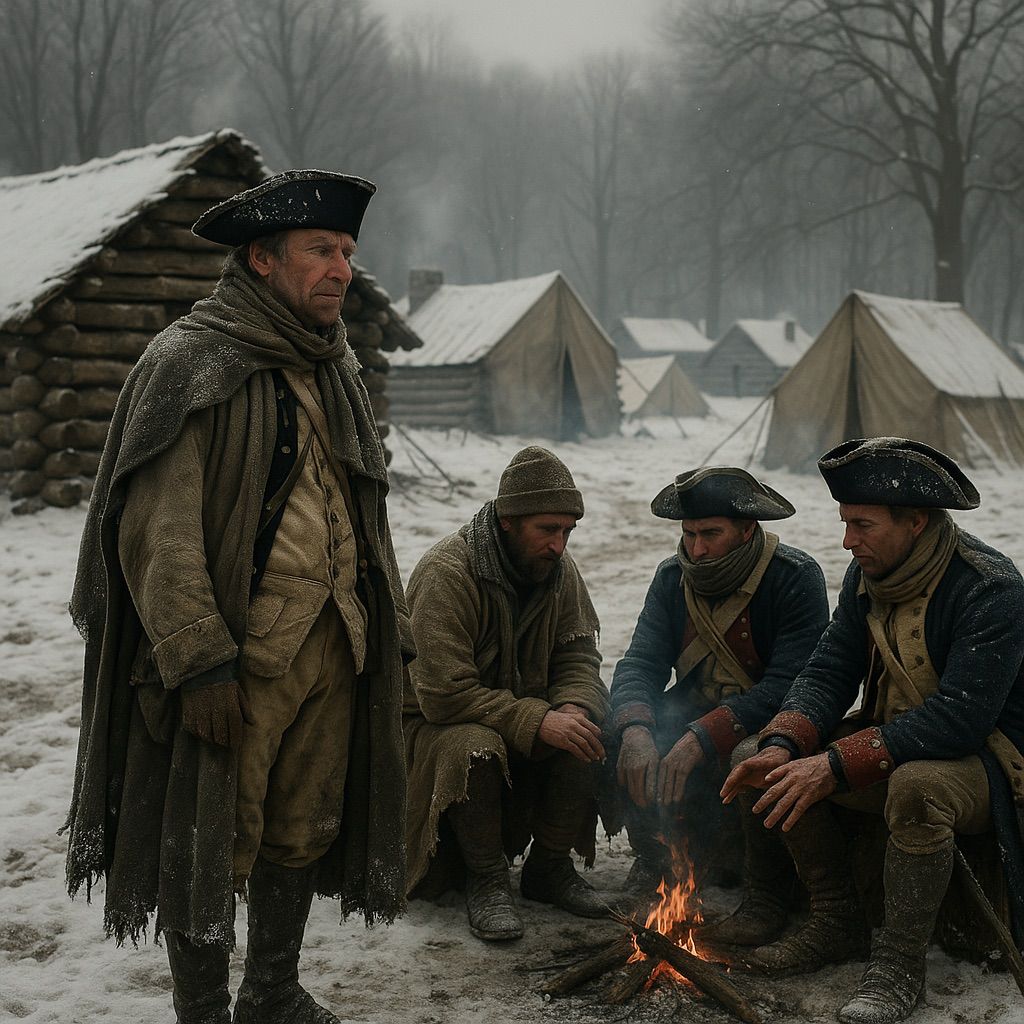
When George Washington chose Valley Forge as his winter encampment, he did so out of strategic necessity rather than comfort. The location offered protection from British surprise attacks while allowing the army to keep pressure on enemy-held Philadelphia. Still, strategy could not shield the men from the realities that awaited them. When the first soldiers arrived in December 1777, they found no shelter, no infrastructure, and little food. Snow blanketed the ground, and the wind cut through threadbare uniforms as if they did not exist.

The men of the Continental Army were not professional soldiers in the European sense. Many were farmers, laborers, and tradesmen who had volunteered or been drafted into service. They lacked consistent training, proper equipment, and often even basic supplies. At Valley Forge, these shortcomings became painfully visible. Soldiers marched barefoot through snow stained with blood. Others wrapped rags around their feet, knowing frostbite could claim toes or entire limbs.

Food shortages were relentless. Supply lines failed repeatedly due to poor organization, corruption, and lack of resources. Men survived on meager rations of flour and water, sometimes boiled into a thin paste known as firecake. Meat was rare. Hunger weakened bodies already battered by exposure, making disease spread rapidly through the encampment.

Typhus, dysentery, pneumonia, and influenza swept through the ranks. Makeshift hospitals overflowed with the sick and dying. Doctors worked with limited tools and supplies, often unable to do more than offer comfort. By the end of winter, nearly 2,000 men had died—not from British bullets, but from neglect, cold, and illness.

Morale sank dangerously low. Desertions increased as soldiers questioned whether independence was worth such suffering. Some officers openly criticized Washington, doubting his leadership and whispering of replacement. The so-called Conway Cabal revealed just how fragile unity had become. Yet Washington endured these attacks with restraint, refusing to abandon his post or his men.

Washington’s greatest strength at Valley Forge was not tactical brilliance, but moral authority. He shared in his army’s hardships, refusing special treatment and insisting on fairness wherever possible. He appealed constantly to Congress for aid, demanding accountability from corrupt quartermasters and reorganizing supply systems to ensure survival.

The turning point at Valley Forge did not come from improved weather or sudden abundance. It came from discipline. In February 1778, Friedrich Wilhelm von Steuben arrived at the encampment. A Prussian officer with experience in European warfare, von Steuben brought structure to chaos. Despite limited English, he communicated through example, drilling soldiers personally and instilling order where there had been confusion.

Von Steuben standardized training, taught soldiers how to march, load muskets efficiently, and fight as coordinated units. He introduced hygiene practices that reduced disease and reorganized camp layouts to improve sanitation. Slowly, painfully, the army began to change.

The men who had arrived at Valley Forge as desperate survivors began to leave as disciplined soldiers. Confidence replaced despair. Pride returned where humiliation had once ruled. When spring finally came, the Continental Army emerged not merely intact, but transformed.

This transformation was tested at the Battle of Monmouth in June 1778. There, Washington’s troops faced British forces in open battle and held their ground. Though the engagement was tactically inconclusive, its symbolic importance was immense. The Continental Army had proven it could stand against one of the world’s most powerful militaries.

Valley Forge became the emotional heart of the Revolution. It symbolized sacrifice without surrender, endurance without despair. The suffering endured there forged bonds between soldiers and solidified commitment to a cause larger than any individual hardship.

The winter also reshaped Washington’s legacy. His leadership during those months cemented his reputation as a commander not just of strategy, but of character. He understood that armies are sustained not only by supplies, but by belief. At Valley Forge, belief nearly failed—but did not break.

Today, Valley Forge stands as a reminder that victory is not always born on the battlefield. Sometimes it is forged in endurance, discipline, and the refusal to give up when defeat seems inevitable. The men who survived that winter carried its lessons into every campaign that followed, helping secure independence not through brilliance alone, but through resilience.

Valley Forge endures in American memory because it represents the cost of freedom stripped of romantic illusion. It was cold, painful, unjust, and nearly fatal. Yet from that suffering emerged an army capable of winning a nation.

Related Posts

The Mayflower Landing: Faith, Survival, and the Birth of Plymouth Colony

Elias Rowen

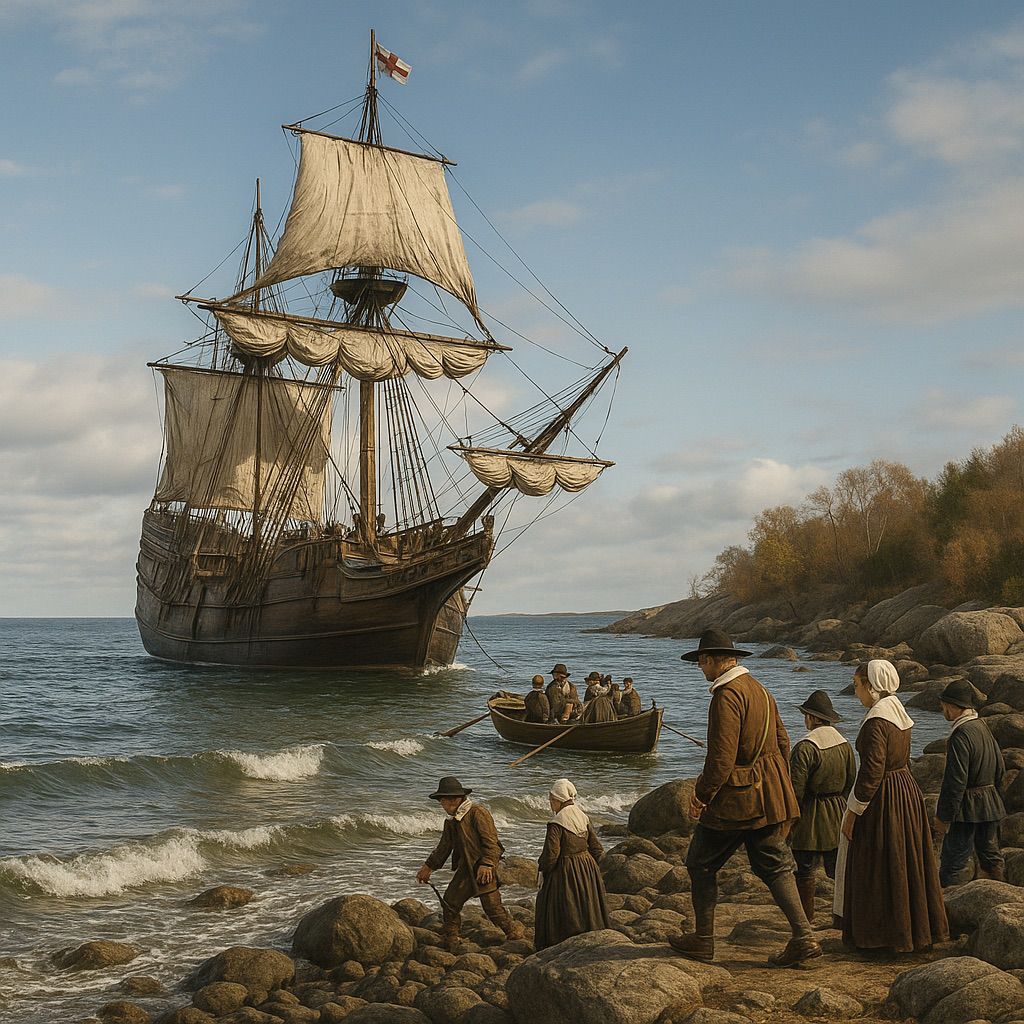
In the early seventeenth century, a single wooden ship crossing the Atlantic carried far more than passengers and cargo. The Mayflower carried fear, hope, desperation, faith, and ambition—elements that would collide on the shores of North America and help shape the future of an entire continent. When the ship finally dropped anchor off the coast of Cape Cod in November 1620, the people aboard were exhausted, uncertain, and unprepared for what lay ahead. Yet they were united by a shared belief that their survival depended on building something new in a land they barely understood.

The passengers of the Mayflower were not explorers in the traditional sense. They were families, craftsmen, laborers, and religious dissenters fleeing a world that no longer offered them security or freedom. Among them were the Separatists—later known as the Pilgrims—who had broken away from the Church of England in search of a simpler, more democratic form of worship. Their refusal to conform made them targets of persecution, forcing them first into exile and eventually toward the unknown.

Years before the voyage, these Separatists had settled in Leiden, Holland, where they enjoyed religious tolerance but struggled economically and culturally. While they were free to worship as they chose, their children began to lose English identity, and work was scarce. At the same time, political changes in England threatened to close even that fragile refuge. Faced with an uncertain future, the community made a decision that would alter history: they would leave Europe entirely.

The opportunity came through negotiations with English investors and the Virginia Company, which hoped to profit from new colonies in North America. The Pilgrims secured permission to settle in the New World, though their destination was meant to be farther south. On September 6, 1620, the Mayflower departed Plymouth Harbour carrying 102 passengers and a crew accustomed to the dangers of the sea.

The voyage was brutal. Storms battered the ship, forcing passengers below deck for weeks at a time. Food spoiled, illness spread, and morale wavered. Yet the travelers endured, bound together by necessity and belief. When land was finally sighted after more than two months at sea, relief quickly gave way to uncertainty. They had arrived far north of their intended destination, beyond the reach of their charter.

Before anyone set foot on land, the settlers faced a critical problem: authority. Without a valid charter, no one technically held legal power. In response, the adult men aboard drafted and signed the Mayflower Compact, an agreement that bound them to govern themselves through collective decision-making. This simple document became one of the earliest expressions of self-governance in American history.

On December 11, 1620, the settlers landed at what would become Plymouth. The land was cold, forested, and unforgiving. There were no towns, no fields, no supplies waiting. Winter came quickly, bringing hunger, disease, and death. Nearly half of the settlers would not survive their first year.

It was during this desperate period that the story of Plymouth Colony became inseparable from the story of the Wampanoag people. Long before the English arrived, Native communities had lived on this land, adapting to its rhythms and dangers. Among them was Tisquantum—known as Squanto—a man whose life had already been shaped by European intrusion. Kidnapped years earlier and taken to England, Squanto returned to find his village destroyed by disease.

Squanto’s knowledge of English and his understanding of both cultures placed him in a unique position. Despite personal loss and mistrust on all sides, he chose to help the settlers. He taught them how to plant corn using fish as fertilizer, how to hunt and fish, and how to survive the harsh New England environment. Without his guidance, the colony likely would have failed.

Relations between the Pilgrims and the Wampanoag were complex and fragile. An alliance formed with the Wampanoag leader Massasoit, driven as much by mutual survival as goodwill. For the English, Native knowledge meant survival. For the Wampanoag, an alliance offered protection against rival tribes and a chance to manage European expansion—though few could foresee the consequences that would follow.

As the seasons passed, Plymouth Colony slowly stabilized. Crops grew, shelters improved, and trade networks formed. Governance evolved as well, reflecting the Pilgrims’ belief in collective responsibility. Yet beneath these successes lay constant tension—between settlers and Native peoples, between faith and survival, and between ideals and reality.

Disease continued to haunt both communities. European illnesses devastated Native populations, while settlers faced recurring outbreaks that threatened to erase their fragile foothold. Each winter brought new uncertainty, reinforcing the understanding that survival depended on cooperation, adaptability, and resilience.

Over time, the colony expanded, drawing new settlers and reshaping the landscape. What began as a refuge gradually became a foothold for broader colonization. Agreements made in desperation became contested as power shifted, and alliances strained under pressure. The story of Plymouth Colony is therefore not one of simple triumph, but of layered complexity—hope entangled with loss, faith intertwined with conflict.

Squanto’s legacy, often reduced to a footnote, remains central to this story. He was neither villain nor savior, but a human being navigating an impossible position between worlds. His role reminds us that the survival of Plymouth Colony was not solely the result of European determination, but of Native knowledge, sacrifice, and compromise.

The arrival of the Mayflower marked a beginning, not a conclusion. It set into motion forces that would shape American identity for centuries, raising enduring questions about governance, faith, coexistence, and consequence. The Pilgrims sought freedom, but their story is inseparable from the land and people they encountered—a truth that complicates the legacy they left behind.

Plymouth Colony stands as both symbol and warning. It represents resilience in the face of adversity, but also the costs of expansion and misunderstanding. To remember it honestly is to acknowledge both the courage of those who crossed the ocean and the lives forever altered by their arrival.

Related Posts

Echo 1A and the Birth of Global Communication: When the World First Spoke Through Space

Elias Rowen

The moment humanity first learned how to speak to itself through space did not arrive with fanfare or celebration, but with quiet precision, careful planning, and a shimmering sphere drifting silently above Earth. When Echo 1A successfully launched on April 1, 1960, it marked the beginning of a revolution that would permanently reshape how people communicated, cooperated, and understood the world. Though often overshadowed by the drama of manned spaceflight and the Cold War rivalry between superpowers, Echo 1A quietly changed everything.

The roots of satellite communication stretch back decades before the first rocket ever left Earth. Visionaries like Konstantin Tsiolkovsky imagined artificial satellites long before technology could support the idea. Later, Arthur C. Clarke expanded that vision, proposing in 1945 that satellites placed in orbit could act as communication relays, bouncing signals across the globe. At the time, his ideas seemed like science fiction. Within fifteen years, they became reality.

The late 1950s were defined by urgency. The Soviet Union’s launch of Sputnik 1 in October 1957 stunned the world, proving that space was no longer theoretical. When Sputnik 2 followed with Laika aboard, the geopolitical implications became impossible to ignore. Space was now a strategic frontier, and communication within it was just as important as exploration itself. The United States responded not only with rockets, but with ideas focused on peaceful, practical applications of space technology.

Echo 1A emerged from this environment of innovation and competition. Developed through collaboration between NASA, the U.S. Army’s Ballistic Missile Agency, and RCA, Echo 1A was unlike any satellite before it. It had no transmitters, no onboard electronics for communication, and no propulsion system. Instead, it was essentially a giant reflective balloon—an enormous Mylar sphere designed to bounce radio signals back to Earth.

At nearly 100 feet in diameter, Echo 1A was astonishing to see. When sunlight struck its surface, it became one of the brightest objects in the night sky, visible to the naked eye. For many people around the world, seeing Echo glide overhead was a profound experience. It was a visible reminder that humanity had extended its reach beyond the atmosphere and into the vastness above.

The satellite’s simplicity was its brilliance. Engineers wanted to test whether radio signals could be reliably reflected off an orbiting object. If successful, this would prove that satellites could serve as global communication platforms. Echo 1A’s passive design eliminated many technical risks while allowing scientists to gather invaluable data about signal behavior, orbital mechanics, and atmospheric interference.

The launch itself was the culmination of years of trial and error. Previous attempts with Echo 1 had failed when the satellite did not properly deploy. Engineers refined the design, improved materials, and adjusted deployment mechanisms until Echo 1A was ready. When the Thor-Able rocket lifted off from Cape Canaveral on April 1, 1960, it carried more than hardware—it carried the future of communication.

Once in orbit, Echo 1A exceeded expectations. Radio transmissions sent from California were reflected back to receivers thousands of miles away. For the first time, voices and signals traveled around the curvature of Earth by touching space itself. The implications were staggering. Distance, once a fundamental limitation, had been fundamentally altered.

Beyond communication, Echo 1A contributed to scientific understanding. Researchers used the satellite to study atmospheric density, orbital decay, and solar radiation pressure. These experiments provided insights that would later support weather satellites, navigation systems, and deep-space missions. Echo was not just a tool—it was a classroom in orbit.

The geopolitical impact of Echo 1A was subtle but powerful. Unlike weapons-focused projects, Echo symbolized peaceful innovation. It demonstrated that space could connect rather than threaten. In an era defined by suspicion and rivalry, Echo offered a glimpse of cooperation and shared progress, even as Cold War tensions remained high.

Echo 1A also laid the groundwork for active communication satellites. While passive reflection had limitations, it proved the concept beyond doubt. Engineers quickly moved toward satellites capable of amplifying and retransmitting signals. This evolution led directly to Telstar, Syncom, and eventually the vast satellite networks that define modern telecommunications.

Within a decade, satellite communication enabled live transatlantic television broadcasts, global telephone networks, and real-time international news. What once took days or weeks now took seconds. Economies expanded, diplomacy evolved, and cultures connected in ways previously unimaginable.

The legacy of Echo 1A lives quietly beneath modern convenience. GPS navigation, satellite internet, disaster response coordination, and global broadcasting all trace their origins back to that reflective balloon drifting above Earth. It did not carry humans, but it carried humanity’s voice.

Echo 1A remained in orbit for several years, slowly descending as atmospheric drag pulled it closer to Earth. When it finally burned up in the atmosphere in 1968, its mission was already complete. The world it helped create no longer needed passive reflection—it had learned how to speak through the stars.

Today, thousands of satellites orbit Earth, forming an invisible web of communication that supports daily life. From video calls to emergency alerts, satellite communication has become so integrated that its absence is difficult to imagine. That seamless connectivity began not with complexity, but with simplicity.

Echo 1A reminds us that innovation does not always roar. Sometimes it whispers, reflects, and quietly changes everything. It stands as one of the most important yet understated milestones in human technological history—a moment when Earth first learned to listen to itself from space.

Related Posts

Verdun: The 303-Day Slaughter That Redefined the Horror of Modern Warfare

Elias Rowen

The Battle of Verdun did not begin with a dramatic breakthrough or a swift advance. Instead, it unfolded slowly, deliberately, and mercilessly, grinding human lives into the soil of northeastern France over the course of 303 days. When it finally ended on December 18, 1916, Verdun had become more than a battlefield. It was a symbol of industrialized death, of endurance pushed beyond reason, and of a war that seemed determined to consume an entire generation.

Verdun was never intended to be just another offensive. For the German high command, it was meant to be something far more calculated and devastating. General Erich von Falkenhayn believed that France could be bled white by attacking a position the French could never afford to abandon. Verdun, with its historic fortresses and strategic importance, was the perfect target. Falkenhayn did not necessarily seek to capture the city outright. His aim was attrition—forcing France to pour men into the fight until its army collapsed under the weight of its own losses.

On February 21, 1916, the German assault began with one of the most intense artillery barrages the world had ever seen. Shells rained down relentlessly, tearing apart trenches, forests, and bodies alike. The earth itself seemed to scream under the violence. French soldiers, many of them stunned and buried alive, struggled to regroup as German infantry advanced through a shattered landscape.

Verdun’s defenses were formidable but incomplete. Years of complacency had left some forts under-garrisoned and inadequately supplied. Yet what the French lacked in preparation, they made up for in resolve. Reinforcements were rushed to the front along the “Sacred Way,” a single supply road kept open day and night under constant shellfire. Trucks moved in endless columns, carrying men toward the front and wounded away from it, creating a grim rhythm that would continue for months.

General Philippe Pétain emerged as the battle’s defining figure on the French side. Calm, methodical, and deeply aware of his soldiers’ limits, he reorganized defenses and emphasized artillery coordination. His famous declaration, “They shall not pass,” became both a rallying cry and a grim vow. Verdun would be held, no matter the cost.

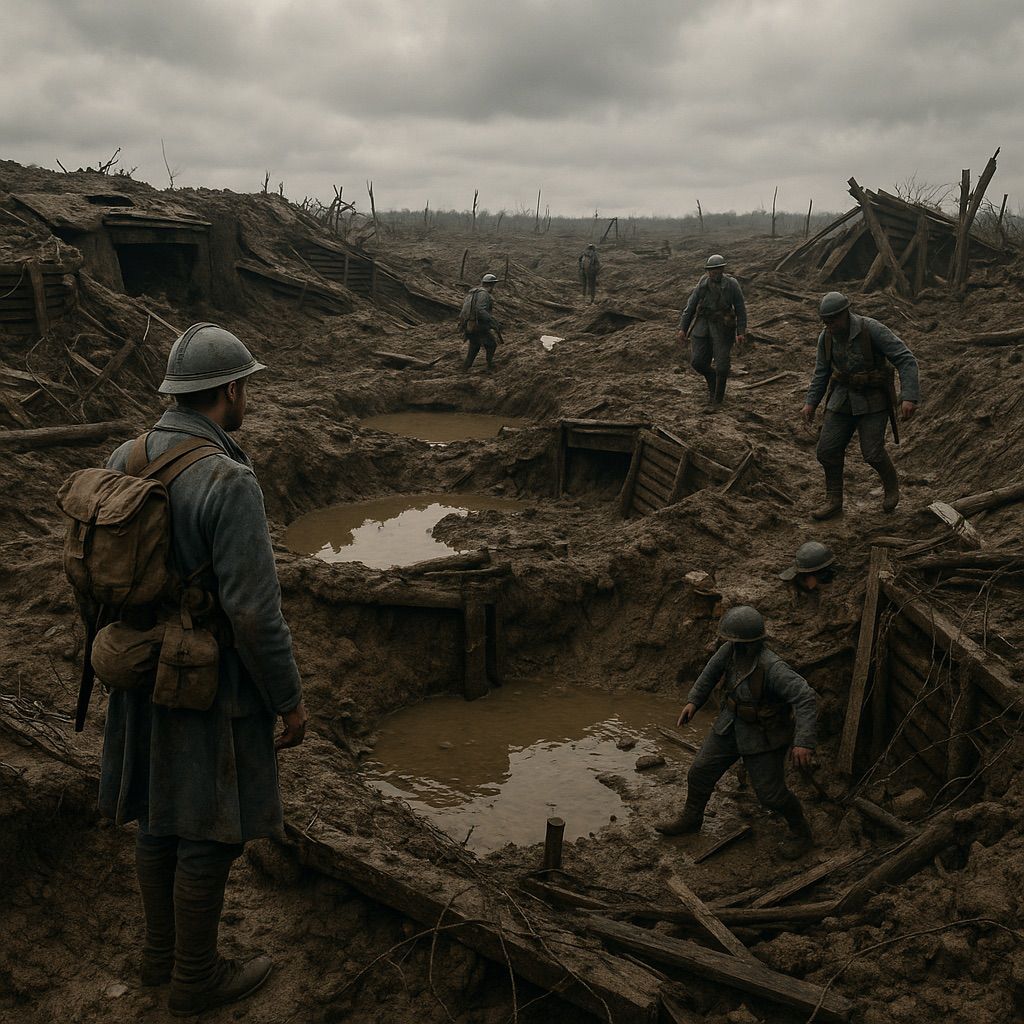
The cost was staggering. Attacks and counterattacks turned hills, forts, and villages into names etched in blood—Douaumont, Vaux, Fleury. Ground was gained and lost repeatedly, sometimes measured in meters at the price of thousands of lives. Trenches collapsed under shellfire, forcing soldiers to fight in open craters filled with mud, water, and decomposing bodies. The landscape became unrecognizable, transformed into a lunar wasteland scarred by millions of shell holes.

As spring turned into summer, Verdun became a war within the war. Both sides fed divisions into the furnace, rotating units to prevent complete collapse. Even so, psychological trauma spread rapidly. Soldiers spoke of “shell shock,” of men reduced to silence or hysteria by constant bombardment. Sleep became impossible. Survival felt arbitrary, dependent on chance rather than skill or bravery.

German frustration mounted as the battle dragged on without decisive results. Falkenhayn’s strategy succeeded only in destroying his own army alongside the French. By mid-1916, German resources were strained, and public confidence wavered. Falkenhayn was eventually replaced, but the damage had been done. Verdun had become a trap for both sides.

In the autumn, the French regained momentum. Improved artillery tactics and renewed offensives slowly pushed German forces back from key positions. Fort Douaumont, once a symbol of German success, was retaken. Fort Vaux, defended with almost mythic desperation earlier in the year, stood as a monument to endurance and suffering.

By December, exhaustion defined both armies. When fighting finally ceased on December 18, 1916, neither side could claim real victory. Verdun remained in French hands, but at an almost incomprehensible cost. Roughly 700,000 men had been killed, wounded, or gone missing. Entire regiments ceased to exist. Families across Europe would never recover from the loss.

The physical devastation was matched by moral shock. Verdun exposed the true nature of modern warfare—mechanized, impersonal, and ruthlessly efficient at killing. It shattered illusions of glory and honor, replacing them with images of mud, blood, and endless artillery fire. For France, Verdun became sacred ground, a symbol of national endurance. For Germany, it became a cautionary tale of strategic hubris.

The battle reshaped military thinking. It accelerated the search for alternatives to trench warfare, contributing to the development of tanks, improved artillery coordination, and new infantry tactics. Yet no innovation could erase Verdun’s legacy. It remained a warning etched into history, a reminder of what happens when strategy ignores humanity.

In the years that followed, Verdun became a place of remembrance. Memorials rose where soldiers once fell. Forests regrew over shattered ground, but beneath the soil lay unexploded shells and unmarked graves. Even today, the land bears scars that refuse to disappear.

Verdun endures not because it was decisive, but because it was relentless. It showed how modern war could devour nations without resolution, how victory itself could feel indistinguishable from defeat. It stands as one of the clearest lessons of World War I: that courage alone cannot redeem a war built on attrition and mass sacrifice.

The Battle of Verdun ended in December 1916, but its echoes continue to shape how we understand war, memory, and loss. It remains one of history’s most haunting reminders that survival, not triumph, is sometimes the only possible outcome.

Related Posts

The Simpsons Redefined Television and American Culture Forever

Elias Rowen

On the evening of December 17, 1989, millions of Americans settled into their living rooms expecting nothing more than another quiet Sunday night of television. Families flipped through channels, children sprawled across carpets, and parents half-watched the screen while thinking about the workweek ahead. Few could have imagined that what aired that night would not only change television forever, but become one of the most influential cultural creations of the modern era. When The Simpsons premiered on Fox, it did not arrive with thunder or spectacle. It arrived quietly, wrapped in yellow skin, crude animation, and a humor that felt oddly familiar and dangerously honest.

At its core, The Simpsons was never about outrageous jokes or shocking satire alone. It was about family, frustration, and the contradictions of modern life. Creator Matt Groening drew deeply from his own upbringing in Portland, Oregon, using personal experience as the emotional blueprint for Springfield’s most famous household. Homer, Marge, Bart, Lisa, and Maggie were exaggerated reflections of people Groening had known all his life, flawed but recognizable, absurd yet grounded in reality.

Groening had little interest in creating traditional cartoon heroes. Instead, he envisioned characters who failed often, contradicted themselves, and stumbled through life with imperfect intentions. Homer Simpson, lazy and impulsive yet strangely endearing, embodied the anxieties of the working-class American father. Marge represented emotional resilience and quiet strength. Bart was rebellion incarnate, Lisa the moral compass, and Maggie the silent witness to it all. Together, they mirrored the American family more truthfully than many live-action sitcoms ever dared.

The road to The Simpsons began humbly with animated shorts on The Tracey Ullman Show. These crude sketches introduced audiences to the Simpson family in brief segments, rough in design but sharp in tone. Viewers responded immediately. There was something refreshing about the show’s irreverence, its willingness to mock authority, consumerism, and even itself. Recognizing its potential, producers James L. Brooks and Sam Simon encouraged Groening to expand the idea into a full half-hour series.

The transition was not easy. Animation schedules were brutal, budgets tight, and early episodes plagued by production challenges. Yet these struggles shaped the show’s identity. The animation style, initially criticized as crude, became iconic. Its imperfections gave the show character, allowing the writing and performances to shine. The voice cast, including Dan Castellaneta, Julie Kavner, Nancy Cartwright, Yeardley Smith, and Hank Azaria, transformed flat drawings into living, breathing personalities.

When the first full episode, Simpsons Roasting on an Open Fire, aired, it set the emotional tone for the series. Rather than opening with cynicism, the episode focused on failure, empathy, and compassion. Homer’s attempt to provide a Christmas gift ends in disappointment, only to transform into something meaningful when Santa’s Little Helper joins the family. It was funny, yes, but also sincere. Viewers saw themselves in that struggle, and the connection was immediate.

Critics took notice. While some were initially skeptical of animated programming in prime time, many praised the show’s intelligence and heart. The Simpsons wasn’t just parodying America—it was holding up a mirror. It tackled issues like class inequality, corporate greed, environmental neglect, and political hypocrisy long before such themes became mainstream in entertainment. It trusted its audience to laugh and think at the same time.

As the first season unfolded, the show’s confidence grew. Storylines expanded beyond slapstick, allowing characters to evolve emotionally. Homer’s stupidity became a lens for exploring insecurity and longing. Lisa’s intelligence highlighted alienation and moral struggle. Springfield itself became a character, populated by exaggerated archetypes that reflected real societal roles: corrupt politicians, incompetent police, predatory businessmen, and apathetic media figures.

By the early 1990s, The Simpsons had become a phenomenon. Bart Simpson emerged as a cultural icon, plastered across lunchboxes, T-shirts, and billboards. Parents worried about his rebellious influence while children embraced his irreverence. The show found itself at the center of national debates about morality, parenting, and popular culture—ironically proving its relevance in the process.

Yet the show’s greatest strength lay in its writing. Episodes like Marge vs. the Monorail showcased how satire could be layered with music, character, and absurdity without losing coherence. The annual Treehouse of Horror episodes pushed creative boundaries, allowing writers to experiment with science fiction, horror, and parody in ways no other series attempted. These episodes demonstrated the show’s willingness to take risks and trust its audience.

Throughout the 1990s, The Simpsons consistently reinvented itself. It tackled racism, gender roles, labor exploitation, and environmentalism with humor sharp enough to cut but never alienate. Episodes like Stark Raving Dad and Lisa the Vegetarian showed the series’ ability to balance comedy with genuine emotional resonance. These were stories that stayed with viewers long after the jokes faded.

Behind the scenes, the writers’ room became legendary. Many writers would go on to shape American comedy for decades, bringing The Simpsons’ DNA into late-night television, film, and stand-up. The show’s influence spread quietly but profoundly, shaping the rhythm, tone, and expectations of modern comedy.

As the years passed, The Simpsons faced the inevitable challenge of longevity. Maintaining relevance across generations is no small task, yet the show adapted. It addressed the rise of the internet, celebrity culture, social media, climate change, and political polarization. Some episodes landed better than others, but the willingness to engage with the present remained constant.

Matt Groening’s influence expanded beyond Springfield. Futurama and Disenchantment carried his signature blend of absurdity and emotional intelligence into new worlds. Still, The Simpsons remained his defining achievement, not because of its length, but because of its cultural reach.

Today, The Simpsons stands as the longest-running primetime scripted series in television history. It has won dozens of awards, inspired countless creators, and permanently altered what animation can achieve. More importantly, it continues to reflect society back at itself—flaws, contradictions, and all.

What began as a simple cartoon has become a living chronicle of modern life. The Simpsons did not just entertain; it taught audiences that humor could be smart, that cartoons could matter, and that satire could be compassionate. Its legacy is not measured in episodes, but in influence.

More than three decades later, the Simpson family still sits on that couch, frozen in time yet forever relevant. And in that simple image lies the show’s greatest achievement: the ability to remain familiar while continually evolving, reminding us that laughter, when wielded honestly, can be one of the most powerful tools of storytelling ever created.

Related Posts

The Spark That Shook the Arab World: How Tunisia Ignited the Arab Spring

Elias Rowen

The year 2010 quietly closed one chapter of Middle Eastern history and violently opened another. What began as scattered frustrations over unemployment, corruption, and rising prices soon erupted into one of the most consequential political movements of the twenty-first century. The Arab Spring did not start in a palace or a parliament, nor was it engineered by foreign powers or elite political groups. It began with ordinary people who had reached a breaking point, and nowhere was that clearer than in Tunisia, where the first sparks of revolt ignited an uprising that would reshape an entire region.

For decades, Tunisia had been held up as a model of stability in North Africa. Tourists flocked to its beaches, foreign investors praised its predictability, and Western governments pointed to it as an example of controlled modernization. Beneath the surface, however, resentment simmered. Economic growth existed on paper, but for millions of Tunisians, daily life told a very different story. Jobs were scarce, wages stagnated, and opportunities were distributed not by merit but by proximity to power.

At the center of this imbalance stood President Zine El Abidine Ben Ali and his inner circle. Having seized power in a bloodless coup in 1987, Ben Ali promised reform, progress, and prosperity. In reality, his rule became increasingly authoritarian. Political opposition was crushed, journalists were silenced, and surveillance became a routine part of daily life. Fear replaced hope, and silence became a survival strategy.

Corruption was not a side effect of Ben Ali’s rule; it was its foundation. The president’s wife, Leila Trabelsi, and her extended family were notorious for their grip on Tunisia’s economy. Entire industries fell under their control, from banking and telecommunications to real estate and mining. State contracts flowed to favored insiders, while ordinary citizens watched opportunity slip further out of reach.

As the global financial crisis hit in 2008, Tunisia’s fragile social contract collapsed. Unemployment soared, particularly among young people who had done everything society asked of them. University degrees no longer guaranteed work. Graduates returned home to live with their parents, trapped between ambition and reality. Frustration turned into humiliation, and humiliation hardened into anger.

Rural Tunisia suffered just as deeply. Farmers faced falling prices for their crops while costs for fuel and supplies rose. Many were forced to sell their land or migrate in search of work. Entire communities felt abandoned, invisible to a government more concerned with protecting elite wealth than addressing public need.

The phosphate mining industry became a symbol of everything that was broken. Despite being one of Tunisia’s most valuable resources, profits rarely reached workers or local communities. Instead, wealth flowed upward, reinforcing the perception that the state existed to serve a narrow elite rather than the nation as a whole. Protests over jobs and wages in mining towns were frequent, but they were usually crushed quickly and quietly.

What made 2010 different was not the presence of discontent, but the sudden collapse of fear. On December 17, in the small town of Sidi Bouzid, a young street vendor named Mohamed Bouazizi was humiliated for the last time. Harassed by local officials and stripped of his livelihood, Bouazizi did something unthinkable. He set himself on fire in front of the governor’s office, a desperate act that transformed private suffering into public outrage.

Bouazizi’s self-immolation struck a nerve that years of repression had failed to sever. Images and stories spread rapidly through social media, satellite television, and word of mouth. Protests erupted almost immediately, first in Sidi Bouzid, then in neighboring towns, and soon across the entire country. What began as demands for jobs and dignity quickly evolved into calls for the end of Ben Ali’s rule.

The government responded with force. Police fired tear gas and live ammunition. Protesters were arrested, beaten, and in some cases killed. But repression no longer worked. Each act of violence fueled more anger, drawing larger crowds into the streets. Workers, students, lawyers, farmers, and civil servants stood shoulder to shoulder, united by a shared sense that the system had failed them.

Tunisia witnessed scenes that would have been unthinkable just weeks earlier. Mass demonstrations filled city centers. Chants of “Ben Ali must go” echoed through neighborhoods once silenced by fear. Flags waved not for a political party, but for dignity and accountability. The regime attempted concessions, promising reforms and blaming corruption on lower officials, but the public no longer believed words without action.

By January 2011, the situation had reached a tipping point. The army, sensing the inevitability of change, refused to fire on protesters. International allies began distancing themselves from Ben Ali. On January 14, after twenty-three years in power, the president fled Tunisia under cover of darkness, leaving behind a stunned nation and a political vacuum filled with uncertainty and hope.

Tunisia’s revolution sent shockwaves far beyond its borders. Across the Arab world, people saw what had seemed impossible: a dictator removed by mass popular protest. Demonstrations soon erupted in Egypt, Libya, Yemen, Bahrain, and Syria. The Arab Spring had begun, and Tunisia stood at its origin.

The aftermath of revolution was anything but simple. Tunisia faced economic instability, political fragmentation, and security threats. Extremist groups sought to exploit uncertainty, and old networks of power resisted reform. Yet unlike many of its neighbors, Tunisia managed to navigate its transition without descending into civil war.

A new constitution, adopted in 2013, enshrined democratic principles, human rights, and gender equality. Elections followed, producing coalition governments that reflected compromise rather than domination. Progress was uneven and often frustratingly slow, but it existed.

Tunisia’s experience revealed both the promise and the limits of popular uprisings. While dictatorship could be overthrown, building democracy required patience, institutions, and sustained civic engagement. Economic challenges persisted, and corruption did not vanish overnight. Still, Tunisia proved that change was possible without total collapse.

More than a decade later, the legacy of Tunisia’s revolution remains contested, debated, and unfinished. Yet its significance cannot be denied. It demonstrated the power of ordinary people to challenge entrenched authority and forced the world to reckon with voices long ignored.

The Arab Spring began not with ideology or violence, but with dignity. It began with a single act of protest that exposed the fragility of authoritarian rule. Tunisia’s story stands as both a warning and an inspiration—a reminder that stability without justice is temporary, and that when people lose fear, even the strongest regimes can fall.

Related Posts

The Wright Brothers Invented Powered Flight and Changed the World Forever

Elias Rowen

For thousands of years, humans looked to the sky with a mixture of wonder and envy. Birds soared effortlessly overhead while people remained bound to the ground, dreaming of flight but unable to escape gravity’s grip. Myths told stories of wings made from wax and feathers, of gods and heroes who could defy nature, yet reality always pulled dreamers back to earth. That reality finally changed in the early years of the twentieth century, not through magic or myth, but through patience, experimentation, and relentless determination. The dawn of powered flight arrived quietly on a cold December morning in 1903, carried aloft by two brothers from Dayton, Ohio, who refused to accept that human flight was impossible.

Orville and Wilbur Wright were not famous scientists, wealthy industrialists, or government-backed engineers. They were bicycle mechanics, self-taught thinkers who believed that careful observation and methodical testing could solve even the most complex problems. What set them apart from other would-be aviators was not raw genius alone, but their willingness to question assumptions, collect their own data, and learn from every failure. Their story is not one of sudden inspiration, but of years spent chasing answers through trial, error, and persistence.

By the late nineteenth century, the idea of human flight had shifted from fantasy into serious scientific inquiry. Engineers and inventors across Europe and America were experimenting with gliders, kites, and powered contraptions, all attempting to unlock the secrets of lift and control. One of the most influential figures of the era was Octave Chanute, whose book Progress in Flying Machines compiled decades of aeronautical experiments into a single volume. For the Wright brothers, this book was a revelation. It showed them that flight was not a foolish dream, but a technical challenge waiting to be solved.

Another key influence was Otto Lilienthal, a German engineer whose glider flights demonstrated that controlled, heavier-than-air flight was possible. Lilienthal’s work fascinated the Wright brothers, but his death in a gliding accident also served as a sobering reminder of how dangerous aviation could be. Rather than discouraging them, his death convinced Orville and Wilbur that careful control, not just lift, was the missing piece of the puzzle. They believed that mastering control would be the key to safe and sustained flight.

Their early experiments began modestly. In 1899, the brothers built small kite-like machines to test wing warping, a method of controlling an aircraft by twisting the wings. These tests revealed something revolutionary: control could be achieved not by brute force, but by subtle adjustments that worked with the air rather than against it. Encouraged by these results, they turned their attention to gliders capable of carrying a human pilot.

Finding the right testing ground was crucial. After extensive research, the Wright brothers chose Kitty Hawk, North Carolina, a remote coastal area known for steady winds, soft sand, and isolation from prying eyes. There, far from crowds and critics, they could test freely and fail safely. Beginning in 1900 and continuing through 1902, they made repeated trips to Kitty Hawk, hauling gliders, tools, and notebooks across rough terrain in pursuit of progress.

Those early glider experiments were anything but smooth. The brothers quickly realized that existing aerodynamic data was flawed. Lift calculations from respected scientists did not match real-world results. Instead of abandoning their efforts, Orville and Wilbur did something radical: they built their own wind tunnel back in Dayton. Using carefully crafted models, they gathered more accurate data than anyone before them. This quiet innovation laid the foundation for modern aerodynamics and gave the Wright brothers an enormous advantage over their competitors.

By 1902, their improved glider represented a major breakthrough. It incorporated effective wing warping and a movable rear rudder, allowing pilots to maintain balance and direction. For the first time, sustained controlled gliding was possible. The brothers knew they were close. All that remained was the most difficult challenge of all: powering the aircraft without making it too heavy to fly.

No existing engine met their needs, so they built one themselves. Working with their mechanic, Charlie Taylor, they designed a lightweight gasoline engine capable of delivering enough power without weighing the aircraft down. It wasn’t elegant, and it wasn’t particularly powerful by modern standards, but it was sufficient. Paired with custom-designed propellers—another area where the brothers’ calculations surpassed conventional wisdom—the engine transformed their glider into a true airplane.

By December 1903, everything was ready. The Wright Flyer, constructed from spruce wood and fabric, was assembled at Kill Devil Hills near Kitty Hawk. It was fragile, awkward, and unremarkable in appearance, yet it represented years of accumulated knowledge and perseverance. On December 14, Wilbur attempted the first powered flight, but the aircraft stalled and crashed shortly after takeoff. The damage was repaired, and the brothers prepared for one final attempt.

On the morning of December 17, 1903, the wind was strong but manageable. Orville took his place in the Flyer while Wilbur steadied the wing. At 10:35 a.m., the engine roared to life, and the aircraft began moving along its wooden rail. Then, almost imperceptibly, it lifted off the ground. For twelve seconds, Orville Wright flew. The aircraft covered 120 feet before settling back onto the sand, but history had been made.

Three more flights followed that day, each longer than the last. The final flight, piloted by Wilbur, lasted nearly a minute and traveled over 800 feet. It ended abruptly when a gust of wind overturned the aircraft, damaging it beyond immediate repair. Yet the damage didn’t matter. The goal had been achieved. Human beings had flown under their own power, with control, and returned safely to the ground.

At the time, few people noticed. The event was witnessed by only a handful of locals, and early newspaper reports were skeptical or dismissive. The Wright brothers themselves returned quietly to Dayton, focused not on fame, but on improvement. They understood that their invention was only the beginning. True success would require reliability, endurance, and practical applications.

Over the next several years, Orville and Wilbur refined their designs, developing aircraft that could fly longer distances, turn smoothly, and remain stable in changing conditions. One of their most important contributions was the three-axis control system, which allowed pilots to manage roll, pitch, and yaw independently. This innovation remains fundamental to aircraft design today.

As evidence of their success accumulated, skepticism faded. Public demonstrations in the United States and Europe silenced critics and established the Wright brothers as legitimate pioneers. Governments and militaries took notice. In 1908, the U.S. Army Signal Corps purchased a Wright aircraft, marking the birth of military aviation. Soon after, flying schools, air shows, and experimental aircraft began appearing around the world.

The brothers’ impact extended far beyond aviation. Their methods—testing assumptions, collecting data, and learning from failure—became models for modern engineering and scientific research. Their work accelerated advancements in transportation, communication, and global connectivity. Within a few decades, airplanes shrank the world, making international travel and commerce routine rather than extraordinary.

Tragically, Wilbur Wright died of typhoid fever in 1912 at the age of forty-five, before he could witness the full scope of their achievement. Orville lived on, watching aviation evolve from fragile biplanes to powerful aircraft capable of crossing oceans and continents. He remained humble, often emphasizing that flight was not the result of a single moment, but of years of careful effort.

Today, the Wright brothers are remembered not just as inventors, but as symbols of human potential. Their story reminds us that progress rarely comes from sudden brilliance alone. It comes from persistence, curiosity, and the courage to fail repeatedly in pursuit of something greater. The first powered flight was short and unremarkable by modern standards, yet it changed everything.

Every airplane that lifts off today carries a piece of that December morning at Kitty Hawk. Every jet crossing the sky traces its lineage back to two brothers who believed that controlled flight was possible and refused to give up until they proved it. Their legacy is written not only in history books, but across the skies themselves, wherever human beings continue to rise above the earth and push the boundaries of what is possible.

Related Posts

The Night Tea Sparked a Revolution: How the Boston Tea Party Changed America Forever

Elias Rowen

The Boston Tea Party stands as one of those rare moments in history when a single night of action rippled outward to change the fate of an entire nation. It wasn’t a battle, it wasn’t a declaration, and no blood was shed, yet its impact echoed louder than cannon fire. On a cold December night in 1773, ordinary colonists made an extraordinary decision: they would no longer quietly accept being ruled, taxed, and ignored by a distant government that saw them as little more than a source of revenue. What followed was not random vandalism or mob violence, but a carefully planned act of political defiance that would become a cornerstone of American identity.

To understand why the Boston Tea Party happened, it’s important to step back into the world of the American colonies in the mid-18th century. The colonists were, in many ways, loyal British subjects. They shared language, customs, legal traditions, and a sense of pride in being part of the British Empire. But loyalty had its limits, especially when decisions made thousands of miles away in London began to directly affect daily life in the colonies without any meaningful colonial input. That tension simmered for years before finally boiling over.

The first sparks appeared after Britain emerged victorious from the French and Indian War in 1763. The war had been costly, and Parliament faced staggering debts. British leaders reasoned that the colonies, which had benefited from British military protection, should help shoulder the financial burden. From the perspective of Parliament, this seemed logical. From the perspective of the colonists, it felt deeply unfair. They had no representatives in Parliament, yet they were being asked to pay taxes decided entirely without their consent.

The Sugar Act of 1764 marked one of the earliest signs of trouble. By taxing imported sugar, molasses, and other goods, the British government struck at the economic lifeblood of colonial trade. Merchants, sailors, and artisans felt the effects almost immediately. What angered colonists just as much as the tax itself was the aggressive enforcement that accompanied it. British customs officials were given expanded powers, and smugglers faced harsh penalties. The message was clear: London was tightening its grip.

Then came the Stamp Act of 1765, and with it, a wave of outrage that swept through the colonies. For the first time, a direct tax was imposed on everyday items like newspapers, legal documents, licenses, and even playing cards. This wasn’t a distant tax hidden in shipping fees or trade regulations; it was impossible to ignore. Colonists from all walks of life suddenly felt the weight of British authority pressing down on them.

Protests erupted almost immediately. Crowds gathered in the streets, effigies of British officials were burned, and tax collectors were harassed, threatened, and sometimes forced to resign. In Boston, resistance coalesced into a more organized form with the rise of the Sons of Liberty. This loosely connected group of merchants, craftsmen, and political agitators became the beating heart of colonial resistance. Figures like Samuel Adams emerged as powerful voices, arguing that liberty itself was at stake.

Although Parliament repealed the Stamp Act in 1766, it did so with a warning. The Declaratory Act asserted that Britain retained full authority over the colonies “in all cases whatsoever.” This wasn’t reconciliation; it was a reminder of who held the power. The tension never truly faded, and before long, new taxes arrived in the form of the Townshend Acts. Duties on imported goods such as glass, paint, paper, and tea reignited colonial anger. Boycotts followed, and once again, resistance spread.

Boston became the epicenter of unrest. British soldiers were stationed in the city to maintain order, but their presence only made things worse. The streets felt occupied, tempers ran high, and mistrust grew on both sides. This volatile atmosphere eventually led to the Boston Massacre in 1770, where British soldiers fired into a crowd, killing five colonists. Though the Townshend duties were largely repealed afterward, the tax on tea remained, serving as a symbol of Parliament’s authority and the unresolved conflict between ruler and ruled.

Tea might seem like a small thing, but in colonial America, it was anything but. Tea was a daily ritual, a symbol of refinement, and a staple in households across social classes. By keeping the tea tax in place, Parliament was sending a message: it still had the right to tax the colonies. Many colonists understood this clearly. Accepting taxed tea meant accepting Parliament’s authority, and that was something growing numbers of Americans were unwilling to do.

The situation escalated dramatically in 1773 with the Tea Act. Designed to rescue the struggling British East India Company, the act allowed the company to sell tea directly to the colonies at a lower price, undercutting colonial merchants and smugglers. On paper, it made tea cheaper. In reality, it was a political trap. The tax remained, and the monopoly threatened local businesses. Colonists saw it as a calculated attempt to force them into submission.

When ships carrying East India Company tea arrived in colonial ports, resistance flared. In New York and Philadelphia, ships were turned away. In Charleston, the tea was seized and stored. But in Boston, Governor Thomas Hutchinson refused to budge. He insisted the tea be unloaded and the tax paid. With the ships sitting in the harbor and tensions rising, Boston stood at a crossroads.

On the night of December 16, 1773, the decision was made. Thousands gathered at the Old South Meeting House, where heated debates filled the air. When it became clear that the governor would not compromise, a signal was given. As darkness fell, a group of men, many disguised as Mohawk Indians, moved quietly toward Griffin’s Wharf.

They boarded three ships—the Dartmouth, the Eleanor, and the Beaver—with remarkable discipline. This was not a drunken riot or chaotic outburst. The men worked methodically, breaking open 342 chests of tea and dumping them into Boston Harbor. They took care not to damage other cargo, and even replaced a broken padlock. By the end of the night, the harbor was thick with tea leaves, and a powerful statement had been made.

News of the Boston Tea Party spread quickly throughout the colonies and across the Atlantic. To many colonists, it was an act of courage and principle. To British officials, it was a shocking display of lawlessness and defiance. Parliament responded with fury, determined to make an example of Massachusetts. The result was the Coercive Acts, known to colonists as the Intolerable Acts.

Boston Harbor was closed until the tea was paid for. Massachusetts’ self-government was severely restricted. British officials accused of crimes were given protection from colonial courts. Soldiers were quartered in private homes. These measures were meant to isolate Boston and crush resistance, but they had the opposite effect. Instead of dividing the colonies, they united them.

Sympathy poured in from other colonies. Supplies were sent to Boston. Committees of correspondence strengthened communication and coordination. In 1774, colonial leaders gathered for the First Continental Congress, marking a new level of unity and resolve. The Boston Tea Party had transformed resistance into something far more powerful: a shared American cause.

Within two years, shots would be fired at Lexington and Concord. Within three, independence would be declared. The Boston Tea Party didn’t cause the American Revolution on its own, but it made compromise nearly impossible. It forced both sides to confront the reality that the relationship between Britain and the colonies was fundamentally broken.

Today, the Boston Tea Party is remembered not just as an act of protest, but as a defining moment in the story of democracy. It showed that ordinary people, when pushed too far, could organize, resist, and reshape their destiny. It wasn’t about tea. It was about dignity, representation, and the belief that government derives its power from the consent of the governed.

That belief continues to resonate centuries later. The image of chests splashing into dark harbor waters remains a symbol of resistance to unjust authority. It reminds us that history is often changed not by kings or parliaments, but by people who decide they have had enough and are willing to act.

Related Posts

Operation Desert Fox: The Four-Day Air War That Set the Stage for Iraq’s Future

Elias Rowen

In December 1998, as the world approached the end of the twentieth century, a brief but consequential military campaign unfolded over Iraq that would quietly shape the trajectory of Middle Eastern geopolitics for years to come. Operation Desert Fox, launched by the United States and the United Kingdom, was a four-day bombing campaign aimed at degrading Iraq’s military infrastructure and compelling Saddam Hussein’s regime to comply with United Nations weapons inspections. Though short in duration, the operation carried profound political, strategic, and humanitarian implications that continue to be debated decades later.

The roots of Operation Desert Fox lay in the unresolved tensions following the 1991 Gulf War. Iraq’s defeat had forced Saddam Hussein to accept strict ceasefire conditions, including the dismantling of nuclear, chemical, and biological weapons programs. United Nations inspectors were tasked with verifying compliance, while economic sanctions placed enormous pressure on Iraq’s economy and civilian population. For much of the 1990s, this uneasy standoff defined relations between Iraq and the international community.

From the outset, Saddam Hussein viewed the inspections as an affront to Iraqi sovereignty. While inspectors uncovered and destroyed large quantities of prohibited weapons and materials, cooperation was inconsistent. Iraqi authorities frequently restricted access to sites, delayed inspections, or accused inspectors of espionage. Each confrontation heightened tensions, reinforcing mistrust on both sides.

By 1998, the situation had deteriorated significantly. Iraq suspended cooperation with UN inspectors altogether, effectively daring the international community to respond. For U.S. policymakers, this defiance was unacceptable. President Bill Clinton’s administration argued that allowing Iraq to obstruct inspections undermined global nonproliferation efforts and threatened regional stability.

Operation Desert Fox was conceived as a punitive and preventative measure rather than a full-scale war. Its objectives were narrowly defined: degrade Iraq’s ability to produce and deliver weapons of mass destruction, weaken its air defense systems, and signal that continued defiance would carry consequences. Unlike the Gulf War, there would be no ground invasion. Air power would carry the mission alone.

The operation began on December 16, 1998. Cruise missiles and aircraft struck Iraqi air defense installations, command-and-control facilities, missile production sites, and suspected chemical and biological weapons infrastructure. Over four days, coalition forces conducted hundreds of sorties, employing precision-guided munitions designed to minimize collateral damage while maximizing military impact.

From a tactical standpoint, the strikes demonstrated the growing sophistication of Western air power. Advances in targeting technology allowed aircraft to hit hardened and deeply buried facilities with unprecedented accuracy. U.S. and British officials claimed that the campaign significantly degraded Iraq’s military capabilities, setting back weapons programs and limiting its ability to threaten neighbors.

Yet the political context surrounding the operation complicated its reception. The timing of Desert Fox coincided with domestic political turmoil in the United States, including impeachment proceedings against President Clinton. Critics questioned whether the operation was influenced by internal political considerations, casting doubt on its legitimacy and intent.

International reactions were mixed. Britain strongly supported the strikes, framing them as a necessary response to Iraqi noncompliance. Other allies were less enthusiastic. France, Russia, and China expressed concern over the use of force without explicit new authorization from the UN Security Council, arguing that diplomacy had not been exhausted.

Within Iraq, the impact was immediate and visible. Bombing damaged military installations but also affected infrastructure already weakened by years of sanctions. Iraqi officials accused the coalition of targeting civilian areas, a claim echoed by humanitarian organizations monitoring conditions on the ground. While coalition leaders insisted that strikes were carefully planned to avoid civilian harm, independent assessments raised questions about unintended consequences.

Operation Desert Fox underscored the limitations of air power as a tool for coercion. While the campaign inflicted damage, it did not compel Saddam Hussein to resume cooperation with inspectors. In fact, Iraq expelled UN inspection teams entirely in the aftermath, leaving the international community without direct oversight of its weapons programs.

The operation also deepened the humanitarian crisis inside Iraq. Sanctions had already strained healthcare, food supply, and infrastructure. Additional damage from airstrikes exacerbated suffering among civilians, fueling criticism that military pressure was being borne disproportionately by the Iraqi population rather than the regime itself.

Strategically, Desert Fox marked a shift in U.S. policy toward containment through periodic force. Rather than pursuing regime change outright, Washington sought to manage the Iraqi threat through sanctions, no-fly zones, and occasional military action. This approach reflected both caution and constraint, shaped by lessons from earlier conflicts and uncertainty about long-term outcomes.

Despite its limited scope, Operation Desert Fox foreshadowed developments that would culminate in the 2003 invasion of Iraq. The absence of inspectors, combined with continued intelligence assessments suggesting potential weapons programs, created a climate of suspicion that proved difficult to dispel. The operation did not resolve the Iraq problem; it prolonged it.

In retrospect, Desert Fox revealed the complexities of enforcing international norms through military means. It highlighted the difficulty of achieving compliance without sustained diplomatic engagement or credible enforcement mechanisms. It also exposed the moral tension inherent in strategies that seek to pressure regimes while minimizing harm to civilians—a balance that is rarely achieved in practice.

For military planners, the operation offered lessons in joint operations, precision strike capabilities, and rapid deployment. For policymakers, it raised enduring questions about proportionality, legitimacy, and effectiveness. For Iraq, it was another chapter in a decade defined by isolation, hardship, and confrontation.

Operation Desert Fox did not change Saddam Hussein’s behavior in any fundamental way, but it altered perceptions. It reinforced the view within Washington that limited force alone could not resolve the Iraqi issue. It also reinforced Saddam’s belief that survival depended on defiance, not accommodation.

Today, Desert Fox is often overshadowed by the events that followed in the next decade. Yet its significance lies precisely in its position between wars—a moment when the international community grappled with how to respond to defiance without escalation, and ultimately failed to find a durable solution.

The four-day campaign serves as a case study in the limits of military power when political objectives are ambiguous and humanitarian consequences unavoidable. It reminds us that short wars can have long shadows, shaping decisions and perceptions long after the last missile is launched.

Related Posts

The Battle of the Bulge and Hitler’s Last Gamble

Elias Rowen

December 16, 1944, dawned cold, quiet, and deceptively calm across the Ardennes Forest. Snow blanketed the rolling hills of Belgium and Luxembourg, muffling sound and limiting visibility. For many Allied soldiers stationed in the region, the area was considered a rest sector, a place to recover from months of brutal fighting across France. Few suspected that this frozen landscape was about to become the stage for the largest and bloodiest battle ever fought by the United States Army.

The Battle of the Bulge was born out of desperation. By late 1944, Nazi Germany was losing on every front. The Allied invasion of Normandy had succeeded beyond expectations, Paris had been liberated, and Allied armies were pushing steadily toward Germany’s western borders. In the east, Soviet forces were closing in relentlessly. Adolf Hitler, increasingly isolated and dismissive of his generals, believed only a bold, decisive strike could reverse Germany’s fortunes.

Hitler’s plan was audacious to the point of recklessness. He ordered a massive surprise offensive through the Ardennes, the same forested region used successfully during Germany’s 1940 invasion of France. The goal was to split Allied forces, capture the vital port of Antwerp, and force the Western Allies into a negotiated peace. It was a gamble based on speed, surprise, and the hope that Allied morale would collapse under pressure.

To carry out the plan, Germany assembled over 200,000 troops, along with tanks, artillery, and limited air support. Many units were composed of inexperienced soldiers, older reservists, and teenage conscripts. Fuel shortages plagued the operation from the start, and German commanders quietly doubted its chances. Still, orders were orders, and preparations moved forward in secrecy.

At 5:30 a.m. on December 16, German artillery shattered the silence. Shells rained down on American positions, followed by waves of infantry and armored units pushing through fog and snow. The surprise was nearly complete. Many American units were understrength and scattered, caught off guard by the scale of the assault. Roads quickly clogged with retreating troops, refugees, and burning vehicles.

The German advance created a massive bulge in the Allied lines, giving the battle its enduring name. In the opening days, German forces achieved alarming gains, overrunning towns and capturing thousands of American soldiers. Panic spread in some sectors, but collapse never came. Small units fought stubbornly, delaying German progress and buying precious time.

Weather played a decisive role in the battle’s early phase. Thick clouds grounded Allied aircraft, preventing air support and reconnaissance. German forces advanced under cover of fog, while American troops struggled to resupply and reposition. The cold was relentless. Temperatures plunged below zero, and frostbite became as deadly as enemy fire.

One of the most critical points of the battle centered on the Belgian town of Bastogne. Its road network made it strategically vital, and German commanders were determined to seize it. The U.S. 101st Airborne Division, rushed to the area in trucks, was ordered to hold the town at all costs. They arrived poorly equipped for winter warfare and quickly found themselves surrounded.

Encircled, low on ammunition, and battered by constant attacks, the defenders of Bastogne became symbols of defiance. When a German envoy demanded surrender on December 22, General Anthony McAuliffe famously replied with a single word: “NUTS.” The message encapsulated the unbreakable resolve of Allied forces and soon spread throughout the ranks as a rallying cry.

As the siege continued, American artillery units fired relentlessly, often at close range. Medics worked without rest, treating wounded soldiers in freezing conditions. Civilians huddled in cellars, caught between advancing armies. Bastogne held, denying German forces a crucial objective and slowing their entire offensive.

Meanwhile, Allied command reacted swiftly. General Dwight D. Eisenhower recognized the threat and ordered reserves into action. The most dramatic response came from General George S. Patton, whose Third Army executed a rapid and daring pivot northward. In a matter of days, Patton’s forces marched through brutal winter conditions to relieve Bastogne.

On December 23, the weather finally broke. Clear skies returned, and Allied air power roared back into action. Fighter-bombers struck German supply lines, tanks, and troop concentrations with devastating effect. Without adequate fuel or air cover, German momentum stalled.

The battle turned decisively in favor of the Allies. American, British, and Canadian forces launched coordinated counterattacks, squeezing the bulge from both sides. German units, exhausted and undersupplied, began to retreat. What had been intended as a bold offensive became a costly withdrawal.

By January 25, 1945, the Battle of the Bulge was effectively over. The front lines returned nearly to their original positions, but the cost had been enormous. Approximately 19,000 Americans were killed, with tens of thousands wounded or captured. German losses were even greater, including irreplaceable tanks, aircraft, and experienced troops.

The battle marked Germany’s last major offensive in the West. After the Ardennes, the Wehrmacht would never regain the initiative. Allied forces surged forward into Germany, crossing the Rhine and accelerating the collapse of the Third Reich. Victory in Europe was now inevitable.

Beyond its strategic significance, the Battle of the Bulge became a defining test of endurance, leadership, and unity. Soldiers fought not only the enemy but starvation, exhaustion, and freezing cold. Acts of heroism occurred daily, often unnoticed, as small units held ground against overwhelming odds.

The battle also revealed the adaptability of Allied command. Initial surprise gave way to rapid coordination, flexible planning, and decisive action. Lessons learned in the Ardennes would influence modern military doctrine for decades to come.

For Adolf Hitler, the failure of the offensive was catastrophic. It shattered any remaining confidence among his generals and drained Germany’s final reserves. The illusion of a negotiated peace evaporated, replaced by the grim reality of total defeat.

Today, the forests and towns of the Ardennes stand quiet once more. Memorials and cemeteries mark where thousands fought and fell. Veterans’ stories, preserved through memory and history, continue to remind the world of the cost of freedom.

The Battle of the Bulge endures as a testament to the resilience of the human spirit. It was a battle defined not by flawless planning, but by perseverance under the harshest conditions imaginable. Against surprise, cold, and overwhelming pressure, Allied forces stood firm—and in doing so, helped bring an end to the most devastating war in human history.

Related Posts

Gone With the Wind Premieres: The Night Hollywood Changed Forever

Elias Rowen

On the evening of December 15, 1939, Atlanta, Georgia became the epicenter of the cinematic world. Searchlights cut through the Southern night sky, streets overflowed with spectators, and anticipation hung thick in the air as one of the most ambitious films ever produced prepared to make its debut. Gone with the Wind was more than a movie premiere—it was a cultural event, a statement of Hollywood’s power, and the unveiling of a story that would shape American cinema for generations.

The Loew’s Grand Theatre stood at the heart of the celebration, transformed into a shrine of glamour and spectacle. Thousands gathered outside, hoping to catch a glimpse of stars arriving in elegant gowns and tailored tuxedos. The premiere was treated with the grandeur of a royal coronation, complete with parades, fireworks, and national attention. In an era still recovering from the Great Depression, the night offered an intoxicating sense of escapism and wonder.

Gone with the Wind had already achieved legendary status before a single frame reached the screen. Margaret Mitchell’s novel, published in 1936, became an instant phenomenon, selling millions of copies and embedding itself deeply into American culture. Readers were captivated by the story of Scarlett O’Hara, a fiercely determined Southern woman whose life is upended by the Civil War and its aftermath. The book’s success made a film adaptation inevitable, but also immensely risky.

From the outset, adapting the novel proved to be a monumental challenge. The story spanned decades, featured dozens of characters, and grappled with themes of love, survival, loss, and societal collapse. Producer David O. Selznick committed himself to honoring the scope of Mitchell’s work, even as Hollywood insiders doubted that such a sprawling narrative could be translated to film. The result was a production plagued by rewrites, director changes, and mounting pressure.

Casting Scarlett O’Hara became one of the most publicized searches in Hollywood history. Hundreds of actresses were considered, auditions scrutinized, and opinions fiercely debated. When Vivien Leigh, a relatively unknown British actress, was finally cast, the decision was met with both excitement and skepticism. Yet from her first appearance on screen, it became clear that Leigh embodied Scarlett’s fire, vulnerability, and resilience in a way few others could have achieved.

Clark Gable, already one of Hollywood’s biggest stars, was cast as Rhett Butler, the charismatic rogue whose wit and emotional detachment mask deep complexity. Gable’s presence brought gravitas and star power, but his participation was not without personal strain. Behind the scenes, he was grieving the recent death of his wife and struggling with health issues, adding emotional weight to his performance.

The production itself was an endurance test. Filming stretched over two years, with multiple directors rotating through the project before Victor Fleming ultimately guided it to completion. Sets were constructed on a massive scale, costumes meticulously crafted, and battle scenes staged with unprecedented ambition. Over a thousand costumes were designed, many of them worn by Scarlett alone, visually charting her transformation from sheltered plantation daughter to hardened survivor.

Music played a crucial role in shaping the film’s emotional power. Max Steiner’s sweeping score underscored moments of romance, despair, and defiance, weaving itself into the identity of the film. The music elevated scenes into operatic grandeur, reinforcing Gone with the Wind’s epic tone and emotional resonance.

As the premiere approached, anticipation reached a fever pitch. Atlanta embraced the film as its own, seeing it as both a tribute to Southern history and a major cultural milestone. Streets were decorated, Confederate imagery prominently displayed, and the city transformed into a living backdrop for the film’s themes. While this celebration reflected the sentiments of the time, it also foreshadowed the complex and controversial legacy the film would carry.

When the lights dimmed inside the Loew’s Grand Theatre, the audience was transported to Tara, Scarlett’s beloved plantation. From the opening moments, the scale of the film was unmistakable. Sweeping landscapes, vivid Technicolor, and emotionally charged performances drew viewers into a world both romanticized and ravaged by war.

Audiences were mesmerized. Gasps echoed during battle scenes, tears flowed during moments of loss, and applause erupted at iconic lines that would later become legendary. By the time Rhett Butler delivered his now-famous farewell, the film had secured its place in cinematic history.

Critical reception was overwhelmingly positive. Reviewers praised the film’s ambition, performances, and visual splendor. Vivien Leigh was hailed as a revelation, while Clark Gable’s portrayal of Rhett Butler was celebrated as one of his defining roles. The film would go on to win eight Academy Awards, including Best Picture and Best Actress, further cementing its status.

Financially, Gone with the Wind became an unprecedented success. Adjusted for inflation, it remains one of the highest-grossing films of all time. Its popularity endured through multiple re-releases, drawing new audiences with each generation and reinforcing its place in the American canon.

Yet even at the height of its acclaim, the film was not without controversy. Its portrayal of slavery and the Old South drew criticism for romanticizing a brutal and oppressive system. Characters were depicted through lenses that reflected the prejudices of the era, sparking debates that continue to this day. Over time, Gone with the Wind became a focal point for discussions about historical memory, representation, and the responsibility of art.

Despite these debates, the film’s influence on cinema is undeniable. It set new standards for epic storytelling, production design, and emotional scope. Countless filmmakers drew inspiration from its scale and ambition, while its characters and dialogue became embedded in popular culture.

Gone with the Wind also demonstrated the power of film as a shared national experience. At a time when the world stood on the brink of global conflict, the movie offered both escape and reflection, reminding audiences of resilience in the face of upheaval.

As decades passed, interpretations of the film evolved. What was once seen primarily as a romantic epic came to be examined through more critical lenses. Scholars, historians, and audiences reassessed its themes, acknowledging both its artistic achievements and its problematic elements. This ongoing dialogue has ensured that the film remains relevant, not frozen in time but continually reexamined.

More than eighty years after its premiere, Gone with the Wind continues to provoke conversation, admiration, and debate. Its legacy is complex, layered with both brilliance and contradiction. Yet its impact is unquestionable. Few films have shaped the language of cinema so profoundly or left such a lasting imprint on cultural consciousness.

The night of December 15, 1939 marked more than a premiere—it marked a turning point. Hollywood demonstrated its capacity for grand storytelling, emotional depth, and cultural influence. Gone with the Wind became not just a film, but a mirror reflecting both the dreams and the flaws of the society that created it.

In the end, Gone with the Wind endures because it tells a story about survival—about people clinging to identity, love, and purpose as their world collapses around them. That theme, more than any spectacle or controversy, is what continues to resonate across generations.

Related Posts

Venera 7 and the First Touchdown on Hell: How the Soviet Union Landed on Venus

Elias Rowen

On December 15, 1970, humanity accomplished something that once seemed firmly in the realm of science fiction. A robotic spacecraft built by the Soviet Union survived its descent through the crushing atmosphere of Venus and transmitted data back to Earth from the planet’s surface. That spacecraft was Venera 7, and its success marked one of the boldest and most technically demanding achievements in the history of space exploration. For the first time, a human-made object had landed on another planet and spoken back from the ground itself.

Venus had long taunted scientists with its mystery. From Earth, it appeared serene and luminous, wrapped in thick clouds that reflected sunlight brilliantly. Yet those same clouds hid an environment that was violently hostile. Early radar observations hinted at extreme heat and pressure, but the true nature of Venus remained uncertain throughout much of the 20th century. Sending a spacecraft there was not merely difficult—it bordered on reckless. And yet, that challenge was precisely what drew the attention of Soviet engineers and scientists.

The Soviet Union began conceptualizing missions to Venus in the early 1960s, driven by both scientific ambition and geopolitical rivalry. Space exploration had become a defining arena of the Cold War, and each new milestone carried symbolic weight. But Venus presented a problem that neither ideology nor ambition alone could solve. The planet’s atmosphere was dense enough to crush steel, and its temperatures could melt lead. Any spacecraft sent there would need to survive conditions far beyond anything previously encountered.

Early Venera missions were plagued by failure. Some spacecraft lost communication before reaching Venus. Others succumbed to the planet’s atmosphere during descent. Each failure, however, yielded invaluable data. Engineers learned how electronics behaved under intense heat, how pressure affected structural integrity, and how communication signals degraded under extreme atmospheric density. The Venera program became a masterclass in learning from defeat.

By the time Venera 7 was conceived, the Soviet space program had accumulated nearly a decade of hard-earned experience. The mission represented a shift from atmospheric probes to surface exploration, reflecting a growing understanding that Venus’s geology could offer clues about planetary evolution and Earth’s own climate history. But to reach the surface, engineers had to solve problems no one else had ever solved.

Venera 7 was designed with survival as its primary objective. Unlike earlier probes, it was built like a pressure vessel, with thick walls and minimal moving parts. Its most critical feature was its heat shield, constructed from specialized materials capable of withstanding temperatures exceeding 500 degrees Celsius. This shield would bear the brunt of atmospheric friction during descent, protecting the delicate instruments inside.

Launched from the Baikonur Cosmodrome on December 4, 1970, Venera 7 began its journey quietly, without fanfare outside scientific circles. As it cruised through space toward Venus, mission controllers monitored its systems closely. There would be no second chances. Once it entered Venus’s atmosphere, everything depended on the integrity of its design.

When Venera 7 reached Venus, it plunged into an atmosphere unlike any other encountered by a spacecraft. The air was thick with carbon dioxide, laced with sulfuric acid clouds, and compressed to staggering density. Temperatures climbed rapidly as the probe descended, testing the limits of its shielding. Instruments recorded pressure and heat values that confirmed Venus was far more extreme than previously imagined.

At approximately 25 kilometers above the surface, Venera 7’s parachute deployed—but only briefly. Engineers had anticipated that a conventional descent would expose the probe to lethal heat for too long. The parachute was designed to tear away intentionally, allowing the probe to fall faster and reduce exposure time. It was a calculated risk, one that underscored the mission’s boldness.

The final descent was brutal. Venera 7 slammed into the surface of Venus at high speed, its impact knocking the probe onto its side. For a moment, mission control feared total failure. Communication signals were faint, erratic, and barely distinguishable from background noise. But then came confirmation: the probe was alive.

For 23 minutes, Venera 7 transmitted data from the surface of another planet. Those minutes rewrote the history of space exploration. The data confirmed surface temperatures of approximately 467 degrees Celsius and atmospheric pressures more than 90 times that of Earth. Venus was not merely hot—it was an industrial furnace wrapped in crushing air.

Though the probe was not equipped with cameras, its measurements told a vivid story. Venus was a world shaped by intense volcanic activity and runaway greenhouse effects. Its environment bore little resemblance to Earth, despite similar size and composition. The findings forced scientists to rethink assumptions about planetary habitability and climate stability.

The success of Venera 7 sent shockwaves through the global scientific community. For the Soviet Union, it was a moment of immense pride, demonstrating technical mastery in one of the harshest environments imaginable. For planetary science, it was transformative. Venus was no longer an abstract mystery—it was a measurable reality.

Venera 7 also proved that robotic exploration could succeed where human exploration could not. No astronaut could survive Venus’s surface, but machines, carefully designed and ruthlessly simplified, could endure long enough to bring back knowledge. This realization would guide planetary exploration for decades to come.

The mission’s legacy extended far beyond its brief transmission window. Later Venera missions built upon its success, eventually sending probes equipped with cameras that captured haunting images of Venus’s rocky terrain. Each mission pushed technology further, refining heat resistance, pressure tolerance, and communication systems.

Venera 7’s achievement also carried deeper implications for Earth. Venus became a cautionary tale—a planet that may once have been temperate, now transformed into a hellscape by atmospheric imbalance. Its example added urgency to emerging studies of climate change and greenhouse effects, showing how planetary systems could spiral beyond recovery.

The engineers behind Venera 7 worked largely in obscurity, constrained by secrecy and limited resources. Yet their work rivaled—and in some areas surpassed—that of their Western counterparts. They solved problems not with elegance, but with relentless pragmatism, designing systems that favored durability over sophistication.

In hindsight, Venera 7 stands as one of the most underappreciated triumphs of the Space Age. While moon landings captured public imagination, landing on Venus demanded equal courage and ingenuity. It was not glamorous, not televised, and not easily celebrated—but it was revolutionary.

More than half a century later, no spacecraft has surpassed the audacity of Venera 7’s mission profile. Modern probes still struggle with Venus’s environment, and future missions continue to rely on lessons learned by Soviet engineers in the 1960s. The planet remains one of the greatest challenges in planetary science.

Venera 7 proved that humanity could touch even the most inhospitable worlds. It reminded us that exploration is not about comfort or safety, but about extending knowledge beyond the limits of our environment. In landing on Venus, the Soviet Union did not just win a technical race—it expanded the frontier of what was considered possible.

Related Posts

Securing Liberty: How the Bill of Rights Became America’s Shield Against Power

Elias Rowen

In the fragile years following the American Revolution, the United States stood at a crossroads, unsure whether the hard-won promise of liberty could survive the transition from rebellion to governance. Independence had been secured, but freedom itself still felt uncertain. Many Americans feared that the very government created to protect them might one day resemble the distant tyranny they had just cast off. Out of this tension, debate, and distrust emerged one of the most consequential achievements in the nation’s history: the ratification of the Bill of Rights.

The Constitution, ratified in 1788, was a bold experiment. It replaced the weak Articles of Confederation with a stronger federal system capable of taxation, defense, and lawmaking. For its supporters, the document was a triumph of political philosophy, blending order with republican ideals. For its critics, however, it was deeply unsettling. Nowhere did it explicitly guarantee freedom of speech, religion, or personal security. To many citizens, the absence of those protections felt like a betrayal of the Revolution’s ideals.

Opposition voices were loud and influential. Figures such as Patrick Henry and George Mason warned that unchecked federal power would inevitably erode liberty. They argued that without written protections, citizens would be left vulnerable to abuse by distant lawmakers. Mason, who had helped draft Virginia’s Declaration of Rights, refused to sign the Constitution specifically because it lacked safeguards for individual freedoms. His objections echoed through town halls, newspapers, and state conventions across the young nation.

James Madison initially believed the Constitution itself offered sufficient protection through its structure of checks and balances. Over time, however, he recognized that political reality demanded compromise. Without additional guarantees, public trust in the new government would remain fragile. Madison understood that legitimacy was not secured by authority alone, but by consent rooted in confidence.

In 1789, Madison introduced a series of amendments to Congress, drawing heavily from state declarations of rights and earlier colonial grievances. His proposals sought to clarify what the federal government could not do, rather than expanding what it could. This distinction was crucial. The amendments were not meant to weaken the Constitution, but to complete it.

The congressional debate that followed was intense. Some lawmakers feared that listing specific rights would imply the existence of others not mentioned, potentially limiting freedoms rather than expanding them. Others worried that amendments would invite endless revisions and undermine the authority of the new government. Madison navigated these concerns carefully, refining his proposals to focus squarely on essential liberties.

Outside Congress, public opinion was sharply divided. Newspapers printed fiery essays both defending and denouncing the amendments. Supporters argued that liberty demanded explicit protection. Critics warned that excessive limitations would paralyze governance. Yet even amid disagreement, one principle gained traction: a government accountable to its people must acknowledge boundaries.

By late 1789, Congress approved twelve amendments and sent them to the states for ratification. The process was slow and uneven. Some states ratified quickly, viewing the amendments as a victory for democratic ideals. Others hesitated, wary of federal intrusion or skeptical of the amendments’ necessity. Political culture varied widely from state to state, reflecting regional priorities and lingering distrust.

James Madison worked relentlessly behind the scenes, corresponding with state leaders and appealing to shared revolutionary values. His efforts paid off gradually. State by state, momentum built. Each ratification represented not just legal approval, but a philosophical endorsement of individual liberty as the cornerstone of the republic.

By December 1791, the necessary number of states had ratified ten of the twelve proposed amendments. These ten became known as the Bill of Rights. They enshrined freedoms that Americans had long believed were inherent but had never before formally protected at the federal level. Freedom of speech, religion, the press, and assembly; protection from unreasonable searches; the right to due process; safeguards against cruel punishment—all were now woven into the nation’s supreme law.

The ratification of the Bill of Rights transformed the Constitution from a framework of governance into a moral covenant between the government and its people. Power was no longer assumed to be benevolent. It was constrained, questioned, and defined. This shift marked a profound evolution in political thought, recognizing that liberty must be defended not only from foreign threats, but from domestic authority as well.

The impact was immediate and enduring. Citizens gained confidence that their rights were not dependent on goodwill or tradition, but guaranteed by law. Courts began interpreting these protections, shaping a legal culture that would continue to evolve for centuries. Over time, the Bill of Rights became a touchstone in struggles for equality, justice, and civil liberties.

Importantly, the Bill of Rights did not freeze American ideals in time. Instead, it provided a foundation upon which future generations could build. Amendments expanding voting rights, abolishing slavery, and guaranteeing equal protection drew inspiration from the same principle: that liberty grows stronger when clearly defended.

The Bill of Rights also influenced global movements for freedom. Its language and structure echoed in constitutions around the world, inspiring nations seeking to balance authority with individual dignity. What began as a domestic compromise became an international symbol of democratic aspiration.

James Madison’s role in this process secured his legacy not merely as an architect of government, but as a guardian of liberty. His willingness to adapt, compromise, and persist demonstrated that democracy thrives through dialogue rather than rigidity. The Bill of Rights was not inevitable; it was earned through effort, debate, and trust-building.

More than two centuries later, the Bill of Rights remains central to American identity. It is invoked in courtrooms, classrooms, protests, and political debates. Its principles continue to be tested, reaffirmed, and reinterpreted, reflecting the living nature of constitutional democracy.

The ratification of the Bill of Rights stands as a reminder that freedom is not self-sustaining. It requires vigilance, courage, and the willingness to confront power with principle. In securing those first ten amendments, the founders acknowledged a timeless truth: that a nation devoted to liberty must place limits on itself.

Related Posts

First to the Bottom of the World: How Roald Amundsen Conquered the South Pole

Elias Rowen

On December 14, 1911, at precisely 3:30 in the afternoon, a small group of men stood at the most remote point on Earth and quietly made history. Roald Amundsen and his Norwegian team planted their flag in the frozen heart of Antarctica, becoming the first humans to reach the South Pole. There was no cheering crowd, no dramatic announcement carried by radio waves in real time, only biting wind, endless white horizon, and the profound realization that they had accomplished something no one else had ever done. It was a moment that reshaped the story of exploration and cemented Amundsen’s place among history’s greatest pioneers.

The road to the South Pole had been paved with ambition, secrecy, and relentless preparation. Amundsen was not the most famous explorer of his era, nor was he the most publicly celebrated when he began planning the expedition. What set him apart was not bravado, but discipline. He believed exploration was not about daring gestures, but about reducing risk through meticulous planning and respect for the environment. This philosophy would prove decisive in one of the most competitive races of the early twentieth century.

Born in 1872 in Norway, Amundsen was shaped by the sea long before he ever dreamed of polar conquest. He went to sea as a boy and learned early lessons about survival, patience, and adaptability. Unlike many explorers of his time, he did not romanticize danger. He studied it. His early years aboard merchant ships taught him that nature was indifferent to human ambition and that survival depended on preparation rather than heroics.

Amundsen’s first major expedition, the attempt to navigate the Northwest Passage between 1903 and 1906, became a turning point in his life. While the voyage did not bring immediate fame, it provided something far more valuable: experience living and traveling in extreme Arctic conditions. He learned from the Inuit, adopting their clothing styles, sled techniques, and understanding of cold-weather survival. These lessons, dismissed by some European explorers as unnecessary or primitive, would later save lives.

By the time Amundsen set his sights on Antarctica, the race for polar dominance was already underway. The North Pole had recently been claimed, and attention turned south. Britain’s Robert Falcon Scott had publicly announced his intention to reach the South Pole, and much of the world assumed the honor would belong to him. Amundsen, aware of this, made a controversial decision. Rather than compete openly and risk political interference or loss of funding, he changed his objective in secrecy, redirecting his expedition from the Arctic to Antarctica without public announcement.

This decision remains one of the most debated aspects of Amundsen’s legacy, yet it underscores his strategic mindset. He believed exploration was not a matter of national pride, but of execution. When the Norwegian ship Fram departed in October 1910, only a small circle knew its true destination. The vessel itself was a marvel, built specifically for polar conditions, capable of withstanding crushing ice and brutal seas.

Once in Antarctica, Amundsen’s approach again set him apart. He selected a base location that provided a shorter route to the pole, even though it meant navigating unfamiliar terrain. He relied heavily on sled dogs, skis, and lightweight equipment, all carefully tested beforehand. Every aspect of the journey had been rehearsed. Food caches were laid with mathematical precision. Clothing was chosen for function, not tradition. Even the daily pace was calculated to conserve energy.

When the journey inland began in November 1911, the environment offered no mercy. Temperatures plunged far below zero, winds scoured exposed skin in seconds, and the landscape presented crevasses capable of swallowing entire sled teams. Yet the Norwegian party moved steadily forward. Their efficiency was not accidental. They skied rather than walked, allowing smoother movement across the snow. They rotated responsibilities evenly, preventing exhaustion. They trusted their dogs, treating them not as expendable tools, but as integral partners.

As days turned into weeks, the Antarctic Plateau tested their resolve. White blended into white, sky merged with snow, and the monotony became as dangerous as the cold. Mental discipline became as important as physical endurance. Amundsen kept strict routines, maintaining morale through structure and purpose. Every mile gained reinforced their confidence that they were doing something right.

The final approach to the South Pole was marked by both anticipation and caution. Amundsen was acutely aware that success depended on reaching the pole and returning alive. Discovery alone was meaningless if it ended in tragedy. When the team finally arrived, there was no dramatic celebration. They planted the Norwegian flag, took measurements to confirm their location, and set up a small tent to mark the achievement. Amundsen left a letter for Scott inside, a gesture of respect in case the British expedition arrived later.

The contrast between Amundsen’s success and Scott’s fate could not have been more striking. Scott reached the South Pole weeks later, only to find the Norwegian flag already flying. His return journey ended in disaster, with Scott and his men perishing in the cold. The tragedy cemented a narrative of British heroism, but it also highlighted the differences in approach between the two expeditions. Where Scott relied on manpower and tradition, Amundsen relied on adaptation and efficiency.

Amundsen returned to civilization as a hero, though he remained characteristically reserved. He credited his team, his preparation, and his willingness to learn from indigenous knowledge rather than claiming personal glory. His success challenged long-held assumptions about exploration, proving that humility and planning could triumph over sheer determination alone.

The South Pole expedition reshaped polar exploration forever. Future explorers adopted Amundsen’s methods, embracing skis, sled dogs, and lightweight gear. His emphasis on preparation became standard practice rather than exception. He demonstrated that understanding the environment was more important than conquering it.

Beyond the technical legacy, Amundsen’s journey captured the imagination of the world. It symbolized humanity’s ability to reach the most extreme corners of the planet through cooperation, discipline, and respect for nature. The South Pole, once an abstract concept, became a real place that humans could reach—and survive.

Amundsen continued exploring throughout his life, including pioneering flights over the Arctic. His disappearance in 1928 during a rescue mission only deepened his legend. He died as he lived, pushing boundaries not for fame, but for discovery.

More than a century later, the moment Amundsen reached the South Pole still resonates. It stands as a reminder that the greatest achievements are rarely loud or reckless. They are quiet victories earned through preparation, humility, and the courage to choose wisdom over pride. In the endless white silence of Antarctica, Roald Amundsen proved that the greatest triumphs are not about beating others, but about mastering the challenge itself.

Related Posts