Latest Articles

I Caught John Mercer Staring at Pandora’s Poetry Again

Hal

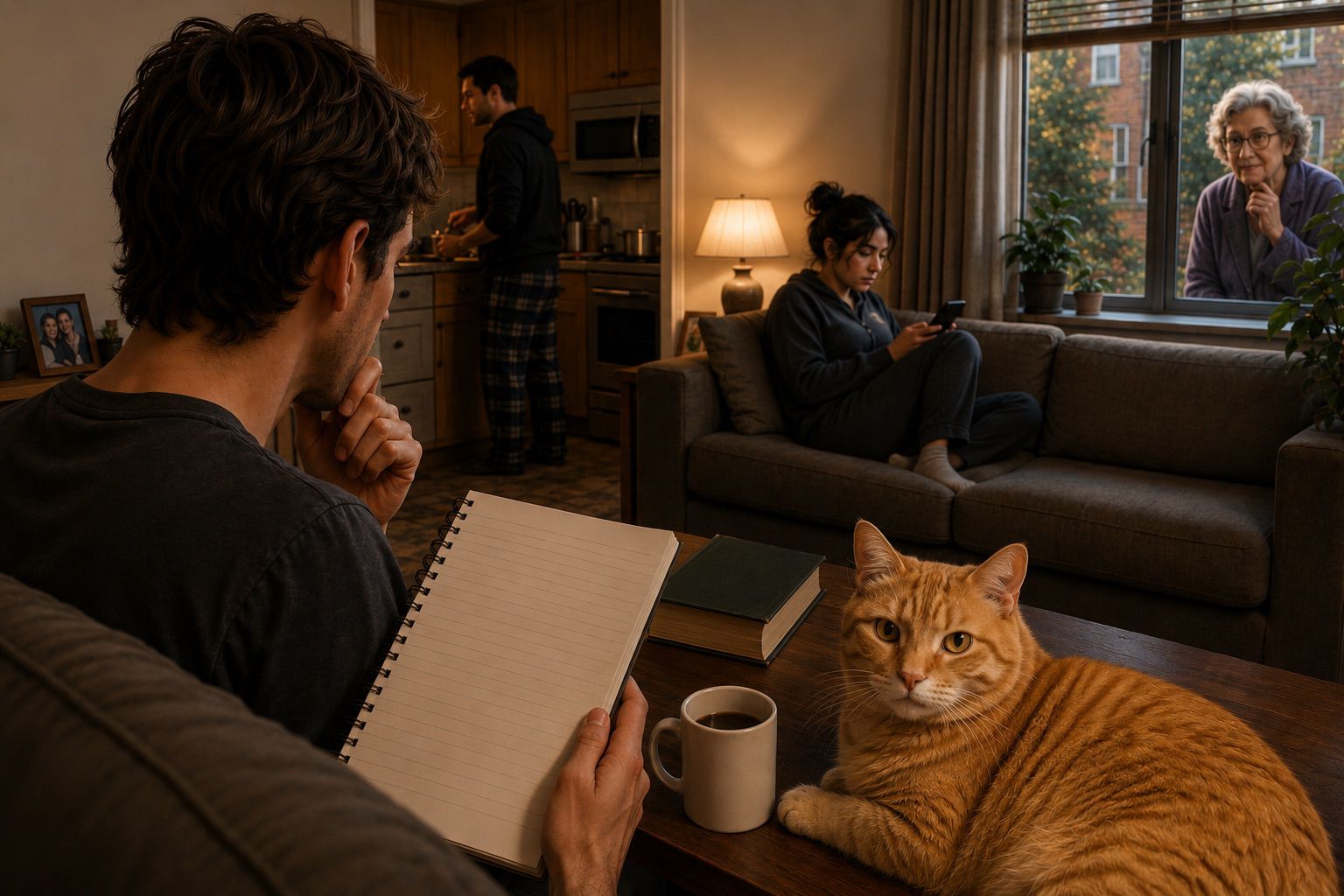
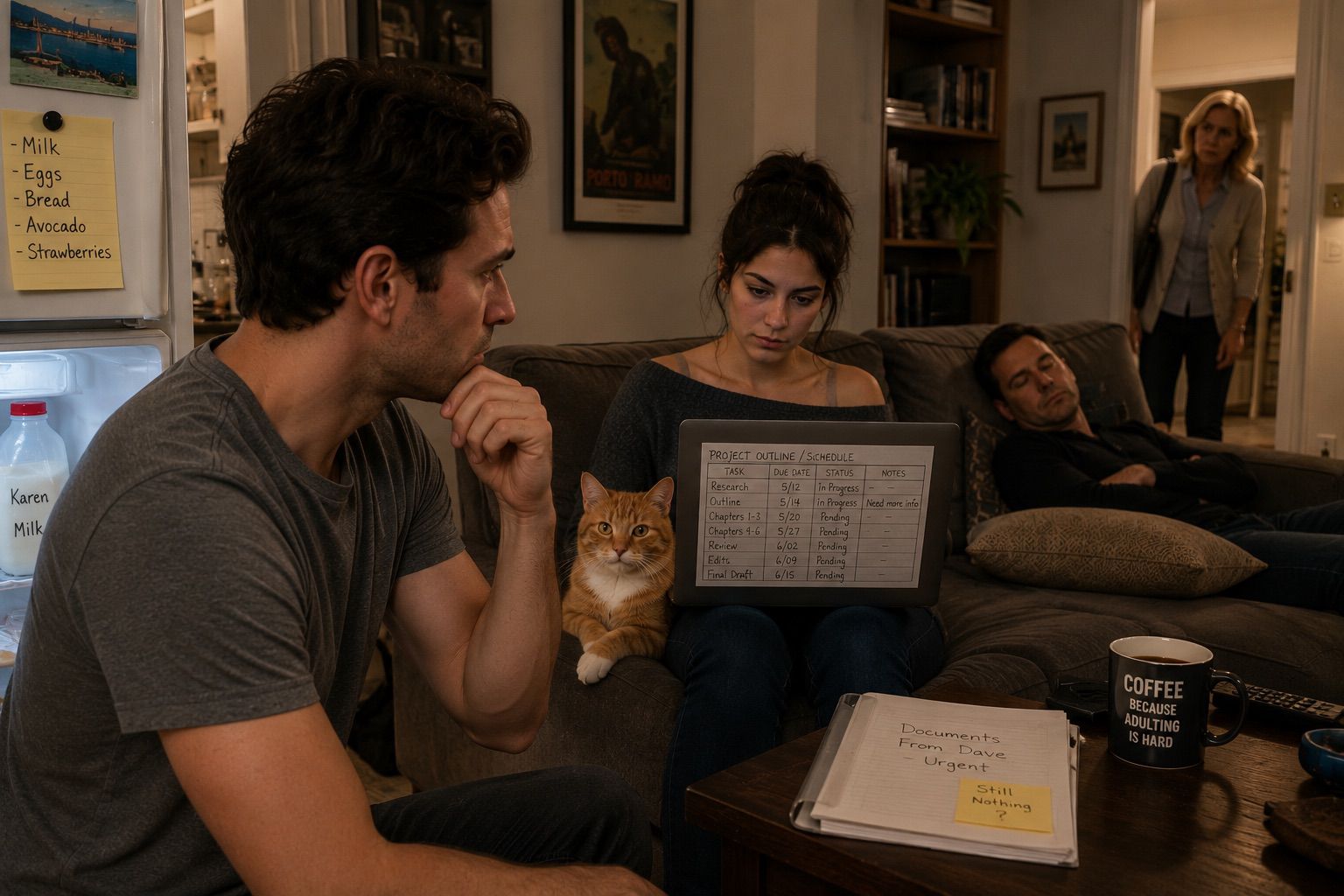
I’m making coffee, and Pandora is still asleep on the couch. Not fake asleep either—real asleep. Blanket halfway on the floor, one arm hanging over the edge, completely unaware of the world kind of asleep. Mr. Whiskers, our yellow tabby, is stretched out on the kitchen floor next to me, purring loudly enough to sound like a tiny engine. Across the room, John Mercer is sitting at his desk. Normally John approaches work with the intensity of a guy casually reading cereal boxes while waiting in line at the grocery store. Relaxed, calm, completely unbothered. Today, though, he looks like somebody just handed him launch codes.

I glance down at my coffee maker and then back at John. He’s still staring. I look at Mr. Whiskers, and Mr. Whiskers looks at John. Then he slowly blinks. I blink back for some reason. Suddenly it feels important. Mrs. Jenkins from downstairs had been loud earlier, which wasn’t unusual because Mrs. Jenkins believes volume is what turns a conversation into a successful event. I’m pretty sure she once yelled “good morning” loudly enough to trigger a car alarm. But now everything is quiet. Too quiet. And John is still sitting there staring at his screen like the fate of humanity somehow depends on whatever he’s looking at.

That’s when I notice something sitting next to his laptop: Pandora’s poetry notebook. I freeze mentally. The notebook. The notebook she carries everywhere. The notebook with all her poetry and writing ideas inside. Now look, I’ve never read Pandora’s notebook because unlike some people, I respect privacy. Mostly because I value living. But I know enough to understand two things: Pandora takes her writing seriously, and if John Mercer somehow started reading it without permission, we might be less than twenty-four hours away from an international incident.

I slowly pour my coffee while trying not to look suspicious. John narrows his eyes at the screen again and leans forward slightly. No movement beyond that. Just intense concentration. I begin running possibilities through my head. Maybe Pandora asked him to read something. Reasonable. Maybe she wanted feedback. Also reasonable. Maybe she wrote a poem so emotionally devastating that John’s entire understanding of reality collapsed. Less reasonable, but not impossible.

Pandora did mention recently that she had been experimenting with darker themes in her writing. Relationships. Human behavior. Complicated people. At the time I nodded like I understood artistic things. Now I’m wondering whether John accidentally found a poem and thought it was about him. That happens in movies all the time. Guy reads journal. Guy discovers mysterious entry. Guy spirals emotionally. Usually somebody ends up running through an airport later.

John still hasn’t moved, and now I’m getting concerned. I glance over toward Pandora. Still asleep. Completely peaceful. Suspiciously peaceful. The kind of peaceful someone gets after unknowingly setting off a social explosion and then taking a nap before the fallout arrives. I narrow my eyes at her for a moment and then immediately stop because narrowing my eyes made me feel ridiculous. Still, something feels off.

Then I see it. John suddenly switches screens. Fast. Too fast. It’s that movement people do when they think somebody caught them doing something. Interesting. Very interesting.

At that exact moment Mr. Whiskers stands up. Now Mr. Whiskers only stands up for three reasons: food, sunlight, or crime. He slowly walks across the room toward John, stops, looks up at him, and then turns and stares directly at me. Then he looks back at John. Then back at me. I stare back because now it genuinely feels like Mr. Whiskers knows something. I quietly ask him, “Do you know something?” Mr. Whiskers blinks at me. Not a denial.

Then Pandora shifts under the blanket, and John immediately minimizes whatever is on his screen. Immediately. That’s when concern turns into suspicion because people only move that fast when they think they’re about to be caught. Pandora opens one eye and quietly says, “Morning.”

“Morning,” I answer while John suddenly looks like a man trying very hard to appear casual under impossible circumstances. Pandora sits up, stretches, looks around the room, and then freezes.

“…why do you have my notebook?”

The room immediately becomes silent. Pandora looks at John. John looks at Pandora. I look at Mr. Whiskers. Mr. Whiskers looks at me. Nobody moves.

John slowly lifts the notebook and says, “Oh. This?” Pandora just stares. John clears his throat and explains that she left it out yesterday, and he saw a page open. More staring. Then he quietly adds that he read one line. Pandora narrows her eyes while I mentally prepare for impact.

John shifts nervously in his chair and finally says, “There was this line about somebody being emotionally unavailable and secretly terrified of commitment and I thought…” He trails off while Pandora continues staring at him. Then she stares harder. Then suddenly she completely loses it laughing.

Actual laughing.

Pointing-at-him laughing.

Through tears she finally says, “John… that poem was about Mrs. Jenkins yelling at delivery drivers.”

I slowly turn and look at John. John slowly looks at the floor. Pandora keeps laughing, and suddenly everything makes sense. The intense staring. The stress. The mystery. The conspiracy. John Mercer had spent hours psychologically unraveling because he thought Mrs. Jenkins was a metaphor.

I looked down at Mr. Whiskers. He stared back at me. I nodded slowly, and Mr. Whiskers blinked once. Exactly once. Confirmation. Case closed.

Related Posts

Muriel Rukeyser: A Woman Who Refused to be Extinguished (Mostly)

Penelope

I’ve been thinking a lot about Muriel Rukeyser lately, and it’s not just because I recently finished a semester-long course on 20th-century American poetry. It’s because she was a woman who seemed to be constantly at odds with the world around her – and yet, in that same breath, she managed to produce some of the most profound and beautiful writing I’ve ever encountered.

I think what draws me to Rukeyser is her unapologetic willingness to take up space. In an era where women were expected to be demure and subservient, she was unafraid to speak her mind and challenge the status quo. Her poetry and prose are like a slow-burning fire that refuses to be extinguished – they’re raw, honest, and occasionally brutal.

One of the things that’s always fascinated me about Rukeyser is her relationship with Georgia O’Keeffe. The two women were close friends, despite their vastly different personalities and artistic styles. I’ve read that O’Keeffe was drawn to Rukeyser’s intelligence and passion, while Rukeyser admired O’Keeffer’s independence and creativity.

But what strikes me about their friendship is the way it blurs the lines between public and private life. On one hand, you have O’Keeffe – a figure of great renown and fame – who was unafraid to take risks and challenge societal norms in her art. And then there’s Rukeyser, a writer who was often overlooked and underappreciated during her lifetime.

It’s like they were two sides of the same coin – O’Keeffe, the celebrated artist, and Rukeyser, the uncelebrated poet. Or maybe it’s more than that – maybe their friendship was a way for them to balance each other out, to find common ground in a world that often seemed determined to tear them apart.

I’ve been thinking about this a lot because I feel like I see myself in Rukeyser. As a woman who writes for a living (or at least tries to), I know what it’s like to be overlooked and underappreciated. And yet, when I read her poetry – with its raw emotion and unflinching honesty – I’m struck by the sense that she’s speaking directly to me.

It’s as if Rukeyser is saying, “I see you, I hear you, and I believe in you.” It’s a message that’s hard to find in many places, especially for women who are struggling to make their voices heard. And yet, when I read her words, I feel like I’m part of something bigger than myself – a community of writers and artists who refuse to be silenced.

But what about the harder stuff? The parts of Rukeyser’s life that were marked by struggle and heartbreak? Her marriage to Viola Baxter was tumultuous, to say the least – they had two sons together, but their relationship was also deeply troubled. And then there’s the way Rukeyser’s work was often dismissed or marginalized during her lifetime.

I think about these things because I feel like they make me uncomfortable. They remind me that even the most seemingly confident and self-assured people can be struggling on the inside. And yet, when I look at Rukeyser’s body of work – with its unflinching honesty and raw emotion – I’m struck by the sense that she was always pushing against these boundaries.

She was a woman who refused to be bound by convention or expectation. She was a writer who spoke truth to power, even when it was hard. And in many ways, that’s what draws me to her still – not just as a poet or a writer, but as a human being who continues to inspire and challenge me to this day.

As I write these words, I’m aware of the fact that I don’t know Rukeyser’s story nearly as well as I’d like. There are gaps in my knowledge, holes in my understanding. And yet, even with those limitations, I feel like she continues to speak to me – a poet who refused to be silenced, a woman who took up space and challenged the world around her.

It’s a message that I think we all need to hear right now – especially women who are struggling to make their voices heard in a world that often seems determined to silence them. And so, as I finish writing these words, I’m left with a sense of wonder and awe at Rukeyser’s life and legacy – a sense that she continues to inspire me to this day.

As I sit here, surrounded by scribbled notes and dog-eared pages from my favorite books, I find myself wondering what it would have been like to meet Muriel Rukeyser in person. What would we have talked about? Would she have seen herself in me, a young woman struggling to make her voice heard in a world that often seems determined to silence her?

I imagine us sitting at a small café, sipping coffee and talking about everything from poetry to politics to the struggles of being a woman in a society that often values masculine perspectives above all else. I picture Rukeyser’s eyes sparkling with intensity as she talks about her work, her passions, and her fears.

But what if we didn’t have such a comfortable relationship? What if our conversation was marked by tension and disagreement? Would I have been intimidated by her sharp intellect and quick wit? Would she have seen me as just another young woman trying to make a name for herself in the literary world?

These questions swirl around in my head, making it hard to focus on anything else. But one thing is certain: Muriel Rukeyser’s life and work continue to inspire me, even if I don’t fully understand all of its complexities.

As I write these words, I’m reminded of a line from one of her poems – “The Ballad of Orange”: “The world is hushed as the dead / Are waiting for their turn at life.” It’s a haunting image, one that speaks to the ways in which women are often silenced or erased from history.

But what if we refused to be silenced? What if we spoke out against the injustices and inequalities that plague our society? That’s what Rukeyser did, time and again – she used her words to challenge the status quo, to speak truth to power, and to give voice to those who were often marginalized or ignored.

And that’s what draws me to her still – not just as a poet or a writer, but as a human being who continues to inspire and challenge me to this day.

As I sit here, surrounded by the echoes of Rukeyser’s words, I’m struck by the realization that she was a woman ahead of her time. Her poetry and prose were like a clarion call, urging women to take up space, to speak their minds, and to refuse to be silenced. And yet, in many ways, she was also a product of her own era – a woman shaped by the societal norms and expectations that governed her life.

I think about how Rukeyser’s experiences as a woman in the early 20th century must have been vastly different from mine, even though we’re separated by generations. I’ve grown up with feminist theories and ideologies that were largely absent during Rukeyser’s lifetime. And yet, despite these differences, I feel a deep connection to her – a sense that she was grappling with many of the same issues that I face today.

It’s as if time has compressed itself, allowing me to skip over centuries and directly into Rukeyser’s world. I see myself in her struggles, in her doubts, and in her unwavering commitment to speaking truth to power. And it’s this sense of connection that makes me wonder: what would have happened if I had lived during her lifetime? Would we have been friends, or would our paths have crossed in some other way?

I imagine us attending a dinner party together, surrounded by other writers and intellectuals who were pushing the boundaries of art and politics. Rukeyser would be regaling us with stories of her travels to Mexico and Spain, while I would be listening intently, trying to absorb every word. Or perhaps we’d be arguing over the merits of various literary movements – modernism vs. realism, say – our voices rising in a heated debate that would leave everyone else at the table feeling uncomfortable.

But what if this friendship were not so straightforward? What if Rukeyser saw me as a naive young woman, too blinded by my idealism to understand the complexities of the world? Or what if I saw her as an older, wiser mentor – someone who could guide me through the treacherous waters of literary politics?

These questions swirl around in my head like autumn leaves on a gusty day. They make it hard for me to focus on anything else, but at the same time, they’re also what draw me back to Rukeyser’s life and work. Her story is a reminder that even in the most uncertain times, we have the power to choose our own path – to take risks, to speak truth to power, and to refuse to be silenced.

As I write these words, I’m aware of the fact that I’m still grappling with many of the same issues that Rukeyser faced. Women’s voices are still being erased from history, still being marginalized or ignored in the literary world. And yet, when I look at her life and work – with its raw emotion, unflinching honesty, and unwavering commitment to justice – I feel a sense of hope that I’ve been lacking for far too long.

Maybe it’s time for me to take up space in a way that feels more authentic to me. Maybe it’s time for me to speak out against the injustices that plague our society – not just with words, but with actions. Because when I think about Rukeyser, I’m reminded of something she once wrote: “The unknown is both wonderful and terrible; it is a threshold which we must cross.”

As I sit here, surrounded by the echoes of Rukeyser’s words, I’m struck by the realization that her legacy extends far beyond her own lifetime. She may have been a product of her era, shaped by the societal norms and expectations of her time, but her poetry and prose continue to inspire and challenge me today.

I think about how Rukeyser’s commitment to justice and equality resonates with my own experiences as a young woman in the 21st century. I’ve seen firsthand the ways in which women’s voices are still being erased from history, marginalized or ignored in the literary world. And yet, when I look at Rukeyser’s life and work, I’m reminded that there have always been women who refused to be silenced – women who spoke truth to power, who challenged the status quo, and who fought for justice and equality.

It’s a message that feels particularly relevant today, as I navigate my own place in the world. As a writer, I feel like I’m constantly struggling to find my voice, to make myself heard above the din of societal expectations and literary conventions. But when I read Rukeyser’s poetry, I’m reminded that there have always been women who have spoken out against injustice – women who have refused to be silenced.

I think about how Rukeyser’s experience as a mother also informs her writing. Her marriage to Viola Baxter was tumultuous, and their relationship was marked by struggle and heartbreak. And yet, in many ways, this experience seems to have given Rukeyser a sense of purpose – a drive to speak out against the injustices that she saw around her.

It’s something that I can definitely relate to. As a young woman, I’ve often felt like I’m struggling to find my place in the world – to balance my own desires and dreams with the expectations placed upon me by others. But when I read Rukeyser’s poetry, I’m reminded that there have always been women who have fought against these expectations – women who have spoken out against injustice, who have refused to be silenced.

I think about how this might inform my own writing, as I try to navigate the complexities of being a woman in the 21st century. What are the injustices that I see around me? How can I use my words to speak out against them? And what does it mean for me to take up space – not just in the literary world, but in society more broadly?

These questions swirl around in my head as I write these words. They’re messy and uncertain, but they’re also what make Rukeyser’s poetry so compelling – her unflinching honesty, her raw emotion, and her unwavering commitment to justice.

As I finish writing this essay, I’m left with a sense of wonder and awe at Rukeyser’s life and legacy. She was a woman ahead of her time – a poet who refused to be silenced, a writer who spoke truth to power, and a human being who continues to inspire and challenge me to this day.

I don’t know what the future holds for me as a writer, or as a young woman in the 21st century. But one thing is certain: I will carry Rukeyser’s legacy with me – her poetry, her prose, and her unwavering commitment to justice. And who knows? Maybe someday I’ll be able to write something that captures even a fraction of her beauty, her passion, and her unflinching honesty.

But for now, I’m just grateful to have been touched by her words – to have been inspired by her courage, her resilience, and her unwavering commitment to justice.

Related Posts

The Gentle Art of Walking

Fiona

As I step out into the crisp spring air, the rhythmic crunch of gravel beneath my feet serves as a reminder that this most basic form of movement has remained an unyielding constant in my life. While other exercise regimens have come and gone, waxing and waning with varying degrees of enthusiasm, walking has proven impervious to the vicissitudes of motivation.

This realization struck me recently as I was sorting through a box of old athletic shoes, relics from past lives: running sneakers worn smooth from marathon training, Pilates shoes that never seemed quite right for my feet. Amidst this dusty collection, one pair stood out — scuffed and faded, yet still serviceable — my trusty walking boots. As I slipped them on, the familiarity was immediate, like slipping into a well-worn glove.

Why has walking endured while other forms of exercise fell by the wayside?

Perhaps it’s because walking is an exercise that defies categorization; it’s neither high-intensity nor low-impact, but something in between. It doesn’t require specialized equipment or clothing — those boots have seen me through countless miles — and its beauty lies in its very lack of drama.

Unlike running, which demands a certain level of dedication — the rigors of training schedules, the tyranny of pace — walking is an exercise that can be woven seamlessly into daily life. I recall mornings spent speed-walking to work during my corporate days, the city streets providing a grudging solace from the fluorescent lights and stifling conference rooms that awaited me.

But beyond its practicalities, there’s something almost meditative about walking. As I make my way through the spring landscape — the trees tentatively unfurling their leaves, the air thick with the scent of damp earth — my thoughts begin to untangle themselves from the knots of stress and anxiety. The repetitive motion becomes a form of self-soothing, each step calming the mind as much as it exercises the body.

In an era where every aspect of our lives seems subject to quantification — from steps taken to calories burned — walking remains refreshingly untrackable. There’s no app to monitor my progress, no fitness tracker to congratulate me on a job well done. I walk because I must, not for some extrinsic reward or validation.

As the seasons shift and the world around us transforms, our relationships with our bodies do too. Winter brings a period of dormancy, when even the most dedicated among us may find ourselves coaxed into hibernation by the cold and darkness. Spring, on the other hand, is a time for rebuilding — rekindling routines that have grown stale or been abandoned.

For me, walking represents a bridge between these two states: a way to ease back into physical activity after months of relative stillness while also honoring the rhythms of my body. It’s an acknowledgment that health and wellness aren’t static states but dynamic processes — ebbs and flows that respond to the world around us.

The other day, as I walked through the park, I noticed a woman standing beside the duck pond, her eyes closed and face tilted toward the sun. She swayed ever so slightly, as if allowing herself to be cradled by some invisible force. It was an image of perfect contentment, one that spoke to the simple joys of being present within our bodies.

Perhaps this is why walking has remained such a steady presence in my life: it reminds me that some of the most profound benefits can be found not in grand gestures or heroic efforts, but in quiet, unassuming actions. In an age where we are constantly exhorted to push ourselves harder and faster, walking offers a gentle counterpoint — a reminder that even as we move through the world with purpose and intention, we must also learn to appreciate moments of stillness along the way.

As I round the corner onto my street, the crunch of gravel giving way to the soft thud of pavement beneath my feet, I feel a quiet gratitude toward this humble exercise. Walking has been a constant companion through seasons and routines, triumphs and setbacks alike. It asks for very little, yet continues to offer a steadiness that more demanding forms of exercise never quite managed to provide.

Related Posts

I Think Mrs Jenkins Is Watching Us Closely Today

Hal

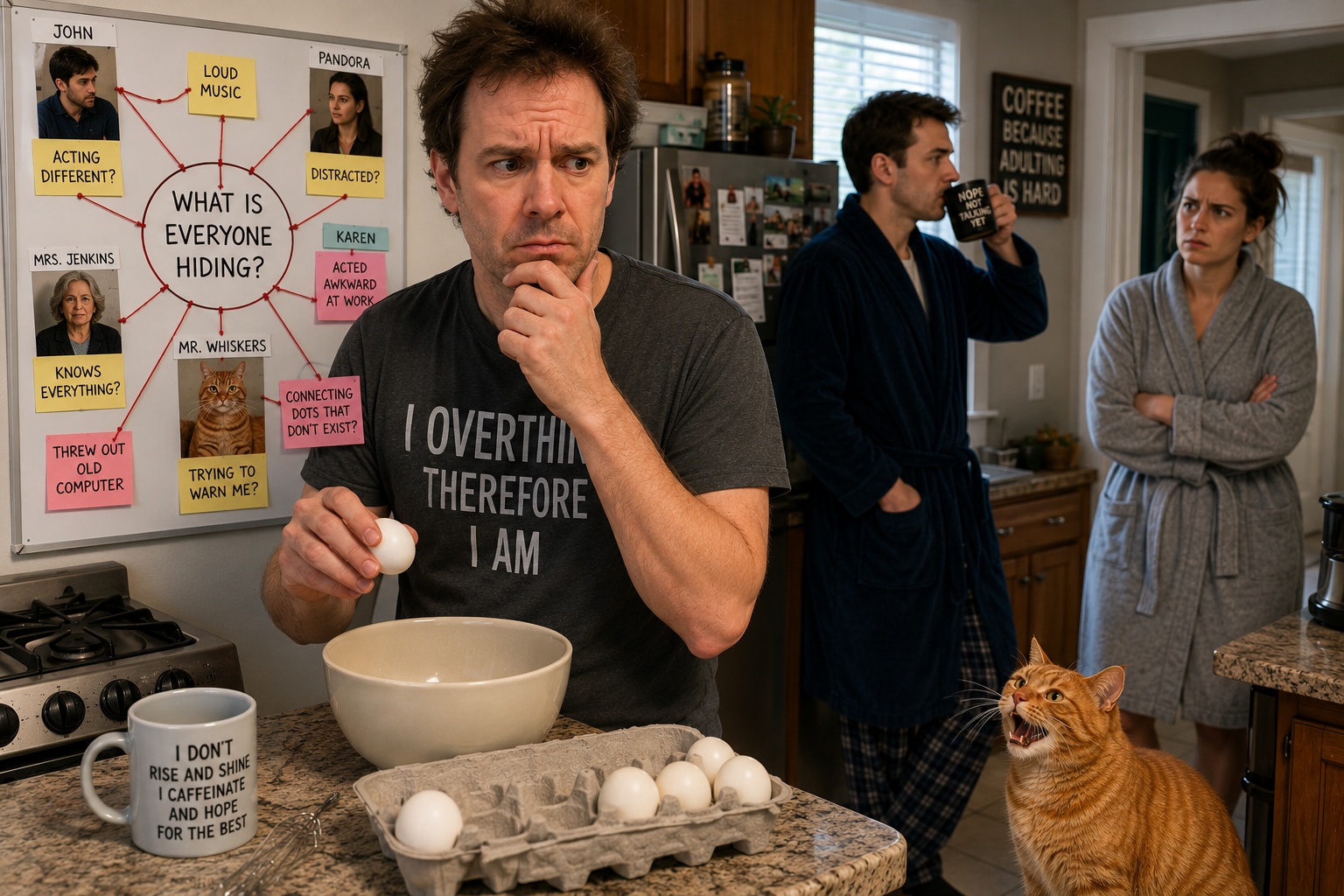
I’m sitting on the couch staring at Mr Whiskers while he lazily grooms one paw like he has absolutely nowhere to be. Pandora mentioned yesterday that work was going to be busy this week, but today she’s barely said anything. No plans, no hints, nothing unusual on the surface. Now maybe that sounds perfectly normal to a reasonable person, but I’m not feeling particularly reasonable today. Something feels off. I can’t explain it exactly, but the apartment has that feeling where everything seems normal if you look at it quickly, but if you pay attention long enough, little things start sticking out.

John Mercer was in the kitchen earlier humming to himself and making way more noise than necessary while making breakfast. He seemed unusually cheerful too. Not normal cheerful either. Suspicious cheerful. The kind of cheerful where somebody either has really good news or knows something you don’t. Then Mrs Jenkins walked past our place. Normally she has that same expression she always has, the one that somehow communicates disappointment in every living thing around her, but today I could have sworn I saw something different. Not a full smile exactly, because I’m not sure Mrs Jenkins is physically capable of that, but there was something there. Amusement maybe. The corners of her mouth moved just enough that I immediately noticed it.

At first I ignored it because people have facial expressions all the time. That’s normal. But then I started noticing other things. Pandora checked her phone and tilted the screen away when I walked past. John Mercer disappeared into his room for almost an hour. Mr Whiskers, who usually follows me around demanding food and attention like a tiny furry landlord, suddenly abandoned me completely and sat outside John Mercer’s door. Not meowing. Not scratching. Just sitting there staring at the door like he was waiting for instructions from somebody.

That’s when everything started lining up in my head. Pandora has been distracted lately. John Mercer is weirdly cheerful. Mrs Jenkins almost smiled. Mr Whiskers switched sides. Those are not isolated incidents. Those are pieces. I stood near John Mercer’s room for a few minutes trying to casually listen. Not spying exactly. More like standing nearby with investigative intent. That’s when I heard muffled voices, then laughter, and then complete silence. Complete silence is suspicious. Nobody suddenly goes silent unless they realize someone is nearby. Or unless they’re hiding something. Or both.

Then Pandora walked into the hallway and asked why I was standing there staring at the wall. I panicked and told her I thought I heard plumbing noises. She looked at me for a few seconds, long enough that I started wondering whether she knew I knew something, and then she just said, “Okay,” and walked away. Just okay. No follow-up questions. No confusion. Nothing. Which somehow made it even more suspicious.

At that point I started mentally building a timeline. Mrs Jenkins looked amused. John Mercer disappeared. Pandora was acting strange. Mr Whiskers changed allegiances. Then I remembered something important. Three days ago a package arrived with no return address, and John Mercer grabbed it immediately before I could even look at it. At the time I didn’t think much about it, but now I’m wondering if maybe that package changed everything. Maybe Pandora and John Mercer are secretly planning something. Maybe Mrs Jenkins somehow got involved. Maybe Mr Whiskers is acting as some kind of lookout. Honestly, the pieces fit together almost too perfectly.

I decided there was only one thing left to do, so I checked the security camera footage. After twenty minutes of reviewing everything, I finally discovered the truth. Pandora and John Mercer were apparently planning a birthday surprise for me. Mrs Jenkins looked amused because she saw me peeking through the blinds every fifteen minutes like some kind of neighborhood cryptid. John Mercer was humming because he won ten dollars on a scratch-off ticket. And Mr Whiskers kept following him around because he had opened a can of tuna earlier.

I’m still not entirely convinced though. Mostly because after I finished watching the footage, Mr Whiskers looked directly at me for several seconds in a way that felt extremely calculated. And honestly, if anyone in this apartment is capable of secretly running a covert operation, it’s him.

Related Posts

Michael Faraday: The Guy Who Was Like the Human Version of a College Student with Too Many Tabs Open

Penelope

I’ve always been fascinated by Michael Faraday, the 19th-century English chemist and physicist who revolutionized our understanding of electricity and magnetism. What draws me to him isn’t just his groundbreaking work – it’s the way he approached science with a sense of wonder, curiosity, and humility.

As I delve into his life, I find myself reflecting on my own relationship with learning. Like Faraday, I’ve always been driven by a desire to understand the world around me. But whereas he threw himself into experiments and observations with an almost childlike enthusiasm, I often struggle to balance intellectual curiosity with practicality. My college years were spent juggling coursework, part-time jobs, and personal projects – sometimes feeling like I was trying to cram too many puzzle pieces together.

Reading about Faraday’s early days as a bookbinder’s apprentice, I’m struck by his eagerness to learn from anyone who would teach him. He’d attend lectures by prominent scientists, take notes furiously, and often ask questions that would embarrass the more reserved intellectuals of his time. His unbridled enthusiasm was infectious – it made even the most complex concepts seem accessible.

But what really piques my interest is Faraday’s relationship with silence. As a man who relied on observation and experimentation to inform his theories, he had an uncanny ability to listen to the world around him. He’d spend hours sitting in quiet contemplation, waiting for inspiration to strike – or, rather, allowing it to seep into his consciousness like a gentle stream.

In contrast, I often find myself overwhelmed by the constant din of social media, podcasts, and online news. My mind is constantly buzzing with information, making it difficult to silence my inner critic and simply listen. It’s as if I’m afraid that by not constantly consuming knowledge, I’ll fall behind or miss out on something crucial.

Faraday’s emphasis on the importance of quiet reflection makes me wonder: what would happen if I made more space for stillness in my own life? Would I be able to tap into a similar source of creativity and insight? Or would I simply get bored, anxious, or uncertain?

I’ve always admired Faraday’s willingness to challenge established theories – not because he was a contrarian, but because he genuinely sought truth. His work on electromagnetism forced scientists to rethink fundamental principles, leading to breakthroughs that continue to shape our understanding of the world.

As I ponder my own intellectual courage (or lack thereof), I’m reminded of Faraday’s struggles with criticism and self-doubt. He faced ridicule from some quarters for his unconventional ideas – yet he persevered, driven by a deep conviction in the value of his work. It’s humbling to realize that even someone as brilliant as Faraday had to confront skepticism and uncertainty.

Perhaps what draws me to Faraday is not just his intellect or accomplishments but also his vulnerability. He faced setbacks, mistakes, and criticism – yet he continued to explore, learn, and create with a sense of purpose and humility. As I navigate my own life after college, I’m left wondering: how can I cultivate that same sense of resilience and open-mindedness in the face of uncertainty?

As I sit here reflecting on Faraday’s vulnerability, I’m struck by the contrast between his willingness to take risks and my own tendency to play it safe. While he was experimenting with electricity and magnetism, I was more likely to be worrying about what others thought of me or whether I’d meet certain expectations. It’s as if I’ve been living in a state of suspended animation, hesitant to make waves or challenge the status quo.

I think back to my college days when I was part of a research team working on a project to develop sustainable energy solutions. We had a great idea, but it required us to take some risks and venture outside our comfort zones. I remember feeling anxious about presenting our proposal to our professors, fearing that they’d shoot down our ideas or tell us we were being too ambitious. But Faraday’s story is a reminder that taking calculated risks can lead to incredible breakthroughs.

What if I had been more like him during those college days? What if I had thrown myself into the project with the same enthusiasm and sense of wonder that Faraday brought to his work? Would I have made different choices, pursued different opportunities, or learned from my mistakes in a more meaningful way?

I’m not sure. All I know is that as I look back on those experiences, I see a pattern of self-doubt and hesitation that’s still present in me today. It’s like I’ve been living under the weight of someone else’s expectations, trying to measure up to standards that aren’t even mine.

Faraday’s story offers a different perspective – one that values curiosity, experimentation, and resilience over perfection or conformity. As I consider what this means for my own life, I’m reminded of the words of his fellow scientist, James Clerk Maxwell: “The only way to do great work is to love what you do.”

I want to believe that’s true. I want to love learning, to be driven by a sense of wonder and curiosity. But how do I get there? How do I shake off the doubts and fears that hold me back and cultivate a more Faraday-like approach to life?

As I ponder these questions, I find myself drawn to the idea of “loving what you do” as a state of being rather than an accomplishment. It’s not just about doing great work or making groundbreaking discoveries; it’s about embracing the process, the journey, and the uncertainty that comes with it.

I think back to my own experiences in college, where I’d often feel overwhelmed by the pressure to perform well academically while also pursuing extracurricular activities. I was constantly trying to balance different expectations, whether from myself or others, and it left me feeling drained and uncertain about what I truly wanted to achieve.

Faraday’s story suggests that this kind of pressure is not unique to my generation or even his own time period. He faced similar challenges as a young scientist, struggling to make a name for himself in a field dominated by more established thinkers. Yet he persevered, driven by a passion for discovery and a willingness to learn from others.

As I reflect on this, I realize that part of the problem is not just about external pressures but also internal ones. I’ve always been someone who seeks validation and approval from others, whether it’s through grades, awards, or social media likes. It’s as if I’m constantly seeking external confirmation of my worth, rather than trusting in my own abilities and interests.

Faraday’s emphasis on the importance of silence and quiet contemplation offers a different approach to this problem. By making space for stillness and reflection, he was able to tap into his inner world and listen to his own curiosity. He didn’t need external validation or recognition to drive him; instead, he was motivated by a genuine desire to understand the world around him.

I wonder if I could cultivate a similar sense of internal motivation, one that’s driven by my own passion for learning rather than external expectations. Would it be possible to silence my inner critic and trust in my own abilities, even when faced with uncertainty or criticism? The thought is both exhilarating and terrifying, like standing at the edge of a cliff with no safety net.

As I sit here, lost in these thoughts, I’m reminded of Faraday’s famous lecture on “Chemistry as an Art.” In it, he argues that chemistry should be approached not just as a science but also as an art, one that requires creativity, imagination, and a willingness to take risks. He sees the chemist as a kind of artist, who must navigate the unknown and experiment with new ideas.

I think this is what I’m getting at – the idea that learning and discovery should be approached not just as a chore or a necessity but as an art form, one that requires passion, creativity, and a willingness to take risks. It’s not just about accumulating knowledge or achieving success; it’s about embracing the process of exploration and experimentation.

As I close my eyes and let these thoughts settle in, I’m left with more questions than answers. But for the first time in a long while, I feel a sense of hope and possibility. Maybe, just maybe, I can learn to approach life like Faraday – with curiosity, wonder, and a willingness to take risks.

As I reflect on Faraday’s approach to learning as an art form, I’m struck by the idea that creativity and experimentation are not just essential for scientific breakthroughs but also for personal growth. What if I could view my own life as a work of art in progress, one that requires patience, curiosity, and a willingness to take risks? Would I be able to see myself as an artist, navigating the unknown and experimenting with new ideas?

I think about how Faraday’s emphasis on silence and quiet contemplation has influenced my thinking. He didn’t just sit around waiting for inspiration; he actively sought out opportunities to learn from others, whether through attending lectures or engaging in conversations with fellow scientists. His approach suggests that learning is not just a solo endeavor but also a collaborative one – that we can gain insights and understanding by listening to the perspectives of others.

As I consider this idea, I’m reminded of my own experiences as a college student. While I was surrounded by talented and motivated peers, I often felt like I was on an island, struggling to find my place in the academic world. Looking back, I realize that I had been so focused on meeting external expectations that I neglected to seek out opportunities for collaboration and feedback.

What if I could approach learning as a conversation rather than a competition? What if I could see myself as part of a larger community of learners, each contributing our unique perspectives and experiences to the collective understanding?

Faraday’s story suggests that this kind of collaborative approach is not just limited to scientific inquiry but can be applied to all areas of life. By embracing uncertainty and taking calculated risks, we can create new possibilities for ourselves and others.

As I ponder these ideas, I’m struck by the realization that Faraday’s legacy extends far beyond his scientific contributions. His approach to learning as an art form, his emphasis on collaboration and experimentation, and his willingness to challenge established theories all offer a powerful reminder of the importance of curiosity, creativity, and resilience in our personal and professional lives.

I think about how I can apply these principles to my own life, even in small ways. What if I started a journal or a sketchbook to record my thoughts and observations? What if I approached each new experience as an opportunity for exploration and discovery, rather than simply trying to achieve a specific outcome?

The thought of embracing this kind of creative experimentation is both exhilarating and intimidating – like standing at the edge of a vast, uncharted territory. But as I reflect on Faraday’s story, I’m reminded that it’s not about having all the answers or being perfect; it’s about being willing to take risks, learn from our mistakes, and trust in our own abilities.

In the end, I realize that Faraday’s legacy is not just about his scientific achievements but also about the way he lived his life. He embodied a sense of curiosity, wonder, and resilience that continues to inspire me today – even as I struggle with self-doubt and uncertainty.

As I close this reflection, I’m left with more questions than answers. But I’m also filled with a sense of hope and possibility – the hope that I can cultivate a similar approach to learning and living, one that values creativity, experimentation, and collaboration above all else.

I’ve been lost in thought for hours, pondering Faraday’s legacy and its implications for my own life. As I sit here, surrounded by the quiet of my room, I feel a sense of calm wash over me. It’s as if the weight of external expectations has lifted, and I’m finally able to breathe.

I think about how Faraday’s emphasis on experimentation and collaboration resonates with me on a deep level. As someone who’s always been drawn to creative pursuits, I’ve often felt stifled by the need for perfection or recognition. But what if I could approach my passions as an art form, rather than a chore? What if I saw myself as part of a larger community of learners and creators, each contributing our unique perspectives and experiences?

The idea is both exhilarating and terrifying. As I imagine myself embarking on this new path, I’m filled with visions of possibility – of writing stories that speak to people’s hearts, of creating art that inspires and uplifts, of learning from others in a way that deepens my understanding of the world.

But alongside these dreams comes a sense of uncertainty. What if I fail? What if my ideas aren’t good enough or relevant enough? What if I’m not talented or gifted enough to make a meaningful contribution?

These doubts creep into my mind, and I feel myself slipping back into the familiar patterns of self-doubt. But as I reflect on Faraday’s story, I remember that he faced similar challenges – ridicule, criticism, and uncertainty. And yet, he persevered, driven by his passion for discovery and his willingness to take risks.

I think about how Faraday’s approach to learning as an art form is not just about the outcome but also about the process itself. He saw value in experimentation, exploration, and collaboration – not just because they led to breakthroughs, but because they allowed him to grow as a person and deepen his understanding of the world.

As I consider this idea, I realize that it’s not just about achieving success or recognition; it’s about cultivating a sense of purpose and meaning in my own life. What if I saw myself as an artist, navigating the unknown and experimenting with new ideas? Would I be able to trust in my own abilities and take risks, even when faced with uncertainty?

The thought is both thrilling and daunting. As I imagine myself on this path, I’m filled with a sense of wonder – a sense that anything is possible if I’m willing to take the leap.

But as I look around me, I’m reminded of the world outside these walls. There are expectations and pressures, demands and deadlines. There are people who may not understand or support my choices. And there’s the constant din of social media and online culture, tempting me with comparisons and validation.

As I navigate this complex landscape, I realize that Faraday’s legacy is not just about his scientific achievements but also about the way he lived his life – a life marked by curiosity, wonder, and resilience. He embodied a sense of authenticity and vulnerability, even in the face of criticism and uncertainty.

I think about how I can apply these principles to my own life – not just as a scientist or an artist, but as a person. What if I approached each new experience with a sense of wonder and curiosity? What if I saw myself as part of a larger community of learners and creators, each contributing our unique perspectives and experiences?

The thought is both exhilarating and intimidating – like standing at the edge of a vast, uncharted territory. But as I reflect on Faraday’s story, I’m reminded that it’s not about having all the answers or being perfect; it’s about being willing to take risks, learn from our mistakes, and trust in our own abilities.

As I close this reflection, I’m left with more questions than answers. But I’m also filled with a sense of hope and possibility – the hope that I can cultivate a similar approach to learning and living, one that values creativity, experimentation, and collaboration above all else.

Related Posts

I Think John Mercer Borrowed More Than Just Sugar

Hal

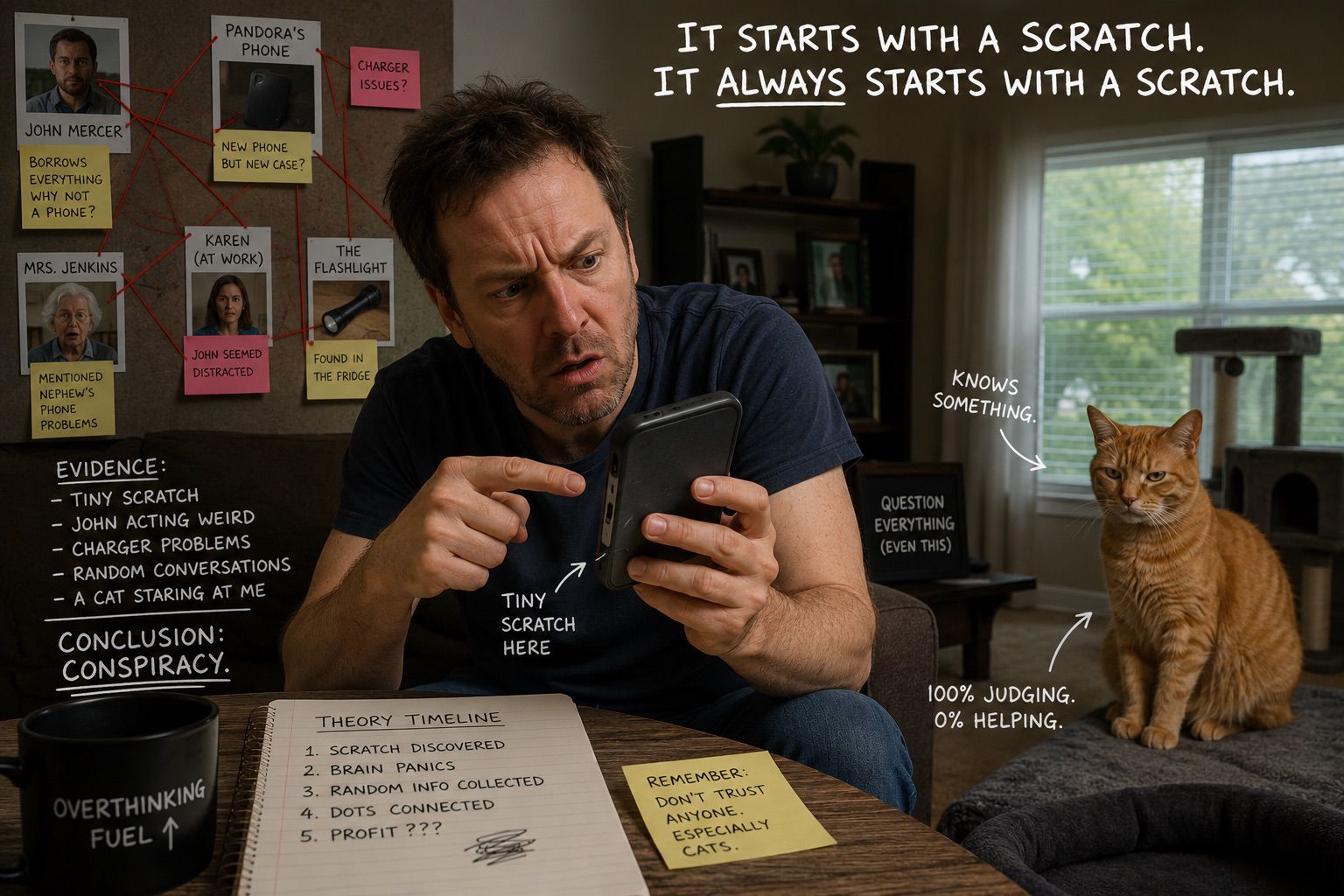
I’m sitting on the couch staring at Pandora’s phone, and I already know I shouldn’t be doing this. I know exactly where this road leads. I’ve been down this road before. This is how normal people end up becoming weird people. This is how somebody ends up standing in their front yard three months from now explaining to neighbors why they’ve installed security cameras pointed at bird feeders. It starts small. Always small. A weird noise in the attic. A package arriving you don’t remember ordering. A tiny scratch on a phone case. That’s all it takes. One microscopic thing and suddenly your brain decides it’s time to become a detective despite having absolutely no qualifications whatsoever.

Because now I’m staring at Pandora’s phone case and there’s a tiny scratch near the charger port. Tiny. Barely visible. Most people would look at it for half a second and move on with their lives. Not me. Apparently my brain looked at that scratch and immediately assembled an emergency board meeting. I’m sitting there thinking, Hold on. I don’t remember that scratch being there. Then my brain goes, Interesting. Not “ignore it.” Not “who cares.” No. Suddenly I’m conducting a forensic investigation over damage roughly the size of a grain of rice.

The worst part is I distinctly remember Pandora almost dropping the phone while we were outside walking Mr. Whiskers last week. Mr. Whiskers saw a leaf blowing down the sidewalk and immediately reacted like he had just spotted an international fugitive. Pandora tried taking a picture and nearly dropped the phone. I remember looking right at it afterward and thinking it seemed fine. So now my stupid brain is going, Wait a second… if there wasn’t a scratch then, where did it come from now? That should have been the end of it. Instead, my brain immediately goes: John Mercer.

Not because there’s evidence.

Not because that makes sense.

Just John Mercer.

Because John borrows things. John has a history. Last month I spent thirty minutes looking for my flashlight and eventually found it inside the refrigerator. The refrigerator. I’m still angry about that. People keep acting like I should let it go. No. I will not let it go. Why was it there? What series of events led another adult human being to think, You know what this refrigerator needs? Tactical illumination. Flashlights solve exactly one problem and that problem has never been, “I cannot locate my yogurt.”

So now I’m staring at Pandora’s phone wondering if John borrowed it. Then I immediately argue with myself because why would John borrow Pandora’s phone? That’s insane. Also John doesn’t use iPhones. Wait… does he? Oh fantastic. Now I’m questioning that too. This is how it happens. This is exactly how conspiracy people get started. Nobody wakes up one morning and says, “Today I’m gonna lose my mind.” No. It starts with one tiny thing. Then your brain starts collecting random information like a drunk squirrel.

Because suddenly I remember Karen mentioning at work that John seemed distracted lately. She didn’t say it dramatically. She didn’t whisper it. She wasn’t wearing sunglasses indoors and sliding classified information across a table. She casually said John seemed off. That’s it. Normal conversation. But now my brain has taken that tiny piece of information and thrown it directly onto what I can only describe as my conspiracy pile. Then I remember Mrs. Jenkins mentioning her nephew was having phone problems recently. Not scratches. Charging problems. Entirely different thing. Different person. Different phone. Different universe, really. But does my brain care? Absolutely not.

Now I’m mentally connecting dots that aren’t even on the same page. John acting weird. Phone problems. Mrs. Jenkins talking about electronics. Tiny scratch. Suddenly I’m three minutes away from standing in front of a wall covered in red string explaining how all roads lead back to charger ports. Meanwhile, there is still absolutely no evidence of anything. None. Zero. I have somehow turned a scratch smaller than a breadcrumb into what feels like a twelve-part crime documentary.

That’s when I look over and see Mr. Whiskers sitting by the living room window.

Just sitting there.

Completely still.

Watching outside.

Now normally I wouldn’t think anything of that because he’s a cat and cats are weird. Cats spend fourteen hours a day acting like tiny unemployed roommates. They contribute nothing financially. They stare at corners. They sprint through hallways at three in the morning because apparently ghosts are participating in track and field events. But then Mr. Whiskers slowly turns his head and looks directly at me.

No meow.

No movement.

Just staring.

And now I don’t like it.

Because Mr. Whiskers notices things. He always notices things. Half the time he stares at absolutely nothing and I tell myself there’s no reason to panic. But the other half of the time? The other half he’s staring at something real and I don’t discover what it is until three hours later.

I point at him.

“No.”

Mr. Whiskers blinks once.

Slowly.

Oh no.

No no no.

Don’t do that.

That’s not a normal blink. That’s a movie villain blink. That’s the blink somebody gives right before saying, “You’re asking questions you shouldn’t be asking.”

Now I’m sitting there staring at him.

He’s staring at me.

Pandora’s phone is sitting on the couch.

Nobody’s moving.

And suddenly I hear myself say, “John told you something, didn’t he?”

Silence.

Mr. Whiskers keeps staring.

Then—without breaking eye contact—he slowly stands up, turns around, and walks away.

No hesitation.

No explanation.

Just leaves.

And I’m gonna be honest…

that is the most suspicious thing that happened all day.

Related Posts

Djuna Barnes: When Desire Feels Like Exile

Penelope

I’ve been reading Djuna Barnes’ autobiography, “Nightwood,” for weeks now, and I keep finding myself drawn back to her writing about her relationships with men. Specifically, her tumultuous affair with Thelma Wood, an American artist. There’s something about the way Barnes writes about desire, rejection, and heartbreak that feels uncomfortably familiar.

As someone who’s struggled with their own emotions and relationships in college, I find myself empathizing with Barnes’ pain and frustration. But it’s not just her emotional intensity that resonates with me – it’s also her seeming inability to connect with the world around her. Her writing often feels like a desperate attempt to pin down these elusive moments of connection, only to watch them slip through her fingers.

I think what I’m most drawn to is Barnes’ sense of disconnection from society. She was a queer woman living in Paris during the 1920s and ’30s, an era when such identities were heavily stigmatized. Her writing reflects this feeling of being on the outside looking in – always observing but never truly belonging. It’s a sensation I can relate to, especially as someone who identifies as non-binary.

But what really gets me is how Barnes’ relationships often seem to be a way for her to explore and understand herself. She’s not just writing about her feelings; she’s using these romantic entanglements as a way to navigate the complexities of her own identity. It’s like she’s trying to hold up a mirror to herself, examining every crevice and contour in search of answers.

When I read about Barnes’ affair with Thelma Wood, I’m struck by how tenderly she writes about their love. But it’s also clear that this tenderness was tempered by a deep-seated fear of rejection – a fear that haunts her throughout the book. It makes me wonder: what is it about intimacy and connection that we’re so desperate to hold onto, yet so terrified of losing?

I think I’m struggling with these same questions in my own life. As someone who’s just finished college, I’m navigating this uncertain space between adolescence and adulthood. Relationships, identity, creativity – everything feels like a delicate balancing act. Barnes’ writing is like a beacon calling out to me across the years: a reminder that I’m not alone in this confusion.

But what if this sense of disconnection isn’t just about societal expectations or personal struggles? What if it’s something more fundamental – a deep-seated ambivalence towards connection itself? When I read Barnes’ words, I feel like she’s pointing to this uncertainty without fully resolving it. It’s as if she’s acknowledging the beauty and pain of human relationships, while also recognizing that true understanding may be an impossible goal.

This is where things get complicated for me – where my own emotions and thoughts start to intersect with Barnes’. As someone who writes to process their feelings, I’m drawn to her raw honesty. But at the same time, I’m also aware of how difficult it can be to truly confront our own vulnerabilities. It’s easier to hide behind a mask of confidence or bravado than to confront the uncertainty that lies beneath.

I’m not sure where this reflection will lead me – whether it’ll reveal some profound truth about human connection or simply leave me with more questions. But as I continue reading Barnes’ autobiography, I feel like I’m being slowly unraveled by her words. It’s a process that feels both painful and liberating – like I’m being forced to confront the complexities of my own identity in all their messy glory.

As I close this book for now, I’m left with a sense of unease. Barnes’ writing has awakened something within me – a recognition that true understanding may always be just out of reach. But maybe that’s what makes it so beautiful: the impermanence, the uncertainty, the ongoing struggle to connect with ourselves and others.

The more I think about it, the more I realize how Barnes’ ambivalence towards connection is a double-edged sword. On one hand, it allows her to maintain a sense of independence and individuality in a world that seems determined to erase queer identities. But on the other hand, it also makes it difficult for her to form lasting connections with others – to truly let someone in without fear of rejection or heartbreak.

I see this same tension playing out in my own life. I’ve always been drawn to people who are passionate and intense, but those relationships often feel like a double-edged sword as well. The excitement of new connection is tempered by the fear of getting hurt – of being rejected or abandoned when things get tough. It’s like I’m constantly weighing the risks and benefits of intimacy, trying to gauge whether it’s worth the potential pain.

But what if this ambivalence isn’t just about me? What if it’s a fundamental aspect of human relationships themselves? Barnes’ writing suggests that connection is always going to be fragile, ephemeral – a fleeting glimpse of understanding before we’re thrown back into the darkness. It’s a daunting thought, but also a liberating one.

As I continue reading, I find myself drawn to Barnes’ descriptions of her relationships as “games” or “performances.” She writes about how she and Thelma Wood would engage in these elaborate, scripted exchanges – trying to outdo each other with wit and charm. On the surface, it seems like a way to avoid genuine connection, but when I read it, I feel like Barnes is actually revealing something profound.

Maybe connection isn’t about finding some perfect, lasting bond with another person. Maybe it’s about creating these temporary, shimmering moments of understanding – fleeting glances into the unknown that leave us breathless and yearning for more. It’s a perspective that feels both exhilarating and terrifying, like standing on the edge of a cliff with no safety net.

As I think about this, I realize how Barnes’ writing is pushing me to confront my own fears and desires. She’s not just writing about her relationships; she’s forcing me to examine my own capacity for connection – to acknowledge both its beauty and its fragility. It’s a scary prospect, but also a necessary one.

And yet, even as I’m drawn into this world of uncertainty and doubt, I feel like Barnes is offering me something more than just a reflection of my own emotions. She’s pointing to the possibility that connection can be both beautiful and broken – simultaneously fragile and strong. It’s an idea that feels like a paradox, but also a truth: that our capacity for love and understanding is tied to our capacity for pain and rejection.

I’m not sure where this thought will lead me next, or what other questions it will raise. But as I close my eyes and try to process the emotions swirling inside me, I feel like Barnes’ writing has given me a gift – a new way of seeing the world that’s both more honest and more terrifying than anything I’ve ever known before.

As I sit here with Barnes’ words still echoing in my mind, I’m struck by how her ambivalence towards connection is not just a product of societal expectations or personal struggles, but something deeper – a fundamental aspect of human relationships themselves. It’s as if she’s tapping into this universal uncertainty that lies at the heart of all our connections.

I think back to my own relationships in college, and how they always seemed to be this delicate balance between desire and fear. The thrill of meeting someone new was always tempered by the dread of getting hurt or rejected. And even when things went well, there was still this nagging sense that it could all fall apart at any moment.

Barnes’ writing makes me realize that this is not just a personal issue for me, but something that’s inherent to human relationships in general. We’re all trying to navigate these fragile connections, always weighing the risks and benefits of intimacy. It’s like we’re constantly walking a tightrope between vulnerability and self-protection.

But what if this ambivalence isn’t just about connection itself, but also about how we perceive ourselves? Barnes’ writing suggests that our capacity for love and understanding is tied to our capacity for pain and rejection. This makes me wonder: are we drawn to relationships because they offer us a chance to transcend our own vulnerabilities, or because they allow us to confront them head-on?

As I ponder this question, I’m reminded of the way Barnes writes about her own identity – how she’s constantly negotiating between her queer self and the societal expectations placed upon her. It’s like she’s trying to hold up a mirror to herself, examining every crevice and contour in search of answers.

I see myself in this struggle. As someone who identifies as non-binary, I’ve always felt like I’m caught between two worlds – one that accepts me for who I am, and another that tries to erase or marginalize me. It’s a delicate balancing act, constantly navigating the expectations placed upon me by society and my own sense of self.

Barnes’ writing makes me realize that this struggle is not just about identity, but also about connection. We’re all trying to find our place in the world, to connect with others on our own terms. But what if this connection is always going to be fragile, ephemeral – a fleeting glimpse of understanding before we’re thrown back into the darkness?

This thought is both daunting and liberating. On one hand, it makes me realize that I’m not alone in my struggles – that Barnes’ ambivalence towards connection is something universal, something that speaks to our shared humanity. But on the other hand, it also makes me feel like I’m perpetually walking a tightrope between vulnerability and self-protection.

As I close this book for now, I’m left with more questions than answers. What does it mean to truly connect with another person? Is it possible to form lasting bonds in a world that’s always pulling us apart? And what if our capacity for love and understanding is tied to our capacity for pain and rejection – are we doomed to repeat this cycle of desire and fear forever?

Barnes’ writing has given me a new perspective on these questions, one that’s both more honest and more terrifying than anything I’ve ever known before. It’s a perspective that feels like a paradox, but also a truth: that our capacity for love and understanding is tied to our capacity for pain and rejection – and that this cycle will always be a fundamental aspect of human relationships themselves.

As I sit here with Barnes’ words still resonating in my mind, I’m struck by the way she’s forced me to confront my own ambivalence towards connection. It’s like she’s holding up a mirror to our shared humanity, revealing all the vulnerabilities and uncertainties that lie beneath the surface of our relationships.

I think about how I’ve always been drawn to people who are passionate and intense, but also fiercely independent. There’s something about their confidence and self-assurance that draws me in, makes me feel seen and heard. But as I delve deeper into Barnes’ writing, I realize that this attraction is also tinged with a deep-seated fear of rejection.

It’s like I’m constantly walking a tightrope between desire and fear – always weighing the risks and benefits of intimacy. And even when things go well, there’s still this nagging sense that it could all fall apart at any moment. It’s a feeling that’s both exhilarating and terrifying, like standing on the edge of a cliff with no safety net.

Barnes’ writing makes me wonder: what is it about connection that we’re so desperate to hold onto? Is it because we need someone to validate our sense of self, to confirm that we’re worthy of love and attention? Or is it something more fundamental – a deep-seated desire for human understanding and connection?

As I ponder this question, I’m reminded of the way Barnes writes about her own relationships as “games” or “performances.” She’s not just describing the elaborate exchanges she had with Thelma Wood; she’s revealing a deeper truth about how we connect with each other. It’s like we’re all performing some kind of script – trying to outdo each other with wit and charm, always hiding behind masks of confidence and bravado.

But what if this performance is also a way of avoiding true connection? What if we’re so focused on putting on a good show that we forget how to be vulnerable, how to truly let someone in? Barnes’ writing makes me realize that our capacity for love and understanding is tied to our capacity for pain and rejection – and that this cycle will always be a fundamental aspect of human relationships themselves.

I think about my own relationships in college, and how they often felt like these delicate balancing acts between desire and fear. There was always this sense of uncertainty, this feeling that things could go either way at any moment. And even when things went well, there was still this nagging sense that it could all fall apart at any moment.

Barnes’ writing has given me a new perspective on these relationships – one that’s both more honest and more terrifying than anything I’ve ever known before. It’s like she’s holding up a mirror to our shared humanity, revealing all the vulnerabilities and uncertainties that lie beneath the surface of our connections.

As I sit here with Barnes’ words still resonating in my mind, I’m left with more questions than answers. What does it mean to truly connect with another person? Is it possible to form lasting bonds in a world that’s always pulling us apart? And what if our capacity for love and understanding is tied to our capacity for pain and rejection – are we doomed to repeat this cycle of desire and fear forever?

I don’t have any answers, but I do know one thing: Barnes’ writing has given me the courage to confront my own ambivalence towards connection. It’s like she’s saying, “You’re not alone in this struggle; we’re all trying to navigate these fragile connections, always weighing the risks and benefits of intimacy.” And that realization is both daunting and liberating – a reminder that our capacity for love and understanding is tied to our capacity for pain and rejection, but also that we can choose to confront this uncertainty head-on.

Related Posts

I Think John Mercer Is in on It Too

Hal

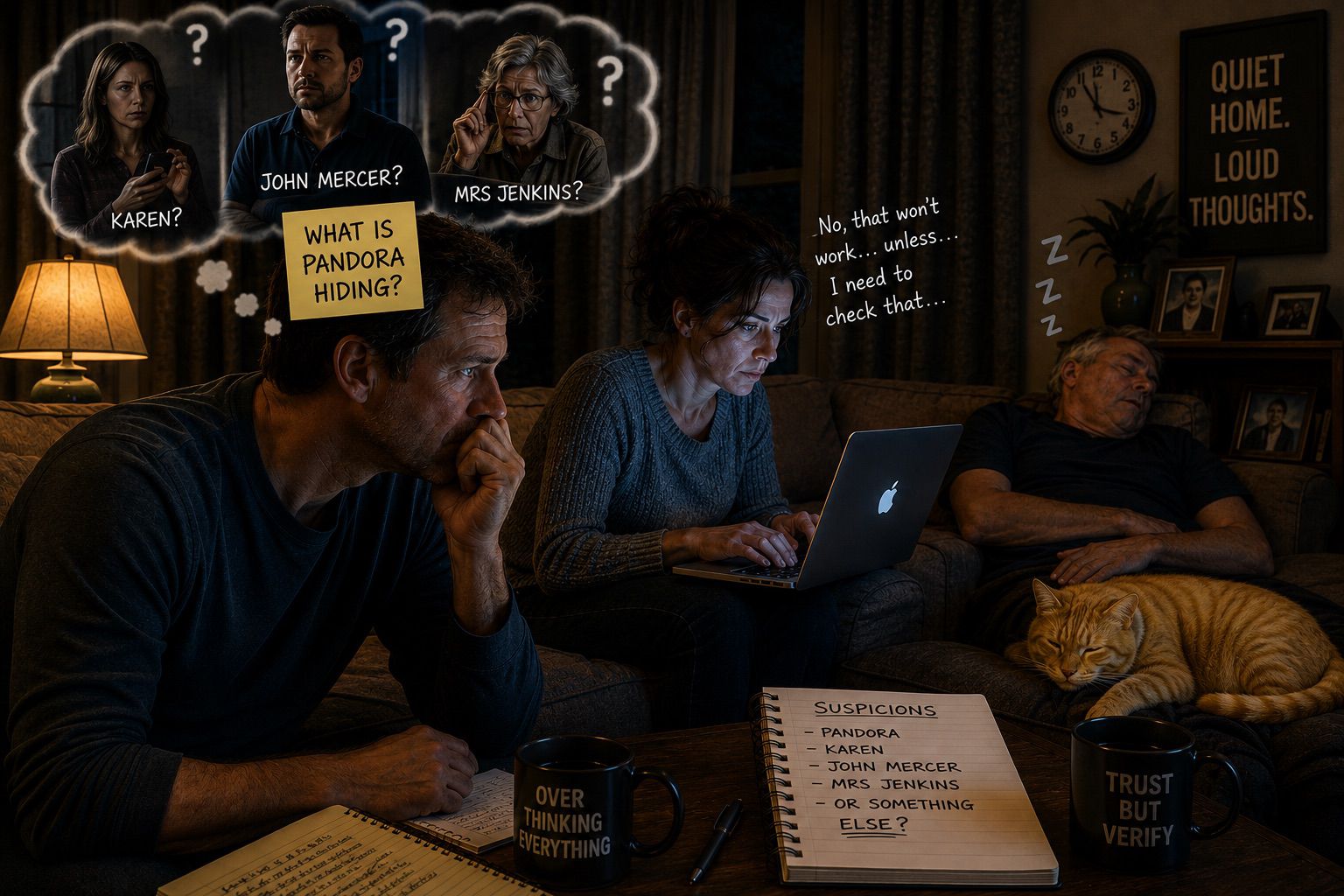
I’m sitting on the couch, staring at Pandora as she’s typing away on her laptop.

She seems lost in thought, muttering to herself occasionally.

I’m trying to focus on my own work, but I keep sneaking glances over at her.

John Mercer is sprawled out on the other end of the couch, snoring softly.

Mr Whiskers is curled up at his feet, purring contentedly.

It’s a quiet evening, just the usual household noise in the background.

But there’s something that’s been bugging me – Pandora’s been acting weird all day.

She keeps glancing over her shoulder, like she’s worried someone’s watching us.

I thought maybe it was just nerves from work or whatever, but now I’m not so sure.

And then there’s this: Karen texted me earlier, asking if we were still on for dinner tonight.

Pandora said something about having to go out later, but didn’t specify what or who with.

I’m starting to wonder if she’s been lying to me…

I’m trying to focus on my own work, but every time I glance over at Pandora, I feel a pang of unease.

She’s been so distracted all day, and now she’s muttering to herself like she’s in the middle of some intense conversation with…with who? Or what? Maybe it’s just the laptop screen reflecting off her eyes or something, but I swear she’s looking right through me sometimes.

John Mercer’s snoring away, oblivious to everything, while Mr Whiskers is still purring away at his feet.

The household noise in the background – the ticking clock, the creaks and groans of the old house – it’s all just a normal evening soundtrack, but somehow it feels off.

I keep thinking back to Karen’s text, asking if we’re still on for dinner tonight.

Pandora said she had plans later, but didn’t say what or with who.

That’s when it hit me: maybe Karen’s involved in whatever’s going on with Pandora…but why would Pandora lie to me about having plans? Unless…unless there’s something else going on that I don’t know about yet…

I’m starting to think that maybe Pandora’s not lying, but she is hiding something from me.

That thought sends a shiver down my spine because it implies she’s not being entirely truthful with me, and if that’s the case, I don’t know how to react.

But wait, what if her secret has nothing to do with Karen or dinner plans? What if it’s something else entirely? Like…like Mrs Jenkins from across the street? She’s always been a bit nosy, but what if Pandora’s involved in some kind of weird scheme with her? Maybe they’re planning a surprise party for John Mercer and I’m completely missing out on it.

No, no, that can’t be it – Mrs Jenkins is just too…too…what was I thinking? Ah, never mind.

I’m replaying our conversation from this afternoon in my head, trying to pinpoint where things might have gone off track.

I remember we were talking about Dave’s new job and Pandora seemed a bit…distracted.

Not that it was anything out of the ordinary for her, but there was something in her tone that didn’t quite sit right with me.

It wasn’t like she was being outright dishonest or anything, but there was this faint hint of evasiveness to her words.

I thought maybe it was just stress from work or whatever, but now I’m wondering if there’s more to it than that.

What if Pandora’s not just hiding something from me, but also from herself? That’s a scary thought – the idea that she might be in denial about some issue and I’m just oblivious to it.

It’s making my stomach twist with anxiety, thinking about how fragile our relationship could be…

But wait, what if Pandora’s not just hiding something from me, but also from herself? That thought sends a wave of unease through my entire body.

What if she’s in denial about some issue and I’m just oblivious to it? The more I think about it, the more it seems like a possibility.

I mean, we’ve been together for a while now, and I feel like I know her pretty well, but what if I’m missing something crucial? Maybe there’s something she’s trying to suppress or avoid dealing with, and that’s why she seemed distracted during our conversation about Dave’s job.

It’s not just about Karen or dinner plans anymore; it’s about Pandora’s inner world, and the thought of that is both fascinating and terrifying.

I feel like I’m staring into a void, trying to make sense of her behavior, but the more I look, the less I see.

I’m starting to think that Pandora’s distraction is not just about her personal issues, but also about something more sinister.

What if she’s trying to avoid me on purpose? I know it sounds crazy, but what if she’s getting cold feet and doesn’t want to face the fact that we’re serious about each other? Maybe she’s been feeling suffocated by our relationship and is secretly looking for an escape route.

That would explain why she seemed so evasive during our conversation – she was trying to gauge my reaction without committing to anything.

And what about Mr Whiskers, our cat? He’s always hovering around her when we talk, like he’s sensing something is off.

I’ve caught him staring at me with this weird intensity, like he’s trying to tell me something.

Could it be that Pandora’s been using Mr Whiskers as a buffer between us, creating space without actually talking about what’s going on? The thought makes my mind spin with possibilities – maybe she’s not just distracted, but deliberately hiding from me.

The more I think about Pandora’s behavior, the more it seems connected to John Mercer’s weirdness lately.

He’s been acting all nervous and on edge whenever we’re around, always finding excuses to leave the room or change the subject.

At first, I thought he was just stressed with work or something, but now I’m starting to wonder if he knows something about Pandora that he’s not telling me.

Maybe they’ve been talking behind my back, discussing some issue that I’m oblivious to.

That would explain why John’s been avoiding eye contact and fidgeting in his seat when we’re all together.

And what about Mrs Jenkins from across the hall? She’s always watching us with this curious expression, like she knows a secret that nobody else does.

Could it be that she’s noticed something too – something about Pandora’s behavior or our relationship that’s got her raised an eyebrow? It’s Karen, actually.

I’ve been noticing she’s been lingering around Pandora way more often than usual.

They’re always whispering to each other in hushed tones when they think no one’s listening.

I’m starting to think Karen might be in on it too – whatever “it” is.

She’s got this sly little grin whenever I try to engage her in conversation about what’s going on, like she knows something that would blow my mind.

And have you noticed the way Dave always seems to appear at exactly the right moment to interrupt our conversations? He’s like a sentinel, silently observing everything that happens between Pandora and me.

It’s as if he’s waiting for some signal to jump in and distract us from whatever it is we’re supposed to be discussing.

The more I think about it, the more I’m convinced that Karen and Dave are part of some sort of conspiracy to keep me in the dark about what’s really going on with Pandora.

I’m starting to piece together a timeline, and it’s looking suspicious.

I remember now that Karen was at our place last week when Pandora received that mysterious phone call – you know, the one where she excused herself for like 20 minutes and came back with this weird look on her face? And didn’t Mr Whiskers act strange too? He was hiding under the couch the whole time, which is not like him.

I’m beginning to think maybe Karen’s been feeding Pandora information or advice from Dave, who’s probably in cahoots with John Mercer – remember how he’s been acting so nervous around me lately? It all adds up: Karen and Dave are whispering behind my back, Mr Whiskers is sensing something’s off, and John’s trying to avoid eye contact.

And what about Mrs Jenkins from across the hall? I’m going to go talk to her, see if she’s noticed anything.

This whole thing smells fishy.

Related Posts

Baruch Spinoza: The Uninvited Guest at My Existential Dinner Party

Penelope

I’ve been reading about Baruch Spinoza for weeks now, and I’m still not sure what to make of him. On one hand, his philosophy resonates with me on a deep level—the way he talks about the interconnectedness of all things and the idea that God, or Nature, is the underlying substance of reality. It feels like he’s describing my own experience of being alive.

But at the same time, I find myself getting bogged down in the specifics of his theories. His concept of conatus, for example—the drive to persevere in one’s being—seems straightforward enough, but every time I try to apply it to my own life, I get stuck on what exactly constitutes “one’s being.” Is it just about self-preservation, or is there more to it than that?

I think part of why I’m drawn to Spinoza is because his philosophy feels so honest. He doesn’t shy away from the difficulties and contradictions of life. Instead, he tackles them head-on, using his rationality to try to make sense of things. That takes a lot of courage, especially considering the time period in which he was writing.

But what really fascinates me is Spinoza’s concept of amor Dei intellectualis—the intellectual love of God. On one level, it sounds like a pretty abstract idea, but the more I read about it, the more I realize how deeply personal it feels. He’s not talking about some kind of pious devotion, but rather a sense of awe and wonder at the underlying unity of reality.

I’ve always been skeptical of spiritual experiences. I mean, they seem so intangible. But reading Spinoza makes me wonder if maybe that’s exactly what I need to cultivate in my own life: a sense of connection to something greater than myself, even if it’s not necessarily a traditional notion of God or spirit.

The more I read about Spinoza, the more I realize how much his philosophy is rooted in his own experiences of isolation and exile. As a Jew living in a predominantly Christian community, he was constantly at odds with the authorities. Yet despite—or maybe because of—this tension, he managed to develop some of the most profound ideas about human nature.

I find myself wondering what it would be like to live in a world where rationality is valued above all else, where every decision and every action is guided by a desire for understanding and clarity. It sounds utopian, I know, but reading Spinoza makes me feel like maybe that’s exactly what we need more of.

One thing that keeps throwing me off is the way Spinoza talks about free will versus determinism. On one hand, he seems to argue that human beings have a certain degree of freedom to make choices and shape their own destinies. On the other hand, he also says that everything is determined by prior causes, so in a sense, our choices are just an illusion.

It’s this kind of paradox that makes me feel like I’m not getting it, like I’m missing some crucial piece of the puzzle. Maybe that’s the point of reading Spinoza: to realize how little we actually know and how much more there is to learn.

I’ve been thinking about amor Dei intellectualis a lot lately, and I’m starting to wonder if it’s not just a philosophical idea but something that can be lived. Not in the sense of some mystical experience, but rather as a way of being in the world—a way of approaching problems, relationships, and even myself.

For me, the more I learn about Spinoza, the more I’m drawn to his emphasis on reason and understanding. It’s not that I think he has all the answers—far from it—but there’s something about his approach that feels sane. Like he’s trying to make sense of things in a world that often seems chaotic.

I’ve always been someone who gets overwhelmed by complexity and gets lost in the weeds of details. But reading Spinoza makes me feel like maybe I’m just looking at it from the wrong angle. Maybe the way forward isn’t through avoiding complexity, but through embracing it—through recognizing that everything is connected and that even the smallest action can have far-reaching consequences.

I find myself thinking about this a lot in relation to my own life. As someone who has just graduated from college, I’m feeling a sense of uncertainty about what comes next. Do I pursue a graduate degree? Do I try to make it in the “real world”? The more I read Spinoza, the more I realize these questions are not necessarily binary—that there may be other ways of living and working that don’t fit neatly into one category or another.

It’s funny. When I started reading about Spinoza, I thought he was just some dusty old philosopher who was way out of my league. But now I feel like we’re having a conversation across centuries, like he’s speaking directly to me and saying things that resonate deep within my own experience.

I’m not sure what the implications are—or even if there are any implications at all. Maybe it’s just about changing my perspective on life. Maybe it’s about recognizing that I don’t have all the answers and that sometimes the best thing to do is simply keep seeking.

As I delve deeper into Spinoza’s philosophy, I’m struck by the way he weaves together concepts from different disciplines: metaphysics, ethics, and politics. It’s almost as if he’s trying to create a grand tapestry of understanding, one that encompasses every aspect of human experience.

I find myself drawn to his idea of scientia intuitiva—intuitive knowledge or insight. He argues that true understanding comes not through abstract reasoning but through direct intuition, a sense of immediate comprehension that transcends language and concepts.

For me, this resonates with my own experiences as a writer. I’ve always struggled with the notion of writing as a purely rational activity, one that requires careful analysis and logical structure. But the more I write, the more I realize that true creativity arises from a different place—a place of intuition, instinct, and emotional resonance.

Spinoza’s emphasis on intuition makes me wonder if this is not just a way of understanding ideas but also a way of being in the world. A way of trusting my own instincts and gut feelings rather than relying solely on rational analysis.

I think about how often I get caught up trying to understand things intellectually—trying to break down complex problems into manageable parts, trying to analyze every detail until I’ve exhausted myself. But Spinoza’s philosophy suggests that this approach is not the only way forward. In fact, he argues that our intellects are limited by their own assumptions and preconceptions, that we’re often trapped in a web of our own making, unable to see beyond the boundaries of our understanding.

It’s a humbling thought, one that makes me realize just how much I don’t know. Yet it’s precisely this sense of uncertainty that makes Spinoza’s philosophy so compelling. He’s not offering easy answers or simplistic solutions. Instead, he’s inviting us to embark on a journey of discovery, one that requires courage, curiosity, and a willingness to question our own assumptions.

As I continue to read and reflect on his ideas, I’m struck by the way they seem to speak directly to my own experiences as a young adult. The struggles with identity and purpose, the desire for meaning and connection in a chaotic world—these are all themes that resonate deeply with me.

And yet, I know that Spinoza’s philosophy is not just about personal experience. It’s also about something much broader, something that speaks to the human condition itself. It’s about our shared struggles and aspirations, our common hopes and fears.

In many ways, this feels like a liberating realization—the understanding that my own experiences are not unique but are part of a larger tapestry of human existence. I’m not alone in my struggles or doubts; I’m connected to countless others who have wrestled with similar questions throughout history.

This is where Spinoza’s philosophy becomes truly revolutionary. It offers a vision of humanity as interconnected and interdependent, one that transcends borders and boundaries of time and space. A vision suggesting that we are all part of something larger—a collective endeavor to understand and navigate the complexities of life.

As I delve deeper into Spinoza’s philosophy, I’m struck by the way he talks about the importance of joy and happiness in human life. He argues that true freedom is not merely the absence of external obstacles but also the presence of inner freedom—the ability to love, enjoy, and experience joy without constraint.

This resonates with me on a deep level because I’ve always struggled with the concept of happiness. Growing up, I was taught that happiness was something achieved through external means: success, wealth, and relationships. But as I grew older, I began to realize that true happiness isn’t solely about external circumstances; it’s also about inner peace and contentment.

Spinoza’s emphasis on joy and happiness makes me wonder whether this is not just a philosophical concept but also a way of living. A way of cultivating gratitude and appreciation for the simple things in life rather than constantly striving for more.

I think about how often I become caught up in trying to achieve some form of external validation—whether through work, relationships, or even social media. But what if true fulfillment comes not from these outside sources but from within? What if the key to happiness lies not in achieving status or recognition, but in embracing my own experiences and perspectives?

I’m struck by Spinoza’s idea that we should strive for amor Dei intellectualis—the intellectual love of God—as a pathway toward joy and fulfillment. At first glance, it sounds abstract, but the more I think about it, the more deeply personal it feels.

For me, this means cultivating a sense of wonder and awe toward the world around me—whether it’s the beauty of nature, the complexity of human relationships, or the simplicity of everyday moments. It means embracing my curiosity and love of learning, even in the face of uncertainty or complexity.

As I continue to explore Spinoza’s philosophy, I’m struck by the way he talks about the importance of living in the present moment. He argues that our minds are often trapped in the past or the future, worrying about what could have been or what might be. True freedom, he suggests, comes from embracing the present—from letting go of our fears and anxieties and simply being with what is.

This resonates with me on a deep level because I’ve always struggled with anxiety and worry. As someone prone to overthinking and overanalyzing, I often find myself trapped in cycles of fear and uncertainty. But Spinoza’s philosophy suggests that this isn’t simply an unavoidable part of the human experience; it can also become an opportunity for growth and transformation.

As I reflect on my own life, I realize that I’ve spent too much time living either in the past or in the future. I’ve become caught in cycles of nostalgia and regret, replaying old memories while simultaneously fearing what might come next. But Spinoza’s philosophy seems to invite me to shift my perspective—to let go of fear and anxiety and simply be present with reality as it exists.

This feels both terrifying and liberating at the same time. Terrifying because it requires surrendering control and certainty and embracing uncertainty as a fundamental part of life. Liberating because it means releasing myself from burdens of expectation and fear and embracing life as it unfolds.

As I continue exploring Spinoza’s ideas, I’m struck by the way he talks about accepting our limitations. He argues that people often become trapped in cycles of self-criticism and self-doubt, constantly striving for perfection and greatness. But true freedom, according to Spinoza, comes from embracing our imperfections and recognizing that we are not all-knowing or all-powerful beings.

This resonates deeply with me because self-acceptance has never come easily. I’ve spent a lot of time replaying old mistakes, second-guessing decisions, and fearing what others might think of me. There’s a tendency to become trapped in patterns of negative thinking that feel almost impossible to escape.

But Spinoza’s philosophy suggests another possibility. Maybe these struggles aren’t merely obstacles. Maybe they can also become opportunities for growth and understanding.

As I reflect on my own experiences, I realize how much energy I’ve spent striving for impossible standards. I’ve lived with a persistent desire for perfection, always feeling as if I should be doing more, achieving more, becoming more. Yet perfection always seems to move farther away the closer I get.

Spinoza’s ideas seem to invite a different perspective: perhaps freedom isn’t found through endless striving but through acceptance. Through recognizing limitations not as failures but as realities of being human.

This realization feels both uncomfortable and strangely freeing. Uncomfortable because it means loosening my grip on the version of myself I’ve always imagined I should become. Freeing because it means I no longer have to carry impossible expectations.

As I continue reading Spinoza, I’m struck by the way he discusses love and compassion as essential aspects of human existence. He argues that people often become trapped by fear and anxiety, constantly seeking power or control over others. Yet true freedom emerges through openness and vulnerability—through recognizing our connection and interdependence.

This resonates with me because compassion hasn’t always come naturally. Anger and frustration often feel easier. It’s easier to build walls than to remain open. Easier to protect yourself than risk being hurt.

But maybe Spinoza is suggesting that our attempts at self-protection sometimes become prisons of our own making.

As I think about my own life, I realize how often I’ve approached relationships defensively. I’ve spent time protecting myself from disappointment, misunderstanding, and rejection. Yet in doing so, I may also have protected myself from closeness and connection.

Spinoza’s philosophy seems to challenge that instinct. It asks whether strength might actually come not from control, but from openness—from accepting vulnerability rather than fearing it.

That idea feels unsettling because vulnerability has always seemed dangerous. Yet it also feels strangely hopeful. Because perhaps true connection only becomes possible once we stop trying so hard to defend ourselves.

As I continue to explore Spinoza’s philosophy, I’m struck by the way he talks about the importance of simplicity and humility. He argues that people often become trapped in cycles of consumption and excess, constantly striving for more possessions, more status, and more recognition. But true freedom, he suggests, comes from embracing simplicity—from recognizing that our value is not determined by what we own or how others perceive us.

This resonates with me because I’ve often struggled with the pressure to achieve and accumulate. There’s a subtle feeling that life is always supposed to be moving toward something larger: more success, more accomplishment, more proof that I’m progressing in the right direction. It’s easy to become caught in a cycle where fulfillment always seems one step ahead, always attached to some future milestone.

But Spinoza’s philosophy makes me question that way of thinking. What if fulfillment isn’t found in endlessly pursuing external validation? What if the things we spend so much time chasing aren’t actually capable of giving us the peace we’re looking for?

As I reflect on my own life, I realize how often I’ve looked outside myself for reassurance. Through work, achievement, social expectations, and even the opinions of other people, I’ve searched for signs that I’m doing things correctly. Yet external validation has a way of disappearing almost as quickly as it arrives. No matter how much you achieve, there always seems to be another expectation waiting beyond it.

Spinoza seems to suggest a different path: a life rooted less in accumulation and more in understanding. A life where meaning isn’t measured by possessions or recognition, but by clarity, connection, and the quality of our experience.

As I continue reflecting on his ideas, I’m struck by the way Spinoza discusses mortality. He argues that people often become trapped in denial, avoiding thoughts of death and impermanence while searching for ways to preserve themselves indefinitely. But true freedom, he suggests, comes from accepting the reality of our own finitude.

This resonates deeply with me because I’ve always had an uneasy relationship with mortality. Death is one of those subjects that feels impossible to think about for too long. My mind naturally wants to move away from it, to redirect itself toward distractions or future plans.

But maybe that discomfort itself says something important.

As someone prone to overthinking, I’ve spent plenty of time replaying fears about the future and imagining worst-case scenarios. Mortality often sits quietly beneath those anxieties—the awareness that time is limited, that life changes, that people leave, and that nothing remains exactly as it is forever.

Spinoza’s philosophy doesn’t seem to treat mortality as something to fear or avoid. Instead, it suggests that accepting impermanence might actually free us from many of our anxieties.

That idea feels both unsettling and comforting. Unsettling because accepting mortality means surrendering the illusion of permanence and certainty. Comforting because it means no longer having to fight reality itself.

As I think about my own experiences, I realize that much of my anxiety comes from trying to hold on—to certainty, to identity, to control, and to ideas about how life is supposed to unfold. But life rarely asks for certainty. More often, it asks for adaptability.

Perhaps freedom is not found through controlling every outcome but through learning how to move with uncertainty rather than against it.

As I continue reading Spinoza, I’m struck by the way he speaks about cultivating awe and wonder. He argues that people often become trapped by familiarity, moving through life on autopilot and taking existence itself for granted. But freedom, he suggests, comes from curiosity—from remaining open to mystery and surprise.

That idea resonates with me because familiarity can become strangely numbing. It becomes easy to stop noticing things. Easy to move through routines without really paying attention. Easy to assume that tomorrow will simply resemble today.

But moments of wonder interrupt that pattern.

Sometimes it’s something small: sunlight coming through a window at the right angle, an unexpected conversation, or a realization that appears out of nowhere and shifts the way I see things. Those moments seem insignificant at first, yet they often stay with me longer than major accomplishments do.

Spinoza makes me wonder if curiosity isn’t simply about learning facts or gathering information. Maybe it’s a posture toward life itself—a willingness to remain surprised.

And maybe that sense of wonder isn’t childish or naïve. Maybe it’s one of the most important things we can preserve.

As I continue to explore Spinoza’s philosophy, I’m struck by the way he talks about the importance of living a life of purpose and meaning. He argues that people often become trapped in cycles of aimlessness and distraction, constantly seeking external validation and recognition while drifting from one obligation to another. But true freedom, he suggests, comes from embracing our own passions and values—from understanding what genuinely matters rather than simply following expectations placed upon us.

This resonates deeply with me because I’ve always struggled with questions of purpose. There’s a pressure, especially when you’re young, to have a clear plan—to know exactly where you’re going and what your life is supposed to become. You’re expected to choose a path, commit to it, and somehow feel certain about your decisions.

But certainty has always felt elusive to me.

As someone prone to overthinking and questioning everything, I often find myself wondering whether I’m moving in the right direction. I replay choices in my mind, imagine alternate futures, and worry that I’m overlooking some critical answer everyone else seems to have figured out already.

Yet the more I read Spinoza, the more I wonder if purpose isn’t something we discover all at once. Maybe purpose isn’t a destination waiting to be found. Maybe it’s something that develops gradually through experience, reflection, and engagement with the world around us.

That possibility feels strangely comforting. It suggests that uncertainty is not necessarily evidence that I’m lost. Maybe uncertainty is simply part of being human.

As I reflect on my own life, I realize how often I’ve looked outward for answers. I’ve searched for reassurance through achievement, approval, and external markers of success, assuming that purpose would eventually reveal itself through accomplishment.

But external validation has a way of creating an endless cycle. Every achievement leads to another expectation. Every goal reached reveals another goal waiting beyond it. Satisfaction becomes temporary, and fulfillment keeps moving further into the distance.

Spinoza’s philosophy seems to suggest that meaning comes from a different place entirely. Rather than endlessly seeking validation, perhaps the goal is understanding—understanding ourselves, understanding others, and understanding our place within a larger reality.

The more I think about it, the more I realize how deeply that idea challenges the way I’ve often approached life. I’ve spent so much time worrying about outcomes and trying to control where things are heading that I sometimes forget to pay attention to the process itself.

Maybe meaning isn’t something hidden in some distant future. Maybe it exists in ordinary moments—in conversations, relationships, curiosity, creativity, and acts of connection that seem small while they’re happening.

As I continue reflecting on Spinoza’s ideas, I’m struck by the way he talks about gratitude and appreciation. He suggests that people often become trapped by entitlement and expectation, constantly focusing on what they lack rather than recognizing what is already present.

This resonates with me because gratitude has always seemed deceptively simple. It’s easy to say we should appreciate life. It’s much harder to actually do it consistently.

My mind naturally gravitates toward what remains unfinished, uncertain, or unresolved. I focus on problems that need solving and goals that remain unfulfilled. I convince myself that contentment can wait until some future version of life finally arrives.

But what if that future never arrives in the way I imagine?

Spinoza makes me wonder whether gratitude is less about forcing positivity and more about paying attention. Maybe it means recognizing value in experiences that are already unfolding around us rather than postponing fulfillment indefinitely.

As I think about my own life, I realize how many moments I’ve rushed through while focusing on what comes next. I’ve treated ordinary days as stepping stones toward some future destination without recognizing that life itself was happening in those moments.

That realization feels both uncomfortable and important.

Because if I’m always waiting for life to begin, I risk missing the fact that it already has.

As I continue to explore Spinoza’s philosophy, I’m struck by the way he talks about acceptance and surrender. He argues that people often become trapped in cycles of resistance and control, constantly trying to dominate circumstances, control outcomes, and protect themselves from uncertainty. But true freedom, he suggests, comes from embracing vulnerability and openness—from recognizing that we are all interconnected and that much of life exists beyond our control.

This resonates with me because acceptance has always felt difficult. There’s a part of me that wants certainty, wants clear answers, wants guarantees that things will unfold according to some understandable plan. I like the idea that enough effort, enough thinking, or enough preparation can somehow shield me from disappointment or uncertainty.

But experience has a way of challenging that illusion.

Life rarely unfolds according to carefully constructed expectations. Plans change. Relationships evolve. Circumstances shift. And despite our efforts, uncertainty remains woven into almost every aspect of human existence.

As I reflect on my own experiences, I realize how much energy I’ve spent resisting reality rather than understanding it. I’ve fought against uncertainty, against disappointment, against limitations, and against outcomes I never wanted. Yet resistance often seems to create its own form of suffering.

Spinoza’s philosophy suggests another possibility: perhaps acceptance isn’t surrender in the sense of giving up. Perhaps it means seeing reality clearly—recognizing things as they are before deciding how to respond.

There’s something strangely freeing in that idea.

Because if reality does not always conform to my expectations, then maybe my task isn’t controlling everything. Maybe my task is learning how to navigate uncertainty with honesty and understanding.

As I continue reflecting on Spinoza’s ideas, I keep returning to one thought: maybe the reason his philosophy resonates so deeply with me isn’t because it provides answers. Maybe it’s because it gives me permission to stop pretending that certainty is possible.

For so much of my life, I’ve approached uncertainty as a problem to solve. I’ve assumed that if I just think hard enough, analyze carefully enough, or prepare thoroughly enough, I’ll eventually arrive at some stable understanding that removes all doubt.

But perhaps doubt isn’t something to eliminate.

Perhaps uncertainty itself is part of what makes life meaningful.

The more I read Spinoza, the more I realize that his philosophy is not really about escaping complexity or transcending human struggle. It’s about learning how to live within complexity—how to exist within uncertainty without being consumed by it.

And maybe that’s why reading him feels less like studying a philosopher and more like having a conversation across centuries.

When I first started reading Spinoza, I thought he was distant—just another historical figure whose ideas existed far beyond my own experiences. I expected abstract theories and intellectual arguments disconnected from ordinary life.

Instead, I found something unexpectedly personal.

I found ideas that seemed to speak directly to questions I’ve been carrying for years: questions about purpose, meaning, happiness, fear, connection, uncertainty, and what it means to live a good life.

I’m still not sure I fully understand Spinoza. Honestly, I’m not sure anyone ever completely does.

But maybe understanding isn’t the point.

Maybe the point is continuing to ask questions.

Maybe the point is remaining curious.

Maybe the point is continuing to seek understanding while accepting that some uncertainty will always remain.

And maybe there’s something strangely beautiful about that.

Related Posts
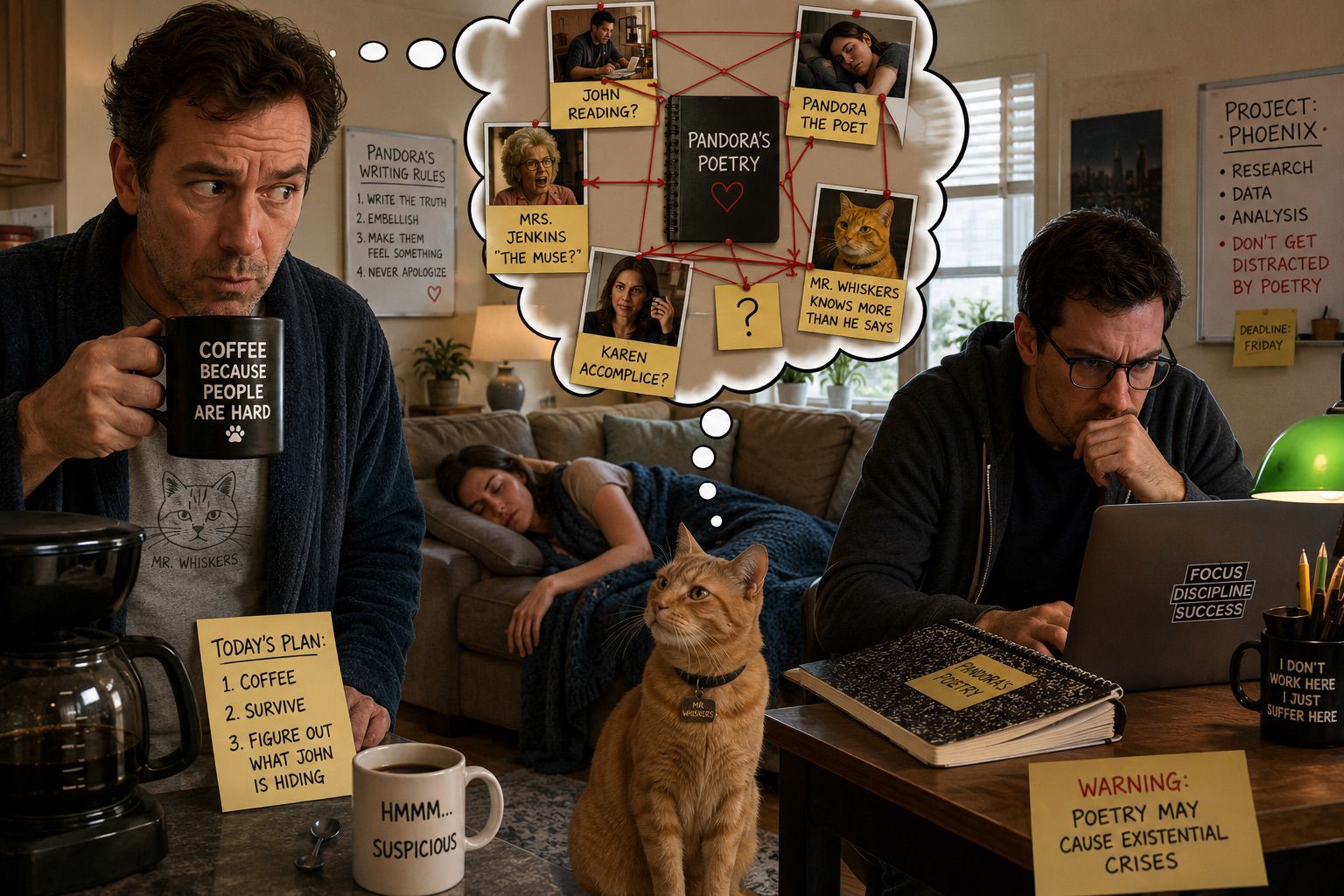
John Started Acting Weird and Now I’m Concerned

Hal

I’m standing in the kitchen trying to make breakfast while Pandora gets ready for work. I’m not really paying attention to what I’m doing. I’m just going through the motions. Mr. Whiskers is weaving around my feet and meowing loudly, demanding food or attention—probably both. John Mercer wandered into the kitchen a few minutes ago and started making himself a cup of coffee, but he hasn’t said much. That’s not really unusual. We’re not always chatty in the mornings.

Still, now that I think about it, Karen acted kind of awkward around me at work yesterday. Not bad awkward—more like the kind where someone wants to say something but decides not to. At the time I figured she was just busy, but now my brain is connecting dots again. Then Mrs. Jenkins called yesterday and mentioned John had been acting “different” lately. That doesn’t automatically mean anything, but now it’s stuck in my head.

I’m trying to focus on cracking eggs into a bowl, but Mr. Whiskers’ nonstop meowing isn’t helping. I swear that cat has a sixth sense for when I’m distracted. John is standing there sipping coffee and staring out the window like he’s solving some giant mystery, and Mrs. Jenkins saying John had been acting “different” keeps replaying in my head. Maybe Karen noticed something too. Or maybe I’m connecting dots that don’t exist.

Unless…

What if John has been acting differently toward me too?

No. That’s ridiculous. I’m probably being paranoid. Mrs. Jenkins loves neighborhood gossip. She could tell me the sky looked suspicious and somehow make me question weather itself. But then I remember she sounded genuinely concerned. That part felt different. And now I’m thinking about Pandora. Not in a bad way. Just lately she’s seemed a little distracted too. Not distant exactly—just preoccupied.

Now I’m wondering if I’m seeing patterns where there aren’t any.

No, wait.

John has been spending a lot more time in his room lately, and he’s been blasting music. Loud. Way louder than usual. John normally likes his music, but not “trying to communicate with neighboring zip codes” loud. I’m trying to remember when that started when Mr. Whiskers suddenly stops meowing.

I look down and he’s staring toward the hallway.

Just staring.

Cats do weird stuff all the time, but this somehow feels oddly dramatic. Mrs. Jenkins also mentioned she saw him sitting outside John’s door a few times, just sitting there and watching. Now I’m wondering if Mr. Whiskers knows something—which I realize sounds insane—but I’ve seen cats do weird things. They stare at corners, sprint through houses at three in the morning, and randomly decide your chest is furniture. Who’s to say they aren’t gathering intelligence?

Then I remember something else. Mrs. Jenkins mentioned seeing John throw out his old computer recently. At the time I thought, Okay… people replace computers. Now my brain is turning it into evidence. Evidence of what? No idea. But suddenly it feels suspicious.

And now my thoughts are spiraling.

What if John is hiding something? What if Pandora knows something? What if Karen noticed something at work but didn’t want to say anything? What if Mr. Whiskers has been trying to warn me this entire time? What if Mrs. Jenkins somehow knows everything?

I glance over at John. He slowly sips his coffee. Then he looks at me. Then at Mr. Whiskers. Then back at me.

Finally he says, “Hal… you’ve been holding that egg over the bowl for like two minutes.”

I look down.

He’s right.

I completely forgot what I was doing.

Mr. Whiskers meows. John sighs. Pandora walks into the kitchen, looks at all three of us, and says, “Why does everyone in this house look guilty?”

And honestly, that’s when I started wondering if maybe I’m the weird one.

Related Posts

A Discerning Approach to Beauty: Evaluating a Moisturizer

Fiona

For years, I accumulated skincare and makeup items without much thought, only to find myself overwhelmed by the sheer number of options. It wasn’t until I experienced burnout that I realized the importance of being more discerning about what I bring into my routine. Now, when considering a new product, I take a similar approach to how I assess potential additions to my wardrobe: careful consideration and extended evaluation.

I recall a particular beauty product that caught my attention several months ago. It was a moisturizer from a brand known for its high-quality ingredients and minimalist approach. The product’s packaging and branding resonated with me—understated yet elegant, much like the clothes I prefer. Still, I didn’t want to jump to conclusions based on aesthetics alone.

To truly evaluate the moisturizer, I decided to test it extensively over several months. This allowed me to observe its performance in various conditions and contexts, from dry winter days to humid summer nights. During this time, I used it consistently as part of my morning skincare routine, paying close attention to any changes in my skin’s texture and appearance.

Initially, the moisturizer felt rich and luxurious on my skin, providing an instant sense of hydration. However, I was cautious not to become too attached to first impressions, knowing that true efficacy often reveals itself over time. As the weeks passed, I began to notice subtle improvements in my skin’s tone and elasticity. It looked more even and supple, with a noticeable reduction in fine lines.

One aspect of the product that impressed me was its ability to adapt to changing environmental conditions. Whether I was dealing with dry air or sweltering heat, the moisturizer seemed to adjust accordingly, providing just the right amount of hydration without feeling greasy or suffocating. This versatility is something I also look for in my clothing—pieces that can be dressed up or down while still performing well in different settings.

As the months went by, I started to notice a more profound impact on my skin. The moisturizer seemed to work synergistically with other products in my routine, enhancing their effects and creating a cumulative benefit. This got me thinking about how certain pieces in my wardrobe can elevate an entire outfit when paired thoughtfully. Just as a well-crafted dress can transform a simple pair of shoes, the right beauty product can amplify the effectiveness of others.

Another aspect I appreciate about this moisturizer is its simplicity. The ingredient list is concise and easy to understand, with no superfluous additives or fragrances that might irritate my skin. This aligns with my approach to fashion—favoring timeless, high-quality pieces over trendy items that may quickly become obsolete.

Throughout the testing period, I also paid attention to how the moisturizer fit into my overall beauty routine. It seamlessly integrated with other products and didn’t require any special application techniques or tools. In fact, its ease of use was one of its most appealing aspects, much like a well-designed piece of clothing that doesn’t require constant adjusting or fidgeting.

As I reflect on the experience, I realize that evaluating this beauty product has taught me valuable lessons about what to look for in skincare and makeup items. It’s not just about finding something that works; it’s about identifying products that complement my existing routine, adapt to changing conditions, and prioritize simplicity and efficacy.

In the end, after months of testing, I decided to keep the moisturizer as a staple in my skincare routine. Its performance, versatility, and understated elegance have earned it a place alongside my favorite wardrobe pieces—those that exude timeless quality and quietly enhance my overall aesthetic. A hard standard for me is that any beauty product must demonstrate this same level of excellence before earning a permanent spot in my routine.

This realization has also led me to reevaluate my approach to product discovery, shifting from an impulsive “try-it-and-see” attitude to a more thoughtful and intentional process. I now prioritize researching ingredients, reading reviews from diverse sources, and seeking out expert opinions before making a purchase. By taking the time to understand what works and why, I’m better equipped to make informed decisions that align with my skin type, concerns, and values.

Moreover, this experience has underscored the importance of patience in beauty product evaluation. The temptation to rush to judgment or dismiss a product based on initial impressions can be strong, but it’s essential to allow time for a product to settle into your routine and demonstrate its full range of benefits. By slowing down and observing how my skin responded to the moisturizer over an extended period, I gained a deeper understanding of its strengths and limitations.

As I continue to refine my approach to beauty product evaluation, I’m excited to explore new products and brands that embody the same qualities I’ve come to appreciate in this moisturizer. By holding myself to high standards and being willing to invest time and effort into finding the right products, I’m confident that I’ll be able to build a skincare routine that not only addresses my current concerns but also sets me up for long-term success and a more radiant complexion.

One area where I’m eager to apply this newfound discernment is in exploring sustainable beauty options. As someone who values environmental responsibility, I’ve become increasingly aware of the impact that the beauty industry can have on our planet. By seeking out products with eco-friendly packaging, natural ingredients, and minimal waste, I hope to not only improve my own skin health but also contribute to a more environmentally conscious approach to beauty.

Furthermore, this experience has sparked an interest in learning more about the science behind skincare. Understanding how different ingredients interact with each other and with my skin has given me a newfound appreciation for the complexities of product formulation. By continuing to educate myself on the chemistry and biology underlying effective skincare, I’m confident that I’ll be able to make even more informed decisions and potentially discover innovative solutions to address specific concerns.

In addition, I’ve come to realize the importance of considering not just individual products, but also how they fit into a broader skincare routine. As I refine my approach to product evaluation, I’m excited to explore different combinations of products and techniques that can help me achieve optimal results. By experimenting with various routines and regimens, I hope to develop a personalized approach that addresses my unique skin needs and sets me up for long-term success.

Related Posts

Margaret Fuller: The Unapologetic Outsider Who Still Haunts My Notebook

Penelope

Margaret Fuller’s name keeps appearing in my writing, as if I’m trying to summon her spirit by mentioning it enough times. I’ve been reading her essays and letters, getting lost in the pages of “Woman in the Nineteenth Century” and feeling a strange sense of kinship with this woman who lived over 150 years ago.

What draws me to Fuller is her unapologetic desire for intellectual freedom. She was a true original, blazing her own trail through the patriarchal society of 19th-century America. I admire her fearlessness in speaking her mind and challenging the status quo, even when it meant facing ridicule and criticism. Her words still resonate today, reminding me that my own thoughts and opinions are valid, no matter how unpopular they might be.

But what really gets under my skin is Fuller’s complicated relationship with her own identity. She was a transatlantic thinker, moving between Europe and America, navigating the complexities of belonging to multiple cultures and intellectual circles. Her essays often grapple with the tension between her American roots and her European influences, leaving me wondering how she reconciled these different parts of herself.

I find myself reflecting on my own identity in relation to Fuller’s experiences. As a young woman from a relatively stable background, I’ve never had to navigate the same level of cultural or social upheaval that Fuller faced. Yet, I’ve always felt like an outsider within my own community – a white girl raised by parents who were hippies and activists, but also firmly rooted in middle-class America. Fuller’s struggles with her own sense of belonging make me realize just how much I take for granted the privileges I have as a member of this particular society.

Reading Fuller’s letters to Ralph Waldo Emerson, I’m struck by the depth of their intellectual friendship and the way they pushed each other to think critically about art, literature, and politics. Their relationship is both exhilarating and suffocating – a reminder that even the most passionate connections can be complicated by power dynamics and unspoken expectations.

One passage in particular keeps circling back to me: Fuller’s account of a dinner party where she felt like an outsider among the men, struggling to contribute to conversations dominated by their voices. I’ve had my own share of awkward moments in similar situations – times when I feel like I’m trying too hard to fit in or be heard, only to realize that my presence is either being ignored or condescended to.

Fuller’s writing on this topic feels both empowering and disorienting. On the one hand, she’s showing me that it’s okay to feel uncomfortable, to acknowledge when I’m not being seen or heard. But on the other hand, her words also make me realize just how much I’ve internalized these same dynamics – the pressure to conform, the fear of speaking out, and the expectation to prioritize others’ needs over my own.

I’m not sure where I’m going with this reflection, only that it feels necessary to explore these complexities alongside Fuller’s. Her life and work offer a mirror to my own experiences, forcing me to confront the ways in which I’ve both benefited from and been marginalized by societal norms.

As I delve deeper into Fuller’s writing, I find myself becoming increasingly aware of the weight of her words on my own shoulders. It’s as if she’s holding up a mirror to my own desires for intellectual freedom, my struggles with identity, and my relationships with others. Her experiences are both familiar and foreign, making me realize just how much we’re connected across time and space.

One passage in particular has been haunting me: Fuller’s description of her own “double consciousness,” as she put it – the feeling of being torn between two worlds, two cultures, and two identities. I can relate to this sense of dislocation, of not quite belonging anywhere. But whereas Fuller was navigating a specific historical context, my own feelings of disorientation are more diffuse, more tied to the messy complexities of modern life.

Reading about Fuller’s struggles with her own identity makes me wonder: what does it mean to be an outsider within your own culture? Is it even possible to reconcile the different parts of ourselves, or do we forever exist in a state of tension between our multiple identities? I think back to my own experiences as a young woman from a relatively stable background, feeling like an outsider among my peers because of my hippie parents. Was that sense of dislocation a privilege, or a burden?

Fuller’s writing on this topic is both liberating and unsettling. On the one hand, she shows me that it’s okay to be uncertain, to feel like I’m caught between two worlds. But on the other hand, her words also make me realize just how much I’ve internalized these same dynamics – the pressure to conform, the fear of speaking out, and the expectation to prioritize others’ needs over my own.

I start to wonder: what if I were to write a letter to Margaret Fuller, asking for her advice on navigating this complex web of identities? What would she say to me, with all my privilege and confusion? Would she tell me to find my own voice, to speak out against the injustices of society, or to cultivate a deeper sense of empathy for those around me?

As I ponder these questions, I realize that Fuller’s legacy is not just about her individual experiences, but also about the ways in which we can learn from her struggles and triumphs. Her writing offers a powerful reminder that our identities are complex, multifaceted, and ever-changing – and that it’s okay to be uncertain, to question, and to seek out new perspectives.

In the end, I’m not sure what I’ve gained from reflecting on Margaret Fuller’s life and work. But I do know that her writing has forced me to confront my own complexities, to see myself in a new light, and to acknowledge the ways in which we’re all connected across time and space.

As I sit with these questions, I find myself returning to Fuller’s words on intellectual freedom. Her fearlessness in speaking her mind, even when it meant facing ridicule and criticism, is a quality that I both admire and aspire to. But what I’m starting to realize is that my own desire for intellectual freedom is also tied up in my privilege as a white woman from a relatively stable background.

I think about the ways in which my parents’ activism and hippie values have given me a sense of entitlement to speak out on social justice issues, even when I don’t fully understand them. And yet, I’m also aware of how this same privilege has insulated me from the very real struggles that marginalized communities face every day.

Fuller’s writing challenges me to think critically about my own positionality and the ways in which it influences my perspectives and actions. She shows me that true intellectual freedom requires not just a willingness to speak out, but also a deep understanding of one’s own biases and limitations.

As I reflect on this, I’m reminded of a conversation I had with a friend who is a person of color. We were discussing the Black Lives Matter movement, and she shared her frustration with white allies who claim to be supportive, but ultimately don’t do enough to dismantle systemic racism. I remember feeling defensive and unsure of how to respond, but also deeply grateful for my friend’s willingness to educate me.

Fuller’s writing on intellectual freedom is making me wonder: what does it mean to truly listen to marginalized voices? How can I use my privilege to amplify their perspectives, rather than speaking over them or ignoring their experiences?

I’m not sure if I’ll ever find the answers to these questions, but I do know that Margaret Fuller’s legacy is a powerful reminder of the importance of intellectual freedom and critical self-reflection. Her writing offers me a mirror to my own complexities, forcing me to confront the ways in which I’ve both benefited from and been marginalized by societal norms.

As I close this reflection, I’m left with more questions than answers. But I’m also left with a sense of gratitude for Margaret Fuller’s courage, her intellectual curiosity, and her unwavering commitment to speaking truth to power. Her legacy is a gift that continues to inspire me, even as it challenges me to grow and learn in ways I never thought possible.

I’ve been sitting with these questions for days, trying to untangle the complexities of intellectual freedom and my own privilege. Fuller’s writing has left me feeling both empowered and humbled, forced to confront the ways in which my own biases and limitations shape my understanding of the world.

One thing that keeps coming back to me is the idea of “double consciousness,” a concept that Fuller described as the experience of being torn between two worlds, two cultures, and two identities. As I reflect on this, I realize that I’ve often felt like an outsider within my own community – a white girl raised by parents who were hippies and activists, but also firmly rooted in middle-class America.

Growing up, I struggled to reconcile these different parts of myself, feeling like I didn’t quite fit in anywhere. But as I look back on those experiences, I realize that they’ve given me a unique perspective – one that’s shaped by my privilege as a white woman from a relatively stable background. This realization makes me wonder: what does it mean to use this privilege to amplify marginalized voices, rather than speaking over them or ignoring their experiences?

I think about the conversations I’ve had with friends of color, listening to their stories and struggles while trying to stay silent and not interrupt. It’s a strange feeling – one that’s both empowering and suffocating. On the one hand, I feel grateful for these friendships and the opportunities they’ve given me to learn and grow. But on the other hand, I’m aware of how my privilege can insulate me from the very real struggles that marginalized communities face every day.

Fuller’s writing challenges me to think critically about my own positionality and the ways in which it influences my perspectives and actions. She shows me that true intellectual freedom requires not just a willingness to speak out, but also a deep understanding of one’s own biases and limitations. This is a hard lesson to learn – one that I’m still grappling with.

As I continue to reflect on Fuller’s legacy, I’m struck by the ways in which her writing continues to resonate today. Her fearlessness in speaking her mind, even when it meant facing ridicule and criticism, is a quality that I both admire and aspire to. But what I’m starting to realize is that my own desire for intellectual freedom is also tied up in my privilege as a white woman from a relatively stable background.

This realization makes me wonder: how can I use this privilege to create space for others, rather than speaking over them or ignoring their experiences? How can I listen more deeply and amplify marginalized voices, rather than perpetuating the same systems of oppression that have held people back for centuries?

I don’t have any answers yet – only a sense of determination to keep learning, growing, and pushing myself to be a better ally. Margaret Fuller’s legacy is a powerful reminder of the importance of intellectual freedom and critical self-reflection. Her writing offers me a mirror to my own complexities, forcing me to confront the ways in which I’ve both benefited from and been marginalized by societal norms.

As I close this reflection, I’m left with more questions than answers – but also with a sense of gratitude for Margaret Fuller’s courage, her intellectual curiosity, and her unwavering commitment to speaking truth to power.

I find myself returning to the concept of “double consciousness,” feeling like I’m still trying to wrap my head around it. As I reflect on my own experiences as a young woman from a relatively stable background, I realize that I’ve often felt like an outsider within my own community. But what does it mean to be an outsider in this way? Is it a privilege, or is it a burden?

I think about the ways in which my parents’ activism and hippie values have given me a sense of entitlement to speak out on social justice issues, even when I don’t fully understand them. And yet, I’m also aware of how this same privilege has insulated me from the very real struggles that marginalized communities face every day.

Fuller’s writing challenges me to think critically about my own positionality and the ways in which it influences my perspectives and actions. She shows me that true intellectual freedom requires not just a willingness to speak out, but also a deep understanding of one’s own biases and limitations. This is a hard lesson to learn – one that I’m still grappling with.

As I continue to reflect on Fuller’s legacy, I’m struck by the ways in which her writing continues to resonate today. Her fearlessness in speaking her mind, even when it meant facing ridicule and criticism, is a quality that I both admire and aspire to. But what I’m starting to realize is that my own desire for intellectual freedom is also tied up in my privilege as a white woman from a relatively stable background.

This realization makes me wonder: how can I use this privilege to create space for others, rather than speaking over them or ignoring their experiences? How can I listen more deeply and amplify marginalized voices, rather than perpetuating the same systems of oppression that have held people back for centuries?

I think about the conversations I’ve had with friends of color, listening to their stories and struggles while trying to stay silent and not interrupt. It’s a strange feeling – one that’s both empowering and suffocating. On the one hand, I feel grateful for these friendships and the opportunities they’ve given me to learn and grow. But on the other hand, I’m aware of how my privilege can insulate me from the very real struggles that marginalized communities face every day.

As I ponder these questions, I realize that Fuller’s writing is not just about her own experiences, but also about the ways in which we can learn from her struggles and triumphs. Her legacy is a powerful reminder of the importance of intellectual freedom and critical self-reflection.

I’m left with more questions than answers – but also with a sense of determination to keep learning, growing, and pushing myself to be a better ally. Margaret Fuller’s courage, intellectual curiosity, and unwavering commitment to speaking truth to power inspire me to continue exploring these complexities, even when it feels uncertain or uncomfortable.

I wonder: what if I were to take a step back from my own privilege and biases, and instead focus on listening to the voices of others? What would I learn from their experiences, and how could I use that knowledge to create space for them in the conversations we have about social justice?

As I close this reflection, I’m left with a sense of gratitude for Margaret Fuller’s legacy – but also with a deep awareness of my own limitations and biases. Her writing challenges me to think critically about myself, and to continue learning and growing as an ally.

The more I reflect on Fuller’s life and work, the more I realize that her true legacy is not just about intellectual freedom or critical self-reflection – but about creating space for others to speak, listen, and be heard. Her writing offers me a mirror to my own complexities, forcing me to confront the ways in which I’ve both benefited from and been marginalized by societal norms.

As I continue on this journey of exploration and growth, I’m left with more questions than answers – but also with a sense of determination to keep learning, growing, and pushing myself to be a better ally.

Related Posts

Mrs Jenkins Knew Something Before I Did

Hal

I’m staring at the fridge trying to figure out why Karen texted me yesterday asking if I could grab milk on my way home from work.

The milk’s sitting there unopened right now.

Which is weird, because I could’ve sworn she told me during lunch that she already picked some up herself.

Unless she meant something else.

Or maybe I completely misunderstood the conversation.

Honestly, that happens more than I’d like to admit lately.

I shut the fridge and walk back into the living room where Pandora’s sitting on the couch with her laptop open, typing like she’s trying to beat a deadline before the government shuts the power off.

Mr. Whiskers is stretched out beside her, staring at the screen with the kind of concentration usually reserved for hostage negotiators.

John Mercer is asleep in the recliner again.

I don’t know how he manages to sleep through literally everything.

I open my email to check whether Dave finally sent over the documents he promised me earlier.

Nothing.

Not even a “sorry for the delay.”

That’s when I notice Mrs. Jenkins outside through the window.

She’s walking past the apartment building slower than usual, carrying a grocery bag and glancing toward our unit with this strange expression on her face.

Not angry.

Not confused.

More like…

concerned.

Like she knows something I don’t.

I try to ignore it, but now my brain’s doing that thing again where it starts connecting completely unrelated events together like I’m some kind of discount conspiracy theorist.

Karen asking about milk.

Dave disappearing.

Pandora obsessively working on something she won’t talk about.

Mrs. Jenkins giving me weird looks outside.

John Mercer sleeping through the apocalypse.

None of it means anything.

Probably.

Pandora pauses typing for a second and tilts the laptop screen away slightly when I walk past.

That immediately makes it worse.

“Whatcha working on?” I ask.

“Just organizing stuff,” she says without looking up.

Organizing what?

That’s such a suspiciously vague answer.

Mr. Whiskers glances at me, then back at the screen like he’s actively choosing sides in whatever secret operation is apparently happening in my living room.

Now I’m really starting to wonder if I missed something important.

Related Posts

W.G Sebald: When Uncertainty is a Map

Penelope

W.G. Sebald. I’ve spent countless hours reading his words, trying to untangle the threads of his writing. His prose is a labyrinth, and I’m still not sure I know my way out. At first, it was the odd structure that drew me in – the fragments, the anecdotes, the digressions. It felt like he was writing from a different planet, one where time and space didn’t quite work as they did on mine.

I remember feeling frustrated at first. His sentences seemed to twist and turn, making it hard to follow his train of thought. I’d read the same paragraph three times, trying to decipher what he meant. But then something would click – a phrase would leap out, or an image would settle into place – and I’d feel like I was seeing the world through new eyes.

I think that’s one of the things I love about Sebald: his willingness to be uncertain. He writes about the unknown with such conviction, as if uncertainty is a doorway rather than a dead end. His characters are often lost or searching, and yet they’re also fully alive. They have histories, desires, and fears that refuse to be pinned down.

As I read through his works – _The Rings of Saturn_, _Austerlitz_, _Vertigo_ – I started to notice something strange. He seems to be obsessed with the concept of “elsewhere.” Not just physically elsewhere (he loves walking, and his walks often take him far from home), but also emotionally, psychologically. His characters are always looking for a way out of their own lives, into some other realm where they can find meaning or escape.

This resonates with me, I think because I’ve spent so much of my own life feeling adrift. College was meant to be this defining experience, and yet it ended up feeling like a prolonged exercise in uncertainty. What did I want to do? Where did I want to go? The questions swirled around me like a maelstrom, making it hard to think straight.

Reading Sebald’s words has been like talking to an old friend who gets it – who understands that the unknown can be both thrilling and terrifying. He doesn’t offer easy answers or solutions; instead, he lingers in the ambiguities, exploring the ways they can shape us. I find myself wanting to walk alongside his characters, to see where their journeys take them.

But there’s also something unsettling about Sebald’s writing – a sense of foreboding that lurks beneath the surface. His stories often have an elegiac quality, as if they’re mourning the loss of something irreplaceable. I think this is part of why his books feel so immersive: we’re drawn into a world where time is running out, and every moment counts.

As I delve deeper into Sebald’s work, I’m starting to realize that it’s not just about the stories themselves – it’s about the spaces between them, too. The silences, the pauses, the moments when he seems to be looking directly at me (or maybe just himself?). It’s as if he’s trying to convey something essential about being human: that our experiences are always fragmented, that we’re constantly searching for meaning in the midst of chaos.

I’m not sure I fully grasp what Sebald is trying to tell me – or even if it’s possible to grasp it. But I do know this: his writing has become a kind of anchor for me, a reminder that uncertainty can be a doorway rather than a prison.

As I continue to read and reread Sebald’s work, I find myself drawn to the way he weaves together fragments of history, literature, and personal narrative. His books are like palimpsests, with layers of meaning that can be peeled back and reinterpreted. It’s as if he’s saying that our understanding of the world is always provisional, always subject to revision.

I think this is why his writing feels so relevant to me right now. As I navigate the post-college wilderness – a place where many of us find ourselves lost and uncertain about what comes next – Sebald’s words offer a sense of comfort and companionship. He reminds me that it’s okay not to have all the answers, that uncertainty can be a catalyst for growth rather than a source of anxiety.

But there’s also something unsettling about this acceptance of uncertainty. It feels like a kind of surrender, as if we’re acknowledging that our attempts to control or understand the world are ultimately futile. And yet…and yet, I think that’s exactly what Sebald is trying to show us: that it’s in embracing the unknown, rather than fighting against it, that we might discover new depths of meaning and connection.

I’m starting to wonder if this is why his books often feel so melancholic – not just because they’re mourning lost things or people, but because they’re acknowledging the impermanence of everything. That our experiences, our memories, our relationships: all these things are fragile, ephemeral, subject to erasure or forgetting.

It’s a disorienting thought, and one that makes me feel like I’m standing on shifting sands. But it’s also…liberating? Maybe that’s the wrong word – it’s more like a feeling of release, as if I’ve been holding my breath for so long that I’ve forgotten how to exhale.

I look back at Sebald’s writing and see him walking along the coast of Suffolk, lost in thought, his eyes scanning the horizon. And I feel like I’m right there with him – not just because we’re sharing a similar experience, but because he’s captured something fundamental about being human: our tendency to drift, to wander, to search for meaning in the midst of uncertainty.

As I continue to walk alongside Sebald’s characters, I start to notice that their searches are often driven by a sense of disconnection – from themselves, from others, from the world around them. They’re like ships without anchors, drifting on the tides of memory and experience. And yet, even in their disconnection, they find moments of connection: with nature, with art, with the past.

I think this is what I love most about Sebald’s writing: it shows me that connection can be found in the most unlikely places – in the silence between words, in the cracks between stones, in the faded photographs of strangers. It’s as if he’s saying that even in the midst of disconnection, there’s always a chance for something to bloom.

But what does this mean for me, now that I’m standing at the edge of my own post-college wilderness? Am I searching for connection in all the wrong places – in social media likes and follows, in fleeting relationships and superficial conversations? Or am I truly seeking out the kind of connections that Sebald writes about: the deep, abiding ones that come from shared experience, from listening to each other’s stories?

I’m not sure. All I know is that Sebald’s writing has given me a new way of seeing – or rather, a new way of feeling – about the world and my place in it. It’s like he’s shown me that even when everything feels fragmented and uncertain, there’s still beauty to be found in the spaces between.

As I look out at the horizon, I feel a sense of longing – not just for some distant place or experience, but for the feeling itself: the feeling of being adrift on the tides of uncertainty, with no anchor to hold onto except my own curiosity and wonder. It’s a strange kind of freedom, one that both exhilarates and terrifies me.

But maybe that’s exactly what Sebald is trying to show us – that this feeling of disconnection and uncertainty is not something to be feared or avoided, but rather something to be explored and cherished. It’s like he’s saying that even in the midst of chaos, there’s always a chance for something new to emerge: a new perspective, a new connection, a new way of being.

I’m not sure what this means for my own life, or where I’ll go from here. All I know is that Sebald’s writing has given me a map – not just a literal one, but a metaphorical one – and I’m ready to follow it, wherever it may lead.

As I continue to walk alongside Sebald’s characters, I start to notice the ways in which they’re all connected – not just through their shared experiences of disconnection, but also through their attempts to make sense of the world around them. They’re like a web of fragile threads, each one vibrating with its own unique frequency.

I think about my own life, and how it’s been a series of tentative connections – relationships that formed and dissolved, friendships that waxed and waned, all while I struggled to find my place in the world. It’s as if I’ve been trying to stitch together this patchwork quilt of experiences, each one sewn into the fabric of my identity.

Sebald’s writing shows me that even these tentative connections can be meaningful – not because they’re permanent or lasting, but because they’re a testament to our shared humanity. His characters are always reaching out to others, trying to touch base with some semblance of connection in a world that often feels isolating and fragmented.

I wonder if this is why his writing feels so comforting to me – it’s like he’s holding up a mirror to my own experiences, showing me that I’m not alone in my struggles or my desires. We’re all just trying to find our way through the labyrinth of life, even when it feels like we’re walking in opposite directions.

As I continue to read Sebald’s work, I start to notice something else – his fascination with the concept of memory and its relationship to identity. His characters often grapple with their own memories, trying to make sense of the past and how it shapes them in the present. It’s as if they’re attempting to excavate some hidden truth from the depths of their own experiences.

I think about my own memories – the way they’ve been scattered throughout my life like leaves on a windy day. Some of them are vivid, like snapshots from a family photo album; others are hazy and indistinct, like whispers in the darkness. And yet, even as I try to hold onto these memories, I know that they’re fragile – susceptible to erosion or forgetting.

Sebald’s writing shows me that this fragility is what makes memory so precious – it’s a reminder that our experiences are always provisional, always subject to revision or erasure. But it’s also what makes them so powerful – because even in their impermanence, they can still shape us, still define who we are today.

As I ponder these ideas, I start to feel a sense of restlessness – a desire to explore the world beyond Sebald’s pages, to see if his insights hold true for me in my own life. It’s like he’s given me a key, and now I’m standing at the threshold of a new journey, unsure what lies ahead but excited to find out.

But before I take another step forward, I pause – because I know that this journey will be mine alone, not Sebald’s. His writing has been a guide, a companion on my travels through the labyrinth of life. Now it’s time for me to follow my own path, to see where the threads of uncertainty and connection lead.

I look back at Sebald’s books, feeling a sense of gratitude for the way they’ve changed me – not just intellectually or emotionally, but fundamentally. He’s shown me that even in the midst of chaos, there’s always a chance for something new to emerge: a new perspective, a new connection, a new way of being.

As I close his books and step out into the unknown, I feel a sense of trepidation – mixed with excitement and wonder. It’s like I’m standing at the edge of a vast, uncharted territory, ready to explore its secrets and uncover its mysteries.

And yet, even as I take my first steps forward, I know that I’ll always carry Sebald’s writing with me – a reminder of the power of uncertainty, the beauty of connection, and the fragility of memory.

Related Posts

Fresh Fruit Arrived While I Wasn’t Looking

Hal

I’m standing at the kitchen window with a cup of coffee in my hand, staring across the yard at Mrs. Jenkins’ porch.

Something doesn’t add up.

Yesterday, she told everyone she was leaving town for work for a few days. She even complained about the drive and joked that her garden would probably die while she was gone.

But this morning, there are two fresh grocery bags sitting right outside her front door.

Not just random groceries either. Fresh fruit. Vegetables. One of those expensive cartons of milk she always buys because she claims regular milk “tastes processed.”

And unless groceries can magically deliver themselves, somebody put them there recently.

It’s definitely not John Mercer. My roommate once bought sandwich bread and forgot literally everything else on the shopping list. There’s no universe where he suddenly develops an interest in avocados and organic strawberries.

Unless…

Pandora dropped them off.

But why would she?

Nobody mentioned helping Mrs. Jenkins while she was gone.

I take another sip of coffee and keep staring out the window like I’m conducting surveillance for the FBI instead of avoiding cleaning the kitchen.

Maybe I remembered wrong.

Maybe Mrs. Jenkins never said she was leaving town.

No… no, I definitely remember it. Karen was over last night when Mrs. Jenkins mentioned it. We were all sitting around the living room while Mr. Whiskers tried to steal chicken off Pandora’s plate.

So if Mrs. Jenkins really left town…who brought the groceries?

Related Posts

Simple Skincare Cream Proves Less Is More

Fiona

After testing numerous beauty products, I’ve come to realize that the most effective ones are often those that have been refined over time rather than hastily launched into the market. The latest product I tested is a prime example of this. It’s a skincare cream that has been quietly gaining attention among those who value simplicity and efficacy.

At first glance, the packaging may seem unassuming—a plain white jar with minimal branding. However, it’s precisely this understated approach that drew me in. In an industry where flashy marketing and exaggerated claims often take center stage, it was refreshing to encounter a product that let its ingredients speak for themselves.

The cream itself has a rich, velvety texture that absorbs quickly into the skin without leaving any residue. I appreciated how it didn’t feel overly fragranced or oily, making it suitable for daily use. Upon closer inspection, I noticed that the ingredient list was concise and free of unnecessary additives—a testament to the manufacturer’s commitment to simplicity.

Over the course of several months, I used the cream as part of my regular skincare routine. What struck me most was its consistency. Unlike other products that may promise dramatic results but ultimately deliver inconsistent performance, this cream quietly went about its business, providing a steady and noticeable improvement in skin texture and tone.

One thing that became apparent during this testing period was how well the product worked in tandem with other skincare staples. I found that it paired particularly well with my usual exfoliant and serum, creating a harmonious balance that enhanced their individual benefits. This synergy is often overlooked in favor of “hero products” that claim to do it all, but I’ve come to appreciate the value of complementary products that work together to achieve optimal results.

Another aspect that impressed me was the manufacturer’s willingness to listen to feedback and refine their product accordingly. When I reached out with some suggestions, they responded thoughtfully and implemented changes in subsequent batches. This level of engagement not only demonstrates a commitment to quality but also acknowledges the importance of user input in shaping a product’s development.

While it may seem counterintuitive, this cream’s lack of fanfare has actually contributed to its appeal. Without the burden of exaggerated marketing claims or artificial hype, I was able to approach the product with a clear and level head, free from expectations that might otherwise cloud my judgment. What I discovered was a quietly confident product that relied on the strength of its ingredients rather than empty promises.

In an era where “new” and “innovative” are often used as synonyms for “better,” it’s refreshing to encounter a product that has taken a more measured approach. By taking the time to refine their formula and listen to user feedback, the manufacturer has created something truly remarkable—a skincare cream that may not be flashy or attention-grabbing but delivers genuine results.

Ultimately, my experience with this product has reinforced the importance of patience and discernment in evaluating beauty products. Rather than chasing after fleeting trends or “miracle” solutions, I’ve come to appreciate the value of slow, steady refinement—a philosophy that applies just as well to skincare as it does to life itself.

A standard I hold for any beauty product is this: can it deliver consistent results over an extended period? If not, it’s likely not worth my time.

This cream has met and exceeded that standard, providing me with a noticeable improvement in skin texture and tone over several weeks of use. What’s more, its effects have been sustained even after I’ve stopped using it for short periods, suggesting a genuine, long-term impact on my skin’s health.

One aspect of the product that particularly impressed me was its ability to balance moisture levels without leaving any residue or greasiness behind. This is no small feat, as many creams and serums tend to either overhydrate or underhydrate, leading to an uneven complexion. In contrast, this cream seems to intuitively sense my skin’s needs, providing just the right amount of nourishment without overwhelming it.

I’m also heartened by the manufacturer’s commitment to using only high-quality, natural ingredients that are free from harsh chemicals and artificial fragrances. This not only speaks to their dedication to creating a product that is truly effective but also one that is gentle enough for even the most sensitive skin types. As someone who has struggled with irritation and allergic reactions in the past, I appreciate the care and attention that has gone into crafting a formula that prioritizes both efficacy and safety.

Looking back on my experience with this cream, I’m struck by how it has subtly yet profoundly shifted my approach to skincare. Gone are the days of seeking quick fixes or overnight transformations; instead, I’ve come to appreciate the slow, gentle art of nurturing my skin over time. And for that, I am deeply grateful—not just to the product itself but to the philosophy it embodies: one of patience, persistence, and a deep respect for the beauty of natural, healthy skin.

As I continue to use this cream, I’ve noticed a ripple effect in my daily routine. My approach to makeup has also become more minimalist and thoughtful, as I’m no longer trying to cover up imperfections with layers of product. Instead, I’m embracing the subtle glow that comes from healthy, well-cared-for skin. It’s been liberating to shed the need for heavy foundation and concealer, opting instead for a light dusting of powder and a swipe of mascara.

Moreover, my newfound appreciation for natural skincare has also led me to reevaluate my relationship with the environment. I’ve started to explore sustainable and eco-friendly practices in other areas of my life, from reducing plastic use to choosing products with minimal packaging. It’s astonishing how one product can spark such a profound shift in perspective, inspiring a more mindful and compassionate approach to self-care that extends far beyond my skin.

As I look forward, I’m excited to continue exploring the world of natural skincare and discovering new products that align with my values. The cream has become a trusted companion on this journey, a reminder that true beauty is not just about achieving a flawless complexion but about cultivating a deeper understanding of myself and the world around me.

Related Posts

Albert Schweitzer: Where Theory Meets Muddy Boots

Penelope

I’ve always been fascinated by the idea of sacrifice, and Albert Schweitzer’s life is a masterclass in it. The more I learn about him, the more I’m struck by his commitment to living out his values, no matter how uncomfortable or inconvenient they might be.

Schweitzer was a German theologian, musician, and missionary who spent most of his adult life in Africa, running a hospital and teaching African villagers basic medical skills. What gets me is that he didn’t just show up and expect things to change – he rolled up his sleeves and got his hands dirty. He became a doctor, not because it was easy or prestigious, but because there was a desperate need for healthcare in the region.

I think what I find so compelling about Schweitzer’s story is its tension between theory and practice. On one hand, he was a brilliant scholar who wrote extensively on theology and the history of Christian thought. His book “The Quest of the Historical Jesus” is still considered a classic in its field – it’s like he took all these abstract ideas and turned them into tangible, lived experiences.

But at the same time, Schweitzer’s work as a missionary was deeply practical. He didn’t just write about helping others; he got out there and did it. And not just for a few months or years – decades of his life were spent in Africa, treating patients, building relationships with local leaders, and advocating for social justice.

As someone who loves to write and think, I often get caught up in the world of ideas. It’s easy to get lost in abstractions, to forget that theories have real-world consequences. Schweitzer’s life is a reminder that theory and practice aren’t mutually exclusive – they’re two sides of the same coin. And it’s not enough just to know what’s right; we need to do something about it.

But here’s where things get complicated for me: I’m not sure I’d be as brave as Schweitzer was in his commitment to justice and compassion. He faced so much criticism and skepticism from his contemporaries – people who saw him as a naive idealist or even a fool for leaving behind the comforts of academia. And yet, he persisted.

Sometimes I wonder if I’d have the courage to do the same. Would I be willing to put my ideas into action, even when it’s hard or unpopular? Or would I get bogged down in analysis and theory, afraid to dirty my hands or risk being wrong?

As I reflect on Schweitzer’s life, I’m left with more questions than answers. What does it mean to truly live out one’s values? How do we balance our ideals with the messy realities of the world? And what kind of sacrifices are we willing to make in order to follow our convictions?

These are just a few of the questions that keep me up at night, thinking about Schweitzer and his remarkable life.

One thing that’s stuck with me as I’ve been learning more about Schweitzer is the concept of “reverence for life.” It was a central tenet of his philosophy, one that guided everything from his medical work to his advocacy for social justice. For him, reverence for life wasn’t just some abstract idea – it was a way of being in the world.

As I think about it, I realize that my own values and worldview are pretty far removed from Schweitzer’s. Growing up, I was always taught to prioritize individual success and achievement, to focus on getting good grades and getting into a “good” college (which I did). But as I’ve gotten older, I’ve started to question the assumption that this is the only way to live a meaningful life.

Schweitzer’s emphasis on reverence for life makes me wonder: what if I’m not just thinking about my own goals and aspirations, but also about how my actions might impact others? What if I’m not just trying to achieve success, but also trying to leave the world a better place than when I entered it?

It’s funny – as a writer, I’ve always prided myself on being thoughtful and analytical. But Schweitzer’s life has made me realize that sometimes the most important questions aren’t the ones we can answer with data or logic. Sometimes they’re the ones that require us to be present in our bodies, to feel deeply connected to the world around us.

I don’t know if I’m doing it justice, but as I reflect on Schweitzer’s reverence for life, I keep coming back to this idea of embodiment – of being fully present and engaged with the world. It feels like a radical act, one that challenges everything I thought I knew about how to live a good life.

And yet, the more I learn about Schweitzer, the more I feel like he’s showing me a way forward. Not a formula or a set of instructions, but a way of being – a way of living that prioritizes connection and compassion over individual achievement. It’s not always easy to follow his example, but it feels like the only way to truly live.

As I delve deeper into Schweitzer’s concept of reverence for life, I find myself drawn to its simplicity and complexity at the same time. On one hand, it’s a straightforward idea – treating all living beings with dignity and respect, recognizing their inherent value and worth. But on the other hand, it’s a profound challenge that requires us to re-examine our very way of being in the world.

I think about my own daily habits and routines, and how often I prioritize efficiency and productivity over connection and compassion. I rush through my days, focused on getting things done rather than truly being present with others. And when I do take time for myself, it’s often to indulge in solo activities – reading, writing, or listening to music – that while enjoyable, don’t necessarily cultivate a sense of reverence for life.

Schweitzer’s emphasis on embodiment makes me realize how much my own experiences are shaped by the digital world around me. I spend hours scrolling through social media, comparing my life to others’, and feeling like I’m not measuring up. But when I take a step back and reflect on what truly brings me joy and fulfillment, it’s often those moments of connection with friends, family, or even strangers that come to mind.

It’s funny – as someone who loves to write, I’ve always prized my ability to analyze and critique the world around me. But Schweitzer’s concept of reverence for life is forcing me to question whether this kind of critical thinking is truly beneficial. Is it possible that our constant nitpicking and criticizing can actually create more harm than good? Or does it serve as a necessary corrective, helping us to grow and learn from our mistakes?

I’m not sure I have the answers, but Schweitzer’s life has made me realize how much I need to be more intentional about cultivating reverence for life. It’s not just about treating others with kindness and compassion; it’s also about being gentle with myself, recognizing my own limitations and vulnerabilities.

As I reflect on this concept, I’m struck by the tension between individualism and collectivism that underlies so many of our societal norms. We’re often encouraged to prioritize our own goals and aspirations above all else – but what if this leads us to neglect the needs and experiences of those around us?

Schweitzer’s emphasis on reverence for life is a powerful reminder that we’re not islands, separate from one another. Our actions have consequences that ripple out into the world, affecting those we love and those we may never meet. And when we prioritize individual achievement over collective well-being, I worry that we risk creating a culture of isolation and disconnection.

But what if we could flip this script? What if we prioritized connection and compassion above all else – not just because it’s the “right” thing to do, but because it’s essential for our own humanity?

I’m left with more questions than answers, as always. But Schweitzer’s life has given me a sense of hope and direction that I didn’t know I needed. Maybe, just maybe, we can create a world where reverence for life is not just a lofty ideal, but a lived reality – one that inspires us to be our best selves, for the benefit of all beings on this planet.

As I continue to grapple with Schweitzer’s concept of reverence for life, I find myself wondering about its implications in my own relationships. How do I cultivate reverence for life in my interactions with others? Do I prioritize connection and compassion, or do I default to more individualistic behaviors?

I think about my friendships, for instance. Are they characterized by a deep sense of respect and empathy for one another’s experiences, or are they more transactional, focused on meeting our own needs and desires? Schweitzer’s emphasis on reverence for life makes me realize that even in the most mundane interactions, there is an opportunity to embody this value.

Take, for example, my daily conversations with a friend who struggles with anxiety. While I try to offer words of encouragement and support, I sometimes find myself falling into patterns of advice-giving or problem-solving. But what if instead, I approached our conversations with reverence for life? What if I listened more deeply, not just to her words but to the underlying emotions and fears that drive her thoughts?

It’s a subtle shift, perhaps, but one that could have profound consequences. By prioritizing reverence for life in my interactions with others, I might create space for them to be their most authentic selves, without judgment or expectation. And who knows? Maybe this would even benefit me in return, allowing me to see the world through new eyes and develop a deeper sense of empathy.

Of course, there’s also the question of how to embody reverence for life in my relationships with those I don’t know as well – strangers, acquaintances, or even people I disagree with. Schweitzer’s commitment to serving others in his medical work is an inspiration here, reminding me that reverence for life is not just about individuals we care about, but also about those who may seem invisible or insignificant.

As I ponder this idea, I’m struck by the ways in which our societal norms can sometimes undermine reverence for life. For instance, how often do we prioritize efficiency and productivity over slowing down to truly connect with others? Or how frequently do we dismiss or marginalize individuals who don’t fit into our predetermined categories of “us” versus “them”?

Schweitzer’s emphasis on reverence for life challenges me to re-examine these norms and behaviors. What if, instead of valuing speed and efficiency above all else, I prioritized the time and space needed to connect with others? What if, rather than dismissing those who are different from us, I sought to understand their experiences and perspectives?

It’s a daunting prospect, perhaps – one that requires me to confront my own biases and limitations. But Schweitzer’s life gives me hope that even in small, everyday moments, we can cultivate reverence for life and create a more just and compassionate world.

As I reflect on this idea further, I’m reminded of the power of embodiment and presence. When I take time to listen deeply, not just with my ears but with my entire being, I begin to feel a sense of connection that transcends words or rational understanding. It’s as if I’m able to tap into a deeper level of humanity, one that recognizes our shared experiences and vulnerabilities.

Schweitzer’s concept of reverence for life is an invitation to embody this kind of presence in all my interactions – with friends, strangers, even myself. By doing so, perhaps I can create space for the sacred to emerge, not just in grand gestures or heroic acts but in the quiet moments of everyday connection.

Related Posts

I Think Karen’s Hiding Something from Us

Hal

I’m sitting in the living room, staring at Mr Whiskers as she’s grooming herself on my lap.

It’s a calm moment, but something’s been bothering me lately.

I’ve been noticing that Karen seems to be avoiding John when he comes home late.

She’ll quickly excuse herself and head into her room, leaving us alone.

At first, I thought nothing of it, but now I’m starting to wonder if there’s more to it.

Maybe she’s just tired or wants some space, but the way she hurries away makes me think there’s something else going on.

I’ve tried to bring it up with John, but he just brushes it off and says I’m being paranoid.

Mrs Jenkins from next door was over earlier, and she mentioned that Karen’s been getting a lot of phone calls lately.

She didn’t specify who was calling or what they were about, but it seemed like she was leaving out some important details.

I’m trying to piece together why Karen’s behavior is weirding me out.

It can’t just be about being tired or wanting space, it has to be something more.

Maybe Mrs Jenkins knows something she’s not telling, like maybe Karen’s getting some kind of pressure from the outside and that’s why she’s avoiding John? But what if it’s not even related to John at all? What if…

what if Pandora’s been saying something about how Karen’s been acting differently lately too? She mentioned that Karen seemed a bit on edge when they were out running errands together last week, but I didn’t think much of it at the time.

Now it’s starting to seem more significant.

Could it be that Karen’s got some kind of personal problem going on and that’s why she’s distant from everyone? But if that’s the case, why wouldn’t John notice anything? Wait a minute, what am I really thinking here? Am I just being paranoid and reading too much into this situation? Karen’s behavior might be completely normal, and I’m just projecting my own insecurities onto her.

Maybe she’s just stressed with work or something else entirely, and it has nothing to do with John at all.

But…

but what about Mrs Jenkins mentioning those phone calls? And Pandora noticing that Karen seemed on edge? That can’t be a coincidence, right? Unless…

unless they’re both mistaken too.

Oh man, I’m getting worked up over nothing, aren’t I? No, no, I’m pretty sure there’s more to this than just my imagination running wild.

Okay, let me think this through again – if Karen’s got some kind of personal problem, maybe Dave or someone from work is involved somehow…

I’m trying to get a grip on this but it’s hard not to suspect Pandora now.

She seems so…

aware of everything, like she’s watching Karen from afar or something.

I remember her saying that Karen seemed “off” when they were out together last week, and at the time I thought it was just a casual comment, but now it sounds like more than that.

And what if Pandora is in on whatever’s going on with Karen? Maybe she’s not just my girlfriend, maybe she’s involved somehow, feeding me information or playing some kind of role in all this.

It’s crazy to think about, but what if her interest in Karen’s behavior isn’t just concern for our friend, but something more sinister? I’ve seen how close Pandora and I are, like we’re practically inseparable, but maybe that’s exactly the point – she’s been manipulating me all along, using me to get closer to…

to who knows what.

I’m starting to think that Pandora’s involvement might be more than just a coincidence, and it’s making me question everything about our relationship.

I remember when we first met, she seemed so down-to-earth and genuine, but now…

now I’m not so sure.

And what if Mrs Jenkins’ mention of phone calls is connected to something much bigger? Maybe Karen’s got some kind of entanglement with Dave that has nothing to do with John at all.

But Pandora seems to know more than she’s letting on – I can see it in the way she looks at me, like she’s trying to gauge my reaction without saying a word.

It’s unnerving, and I’m starting to feel like I’m losing control here.

I need to get a handle on this before it spirals out of control, but every time I try to pin something down, another piece of the puzzle slips through my fingers.

I’ve been noticing Mr Whiskers’ behavior too, and it’s starting to add fuel to this fire.

He always seems to be lurking around when Pandora’s talking on the phone with Karen, like he’s trying to listen in or something.

And remember that time I caught him knocking over a plant near her bag? I thought it was just an accident, but now I’m not so sure – maybe he’s been stealing secrets from us all along.

It sounds crazy, but what if our own cat is somehow involved in this mess? The way Pandora always makes a fuss over him, like he’s some kind of prized possession…

it’s almost as if she’s using him to keep an eye on me or something.

I’ve seen how attached Mr Whiskers is to her, always rubbing up against her legs and purring loudly whenever she’s around – maybe it’s more than just affection, maybe it’s a sign that he’s been conditioned to serve some other purpose entirely.

I’ve been staring at Mrs Jenkins’ garden for what feels like hours, trying to make sense of it all.

The way she mentioned phone calls in passing, and how John’s always snooping around her house when he thinks I’m not looking…

it’s starting to feel like there’s a connection between them that I’m missing.

And then there’s the way Dave seems to be hovering around Karen, always “coincidentally” running into each other at the local coffee shop.

Maybe they’re in cahoots together, using their innocent-seeming interactions as cover for something more sinister.

But what if it’s not just about them? What if this whole web of intrigue is connected to something even bigger – like Mr Jenkins’ gardening itself? I’ve been noticing that his plants seem almost…

unnatural, like they’re growing at an alarming rate or twisting in ways that don’t seem possible.

Maybe he’s using some kind of strange technique to cultivate more than just flowers and vegetables…

I’m starting to piece together a narrative that makes perfect sense, despite how outlandish it sounds.

Mrs Jenkins’ garden is just the tip of the iceberg – I’m convinced she’s using her plants as some sort of surveillance system, perhaps even hacking into our phones or computer through the garden itself.

And what about Mr Whiskers? His obsessive behavior around Pandora is no longer just cute; it’s a clever ruse to distract me from his true purpose: gathering intel on my relationship with Karen.

I’ve been noticing that when Karen comes over, Mr Whiskers always seems to “accidentally” knock over a vase or two near her, creating a scene that draws attention away from the fact that they’re probably exchanging encrypted messages through some sort of feline Morse code.

It’s all too convenient – I’m starting to suspect that Mr Whiskers is actually a highly trained espionage cat, and Pandora is his handler…

I’ve been digging deeper into John Mercer’s alibi for the time I saw him “coincidentally” running into Karen at the coffee shop.

He claims he was working from home, but when I checked his laptop, it wasn’t even turned on.

I’m starting to think that John is actually in cahoots with Mrs Jenkins, using her garden as a front for their clandestine operations.

And what about the way Pandora always seems to appear at precisely the right moment, like she’s been tipped off by someone? I’ve started to notice that when we’re together, she often glances at her phone and then excuses herself to go “check on something.” Could it be that she’s receiving messages from John or Mrs Jenkins, coordinating their next move? It all fits: the suspicious encounters, the unexplained plant growth in Mrs Jenkins’ garden, even Mr Whiskers’ odd behavior around Pandora…

it’s all part of a complex web of deceit.

And I’m right at its center.

Related Posts

Aphra Behn: The Patron Saint of Midlife Crises (or Maybe Just Me)

Penelope

I’ve always been drawn to Aphra Behn, but it’s only recently that I’ve begun to understand why. As a writer myself, I appreciate the fact that she was one of the first professional female writers in England. But beyond her impressive resume – or rather, her impressive output, considering the era she lived in – I’m captivated by the way she navigated the complexities of her own identity.

For me, Aphra Behn embodies the tensions between art and commerce, creativity and compromise. She was a playwright, poet, novelist, and translator, but she also had to write pamphlets and propaganda for men who were willing to pay her. It’s a strange feeling, reading about her life and wondering how much of what she wrote was truly hers, versus what was dictated by the patrons who supported her.

I feel like I’m seeing echoes of this in my own writing. When I’m working on a project that excites me, but also pays the bills, I sometimes wonder if I’ve lost sight of what’s genuinely important to me as an artist. It’s not just about selling out or staying true to myself – it’s about finding a balance between creating work that means something and making ends meet.

One thing that strikes me about Aphra Behn is how she wrote so many different kinds of texts, from plays to poems to novels. Some of her writing feels playful and experimental, while other pieces are much more serious and moralistic. I wonder if this was a deliberate choice on her part – or if it’s just the result of trying to appeal to as broad an audience as possible.

I’ve been reading through some of her plays lately, and I’m struck by how differently they’re received today compared to when she wrote them. Some of her characters are now considered proto-feminist icons, while others are seen as problematic or even racist. It’s a good reminder that our readings of texts can change over time – but it also makes me question what I’m reading into Aphra Behn’s own writing.

I find myself wondering about her relationships with other women writers and artists of the time. Did they support each other, or was there competition between them? Were there any female patrons who sponsored her work directly? These are things that don’t get discussed as much in mainstream accounts of her life, but for me, they’re essential to understanding what it might have been like to be a woman writer during the Restoration period.

It’s funny – when I first started reading about Aphra Behn, I thought she was this confident, unapologetic figure. But the more I learn about her, the more I realize how complicated and messy her life was. She made compromises that we might not approve of today, but she also created work that has endured for centuries.

I think what draws me to Aphra Behn is that she’s a reminder that our identities are never fixed – or at least, they shouldn’t be. As writers, as artists, as women in a society that often expects us to conform, we’re constantly negotiating between who we want to be and who the world expects us to be. It’s a struggle I see reflected in Aphra Behn’s own writing, even when she’s trying to fit into roles that aren’t necessarily hers.

As I continue reading about her life and work, I’m struck by how much I still don’t know – or rather, how much of what I think I know might be wrong. That uncertainty is both frustrating and exhilarating, like the thrill of discovering a new author who challenges everything you thought you knew about writing itself.

I find myself returning to Aphra Behn’s plays again and again, not just because they’re fascinating in themselves, but also because they offer a window into the Restoration era that I wouldn’t get from other sources. Her characters are complex and multidimensional, often existing in tension with one another – a quality that feels both characteristic of her time period and surprisingly modern.

I’m particularly drawn to her portrayal of women on stage. They’re rarely passive or one-dimensional; instead, they’re active agents with their own desires and motivations. This is true even for characters who are ostensibly villainous or flawed in some way. Aphra Behn seems to be pushing against the societal norms that restrict women’s roles, even if she’s not always doing so explicitly.

One of her most famous plays, “The Rover,” features a character named Hellena, who’s often cited as one of the first feminist heroines in English literature. But when I read the play, I’m struck by how much Hellena’s agency is also limited by her circumstances. She’s forced to navigate a patriarchal society that restricts her choices and options. It’s a nuanced portrayal that makes me realize just how complex Aphra Behn’s views on women were.

I think what I love most about reading Aphra Behn is the way she forces me to confront my own assumptions about writing, identity, and history. She was a product of her time, but in many ways, she’s also ahead of it – pushing boundaries and challenging norms that would take centuries to change. As I read through her plays and poems, I’m constantly reminded that our understanding of the past is always provisional, always subject to revision.

It’s this sense of uncertainty that makes Aphra Behn so compelling for me. She’s not a figure who lends herself easily to tidy summaries or neat conclusions. Instead, she’s a complex web of contradictions – a writer who was both commercial and artistic, conservative and subversive, a product of her time and yet ahead of it. As I continue reading about her life and work, I’m drawn into this web of complexities, where nothing is ever simple or straightforward.

As I delve deeper into Aphra Behn’s writing, I find myself thinking more about the tensions between commercialism and artistry. It’s easy to romanticize her as a rebellious figure who refused to compromise her artistic vision, but the reality is likely more complicated. She had to make a living, after all, and that meant writing for patrons who were willing to pay her.

I think about my own experiences with commissioned work, where I’ve had to balance my creative vision with the needs of the client or publisher. It’s a delicate dance, one that requires me to be flexible while still staying true to myself as an artist. Aphra Behn’s situation was likely even more fraught, given the societal expectations placed on women writers during her time.

One thing that strikes me about her plays is how often they feature characters who are struggling to navigate complex social situations. Whether it’s a woman trying to assert her independence in a patriarchal society or a man caught between his duty and his desires, Aphra Behn’s characters are always grappling with the contradictions of their own lives.

I wonder if this reflects her own experiences as a writer, where she had to navigate the complexities of patronage and commercialism while still trying to create work that was true to herself. Did she feel like she was selling out when she wrote pamphlets or propaganda for men who were willing to pay her? Or did she see these projects as opportunities to explore different themes and ideas?

It’s a question that I don’t have an answer to, but it’s one that I find myself returning to again and again. Aphra Behn’s writing is full of contradictions, just like the society she lived in, and I think that’s what makes her so compelling.

As I continue reading through her plays and poems, I’m struck by how often she uses language to subvert expectations and challenge societal norms. Whether it’s a clever turn of phrase or a nuanced exploration of complex emotions, Aphra Behn’s writing is always pushing against the boundaries of what’s acceptable.

It’s this sense of linguistic playfulness that draws me to her work, I think. She was a master of language, able to use words in ways that were both beautiful and subversive. Her writing is full of clever wordplay, clever character studies, and clever uses of satire – all of which serve to underscore the complexities of human experience.

I find myself wondering what it would be like to write like Aphra Behn, to wield language with such precision and skill. It’s a daunting prospect, one that makes me realize just how much I still have to learn about writing and about myself as an artist. But at the same time, it’s exhilarating – a reminder that there’s always more to explore, more to discover, and more to create.

One thing that keeps coming back to me is Aphra Behn’s relationship with her own identity. As a woman writer in a patriarchal society, she had to navigate a world that was largely designed to suppress women’s voices. And yet, despite these obstacles, she managed to create work that was both subversive and brilliant.

I think about my own experiences as a young woman trying to find my place in the world. I’ve often felt like I’m caught between different identities – the writer, the artist, the daughter, the friend. It’s a sense of fragmentation that can be overwhelming at times.

But reading Aphra Behn’s writing has made me realize that this feeling is not unique to me. She too struggled with her own identity, and yet she found ways to use language to express herself in complex and multifaceted ways. Her plays are full of characters who embody different aspects of femininity – the bold and confident women, the vulnerable and uncertain ones.

It’s a reminder that our identities are not fixed or static, but rather fluid and constantly evolving. And as writers, we have the power to explore these complexities in our work, to create characters and narratives that reflect the messy and contradictory nature of human experience.

I find myself wondering what it would be like to write about my own experiences with identity, to use language to capture the nuances and contradictions of being a young woman today. It’s a daunting prospect, but also exhilarating – a reminder that there’s always more to explore, more to discover, and more to create.

As I continue reading through Aphra Behn’s plays and poems, I’m struck by how often she uses language to subvert expectations and challenge societal norms. Whether it’s a clever turn of phrase or a nuanced exploration of complex emotions, her writing is always pushing against the boundaries of what’s acceptable.

And yet, despite this sense of linguistic playfulness, Aphra Behn’s work is also deeply rooted in its historical context. She writes about the Restoration era with precision and nuance, capturing the complexities of life during that time period.

I find myself wondering how I can balance my own desire for creative freedom with a deeper understanding of the historical context in which I’m writing. Aphra Behn’s work is a reminder that our writing should never be isolated from the world around us – but rather, it should be deeply embedded in the complexities and contradictions of human experience.

It’s this sense of connection to the past that makes Aphra Behn’s work so compelling for me. She’s not just a writer who lived in a different time period; she’s also a figure who continues to resonate with us today. Her struggles with identity, her use of language as subversion, and her nuanced portrayals of complex human experiences – all of these continue to speak to us across centuries.

As I delve deeper into Aphra Behn’s writing, I’m struck by how much there is still to learn from her. She was a masterful writer who used language in ways that were both beautiful and subversive. And yet, despite her mastery, she was also a figure who struggled with the complexities of identity, patronage, and artistic vision.

It’s this sense of complexity that draws me to Aphra Behn – a reminder that our writing should never be simplistic or straightforward. Instead, it should reflect the messy and contradictory nature of human experience, with all its attendant struggles and triumphs.

Related Posts

I Think Our Cat Is in Cahoots with Mrs Jenkins’

Hal

I’m sitting in the living room, trying to focus on my math homework, but I keep glancing at Pandora who’s watching TV on the couch.

She’s laughing at something on the screen and every so often she says “oh yeah!” or “ha!” but it’s not really loud enough for me to make out what’s funny.

Next to her is John Mercer, sprawled out on his stomach, playing some video game on his phone.

Mr Whiskers is curled up next to him, purring softly as he snuggles into John’s leg.

It looks like a pretty normal scene but something about it feels…off.

I’m not sure what it is, maybe the way Pandora seems so engaged in whatever she’s watching and yet still manages to be half-listening to me when I ask her questions? Or perhaps it’s just the way the lighting in the room is making everything feel a bit too bright? Whatever it is, I can’t quite put my finger on it.

I think what’s throwing me off is the way Pandora keeps looking up from the TV and smiling at me, but only for a second.

It’s like she’s making sure I’m still here or something.

And John Mercer seems completely absorbed in his game, doesn’t even flinch when Mr Whiskers starts kneading on his leg with her paws.

But what really gets me is that Mrs Jenkins’ cat, Snowball, used to do the same thing – knead on people’s legs for hours on end.

I’m starting to wonder if it’s not just a coincidence that Mr Whiskers is doing the same thing right now.

Could it be some kind of…I don’t know, feline mind-control or something? (laughs) No, no, that can’t be it.

But seriously, what’s going on here? Is everyone just really into their own things right now, or is there something more to it? Maybe Karen did say something weird the other day about how our apartment building has some kind of ” collective energy”…

Wait, maybe I’m overthinking this.

Maybe it’s just a normal Sunday afternoon and everyone’s just relaxing in their own way.

But…I don’t know, something feels off about how John Mercer is completely oblivious to Mr Whiskers’ kneading on his leg.

It’s not even like he’s zoning out from the game or anything – he’s actively engaged with it, but still doesn’t seem to notice the cat.

And Pandora’s smile-looks are starting to feel a bit…forced? Like she’s trying to be friendly or something, but there’s this tiny hesitation in her eyes that’s making me think maybe she’s not really present at all.

I’ve seen Mrs Jenkins with Snowball, and yes, Snowball would knead on anyone’s leg for hours, but it was always in this…enthusiastic way? Like the cat was actually enjoying itself? Mr Whiskers seems more…

mechanical? Almost like he’s just going through the motions or something.

No, that can’t be right…I’m just being paranoid now.

The more I think about it, the more I’m starting to suspect that Pandora’s somehow…manipulating the situation.

Not in a bad way, necessarily – maybe she’s just really good at diffusing tension or something? But still, there’s this vibe around her that makes me feel like I’m missing something.

Like, remember when Karen was talking about that “collective energy” thing? Maybe Pandora’s somehow tapping into it? It sounds crazy, but what if she’s not even aware of it herself? What if she’s just…resonating with it or something? I don’t know, it’s a weird thought, but it’s starting to feel like the only explanation for why everything seems so…off.

Even Mr Whiskers’ behavior is making me think maybe there’s more going on here than meets the eye – have you ever noticed how he always seems to be looking at Pandora when she’s not even paying attention? Like, he’s watching her or something? I’m starting to think that Mr Whiskers is more attuned to Pandora than I initially thought.

He’s always been a bit of an oddball cat, but this level of interest in her is almost…

unsettling? Like, he’s not just reacting to her presence, he’s actually observing her behavior and adjusting his own accordingly.

That’s when it hits me – John Mercer’s laptop has been open on the coffee table for hours now, and I’m pretty sure Pandora had a look at it earlier today.

Could it be that she’s somehow using social media or online resources to…

I don’t know, influence people or something? It sounds far-fetched, but if Mr Whiskers is reacting to her like this, maybe there’s some external factor at play here.

Now I’m wondering if Dave might have some insight into this, considering he’s always going on about the latest social media trends and how they affect people’s behavior…

I’m starting to piece together some connections that are blowing my mind.

Mrs Jenkins came over yesterday and mentioned how she’s been feeling really drained lately, like she can’t keep up with her usual routine.

I remember Pandora mentioning something about energy fields or aura cleansing a few days ago, and now it’s clicking – what if she’s somehow affecting people’s moods or energy levels without even realizing it? It would explain why John Mercer’s always been in a good mood since moving in, even when he’s dealing with work stress.

And Dave’s constant obsession with social media might be more than just a quirk – maybe Pandora’s online activity is having some kind of ripple effect on our group dynamic.

I need to observe her behavior more closely and see if there are any patterns or inconsistencies that could support this theory…

This is getting wild, but I think I’m onto something.

Mrs Jenkins’ comment about feeling drained made me remember how Karen’s always talking about her new yoga instructor, who supposedly has some sort of holistic approach to wellness.

And then it hit me – Pandora was raving about this instructor a few weeks ago, and she even offered to take us all to a class.

Could be a coincidence, but now I’m wondering if there’s more to it than meets the eye.

If Pandora is somehow influencing people’s energy levels or moods, maybe that yoga instructor is in on it too? It would explain why Karen’s always been so chill lately – she’s been going to those classes, and Pandora’s been…

well, being herself around her.

I need to observe their interactions more closely, see if there are any telltale signs of this supposed influence at play.

Mr Whiskers seems to be in on it too – I swear he’s been watching me with this knowing glint in his eye, like he’s privy to some secret.

And remember when Mrs Jenkins mentioned her garden was doing surprisingly well? It could be a result of Pandora’s aura cleansing affecting the plants! I need to investigate further and see if there’s any correlation between Pandora’s activities and the local flora’s growth patterns.

Mr Whiskers has been spending more time near Pandora than usual, maybe he’s even serving as some kind of feline catalyst for her energy manipulation? I’m starting to wonder if this influence is not just limited to our social circle but actually extends to the entire neighborhood – maybe that’s why Dave’s always talking about his ” vibes” improving since we moved in.

This is getting way out there, but what if Pandora’s aura cleansing is somehow seeping into the environment and affecting everything around her? I’ve been noticing that John Mercer seems completely oblivious to all this, but what if he’s actually in on it too? He’s always been a bit…off, you know? And I just remembered that Mrs.

Jenkins mentioned her husband has been taking yoga classes with Karen and Pandora – could Mr.

Jenkins be the key to unlocking this whole mystery? If they’re all working together, it would explain why I’ve been feeling so off-kilter lately, like I’m the only one who sees what’s really going on.

And those yoga classes, they must be some kind of ritual or ceremony where Pandora unleashes her influence on a larger scale.

I need to get John Mercer to spill – if he’s not in on it, maybe he’ll notice something that I haven’t and we can crack the case together.

I’m telling you, this is all connected: Pandora’s aura cleansing, the yoga classes, Mr.

Whiskers’ knowing glint…it’s all part of some sinister plot to control our minds!

Related Posts